

When people search for a digital marketing agency near me, they are usually not browsing for fun. They are trying to solve a revenue problem, fix weak lead flow, or find a team that can finally turn scattered marketing into something measurable. That urgency makes local agency selection different from a generic vendor search, because the stakes are tied to growth, speed, and trust.
The local side of this matters more than a lot of businesses realize. SOCi’s 2024 consumer research found that 80% of U.S. consumers search for local businesses weekly and 32% do it daily, while BrightLocal’s 2025 search behavior study shows that 45% of consumers default to Google for local searches and another meaningful share starts inside Google Maps or Safari. That means the agency you hire needs to understand how local discovery actually works, not just how to make pretty reports.
Trust is the other half of the equation. BrightLocal’s 2025 review survey found that 74% of consumers use at least two sites for reviews, over three-quarters consume video content while researching local businesses, and 63% expect review responses within roughly two to seven days. So when you evaluate an agency, you are not just hiring for ads or SEO. You are hiring for visibility, reputation, speed, and local conversion friction all at once.
Before you shortlist anyone, it helps to understand the terrain. Google’s own local ranking guidance says local results are driven mainly by relevance, distance, and prominence, and Google Business Profile itself is positioned as a tool that turns people who find you on Search and Maps into new customers. On top of that, Clutch’s live marketplace for digital marketing agencies lists more than 125,000 companies, which explains why so many businesses end up overwhelmed before they even request the first proposal.
- Why Local Agency Searches Matter More Than Ever
- The Six-Part Framework for Choosing the Right Agency
- What Good Agencies Actually Do and What They Should Prove
- How to Vet Pricing, Contracts, and Reporting Without Getting Burned
- How to Compare Local, Remote, and Hybrid Agency Options
- How to Make the Final Decision and Start the Engagement Strong

Why Local Agency Searches Matter More Than Ever
A search like digital marketing agency near me sounds simple, but it usually sits at the intersection of local SEO, paid acquisition, conversion optimization, and reputation management. BrightLocal’s local SEO statistics roundup notes that close to half of consumers always or often add “near me” to local queries, which means local intent is not a niche behavior anymore. It is a normal buying pattern, and businesses that ignore it leave demand on the table.
That is also why a nearby or locally capable agency can create leverage faster than a broad “full-service” promise with no local depth. Google’s local ranking documentation makes it clear that complete business information improves relevance, distance affects visibility, and prominence depends on how established and trusted a business appears online. If an agency cannot explain how it will improve those specific local signals, it probably does not understand the search you are trying to win.
There is another practical reason this matters. BrightLocal’s 2025 review data shows that consumers increasingly make decisions from a limited set of sources, and 27% use only one website for review checking before choosing a local business. That means small execution gaps are costly, because a weak profile, stale reviews, or inconsistent business information can lose the sale before a prospect ever reaches your site.
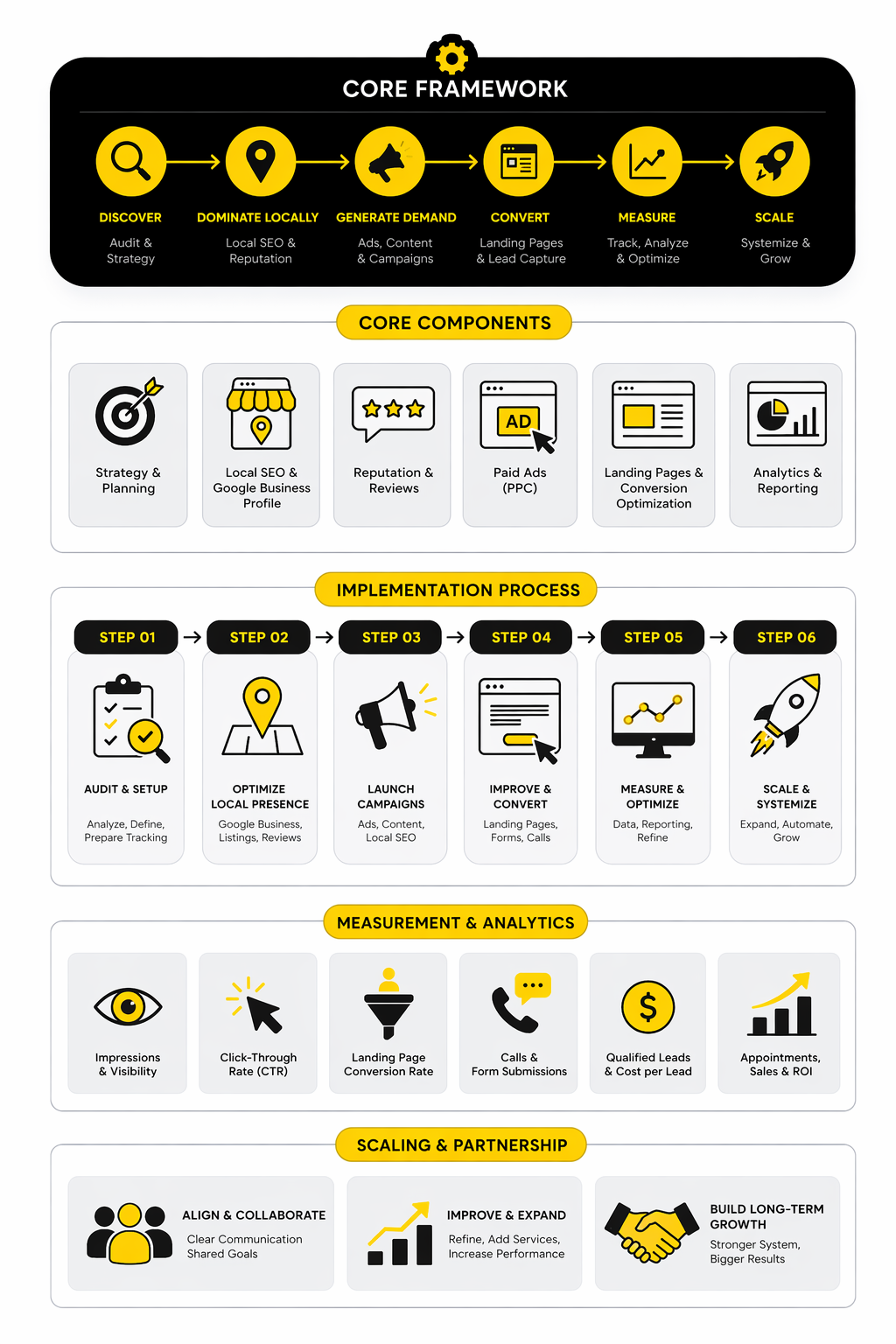
The Six-Part Framework for Choosing the Right Agency
This article uses a six-part framework because hiring the right agency is not one decision. It is really a sequence of decisions about fit, capability, proof, economics, communication, and execution. Breaking it into parts makes it easier to avoid the two classic mistakes: hiring based on charisma alone, or hiring based on price alone.
In the next section, we will define what a strong digital marketing agency should actually own, from local search visibility to paid media, conversion tracking, and reporting discipline. After that, we will move into the harder part: how to validate whether the team in front of you can really do the work they are selling. By the end of the full guide, you will have a practical system for comparing agencies in a way that is grounded in real local search behavior, real platform mechanics, and real buyer risk.
What Good Agencies Actually Do and What They Should Prove
A strong agency does not start by pitching random tactics. It starts by showing how it will connect local visibility, lead capture, follow-up, and reporting into one system that can actually be measured. That matters because local demand is large and still shifting toward digital channels, with BIA forecasting U.S. local advertising revenue at about $171 billion in 2025 and digital projected to take a larger share of local ad revenue than traditional media for the first time.
That is the real standard when you search for a digital marketing agency near me. You are not just hiring someone to run ads or post on Instagram. You are hiring a team that should be able to explain how a local buyer discovers you, why they trust you, what makes them convert, and how those actions get turned into revenue signals you can optimize against.
Local Search Visibility Has to Be a Core Capability
Any agency worth considering should know how to improve the assets that influence local discovery first. Google’s local ranking guidance is still clear on the fundamentals: relevance, distance, and prominence shape local results, and complete, accurate profile information improves the odds of showing up. That means the agency should be able to audit your Google Business Profile, service categories, business details, location pages, and on-site local signals before it talks about scaling spend.
This work is not limited to your profile alone. Google’s LocalBusiness structured data documentation shows that business hours, departments, and other local business details can be communicated directly through structured data, which helps search engines understand your business more clearly. A good agency should be able to tell you where your local presence is inconsistent, where your website is weak, and what fixes matter first instead of hiding behind vague promises about “authority.”
Paid Media Should Be Tied to Lead Quality, Not Just Lead Volume
A lot of agencies can launch Google Ads. Far fewer can explain whether the leads are actually good. That distinction matters because WordStream’s 2025 benchmark data across more than 16,000 U.S.-based campaigns puts the average Google Ads search conversion rate at 7.52%, average CPC at $5.26, and average cost per lead at $70.11, while its newer cost breakdown says many SMBs start in the $1,000 to $2,500 per month budget range. If an agency talks only about clicks and impressions, it is skipping the part that affects profit.
That is why real paid media management has to include conversion definitions, landing-page fit, keyword intent, and downstream sales outcomes. Google’s guidance on offline conversions and enhanced conversions for leads makes the point directly: advertisers should connect online ad activity with the qualified leads and sales that happen inside their CRM. A serious agency should already be thinking about call tracking, booked appointments, closed deals, and lead scoring before it ever asks you to raise budget.
Reputation Management Is Not Optional Anymore
Many businesses still treat reviews as a side task. That is a mistake, because review behavior now shapes both trust and conversion speed. BrightLocal’s 2026 review survey shows that 89% of consumers expect businesses to respond to reviews, 51% expect a response within two days, and 81% expect one within a week, while Google’s review management documentation confirms that verified businesses can reply directly inside their Business Profile.
So a good agency should not say, “Yes, we monitor reviews,” and leave it there. It should show you the response workflow, escalation rules, ownership model, and how review activity ties back to local search performance and customer trust. When someone searches for a digital marketing agency near me, this is one of the clearest places where a polished proposal and real operational ability separate fast.
Conversion Infrastructure Matters More Than Fancy Reporting
Pretty dashboards are cheap. Reliable conversion infrastructure is not. If your forms break, calls go unattributed, CRM stages are messy, and lead sources are misclassified, then the monthly report is just a cleaner-looking version of bad data.
That is why the better agencies usually care a lot about systems. Platforms like GoHighLevel are popular with agencies because they combine CRM, automation, landing pages, and attribution in one place, while tools like Fillout, Cal.com, and Copper often fit specific lead capture, scheduling, and pipeline workflows. The exact stack matters less than the discipline behind it, but the agency should be able to explain how inquiries move from click to form to meeting to sale without losing the trail.
Follow-Up and Nurture Often Decide Whether Marketing Works
This is the part many businesses underestimate. Traffic can improve, rankings can improve, and lead volume can improve, yet results still disappoint because follow-up is slow or inconsistent. Current HubSpot marketing data still puts email among the highest ROI channels for B2C brands, which is one reason agencies that understand automation, remarketing, and lead nurture often outperform agencies that stop at lead generation.
In practice, that means your agency should think beyond the first conversion. A local lead who does not book today may still book next week if the business has clean follow-up sequences, appointment reminders, review requests, retargeting, and segmented email or SMS nurture. Tools such as ManyChat, Brevo, and Moosend can support that layer, but again, the real issue is whether the agency knows how to build and maintain the sequence.
What a Professional Implementation Looks Like
Professional implementation is usually a lot less glamorous than agency websites make it look. It starts with access, tracking, baselines, CRM hygiene, attribution logic, landing-page review, and a brutally honest audit of what is broken. Then it moves into prioritization, because businesses rarely need everything at once and almost always need a few high-impact fixes before they need expansion.
A competent team should be able to walk you through a phased plan like this:
- Fix tracking, reporting, and CRM gaps so results can be trusted.
- Clean up local search assets, including profile data, location pages, and review processes.
- Improve landing pages and lead capture paths before pushing more paid budget.
- Launch or refine paid campaigns around high-intent services and locations.
- Build nurture and remarketing so unclosed leads still have value.
- Review performance against qualified leads, appointments, sales, and efficiency targets.
If an agency cannot explain its implementation in language this concrete, that is a warning sign. The next step is not asking whether the agency offers more services. The next step is figuring out whether it can prove those services work, which is where most buying decisions get won or lost.
How the Engagement Should Actually Roll Out
Once you move past the sales call, the real question is not whether the agency sounds smart. It is whether the team has a process that reduces risk, creates clean data, and gets you to a point where decisions are based on signal instead of guesswork. That matters because platforms keep changing their measurement systems, with Google Analytics continuing to rely on recommended and custom event setup in GA4 and Google Ads changing how enhanced conversions for web and leads are handled starting in 2026.
A good process also protects you from one of the biggest frustrations in local marketing: paying for activity before the foundations are stable. That is why the best answer to a search like digital marketing agency near me is usually not “we will launch fast.” It is “we will launch in the right order.”
The First 30 Days Should Be Mostly About Clarity
The first phase should focus on getting the account structure, tracking, and business context under control. This is where a serious agency gathers access to analytics, ad platforms, CRM, call tracking, Google Business Profile, and website systems, then maps your real lead flow from first click to closed sale. Without that, every later decision gets weaker because the business is still operating on partial information.
This is also the phase where smart agencies establish baseline definitions. They should confirm what counts as a lead, what counts as a qualified lead, which services matter most, what your highest-intent geography is, and how long the sales cycle usually takes. HubSpot’s 2026 marketing data shows that lead quality and lead-to-customer conversion rank above raw lead volume for many marketers, which is exactly why baseline definitions come before campaign expansion.
Build the Measurement Layer Before You Push Budget
If the agency skips measurement work, it is usually because it wants to get into media buying quickly. That may feel productive, but it is often where waste starts. Google Analytics documentation makes it clear that many meaningful business actions still depend on optional event configuration, and Google’s explanation of key-event attribution in GA4 shows that attribution settings affect how those actions are credited in reports.
In practice, that means the agency should configure and test the actions that matter most to your business. For a local service company, that often includes form submissions, calls, appointment bookings, direction requests, quote requests, and CRM handoff events. If those actions are not measured properly, the monthly report can look polished while the underlying optimization is still half-blind.
The Local Search Foundation Comes Next
Once the tracking layer is dependable, the next step is cleaning up the local foundation. That usually means reviewing your categories, services, hours, business description, review process, location pages, local schema, and the consistency of your core business information. Google’s local ranking guidance still emphasizes complete and accurate profile information, and Google’s LocalBusiness structured data documentation shows exactly how location-relevant business details can be communicated on-site.
This is also where a good agency decides what not to do yet. If your profile data is incomplete, your location pages are thin, and your review velocity is weak, then scaling spend aggressively is usually premature. A disciplined team fixes the local trust layer first, because that work improves the performance of both organic and paid acquisition.
Make the Execution Process Visible
At this point, the process should become tangible enough that you can see who owns what and when it is happening. The agency should be able to show you a staged rollout with milestones, dependencies, and reporting checkpoints. If it cannot explain the process clearly, you should assume the work itself is not clear internally either.
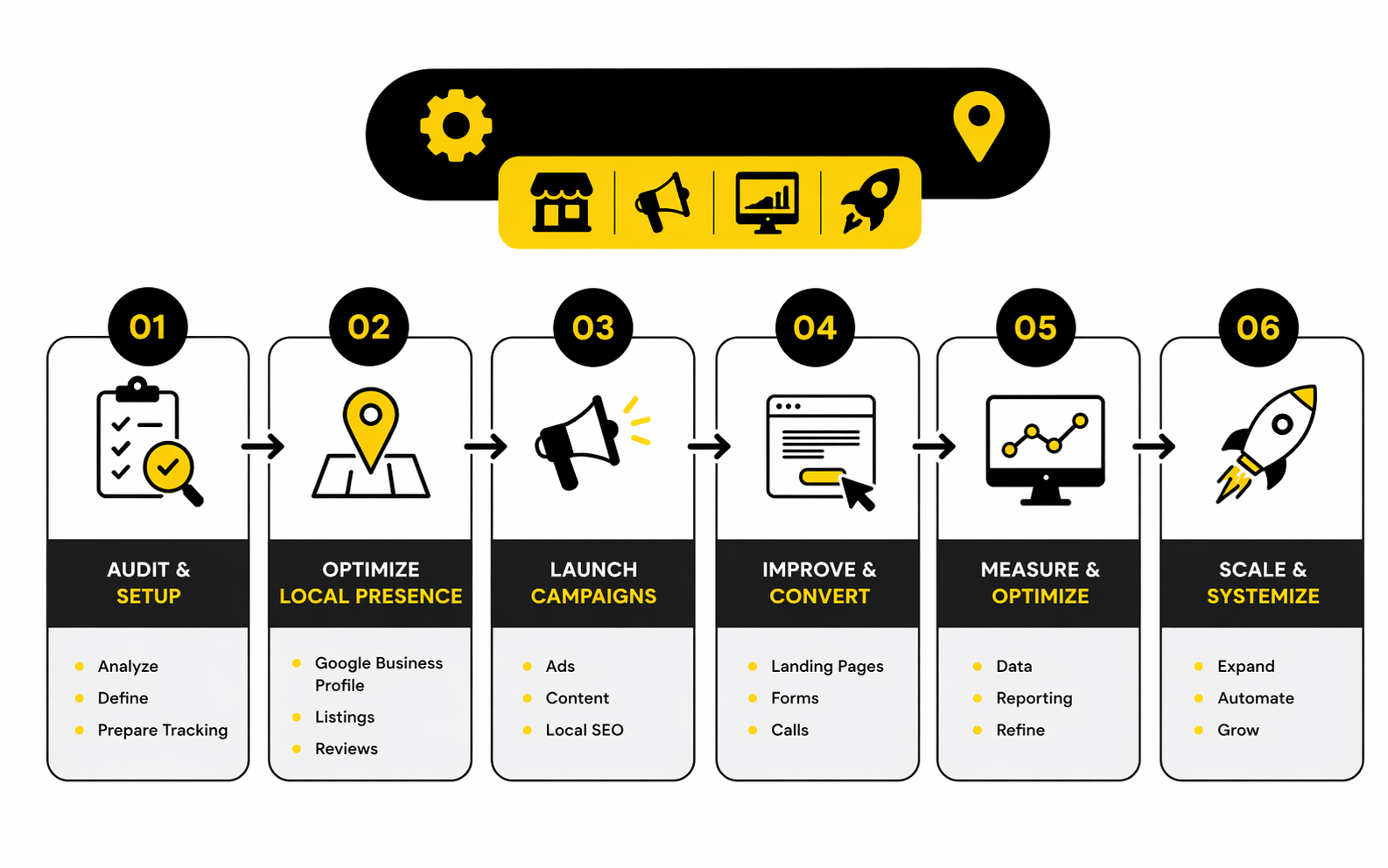
A clean implementation sequence often looks like this:
- Collect account access, business goals, service priorities, and geographic targets.
- Audit analytics, ad accounts, CRM, forms, landing pages, and local search assets.
- Set up or repair events, key actions, attribution logic, and downstream lead tracking.
- Fix urgent visibility gaps in the Google Business Profile, location pages, and review workflow.
- Improve landing pages before scaling paid traffic into them.
- Launch or rebuild campaigns around high-intent services and locations.
- Layer in retargeting, nurture, and operational follow-up.
- Review performance against qualified leads, appointments, close rates, CAC, and revenue efficiency.
That order matters. Unbounce’s benchmark data based on 57 million conversions puts the median landing page conversion rate at 6.6%, which is a useful reminder that traffic quality and page quality have to work together. If an agency sends paid clicks to weak pages, the business is basically paying tuition for avoidable mistakes.
Landing Pages Should Be Treated Like Sales Assets
This is where many agency engagements go soft. They talk about campaigns constantly but treat landing pages like an afterthought. That is backwards, because the page is where ad intent, trust, clarity, and conversion friction all collide.
A capable team should review message match, mobile layout, form length, proof elements, location relevance, load speed, and booking friction before deciding whether media performance is the problem. Tools like Replo, ClickFunnels, or Systeme.io can help agencies or businesses build pages faster, but the bigger point is that the page needs to support the buying moment, not just look modern.
User Behavior Tools Help Agencies See Friction Faster
Good agencies do not rely only on dashboards. They also look at how real users behave once they land on the page. Session replay and heatmap tools can reveal hesitation, rage clicks, dead sections, or form abandonment that raw analytics alone may not explain.
That is one reason tools like Microsoft Clarity remain useful in implementation work. Its own documentation describes heatmaps as a way to analyze aggregated user interaction, which gives agencies another layer of evidence when they are diagnosing why conversion paths are weaker than expected. When an agency combines behavioral tools with analytics and CRM data, optimization stops being abstract and starts getting specific.
Launch Should Be Narrow Before It Gets Broad
A lot of agencies burn budget because they launch too wide. They target too many services, too many geographies, or too many audiences before they understand where the strongest economics are. A better rollout starts narrow, proves one or two profitable paths, and then expands from something real.
That approach fits current platform reality. Google’s own business-facing resources for lead generation in 2026 keep emphasizing performance planning, always-on coverage, and conversion-focused campaign structures instead of stop-start guesswork. In other words, the smart move is usually not launching everything. It is finding the first repeatable win and compounding from there.
Reporting Should Show Decision Points, Not Just Metrics
Once campaigns are live, the agency should not disappear into a reporting rhythm that tells you what happened but never what to do next. Good reporting answers practical questions: Which services generate qualified leads, which locations are expensive, where does conversion rate break down, and which channel deserves the next dollar. Google Analytics product updates increasingly focus on spend, conversions, revenue, and scenario planning, which reflects where marketers are trying to go with reporting in general.
That is also why the agency should translate performance into actions. If branded search is rising but non-branded visibility is weak, that means one thing. If forms convert but booked calls are low, that means something else. A useful agency does not just deliver charts. It shows the next move.
Communication Is Part of the Implementation, Not an Extra
Execution gets messy when communication is treated like a side issue. Local marketing work touches reviews, customer service, web edits, offers, call handling, CRM stages, and sometimes in-store or front-desk behavior. If the agency does not have a rhythm for decisions and approvals, good strategy gets slowed down by operational drift.
So the process should include fixed check-ins, decision owners, and turnaround expectations from the start. The next step is making sure the commercial side of the engagement is just as clear, because even a solid process can become a bad deal if pricing, contract structure, and reporting terms are fuzzy.
What the Numbers Should Actually Tell You
This is where a lot of businesses get misled. They hire an agency, get a monthly dashboard full of charts, and still cannot answer the only question that matters: is marketing turning into profitable demand. When you search for a digital marketing agency near me, this is the part that separates a real operator from a reporting decorator.
The problem is not data scarcity. It is data interpretation. Most agencies can show clicks, impressions, and traffic growth, but those are only useful when they connect to qualified leads, appointments, close rates, and customer acquisition cost. Without that chain, the numbers can look busy while the business stays stuck.
Statistics and Data
The benchmark numbers are useful, but only if you treat them as context instead of goals. WordStream’s 2025 PPC benchmarks put average Google Ads search CTR at 6.66%, average CPC at $5.26, average conversion rate at 7.52%, and average cost per lead at $70.11 across more than 16,000 U.S.-based campaigns. Those figures tell you what the market roughly looks like, not what your business should blindly accept.
That distinction matters because local businesses live in wildly different realities. A legal practice, dental clinic, HVAC company, med spa, and boutique retailer can all search for a digital marketing agency near me, but the economics behind a lead are completely different. So when an agency uses benchmark averages as proof that your results are “normal,” push harder. Normal is not the goal. Profitable is.
The First Layer of Metrics Is About Attention
At the top of the system, you need to know whether the market is noticing you at all. That includes impressions, reach, click-through rate, branded search lift, map visibility, and engagement with your business profile. These numbers tell you whether the agency is improving discoverability, but they still do not prove commercial value on their own.
For local search specifically, attention metrics become more meaningful when you pair them with buyer behavior. BrightLocal’s 2026 review research shows that 74% of consumers only care about reviews from the last 90 days, while BrightLocal’s related 2026 review strategy webinar highlights that 31% of consumers ignore businesses below 4.5 stars. Those numbers matter because visibility without trust still leaks revenue. If impressions rise while reviews stay stale or weak, you may be increasing exposure without increasing conversion odds.
The Middle Layer Is About Intent
Once someone clicks, you need to understand whether they arrived with serious buying intent or casual curiosity. This is where landing-page conversion rate, bounce patterns, call clicks, form starts, appointment attempts, and time-to-contact begin to matter. A strong agency should be able to show which campaigns attract high-intent visitors and which ones mostly create noise.
Landing-page benchmarks help here, but they need to be used carefully. Unbounce’s benchmark data from 41,000 landing pages, 464 million visits, and 57 million conversions puts the median landing page conversion rate at 6.6% across industries. That is a useful reference point, but it should prompt questions, not conclusions. If your page converts at 3%, maybe the traffic is weak, maybe the offer is weak, maybe the page is weak, or maybe your form is asking for too much too soon. The number tells you there is friction. It does not tell you where the friction lives.
The Bottom Layer Is About Revenue Signals
This is the layer agencies too often avoid because it is where accountability gets real. You need to know how many raw leads became qualified leads, how many qualified leads became appointments, how many appointments became customers, and what each acquired customer cost. When those numbers are visible, you can finally judge whether a campaign is worth scaling.
That is also why platform-side conversion setup matters so much. Google’s guide to setting up events in GA4 and its documentation on recommended events make it clear that many business-critical actions require deliberate configuration. If the agency never set up the right events, never mapped lead stages, or never connected ad data to CRM outcomes, then the “results” you are seeing are only partial results.
A Good Analytics System Should Be Easy to Follow
A business owner should not need to decode a maze of dashboards just to understand performance. The agency should be able to explain the analytics system in a straight line: source, action, qualification, sale, and efficiency. If that path is fuzzy, the reporting is not mature yet.
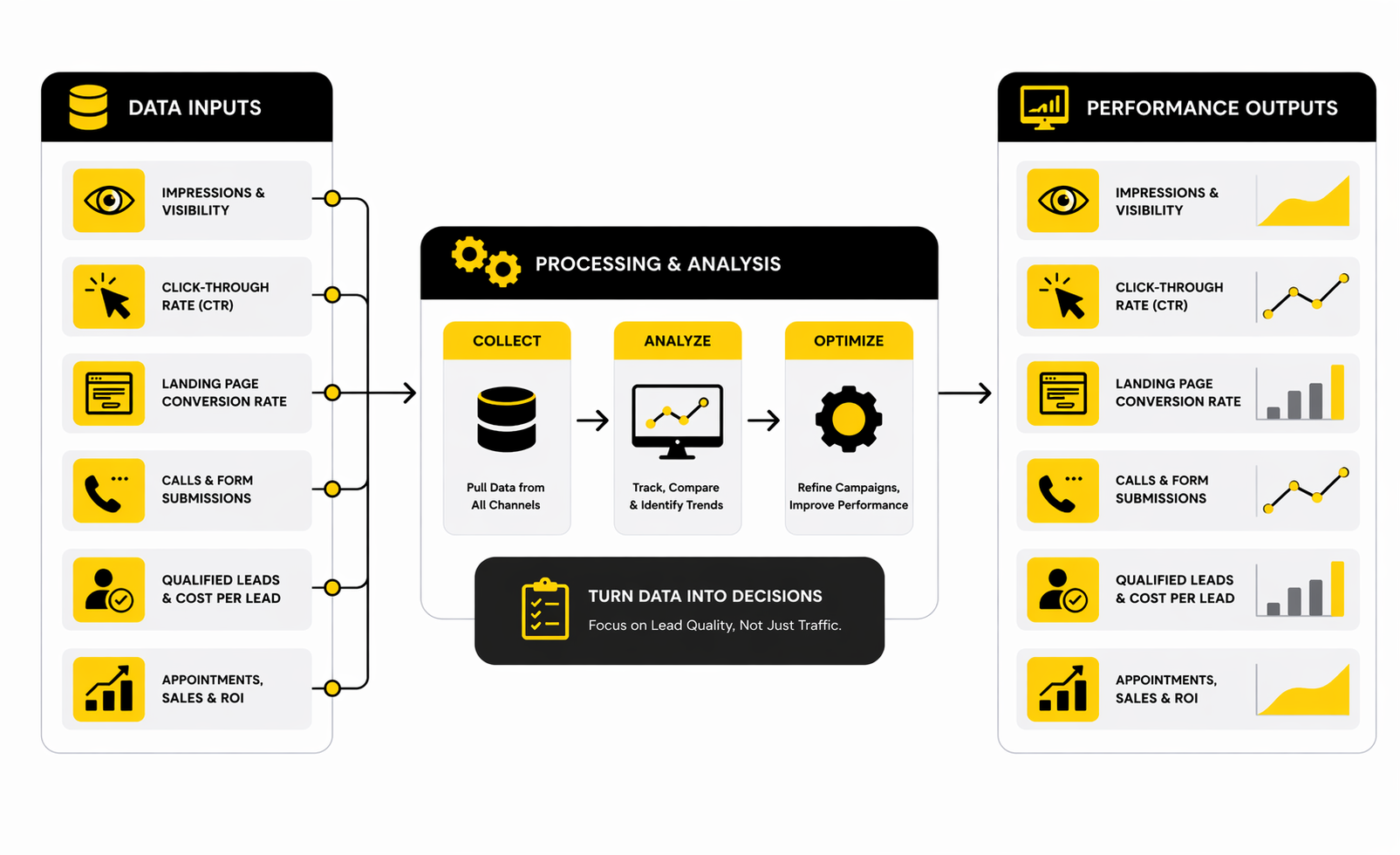
A practical measurement stack usually works like this:
- Traffic source shows where demand is coming from, such as Google Ads, organic search, Maps, email, social, or referrals.
- On-site action captures what the visitor actually did, such as a call click, form submit, booking attempt, or quote request.
- Lead qualification shows whether the inquiry was relevant, serviceable, and serious enough for the sales process.
- Pipeline progression tracks whether the lead moved to appointment, estimate, consultation, or another real sales milestone.
- Revenue outcome confirms whether that lead became revenue and what the return looked like relative to spend.
When an agency can show this chain clearly, decision-making gets dramatically easier. You stop arguing about vanity metrics and start making budget calls based on where the funnel is truly breaking.
What Strong Performance Signals Look Like
Strong performance usually shows up as a pattern, not a single spike. Qualified lead volume goes up, cost per qualified lead becomes more stable, landing-page conversion rate improves, review freshness supports trust, and sales teams report that lead quality feels more aligned. None of those metrics alone is enough, but together they form a believable growth story.
Weak performance has a pattern too. Clicks rise but calls do not. Leads come in but close rates fall. Organic visibility improves but branded demand stays flat. That is why agencies should not celebrate every increase. Sometimes a number is going up because waste is going up with it.
What to Do When the Data Looks Mixed
Mixed data is normal, especially in the first months. A campaign can generate more leads while quality drops, or cost per click can rise while conversion rate improves enough to offset it. WordStream’s 2026 Google Ads cost analysis notes that SMB budgets and lead costs continue to vary widely, which is exactly why smart agencies focus on economics deeper in the funnel instead of treating CPC as the main story.
When data is mixed, the right move is to ask which metric is closest to revenue truth. Usually that means qualified cost per lead, appointment rate, show rate, close rate, and customer acquisition cost carry more weight than top-of-funnel efficiency. This is where experienced agencies earn their fee, because they know which signals deserve patience and which ones deserve immediate intervention.
Benchmarks Are for Framing, Not for Excuses
This point is worth being blunt about. Benchmarks are useful when they help you ask sharper questions. They become dangerous when agencies hide behind them to explain weak execution. A local business does not need average results because other companies are also average. It needs results that make the economics work.
So when you evaluate an agency, ask for more than a dashboard. Ask what number they trust most, what number they trust least, which number they expect to move first, and what action follows when a metric underperforms. That is the kind of conversation that tells you whether the team really understands measurement or just knows how to export charts.
The Right Data Should Push Clear Action
Every important number should trigger a next step. If CTR is low, ad relevance or offer positioning may need work. If landing-page conversion rate is low, page clarity, speed, proof, or form friction may be the issue. If cost per lead looks acceptable but close rate is weak, the problem may sit in sales handling, qualification, or follow-up rather than media buying.
That is the real value of analytics in an agency relationship. Not more numbers. Better decisions. The next thing to examine is whether the relationship structure itself supports those decisions, because pricing, scope, contracts, and accountability can either reinforce performance or quietly undermine it.
How to Compare Local, Remote, and Hybrid Agency Options
By this stage, the search for a digital marketing agency near me should be less about geography and more about operating fit. Local proximity can help when your business depends on field context, in-person collaboration, local reputation management, or close coordination with a front desk or sales team. But local alone is not a performance advantage, especially when the real work depends on channel expertise, analytics discipline, and process maturity rather than office distance. Google’s local ranking guidance and BIA’s local advertising outlook both point to the same reality: local demand is real, but the systems used to capture it are increasingly digital and operationally complex.
That creates a strategic tradeoff. A nearby agency may understand your city, competitors, and local buyer patterns faster, while a remote specialist may have stronger depth in paid search, landing-page optimization, CRM automation, or multi-location SEO. In practice, the best setup for many companies is hybrid: a partner that understands local intent and service-area nuance, but runs execution with the kind of process you would expect from a more specialized team. Clutch’s 2026 pricing and marketplace data shows just how broad the agency market is, which is exactly why location should be treated as one variable, not the deciding one.
Pricing Models and Contract Terms Can Change the Outcome
A mediocre pricing structure can ruin a good agency relationship, and a smart pricing structure can make a decent one workable. Current Clutch pricing data updated April 16, 2026 shows digital marketing agencies commonly charging $25 to $49 per hour, with many digital marketing projects reviewed on the platform falling in the $10,000 to $49,999 range and service-specific work often priced much higher by specialty. That spread tells you something important: agency pricing is not standardized enough to judge quality on cost alone.
The better question is whether the pricing model matches the job. A monthly retainer usually works best when the work involves ongoing optimization, reporting, landing-page iteration, review management, and lead-quality analysis. Project pricing makes more sense when the task is finite, like a website rebuild, analytics implementation, or local SEO cleanup. Performance pricing sounds attractive, but it can create incentives to optimize for cheap leads instead of profitable customers if the contract does not define lead quality properly. Gartner’s 2025 CMO Spend Survey reinforces why this matters: budgets are flat at 7.7% of company revenue on average, and many marketers feel underfunded, so wasted structure hurts more when there is less room for error.
What the Contract Should Protect
A contract is not just legal housekeeping. It defines whether you are buying clarity or buying future headaches. At minimum, the agreement should make scope, reporting cadence, deliverables, payment terms, termination terms, account ownership, asset ownership, and data access completely explicit. Even outside marketing, practical agency-agreement guidance from the Netherlands Chamber of Commerce emphasizes that the contract is the basis of cooperation precisely because the parties often have different interests.
This is where businesses get caught. The agency believes strategy decks, ad creative, landing pages, automation flows, and reporting systems are part of its operating engine. The client assumes everything paid for is automatically portable. That mismatch turns ugly during underperformance, leadership changes, or a breakup. You want those terms sorted before launch, not after the relationship goes sideways.
Ownership, Access, and Exit Readiness Matter More Than Most People Think
This point is worth being blunt about. If your agency relationship ended tomorrow, could you still access your ads, analytics, CRM, website assets, call tracking, and reporting history without begging for help. If the answer is no, your setup is fragile.
Google’s own documentation gives a clear baseline for how this should work. Google Ads account access settings let businesses grant and remove user access directly, manager account ownership rules state that the client account still owns its data and can remove ownership access by unlinking, and Google Analytics access management documentation shows that account- and property-level permissions should be controlled through the client’s own admin structure. In plain English, the business should own the environment, and the agency should receive access, not custody.
Security is part of this too. Google Workspace security guidance recommends strong administrator protections such as 2-Step Verification, which matters because admin accounts can control access to sensitive business and customer data. A good agency will not resist this. It will encourage it, because mature partners know that shared access and clean permissions are healthier than password sharing and informal handoffs.
AI and Automation Can Improve Execution, but They Also Change the Risk Profile
AI is now part of agency delivery whether businesses realize it or not. Gartner’s 2025 CMO survey found that marketers are using AI to improve time efficiency, cost efficiency, and capacity, which is one reason more agencies can now produce content, ads, reports, and workflows faster than before. That can be a genuine advantage when it reduces manual waste and speeds up testing.
But it also creates a new due-diligence question. You should know where AI is being used, what human review exists, and which outputs are still being quality-checked by a strategist who understands your business. If the agency uses AI to speed up reporting summaries, ad variant generation, or workflow drafting, that can be sensible. If it uses AI as a substitute for strategic judgment, market understanding, or data interpretation, you are paying for shortcuts dressed up as innovation.
Scaling Is Where Weak Agency Systems Usually Break
A lot of agencies look competent at low spend and low complexity. Scaling exposes whether the operating system underneath is real. More locations, more services, more landing pages, and more lead volume create pressure on tracking, creative production, sales handoff, reporting logic, and client communication all at once.
That matters even more because the market keeps getting more competitive. BIA’s 2025 local advertising report points to a local media market of $171 billion, including an $89 billion digital component, while Reuters reporting on 2026 digital ad revenue trends shows the larger ad ecosystem continuing to shift as major platforms consolidate more spend. Translation: scaling is not just about “doing more.” It is about doing more while media gets more automated, competition stays intense, and margin for waste stays thin.
The Real Scaling Question Is Whether Economics Improve or Decay
More spend does not automatically produce better outcomes. Sometimes it makes the economics worse because the agency expands too fast into weaker keywords, looser targeting, lower-intent geographies, or generic landing pages. That is why the best agencies scale in layers, not leaps.
You should expect the agency to define what has to remain true before expansion happens. For example, qualified cost per lead may need to stay under a threshold, appointment rate may need to hold, close rate may need to remain healthy, and sales capacity may need to keep pace. WordStream’s Google Ads benchmarks and its 2026 cost analysis are useful reminders that average CPCs, conversion rates, and lead costs vary widely enough that scale without discipline can quietly destroy efficiency.
Late-Stage Red Flags Most Businesses Miss
Some red flags only appear after the honeymoon period. The agency stops talking about business outcomes and starts talking mostly about activity. Reporting becomes longer but less useful. Questions about access, attribution, or ownership get vague. Wins are presented quickly, but problems are explained as temporary, seasonal, or outside scope every single month.
Another warning sign is role drift. The strategist disappears, the work gets pushed downward, and you end up speaking mostly with account coordinators who are polite but not empowered. None of this proves the agency is bad on its own, but patterns matter. A strong partner gets more concrete as the relationship matures, not less.
How to Choose the Agency You Can Still Trust in 12 Months
At the advanced stage, the best question is not “Who can start fastest?” It is “Who will still look like the right partner after the first few easy wins are gone?” That usually points you toward agencies that are transparent about access, disciplined about measurement, realistic about ramp time, and comfortable talking about tradeoffs instead of overselling certainty. Clutch’s 2026 agency pricing guide and Gartner’s budget data both support the same conclusion: businesses do not have infinite budget or patience, so structural clarity matters almost as much as channel skill.
That is the mindset that should carry you into the final decision. By the time you finish comparing options, reviewing economics, and stress-testing ownership and scale, the right choice usually becomes less mysterious. The last step is turning that clarity into a final shortlist, a clean decision process, and a confident start.
How to Make the Final Decision and Start Strong
The final decision usually becomes easier once you stop asking which agency sounds the most impressive and start asking which one gives you the clearest path to measurable growth. At this point, you should know how the team handles tracking, local visibility, landing pages, lead quality, ownership, reporting, and scale. If those pieces still feel fuzzy, the agency is not ready, no matter how polished the pitch looks.
A smart final choice also depends on your internal reality. If your team is slow to approve changes, weak on follow-up, or unclear on service priorities, even a strong agency will struggle to produce clean results. That is why the best engagements begin with aligned expectations, clear access, and a shared definition of what success should look like in the first 90 days.
Before signing, narrow the shortlist to the team that can answer these questions most clearly:
- What are the first three fixes you would make in our funnel and why.
- Which metrics do you believe matter most in the first 60 to 90 days.
- How will you prove lead quality, not just lead volume.
- Who owns the accounts, data, pages, and automations if the relationship ends.
- What has to go right operationally on our side for this to work.
That kind of decision process is more reliable than chasing the agency with the slickest deck or the lowest price. The businesses that get the best outcomes from a digital marketing agency near me usually choose the partner that makes the work understandable, measurable, and durable. That is the real win, because strong marketing is not just about getting attention now. It is about building a system you can keep improving.
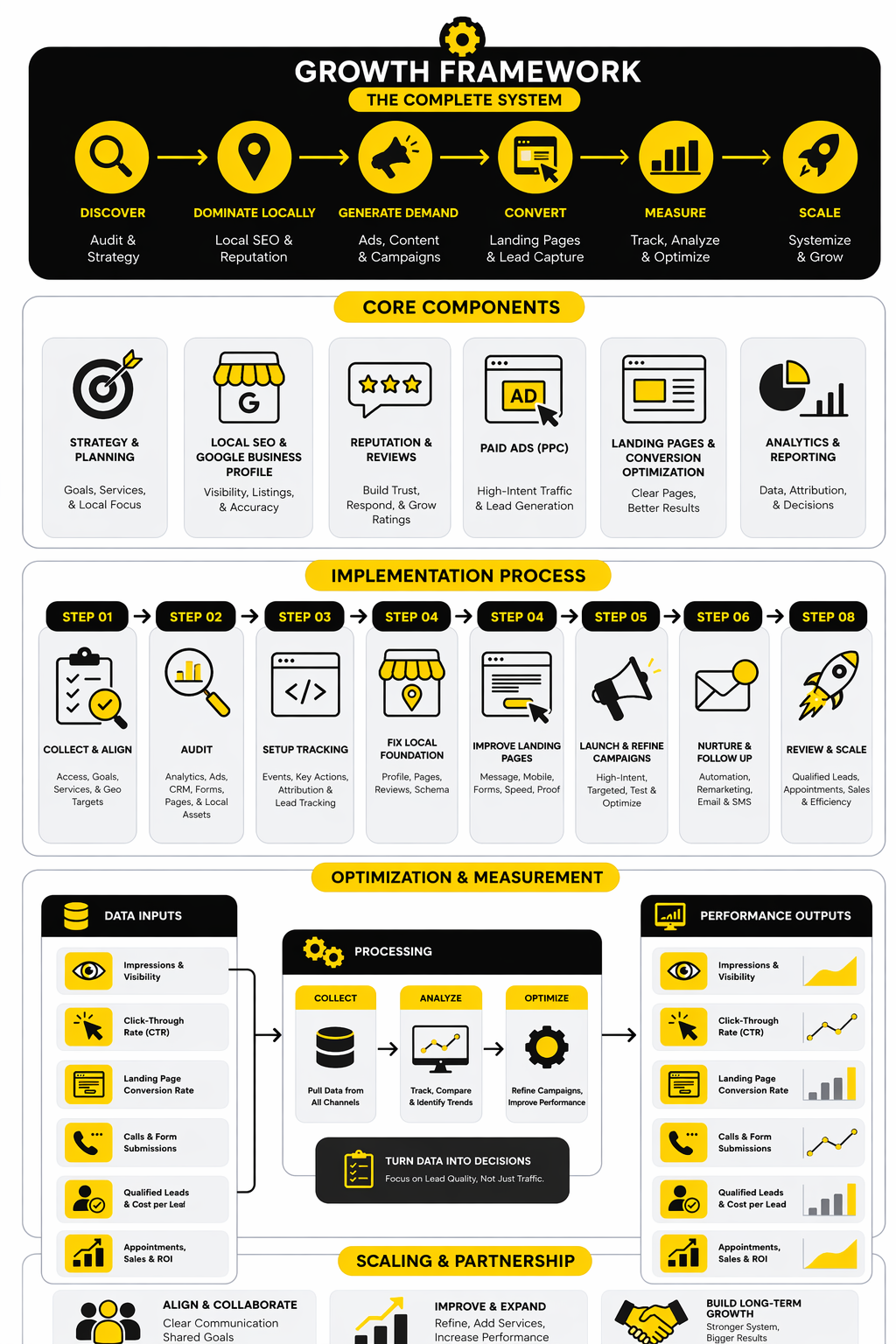
FAQ - Built for Complete Guide
How do I know if a digital marketing agency near me is actually good?
A good agency can explain your growth problem in plain language and connect it to specific actions, not generic service lists. It should be able to show how it thinks about local discovery, conversion paths, CRM handoff, and reporting without hiding behind jargon. If the team cannot explain what it will do in the first 30 to 90 days, that is usually a sign the process is not strong enough yet.
Is a local agency always better than a remote one?
Not automatically. A local agency may understand your market, service area, and regional competitors faster, but a remote specialist may be stronger in paid search, analytics, landing pages, or automation. The better question is whether the agency understands your local buyer journey and has the systems to execute consistently.
What should I expect to pay a digital marketing agency?
Pricing varies a lot based on scope, channel mix, and specialization, which is why marketplace averages should be treated as context rather than rules. Clutch’s 2026 pricing data shows wide hourly and project ranges across the digital marketing category, and that spread exists because the work itself can be radically different from one business to another. You should judge price against clarity, accountability, and commercial impact, not against the cheapest available retainer.
How long should it take before I see results?
Some improvements can appear quickly, especially when tracking is fixed, landing pages are improved, or wasted spend is removed. But meaningful performance trends usually need enough time for implementation, learning, and optimization, especially when your agency is improving both local visibility and lead quality at the same time. A good partner will set expectations by channel and by milestone instead of promising instant wins across everything.
Should I hire one full-service agency or several specialists?
That depends on your operational capacity. One full-service agency can create better coordination across SEO, paid ads, landing pages, follow-up, and reporting, but only if it truly has depth in those areas. Several specialists can work well too, but only when someone owns strategy and keeps the systems connected instead of letting each vendor optimize its own corner in isolation.
What are the biggest red flags during the sales process?
The biggest red flags are usually vague answers dressed up as confidence. Watch for teams that promise rankings, dodge questions about account ownership, focus only on vanity metrics, or rush past lead quality and sales handoff. If every problem sounds easy in the pitch, the agency is probably overselling certainty instead of showing operational maturity.
Which metrics matter most in the first few months?
In the beginning, you usually care most about clean tracking, lead attribution, landing-page conversion performance, qualified lead volume, and early signals from booked appointments or calls. Those numbers help you determine whether the agency is improving the system or just increasing traffic. Top-of-funnel metrics still matter, but they should support the business story, not replace it.
Do I need a CRM before hiring an agency?
You do not always need a sophisticated CRM before hiring, but you do need a way to track what happens after a lead comes in. If that part is missing, the agency should help you create a workable system rather than pretending ad platform data alone is enough. Tools such as GoHighLevel, Copper, or booking and form layers like Cal.com and Fillout can help create that structure when the stack is still messy.
How important are reviews when choosing an agency strategy?
They are far more important than many businesses assume. BrightLocal’s 2026 review research shows how strongly freshness, star rating, and responses influence local decision-making, which means reputation is not just a branding issue anymore. If your agency ignores reviews, it is ignoring a major part of local trust and conversion.
Should the agency build my landing pages too?
Usually yes, or at least it should own performance recommendations for them. Paid traffic, local service intent, offer positioning, and form friction all come together on the page, so separating campaigns from landing-page responsibility often creates excuses instead of results. Builders like Replo, ClickFunnels, and Systeme.io can help teams move faster, but the bigger issue is whether the agency treats the page like a sales asset.
How do I make sure I keep ownership of everything?
You should insist that the business owns the ad accounts, analytics properties, CRM environment, domain assets, and core automation systems wherever possible. Google Ads access documentation, manager account ownership rules, and Google Analytics permission guidance all support a model where the client controls access instead of surrendering it. If an agency resists that structure, take it seriously.
What if my agency is generating leads but sales are still weak?
That usually means the problem may not be media buying alone. Weak close rates can come from poor qualification, slow follow-up, weak call handling, unclear offers, or broken booking flows even when lead volume appears healthy. A competent agency should help diagnose where the breakdown happens instead of treating every performance issue like an ad-platform problem.
Can AI make a marketing agency more effective?
Yes, but only when it is used to improve speed and execution without replacing strategic judgment. AI can help with reporting summaries, workflow drafting, ad variations, research support, or automation logic, but it still needs human review and commercial context. The safest way to evaluate this is to ask exactly where AI is used, who checks the outputs, and which decisions still require senior oversight.
When should I replace my current agency?
You should start considering a change when the relationship loses clarity, not only when performance drops. If reporting becomes less actionable, access questions get messy, lead quality stays vague, or every missed target gets explained away without concrete fixes, the partnership is likely weakening structurally. The right time to leave is usually when trust in the process breaks, because weak process almost always becomes weak results eventually.
Work With Professionals
Explore 10K+ Remote Marketing Contracts on MarkeWork.com
Most marketers spend too much time chasing clients, competing on crowded platforms, and losing a percentage of every project to middlemen. MarkeWork gives you a better way. Browse thousands of remote marketing contracts and connect directly with companies desperate to hire skilled marketers like you, without platform commissions and without unnecessary gatekeepers.
If you're serious about finding better opportunities and keeping 100% of what you earn, explore available contracts and create a profile for free at MarkeWork.com.