

A marketing company for small business growth should do more than post on social media, run a few ads, and send a monthly report full of vanity numbers. Small businesses usually do not have the luxury of wasting six months on scattered tactics, bloated retainers, or campaigns that look polished but never turn into leads, bookings, or sales. The right partner helps a business focus on the channels that match its stage, market, offer, and sales process.
That matters even more now because buyers move across search, reviews, social platforms, email, and increasingly AI-assisted discovery before they ever contact a company. BrightLocal’s SMB Marketing Report 2025 found that 54% of small business owners manage marketing on their own, which explains why many teams hit a ceiling and start looking for outside help. The same research also showed that only 8% of SMBs said they do not invest in organic social media, while 11% said they are not investing in SEO or local SEO, which tells you where attention is going and where execution gaps often appear.
The problem is that “marketing company” can mean almost anything. It might mean a local SEO specialist, a paid ads shop, a content agency, a CRM automation partner, or a full-service team trying to do everything at once. So the smart move is not asking who has the nicest website. It is asking who can build a practical growth system around your business model.
Article Outline
- Why a Marketing Company for Small Business Growth Matters
- What a Small-Business Marketing Company Actually Does
- A Framework for Choosing the Right Partner
- The Core Services That Usually Matter Most
- What Professional Implementation Should Look Like
- Red Flags, Pricing Reality, and the Final Decision Checklist
Why a Marketing Company for Small Business Growth Matters
Small businesses rarely fail because they lack marketing ideas. They usually struggle because they lack the time, specialist skill, channel discipline, and measurement structure to turn those ideas into a repeatable pipeline. The U.S. Small Business Administration’s marketing and sales guidance makes the same point in simpler terms: marketing starts with a real plan, not random activity.
Trust is also doing far more work than many owners realize. BrightLocal’s Local Consumer Review Survey 2026 found that 85% of consumers say positive reviews make them more likely to use a business, while 77% say negative reviews make them less likely to choose one. That means a marketing company for small business success cannot treat reputation, search visibility, and conversion as separate projects. They are connected in the customer’s mind, so they need to be connected in execution too.
There is another shift happening underneath all this. BrightLocal’s recent research on AI and local business discovery shows that consumers are using AI tools much more often when looking for business recommendations. For a small business, that raises the bar. A partner now needs to think about website clarity, review quality, local signals, structured offers, and follow-up systems together, because discovery is becoming more fragmented, not less.
A Framework for Choosing the Right Partner
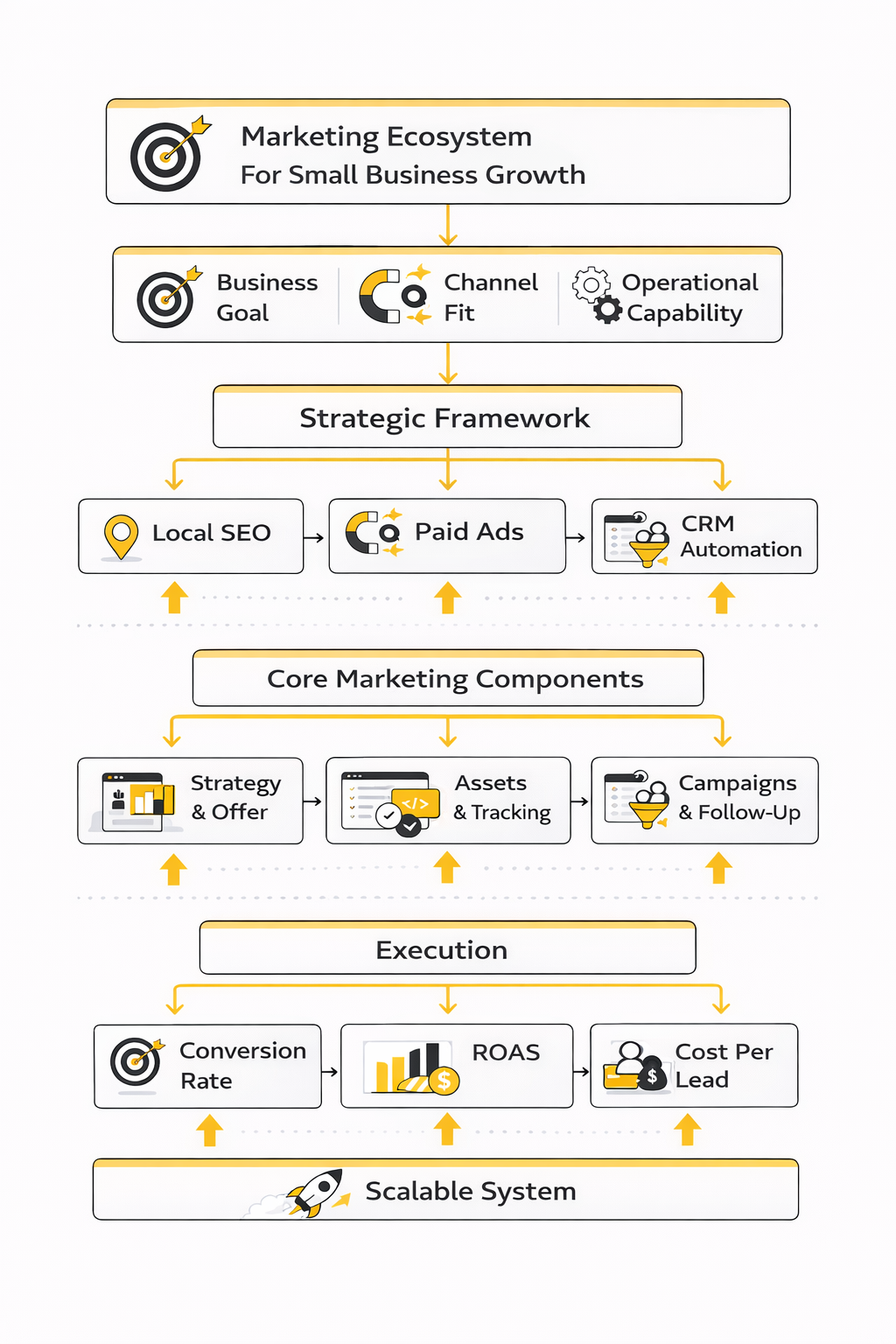
Before you compare agencies, you need a simple framework. Otherwise, you end up judging presentation quality instead of business fit. The fastest way to narrow the field is to evaluate every marketing company for small business needs through four lenses: business goal, channel fit, operational capability, and reporting clarity.
The first lens is the business goal. A company helping a local service business book more calls should not look the same as a company helping an ecommerce brand improve repeat purchases. If your goal is lead generation, you may need local SEO, search ads, landing pages, and CRM follow-up. If your goal is retention, you may need email, SMS, offers, and better segmentation through tools such as Brevo or Buffer supporting the content side.
The second lens is channel fit. Not every small business needs a full-stack agency, and that is where many expensive mistakes begin. A neighborhood law firm, a med spa, a home services company, and a Shopify store all need different channel priorities, different sales cycles, and different conversion assets. Good agencies know what to ignore, not just what to add.
The third and fourth lenses are where professional operators stand out. Operational capability means the company can actually build pages, launch tracking, fix forms, connect the CRM, handle attribution, and improve the handoff from marketing to sales. Reporting clarity means they can tell you what is happening in plain English, show which activities produced real business outcomes, and keep the whole system simple enough that you are not trapped in their dashboard forever.
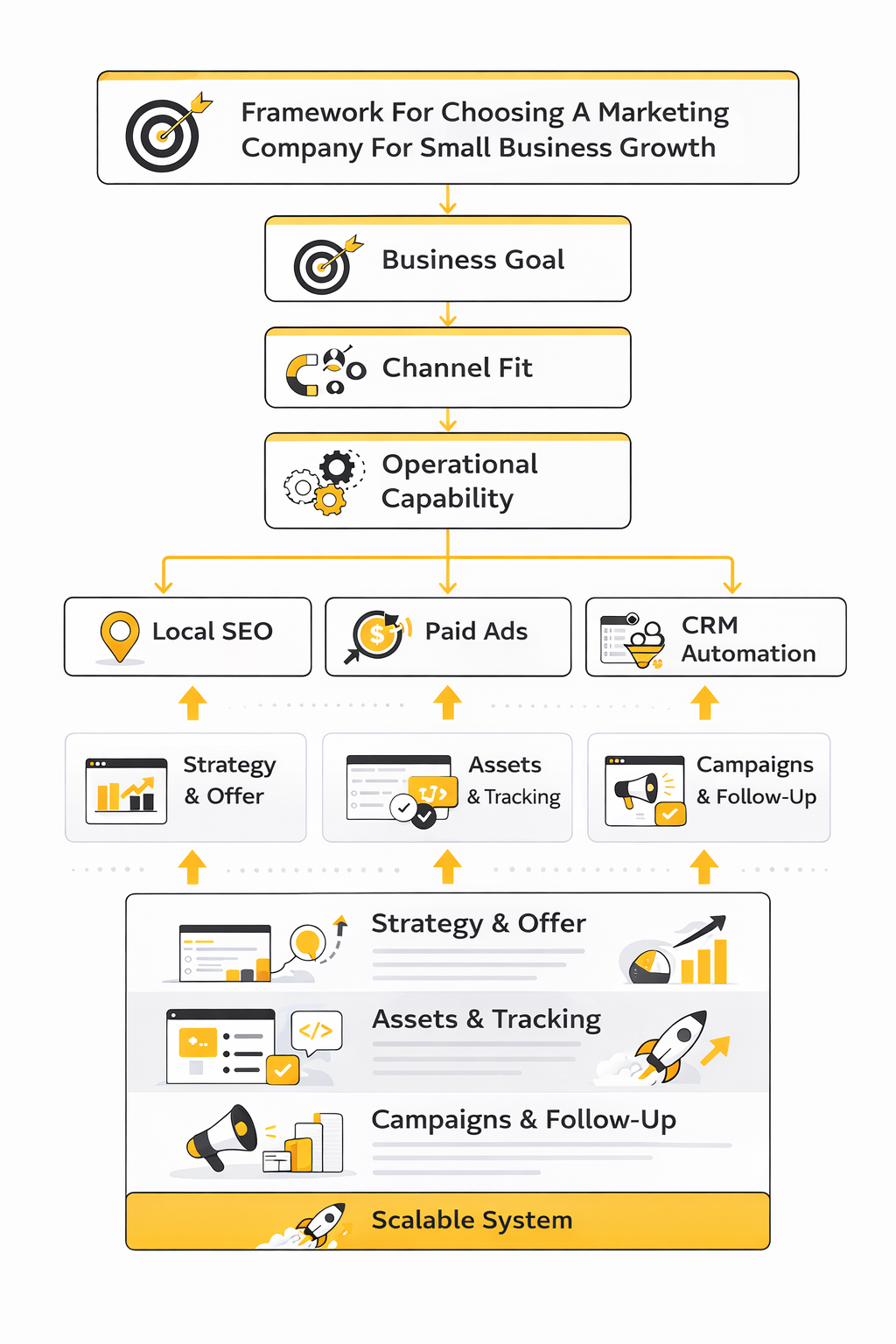
The rest of this article will build on that framework step by step. Next, we will look at what a small-business marketing company actually does day to day, because that is where the gap between a real growth partner and a glorified freelancer network becomes obvious.
What a Small-Business Marketing Company Actually Does
A real marketing company for small business growth is not just a vendor that publishes content and waits for something good to happen. It should diagnose where demand is coming from, where leads are leaking, and which channels can realistically move revenue within your budget. That means the job is part strategy, part execution, part measurement, and part operational cleanup.
In practical terms, the best partners own the full path from attention to action. They help shape the offer, improve the website experience, tighten local visibility, launch campaigns, connect forms and pipelines, and make sure every inquiry gets followed up properly. Google’s own Business Profile guidance for small businesses makes that customer path clear: discovery on Search and Maps has to lead into calls, visits, bookings, or messages, not just impressions.
This is where many business owners get misled. Some agencies sell deliverables instead of outcomes, so the client gets four blog posts, twelve social posts, and a report full of reach metrics, but no stronger pipeline. A good marketing company for small business clients works backward from what has to happen in the real world: more qualified calls, better close rates, higher order values, stronger retention, or lower customer acquisition costs.
Strategy Comes First, Not Tactics
The first responsibility is deciding what should happen before anyone launches a campaign. That includes clarifying the audience, the service mix, the average deal value, the buying cycle, and the actual bottleneck in the business. The U.S. Small Business Administration’s marketing and sales framework still gets this right: businesses need a plan that connects promotion to real sales activity.
For one small business, the problem is weak visibility. For another, the problem is poor conversion after the click. For another, the problem is no follow-up after the lead comes in. When an agency skips this diagnosis step, it usually defaults to whatever service it likes to sell, not what your business actually needs.
That is why the early conversations matter so much. A serious partner will ask about lead sources, margins, seasonality, service areas, close rates, repeat purchase behavior, and capacity constraints. If they do not ask those questions, they are probably not building a growth system. They are selling a package.
Execution Has to Cover the Entire Funnel
Once the strategy is clear, the agency should be able to execute across the parts of the funnel that matter most for your model. For a local service company, that may mean search visibility, landing pages, review generation, call tracking, and CRM automation. For an ecommerce brand, it may mean product page optimization, paid acquisition, email flows, and post-purchase retention.
This is also where channel confusion creates waste. A lot of small businesses think they need “more marketing,” when what they really need is tighter coordination between a few high-impact pieces. Google highlights on its Business Profile product page that profiles can turn Search and Maps discovery into customer actions, but that only works well when the website, reviews, service information, and response process are aligned.
The same logic applies to email and automation. Mailchimp’s current email marketing benchmarks and its guidance on building an email strategy both point to the same operational truth: email works best when it is tied to segmentation, timing, and ongoing performance review. So if an agency says it “does email,” but cannot explain list hygiene, lifecycle flows, offer timing, and reporting, it is not really doing retention marketing at a professional level.
Measurement Should Be Tied to Business Outcomes
A competent agency does not stop at campaign management. It also builds a measurement model that helps a small business owner make better decisions month after month. That means separating surface-level engagement from numbers that actually influence cash flow.
The useful questions are simple. How many qualified leads came in, from which channel, at what cost, and what happened after that? If the reporting cannot connect activity to pipeline movement, it becomes decoration.
This is one reason modern small-business marketing increasingly leans on automation and CRM structure. HubSpot’s overview of marketing automation focuses on repetitive tasks like lead nurturing and personalized follow-up, but the deeper point is more important: automation gives businesses cleaner visibility into what happens after someone raises a hand. A marketing company for small business growth should be able to translate that into clear answers, not just dashboards.
The Core Services That Usually Matter Most
Small businesses do not need every service under the sun. They need the services that remove the biggest growth constraint first. That usually means starting with the channels and assets closest to purchase intent, then layering in brand and retention once the foundation is working.
The exact mix changes by industry, but several core components show up again and again. They matter because they connect directly to discoverability, trust, conversion, and follow-up. Those four forces do most of the heavy lifting in small-business growth.
Local Search and Reputation Management
For local businesses, local search is often the first battlefield. Customers search for a category, compare profiles, read reviews, check photos, and decide whether to call or keep scrolling. Google’s help documentation on managing customer reviews and tips to get more reviews makes it plain that review activity is not cosmetic. It shapes trust and helps customers evaluate whether a business feels credible enough to contact.
That means a capable agency should treat your profile, reviews, photos, offers, service descriptions, and response process as part of one system. It should also know the difference between ethical review generation and risky shortcuts. That matters because Google has tightened enforcement around fake engagement and review abuse, which raises the cost of lazy reputation tactics.
For many small businesses, this is the easiest place to spot agency quality. Anyone can promise rankings. Fewer teams can systematically improve local visibility while also improving conversion once people find you.
Paid Search and Paid Social
Paid media becomes valuable when you already know the offer, the audience, and the action you want people to take. Without that, ad spend becomes a very fast way to buy confusion. With clarity, though, paid campaigns can give a small business speed that organic channels cannot always match.
Google’s advertising ecosystem continues to matter because search often captures high-intent demand already in motion, while Meta’s small-business ad guidance shows how paid social is better suited to awareness, engagement, and demand creation at scale. Those are different jobs, and a solid agency knows when each one fits. It does not lump every ad platform into one vague promise.
The important point is not whether an agency “runs ads.” It is whether it can control targeting, landing page experience, offer structure, tracking, and lead quality at the same time. If it cannot, media buying alone will not save the campaign.
Website, Landing Pages, and Conversion Assets
A website is not just an online brochure anymore. It is often the sales environment where trust is either reinforced or lost. Many small businesses blame traffic for poor results when the real problem is that the page does not answer basic buying questions fast enough.
That is why serious agencies obsess over landing pages, offer clarity, proof, friction, and next steps. For businesses that need faster page iteration, funnel tools like ClickFunnels, Systeme.io, or ecommerce-focused experiences built through Replo can make sense when the business needs more testing speed and tighter campaign-specific pages.
The agency side of this should feel practical, not theatrical. You want someone who can tighten messaging, reduce friction, improve forms, and align the page with the ad or search intent that brought the visitor there. That is where conversion gains usually come from.
CRM, Automation, and Follow-Up
This is the part many small businesses underestimate. A lead that comes in and sits untouched for hours is not really a lead generation problem. It is a process problem.
A strong marketing company for small business clients will usually push for better follow-up systems because that is where easy wins hide. Platforms like GoHighLevel, Brevo, ManyChat, and Chatbase are useful here because they support faster responses, cleaner routing, lead nurturing, and better handoffs.
The exact tool matters less than the discipline behind it. Leads should be captured cleanly, routed fast, tagged correctly, and followed up with useful messages that match intent. When that system works, the same traffic produces more revenue without requiring the business to buy growth twice.
Part of choosing the right agency, then, is checking whether it can actually implement these systems instead of just recommending them. That is the line between advice and real operating help. In the next section, that distinction gets even more important, because professional implementation is where the best agencies separate themselves from the ones that only sound smart.
What Professional Implementation Should Look Like
This is the point where a lot of agency pitches fall apart. It is easy to promise better leads, cleaner branding, and smarter campaigns, but professional implementation is where a marketing company for small business clients proves whether it can actually operate inside a real business. The difference shows up in how fast it gets clarity, how cleanly it installs tracking, how tightly it connects channels, and how seriously it treats follow-up.
A real implementation process should feel structured from week one. You should know what is being audited, what is being fixed first, which channels are being prioritized, and how success will be measured. If the process feels vague, overloaded, or overly dependent on “creative testing” before the basics are in place, that is usually a warning sign rather than sophistication.
Step 1: Start With a Ruthless Audit
The first stage should not be campaign launch. It should be diagnosis. A serious agency reviews traffic sources, website paths, existing lead forms, response speed, CRM setup, review health, local visibility, and whether conversion events are even being measured correctly in the first place.
This matters because small businesses often have hidden breakdowns before media spend ever becomes the issue. Maybe Google Business Profile is driving interest, but the site is weak. Maybe search ads are running, but conversion tracking is incomplete. Maybe leads are arriving, but the handoff between marketing and sales is messy, which means the business mistakes a process problem for a traffic problem.
A good audit is not just a checklist. It should end with a ranked action plan that explains what will be fixed first, what can wait, and what should be ignored for now. That prioritization is one of the clearest signs you are dealing with a real operator instead of a team that wants to sell every service it offers.
Step 2: Lock In Tracking Before Scaling
Once the audit is done, measurement comes next. Google’s conversion measurement documentation makes this plain: you define the valuable actions, connect the right data sources, create conversion actions, and then use those measurements to refine the campaign. If that foundation is missing, the agency is effectively spending your money while guessing.
For a small business, this usually means tracking calls, form submissions, bookings, purchases, or qualified lead events instead of just traffic. It also means agreeing on which actions actually matter to the business, because not every click deserves equal weight. Clean tracking is not glamorous, but it is one of the few things that turns marketing from opinion into decision-making.
This is also where the agency should simplify the stack instead of making it more confusing. If you need better funnel visibility and tighter lead handling, tools like GoHighLevel, Copper, or Fillout can help support cleaner capture and routing, but the tool only helps if the process behind it is disciplined. The agency’s job is to reduce blind spots, not add another layer of software chaos.
Step 3: Build the Core Assets Before Turning Up Spend
After tracking is in place, the next step is building or repairing the assets that convert demand into action. That usually includes landing pages, service pages, forms, review requests, email sequences, ad creative, offer framing, and local profile improvements. The order matters because weak assets can waste even strong traffic.
For example, if the business depends on booked calls, the page needs to answer basic trust questions immediately. If the business depends on local search, the profile needs accurate service details, stronger proof, and a review process that keeps momentum going. If the business depends on retention, then customer journeys and trigger-based automation need to be mapped before the agency starts bragging about lifecycle marketing.
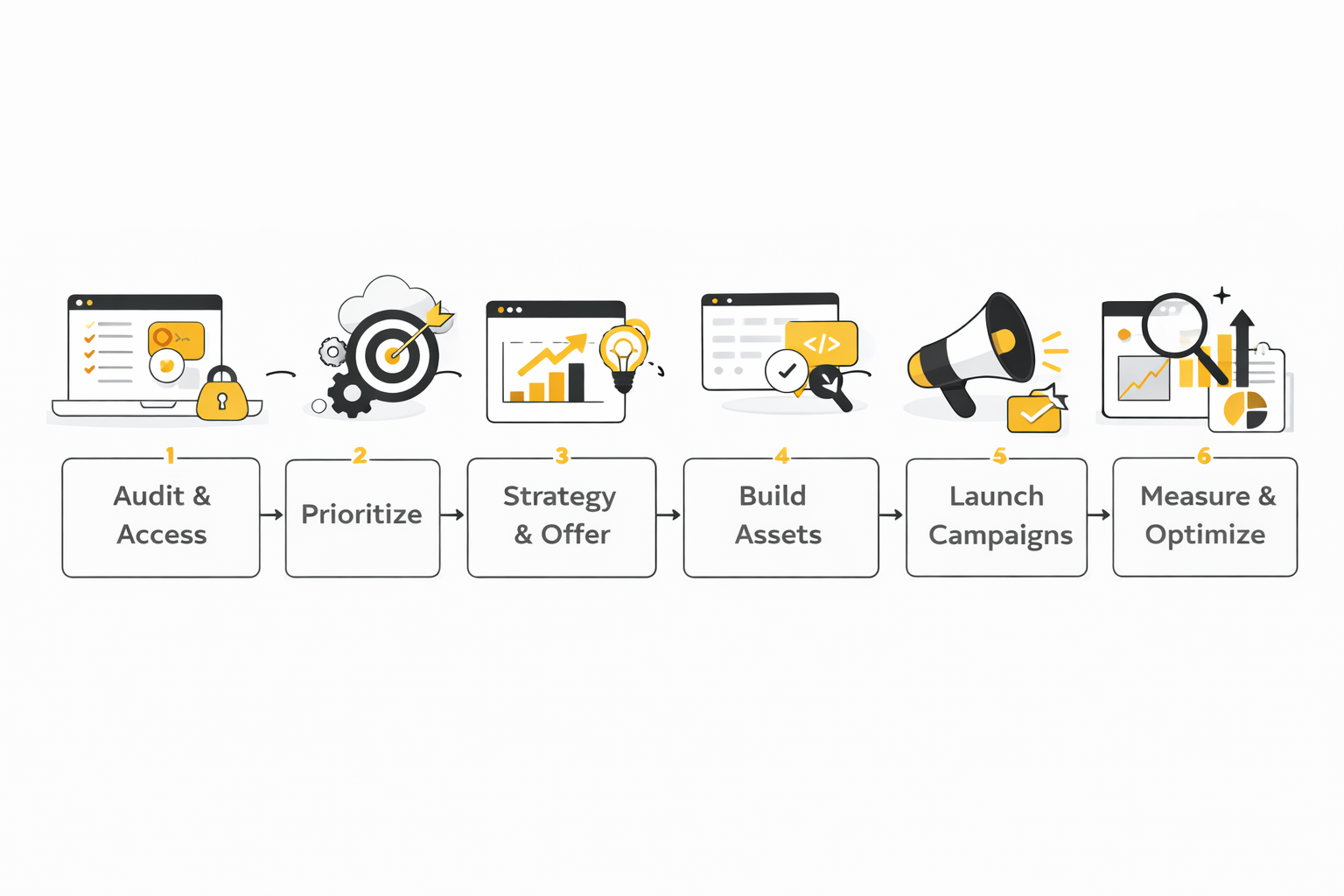
This is where execution becomes tangible. A professional marketing company for small business growth should be able to show the sequence clearly: audit, tracking, core asset build, campaign launch, follow-up automation, and reporting loop. When that sequence is clear, the business knows what is happening and why, and the agency has fewer places to hide when performance is weak.
Step 4: Launch in Controlled Waves, Not All at Once
Weak agencies love big-bang launches because they sound exciting. Strong agencies usually prefer controlled rollouts because they make performance easier to interpret. That might mean starting with branded and high-intent search campaigns first, tightening the landing pages, confirming lead quality, and only then expanding into broader paid social, content distribution, or additional markets.
There is a practical reason for that restraint. When too many variables change at once, nobody really knows what caused the result. A better process limits noise, validates assumptions, and gives the business a cleaner path to scale.
This is especially important for businesses with limited budget. A marketing company for small business clients should know that protecting learning speed matters just as much as chasing raw reach. Fast feedback beats scattered activity almost every time.
Step 5: Connect Marketing to Follow-Up and Sales
This is the stage that separates campaign managers from growth partners. Marketing can generate attention, but revenue still depends on what happens after the lead arrives. HubSpot’s material on sales and marketing automation emphasizes that the handoff works best when both systems are connected on a shared CRM so information is not lost and outreach is not duplicated.
In practice, that means every lead should trigger a clear next step. A form fill might create a pipeline record, send an internal alert, trigger a confirmation email, and start a nurture sequence if the person does not book right away. A chat inquiry might route into a team inbox or AI-assisted workflow through tools like ManyChat, Chatbase, or Guideless if that matches the business model.
Mailchimp’s automation documentation reinforces the same idea from the retention side: flows work when triggers, branches, and actions are mapped to real customer behavior instead of generic blasts. That is why implementation has to include the post-click journey, not just the campaign setup.
Step 6: Review Performance With Clear Operating Rhythm
Once the system is live, the agency should settle into a predictable review cadence. Google Business Profile performance reporting lets businesses track views and customer interactions across Search and Maps, while Google Ads conversion measurement closes the loop on what ad traffic is actually doing after the click. Those inputs should feed a monthly review that is direct, honest, and tied to decisions.
That review should answer a small set of hard questions. What improved, what stalled, what got more expensive, what produced qualified demand, and what should change next month? If the agency cannot answer those questions without hiding behind jargon, it is not managing the account at a professional level.
The best operating rhythm is boring in the best way. It creates visibility, trims waste, sharpens the offer, and compounds small improvements over time. That is exactly what most small businesses need from a marketing company: not drama, not noise, just disciplined execution that keeps turning attention into revenue.
The next piece of the decision is money, and this is where a lot of owners get burned. Pricing can look reasonable on paper while the scope is weak, the deliverables are padded, or the incentives are misaligned. So before choosing a partner, it is worth looking closely at what agencies charge, how retainers are structured, and which red flags tend to show up before the relationship goes sideways.
What the Numbers Actually Tell You
Once implementation is live, the next mistake is obsessing over whichever number is easiest to screenshot. A marketing company for small business clients should be able to tell the difference between activity metrics, diagnostic metrics, and outcome metrics, because they serve very different purposes. If an agency keeps reporting visibility without showing what happened next, the reporting may look polished while the business stays stuck.
The useful way to read marketing data is simple. First, check whether people are finding you. Then check whether they are engaging with the right pages, offers, or profiles. Then check whether those interactions become calls, forms, bookings, purchases, or repeat business. That chain matters because a healthy top-of-funnel number means very little if the conversion path underneath it is weak.
The Only Metrics That Deserve Executive Attention
Most small businesses do not need fifty KPIs. They need a short operating dashboard that ties marketing to money. In most cases, the core list is qualified leads, cost per lead, conversion rate, close rate, customer acquisition cost, and customer value over time.
Everything else is support data. Impressions can help explain reach, click-through rate can help diagnose relevance, and engagement metrics can help reveal page quality, but none of those should outrank real conversion events. Google Analytics defines key events as actions that are particularly important to the success of the business, which is exactly how a small-business dashboard should be built.
This is where a serious marketing company for small business growth earns its keep. It should help the owner decide what counts as a meaningful win before reporting starts, not after a bad month forces the conversation. If that definition is fuzzy, the agency can always find a number that looks better than the one that actually matters.
How to Read Conversion Benchmarks Without Fooling Yourself
Benchmarks are helpful, but only when they are used as context instead of therapy. WordStream’s latest Google Ads benchmark data puts the overall average search conversion rate at 6.96% across industries, but that number does not mean your campaign is healthy or broken on its own. A local emergency plumber, a dental practice, and an online apparel store can all have completely different buying intent, lead quality, and sales cycles.
The better move is to compare against yourself in layers. Start with industry context, then compare campaigns by intent, landing page, offer, location, and device. If one campaign converts at 4% and another converts at 9%, the lesson is not just that one is better. The lesson is that something in the audience, message, or page experience is creating a better fit.
Cost per lead works the same way. WordStream’s 2024 benchmark research shows an average Google Ads cost per lead of about $66.69, but treating that as a universal ceiling is a fast way to make bad decisions. A $120 lead can be excellent if the close rate and job value are strong, while a $25 lead can be terrible if it produces junk inquiries that waste staff time.
What Local Search Data Should Trigger
For local businesses, profile performance and review data are not vanity signals. They are often the earliest indicators of whether trust and discoverability are rising together. Google’s Business Profile performance tools show views, clicks, calls, and other customer interactions across Search and Maps, which makes local analytics unusually close to real-world buying behavior.
BrightLocal’s 2026 review research found that 97% of consumers read reviews for local businesses and 41% say they always read reviews when browsing for businesses. That matters because review strength does not just support reputation. It changes whether discovery turns into action at all.
The action this should drive is straightforward. If profile views are rising but calls and site clicks are not, the profile likely needs better proof, better photos, stronger service descriptions, or fresher reviews. If clicks are healthy but booked jobs are weak, the problem is probably further down the funnel. That is why local data should always be read alongside website conversion data and lead handling, not in isolation.
Why Engagement Metrics Matter, but Only in the Right Order
GA4 replaced a lot of lazy thinking about bounce rate with a more useful idea: engagement. Google defines an engaged session as one that lasts longer than 10 seconds, triggers a key event, or includes at least two page or screen views. That means engagement rate is not just a softer version of traffic quality. It is a way to see whether visitors are showing signs of intent.
That said, engagement metrics are still middle-of-the-chain data. They are useful when you need to diagnose why a page is underperforming, but they are not the finish line. A page can have decent engagement and still convert poorly if the offer is weak, the form is clumsy, or the next step feels risky.
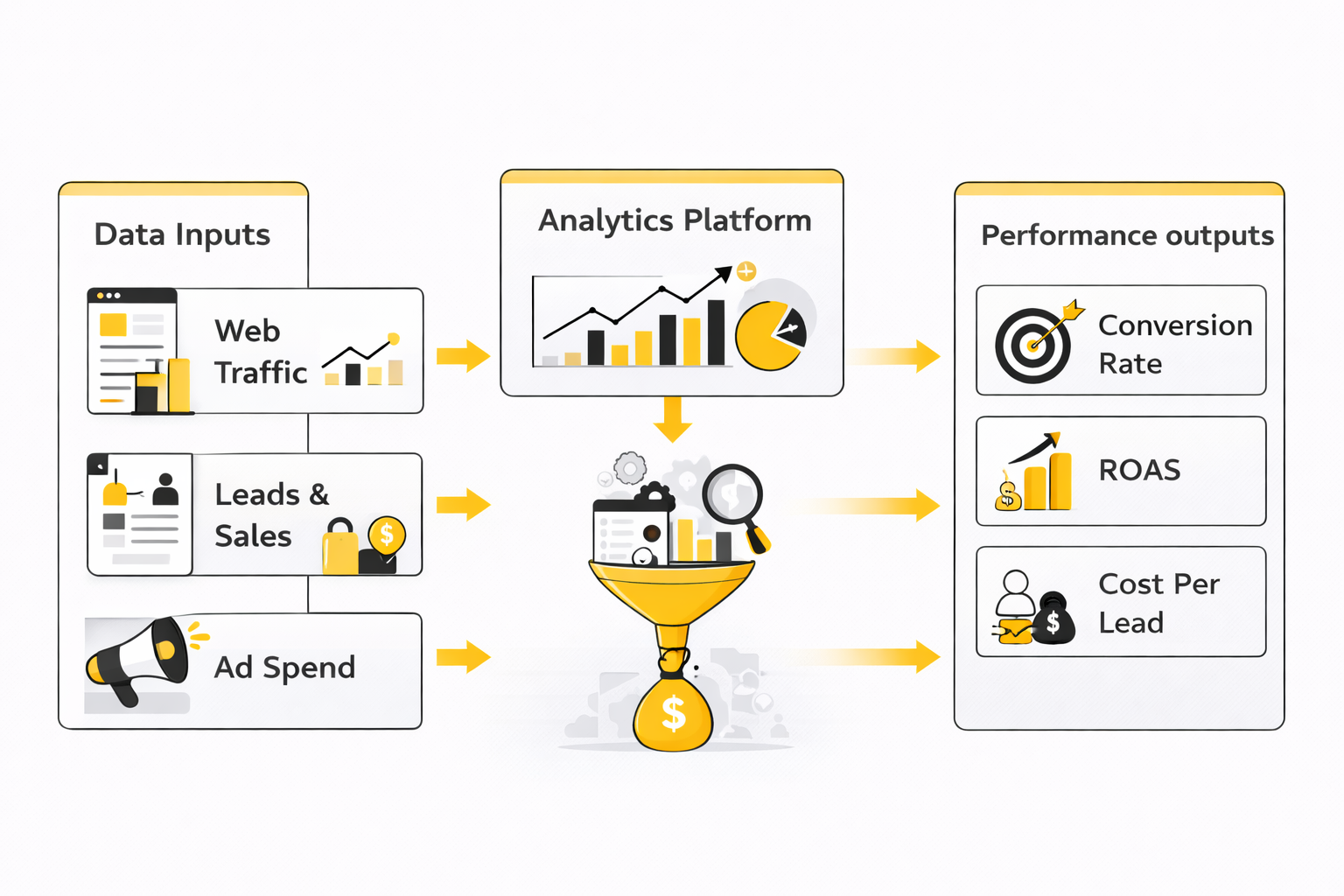
The cleanest way to use analytics is as a layered system. Source metrics tell you where people came from. Engagement metrics tell you whether the experience held attention. Conversion metrics tell you whether the visit produced business value. Once a marketing company for small business reporting is organized that way, optimization becomes much more obvious and much less emotional.
Email and Follow-Up Metrics Need Harder Standards
Email reporting is another area where businesses get lulled by soft wins. Mailchimp’s benchmark data shows average email open rates of around 34.23% across industries, while more recent Klaviyo benchmark reporting puts average campaign click rates at 1.69% and top 10% performance at 3.38%. Those numbers are useful, but they should not be read as a scoreboard by themselves.
Open rates are directional now, not definitive, because privacy protections have made them less precise. Clicks, conversions, revenue per recipient, booked calls, reply rates, and list growth quality usually tell a tougher and more useful story. So if an agency keeps celebrating opens while sales stay flat, it is probably protecting the report, not the client.
This is one reason automation platforms matter when used properly. Systems such as Brevo, GoHighLevel, and ManyChat make it easier to connect responses, triggers, and downstream outcomes, which means the business can judge follow-up by what it produces rather than by how busy it looks.
The Difference Between a Healthy Trend and a False Positive
One good month is not proof of a scalable system. Marketing data should be read across trends, not snapshots, especially in small businesses where seasonality, promotions, local events, and staffing issues can distort short windows. A healthy trend usually looks like better lead quality, steadier conversion efficiency, and improving performance across several connected metrics at the same time.
A false positive usually looks flashier. Traffic spikes, social reach jumps, or open rates rise, but qualified demand does not follow. That is exactly why a strong marketing company for small business clients should be ruthless about separating signal from noise.
The practical takeaway is this: every metric should trigger a decision. If cost per lead rises, inspect targeting, intent, and landing pages. If engagement falls, inspect speed, clarity, and offer fit. If profile visibility rises but actions stall, improve trust assets. If email opens look fine but clicks lag, fix the message, segmentation, or call to action. Good analytics should create next steps, not just monthly commentary.
That leads directly into pricing and agency selection, because once you understand what should be measured, it gets much easier to spot when an agency’s scope, retainer, or promises do not line up with the work required to actually move those numbers.
Advanced Considerations Before You Sign
By this point, the basic question is no longer whether you need help. It is whether a specific marketing company for small business growth can help without creating new problems as you scale. That is a more serious question, because growth often breaks weak systems before it rewards strong campaigns.
This is where owners need to think beyond monthly deliverables. The real issues are strategic fit, operational ownership, channel concentration risk, and whether the agency model still works when lead volume, locations, products, or team complexity increase. If you skip those questions, you can end up buying short-term momentum that becomes expensive to maintain.
Specialization Usually Beats Full-Service Promises
A lot of agencies sell “full service” because it sounds convenient. In reality, small businesses usually get better results from a partner that is excellent in the one or two areas most connected to revenue. The U.S. Small Business Administration’s guidance on market research and competitive analysis points back to the same principle: competitive advantage comes from understanding the market clearly, not from trying to do everything at once.
That does not mean full-service firms never work. It means the burden of proof is higher. If an agency claims it can handle local SEO, paid search, paid social, email, CRM automation, landing pages, analytics, and creative at a high level, you should expect to see sharp process clarity, not vague promises about “integrated growth.”
For a small business, specialization often creates cleaner accountability. If local search is the bottleneck, hire the team that is excellent there. If paid acquisition is the bottleneck, hire the team that can prove it understands intent, tracking, landing pages, and downstream lead quality.
Do Not Outsource Strategic Judgment
Outsourcing execution can be smart. Outsourcing judgment is dangerous. A marketing company for small business clients should advise aggressively, but the business owner still needs control over positioning, pricing, customer experience, and what counts as a qualified lead.
That matters because agencies do not live inside the business every day. They can see patterns, benchmark channels, and improve systems, but they do not feel the sales friction, service bottlenecks, margin pressure, or staffing strain the way the owner does. If the owner becomes too passive, the agency can start optimizing for easier metrics instead of better business decisions.
The healthiest setup is shared control. The company owns the business model and the standards. The agency brings outside pattern recognition, speed, and execution depth. When those roles blur too much, frustration usually follows.
Channel Dependence Becomes a Real Risk at Scale
A campaign that works is not automatically a growth engine you can trust forever. One of the biggest scaling mistakes small businesses make is becoming over-dependent on a single acquisition channel, especially paid search, one social platform, or one local listing source. That channel can get more expensive, more competitive, or less reliable long before the business is ready for it.
You can already see the environment shifting. BrightLocal’s SMB Marketing Report 2025 shows small businesses spreading effort across social, SEO, paid media, websites, and directory visibility rather than relying on one source of attention. BrightLocal’s 2025 local marketing predictions also highlight growing pressure from AI-driven search experiences and heavier dependence on well-maintained business profiles, review signals, and consistent local data.
That should shape how you judge an agency. You want a partner that can help you exploit your best channel today while reducing dependency risk over time. If all growth depends on one lever, you do not have a stable system yet. You have a temporary edge.
Ownership of Accounts, Data, and Creative Is Not a Small Detail
This is one of the least glamorous questions and one of the most important. Before hiring any marketing company for small business needs, you should know exactly who owns the ad accounts, analytics property, CRM data, landing pages, automations, call tracking numbers, and creative assets. If the answer is fuzzy, you are looking at a future problem.
Google’s Business Profile and Ads ecosystems both rely on access management and account-level permissions, which is a reminder that platform access should be structured, not improvised. The business should retain administrative visibility into the systems that matter, even if the agency manages the day-to-day work. That is not distrust. It is basic operational hygiene. (support.google.com, support.google.com)
This becomes critical during agency transitions. If accounts are built under the agency’s ownership, reporting is hard to validate, and historical data can become harder to preserve or compare. A good partner will not trap a client inside the relationship. It will build systems that remain usable even if the relationship eventually ends.
AI Can Improve Execution, but It Does Not Replace Operating Discipline
AI is changing agency workflows fast, and that is not inherently bad. It can speed up drafts, research, reporting, content production, and some customer interactions. Google’s product updates keep pushing more AI into advertising and measurement environments, which means agencies that ignore it will eventually move slower than the market. (support.google.com)
But this is where owners need to stay sharp. Faster output is not the same as better judgment. AI can help a marketing company for small business clients move more quickly, but it can also multiply generic messaging, low-quality content, weak targeting logic, and lazy reporting if the underlying operator is not strong.
The practical test is simple. Ask what AI is replacing and what it is improving. If the agency uses it to speed up repetitive work while keeping strategy, QA, and decision-making tight, that is useful. If it uses AI as a way to produce more noise for the same retainer, that is not innovation. That is cost-cutting with better branding.
Scaling Fails When Operations Cannot Absorb New Demand
This is the part many growth conversations conveniently ignore. More leads only help if the business can respond, qualify, schedule, sell, onboard, fulfill, and retain customers at the higher volume. Otherwise, the agency may technically improve top-of-funnel performance while the business becomes less profitable underneath it.
That is why the best agencies start asking operations questions once campaigns begin working. Can the team answer calls fast enough? Are no-shows rising? Are service teams overloaded? Is the sales script breaking under higher inquiry volume? If those questions never come up, the partner may be managing media, but not growth.
This is also where better systems start to matter more than more channels. A stronger intake form through Fillout, cleaner pipeline management through GoHighLevel or Copper, faster scheduling through Cal.com, and smarter routing through Chatbase or ManyChat can often unlock more value than adding a brand-new acquisition channel too early.
Budget Allocation Should Follow Constraint, Not Hype
Small businesses do not have room for trendy budgeting. Money should go where the current growth constraint lives. If discoverability is weak, fix visibility. If traffic is solid but conversion is weak, fix pages and offers. If leads are coming in but sales are soft, fix follow-up and qualification before increasing spend.
That sounds obvious, but it gets lost surprisingly often. HubSpot’s current guidance on managing a marketing budget makes the same practical case in broader terms: budget planning works when resources are tied to goals and performance, not distributed evenly just to make the plan look balanced.
This is why the right agency budget is rarely static. As the system matures, the allocation should change. Early on, you might invest more in setup, pages, tracking, and local presence. Later, the business may shift more budget into paid acquisition, retention, or automation because the underlying engine can finally handle it.
The Agency Relationship Should Get Simpler as Results Improve
Here is a subtle but important sign of maturity. A strong marketing company for small business clients should make the business clearer over time, not more dependent on jargon, dashboards, or endless explanations. If six months in, the owner still cannot explain what is working and why, the agency is not creating enough visibility.
The best relationships usually feel more boring as they improve. The meetings get sharper. The numbers make more sense. The priorities become more obvious. The business understands where growth is coming from and what needs attention next.
That is exactly where you want to be before making a final hiring decision. Once you understand the tradeoffs, the risks, and the scaling issues, the last step is much easier: identify the red flags, compare pricing with clearer eyes, and use a final checklist to decide whether a specific agency is actually worth trusting.
Red Flags, Pricing Reality, and the Final Decision Checklist
By the time you are comparing proposals, most agencies start sounding strangely similar. Everyone talks about growth, full-funnel systems, better leads, and transparent reporting. The difference usually shows up in the details they avoid, the assumptions they make about your business, and how much of the actual work they can clearly explain.
One hard truth is that the cheapest option is not always safer, and the most expensive option is not always better. BrightLocal’s SMB Marketing Report 2025 shows cost is still a major constraint for many small businesses, which is exactly why bad-fit retainers hurt so much. A marketing company for small business growth should be able to explain how the fee connects to setup, execution, reporting, and business outcomes rather than hiding behind broad service categories.
Red Flags That Usually Predict a Bad Agency Relationship
The first red flag is vague scope. If the proposal promises SEO, ads, content, social media, email, automation, and reporting without clearly saying what gets done, how often, and by whom, the business is buying blur instead of process. That kind of ambiguity tends to protect the agency more than the client.
The second red flag is platform obsession without business context. If the team talks endlessly about impressions, followers, AI tools, or ad account tactics without asking about margins, lead quality, close rates, and service capacity, it is probably optimizing around marketing theater. That usually looks impressive early and frustrating later.
The third red flag is weak ownership rules. If you cannot get a clean answer on who owns the ad account, the CRM, the landing pages, the analytics property, the call tracking numbers, and the creative assets, stop there and get that settled first. Google’s access-management guidance for Business Profile users and Google Ads account access makes it clear that permissions and visibility are part of professional operations, not a minor admin detail.
What Pricing Should Really Cover
A serious retainer should usually cover more than campaign launches. It should include planning, implementation, optimization, reporting, communication, and enough operational support to fix the problems uncovered during execution. If the fee only buys activity while every meaningful fix becomes an upsell, the working relationship gets expensive fast.
That does not mean every agency needs to be full service. It means the pricing model should match the actual job. A specialist local SEO partner may justifiably price around profile management, review systems, local pages, and reporting, while a paid acquisition partner may price around media management, testing, landing page coordination, and conversion tracking.
This is where the smartest buyers slow down. Instead of asking, “How much do you charge?” ask, “What exactly has to go right for this engagement to pay for itself?” That question forces a much better conversation about risk, timelines, dependency, and the real work required.
The Final Decision Checklist
Before hiring any marketing company for small business needs, the business owner should be able to answer a handful of sharp questions with confidence. If too many answers are fuzzy, the agency has not earned the deal yet.
- Does the agency understand the business model, not just the marketing channels?
- Can it explain the first 30, 60, and 90 days clearly?
- Are tracking, reporting, and ownership rules defined in plain language?
- Does the scope match the actual bottleneck in the business?
- Can the business keep administrative visibility into critical platforms and assets?
- Does the reporting focus on qualified leads, conversions, and revenue signals rather than vanity metrics?
- Is there a realistic plan for follow-up, sales handoff, and retention?
- Can the agency explain what it will ignore, not just what it wants to add?
A good final choice usually feels clearer, not flashier. You understand the priorities, the risks, the measures of success, and the operating rhythm. That is the point of this entire guide: choosing a partner that can actually help a small business grow without making the system harder to understand or harder to control.
FAQ
What does a marketing company for small business actually do?
A real marketing company for small business growth helps a company attract attention, convert that attention into leads or sales, and then improve what happens after someone shows interest. That can include local visibility, paid ads, landing pages, email, CRM workflows, review generation, analytics, and conversion optimization. The best partners also use data from tools like Google Business Profile performance and GA4 to tie activity back to customer actions instead of just reporting traffic.
How do I know if my business needs an agency or just a freelancer?
If your main problem is one narrow task, like fixing a landing page or setting up one campaign, a good freelancer may be enough. If your problem spans messaging, traffic, conversion, tracking, and follow-up, you probably need a more integrated partner. The choice should follow complexity, not ego.
How much should a small business expect to spend on marketing help?
There is no universal number that makes sense across industries, deal sizes, and growth stages. The smarter question is whether the cost is justified by the revenue opportunity, the operational support included, and the size of the bottleneck being solved. BrightLocal’s SMB Marketing Report 2025 shows cost remains a real barrier for many small businesses, which is exactly why the scope has to be tightly connected to outcomes.
Should I hire a local agency or a remote one?
Local agencies can be useful when market knowledge, local content, or in-person collaboration truly matters. Remote agencies can be just as effective, and often stronger, when they bring sharper specialization, better systems, and clearer reporting. What matters most is whether the partner understands your market and can execute consistently, not whether its office is nearby.
How long should it take to see results?
That depends on the channel and the problem being solved. Paid search and landing page fixes can show movement relatively quickly, while SEO, review momentum, and content systems usually need longer to compound. A credible agency should be able to explain which wins are expected early and which ones naturally take longer.
What metrics should I pay attention to first?
Start with qualified leads, conversion rate, close rate, customer acquisition cost, and retained value where relevant. Use supporting metrics like clicks, engagement, and profile views to diagnose performance, but do not mistake them for the finish line. Google’s definition of engaged sessions is useful for diagnosing visitor quality, but the business still has to care most about outcomes.
Is SEO still worth it for small businesses in 2026?
Yes, especially for businesses with local intent, service-area demand, and research-heavy buying journeys. Search behavior is evolving, but visibility, reviews, clear service pages, and profile quality still influence whether a business gets considered. BrightLocal’s Local Consumer Review Survey 2026 shows that review-led local discovery remains deeply important, which reinforces the value of solid SEO and local search foundations.
Do I need paid ads if I already have referrals?
Referrals are great, but they are rarely enough to build a predictable growth system on their own. Paid ads can help when you know the offer, understand the audience, and have a conversion path that works. The key is not adding ads because they sound scalable, but using them when the business is operationally ready to turn demand into revenue.
What tools should a good agency be comfortable with?
The exact stack varies, but a serious agency should be comfortable with tracking tools, analytics, CRM workflows, landing page systems, and communication automation. Depending on the model, that may include platforms like GoHighLevel, Brevo, ManyChat, ClickFunnels, or Replo. What matters more than the tool list is whether the agency can explain why the stack supports your specific growth model.
What is the biggest mistake small businesses make when choosing an agency?
The biggest mistake is buying a bundle of services before diagnosing the actual bottleneck. That usually leads to lots of activity, unclear accountability, and too many channels being touched too early. A better decision starts with the business problem, then chooses the smallest set of marketing interventions that can solve it.
How can I tell if an agency report is honest?
An honest report makes the business easier to understand. It shows what improved, what stalled, what became more expensive, and what action should happen next. If every month sounds upbeat no matter what the numbers say, the report is probably protecting the relationship more than the result.
Can AI replace a marketing company for small business owners?
AI can speed up research, drafting, reporting, and parts of customer communication. It cannot replace sound judgment about positioning, budget allocation, conversion paths, customer quality, or operational fit. The useful question is not whether the agency uses AI, but whether it uses AI to improve execution without lowering standards.
What should happen in the first month after I hire an agency?
The first month should focus on audit, access, tracking, asset review, and prioritization. You should leave that phase with a clearer picture of what is broken, what will be fixed first, and how performance will be measured. If the first month produces lots of activity but not much clarity, the relationship may be heading in the wrong direction.
Is social media enough for a small business?
Sometimes it is helpful, but rarely enough by itself. Social content can support awareness, trust, and community, yet many small businesses still depend on search, reviews, websites, email, and follow-up systems to convert real buying intent. That is why the right marketing company for small business growth usually thinks in systems, not just channels.
Work With Professionals
Explore 10K+ Remote Marketing Contracts on MarkeWork.com
Most marketers spend too much time chasing clients, competing on crowded platforms, and losing a percentage of every project to middlemen. MarkeWork gives you a better way. Browse thousands of remote marketing contracts and connect directly with companies desperate to hire skilled marketers like you, without platform commissions and without unnecessary gatekeepers.
If you're serious about finding better opportunities and keeping 100% of what you earn, explore available contracts and create a profile for free at MarkeWork.com.