

https://chatgpt.com/backend-api/estuary/content?id=file_00000000bc88720a872473eb5225b04d&ts=493390&p=fs&cid=1&sig=8278c9d15d151fc1242f28c874f864773850b3004ce53eb980f396ce3d22f62d&v=0
How To Choose A PPC Agency Without Getting Burned
By the time most companies start shopping for a PPC agency, they are already frustrated. They have usually tried boosting posts, running a few Google Ads campaigns in-house, or hiring a freelancer who could launch ads but could not build a real acquisition system. That frustration matters, because it can push you toward the wrong kind of partner fast.
A good PPC agency does not just know how to spend budget. It knows how to connect keyword intent, ad creative, landing pages, tracking, sales follow-up, and revenue quality. That matters even more now that Google keeps leaning harder into automation, AI-driven bidding, responsive ad formats, and new campaign workflows like AI Max for Search, which Google says can lift conversions or conversion value by 14% at a similar CPA, and even more for campaigns still relying heavily on exact and phrase match.
Start With The Business Goal, Not The Platform
The easiest way to hire the wrong PPC agency is to ask, “Can you manage Google Ads?” That is too shallow. Almost any agency can say yes, and that answer tells you nearly nothing about whether they can actually improve pipeline, booked calls, qualified leads, or ecommerce margin.
The better question is what the agency thinks success should look like for your business model. A B2B company with a 90-day sales cycle needs a very different setup from a local service business that closes leads within 10 minutes, and both look different again from a DTC brand trying to scale blended return. Even Clutch’s latest guidance on how to choose a PPC agency starts with clarifying business goals before talking tactics, which is exactly right.
If an agency jumps straight into keywords, campaign types, and budgets before asking about margins, close rates, sales capacity, lead handling, and customer lifetime value, that is a red flag. It usually means they are thinking like media buyers, not growth operators. And that gap gets expensive very quickly.
Look For Channel Depth, But Also Commercial Understanding
A serious PPC agency should have platform fluency. That includes Google Ads, Microsoft Advertising, paid social when relevant, conversion tracking, feed management for ecommerce, and landing page testing. But technical fluency alone is not enough anymore because modern ad platforms have removed a lot of the old manual levers.
Google’s own documentation now pushes advertisers toward Smart Bidding, responsive search ads, and stronger first-party measurement through web conversions and enhanced conversions for leads. That means the edge is less about who can tweak bids every hour and more about who can feed the system better inputs, cleaner structure, better creative, and stronger downstream data.
In plain English, the best PPC agency today is not the one with the flashiest dashboard. It is the one that understands your economics well enough to train the platform toward the right outcome. Cheap leads are meaningless when they do not turn into revenue.
Ask What They Actually Control
This is one of the most important conversations you can have before signing anything. Many businesses hire a PPC agency expecting revenue growth, while the agency only plans to manage ads and report on clicks, impressions, and conversions. That mismatch becomes a fight a few months later.
A strong agency should be able to tell you exactly which parts of the system it owns and which parts it influences. That usually includes:
- account structure
- bidding strategy
- ad copy and creative testing
- audience setup
- negative keyword management
- landing page recommendations or testing
- tracking implementation
- reporting tied to business outcomes
That list matters because Google’s ad quality system is not isolated from the rest of the funnel. Quality Score still reflects expected clickthrough rate, ad relevance, and landing page experience, and Google is explicit that landing page usefulness and relevance influence that experience rating in its guidance on landing page experience. So if an agency says landing pages are “not our problem,” that is not always a dealbreaker, but it does mean you need another owner for that piece.
The same goes for lead management. If your sales team takes two days to call inbound leads, the agency cannot fix that with better ad copy. In service businesses especially, speed-to-lead often decides whether paid traffic becomes revenue or waste.
Make Them Show You Their Measurement Philosophy
Any PPC agency worth hiring should talk about tracking early and in detail. Not as a technical add-on. Not as something they will “set up later.” Tracking is the foundation of every bidding and optimization decision they make.
Google has made this even more obvious by leaning into conversion measurement and first-party data signals. Enhanced conversions exist for a reason: cleaner measurement improves attribution and helps automated bidding make better decisions. That is also why Google recommends upgrading offline lead tracking workflows so advertisers can use better downstream conversion data for bidding after enough conversion cycles have passed, as outlined in its guide to upgrading offline imports.
So ask direct questions. What counts as a conversion? Which conversions are primary? Are they optimizing for form fills, qualified leads, booked calls, opportunities, closed revenue, or some mix? How do they handle duplicate leads, spam, unqualified inquiries, and offline sales feedback? If their answer sounds vague, the performance will be vague too.
For businesses that need tighter lead routing and follow-up, this is also where stack decisions start to matter. If your current CRM and attribution flow are messy, tools like GoHighLevel can make agency reporting and lead management much cleaner, especially for service businesses that live and die by call speed and pipeline visibility.
Don’t Confuse Activity With Competence
A lot of agencies are very good at looking busy. They send polished reports, hold weekly calls, and throw around terms like audience layering, creative fatigue, and incrementality. None of that proves they are improving the business.
What matters is whether they can tie changes in the account to a credible operating logic. If they recommend broad match, can they explain when it works and what measurement setup is required first? If they want to push automated bidding, do they understand the conversion volume thresholds and lag issues that can distort learning? If they pitch Microsoft Ads, can they explain why it fits your audience rather than just saying it is “cheaper traffic”?
That last point is especially worth testing because Microsoft Advertising can be useful, but only in the right situations. It remains much smaller than Google, with Statcounter showing Google at 89.85% worldwide search market share in March 2026 and Bing at 5.13%. Microsoft can still work well for some B2B, local, and older-skewing audiences, and its Google import tools make expansion easier, but it should be a strategic move, not a default checkbox.
What A Good PPC Agency Should Show In The Sales Process
You do not need a 40-slide pitch deck. You need signs of disciplined thinking. During the sales process, a strong PPC agency should usually be able to show:
- A clear understanding of your revenue model
- Questions about lead quality, sales process, and close rates
- A realistic view of how much budget is needed for testing
- Specific thoughts on tracking and attribution
- A plan for creative, landing pages, and conversion rate improvement
- Honest boundaries about what they can and cannot control
Notice what is missing from that list. Fancy promises. Guaranteed ROAS. Claims that they have a “secret system.” In PPC, anyone promising certainty is usually selling confidence, not competence.
How PPC Agency Pricing Really Works
Pricing is where a lot of businesses get trapped. Not because agencies are always dishonest, but because pricing models can hide misaligned incentives. If you do not understand how the PPC agency gets paid, you can end up rewarding spend growth instead of profit growth.
The most common pricing structures are monthly retainers, percentage-of-spend fees, flat project pricing, hourly consulting, and performance-based hybrids. In practice, many agencies combine them. Recent agency pricing data from WebFX puts PPC management fees roughly in the $1,500 to $10,000 per month range, while HawkSEM notes average monthly retainers around $3,500, with minimums often landing around $1,000 to $1,500.
That range is wide because it should be. Managing a local business spending $4,000 a month is not the same job as managing a multi-location brand, a B2B account with offline CRM integration, or an ecommerce store with heavy feed optimization. The mistake is not paying more. The mistake is paying more without knowing what you are buying.
The Retainer Model
A monthly retainer is often the cleanest setup when you want predictable service and stable incentives. You pay a fixed monthly fee and the agency delivers a defined scope, which may include campaign management, reporting, tracking support, copy testing, and strategic calls.
The upside is obvious. Budget changes do not automatically increase agency compensation, so the agency has less reason to push spend purely to raise its own fee. That can create a healthier relationship, especially when the real job involves more than media buying, like landing page testing, CRM fixes, and offer refinement.
The downside is that retainers can become lazy if scope is vague. Some agencies sell a premium retainer and then do light-touch optimization once the account is stable. That is why you should ask what gets reviewed weekly, monthly, and quarterly, and what kind of testing cadence they actually maintain.
The Percentage-Of-Spend Model
This model is common because it scales with account size. The agency charges a percentage of media spend, often with a minimum monthly fee. On paper, it feels fair because bigger accounts usually do create more work.
The problem is incentive design. A PPC agency paid on spend can make more money even if efficiency gets worse, as long as the client keeps increasing budget. That does not mean the model is bad. It means you need guardrails.
If you choose this setup, tie the relationship to business outcomes, not just media volume. Make sure reporting includes cost per qualified lead, cost per opportunity, MER, contribution margin, or another real business metric. Otherwise you can end up in the classic situation where the agency celebrates scale while the finance team quietly hates the numbers.
Performance-Based Pricing Sounds Better Than It Usually Is
A lot of founders love the idea of performance pricing because it sounds aligned. Only pay when results happen. In reality, it can get messy fast.
The first problem is definition. Are you paying for leads, booked calls, SQLs, purchases, or closed revenue? The second problem is quality control. Agencies can drive more low-quality conversions if the payout is tied to shallow events. The third problem is measurement. Attribution is rarely clean enough to support a pure pay-for-performance contract unless the funnel is simple and the tracking is extremely disciplined.
That is why many experienced businesses prefer a hybrid model. They pay a base fee for the real strategic and operational work, then add incentives tied to qualified outcomes. That structure usually reflects reality better than pretending media buying can be isolated from product, sales, and conversion rate issues.
Cheap PPC Agency Pricing Is Often Expensive In Disguise
This is where people get burned most often. They compare agency fees without comparing the system behind them. A low-cost PPC agency may look attractive, but if the account lacks conversion tracking, uses weak landing pages, ignores search term quality, and reports only on top-line leads, you are not saving money. You are paying for delay.
Google’s current ad ecosystem is not especially forgiving to weak inputs. Responsive search ads work better when advertisers provide stronger assets, and Google says advertisers who improve ad strength from Poor to Excellent see 15% more clicks and conversions on average. Smart Bidding also depends on meaningful conversion data, and Google keeps reinforcing that direction in its guidance on automated bidding and new features and announcements.
That means the real question is not whether one agency charges $2,000 and another charges $4,500. It is whether the more expensive one is fixing the parts of the funnel that actually move the economics. In plenty of cases, the pricier agency is cheaper by month three.
What Should Be Included In A PPC Agency Fee
A professional PPC agency agreement should spell this out in plain language. If it does not, ask for it. You should know whether the fee includes tracking implementation, GTM support, landing page recommendations, creative production, call tracking setup, CRM integration, feed work, reporting dashboards, and strategy calls.
This matters because performance problems often hide in the handoff between systems. The ads may be fine, but the landing page may be weak. Or the landing page may convert, but the CRM may fail to route leads correctly. Or the leads may be good, but the sales team may not follow up fast enough. A good agency does not need to own every layer, but it should be able to diagnose the bottleneck and help coordinate the fix.
For brands that need stronger landing page velocity, using a tool like Replo can make it much easier to launch and test pages without waiting on a full development sprint. That matters more than most companies realize, because ad performance and landing page relevance are tightly connected.
Questions To Ask Before You Sign
Before you hire any PPC agency, get direct answers to these questions:
- What is your pricing model, and why is it the right fit for our account?
- What exactly is included in the monthly fee?
- Who will manage the account day to day?
- What access will we have to ad accounts, data, and creative assets?
- How do you define success in the first 30, 60, and 90 days?
- What happens if tracking is broken or lead quality is poor?
- How do you work with landing pages and sales follow-up?
- What would make you tell us not to scale budget yet?
That last question is especially revealing. A mature PPC agency should be comfortable saying no. Sometimes the bottleneck is not traffic. It is conversion rate, offer clarity, call handling, or measurement quality. An agency that understands that is much more likely to protect your money.
The Right PPC Agency Should Feel Like A Growth Partner
At this stage, the goal is not to find a PPC agency that says yes to everything. It is to find one that sees the full system clearly and is willing to tell you where the real constraints are. That kind of honesty is rare, but it is exactly what makes the partnership valuable.
The best agencies do not just manage campaigns. They improve signal quality, sharpen offers, tighten landing pages, pressure-test attribution, and help you decide when to scale and when to fix the funnel first. That is the difference between buying ad management and buying growth leverage.
In the next section, we will get into what a strong PPC agency actually does after onboarding, including account structure, campaign setup, testing workflows, reporting, and the operational habits that separate average results from serious performance.
What A Strong PPC Agency Actually Does After Onboarding
This is the point where the difference between a real PPC agency and a glorified account babysitter becomes obvious. Almost everybody can open Google Ads, create campaigns, and push traffic to a page. The hard part is building the account in a way that gives the platform clean inputs, gives the business useful feedback, and gives both sides a clear path to scale.
A good implementation process is never just “launch ads and see what happens.” It starts with deciding what the account should optimize for, how success will be measured, and which parts of the funnel need to be fixed before budget gets pushed harder. That discipline matters more now because Google keeps rewarding better inputs through tools like Smart Bidding, responsive search ads, and cleaner first-party measurement through Data Manager.
Step 1: Audit The Existing Funnel Before Touching Campaigns
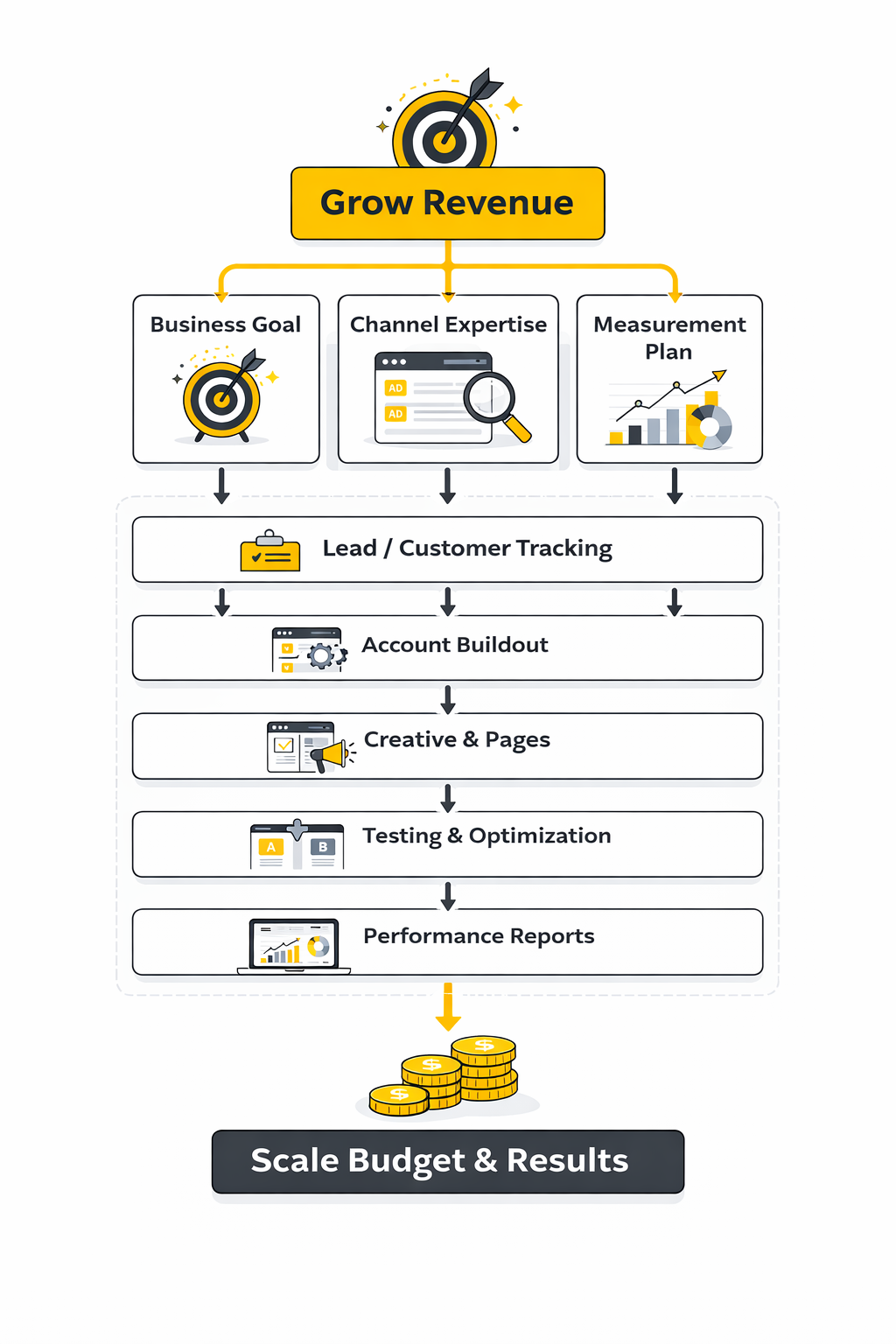
The best PPC agency does not start by making cosmetic changes inside the ad account. It starts by auditing the entire path from click to customer. That means checking conversion tracking, CRM routing, landing pages, offer clarity, sales response time, historical performance, and what counts as a qualified outcome.
This matters because weak inputs break optimization before the first new ad even goes live. Google’s own guidance on conversion tracking makes it clear that bidding works best when advertisers measure the right actions, and its workflow for offline conversion upgrades pushes advertisers toward stronger downstream signals, not just top-of-funnel form fills. If a PPC agency skips this audit, it is usually guessing with your budget.
A serious audit should also separate symptom from cause. High cost per lead is not always a bidding problem. Sometimes the real issue is weak message match, slow page speed, poor qualification, or the fact that the sales team treats paid leads like leftovers instead of hot demand.
Step 2: Clean Up Tracking So The Platform Can Learn Properly
Once the audit is done, the next job is measurement cleanup. This is where a competent PPC agency earns trust fast, because a lot of accounts are still optimizing toward the wrong events. They may count every form fill as equal, double-count conversions, miss phone calls, or fail to connect ad clicks to closed revenue later in the pipeline.
Google has been very direct about the importance of better first-party data. Enhanced conversions help improve measurement accuracy, while enhanced conversions for leads and offline import upgrades are specifically designed to pass better lead-quality data back into the system. In other words, the PPC agency is not just setting up tags. It is deciding what feedback loop the algorithm will use.
That is why good agencies usually define a conversion hierarchy early. A primary conversion may be a qualified call, booked demo, or closed-won event, while softer actions stay secondary for visibility. This prevents the account from chasing cheap actions that look good in a dashboard and do almost nothing for the business.
Step 3: Build Campaign Structure Around Intent, Not Guesswork
After tracking is stable, campaign architecture comes next. This is where a good PPC agency makes the account easier to read, easier to optimize, and harder to pollute with mixed intent. That usually means separating brand from non-brand, isolating core service or product themes, splitting search intent cleanly, and being intentional about geography, devices, and budget control.
Google’s documentation on keyword matching options and negative keywords still matters here because search quality depends heavily on what queries you allow in and what junk you keep out. The agency should not be throwing every keyword into one campaign and hoping automation sorts it out. Automation works better when the account gives it cleaner context.
For ecommerce or feed-driven accounts, structure also includes product segmentation. If Performance Max is in the mix, listing groups and asset groups need to be built deliberately because Google notes that properly configured listing groups are crucial for campaign performance. That is not a minor setup detail. It directly affects what gets shown, where budget goes, and how cleanly performance can be interpreted later.
Step 4: Match Ads, Keywords, And Landing Pages Tightly
This is the step too many agencies rush, and it is one of the biggest reasons accounts underperform. A PPC agency should be obsessive about message match. The search term, the ad promise, and the landing page experience should feel like one continuous conversation.
Google still makes that relationship explicit through Quality Score and Ad Strength. Its responsive ad system is designed to test combinations of headlines and descriptions automatically, but the raw materials still matter. If the ad is generic and the landing page is vague, the machine cannot rescue weak positioning.
This is also why implementation often reaches beyond the ad account. A strong PPC agency will push for dedicated landing pages, sharper offers, better proof, cleaner forms, stronger mobile layout, and fewer leaks between click and conversion. If your team needs to move faster on page testing, tools like Replo can make iteration a lot easier without turning every page change into a development project.
Step 5: Launch With Controlled Inputs, Not Maximum Complexity
A good launch is usually more disciplined than dramatic. The agency is not trying to light up every campaign type, every audience, and every creative concept at once. It is trying to create a setup that can produce signal fast enough to learn from without introducing so many moving parts that nobody knows what is working.
That usually means starting with the highest-intent campaigns first. For a lead generation account, that is often search around core commercial terms. For ecommerce, it may involve branded search protection, standard shopping or Performance Max depending on catalog quality, and remarketing layers once clean audience data is available. Google’s notes on audience signals for Performance Max make the role of first-party guidance clear: the system can expand beyond your signal, but your starting inputs still shape the learning path.
This is also where budget discipline matters. A good PPC agency knows when the account needs more time, more conversion volume, or better landing pages before expanding into broad match, new geos, or additional channels. That patience can save a lot of money.
Step 6: Feed The Account Better Data As Soon As Possible
Modern PPC management is increasingly a data quality game. Once campaigns are live, a strong PPC agency looks for ways to improve what the platforms can learn from. That may include importing offline qualified leads, syncing CRM stages, uploading customer lists, excluding poor-fit segments, or using first-party audience data to improve targeting and bidding.
Google’s Customer Match best practices and Data Manager documentation both point in the same direction: first-party data is not optional fluff anymore. It is part of how strong accounts are built. When an agency ignores that layer, it is usually leaving efficiency on the table.
For service businesses especially, this is where the tech stack starts affecting ad performance directly. If leads are scattered across inboxes and spreadsheets, the agency cannot send useful sales outcomes back into the platform. A system like GoHighLevel can help centralize forms, pipelines, call tracking, and follow-up, which makes optimization far more grounded in actual sales outcomes.
Step 7: Optimize In Cycles Instead Of Random Tweaks
This is where the agency’s process really shows. Weak PPC agencies make scattered changes because they want to look active. Strong ones optimize in cycles. They review search terms, conversion quality, ad asset performance, auction behavior, landing page friction, and budget allocation on a clear cadence.
Google’s Experiments page exists for a reason. Testing works best when it is structured, documented, and compared against a control rather than based on gut feeling. The best PPC agency does not keep changing five things at once and then pretend to know what caused the result.
This also applies to creative and offer testing. If the account is getting traffic but not enough action, the right move may not be a new bidding strategy. It may be a stronger headline, a more specific angle, a better guarantee, or a landing page with less friction. That is why good agencies think like operators, not just dashboard watchers.
Step 8: Report On Business Movement, Not Just Ad Metrics
A mature PPC agency knows that clients do not actually buy clicks. They buy growth. So reporting should move beyond impressions, CTR, and average CPC as quickly as the measurement setup allows.
That does not mean top-level metrics are useless. They still help diagnose performance. But they need to connect to something that matters commercially, whether that is qualified lead volume, cost per booked call, pipeline value, MER, or contribution margin. Otherwise reporting becomes a theater performance where the charts look busy and nobody can answer the only question that matters: is this making the business more money?
This is also why communication cadence matters. A good agency should be able to explain what changed, why it changed, what the account is learning, and what bottleneck currently matters most. When they can do that clearly, trust usually rises even before the numbers fully mature.
What The First 90 Days With A PPC Agency Should Usually Look Like
The exact timeline changes by business, but the overall pattern is more consistent than many people think. The first month is usually about audit, tracking cleanup, structural fixes, and getting a trustworthy launch live. The second month is about collecting enough signal to spot patterns, trim waste, and start refining creative, queries, and landing page experience.
By the third month, a good PPC agency should have a much clearer read on lead quality, search intent, conversion friction, and whether the account is ready to scale. Google itself recommends giving upgraded offline conversion actions the longer of three conversion cycles or four weeks before swapping them into primary bidding, which is another reminder that serious optimization depends on enough clean data, not instant conclusions.
That does not mean every account should wait 90 days before expecting progress. Some wins come faster, especially when obvious waste gets removed. But real performance management is usually cumulative. The agency is improving relevance, signal quality, landing page fit, and budget allocation over time, not pressing a magic button.
Where Great PPC Agency Processes Usually Break
Even with a capable team, implementation can still get derailed. Sometimes the ad account is fine, but nobody can fix the landing pages quickly. Sometimes the business wants lead quality, but the sales team never marks outcomes inside the CRM. Sometimes stakeholders demand fast scale before the campaign has enough data to support it.
This is why process matters so much. A strong PPC agency does not just manage the account. It creates operational clarity around what is blocking better results. That may not sound glamorous, but it is often the real reason one account compounds and another stalls.
And once that implementation foundation is in place, the next question becomes even more important: how do you measure whether your PPC agency is actually doing a good job over time rather than just looking competent in meetings?
Statistics And Data
Once a PPC agency gets past setup and into live optimization, the entire relationship becomes a measurement game. Not a reporting game. Not a dashboard theater game. Measurement is where you find out whether the account is actually improving, whether the leads are getting better, and whether the agency is learning anything useful from the spend.
This is also where a lot of companies get confused. They look at click-through rate, cost per click, and conversion volume without understanding what those numbers are really saying. A good PPC agency does not just send metrics. It explains what each signal means, what it does not mean, and what action should come next.
The First Rule: A Metric Only Matters In Context
There is no single benchmark that tells you whether a PPC agency is doing a great job. A 7% conversion rate can be strong in one market and mediocre in another. A $90 cost per lead can be a disaster for a low-ticket offer and a bargain for a high-margin service line.
That is why benchmarks are useful as directional context, not as final judgment. Recent benchmark data built from more than 16,000 US campaigns showed average search PPC results around a 6.66% click-through rate, $5.26 cost per click, 7.52% conversion rate, and $70.11 cost per lead. Those numbers are helpful because they tell you what “normal” can look like at a broad market level, but they do not tell you whether your account economics work.
A smart PPC agency uses benchmarks to ask better questions. Are your clicks unusually expensive because the market is competitive, or because relevance is weak? Is your conversion rate low because the traffic is poor, or because the landing page is underperforming? Is your cost per lead high because the agency is inefficient, or because the business is chasing high-value demand in an expensive category?
Click-Through Rate Tells You About Relevance, Not Profit
CTR is one of the easiest metrics to misunderstand. A high click-through rate usually means the ad is relevant enough to win attention, which is useful. It can also support better ad efficiency because Google’s auction still rewards stronger relevance signals through ad quality and expected click behavior.
But CTR is not a business outcome. If the agency boosts CTR by writing curiosity-heavy ads that pull in weak clicks, the account can get worse while the chart looks better. That is why a PPC agency should treat CTR as an early signal, not a finish line.
Broad benchmark data shows search ad CTR varies a lot by industry, but the overall average has remained solid, with LocaliQ’s 2025 benchmark coverage using WordStream data highlighting a 6.66% average CTR and noting that more than half of industries still saw declines year over year. The action here is simple. If CTR is weak, look first at keyword intent, ad copy specificity, and whether the offer is actually compelling. If CTR is strong but downstream quality is poor, the agency needs tighter message match and better filtering.
Cost Per Click Is A Pressure Signal
CPC matters because it tells you how expensive it is to buy traffic in your market, but it does not tell you whether the agency is doing good work by itself. High CPCs can be perfectly acceptable when the conversion rate and deal value support them. Low CPCs can be useless if the traffic is weak and never turns into revenue.
The average search CPC in the same 2025 benchmark set landed at $5.26, which gives you a rough midpoint, not a target. Legal, dental, and other high-value categories can run much higher. Lower-intent or less competitive markets can sit well below that. So the right question is not whether your CPC is above average. It is whether the economics still work after clicks turn into leads and sales.
When CPC climbs, a good PPC agency should investigate three things fast. First, are you bidding into a genuinely expensive auction? Second, is your quality and relevance weak enough that Google is making you pay more than necessary? Third, are you buying traffic that sounds big on paper but is not commercially tight enough to justify the cost?
Conversion Rate Is Only Useful If The Conversion Matters
This is where a lot of agencies accidentally mislead clients. They improve conversion rate by making it easier for users to complete a weak action, like an unqualified form submission, a low-intent lead magnet, or a short contact form that attracts junk. The number improves. The business does not.
Still, conversion rate remains one of the most useful operating metrics when it is tied to a meaningful action. The same 2025 benchmark dataset puts average Google Ads conversion rate at 7.52%, which is a healthy reminder that many accounts can convert well when the traffic, offer, and page all line up. But that average becomes dangerous when companies assume they should force their own numbers to match it without considering funnel type and lead quality.
A good PPC agency reads conversion rate like a diagnosis tool. If CTR is healthy but conversion rate is weak, the problem usually sits after the click. That points toward landing page relevance, trust, speed, offer strength, form friction, or sales process leakage. If both CTR and conversion rate are weak, the problem often starts earlier with intent targeting and positioning.
Cost Per Lead Can Look Better While Revenue Gets Worse
This is one of the most important measurement traps to understand. Cost per lead is useful because it gives you a fast way to compare efficiency across campaigns, but it becomes dangerous when it turns into the main success metric. Plenty of PPC agencies optimize accounts toward lower CPL because clients love seeing that number drop.
The problem is obvious once you think about it. If the agency lowers CPL by attracting lower-quality leads, the account can produce more conversions and less profit at the same time. The broad market benchmark of about $70.11 average cost per lead is useful for orientation, but it should never outrank qualified lead rate, close rate, or revenue per lead.
This is why stronger PPC agencies usually build lead tiers into reporting. They separate raw leads from qualified leads, qualified leads from booked calls, and booked calls from actual sales outcomes. That one change can completely reshape how performance is interpreted.
Quality Score Is A Diagnostic, Not A Trophy
A lot of advertisers either obsess over Quality Score or ignore it completely. Both extremes miss the point. Google is very clear that Quality Score is a diagnostic tool, not a key performance indicator. But Google is just as clear that higher scores generally reflect more relevant ads and landing pages, which usually supports better auction efficiency.
That means a PPC agency should not chase Quality Score for vanity. It should use it to identify friction. If important keywords have weak expected CTR, poor ad relevance, or bad landing page experience, those are clues that the account is paying a tax for being less useful than it should be.
The action here is practical. When Quality Score is low on commercially important terms, do not just bid harder. Improve keyword grouping, tighten message match, rewrite ads with more precise intent language, and strengthen the landing page so the click feels deserved.
Ad Strength Helps Build Better Inputs, But It Is Not The Goal
Google has leaned heavily into responsive ad systems, so most PPC agencies now work inside frameworks where assets are mixed and matched automatically. In that world, ad quality inputs matter. Google says advertisers who improve responsive search ads from Poor to Excellent see 12% more conversions on average, and in updated help documentation it also notes that better ad strength can support more clicks and conversions.
That does not mean a PPC agency should blindly follow every recommendation inside the platform. It means ad strength is useful when it pushes the team toward more varied, relevant, high-quality assets. The danger is treating the score itself as the objective.
The right action depends on what the rest of the data says. If ad strength is low and CTR is weak, improving assets is probably worth prioritizing. If ad strength is mediocre but lead quality is strong and economics are healthy, it may not deserve urgent attention.
Optimization Score Is Not A Performance Report
This one causes unnecessary confusion all the time. Google states plainly that optimization score is an estimate of how well the account is set to perform, on a 0 to 100% scale. That sounds useful, and sometimes it is. But it is still a recommendation engine, not a profit engine.
A PPC agency should never use optimization score as proof that the account is doing well. It can help surface ideas, but many recommendations push expansion, automation, or structure changes that may or may not fit the actual business. Smart agencies review recommendations, accept the ones that improve fit, and ignore the ones that would create noise.
So if an agency keeps pointing to a high optimization score as evidence of success, that is weak reporting. The better question is whether the account is generating more qualified pipeline at an acceptable cost and whether the measurement is trustworthy enough to believe the trend.
The Analytics Stack Needs To Show The Whole Path
A serious PPC agency should not be measuring only what happens inside the ad platform. Google itself emphasizes that conversion tracking helps advertisers understand which ads drive value, but for many businesses the real value appears later, after calls are reviewed, meetings are booked, or deals are closed offline.
That is why offline measurement matters so much. Google’s documentation on offline conversion imports makes the point directly: advertisers can measure what happens after a click or call leads to an offline sale or other real-world outcome. This is where a strong PPC agency separates itself from teams that only optimize what is easy to count.
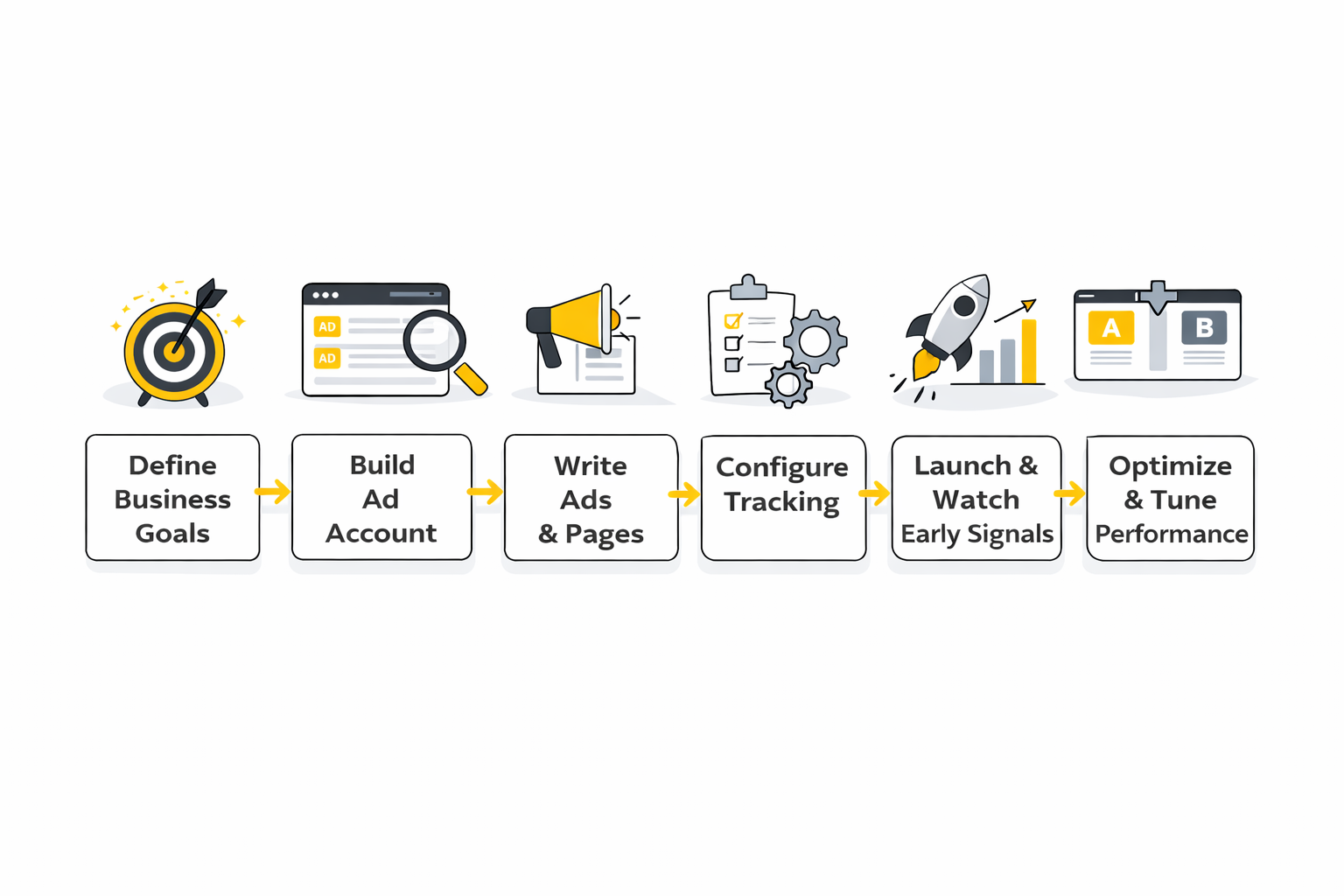
The analytics system should usually connect these layers:
- Ad platform data like spend, clicks, CTR, CPC, impression share, and conversions
- Website or landing page data like sessions, bounce patterns, form completion, and call activity
- CRM data like qualification rate, booked appointments, opportunities, closed revenue, and time-to-close
- Sales feedback like lead quality, no-show rate, close rate by campaign, and revenue by source
Once those layers are connected, the PPC agency can finally answer the questions that matter. Which campaigns produce junk leads? Which keywords create real opportunities? Which landing pages convert cheaply but bring in low-intent prospects? Which offers raise close rate, not just form-fill volume?
What Metrics Should Matter Most At Different Stages
Not every account should be judged by the same dashboard at the same time. Early in the relationship, a PPC agency is usually trying to validate intent, relevance, and measurement quality. That means CTR, search term quality, conversion tracking accuracy, and landing page behavior matter a lot in the first stage.
After the account starts producing stable signal, the focus should shift toward conversion rate, qualified lead rate, cost per qualified lead, and sales follow-up performance. Later, once the data is mature enough, the agency should care more about opportunity volume, revenue efficiency, payback period, and marginal return from increased spend.
This progression matters because many bad decisions happen when companies jump too early to end-stage metrics without enough signal, or stay stuck on top-of-funnel metrics long after they should have moved deeper. A good PPC agency knows when each layer of measurement deserves the most attention.
Impression Share And Lost Share Help Explain Missed Demand
These are underused signals, especially in lead generation accounts. Impression share tells you how often your ads are showing compared with the total eligible opportunities, while lost impression share can point to budget constraints or rank problems. That makes it a useful tool when deciding whether weak volume comes from lack of demand or from weak auction presence.
If impression share is low because of budget, the action may be to scale spend once economics justify it. If impression share is low because of rank, the agency needs to look harder at bids, relevance, landing page experience, and ad quality. This is a much better conversation than simply saying, “We need more budget.”
A competent PPC agency uses these metrics to separate scaling problems from efficiency problems. That distinction protects the client from pouring money into an account that still has unresolved structural issues.
Search Terms Still Tell You What The Market Is Really Saying
One of the most valuable habits in PPC is still reviewing search terms properly. Automation has changed a lot, but it has not changed the fact that real user queries reveal intent, ambiguity, and waste faster than almost any other report. A PPC agency that ignores search terms for too long usually starts paying for irrelevant traffic, broad informational queries, or weak-fit commercial intent.
This is why keyword match types and negatives still matter. Google’s guidance on negative keywords remains directly relevant because keeping irrelevant searches out of the account is still one of the fastest ways to protect efficiency. When the search terms report starts showing weak-fit demand, the action is not to wait politely. It is to tighten the account.
Good agencies do this consistently. Great agencies tie those query insights back to landing page language, offer framing, and sales-call feedback so they can improve the whole funnel, not just the keyword list.
Benchmarks Should Trigger Questions, Not Ego
This is where many PPC relationships get weird. The agency wants to prove it is beating benchmarks. The client wants reassurance. Both sides start acting like average market numbers are some kind of trophy wall.
That is the wrong mindset. Benchmarks are useful because they give context, but they are not your business model. If your account beats average CTR but misses revenue targets, the benchmark does not save you. If your CPC is above average but your close rate and customer value are excellent, the benchmark does not condemn you either.
The right use of benchmark data is operational. It should trigger better investigation. Why is this metric above range? Why is this one below? What does that tell us about relevance, demand quality, funnel friction, or competitive pressure? A good PPC agency keeps the conversation there.
The Best Data Question Is Always “What Should We Do Next?”
This is the core measurement principle that separates serious operators from people who just build dashboards. Every important metric should create a practical next move. Weak CTR should trigger ad and intent work. Weak conversion rate should trigger landing page and offer analysis. High CPL with strong close rate may justify more budget. Low CPL with weak close rate should raise a red flag immediately.
A strong PPC agency never leaves the data sitting there like decoration. It translates numbers into decisions. That is the real value of analytics. Not reporting for its own sake, but clarity about what to fix, what to protect, and what to scale.
And once you can read the data properly, the next challenge becomes easier to see too: which mistakes, blind spots, and red flags usually cause PPC agency relationships to fail even when the dashboards still look fine?
Advanced PPC Agency Decisions That Separate Good Results From Expensive Noise
Once the basics are in place, the real work gets harder. This is where a PPC agency has to make judgment calls that do not show up neatly inside platform recommendations. Scaling, attribution, automation, privacy, creative fatigue, and sales quality all start colliding at the same time.
This stage is where average agencies often drift into comfortable habits. They keep budgets moving, keep reports polished, and keep the account looking active. But a strong PPC agency becomes more valuable here because it knows when to push harder, when to slow down, and when the next bottleneck is no longer media buying.
Scaling Spend Is Not The Same As Scaling Profit
This is the first tradeoff that matters at an expert level. Early gains often come from cleaning waste, tightening intent, and fixing obvious conversion leaks. Scaling is different because every extra dollar usually gets deployed into weaker inventory, broader intent, or more competitive auctions.
That is why a PPC agency should never treat budget growth as automatic proof of success. Google’s own guidance around bidding and budgeting in the AI era makes the point indirectly by emphasizing learning periods, cold starts, and the need to balance targets with enough freedom for campaigns to grow. In practice, that means scale has a cost curve, and the agency needs to know where marginal return starts weakening.
The action is not just “increase budget slowly.” The real action is to watch efficiency by budget layer. If the first $10,000 produces excellent lead quality and the next $10,000 produces weaker sales outcomes, the account may still be growing while the business is quietly losing quality. A serious PPC agency catches that early.
Automation Is Powerful, But Only When The Inputs Are Clean
Most modern PPC work now happens inside systems that rely heavily on automation. Smart Bidding, responsive assets, broad match expansion, audience modeling, and campaign automation can absolutely outperform old manual habits. But only when the account is feeding those systems high-quality signals.
Google’s Smart Bidding documentation keeps reinforcing the same message: automated strategies optimize around the conversion goals and data you provide. So the strategic question is no longer whether automation is good or bad. The real question is whether your PPC agency has built an account that deserves automation.
That changes how expert-level management works. Instead of obsessing over manual micro-adjustments, the agency needs to improve the signal layer, protect intent quality, and stop the machine from learning from junk. When that discipline is missing, automation just scales confusion faster.
Broad Match Can Unlock Growth Or Create Very Expensive Chaos
This is one of the clearest examples of why strategic judgment matters. Broad match has become much more powerful when paired with Smart Bidding and strong conversion data, and many mature accounts do find new scale through it. But broad match is not a shortcut. It is an expansion tool that works best after the basics are stable.
Google has kept nudging advertisers toward broader intent matching, and many practitioners now treat it as a legitimate growth lever once exact and phrase campaigns are mature. But the agency still needs negative keyword discipline, strong ad relevance, and clean downstream measurement before expanding. Otherwise the account can look busy while becoming less commercial.
A strong PPC agency should treat broad match as a controlled test, not a faith-based upgrade. If lead quality declines, the lesson is not that broad match is bad forever. The lesson is that the account may not yet have enough signal integrity to support it.
Attribution Gets Worse As The Funnel Gets More Complex
A lot of companies assume more spend should create clearer answers. In reality, the opposite often happens. As you add campaigns, touchpoints, repeat visits, branded search lift, remarketing, sales calls, and offline close cycles, attribution gets much messier.
That is why a mature PPC agency should not rely on one reporting lens. Google’s guidance on combining incrementality, marketing mix models, and attribution is worth paying attention to because it reflects the actual challenge: attribution is helpful, but it is not the whole truth. The more sophisticated the business becomes, the more the agency needs multiple measurement angles.
This matters especially when branded search starts looking amazing. Sometimes a PPC agency is doing excellent demand capture. Sometimes it is taking credit for demand created elsewhere. The action here is to test assumptions instead of falling in love with easy attribution wins.
Incrementality Matters More Than Most PPC Agencies Admit
At some point, the smartest question in the room is no longer “Which campaign has the best ROAS?” It becomes “What would happen if this spend disappeared?” That is an incrementality question, and it matters because not every reported conversion is truly caused by the ad.
Google’s own measurement guidance and experimentation material on incrementality testing make this especially relevant for more mature advertisers. The point is not to run complicated experiments for vanity. The point is to find out whether the channel is driving net-new growth or simply intercepting demand that would have shown up anyway.
A smart PPC agency uses this thinking to challenge comfortable assumptions. Branded campaigns, remarketing, and bottom-funnel search often look incredible in-platform. Sometimes they deserve the praise. Sometimes they are the easiest place for false confidence to hide.
Privacy And Consent Are Now Performance Variables
This is not just a compliance issue anymore. Privacy setup now directly affects measurement quality, modeled conversions, audience size, and bidding performance. A PPC agency that treats consent setup like a legal side note is already behind.
Google’s Consent Mode overview is explicit that it helps fill reporting gaps while respecting user choices, and recent reporting on Google’s consent simplification changes shows the setup is becoming even more operationally important for advertisers managing Ads and Analytics together. In plain English, weak consent implementation can make your performance look worse, hide real outcomes, and train bidding on incomplete data.
That means expert PPC management now overlaps with analytics architecture. If measurement is degraded by privacy setup, the solution is not to panic over declining numbers immediately. The first step is to confirm whether the account is underperforming or simply under-measuring.
The Landing Page Often Becomes The Real Ceiling
This happens all the time once a PPC agency has done the obvious account cleanup. Keywords are cleaner. ads are tighter. tracking is stronger. The problem is that conversion rate stops improving because the page experience has become the bottleneck.
This is where weak agencies start making endless ad tweaks because that is the layer they control most comfortably. Strong agencies shift attention to the offer, proof, layout, speed, friction, and call-to-action clarity. They know the account may not need more targeting complexity. It may need a page that deserves the click.
That is also why the best PPC relationships often become more cross-functional over time. Faster page iteration, tighter forms, stronger proof sections, and cleaner call booking flows can unlock more growth than another round of bidding experiments. When teams need to move landing pages faster without waiting on full development queues, tools like Replo can help reduce that bottleneck.
Lead Quality Problems Usually Start Outside The Ad Account
One of the most frustrating parts of paid acquisition is that the ad platform can be telling the truth while the business still feels disappointed. The dashboard may show stable conversion volume and reasonable CPL, but the sales team says the leads are weak. That does not always mean the PPC agency failed at targeting.
Sometimes the real issue is follow-up speed, poor qualification, missed calls, weak sales scripting, or broken routing. In lead generation especially, paid traffic performance depends heavily on what happens after submission. A slow or inconsistent sales process can make a good PPC program look broken.
This is why strong agencies push for feedback loops from CRM to platform. They want qualified lead status, pipeline movement, and closed revenue visibility. Systems like GoHighLevel can help centralize that handoff when the current stack is fragmented, which makes it much easier to separate media problems from operational ones.
Channel Expansion Should Follow Signal Quality, Not Boredom
A lot of PPC agency roadmaps get noisy once the core account stabilizes. Someone wants YouTube. Someone wants Microsoft Ads. Someone wants paid social expansion. Someone wants Performance Max everywhere. Sometimes those are smart next steps. Sometimes they are just the agency trying to look proactive.
Expansion should be earned. The business should first understand what works in its current acquisition engine, what conversion events are trustworthy, and where the marginal economics still look healthy. Without that foundation, adding channels can create more reporting clutter than growth.
That does not mean staying narrow forever. It means sequencing matters. A disciplined PPC agency expands once the current system has enough clarity to support the next layer, not just because a quarterly roadmap needs fresh slides.
When A PPC Agency Should Tell You Not To Scale Yet
This is one of the clearest signs that you are dealing with adults. Good agencies can scale campaigns. Great agencies can explain why now is the wrong time. That takes more confidence, and it usually protects the client from expensive impatience.
There are several moments where a PPC agency should slow things down. Tracking may still be unreliable. Lead quality may not be validated. Landing pages may be leaking too much traffic. Sales follow-up may be too weak to monetize additional demand. Consent or attribution changes may have distorted reporting enough that recent trends cannot be trusted yet.
That kind of restraint is not passive. It is strategic. It means the agency is optimizing for the business, not for ad spend volume.
The Biggest Strategic Risk Is Mistaking Platform Success For Business Success
This is the trap sitting under almost every mature account. The campaigns get cleaner. Automation improves. dashboards look smarter. The PPC agency becomes very good at explaining platform metrics. And then slowly, if nobody is careful, the business starts managing to what the platform likes instead of what the company actually needs.
That can show up in subtle ways. The agency favors easier-to-convert audiences instead of higher-value segments. It protects branded demand because the ROAS looks great. It pushes shallow conversion events because they help bidding stabilize. None of those moves are automatically wrong, but each one can pull the account away from the real commercial goal.
The fix is brutally simple. Keep dragging the conversation back to revenue quality, margin, sales efficiency, and incrementality. A great PPC agency is not just a better platform operator. It is a better business translator.
What Expert-Level PPC Management Really Looks Like
At the advanced level, the work stops being about toggles and starts being about judgment. The agency has to know which metrics to trust, which ones to challenge, when automation deserves more room, when it needs stronger inputs, and when the next growth unlock sits outside the ad account completely.
That is why the best PPC agency relationships feel less like outsourced campaign management and more like performance leadership. The agency protects data quality, questions attribution comfort zones, diagnoses bottlenecks honestly, and helps the business scale without lying to itself.
That is also the right place to end the strategic part of the article. The final step is simpler and more practical: answering the most common questions businesses still have before hiring, replacing, or working with a PPC agency.
FAQ - Built for Complete Guide
What does a PPC agency actually do day to day?
A PPC agency is supposed to do far more than launch ads and tweak bids. The real day-to-day work includes search term analysis, budget control, creative testing, landing page feedback, tracking validation, reporting, and turning campaign data into business decisions. Google’s own guidance around Smart Bidding and experiments makes it clear that modern account management is ongoing optimization, not one-time setup.
How long should it take a PPC agency to show results?
Some improvements can happen quickly if the account has obvious waste, broken tracking, or poor structure. Real performance trends usually take longer because the platform needs enough clean data to learn, and the business often needs time to validate lead quality and downstream sales impact. Google’s guidance on upgrading offline conversion actions recommends waiting the longer of three conversion cycles or four weeks before switching primary optimization, which is a good reminder that serious performance management is cumulative.
Is it better to hire a PPC agency or build an in-house team?
That depends on stage, budget, and complexity. A PPC agency often makes more sense when you need specialized execution, outside perspective, and faster implementation without hiring multiple full-time roles across media buying, analytics, and creative. In-house usually becomes stronger when paid media is already a large, strategic growth engine and the company can support deeper internal ownership.
How much should you spend before hiring a PPC agency?
There is no magic threshold, but the budget has to be large enough to support both media spend and competent management. If the ad budget is too small, the business may not generate enough signal to optimize properly, and even a good PPC agency will be working with limited room. What matters most is not chasing an arbitrary number but having enough budget to test intent, gather data, and improve the funnel instead of starving it.
What is a normal PPC agency pricing model?
Most agencies use a monthly retainer, a percentage of ad spend, or some hybrid structure. Recent benchmark and pricing coverage from WebFX and HawkSEM shows PPC management fees often ranging from lower four figures to much more, depending on complexity, spend, and scope. The important part is not the pricing model itself but whether incentives stay aligned with business outcomes instead of just rewarding spend growth.
Should a PPC agency also handle landing pages?
In many cases, yes, or at minimum it should influence them heavily. Google still ties ad efficiency to relevance and page experience through tools like Quality Score, so a PPC agency that ignores landing pages is ignoring one of the biggest levers in the system. That does not mean the agency must design every page personally, but it should absolutely own the recommendations and testing logic.
What metrics matter most when judging a PPC agency?
The short answer is that shallow metrics are never enough. CTR, CPC, and conversion rate are useful operating signals, but they should lead toward qualified leads, booked calls, opportunities, revenue, margin, or other real business outcomes. That is also why broad market numbers like the 2025 average search CTR of 6.66%, CPC of $5.26, conversion rate of 7.52%, and CPL of $70.11 are useful context, not final judgment.
Is a lower cost per lead always a good sign?
Not even close. A PPC agency can lower CPL by opening the funnel too wide, weakening qualification, or optimizing toward easier conversions that never become sales. That is why strong reporting separates raw lead volume from qualified lead rate, close rate, and revenue per lead.
Should a PPC agency use broad match and automation?
Sometimes yes, but not blindly. Broad match and automated bidding can work very well when the account has strong conversion data, clean structure, and reliable business feedback, which lines up with Google’s current direction in Smart Bidding and AI-era budget guidance. When those inputs are weak, automation can amplify bad signals instead of solving them.
What access should you keep when working with a PPC agency?
You should keep full ownership of the ad account, analytics setup, tracking assets, and reporting visibility whenever possible. A PPC agency should be a partner with access, not the owner of your business data. If a team insists on running everything inside a black-box account you cannot fully access, that is a red flag.
Does a PPC agency need CRM access?
If lead quality matters, then usually yes. Without CRM visibility, the agency often ends up optimizing toward form fills or calls without knowing whether those actions turned into qualified pipeline or revenue. That is one reason systems like GoHighLevel are often attractive for lead generation businesses that need cleaner routing, follow-up, and closed-loop attribution.
What are the biggest red flags when hiring a PPC agency?
Guaranteed ROAS promises are a major one. So is vague reporting, weak tracking discussion, reluctance to talk about lead quality, and a fixation on platform metrics without business context. Another common red flag is an agency that always wants to scale spend before proving that the underlying funnel can convert more traffic profitably.
Can a PPC agency help if the business already runs ads in-house?
Yes, and sometimes that is where outside help creates the most value. A good PPC agency can audit tracking, challenge stale assumptions, improve landing page strategy, test new structures, and catch blind spots that internal teams stop noticing after staring at the same account for too long. That kind of external pressure is often useful when growth has stalled and nobody is sure why.
What happens if tracking is broken?
Then almost every optimization decision becomes less trustworthy. Google keeps emphasizing stronger measurement through enhanced conversions and upcoming 2026 changes to enhanced conversion settings, which shows how central clean signal quality has become. A competent PPC agency should treat broken tracking as an urgent operational issue, not a minor side task.
Does privacy setup affect PPC performance?
Yes, more than many businesses realize. Google’s documentation on Consent Mode and recent updates around Consent Mode becoming a more central control layer in 2026 make it clear that privacy choices now influence measurement, modeled conversions, and data continuity. That means a PPC agency needs to understand consent and measurement architecture well enough to tell the difference between weak performance and weak visibility.
When should you replace your PPC agency?
You should think seriously about replacing them when reporting stays vague, lead quality is ignored, the team cannot explain what it is learning, or account changes feel random rather than strategic. The same goes for agencies that protect their own process more than your business clarity. A strong PPC agency should make the account easier to understand over time, not harder.
Work With Professionals
Explore 10K+ Remote Marketing Contracts on MarkeWork.com
Most marketers spend too much time chasing clients, competing on crowded platforms, and losing a percentage of every project to middlemen. MarkeWork gives you a better way. Browse thousands of remote marketing contracts and connect directly with companies desperate to hire skilled marketers like you, without platform commissions and without unnecessary gatekeepers.
If you're serious about finding better opportunities and keeping 100% of what you earn, explore available contracts and create a profile for free at MarkeWork.com.
Dokončujeme