

The easy-money phase of NFTs is over, and that is exactly why choosing the right nft marketing agency matters more now than it did during the first wave. When almost any collection could get attention with a Discord server, a whitelist, and a few influencer posts, weak operators could still look competent. In the current market, the projects that win usually have sharper positioning, cleaner execution, stronger community systems, and a much better grip on trust.
That shift is visible in the numbers. Dapp activity kept climbing even while the NFT category became far more selective, with 17.2 million daily unique active wallets in Q3 2024 and 25 million daily unique active wallets in May 2025. At the same time, NFT demand stopped behaving like a blanket trend and started rewarding specific formats, with Q3 2025 trading volume reaching $1.58 billion and 18.1 million NFTs sold, which tells you the audience is still there but far less forgiving.
That is also why a serious nft marketing agency is not just a traffic vendor. It sits at the intersection of community design, launch strategy, creator partnerships, paid acquisition, retention, analytics, and risk control. The gap between projects that understand that and projects that still sell “hype” is enormous.
Some brands learned this the hard way. Starbucks shut down Odyssey in March 2024, ending its NFT-based loyalty experiment, while Reddit now states that Collectible Avatars are no longer sold on-platform. On the other side, Pudgy Penguins kept pushing its IP into retail, with Series 2 collectibles arriving at Walmart and Target, which is a much stronger sign of brand durability than social noise alone.
- Why NFT Marketing Needs Specialist Execution
- The NFT Marketing Agency Framework
- Core Services That Actually Move an NFT Project
- How Agencies Build Trust, Community, and Distribution
- How to Choose, Brief, and Manage an NFT Marketing Agency
- Mistakes to Avoid Before You Sign Any Agency Contract
Why NFT Marketing Needs Specialist Execution
NFT marketing looks simple from the outside, but it is one of the messiest environments in digital growth. The audience is fragmented across X, Discord, Telegram, Farcaster, niche marketplaces, private communities, creator ecosystems, and chain-specific subcultures. That means a generic performance agency can buy clicks, but it usually cannot build the kind of coordinated trust loop that gets a collector, fan, or customer to actually connect wallet, mint, stay active, and buy again.
The compliance angle also changes the job. U.S. regulators have already shown that promotional language matters, especially when teams imply future upside, emphasize resale expectations, or blur the line between utility and investment. The SEC’s own record shows how marketing claims became central in actions such as Stoner Cats, and a later policy submission noted three NFT-related enforcement actions between August 2023 and September 2024. A real nft marketing agency has to know where attention-building ends and unnecessary legal risk begins.
There is also a basic business reality here: most NFT projects are not really selling JPEGs. They are selling access, identity, cultural status, IP, utility, membership, gameplay, licensing potential, loyalty mechanics, or some combination of all of them. If the agency does not understand what the project is truly selling, the campaign quickly turns into random content production with no durable narrative.
That is why specialist execution matters. A good nft marketing agency translates a project into a believable market story, matches that story to the right channels, builds a launch and retention system around it, and keeps the whole thing grounded in real metrics. Without that layer, teams usually confuse noise for traction and followers for demand.
The NFT Marketing Agency Framework
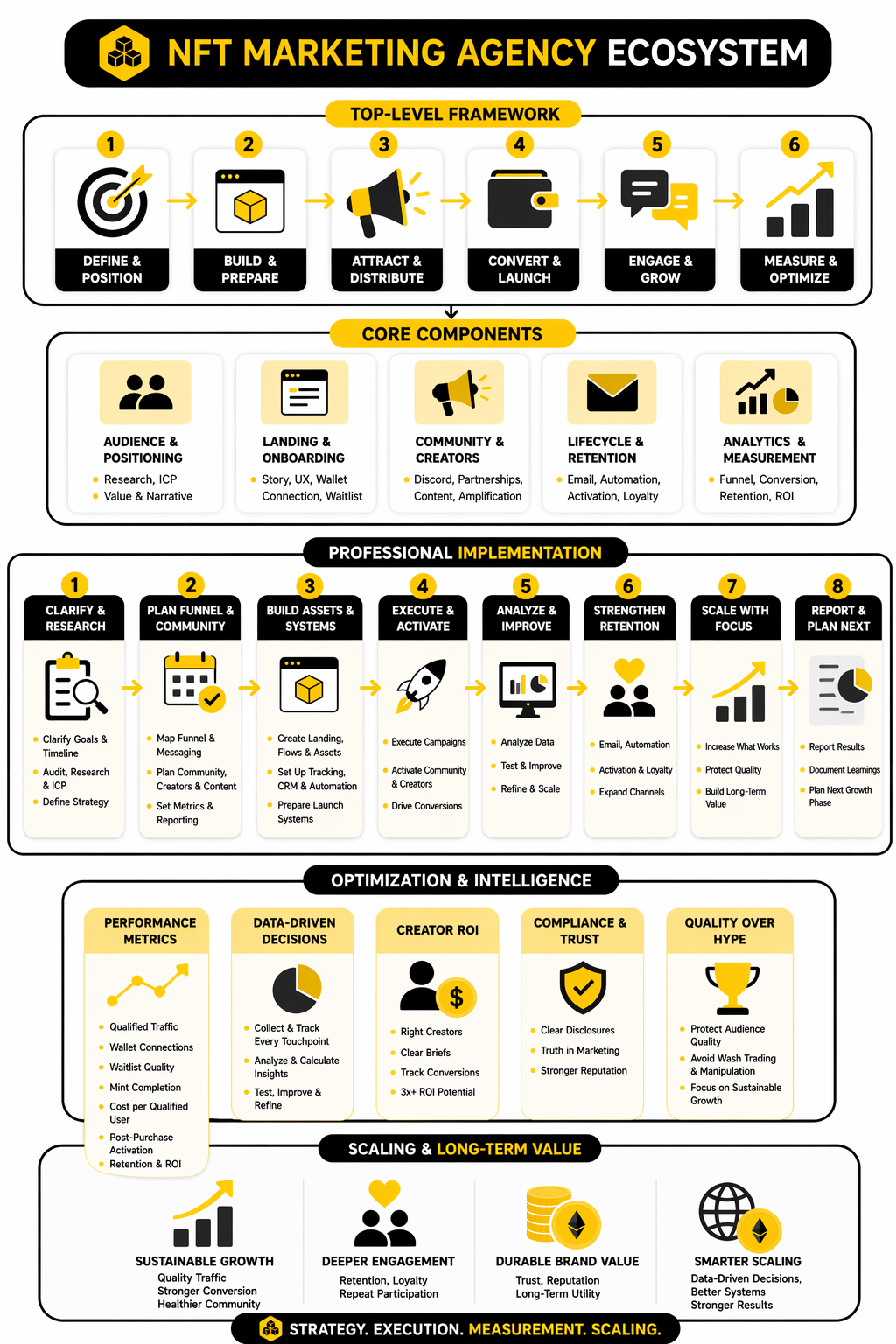
The simplest way to evaluate an nft marketing agency is to stop asking whether it can “promote the drop” and start asking whether it can build a full growth system. The right framework has four moving parts: positioning, distribution, conversion, and retention. If one of those breaks, the campaign might still look active on the surface, but it will not compound.
Positioning comes first because the market is crowded and impatient. An agency has to define why this project should exist now, who it is for, why that audience should care, and what makes the offer different from another collection, loyalty program, gaming asset, or brand activation. Without that clarity, every other marketing input gets more expensive and less effective.
Distribution is the next layer, and this is where most weak agencies overpromise. They treat distribution like a list of creators and paid placements, when in reality it is a coordinated mix of founder content, community loops, earned media, creator partnerships, social content, ecosystem relationships, launch pages, email or DM flows, and post-mint communication. Modern social research keeps pointing in the same direction: consumers reward brands that feel authentic and memorable, which is exactly why the 2025 Sprout Social Index puts so much weight on content quality and meaningful engagement instead of volume alone.
Conversion is where the technical side meets the storytelling side. The user has to understand the offer, trust the process, move from social curiosity to wallet action, and feel that the next step is obvious. That sounds basic, but in Web3 it is still easy to lose people through confusing mint mechanics, weak landing pages, bad onboarding, vague utility, or unclear post-purchase expectations.
Retention is the part that decides whether a project becomes a brand or just a launch event. The strongest agencies think beyond mint day and design reasons to stay, participate, collect, refer, and come back. That matters even more in community-led categories, where platforms like Discord keep expanding commerce and account-linking features because community participation can directly support engagement and revenue growth.
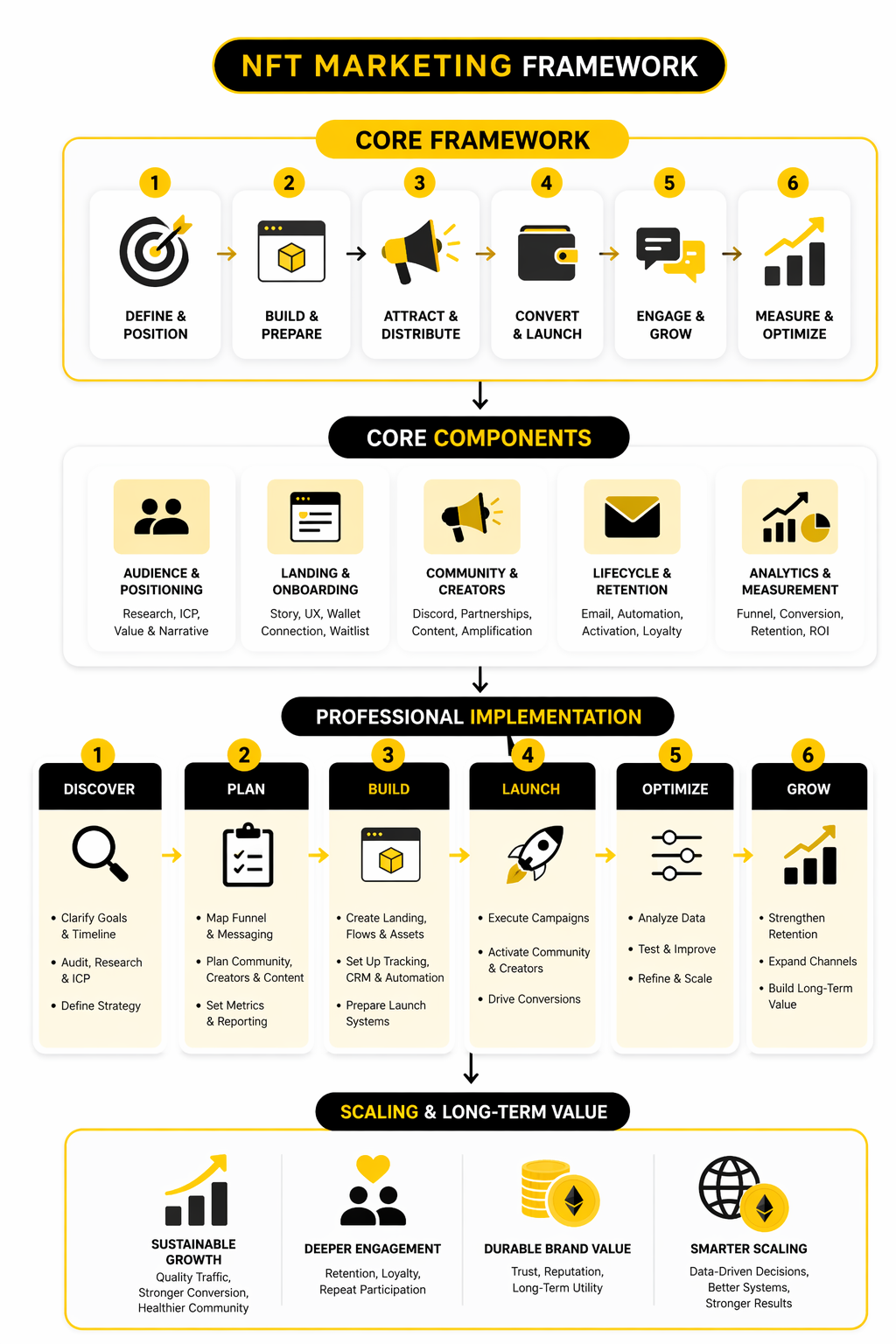
When you look at the category through that lens, the job of an nft marketing agency becomes much clearer. It is not there to manufacture hype for a week. It is there to create a repeatable system that turns attention into trust, trust into action, and action into long-term brand momentum.
Core Services That Actually Move an NFT Project
Once the strategy is clear, the next question is execution. This is where a good nft marketing agency separates itself from a team that only knows how to post threads and book influencer slots. The real work usually happens across offer design, launch infrastructure, creator distribution, paid media, lifecycle retention, and analytics.
Positioning and offer design
A serious agency starts by tightening the offer before it spends a euro on reach. That means clarifying whether the NFT is being sold as access, loyalty, fandom, identity, IP participation, in-game utility, or a hybrid of those angles. If that part is fuzzy, the market feels it immediately, because collectors and customers now compare every launch against stronger, more mature products, not just against other profile-picture drops.
This is also where category fit matters. Research on NFT-driven brand relationships keeps pointing to the same core issue: consumers respond differently when the token feels like a genuine extension of membership or brand value rather than a speculative add-on, which is exactly why recent academic work on NFT-based loyalty programs and brand-customer relationships built around NFTs matters so much. A good nft marketing agency translates that into practical messaging, utility hierarchy, pricing logic, and launch timing.
Landing pages, mint flows, and conversion assets
Most NFT campaigns do not fail because nobody sees them. They fail because too many people see them and still do not understand what to do next. That is why conversion infrastructure matters so much, especially in a category where wallet friction, chain confusion, and unclear utility can kill momentum fast.
The best agencies treat the landing page and mint flow as part of the product, not as a design afterthought. They use clearer copy, better onboarding, stronger FAQ logic, better wallet guidance, stronger proof elements, and simpler action paths. Teams that want sharper pages and faster iteration often rely on tools built for high-converting storefronts and experiences like Replo, because NFT buyers are no more patient than any other ecommerce audience.
Creator partnerships and social distribution
Creator distribution still matters, but the way smart agencies use it has changed. They do not buy random visibility and call that strategy. They build a creator mix that matches the project’s audience, chain, culture, and buying psychology.
That approach lines up with the broader creator economy data. CreatorIQ’s latest report notes that 71% of industry leaders say creator marketing delivers more than 3x ROI, which helps explain why competent NFT teams still invest here. But the key is fit, not volume, and broader social research keeps reinforcing that brands win when content feels more authentic, more distinctive, and more community-aware, as shown in the 2025 Sprout Social Index and HubSpot’s 2025 social media trends research.
A capable nft marketing agency usually builds creator programs in layers. One layer handles reach, another drives credibility inside the niche, and another produces repeatable content that the brand can repurpose across the launch window. That is a much stronger model than paying for one loud post and hoping secondary market demand appears by magic.
Community operations and direct-response systems
Community is still one of the most important assets in NFT marketing, but it should be run like an operating system, not like a chat room. The best agencies design onboarding, moderation, event cadence, status rewards, contributor roles, and feedback loops with the same seriousness other brands give to lifecycle automation. That is how a Discord or Telegram community turns into a trust and retention engine instead of a temporary holding pen for hype.
Direct-response systems matter here too. An nft marketing agency that understands modern retention will often connect X content, Discord activity, email, SMS, and DM follow-up into one lifecycle loop. Tools like ManyChat and GoHighLevel are useful in that stack because they help turn scattered interest into structured follow-up instead of letting leads disappear after the first touch.
Email is still part of that system, and it deserves more respect in Web3 than it usually gets. Litmus shows that email remains a high-return channel, with its 2025 ROI breakdown showing many teams still earning strong returns from lifecycle email, while benchmark datasets from Mailchimp and Klaviyo keep giving marketers channel-specific performance baselines. In plain English, if a project is relying only on social posts and Discord chatter, it is probably leaving money and retention on the table.
Measurement, attribution, and post-launch optimization
The last core service is measurement, and most weak agencies undersell it because it exposes whether the campaign is actually working. Vanity dashboards are easy. Useful reporting is harder, because an NFT project needs to track qualified traffic, allowlist conversion, mint completion, wallet connects, community activation, creator-assisted conversions, retention behavior, and secondary-market signals without pretending they all mean the same thing.
That is why a serious nft marketing agency builds reporting around decision-making. It looks for which narrative drove the best click quality, which creators brought action rather than impressions, which pages leaked trust, and which community touchpoints actually improved conversion. Once that loop is working, the team can stop guessing and start reallocating budget toward the parts of the system that are compounding.
How Agencies Build Trust, Community, and Distribution
The next layer is where many NFT campaigns either become real brands or collapse into noise. Trust, community, and distribution are connected. If one of them is weak, the other two become more expensive and less effective.
Trust has to be designed, not assumed
A lot of Web3 teams still talk as if trust is created by technical features alone. It is not. Trust is built through message clarity, founder visibility, realistic promises, good onboarding, consistent support, transparent roadmaps, and a launch experience that does not make buyers feel tricked or rushed.
That matters even more now because trust has become a central buying filter across the broader market. Edelman’s latest special report shows that trust in brands has risen to 68%, and consumers increasingly expect brands to make them feel safe, competent, and worth following. In NFT terms, that means a good agency does not just create attention. It reduces uncertainty.
Community should create momentum, not just activity
A busy Discord can still be a dead asset if the conversation is shallow and the members are not moving toward action. Smart agencies know that community performance is not measured by raw message count. It is measured by whether the right people join, participate, convert, stay, and advocate.
This is where platform behavior matters. Discord has been pushing harder into account linking, commerce, and retention mechanics because those systems create deeper engagement and incremental revenue opportunities, as shown in its 2026 growth update and social commerce documentation on account linking and item delivery and its March 2026 announcement on engagement and revenue growth for developers. A competent nft marketing agency pays attention to these shifts because they affect how community can connect to actual business results.
Distribution works best when owned, earned, and partnered channels reinforce each other
Weak agencies think distribution is mostly rented attention. Strong agencies know the best launch patterns come from channel overlap. Founder-led content creates clarity, creator partnerships add social proof, community systems deepen trust, and owned channels convert attention into a usable audience the brand can reach again.
That approach fits the social data too. Sprout’s 2025 research shows consumers care most about authenticity, relatability, and entertainment in brand content, while HubSpot’s 2025 findings highlight the growing importance of community and micro-influencers in driving attention that actually feels native instead of forced. The takeaway is simple: distribution gets cheaper when the content already belongs in the feed and already fits the culture of the audience seeing it.
Retention is where the real brand value shows up
If the project disappears emotionally after mint, the marketing was incomplete. A good nft marketing agency thinks about post-purchase value from day one, because that is where referrals, repeat engagement, secondary interest, and brand equity start to build. Without retention, launch performance can look decent for a week and still produce almost no durable outcome.
The strongest recent examples of NFT-style brand execution lean in this direction. Avalanche’s case study on the Cleveland Cavaliers reports that its blockchain-powered fan rewards program drove more than 1 million transactions, which is a much more useful signal than surface-level hype because it ties digital ownership mechanics to repeated behavior. That is the standard agencies should aim for: not just attention, but a system that keeps producing action after the launch window closes.
How to Choose, Brief, and Manage an NFT Marketing Agency
By this point, the difference between a real nft marketing agency and a hype shop should be pretty obvious. The next challenge is operational: how do you actually choose one, get it aligned, and keep it useful once the contract starts. This is where a lot of founders and brand teams make expensive mistakes, because they hire on vibes, confuse activity with progress, and realize too late that nobody agreed on what success meant.
A better approach is to treat the agency selection process like a growth system before the campaign even starts. You want clear goals, defined scope, decision rights, reporting standards, legal guardrails, and a realistic operating rhythm. If those pieces are missing, the relationship usually drifts into reactive content production instead of disciplined execution.
Start with the business goal, not the channel plan
The first thing to lock down is the business objective. Not the platform mix, not the creator wishlist, and not the amount of content you want produced. The actual commercial objective.
That could mean selling out a mint at a specific price point, onboarding a target number of qualified wallets, driving usage of a loyalty experience, filling an allowlist with high-intent users, or increasing post-mint retention over a defined period. A decent nft marketing agency can help refine the route, but the destination should come from the project team.
This matters because scope gets messy fast in Web3. Asana’s 2025 guidance on project briefs keeps the logic simple: the brief should summarize goals, scope, timeline, and audience in a way that keeps everyone aligned from the start, and that basic structure still holds up here even when the campaign itself is more complex than a normal product launch project brief framework. If you cannot write down the business goal clearly, the agency cannot build a clean plan around it.
Use a brief that forces clarity
A strong brief is not corporate paperwork. It is one of the fastest ways to find out whether the project team and the agency are actually talking about the same thing. If the brief is vague, the work will be vague too.
The best briefs for an nft marketing agency usually cover:
- the product or collection and what it really offers
- the target audience and what they already care about
- launch timing and hard deadlines
- chain, wallet, and platform constraints
- legal or claims boundaries
- conversion goals and retention goals
- what the internal team owns versus what the agency owns
That sounds obvious, but most breakdowns happen in those details. Asana’s 2025 project management resources keep pointing back to shared language, scope clarity, and named responsibilities as the baseline for keeping complex campaigns on track marketing project management and project management terms. In NFT marketing, that discipline matters even more because content, community, creators, paid media, and technical launch assets are all tightly linked.
Evaluate proof of execution, not just brand name
A flashy agency deck is not proof. A long client list is not proof either. What you need is evidence that the team understands launches with moving parts, knows how to brief creators, can structure community operations, and can measure something more useful than reach.
Ask for specifics. What did they own in past campaigns. What were the success metrics. How did they handle underperforming channels. What did they change mid-campaign when the first plan stopped working. A credible nft marketing agency should be able to explain process decisions clearly, not hide behind buzzwords.
This is also where you should pay attention to whether the agency speaks in outcomes or in deliverables. Deliverables matter, but they are not the same thing as results. If the conversation stays trapped at the level of posts, spaces, announcements, and influencer drops, you are probably talking to a vendor, not a growth partner.
Make compliance part of the brief, not a legal afterthought
This point is easy to ignore when momentum feels high, and that is exactly why it matters. If creators, ambassadors, or community leaders are promoting the project, disclosure rules and marketing claims have to be handled properly. You do not want to discover halfway through a launch that the campaign has been encouraging sloppy or misleading language.
The FTC’s guidance is direct on this. Material connections between advertisers and endorsers need to be disclosed clearly, and that applies across social media, influencer content, reviews, and sponsored promotion Endorsements, Influencers, and Reviews and FTC’s Endorsement Guides FAQ. For an nft marketing agency, that means creator briefs, approvals, and content workflows should already account for disclosure and claim discipline before anything goes live.
Build the operating rhythm before launch week
This is the part most teams leave too late. They spend weeks debating creative concepts and then try to improvise the actual operating system in the final days before mint. That is when communication breaks, approvals slow down, assets go missing, and nobody is sure who owns the next move.
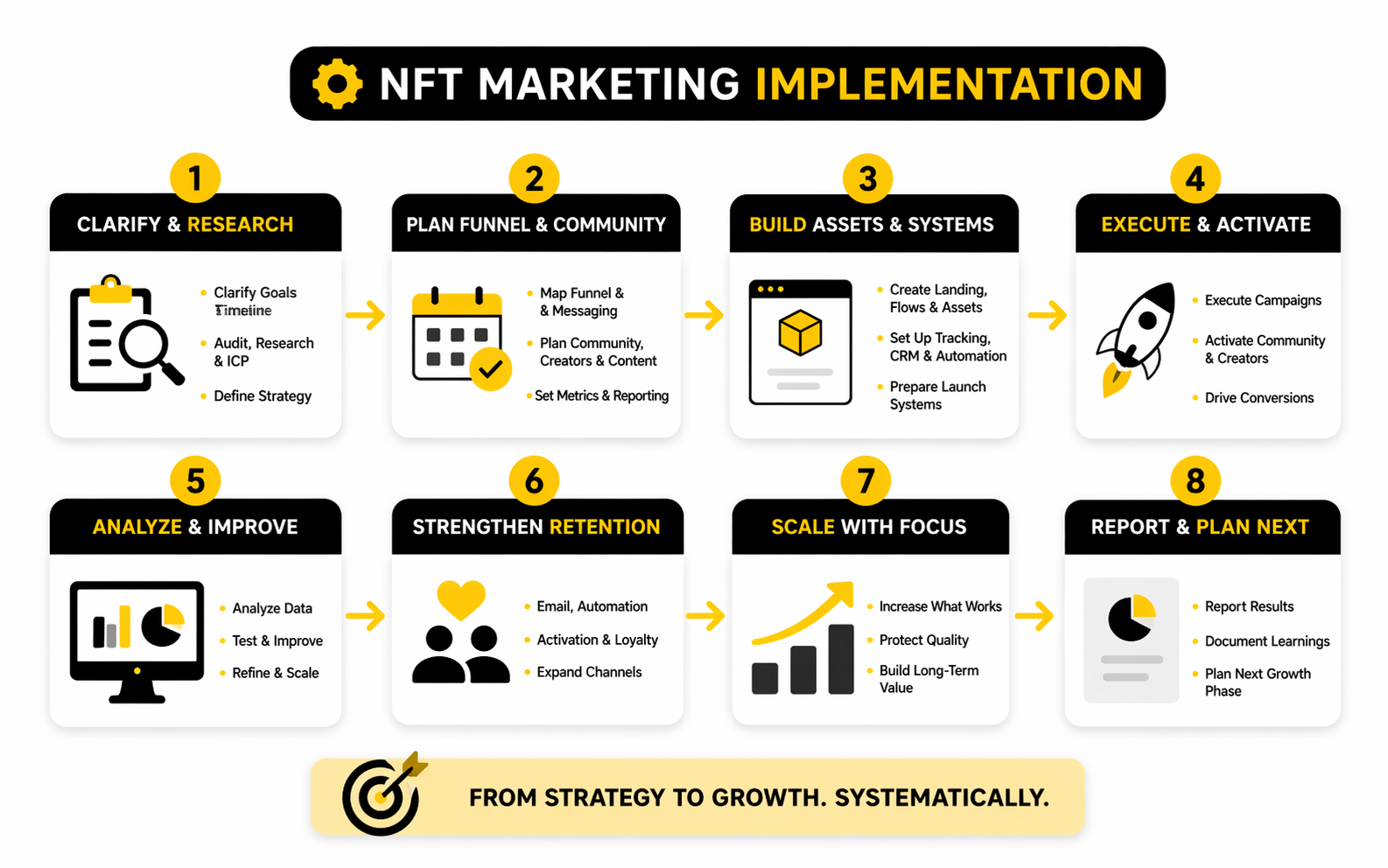
A better model is to set the cadence early. That usually means a weekly planning call, a shared dashboard, named owners for content and approvals, a creator tracking sheet, a community escalation process, and a launch-week war room structure. It does not need to be fancy, but it does need to exist.
A practical rollout usually looks like this:
- strategy alignment and goal setting
- audience and offer refinement
- landing page and mint-path buildout
- creator and distribution planning
- community onboarding and moderation prep
- pre-launch testing and messaging QA
- launch execution and daily optimization
- post-launch retention and reporting
A good nft marketing agency makes that process visible. You should know what happens each week, what gets reviewed, what gets measured, and what triggers a pivot. If you do not have that visibility, you are basically funding a black box.
Choose reporting that helps you make decisions
Reporting should help you decide what to do next. That sounds basic, but plenty of agency dashboards still hide the useful story under piles of surface-level metrics. More impressions are not automatically better. More comments are not automatically better. Even more wallet connects are not automatically better if the quality of those users is weak.
Useful reporting usually ties activity to stage-by-stage movement. Which channels drove qualified traffic. Which creators brought real conversions. Which content themes lifted trust. Where people dropped off in the onboarding flow. Which community actions improved participation after purchase. That is the level where an nft marketing agency becomes genuinely valuable.
This also matches how modern social teams are thinking more broadly about community and durable audience building. Buffer’s 2026 review of social trends highlighted the continued shift toward world-building, smaller communities, and creator businesses that prioritize sustainability over empty scale 2025 social media predictions review. That is exactly the mindset reporting should support: not more noise, but more useful traction.
Manage the agency like a partner, not like a miracle worker
Even a strong nft marketing agency cannot rescue a weak offer, a confused founder narrative, or an unrealistic roadmap. The relationship works best when the project team gives timely approvals, surfaces product changes early, shares actual conversion data, and treats the agency as part of the decision loop instead of as outsourced posting labor.
That also means being honest about what is broken. If the offer is unclear, fix it. If the page is weak, rebuild it. If the creator mix is off, replace it. If the retention system is nonexistent, stop pretending the problem is reach. The best agency relationships improve quickly because both sides are willing to confront reality fast.
When that working relationship clicks, execution gets dramatically stronger. The nft marketing agency is no longer guessing what the founders want, and the founders are no longer wondering whether the agency is doing anything useful. Everyone is working from the same scorecard, the same operating rhythm, and the same idea of what success looks like.
The Numbers That Actually Matter
By the time you are evaluating an nft marketing agency, you need more than screenshots and momentum talk. You need a measurement model that tells you whether attention is turning into qualified demand, whether qualified demand is turning into wallet action, and whether wallet action is turning into durable brand value. That is the difference between a campaign that looks alive online and one that is actually building something commercially useful.
The market data already shows why that distinction matters. The wider dapp ecosystem stayed active with 24 million daily unique active wallets in Q1 2025 and 24.3 million in Q2 2025, while NFT trading volume in Q1 2025 still reached about $1.5 billion. That combination tells you something important: user activity is still there, but the NFT category is more selective, which means weak offers get exposed faster and strong execution matters more.
Market-level numbers are context, not proof
A lot of teams misuse market statistics. They see rising wallet activity or a rebound in NFT sales and assume that demand for their project is somehow guaranteed. It does not work like that.
Category data is useful because it helps you understand timing, market temperature, and buyer behavior. It does not prove that your positioning is sharp, that your funnel is clear, or that your distribution plan is working. A good nft marketing agency uses market data as context for strategy, not as a substitute for campaign performance.
That is also why broad metrics need interpretation. DappRadar itself notes that daily unique active wallets are an engagement indicator, not a one-to-one user count, because one person can operate multiple wallets Q2 2025 industry report. So if an agency throws wallet-based market numbers at you without explaining what they do and do not mean, that is not insight. That is just presentation.
Funnel metrics matter more than vanity metrics
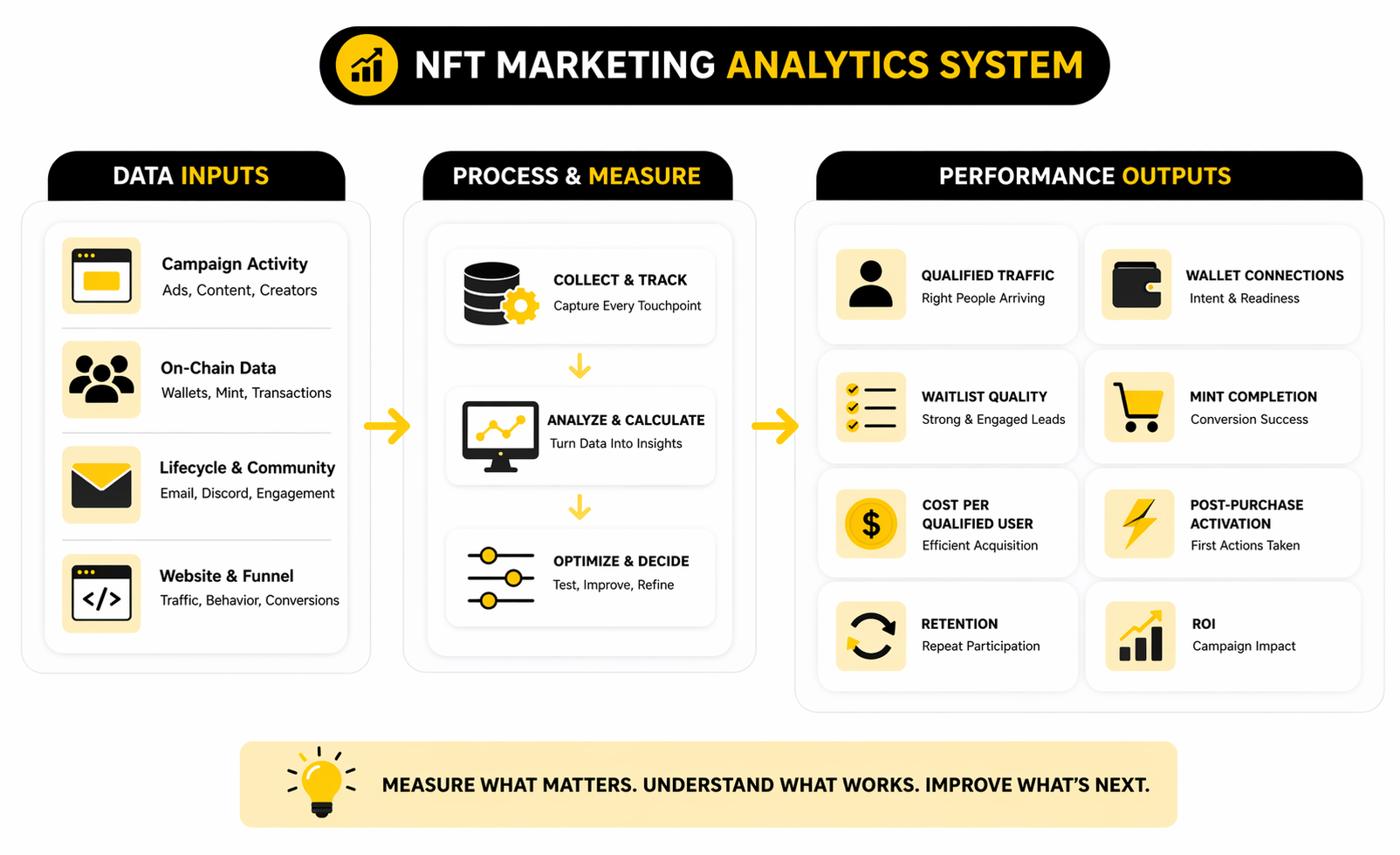
The most useful reporting model for an nft marketing agency follows the user journey. You want to see how many people saw the message, how many clicked, how many qualified themselves, how many connected wallet, how many completed the mint or purchase, and how many stayed active after that first action. Once you can see that flow clearly, your optimization decisions get much easier.
That also means you have to stop overvaluing top-of-funnel noise. Impressions can matter, but they are not enough. Community message volume can matter, but it is not enough. Follower growth can matter, but it is definitely not enough.
The better signal stack usually looks like this:
- content reach and qualified traffic
- landing page click-through and bounce behavior
- wallet connections or sign-up completions
- allowlist or waitlist conversion rate
- mint completion rate
- cost per qualified user, not just cost per click
- post-mint activation and retention
- referral or repeat participation rate
When an nft marketing agency reports on those stages consistently, you can diagnose real problems. If reach is strong but qualified traffic is weak, the message is probably off. If clicks are healthy but wallet connections are poor, the landing page or onboarding flow may be the issue. If mint completion falls off late, trust, price, timing, or technical friction may be the real bottleneck.
Benchmarks help when they are used carefully
Benchmarks are useful, but only when they are treated like directional guides instead of magical standards. This is especially true when NFT projects use email, SMS, and lifecycle messaging around a launch. Those channels are often undervalued in Web3, even though they are some of the clearest ways to recover interest, confirm intent, and improve retention.
Mailchimp’s current benchmark data puts the average email open rate around 34.23% across industries, while its reporting guidance explains how open and click rates should be read together rather than in isolation open and click rate explainer. Klaviyo takes the same practical approach, emphasizing that segmentation and automation are what make benchmark comparisons useful rather than decorative ecommerce benchmark guidance and benchmark feature overview.
The action here is straightforward. If an nft marketing agency is sending broad campaign blasts to everyone and calling that retention, it is behind. Behavioral segmentation, wallet-stage messaging, and launch-specific automation are much stronger indicators of maturity. That is one reason tools built around lifecycle orchestration, such as GoHighLevel, ManyChat, and Brevo can fit naturally into a smarter execution stack when the team actually uses them well.
Creator and community metrics need harder standards
This is another area where reporting often gets lazy. Agencies love to report creator reach, social mentions, and community growth because those numbers usually look impressive in a deck. The problem is that they do not automatically tell you whether the project gained trust, gained buyers, or gained a more valuable audience.
A better standard is to ask what each creator or community initiative changed. Did a creator drive high-quality traffic. Did their audience connect wallet. Did that traffic convert better than paid social. Did community onboarding improve activation. Did certain events increase holder retention or repeat participation. Those are answerable questions if the agency is actually tracking the journey.
Industry creator data supports that deeper approach. CreatorIQ’s latest state-of-the-market report shows 71% of leaders reporting more than 3x ROI from creator marketing, but that does not mean every creator deal works. It means the channel can perform exceptionally well when selection, brief quality, tracking, and audience fit are handled properly. So the takeaway is not “buy more creator posts.” The takeaway is “measure creators like revenue contributors, not like decoration.”
Retention metrics are where the truth comes out
Launch-day numbers get the attention, but retention numbers tell you whether the brand is real. If people mint and disappear, the campaign may still generate a spike in vanity metrics, but it did not create a durable asset. A serious nft marketing agency should be able to talk about retention with the same confidence it talks about launch reach.
This is exactly why brand-led blockchain activations are more interesting when they show repeated behavior rather than one-time noise. Avalanche’s Cleveland Cavaliers case study reports more than 1 million transactions, which matters because it points to repeated use inside a fan rewards ecosystem, not just launch excitement. That is the kind of signal sophisticated teams should care about.
Retention metrics can include repeat visits, holder participation in gated experiences, event attendance, email re-engagement, referral activity, loyalty actions, or secondary behaviors linked to the original campaign. The specific metric depends on the project model, but the principle stays the same: measure what proves continued relationship, not just first contact.
What the data should make you do next
Metrics are only useful if they drive decisions. That sounds obvious, but too many agency reports end with observations instead of actions. A proper reporting system should tell you what to keep, what to cut, what to rewrite, what to automate, and where to spend the next unit of budget.
In practice, the decision rules are usually pretty simple:
- high reach and low qualified traffic means the message is attracting the wrong people
- high traffic and low wallet progression means the conversion path is confusing or unconvincing
- strong creator engagement and weak conversion means the creator fit or offer framing is off
- decent mint conversion and weak retention means the post-purchase experience is underbuilt
- healthy owned-channel response and poor paid performance may mean the audience trust gap is wider than expected
That is how an nft marketing agency should work with data. Not as a way to justify effort after the fact, but as an operating system for improvement. When the numbers are interpreted correctly, they stop being a reporting ritual and start becoming a real advantage.
Advanced Tradeoffs, Risks, and Scaling Decisions
Once the basics are working, the harder questions start. This is the stage where an nft marketing agency has to think less like a launch team and more like an operator. The challenge is no longer just getting attention. It is deciding which kinds of growth are actually worth buying, which metrics can be trusted, and how far the campaign can scale before the original story starts breaking.
Growth can become low-quality faster than most teams expect
The first scaling problem is audience quality. A campaign can expand reach, increase impressions, and fill the top of the funnel while quietly getting worse at attracting the right people. That happens a lot in NFT marketing because the category still draws curiosity, speculation, opportunism, and low-intent traffic all at once.
This is where a strong nft marketing agency earns its keep. It has to protect the signal. That means refusing cheap traffic that will not convert, being selective with creator partnerships, and keeping the message tight enough that the wrong audience filters itself out. Bigger numbers are not better if they make the community weaker, the conversion rate lower, and the post-launch relationship more fragile.
Secondary-market noise can distort the whole strategy
One of the biggest traps in NFT marketing is treating secondary-market activity as pure proof of brand strength. Sometimes it is a healthy sign of demand. Sometimes it is a distorted signal driven by speculation, coordination, or short-term flipping behavior.
That is not a theoretical risk. Chainalysis reported in January 2025 that suspected wash trading on select blockchains may account for up to $2.57 billion in trading volume. For any nft marketing agency, that should force a more careful reading of marketplace spikes. Volume alone does not tell you whether the brand is strengthening or whether the market is simply generating misleading activity.
The practical move is to separate trading behavior from customer behavior. If secondary volume rises but community retention, direct traffic quality, and owned-channel engagement stay flat, the project may be seeing market churn rather than real brand growth. That should change how budget is allocated and how success is framed internally.
Compliance risk grows with scale, not just with visibility
A smaller campaign can get away with messy processes for a while. A larger one usually cannot. As soon as more creators, ambassadors, affiliates, or paid partners enter the system, the chance of sloppy claims and weak disclosure rises fast.
That is why compliance cannot stay trapped in a legal folder nobody reads. The FTC’s endorsement guidance is very clear that material connections need to be disclosed and that the same truth-in-advertising rules apply across social and influencer formats endorsement guidance and FAQ on disclosure expectations. A growing nft marketing agency operation needs creator briefs, approval workflows, and internal review standards that get stricter as distribution widens.
The same goes for message discipline. The more aggressively a campaign scales, the more tempting it becomes to oversell future value, implied upside, or roadmap certainty. That is exactly where experienced teams slow down, tighten the language, and protect the brand from making short-term growth decisions that create long-term damage.
Channel dependence is a hidden strategic weakness
Another scaling mistake is overbuilding on one platform. A project that depends almost entirely on X, Discord, one marketplace, or one creator cluster may feel efficient at first, but it is fragile. One algorithm shift, one platform policy change, one creator controversy, or one community slowdown can knock the whole system off balance.
That is why mature NFT operators build layered distribution. Discord itself has been pushing account linking and social commerce tools because connected ecosystems improve onboarding and monetization across environments rather than keeping brands trapped in one surface social commerce tools and growth tools update. The broader lesson is simple: the more portable your audience and data become, the stronger your marketing becomes.
For an nft marketing agency, that means turning rented attention into owned relationships wherever possible. Email, SMS, direct messaging, gated communities, waitlists, CRM workflows, and wallet-linked customer journeys matter because they reduce platform dependence. They also make future launches cheaper and more predictable.
Not every project should scale the same way
This is an advanced point, but it matters. Some NFT projects should expand breadth. Others should go deeper with a smaller, more committed audience. The right choice depends on the offer, the economics, and the long-term role the NFT plays in the brand.
A fan rewards program, for example, may benefit from broad participation and repeated low-friction actions. A premium art or membership project may do better by preserving curation, scarcity, and tighter cultural fit. A gaming asset ecosystem may need sustained onboarding improvements more than aggressive awareness. A capable nft marketing agency should be able to tell the difference instead of applying the same “more reach, more creators, more spend” template everywhere.
That point is backed by recent market behavior. DappRadar’s Q3 2025 report showed NFT trading volume climbing to $1.58 billion with 18.1 million NFTs sold, but category growth was not evenly distributed. Sports NFTs surged particularly fast in that period, which is a reminder that sector context matters. Scaling the wrong way inside the wrong niche can still waste money even when the broader market is improving.
Operational complexity becomes a real bottleneck
As campaigns scale, coordination starts to matter almost as much as strategy. More creators, more assets, more stakeholders, more approvals, more community layers, and more lifecycle automation all create hidden drag. If the operating model is weak, the campaign becomes slower exactly when it needs to become sharper.
This is usually where founders start feeling that the agency is underperforming, when the deeper issue is that the whole system is overloaded. A strong nft marketing agency will notice this early. It will simplify decision-making, reduce channel clutter, narrow the content themes, and make the reporting structure more practical. Scaling is not just about adding resources. It is often about removing friction.
The smartest teams also invest more in workflow and customer infrastructure at this stage than they did during the initial launch. That can mean better segmentation, cleaner intake forms, stronger follow-up systems, or more reliable lifecycle tooling. Products like Fillout, GoHighLevel, and Copper fit this stage well when the goal is operational clarity rather than just more promotion.
The best agencies know when to say no
This is probably the clearest sign of senior judgment. A weak nft marketing agency says yes to every launch date, every creator request, every paid push, and every expansion plan. A strong one knows when a campaign is premature, when the positioning is not ready, when the funnel is too weak to scale, or when the retention plan is too thin to justify a bigger push.
That kind of restraint matters because the market is still noisy, scams are still a real drag on trust, and user skepticism is rational. Chainalysis reported that cryptocurrency scams received at least $14 billion on-chain in 2025, which is one more reason serious teams have to work harder to earn confidence instead of trying to borrow it. In practice, that means better education, cleaner onboarding, better disclosures, and more realistic marketing promises.
At the expert level, that is what separates performance from theater. The agency is not there to make the project look busy. It is there to help the project grow without losing credibility, wasting budget, or scaling the wrong thing. That is the real tradeoff, and it is where most of the long-term value gets decided.
Where NFT Marketing Is Headed Next
The last thing worth saying is that the role of an nft marketing agency is getting broader, not narrower. A few years ago, many agencies could get by with launch theatrics, influencer bursts, and community hype. That is not enough anymore, because the market is steadily moving toward utility, loyalty, gaming, fandom, and measurable customer relationships rather than pure collectible speculation.
You can see that shift in the way the ecosystem keeps evolving. DappRadar’s late-2025 reporting showed 10.1 million NFT sales in October 2025, while brand and fan-engagement use cases kept gaining credibility through examples like the Cleveland Cavaliers’ blockchain rewards program with more than 1 million transactions. For founders and operators, that means the future is less about manufacturing scarcity and more about building systems people actually want to use repeatedly.
The agencies that survive this shift will be the ones that can connect brand strategy, lifecycle marketing, creator distribution, community mechanics, compliance discipline, and product thinking into one operating model. In other words, the job is becoming more demanding, but also more valuable. If you are hiring an nft marketing agency now, that is the standard to use.
FAQ
What does an nft marketing agency actually do?
A real nft marketing agency does much more than promote a mint. It helps define the offer, sharpen the positioning, build the landing and onboarding flow, coordinate creators, manage community systems, set up retention, and measure what is working. The point is not just to get attention, but to turn attention into trust, conversion, and continued participation.
When should a project hire an nft marketing agency instead of building in-house?
You hire an nft marketing agency when speed, specialist knowledge, or distribution access matters more than keeping every task internal. That is especially true when the team lacks experience with creator partnerships, Discord operations, launch sequencing, wallet onboarding, or lifecycle automation. If the internal team already has strong operators in all those areas, an agency may be less important than a sharp consultant or an in-house growth lead.
How much should an nft marketing agency influence the product or offer?
More than most founders expect, but not in a controlling way. If the agency sees weak positioning, confusing utility, or a broken conversion path, it should absolutely speak up because marketing cannot sustainably compensate for a weak offer. The best agency relationships work when the team is allowed to challenge the funnel, message, and user experience instead of being limited to content production.
What is the biggest red flag when hiring an nft marketing agency?
The biggest red flag is when the agency sells hype without talking seriously about conversion, retention, or measurement. If it leads with follower counts, influencer access, and guaranteed buzz while staying vague on reporting and process, that is usually a bad sign. You want a team that can explain what it will test, what it will measure, what it will own, and how it will adapt if the first plan underperforms.
Which metrics matter most in NFT marketing?
The most useful metrics are the ones that show movement through the funnel. Qualified traffic, wallet connections, waitlist quality, mint completion, cost per qualified user, post-purchase activation, and retention tell you far more than views or impressions on their own. Market-level numbers can still help with context, but they are not the same thing as campaign proof, which is why reports like DappRadar’s Q1 2025 industry update and Q2 2025 industry update are useful for timing and category context rather than for validating a specific agency.
Is influencer marketing still worth it for NFT projects?
Yes, but only when it is treated as a quality channel instead of a volume game. CreatorIQ’s current market data shows 71% of industry leaders saying creator marketing delivers more than 3x ROI, which is strong evidence that the channel still works. The catch is that the brief, audience fit, tracking, and content quality have to be right, otherwise creator spend just buys noisy traffic.
How important is compliance in NFT marketing campaigns?
It is extremely important, and it becomes more important as the campaign gets bigger. The FTC makes it clear that material connections in endorsements and influencer marketing need to be disclosed properly, and those rules apply to social posts, reviews, and sponsored content endorsement guidance and endorsement FAQ. A competent nft marketing agency should already have creator briefing standards, approval workflows, and message guardrails built into the campaign.
How do you know whether community growth is real?
You look beyond message count and member count. Real community growth shows up in onboarding quality, repeat participation, event attendance, conversion behavior, and retention after the initial excitement fades. If a Discord looks active but very little of that activity connects to sign-ups, mints, referrals, or product usage, the project may have conversation without momentum.
What tools should an nft marketing agency typically use?
That depends on the campaign model, but the stack usually includes landing-page software, CRM or lifecycle automation, community tools, reporting systems, and creator workflows. For some teams, a combination like Replo, ManyChat, and GoHighLevel makes sense because it covers conversion assets, direct-response messaging, and lifecycle follow-up. The important point is not the logo stack itself, but whether the tools are tied together into a measurable system.
Can traditional brands benefit from hiring an nft marketing agency, or is this only for Web3-native projects?
Traditional brands can absolutely benefit, but only if the NFT or tokenized experience serves a real customer purpose. That is why the stronger recent use cases tend to be loyalty, fandom, access, and gaming-related participation rather than abstract collectible campaigns. Brand research on NFTs keeps moving in that direction too, including recent work on NFTs in brand experience design and NFT-based brand-customer relationships.
How long does it usually take to see results from an nft marketing agency?
You can see early signals quickly, but meaningful judgment takes longer than many teams want. Messaging response, landing-page engagement, creator traction, and waitlist quality can become visible within weeks, while stronger retention signals take more time because they depend on what happens after launch. The mistake is expecting one week of noise to prove the entire model; the smarter move is to evaluate the funnel stage by stage.
What should a founder prepare before talking to an nft marketing agency?
A founder should walk in with a clear product story, target audience hypothesis, business objective, timeline, basic budget range, and honest view of what is not working yet. That gives the agency something real to evaluate instead of forcing it to guess from fragments. The clearer the inputs, the easier it is to tell whether the agency has real strategic depth or just polished sales language.
Is marketplace volume still a reliable success metric?
It can be useful, but it should never stand alone. Chainalysis reported in early 2025 that suspected wash trading on select blockchains may account for up to $2.57 billion in volume, which tells you exactly why raw trading activity needs context. If an nft marketing agency celebrates secondary volume without checking retention, owned-channel response, and customer quality, it is reading the market too shallowly.
Work With Professionals
Explore 10K+ Remote Marketing Contracts on MarkeWork.com
Most marketers spend too much time chasing clients, competing on crowded platforms, and losing a percentage of every project to middlemen. MarkeWork gives you a better way. Browse thousands of remote marketing contracts and connect directly with companies desperate to hire skilled marketers like you, without platform commissions and without unnecessary gatekeepers.
If you're serious about finding better opportunities and keeping 100% of what you earn, explore available contracts and create a profile for free at MarkeWork.com.