

Email marketing has quietly become one of the highest ROI channels in digital marketing. While flashy platforms come and go, email continues to outperform, with data showing an average return of $36 for every $1 spent. That kind of efficiency forces a serious question: who is actually powering those results behind the scenes?
The answer is almost always an email marketing service provider. But not all providers are built the same. Some are designed for simple newsletters, while others operate as full-scale growth engines that handle automation, segmentation, and revenue tracking at a deep level.
Choosing the wrong provider doesn’t just slow you down. It can quietly destroy deliverability, limit personalization, and cap your revenue potential. Choosing the right one, on the other hand, unlocks a system that compounds over time.
This article breaks down exactly how to approach that decision.
Article Outline
- Why Email Marketing Service Providers Matter More Than Ever
- What an Email Marketing Service Provider Actually Does
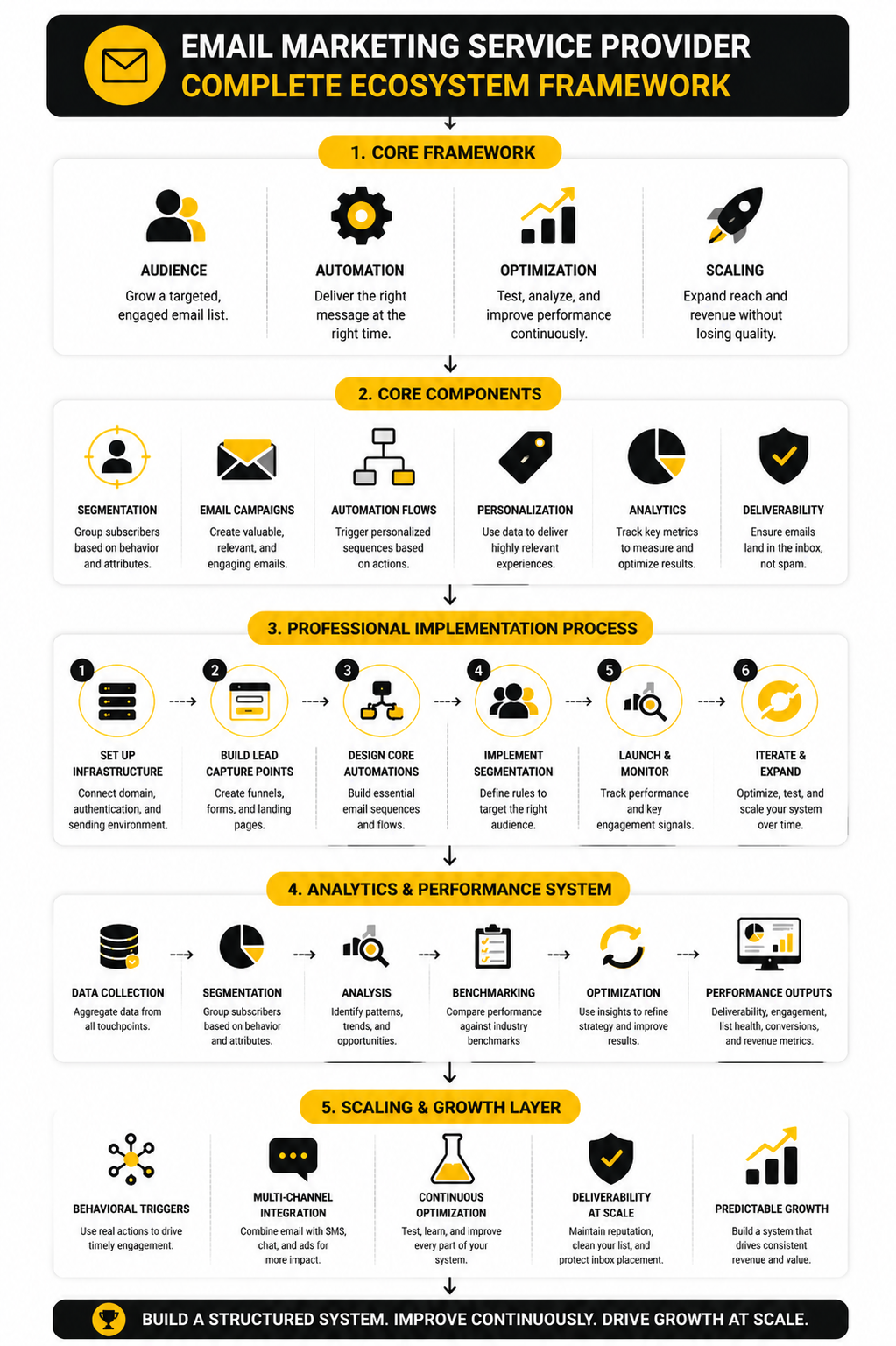
- The Framework Behind Modern Email Marketing Systems
- Core Components Every Provider Should Offer
- How Professionals Implement Email Marketing at Scale
- Choosing the Right Provider for Your Business Goals
Why Email Marketing Service Providers Matter More Than Ever
Email marketing isn’t just surviving in the age of social media and AI-driven ads. It’s dominating in ways most people underestimate. Platforms change algorithms overnight, but your email list remains a direct asset you control.
Recent benchmarks show that email consistently outperforms paid social in conversion rates, often by multiple factors depending on the industry. That reliability comes down to ownership. You’re not renting attention — you’re building it.
This is exactly where an email marketing service provider becomes critical. Without the right infrastructure, even a large list becomes ineffective. Poor deliverability, weak segmentation, and lack of automation can turn a valuable audience into dead weight.
The difference between basic and advanced providers is especially visible in growth stages. Early on, almost any tool works. But as soon as you scale, the limitations show up fast — missed revenue opportunities, poor timing, and inability to personalize at scale.
What an Email Marketing Service Provider Actually Does
At its core, an email marketing service provider is more than a sending tool. It’s a system that manages relationships with your audience across the entire lifecycle.
That includes:
- capturing leads
- storing and organizing contact data
- automating communication sequences
- tracking engagement and conversions
- optimizing deliverability
Modern platforms like Brevo or Moosend have evolved far beyond simple email blasts. They now integrate behavioral data, predictive analytics, and cross-channel messaging into one unified system.
The real value comes from orchestration. Instead of sending isolated campaigns, you build automated journeys that respond to user behavior in real time. That means welcome sequences, abandoned cart flows, re-engagement campaigns, and post-purchase follow-ups all running simultaneously.
Without a structured provider, this level of coordination simply isn’t possible.
The Framework Behind Modern Email Marketing Systems
Understanding how an email marketing service provider works internally helps you make better decisions. Most high-performing systems follow a structured framework that connects data, automation, and messaging.
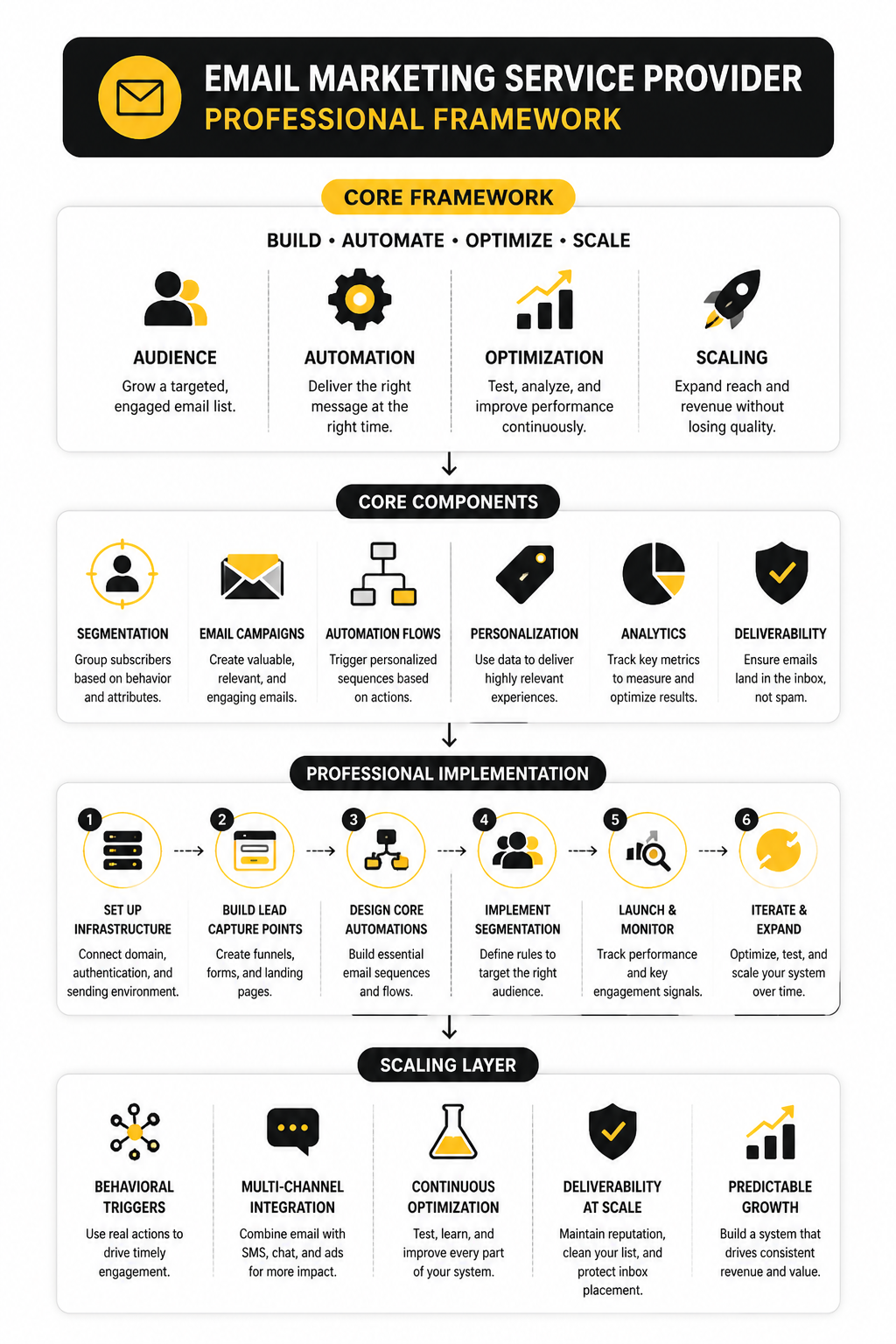
At a high level, the framework looks like this:
- Acquisition Layer
This is where leads enter your ecosystem. Forms, landing pages, and integrations feed data into your system. Tools like ClickFunnels or Systeme.io often play a major role here.
- Data & Segmentation Layer
Once captured, contacts are organized based on behavior, demographics, and engagement. This is where advanced providers separate themselves. Segmentation directly impacts open rates, click rates, and ultimately revenue.
- Automation Engine
This is the core system that triggers emails based on user actions. Whether someone clicks a link, abandons a cart, or hasn’t opened an email in 30 days, the automation engine reacts instantly.
- Delivery & Optimization Layer
Deliverability, timing, and testing all happen here. The best providers constantly optimize send times and maintain strong sender reputations.
- Analytics & Feedback Loop
Every action feeds back into the system. Open rates, click behavior, and conversions refine future campaigns automatically.
When this framework is fully implemented, email marketing stops being a task and becomes a system that scales with minimal manual effort.
Core Components Every Provider Should Offer
Not every email marketing service provider delivers the same level of functionality. If you’re evaluating options, certain components are non-negotiable.
Advanced Automation Capabilities
Automation is no longer optional. It’s the backbone of modern email marketing. Providers should allow multi-step workflows triggered by user behavior, not just simple time-based sequences.
Platforms like GoHighLevel push this further by combining CRM, automation, and communication into one system. That level of integration reduces friction and increases execution speed.
Strong Deliverability Infrastructure
Even the best campaigns fail if emails don’t reach the inbox. Deliverability depends on sender reputation, authentication protocols, and infrastructure quality.
Top providers invest heavily in maintaining relationships with ISPs and optimizing sending patterns. This is one of the least visible but most critical features.
Deep Segmentation and Personalization
Generic emails are losing effectiveness fast. Segmentation allows you to send the right message to the right person at the right time.
Behavior-based targeting — like sending different emails to users who clicked vs. those who didn’t — dramatically improves performance. This is where basic tools fall apart and advanced providers shine.
Integration Ecosystem
Your email marketing service provider should connect seamlessly with your broader stack. That includes landing page builders, CRMs, analytics tools, and messaging platforms.
For example, combining email with chat automation tools like ManyChat creates a multi-channel communication system that increases engagement across touchpoints.
This is where most businesses hit a ceiling. They either outgrow their provider or never fully utilize the system they already have. The next part breaks down how professionals actually implement these tools to drive measurable growth.
How Professionals Implement Email Marketing at Scale
Most businesses don’t fail at email marketing because of bad ideas. They fail because they never move beyond basic campaigns. Professionals treat an email marketing service provider as infrastructure, not just a tool, and that shift changes everything.
At scale, the focus moves from sending emails to designing systems. Every message, trigger, and segment becomes part of a larger machine that runs continuously in the background. This is where real leverage comes from.
Building a Lifecycle-Based System
Professional setups always start with lifecycle thinking. Instead of random campaigns, emails are mapped to specific stages of the customer journey.
That typically includes:
- Lead acquisition sequences that introduce and educate
- Activation sequences that drive the first key action
- Revenue sequences focused on conversion
- Retention and loyalty flows that increase lifetime value
Each stage has its own logic and messaging. When implemented correctly, users move naturally from one phase to another without manual intervention.
Platforms like GoHighLevel are often used here because they combine CRM data with automation logic. That allows businesses to trigger emails based on real pipeline movement, not just superficial actions like opens or clicks.
Leveraging Behavioral Triggers Instead of Time-Based Campaigns
Basic email marketing relies heavily on time delays. You sign up, wait two days, get an email. Wait three more days, get another. It works, but it’s inefficient.
Professionals shift to behavior-driven automation. Emails are triggered by what users actually do:
- visiting key pages
- clicking specific links
- abandoning a cart
- engaging with previous emails
- becoming inactive
This creates relevance at scale. Instead of guessing timing, the system responds instantly to user intent.
Advanced providers like Brevo allow for event-based automation that ties directly into user behavior across channels. That’s where engagement starts to compound.
Combining Email With Multi-Channel Touchpoints
Email doesn’t operate in isolation anymore. High-performing systems integrate multiple channels into one cohesive experience.
That often includes:
- SMS follow-ups
- chat automation
- retargeting ads
- CRM-driven notifications
For example, pairing email with chat automation tools like ManyChat allows you to capture attention in different contexts. Someone who ignores an email might respond instantly to a message on another platform.
The key is orchestration. All channels should share data and work toward the same outcome, not compete for attention.
Continuous Optimization Through Data Feedback
Professionals don’t “set and forget” email systems. They treat them as evolving assets that improve over time.
Every part of the system is tested and refined:
- subject lines
- send times
- segmentation logic
- offer positioning
- email frequency
Small improvements compound fast. Even a modest increase in open rate or click-through rate can translate into significant revenue gains when applied across thousands of subscribers.
An effective email marketing service provider makes this process easier by centralizing analytics and enabling quick iteration. Without that visibility, optimization becomes guesswork.
Scaling Without Breaking Deliverability
One of the biggest mistakes during growth is pushing volume too fast. Sending more emails doesn’t automatically mean more revenue. In fact, it often damages sender reputation if done incorrectly.
Professionals scale carefully by:
- warming up domains and IP addresses
- maintaining consistent sending patterns
- cleaning inactive subscribers regularly
- monitoring spam complaint rates
Deliverability is fragile, and once it drops, recovery can take months. That’s why experienced teams treat it as a core priority, not an afterthought.
Tools like Moosend include built-in deliverability monitoring, which becomes increasingly valuable as your list grows.
At this point, the difference becomes clear. A basic setup sends emails. A professional setup builds a system that drives predictable revenue.
The next step is understanding how to choose the right email marketing service provider based on your specific business model, growth stage, and long-term goals.
Choosing the Right Provider for Your Business Goals
By this point, the gap between basic usage and professional implementation should be obvious. But here’s where most people still get stuck: choosing the right email marketing service provider for their specific situation.
This decision isn’t about picking the “best” platform. It’s about picking the one that aligns with how you actually operate, how fast you plan to grow, and how complex your system needs to become.
Start With Your Growth Stage, Not Features
Most comparisons focus on features. That’s the wrong starting point. What matters more is your current growth stage.
If you’re early, you need speed and simplicity. You want to launch quickly, capture leads, and start building automated sequences without friction. Tools like Systeme.io or Brevo work well here because they reduce setup complexity while still offering solid automation.
If you’re scaling, the equation changes. You need deeper segmentation, multi-channel orchestration, and stronger CRM integration. That’s where platforms like GoHighLevel become more relevant because they’re built for operational control, not just campaigns.
Choosing a tool that’s too advanced too early slows you down. Choosing one that’s too simple later caps your growth.
Match the Provider to Your Business Model
Different business models require different email strategies, and your provider should reflect that.
- Ecommerce businesses need strong behavioral tracking, abandoned cart flows, and product-based segmentation.
- Service businesses rely more on lead nurturing, appointment booking, and CRM integration.
- Content-driven businesses need flexible broadcasting, audience tagging, and engagement tracking.
There’s no universal solution. A platform that works perfectly for an ecommerce brand might feel restrictive for a service-based business.
This is why understanding your own system matters more than reading feature lists. The email marketing service provider should support your workflow, not force you to adapt to it.
Evaluate the Ecosystem, Not Just the Tool
An email platform doesn’t exist in isolation. It sits inside a broader stack that includes landing pages, funnels, CRM systems, and communication tools.
If your provider doesn’t integrate cleanly, you end up stitching together disconnected systems. That leads to data gaps, broken automations, and wasted time.
For example, pairing funnel builders like ClickFunnels with a compatible email system creates a smoother acquisition-to-conversion pipeline. The same applies when connecting chat tools like ManyChat for multi-channel engagement.
The goal is simple: everything should talk to everything else.
Prioritize Deliverability and Control
A lot of platforms look similar on the surface. The real difference shows up in areas most people ignore — deliverability and control.
If your emails don’t land in the inbox, nothing else matters. Strong providers actively manage sender reputation, authentication protocols, and sending infrastructure.
Control matters just as much. You should be able to define segmentation rules, build complex automations, and access meaningful data without hitting limitations.
This is where cheaper or entry-level tools often fall short. They work fine until you need flexibility. Then the constraints become obvious.
The Step-by-Step Implementation Process
Once you’ve chosen your email marketing service provider, execution becomes the priority. This is where ideas turn into systems that actually drive results.
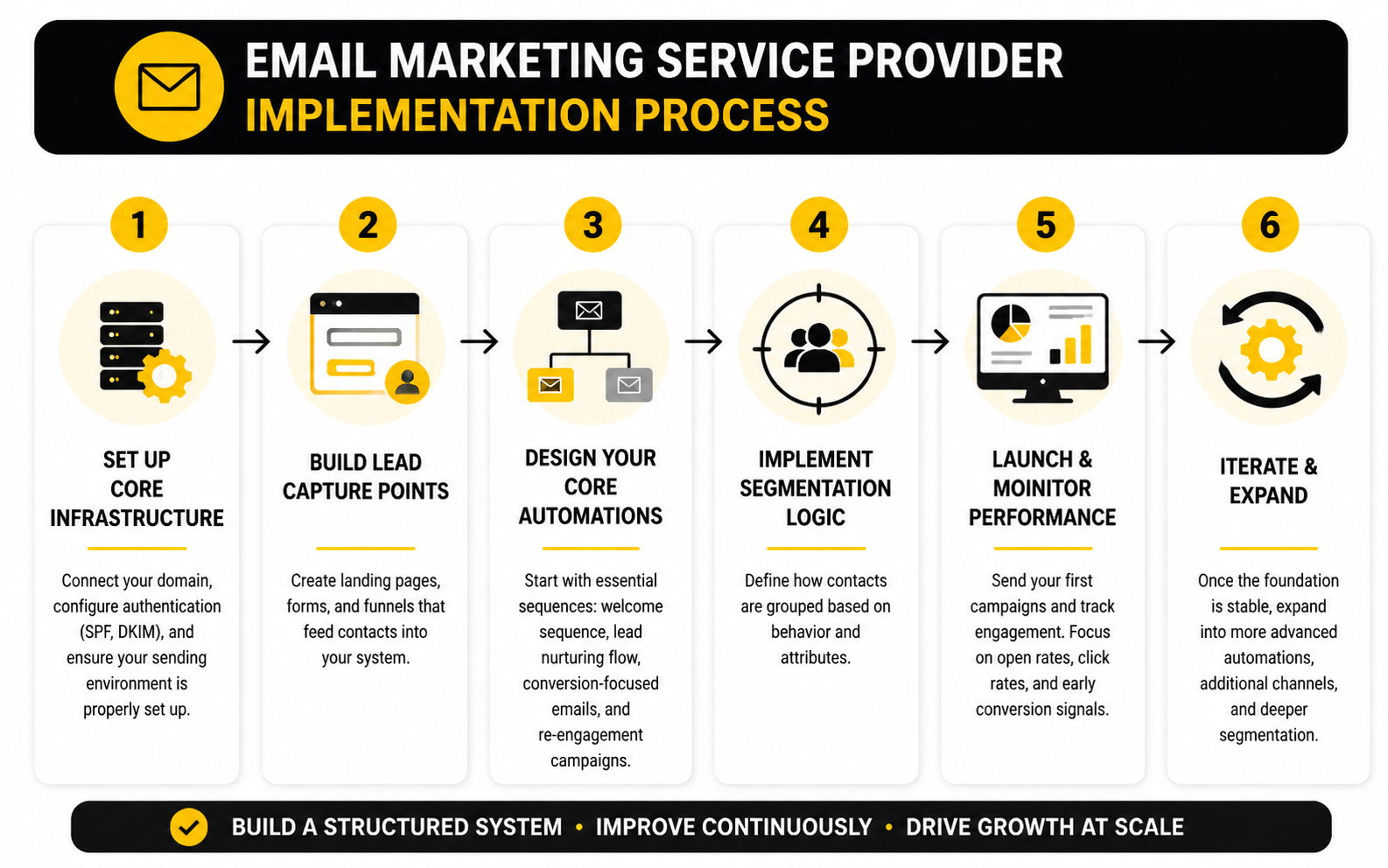
A practical implementation process looks like this:
- Set Up Core Infrastructure
Connect your domain, configure authentication (SPF, DKIM), and ensure your sending environment is properly set up. This step directly impacts deliverability from day one.
- Build Lead Capture Points
Create landing pages, forms, and funnels that feed contacts into your system. Tools like Systeme.io or ClickFunnels are commonly used here.
- Design Your Core Automations
Start with essential sequences:
- welcome sequence
- lead nurturing flow
- conversion-focused emails
- re-engagement campaigns Keep it simple at first. Complexity comes later.
- Implement Segmentation Logic
Define how contacts are grouped based on behavior and attributes. This is what allows personalization at scale.
- Launch and Monitor Performance
Send your first campaigns and track engagement. Focus on open rates, click rates, and early conversion signals.
- Iterate and Expand
Once the foundation is stable, expand into more advanced automations, additional channels, and deeper segmentation.
This process removes guesswork. Instead of randomly sending emails, you build a structured system that improves over time.
At this stage, you have both the strategy and the execution model. The final pieces come down to refining your system, avoiding common mistakes, and turning your email marketing service provider into a long-term competitive advantage.
Email Marketing Performance Data That Actually Matters
Once your system is running, the real leverage comes from understanding the data behind it. Most people look at email metrics in isolation, but professionals treat them as signals inside a larger system.
An email marketing service provider gives you access to dozens of metrics. The mistake is tracking everything without knowing what actually drives growth. What matters is not just the numbers, but what they reveal about user behavior and system performance.
The Core Metrics You Should Actually Care About
There are a handful of metrics that consistently determine whether your email system is working or not. Everything else is secondary.
- Open rate shows whether your subject line and sender reputation are strong enough to earn attention
- Click-through rate (CTR) reveals whether your message and offer resonate
- Conversion rate tells you if the system is actually generating revenue or outcomes
- Unsubscribe rate signals whether your messaging is misaligned or over-saturated
- Spam complaint rate directly impacts deliverability and long-term viability
These metrics are interconnected. A high open rate with low clicks usually means your promise is strong but your content falls flat. High clicks with low conversions often point to issues outside the email, like landing pages or offers.
Benchmarks vary by industry, but recent aggregated data shows average open rates hovering around 20% to 40% depending on segmentation and industry. The key insight is not chasing averages — it’s improving your own baseline over time.
Understanding the Analytics System Behind Your Provider
A strong email marketing service provider doesn’t just show numbers. It builds a feedback loop that connects behavior, messaging, and outcomes.
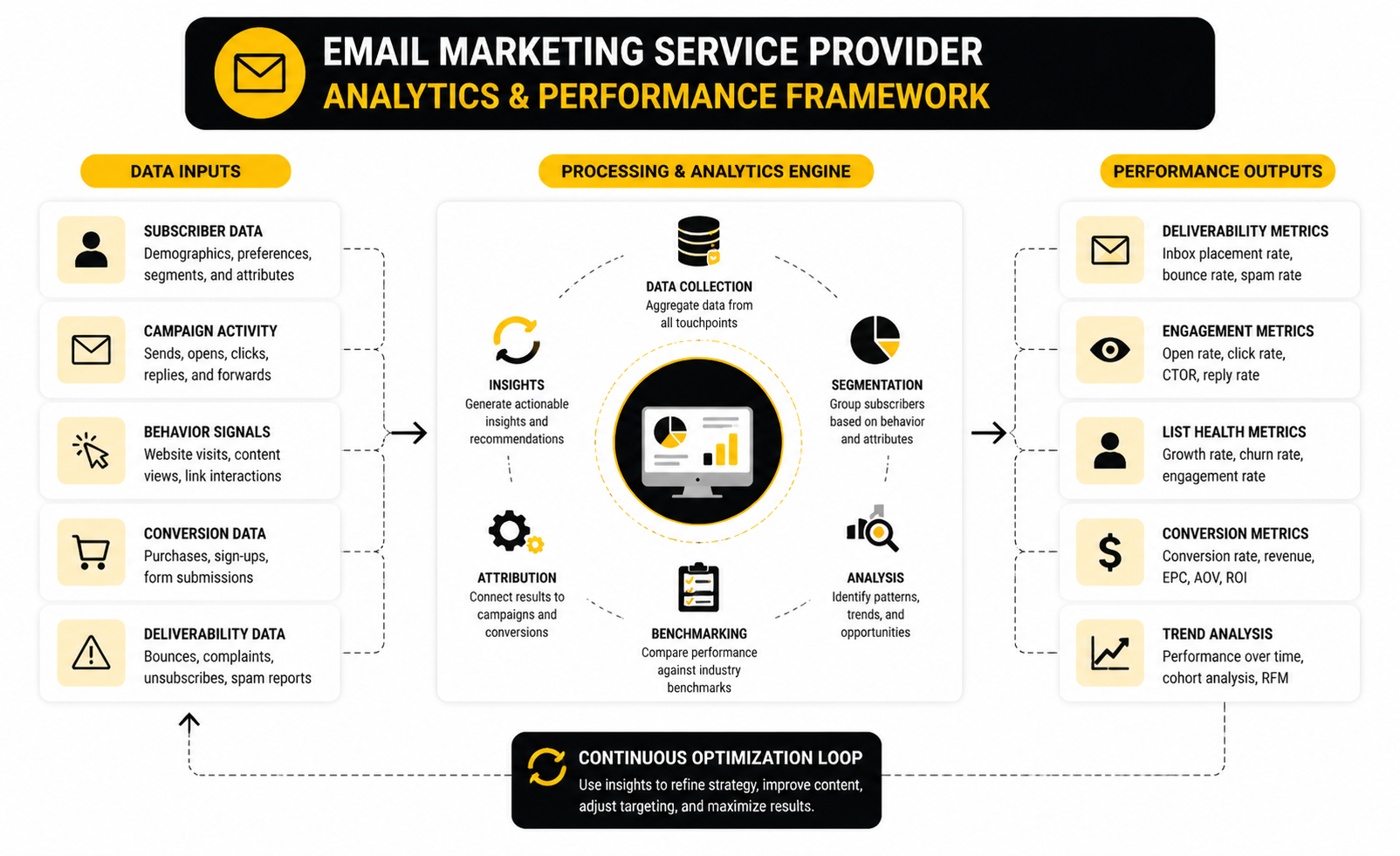
At a system level, analytics typically follow this flow:
- User Action Tracking
Every interaction is recorded — opens, clicks, purchases, inactivity. This creates a behavioral dataset.
- Data Aggregation and Segmentation
Users are grouped based on patterns. For example, highly engaged subscribers vs. dormant ones.
- Performance Analysis
Campaigns and automations are evaluated based on how different segments respond.
- Automated Optimization
The system adjusts send times, prioritizes engaged users, and refines targeting.
- Strategic Decision Making
You use these insights to improve messaging, offers, and overall system design.
This is where tools like GoHighLevel stand out. They don’t just track email engagement — they connect it directly to pipeline movement and revenue, which is what actually matters.
What the Data Is Really Telling You
Numbers are easy to collect but hard to interpret correctly. Each metric is a signal pointing to a deeper issue or opportunity.
- Low open rates usually mean poor subject lines, weak sender reputation, or bad list quality
- High opens but low clicks indicate a mismatch between expectation and content
- Strong clicks but weak conversions often point to landing page or offer problems
- Rising unsubscribe rates suggest fatigue, poor targeting, or irrelevant messaging
The goal isn’t perfection. It’s clarity. You want to understand exactly where the system is breaking down so you can fix the right layer.
This is why segmentation matters so much. Looking at global averages hides problems. Looking at specific segments reveals them.
Turning Metrics Into Action
Data without action is useless. The entire purpose of analytics is to drive better decisions.
Here’s how professionals translate metrics into execution:
- If open rates drop, they test new subject lines and adjust sending frequency
- If click rates fall, they rewrite content and improve call-to-action clarity
- If conversions lag, they optimize landing pages or reposition the offer
- If engagement declines, they run reactivation campaigns or clean the list
Even small improvements compound quickly. Increasing click-through rate by a few percentage points across thousands of subscribers can generate significant revenue gains over time.
Platforms like Moosend make this easier by visualizing performance trends and highlighting anomalies early.
The Difference Between Vanity Metrics and Growth Metrics
Not all metrics are equal. Some look good but don’t translate into real outcomes.
Vanity metrics include:
- total subscribers
- raw open rates without context
- email send volume
Growth metrics focus on impact:
- revenue per subscriber
- conversion rate by segment
- lifetime value influenced by email
An email marketing service provider should help you prioritize the second category. That’s what turns email from a communication channel into a revenue engine.
Once you understand how to read the data, everything changes. You stop guessing and start optimizing with precision.
The next step is identifying the most common mistakes businesses make with their email marketing service provider — and how to avoid them before they cost you growth.
Advanced Considerations When Scaling Email Marketing Systems
Once your system is producing consistent results, a new layer of complexity appears. Growth introduces tradeoffs that don’t exist at earlier stages. What worked at 1,000 subscribers often breaks at 100,000.
This is where your email marketing service provider either becomes a long-term advantage or a limiting factor. The difference comes down to how well it handles scale, complexity, and control.
The Hidden Cost of Scaling Too Fast
Growth is usually seen as a positive signal, but in email marketing, speed can create problems if it’s not managed correctly.
When you rapidly increase sending volume:
- inbox providers start scrutinizing your behavior more closely
- engagement rates can drop if your list quality isn’t strong
- spam complaints increase if targeting isn’t precise
This creates a compounding effect. Lower engagement leads to worse deliverability, which leads to even lower engagement.
Professional teams scale deliberately. They increase volume in controlled increments, monitor response signals, and adjust before problems escalate. A capable email marketing service provider supports this by giving visibility into deliverability trends and sender reputation.
When Simplicity Becomes a Limitation
At the beginning, simplicity is an advantage. Fewer features mean faster execution. But at scale, that simplicity turns into friction.
Common limitations that appear later:
- inability to build complex automation logic
- restricted segmentation options
- lack of integration depth with other tools
- limited reporting capabilities
This is where many businesses outgrow their original platform. Migrating later is possible, but it’s expensive and time-consuming.
Choosing a provider like GoHighLevel earlier can reduce the need for migration because it combines CRM, automation, and communication into one system. The tradeoff is a steeper learning curve upfront.
Data Ownership and Platform Risk
One of the most overlooked risks is platform dependency. When your entire email system lives inside one provider, you’re exposed to their rules, pricing changes, and technical limitations.
Important questions to consider:
- Can you export your data easily?
- Do you control your contact segmentation and tagging?
- Are automations portable if you switch platforms?
A reliable email marketing service provider should give you full access to your data and enough flexibility to avoid lock-in.
This becomes critical during transitions. Businesses that don’t plan for portability often find themselves trapped in systems that no longer fit their needs.
Balancing Automation With Human Touch
As systems become more automated, there’s a risk of losing authenticity. Over-automation leads to emails that feel mechanical, predictable, and easy to ignore.
The best-performing systems balance automation with personalization:
- dynamic content based on behavior
- conversational tone instead of corporate language
- strategic manual campaigns layered on top of automation
Automation should enhance communication, not replace it. The goal is to make emails feel timely and relevant, not robotic.
Deliverability as a Long-Term Asset
At scale, deliverability becomes one of your most valuable assets. It’s also one of the easiest to damage.
Key factors that influence long-term deliverability:
- list hygiene and regular cleaning
- consistent engagement levels
- domain reputation and authentication setup
- frequency control
Once deliverability drops, recovery can take months. That’s why experienced teams treat it as a core system component, not a technical detail.
Providers like Moosend and Brevo include monitoring tools that help identify issues early, but the strategy behind them still matters more than the tool itself.
Strategic Tradeoffs You Need to Accept
There is no perfect email marketing service provider. Every choice involves tradeoffs, and understanding them upfront helps you avoid frustration later.
Some of the most common tradeoffs:
- Ease of use vs. flexibility
Simple tools are faster to use but harder to customize deeply
- All-in-one platforms vs. specialized tools
Integrated systems reduce friction but may lack depth in certain areas
- Cost vs. scalability
Cheaper platforms often become expensive indirectly when they limit growth
The key is alignment. Your provider should match your priorities, not someone else’s use case.
At this stage, the difference between average and high-performing email systems becomes clear. It’s not about sending more emails. It’s about building a system that can grow without breaking.
The final part brings everything together with practical answers to common questions and clear next steps you can act on immediately.
Bringing Your Email Marketing System Together
By now, the full picture should be clear. An email marketing service provider is not just a tool you plug in and forget. It’s the backbone of a system that connects acquisition, communication, conversion, and retention into one continuous loop.
At a high level, everything you’ve built flows together like this:
- leads enter through funnels and forms
- data is captured and segmented automatically
- behavior triggers personalized communication
- performance data feeds back into optimization
- the system improves with every interaction
When all of these layers are aligned, email stops being a channel and becomes an asset. It compounds. It stabilizes revenue. It gives you control in a landscape where most platforms don’t.
The difference between average and elite execution isn’t effort. It’s structure.
FAQ - Built for Complete Guide
What is an email marketing service provider?
An email marketing service provider is a platform that allows you to manage contacts, send campaigns, automate communication, and track performance. It acts as the central system that controls how you communicate with your audience at scale.
Modern providers go far beyond newsletters. They integrate automation, segmentation, and analytics into a single environment that supports full customer lifecycle marketing.
How do I choose the best email marketing service provider?
Start with your business model and growth stage. Early-stage businesses benefit from simplicity, while scaling businesses need flexibility and deeper automation.
Tools like Brevo are strong for ease of use, while platforms like GoHighLevel offer more control for complex systems.
Is email marketing still effective in 2026?
Email remains one of the highest-performing channels in digital marketing. Engagement quality is higher because users have opted in, and you own the audience directly.
The key difference today is execution. Basic campaigns underperform, while behavior-driven systems consistently produce strong results.
What features should I prioritize?
Focus on automation, segmentation, deliverability, and integrations. These are the components that directly impact performance.
Everything else is secondary. Design templates and visual builders are useful, but they don’t drive revenue on their own.
How important is deliverability?
It’s critical. If your emails don’t reach the inbox, nothing else matters.
A strong email marketing service provider will support authentication, monitor reputation, and help maintain healthy sending patterns. You still need to manage list quality and engagement.
How long does it take to see results?
You can see early signals within days, especially with welcome sequences and basic campaigns. However, meaningful results typically come from consistent optimization over weeks and months.
Email marketing compounds. The longer the system runs, the stronger it becomes.
Can I switch providers later?
Yes, but it’s not trivial. Migrating contacts, automations, and data structures takes time and can disrupt performance.
This is why choosing a scalable email marketing service provider early can save significant effort later.
How often should I send emails?
There is no universal frequency. It depends on your audience, content quality, and business model.
The real focus should be relevance. Sending fewer, more targeted emails often outperforms high-volume generic campaigns.
What’s the biggest mistake businesses make?
Treating email as a one-off campaign tool instead of a system. Without automation, segmentation, and data-driven optimization, most of the potential is lost.
Another common mistake is ignoring deliverability until it becomes a problem.
Do I need multiple tools or one all-in-one platform?
It depends on your priorities. All-in-one platforms like GoHighLevel simplify operations, while specialized tools can offer deeper functionality in specific areas.
The key is integration. Your tools should work together seamlessly, regardless of how many you use.
How do I increase email revenue quickly?
Focus on improving existing flows before adding new ones. Optimize subject lines, refine messaging, and improve segmentation.
Even small improvements in click-through and conversion rates can have a large impact when applied across your entire list.
Work With Professionals
Explore 10K+ Remote Marketing Contracts on MarkeWork.com
Most marketers spend too much time chasing clients, competing on crowded platforms, and losing a percentage of every project to middlemen.
MarkeWork gives you a better way. Browse thousands of remote marketing contracts and connect directly with companies desperate to hire skilled marketers like you, without platform commissions and without unnecessary gatekeepers.
If you're serious about finding better opportunities and keeping 100% of what you earn, explore available contracts and create a profile for free at MarkeWork.com.