


Learning how to get freelance marketing clients is not really about finding one clever channel. It is about building a system that makes the right buyers trust you fast, understand what you do, and feel confident that hiring you will move the numbers they care about. That matters even more now, because the market is active but noisier than ever, with 28% of U.S. skilled knowledge workers operating independently and generating $1.5 trillion in 2024 earnings.
Businesses still need marketing help, but they do not buy the way they used to. Buyers spend more time researching on their own, and strong educational content now influences shortlists and purchase decisions, which is exactly why [Edelman and LinkedIn found thought leadership has a measurable impact o
Position Your Offer Around a Painful Problem
If you want to learn how to get freelance marketing clients consistently, start here. Most freelancers stay too broad for too long, which makes every sales conversation harder than it should be. A client does not usually wake up thinking, I need a freelance marketer today. They wake up thinking leads are weak, conversions are down, revenue is flat, paid ads are wasting budget, or content is not turning into pipeline.
That difference is everything. The market rewards people who can connect their work to a painful business problem, especially when buyers are being pushed to show performance and efficiency at the same time, which is exactly the pressure reflected in recent marketing benchmark data from HubSpot and B2B marketing research covered by Marketing Week. When your positioning is built around a costly problem instead of a list of services, you immediately sound more valuable.
Pick a Market Narrow Enough to Understand
A clear niche does not trap you. It gives you language, pattern recognition, and faster credibility. You do better work when you understand the buyer, the sales cycle, the common bottlenecks, and what success actually looks like in that market.
This is also why generalist messaging tends to disappear into the background. A freelancer saying, “I help SaaS companies improve demo conversions,” is much easier to remember than someone saying, “I do digital marketing for all kinds of businesses.” That kind of focus matters because business buyers are filtering huge amounts of noise, and strong relevance is often what gets you into the conversation in the first place.
One practical way to choose a niche is to look for a market where three things overlap. You understand the customer well enough to speak their language, the problem is expensive enough to justify your fee, and the results are visible enough to prove. That could be local service businesses that need more booked jobs, B2B SaaS teams that need better lead quality, ecommerce brands that need stronger email revenue, or consultants who need a cleaner lead-generation funnel.
Sell One Outcome, Not Every Marketing Service
This is where a lot of freelancers lose momentum. They offer SEO, email, social media, content, paid ads, funnels, automation, and analytics all at once, hoping the broader menu will appeal to more people. In reality, a crowded offer usually creates confusion, and confused buyers hesitate.
A better move is to package your work around one clear result. Instead of “email marketing services,” say you help ecommerce brands recover abandoned carts and increase repeat purchases. Instead of “LinkedIn content,” say you help B2B founders turn their expertise into sales conversations. Instead of “funnel building,” say you help coaches and consultants turn cold traffic into qualified booked calls.
This approach matches how buyers think. Many SMBs are actively trying to improve SEO visibility, lead generation, and brand awareness through their websites, as shown in Duda’s SMB website research. They are not looking for a random bundle of tactics. They are looking for progress on the specific
Use Outbound Outreach That Starts Conversations
Once your positioning and proof are in place, the next step in learning how to get freelance marketing clients is simple but often misunderstood: start conversations directly with the people who might need your help.
Freelancers sometimes wait too long for inbound leads. That can work eventually, but it is rarely the fastest path to revenue. Outreach closes that gap. It lets you reach decision-makers who already have the problem you solve instead of hoping they randomly discover your content.
This approach aligns with how many B2B deals still begin. Relationship-driven outreach, warm introductions, and targeted prospecting remain core drivers of pipeline in most industries, which is why LinkedIn’s B2B Institute research consistently highlights direct professional networking as a major driver of deal creation. When done well, outreach does not feel like spam. It feels like a useful conversation starter.
Find Prospects With Clear Signals
Effective outreach starts with targeting. Instead of contacting hundreds of random businesses, focus on companies that show visible signs they might benefit from your work.
Those signals could include:
- companies actively hiring marketing roles
- websites with clear conversion or funnel issues
- brands investing in ads but lacking conversion infrastructure
- founders posting about growth challenges
- businesses launching new products or services
The point is to contact companies that already have marketing motion. A business that is investing in growth is far more likely to hire outside help than one that is barely marketing at all.
Tools that gather contact data and automate outreach workflows can help keep the process organized. Platforms like ScaledMail can support structured email outreach campaigns, while form tools such as Fillout can help collect prospect responses or qualification data without complicated systems.
Write Outreach That Feels Human
The biggest mistake freelancers make with outreach is sounding like a template. Generic messages get ignored because they show no understanding of the prospect's situation.
A better outreach message usually includes three things:
- A specific observation Mention something you noticed about their marketing. This proves the message was not automated.
- A relevant insight Share a short idea that relates to the issue you noticed.
- A simple invitation Offer a conversation, not a hard sell.
For example, instead of sending a pitch about marketing services, you might point out that a landing page loads slowly or that a paid campaign leads to a weak conversion flow. That kind of message immediately signals expertise because it connects your outreach to a real observation.
The goal is not to close a deal in the first message. The goal is to earn curiosity.
Follow Up Like a Professional
Many freelance deals happen after the second or third interaction, not the first. That makes follow-up one of the most overlooked parts of the process.
Consistent follow-up matters because people are busy, not because they are rejecting you. A founder might intend to reply but forget, a marketing director might need internal approval, or a team might simply be in the middle of a launch.
A simple follow-up rhythm often works best:
- first message introducing the insight
- second message adding a useful observation
- third message offering a short call or audit
Keeping these interactions organized is easier when you track conversations properly. Lightweight CRM tools like Copper make it easier to manage prospect pipelines without building complex infrastructure.
Turn Outreach Into a Repeatable Client Acquisition Process
The freelancers who consistently win clients rarely rely on bursts of motivation. They build a simple weekly process that keeps conversations flowing.
This matters because freelance pipelines behave differently from traditional sales pipelines. Projects end, priorities shift, and new opportunities appear unpredictably. Without consistent prospecting, the pipeline eventually dries up.
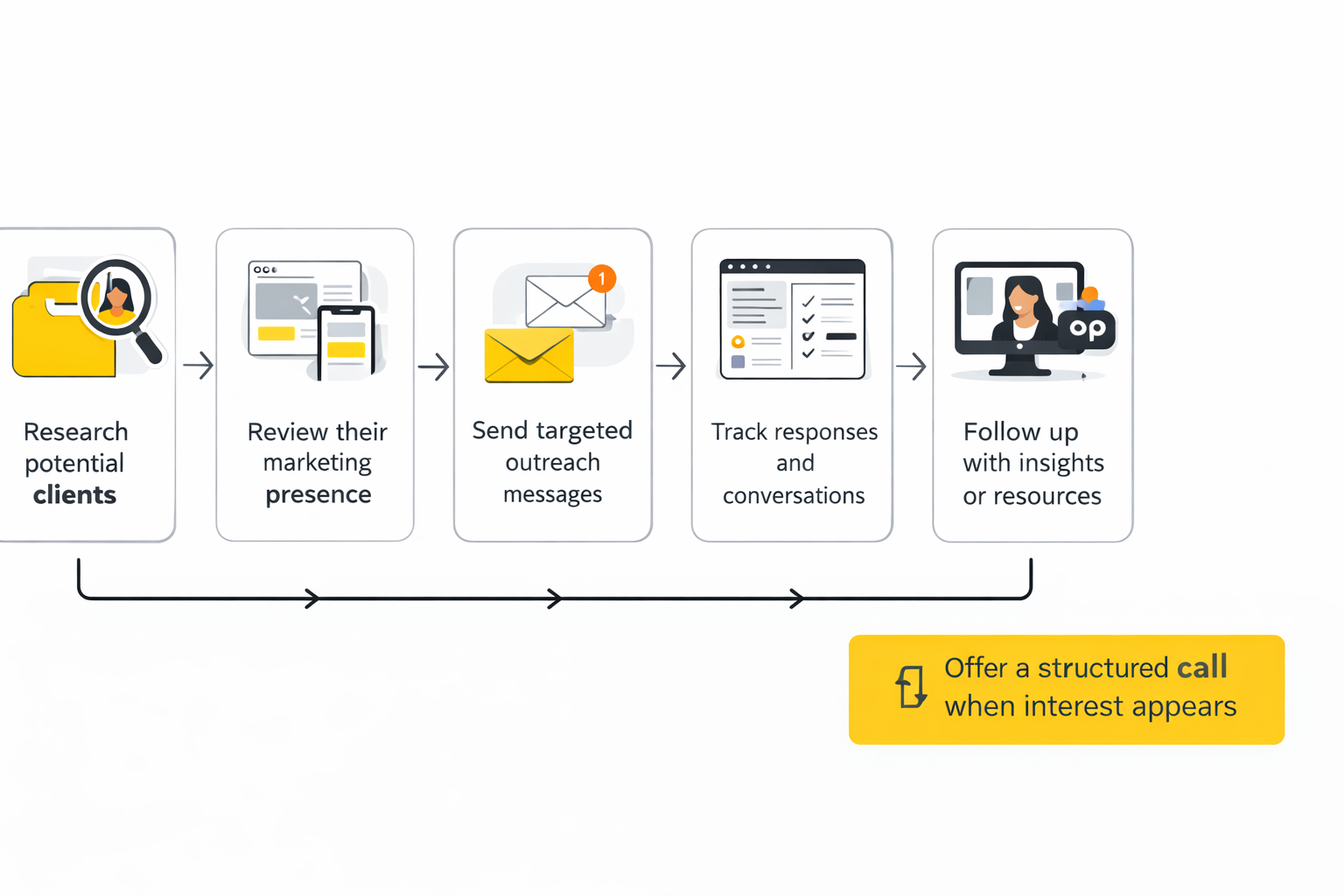
A Practical Weekly Outreach Workflow
Once the system is visible, the process becomes much easier to execute. A straightforward weekly workflow could look like this:
- Research potential clients Identify companies that fit your niche and show signs of needing help.
- Review their marketing presence Scan their website, ads, social channels, and funnels for obvious gaps.
- Send targeted outreach messages Write short, personalized messages referencing what you noticed.
- Track responses and conversations Store interactions in a CRM or simple spreadsheet.
- Follow up with insights or resources Continue the conversation with helpful observations rather than pressure.
- Offer a structured call when interest appears Use a simple booking link like Cal.com so scheduling is frictionless.
This kind of system removes a lot of the uncertainty around how to get freelance marketing clients. Instead of relying on luck, you create steady opportunities by talking to the right people every week.
Make Your First Offer Easy to Accept
When a prospect finally shows interest, the worst move is presenting a huge complicated proposal. Early conversations work best when the next step feels small and practical.
That could mean offering:
- a quick funnel audit
- a paid strategy session
- a short marketing sprint
- a targeted campaign improvement
The exact structure will depend on your niche, but the principle is consistent. Lower the barrier to the first engagement.
Funnel-building platforms like ClickFunnels or all-in-one systems such as Systeme.io can help freelancers present clear service funnels and booking flows, which makes the transition from conversation to project much smoother.
Once you start turning outreach into structured conversations, the question of how to get freelance marketing clients becomes less mysterious. It becomes a process you can repeat, refine, and scale.
Statistics and Data That Actually Matter
Learning how to get freelance marketing clients becomes much easier when you stop guessing and start measuring the signals that lead to real deals. Most freelancers track the wrong things. They watch vanity metrics like likes, impressions, or random traffic spikes instead of monitoring the indicators that predict conversations, proposals, and signed clients.
Modern marketing research keeps reinforcing the same idea: pipeline health matters more than surface-level visibility. The companies investing heavily in marketing measurement are doing it because the link between marketing activity and revenue is under intense scrutiny. Reports like the Nielsen Annual Marketing Report show that marketers are increasingly expected to prove ROI, which means freelancers who understand data become more valuable partners.
Instead of chasing every metric available, focus on numbers that connect directly to client acquisition.
The Four Metrics That Predict Freelance Revenue
Freelance marketing pipelines become much clearer when broken into four measurable stages. Each stage represents a different level of buyer commitment.
- Reach
- Conversations
- Qualified Opportunities
- Closed Clients
Each stage filters the previous one. Large reach is useless if it does not produce conversations, and conversations are meaningless if they never turn into real opportunities.
For example, social platforms can deliver large audiences but vary significantly in conversion behavior. B2B marketing research continues to highlight LinkedIn’s importance for professional engagement and deal creation, which is why LinkedIn’s B2B benchmark studies consistently show strong engagement and lead generation performance compared with many other platforms.
This does not mean other channels cannot work. It simply illustrates why freelancers should track how visibility translates into actual conversations.
What Healthy Numbers Often Look Like
Freelancers do not need perfect benchmarks, but having directional expectations helps interpret results. Marketing funnel performance studies across SaaS, services, and B2B sectors consistently show that only a small portion of initial outreach or traffic becomes qualified sales conversations.
Typical patterns often look like this:
- 100–200 targeted prospects identified
- 20–40 outreach conversations started
- 5–10 qualified discovery calls
- 1–3 new client projects
These ranges vary widely by niche, pricing, and reputation, but the underlying pattern remains consistent. Most of the pipeline activity happens before revenue appears. Understanding this prevents freelancers from abandoning a strategy too early.
Many teams track similar funnel performance when evaluating lead generation programs. Sales funnel benchmarks across industries repeatedly demonstrate that only a fraction of leads become qualified opportunities, which is why HubSpot’s marketing and sales benchmark data focuses heavily on conversion stages rather than surface-level traffic.
The Freelance Client Acquisition Dashboard
Once you start measuring the right numbers, the client acquisition process becomes easier to improve. A simple analytics dashboard can reveal exactly where momentum is slowing.
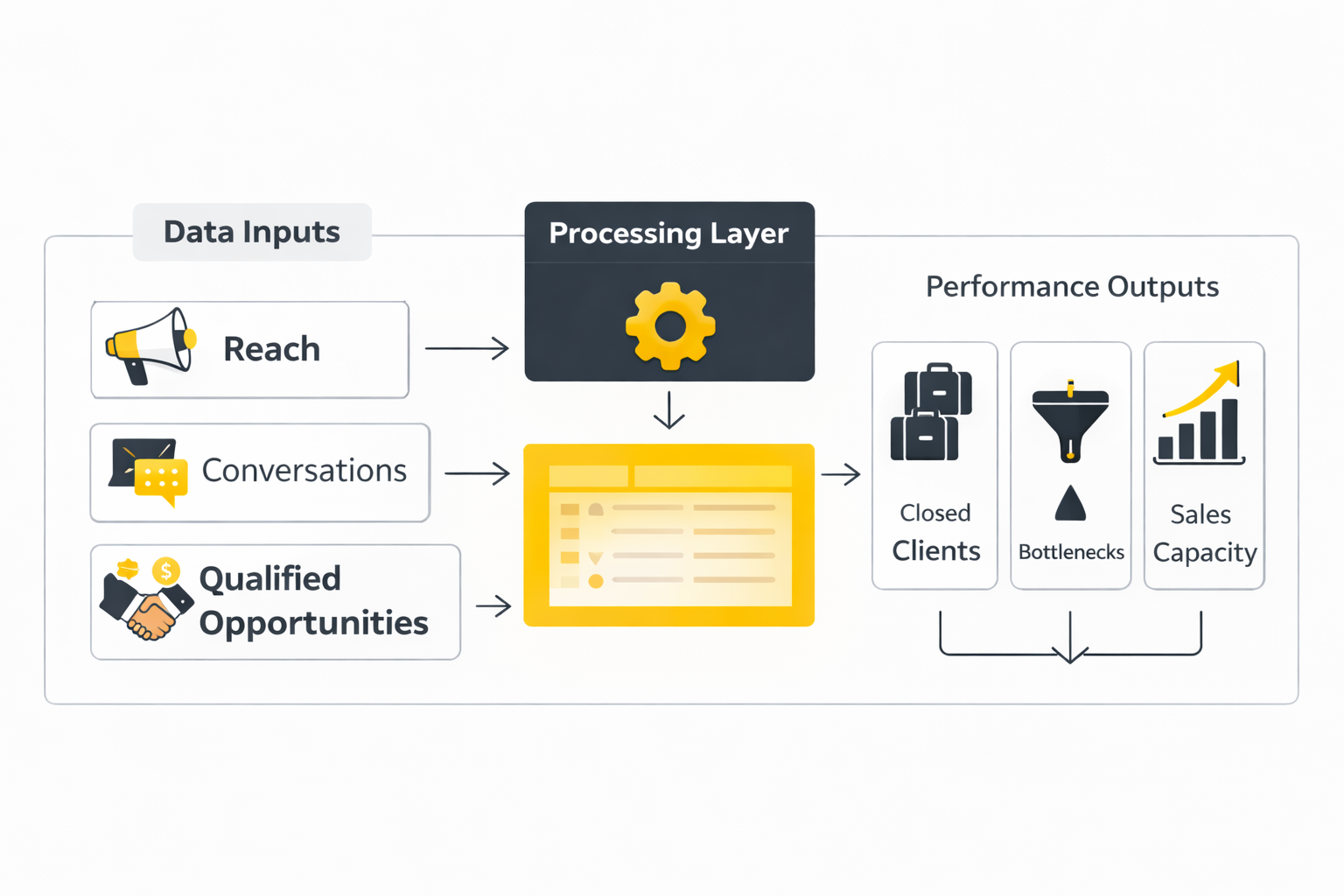
A basic weekly tracking system can include:
- new prospects researched
- outreach messages sent
- responses received
- conversations started
- calls booked
- proposals delivered
- clients signed
Tracking these numbers does two powerful things. First, it turns client acquisition into a process you can improve instead of a mystery you hope works. Second, it highlights bottlenecks quickly. If many people respond but few calls get booked, the issue might be positioning. If calls happen but deals stall, the problem might be the offer or pricing structure.
This level of clarity also helps freelancers present themselves more professionally to prospects. When you understand conversion rates, you can estimate timelines, forecast pipeline activity, and manage your workload more intelligently.
Interpreting Data Without Overreacting
Data becomes dangerous when interpreted without context. A slow week does not mean a strategy failed, just like a sudden burst of leads does not guarantee long-term success.
Healthy marketing pipelines tend to behave in cycles. Outreach activity might generate conversations this week, calls next week, and signed clients the following month. That delay is normal because buying decisions take time, especially in B2B services where multiple stakeholders often review proposals.
Industry research consistently highlights this longer decision cycle. Many B2B buyers now complete significant portions of their research before speaking to a vendor, which is why Google and Gartner research on modern B2B buying behavior emphasizes complex decision paths and extended evaluation periods.
For freelancers, this means patience and consistency matter more than short bursts of effort. When outreach, content, and conversations happen regularly, the numbers eventually start to compound.
Turning Data Into Action
Numbers only become useful when they guide decisions. Once you start tracking your pipeline, every metric can point to a specific improvement.
If responses are low, the outreach messaging probably needs stronger personalization. If many conversations happen but few clients sign, the offer may not clearly solve a painful problem. If discovery calls happen regularly but prospects hesitate, the issue might be trust signals such as case studies or proof.
Over time, this feedback loop transforms the entire process of learning how to get freelance marketing clients. Instead of guessing what works, you start adjusting tactics based on real signals. The freelancers who grow fastest rarely rely on inspiration alone. They rely on consistent activity, clear measurement, and steady improvement.
Create a Professional Client-Winning System
By this point, the mechanics of how to get freelance marketing clients should feel much clearer. You need positioning, proof, outreach, and measurement. But there is another layer that separates freelancers who occasionally land projects from freelancers who build a durable business: they design a system that protects quality, margins, and momentum at the same time.
That matters because the freelance market is not small anymore. Upwork’s 2025 workforce research shows skilled knowledge freelancers generated more than $1.5 trillion in U.S. earnings in 2024, which means you are not just competing on talent. You are competing on clarity, trust, speed, and how professionally your business runs.
Balance Inbound and Outbound Instead of Betting on One Channel
A lot of freelancers become emotionally attached to one acquisition method. Some only want inbound because it feels cleaner. Others rely entirely on outbound because it feels more controllable. Both approaches can work, but both become fragile when used alone.
Inbound usually compounds more slowly, but it tends to improve trust before the first call. Outbound creates faster opportunities, but it demands tighter targeting and stronger follow-up. The smart move is to let the two channels support each other. Your content makes your outreach warmer, and your outreach gives your content a faster path to the right buyers.
This is especially important in modern B2B buying environments where Edelman and LinkedIn’s 2025 research shows thoughtful expertise can make buyers more receptive to sales conversations. In plain English, prospects are more likely to reply when they can quickly verify that you know what you are talking about.
Protect Your Positioning as Demand Increases
One of the easiest ways to break a good freelance business is to say yes to too many mismatched projects. The first few new clients feel exciting, so the temptation is to widen the offer, accept every request, and chase short-term cash. That usually creates delivery chaos, weak case studies, and muddier positioning.
The better move is to tighten your lane as you gain traction. If a certain type of client closes faster, gets better results, and is easier to retain, that is not a coincidence. That is market feedback. Pay attention to it. Specialization often looks risky at the start, but it usually makes growth easier because your messaging, proof, and fulfillment all become sharper.
This is where a short qualification process helps. A clean intake form through Fillout or a simple pre-call filter can save you from long conversations with poor-fit leads. More leads are not always the answer. Better-fit leads are.
Price for Delivery Reality, Not Just Sales Excitement
Freelancers often underprice when they are trying to figure out how to get freelance marketing clients, then overwork themselves to compensate. That might help close a few early deals, but it usually creates a business that feels stressful even when revenue improves.
Pricing has to reflect the actual cost of delivery, communication, revisions, reporting, and strategic thinking. It also has to reflect the risk you are taking on. A one-off audit, a structured sprint, and an ongoing retainer should not be priced as if they create the same time pressure or operational load. They do not.
This is also why packaged offers tend to outperform vague custom work early on. Buyers understand them faster, and you can deliver them more consistently. If you need a clean funnel for booking, qualification, and offer presentation, a system like Systeme.io or ClickFunnels can help, but the real advantage is not the software. It is the clarity of the offer behind it.
Build for Retention, Not Just Acquisition
Winning a client is useful. Keeping a good client is transformational. A freelancer who can retain clients longer needs fewer new leads, has steadier cash flow, and builds stronger proof over time.
Retention usually comes from three things: clear expectations, visible progress, and ongoing strategic value. Clients stay when they understand what is happening, see movement in the right metrics, and feel that you are helping them make better decisions instead of simply completing tasks. This is where your reporting and communication style matter almost as much as your technical work.
The pressure to prove business impact is only getting stronger. Nielsen’s 2024 Annual Marketing Report found marketers are under growing pressure to connect activity to ROI, so freelancers who report in terms of business outcomes are easier to keep around. Do not just send dashboards. Explain what changed, why it matters, and what happens next.
Reduce Operational Friction Before You Try to Scale
A lot of freelancers talk about scaling when what they really need is smoother execution. If proposals are slow, onboarding is messy, follow-up gets forgotten, and reporting lives in five different places, adding more clients will not fix the business. It will expose the cracks faster.
Start by simplifying the handoff points. Use one CRM, one booking flow, one onboarding sequence, and one reporting rhythm. A lightweight setup with Copper, Brevo, and Cal.com is often enough for a solo freelancer who wants to look sharp without drowning in software. You do not need a giant stack. You need a reliable one.
The same principle applies to content and communication. A scheduling tool like Buffer can keep your publishing consistent, and a cleaner writing workflow can help if you use something like Wispr Flow. But again, tools are only useful when they remove friction from a process that already makes sense.
Use AI Carefully Without Hiding Behind It
AI can absolutely help freelancers move faster. It can speed up research, outlines, drafts, workflow automation, and repetitive admin. The trap is using it to produce bland work that sounds efficient but feels generic.
Clients do not hire freelance marketers because they want more average content or more average outreach. They hire for judgment. They hire because they want someone to notice what matters, connect patterns, and make good calls under uncertainty. AI can support that process, but it cannot replace the strategic layer that makes your work valuable.
Used well, AI tools can tighten parts of the client acquisition system. Something like Chatbase, Guideless, Firecrawl, or Comp AI may fit specific workflows depending on your niche. Just make sure the end result still sounds like you, solves a real problem, and improves the client experience instead of making it feel automated.
Turn Happy Clients Into Your Lowest-Cost Growth Channel
The final strategic tradeoff is simple. You can spend all your energy chasing the next lead, or you can create a business where past clients help pull future clients toward you. Referrals, testimonials, introductions, and second engagements are often the cheapest and highest-trust opportunities you will ever get.
That matters even more because trust still drives buying behavior. When people already have a reason to believe you are competent and easy to work with, the sales cycle gets shorter and the pricing conversation gets easier. So do not treat delivery and acquisition as separate worlds. Great delivery is one of the strongest client acquisition channels you have.
This is the expert-level shift. Once you understand how to get freelance marketing clients, the next goal is to make each client improve the odds of the next one. That is how a freelancer stops living project to project and starts building a real business.
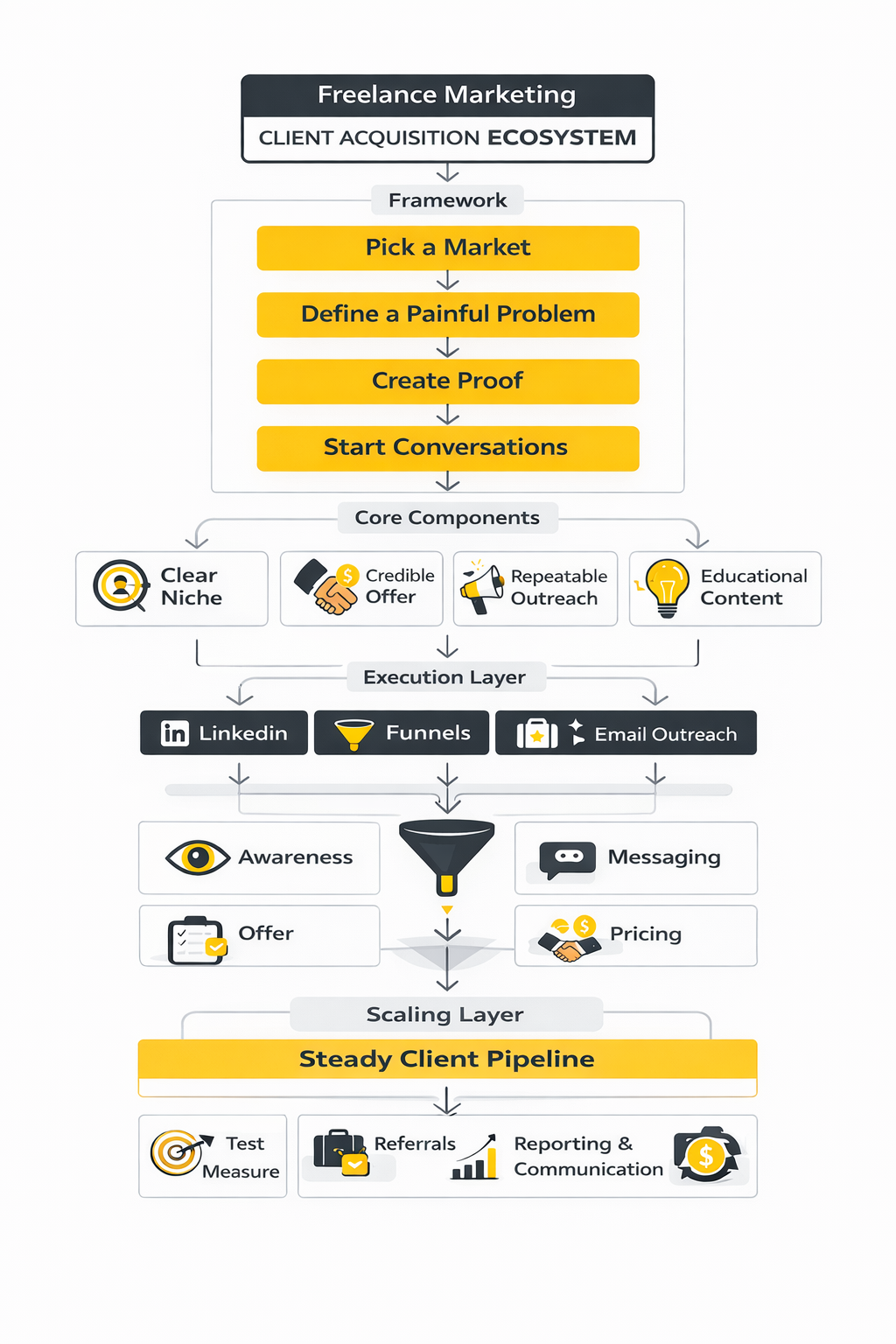
FAQ - Built for Complete Guide
How long does it usually take to get your first freelance marketing client?
The timeline varies widely depending on positioning, outreach consistency, and proof. Many freelancers who start targeted outreach and publish useful niche content begin conversations within the first few weeks, but converting those conversations into signed work often takes longer.
Modern B2B buying cycles have grown more complex because buyers spend more time researching before speaking to vendors. Research from Gartner on the modern B2B buying journey highlights how multiple stakeholders and self-guided research extend decision timelines. That means early traction should be measured in conversations and discovery calls, not just closed deals.
What is the fastest way to get freelance marketing clients?
Targeted outreach combined with clear positioning tends to generate the fastest results. When freelancers contact businesses already showing marketing activity or growth signals, the probability of starting a useful conversation increases dramatically.
Speed improves further when outreach references a specific observation. A short message about a funnel issue, a weak landing page, or a missed conversion opportunity feels more relevant than a generic sales pitch. The goal is not to close immediately but to open a conversation with someone who already has a marketing problem.
Do freelance marketers need a website to get clients?
A website helps but is not always required at the beginning. Many freelancers land their first clients through LinkedIn, referrals, and direct outreach.
However, having at least a small proof hub eventually becomes useful. A portfolio page, a few practical case breakdowns, and a clear services description give prospects a place to verify your expertise. Research on professional buying behavior repeatedly shows that buyers investigate service providers before committing to a conversation, which makes visible proof valuable.
Which platforms work best for finding freelance marketing clients?
Different platforms work better for different markets. LinkedIn remains one of the strongest channels for B2B service professionals because decision-makers actively participate there.
Other sources can include niche job boards, industry communities, referrals, and specialized marketplaces. The most reliable strategy usually combines platform visibility with direct outreach so you are not dependent on a single traffic source.
Should freelance marketers specialize in one niche?
Specialization usually accelerates growth. A focused niche helps refine messaging, build recognizable expertise, and develop stronger case studies.
Clients often prefer specialists because they believe specialists understand their problems more deeply. That belief matters in competitive buying environments where trust and perceived expertise strongly influence vendor selection.
How many outreach messages should freelancers send each week?
Consistency matters more than volume. A manageable weekly rhythm might include 20 to 40 targeted messages if each one includes genuine research and personalization.
Sending hundreds of automated messages often damages credibility and reduces response rates. Thoughtful outreach tends to perform better because prospects recognize the message was written specifically for them.
What is the biggest mistake freelancers make when trying to get clients?
The most common mistake is selling vague services instead of clear outcomes. When messaging focuses on generic activities like “social media management” or “digital marketing,” prospects struggle to understand the business value.
Framing work around specific improvements, such as improving conversion rates or generating qualified leads, makes the offer much easier for buyers to understand and evaluate.
How important are referrals in freelance marketing?
Referrals remain one of the strongest growth channels because they carry built-in trust. When a satisfied client introduces you to another company, the initial skepticism is much lower.
Research on trust in marketing communication consistently shows that people place higher confidence in recommendations from peers and colleagues. For freelancers, that means great delivery can become one of the most powerful client acquisition tools available.
What tools help freelancers manage client acquisition?
Freelancers benefit from tools that reduce operational friction rather than adding complexity. A lightweight CRM, a booking system, and an email platform often cover most needs.
For example, freelancers frequently use tools such as Copper for managing contacts, Brevo for communication workflows, and scheduling tools like Cal.com to simplify booking calls. The goal is not building a massive tech stack but creating a smooth path from conversation to signed project.
Can AI help freelancers find clients?
AI can support research, outreach preparation, and workflow automation, but it works best when used as a productivity tool rather than a replacement for expertise.
Freelancers who rely entirely on automated messaging often produce generic communication that prospects ignore. AI tools become much more useful when they assist with data gathering, workflow automation, or repetitive tasks while leaving strategy and personalization in human hands.
How do freelancers scale after they start getting consistent clients?
Scaling usually starts with operational clarity rather than hiring immediately. Freelancers benefit from standardizing offers, improving onboarding processes, and refining reporting systems before expanding their capacity.
Once delivery becomes predictable, scaling options become clearer. Some freelancers grow by raising prices and serving fewer clients, while others expand through subcontractors, partnerships, or productized services.
Work With Professionals
Explore 10K+ Remote Marketing Contracts on MarkeWork.com
Most marketers spend too much time chasing clients, competing on crowded platforms, and losing a percentage of every project to middlemen.
MarkeWork gives you a better way. Browse thousands of remote marketing contracts and connect directly with companies desperate to hire skilled marketers like you, without platform commissions and without unnecessary gatekeepers.
If you're serious about finding better opportunities and keeping 100% of what you earn, explore available contracts and create a profile for free at MarkeWork.com.