

HubSpot marketing is no longer just about sending emails, publishing landing pages, and hoping the automation does the heavy lifting. The platform has evolved into a connected growth system that ties lead capture, CRM data, segmentation, automation, attribution, and increasingly AI-assisted execution into one place. That shift matters because modern buyers expect relevance fast, and disconnected tools make that harder than it should be.
The stakes are higher now than they were even a couple of years ago. 61% of marketers say AI is creating the biggest disruption the field has seen in 20 years, while 80% already use AI for content creation. At the same time, buyer behavior keeps moving toward self-service research, with 61% of B2B buyers preferring a rep-free buying experience and 73% actively avoiding irrelevant outreach. In that environment, HubSpot marketing works best when it becomes the operating system for timely, useful, data-backed customer journeys rather than a pile of disconnected campaigns.
- The New Reality of HubSpot Marketing
- How the HubSpot Marketing Framework Works
- The Core HubSpot Marketing Tools That Actually Drive Results
- Campaign Execution, Automation, and Measurement
- Professional Implementation for Scaling Teams
- Optimization, Common Mistakes, and FAQs
The New Reality of HubSpot Marketing
The basic promise of HubSpot marketing is still attractive: attract the right visitors, convert them into leads, nurture them intelligently, and hand qualified demand to sales without chaos. What has changed is the complexity around that promise. The martech market now includes 15,384 solutions across 49 categories, so the real advantage is often not having more tools, but having fewer disconnected ones.
That is where HubSpot still has a practical edge. HubSpot positions Marketing Hub as a way to identify high-intent leads, automate personalized customer experiences, and launch cross-channel campaigns, while keeping the data inside the same customer platform. For teams that are tired of stitching together forms, email software, analytics tools, CRM records, and reporting layers, that integrated model is usually the biggest reason HubSpot marketing becomes attractive in the first place.
The timing also matters. HubSpot now serves more than 288,000 customers in over 135 countries, which says something important about where the platform sits in the market. It is no longer a niche inbound tool for small teams. It has become a mainstream platform for companies that want marketing, sales, and service working from the same customer record.
What makes that important is not just convenience. Buyers are doing more homework before they ever want to talk to anyone, and research from 6sense shows they can complete roughly two-thirds of the buying journey before engaging sellers. That means your website, forms, nurture flows, content, and reporting have to do real selling work on their own, and HubSpot marketing is strongest when it is built around that reality.
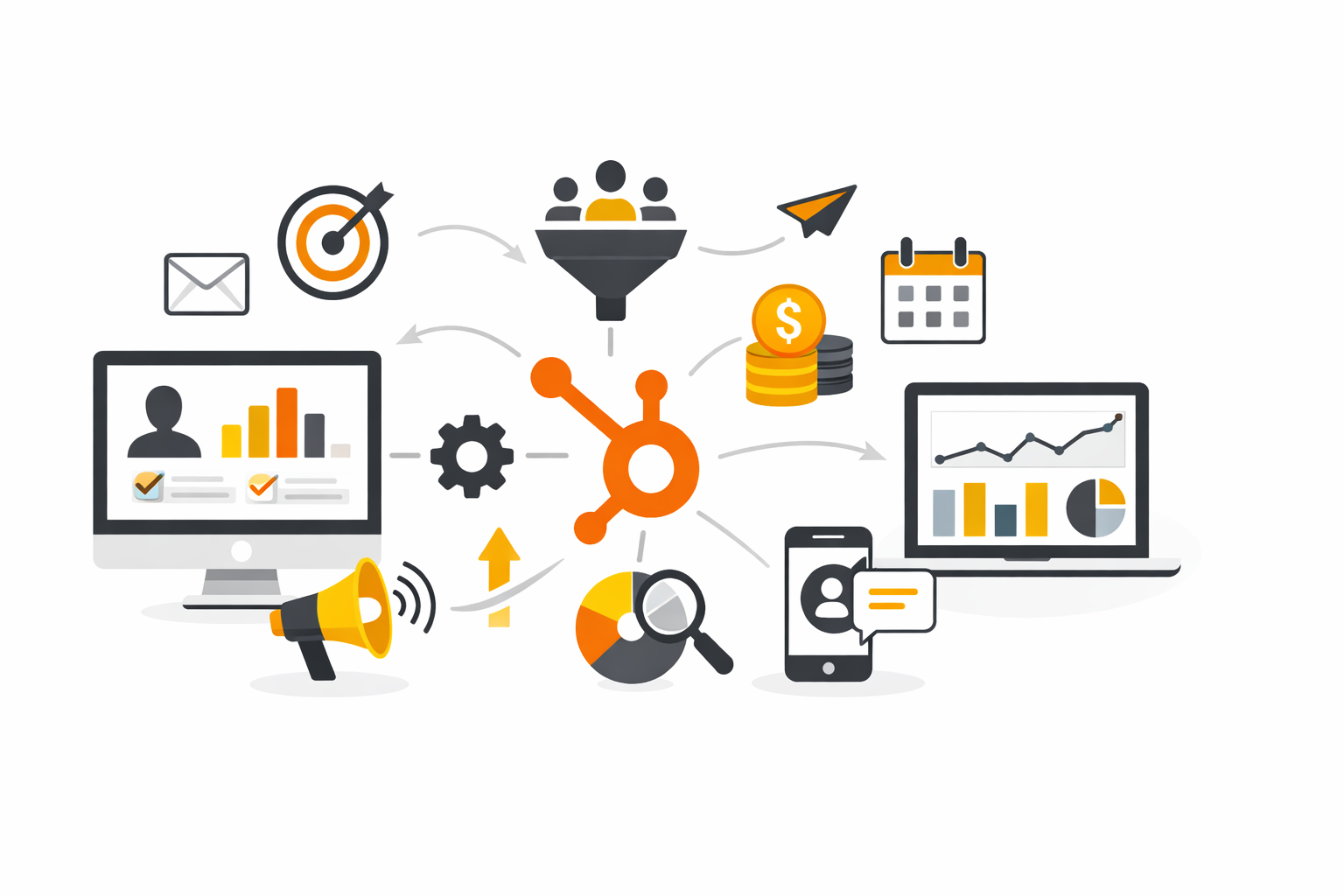
Seen from a distance, the platform is less like a channel tool and more like a system for managing attention, intent, and timing. You bring in traffic from search, social, paid media, partnerships, and direct visits. Then you use CRM-connected conversion points, segmentation, and automation to decide what each contact should see next, while reporting tells you which activities are actually creating contacts, deals, and revenue.
How the HubSpot Marketing Framework Works
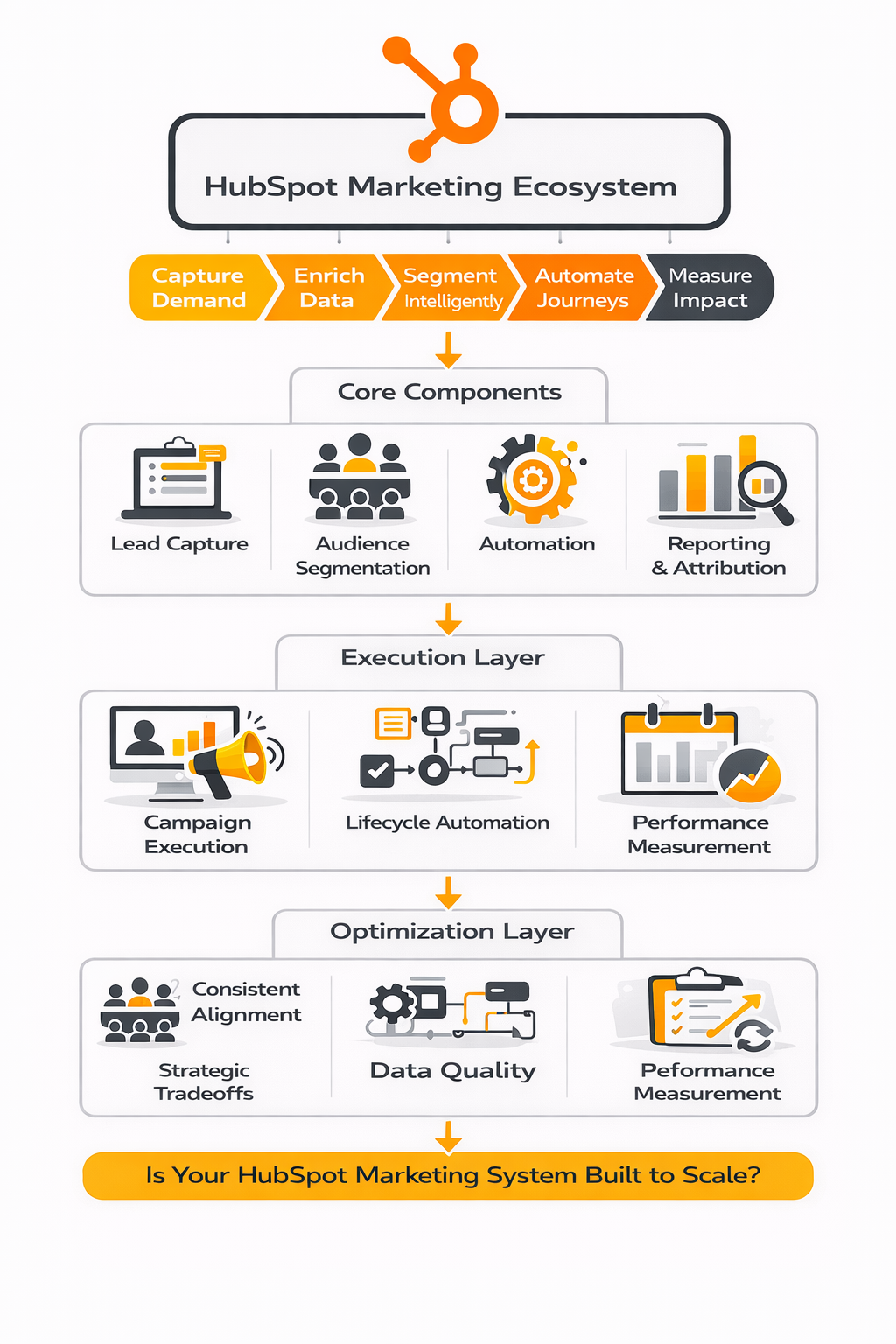
A useful way to think about HubSpot marketing is as a five-part framework: capture demand, enrich data, segment intelligently, automate journeys, and measure business impact. That sounds simple, but the strength is in how those pieces connect. When they are implemented well, you stop running random campaigns and start operating a compounding system.
The first layer is capture. HubSpot’s lead capture tools are built around forms, landing pages, and chatbots that sync contact data into the CRM. That matters because lead generation gets messy fast when conversion data lives in one system, audience logic lives in another, and the CRM gets updated hours or days later.
The second layer is enrichment and prioritization. HubSpot’s own marketing automation guidance describes automation as software that handles recurring tasks like email marketing, behavioral targeting, lead prioritization, and personalized advertising. In practice, this is where basic list building becomes something more strategic, because you are no longer treating every lead the same way.
The third layer is orchestration. HubSpot workflows can be built from scratch or even generated with AI assistance inside the workflow builder, which shows how much the platform is pushing toward faster execution. But speed only helps if the logic is clear. Good HubSpot marketing does not automate everything possible; it automates the moments where timing, relevance, and consistent follow-up actually move someone forward.
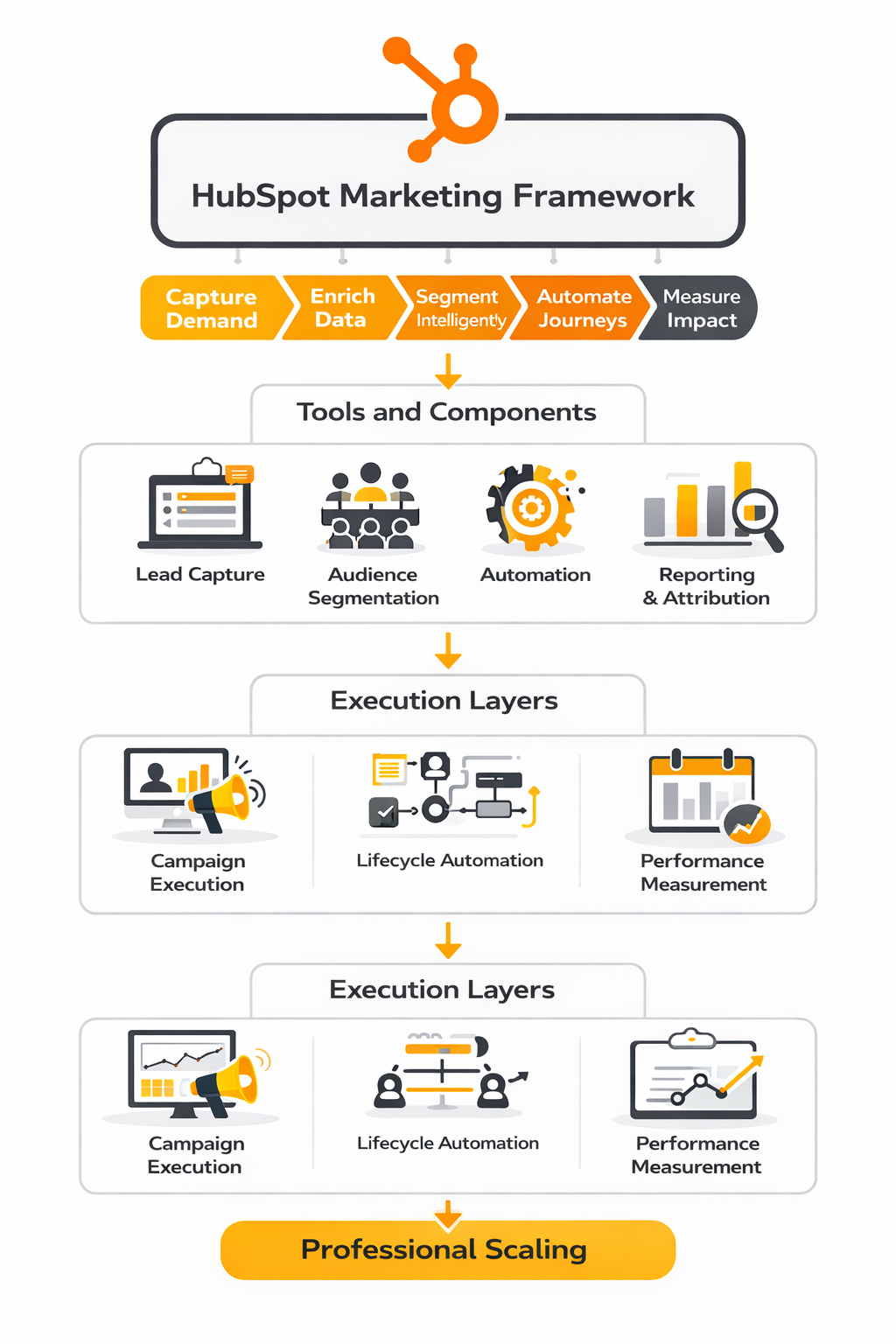
The fourth layer is measurement. HubSpot’s reporting stack is designed to identify top-performing assets across the buyer’s journey and analyze campaigns in one dashboard, and its attribution reporting can connect activity to new contacts, new deals, and won revenue. That is a major difference between surface-level campaign reporting and real operational marketing, because it gives teams a way to judge performance beyond opens, clicks, and vanity traffic.
The final layer is alignment with sales. HubSpot marketing works best when marketing is not optimizing for lead volume alone, but for lead quality, handoff timing, and downstream pipeline contribution. That is especially important now because buyers are more independent, less tolerant of bad outreach, and more likely to reward companies that show relevance before the first sales conversation even happens.
Taken together, this framework explains why HubSpot marketing can feel powerful or disappointing depending on implementation. If you only use it as an email sender, you get email-software-level outcomes. If you use it as a connected system for capture, segmentation, automation, attribution, and revenue alignment, you get a much stronger foundation for sustainable growth.
The Core HubSpot Marketing Tools That Actually Drive Results
A lot of teams buy HubSpot marketing for the promise of an all-in-one engine, then barely scratch the surface. They run a few email sends, publish a couple of landing pages, and assume the platform itself should somehow create better results. In reality, the upside comes from knowing which tools matter most and how they connect inside the same customer record.
The first core layer is lead capture. HubSpot’s marketing software is built to help teams attract, convert, and engage high-intent visitors, with lead generation flowing through forms, landing pages, and connected CRM records rather than through isolated plugins and spreadsheets. That sounds basic, but it changes the quality of execution because the same system collecting the lead can also trigger segmentation, automation, and reporting immediately after the conversion happens.
The second layer is audience management. HubSpot marketing gets more valuable when segmentation is based on behavior and lifecycle movement instead of static lists built once and forgotten. That matters more now because buyer journeys are increasingly self-directed, and many buyers complete major parts of the decision process before they ever talk to sales, which means your database needs to reflect intent signals fast enough to respond while interest is still warm.
The third layer is automation. HubSpot explicitly positions Marketing Hub around the ability to automate personalized customer experiences and launch cross-channel campaigns, which is exactly where good operators separate themselves from teams that just send newsletters. The real point is not to automate for the sake of looking sophisticated, but to build reliable next steps for each meaningful action a prospect takes.
Lead Capture That Feeds the CRM Properly
If your forms collect leads but fail to enrich the CRM in a way sales and marketing can actually use, you do not have a lead generation system. You have a contact collection system. HubSpot marketing works best when every key conversion point is tied to a clear purpose, a clear follow-up path, and a clear downstream measurement model.
That usually starts with matching the form or landing page to the intent of the visitor. Someone downloading a tactical checklist is not showing the same buying intent as someone requesting a demo, and HubSpot gives teams the structure to treat those contacts differently from the first touch. When those paths are handled well, marketing stops pushing every lead into the same nurture flow and starts building experiences that fit the buying stage.
There is also a practical reporting advantage here. When lead capture lives in the same environment as attribution and funnel reporting, teams can trace whether a campaign is merely creating names in the database or actually contributing to qualified pipeline. That is a much more useful standard than celebrating form fills that never move any closer to revenue.
Automation That Respects Buyer Intent
Automation is where HubSpot marketing can either become a competitive advantage or a factory for irrelevant noise. The platform now leans heavily into AI-powered execution through tools like Breeze and workflow support, but the strategic question is still the same: are you helping the buyer move forward, or are you just sending more stuff because you can?
That question matters even more because AI is already mainstream in marketing. HubSpot’s 2026 research shows 61% of marketers believe marketing is experiencing its biggest disruption in 20 years because of AI, while 80% use AI for content creation. When everyone has access to faster production, the edge shifts toward judgment, targeting, and timing rather than sheer content volume.
In practical terms, strong automation usually means simple logic executed consistently. A contact visits a pricing page twice, downloads a bottom-funnel asset, or returns after a period of inactivity, and that behavior triggers a tailored response instead of a generic blast. HubSpot marketing is strongest when workflows are built around those real moments of intent, not around a fantasy that every lead should move through the same prewritten sequence.
Reporting That Connects Activity to Business Outcomes
This is the part too many teams delay, and it is usually the reason they cannot tell what is working. HubSpot’s attribution reporting is designed to show which interactions contribute to contacts, deals, and revenue, which gives marketing teams a way to measure performance across the full funnel instead of stopping at early engagement metrics. That changes budget decisions because it surfaces which assets influence pipeline, not just which ones attract clicks.
HubSpot breaks attribution into three reporting types: contact creation, deal creation, and revenue attribution. That structure is useful because it mirrors how real growth happens. Some activities are better at filling the top of the funnel, some influence opportunity creation, and some genuinely contribute to won revenue, and pretending those are the same thing is one of the fastest ways to misread performance.
For teams serious about HubSpot marketing, this is where maturity starts to show. Instead of asking which email had the best open rate, they ask which campaign created qualified contacts, which touchpoints showed up before deal creation, and which assets had measurable influence on won business. That shift sounds subtle, but it changes how campaigns are planned, how content is prioritized, and how marketing earns credibility internally.
Campaign Execution, Automation, and Measurement
Once the core tools are in place, HubSpot marketing becomes an execution problem. The platform can support multichannel campaigns, automation, and analytics, but none of that matters if campaigns are built around internal activity instead of buyer progression. The goal is not to launch more campaigns. The goal is to create campaigns that move the right people toward the right decision with enough consistency that the results compound.
That requires a different mindset from the traditional campaign calendar. Instead of planning around channel silos like email week, webinar week, and paid social week, stronger teams build campaigns around a business objective, a segment, an offer, and a defined conversion path. HubSpot marketing supports that structure well because it keeps campaign assets, automation logic, and reporting close enough together that teams can see the whole system instead of isolated outputs.
It also fits the current market better. Buyers are more digital, more self-directed, and more cautious, with 6sense reporting that buyers can complete about two-thirds of the buying journey before engaging sellers and nearly 70% saying economic conditions affected vendor choice. That means campaigns need to reduce friction, build trust, and make the next step feel obvious, especially when prospects are comparing options quietly.
Build Campaigns Around One Conversion Path
One of the easiest mistakes in HubSpot marketing is asking a single campaign to do too many jobs at once. When awareness content, lead capture, qualification, nurture, and sales enablement are all jammed into one vague plan, nobody knows what the campaign is supposed to produce. The cleaner approach is to define one primary conversion path and make every asset support that path.
That does not mean every campaign has to aim at a demo request. It means you should know exactly what success looks like for that campaign and what should happen after conversion. A webinar campaign, for example, might aim to create qualified contacts in a specific segment, then route attendees and no-shows into different post-event sequences based on their engagement. That is the kind of structure HubSpot marketing handles well because the campaign, CRM activity, and workflow logic can all live in one operating environment.
Measure Momentum, Not Just Activity
Execution gets stronger when measurement happens early and often, but the wrong metrics can still send a team in the wrong direction. Activity metrics like sends, impressions, and click volume are useful for diagnostics, but they are not the final score. HubSpot marketing becomes much more effective when those early signals are treated as context rather than proof of success.
The better question is whether campaign activity is producing movement through the funnel. Are the right contacts being created, are they getting qualified faster, and are those interactions showing up in deal and revenue attribution over time? HubSpot’s reporting model is built specifically to answer those questions, which is why serious teams should treat measurement as part of campaign design rather than a report they build after the fact.
That discipline matters more in a market where AI has lowered the cost of producing average marketing. The teams that win with HubSpot marketing are not the ones publishing the most assets. They are the ones building cleaner journeys, tighter segmentation, and better reporting loops so they can see what deserves to scale and what should be cut.
Professional Implementation for Scaling Teams
This is the point where HubSpot marketing stops being a software subscription and becomes an operating system. Most teams do not fail because the platform lacks features. They fail because the implementation is rushed, the lifecycle logic is vague, the ownership is messy, and nobody agrees on what should trigger movement from one stage to the next.
A professional implementation starts with one principle: build the system around your revenue process, not around the menu inside the tool. HubSpot itself centers lifecycle stages on where contacts and companies sit inside your marketing and sales process, and that is exactly the right foundation because it forces the team to define how handoff, qualification, and follow-up actually work.
That matters even more as buying gets less linear. Buyers are doing more research before they want to engage, which means your setup has to recognize intent, route attention, and trigger relevant next steps without waiting for someone to manually sort contacts one by one.
Start With the Data Model Before You Touch Automation
The fastest way to create a messy HubSpot marketing setup is to build workflows before the core data structure is clean. If lifecycle stages, lead statuses, owner rules, source properties, and segmentation logic are inconsistent, automation will simply scale the confusion. The platform can handle a lot, but it cannot rescue a team from unclear definitions.
The practical move is to define the journey in plain language first. What makes someone a subscriber, a lead, an MQL, or an opportunity in your business, and what specific event should move them forward? HubSpot supports both default and custom lifecycle stages, which is helpful, but the real win comes from using that flexibility carefully instead of inventing extra stages that make reporting harder and alignment worse.
This is also where implementation quality starts to show. A solid team decides which properties are operationally critical, which ones are nice to have, and which ones should never drive workflow logic at all. That keeps HubSpot marketing usable six months later instead of turning it into a brittle system nobody trusts.
Build the Process in a Sequence That Matches Reality
Once the data model is clear, the implementation should move in a simple order. First define stages and ownership. Then configure capture points. Then create segments. Then add scoring and routing. Only after that should you build nurture and handoff workflows, because otherwise you are automating on top of incomplete logic.
That sequence sounds obvious, but a lot of HubSpot marketing builds skip straight to email automation because it feels tangible. The problem is that emails are only one expression of the system. If the segmentation is weak or the lifecycle movement is wrong, the nurture flow may look polished while still pushing the wrong message to the wrong person at the wrong time.
The better approach is to make each implementation layer earn the next one. When capture is working and records are being categorized properly, segmentation becomes easier. When segmentation is clean, scoring becomes more meaningful. When scoring is credible, automation becomes more useful because it is responding to signals that actually mean something.
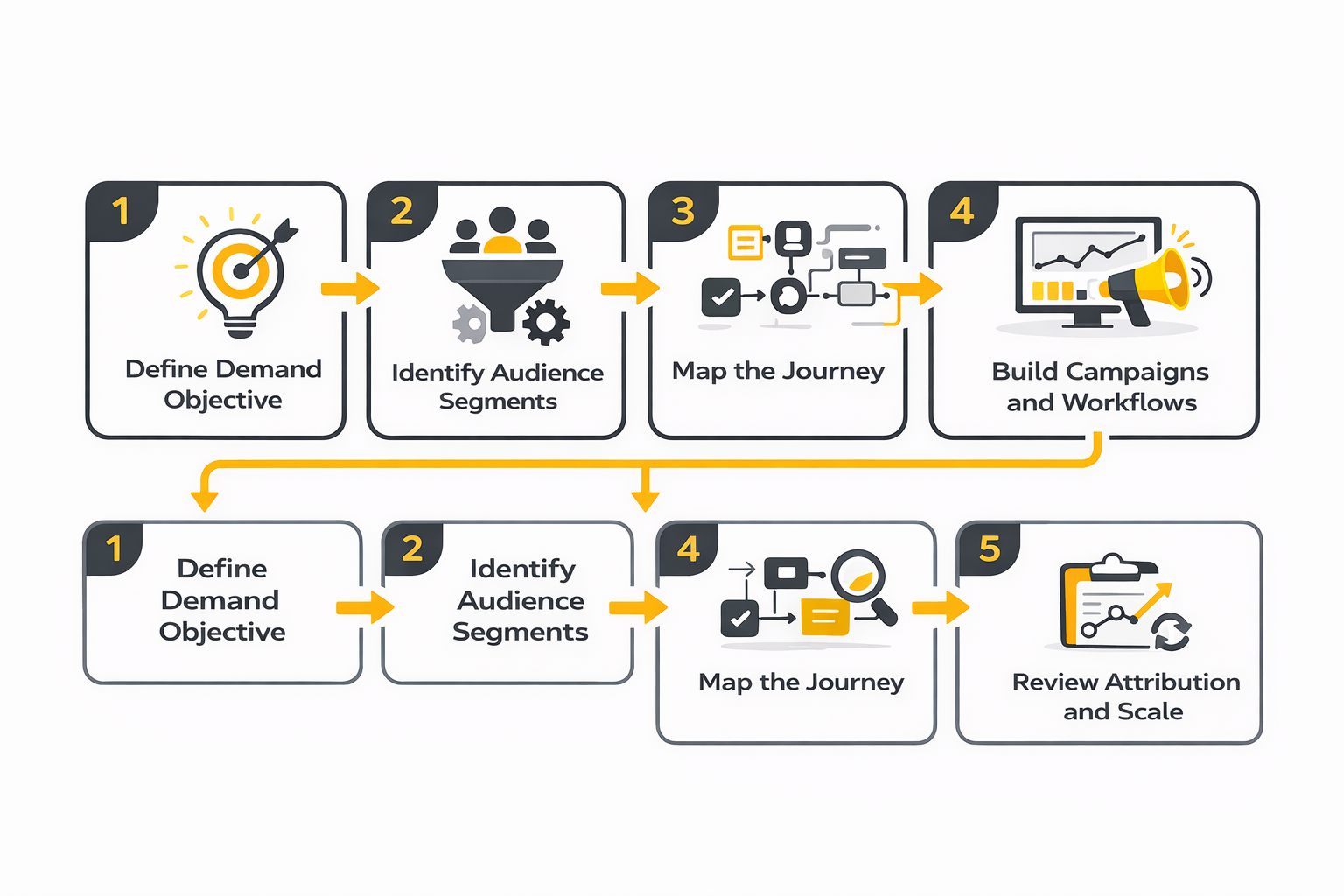
A Practical HubSpot Marketing Implementation Process
A professional HubSpot marketing rollout usually works best as a staged build rather than a giant one-time launch. That gives the team a chance to validate assumptions, catch bad logic early, and avoid creating dozens of workflows that have to be rebuilt later. HubSpot’s own recent guidance leans in that direction too, especially around starting with one lifecycle workflow before expanding.
A strong implementation process usually looks like this:
- Define lifecycle stages, qualification rules, and sales handoff criteria in writing.
- Audit forms, landing pages, and tracking so new records enter the CRM correctly.
- Create the active segments needed for nurture, exclusions, routing, and reporting.
- Configure scoring around real buying signals instead of soft engagement vanity.
- Launch one or two core workflows first, usually lifecycle progression and routed follow-up.
- Test re-enrollment, suppression logic, and edge cases before scaling the system.
- Review attribution and segment performance before adding more campaign complexity.
The reason this process works is that it respects how HubSpot marketing actually behaves in production. Records change over time, contacts revisit pages, scores rise and fall, and workflows re-enroll based on updated criteria. If you do not design for those moving parts from day one, small setup mistakes turn into reporting noise, duplicate actions, and poor handoffs.
Keep Scoring and Intent Simple Enough to Trust
Lead scoring is one of those areas where teams love complexity right up until the moment nobody understands the score anymore. HubSpot has improved the transparency of score calculations, including better testing visibility, which is useful because scoring only helps when sales and marketing both trust what the threshold means.
The smarter move is to keep the model tied to a small set of meaningful signals. Buyer intent, recent intent signals, repeated high-value page visits, strong conversion events, and fit-based properties are usually more valuable than piling on points for every email open and casual click. HubSpot explicitly supports using intent signals inside workflows and lead scoring, which makes it easier to prioritize accounts showing stronger evidence of interest.
This is where discipline matters. If your HubSpot marketing implementation rewards weak activity, sales gets flooded with false positives. If it waits for perfect certainty, the handoff happens too late and momentum is gone. The goal is not perfect prediction. The goal is a scoring model that is simple enough to explain, stable enough to manage, and accurate enough to improve prioritization.
Use Segmentation as Infrastructure, Not Decoration
A lot of teams talk about segmentation as if it were just a campaign feature. In reality, it is infrastructure. HubSpot’s segment analytics now let teams review how segments are performing, where they are activated across tools, how they overlap, and how contacts within them are progressing, which is exactly how a mature system should be managed.
That matters because segmentation powers far more than email lists. It influences who enters workflows, who gets excluded from campaigns, how reporting is grouped, and whether the right people see the right follow-up. Active segments are especially useful when the underlying conditions change frequently, such as lifecycle stage or behavioral activity, because the audience updates without someone rebuilding the list every week.
For HubSpot marketing, this is one of the clearest maturity markers. Weak teams treat segments as temporary campaign buckets. Strong teams treat them as reusable operating logic that supports automation, routing, reporting, and personalization across the entire funnel.
Roll Out in Layers, Then Tighten the System
The best implementations do not try to automate every scenario in the first month. They launch the essential pieces, validate the handoffs, inspect the reports, and only then add more branches, more segmentation depth, and more campaign variants. That slower start usually creates faster long-term growth because the foundation stays readable and trustworthy.
This is also where AI can help without taking over the strategy. HubSpot’s current tooling can assist with workflow creation and content generation, but the judgment still has to come from the team running the system. AI can speed up production. It cannot decide what your lifecycle definitions should mean, when a lead should be routed to sales, or which signals are worth acting on.
That is the practical truth behind great HubSpot marketing implementation. The platform is powerful, but the real advantage comes from operational clarity. When the data model is clean, the scoring is credible, the segmentation is useful, and the automation is tied to real intent, the whole engine gets easier to scale.
What the Numbers in HubSpot Marketing Actually Tell You
A lot of teams say they want data-driven HubSpot marketing, but what they really mean is that they want cleaner dashboards. Those are not the same thing. Real measurement is not about collecting more charts. It is about knowing which signals reflect buyer movement, which numbers are noise, and what action the team should take next.
That matters because buyer behavior is getting harder to read with surface-level metrics alone. Buyers are doing more research independently, with Gartner reporting that 67% of B2B buyers now prefer a rep-free experience, while 6sense continues to show that many buyers can complete about two-thirds of the buying journey before engaging sellers. In plain English, that means HubSpot marketing measurement has to focus less on visible activity alone and more on intent, progression, and influence.
The temptation is to dump a pile of stats into a report and call it strategy. That is exactly the wrong move. The right move is to build a measurement system that tells you whether your marketing is creating qualified demand, accelerating movement, and contributing to deals instead of just generating attention.
The Metrics That Actually Matter First
The first number that matters is not open rate, click-through rate, or raw website traffic. It is whether the right audience is entering the system in the first place. HubSpot’s attribution framework is built around contact creation, deal creation, and revenue attribution, which is a far more useful hierarchy because it mirrors how marketing activity becomes business impact over time. (understanding attribution models, creating attribution reports)
That structure matters because top-of-funnel growth can hide weak execution. You can grow traffic and even grow leads while still making the pipeline worse if low-fit contacts are entering nurture flows, cluttering scoring models, and distracting sales. In HubSpot marketing, volume without downstream quality is not momentum. It is usually expensive confusion.
That is why the cleanest measurement stack starts with three questions. Are we creating the right contacts, are those contacts progressing at a healthy rate, and are our campaigns showing influence on deals or revenue? Once those are visible, secondary metrics become useful for diagnosis instead of becoming the whole story.
Why Vanity Metrics Break Decision-Making
Vanity metrics are dangerous because they are not always false. They are just incomplete in ways that make bad decisions feel justified. An email campaign can produce strong click activity while attracting low-intent traffic, and a landing page can convert well while pulling in contacts that never get close to a sales conversation.
This problem gets worse in an AI-heavy environment. HubSpot’s latest marketing research shows that 80% of marketers use AI for content creation and nearly 75% use AI for media production. That means content production is faster, cheaper, and easier to scale, but it also means activity metrics can rise even while strategic quality stays flat.
The practical takeaway is simple. In HubSpot marketing, a spike in content output or engagement should never be treated as proof of success on its own. It should trigger a second question: did this activity improve contact quality, accelerate progression, or increase attributed pipeline influence?
How to Read the Analytics System Inside HubSpot
HubSpot gives teams several layers of measurement, and the value comes from using them together rather than staring at one dashboard in isolation. Campaign attribution reports can measure effectiveness by contacts created, deals created, or revenue, while broader attribution reporting helps break down which interactions across the journey received credit. (campaign attribution reports, attribution report definitions)
That setup matters because not every asset plays the same role. Some assets are built to create first conversion. Others help qualify or nurture. Others influence closing stages later in the journey. If your reporting expects every blog post, landing page, webinar, and email to perform the same job, you will misread performance and kill assets that are quietly doing useful work deeper in the funnel.
The right way to interpret the analytics is by role. Contact creation tells you what is bringing new people into the database. Deal creation helps show which marketing touches are closer to commercial movement. Revenue attribution gives the strongest signal of business impact, but it should be read with context because longer sales cycles and multiple touchpoints can spread credit across several assets.
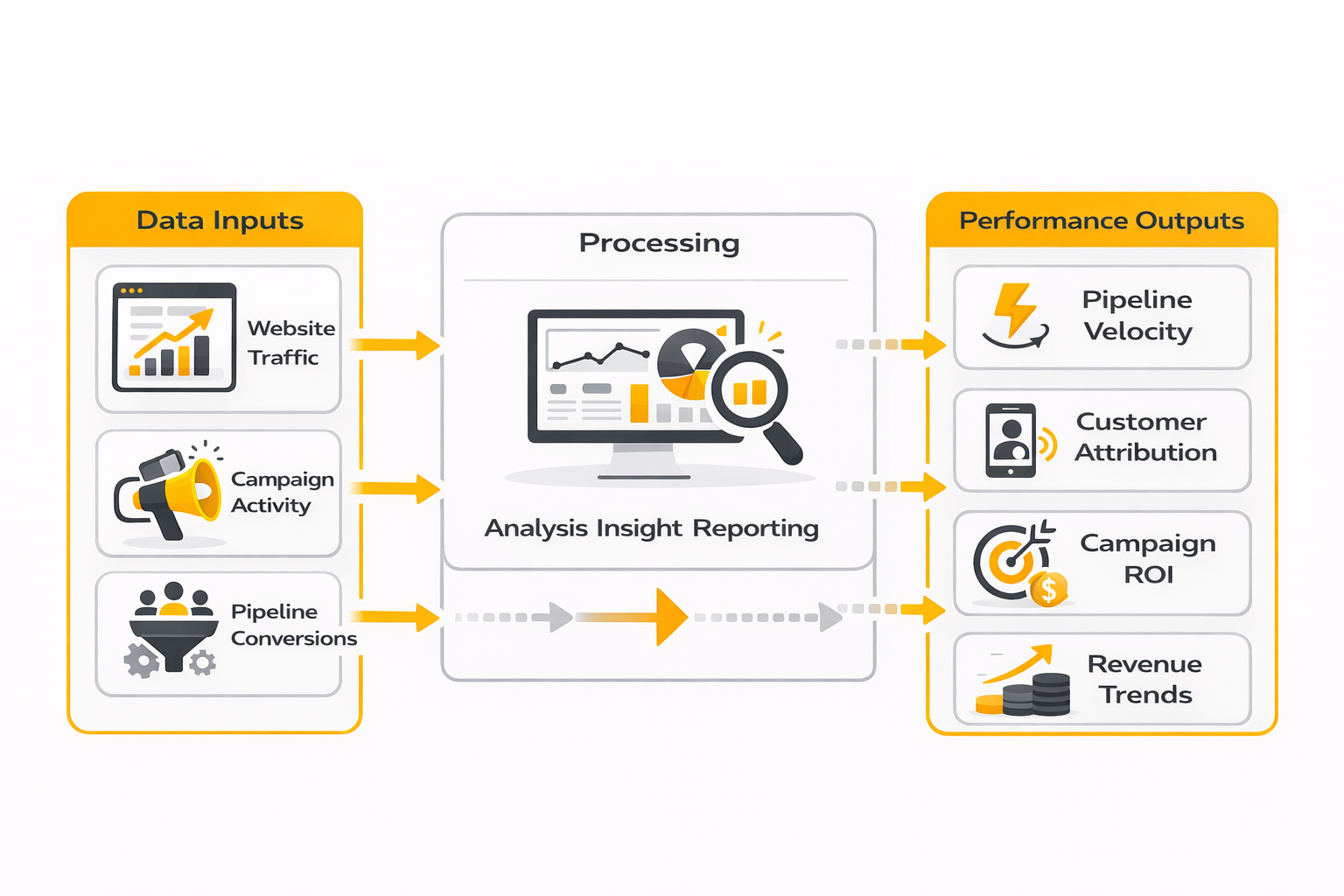
This is where HubSpot marketing becomes more strategic than a basic reporting tool. Instead of asking which campaign got the most clicks, you can ask which campaign created quality contacts, which interactions appeared before deal creation, and which assets had measurable influence on won revenue. That is a very different level of decision-making, and it is the level that usually separates serious operators from busy teams.
Benchmarks Are Useful Only When They Stay in Context
Benchmarks help, but only when they are used as directional tools rather than as fixed goals. For example, HubSpot’s 2026 research found that 93.2% of marketers say personalized or segmented experiences have led to more leads and purchases. That does not mean every brand should obsess over creating endless micro-segments tomorrow. It means segmentation is strong enough as a pattern that generic messaging should now be treated as a risk, not a default.
The same goes for buyer behavior data. When Gartner reports that 73% of buyers actively avoid irrelevant outreach, the useful conclusion is not just that personalization matters. The more important conclusion is that weak targeting damages performance before a conversation even starts, which means segmentation, suppression rules, and routing logic are now measurement issues as much as messaging issues.
In other words, benchmarks should drive questions, not ego. If your email engagement looks acceptable but lead quality is weak, the benchmark that matters may be relevance rather than response rate. If traffic is healthy but revenue attribution is flat, the real issue may be offer quality, qualification logic, or sales handoff rather than channel performance.
The Performance Signals Worth Watching Closely
In practical HubSpot marketing terms, a few signals tend to matter more than the rest. One is conversion rate by source and offer, because it shows whether the promise and audience match. Another is lifecycle progression speed, because it reveals whether contacts are actually moving or just sitting in the database. A third is the gap between contact creation and deal influence, because that gap often exposes poor qualification or weak nurture design.
These signals are especially useful because they lead to action. If a source drives cheap conversions but almost no deal influence, budget should probably shift or the offer should change. If contacts enter the CRM but stall before meaningful sales engagement, the likely issue is in segmentation, lead scoring, nurture timing, or handoff logic rather than in traffic generation itself.
HubSpot’s custom reporting options help here because they allow teams to combine operational and outcome data instead of living inside channel silos. The point is not to create more reports for their own sake. The point is to make performance patterns visible early enough that the team can fix them before the quarter disappears. (custom reports in HubSpot)
What the Data Should Make You Do Next
Good measurement should create action, not admiration. If the numbers show that one campaign creates lots of contacts but very little downstream movement, you do not need a prettier chart. You need to tighten targeting, adjust the offer, or change the post-conversion journey. If another campaign creates fewer leads but more deal influence, that is often a sign you should protect it, not panic because the top-of-funnel volume looks smaller.
This is why HubSpot marketing works best when analytics is tied directly to operational ownership. Someone needs to own source quality. Someone needs to own lifecycle progression. Someone needs to own attribution review. Without that, the numbers get discussed, nobody changes anything, and reporting becomes theater.
The deeper point is that data only becomes useful when it helps you decide what to scale, what to cut, and what to fix. That is the real purpose of measurement. Not to prove that marketing was busy, but to show whether the system is actually producing business movement.
Optimization, Common Mistakes, and the Tradeoffs That Show Up as You Scale
This is the stage where HubSpot marketing gets more interesting and a lot less forgiving. Early on, almost any improvement feels meaningful because the baseline is messy and the easiest wins are obvious. Later, the gains come from better judgment, cleaner systems, tighter prioritization, and the discipline to stop doing things that look productive but do not move revenue.
That shift matters because the market is pushing teams in two directions at once. Buyers want more relevance and more self-service, while internal teams want faster execution, more automation, and clearer proof of ROI. HubSpot sits right in the middle of that tension, which means scaling well is not just about using more features. It is about making better tradeoffs inside one connected system.
The Real Scaling Problem Is Usually Complexity, Not Capacity
Most teams assume scaling HubSpot marketing means adding more workflows, more segments, more assets, and more campaigns. Sometimes that is true for a while. But past a certain point, growth starts breaking down not because the platform cannot handle the volume, but because the operating model becomes too complex for the team to manage with confidence.
That is why advanced teams simplify aggressively. They reduce overlapping workflows, retire dead properties, standardize naming, clean up campaign structure, and make sure reporting still reflects how the business actually sells. The goal is not a more impressive-looking portal. The goal is a system that still makes sense under pressure.
This is also where operational maturity becomes visible. If nobody can explain why a workflow exists, why a field matters, or why a contact entered a segment, the system is already becoming fragile. HubSpot marketing scales best when every important automation has a clear purpose, a clear owner, and a clear success condition.
AI Speeds Execution, but It Also Raises the Cost of Sloppy Strategy
HubSpot is investing heavily in AI-assisted workflows, content support, and broader platform productivity. That creates real upside because teams can move faster, create more, and automate more of the routine work that used to eat the week. But faster production is not the same as better marketing, and that distinction matters more now than ever.
The risk is subtle. When content, workflows, and campaign assets become easier to generate, weak decisions scale faster too. A bad nurture path written slowly is a problem. A bad nurture path written instantly and deployed across multiple segments is a much bigger one.
So the expert move is not to resist AI. It is to contain it inside a better system. Use it to accelerate drafts, workflow setup, testing ideas, and production support, but keep the strategic choices human. HubSpot marketing gets stronger when AI handles speed and the team handles judgment.
Data Quality Becomes a Revenue Issue Much Earlier Than Most Teams Expect
A lot of teams treat data hygiene like admin work they can clean up later. That is a mistake. Once HubSpot marketing starts powering segmentation, scoring, routing, attribution, and handoff logic, bad data stops being an inconvenience and starts distorting decisions across the whole funnel.
Duplicates are a good example. One duplicate contact is annoying. Hundreds of duplicates can break attribution, create conflicting lifecycle status, send people into the wrong workflows, and make performance reviews feel inconsistent even when campaigns are working. HubSpot’s current data quality tooling reflects how central this has become, with duplicate management, formatting fixes, enrichment coverage, and property usage insights all now sitting inside a formal data quality layer.
This is why strong operators build recurring cleanup into the system instead of treating it like occasional maintenance. They review critical properties, inspect duplicates, check enrichment coverage, and retire fields that are no longer operationally useful. It is not glamorous, but it protects every other layer of HubSpot marketing from becoming less trustworthy over time.
Personalization Is Powerful, but Over-Segmentation Can Slow You Down
Segmentation is one of the clearest drivers of better performance, and it is easy to see why. Buyers respond better when the message fits their role, stage, behavior, and level of intent. HubSpot’s own recent marketing research continues to reinforce that more relevant experiences outperform generic ones, especially in a market crowded with AI-generated sameness.
But there is a tradeoff here that experienced teams learn the hard way. More segments do not automatically mean better execution. If every campaign requires endless audience branches, custom logic, and one-off assets, the team can spend so much time maintaining personalization that it loses speed, consistency, and measurement clarity.
The better approach is layered relevance. Use a small number of strategically meaningful segments, make the major differences count, and avoid building a custom universe for every slight variation in behavior. HubSpot marketing works best when segmentation sharpens the message without turning the system into a maze.
Attribution Can Guide Smart Decisions, but It Can Also Be Overread
Attribution is one of the most valuable parts of serious HubSpot marketing because it pushes teams beyond vanity metrics. It helps reveal which assets bring in contacts, which interactions appear before deal creation, and which campaigns influence revenue. That is powerful, especially for budget decisions and channel prioritization.
But attribution is still a model, not a perfect recording of reality. In longer buying cycles, multiple touches matter, sales conversations matter, timing matters, and not every influence is captured equally. If teams treat attribution like absolute truth instead of directional intelligence, they can end up cutting useful upper-funnel work just because it is less visible in short-term revenue reports.
The smarter move is to read attribution together with progression speed, sales feedback, conversion quality, and campaign role. That creates a fuller picture. HubSpot marketing gets better when attribution informs decisions, not when it becomes the only lens anyone trusts.
The Biggest Mistakes Usually Come From Misalignment, Not Tactics
When HubSpot marketing underperforms, the first instinct is often to blame channels, content, or automation tactics. Sometimes those are the issue. More often, the deeper problem is that marketing and sales are using different definitions of quality, timing, and readiness, so the platform is reflecting organizational confusion instead of fixing it.
This shows up everywhere. Marketing celebrates lead growth while sales sees weak fit. Automation routes contacts based on engagement while sales wants firmer buying signals. Reporting says performance is improving while pipeline conversations say the opposite. None of that is really a software problem.
The fix is simple in theory and demanding in practice. Define what qualified means, what handoff means, what progression means, and what should happen after each meaningful signal. Once those rules are shared, HubSpot marketing becomes much easier to scale because the system is supporting a common process instead of mediating an internal argument.
What Expert Teams Do Differently
The teams that get the most out of HubSpot marketing usually look less flashy from the outside than people expect. They are not always running the most campaigns or publishing the most content. What they do better is keep the machine coherent.
They protect the data model. They review workflows before adding new ones. They use AI where it saves time, not where it replaces thinking. They watch lifecycle movement, source quality, and attributed impact together instead of chasing one metric at a time. And they are willing to remove complexity when complexity stops paying for itself.
That last point is worth emphasizing. In advanced HubSpot marketing, success is not just about what you build. It is also about what you refuse to keep. The strongest systems stay effective because someone is consistently pruning, simplifying, and tightening the setup before scale turns into drag.
FAQ
Is HubSpot marketing a good fit for small teams?
Yes, but only if the team is ready to use it as a system rather than as a collection of isolated tools. HubSpot’s own product structure is designed to connect lead capture, automation, CRM data, and reporting, which makes it useful for small teams that want fewer handoffs and less fragmentation. The catch is that even a smaller team still needs clear lifecycle rules, clean data, and realistic campaign priorities or the platform will feel heavier than it should. (HubSpot Marketing Hub, lifecycle stages)
What is the biggest mistake companies make with HubSpot marketing?
The most common mistake is building campaigns and workflows before defining the underlying process. When lifecycle stages, ownership, qualification, and segmentation are unclear, automation simply scales the confusion. HubSpot marketing works much better when the team agrees first on how contacts should enter, move through, and exit the system. (lifecycle stages, attribution reports)
Does HubSpot marketing replace other tools completely?
Sometimes it can reduce the number of tools you need, but that does not mean it should replace everything by default. The strength of HubSpot marketing is that forms, CRM records, workflows, and reporting live close enough together to reduce operational drag. Whether it fully replaces other software depends on your use case, reporting needs, channel mix, and how specialized your current stack has become. (HubSpot products overview, forms)
How important are lifecycle stages in HubSpot marketing?
They are foundational. HubSpot’s lifecycle stage property is built specifically to show where a contact or company sits in your marketing and sales processes, which directly affects handoff, segmentation, and reporting. If those stages are vague or inconsistent, almost every part of HubSpot marketing gets weaker downstream. (lifecycle stages)
Should you build lots of workflows right away?
No, that usually creates technical clutter before the logic is proven. A stronger approach is to start with the few workflows that control lifecycle movement, routing, and essential nurture actions, then expand after the team has validated the triggers and outcomes. HubSpot’s workflow capabilities are powerful, but they become much easier to manage when they are layered gradually. (workflows knowledge base, lifecycle stages)
What metrics matter most in HubSpot marketing?
The best starting metrics are contact creation quality, lifecycle progression, deal influence, and revenue attribution. HubSpot’s attribution reporting is built around contact creation, deal creation, and revenue, which is more useful than relying on opens, clicks, or traffic alone. Those surface metrics still help with diagnosis, but they should not be treated as the final score. (attribution reports)
Is HubSpot marketing still relevant now that AI is everywhere?
Yes, arguably more than before, because AI makes execution faster while increasing the value of clean systems and better judgment. HubSpot’s 2026 marketing research centers heavily on AI, trust, and brand distinctiveness, which fits the reality most teams are now facing. The teams that win will not just create more with AI; they will use HubSpot marketing to organize the data, journeys, and measurement behind that output. (2026 State of Marketing Report, 2026 marketing statistics)
How should teams think about personalization inside HubSpot?
Personalization matters, but not every difference deserves its own segment or workflow. HubSpot marketing gets better when segmentation reflects meaningful differences in role, stage, fit, or intent rather than endless micro-variations that become hard to manage. The goal is relevant messaging with operational clarity, not personalization theater. (list and segment guidance, 2026 State of Marketing Report)
When does HubSpot marketing start feeling expensive?
Usually when the portal is underused, the setup is messy, or the team is paying for complexity it cannot operationalize. Pricing only becomes worthwhile when the business is actually using the connected value of CRM sync, automation, attribution, and campaign orchestration instead of treating the platform like a simple email sender. That is why implementation quality matters so much early. (Marketing Hub pricing, HubSpot Marketing Hub)
Can HubSpot marketing help sales teams too?
Yes, because better marketing data improves timing, prioritization, and handoff quality for sales. When forms, intent signals, lifecycle stages, and attribution all connect to the same customer record, sales can see more context and respond with better relevance. HubSpot marketing is strongest when it is not treated as a department-only tool, but as part of a shared revenue system. (HubSpot products overview, lifecycle stages)
How long does it take to see results from HubSpot marketing?
That depends on what you mean by results. You can usually improve lead capture, routing, and reporting visibility relatively early, but better lifecycle progression, cleaner qualification, and stronger revenue attribution take longer because they depend on campaign cycles and sales motion. HubSpot marketing tends to reward teams that build the foundation properly and then improve the system in layers rather than expecting one big launch to solve everything at once. (forms, attribution reports)
What does good HubSpot marketing look like in practice?
It looks less flashy than people expect. Good HubSpot marketing usually means clean data, clear lifecycle movement, useful segmentation, a handful of well-designed workflows, and reporting that shows what is influencing qualified demand and revenue. When those pieces are working together, the platform feels simpler, more valuable, and much easier to scale. (HubSpot Marketing Hub, lifecycle stages, attribution reports)
Work With Professionals
Explore 10K+ Remote Marketing Contracts on MarkeWork.com
Most marketers spend too much time chasing clients, competing on crowded platforms, and losing a percentage of every project to middlemen.
MarkeWork gives you a better way. Browse thousands of remote marketing contracts and connect directly with companies desperate to hire skilled marketers like you, without platform commissions and without unnecessary gatekeepers.
If you're serious about finding better opportunities and keeping 100% of what you earn, explore available contracts and create a profile for free at MarkeWork.com.