

Most HVAC companies do not have a lead problem in the abstract. They have a visibility problem in the moments that matter most: when a homeowner’s system fails, when energy bills spike, when a builder needs a dependable install partner, or when seasonal demand suddenly compresses the buying window. That is why a generic agency usually underperforms here. HVAC marketing sits at the intersection of urgent intent, local trust, service-area logistics, call handling, financing, and reputation management.
The category itself is still expanding, not shrinking. The U.S. heating and air-conditioning contractor market has been growing, with IBISWorld estimating a 2.6% CAGR from 2021 to 2026, while the labor side remains tight enough that the Bureau of Labor Statistics projects 8% employment growth for HVAC mechanics and installers from 2024 to 2034. In plain English, demand is there, competition is serious, and the companies that win are usually the ones that turn local attention into booked jobs faster and more consistently.
That is the real job of an HVAC marketing agency. It is not just running ads or posting on social media. It is building a system that helps the right customer find you, trust you, contact you, and choose you before they keep scrolling or call the next contractor.
Article Outline
- Why HVAC Marketing Needs a Specialist Agency
- The HVAC Growth Framework
- Core Services an HVAC Marketing Agency Should Own
- How the Best Agencies Build Demand Across Search, Ads, Reviews, and Retention
- How to Choose and Manage an HVAC Marketing Agency
- Common Mistakes, Key Metrics, and FAQs
Why HVAC Marketing Needs a Specialist Agency
HVAC is one of those markets where buyer behavior is brutally context-driven. Some searches are emergencies. Some are price shopping. Some are long-consideration replacement jobs tied to rebates, tax credits, financing, or efficiency upgrades. A serious HVAC marketing agency understands that those intents cannot be treated the same way, because a “no cooling” search at 6 p.m. is not the same lead as a homeowner comparing heat pump options over three weekends.
Google’s own explanation of Search says its systems can recognize when a query has local intent and surface nearby businesses, which is exactly why HVAC growth is so tied to local SEO, map visibility, and proximity-based relevance rather than broad national brand awareness alone Google Search local intent. On top of that, Google positions Business Profile as a way to turn people who find a company on Search and Maps into customers, and the platform gives owners direct visibility into views, clicks, calls, and direction requests through its performance insights Google Business Profile and Business Profile performance metrics.
Trust is the second reason specialization matters. In local service categories, review behavior directly shapes conversion, and that effect is not subtle. BrightLocal’s 2025 local SEO statistics roundup reports that 83% of consumers use Google to find local business reviews, and the same source highlights that 88% say they would use a business that responds to both positive and negative reviews, compared with just 47% for a business that does not respond at all. For an HVAC company, that means reputation management is not some nice little side task. It is part of the sales process.
Specialization also matters because HVAC buyers respond to economics, not just comfort. ENERGY STAR’s federal tax credit guidance and home savings resources make it clear that incentives can materially change the homeowner’s decision window, while ENERGY STAR’s heating and cooling page shows how even products like smart thermostats can be framed around measurable savings. A competent HVAC marketing agency knows how to translate those technical and financial details into offers, landing pages, and call scripts that actually move people to act.

The HVAC Growth Framework
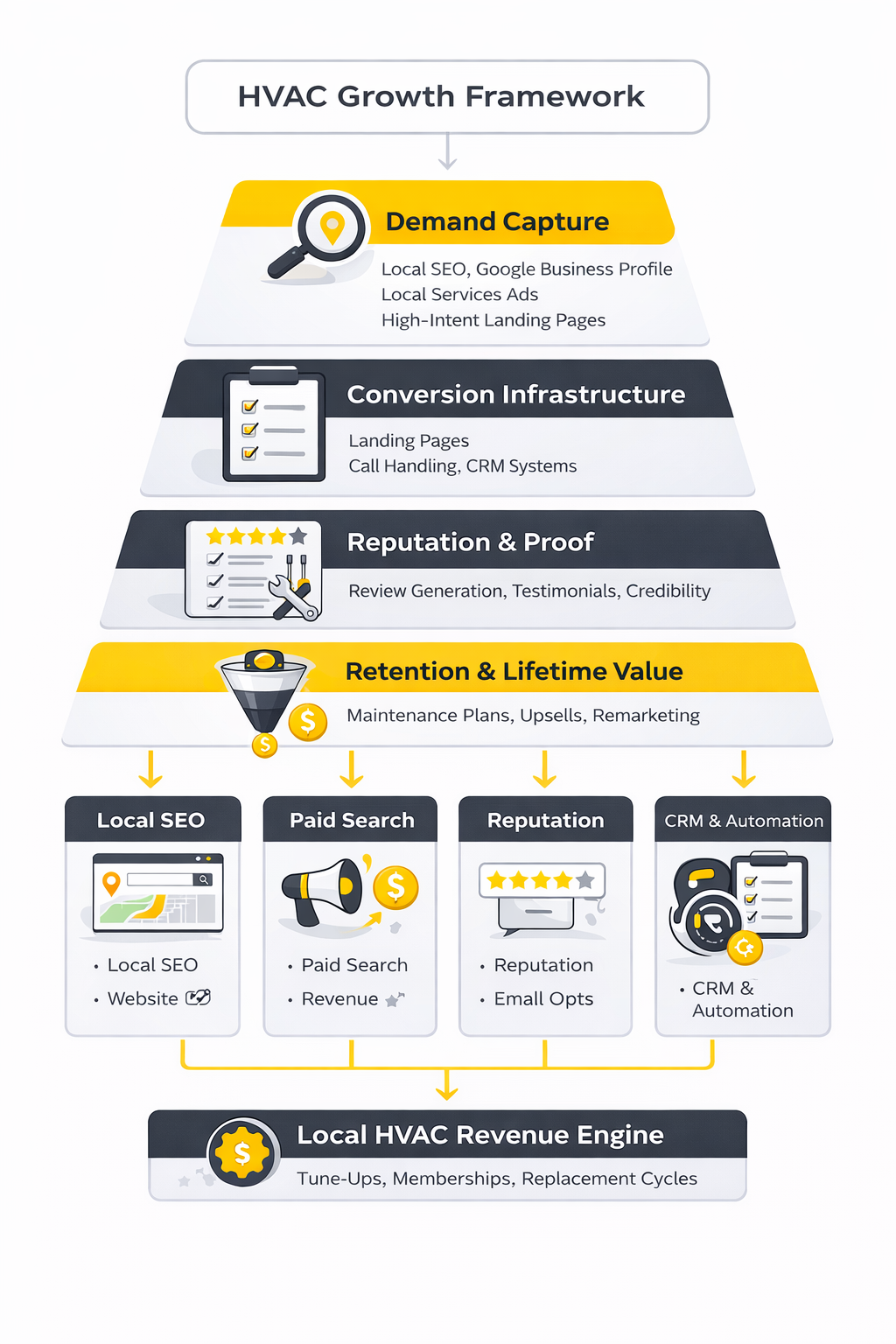
The simplest way to evaluate an HVAC marketing agency is this: can it build a system instead of a pile of tactics? Good HVAC marketing is not “SEO over here, Google Ads over there, maybe some Facebook posts if there is time.” It is a connected framework that captures existing demand, creates future demand, converts attention into leads, and then turns one-time customers into repeat revenue through maintenance, membership, and replacement cycles.
At the top of the framework is demand capture. This is where local SEO, Google Business Profile optimization, paid search, Local Services Ads, and high-intent landing pages do the heavy lifting. Google explicitly says a Business Profile can help service-area businesses convert Search and Maps discovery into customer actions Google Business Profile, and Google’s Local Services documentation shows why contractor categories are different from ordinary ads: in many cases, businesses must pass screening and background-check requirements to participate Local Services screening process and Local Services platform policies. That means visibility, trust, and eligibility are all linked.
The next layer is conversion infrastructure. This is where many agencies fall apart. Ranking, impressions, and clicks are not enough if the landing page is generic, the phone is not answered fast, the financing message is buried, or the dispatcher cannot separate maintenance from emergency service. The agency has to work backward from booked revenue, not forward from vanity metrics.
Then comes reputation and proof. Reviews, before-and-after content, technician credibility, maintenance plan positioning, and neighborhood-specific proof points all reinforce the same message: this company is real, responsive, and safe to call into the home. In HVAC, where customers often make decisions under stress, reducing uncertainty is one of the highest-leverage forms of marketing.
Finally, the best framework includes retention and lifetime value. HVAC is not a single-sale business unless the company chooses to run it that way. Tune-ups, memberships, indoor air quality upgrades, duct work, thermostat add-ons, and eventual system replacement all increase the value of acquiring one qualified household. That is why an agency worth hiring should think beyond lead volume and into customer value, follow-up systems, and remarketing paths. Platforms built for lead capture, CRM, and automation can help connect those pieces; for contractors looking at integrated funnels and follow-up, tools such as GoHighLevel are often part of that conversation.
What Part 1 Sets Up for the Rest of the Article
Before you compare retainers, ad dashboards, or agency promises, you need to understand the structure of the game. HVAC marketing works when the company shows up in the right local moments, presents trust fast, removes friction from contact, and keeps nurturing value after the first job. Miss one of those pieces, and the rest gets more expensive.
That is also why the next sections matter. The rest of this article will break down the core services a real HVAC marketing agency should own, how those services work together across channels, how to choose the right partner without getting trapped in fluff, and which metrics actually tell you whether your marketing is producing profitable growth.
Core Services an HVAC Marketing Agency Should Own
A good HVAC marketing agency does not sell disconnected tasks. It owns the chain from visibility to booked revenue, and it knows where that chain usually breaks for contractors. In this market, the weak points are rarely mysterious. They are usually local discovery, slow response, thin landing pages, poor review velocity, and almost no follow-up after the first job.
That is why the service mix matters more than the label on the proposal. One agency may call itself full-service and still ignore call handling, customer retention, or Google Business Profile performance. Another may be smaller on paper but much more dangerous in practice because it knows how to connect SEO, paid media, reviews, automation, and service-area operations into one system.
Local SEO and Google Business Profile Management
This is the foundation, not the add-on. HVAC companies live and die on local intent, and Google is explicit that Business Profile exists to help companies show up on Search and Maps and turn that visibility into real actions like calls, website visits, and direction requests through Business Profile performance metrics. If an HVAC marketing agency cannot explain how it manages categories, service areas, service pages, review growth, photos, Q&A, and profile accuracy, it is missing the center of the board.
The details matter more than most owners realize. Google’s business representation guidelines tell companies to keep addresses or service areas precise and to choose only the categories that accurately describe the real business, which is a direct reminder that sloppy profile setup can hurt visibility and trust Google’s business representation guidelines. For a contractor serving multiple towns, this work has to be reflected across the profile, the website, and the service pages so Google sees a coherent local entity instead of a messy patchwork.
A serious HVAC marketing agency also understands that local SEO is not just a rankings game. It is a lead quality game. The point is to win the searches that map cleanly to profitable work, whether that is emergency AC repair, furnace replacement, ductless mini-split installation, indoor air quality upgrades, or maintenance plans.
Paid Search and Local Services Ads
Organic visibility is powerful, but it is not enough by itself, especially during peak season or in crowded metro areas. Paid search lets an HVAC company show up immediately for high-intent queries, control message match by service line, and route traffic to pages built for replacement, repair, tune-ups, or financing rather than a generic homepage. The agency’s job is not merely buying clicks. It is shaping demand around urgency, geography, device behavior, and actual margin.
Local Services Ads add another layer that matters specifically for contractors. Google states that businesses on the platform must pass screening and verification, and those requirements can include business registration, insurance, licensing checks, and in some cases minimum review requirements through the Local Services screening process and platform policies. An HVAC marketing agency that really knows the channel should be able to handle setup, dispute issues, budget pacing, lead quality review, and the operational side of turning LSA leads into real appointments.
This is one place where specialization saves money. HVAC leads can be expensive, and the wrong account structure burns budget on low-fit traffic fast. The right agency separates branded searches from non-branded ones, emergency jobs from replacement intent, and homeowner demand from commercial queries so the company is not paying premium rates for traffic that was never likely to book.
Landing Pages, Conversion Rate Optimization, and Call Handling
Here is where a lot of agencies get exposed. They send traffic to a site that looks decent enough, then blame the market when conversion is weak. That is lazy. In local home services, conversion usually rises or falls on speed, trust, clarity, and what happens when the phone rings.
Google’s mobile speed research found that as load time rises from one second to three seconds, bounce probability increases by 32%, and from one second to seven seconds it increases by 113% in the Think with Google speed benchmarks. For an HVAC company, that is not a technical footnote. It is lost emergency demand, especially on mobile, where the person searching often wants a technician now, not after a bloated page finishes loading.
A competent HVAC marketing agency builds pages that reduce hesitation immediately. That means clear service-area language, financing visibility, trust badges where they help, strong review proof, real offer hierarchy, and obvious paths to call or book. It also means measuring what happens after the click. Invoca’s 2025 benchmark report is based on more than 60 million phone calls from 2024, which is a useful reminder that phone conversations still decide revenue in high-value service categories like HVAC Invoca’s call conversion benchmarks.
This is why the agency should care about response workflows, not just ad metrics. If the office misses calls, if forms sit untouched for hours, or if nobody follows up on estimate requests, the marketing can look busy while the business stays flat. Good agencies know that booked jobs are operational outcomes, not just campaign outcomes.
Review Generation and Reputation Management
Reputation is not separate from acquisition in HVAC. It is part of acquisition. When someone is letting a contractor into the house, often under time pressure, they want proof that other people had a safe, competent, and responsive experience.
BrightLocal’s most recent consumer review research shows that people still rely heavily on reviews during local buying decisions, and it also shows that review responses meaningfully affect whether a consumer would consider using a business through the 2026 Local Consumer Review Survey and the 2025 survey findings. That means an HVAC marketing agency should not just ask for reviews occasionally. It should run a structured system for requesting them, responding to them, and learning from them.
This work also improves more than conversion rate. Strong review flow supports local search visibility, strengthens trust signals on landing pages, and gives sales staff something specific to reference on the phone. The best agencies treat reviews like reusable sales assets, not vanity screenshots.
CRM, Automation, and Retention Marketing
The final service most weak agencies underplay is retention. HVAC businesses have recurring opportunities built into the model: seasonal tune-ups, maintenance memberships, filter reminders, IAQ upgrades, smart thermostats, duct work, and eventual replacement. A company that markets only for first-time calls is leaving a huge amount of profit on the table.
That is where CRM and automation matter. Systems for missed-call text back, estimate follow-up, maintenance reminders, reactivation campaigns, and membership renewal sequences help an HVAC company earn more from every customer it already paid to acquire. Tools like GoHighLevel are often used for this kind of workflow because they combine forms, pipelines, messaging, and follow-up in one place, which is exactly the kind of operational alignment service businesses need.
There is also a strategic angle here. ENERGY STAR’s heating and cooling guidance, the maintenance checklist, and clean heating and cooling guidance all reinforce a point smart agencies already understand: homeowners do not just buy emergency repairs. They buy efficiency, comfort, air quality, and prevention. An HVAC marketing agency that knows how to market those outcomes can help a contractor build steadier revenue instead of living and dying by breakdown season.
The bigger point is simple. When an HVAC marketing agency is doing its job properly, it is not just generating attention. It is building a local revenue engine with clear inputs, measurable conversion points, and repeatable follow-up. That is the standard the rest of this article will use from here forward.
How the Best Agencies Build Demand Across Search, Ads, Reviews, and Retention
The difference between a mediocre vendor and a strong HVAC marketing agency shows up in execution. Plenty of firms can describe the channels. Far fewer can run them in the right order, connect the handoffs, and keep improving the system after the first burst of leads. The agencies that outperform usually follow a disciplined operating process instead of chasing random tactics.
That process starts with one assumption: HVAC demand is uneven, local, and time-sensitive. Google’s own materials on Business Profile performance make it clear that local visibility leads to measurable actions like calls, website clicks, and direction requests, while Local Services Ads are built to surface screened providers directly in high-intent searches.
Step 1: Build the Local Search Foundation First
A serious HVAC marketing agency begins by cleaning up the basics before scaling spend. That means fixing the Google Business Profile, aligning service areas, tightening category choices, cleaning citation consistency, and making sure the site has service pages that match what the company actually sells. If the foundation is messy, every paid click and every SEO campaign becomes more expensive than it should be.
This is not glamorous work, but it is high leverage. Google’s guidance makes clear that businesses can track interactions from Search and Maps, including calls and website clicks, which means the profile is not just a listing. It is part of the conversion path.
Step 2: Segment Demand by Job Type and Intent
Once the local foundation is in place, the next move is segmentation. The best agencies do not push all traffic into one campaign and hope the algorithm figures it out. They separate emergency repair, planned replacement, tune-ups, indoor air quality, ductless systems, and maintenance because those searches behave differently, convert differently, and produce different revenue outcomes.
This matters even more in HVAC because urgency changes buyer behavior. Someone looking for same-day AC repair on a hot afternoon needs speed, trust, and a phone number. Someone comparing a heat pump replacement needs education, financing context, and reassurance that the installer knows how to handle the project cleanly.
Step 3: Match Each Intent to the Right Landing Experience
This is where the execution gets tangible. A good HVAC marketing agency does not send every click to the homepage. It builds specific landing experiences for each service line, each market priority, and often each level of urgency so the user immediately sees the offer, the geography, the proof, and the next action.
Google’s long-running mobile speed benchmarks still matter here because slower pages sharply increase bounce probability as load times rise. For HVAC campaigns, especially mobile and emergency traffic, that is a direct revenue issue, not a cosmetic one.
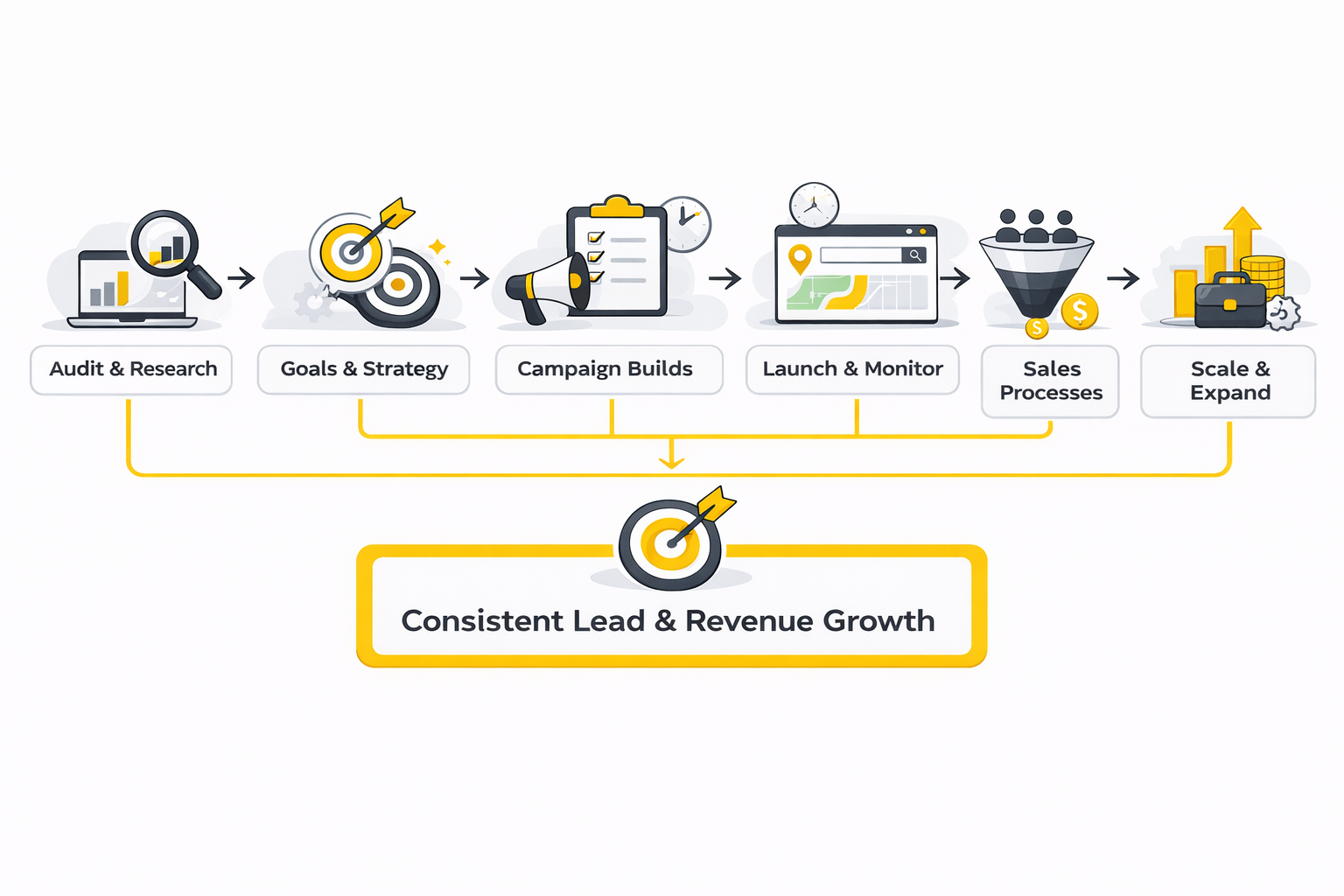
The best implementation process usually looks like this:
- Identify the highest-value service lines and target geographies.
- Create or rewrite landing pages around those exact intents.
- Put financing, reviews, trust signals, and contact options near the top.
- Route phone calls and form fills into a CRM with immediate follow-up.
- Measure booked jobs, not just clicks or raw leads.
- Improve pages and campaigns based on actual close-rate patterns.
That sequence sounds obvious, but most underperforming campaigns skip at least two of those steps. They buy traffic before the page is ready, collect leads without proper tracking, and then make decisions from incomplete data.
Step 4: Turn Calls Into Measurable Sales Conversations
In HVAC, the phone is still one of the main battlegrounds. Invoca’s 2025 benchmark work, based on more than 60 million calls analyzed from 2024, reinforces that phone conversations remain critical conversion points for high-consideration purchases and service interactions. For an HVAC marketing agency, that means call quality, answer rate, routing, and follow-up cannot be treated as someone else’s problem.
This is where smart agencies get operational. They listen for patterns. Which calls come from Local Services Ads but do not get booked? Which service lines generate long call durations but weak close rates? Which office locations answer fastest? Which campaigns generate after-hours calls that need missed-call text-back automation? Those are the questions that improve revenue, because they connect media performance to the actual buying conversation.
For teams that want one place to connect forms, call workflows, pipelines, and automated follow-up, platforms like GoHighLevel can make the implementation cleaner. The tool itself is not the strategy, but it can reduce friction when an agency is trying to connect lead capture and sales response into one working system.
Step 5: Build Review Velocity Into the Weekly Workflow
Review management is not something the agency should “get to later.” The best HVAC marketing agency builds it into the operating rhythm from the start. That usually means setting review requests after completed jobs, watching response times, coaching the client on how to ask, and feeding great review language back into ads and landing pages.
BrightLocal’s latest review research keeps reinforcing the same point: review responses shape trust and influence purchase decisions. That is why reputation work belongs inside the weekly process, not in a forgotten monthly report.
There is a second advantage here that a lot of companies miss. Reviews do not just reassure prospects. They also create language the market already uses. When customers repeatedly mention fast response, respectful technicians, financing help, or clean installs, the agency gets real copy inputs it can reuse in pages, ads, and scripts without sounding manufactured.
Step 6: Add Retention Once Acquisition Is Stable
Weak agencies stop at lead generation. Strong ones extend the system into retention once the front end is working. That is the point where an HVAC marketing agency starts earning its keep beyond campaign setup, because the company can now market maintenance plans, seasonal tune-ups, filter reminders, IAQ upgrades, and replacement opportunities to people who already know the brand.
This is also where the economics improve fast. Google’s local surfaces help businesses drive discovery, but the real profit often comes from what happens after the first booked job: the second visit, the membership, the upsell, and eventually the replacement cycle. The agency that understands that will build follow-up sequences, reactivation campaigns, and segmented customer messaging instead of chasing only net-new cold traffic.
For that stage, communication tools can help keep the cadence consistent. A contractor that wants better lifecycle messaging might use Brevo for email and SMS workflows, or ManyChat for conversational follow-up where chat-based engagement fits the broader funnel.
What Professional Implementation Really Looks Like
Professional implementation is not one launch day and a monthly PDF. It is a cadence. The agency reviews search visibility, ad spend efficiency, lead quality, answer rates, close rates, review growth, and retention performance together, because those signals influence each other. When the system is managed properly, it gets sharper over time rather than noisier.
That is the standard owners should look for. A real HVAC marketing agency does not hide behind impressions, vague branding language, or pretty dashboards. It builds a working revenue system, watches where that system leaks, and fixes those leaks fast. The next step is figuring out how to choose that kind of partner without getting trapped by promises that sound polished but are operationally hollow.
What the Numbers Actually Mean
A smart HVAC marketing agency does not drown you in dashboards. It tells you which numbers are early signals, which ones are final outcomes, and which ones are just noise dressed up as sophistication. That distinction matters because HVAC owners do not need more reporting. They need clearer decisions.
The easiest mistake is measuring marketing like media and not like operations. Clicks, impressions, and lead counts matter, but they are not the finish line. In HVAC, the numbers only become useful when they explain whether the business is getting more qualified calls, booking more jobs, and creating more revenue from the same service area.
Start With the Metrics That Sit Closest to Revenue
The most important performance signals are the ones nearest to booked work. That usually means qualified calls, form submissions that actually get contacted, appointments set, jobs sold, average ticket, and customer value over time. Everything else is a supporting indicator.
Google’s own documentation for Search Console explains that clicks, impressions, CTR, and average position are visibility metrics, not business outcomes, which is exactly how they should be treated in an HVAC reporting stack Search Console performance report and Google’s clicks and CTR guidance. Those numbers help you understand whether search visibility is improving and whether your snippets are attractive enough to earn traffic, but they do not tell you whether the traffic turns into service revenue.
That is why a good HVAC marketing agency should separate metrics into two buckets:
- Leading indicators such as impressions, local rankings, profile views, CTR, landing page speed, and review growth
- Lagging indicators such as qualified leads, booked calls, close rate, revenue, and repeat business
If the leading indicators improve but the lagging indicators stay flat, the system is leaking somewhere after the click. That usually means the issue is the landing page, the offer, the call handling, or the follow-up process rather than channel visibility alone.
Measure Local Visibility Like a Revenue Input, Not a Vanity Metric
For local service businesses, Google Business Profile data is more useful than many owners realize. Google states that Business Profile performance includes views, calls, website clicks, direction requests, and other customer interactions, and Google Analytics now supports connecting Business Profile data so businesses can analyze those local signals in one reporting environment Business Profile performance metrics and connect Google Business Profile to Google Analytics.
That matters because local visibility is often the first measurable sign that an HVAC marketing agency is moving the market. If profile interactions increase but your website leads do not, that is not automatically bad news. It may mean more prospects are calling directly from Maps instead of filling out forms. If direction requests rise for a company that serves from a storefront, that may indicate stronger local intent. If calls rise but booked jobs do not, the agency needs to look past the listing and into call quality and office response.
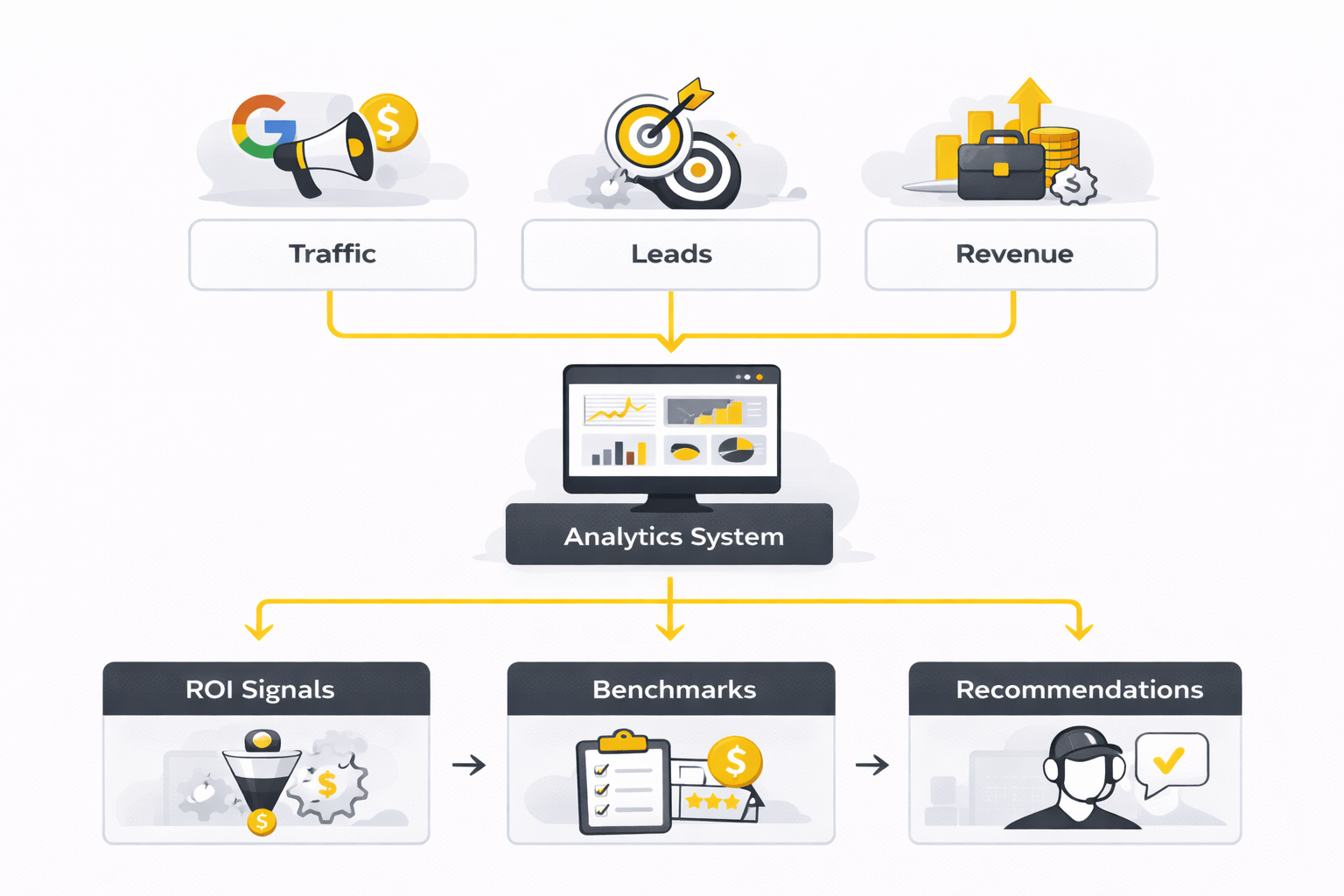
The practical dashboard for local HVAC reporting should answer five questions every week:
- Are more people discovering the business in Google Search and Maps?
- Are those people calling, clicking, or requesting directions at a higher rate?
- Are those interactions turning into qualified opportunities?
- Are those opportunities turning into sold work?
- Is the business earning more from retained customers, not just first-time leads?
That is the measurement chain that keeps reporting honest. It forces the HVAC marketing agency to connect top-of-funnel movement with real operating results instead of celebrating traffic for its own sake.
Understand Why CTR and Position Matter, but Do Not Worship Them
Google defines CTR as clicks divided by impressions, which makes it a useful signal for whether a page title, meta description, or ad is compelling enough to win the click Google Ads CTR definition and Search Console clicks and impressions guidance. In HVAC, a rising CTR often means your message is getting sharper. The service is clearer, the location is more relevant, or the offer is more urgent.
But CTR is easy to misread. A high CTR can still produce low-quality traffic if the promise is broad or the landing page is mismatched. A lower CTR on a very specific replacement keyword can still be more valuable if those visitors turn into large jobs. That is why a strong HVAC marketing agency looks at CTR in context, not in isolation.
Average position works the same way. It helps explain visibility trends, but it is not a trophy. Moving from position 7 to position 3 on an emergency repair query can matter a lot. Moving from position 28 to position 16 on an irrelevant query might not matter at all. The metric becomes useful only when tied to a page, a service line, and an actual revenue path.
Call Data Often Explains More Than Form Data
For HVAC, the phone still carries enormous weight. Invoca’s 2025 benchmark report is based on more than 60 million calls analyzed from 2024, and the core takeaway is not subtle: phone conversations remain decisive conversion moments in high-value service categories Invoca benchmark report and Invoca’s analysis of 60 million phone conversations. That should change how an HVAC marketing agency builds its measurement system.
If your reporting stops at “we generated 80 leads,” it is incomplete. You need to know how many of those leads were phone calls, how many were answered, how many were qualified, and how many became appointments. A spike in call volume can look like success in a report while the office misses half the calls after 5 p.m. That is not a marketing win. It is an operations bottleneck with a marketing price tag.
The best interpretation framework is simple:
- More calls, same bookings usually points to answer-rate or qualification issues
- More clicks, fewer calls often points to landing page friction or weak offers
- More leads, lower close rate can mean targeting has widened too far
- Fewer leads, higher revenue can actually be progress if the mix is shifting toward better jobs
This is why call tracking, tagging, and CRM discipline matter. An HVAC marketing agency that cannot tell the difference between a real sales opportunity and a low-value inquiry will make bad optimization decisions fast.
Review Metrics Are Trust Metrics
Review data should not be treated as a branding side note. It is a measurable trust signal that affects both click behavior and conversion behavior. BrightLocal’s 2026 consumer review research shows that 89% of consumers expect business owners to respond to reviews, 80% are more likely to use a business that responds to every review, and 42% are unlikely to use a business that ignores reviews entirely BrightLocal’s 2026 survey and review response takeaways for agencies.
For an HVAC marketing agency, those numbers should drive action, not just commentary. Review count, response rate, response speed, and review recency all deserve a place on the dashboard because they influence the customer before the customer ever fills out a form. A company with strong ad performance and weak review hygiene is sending mixed signals into the market.
The right interpretation is straightforward. If review volume is growing and response habits are improving, trust is compounding. If lead costs are rising while reviews are stale and unanswered, the market may be forcing the ads to do too much persuasion work by themselves.
Page Speed and Friction Metrics Are Conversion Diagnostics
A lot of HVAC companies still underestimate how much site friction costs them. Google’s mobile page speed research found that as load time rises from one second to three seconds, bounce probability increases by 32%, and by seven seconds it rises by 113% Google’s mobile speed benchmarks and Think with Google’s speed summary. That is one reason page speed belongs in the measurement discussion even if it does not look like a classic lead metric.
In practice, speed is a diagnostic metric. If ad traffic is expensive and mobile-heavy, slow pages waste budget before the sales conversation even begins. If your HVAC marketing agency reports strong click volume but bounce behavior stays ugly, the next action is usually not “increase spend.” It is “reduce friction.”
That friction can come from a slow site, but it can also come from bad information architecture. Too many choices, weak proof, buried financing options, and vague service-area language all drag conversion down. The number matters because it points toward a fix.
Local Services Ads Need Quality Control, Not Blind Trust
Local Services Ads can be powerful for HVAC, but they should be measured with more skepticism than many agencies apply. Google states that advertisers are charged for valid leads and that lead prices can vary by location, job type, lead type, and bidding mode how Local Services leads work. Google also documents automated lead credits, which is a reminder that lead quality is not perfect and disputes are part of the operating reality automated Local Services lead credits.
That means the correct KPI is not simply cost per lead. It is closer to cost per qualified booked lead and, ideally, cost per sold job. If the HVAC marketing agency reports that LSAs are cheap while the dispatch team says half the calls are wrong-fit or unbookable, the reporting is incomplete. The action there is to audit categories, service areas, booking behavior, and lead dispute handling, not just celebrate the headline CPL.
The Best Analytics Systems Push Decisions, Not Just Reports
A proper HVAC measurement stack should make it obvious what to do next. If Search Console clicks are improving but Business Profile calls are flat, the agency may need stronger local page intent or better map visibility. If profile interactions are rising but booked jobs are not, call handling probably needs attention. If review response rates are weak, the agency should push a workflow fix, not just mention the issue in a monthly deck.
That is where integrated tooling becomes useful. A platform like GoHighLevel can help centralize lead capture, pipeline tracking, and follow-up so the agency is not stitching together half the customer journey from disconnected systems. The software does not replace strategy, but it makes it much easier to measure whether marketing is creating real movement from inquiry to appointment to revenue.
The bottom line is simple. Data is only valuable when it changes behavior. A strong HVAC marketing agency uses measurement to identify bottlenecks, tighten targeting, improve conversion paths, and protect margin. The numbers matter because they tell you where the system is leaking, and once you know that, the next move becomes much clearer.
How to Choose and Manage an HVAC Marketing Agency
At this point, the question is no longer whether marketing matters. It is whether the agency you hire can operate inside the real constraints of an HVAC business. That means seasonal swings, uneven technician capacity, urgent phone-driven demand, financing-sensitive replacements, and a local reputation that can improve slowly and collapse fast.
This is where a lot of owners get into trouble. They hire based on polished sales calls, broad promises, or channel jargon, then discover six months later that the agency never really understood dispatch realities, service mix, or how to report on booked revenue instead of surface activity. The right HVAC marketing agency should feel less like a vendor and more like a commercial operator that happens to specialize in customer acquisition.
Pick an Agency That Understands Capacity, Not Just Lead Volume
More leads are not automatically better. If the company cannot answer the phone, cannot staff peak demand, or cannot absorb a surge in replacement consultations, aggressive campaign scaling can actually damage the brand. Slow callbacks, missed appointments, and overbooked service windows turn paid demand into wasted spend and frustrated customers.
That is why capacity planning belongs inside the agency relationship. A strong HVAC marketing agency should know when to push emergency repair, when to lean into tune-ups, when to protect margin by narrowing geography, and when to slow acquisition because operations are already strained. Growth without capacity discipline is one of the fastest ways to make marketing look broken when the real issue is fulfillment.
Demand Quality Beats Lead Quantity
A lot of agencies still sell on raw lead counts because it is the easiest number to inflate. Broad match traffic, vague offers, and oversized service areas can all make the lead number look healthier while job quality gets worse. The owner sees activity. The office feels chaos. The install board does not improve the way it should.
This is why the agency has to be judged on lead quality and sales fit, not on volume alone. Google’s attribution and funnel tools are useful precisely because they help teams see the path to conversion and where prospects fall away rather than pretending every inquiry has the same value Google Analytics conversion setup, funnel exploration, and attribution reporting in Google Ads.
The practical takeaway is simple. If an HVAC marketing agency keeps talking about CPL while ignoring booking rate, close rate, average ticket, and repeat revenue, it is optimizing the wrong game. That is not a small mistake. It changes every decision downstream.
Watch for Platform Dependency Before It Becomes a Real Risk
One of the biggest strategic tradeoffs in HVAC marketing is how dependent you want to be on any single channel. If the business gets most of its leads from Google Ads or Local Services Ads, performance can swing hard when costs rise, competitors enter the market, or lead quality shifts. If the company depends only on SEO, growth can be slow and vulnerable to local competition or profile issues.
A mature HVAC marketing agency manages this tradeoff on purpose. It uses paid channels for speed, local SEO and review growth for compounding visibility, and retention systems for margin protection. That blended model is harder to build, but it is also more stable than trying to squeeze everything out of one source.
Local Services Ads are a good example. Google is clear that advertisers pay for valid leads, but the platform also requires active lead management and has automated credit systems for certain disputes, which means quality control is part of the job, not an afterthought how Local Services leads work and automated lead credits.
Own Your Data or You Will Eventually Lose Leverage
This point matters more than most owners realize. If the agency controls the ad accounts, the tracking setup, the call data, the CRM, the landing pages, and the historical reporting without proper access for the client, the business is exposed. The moment the relationship goes sideways, the owner may lose the exact data needed to understand what was working.
A serious HVAC marketing agency should have no issue with transparent ownership and access. The client should be able to view accounts, understand conversion definitions, and retain historical insight across agencies or internal team changes. Google Analytics now allows more granular conversion and attribution settings, which makes governance even more important because the way conversions are defined can directly affect both reporting and bidding behavior what’s new in Google Analytics and the event-based Analytics model.
That does not mean the owner needs to become a power user. It means the business should not be held hostage by a reporting structure it does not understand. Good agencies welcome visibility because it makes results easier to defend.
Seasonal Strategy Needs Intentional Adjustment
HVAC is not a flat market. Demand shifts with weather, energy costs, equipment age, and local housing patterns. The agency should not run the same bidding logic, same offers, and same service priorities in every season and expect great outcomes. That is lazy management.
Google’s Smart Bidding guidance specifically allows for seasonality adjustments when advertisers expect short-term changes in conversion rates, which is a useful reminder that paid media strategy needs context, not autopilot Smart Bidding seasonality adjustments.
A sharp HVAC marketing agency should already be thinking like this. During peak cooling months, speed and emergency availability may dominate. In shoulder seasons, maintenance, IAQ, and membership retention might deserve more emphasis. During replacement-focused windows, financing language and high-ticket landing pages usually matter more. The strategy should breathe with the market.
Review Management Has Legal and Strategic Consequences
By now, most owners understand that reviews affect trust. Fewer understand that bad review practices can also create legal risk. The FTC’s reviews and testimonials rule, effective October 21, 2024, targets deceptive conduct involving reviews and testimonials, including fake reviews and certain forms of manipulated sentiment FTC rule Q&A and FTC endorsements and reviews guidance. FTC warning letters in December 2025 reinforced that conditioning incentives on a particular sentiment is a real enforcement issue, not a theoretical one FTC warning letters.
That means an HVAC marketing agency cannot treat review generation like a hack. It needs a clean system for asking every happy customer, avoiding manipulative filters, and responding professionally without gaming the process. Ethical review growth is slower than spammy shortcuts, but it compounds better and protects the brand.
Scaling Creates New Problems, Not Just Bigger Results
A smaller HVAC business can sometimes get away with messy handoffs, manual follow-up, and inconsistent reporting. A larger one cannot. Once multiple service lines, multiple locations, or larger ad budgets enter the picture, small process weaknesses become expensive fast.
That is why scale requires tighter systems. Campaign naming conventions matter more. Attribution hygiene matters more. Sales follow-up discipline matters more. CRM automation matters more. A platform such as GoHighLevel can help centralize pieces of that process, but the underlying requirement is operational maturity, not software alone.
The same goes for scheduling and pipeline coordination. Once replacement estimates, service calls, maintenance memberships, and financing conversations start running in parallel at higher volume, calendar friction can quietly hurt conversion. Tools like Cal.com can help reduce scheduling drag where that workflow fits, but only if the agency is thinking beyond ad clicks and into sales flow.
The Best Agency Relationships Are Managed, Not Outsourced Blindly
An HVAC marketing agency should bring expertise you do not have time to build internally. It should not become a black box that nobody challenges. The best relationships usually have clear scorecards, fast feedback loops, weekly or biweekly review rhythms, and honest conversations about lead quality, seasonality, operational bottlenecks, and margin targets.
That management discipline is where a lot of the advantage comes from. When the owner, dispatcher, sales team, and agency all use the same definitions for qualified leads, booked calls, sold jobs, and repeat revenue, optimization gets faster. When those definitions are fuzzy, every meeting turns into opinion trading.
The smartest move is to treat the agency like part of the growth team but not the whole growth team. They should influence positioning, channels, offers, reporting, and follow-up systems. You should still insist on data access, strategic clarity, and business logic that holds up under pressure. That is how you avoid vanity growth, protect margin, and build a marketing engine that stays useful even as the company gets bigger.
Common Mistakes That Undermine HVAC Marketing Results
By the time an HVAC company reaches this stage, the biggest risks are usually not a lack of tactics. They are misalignment, impatience, and sloppy execution. A weak HVAC marketing agency will often hide those problems behind activity, but the damage shows up in wasted spend, poor lead quality, and a team that slowly loses trust in the whole program.
One common mistake is pushing acquisition harder than operations can support. Another is judging campaigns too early without giving local SEO, review growth, and conversion testing enough time to compound. A third is ignoring compliance and platform rules around reviews, claims, and ad setup, even though the FTC’s current reviews rule and Google’s platform documentation make it clear that businesses need cleaner systems than they used to FTC’s reviews rule Q&A, Google’s Local Services lead rules, and Google Business Profile performance guidance.
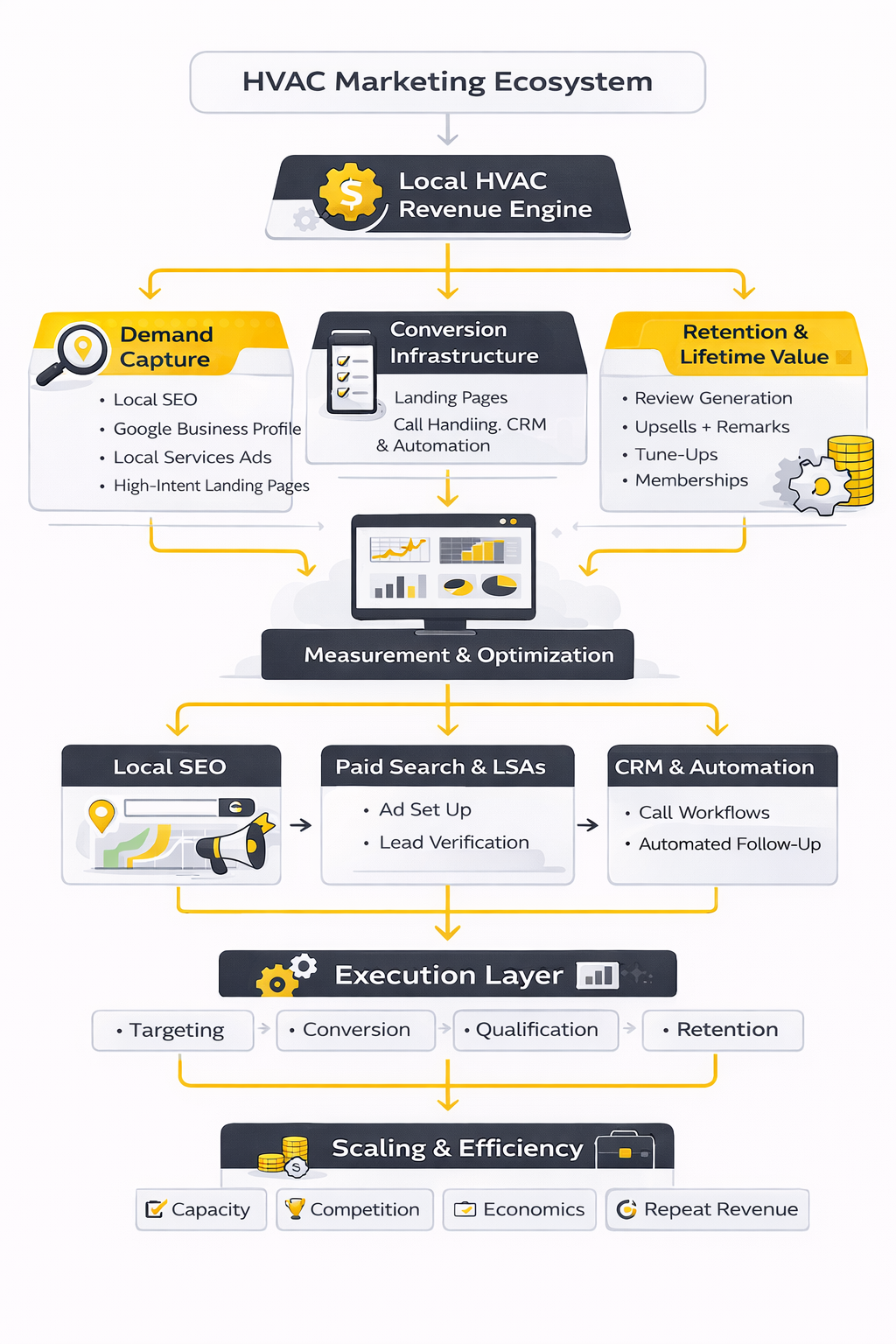
The fix is not more complexity. It is better discipline. A strong HVAC marketing agency keeps the full system visible: local presence, paid demand capture, review quality, response speed, booking performance, customer retention, and the economics that connect all of it.
FAQ - Built for Complete Guide
What does an HVAC marketing agency actually do?
An HVAC marketing agency helps a heating and cooling company generate, convert, and retain customers through channels like local SEO, Google Business Profile, paid search, Local Services Ads, review management, landing pages, and follow-up automation. The key difference between a specialist and a generic agency is that HVAC demand is local, urgent, and tied closely to phone calls, dispatching, and trust. That means the job is not just getting traffic. It is building a system that turns intent into booked jobs and repeat revenue.
How is an HVAC marketing agency different from a general digital marketing agency?
A general agency may understand ads, websites, and analytics, but HVAC has different buying behavior than ecommerce or SaaS. Homeowners often search under time pressure, compare local proof fast, and decide based on reviews, response speed, financing, and confidence that the technician is credible. A true HVAC marketing agency knows how to structure campaigns around those realities instead of applying the same playbook it would use for every other local business.
How long does it take to see results?
Paid search and Local Services Ads can produce movement quickly, but local SEO, review growth, and conversion improvements usually take longer to compound. Google’s own documentation on search performance and business profile interactions makes it clear that visibility and customer actions can be measured over time, which is useful because it helps owners separate early signals from final outcomes Search Console performance reporting and Business Profile performance metrics. In practice, the timeline depends on competition, market size, website quality, review profile, and how well the business handles inbound demand.
Should HVAC companies focus more on SEO or paid ads?
It should almost never be framed as an either-or decision. SEO builds compounding local visibility, while paid ads create speed and control around priority services, geographies, and seasonal pushes. The best HVAC marketing agency uses both on purpose, then adjusts the balance based on margin, competition, response capacity, and how fast the company needs demand.
Are Local Services Ads worth it for HVAC?
They can be, especially in markets where homeowners want fast reassurance and direct contact with screened service providers. Google states that advertisers on Local Services Ads pay for valid leads and can manage budgets around desired lead volume, which makes the channel attractive when it is monitored carefully how Local Services leads work. The catch is that lead quality still needs oversight, and the real KPI is not just cost per lead. It is cost per qualified booked opportunity and, ideally, cost per sold job.
What metrics should an HVAC company watch most closely?
The most important numbers are the ones closest to revenue: qualified calls, appointments set, jobs sold, average ticket, close rate, and repeat customer value. Supporting metrics like search impressions, profile views, CTR, page speed, and review growth matter because they explain why the core numbers are moving, but they are not the endpoint. A capable HVAC marketing agency will always connect the top of the funnel to the actual commercial outcome instead of treating visibility as success by itself.
How important are reviews for HVAC lead generation?
They matter a lot because they shape both click behavior and conversion behavior before the prospect ever talks to your team. BrightLocal’s 2026 local consumer review research shows how strongly people still rely on reviews and how much review response habits affect trust and decision-making BrightLocal’s 2026 Local Consumer Review Survey. For HVAC companies, that means review generation and response quality should be treated as a revenue lever, not just a branding chore.
Can a small HVAC company compete with larger brands?
Yes, but it usually wins differently. A smaller operator can often move faster, own local trust more credibly, respond more personally, and build tighter service-area pages and review momentum than larger competitors with slower internal processes. A strong HVAC marketing agency will lean into that advantage instead of pretending the only path is outspending bigger companies everywhere at once.
What tools help an HVAC marketing agency run a better system?
The best tools are the ones that reduce friction between lead capture, follow-up, and reporting. For many agencies and contractors, GoHighLevel is useful because it can centralize forms, pipelines, messaging, and automation in one place, which makes missed-call text-back, estimate follow-up, and retention sequences easier to manage. Email and SMS platforms like Brevo can also help when the goal is cleaner lifecycle communication rather than one-off campaigns.
Should HVAC companies use chat, forms, or phone-first funnels?
For many HVAC services, phone-first still matters because urgency is high and the buyer wants immediate reassurance. That said, forms and chat can still be valuable for replacement consultations, after-hours demand, and lower-pressure follow-up paths, especially when they are connected to automation. The right HVAC marketing agency usually builds multiple entry points, then measures which ones produce the best booked and sold outcomes rather than arguing from preference alone.
Is social media a major growth channel for HVAC?
Usually not in the same direct-response way as local search, maps, paid search, and reviews. Social can still support trust, recruiting, local brand familiarity, and remarketing content, but most HVAC companies should not confuse engagement with demand capture. A smart HVAC marketing agency treats social as a supporting channel unless the data proves it is contributing meaningfully to pipeline and revenue.
What is the biggest red flag when hiring an HVAC marketing agency?
The biggest red flag is when the agency sells confidence without operational logic. If it talks obsessively about impressions, reach, or broad lead volume but cannot explain booking rate, close rate, review workflow, call handling, or seasonal adjustments, it is probably optimizing for the wrong outcome. Another major red flag is lack of transparency around account ownership, tracking definitions, and data access, because that usually becomes a problem later when performance gets questioned.
Work With Professionals
Explore 10K+ Remote Marketing Contracts on MarkeWork.com
Most marketers spend too much time chasing clients, competing on crowded platforms, and losing a percentage of every project to middlemen.
MarkeWork gives you a better way. Browse thousands of remote marketing contracts and connect directly with companies desperate to hire skilled marketers like you, without platform commissions and without unnecessary gatekeepers.
If you're serious about finding better opportunities and keeping 100% of what you earn, explore available contracts and create a profile for free at MarkeWork.com.