

Most HVAC companies do not have a traffic problem. They have a conversion problem, a tracking problem, or a channel-mix problem hiding underneath the lead flow. That is exactly why choosing an HVAC marketing agency is so often frustrating: the agency talks about clicks, rankings, and impressions, while the owner needs booked calls, sold jobs, stronger margins, and less chaos at the front desk.
The market is also getting less forgiving. Home services buyers now move through 5.5 touchpoints before they submit a form or make a purchase, and Local Services Ads climbed from an average of $50.46 per lead in 2023 to just over $60.50 in 2024. In other words, HVAC marketing has become less about “getting seen” and more about building a system that captures demand fast, earns trust locally, and turns attention into revenue.
What follows is a practical framework for evaluating what a real HVAC marketing agency should do, how the work should be structured, and where most contractors lose money without realizing it.
- Why HVAC Marketing Needs a Different Playbook
- The HVAC Marketing Agency Framework
- Local Search and Demand Capture
- Paid Acquisition Without Wasted Spend
- CRM, Follow-Up, and Conversion Systems
- Choosing and Managing an HVAC Marketing Agency
Why HVAC Marketing Needs a Different Playbook
HVAC is not a generic local business category, and treating it like one is where weak marketing starts. The customer journey is shaped by urgency, seasonality, geography, trust, financing sensitivity, and whether the call is for repair, replacement, or maintenance. An agency that uses the same playbook for dentists, med spas, roofers, and HVAC contractors usually ends up optimizing for volume instead of job quality.
That difference matters because the home services market is large, fragmented, and becoming more digitally competitive. McKinsey estimates U.S. home services spending at about $700 billion, with digitalization, e-commerce, and multibrand platforms steadily reducing friction for buyers. For HVAC contractors, that means the best agency is not just buying leads; it is helping the business win in a market where customers expect fast answers, simple booking, visible proof, and a smooth experience from first search to completed job.
Local trust signals carry unusual weight here. Google’s own guidance says complete and accurate Business Profile information, verification, review responses, and fresh photos all help a company stand out in local search results (Google Business Profile help). At the same time, BrightLocal’s 2026 review study shows that 54% of consumers visit a business website after reading positive reviews, while 89% expect owners to respond to reviews. So an HVAC marketing agency that only talks about SEO or ads, but ignores reviews, website friction, and follow-up discipline, is leaving money on the table.
There is another trap HVAC owners run into all the time: mistaking visibility settings for real ranking work. Service-area businesses often assume that adding more cities to Google Business Profile will expand reach, but controlled testing from Whitespark found that adding service areas still did not improve local rankings. That is a good example of why HVAC marketing needs specialists. The details are specific, the myths are expensive, and the wrong advice compounds quickly when peak season hits.
The HVAC Marketing Agency Framework
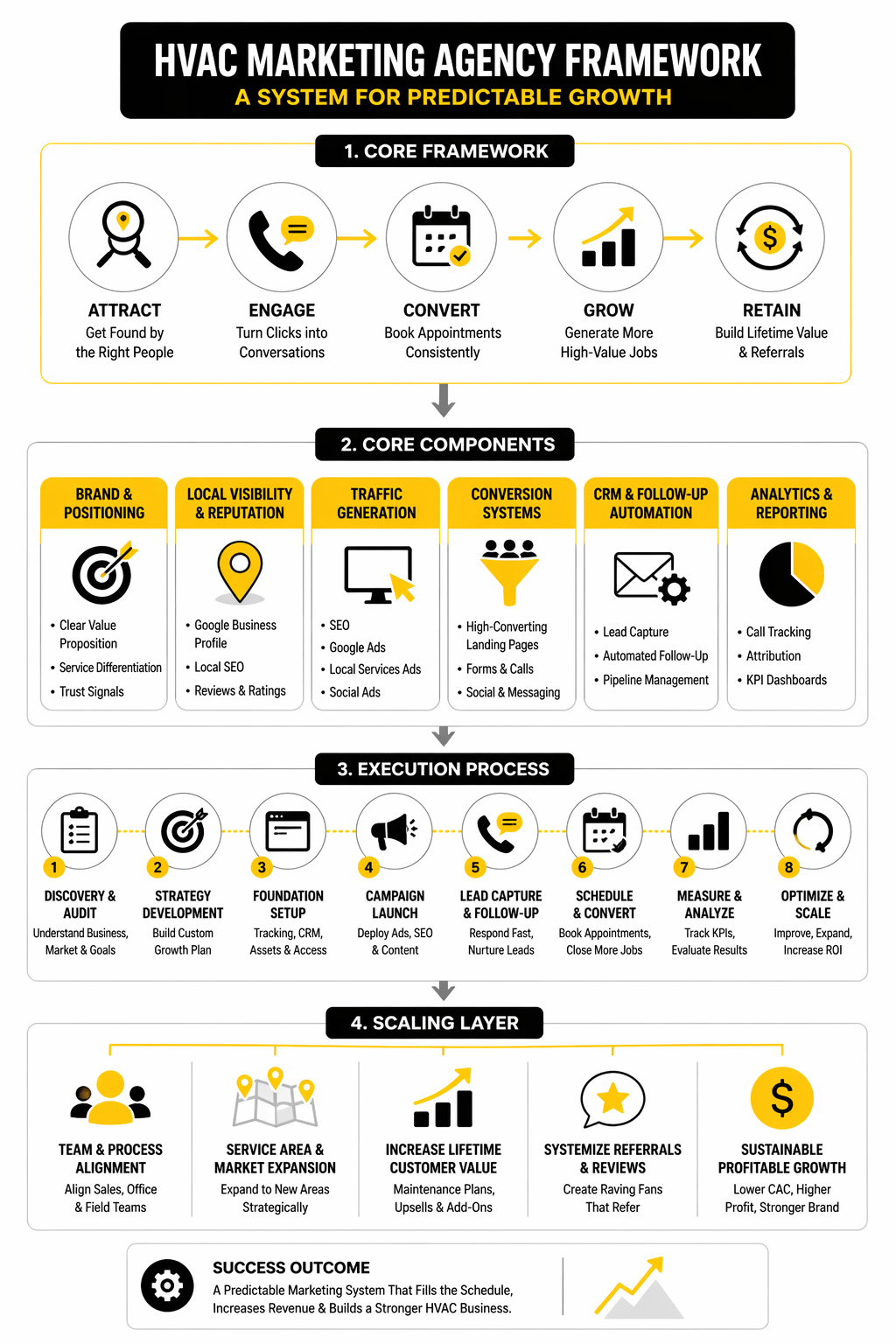
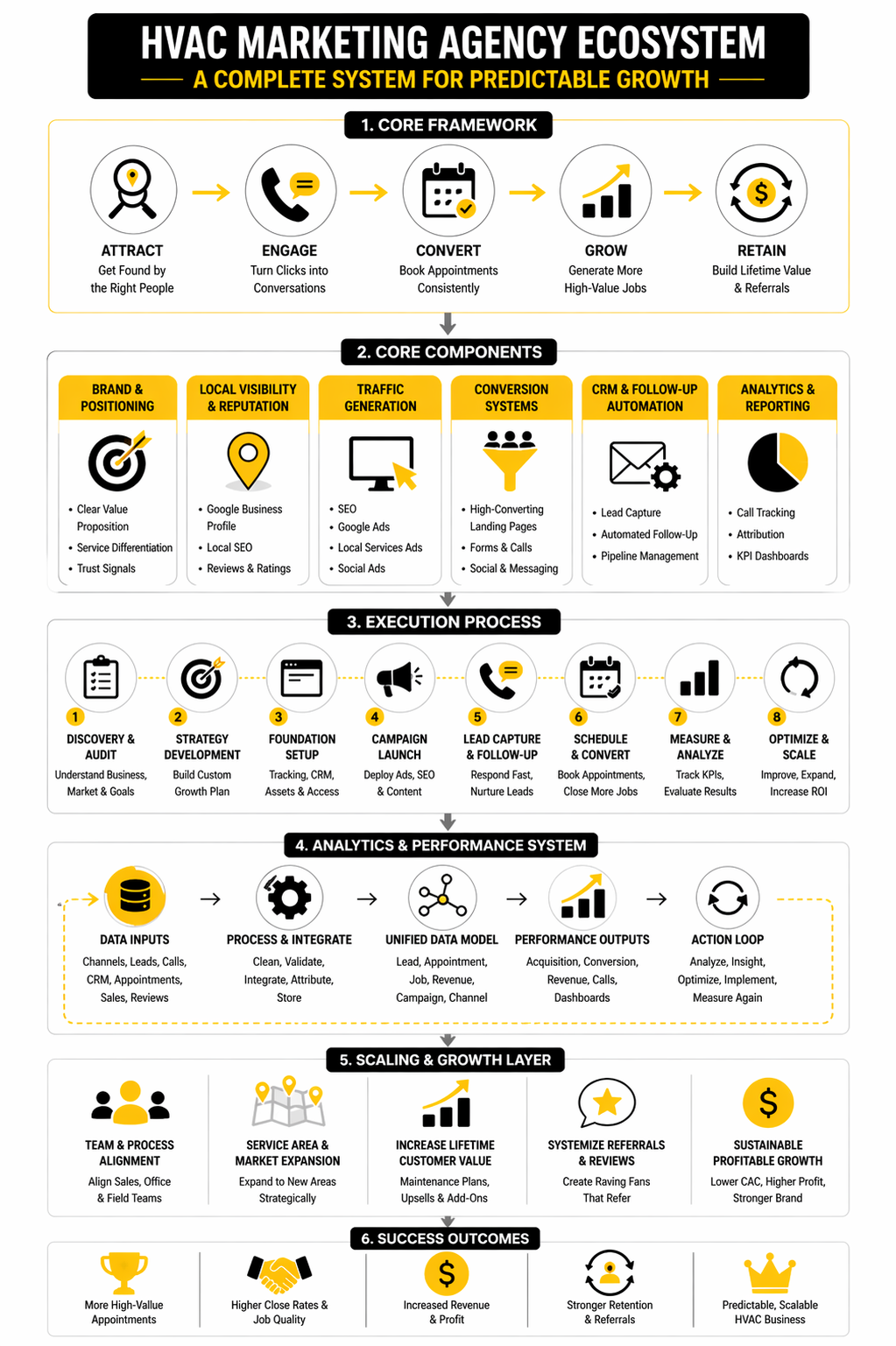
A solid HVAC marketing agency should be building one connected system, not selling disconnected services. The cleanest way to think about it is this: demand has to be captured, trust has to be earned, leads have to be answered quickly, and every step has to be tracked all the way to revenue. If one of those pieces breaks, the whole machine gets noisier and more expensive.
That framework starts with demand capture. Some homeowners already know what they want and search with high intent, which is why channels like Google Search, Google Business Profile, and Local Services Ads matter so much for HVAC. Google explains that Local Services Ads place providers prominently in Search and charge when customers contact the business, which makes them useful for urgent, bottom-of-funnel demand, especially when weather or equipment failure spikes call volume.
The second layer is trust architecture. Reviews, local relevance, brand consistency, financing clarity, technician credibility, and a clean website all influence whether a homeowner takes the next step. That matters more than many contractors realize, because BrightLocal found that 85% of people are more likely to use a business after reading positive reviews, and Harris Williams highlighted digital marketing as a key success factor in its 2025 home services consumer study.
The third layer is conversion infrastructure. This is where many agencies underperform because they stop at lead generation and never fix the handoff. A strong HVAC marketing agency should either manage or closely coordinate the CRM, call tracking, automation, and booking flow so that leads are answered immediately, routed correctly, and followed up until they book or disqualify. That is why platforms built around pipeline management and automated follow-up, such as GoHighLevel, keep showing up in serious local-service stacks: they help connect marketing activity to actual sales outcomes instead of vanity reporting.
The final layer is accountability. Every campaign should eventually answer simple questions: which channel produced the call, which calls turned into appointments, which appointments turned into sold work, and which jobs created profit worth scaling. Without that closed-loop view, an HVAC marketing agency can always claim progress while the owner is still wondering why revenue feels harder to win.
A practical framework for judging agency quality looks like this:
- Capture intent through local SEO, Google Business Profile, Local Services Ads, paid search, and branded search defense.
- Build trust with review generation, fast review responses, clear service pages, proof, and consistent local positioning.
- Convert fast with live answering, short forms, scheduling logic, automation, and disciplined speed to lead.
- Track revenue with call attribution, source-level reporting, booked-job reporting, and campaign profitability.
- Improve continuously through testing by service line, geography, season, offer, and close-rate quality rather than lead count alone.
In the next part, we will move from the high-level model into the first execution layer: local search and demand capture. That is where the right HVAC marketing agency separates itself quickly, because it knows how to structure Google Business Profile, service pages, reviews, local authority, and search intent around the way HVAC customers actually buy.
Local Search and Demand Capture
If an HVAC marketing agency cannot win the local demand that already exists, the rest of the strategy barely matters. This is the lowest-friction opportunity in the whole system because these are the people already searching for repair, installation, replacement, or maintenance help in a defined service area. The agency’s job is not to invent intent out of thin air first; it is to capture the intent that is already showing up every day and route it into booked work.
This is also where a lot of bad agency work hides in plain sight. Plenty of firms will send over a ranking report, highlight impressions, and celebrate map visibility while calls and revenue stay flat. A real HVAC marketing agency should be able to connect local visibility to actual business outcomes such as phone calls, booked visits, job type mix, and service-area profitability.
Google still makes the local ranking framework surprisingly clear: local results are driven by relevance, distance, and prominence. That means HVAC contractors do not need gimmicks. They need cleaner relevance signals, stronger local authority, better review velocity, tighter service-page structure, and faster conversion once the click or call happens.
Start With Google Business Profile Fundamentals
A serious HVAC marketing agency starts by getting the Google Business Profile right because it influences visibility in Maps, branded search results, and local trust at the exact moment a homeowner is making a decision. Google’s own guidance emphasizes complete and accurate information, verification, regular photo updates, business category alignment, and active review management as part of stronger local presence in Business Profile best practices. None of that is glamorous, but this is exactly the kind of work that compounds.
What matters here is precision, not box-checking. The primary category, secondary categories, service descriptions, service menus, hours, emergency availability, and business details all need to reflect the real operating model of the company. When an agency gets lazy and treats every HVAC business the same, the profile becomes broad, vague, and weaker than it should be for the searches that actually matter.
Review management belongs in this foundation too, not as some separate reputation add-on. BrightLocal’s latest consumer research shows that 89% of people expect business owners to respond to reviews, and 54% visit a business website after reading positive reviews. For HVAC, that means review requests, responses, and proof of recent customer experience directly affect how much value the profile creates.
Stop Believing Service-Area Myths
One of the biggest reasons contractors hire the wrong HVAC marketing agency is that the agency sounds confident while repeating advice that does not hold up. A perfect example is the idea that adding more cities inside Google Business Profile will suddenly help the business rank across all of them. It sounds plausible, but controlled testing has continued to point the other way.
Whitespark’s 2024 analysis found that service areas still did not improve Google Business Profile rankings. That matters because it changes where the work should happen. Instead of wasting time treating profile settings like a growth lever, a competent agency should focus on city-specific service pages, localized authority, review strength, internal linking, and real conversion assets tied to each target area.
This is where strategic thinking starts to separate pros from pretenders. If a contractor wants to grow into nearby cities, the answer is not to stuff more locations into a profile and hope. The answer is to build local relevance the hard way, with pages that genuinely match the geography, the service intent, and the problems homeowners in those areas are actually searching to solve.
Build Service Pages Around Intent, Not Templates
The website has to carry much more of the load than many HVAC companies expect. Google Business Profile might earn the first click, but the site often decides whether that click turns into a call, form submission, or bounce. That means an HVAC marketing agency should structure service pages around intent clusters such as AC repair, furnace replacement, heat pump installation, indoor air quality, emergency HVAC service, and maintenance plans, rather than publishing thin, nearly identical pages that exist only for keywords.
This matters because search intent in HVAC is not uniform. Someone searching for “AC not cooling” is in a different state of mind than someone searching for “new heat pump cost” or “HVAC maintenance near me.” Strong service pages need to reflect that difference in language, proof, offer structure, and call to action, especially when the business serves both emergency repair demand and higher-ticket replacement demand.
Google’s ranking factors make this approach logical. If local results depend on relevance, then pages should clearly map to the services, locations, and needs the business actually serves under Google’s local ranking guidance. An HVAC marketing agency that understands this will build pages that make the next step obvious, not pages that just repeat a keyword and hope for traffic.
Own the Bottom of the Funnel Before Expanding Upward
A lot of contractors get distracted by broad content plans too early. There is nothing wrong with educational content, but it should come after the business has already locked down the bottom of the funnel: location pages, service pages, review acquisition, branded search control, and profile optimization. That is where the fastest wins usually sit, because that is where buyer intent is strongest and the path to booking is shortest.
This is especially important now that customer journeys are getting more complex. The home-services research cited in Part 1 showed buyers moving through 5.5 touchpoints before submitting a form or making a purchase. When that many touchpoints are involved, the agency has to make sure the highest-intent ones are controlled first before investing heavily in slower awareness plays.
A good HVAC marketing agency will usually prioritize local demand capture in this order:
- Google Business Profile accuracy and review operations
- Core service pages for highest-margin and highest-intent jobs
- City or service-area pages built for real local relevance
- Branded search protection and reputation visibility
- Supporting content that strengthens authority and long-tail discovery
That order is practical because it follows buying behavior, not agency convenience. It helps the contractor capture urgent demand now while building a stronger local footprint that can keep compounding over time. It also makes the next section much easier, because once local demand capture is working, paid acquisition becomes something you scale deliberately instead of something you use to cover up weak fundamentals.
Paid Acquisition Without Wasted Spend
Once local search fundamentals are in place, paid acquisition becomes a force multiplier instead of a rescue plan. That distinction matters more than most owners think. A weak HVAC marketing agency uses ads to paper over bad local positioning, weak landing pages, sloppy intake, and unclear offers, while a strong one uses paid media to capture the searches that already signal commercial intent and then scales what is actually turning into revenue.
The pressure on this channel is real. In home services, Local Services Ads rose from an average of $50.46 per lead in 2023 to more than $60.50 in 2024, and broader search advertising costs continued climbing into 2025, with overall Google Ads cost per lead averaging $70.11 across industries. That does not mean HVAC paid acquisition stopped working. It means waste is more expensive now, so campaign structure, landing page relevance, and lead handling matter far more than they did when traffic was cheaper.
The Right Paid Channel Mix for HVAC
An HVAC marketing agency should not throw every paid platform into the mix on day one. The smart move is to prioritize the channels closest to active purchase intent, because HVAC buyers usually do not need much nurturing when the system is down, the house is too hot, or a replacement quote is already on their mind. In practice, that usually means Google Local Services Ads first, search ads second, and retargeting only after the core conversion path is already solid.
Google’s own Local Services documentation makes the model clear: businesses can appear prominently in local search and pay when potential customers get in touch rather than paying per click. That is a strong fit for HVAC because emergency demand often starts with a call, not a long browsing session. But it is still not magic. The lead only has value if the business answers fast, qualifies well, and gets the appointment booked before the prospect moves on.
Traditional Google Search campaigns still matter because they give the agency more control over targeting, match types, ad copy, service-line segmentation, and landing page alignment. This is especially useful when the contractor wants to separate repair from replacement, branded from non-branded, financing-driven demand from emergency demand, or heat pumps from legacy system work. A capable HVAC marketing agency understands that the point is not “more ads.” The point is channel control with clear economic logic behind each campaign.
Why Most HVAC Paid Campaigns Get Expensive
Paid search usually gets expensive for boring reasons, not mysterious ones. Keywords are too broad, landing pages are too generic, calls are not tracked tightly enough, and the office does not follow up fast enough once the lead comes in. Then the agency reports lead volume while the owner quietly absorbs lower close rates and thinner margins.
Google keeps pointing advertisers back to the same core diagnostics for a reason. Quality Score is influenced by expected clickthrough rate, ad relevance, and landing page experience, and Google explicitly ties better performance to improving ads, keywords, and page usefulness in its Quality Score guidance and landing page experience documentation. For HVAC, that means an ad about furnace replacement should not dump people onto a generic homepage, and an ad for emergency AC repair should not force them to hunt for the phone number.
There is also a more subtle cost issue that weak agencies miss: not all leads are equally valuable. A maintenance tune-up inquiry, a same-day repair call, and a full-system replacement lead can all show up as one “conversion” inside an ad platform, even though their revenue potential is completely different. That is why any HVAC marketing agency worth hiring needs to optimize toward booked jobs and downstream revenue, not just cheap form fills.
How an HVAC Marketing Agency Should Execute Paid Acquisition
This is where the process needs to get tangible. Not theoretical, not “best practices” slides, but an operating sequence the contractor can actually inspect. A real HVAC marketing agency should be able to walk through implementation in a way that feels operational from the first week, because paid acquisition breaks fast when ownership gets fuzzy.
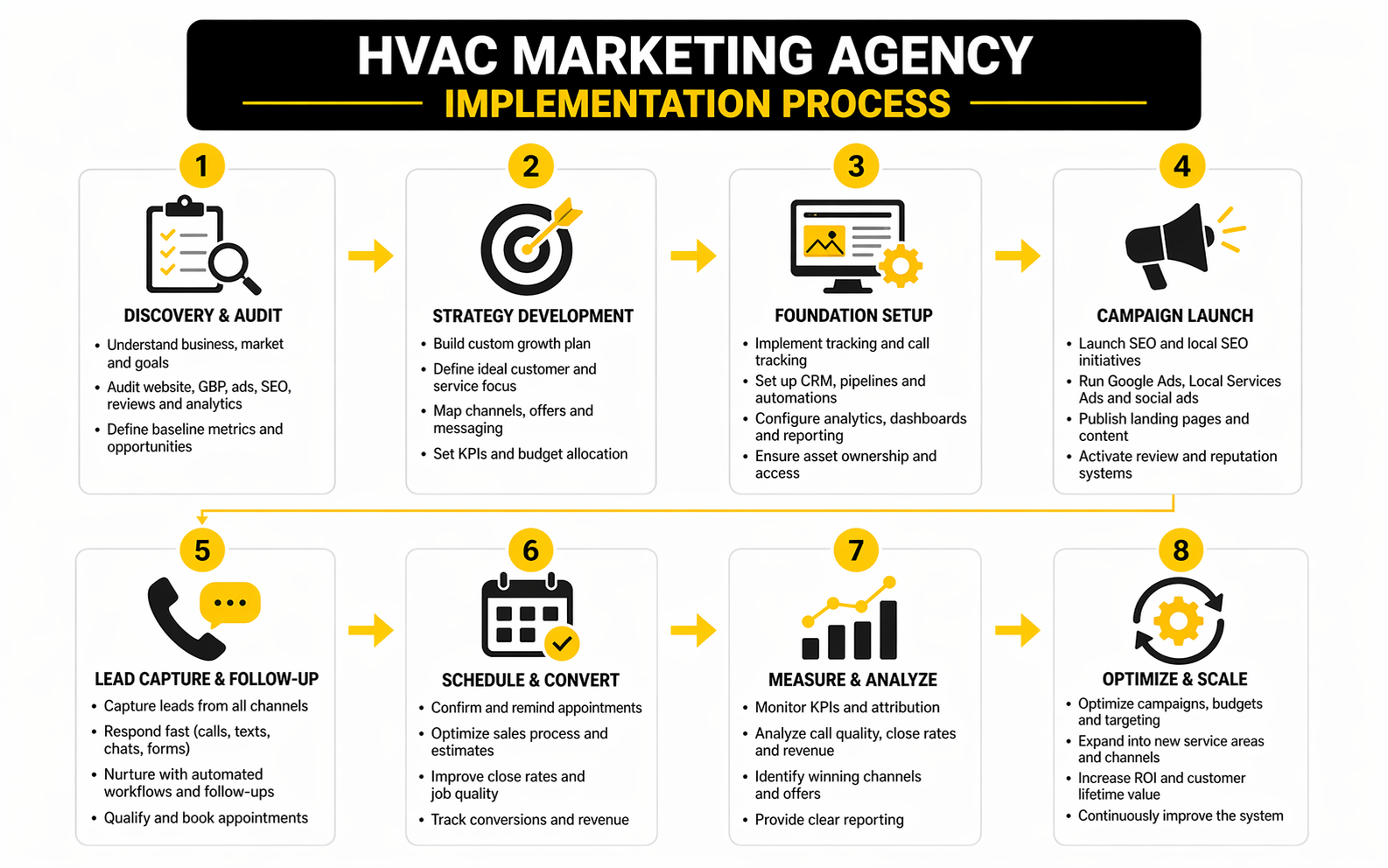
A clean implementation process usually looks like this:
- Separate campaign intent by service line. Repair, replacement, maintenance, ductless, IAQ, and emergency demand should not all live in one messy campaign. Different intent requires different budgets, messaging, and landing pages.
- Split branded and non-branded traffic. Brand searches defend existing demand, while non-brand campaigns go after competitors and category demand. Mixing them hides performance and inflates the story.
- Map each ad group to a relevant landing page. Google’s own guidance keeps reinforcing the importance of relevance and usefulness on the landing page because that directly affects ad efficiency and user experience inside Google Ads help.
- Track calls, forms, and booked appointments separately. A call is not the same as a qualified lead, and a lead is not the same as an appointment. The reporting needs to reflect that.
- Review search terms aggressively. Waste often comes from vague matches, informational traffic, or irrelevant job types that never should have triggered the ad in the first place.
- Push budget toward proven economics. Once service-line performance is visible, the agency should shift spend toward the jobs, geographies, and offers that close well and produce healthy revenue.
That process is simple on paper, but this is where good operators earn their keep. They make fast decisions with incomplete data, clean up tracking before it becomes a political debate, and cut vanity spend without getting sentimental about “traffic.” A weak HVAC marketing agency delays those decisions because it is easier to report on platform activity than on business outcomes.
Landing Pages and Offers Do More Than Most Agencies Admit
In HVAC, the difference between a mediocre paid campaign and a strong one often shows up after the click. That is why landing pages deserve more attention than they usually get. Google repeatedly emphasizes usefulness, relevance, easy navigation, and matching user expectations as part of the page experience that supports better ad results in its landing page documentation.
For HVAC contractors, that usually means fewer distractions and clearer intent matching. A replacement page should make financing, estimates, timing, and trust signals easy to find. A repair page should reduce friction, highlight fast response, and make calling or booking obvious. An HVAC marketing agency that sends all traffic to the homepage is not being strategic; it is being lazy.
Offers matter too, but not in the spammy way many agencies use them. The job is not to invent fake urgency. The job is to reduce decision friction with something credible, such as financing visibility, maintenance membership framing, same-day availability, or a clear estimate path. The best HVAC marketing agency will align the offer to the customer’s problem instead of stapling the same coupon onto every campaign and hoping volume covers the drop in quality.
Paid Media Only Works When Operations Keep Up
This is the part many owners know intuitively but agencies still underplay. Ads can generate demand, but they cannot rescue a bad intake process. If the phones ring and nobody answers, if forms sit untouched for hours, or if reps cannot distinguish repair urgency from replacement opportunity, media performance will look worse than it really is.
That operational link is getting harder to ignore. Invoca’s 2025 benchmark work drew on more than 60 million phone conversations, which underlines how important call handling still is in high-intent categories. HVAC fits that pattern perfectly because many of the most valuable prospects want immediate answers, not a delayed email sequence.
This is also why platform and workflow decisions matter. A contractor that wants cleaner lead routing, pipeline visibility, automated follow-up, and tighter source tracking usually needs more than a spreadsheet and a shared inbox. Tools such as GoHighLevel are often part of that stack because they help centralize lead capture, automations, and pipeline management in a way that makes agency execution easier to measure and easier to improve.
The next section goes deeper into that exact layer. Once local demand capture and paid acquisition are both working, the next bottleneck is almost always what happens after the lead arrives. That is where CRM, follow-up, and conversion systems turn marketing from a lead-generation activity into a real revenue system.
CRM, Follow-Up, and Conversion Systems
The moment a lead comes in, marketing stops being a visibility game and becomes an execution game. This is where a weak HVAC marketing agency runs out of answers, because it can explain clicks and impressions but not what happened after the phone rang. A strong agency treats CRM, follow-up, and measurement as one system, because that is the only way to tell whether the marketing is actually producing booked jobs and revenue.
This is also where the data starts getting useful instead of decorative. Plenty of dashboards are packed with numbers that look impressive but do not change a single business decision. The right data tells you where money is leaking, which channel is producing qualified demand, and whether the bottleneck sits in traffic, intake, scheduling, or sales execution.
What the Numbers Actually Mean
An HVAC marketing agency should not drown the owner in random metrics. The goal is to use a small set of numbers that explain what is happening from first touch to closed revenue. When those numbers are clean, the business can stop guessing and start fixing the exact stage where performance breaks.
The first number that matters is cost per lead, but only as an opening signal. Search advertising got more expensive again in 2025, with average Google Ads cost per lead across industries reaching $70.11, while home services Local Services Ads moved from $50.46 per lead in 2023 to more than $60.50 in 2024. Those figures matter because they tell you wasted spend compounds fast, but they do not tell you whether the campaign is healthy on their own.
That is why cost per booked appointment matters more than cost per lead, and cost per sold job matters more than cost per booked appointment. An HVAC marketing agency that only reports top-of-funnel lead cost can make weak campaigns look efficient. Once you measure deeper into the funnel, you can finally tell whether cheap leads are actually expensive because they do not book, do not show, or do not close.
The next number that matters is answer rate. Invoca’s 2025 benchmark research was built from more than 60 million phone calls, which is a useful reminder that high-intent buying categories still live and die on conversations. In HVAC, if call answer rates are weak, ad performance will often look worse than it really is because the business is paying to generate opportunities it never properly receives.
Then comes close rate by source and job type. This is where the story gets interesting, because not every lead source behaves the same way. Paid search might bring in urgent repair calls, branded traffic might close at a higher rate, Local Services Ads might create volume with mixed job quality, and local organic traffic might quietly produce some of the best economics in the whole system. A competent HVAC marketing agency tracks those differences instead of flattening everything into one blended conversion number.
The Analytics Stack Should Be Simple Enough to Run
A lot of businesses overcomplicate analytics before they have mastered the basics. They add tools, create dashboards, and pipe data everywhere, but still cannot answer which leads booked and which campaigns made money. That is backwards.
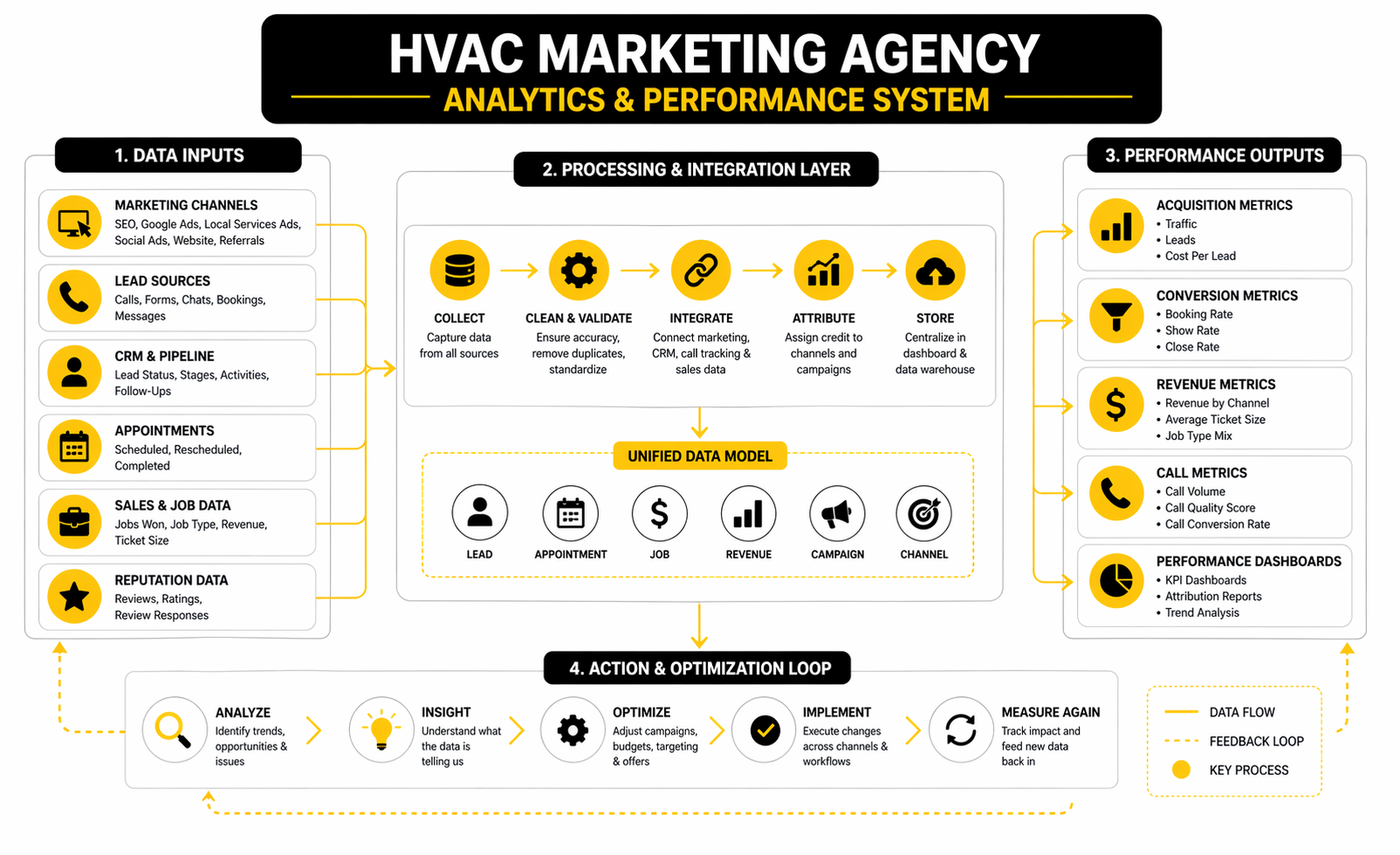
The system should be simple enough to run every week without drama. At a minimum, an HVAC marketing agency should be able to connect traffic source, call tracking, form submissions, booking status, pipeline stage, and revenue outcome in one consistent reporting process. The technology can vary, but the logic cannot.
A clean measurement stack usually includes:
- Traffic analytics to see where visits come from and which landing pages create action
- Call tracking to attribute inbound calls to channel, campaign, and keyword group where possible
- Form tracking to separate real inquiries from noise and duplicates
- CRM pipeline reporting to show lead status, booked jobs, estimates, wins, and losses
- Revenue reporting to compare channel spend against actual sold work
This is exactly why many service businesses end up using platforms that combine capture, automation, and pipeline management instead of stitching together disconnected tools forever. Systems like GoHighLevel are attractive in this context because they make it easier to centralize forms, lead routing, follow-up automation, and pipeline visibility without losing the thread between the campaign and the sale. The tool itself is not the strategy, but clean infrastructure makes strategy measurable.
Good Benchmarks Are Directional, Not Magical
Benchmarks help when they sharpen judgment. They hurt when owners use them like universal targets without context. A good HVAC marketing agency knows the difference.
For example, rising search CPL tells you competitive pressure is real, not that your campaign is automatically broken. The move to $70.11 average Google Ads CPL in 2025 matters because it raises the price of bad decisions. It should push the agency to tighten keyword intent, landing page relevance, and qualification quality, not panic every time a lead costs more than it did last year.
Review data works the same way. BrightLocal found that 80% of consumers are more likely to use a business that responds to every review and 42% are unlikely to use one that ignores reviews entirely. That should drive action around response processes and review generation, not just vanity celebration around star rating averages. The number matters because it points to a fixable conversion lever.
Touchpoint data matters for the same reason. In home services, buyers now move through 5.5 touchpoints before they submit a form or purchase. That should change how an HVAC marketing agency interprets attribution. It is rarely one channel doing all the work. Search, reviews, brand recall, website trust, and follow-up often work together, so simplistic last-click reporting can hide what is really influencing decisions.
The Signals That Should Trigger Action
A useful dashboard does not just describe the business. It tells the team what to do next. That is the standard an HVAC marketing agency should be held to.
If traffic is rising but lead volume is flat, the likely problem is page relevance, weak calls to action, or intent mismatch. If leads are rising but appointments are weak, the issue usually sits in intake, answer rate, form handling, or speed to follow-up. If appointments are strong but revenue is disappointing, then the bottleneck is often inside sales, technician close rate, financing presentation, or job mix.
A few signal-to-action examples make this clearer:
- High click volume, weak conversion rate usually means the landing page and ad promise are out of sync
- Healthy lead count, poor booking rate usually points to bad intake discipline or delayed follow-up
- Strong booking rate, weak sold revenue usually points to poor qualification, weak estimating, or the wrong offer mix
- Good blended results, weak replacement revenue may mean the channel mix is over-indexed on low-value repair demand
- Great branded performance, weak non-brand performance usually means demand capture is fine but market expansion is underdeveloped
This is where confidence comes from. Not from prettier reporting. From knowing what each pattern means and what lever should move next.
What an Owner Should Ask the Agency Every Month
Most agency meetings drift because the questions are too vague. The owner asks how things are going, the agency opens a slide deck, and everyone leaves with activity updates instead of decisions. That is a waste.
A better monthly review revolves around a handful of operational questions:
- Which channels produced the most booked appointments?
- Which channels produced the highest-value sold jobs?
- Where did lead handling fail most often?
- Which service lines are getting more expensive to acquire?
- Which landing pages or campaigns are underperforming and why?
- What will be changed this month based on the data?
If the HVAC marketing agency cannot answer those clearly, it is probably managing platforms rather than managing growth. That distinction is everything. The next part brings it together by looking at how to choose and manage an HVAC marketing agency so the relationship stays accountable, commercially focused, and hard to bluff.
Choosing and Managing an HVAC Marketing Agency
By this point, the pattern should be obvious: the right HVAC marketing agency is not just a vendor buying clicks or tweaking rankings. It is an operating partner that understands how local demand, paid media, intake, follow-up, and reporting connect to actual revenue. That is why choosing the agency matters so much, but managing the relationship well matters just as much.
A lot of agency relationships go sideways for predictable reasons. The owner expects growth without giving the agency access to the real numbers, the agency hides behind platform jargon, or both sides talk about “more leads” when the real issue is margin, booking quality, or field capacity. The fix is not more meetings. It is better structure, clearer ownership, and a much sharper definition of what success actually means.
Choose the Agency Model That Matches Your Stage
Not every HVAC company needs the same type of agency. A smaller contractor with one location and weak local fundamentals often needs an operator that can clean up Google Business Profile, build conversion-ready service pages, tighten paid search, and install a working CRM rhythm. A larger or multi-location business usually needs more sophistication around reporting, location governance, call handling, attribution, and rollout consistency across markets.
This matters because the home services market is still highly fragmented, even while large consolidators and platforms keep pushing in. McKinsey describes U.S. home services as a roughly $700 billion market, while Harris Williams points to durable consumer demand and continued investor interest in the category in its 2025 home services consumer study. An HVAC marketing agency that works well for a founder-led local shop may not be the right fit for a business trying to standardize acquisition across multiple branches.
The practical question is not whether the agency sounds impressive. It is whether the agency’s operating model matches the business you actually run today. If the company is still struggling with lead handling and calendar management, there is no point paying for a strategy deck built for a regional roll-up. If the company is already scaling across markets, then basic local SEO alone is not enough.
Never Give Away Ownership of the Core Assets
This is one of the least glamorous topics in marketing, and one of the most important. An HVAC marketing agency should manage your systems, but the business should retain durable control over the core assets: domain, website, CRM data, Google Business Profile, call tracking numbers, analytics, and ad account access. If the relationship ends, the business should not have to rebuild its operating history from scratch.
Google’s own ecosystem keeps reinforcing the importance of clean access control and ownership. Google Ads has long distinguished between normal permissions and account ownership in its product updates, and Google’s Business Profile community guidance explicitly warns agencies that if they take owner access, the agency account may become the primary owner, which is not ideal for clients. That is not a theoretical risk. It is exactly the kind of messy handoff problem that turns an agency breakup into an operational disaster.
This is where confident owners draw clean lines. The HVAC marketing agency can have the access it needs, but the business should own the house. If an agency resists that, gets vague about access structure, or wants to keep critical systems under its own master account forever, treat that as a serious warning sign.
Scaling Too Early Creates Expensive Chaos
A lot of contractors want to scale demand before they can reliably absorb it. That feels exciting for about five minutes, then the phones get messy, close rates slip, technician calendars tighten, and lead quality suddenly becomes everyone’s favorite excuse. In reality, the business has created operational drag that marketing can no longer hide.
This is where strategy needs some discipline. If a company has not stabilized answer rate, dispatch flow, estimate follow-up, and sales process by service line, then aggressive acquisition usually produces noise faster than profit. The right HVAC marketing agency should be willing to say that out loud, even when the owner wants to push harder.
That judgment matters more now because buyer behavior is getting more complex, not simpler. Home services shoppers are moving through 5.5 touchpoints before they submit a form or buy, which means scale is not just a matter of “turning on more ads.” It means sustaining consistency across reviews, landing pages, intake, follow-up, and field experience while the business grows. If one of those layers breaks, the economics deteriorate faster than most reporting will admit.
Margin Beats Lead Volume
This is the advanced tradeoff that separates operators from tourists. Not every new lead is worth buying, and not every booked call deserves the same level of enthusiasm. A smart HVAC marketing agency eventually shifts the conversation away from lead count and toward revenue quality, gross profit potential, and service-line mix.
That matters because HVAC has structurally different economic profiles inside the same business. Emergency repairs can be fast and useful for cash flow. Replacement jobs can produce stronger ticket values. Maintenance can improve retention and smooth seasonality. Indoor air quality and add-on services can lift average revenue per customer when positioned correctly. When an agency treats every conversion the same, it flattens those differences and pushes the contractor toward growth that can look healthy in a dashboard while weakening the business underneath.
The better way is to evaluate acquisition by the kind of work it creates. If paid search keeps filling the board with low-value service calls while replacement revenue stalls, the campaign mix may need to shift. If organic and branded channels are producing the highest-quality booked work, then the agency should protect and expand those advantages instead of chasing volume for its own sake.
Retention Is Part of the Marketing System
A surprising number of HVAC companies hire an agency to acquire demand while ignoring the value already sitting in their customer base. That is a mistake. The same systems that help capture and convert new leads should also support maintenance reminders, seasonal outreach, review requests, financing follow-up, and reactivation campaigns for older customers.
That is not just theory from software companies. Trade-focused reporting in early 2026 highlighted how repeat business in service categories comes less from flashy campaigns and more from consistent communication, proactive follow-up, and repeatable habits that build trust over time. An HVAC marketing agency that only knows how to chase net-new traffic is leaving a valuable growth layer untouched.
This is also where good CRM infrastructure pays off again. When past customers are segmented cleanly and follow-up is automated intelligently, the business can generate more revenue without paying full freight for every new customer interaction. That is usually a better scaling move than simply raising budget and hoping the front office keeps up.
Protect the Business From Preventable Risk
Good agency management is not only about performance. It is also about risk control. A business that hands over logins casually, approves unclear billing arrangements, or responds blindly to spoofed “Google support” messages is making itself vulnerable in ways that have nothing to do with creative strategy.
Google explicitly warns that it will not send unsolicited messages asking for passwords or other sensitive information through email or links. That should sound obvious, but it matters because local businesses often move fast, delegate access informally, and do not notice account-security problems until ownership or billing gets tangled. An HVAC marketing agency worth trusting should have clean permission processes, documented ownership, and basic security discipline baked into onboarding.
There is a softer version of risk too: policy risk and brand risk. Google Business Profile guidelines make clear that businesses should represent themselves consistently in the real world, use accurate service areas, choose the fewest categories necessary, and avoid duplicate profiles. When an agency cuts corners on those basics, the contractor may get short-term movement but increases the odds of bigger headaches later.
What Strong Agency Leadership Looks Like
At the expert level, the biggest difference is not a tactic. It is judgment. The best HVAC marketing agency will know when to push harder, when to slow down, when to fix operations before buying more demand, and when to challenge the owner’s assumptions with real evidence.
That usually shows up in behavior more than in promises. Strong agencies simplify the scorecard, tell the truth about weak spots, connect marketing to revenue quality, and make decisions that protect the company’s long-term position rather than chasing short-term optics. They are comfortable saying no to waste, even when waste is dressed up as “growth.”
That is the standard to aim for. In the final part, we will wrap this up with the practical close: the red flags, the green flags, and the most important questions to ask before hiring an HVAC marketing agency.
The final piece is simple, but it matters: an HVAC marketing agency should make the business more understandable, not more complicated. By the time you reach this stage, you should be able to tell whether the agency can connect local demand, paid acquisition, review strength, CRM discipline, and revenue tracking into one coherent system. If it cannot do that, it is not really running marketing. It is just moving pieces around.
That is the real dividing line. Google still bases local visibility on relevance, distance, and prominence, and Local Services Ads still work by generating calls, messages, and bookings from local intent. But those channels only become durable growth engines when the business owns its assets, answers fast, follows up well, protects its reputation, and reads the numbers correctly.
A serious HVAC marketing agency should leave the company stronger even if the engagement ends. The business should have cleaner data, better local positioning, more consistent follow-up, and a clearer sense of which channels deserve more investment. That is the standard. Everything else is packaging.
FAQ
What does an HVAC marketing agency actually do?
An HVAC marketing agency helps a heating and cooling company generate and convert demand across channels such as Google Business Profile, local SEO, paid search, Local Services Ads, reviews, landing pages, and follow-up systems. The strong ones do not stop at traffic or leads. They connect marketing activity to booked appointments, sold jobs, and revenue quality.
That distinction matters because HVAC buying behavior is highly local and often urgent. The agency should understand repair intent, replacement intent, maintenance retention, and how those different job types affect campaign structure and economics.
Is hiring an HVAC marketing agency better than building an in-house team?
It depends on stage, budget, and operational maturity. A smaller contractor often gets faster traction with a specialized agency because the business needs execution across several disciplines at once, including local search, paid media, landing pages, review systems, and CRM workflows. Building that in-house too early can be slower and more expensive than owners expect.
An internal team starts to make more sense when the company has enough scale to justify dedicated channel specialists and stronger management overhead. Even then, many larger HVAC businesses still keep an agency involved for strategy, rollout support, or multi-location execution.
How long does it take to see results?
Some results can move quickly, especially when the agency fixes obvious issues like broken conversion paths, weak intake speed, or poor landing-page alignment. Paid search and Local Services Ads can usually create earlier signal than organic local work. That said, durable local SEO and review strength take longer because they compound over time instead of flipping overnight.
The better question is not just how fast results appear. It is how long it takes to produce reliable, repeatable results that the company can scale without losing margin.
What should I expect an agency to measure?
At minimum, the HVAC marketing agency should track traffic sources, calls, forms, booked appointments, close rates, and sold revenue by channel whenever possible. That creates a practical line from first touch to business outcome. Without that, the reporting usually turns into platform screenshots and vague claims about awareness.
The most useful dashboards are not the busiest dashboards. They are the ones that help an owner decide what to fix, what to scale, and what to cut.
Are Google Local Services Ads enough on their own?
Usually not. They can be powerful because Google says they are built to help local businesses receive phone calls, messages, and bookings directly from the ad. For HVAC, that makes them especially useful for bottom-of-funnel demand.
But they should sit inside a wider system. Reviews, branded search, service pages, intake discipline, and CRM follow-up still shape whether those leads convert profitably. An HVAC marketing agency that relies on one channel alone is building something fragile.
What are the biggest red flags when evaluating an HVAC marketing agency?
One big red flag is vague reporting. If the agency cannot explain what happened after the lead came in, it is probably not managing the full revenue path. Another is weak asset ownership. Your business should retain control over the domain, CRM data, Google Business Profile, ad accounts, and analytics access.
You should also be cautious if the agency promises rankings without discussing reviews, intake, landing pages, or conversion systems. HVAC growth is not one-variable math, and agencies that sell it that way usually disappoint.
How important are reviews for HVAC marketing?
They are extremely important because they influence both discovery and conversion. BrightLocal’s 2026 consumer research shows that 80% of consumers are more likely to use a business that responds to every review, which makes review management more than a cosmetic task. It is a live conversion lever.
For HVAC companies, reviews also reduce buyer hesitation during stressful moments. When someone needs urgent service, trust signals often shape the decision before a technician ever gets to the door.
Can one agency handle SEO, PPC, CRM, and follow-up well?
Some can, but not all should. The issue is not whether the agency offers all those services on a menu. The issue is whether it can connect them operationally and prove that the handoffs are working. Plenty of agencies sell an all-in-one package and still operate each function in a silo.
A real HVAC marketing agency should show how local visibility, paid traffic, intake, automations, and pipeline reporting reinforce each other. If those pieces are disconnected, the business pays for complexity without getting the benefit of an actual system.
Should an HVAC company care about brand or just lead generation?
It should care about both, but in the right order. Lead generation captures active demand, which is critical. Brand strength improves conversion, repeat business, review trust, and the efficiency of future acquisition. The best agencies do not force a fake choice between the two. They use performance channels to create near-term revenue while strengthening the signals that make the next sale easier.
That balance becomes more important as competition rises and customer journeys become more fragmented. Buyers do not always convert in one step, so recognition and trust matter more than many contractors think.
What should the first 90 days with an agency look like?
The first month should focus heavily on diagnosis, tracking cleanup, access structure, local profile quality, landing pages, and intake flow. The second month should start producing cleaner performance signals through campaign refinement, review systems, and conversion improvements. By the third month, the business should have a much clearer view of which sources create real opportunities and where the operational leaks still are.
What should not happen in the first 90 days is a lot of noise with no baseline. If an HVAC marketing agency cannot define the scorecard early, the rest of the engagement becomes much easier to bluff.
How do I know whether the agency is helping profit, not just lead count?
Look at job mix, close rate, average ticket, and revenue by source, not just leads. A campaign that generates more inquiries can still weaken the business if those inquiries are low quality, poorly aligned with high-margin services, or too expensive to convert. This is why serious operators keep shifting the conversation from cheap leads to profitable outcomes.
The right HVAC marketing agency will eventually help the owner answer harder questions, such as which channels drive the best replacement jobs, which campaigns fill the board with low-value work, and where the business is buying volume instead of margin.
Is software part of the agency decision?
Yes, because tools affect execution speed, reporting clarity, and follow-up discipline. The software should not be the star of the show, but it does matter whether the agency has a workable system for forms, call tracking, automations, pipeline stages, and lead attribution. Without that infrastructure, even smart strategy gets lost in operational friction.
This is why some agencies standardize around platforms such as GoHighLevel. The specific platform matters less than whether the setup helps the business respond faster, track cleaner, and keep control of its own data.
Work With Professionals
Explore 10K+ Remote Marketing Contracts on MarkeWork.com
Most marketers spend too much time chasing clients, competing on crowded platforms, and losing a percentage of every project to middlemen.
MarkeWork gives you a better way. Browse thousands of remote marketing contracts and connect directly with companies desperate to hire skilled marketers like you, without platform commissions and without unnecessary gatekeepers.
If you're serious about finding better opportunities and keeping 100% of what you earn, explore available contracts and create a profile for free at MarkeWork.com.