

Inbound marketing works because it aligns with how buyers actually behave. People do not wake up hoping to be interrupted by another ad, another cold email, or another generic pitch. They search, compare, learn, ignore most of what they see, and pay attention only when something feels useful, credible, and timely.
That is the real appeal of inbound marketing. It gives you a way to earn attention instead of renting it, and then turn that attention into trust, leads, customers, and repeat revenue through a connected system. When that system is built well, each asset keeps helping the next one, so your content, email, website, CRM, and automation start compounding instead of operating like isolated tactics.
That compounding effect matters even more now because inbound is no longer just blogging and SEO. It is search visibility, conversion design, lead capture, email nurturing, CRM workflows, conversational touchpoints, and measurement working together. Teams that treat inbound marketing like an operating model usually create more resilience than teams that chase one channel at a time.
Article Outline
- Why Inbound Marketing Still Matters
- How the Inbound Marketing Framework Works
- The Core Components of a High-Performing Inbound Engine
- How to Implement Inbound Marketing Professionally
- Common Inbound Marketing Mistakes That Kill Results
- How to Measure, Improve, and Scale Inbound Marketing
Why Inbound Marketing Still Matters
Inbound marketing still matters because attention is harder to win and easier to waste than ever. Buyers are filtering aggressively, platforms are noisy, and low-effort content is flooding every channel. That makes relevance, clarity, and trust more valuable, not less.
It also matters because inbound is built for consent and continuity. You attract someone with a useful idea, you convert them with a better next step, and you keep the relationship alive with nurturing instead of hoping they remember you later. That is one reason email still holds so much value inside a modern inbound system, with Brevo’s 2025 benchmark data showing a 31.22% average open rate and a 3.64% average click-through rate across more than 44 billion emails.
The other reason inbound marketing keeps outperforming shallow promotion is that it is measurable. Content, landing pages, forms, emails, and follow-up sequences can all be tracked and improved, which is exactly why Buffer’s guidance on analytics emphasizes proving ROI and optimizing based on data rather than guesswork. Inbound is not magic. It is a system that gets stronger when you keep removing friction.
How the Inbound Marketing Framework Works
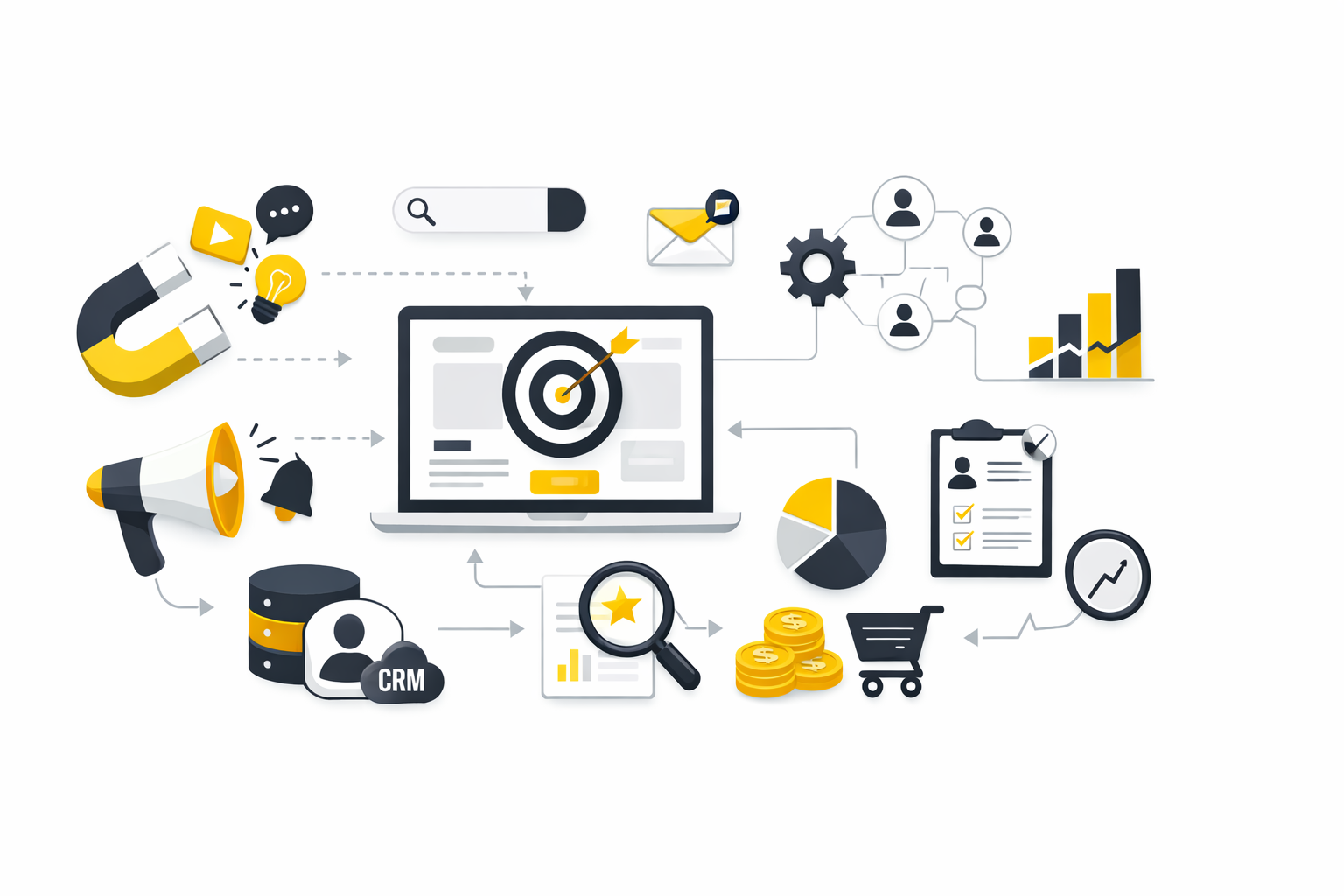
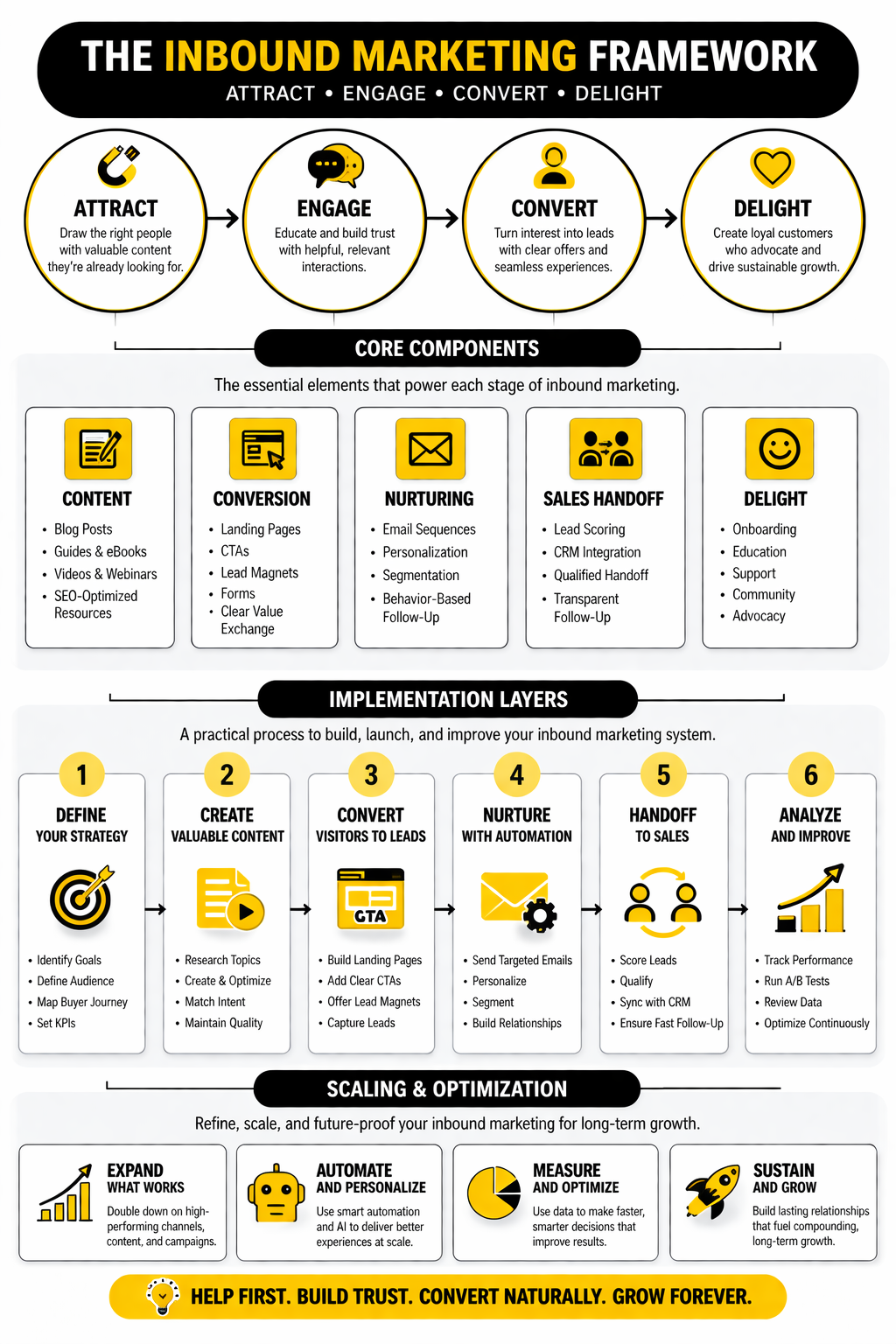
At its core, inbound marketing moves people through four practical stages: attract, convert, nurture, and advance. First you earn attention with content, search visibility, social distribution, and useful entry points. Then you capture intent with pages, forms, lead magnets, demos, bookings, or conversations that give the visitor a clear next action.
After that, the real work begins. Most people do not buy on the first visit, so inbound marketing needs follow-up that feels relevant instead of relentless. That is where email sequences, CRM segmentation, chatbot flows, and sales handoffs become essential, and why tools built for workflow automation across marketing and CRM have become part of serious implementation rather than an optional add-on.
The framework also works best when response time is fast. If someone raises their hand and your system waits hours or days to react, you lose the advantage inbound created. That is why always-on conversational automation has become more important, with Manychat’s recent automation playbook centering instant replies, lead capture, and around-the-clock engagement as practical growth levers.
Done right, this framework feels simple from the outside and disciplined underneath. The visitor sees one helpful piece of content and one obvious next step. Behind the scenes, inbound marketing is orchestrating intent detection, conversion design, segmentation, follow-up logic, and measurement so every interaction leads naturally into the next one.
The Core Components of a High-Performing Inbound Engine
Inbound marketing only works when the system is built from components that support each other. A blog alone is not inbound. A lead magnet alone is not inbound. A newsletter alone is not inbound. What actually produces results is the combination of audience insight, discoverable content, conversion paths, nurturing, and operational follow-through.
That is where a lot of teams get stuck. They publish content without a conversion path, collect leads without a nurture sequence, or generate demand without a CRM structure that helps sales act on intent. Inbound marketing starts looking slow or ineffective when the real problem is that one or two essential components are missing.
Clear Audience Insight and Search Intent
Every strong inbound system starts with knowing what the buyer is trying to solve, how they describe it, and what level of intent sits behind their search. That sounds obvious, but it changes everything from topic selection to page structure to CTA design. When teams skip this step, they create content that sounds smart internally but does not connect with real demand.
Good inbound marketing targets both discovery intent and decision intent. Some people are trying to understand a problem. Others are already comparing tools, methods, or providers. A useful editorial system covers both, which is why practical distribution frameworks like Buffer’s approach to content planning and engagement matter so much once the right topics are in motion.
Audience insight also keeps your messaging from becoming generic. When you know what the buyer is worried about, what they have already tried, and what would make the next step feel safe, your inbound marketing becomes easier to trust. That trust is what earns the click, the signup, and eventually the sale.
Content That Earns Attention Instead of Begging for It
Content is still the front door for a lot of inbound marketing, but the bar is higher now. Publishing for the sake of volume does not move the needle when every industry is already flooded with lightweight posts that say the same thing. What works better is useful content with a clear job: rank, educate, qualify, compare, or convert.
That means every asset needs a role inside the funnel. Some pieces are built to attract broad search traffic. Others exist to help a serious prospect evaluate options or understand implementation. Some are best distributed through social and repurposed across channels, which fits well with Buffer’s broader content and video strategy guidance when you want more mileage from one strong idea.
The important point is this: content should reduce uncertainty. If your inbound marketing content leaves the reader more confused than before, it failed even if it got impressions. Attention is easy to fake on a dashboard. Clarity is what actually creates momentum.
Conversion Paths That Make the Next Step Obvious
Once attention is earned, inbound marketing needs a conversion path that feels natural and low friction. That can be a form, a quiz, a booking link, a free resource, a chatbot prompt, or a product-focused landing page. What matters is that the next action matches the visitor’s level of awareness and does not ask for too much too soon.
This is where a lot of campaigns quietly lose money. Teams spend heavily to attract clicks and then send people to cluttered pages with weak hierarchy, vague copy, and competing calls to action. Practical CRO guidance like Replo’s recent landing page conversion recommendations is useful here because it focuses on clarity, structure, and visual flow instead of gimmicks.
Testing matters too. Small changes in message order, CTA language, proof placement, and form friction can materially change performance over time, which is why Replo’s A/B testing framework for landing pages fits naturally inside a mature inbound marketing program. You do not need a perfect page on day one, but you do need a page built to learn.
Lead Capture and Nurturing That Keep Momentum Alive
Most inbound marketing opportunities are not ready to buy immediately. That is normal. The mistake is acting like every lead should convert on the first touch and then giving up when they do not. A better system captures interest, segments intelligently, and follows up with messaging that matches where the lead actually is.
Email remains one of the most reliable channels for that job because it creates direct, permission-based communication over time. That is a big reason Brevo’s current email strategy guidance keeps emphasizing sequencing, segmentation, and lifecycle thinking instead of one-off blasts. Inbound marketing compounds when the follow-up feels like the next helpful step, not a disconnected campaign.
Conversation-based follow-up matters too, especially when leads are coming through social, ads, or mobile-first touchpoints. This is why automated qualification and response systems such as ManyChat’s DM funnel model have become part of modern inbound marketing rather than a side tactic. The faster and more relevant the response, the less value leaks out of the funnel.
CRM, Automation, and Operational Discipline
Inbound marketing gets expensive fast when leads fall into spreadsheets, inboxes, or handoff gaps. You can do solid work at the top of funnel and still lose the win because routing, tagging, reminders, or follow-up ownership is broken. That is why CRM discipline is not back-office admin. It is core infrastructure.
A professional setup makes sure every lead source is tracked, every contact is categorized, and every key action can trigger the next one automatically. This is exactly where GoHighLevel’s workflow automation examples become relevant, because inbound marketing is much easier to scale when form submissions, pipeline updates, reminders, email sequences, and booking logic are connected from the start.
This component is rarely the most exciting one, but it is often the difference between scattered activity and dependable performance. Inbound marketing is not just a traffic game. It is an execution game. The backend needs to be as intentional as the content the buyer sees.
How to Implement Inbound Marketing Professionally
Knowing the framework is one thing. Building it into a repeatable operating system is something else entirely. This is where inbound marketing stops being a nice idea on a strategy deck and starts becoming a real growth asset that your team can run, measure, and improve without reinventing the process every month.
Professional implementation is not about doing everything at once. It is about building the right sequence, connecting the tools, and making sure each stage creates a better handoff to the next one. When inbound marketing feels chaotic, the problem is usually not a lack of effort. It is a lack of order.
Start With One Buyer Journey, Not Ten Campaigns
The fastest way to break an inbound marketing rollout is to launch too many disconnected initiatives at once. You do not need five lead magnets, eight sequences, and twelve traffic sources on day one. You need one clearly defined buyer journey that starts with a real problem, leads to a useful conversion action, and hands the lead into a sensible nurture process.
That means picking one audience segment, one offer, and one conversion goal first. For a service business, that might be a consultation request. For a software company, it might be a demo or free trial. For a creator-led brand, it might be a lead magnet that feeds a product or newsletter funnel, which is why simpler funnel builders like Systeme.io’s platform or more sales-focused paths like ClickFunnels often make sense when the main priority is getting the first working flow live.
This focused rollout does two important things. First, it forces clarity around the actual path to conversion. Second, it gives you a contained environment where you can learn fast without drowning in variables.
Build the Stack Around Workflow, Not Tool Hype
A lot of inbound marketing setups become expensive patchworks because teams buy tools before mapping the process. That usually creates duplicate features, broken attribution, and handoff issues that only show up after leads start coming in. The better move is to define the required workflow first and then choose tools that support it cleanly.
Most professional setups need six functional layers: content publishing, landing pages, forms or capture points, email or messaging automation, CRM or pipeline tracking, and analytics. In some cases you can keep that stack fairly lean. In others, it makes sense to centralize more of it in a CRM-driven system, especially when automation, pipelines, calendars, and conversations are already meant to work together.
This matters because inbound marketing is an orchestration problem as much as a messaging problem. If the landing page captures a lead but the CRM does not tag it correctly, your follow-up breaks. If the email platform works but your page builder slows testing, improvement gets delayed. Tools should make the journey smoother, not more fragile.
Map the Execution Process Before You Publish Anything
Before you push out content, define the exact path a qualified visitor should take. Write it down step by step. What they see first, what they click next, what page they land on, what information they submit, what message they receive, how they are segmented, who gets notified, and what follow-up happens over the next seven to fourteen days.
That execution map is where inbound marketing becomes tangible. It also makes weak spots painfully obvious, which is good. You want to find friction in the planning phase, not after traffic is already hitting the system.
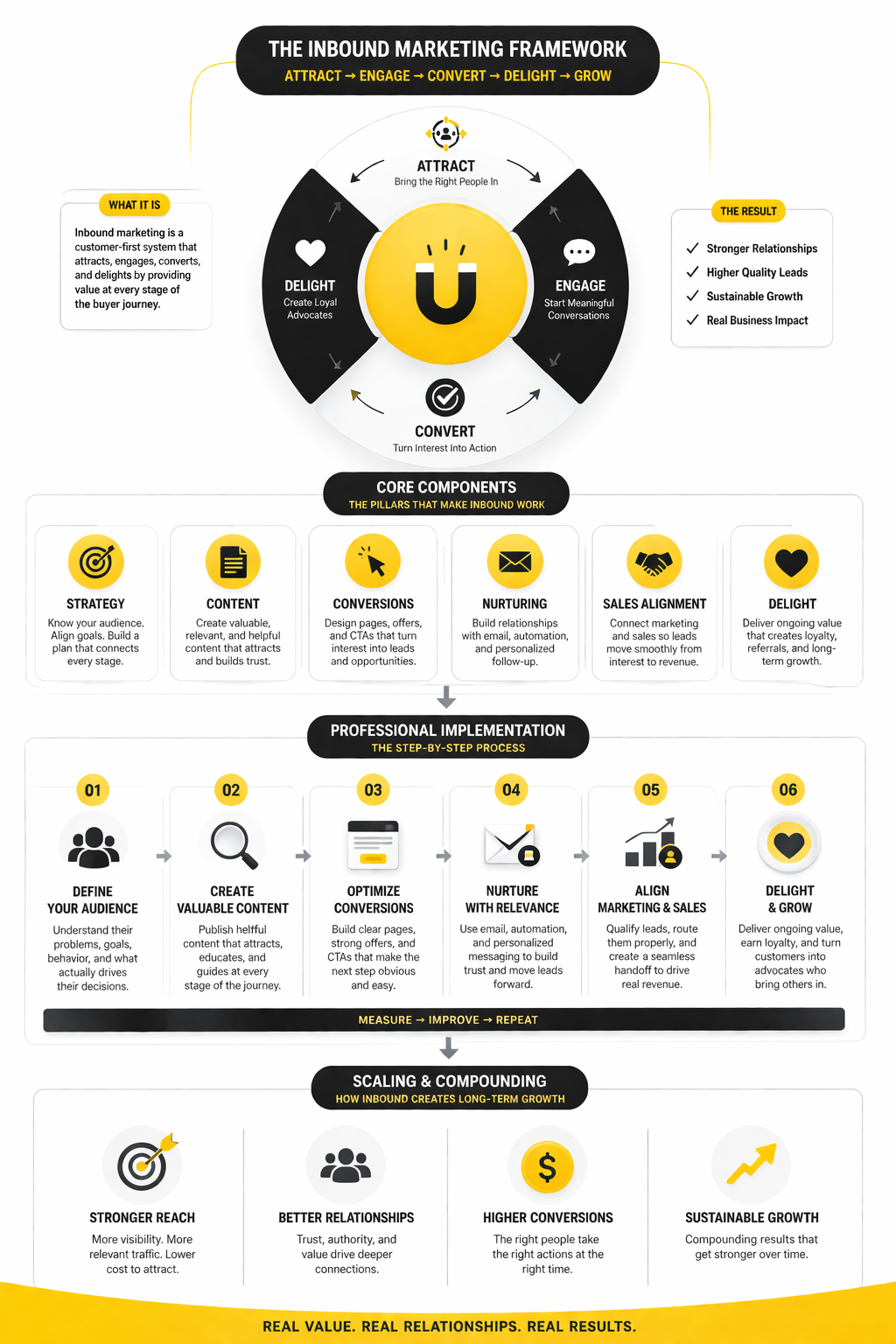
A practical rollout usually looks like this:
- Define the audience, problem, and desired conversion event.
- Create the primary offer, page, and call to action.
- Connect form capture, tags, CRM routing, and alerts.
- Build the first nurture sequence and follow-up logic.
- Publish or distribute the traffic-driving asset.
- Review conversion, response speed, and downstream quality.
The point is not to make the process complicated. The point is to make it visible. Once the path is visible, inbound marketing gets easier to debug, improve, and scale.
Turn Content Into a Production System
Professional inbound marketing needs content production that is steady enough to support the funnel and flexible enough to react to demand. That does not mean publishing every day. It means building a workflow that consistently turns audience questions, sales objections, and search intent into useful assets that serve a clear role.
A simple production system usually includes topic sourcing, outlining, creation, review, distribution, repurposing, and performance review. Teams that get this right tend to reduce waste because they are not starting from zero each week. Practical publishing workflows like Buffer’s content batching process or content bucket system are useful here because they turn content from a burst of inspiration into an operating rhythm.
This is one of those unglamorous advantages that really matters. Inbound marketing rewards consistency more than sporadic brilliance. One strong system beats a dozen random content sprints.
Automate the Follow-Up Without Making It Feel Robotic
Once leads start entering the system, speed and relevance matter more than almost anything else. A professional inbound marketing setup does not wait for someone to manually notice each form fill, DM, or inquiry. It triggers the right response automatically, while still leaving room for human intervention when intent is high.
That usually means combining email, CRM updates, reminders, and conversational touchpoints. Email segmentation remains a core lever because more relevant follow-up improves the odds that the lead keeps moving, which is exactly why Brevo’s segmentation guide and current email strategy playbook are so relevant inside inbound marketing operations.
Messaging automation can tighten that loop even further. If leads are coming through social or direct-response channels, immediate conversational flows often outperform delayed human follow-up, which is why ManyChat’s lead qualification approach fits so naturally into an execution model built around momentum.
The key is tone. Automation should remove delay, not add friction. Good inbound marketing follow-up feels timely, helpful, and aware of context. Bad automation feels like a machine yelling into the void.
How to Measure, Improve, and Scale Inbound Marketing
Inbound marketing becomes dangerous in a good way when you can measure it clearly. Without measurement, teams confuse motion with progress, celebrate traffic that never turns into revenue, and keep producing assets that look busy but do not move the business. Once the analytics system is in place, the conversation changes from “Are we doing enough?” to “What exactly is working, what is leaking, and what should we fix next?”
Build a Measurement System Around the Full Journey
The biggest measurement mistake in inbound marketing is tracking channels instead of tracking movement. A blog post does not matter because it got views. A social post does not matter because it got engagement. Those numbers only become useful when you can see whether they led to a meaningful next step.
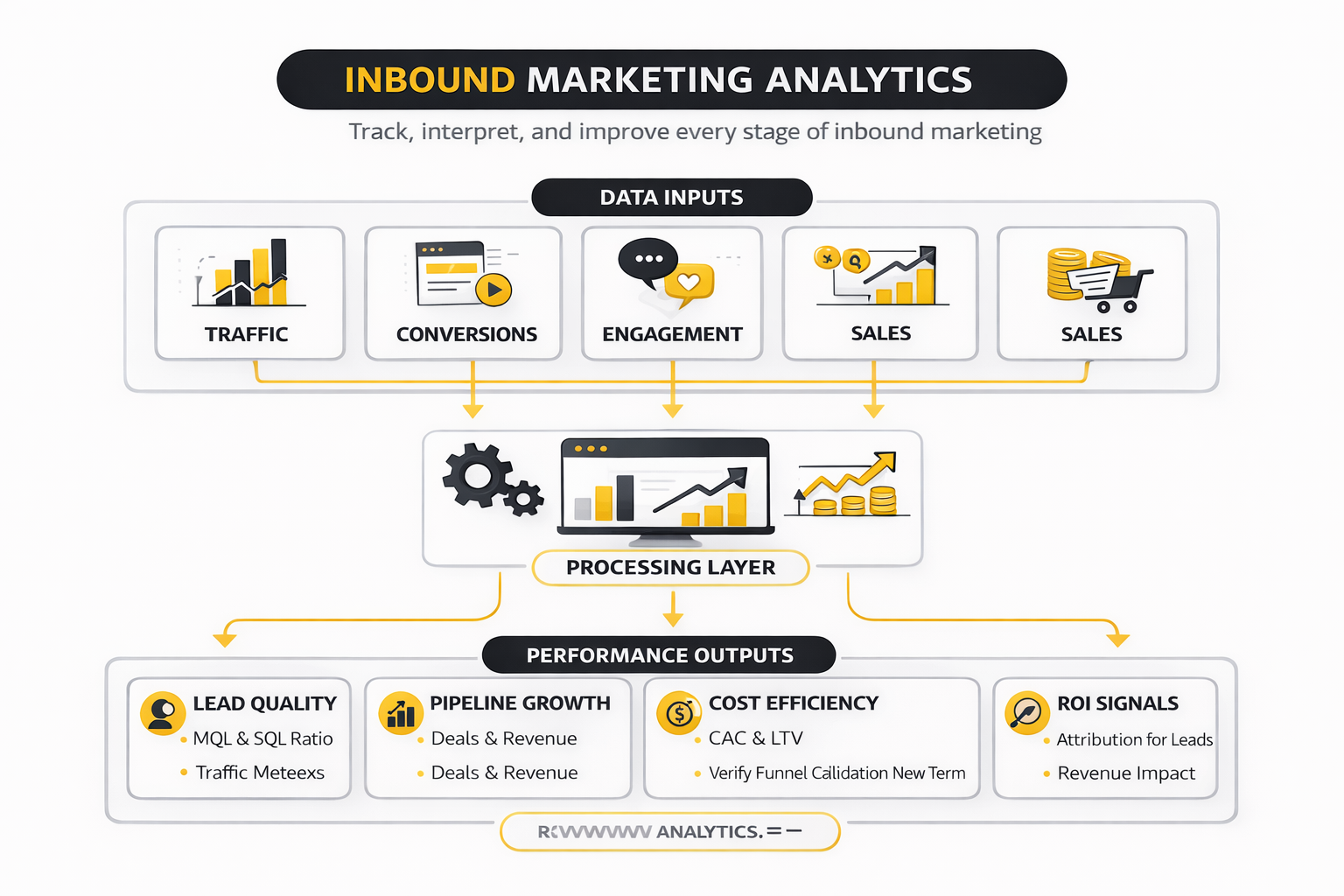
A practical inbound marketing dashboard should track four layers: traffic quality, conversion efficiency, nurture engagement, and sales progression. Traffic quality tells you whether the right people are arriving. Conversion efficiency tells you whether your page, offer, or CTA is doing its job. Nurture engagement tells you whether follow-up is building momentum. Sales progression tells you whether marketing is creating pipeline, not just contacts.
Buffer’s measurement guidance is useful here because it keeps the focus on traffic, conversions, and ROI instead of vanity metrics that flatter the team without improving results. That is exactly the right lens for inbound marketing, where the point is not to be visible everywhere but to move the right people through a system that actually converts. You can see that thinking clearly in Buffer’s analytics framework and its practical approach to building a usable social media dashboard.
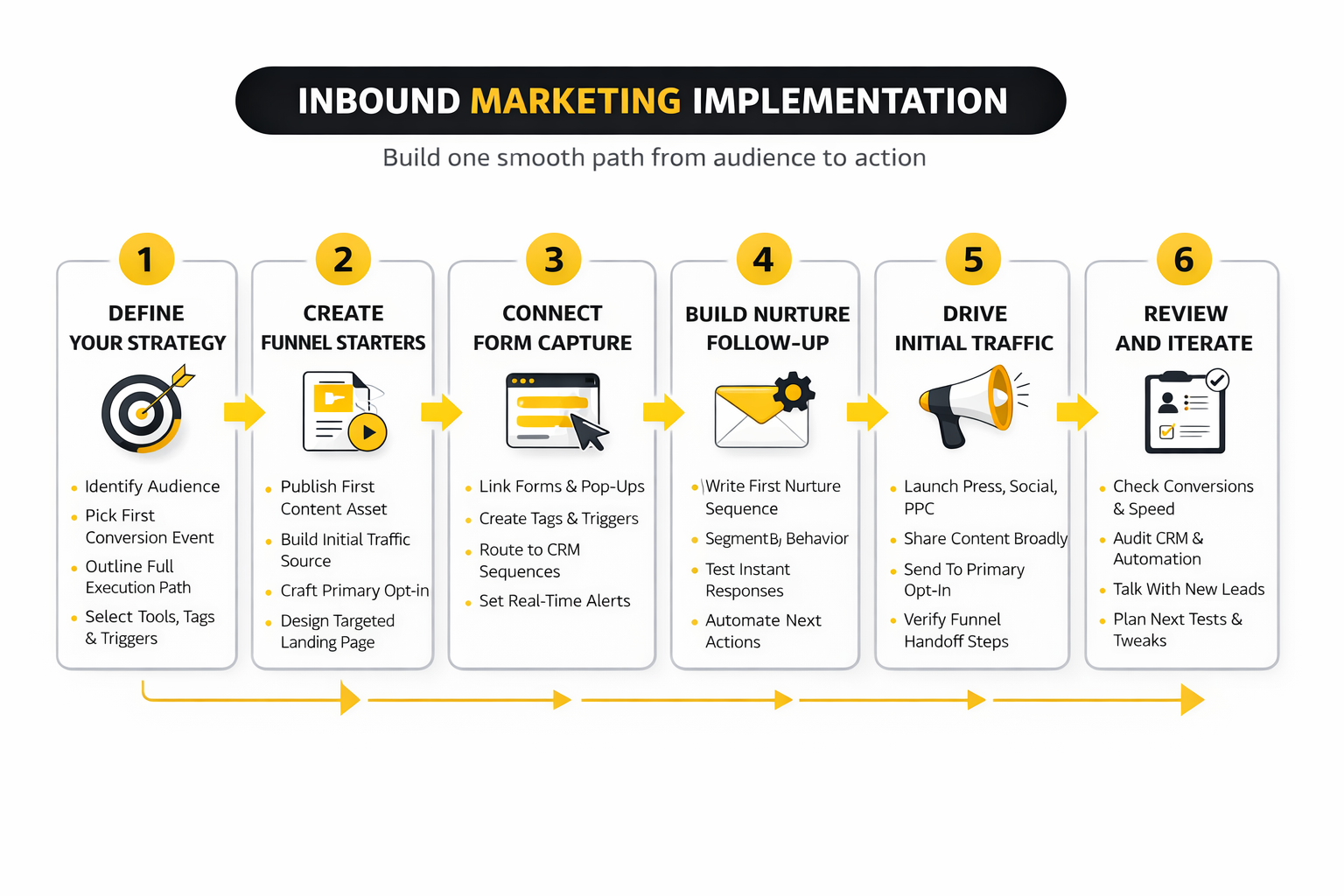
A clean analytics setup usually tracks these signals together:
- Sessions, source mix, and landing-page entry points
- Form completion rate, booking rate, or trial-start rate
- Email open rate, click-through rate, and unsubscribe rate
- Chat or DM response rate, qualification rate, and drop-off points
- Opportunity creation, pipeline value, and closed revenue
This structure matters because it tells you where the system is breaking. If traffic is growing but conversions are flat, the issue is usually the offer, page, or audience match. If conversions are healthy but pipeline quality is weak, the problem is often qualification or handoff. If leads enter the funnel but go cold, the nurture system needs work.
Use Benchmarks as Guardrails, Not as a Crutch
Benchmarks are helpful, but only when you use them properly. They should give you perspective, not replace judgment. Inbound marketing performance is shaped by price point, audience sophistication, traffic temperature, sales cycle length, and channel mix, so no serious operator should copy a benchmark and call it a target.
Still, good guardrails matter. Brevo’s 2025 benchmark report, built from more than 44 billion emails, puts average email open rate at 31.22% and average click-through rate at 3.64%, which makes those numbers useful reference points for nurture performance rather than universal goals. The more important lesson is what those metrics mean in context, which is why Brevo’s benchmark breakdown and its KPI definitions in the campaign benchmark guide are more valuable than a random screenshot of “industry averages.”
Landing-page and on-site conversion benchmarks work the same way. Replo’s recent ecommerce benchmark points to a broad 2% to 5% average conversion range across product categories, and its landing page guidance frames 3% to 5% as a reasonable “good” range for many use cases. Those numbers matter because they stop you from overreacting to noise, but they only become useful when compared against your own traffic source, offer type, and recent trend line, which is exactly how Replo’s conversion benchmark article, landing page conversion guide, and conversion calculator framework keep stressing directional interpretation over blind comparison.
That distinction is important. Benchmarks tell you whether you are in the neighborhood. Your own data tells you whether the house is on fire.
Read the Signals Correctly Before You Change Anything
A lot of bad inbound marketing decisions come from reading one metric in isolation. High traffic can hide low intent. High email open rates can hide weak offers. Good click-through rates can still lead to poor sales outcomes if the audience is curious but unqualified. Numbers do not speak for themselves. They need interpretation.
That is why sequence matters. Start by checking whether the audience coming in is the audience you actually want. Then check whether they are taking the intended action. Then look at what happens after the action. This sounds simple, but it prevents one of the most common mistakes in inbound marketing: trying to optimize the wrong stage because that is where the dashboard looks easiest to manipulate.
Take email as an example. If open rates are decent but clicks are weak, that usually points to message-to-offer mismatch, weak CTA language, or content that creates curiosity without urgency. If clicks are healthy but replies, bookings, or downstream conversions are weak, the problem usually sits deeper in the funnel. Brevo’s own KPI framing helps here because its benchmark documentation makes it clear that open rate, CTR, CTOR, unsubscribes, and bounce data answer different questions and should never be treated as interchangeable.
The same logic applies to conversational funnels. If chats start but qualification stalls, your prompts may be too broad, too early, or too demanding. If users engage but disappear at the handoff, you likely have a trust problem or a continuity problem. Chat-focused performance review works best when you actively inspect interactions, drop-off points, and conversion steps, which is exactly the process described in Chatbase’s guide to monitoring lead-gen flows and its emphasis on actionable analytics for improving conversions.
Let the Data Trigger Specific Actions
The real purpose of measurement is action. Every important metric in inbound marketing should have an implied next move. If it does not, it probably does not belong on the main dashboard.
Here is the kind of cause-and-response logic that keeps an inbound system sharp:
- When traffic rises but lead quality drops, tighten targeting and align content with stronger intent.
- When page visits rise but conversions stall, test the offer, page structure, headline, proof, and CTA order.
- When email opens hold up but clicks weaken, improve the promise inside the body and make the next step more obvious.
- When chat engagement grows but qualified leads do not, simplify the conversation path and reduce friction before qualification.
- When leads convert but revenue lags, fix sales routing, speed-to-lead, or follow-up discipline.
This is where inbound marketing gets smarter over time. You stop asking broad questions like “Should we do more content?” and start asking precise questions like “Which entry pages bring the highest-intent visitors?” or “Which sequence produces meetings instead of passive opens?” That shift is everything.
Teams that treat analytics this way usually improve faster because they are not trying to optimize every number at once. They are fixing the constraint that matters now. That is also why platform decisions matter. Systems that connect funnels, automations, and pipeline tracking in one place make it easier to see what happened after the click, which is exactly the operating advantage highlighted in HighLevel’s funnel and lead-process overview.
The Numbers Matter Only if They Change Behavior
This is the point most teams miss. Data is not valuable because it exists. It is valuable because it changes what you do next. If your inbound marketing reports are full of metrics but nobody changes headlines, offers, sequences, routing logic, or sales follow-up, then the reporting is decoration.
The best inbound teams use analytics to shorten the time between signal and improvement. They review performance often enough to catch leaks early, but not so often that they chase noise. They compare benchmarks without becoming dependent on them. Most importantly, they understand that measurement is not a side activity. It is part of the system itself.
That is what makes inbound marketing scale. Not more dashboards. Better decisions, made faster, with cleaner evidence.
Common Inbound Marketing Mistakes That Kill Results
Inbound marketing usually does not fail because the idea is wrong. It fails because teams build something that looks complete from the outside but breaks under real traffic, real follow-up demands, and real buying behavior. The painful part is that these failures are often quiet. Nothing explodes. Results just stall, costs creep up, and the team starts questioning the whole approach.
Treating Inbound Like a Content Calendar Instead of a Revenue System
This is one of the biggest traps. A company publishes articles, posts on social, maybe sends a newsletter, and calls it inbound marketing. But without a defined conversion path, follow-up logic, and sales connection, that is just activity wearing strategy’s clothes.
A strong inbound system needs movement from attention to action. If the content gets consumed but nothing meaningful happens next, the system is incomplete. That is why practical guidance around social strategy keeps coming back to performance and business impact, not just output volume, which is exactly how Buffer frames benchmarks and strategic measurement.
The fix is simple, even if it is not easy. Every asset should have a job. Attract, qualify, convert, nurture, or advance. If it does none of those clearly, it is probably clutter.
Chasing More Traffic Before Fixing Conversion Friction
A lot of teams react to weak results by trying to bring in more visitors. That can work for a while, but it is usually the wrong first move. If the landing page is confusing, the offer is weak, or the CTA is buried, more traffic just means you are paying to expose more people to the same broken experience.
This is why landing-page discipline matters so much in inbound marketing. Replo’s recent analytics and testing guidance keeps pushing the same principle: conversion rate is shaped by clarity, proof, hierarchy, and speed, and small improvements can have outsized commercial impact over time. You can see that logic in its analytics framework for what actually matters on landing pages, its testing guidance, and its breakdown of CTA structure and placement.
The practical lesson is this: do not add fuel to a funnel that still leaks. Fix the leak first. Then scale what is already working.
Letting Follow-Up Decay After the Lead Comes In
Inbound marketing creates intent, but intent fades quickly when nothing happens next. This is where a huge amount of value disappears. The form gets submitted, the booking is not confirmed fast enough, the email sequence is generic, or the handoff to sales is inconsistent. The lead was real, but the system acted indifferent.
This is not a minor operational issue. It is a strategic one. HighLevel’s recent lead-nurturing material makes the point clearly: weak, delayed, or inconsistent follow-up is one of the most common reasons businesses fail to convert interested prospects. That shows up across its current best-practice content on nurturing breakdowns and how to fix them, AI-assisted response speed, and quick-win automations that respond within minutes.
The action here is obvious. Tighten the handoff. Reduce response time. Make the first follow-up specific to the action the lead just took. Inbound marketing feels much stronger when the system behaves like it noticed the person.
Confusing Automation With Relevance
Automation is powerful, but more automation does not automatically mean better inbound marketing. A bloated sequence, an overbuilt chatbot, or a CRM stuffed with triggers can create the illusion of sophistication while making the buyer experience colder and less coherent. You can absolutely automate yourself into mediocrity.
The real goal is relevant automation. Brevo’s recent strategy and metrics content keeps emphasizing segmentation, lifecycle logic, and message quality because those are the factors that make automation useful rather than noisy. That theme runs through its current email strategy guidance, its KPI framework, and its deliverability checklist.
That is the tradeoff advanced teams understand. Automation buys speed and consistency, but only relevance creates trust. When inbound marketing starts sounding robotic, it usually means the workflow got more attention than the message.
Scaling Channel Count Faster Than You Can Maintain Quality
Expansion is tempting. Once one channel shows signs of life, the instinct is to copy the system everywhere at once. More platforms, more campaigns, more sequences, more content formats. Sometimes that works. More often it creates quality drift.
Buffer’s recent publishing research keeps reinforcing a useful principle: frequency can help, but quality still does the heavy lifting, especially as algorithms and audiences get better at filtering low-value content. That idea shows up in its posting-frequency research, its TikTok guidance on quality versus output pressure, and its observations on engagement trends in 2025.
The tradeoff is real. Scale gives you reach, but complexity taxes execution. Smart inbound marketing teams earn the right to expand by first proving they can maintain clarity, consistency, and feedback loops on fewer channels.
Ignoring Deliverability, Data Hygiene, and System Health
Advanced inbound marketing is not only a creative challenge. It is an infrastructure challenge. If your emails stop reaching inboxes, if duplicate contacts distort attribution, or if pipelines fill with low-quality records, performance degrades even when the top-of-funnel work looks fine.
This is where operational maturity separates serious teams from noisy ones. Deliverability best practices, sender reputation, segmentation hygiene, and clean CRM logic are not glamorous, but they directly influence whether your inbound system keeps compounding or quietly rots. Brevo’s recent material on improving deliverability makes this point especially well because it ties technical health to commercial outcomes instead of treating it like a side concern.
In practice, this means expert-level inbound marketing has to be maintained, not just launched. The system needs audits. The automations need pruning. The database needs discipline. Otherwise you end up scaling noise.
The Strategic Tradeoff Most Teams Avoid
Here is the deeper truth. Inbound marketing works best when you are willing to trade short-term busyness for long-term compounding. That means fewer random campaigns, more system building. Fewer vanity metrics, more journey-level measurement. Fewer disconnected tools, more operational cohesion.
That tradeoff can feel uncomfortable because system building is slower at the beginning. But once the engine is working, every asset has a better chance of making the next one more valuable. That is the part people miss when they call inbound marketing “slow.” Bad inbound is slow. Good inbound gets stronger as the system gets tighter.
And that is the real expert move: not doing more, but making each part of the system deserve the traffic, attention, and trust it receives.
The strongest inbound marketing systems eventually start to feel less like campaigns and more like ecosystems. Content brings in attention, landing pages create movement, automation keeps momentum alive, CRM logic protects follow-up, and analytics show where to improve next. Once those parts are connected, inbound marketing stops depending on one lucky channel and starts behaving like a durable acquisition engine.
That is the real endgame. Not more content for the sake of content, and not more software for the sake of sophistication. The goal is a system where each part makes the other parts more valuable, and where better decisions compound over time.
FAQ
What is inbound marketing in simple terms?
Inbound marketing is the process of attracting people by being useful before asking them to buy. Instead of interrupting strangers, you create content, pages, emails, and follow-up systems that help them solve a problem and move toward a decision. The reason it works is that it matches how modern buyers already behave: they search, compare, consume information, and act when the next step feels relevant.
How is inbound marketing different from outbound marketing?
Outbound marketing pushes the message outward through ads, cold outreach, interruptions, and rented attention. Inbound marketing pulls people in by making your brand discoverable and helpful at the exact moment interest already exists. In practice, most strong growth systems use both, but inbound marketing is what turns attention into a compounding asset instead of a one-time burst.
Does inbound marketing still work in 2026?
Yes, but only when it is executed as a system rather than a content checklist. Search, email, automation, and conversion design still matter because buyers still look for information before they commit, and email remains one of the most durable owned channels, with Brevo’s 2025 benchmark report showing a 31.22% average open rate and 3.64% average click-through rate across more than 44 billion emails. What has changed is the quality threshold, because thin content and slow follow-up get ignored much faster now.
How long does inbound marketing take to show results?
Inbound marketing usually takes longer than direct-response ads to build, but it can produce stronger economics once the system starts compounding. Some teams see early conversion signals within weeks if they already have distribution, strong offers, and clean follow-up. The bigger gains usually come from repeated improvement, because inbound marketing gets stronger when content, conversion rate, nurturing, and routing improve together instead of one at a time.
What channels belong inside an inbound marketing strategy?
The usual core channels are SEO, content, email, landing pages, CRM workflows, and social distribution. Depending on the business, inbound marketing can also include webinars, lead magnets, chat, DM automation, community, or product-led flows. The best mix depends less on trends and more on where your buyers discover information and what next step they are willing to take.
Is SEO still necessary for inbound marketing?
SEO is still one of the most valuable parts of inbound marketing because it captures demand when people are actively looking for answers. That said, inbound is bigger than SEO alone. A business can generate inbound momentum through social content, email referrals, communities, and conversational funnels too, but search remains especially powerful because it compounds when you keep publishing assets that match real intent.
What is the most important metric in inbound marketing?
There is no single perfect metric because inbound marketing is a journey, not a moment. The most useful metrics are the ones that show movement across stages: qualified traffic, conversion rate, nurture engagement, pipeline creation, and revenue. If forced to choose one lens, pipeline quality is usually more meaningful than raw lead volume because it tells you whether the system is attracting people who can actually become customers.
How much content do you need for inbound marketing to work?
Less than most people think, but it needs to be more focused than most people publish. A small library of strong, high-intent assets usually beats a large archive of repetitive content that never converts. Buffer’s recent benchmark and publishing research keeps reinforcing that quality and fit matter more than volume alone, especially as platform competition increases and engagement patterns shift across channels.
Can small businesses use inbound marketing effectively?
Absolutely, and in many cases small businesses benefit the most because inbound marketing lets them build trust without needing the ad budgets of larger competitors. A focused local or niche strategy can outperform a broader one when the messaging is sharper and the follow-up is faster. The key is not to build a giant machine on day one, but to create one buyer journey that works and then improve it steadily.
What tools are most useful for inbound marketing?
The useful categories are usually more important than the specific brands. Most teams need a page builder, form or capture system, email automation, CRM or pipeline tracking, and analytics. For a more centralized setup, systems that combine workflows, conversations, and follow-up logic can be especially practical, which is why businesses often look at options like HighLevel, while others prefer narrower stacks built around Brevo, ManyChat, or Replo.
Should inbound marketing include automation?
Yes, but only where automation improves timing, consistency, and relevance. Automation is great for lead routing, nurture sequences, reminders, DM flows, and status-based follow-up. It becomes a problem when the workflow gets smarter than the message, which is why practical guidance from ManyChat on balancing automation with authentic engagement matters so much.
What kind of offer works best in inbound marketing?
The best offer is the one that matches the visitor’s current level of intent. A cold visitor may respond best to a useful guide, calculator, or diagnostic. A warmer visitor may want a demo, booking, consultation, audit, or trial, which is why conversion-oriented environments like ClickFunnels or Systeme.io can fit naturally when the goal is to move visitors into a clearly structured next step.
How do you know if inbound marketing is failing?
Inbound marketing is usually failing when one of three things happens for too long: the wrong people are entering the funnel, the right people are not converting, or converted leads are not progressing. The giveaway is often not a dramatic crash but a pattern of flat results, weak quality, and constant activity that never compounds. When that happens, the answer is rarely “do more”; it is usually “find the broken stage and fix it.”
Can inbound marketing work without social media?
Yes. Social media can help distribute content and accelerate reach, but inbound marketing can still work through search, email, partnerships, referrals, communities, and direct website traffic. Social is helpful, not mandatory. What matters more is whether your audience can discover you, trust you, and take a sensible next step once they do.
What should a beginner do first with inbound marketing?
Start with one audience, one offer, and one conversion path. Build one useful traffic asset, one landing page, one follow-up sequence, and one clean handoff into CRM or sales. That first working flow will teach you more than months of abstract planning, and once it works, you can expand the system with a lot more confidence.
Work With Professionals
Explore 10K+ Remote Marketing Contracts on MarkeWork.com
Most marketers spend too much time chasing clients, competing on crowded platforms, and losing a percentage of every project to middlemen.
MarkeWork gives you a better way. Browse thousands of remote marketing contracts and connect directly with companies desperate to hire skilled marketers like you, without platform commissions and without unnecessary gatekeepers.
If you're serious about finding better opportunities and keeping 100% of what you earn, explore available contracts and create a profile for free at MarkeWork.com.