

Industrial marketing is how manufacturers, distributors, engineering firms, and technical service providers turn expertise into demand. It is not just “B2B marketing with harder words.” It deals with long buying cycles, technical proof, multiple decision-makers, procurement pressure, compliance needs, and buyers who usually research quietly before they ever speak to sales.
The companies that win here do not rely on pretty campaigns alone. They make complex value easy to understand, prove credibility early, and help buyers reduce risk at every stage. That is the job of modern industrial marketing.
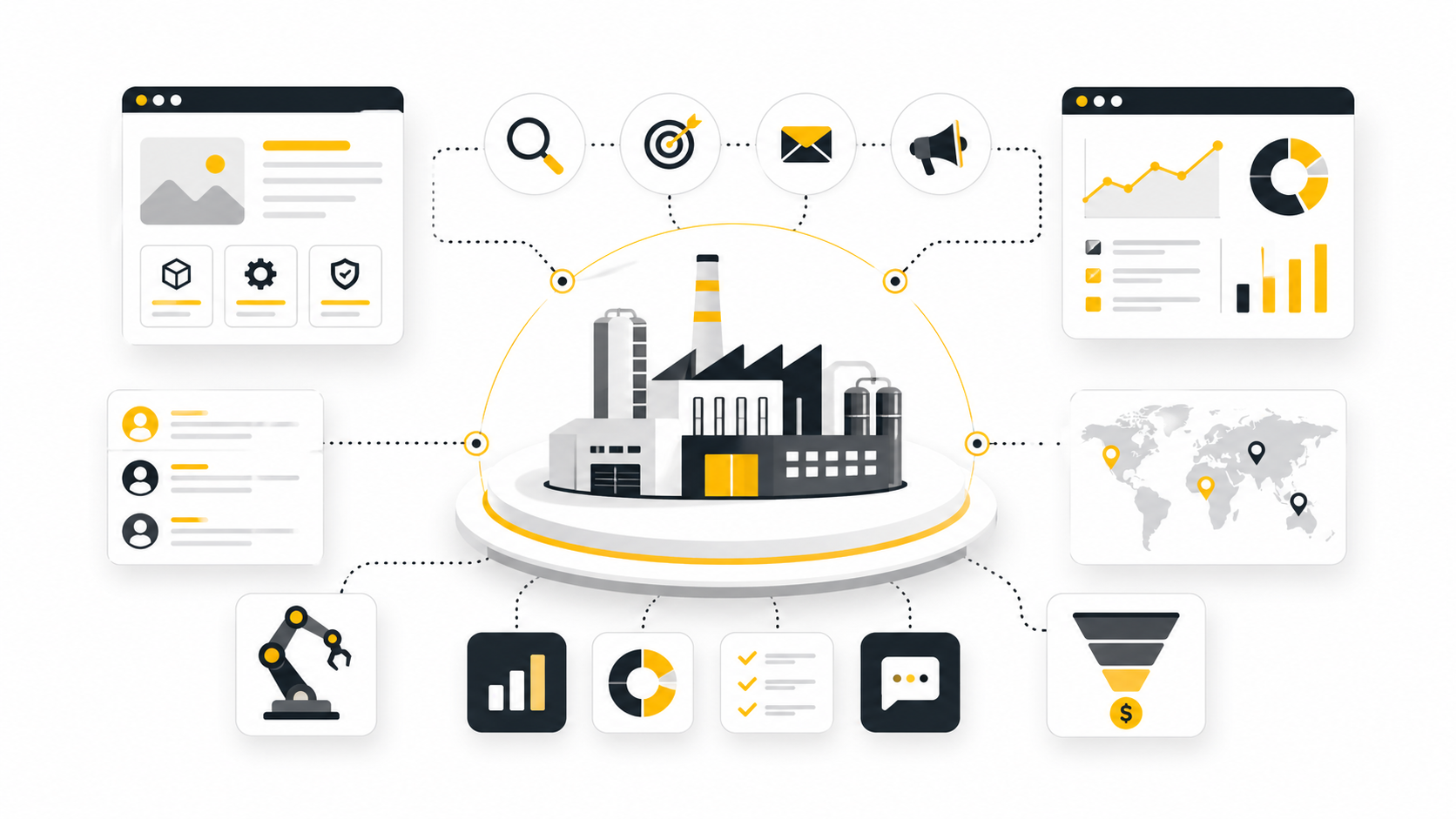
Article Outline
- Why Industrial Marketing Matters Now
- The Industrial Marketing Framework
- Market Positioning and Buyer Insight
- Technical Content, SEO, and Demand Capture
- Lead Generation, Sales Alignment, and Automation
- Measurement, Optimization, and Practical FAQs
Why Industrial Marketing Matters Now
Industrial buyers are under pressure to make safer, smarter, and more defensible decisions. A bad supplier choice can affect production schedules, quality control, margins, compliance, and customer delivery. That is why industrial marketing has to do more than create awareness; it has to build confidence before the buyer is ready to talk.
The buying process is also more self-directed than it used to be. Engineers, procurement teams, plant managers, and executives often compare suppliers online before they request a quote. If your website, technical content, product pages, case material, and follow-up system do not answer the right questions, your sales team may never get the chance.
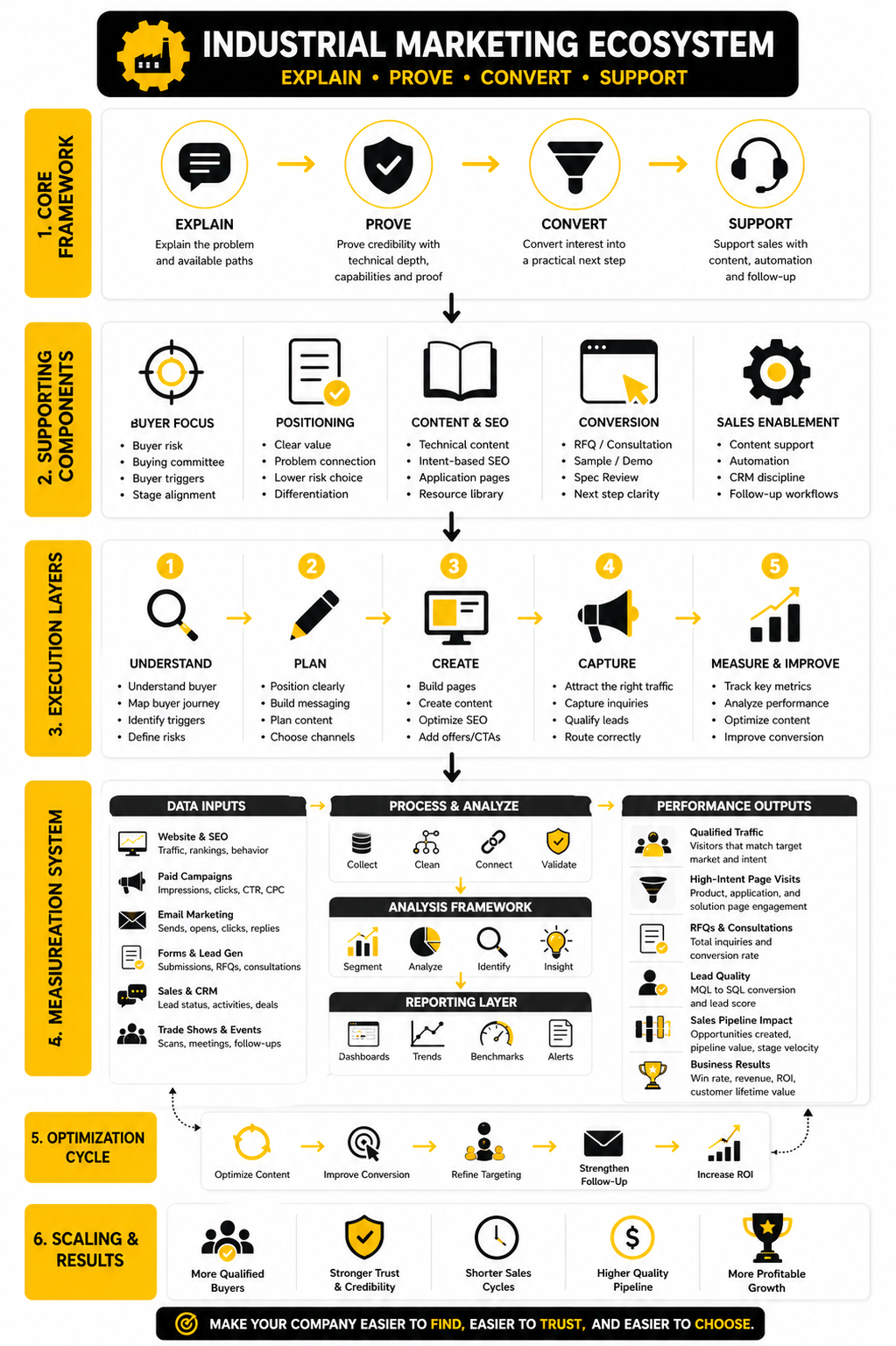
This is where industrial marketing becomes a growth system. It connects positioning, proof, content, search visibility, conversion paths, CRM follow-up, and sales enablement into one practical engine. Done well, it makes your company easier to find, easier to trust, and easier to choose.
The Industrial Marketing Framework
A useful industrial marketing framework starts with the buyer’s risk, not your product catalog. Buyers want to know whether you understand their application, whether your solution fits their constraints, and whether your company can deliver reliably. The framework should guide them from problem recognition to technical validation, commercial evaluation, and final supplier selection.
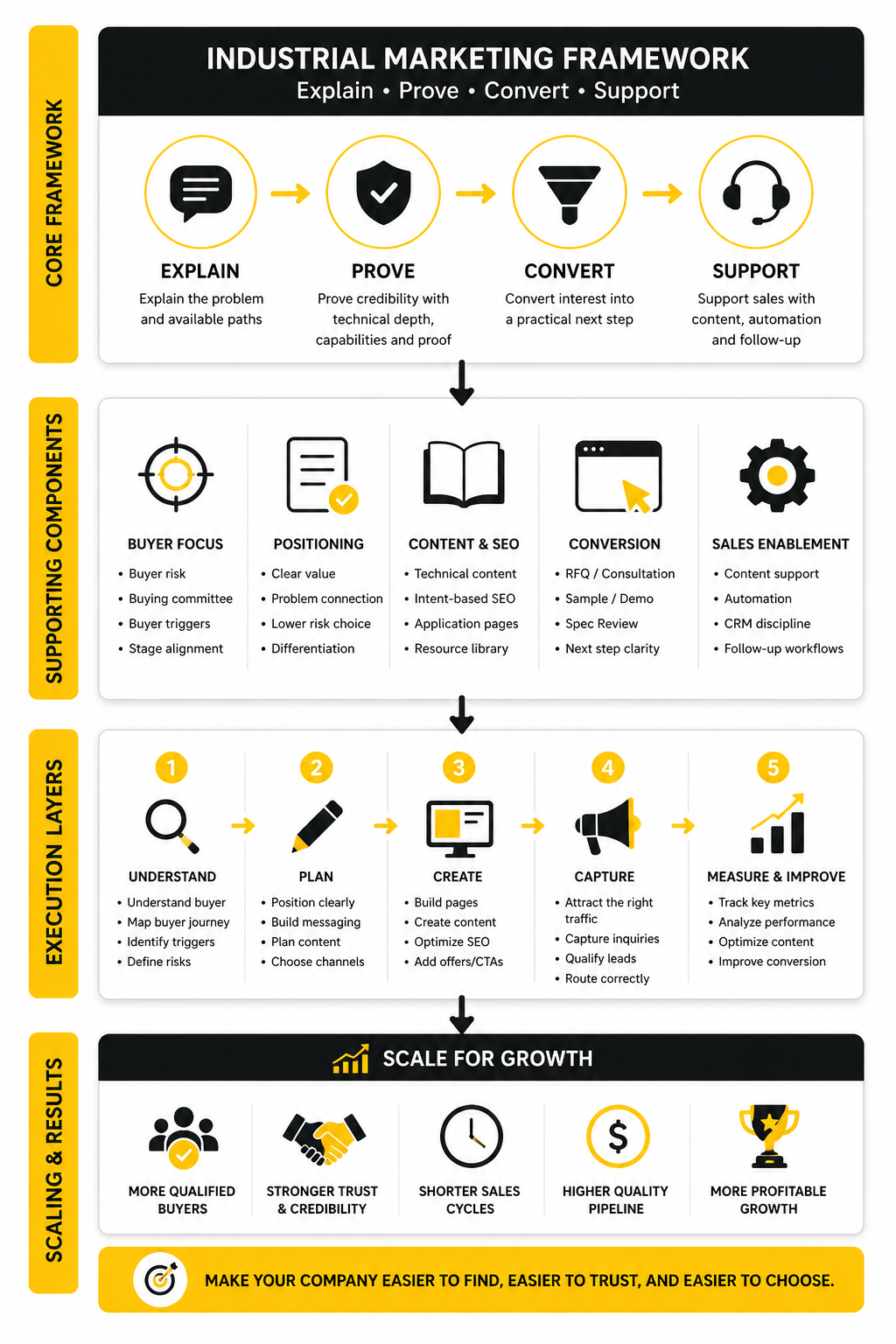
The simplest way to think about it is this: industrial marketing must explain, prove, convert, and support. It explains the problem and the available paths. It proves credibility with technical depth, real capabilities, certifications, process transparency, and useful comparison content.
Then it converts interest into a practical next step, such as an RFQ, consultation, sample request, demo, spec review, or distributor inquiry. After that, it supports sales with content, automation, CRM discipline, and follow-up workflows. The rest of this article will build that system piece by piece.
Market Positioning and Buyer Insight
Strong industrial marketing starts with a clear answer to one uncomfortable question: why should a serious buyer choose you over every other supplier that looks similar on paper? Most industrial companies say they offer quality, reliability, experience, and service. Those are important, but they are also expected, so they rarely create a sharp position by themselves.
Your positioning has to connect your capabilities to a specific buyer problem. That might be shorter lead times for replacement parts, tighter tolerances for regulated applications, better documentation for procurement teams, or easier integration for engineering teams. The goal is not to sound bigger than you are; the goal is to become easier to understand and harder to replace.
This matters because B2B buyers are doing more research before they engage directly with vendors. In one 2025 buyer study, economic uncertainty pushed nearly 70% of buyers toward more conservative vendor choices, including known vendors and incumbents. That means industrial marketing has to reduce perceived risk early, not wait for sales to handle every objection later.
Know the Real Buying Committee
Industrial purchases rarely depend on one person. An engineer may define the technical requirements, a plant manager may care about uptime, procurement may compare pricing and terms, finance may challenge the business case, and leadership may only step in near the end. Each person is evaluating a different kind of risk.
Good positioning speaks to all of them without turning your message into a messy committee document. Your website and sales materials should make the technical case, the operational case, and the commercial case easy to find. If one stakeholder cannot find what they need, the deal can slow down before you even know there is a deal.
This is why vague messaging hurts industrial companies so much. A buyer does not want to decode your capabilities from a generic brochure. They want to know whether you serve their industry, understand their application, meet their requirements, and can support the buying process without creating more work.
Build Around Buyer Triggers
A buyer usually does not wake up and decide to “explore industrial solutions” for fun. Something triggers the search. A production issue appears, a current supplier disappoints, a compliance requirement changes, a new facility opens, a product line expands, or leadership demands a cost reduction.
Your marketing should map these triggers clearly. Each trigger deserves content, proof, and a conversion path that matches the buyer’s urgency. A maintenance manager dealing with downtime needs a different path than an engineering leader planning a new system six months out.
This is where many industrial websites fall short. They organize everything around products and internal categories instead of buyer situations. Product pages matter, but they work better when they are supported by application pages, industry pages, comparison pages, technical guides, and clear next steps.
Turn Positioning Into Practical Messaging
Once you know the buyer, the risk, and the trigger, your messaging gets much easier. You can stop trying to appeal to everyone and start making specific promises you can prove. That is the difference between “high-quality industrial solutions” and “custom stainless components for washdown environments with documentation support for regulated production teams.”
The second version is narrower, but that is the point. Industrial buyers usually reward clarity. They do not need you to sound clever; they need you to sound competent, relevant, and specific.
Your core messaging should answer four questions quickly:
- What do you provide?
- Who is it for?
- What problem does it solve?
- Why are you a lower-risk choice?
If those answers are not obvious within the first few moments of reading your site, your industrial marketing is leaking trust. Not traffic. Trust. And in industrial sales, trust is usually the real conversion point.
Technical Content, SEO, and Demand Capture
Once your positioning is clear, the next job is to turn that clarity into assets buyers can actually use. Industrial marketing works best when content answers real technical and commercial questions before the buyer has to ask sales. That does not mean publishing random blog posts every week; it means building a content system around the decisions your buyers already need to make.
Technical buyers usually want depth, accuracy, and practical detail. They care about specifications, tolerances, use cases, materials, compatibility, lead times, maintenance requirements, documentation, and integration constraints. If your content only says “we deliver quality solutions,” it will not carry enough weight.
This is why SEO matters in industrial markets. Search is often where hidden demand becomes visible. A buyer searching for a material, process, standard, failure mode, replacement part, or application-specific solution is not casually browsing; they are trying to solve a real operational problem.
Build Content Around Search Intent
Industrial SEO should start with buyer intent, not keyword volume alone. A low-volume search from the right engineer or procurement manager can be more valuable than thousands of broad visitors who will never buy. The best opportunities often sit in specific application phrases, product modifiers, comparison terms, compliance questions, and problem-led searches.
The process should be simple enough to execute consistently:
- Identify the industries, applications, and buyer roles you want to reach.
- Collect the questions buyers ask during sales calls, RFQs, demos, distributor conversations, and support tickets.
- Group those questions by buying stage, from early research to supplier comparison.
- Create pages that answer each cluster with technical accuracy and commercial clarity.
- Connect every page to a relevant next step, such as an RFQ, consultation, sample request, or technical review.
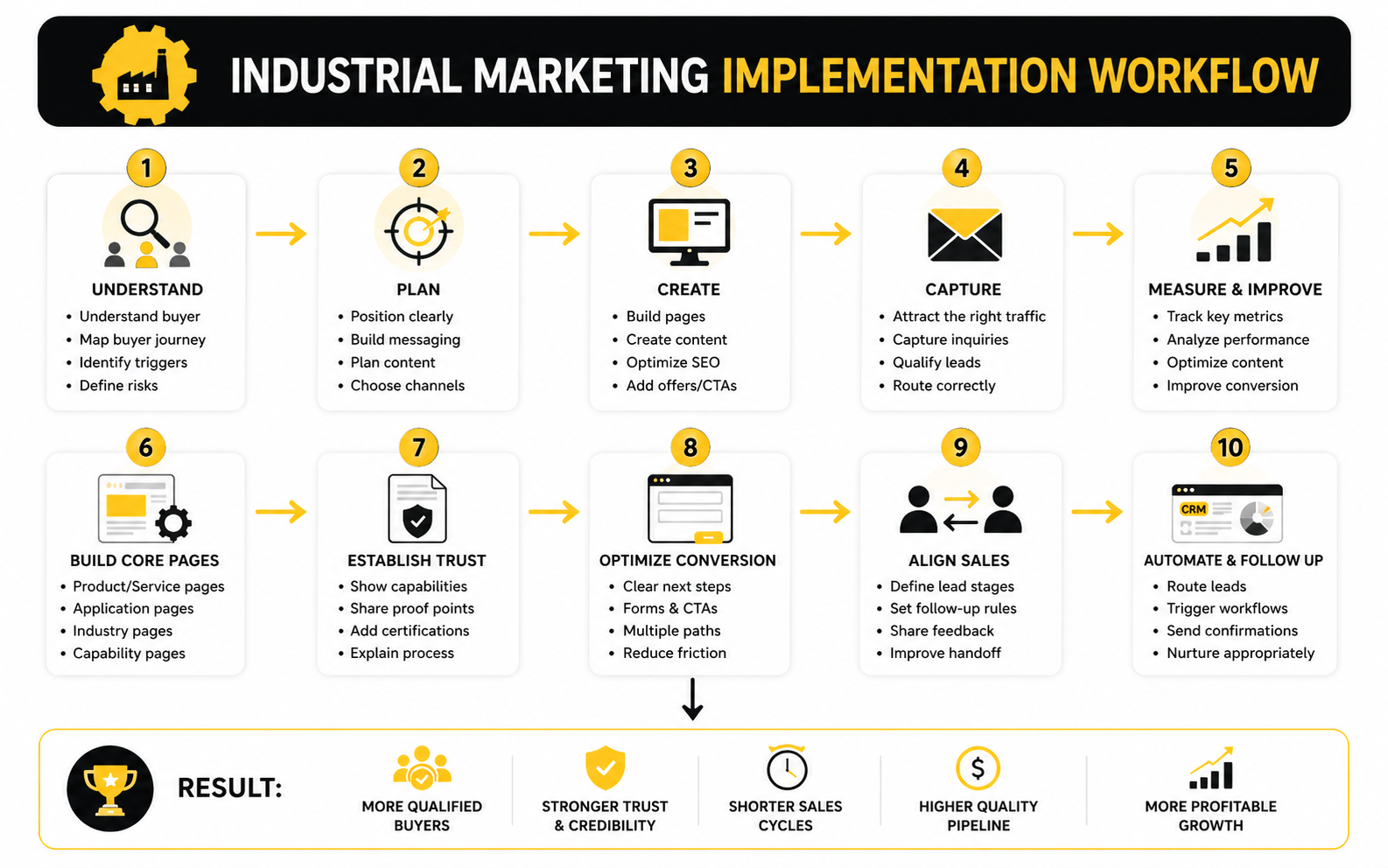
This is where industrial marketing becomes practical. You are not publishing content because “content is good.” You are building a searchable, useful decision library that helps buyers move from uncertainty to action.
Create the Core Page Types
A strong industrial website usually needs more than a homepage and product pages. Product pages capture known demand, but they rarely explain the full buying context. Application pages, industry pages, comparison pages, capability pages, and technical guides help buyers understand whether your solution fits their situation.
Application pages are especially important because they connect your offer to a specific environment or use case. An engineer does not only want to know what you make; they want to know whether it works in their conditions. That is where details about materials, performance limits, cleaning requirements, installation, documentation, and typical constraints become useful.
Capability pages also matter because many industrial buyers are evaluating supplier fit before they know the exact SKU or configuration they need. A page about CNC machining, custom fabrication, industrial automation, packaging systems, or calibration services should explain your process, equipment, quality controls, industries served, and what makes a project a good fit. Make the buyer’s evaluation easier, and you make the sales conversation stronger.
Make Technical Content Easy to Trust
Technical content should be written like it respects the reader’s intelligence. Avoid hype, vague claims, and inflated language. Use clear explanations, specific constraints, diagrams where useful, and plain language around trade-offs.
Trust also comes from showing how you work. Buyers want to know what happens after they contact you, what information you need from them, how quoting works, how engineering review is handled, and where delays typically happen. This type of operational transparency is underrated because it removes friction from the buying process.
Do not hide practical details just because competitors might read them. Your competitors already know the basics. Your buyers are the ones losing confidence when your website feels thin, generic, or evasive.
Capture Demand Without Forcing the Sale
Not every visitor is ready for an RFQ. Some are validating an idea, comparing supplier types, checking terminology, or gathering internal support. If every page pushes the same hard sales action, you will miss buyers who need a softer next step.
Use different conversion paths for different intent levels. A high-intent product or service page can lead to a quote request. A technical guide can offer a checklist, spec review, or consultation. A comparison page can invite the buyer to send requirements for a fit assessment.
For teams that need a practical CRM and follow-up layer, GoHighLevel can fit when the goal is to centralize forms, pipelines, follow-up workflows, and sales conversations. The tool does not replace strategy, but it can help industrial marketing teams stop losing leads after the first form submission. That matters because demand capture is not only about getting the lead; it is about responding in a way that keeps momentum alive.
Statistics and Data
Measurement is where industrial marketing either becomes a real growth system or stays stuck as a collection of disconnected activities. Traffic is useful, but traffic alone does not prove that marketing is working. In industrial markets, the better question is whether the right buyers are finding the right pages, taking meaningful action, and moving into sales conversations with enough context to be useful.
The data should help you make decisions, not decorate a monthly report. A page with low traffic but strong RFQ quality may be more valuable than a high-traffic article that brings in students, competitors, or unqualified visitors. A campaign that produces fewer leads but more qualified opportunities can be a better investment than one that makes the top-line lead number look good.
This matters because modern B2B buying is increasingly buyer-led. The 2025 6sense Buyer Experience Report found that buyers initiated 79% of first contact with vendors, which means many important buying signals happen before sales gets involved. Industrial marketing has to measure those signals early, or the company will only see the visible end of the buying process.
Measure the Full Buying Path
The most useful analytics system connects visibility, engagement, conversion, pipeline, and revenue. You want to know which searches bring the right visitors in, which pages help them understand your offer, which calls to action they use, and which leads become real opportunities. Without that chain, teams end up arguing from opinions instead of diagnosing the system.
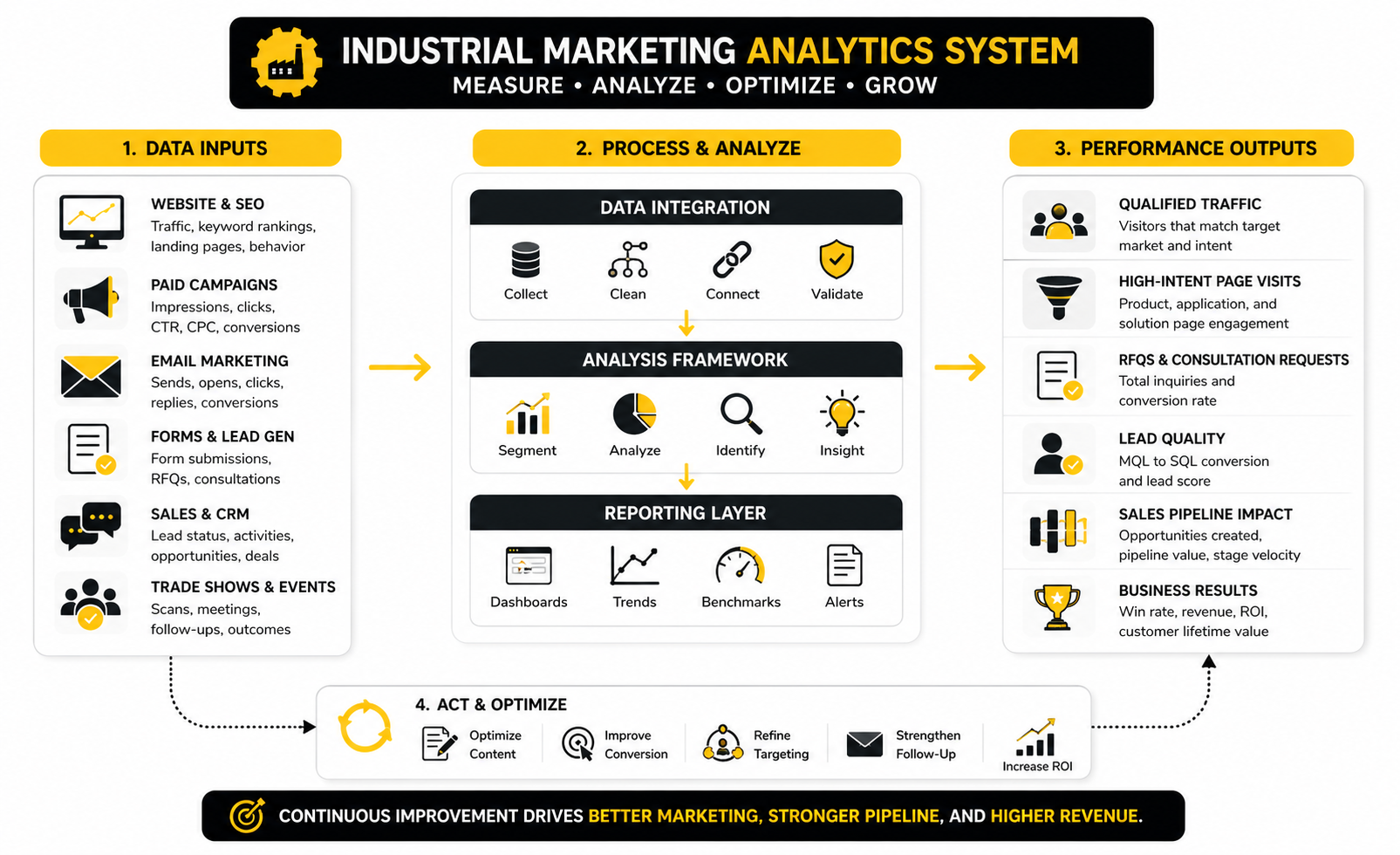
A practical measurement model can be simple:
- Visibility: rankings, impressions, organic clicks, paid search data, and referral sources.
- Engagement: page depth, scroll behavior, return visits, content downloads, and time on key technical pages.
- Conversion: RFQs, consultation requests, quote forms, spec review requests, phone calls, and distributor inquiries.
- Qualification: industry fit, company size, application, urgency, budget range, location, and decision role.
- Sales outcome: qualified opportunity rate, quote-to-close rate, deal value, sales cycle length, and lost reasons.
The point is not to track everything forever. The point is to track enough of the path to see where growth is being created or blocked. If search visibility is rising but qualified inquiries are flat, the problem may be intent mismatch. If inquiries are increasing but opportunities are weak, the issue may be offer fit, form quality, lead routing, or sales qualification.
Read Benchmarks Carefully
Benchmarks are useful only when they are treated as context, not commandments. Industrial companies vary too much by deal size, sales cycle, geography, product complexity, and urgency for one conversion rate to define success. A custom equipment supplier with six-figure deals should not judge performance the same way as a distributor selling repeat-order components.
Recent B2B benchmark data shows why this nuance matters. In one 2025 benchmark set, marketing teams most often tracked pipeline generated, opportunities generated, and new revenue, while efficiency metrics such as marketing cost per opportunity and pipeline conversion were less commonly treated as top measures. That gap matters because industrial teams need to know not only whether marketing produces activity, but whether that activity converts into profitable sales.
For industrial marketing, the best benchmarks are usually internal. Compare product lines, regions, industries, page types, traffic sources, and lead sources against each other. Your own data will reveal which segments are worth more attention and which campaigns create noise.
Separate Leading and Lagging Indicators
Leading indicators show whether the system is moving in the right direction before revenue appears. These include qualified traffic, rankings for high-intent terms, repeat visits from target accounts, form starts, quote-page engagement, email replies, and sales conversations created. They help you adjust before waiting months for closed deals.
Lagging indicators show the final business impact. These include revenue, margin, win rate, deal size, customer acquisition cost, and sales cycle length. They are essential, but they come too late to manage daily execution on their own.
A healthy industrial marketing dashboard uses both. Leading indicators tell you where momentum is building. Lagging indicators tell you whether that momentum is worth paying for.
Turn Data Into Action
The worst use of analytics is passive reporting. A dashboard that nobody acts on is just a prettier spreadsheet. Every metric should point toward a decision: create more of something, fix something, stop something, or test something.
If technical guide pages attract strong traffic but no inquiries, add clearer next steps and internal links to relevant service pages. If RFQs arrive without enough detail, improve the form and explain what information helps you quote accurately. If paid search leads are expensive but close well, the action may be to improve qualification rather than cut spend too quickly.
For teams that need a cleaner way to connect forms, CRM stages, follow-up, and pipeline reporting, GoHighLevel can be useful when the priority is operational visibility. The real win is not the software itself. The win is creating a system where every serious inquiry is captured, routed, followed up, and measured against sales outcomes.
Lead Generation, Sales Alignment, and Automation
At this stage, the main risk is not a lack of marketing activity. It is scaling activity faster than the team can qualify, route, and follow up properly. Industrial marketing can create demand, but the business only benefits when that demand turns into useful conversations, accurate quotes, and winnable opportunities.
This is where strategy gets less glamorous and more important. A company can have strong content, decent rankings, and a growing number of inquiries, but still lose revenue because leads sit too long, sales gets poor context, or marketing celebrates volume while sales deals with low-fit requests. The handoff matters. A lot.
The fix is not to make everything more complicated. The fix is to define what a good lead looks like, what should happen next, who owns each step, and how quickly the team should respond. Without that operating system, automation just helps you create mess faster.
Define Lead Quality Before You Scale
A qualified industrial lead is not just someone who fills out a form. It is someone whose company, application, requirements, timing, and potential value make sense for your business. A small distributor order, an urgent replacement part, and a custom engineering project may all be valid, but they should not be treated the same way.
Lead scoring should reflect real sales judgment. Industry fit, geography, product category, project urgency, company type, technical detail, and repeat-purchase potential usually matter more than shallow signals like one email open. If your scoring model rewards the wrong behavior, the team will chase the wrong opportunities.
This is also where you need to be honest about tradeoffs. More form fields can improve qualification, but too many fields can reduce conversions. Fewer fields can increase lead volume, but sales may waste more time chasing incomplete requests. The right balance depends on deal complexity, urgency, and how much discovery your team can realistically handle.
Align Marketing With the Sales Process
Sales alignment does not mean marketing asks sales for feedback once per quarter and then goes back to publishing. It means both teams agree on the buying stages, lead definitions, follow-up expectations, objection patterns, and content gaps. In industrial marketing, that alignment is especially important because sales often hears the most specific technical questions first.
A simple shared system can solve a lot:
- Marketing-qualified lead: the inquiry matches the target market and shows enough intent to review.
- Sales-qualified lead: sales confirms a real application, need, timeline, and potential fit.
- Quoted opportunity: the buyer has provided enough information for pricing, scope, or technical evaluation.
- Active opportunity: there is a real buying process, stakeholder involvement, and a next step.
- Closed result: the deal is won, lost, delayed, or disqualified with a clear reason.
The language matters because vague pipeline stages create vague decisions. If everyone defines “good lead” differently, reporting becomes political. If the definitions are clear, the team can improve the system without blaming each other.
Use Automation Carefully
Automation is useful when it supports buyer momentum. It is dangerous when it replaces human judgment in moments that require expertise. An engineer asking about a critical application does not need a generic nurture sequence that sounds like it was written for a software demo; they need a useful next step.
Use automation for speed, consistency, and visibility. Send confirmation emails, route inquiries by product line or region, notify the right salesperson, create CRM tasks, trigger reminders, and deliver relevant follow-up resources. Keep the tone direct and practical, because industrial buyers can smell fake personalization immediately.
For teams that want one place to manage forms, pipelines, appointment flows, and follow-up automation, GoHighLevel can be a practical fit. If the company mainly needs simpler email communication or newsletters, Brevo may be enough. The tool choice should follow the workflow, not the other way around.
Protect Trust as You Grow
Industrial buyers are cautious for good reasons. A rushed quote, unclear promise, sloppy follow-up, or over-automated sequence can make a supplier feel risky. The bigger your marketing system gets, the more discipline you need around accuracy.
This is especially true as more teams use AI to speed up content and communication. AI can help with research organization, draft structure, repurposing, and workflow support, but it should not invent specs, compliance claims, performance numbers, or engineering recommendations. In industrial marketing, false confidence is expensive.
The best scaling strategy is controlled growth. Expand the content library, improve conversion paths, tighten CRM hygiene, and automate repetitive tasks, but keep technical review close to the work. Growth should make the buyer experience sharper, not noisier.
Measurement, Optimization, and Practical FAQs
A mature industrial marketing system is not one campaign, one funnel, or one channel. It is an ecosystem where positioning, technical content, search visibility, conversion paths, CRM follow-up, sales feedback, and reporting all reinforce each other. When one part is weak, the whole system feels heavier than it should.
That is why the final layer is optimization. You keep improving the pages that attract serious buyers, the forms that qualify real opportunities, the workflows that speed up response, and the sales materials that help buyers make internal decisions. The goal is not perfection. The goal is a system that gets clearer, faster, and more profitable over time.
FAQ - Built for Complete Guide
What is industrial marketing?
Industrial marketing is the process of promoting technical products, services, and capabilities to business buyers in sectors like manufacturing, engineering, construction, logistics, energy, and industrial technology. It usually involves longer sales cycles, more stakeholders, and more technical evaluation than consumer marketing. The goal is to help buyers understand, trust, compare, and choose your company with less friction.
How is industrial marketing different from normal B2B marketing?
Industrial marketing is usually more technical, more proof-driven, and more dependent on risk reduction. A buyer may need to check specifications, certifications, lead times, integration requirements, maintenance needs, and supplier reliability before making a decision. That makes the content, sales process, and follow-up system more detailed than a typical B2B campaign.
Why does industrial marketing matter for manufacturers?
Manufacturers need industrial marketing because buyers now research suppliers online before making contact. If your website and content do not explain your capabilities clearly, buyers may shortlist competitors before your sales team gets involved. Good marketing makes your company easier to find, easier to evaluate, and easier to trust.
What channels work best for industrial marketing?
The strongest channels usually include SEO, technical content, email follow-up, LinkedIn, paid search, distributor support, trade show follow-up, and direct sales enablement. The best mix depends on your market, deal size, and buyer behavior. For many industrial companies, SEO and high-intent website pages become especially valuable because buyers often search when they already have a real problem.
What should an industrial marketing website include?
A strong website should include clear positioning, product or service pages, industry pages, application pages, technical resources, proof points, certifications, case material where available, and direct conversion paths. It should also explain what happens after a buyer contacts you. The easier you make evaluation, the stronger the website becomes.
How do you generate industrial leads?
Industrial leads come from matching useful content with real buyer intent. That can mean ranking for technical searches, running paid campaigns for high-intent terms, improving quote request pages, creating application-specific landing pages, and following up properly after trade shows or distributor conversations. Lead generation works best when marketing and sales agree on what a qualified inquiry looks like.
What metrics should industrial marketers track?
Track qualified traffic, high-intent page visits, RFQs, consultation requests, lead quality, sales-qualified opportunities, quote rate, win rate, deal value, and sales cycle length. Do not judge performance only by traffic or raw lead volume. In industrial marketing, one serious opportunity can be worth more than hundreds of weak visitors.
How long does industrial marketing take to work?
It depends on the starting point, competition, deal size, and sales cycle. SEO and content usually take time because they build compounding visibility. Paid search, conversion improvements, and better follow-up can create faster signals, but the real value comes from connecting everything into one consistent system.
Should industrial companies use automation?
Yes, but carefully. Automation is useful for lead routing, confirmation emails, CRM tasks, follow-up reminders, appointment scheduling, and pipeline visibility. It should not replace technical judgment or make communication feel generic when the buyer needs expert help.
What is the biggest mistake in industrial marketing?
The biggest mistake is being too vague. Many industrial companies describe themselves with the same words: quality, service, reliability, and experience. Those things matter, but they need to be supported with specific capabilities, specific applications, clear proof, and a buying process that feels professional.
Can small industrial companies compete with larger brands?
Yes, especially when they are more specific, more responsive, and clearer about where they fit. Smaller companies often win when they focus on niche applications, faster communication, deeper expertise, or more flexible support. Industrial buyers do not always want the biggest supplier; they want the lowest-risk supplier for their situation.
What should be improved first?
Start with positioning, website clarity, and lead handling. If buyers cannot quickly understand what you do, where you fit, and how to take the next step, more traffic will not fix the problem. After that, build technical content, improve conversion paths, and measure which channels create real opportunities.
Work With Professionals
Explore 10K+ Remote Marketing Contracts on MarkeWork.com
Most marketers spend too much time chasing clients, competing on crowded platforms, and losing a percentage of every project to middlemen.
MarkeWork gives you a better way. Browse thousands of remote marketing contracts and connect directly with companies desperate to hire skilled marketers like you, without platform commissions and without unnecessary gatekeepers.
If you're serious about finding better opportunities and keeping 100% of what you earn, explore available contracts and create a profile for free at MarkeWork.com.