

An influencer program stops being a side tactic the moment a brand decides creators are not just there to “post something” but to help drive awareness, trust, content production, conversion, and retention in one connected system. That shift matters now because creator marketing is no longer treated like an experiment inside serious marketing teams. In the U.S. alone, creator ad spend was projected to reach $37 billion in 2025, and CreatorIQ’s latest market data shows many teams are moving budget into creator work from paid and digital channels rather than treating it as extra spend on the side.
That change is not happening because marketers suddenly fell in love with vanity metrics. It is happening because the old playbook is under pressure from rising acquisition costs, weaker trust in brand-led messaging, and the nonstop demand for fresh content across every channel. Sprout Social found that 49% of consumers make purchases at least monthly because of influencer posts, while Nielsen’s research has shown creator content can outperform on recall, likability, and perceived credibility when the execution is right.
An influencer program also matters because it solves a structural problem, not just a media problem. Most brands do not need one lucky collaboration. They need a repeatable way to find aligned creators, brief them well, protect compliance, repurpose content, and measure what actually moved. That is the difference between doing influencer marketing occasionally and building an influencer program that compounds.
Article Outline
- Why Influencer Programs Matter Now
- What an Influencer Program Actually Is
- The Operating Model Behind a Scalable Program
- Recruiting Creators Who Can Move the Needle
- Measuring Performance Without Hiding Behind Vanity Metrics
- Scaling the Program Without Losing Trust
Why Influencer Programs Matter Now
The strongest case for an influencer program is simple: buyers trust people more than polished brand copy, but they are also getting better at spotting fake enthusiasm. New academic work keeps reinforcing the same point from different angles: credibility, trust, and perceived authenticity shape purchase intent far more than raw visibility alone, which is exactly why random one-off sponsorships underperform when the creator-brand fit is weak. The channel works best when the audience feels the creator’s recommendation belongs inside their normal voice rather than being dropped in from a brand brief.
That same reality explains why brands are reorganizing around creators instead of just buying sponsored posts. CreatorIQ reported that 55% of organizations increased influencer investment, and its more recent report shows growing spend is often being reallocated from digital and paid budgets because marketers increasingly see creator programs as a proven channel rather than a speculative one. When money moves from established buckets into creator work, that is a sign the market has matured.
There is also a supply-side reason this matters more than it did a few years ago. YouTube’s latest impact reporting, backed by Oxford Economics, says its U.S. creative ecosystem contributed $55 billion to GDP in 2024, which is another way of saying the creator economy is no longer niche infrastructure. Brands are not building programs around a fringe behavior anymore. They are building around a media and commerce layer that has become part of how people discover products, evaluate them, and talk about them in public.
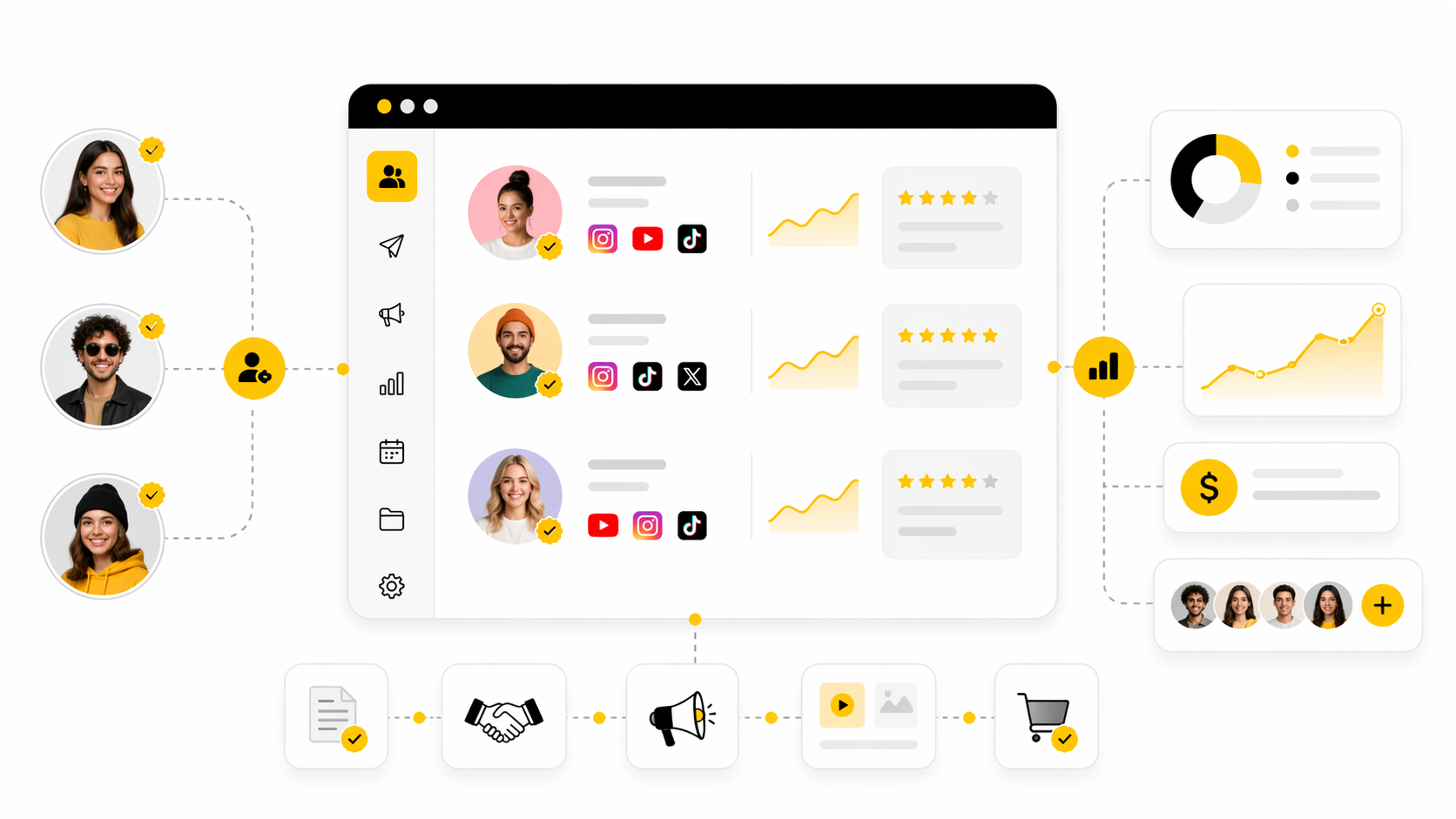
One more reason this matters is risk. The more money that moves into creator partnerships, the less room there is for sloppy disclosure, fake testimonials, inflated engagement, or campaigns built on creators who do not actually understand the product. The FTC’s guidance on endorsements, influencers, and reviews and its consumer reviews and testimonials rule make it clear that brands cannot treat creator marketing like a casual side channel.
That legal pressure is only part of the story. Trust is fragile on the audience side too, especially as feeds get more saturated and AI increases the volume of low-quality content. UNESCO’s global research found that 62% of digital content creators do not systematically fact-check before sharing, which is a useful reminder that a serious influencer program is not just a growth engine. It is also a governance system for deciding who represents the brand, what standards apply, and how credibility is protected over time.
What an Influencer Program Actually Is
An influencer program is a structured operating system for creator partnerships. It includes how you choose creators, how you compensate them, how you brief them, how content gets approved, how performance is measured, what rights the brand has to reuse assets, and what happens after the first campaign ends. Without that structure, most brands do not have a program at all. They just have occasional deals.
That distinction matters because one-off campaigns optimize for convenience, while an influencer program optimizes for consistency. A campaign asks, “Who can post this month?” A program asks, “Which creators should represent us repeatedly, in which formats, on which platforms, with what commercial goal, and how do we improve that system every quarter?” Once you see that difference, a lot of bad creator strategy becomes obvious.
A strong influencer program also sits between brand and performance marketing instead of belonging entirely to one side. It should help the brand build recognition and social proof, but it should also create usable content, generate qualified traffic, assist conversion, and feed learnings back into paid media, lifecycle marketing, landing pages, and product positioning. That is why teams using creator content seriously often pair it with workflow tools for messaging, landing page iteration, CRM follow-up, and social distribution, whether that means creator outreach and conversation flows through ManyChat, campaign landing experiences built in Replo, or broader funnel operations inside GoHighLevel.
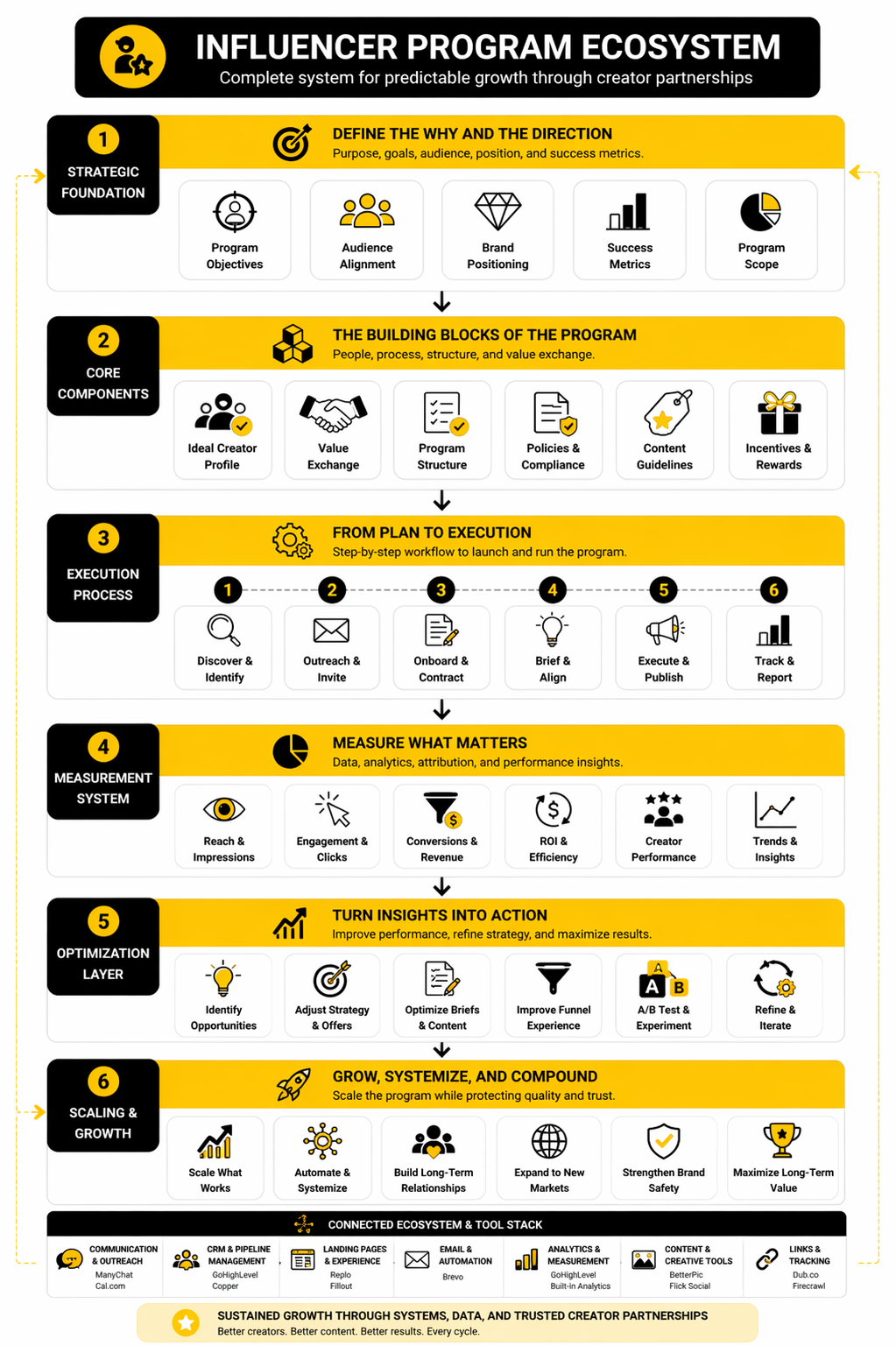
The easiest way to understand the model is to break it into four connected layers. The first is strategy, which defines the commercial purpose of the program and the category of creators you want to work with. The second is operations, which covers sourcing, outreach, contracts, compliance, briefing, approvals, and reporting. The third is content, where creator output is turned into assets that can live beyond a single post. The fourth is measurement, where the team decides what counts as success and how those results influence the next wave of creator decisions.
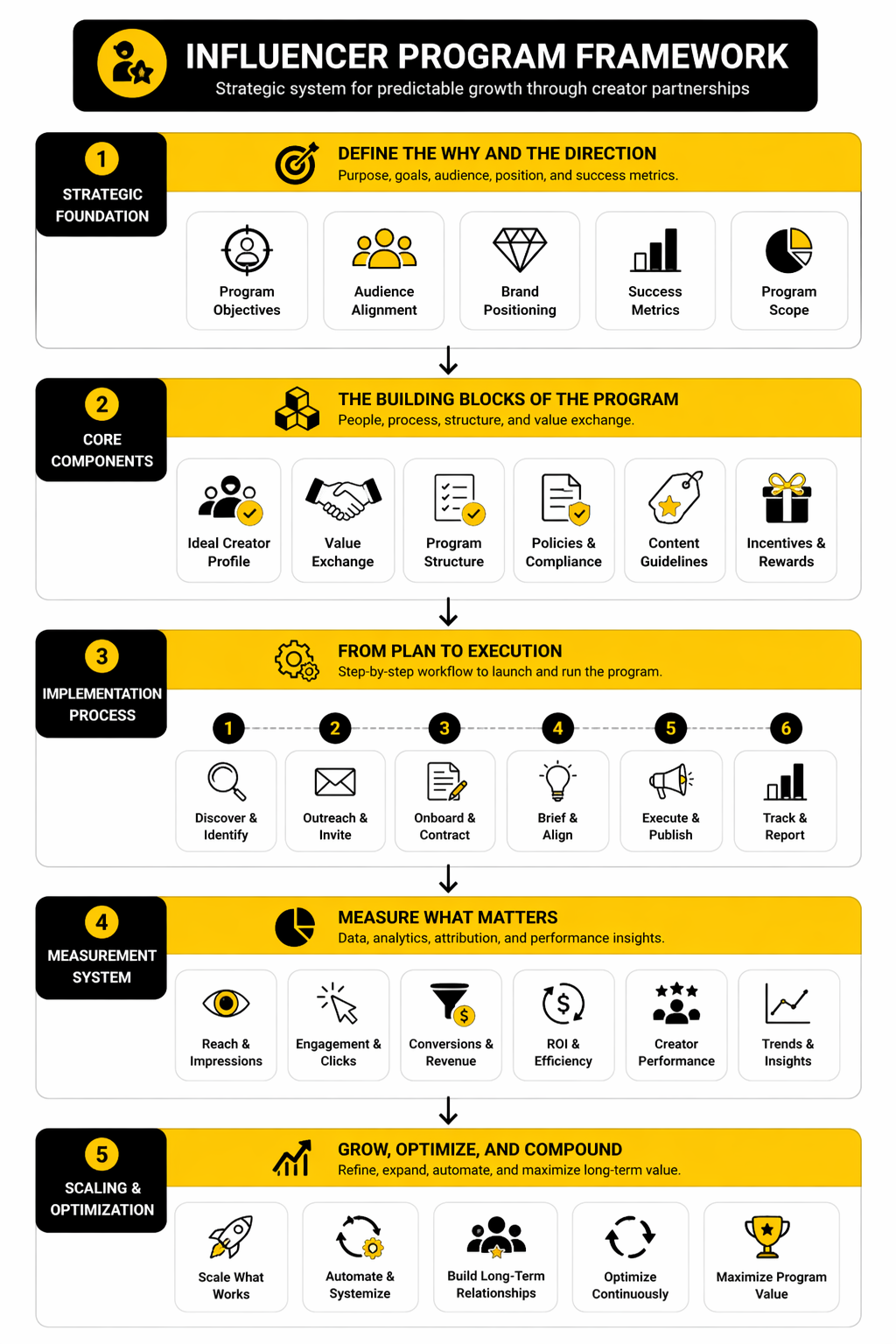
That framework matters because it prevents the most common mistake in creator marketing: overvaluing discovery and undervaluing infrastructure. Most brands spend too much energy asking how to find influencers and not enough asking how to make the relationships repeatable, measurable, and commercially useful. The best influencer program is rarely the one with the flashiest roster. It is the one with the clearest rules, the best fit between creator and offer, and the discipline to turn creator output into a repeatable growth asset.
The Operating Model Behind a Scalable Program
A scalable influencer program runs on process long before it runs on personality. That sounds less exciting than talking about creators, but it is the reason some brands can manage dozens or hundreds of partnerships without chaos while others fall apart after five deals and a spreadsheet. The job is not just to recruit creators. The job is to build a system that keeps quality high, compliance tight, timelines realistic, and performance visible.
This is where a lot of brands get stuck. They think they need better creator discovery when the real problem is that the program has no operating model underneath it. The newest market data keeps pointing in that direction, with CreatorIQ showing measurement, speed, and risk management sitting near the center of how mature teams think about creator programs now, not just reach or engagement (CreatorIQ’s 2025–2026 report). If you want an influencer program that survives budget reviews, leadership changes, and platform shifts, you need infrastructure.
Start With One Commercial Objective
Every influencer program needs a primary job. Not ten jobs. One main job. It can support other outcomes, but the team has to know whether the program is primarily being built to drive awareness, generate conversion-ready content, acquire customers, support retail sell-through, strengthen community, or improve retention and advocacy.
That sounds obvious, but confusion here poisons everything downstream. If leadership wants sales, the social team wants reach, and the brand team wants prestige, the creator brief becomes vague and the reporting becomes political. The stronger play is to pick the main commercial objective first, then define secondary benefits as bonuses rather than pretending every creator activation should do everything at once.
This also helps you choose the right creator mix. The evidence base around influencer effectiveness has become much clearer here. A large meta-analysis covering 1,531 effect sizes across 251 papers found that different factors influence different outcomes, which means the creator who helps drive engagement is not always the creator who helps drive sales. That is exactly why a serious influencer program starts with outcome design instead of follower counts.
Build the Program Around Four Operational Layers
Once the main objective is clear, the influencer program needs four layers working together: strategy, sourcing, execution, and measurement. Strategy decides who the program is for and what business problem it is supposed to solve. Sourcing decides which creators are actually a fit and what role each one plays. Execution handles briefing, contracting, content workflow, legal review, approvals, publishing, rights, and distribution. Measurement closes the loop so the next wave of creator decisions gets smarter instead of louder.
Most weak programs skip at least one of those layers. They often have enough strategy to sound good in a deck and enough sourcing to sign people, but almost nothing between “creator said yes” and “now prove it worked.” That gap becomes expensive fast because the same friction keeps repeating every month: missed deadlines, awkward briefs, poor usage rights, unclear disclosures, and no agreement on success.
The teams that scale usually document this operating model early. They define who owns creator outreach, who signs off on compliance, how briefs are approved, what content rights are needed, what counts as on-time delivery, and which metrics get reviewed weekly versus monthly. It is not glamorous work, but it is what turns creator marketing into a dependable channel.
Treat Creator Fit as a Filtering System, Not a Vibe Check
A strong influencer program does not ask, “Is this creator cool?” It asks whether the creator fits the audience, the product, the channel, the claim, the visual language, and the goal of the campaign. That sounds stricter, and it should be. The more mature the program gets, the more dangerous it becomes to choose creators based on instinct alone.
Recent research on authenticity reinforces this. New work in the Journal of Marketing shows that brands, agencies, creators, and audiences often define authenticity differently, and those misalignments can quietly weaken performance if they are not managed on purpose (the 2025 study on influencer authenticity). In plain English, a creator can look like a fit from the brand’s side while feeling wrong to the audience that actually matters.
That is why creator fit should be scored, not just discussed. A practical system usually looks at audience relevance, historical content alignment, tone, platform strength, prior sponsorship behavior, production style, brand safety, and whether the creator can speak credibly about the product category. The tighter this filter is, the less time the team wastes managing partnerships that never had a real chance.
Create a Workflow That Protects Speed and Trust
Speed matters in creator marketing, but uncontrolled speed wrecks trust. If a brand over-scripts the content, the post feels like an ad wearing a creator costume. If the brand gives no structure at all, the result can drift off-message, miss legal requirements, or make claims the product cannot support. A scalable influencer program solves that tension by being clear about non-negotiables and flexible about everything else.
The best briefs usually define the problem, the audience, the product truth, the required disclosures, and the boundaries around claims. Then they leave room for the creator to translate that into their own voice. That approach is not just good creative practice. It is increasingly essential because disclosure and endorsement rules are not optional, and the FTC continues to make that clear in its guidance on endorsements, influencers, and reviews.
Operationally, this means the workflow should be designed for controlled freedom. The brand needs templates for outreach, briefs, contracts, approvals, disclosure requirements, performance reporting, and asset handoff. It also helps to centralize creator communication and follow-up so messages do not get buried across scattered inboxes, which is exactly where tools built for conversation flows and lead handling can help, including ManyChat for creator-facing communication paths and GoHighLevel when the program also needs CRM, attribution, and follow-up in one place.
Plan Content Reuse Before the First Post Goes Live
This is one of the biggest differences between a basic campaign and a real influencer program. A basic campaign pays for a post. A real program pays for content, trust, distribution, learning, and reuse. If the team waits until after a creator publishes to think about paid amplification, landing pages, email, sales collateral, or retargeting assets, it is already leaving value on the table.
That is one reason creator marketing budgets have become easier to defend. CreatorIQ’s latest report says 94% of organizations report that creator content drives more ROI than traditional digital advertising, and the report directly ties stronger returns to extending creator content beyond social and lowering content production costs across other channels. That is not a small detail. It is the compounding logic behind the whole system.
The same pattern shows up in platform research too. Kantar’s 2025 study for YouTube found that combining creator work with brand advertising improved aided awareness and long-term brand equity compared with brand ads alone (Kantar’s YouTube creator study). So the question is not whether content should be reused. The question is whether your contracts, workflows, and creative planning are built to make reuse easy.
Make Reporting Useful Enough to Change the Next Decision
The dirty secret in a lot of influencer reporting is that it looks polished but changes nothing. Teams pull together reach, views, engagement, clicks, coupon redemptions, maybe some sales, and call it a wrap. The problem is that this rarely tells you which creators to deepen, which formats to repeat, which claims resonated, or how creator content performed once it moved into paid and owned channels.
A better influencer program uses reporting to make decisions, not just summarize activity. That means separating creator-level diagnostics from program-level business outcomes. At the creator level, you care about content quality, audience response, posting reliability, comment sentiment, CTR, conversion contribution, and whether the creator’s assets are strong enough for repurposing. At the program level, you care about blended CAC impact, content production efficiency, incremental lift, assisted revenue, and how creator assets perform compared with brand-made creative.
This shift is overdue. CreatorIQ’s research shows that performance measurement is still one of the most persistent challenges in creator marketing, even as budgets mature (the 2025–2026 State of Creator Marketing report). That is why the winning teams build reporting around the next operational question: keep, cut, expand, repurpose, or redesign.
Recruiting Creators Who Can Move the Needle
Once the operating model is in place, recruiting gets much easier because the team knows what it is hiring for. Without that structure, creator recruitment turns into a scavenger hunt for people with good aesthetics and decent engagement. With structure, it becomes a disciplined selection process tied to commercial outcomes.
That distinction matters more now because brands are not only spending more. They are professionalizing the function. Linqia’s 2025 enterprise survey found that 42% of brands running influencer marketing had dedicated influencer teams, which is a useful sign that creator recruitment is becoming a specialist process rather than a casual side task inside social media. Once a company has a real team, leadership expects repeatability.
The next step is to stop treating creator size as the main filter. Reach still matters, but it is not the clean predictor many marketers hoped it would be. The purchase behavior is real, with Sprout Social reporting that 49% of consumers make purchases at least monthly because of influencer posts, but that does not mean the biggest creator is always the best bet. The strongest influencer program recruits creators whose audience, format, trust level, and content behavior match the actual job to be done.
Look Past Follower Counts and Into Buying Context
The strongest influencer program does not begin with audience size. It begins with audience relevance, creator behavior, and whether the creator can credibly close the gap between discovery and action. That is a more demanding standard, but it is the one that protects budget when leadership starts asking what the program actually changed.
This matters because the market has matured enough to expose lazy selection. Kantar’s recent creator research found that creator-led content can drive stronger brand distinction and stronger performance when the creator’s voice feels authentic to the audience, not just visible in the feed (Kantar marketing trends 2025). The implication is pretty clear: an influencer program gets stronger when creator selection is based on fit and commercial role, not social status.
That is also why the creator shortlist should be built around use case. Some creators are better at product education. Some are better at social proof. Some are better at short-form hooks that can later become paid creative. Some are better at trust transfer in niche categories where expertise matters more than entertainment. If you skip that distinction, the program starts optimizing for appearances instead of outcomes.
Build a Recruitment Pipeline Instead of Hunting One Creator at a Time
A lot of teams still recruit creators like they are filling one urgent slot. They search manually, message a few people, wait too long, lose momentum, and then restart the same process next month. That is not an influencer program. That is a repeated scramble.
A better setup treats recruitment like pipeline management. You build a target list, sort creators by fit and role, segment them by campaign type, and keep notes on responsiveness, content quality, pricing, reliability, and audience match. The teams that do this well are not just looking for creators who can post. They are building a bench of creators they can activate again.
This shift is becoming more normal as the function professionalizes. Linqia’s 2025 data showed that 42% of brands running influencer marketing had dedicated influencer teams, which tells you something important: mature programs are no longer improvising creator sourcing from scratch every time. They are managing it like a recurring operating function with historical data and clear internal criteria.
A practical recruitment pipeline usually includes three buckets:
- Priority creators who already look like strong brand fits and could become recurring partners
- Test creators who are promising but still need proof on conversion, content quality, or professionalism
- Specialist creators who may not be broad ambassadors but can unlock specific launches, niches, or formats
That structure makes the influencer program more resilient. When one creator declines, underdelivers, or becomes unavailable, the program does not stall. It simply moves to the next strong fit already sitting inside the system.
Run Outreach Like an Operator, Not a Fan
Outreach is where a lot of otherwise smart programs get weirdly weak. Brands either overdo it with generic corporate language or underdo it with vague DMs that sound like they were sent to fifty creators in ten minutes. Neither works well for long, especially as creators become more selective about which partnerships deserve their audience’s trust.
Good outreach is specific, brief, and grounded in the creator’s actual work. It explains why the brand is reaching out, what kind of collaboration is in mind, what the product fit is, and what the creator can expect next if they are interested. That is not about being polished for the sake of it. It is about showing respect for the creator’s business and reducing friction in the first reply.
The stronger influencer program usually standardizes this without making it robotic. It creates repeatable templates for first contact, follow-up, qualification, and handoff, then adjusts the message enough to prove the team actually understands the creator’s content. If you need better structure around communication, scheduling, and lead-style follow-up, tools like ManyChat, Cal.com, and Copper can help keep creator conversations from turning into inbox chaos.
There is another reason this matters. Creators are not just evaluating the product. They are evaluating the brand’s process. Slow replies, fuzzy expectations, unclear approvals, and awkward payment conversations all signal that the partnership could become a headache later. In practice, the quality of outreach often predicts the quality of the eventual execution.
Turn Creator Selection Into a Repeatable Launch Process
Once creators start replying, the influencer program needs to move from relationship mode into execution mode without killing momentum. This is where brands either become easier to work with than their competitors or quietly lose great creators before the first post ever goes live. The best programs feel organized from the creator side because the internal process is already settled before the outreach starts.
A repeatable launch process should answer a few questions immediately. What is the campaign goal. What deliverables are being requested. What is the timeline. What can and cannot be said. What usage rights does the brand need. How will the creator be paid. And what counts as approval versus optional feedback. If those answers are fuzzy, the friction will show up somewhere else.
This is also where program maturity becomes visible. CreatorIQ’s current market view puts speed, measurement, and brand safety near the center of creator marketing maturity because those are the pressure points that determine whether creator activity scales cleanly or keeps breaking under volume (CreatorIQ’s 2025–2026 report). A serious influencer program turns those pressure points into explicit process steps instead of hoping smart people will figure them out on the fly.
A Simple Implementation Sequence That Actually Works
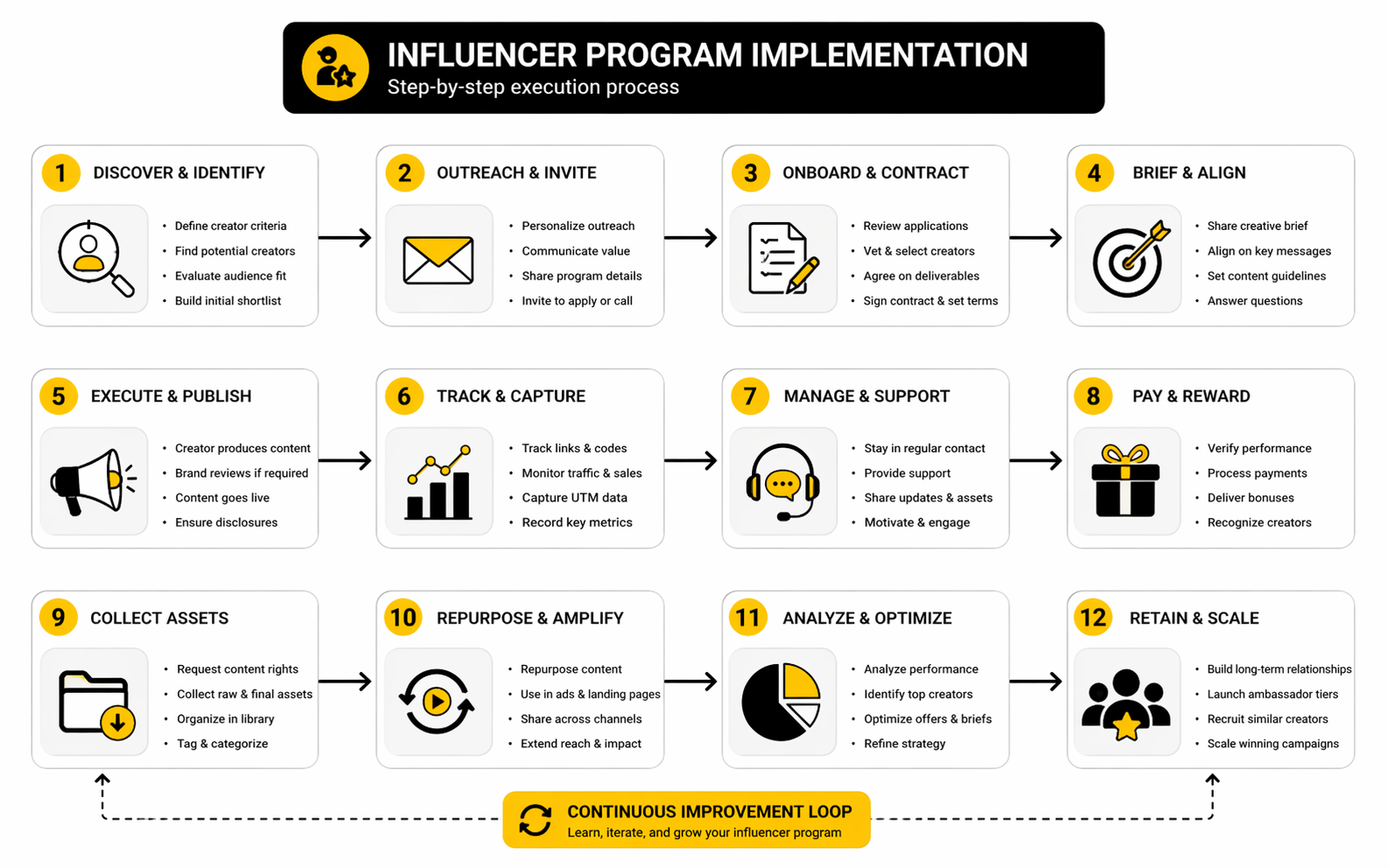
The easiest way to keep execution tight is to reduce it to a sequence the whole team understands. That sequence does not need to be complicated. It needs to be consistent. Once the same steps repeat often enough, the influencer program becomes faster without becoming sloppy.
- Qualify the creator
Review audience relevance, content style, prior sponsorship behavior, likely compliance risk, and whether the creator’s format matches the campaign objective. This is the point where you also decide whether the creator belongs in a test tier, a recurring partner tier, or a specialist one-off role. Doing this before negotiation saves time and avoids emotional decision-making later.
- Confirm the commercial fit
Align on goals, deliverables, timeline, compensation, and whether the brand needs usage rights beyond the original organic post. This step matters more than people think because content reuse is often where the best returns come from. Kantar’s current YouTube creator research shows that creators can strengthen results across the funnel when their work is paired with broader brand advertising, which only happens when reuse and distribution are planned early (Kantar’s 2026 creator study).
- Send a brief that protects the essentials
A good brief does not try to write the post for the creator. It defines the audience, the problem, the product truth, the mandatory disclosure requirements, and the claims the creator cannot go beyond. That balance is important because rigid scripting kills credibility, while loose guidance creates avoidable legal and messaging risk.
- Review content against standards, not preferences
Approval should focus on accuracy, compliance, disclosure, brand safety, and whether the content still serves the campaign objective. It should not turn into endless subjective edits from people who simply want the creator to sound more like the brand. The moment the creator’s voice disappears, the post usually gets weaker.
- Publish, capture assets, and route data back into the system
Once content is live, the job is not done. The team should save approved assets, log performance, preserve proof of disclosure, and tag content that is strong enough for landing pages, email, retargeting, or paid amplification. This is where the influencer program stops being a campaign machine and starts becoming a content engine.
That sequence works because it makes execution tangible. Everyone knows where a creator sits in the pipeline, which decision comes next, and what “ready to launch” actually means. The result is not just better organization. It is higher odds that the content still feels human by the time it goes live.
Get Contracts, Rights, and Disclosure Straight Early
This part is boring until it is expensive. Rights, disclosure, exclusivity, payment terms, and claim boundaries should be settled before content production starts, not after everyone is already emotionally invested in getting the post out. When those basics are left vague, the influencer program becomes fragile fast.
Disclosure is the obvious legal layer. The FTC’s live guidance on endorsements, influencers, and reviews is blunt about material connections needing to be clear and easy to understand, and that applies whether the creator was paid in money, products, discounts, or any other benefit. Brands do not get to outsource that responsibility to the creator and pretend it is someone else’s problem.
Usage rights are the commercial layer, and they are just as important. If the brand plans to reuse creator assets on landing pages, paid social, email, or product pages, that should be discussed explicitly. This is one of the most common weak spots in an influencer program because teams suddenly realize the highest-performing piece of creator content cannot legally be repurposed the way they wanted.
That is why implementation should include a formal asset path after publication. High-performing creator content should move into a clear review queue for reuse, testing, and distribution. If the program is also routing creator-driven traffic into dedicated campaign pages or offer stacks, tools like Replo, Fillout, and GoHighLevel can make the handoff from creator content to conversion path much cleaner.
Build an Internal System That Makes the Program Easier to Scale
The external side of an influencer program gets the attention because creators are public-facing. The internal side is where the leverage really comes from. If the team cannot find briefs, track contracts, log creator history, route assets, or compare campaign outcomes across months, then every new activation starts to feel harder than the last one.
A better approach is to create one internal source of truth. That usually includes creator profiles, contact history, pricing notes, approved assets, disclosure records, usage rights, performance summaries, and next-step recommendations. It does not need to be overengineered. It just needs to be stable enough that the next campaign benefits from the last one.
This is also where a lot of hidden waste disappears. Mature teams do not only save time. They make better decisions because prior learnings are visible instead of trapped in chat threads and personal inboxes. When the influencer program starts remembering what worked, who delivered well, which assets converted, and where the bottlenecks keep showing up, scaling becomes a process problem you can solve rather than a stress problem you just absorb.
Measuring Performance Without Hiding Behind Vanity Metrics
This is where an influencer program either becomes a real growth channel or stays stuck as a reporting theater project. A lot of teams still present nice-looking dashboards full of reach, impressions, likes, and views, then quietly avoid the harder question: what did any of that change. If the data does not help you decide who to keep, what to scale, what to repurpose, and what to cut, the measurement system is not doing its job.
The shift happening across creator marketing is not subtle anymore. CreatorIQ’s current market data shows that 94% of organizations say creator content drives more ROI than traditional digital advertising, but that number only matters if the team can explain where the return came from and how it should influence the next campaign. Otherwise it becomes another comforting statistic people repeat in decks without changing the operating model.
The same logic applies to spend growth. IAB’s latest creator economy outlook projected creator economy ad spend at $37 billion in 2025, which tells you brands are taking the channel seriously at scale. But bigger budgets do not automatically mean better measurement. They usually make weak measurement more expensive.
The Numbers That Matter Most
A strong influencer program tracks performance across four layers: attention, engagement, action, and business impact. Attention tells you whether the content was even seen. Engagement tells you whether people reacted enough to signal interest. Action tells you whether viewers clicked, saved, searched, replied, visited, or used a code. Business impact tells you whether any of that translated into revenue, stronger conversion assets, lower content production costs, or better downstream media performance.
That layered view matters because no single metric explains creator performance well enough on its own. Socialinsider’s latest benchmark data puts TikTok average engagement at 3.70% and Instagram average engagement at 0.48% in 2025, but those platform averages are not instructions. They are context. A post can beat the platform average and still be commercially weak if it never drives clicks, product interest, or usable content for other channels.
This is exactly why engagement should be treated as a diagnostic metric, not a victory metric. If engagement is strong, it tells you the creative probably landed. If engagement is weak, it may signal poor hook quality, wrong creator fit, weak audience alignment, or bad timing. But engagement by itself does not tell you whether the influencer program moved people closer to buying.
What Good Analytics Looks Like in Practice
A useful analytics system does not start at the dashboard. It starts before the campaign launches, when the team defines what each creator is actually supposed to do. One creator may be there to generate strong top-of-funnel social proof. Another may be there to produce paid-social-ready assets. Another may be there to drive direct clicks to a product page. If those roles are not clear before posting, the reporting will be messy after posting.
That is why the best influencer program dashboards separate creator role from creator result. They do not judge every creator by the exact same standard. A conversion-focused creator should be read differently from a credibility-focused niche expert, and both should be read differently from a creator whose main value is producing adaptable content that the brand can reuse across landing pages, retargeting, and lifecycle email.
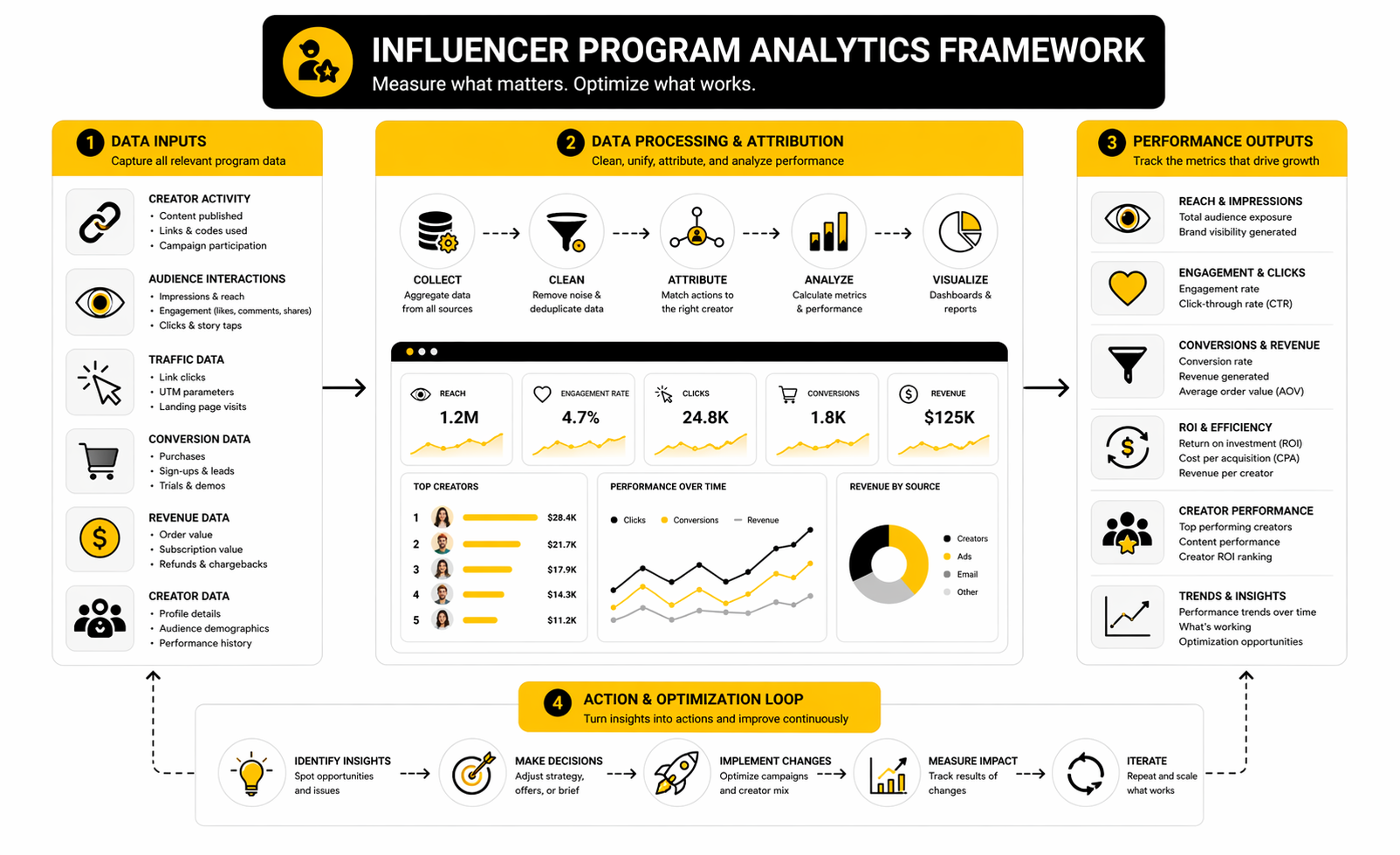
A clean measurement stack usually answers five questions in order:
- Did the content earn real attention
This is where reach, impressions, view rate, watch time, and thumb-stopping performance matter. These metrics help explain whether the creative package and creator match were strong enough to win attention in the feed.
- Did the audience care enough to react
Here you look at saves, shares, comments, engagement rate, click behavior, and sentiment. These are signals of resonance, but not yet proof of commercial value.
- Did the audience take the intended next step
This is where clicks, code usage, affiliate sales, lead form completions, site sessions, product page depth, and assisted conversions start to matter. If your influencer program has no clean path from content to action, you are making measurement harder than it needs to be.
- Did the content create reusable business assets
Some creator posts fail as direct response but still become great paid ads, landing page sections, email creative, or testimonial-like social proof. That should be tracked because it changes the true return profile of the program.
- What should change next
This is the real output of analytics. Keep this creator, change the brief, shorten the video, shift the landing page, negotiate broader usage rights, or stop spending on this format. Measurement is only useful when it leads to a next move.
That final point is the one most teams miss. They collect campaign data as if reporting were the end of the process, when it should really be the beginning of the next decision cycle.
Benchmark Data Is Only Useful When You Read It Properly
Benchmarks are helpful, but they get misused constantly. Teams love external averages because they make performance feel comparable, yet averages can hide more than they reveal. A niche B2B creator, a beauty creator on TikTok Shop, and a lifestyle creator posting for awareness should not be judged against the same expectations.
Still, benchmarks can help you avoid obvious mistakes. CreatorIQ’s benchmarking tools are built on data from more than 1 million creators and 20,000 brands across 15 key metrics, which is useful not because it gives you one perfect target but because it helps you set smarter performance ranges by industry, region, and channel. The action this should drive is simple: build internal benchmarks first, then pressure-test them against external market data so you know whether underperformance is a program problem or just a category norm.
The same caution applies to broad purchase-influence statistics. Sprout Social’s research found that 49% of consumers make purchases at least monthly because of influencer posts, which is strong evidence that creator influence is commercially real. But it does not mean every creator campaign should be judged as a direct sales campaign. The number matters because it validates the channel, not because it replaces campaign-specific measurement.
A better way to use benchmark data is to ask three harder questions. Are we outperforming our own history. Are we outperforming realistic peers in our category. And are the best-performing creators driving value in the same way, or are there multiple success patterns worth scaling. That is how data starts shaping strategy instead of decorating reports.
Watch Time, Saves, and Search Lift Usually Tell You More Than Likes
As creator programs mature, the most useful signals often become less obvious. Likes are fast and visible, which is why people obsess over them. But in many cases, watch time, saves, shares, comment quality, search lift, and click behavior tell you more about whether the content actually changed intent.
That shift is becoming more visible in current measurement thinking. Zeno’s recent creator benchmark work argues that watch time and deeper attention signals matter more than surface-level views alone, which lines up with what a lot of practitioners have been seeing in the field for a while. If people technically saw the content but dropped off before the real product message landed, the influencer program did not create much value.
Saves and shares are similar. They often signal that the audience found the content useful enough to keep or pass on, which usually means the creative carried more substance than a quick reaction post. Search lift matters too because some creator content does not convert in the same session, but it does push people into branded search, product research, and later purchase behavior.
That means the action should be practical, not philosophical. If likes are decent but watch time is weak, fix the opening and pacing. If reach is fine but clicks are poor, fix the offer or landing experience. If comments are strong but code usage is flat, check whether the influencer program is creating interest that the funnel is failing to capture.
Measure the Post, the Asset, and the System Separately
This is a big one. A lot of influencer reporting mixes together three different things and then wonders why the conclusions feel muddy. The first thing to measure is the post itself. Did that specific piece of content perform well on the platform where it was published. The second thing to measure is the asset. Did the content become useful beyond the original post. The third thing to measure is the system. Is the overall influencer program getting smarter, more efficient, and more profitable over time.
Once you split measurement that way, the analysis gets much cleaner. A post can underperform publicly but still produce a high-quality video asset the brand can reuse on a landing page built in Replo, in follow-up email inside Brevo, or inside a wider CRM and attribution flow in GoHighLevel. If you only judge the public post, you miss a chunk of the return.
System-level measurement is what lets the program compound. You want to know whether onboarding is getting faster, whether the hit rate on creator selection is improving, whether reused creator content lowers production costs, and whether the share of creators worth rebooking is rising. Those are boring metrics to people who want a flashy dashboard, but they are exactly the metrics that reveal whether the influencer program is actually becoming more valuable.
The Right Response to Data Is Usually Operational
The best analytics do not end in vague observations. They end in specific operational changes. If creators with narrower audience focus consistently outperform broad lifestyle creators, tighten your sourcing criteria. If short-form educational demos outperform polished brand-heavy scripts, rewrite the brief. If creator content drives strong click-through but weak conversion, fix the page, not the creator.
That is also why measurement cannot sit in isolation from execution. The teams that improve fastest are the ones routing performance learnings back into creator selection, briefing, content format, offer structure, rights negotiation, and post-campaign reuse. The influencer program gets better because the system learns, not because the team keeps collecting more charts.
And one last point matters more than people admit. Clean data also protects trust. The FTC’s current enforcement posture around endorsements, influencers, and reviews and its rule banning fake reviews and testimonials make it very clear that brands should not confuse inflated, misleading, or poorly disclosed activity with real performance. If the numbers look great but the underlying practice is deceptive, that is not optimization. That is a liability.
The smartest move is to build a measurement culture that values signal over spectacle. That means tracking what people did, what the content became, what the funnel captured, and what the team should do differently next time. Once an influencer program reaches that level of discipline, the data stops being a scoreboard and starts becoming a real operating advantage.
Scaling the Program Without Losing Trust
Scaling an influencer program sounds great in planning meetings because growth feels like proof the system works. But scale changes the nature of the challenge. The problem stops being how to launch creator partnerships and becomes how to protect quality, trust, and commercial discipline while volume goes up.
That shift matters because bigger creator programs create new failure points. More creators mean more approvals, more contracts, more disclosure exposure, more brand safety risk, more audience mismatch risk, and more pressure to standardize without making the work feel generic. CreatorIQ’s 2025–2026 market report puts brand safety, governance, and suitability right at the center of mature creator programs, which makes sense because once investment grows, loose operations stop being a small inefficiency and start becoming a strategic liability (CreatorIQ’s 2025–2026 report).
The key tradeoff is simple but brutal. The more you systemize, the easier the program becomes to manage. The more you systemize carelessly, the easier it becomes to drain the creator’s voice out of the content. A strong influencer program scales with tighter decision-making, not heavier creative control.
Long-Term Partnerships Beat Constant Replacement
One of the clearest signs of maturity is that the influencer program stops treating creators like interchangeable ad inventory. The market is moving toward longer relationships because repeated exposure usually builds stronger credibility, gives the creator more context, and reduces onboarding waste for the brand. That does not mean every creator should become a long-term partner, but it does mean the best ones should not be forced back into one-off deal mode every single time.
That trend keeps showing up across current industry research. Multiple 2025 and 2026 market reports point to long-term creator relationships as a major shift because brands want more predictable performance, stronger trust signals, and better reuse of creator insights and assets (impact.com’s 2026 performance trends, Modash’s 2026 trends, and the 2025 influencer marketing report). The action this should drive is straightforward: stop measuring creators only campaign by campaign and start tracking whether they are getting more effective over time.
There is also a financial reason to care. Every new creator relationship comes with search costs, outreach costs, review time, negotiation time, legal time, and learning time. If a creator already understands the product, the audience response is strong, and the assets are reusable, the influencer program usually gets more leverage from deepening the relationship than from constantly restarting with unknown people.
Standardize the System, Not the Creative
This is one of the hardest balancing acts in creator marketing. Brands need repeatable workflows if they want the influencer program to scale beyond a handful of partnerships. But the moment every brief, format, and edit request starts sounding identical, the content loses the exact quality that made creator marketing valuable in the first place.
The right move is to standardize the operational skeleton while keeping the creative muscle flexible. Standardize qualification, contract templates, disclosure rules, usage-rights logic, reporting structures, and review steps. Do not standardize the creator’s phrasing, emotional rhythm, storytelling style, or natural point of view unless the content is drifting into inaccuracy or legal risk.
This matters even more now because authenticity is under heavier scrutiny. Recent research in the Journal of Marketing shows that audiences, creators, agencies, and brands often disagree on what authenticity actually looks like, which creates tension right where partnerships are supposed to feel most natural (the 2025 authenticity study). The practical takeaway is not to chase some vague authenticity slogan. It is to avoid operational behaviors that obviously kill authenticity, like overwriting scripts, forcing unnatural claims, or pushing creators into content formats that do not match their normal audience expectations.
Fraud, Fake Signals, and Synthetic Influence Are Real Risks
As budgets grow, weak signals attract money, and weak signals can be manufactured. That is not a niche issue anymore. Fraud in creator marketing now includes fake followers, purchased engagement, inflated views, engagement pods, and increasingly messy questions around AI-generated identities and synthetic content. A serious influencer program has to assume these risks exist and build verification into sourcing, not bolt it on later after budget has already been spent.
The regulatory side has become sharper too. The FTC’s rule against fake reviews and testimonials explicitly covers deceptive practices tied to fake indicators of social media influence, including fabricated followers or views, and it gives the agency more power to seek penalties against knowing violators (FTC final rule announcement, FTC business guidance, and Reuters coverage of the rule). That means fake influence is not just a bad spend decision. It can become a compliance problem.
The operational response should be disciplined. Review audience quality, not just total audience size. Look for odd growth spikes, shallow comment patterns, inflated engagement disconnected from actual audience conversation, and account histories that suggest audience manipulation. A mature influencer program assumes that verification is part of creator qualification the same way pricing and content fit are part of qualification.
Brand Safety Is Bigger Than Avoiding Obvious Scandals
A lot of teams still treat brand safety as a last-minute check for whether a creator posted something offensive. That is too narrow. In a modern influencer program, brand safety includes disclosure quality, product-claim accuracy, audience fit, contextual suitability, reputational alignment, and whether the creator’s content environment strengthens or weakens the brand’s position.
That broader framing is becoming more common because the risk landscape is more complex now than it was when creator marketing was treated like an experimental social tactic. Ogilvy’s 2026 influencer trends report is blunt that creator investment now comes with the need to manage and monitor risk much more closely, and that vanity-metric thinking is no longer enough when trust and ROI are under pressure (Ogilvy’s 2026 Influencer Trends report). Once you accept that, brand safety stops being a compliance footnote and becomes part of strategic design.
The action here is not to become paranoid. It is to create a risk framework with levels. Some creators are low-risk, recurring fits who need light-touch review. Some sit in medium-risk categories because the claims are sensitive, the category is regulated, or the creator’s tone can drift. Some should simply not be worth the management burden. The stronger influencer program is usually the one that knows the difference early.
The Funnel Around the Creator Matters More as the Program Scales
One reason some programs plateau is that the team gets better at creator activation but never improves the path after the post. That creates a ceiling. You can sign more creators and publish more content, but if the landing experience is weak, the follow-up is messy, and attribution is fragmented, the extra volume just creates more noise.
This is where expert-level thinking becomes practical. The influencer program should not be treated like an isolated channel. It should connect to the page experience, lead capture, nurture sequence, paid amplification, offer structure, and sales follow-up. Otherwise the program gets judged for conversion losses it did not create.
That is also why the tools around the creator matter. If creator traffic needs cleaner campaign pages, Replo can help turn high-performing content into faster landing-page tests. If the program needs better nurture, audience routing, and automation after the click, Brevo, ManyChat, and GoHighLevel can make the rest of the funnel much less fragile. That does not replace creator quality. It makes sure creator quality is not wasted.
International Scaling Creates New Complexity Fast
An influencer program that expands across markets often discovers that what looked scalable in one region was actually locally optimized. Audience humor changes. Disclosure norms shift. Platform strength varies by country. Product claims that feel straightforward in one market may trigger very different scrutiny in another.
This is one reason benchmarks and creator selection should be market-sensitive instead of global by default. CreatorIQ’s benchmark products are useful partly because they let brands compare by geography and industry, not just by platform average (CreatorIQ benchmarks). That should push teams toward region-aware planning rather than copying one creator model everywhere.
The strategic tradeoff here is between central control and local relevance. Centralization helps with governance, contracts, reporting, and brand consistency. Local flexibility helps with audience resonance, creator fit, and content realism. The strongest influencer program usually centralizes rules and measurement while decentralizing enough creative judgment to avoid cultural flattening.
The Best Programs Learn to Say No More Often
This sounds negative, but it is one of the clearest marks of maturity. Early-stage programs often feel pressure to say yes to more creators, more platforms, more campaigns, more deliverables, and more “quick tests” because activity feels like momentum. Mature programs get more selective because they know that every added partnership creates management cost and strategic drag.
Saying no protects focus. It protects creative standards. It protects measurement quality. And it protects the influencer program from turning into a chaotic content vending machine with no clear theory of value. Once the team knows which creators drive action, which formats create reusable assets, and which workflows preserve trust, selectivity becomes a performance advantage.
This is especially important in a market where everyone is trying to do more with creator budgets. The brands that win are not always the ones running the biggest roster. They are often the ones making sharper tradeoffs, building deeper creator relationships, and refusing to scale parts of the system that have not earned the right to expand. That discipline is what makes the difference between a creator strategy that looks busy and an influencer program that keeps compounding.
Bringing the Whole System Together
At this point, the shape of a strong influencer program should be clear. It is not just a creator list, a discount code, or a one-off sponsorship workflow. It is a system that connects strategy, recruiting, briefing, compliance, content reuse, measurement, and scaling so the channel gets sharper over time instead of more chaotic.
That is the real difference between brands that dabble and brands that build an advantage. The dabblers keep restarting from zero, which means they repeat the same sourcing mistakes, the same approval bottlenecks, and the same weak reporting habits. The operators build memory into the system, so every creator campaign improves the next one.
The market is rewarding that level of maturity. U.S. creator ad spend was projected to reach $37 billion in 2025, and that kind of money does not keep flowing into a channel because it looks trendy. It keeps flowing because brands are learning that a well-run influencer program can produce trust, content, conversion paths, and reusable assets at the same time.
FAQ - Built for Complete Guide
What is an influencer program in simple terms
An influencer program is a repeatable system for working with creators, not just a random series of paid posts. It includes how you select creators, how you brief them, how you handle disclosure and approvals, how you measure outcomes, and how you reuse the best content. If those pieces are missing, you probably do not have an influencer program yet. You just have occasional creator deals.
That distinction matters because the market has matured fast. CreatorIQ’s current research shows creator marketing is being treated more like an established business function, with stronger focus on governance, measurement, and strategic fit than in the early experimental phase (CreatorIQ’s 2025–2026 report). In practice, that means brands are expected to run creator partnerships with the same seriousness they bring to paid media, CRM, or lifecycle marketing.
How is an influencer program different from a one-off influencer campaign
A one-off campaign is usually built around a short-term deliverable. The brand wants a post, a video, a launch push, or a small burst of visibility, and once the content goes live the relationship often ends. An influencer program is designed to keep learning, which means the brand tracks creator fit, asset quality, performance patterns, and whether the relationship deserves to deepen over time.
That is why programs usually create better long-term economics. They reduce repeated onboarding, make creator selection smarter, and produce assets that can be reused across other channels. When brands talk about creator content outperforming traditional digital ads, a big part of that advantage often comes from system-level reuse and refinement, not just from a single post performing well.
Why are brands investing more heavily in influencer programs now
Because the channel is no longer being treated like a side experiment. IAB projected creator economy ad spend at $37 billion in 2025, which is a sign of structural growth, not a passing trend. That level of spend reflects the fact that creators now influence discovery, trust, purchase intent, and content production at the same time.
The consumer side supports that shift too. Sprout Social’s current research shows 86% of consumers make at least one influencer-inspired purchase each year, and 49% make purchases at least monthly because of influencer posts. The smart interpretation is not that every creator post will convert directly. It is that creator influence is commercially real enough that serious brands need a real operating model around it.
How do you know whether your brand actually needs an influencer program
If creator partnerships are going to be a recurring channel for your business, you need one. That is especially true if you want creators to support more than awareness, like content production, paid creative testing, landing pages, launches, or retention messaging. Once creators touch multiple parts of the funnel, ad hoc management starts to break down.
You may not need a large program at first, but you do need a clear process. The smallest viable version can still include qualification rules, contract basics, disclosure standards, asset rights, reporting logic, and a shortlist of creators worth testing. That foundation matters because scale punishes messy systems.
What are the most important metrics in an influencer program
The most important metrics are the ones that help you make the next decision. Reach, impressions, watch time, saves, shares, clicks, conversions, asset reuse, assisted revenue, and creator rebooking rate can all matter, but not every metric matters equally for every creator. The whole point is to match the metric to the creator’s role.
That is why a layered model works better than a vanity-metric model. Socialinsider’s recent benchmark data shows platform engagement averages vary sharply by network, with TikTok at 3.70% average engagement and Instagram at 0.48% in 2025, but those numbers are context, not verdicts. A strong influencer program reads engagement as a signal, then connects it to actions, asset value, and business results before deciding what to scale.
Should brands work with micro influencers or bigger creators
That depends on the job the creator is supposed to do. Micro influencers often bring stronger niche trust, tighter community fit, and more focused audience relevance. Larger creators can offer scale, faster awareness, and sometimes stronger cultural visibility, but they also tend to come with higher costs and looser audience alignment if the fit is not exact.
The mistake is thinking this is a simple either-or choice. A strong influencer program usually uses a mix based on campaign role, product category, and objective. The best answer is rarely “pick the biggest creator you can afford.” It is usually “pick the right creator for the exact commercial job you need done.”
How many creators should a brand start with
Fewer than most teams think. A lot of brands rush into volume because more creators feels like faster momentum, but early on that often creates noise instead of clarity. If you start with too many creators, you make it harder to understand whether weak results came from bad selection, bad briefing, bad offers, or bad measurement.
A better starting point is a controlled test group large enough to reveal patterns but small enough to manage properly. That gives the influencer program room to learn who delivers on time, who produces strong assets, who drives real action, and who only looks good in a spreadsheet. Once those patterns become visible, scale becomes much safer.
What makes creator briefs actually work
A strong brief tells the creator what must be true, not what every sentence should sound like. It should define the audience, the product truth, the campaign goal, the claim boundaries, the required disclosures, and the practical deliverables. That gives the creator structure without stripping out the voice that made the partnership valuable in the first place.
This matters more than ever because audiences are sensitive to scripted content that feels borrowed from a brand deck. Research on authenticity in influencer marketing shows that brands, creators, and audiences often see authenticity differently, which is exactly why over-controlling the creative can quietly undermine performance (the 2025 authenticity study). The best briefs protect accuracy and trust while leaving room for natural delivery.
How should brands handle disclosure and compliance
By treating it as a core operating rule, not an afterthought. If a creator was paid, gifted a product, offered a discount, or given any material benefit, the relationship needs to be disclosed clearly and understandably. Brands do not get to hand-wave this away just because the creator is the one posting.
The FTC’s guidance on endorsements, influencers, and reviews is clear, and the agency’s final rule on fake reviews and testimonials adds even more pressure against deceptive practices tied to social proof and fabricated influence (FTC final rule announcement). In practice, a strong influencer program builds disclosure language, review standards, and proof-of-compliance into the workflow from the beginning.
Is it better to pay creators a flat fee, commission, free product, or hybrid deal
There is no single best structure, because compensation should match the creator’s role, leverage, category, and risk. Flat fees make sense when the brand is paying for creative labor, access to audience attention, and predictable deliverables. Commission models can work well when attribution is clean and the creator is positioned to drive direct action, but they often underpay creators whose real value is trust and content quality rather than easy last-click conversions.
A hybrid model is often the smartest middle ground. It combines a base payment with incentives tied to performance, content reuse, or extended rights. That kind of arrangement usually makes the influencer program more attractive to creators and more accountable to the brand at the same time.
Can an influencer program work for B2B brands too
Yes, but it usually looks different from consumer creator marketing. B2B influencer programs often rely more on niche expertise, trust, credibility, and educational content than on broad entertainment or lifestyle appeal. The creator may be a consultant, practitioner, analyst, founder, operator, or respected voice inside a specific industry rather than a traditional social influencer.
That changes the creative style and the metrics, but not the core logic. The same principles still apply: strong fit, useful content, clean disclosure, clear rights, and measurement tied to actual business outcomes. In B2B, that may mean lead quality, demo interest, webinar performance, or sales-cycle influence instead of immediate ecommerce conversion.
How do you repurpose creator content without making it feel worn out
By planning reuse before the campaign launches, not after the content has already gone live. If the influencer program wants to turn creator assets into landing pages, email content, paid ads, nurture flows, or product-page social proof, those rights and workflows should be built into the agreement from day one. That keeps the brand from scrambling later when a strong asset appears.
The smarter move is to treat every creator asset as a potential multi-channel building block. A video that performs moderately well on social can still become a strong landing-page section in Replo, an effective follow-up sequence in Brevo, or a clean automation entry point in GoHighLevel. That is where the economics of a strong influencer program start compounding.
What are the biggest mistakes brands make with influencer programs
The biggest one is confusing activity with progress. Brands often chase more creators, more posts, more dashboards, and more surface-level metrics without improving creator fit, briefing quality, asset rights, funnel strength, or reporting discipline. That makes the program look busy while keeping the real system weak.
The second major mistake is over-controlling the content. The moment a brand tries to force every creator into the same tone, the creative loses the authenticity that made creator partnerships valuable in the first place. The strongest influencer program standardizes the process, not the voice.
How long does it take for an influencer program to become effective
Usually longer than one campaign and faster than many teams expect if the system is sound. Some creators will show clear traction quickly, especially when the offer is strong and the match is tight. But the deeper value of an influencer program comes from repeated learning, content reuse, and improving creator selection over time.
That means the right expectation is not instant perfection. It is progressive clarity. If the program is well-structured, each wave should improve your understanding of who performs, what creative formats travel, which assets deserve reuse, and where the funnel is leaking value.
What tools help an influencer program run better
The best tools are the ones that remove friction around communication, landing-page testing, attribution, CRM, and content reuse. For outreach and conversation flows, brands often benefit from systems like ManyChat. For scheduling and operational coordination, Cal.com can help simplify creator handoffs.
On the funnel side, tools like Replo, Brevo, and GoHighLevel help ensure creator-driven interest does not die on the way to conversion. The right stack depends on the business model, but the principle stays the same: the influencer program is only as strong as the system around the creator.
Work With Professionals
Explore 10K+ Remote Marketing Contracts on MarkeWork.com
Most marketers spend too much time chasing clients, competing on crowded platforms, and losing a percentage of every project to middlemen. MarkeWork gives you a better way. Browse thousands of remote marketing contracts and connect directly with companies desperate to hire skilled marketers like you, without platform commissions and without unnecessary gatekeepers.
If you're serious about finding better opportunities and keeping 100% of what you earn, explore available contracts and create a profile for free at MarkeWork.com.