

An instagram agency is no longer just a team that posts nice-looking content. Done properly, it connects strategy, creative, paid media, creator partnerships, community, analytics, and sales follow-up into one operating system.
That matters because Instagram is still one of the biggest commercial attention channels online. Instagram ads reached about 1.74 billion users in January 2025, and Meta reported that Reels watch time was up more than 30% year over year in the U.S. in Q4 2025 through its earnings call transcript. The opportunity is real, but so is the complexity.
Article Outline
- Why an Instagram Agency Matters
- The Instagram Agency Framework
- Core Services an Instagram Agency Should Offer
- How Professional Implementation Works
- How To Choose Or Build The Right Instagram Agency
- Instagram Agency FAQs And Final Recommendations
Why an Instagram Agency Matters
Instagram has become a discovery, trust, and conversion channel at the same time. People use it to find brands, compare options, watch proof, message businesses, and decide whether a company feels credible. That means weak Instagram execution does not just hurt engagement; it can quietly damage sales.
The best agencies understand that Instagram performance is not only about posting more. It is about creating a repeatable system where content, offers, audience research, paid distribution, and follow-up all support each other. For example, automated DM flows through tools like ManyChat can turn comments, story replies, and lead magnets into actual conversations instead of wasted engagement.
A serious instagram agency also protects the client from random tactics. Trends change fast, but the business still needs consistent positioning, clear reporting, and campaigns that connect to revenue. That is why this article treats Instagram as a business channel, not a content calendar.
The Instagram Agency Framework
A strong agency framework starts with strategy, then moves into execution. Strategy defines the audience, positioning, offer, content pillars, funnel path, and success metrics. Execution turns that strategy into creative production, posting, paid amplification, creator collaborations, community management, and reporting.
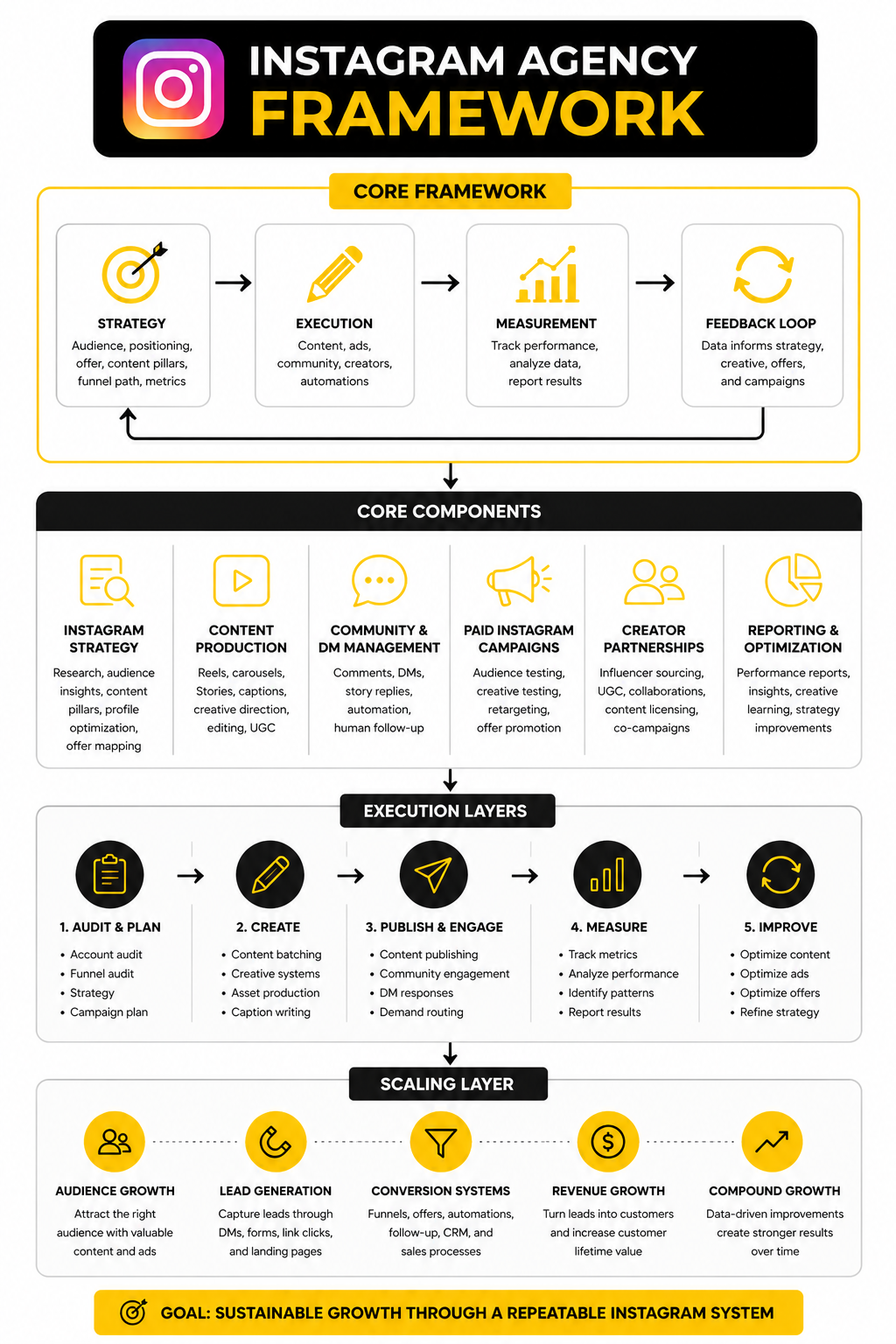
The framework also needs a feedback loop. Content data should inform creative decisions, ad results should inform offers, and customer conversations should inform future campaigns. Without that loop, the agency is guessing.
This is where professional implementation becomes important. A modern instagram agency may use scheduling tools like Buffer, CRM and automation platforms like GoHighLevel, landing page builders, analytics dashboards, and AI-assisted workflows. The tools do not replace strategy, but they make the system faster, cleaner, and easier to measure.
Core Services an Instagram Agency Should Offer
A capable instagram agency should start with positioning before it touches content. The team needs to understand who the brand serves, why people buy, what objections slow them down, and what proof already exists. Without that foundation, even polished content can feel empty.
Instagram Strategy
Strategy is where the agency turns business goals into a practical Instagram plan. That includes audience research, competitor review, content pillars, campaign themes, profile optimization, offer mapping, and measurement rules. This matters because social teams are under more pressure to prove impact, with 65% of leaders wanting social campaigns tied directly to business goals.
A good strategy also separates brand-building content from conversion content. Not every post should sell, but the account still needs clear paths toward leads, bookings, trials, purchases, or conversations. The agency’s job is to make that path obvious without making the brand sound desperate.
Content Production
Content production is usually the most visible service, but it should not be treated as the whole offer. An instagram agency may handle Reels, carousels, Stories, captions, creative direction, editing, UGC-style assets, and campaign shoots. The work should be built around repeatable creative systems, not random posts.
Reels deserve special attention because short-form video still drives a huge part of Instagram behavior. Meta said Instagram Reels watch time was up more than 30% year over year in the U.S. in Q4 2025 through its earnings call transcript. That does not mean every brand should chase every trend, but it does mean agencies need strong video judgment.
Community And DM Management
Community management is where many brands lose easy wins. Comments, Story replies, saved responses, mentions, and DMs are not just “engagement”; they are buyer signals. A good agency treats them as part of the customer journey.
This is especially important for lead generation and service businesses. When someone replies to a Story, comments on a post, or asks a product question, speed matters. Tools like ManyChat can help an instagram agency automate simple DM flows while still leaving room for real human follow-up.
Paid Instagram Campaigns
Organic content builds attention, but paid campaigns help scale what is already working. An agency should be able to test audiences, creative angles, placements, landing pages, and retargeting sequences. The best paid strategy starts with clear creative learning, not just budget increases.
Instagram ads also need strong post-click execution. If the ad sends traffic to a weak page, slow funnel, or unclear offer, the campaign will look worse than it really is. For agencies building funnels around Instagram traffic, platforms like ClickFunnels, Systeme.io, or GoHighLevel can make the campaign easier to track and improve.
Reporting And Optimization
Reporting should explain what happened, why it happened, and what changes next. Vanity metrics still have a place, but they cannot be the whole report. Reach, saves, shares, profile visits, link clicks, DMs, leads, sales, cost per result, and creative learnings all matter in different ways.
The point is not to drown the client in dashboards. The point is to make better decisions every month. A professional instagram agency should turn performance data into sharper content, better offers, cleaner funnels, and stronger campaigns.
How Professional Implementation Works
Professional implementation is where an instagram agency proves whether it has a real operating system or just a nice pitch deck. The work has to move from strategy into repeatable execution without losing the thinking behind it. That means every post, campaign, automation, and report should connect back to a specific business goal.
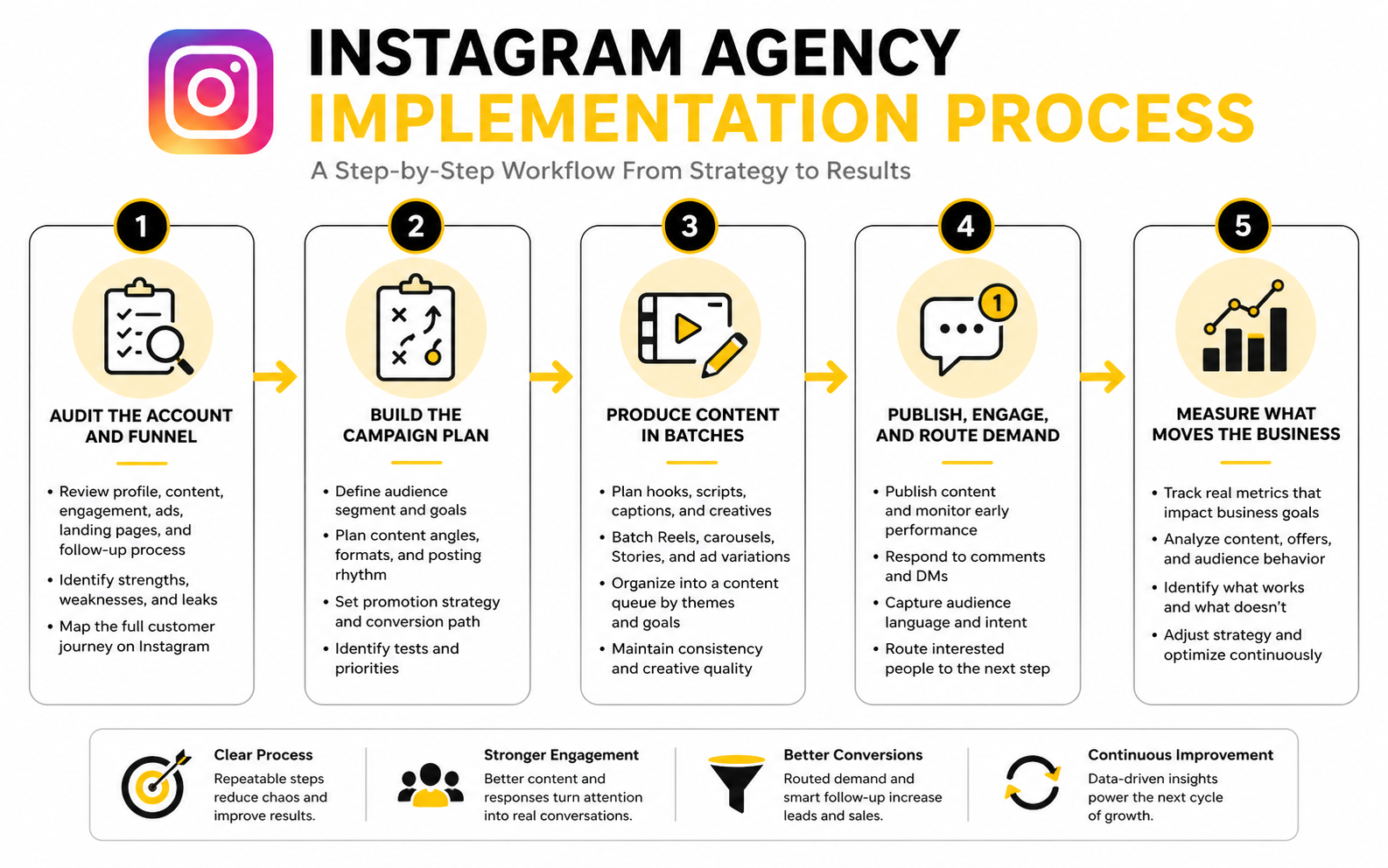
A strong process also reduces chaos for the client. Instead of chasing last-minute ideas every week, the agency runs a clear cycle: research, plan, produce, publish, engage, measure, and improve. That sounds simple, but it is exactly where most weak Instagram efforts fall apart.
Step 1: Audit The Account And Funnel
The first step is a practical audit of the Instagram account and the path people take after they engage. The agency should review the profile, bio, highlights, pinned posts, content mix, creative quality, engagement patterns, ad history, landing pages, and follow-up process. This gives everyone a clear picture of what is working, what is confusing, and what is leaking attention.
The funnel matters because Instagram rarely works in isolation. Someone may watch three Reels, tap the profile, read comments, click a link, visit a landing page, and then come back later through a retargeting ad or DM. If the agency only audits posts, it misses the bigger conversion journey.
Step 2: Build The Campaign Plan
After the audit, the instagram agency should turn findings into a campaign plan. This plan should define the audience segment, content angles, creative formats, publishing rhythm, promotion strategy, and conversion path. It should also clarify what will be tested first, because trying everything at once usually produces messy data.
The plan needs enough structure to keep the team aligned, but not so much that it kills creative momentum. Instagram changes fast, so the agency should leave room for timely content, creator ideas, customer questions, and new platform behavior. The goal is controlled flexibility.
Step 3: Produce Content In Batches
Batch production keeps Instagram execution from becoming a daily emergency. The agency can plan hooks, scripts, captions, carousels, short videos, Stories, and ad variations ahead of time, then organize them into a usable content queue. This creates consistency without forcing the brand to invent ideas from scratch every morning.
The best agencies do not batch generic content. They batch around specific themes, buyer objections, product moments, testimonials, launches, seasonal demand, and campaign goals. That is how the content stays strategic while still feeling natural in the feed.
Step 4: Publish, Engage, And Route Demand
Publishing is not the finish line. Once content goes live, the agency needs to watch early signals, respond to relevant engagement, save useful audience language, and route serious interest into the right next step. Comments and DMs are often where intent becomes visible.
This is why response systems matter. Social customer care has become a real buying factor, with Sprout’s 2025 Index reporting that 71% of social users would buy from a competitor if a brand does not respond to customer service questions. An instagram agency that ignores the inbox is leaving money and trust on the table.
Step 5: Measure What Actually Moves The Business
Measurement should go beyond likes and follower growth. Those numbers can show direction, but they do not tell the whole story. A useful report tracks reach, watch time, saves, shares, profile actions, clicks, DMs, leads, sales activity, cost per result, and creative patterns.
The real value is interpretation. If one content angle drives saves but no conversations, it may be useful for education but weak for conversion. If another angle gets fewer views but produces stronger DMs or booked calls, the agency should notice that and adjust the plan.
Statistics And Data
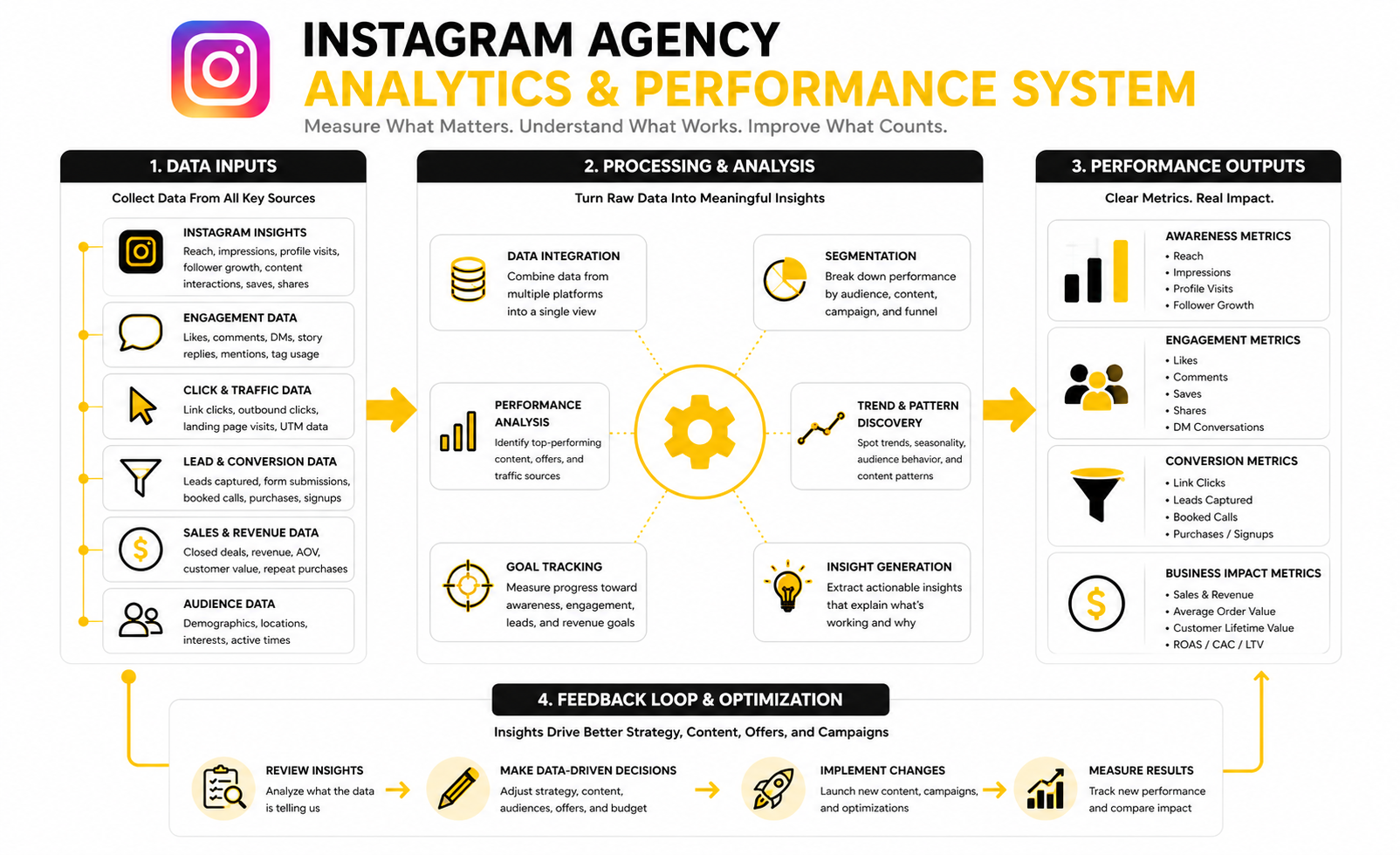
Data should make an instagram agency sharper, not slower. The point is not to collect every possible metric or build a report that looks impressive in a meeting. The point is to understand what the audience is doing, what the content is causing, and what the business should change next.
Instagram is still large enough to matter for most consumer, creator, local, ecommerce, and service brands. The platform’s ad reach was about 1.74 billion users in January 2025, which gives agencies a serious distribution opportunity. But reach alone does not prove performance, so the agency has to connect that attention to intent, trust, and revenue signals.
The Metrics That Actually Matter
The first layer is visibility. Reach, impressions, views, and watch time show whether content is getting distributed and whether people are staying with it. These numbers help an agency judge the strength of hooks, formats, topics, and creative packaging.
The second layer is engagement quality. Saves, shares, profile visits, replies, comments, and DMs usually tell you more than likes because they show stronger intent. A post that gets fewer likes but drives more profile visits or qualified messages may be more valuable than a viral post that attracts the wrong audience.
The third layer is business movement. Link clicks, booked calls, lead forms, purchases, email signups, trial starts, and pipeline activity show whether Instagram is supporting the commercial goal. This is where tools like GoHighLevel, ClickFunnels, or Systeme.io become useful because they help connect social activity to follow-up and conversion.
Benchmarks Are Starting Points, Not Targets
Benchmarks help an instagram agency understand whether an account is unusually strong, average, or underperforming. They are useful for context, especially when a client has no baseline or when a campaign enters a new market. But they become dangerous when teams treat them as universal goals.
Different industries behave differently. A local med spa, a SaaS founder, a fashion brand, and a B2B consultant should not judge Instagram success by the same engagement rate. Socialinsider’s 2026 benchmark analysis found that Instagram organic performance tightened in 2025, with engagement down about 24% year over year, which makes quality and interpretation more important than raw posting volume.
That should change how agencies report. If engagement is harder to earn, the answer is not automatically “post more.” The better move is to identify which topics create retention, which formats earn saves or shares, which offers trigger DMs, and which content brings the right people closer to buying.
How To Read Content Performance
A strong post should be judged by the job it was meant to do. Educational content may be successful if it earns saves and longer viewing time. Trust-building content may be successful if it drives profile visits, comments, replies, or sales conversations. Direct-response content may be successful if it produces clicks, leads, bookings, or purchases.
This is where many reports go wrong. They compare every post against the same metric and then reward whatever got the most surface-level attention. A professional instagram agency should tag content by purpose before judging performance, because a proof post, a founder story, a product demo, and a trend-based Reel are not trying to do the same thing.
Reels also need careful interpretation. Meta reported that Instagram Reels watch time was up more than 30% year over year in the U.S. in Q4 2025 through its earnings call transcript, so video is clearly still a major behavior driver. But more watch time across the platform does not guarantee better results for every brand; the agency still has to test hooks, retention, message clarity, and next-step intent.
What The Data Should Change
Good data should lead to specific decisions. If saves are strong but clicks are weak, the content may be useful but the offer or CTA may need work. If reach is high but followers are low-quality, the creative may be too broad. If DMs increase after certain posts, those themes should become part of the campaign system.
The same logic applies to paid campaigns. If an ad gets cheap clicks but poor leads, the targeting, promise, or landing page may be attracting curiosity instead of intent. If a more expensive ad creates better booked calls or higher-value customers, the agency should optimize toward the business outcome, not the cheapest dashboard metric.
This is why reporting needs a simple decision rhythm. Every review should answer three questions: what worked, what failed, and what changes next. If the report does not create action, it is just decoration.
How To Choose Or Build The Right Instagram Agency
Choosing an instagram agency is really a decision about operating model. You are not just buying posts, captions, or monthly reports. You are deciding who will own strategy, creative quality, audience understanding, execution speed, performance learning, and accountability.
Specialist Agency Or Full-Service Partner
A specialist agency can be the right choice when the business already has a strong marketing system and only needs help with one layer. That could mean Reels production, influencer sourcing, paid Instagram ads, community management, or creative testing. The advantage is focus, but the risk is fragmentation if nobody owns the full customer journey.
A full-service partner makes more sense when Instagram needs to connect with funnels, email, CRM, sales follow-up, landing pages, and reporting. This is especially true for service businesses, coaches, local companies, ecommerce brands, and agencies building lead generation systems. In that case, platforms like GoHighLevel can help keep social leads, automations, appointments, pipelines, and follow-up in one place.
Neither model is automatically better. The question is where the bottleneck actually is. If the content is weak, hire creative depth. If leads are leaking after the click, fix the funnel. If reporting is vague, improve tracking before adding more campaigns.
Organic Growth, Paid Growth, Or Both
Organic Instagram builds trust, taste, and brand memory. It helps people understand the company before they ever click, book, or buy. But organic reach can be uneven, and 2025 benchmark research showed that Instagram engagement became harder to earn, with organic engagement down about 24% year over year.
Paid campaigns give an agency more control over distribution. They can retarget warm audiences, test offers faster, and scale creative that already proves demand. The danger is using paid spend to compensate for unclear messaging, weak content, or a bad landing page.
The strongest approach is usually a connected one. Organic content identifies useful angles and builds credibility, while paid campaigns amplify the best proof, offers, and conversion paths. An instagram agency that can only do one side may still be valuable, but the client should understand the tradeoff.
Creator Partnerships And UGC
Creator partnerships can add trust that brand-owned content often struggles to earn. People are more likely to believe a real person explaining a product than a polished brand post saying the same thing. That is why creator marketing keeps moving closer to the center of social strategy, with U.S. advertisers projected to spend $43.9 billion on creator-driven content in 2026.
The mistake is treating creators like cheap ad units. A good agency looks for fit, audience relevance, creative style, usage rights, messaging control, and the ability to repurpose content across organic, paid, email, and landing pages. One-off posts can work, but repeatable creator systems usually produce better learning.
UGC-style content also needs standards. It should feel native without looking careless, and it should make the product or offer easier to understand. If the agency cannot explain how creator content will be tested, reused, and measured, it is probably still operating at the surface level.
Risk Management And Brand Control
Instagram moves fast, but the brand still needs guardrails. An agency should know the difference between being timely and being reckless. That includes protecting tone, claims, compliance, privacy, customer data, creator contracts, and approval workflows.
This matters even more for regulated industries, health-adjacent offers, finance, legal, education, and high-ticket services. A clever post is not worth a trust problem. The agency should have a clear review process for sensitive claims, testimonials, discounts, guarantees, and customer stories.
Brand control does not mean making the account boring. It means creating enough structure that the team can move quickly without creating unnecessary risk. The best agencies are fast because the rules are clear, not because they ignore them.
Scaling Without Losing Quality
Scaling an Instagram system is not the same as posting more often. More volume can expose weak strategy, thin creative, and poor workflow. If the agency adds output before it improves the system, the account usually becomes noisier instead of stronger.
The better path is to scale what has already shown signal. That may mean expanding a winning content pillar, turning strong posts into ad variations, building creator briefs from proven hooks, or sending engaged followers into a better lead capture flow. Tools like Buffer can help manage publishing rhythm, but the strategy still has to decide what deserves more distribution.
A serious instagram agency should also know when not to scale. If the offer is unclear, the landing page is weak, or the sales follow-up is slow, more attention may only create more wasted demand. Fix the bottleneck first, then increase the pressure.
Instagram Agency FAQs And Final Recommendations
At this stage, the big picture should be clear. A strong instagram agency is not just there to make the feed look active. It should help the business turn attention into trust, trust into action, and action into measurable growth.
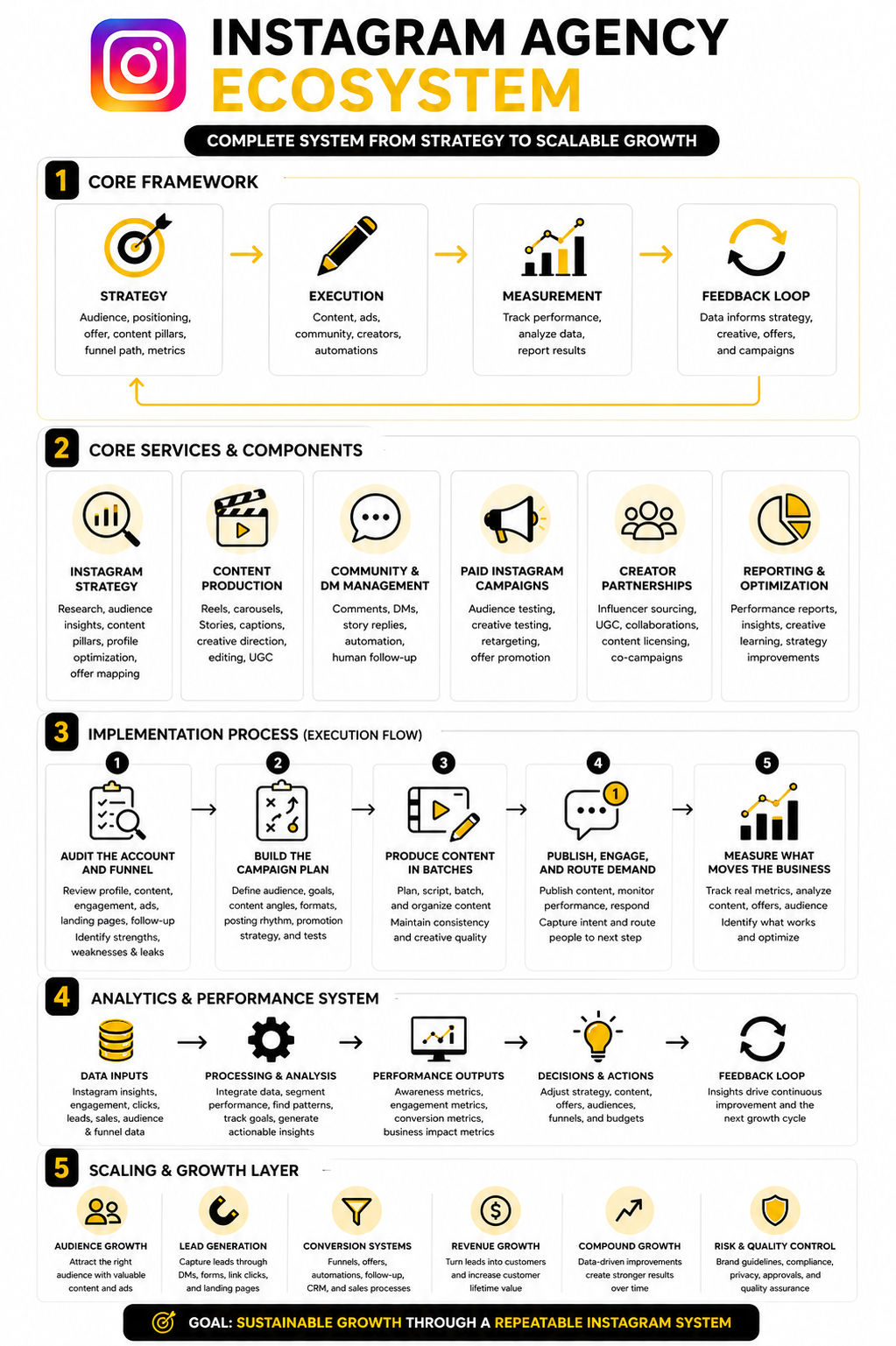
The final system is simple in theory and demanding in practice. Strategy defines the direction, content earns attention, engagement captures intent, funnels convert demand, and reporting improves the next cycle. When those pieces work together, Instagram becomes much more than a place to post.
FAQ - Built For Complete Guide
What does an instagram agency do?
An instagram agency helps brands plan, create, manage, promote, and measure Instagram marketing. The work can include strategy, content production, Reels, carousels, Stories, paid ads, creator campaigns, community management, DM automation, and reporting. The best agencies connect Instagram activity to business outcomes instead of only reporting likes and followers.
Is hiring an instagram agency worth it?
Hiring an instagram agency can be worth it when the business has a clear offer but lacks the time, creative team, or performance system to execute consistently. It is usually not worth it if the business expects the agency to fix a weak offer, poor customer experience, or unclear positioning with content alone. Instagram can amplify a strong business, but it cannot magically repair a broken one.
How much should an instagram agency cost?
Pricing depends on scope, market, deliverables, ad management, creative volume, and strategy depth. A basic content management package will cost much less than a full system with paid ads, creators, landing pages, automation, and reporting. The smarter question is not only “how much does it cost?” but “what business result is this agency responsible for improving?”
What should I look for before hiring an instagram agency?
Look for strategic thinking, clear reporting, strong creative judgment, platform knowledge, and proof that the agency understands your business model. Ask how they diagnose problems, how they decide what to post, how they measure success, and how they handle underperforming campaigns. If they only talk about posting frequency, templates, or vague growth promises, be careful.
Should an instagram agency handle paid ads too?
An instagram agency should handle paid ads only if it has real media buying skill and understands post-click conversion. Running ads without clear tracking, strong creative, and a working funnel can waste budget quickly. If the agency manages both organic and paid, make sure it can explain how creative testing, retargeting, landing pages, and reporting connect.
What tools should an instagram agency use?
The tool stack depends on the client, but most agencies need systems for planning, scheduling, analytics, automation, lead capture, and follow-up. A simple setup might include Buffer for scheduling, ManyChat for Instagram DM automation, and GoHighLevel for CRM, appointments, pipelines, and follow-up. Tools help, but they only work when the strategy is clear.
How long does it take to see results from Instagram marketing?
Some signals can appear quickly, especially reach, saves, replies, profile visits, and DMs. Business results usually take longer because the account needs enough content, testing, audience learning, and follow-up to create a reliable pattern. A serious instagram agency should set expectations around leading indicators first, then connect those signals to leads, sales, and retention over time.
What is the difference between a social media agency and an instagram agency?
A social media agency may manage several platforms, while an instagram agency focuses deeply on Instagram strategy, creative, community, ads, and platform-specific behavior. That focus can be useful when Instagram is the main channel for discovery or sales. The tradeoff is that the agency still needs to understand the wider marketing system, because Instagram rarely works alone.
Can an instagram agency help local businesses?
Yes, and local businesses can benefit a lot when Instagram is tied to booking, messaging, reviews, offers, and community trust. The agency should create content that shows the real experience, answers buyer objections, and makes the next step easy. For local service businesses, fast response times and clean follow-up often matter as much as the content itself.
Can an instagram agency help ecommerce brands?
Yes, especially when the agency understands product education, creator content, paid ads, social proof, landing pages, and repeatable creative testing. Ecommerce Instagram work should make the product easier to understand and easier to trust. If traffic is being sent to product pages or campaign pages, tools like Replo or ClickFunnels can help build dedicated conversion paths.
What are the biggest red flags when choosing an instagram agency?
Be cautious of guaranteed follower promises, unclear reporting, recycled templates, fake engagement tactics, and agencies that cannot explain how their work supports revenue. Another red flag is an agency that focuses only on aesthetics without discussing audience, offer, funnel, or business goals. Pretty content is useful, but pretty content without strategy is expensive decoration.
Should I build an in-house team instead of hiring an agency?
An in-house team can be better when the brand needs constant access, deep product knowledge, and daily collaboration. An agency can be better when the business needs outside expertise, faster execution, specialist skills, or a complete system without hiring several people. Many companies eventually use a hybrid model where the internal team owns brand knowledge and the agency supports strategy, production, ads, or scaling.
What should the first month with an instagram agency look like?
The first month should usually focus on audit, strategy, account cleanup, content planning, tracking setup, and early creative tests. It should not be a random rush to post as much as possible. The agency should leave the first month with clearer positioning, stronger content direction, better measurement, and a practical plan for the next campaign cycle.
What is the best way to judge agency performance?
Judge performance by the goals agreed upfront. For awareness, look at reach, watch time, profile activity, and audience quality. For demand generation, look at DMs, clicks, leads, booked calls, purchases, and sales pipeline movement. The best reports explain what changed, why it changed, and what the agency will do next.
Work With Professionals
Explore 10K+ Remote Marketing Contracts on MarkeWork.com
Most marketers spend too much time chasing clients, competing on crowded platforms, and losing a percentage of every project to middlemen.
MarkeWork gives you a better way. Browse thousands of remote marketing contracts and connect directly with companies desperate to hire skilled marketers like you, without platform commissions and without unnecessary gatekeepers.
If you're serious about finding better opportunities and keeping 100% of what you earn, explore available contracts and create a profile for free at MarkeWork.com.