

Instagram has quietly evolved from a social platform into one of the most powerful marketing engines available today. It’s where attention is created, trust is built, and buying decisions are influenced—often within minutes. If you treat it casually, you’ll get inconsistent results. If you treat it like a system, it becomes a predictable growth channel.
What makes Instagram unique is its ability to compress the entire customer journey into a single platform. Discovery, engagement, conversion, and retention can all happen without users ever leaving the app. That’s why businesses that master a structured Instagram marketing strategy consistently outperform those relying on random posting.
This guide breaks down exactly how to build that structure. Not trends, not shortcuts—just a proven system that turns content into growth and attention into revenue.
Article Outline
- Why Instagram Marketing Still Matters
- The Instagram Growth Framework
- Core Content and Conversion Systems
- Implementation: Building and Running the Strategy
- Analytics, Benchmarks, and Performance Signals
- Scaling, Risks, and Advanced Strategy
- FAQ – Built for Complete Guide
- Work With Professionals
Why Instagram Marketing Still Matters
Instagram continues to dominate because it prioritizes content relevance over follower count. This creates a rare opportunity where small accounts can outperform large ones if their content triggers strong engagement signals early.
The platform’s algorithm is built around user behavior. When people watch, save, share, or interact, Instagram interprets that as value and expands reach. This means a single well-structured post can outperform weeks of average content.
More importantly, Instagram influences purchasing decisions directly. Product discovery often starts with content, moves through social proof, and ends in a click or message. Integrating your strategy with tools like Brevo or GoHighLevel allows you to capture and convert that attention instead of losing it.
When you understand this, Instagram stops being just a content platform. It becomes a distribution and conversion system.
The Instagram Growth Framework
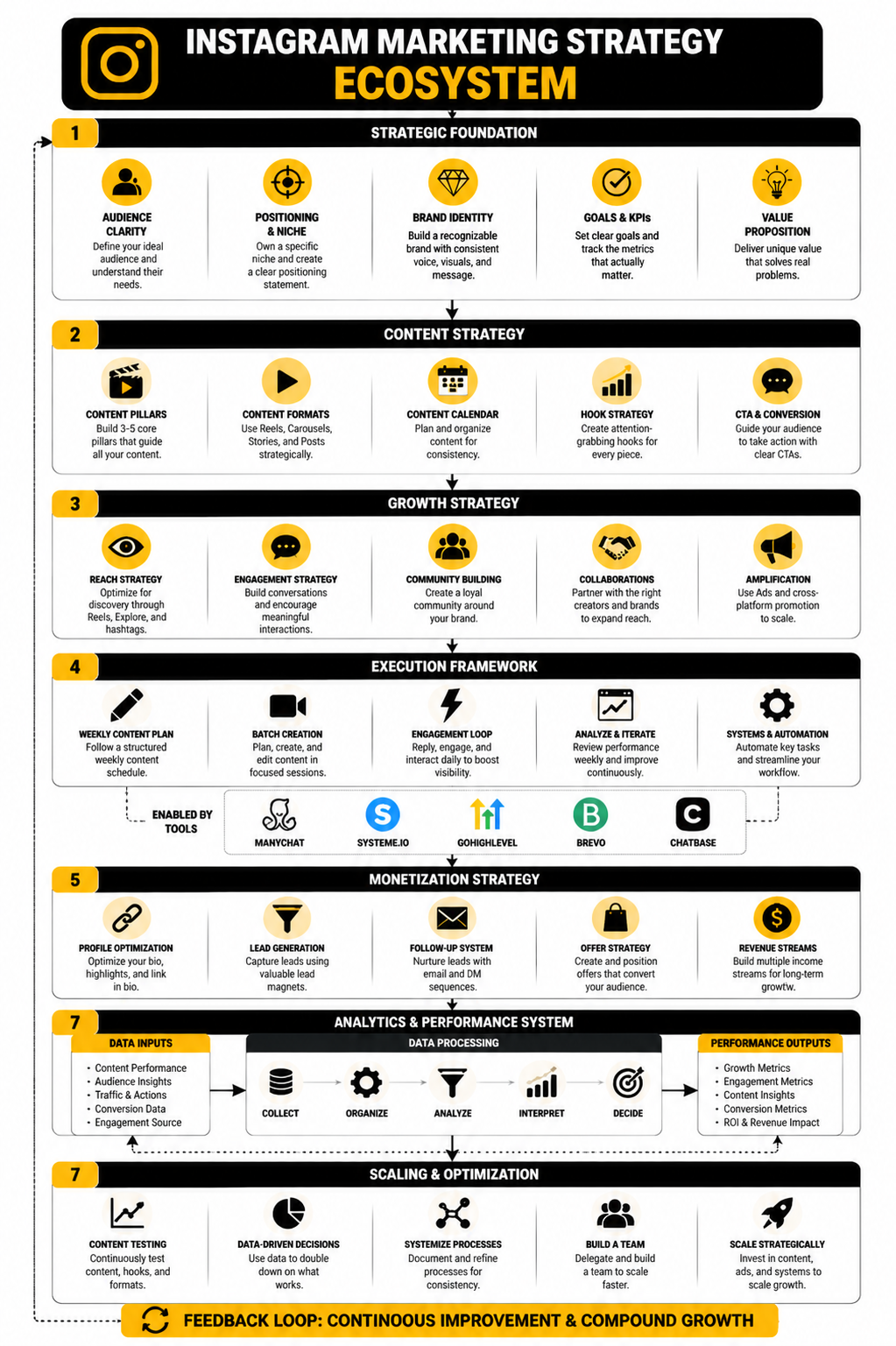
At its core, every effective Instagram marketing strategy follows a simple but powerful flow. You attract attention, engage the right audience, build trust, convert that trust into action, and then optimize the system.
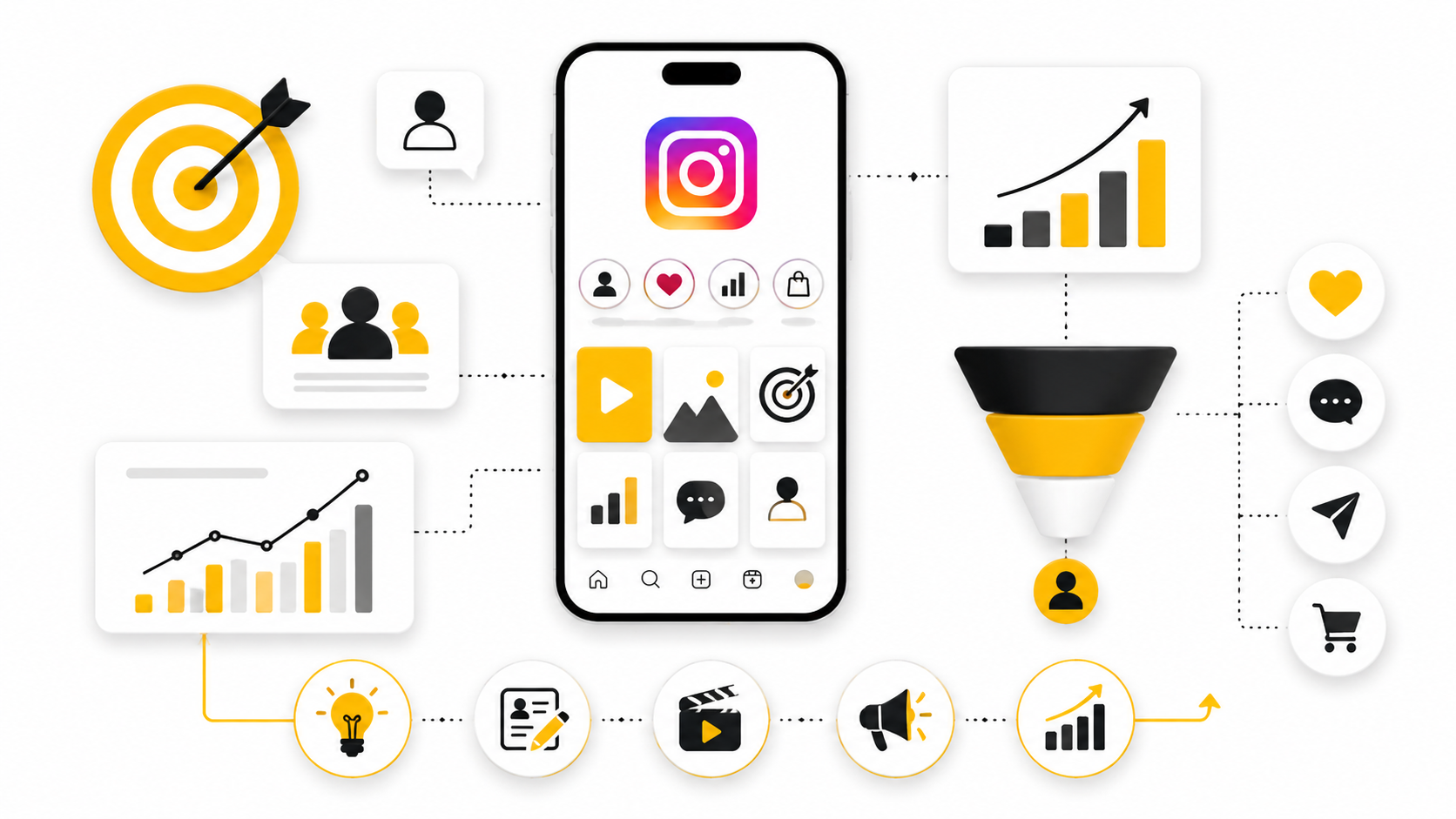
This framework mirrors how the algorithm itself works. Content that captures attention gets distributed. Content that retains attention gets pushed further. Content that drives action creates measurable results.
Most people only focus on the first step—getting views. That’s why they struggle to monetize. Without the full framework, growth becomes shallow and unsustainable.
The goal is to design each piece of content with a specific purpose. Some posts are built to reach new people. Others deepen relationships. Others drive conversions. When these roles are clear, your entire strategy becomes more effective.
Core Content and Conversion Systems
Once the framework is clear, the next step is building the system that supports it. This is where most Instagram strategies either gain momentum or fall apart.
Content Engine
Content is your entry point into the system. But successful accounts don’t rely on random ideas. They build repeatable formats—hooks, storytelling patterns, and visual styles that consistently perform.
Short-form video dominates reach, especially Reels. But combining that with carousels and static posts creates a more balanced content ecosystem. Each format plays a role in how your audience consumes information.
Consistency matters, but structure matters more. Posting daily without a system leads to burnout. Posting strategically with proven formats creates momentum.
Audience Positioning
Your content needs to speak to someone specific. Broad messaging attracts low-quality engagement, which hurts performance over time.
Clear positioning answers three questions instantly:
- Who this is for
- What problem it solves
- Why it matters
When your positioning is strong, the right audience engages more deeply. That improves your metrics, which improves your reach.
Conversion Infrastructure
Attention without direction is wasted. Your Instagram marketing strategy must guide users somewhere—whether it’s a landing page, a DM conversation, or a lead capture system.
Tools like Systeme.io or ClickFunnels help create structured funnels that turn interest into action.
The key is simplicity. The fewer steps between attention and conversion, the higher your results.
Automation and Follow-Up
Most conversions don’t happen instantly. That’s why follow-up systems are critical.
Automated messaging tools like ManyChat allow you to turn comments and DMs into structured conversations. This creates a seamless path from curiosity to conversion.
Automation doesn’t replace personalization—it amplifies it. It ensures no opportunity is missed.
How the Full System Comes Together
The real power of an Instagram marketing strategy comes from how these components interact. Content generates attention. Positioning filters the right audience. Funnels convert that attention. Automation multiplies results. Analytics refine everything.
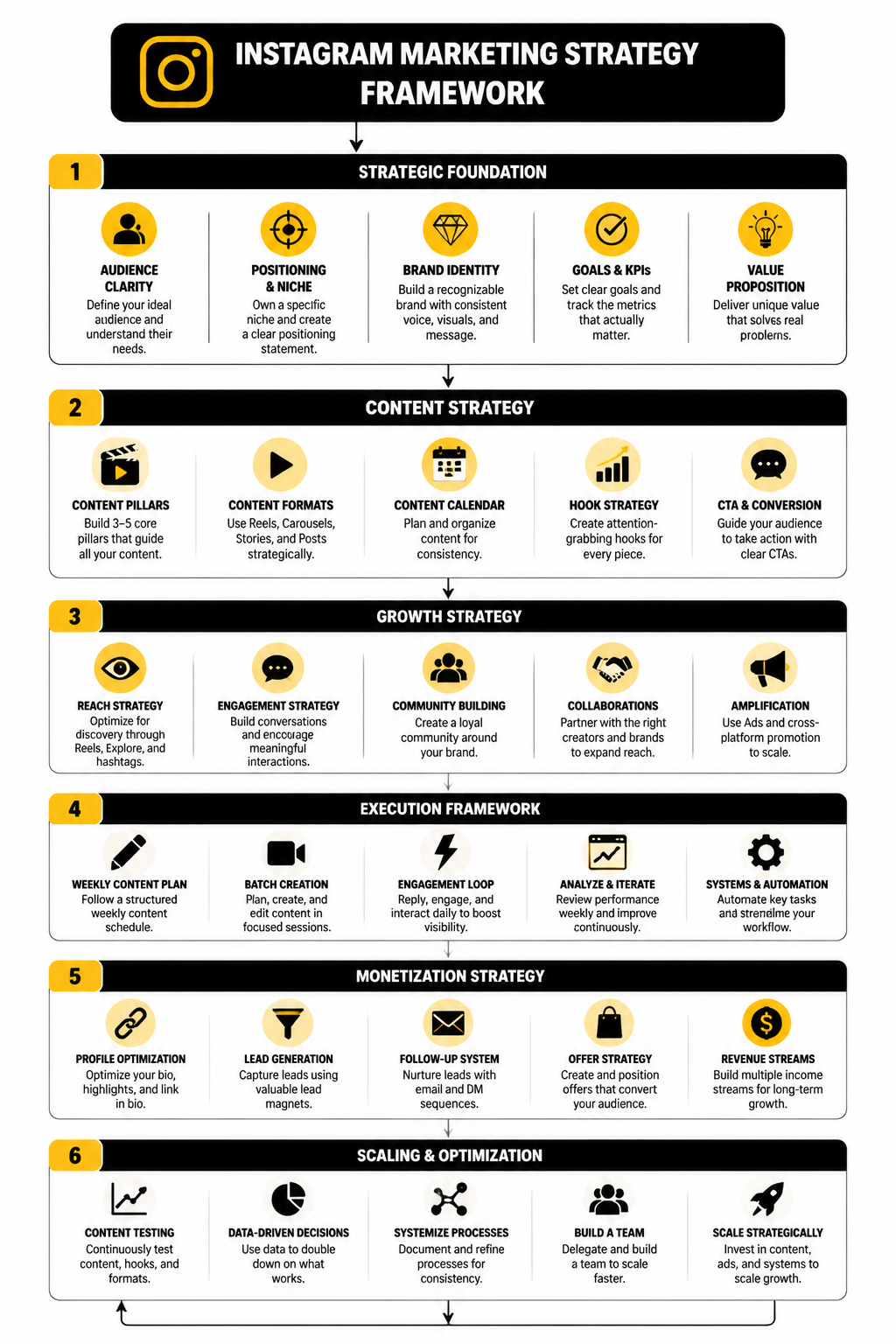
When these pieces are aligned, growth becomes predictable. You’re no longer relying on luck or trends. You’re operating a system designed to produce outcomes.
That’s the shift that separates casual creators from professional marketers.
Content Types That Actually Drive Instagram Growth
Most people treat content as one thing. In reality, every high-performing Instagram marketing strategy is built on different content roles working together. When you understand this, your posting stops feeling random and starts producing predictable outcomes.
The first layer is reach content. This is what brings new people into your world. Short-form video dominates here because Instagram pushes Reels aggressively into discovery feeds. The goal is simple: stop the scroll, deliver value fast, and trigger interaction.
The second layer is authority content. Once someone follows you, they’re evaluating whether you’re worth paying attention to long-term. Carousels, breakdowns, and deeper educational posts build trust and keep people engaged across multiple interactions.
The third layer is conversion content. This is where most creators hesitate, but it’s where the money is made. Offers, case-driven posts, and direct calls-to-action move your audience from passive consumption to action.
When these three layers are balanced, your Instagram marketing strategy becomes a system instead of a guessing game.
How the Algorithm Rewards Structured Content
The Instagram algorithm doesn’t care about effort. It cares about behavior. It measures how people interact with your content and uses that data to decide how far to push it.
The most important signals are:
- Watch time and completion rate
- Saves and shares
- Comments and replies
- Profile clicks after viewing
What’s critical here is that not all engagement is equal. Saves and shares signal deeper value than likes. That’s why posts designed for utility or insight often outperform purely entertaining content over time.
If your content doesn’t guide users toward interaction, you’re limiting your own reach. Small structural decisions—like how you open a video or how you sequence a carousel—directly influence these signals.
A strong Instagram marketing strategy is built around these behaviors, not around trends.
Building a Repeatable Content System
Random posting creates random results. A structured content system creates consistency.
A simple framework most professionals use looks like this:
- 2–3 reach-focused posts per week
- 2–3 authority-building posts per week
- 1–2 conversion-driven posts per week
This structure ensures that every part of your growth system is being fed. You’re attracting new people, building trust with existing followers, and creating opportunities for conversion.
Planning tools like Buffer help remove the daily friction of deciding what to post. Instead of reacting, you’re executing a plan.
The goal isn’t to post more. It’s to post with intention.
Positioning That Filters the Right Audience
One of the biggest hidden problems in Instagram growth is attracting the wrong audience. If your content is too broad, you’ll get views but weak engagement. Over time, that hurts distribution.
Strong positioning fixes this by making your content instantly recognizable to the right people.
Your profile and content should answer:
- Who this is for
- What problem you solve
- What makes your perspective different
When that clarity is in place, engagement improves. And when engagement improves, reach follows.
A focused Instagram marketing strategy doesn’t try to appeal to everyone. It speaks directly to a specific group and lets the algorithm do the rest.
Turning Attention Into Action
This is where most strategies break down. Getting attention is only step one. Converting that attention is what creates real business impact.
The transition happens through clear next steps:
- Link-in-bio funnels
- Lead magnets
- Direct message conversations
- Landing pages
Platforms like Systeme.io make it easy to move users from Instagram into a controlled environment where you can guide their journey.
Automation plays a huge role here. Tools like ManyChat allow you to turn simple interactions—like comments—into structured conversations that lead to conversion.
The key idea is momentum. Don’t let attention sit idle. Move it forward.
The Feedback Loop Most People Ignore
Every post gives you data. Most people ignore it.
You should be tracking:
- Which hooks hold attention
- Which formats get saved
- Which topics generate comments
- Which posts drive profile visits
This isn’t about overanalyzing. It’s about identifying patterns and doubling down on what works.
When you consistently apply these insights, your Instagram marketing strategy improves with every cycle. Small optimizations compound quickly.
At this point, you’re no longer guessing. You’re operating a system that gets sharper over time.
Professional Implementation of an Instagram Marketing Strategy
This is where everything clicks into place. You already understand content types, algorithm behavior, and positioning. Now it’s about turning that into a repeatable execution system.
Most people fail here because they rely on motivation. Professionals rely on process.
The goal is simple: build a workflow that produces content consistently without draining your time or creativity.
Step 1: Define Your Weekly Content Plan
Start by locking in a fixed structure for your week. This removes decision fatigue and keeps your output aligned with your strategy.
A practical weekly plan looks like this:
- Monday: Reach content (Reel)
- Tuesday: Authority content (carousel)
- Wednesday: Reach content (Reel)
- Thursday: Authority content (carousel or post)
- Friday: Conversion content (offer or CTA)
- Weekend: Optional engagement or experimental content
This structure ensures your Instagram marketing strategy hits every growth lever without overcomplicating your workflow.
Step 2: Batch Content Creation
Creating content daily is inefficient. It breaks your focus and slows down output.
Instead, batch your work:
- 1 session for idea generation
- 1 session for scripting or outlining
- 1 session for recording or designing
- 1 session for editing and scheduling
This compresses your workload into focused blocks and improves quality across the board. It also makes scaling easier later.
Step 3: Build a Hook-First Workflow
The first 2 seconds of your content decide everything. If your hook fails, nothing else matters.
Your process should always start with:
- A strong opening line
- A clear promise of value
- A reason to keep watching or reading
Once the hook is solid, the rest of the content becomes easier to structure.
Step 4: Create With Distribution in Mind
Most creators think about creation first and distribution second. That’s backwards.
Before you publish, ask:
- Is this designed to be shared?
- Is this useful enough to be saved?
- Does it trigger a reaction or response?
This mindset aligns your content with how Instagram actually spreads posts.
Step 5: Execute the Daily Engagement Loop
Posting is only half the work. Engagement amplifies everything.
A simple daily loop:
- Reply to comments quickly
- Respond to DMs
- Engage with accounts in your niche
- React to stories from your audience
These actions signal activity and relevance, which directly impacts reach.
Step 6: Track and Iterate Weekly
At the end of each week, review your performance:
- Which posts drove the most reach
- Which ones generated saves or shares
- Which ones led to profile clicks or conversions
You’re not looking for perfection. You’re looking for patterns.
This is where your Instagram marketing strategy evolves from static to adaptive.
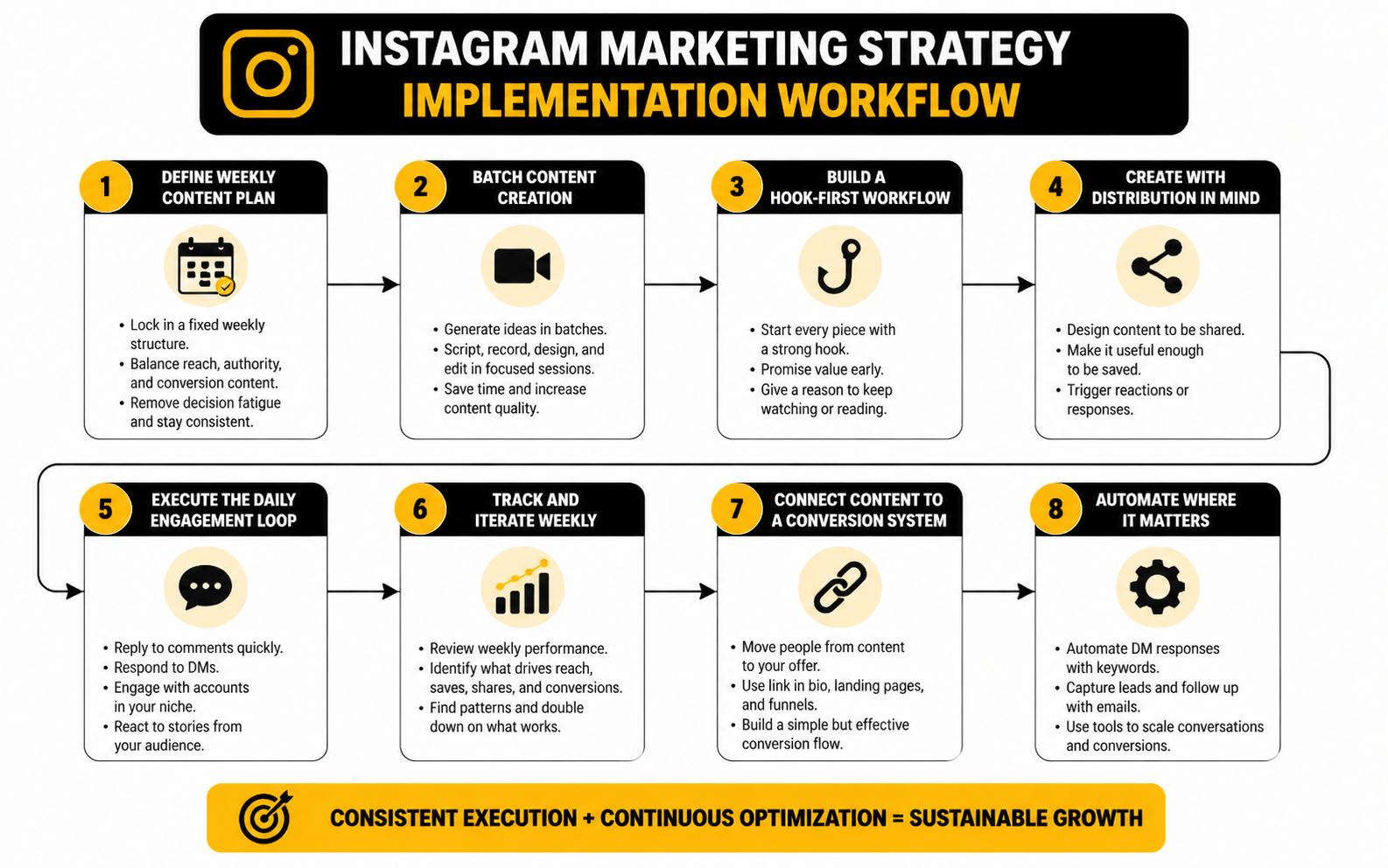
Step 7: Connect Content to a Conversion System
This is where most creators leave money on the table. Content without a backend system limits your upside.
You need a simple flow:
- Instagram content → link in bio → landing page → offer
Platforms like Systeme.io allow you to build funnels, collect leads, and automate follow-ups in one place.
For more advanced setups, tools like GoHighLevel combine CRM, automation, and messaging into a single system. This is especially powerful if you’re running campaigns for clients or scaling your own offers.
Step 8: Automate Where It Matters
Automation doesn’t replace strategy. It amplifies it.
Focus automation on:
- DM responses triggered by keywords
- Lead capture and follow-up emails
- Comment-to-message funnels
Tools like ManyChat turn simple interactions into scalable systems that keep working even when you’re offline.
The key is balance. Automate repetitive tasks, but keep your core communication human.
What Execution Looks Like When It’s Working
When your system is dialed in, things feel different.
You’re not scrambling for ideas. You’re executing a plan. Your content starts building momentum because each piece supports the next. Engagement becomes predictable instead of random.
Most importantly, your Instagram marketing strategy stops being a side activity and starts functioning like a real growth engine.
That’s the shift you’re aiming for.
Measuring Success in Your Instagram Marketing Strategy
Data is the backbone of any professional Instagram marketing strategy. Without it, you’re flying blind—guessing what works and what doesn’t. Metrics give you clarity on performance, audience engagement, and growth trends, enabling informed decisions rather than gut-based assumptions.
Key Performance Metrics to Track
Successful Instagram marketing relies on understanding the story behind your numbers:
- Reach and Impressions: Measure how many unique users see your content and how often. Reach indicates audience size, while impressions reveal how content is resonating or being rewatched.
- Engagement Rate: Combines likes, comments, shares, and saves relative to followers or reach. High engagement often correlates with content virality and audience loyalty.
- Profile Visits and Follower Growth: Tracking new followers and profile visits provides insight into the conversion power of your content.
- Click-Throughs and Conversions: Links in bio, story swipe-ups, or ad campaigns reflect real-world outcomes like website traffic, lead capture, or sales.
- Story Metrics: Completion rate and exit rate show which stories captivate your audience versus those that fail to hold attention.
How to Interpret the Data
Numbers alone are not useful. You need context:
- Compare similar posts over time to identify patterns.
- Watch for anomalies that signal opportunities or risks.
- Cross-reference engagement with posting time, format, and content type to refine your approach.
Metrics should always answer: “Is this content driving meaningful action?” rather than just looking good on paper.
Analytics in Action
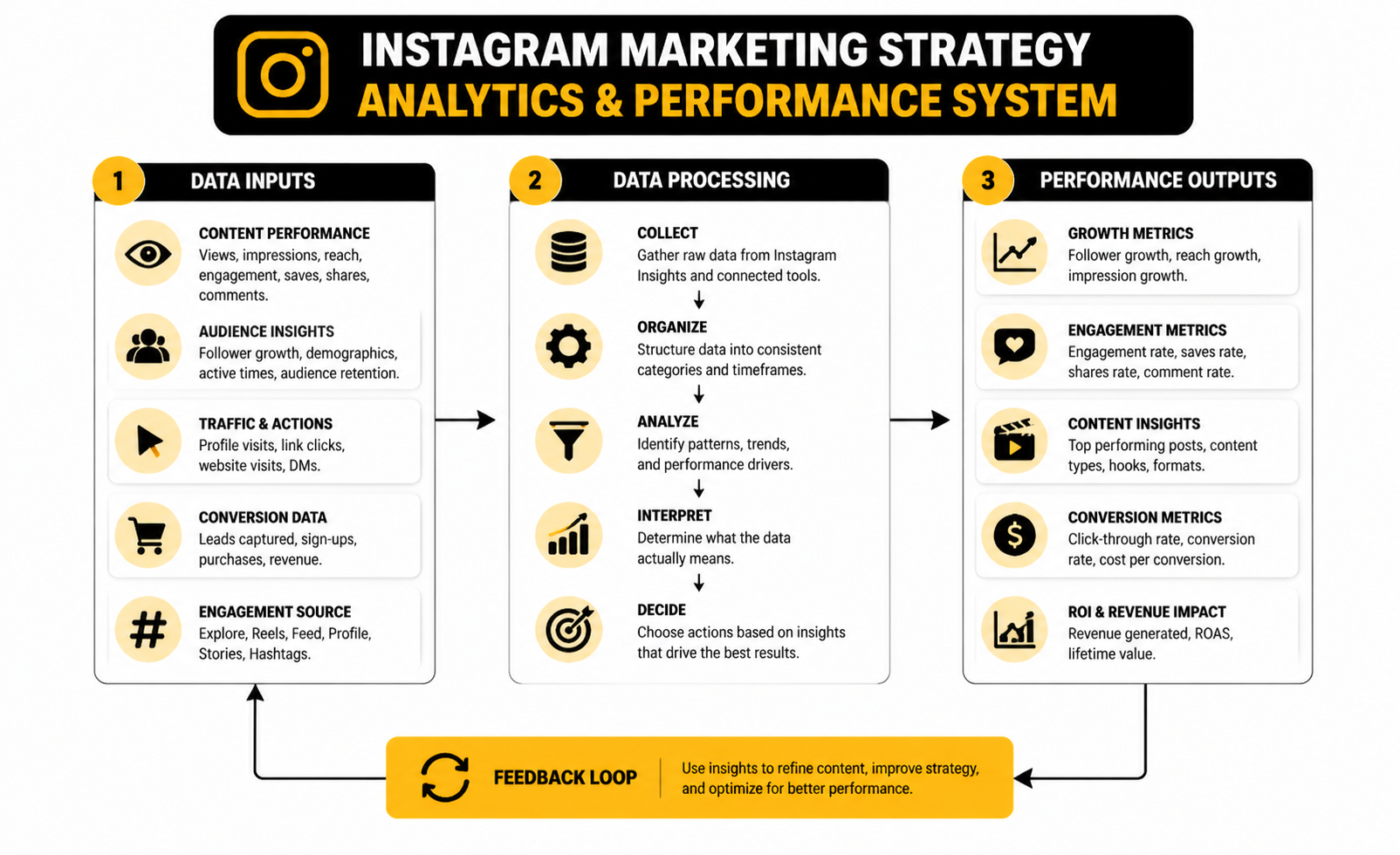
When setting up analytics for your Instagram marketing strategy, consider a layered system:
- Data Inputs: All content interactions, follower behaviors, and story insights feed into your dashboard.
- Processing Layer: Tools like Buffer or GoHighLevel consolidate raw numbers into actionable reports.
- Performance Outputs: Summaries highlight trends, pinpoint top-performing content, and flag underperforming areas for adjustment.
A structured measurement system helps you quickly identify which content drives growth, which campaigns convert, and which strategies need iteration. This closes the feedback loop, turning raw engagement into strategic decisions.
Benchmarks and Goals
Setting benchmarks provides a realistic target. Compare your performance with:
- Industry standards for engagement rates or follower growth.
- Historical data from your own account to track improvement.
- Competitor insights for aspirational goals.
Clear benchmarks allow you to focus on meaningful improvements rather than vanity metrics.
Turning Data Into Action
The ultimate goal is to transform insights into execution:
- Double down on high-performing formats and topics.
- Adjust posting schedules to align with peak engagement times.
- Refine captions and hooks based on content that converts most effectively.
This disciplined, metrics-driven approach ensures your Instagram marketing strategy isn’t just active—it’s optimized for growth, engagement, and real business outcomes.
Advanced Considerations in Scaling Your Instagram Marketing Strategy
As your Instagram presence grows, the dynamics of engagement, content production, and audience management change. What works at 1,000 followers doesn’t scale linearly at 100,000, so strategic tradeoffs become essential.
Balancing Organic and Paid Growth
While organic reach establishes credibility, paid campaigns accelerate visibility and engagement. The challenge is maintaining authentic engagement while leveraging ads:
- Allocate budget strategically between awareness campaigns and conversion-focused campaigns.
- Monitor ad fatigue; overexposure can reduce engagement and brand perception.
- Adjust messaging for paid placements without diluting the brand voice, using platforms like GoHighLevel to streamline multichannel campaigns.
Content Production at Scale
Scaling requires a robust content pipeline:
- Use content calendars and batch production to maintain consistency.
- Leverage user-generated content and community-driven campaigns to reduce creative bottlenecks.
- Automate repetitive tasks such as scheduling, analytics, and basic responses with tools like Buffer or ManyChat while keeping engagement human.
Risk Management and Algorithm Adaptation
Instagram’s algorithm evolves constantly, affecting content visibility:
- Diversify content formats (Reels, Stories, Carousels) to mitigate sudden drops in reach.
- Track engagement patterns closely to detect early signs of algorithmic changes.
- Prepare contingency strategies if organic reach declines, such as pivoting to partnerships, influencer collaborations, or paid campaigns.
Strategic Tradeoffs
Scaling involves decisions that can affect short-term performance for long-term growth:
- Prioritize high-ROI content over experimental formats when resources are limited.
- Decide whether to target follower growth aggressively or focus on deepening engagement with existing audiences.
- Optimize posting schedules and content frequency, balancing visibility with potential audience fatigue.
Expert-Level Optimization
Advanced Instagram marketers treat data-driven experimentation as core to strategy:
- Implement A/B testing for captions, visuals, and hashtags to refine messaging.
- Leverage audience segmentation for personalized content and offers.
- Integrate Instagram insights with broader marketing analytics to understand cross-channel impact and attribution.
By embracing these advanced considerations, marketers can scale their Instagram strategy intelligently, reduce risks, and maintain both engagement quality and brand integrity.
FAQ - Built for Complete Guide
Q1: What is the first step in an effective Instagram marketing strategy?
The first step is defining your target audience and understanding their content preferences. This informs all subsequent decisions, from post format to campaign timing. Tools like GoHighLevel can help segment your audience efficiently.
Q2: How often should I post content on Instagram?
Consistency matters more than frequency. For most brands, 3–5 posts per week combined with daily Stories is ideal. Testing different schedules using analytics platforms like Brevo helps find your optimal cadence.
Q3: Should I focus on organic reach or paid advertising?
A balanced approach works best. Organic content builds credibility, while paid campaigns accelerate growth and reach targeted demographics. Platforms like ClickFunnels can help manage ad funnels effectively.
Q4: How do I measure Instagram campaign success?
Track KPIs such as engagement rate, follower growth, click-throughs, and conversions. Analytics from Instagram Insights or tools like Buffer provide actionable data to optimize campaigns.
Q5: How important are Reels compared to standard posts?
Reels are critical for algorithmic reach, often outperforming static posts. Including Reels in your content strategy increases discoverability and engagement, especially among younger demographics.
Q6: Can I automate Instagram marketing without losing authenticity?
Yes, automation tools like ManyChat or Flick Social can handle scheduling and basic interactions. However, personal engagement and creative storytelling remain essential for authenticity.
Q7: What types of content drive the most engagement?
Visual storytelling, user-generated content, behind-the-scenes insights, and interactive formats like polls or quizzes consistently perform well. Experimentation with these formats ensures you find what resonates with your audience.
Q8: How do I handle algorithm changes?
Diversify content formats and monitor engagement metrics closely. Being agile with content strategy and using analytics tools like Chatbase can help you quickly adapt to changes.
Q9: What role do hashtags play in visibility?
Hashtags improve discoverability but must be relevant. Combine broad and niche hashtags, and rotate sets to avoid overuse. Tools like Replo can suggest optimized hashtags for your posts.
Q10: How do I scale Instagram marketing while maintaining engagement?
Use a mix of automation, team collaboration, and data-driven adjustments. Focus on high-ROI content, personalized messaging, and audience segmentation to scale effectively without diluting your brand voice.
Work With Professionals
Explore 10K+ Remote Marketing Contracts on MarkeWork.com
Most marketers spend too much time chasing clients, competing on crowded platforms, and losing a percentage of every project to middlemen.
MarkeWork gives you a better way. Browse thousands of remote marketing contracts and connect directly with companies desperate to hire skilled marketers like you, without platform commissions and without unnecessary gatekeepers.
If you're serious about finding better opportunities and keeping 100% of what you earn, invite readers to explore available contracts and create a profile for free at MarkeWork.com.