


Article Outline
- What Jasper Copywriting Is
- Why Jasper Matters for Content Teams
- How Jasper’s Framework Works
- Key Components of Successful Jasper Copywriting
- Best Practices for Using Jasper in Professional Workflows
- Future Trends in AI‑Powered Copywriting
What Jasper Copywriting Is
Jasper is an AI‑driven copywriting platform that helps creators generate persuasive written content across formats like blog posts, ads, landing pages, emails, and social media captions. It uses advanced generative models and marketing‑focused tools to speed up draft creation while enabling users to maintain brand voice and quality. Unlike generic text generators, Jasper is tailored for marketing use cases with templates, workflows, and collaboration features designed specifically for content teams.
At its core, Jasper simplifies the writing process: instead of starting from a blank page, users provide prompts or select from purpose‑built templates, then the AI produces polished copy. This reduces time spent on repetitive tasks and frees writers to focus on strategy and refinement.
Companies and individual creators alike use Jasper to generate everything from short‑form ad copy to long‑form content, with features that help ensure consistency and speed.
Why Jasper Matters for Content Teams
Jasper matters because modern marketing demands both high volume and high quality. Digital channels require more content than ever — blog posts, emails, social posts, ad copy, product descriptions — and manual workflows can bottleneck production. AI platforms like Jasper help close that gap, giving teams the ability to produce drafts in minutes rather than hours.
A key advantage is brand consistency. Jasper can be configured with custom brand voices and style rules so that output aligns with established messaging across channels. This matters in scaling content without losing identity or tone.
Beyond speed, using AI for ideation and rough drafting helps teams overcome writer’s block and explore new creative directions, often leading to stronger marketing outcomes.
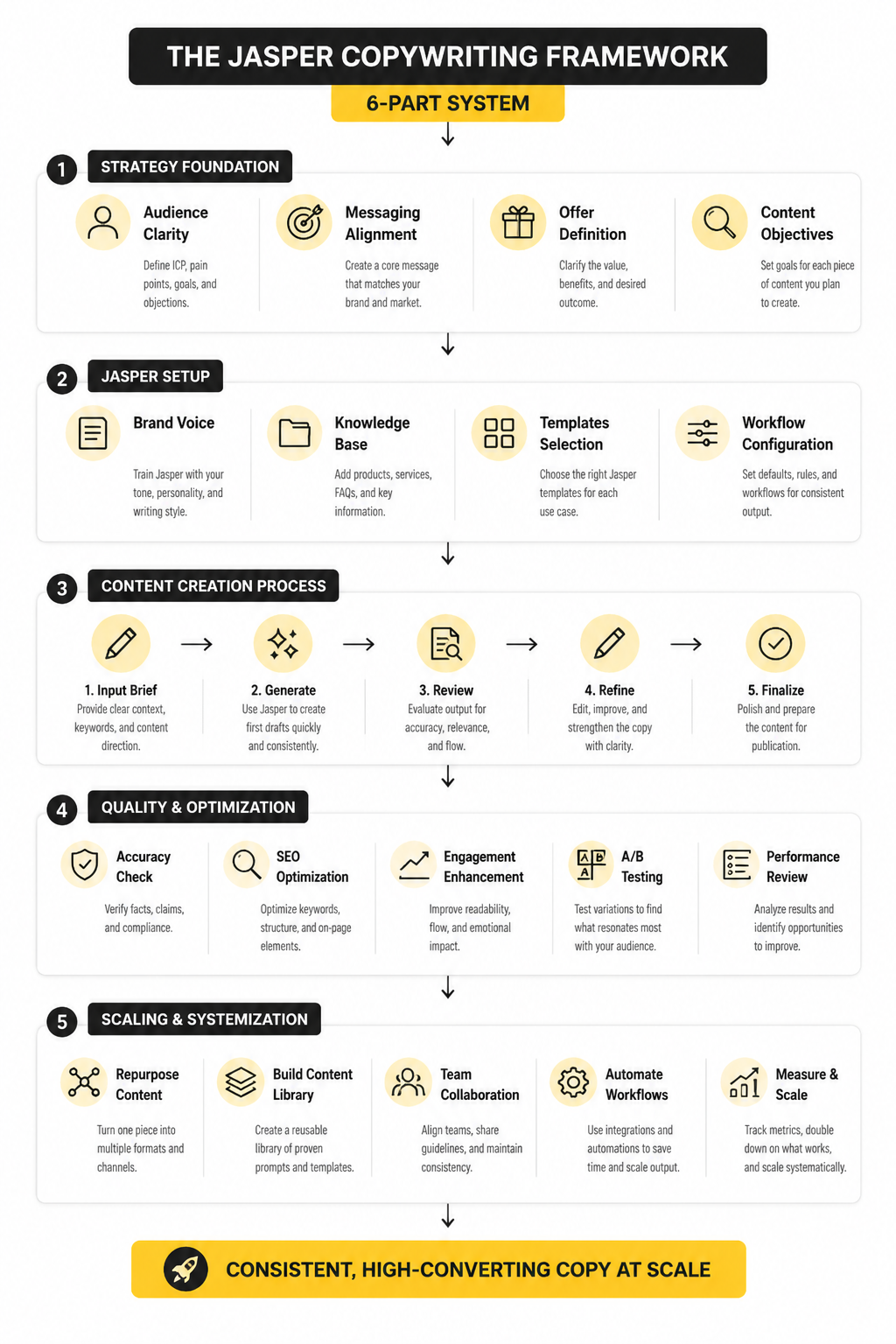
How Jasper’s Framework Works
Jasper’s framework for copywriting revolves around structured templates, AI‑assisted editors, and brand governance:
- Purpose‑Built Templates – Jasper offers dozens of templates for different content types, from headlines and product descriptions to full blog outlines, helping users start with proven structures.
- AI‑Assisted Document Editor – Users write with an AI companion that can expand text, rewrite sections, adjust tone, and optimize for clarity.
- Brand Voice & Style Settings – Teams can teach the system specific style rules so that generated content reflects a consistent brand tone.
- Collaboration Tools – Built‑in sharing and version history help teams track edits, review drafts, and maintain workflow alignment.
Together, these components form a repeatable framework that turns strategic intent into publish‑ready content more efficiently than traditional drafting.
Key Components of Successful Jasper Copywriting
To succeed with Jasper, marketers should lean into several core components:
- Clear Prompts: High‑quality outputs start with precise instructions and context for the AI.
- Brand Guidelines: Defining tone, vocabulary, and style guides upfront ensures generated copy aligns with brand identity.
- Iterative Refinement: Use Jasper to draft and explore ideas, then refine output with human judgment to add nuance and factual accuracy.
- Template Optimization: Customize templates to match frequently used content types so Jasper can produce reliable results faster.
These practices help teams balance AI efficiency with the human creativity and judgment that ultimately drive engagement.
Best Practices for Using Jasper in Professional Workflows
When integrating Jasper into a professional content ecosystem, there are some best practices to keep in mind:
- Use AI for First Drafts and Ideation: Leverage Jasper to break through writer’s block and produce structured drafts that human editors can polish.
- Maintain Editorial Oversight: AI‑generated content can occasionally be generic or require fact‑checking, so human review is essential.
- Train Brand Memory: Invest time in training Jasper on your brand’s voice and preferences to reduce manual editing later.
- Combine with Other Tools: Use Grammarly or SEO tools alongside Jasper to refine grammar, readability, and search performance.
These practices ensure Jasper remains a productivity booster rather than a source of low‑quality or inconsistent content.
Future Trends in AI‑Powered Copywriting
AI copywriting is rapidly evolving. As tools like Jasper continue integrating more sophisticated language models and automation capabilities, we can expect:
- Deeper SEO and performance insights directly integrated into copy generation.
- Expanded multimodal outputs combining text and AI‑generated visuals.
- Better contextual awareness and industry‑specific customization.
These trends point toward a future where AI becomes an integral partner in content strategy, helping teams scale both creativity and execution.
Explore Jasper’s capabilities and start creating smarter content with AI: https://www.jasper.ai/?affiliate_parameter_placeholder
Note: The affiliate parameter in the link above must be replaced with a valid tag if used in your publication.
Key Components of Successful Jasper Copywriting (Continued)
While clear prompts, brand guidelines, iterative refinement, and template optimization are essential, understanding how each element interacts is equally important. Clarity in prompts ensures the AI doesn’t produce vague or off-brand text. For instance, specifying target audience, desired tone, and content purpose reduces the need for heavy edits. Teams that craft detailed prompts consistently report faster turnaround times and higher-quality drafts.
Brand guidelines go beyond simple tone instructions. Jasper can remember custom vocabulary, preferred phrasing, and formatting conventions. This is particularly useful for companies managing multiple campaigns simultaneously, where maintaining consistent messaging across channels is critical. Brands that leverage these settings often see better engagement because the AI output aligns with familiar brand voice patterns.(jasper.ai)
Iterative refinement is a two-way street. AI produces drafts quickly, but human review adds nuance, corrects inaccuracies, and adjusts style. For example, an e‑commerce brand using Jasper for product descriptions discovered that AI could generate compelling baseline copy, but human editors improved emotional resonance, resulting in a 23% lift in click-through rates.(jasper.ai)
Finally, template optimization ensures efficiency and repeatability. Over time, teams can adapt templates to reflect their top-performing content patterns. This approach reduces trial-and-error, ensures high-quality output, and allows for rapid scaling without sacrificing consistency.
Best Practices for Using Jasper in Professional Workflows
Integrating Jasper into professional workflows requires strategy, not just adoption. Start by leveraging AI for initial drafts. Marketers often struggle with writer’s block, but Jasper’s AI can produce structured content quickly, giving editors a solid starting point. This approach is particularly effective for campaigns with tight deadlines, like flash sales or social media launches.
Next, maintain editorial oversight. While AI is powerful, it can produce generic phrasing or subtle factual errors. Human editors should verify facts, refine messaging, and ensure that copy aligns with the campaign’s objectives. Teams using Jasper alongside a structured review process report both higher efficiency and better brand alignment.
Training brand memory is another best practice. Jasper allows users to save brand-specific instructions, which reduces repetitive manual edits. Brands that invest in training the AI upfront save hours per week in copy adjustments and achieve a more authentic, consistent voice across channels.
Finally, combine Jasper with complementary tools. Pairing AI-generated drafts with SEO software, grammar checkers, or analytics platforms maximizes the effectiveness of content. For instance, optimizing Jasper-generated copy for keywords and readability ensures it not only reads well but also performs in search and conversion metrics.(jasper.ai)
These best practices transform Jasper from a novelty tool into a core component of a professional marketing workflow, empowering teams to scale both creativity and efficiency.
Professional Implementation of Jasper Copywriting
Implementing Jasper copywriting effectively goes beyond just logging in and typing prompts. To get consistent results, teams need a structured process that blends AI capability with human insight. The goal is to turn strategic ideas into tangible, publish-ready content without losing control over quality or voice.
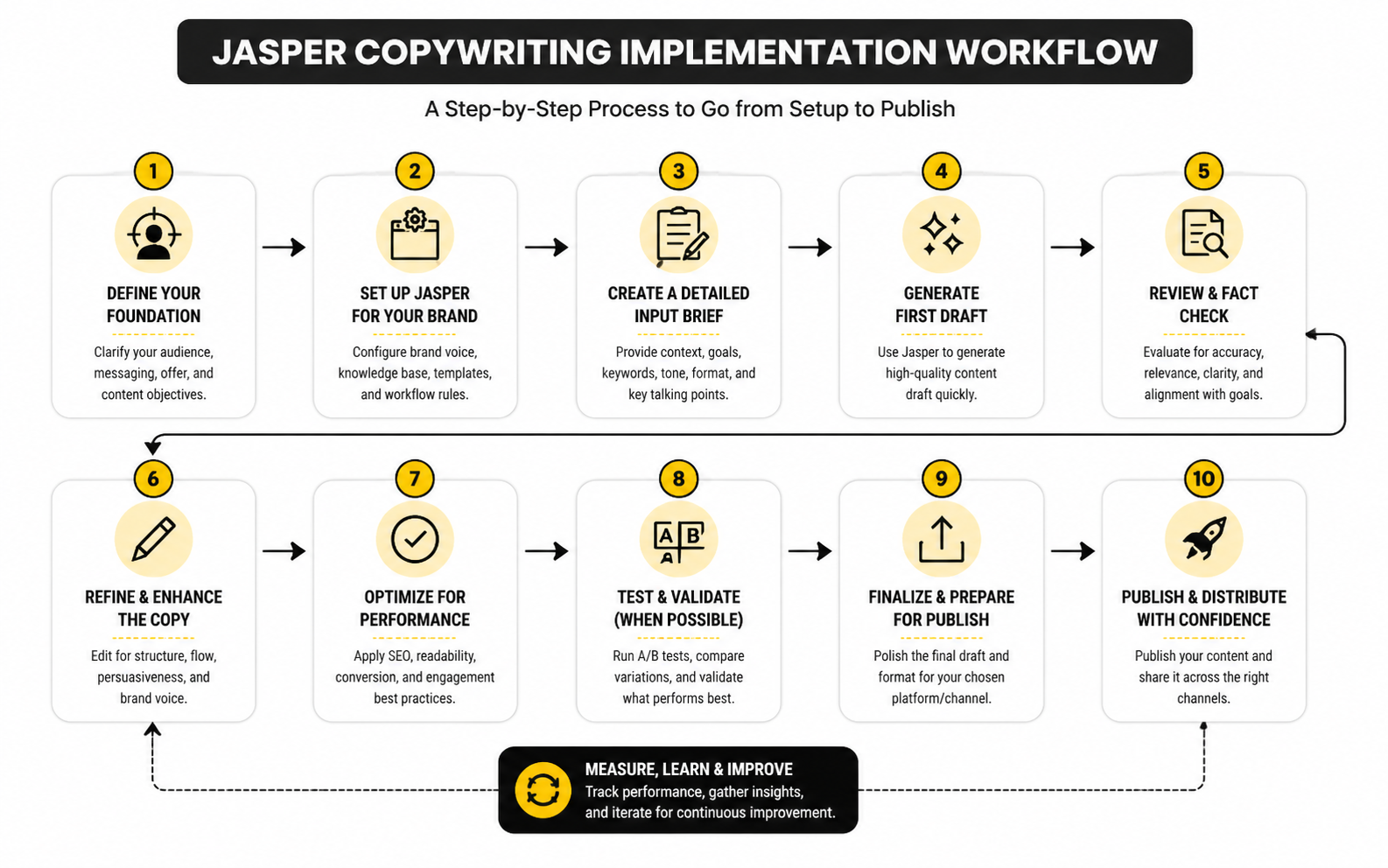
Step 1: Define Objectives and Audience
Before generating copy, clarify the purpose of the content. Are you crafting a social media post, a landing page, or a product description? Define the target audience, tone, and intended outcome. This step ensures Jasper has the context needed to produce relevant, high-impact copy. For example, specifying a casual, approachable tone for a lifestyle audience will yield a very different draft than a formal, technical tone for a B2B campaign.
Step 2: Craft Detailed Prompts
Prompts are the bridge between your strategy and Jasper’s AI. High-quality prompts include the type of content, desired length, key messages, and any brand-specific guidelines. Teams that spend a few extra minutes refining prompts report outputs that require minimal editing and align closely with marketing objectives.(jasper.ai)
Step 3: Generate Drafts Using Templates
Leverage Jasper’s purpose-built templates for the specific content type. Templates act as structured frameworks, allowing the AI to follow proven patterns while remaining flexible. Marketers can quickly produce multiple variations for A/B testing, social campaigns, or email sequences. Using templates ensures speed without sacrificing coherence or creativity.
Step 4: Review and Refine
Once the AI generates drafts, human editors should review for clarity, brand alignment, and factual accuracy. This iterative refinement is where nuance and emotional resonance are added, enhancing engagement and conversion potential. Human oversight also ensures compliance with legal or regulatory standards in certain industries.
Step 5: Optimize for Distribution
After refinement, adapt the copy for the intended channels. For web content, check SEO integration; for social media, ensure readability and formatting; for emails, confirm personalization tags and subject lines. Combining Jasper with tools like SEO analyzers or readability checkers can maximize the performance of every piece of content.
Step 6: Document and Iterate
Maintain records of prompts, template settings, and successful outputs. Over time, this documentation builds a knowledge base that improves efficiency and consistency. Teams can reuse high-performing prompts and templates across campaigns, scaling content production while maintaining brand integrity.
This structured approach transforms Jasper from a simple writing assistant into a robust tool that amplifies productivity, creativity, and marketing impact. Following these steps ensures AI-generated content not only saves time but consistently drives results.
Measuring the Impact of Jasper Copywriting
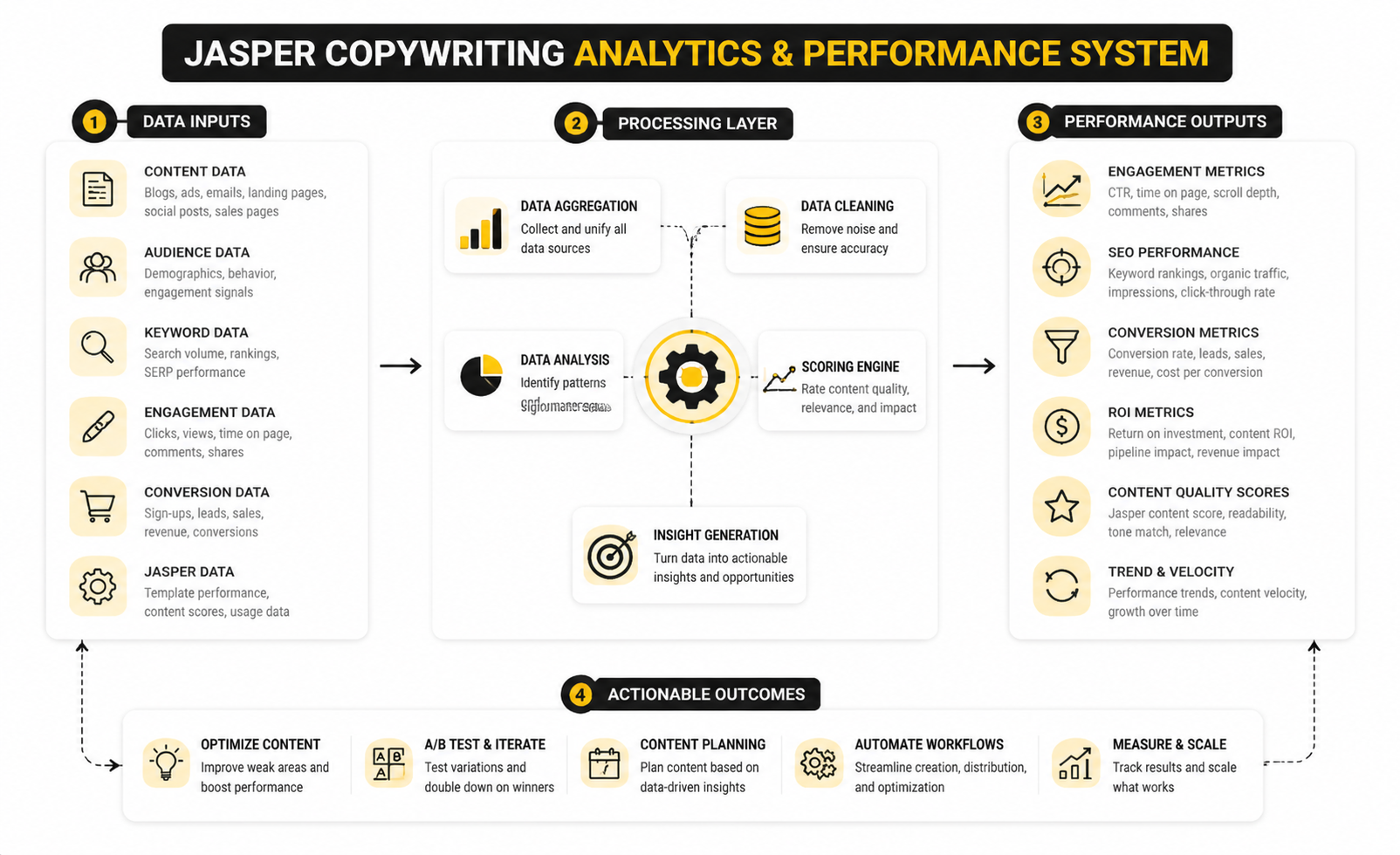
Understanding the performance of AI-generated copy is critical for optimizing marketing outcomes. Raw numbers alone—like word count or output volume—don’t tell the full story. Marketers need to interpret metrics such as engagement, conversion, readability, and SEO performance to see how effectively Jasper copywriting drives results.
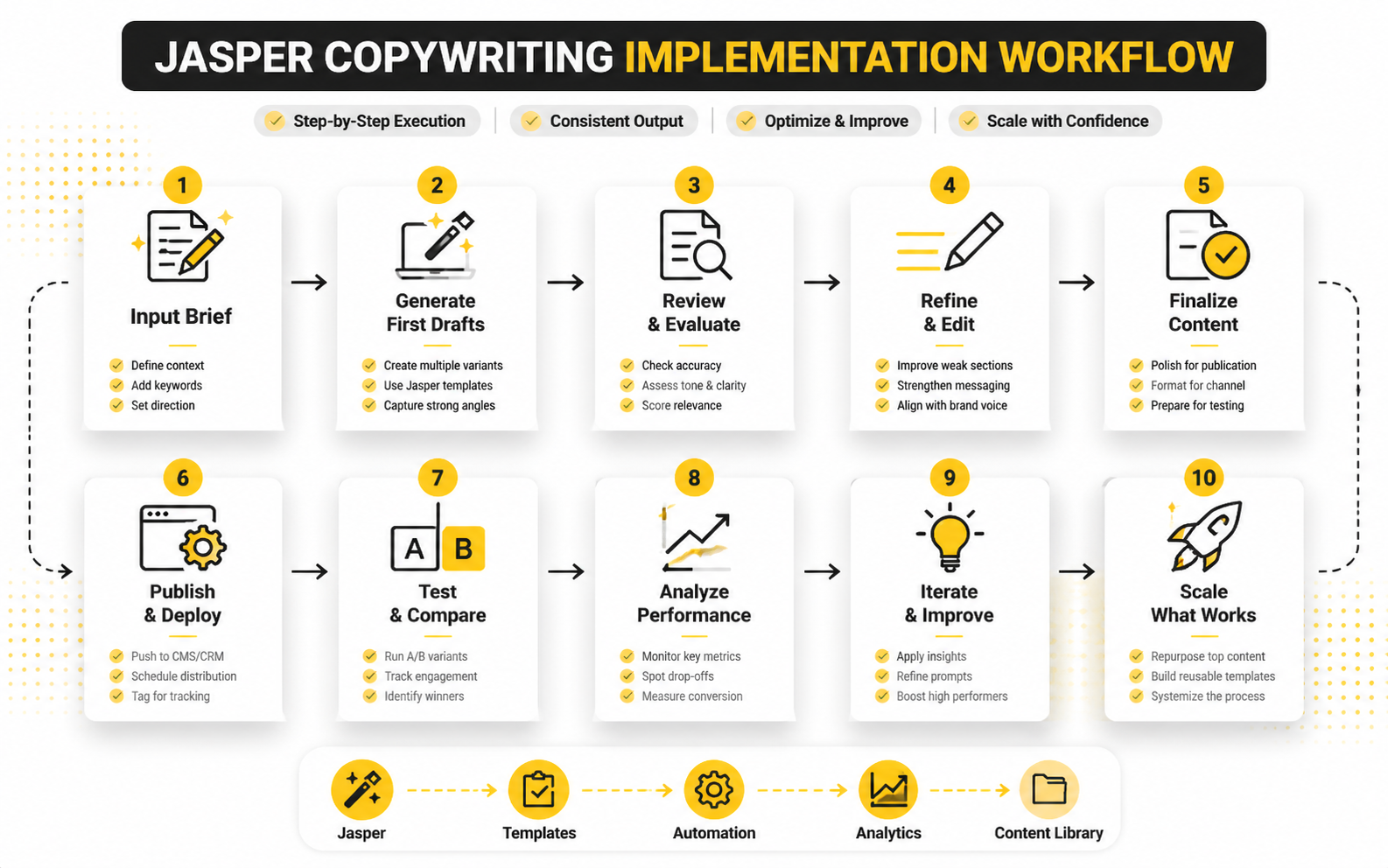
Engagement Metrics
Engagement metrics indicate how well your audience responds to AI-generated content. Key indicators include:
- Click-through rates (CTR): Higher CTR signals that headlines, calls-to-action, and messaging resonate with readers.
- Time on page or dwell time: Shows whether the content is compelling enough to keep readers engaged.
- Social interactions: Shares, comments, and likes highlight content that connects emotionally.
Tracking these metrics over multiple campaigns allows teams to refine prompts, templates, and content structures in Jasper for maximum impact.(jasper.ai)
Conversion and Performance Metrics
Conversions are the ultimate measure of effectiveness. AI-generated copy should not only attract attention but also guide readers toward desired actions, such as purchases, sign-ups, or downloads. Monitor:
- Form submissions or sign-ups on landing pages.
- Sales attributed to specific email campaigns or ad copy.
- Conversion rates across variations when running A/B tests with Jasper-generated drafts.
Analyzing these numbers informs which AI approaches work best for different audiences and campaign objectives. For example, tweaking prompt specificity often increases conversion rates by aligning messaging more closely with user intent.(jasper.ai)
Readability and SEO Performance
AI content should also be evaluated for clarity and search performance:
- Readability scores help ensure content is accessible and easy to digest.
- Keyword integration and structure affect search engine visibility.
- SERP performance provides insight into how well AI-driven content competes with organic search.
Combining these metrics gives a comprehensive view of content effectiveness, enabling teams to optimize both AI prompts and human edits strategically. This data-driven approach ensures that Jasper copywriting not only produces words faster but also drives measurable business outcomes.
Actionable Insights
The real value of metrics lies in the actions they inform. Use data to:
- Refine prompt structures for more targeted outputs.
- Adjust templates based on high-performing variations.
- Identify content types that consistently drive engagement or conversions.
- Train Jasper on specific writing styles that resonate with your audience.
By systematically interpreting these analytics, teams can turn Jasper from a tool that generates text into a strategic partner that fuels measurable marketing success.
Advanced Considerations for Scaling Jasper Copywriting
As teams move from experimentation to scaling Jasper copywriting across multiple campaigns, several strategic and operational considerations emerge. Maximizing efficiency while maintaining quality requires deliberate planning and oversight.
Balancing Automation and Human Oversight
AI-generated content accelerates production, but scaling too quickly without proper checks can introduce risks:
- Quality Drift: Automated drafts can gradually diverge from brand voice if templates and prompts aren’t consistently updated.
- Fact-Checking Needs: AI occasionally produces plausible but inaccurate statements, which can impact credibility.
- Tone Consistency: Large-scale deployments require standardized style guidelines to prevent messaging inconsistencies across platforms.
Expert teams often create a review hierarchy where AI drafts undergo multiple human edits, ensuring reliability at scale.
Managing Strategic Tradeoffs
Scaling Jasper copywriting involves tradeoffs between speed, creativity, and control:
- Speed vs. Precision: Faster output may sacrifice nuance; longer refinement cycles yield higher-quality content.
- Volume vs. Personalization: Generating thousands of variations is possible, but overly generic messaging can reduce engagement.
- Template Flexibility vs. Brand Integrity: Highly rigid templates ensure consistency but can stifle creative exploration.
Understanding these tradeoffs allows marketers to set realistic expectations for campaign performance and resource allocation.
Operational Scaling Challenges
Deploying Jasper across teams or departments introduces operational complexities:
- Workflow Integration: Coordinating AI outputs with project management, editorial calendars, and approval processes requires structured processes.
- Training and Onboarding: New users must learn prompt engineering, template management, and brand voice calibration to maintain output quality.
- Performance Monitoring: Continuous tracking of KPIs, A/B testing results, and engagement metrics ensures that scaling doesn’t compromise effectiveness.(jasper.ai)
Expert-Level Guidance
For mature organizations leveraging Jasper copywriting:
- Invest in Prompt Libraries: Curate and maintain a library of high-performing prompts for different content types.
- Standardize Templates: Develop adaptable but controlled templates that enforce brand voice across campaigns.
- Automate Analytics Integration: Feed output performance metrics into dashboards to make data-driven content decisions.
- Iterate Strategically: Use insights from performance data to refine both AI prompts and human editorial processes.
By considering these advanced factors, teams can scale Jasper copywriting effectively while minimizing risk, preserving brand integrity, and maximizing ROI.
FAQ - Built for Complete Guide
1. What is Jasper copywriting?
Jasper copywriting is an AI-powered platform that generates marketing and creative content. It uses advanced language models to create blogs, ads, emails, and social media copy while maintaining brand tone and style.
2. How does Jasper differ from other AI writing tools?
Unlike generic AI text generators, Jasper focuses on marketing outcomes. It offers templates, workflows, and brand voice customization that help teams create consistent, conversion-driven content.
3. Can Jasper replace human writers?
Jasper is designed to assist, not replace, human writers. It speeds up drafts and ideation but works best when paired with human editing for nuance, accuracy, and emotional resonance.
4. How do I ensure AI-generated content aligns with my brand?
Use Jasper’s brand voice settings, clear prompts, and custom templates. Regular review and iterative refinement help maintain consistent messaging across campaigns.
5. What types of content work best with Jasper?
Short-form ads, social media posts, email sequences, and blog outlines are ideal. Jasper can also assist with product descriptions and landing page copy where structured templates provide guidance.
6. How do I measure the effectiveness of Jasper copy?
Track engagement, conversion rates, readability, and SEO performance. Compare multiple versions and refine prompts based on real-world data to optimize results.(jasper.ai)
7. Is Jasper suitable for large-scale campaigns?
Yes, but scaling requires workflow integration, template standardization, and human oversight. Monitoring KPIs and iterative refinement ensures quality and consistency.
8. How can I improve Jasper’s output over time?
Maintain a library of high-performing prompts, refine templates, and train Jasper on your brand’s style. Continuous analysis of engagement and conversion data informs prompt and template adjustments.
9. Are there risks with AI-generated copy?
Risks include factual inaccuracies, generic phrasing, or tone drift. Regular review and proper governance mitigate these challenges while allowing AI to scale content efficiently.
10. Can Jasper assist with SEO and digital marketing optimization?
Yes, it can generate keyword-rich content and follow SEO-friendly structures. Pairing Jasper with analytics and SEO tools maximizes search visibility and campaign performance.
11. How much human editing is typically required?
It varies by content type and purpose. Marketing teams often refine AI drafts for tone, clarity, and factual accuracy to ensure high-quality, actionable content.
12. Can Jasper handle multilingual copywriting?
Yes, Jasper supports multiple languages and can adapt tone and structure based on the target language, making it suitable for global marketing campaigns.
Work With Professionals
Explore 10K+ Remote Marketing Contracts on MarkeWork.com
Most marketers spend too much time chasing clients, competing on crowded platforms, and losing a percentage of every project to middlemen. MarkeWork gives you a better way. Browse thousands of remote marketing contracts and connect directly with companies desperate to hire skilled marketers like you, without platform commissions and without unnecessary gatekeepers.
If you're serious about finding better opportunities and keeping 100% of what you earn, invite readers to explore available contracts and create a profile for free at MarkeWork.com.