

Klaviyo can look affordable when you first land on the pricing page. The problem is that most brands do not stay in the simple, low-volume scenario for long. Once your list grows, your send volume rises, and you start using SMS or extra products, the monthly bill can move fast.
That is why understanding Klaviyo cost is not really about memorizing one number. It is about knowing what drives the bill, where the platform gets expensive, and what kind of company can justify the spend. If you only compare entry pricing, you can end up budgeting for one tool and operating like it costs two or three.
This article breaks the topic into the practical pieces that matter. We will start with the pricing logic behind Klaviyo, then move into the cost drivers, implementation realities, and the situations where the platform is either a smart investment or an unnecessary expense.
Article Outline
- What Klaviyo Costs in Practice
- Why Klaviyo Pricing Matters More Than It Seems
- A Simple Framework for Estimating Klaviyo Cost
- The Core Cost Drivers Behind Your Monthly Bill
- Professional Implementation Without Wasted Spend
- Final Verdict and FAQ

Why Klaviyo Pricing Matters More Than It Seems
Klaviyo is not priced like a basic newsletter tool. The platform now revolves around active profiles, email sending capacity, SMS credits, and optional products that can stack onto the base subscription. That means your bill is tied to how your customer database behaves, not just whether you log in and send one campaign a week.
This matters because many brands underestimate how messy real lists become. You collect leads through checkout, popups, lead forms, and past campaigns, then keep more profiles than you actually market to effectively. When billing follows active profiles, poor list hygiene turns into a direct cost problem.
It also matters because Klaviyo is usually bought with high expectations. Teams pick it for segmentation, automation, ecommerce integrations, and revenue attribution. If the business is not set up to use those strengths properly, the monthly spend can feel heavy very quickly.
A Simple Framework for Estimating Klaviyo Cost
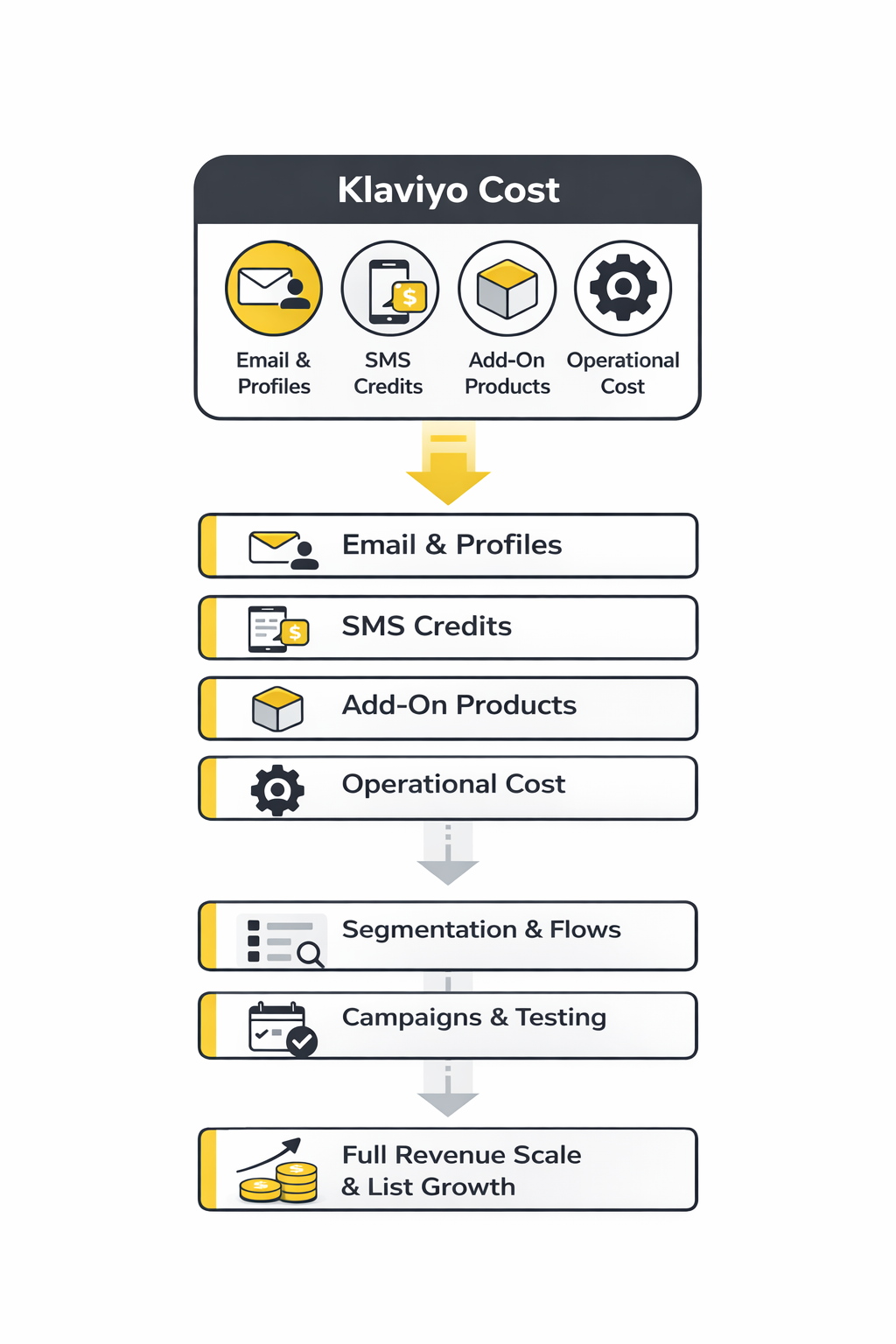
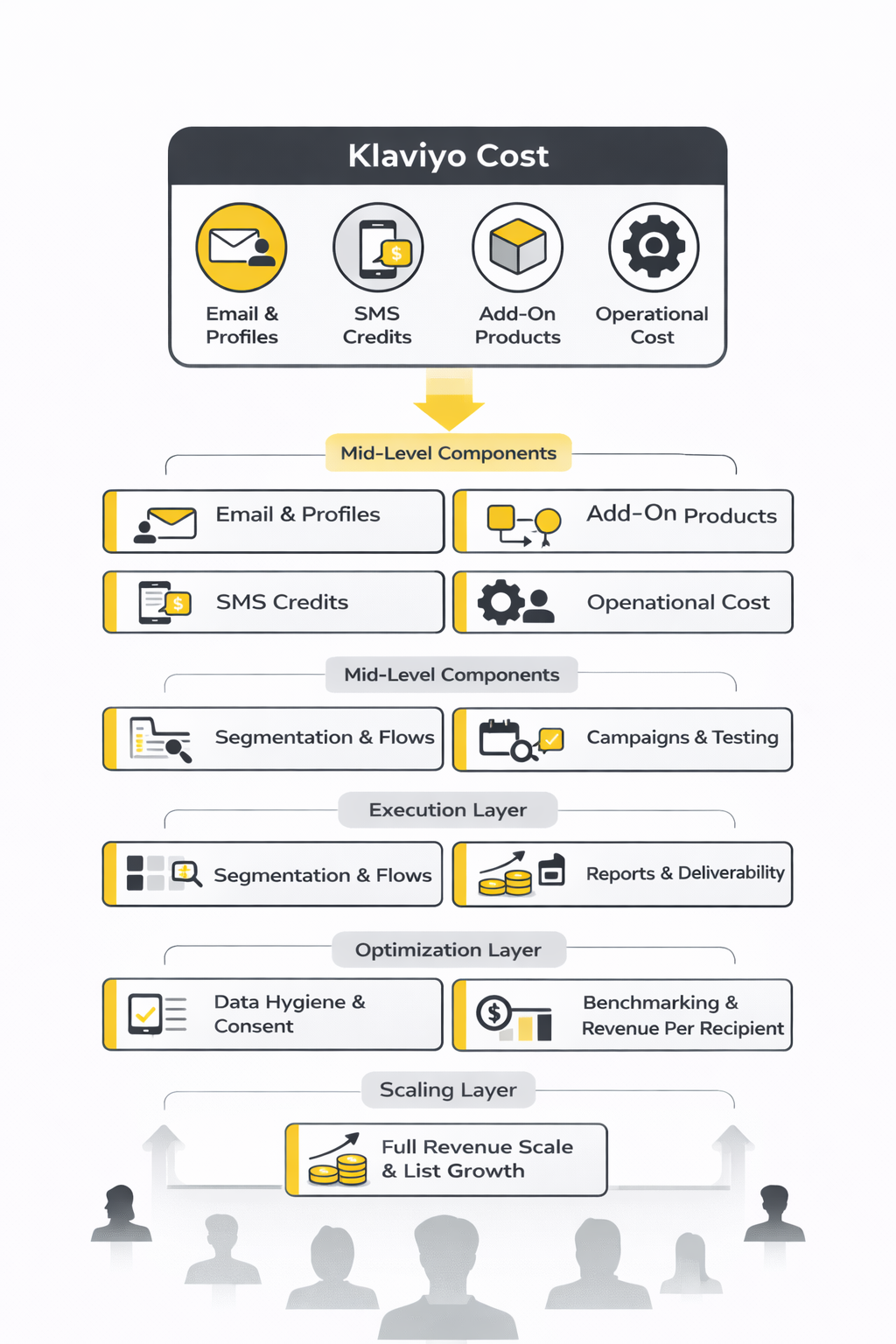
The easiest way to think about Klaviyo cost is to split it into four buckets. First, there is the base email and profile plan. Second, there is SMS, which is separate and usage-based through credits. Third, there are add-on products such as analytics, service, or customer experience tools. Fourth, there is the internal cost of running the platform well.
That last piece gets ignored far too often. Even if the software bill looks manageable, Klaviyo still needs someone to own segmentation, flows, campaign calendars, deliverability, testing, and cleanup. A cheap subscription can become expensive if the account is underused, while a more expensive account can still be profitable when it is managed properly.
So the right question is not just, “How much does Klaviyo cost?” The better question is, “What will Klaviyo cost for my list size, messaging mix, and operating model once we use it the way it is meant to be used?”
What Klaviyo Costs in Practice
At the simplest level, Klaviyo offers a free tier for very small accounts, which is useful for testing the platform and getting initial automations live. But that free tier is intentionally narrow, so it is better viewed as a starting point than a long-term operating plan. Once you grow beyond a small number of active profiles or modest monthly sending, you move into paid territory.
From there, pricing becomes more dynamic than many buyers expect. Your base plan is tied to active profiles and email volume, while SMS sits on its own pricing logic. On top of that, newer products in Klaviyo’s ecosystem can add another layer of spend if you choose to use them.
That is the big idea to keep in mind for the rest of this article. Klaviyo cost is not one flat subscription. It is a stack, and the brands that budget well are the ones that understand each layer before growth makes the total harder to control.
A Simple Framework for Estimating Klaviyo Cost
A lot of pricing articles make Klaviyo sound confusing because they mix software fees, messaging charges, and execution costs into one blurry number. The cleaner way to think about it is to separate the bill into a few distinct layers. Once you do that, Klaviyo cost becomes much easier to estimate before you commit.
Start with the platform subscription itself. Klaviyo’s core pricing is built around active profiles and your email plan, which means your monthly cost rises as your usable database grows. That is different from tools that stay closer to a flat software fee, and it is the first reason brands get surprised later.
Then add messaging usage. SMS is not just a little extra line item you can ignore. If email is your steady retention engine, SMS can become the high-intent channel that pushes revenue fast, but it can also create a second variable cost structure that grows alongside your campaigns and automations.
The third layer is product expansion. Klaviyo has moved well beyond simple email software, so some businesses end up paying not only for core messaging but also for adjacent customer data, service, or analytics capabilities. This is where the platform can become more valuable, but also where the “base price” stops being the real price.
The fourth layer is operational cost. Someone has to build flows, clean lists, watch deliverability, manage consent, run campaigns, interpret reporting, and keep the whole system aligned with the store. If nobody owns that work, the software bill becomes dead weight, even if the subscription itself looks reasonable.
A practical estimate usually follows this sequence:
- Count how many profiles you are realistically going to market to, not how many total records sit in your database.
- Estimate how often you will email those people each month.
- Decide whether SMS is a real part of your strategy or just something you might test occasionally.
- Add the human cost of setup, maintenance, and optimization.
- Stress-test the number against growth, because the list you have now is rarely the list you will have six months from now.
This framework matters because Klaviyo cost is rarely ruined by one dramatic pricing mistake. It usually gets expensive through accumulation. A bigger list, more sends, a heavier SMS program, and under-managed segmentation can all stack up quietly until the monthly spend feels much larger than the original decision implied.
The Core Cost Drivers Behind Your Monthly Bill
Active Profiles Are the Main Lever
If you want to understand what makes Klaviyo expensive, start with active profiles. This is the billing logic that shapes the entire account, because the platform grows more costly as the number of marketable people in your database rises. That means your pricing is tied to audience size and contact management discipline, not just the elegance of the software.
This is where many brands lose control. They keep old buyers, cold leads, duplicate records, giveaway signups, and low-intent subscribers in the same system for too long. The result is simple: you are not just carrying a messy database, you are paying for one.
That makes list hygiene a financial decision, not just a deliverability best practice. Suppressing disengaged contacts, tightening form quality, and segmenting based on actual engagement can reduce waste without reducing real revenue opportunity. In Klaviyo, cleaner data often means a cleaner bill.
Email Volume Still Shapes the Real Spend
Even though Klaviyo is commonly described as profile-based pricing, email activity still matters in practice. The more aggressive your campaign calendar becomes, the more pressure you put on sending limits, account structure, and the commercial logic of the plan you are on. A lean account with disciplined flows behaves very differently from an account blasting broad promotions every few days.
This is why two brands with similar profile counts can experience Klaviyo cost very differently. One brand may rely heavily on automated lifecycle flows and only send a few highly targeted campaigns. Another may run frequent storewide pushes, seasonal drops, launch sequences, and win-back sends that create a much heavier operational footprint.
The hidden point here is that poor email strategy increases cost even when the platform fee itself seems fixed. If you send too broadly, you burn attention, hurt engagement, and keep paying for people who stop responding. Bad campaign discipline makes the account more expensive over time because it weakens the quality of the database that pricing depends on.
SMS Changes the Math Fast
SMS deserves its own attention because it changes the economics of Klaviyo very quickly. Email often feels cheap once the system is in place, but SMS behaves more like a variable media channel. The more you use it, the more obvious the spend becomes.
That is not necessarily a bad thing. SMS can be one of the strongest channels for urgency, replenishment reminders, time-sensitive promotions, and post-purchase touchpoints. But when brands add it casually, without clear rules for frequency, segmentation, and consent quality, the bill grows faster than the strategy matures.
This is why smart operators do not just ask whether they should enable SMS. They ask which flows justify it, which customer segments should receive it, and where text messages should replace email instead of simply piling on top of it. Klaviyo cost stays more rational when SMS is treated as a precision tool rather than a volume habit.
Add-Ons and Ecosystem Creep Are Easy to Miss
Another cost driver is what I would call ecosystem creep. You join Klaviyo for email and SMS, then over time you start looking at adjacent products, richer data use cases, or expanded customer experience functions. None of these choices are automatically wrong, but they move you away from a simple subscription and into a broader software stack decision.
This matters most for growing ecommerce brands that want fewer tools. Consolidation can absolutely be worth paying for when it reduces integration problems, reporting gaps, and operational drag. But it only pays off if you are really replacing separate tools, not just adding more layers because they are available.
So when evaluating Klaviyo cost, do not stop at the monthly entry number. Look at the likely version of your account twelve months from now. That future version is usually closer to the real cost than the starter tier that got your attention in the first place.
Professional Implementation Without Wasted Spend
This is the part most pricing guides skip. Klaviyo cost is not just about what shows up on the invoice. It is also about whether your team sets the account up in a way that keeps the platform efficient as the list grows.
A sloppy implementation makes everything more expensive later. You pay for profiles you should have cleaned, flows you should have simplified, and campaigns that hit too many people with too little relevance. A disciplined setup does the opposite: it keeps the database healthier, makes revenue attribution clearer, and gives you a much better shot at earning back the software cost.
The goal is not to build the most advanced Klaviyo account on day one. The goal is to build an account that is clean, measurable, and easy to improve without creating cost creep every month.
Start With Data Before You Start With Design
A lot of teams begin with templates, popups, and campaign ideas because that work feels visible. The smarter move is to start with data structure. If your integrations, profile properties, consent states, and event tracking are messy from the beginning, every nice-looking email you build sits on top of weak foundations.
That matters because Klaviyo becomes powerful only when the data is usable. Segmentation, automation, personalization, and reporting all depend on the quality of what is flowing into the platform. If customer events are incomplete or inconsistent, you will end up paying for capabilities you cannot fully use.
So before anyone obsesses over brand colors and hero sections, make sure the store connection is solid, consent capture is clear, and profile data is arriving in a format your team can actually work with. That is not glamorous, but it is the difference between a platform that scales and a platform that slowly turns into overhead.
Build Around a Small Number of Core Flows
The next mistake is overbuilding too early. Brands often hear that Klaviyo is strong for automation and immediately start sketching ten or fifteen different flows. In practice, most of the value comes from a smaller set of lifecycle automations that are tightly aligned with customer behavior.
That is where professional implementation saves money. Instead of creating a maze of overlapping logic, start with the flows that usually matter most: welcome, abandoned cart, browse or product interest where relevant, post-purchase, and win-back. Those are easier to maintain, easier to measure, and less likely to create duplicated sending that inflates fatigue and lowers engagement.
This also gives the team a cleaner operating rhythm. When a few foundational automations work properly, you can refine timing, segmentation, and creative based on real performance. When the account is packed with half-finished flows, the cost of managing Klaviyo rises faster than the return.
A Practical Rollout Process
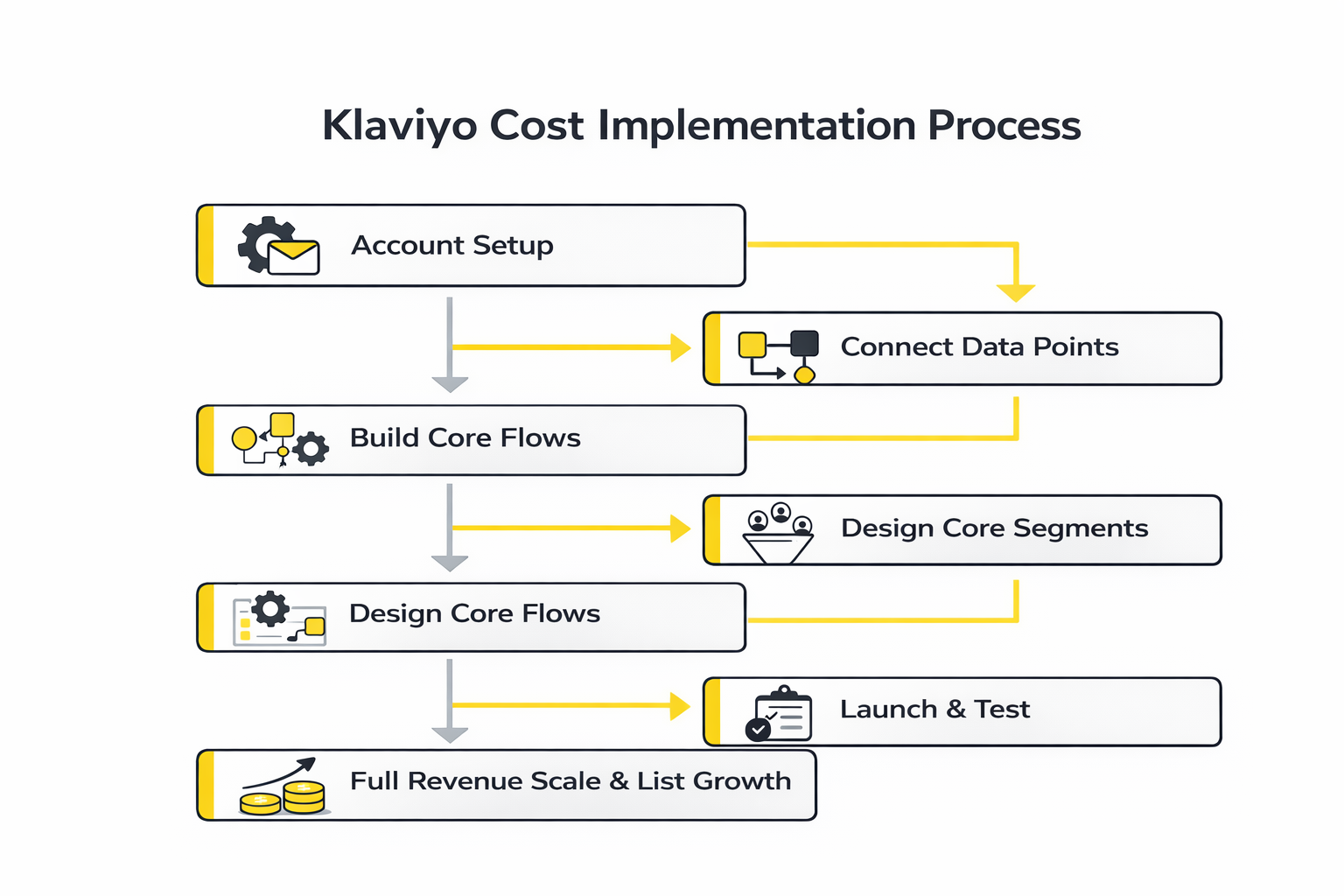
A clean rollout usually follows a simple sequence. It is not flashy, but it is what keeps Klaviyo cost under control while the account matures.
- Connect the ecommerce platform and verify that customer, order, and site behavior data are syncing correctly.
- Confirm email consent and SMS consent are being captured in the right places and stored clearly at the profile level.
- Build the core segments you will actually use, such as new subscribers, recent purchasers, high-intent browsers, and disengaged contacts.
- Launch a limited set of foundational flows before expanding into edge-case automations.
- Create a campaign rhythm that matches your team’s real capacity, not an idealized content calendar.
- Set a recurring review process for suppression, list cleanup, engagement windows, and flow performance.
This process works because it reduces rework. You are not constantly rebuilding around broken logic or paying for growth that comes from low-quality acquisition. The account stays understandable, and that alone has real economic value once more people start touching it.
Consent and List Quality Need Executive Attention
Consent is often treated like a legal checkbox delegated to whoever is nearest to the forms builder. That is a mistake. In a platform like Klaviyo, consent quality directly affects who you can message, how clean your database stays, and whether your expansion into channels like SMS makes commercial sense.
The same goes for list quality. If the business is aggressively collecting names without caring about intent, the profile count rises faster than the value of the audience. That is one of the easiest ways for Klaviyo cost to drift upward without a matching lift in performance.
Strong operators are ruthless here. They care how contacts entered the system, what they actually consented to, and whether those profiles are still worth marketing to. That discipline protects more than compliance. It protects margin.
Reporting Has to Be Set Up for Decision-Making
Implementation is not finished when the flows are live. It is finished when the team can tell what is working, what is wasting money, and where the next improvement should happen. Without that layer, Klaviyo becomes a busy platform rather than a managed growth system.
The reporting structure should answer practical questions, not vanity questions. Which flows are driving meaningful revenue? Which segments are growing but not engaging? Which campaigns are broadening the list but weakening quality? Which channels deserve more budget and which ones need tighter controls?
When you can answer those questions regularly, the platform becomes easier to justify. You are no longer guessing whether Klaviyo cost is acceptable. You are comparing real spend against real outcomes and adjusting before waste compounds.
The Best Implementation Is Boring in the Right Places
This is worth saying clearly because people often expect a more exciting answer. The best Klaviyo accounts are not chaotic, overengineered, or endlessly experimental. They are boring in the right places.
Their data is consistent. Their flows have clear jobs. Their suppression logic is not neglected. Their campaign calendar is realistic. Their team knows what they are measuring and why. That kind of account may not look dramatic from the inside, but it usually produces a much healthier relationship between Klaviyo cost and business value.
And that is the whole point of professional implementation. You are not trying to impress yourself with complexity. You are trying to create a retention system that earns its keep month after month.
What the Numbers Actually Tell You
Once the account is implemented properly, the next question is simple: is Klaviyo cost paying for itself? This is where measurement matters, because the wrong dashboard can make an expensive platform look healthy, and the right dashboard can reveal waste very quickly. You do not need fifty metrics to answer that question, but you do need the right ones in the right order.
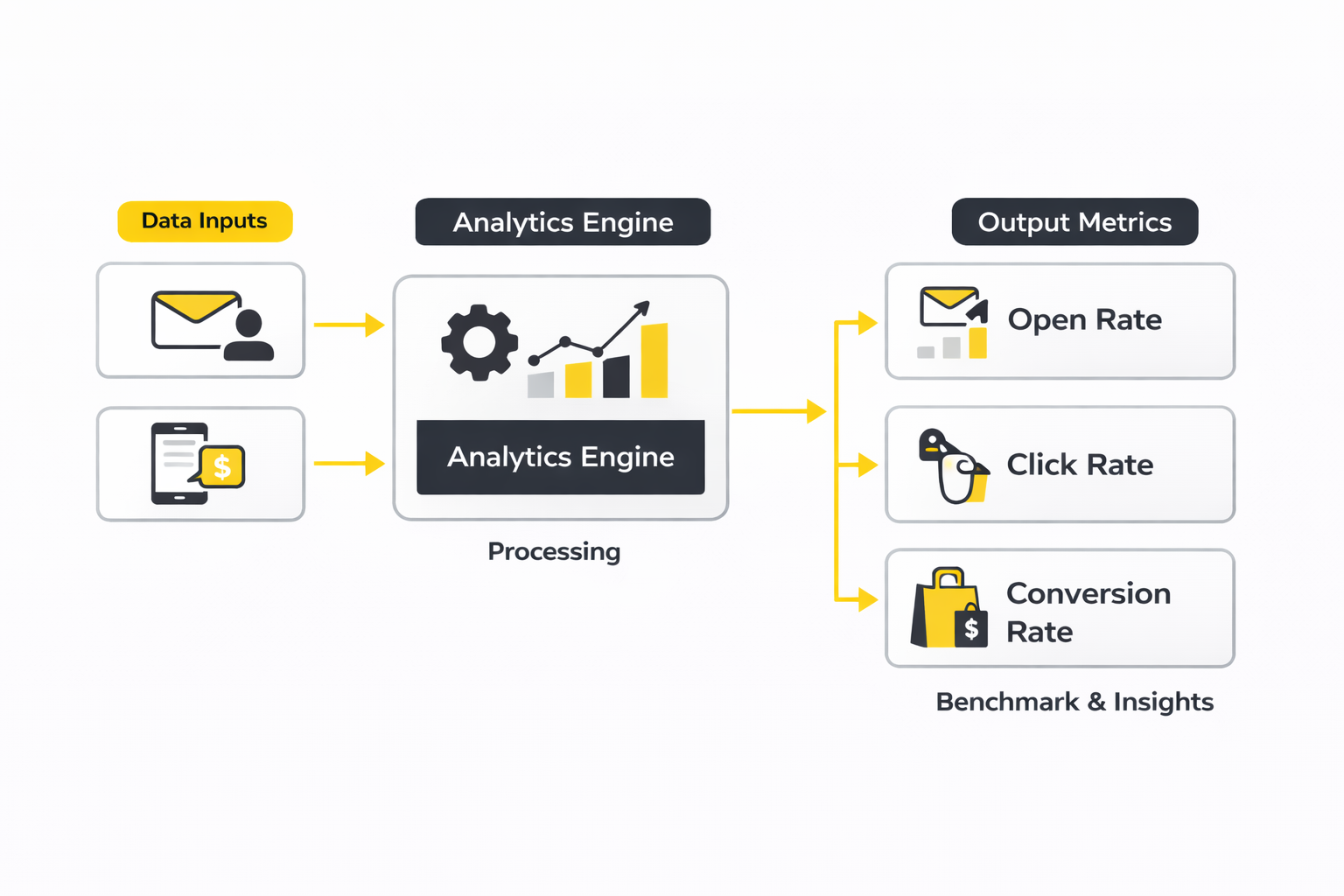
The first thing to understand is that email and SMS metrics are not all equally important. Open rate can tell you whether subject lines, deliverability, and audience targeting are in a decent range, but it does not tell you whether the program is commercially strong. Cost decisions should lean much harder on downstream numbers like click quality, order rate, revenue per recipient, and how automation performs against campaigns.
Start With Efficiency, Not Vanity
If you are trying to decide whether Klaviyo is worth the spend, the cleanest first measure is revenue efficiency. In plain English, that means asking how much value you create per recipient, per message type, and per automation rather than celebrating raw send volume. A larger account can look impressive on the surface while quietly getting less productive every month.
This is why broad benchmark numbers should be interpreted carefully. Industry-wide email engagement can still look solid, with ecommerce benchmarks in the Brevo 2025 report showing ecommerce open rates around 38.58% and click-through rates around 2.08%, but those numbers alone do not prove your account is economically healthy. A brand can beat an open-rate benchmark and still overspend on profiles, overmessage weak segments, or underconvert the clicks it earns.
What matters more is whether each message is doing useful work. If your click rate is steady but revenue per recipient is weak, the issue is not usually “email as a channel.” It is more often offer quality, audience intent, landing-page friction, or automation timing. That is a much better action path than just trying to squeeze another point of open rate out of the same list.
Automation Should Outperform Campaigns
One of the clearest performance signals in retention marketing is the gap between automated messages and scheduled campaigns. When automations are well built, they usually convert better because they are tied to behavior, timing, and intent instead of being sent broadly to a large audience. That distinction matters a lot when you are trying to justify Klaviyo cost, because automation is one of the main reasons companies choose the platform in the first place.
Recent ecommerce benchmark data shows exactly why this matters. In Omnisend’s 2025 ecommerce report, automated emails drove 37% of sales while accounting for only 2% of email volume, and one in three people who clicked an automated message ended up purchasing. The same report found that abandoned cart, welcome, and browse abandonment messages were responsible for 87% of all automated orders, which tells you where most of the commercial leverage usually sits.
That should drive a very practical decision. If your Klaviyo account relies mostly on campaign blasts and your core flows are weak or underdeveloped, the platform will feel more expensive than it should. If your automations are carrying a meaningful share of revenue with relatively low send volume, the cost picture usually looks much healthier.
The Metrics That Actually Deserve Weekly Attention
A useful measurement system is smaller than most teams think. You need enough metrics to see whether the account is healthy, whether customer attention is improving or deteriorating, and whether spend is turning into profitable retention. You do not need a giant reporting deck that nobody acts on.
The most useful weekly view usually includes:
- deliverability signals, including bounce trends and unsubscribe pressure
- click rate and click-to-open quality, so you can separate curiosity from real engagement
- flow-by-flow order rate and revenue per recipient
- campaign performance by segment, not just in aggregate
- list growth versus list decay
- SMS performance separated from email so one channel does not hide the weaknesses of the other
This approach works because it connects metrics to decisions. Rising unsubscribes tell you to slow frequency or tighten targeting. Stable opens with falling clicks point toward weaker creative, weaker offers, or audience fatigue. Strong clicks with poor conversion usually push you to inspect the landing page, pricing, or checkout experience rather than the message itself.
Revenue Per Recipient Is the Closest Thing to a Truth Metric
If I had to reduce the dashboard to one commercial metric, it would be revenue per recipient. That number forces discipline because it combines audience quality, message relevance, and conversion outcome into something much harder to fake. It is not perfect, but it is much more useful than admiring top-line sends or total attributed revenue without context.
Klaviyo’s own benchmark materials lean heavily into revenue-per-recipient and order-rate comparisons for exactly this reason. Those measures help you compare performance in a way that adjusts better for list size and message volume, which is important when platform cost rises with the scale of the audience. A bigger list is not automatically better if each additional profile contributes less economic value than the last.
This metric also helps you spot when growth is becoming inefficient. If your active profiles rise quickly while revenue per recipient falls, you are probably buying or collecting attention faster than you are monetizing it. That is exactly the kind of pattern that makes Klaviyo cost feel painful six months later.
Benchmarking Only Helps When the Peer Group Makes Sense
There is another trap here. Too many teams compare themselves to broad market averages that do not match their business model, price point, or buying cycle. That creates false confidence for some brands and unnecessary panic for others.
Klaviyo’s benchmarking approach is useful when it compares you against businesses that actually resemble yours in scale and dynamics rather than just dropping you into a huge industry bucket. That matters because a fast-moving apparel brand and a high-consideration home goods brand should not read the same click, order, or revenue expectations in the same way. Context changes what “good” looks like.
So use benchmarks as directional tools, not as identity tests. They should help you prioritize where to investigate, not make you chase random averages. If your unsubscribe rate is fine, your click quality is improving, and your revenue per recipient is rising, the account may be healthy even if one surface-level number looks unremarkable.
What the Data Should Make You Do Next
Data is only useful if it changes behavior. If your flows outperform campaigns by a wide margin, shift more effort into automation refinement before adding more broadcast volume. If popups convert weakly, fix acquisition quality before paying for more profiles you will never monetize. If SMS is generating strong response in a narrow set of moments, keep it narrow instead of forcing it into every promotion.
That is the real purpose of measurement in a Klaviyo account. It is not there to make reporting look sophisticated. It is there to tell you whether the platform is becoming more efficient as it grows or simply becoming more expensive.
Strategic Tradeoffs as You Scale
By this point, the real question is no longer whether Klaviyo has good features. The real question is whether the platform still makes economic sense as your list, channel mix, and team complexity increase. That is where Klaviyo cost stops being a simple software discussion and becomes a strategic operating decision.
This matters because scaling can hide inefficiency for a while. Revenue grows, the list expands, and the account looks busier every quarter, but underneath that activity you can still be paying too much for low-quality profiles, weak campaign discipline, or tool overlap. A growing brand can absolutely afford Klaviyo and still use it badly.
The More You Scale, the More Precision Matters
At a small size, waste is often survivable. A few underperforming flows, an overbroad segment, or a messy list might not hurt enough to force serious discipline. As the account grows, those same mistakes become expensive because they multiply across a much larger profile base.
This is why bigger brands do not win by simply sending more. They win by getting more selective about who receives what, how often, and in which channel. Klaviyo cost gets easier to justify when the business becomes more precise as it scales, not just louder.
That creates an important shift in mindset. Early on, growth often feels like a quantity problem. Later, it becomes a quality-control problem, and the brands that miss that transition usually end up blaming the software bill for issues that were really operational.
Complexity Can Quietly Kill Return
There is a point where more segmentation, more flows, and more channel rules stop creating clarity and start creating drag. Teams love the idea of sophisticated lifecycle architecture, but complexity has a maintenance cost that rarely shows up in the initial decision. Every extra branch, exception, and trigger has to be reviewed, understood, and kept aligned with the rest of the account.
That does not mean advanced setups are bad. It means they should be earned. If a brand cannot clearly explain why a workflow exists, what business problem it solves, and what metric proves it deserves to stay, that workflow is probably adding more cost than value.
This is one of the most common expert-level mistakes with Klaviyo. The account becomes technically impressive but commercially harder to run. When that happens, the platform fee is only part of the problem. The bigger cost is the attention the team burns managing unnecessary complexity.
Tool Consolidation Can Help or Hurt
As brands mature, they often start asking whether Klaviyo should remain one tool inside a broader stack or become part of a more consolidated operating model. That is a smart question, because software sprawl creates reporting gaps, handoff problems, and duplicated effort. In some businesses, paying more for a stronger core platform is the right move because it simplifies everything around it.
But consolidation only works when it replaces real cost and real friction. If you are still paying for overlapping popup tools, service tools, reporting tools, and campaign systems while also expanding your Klaviyo footprint, then consolidation is not really happening. You are just layering subscriptions on top of each other and calling it strategy.
This is where alternatives can become relevant. Some companies discover they do not need Klaviyo’s full depth and would be better served by a broader all-in-one stack like GoHighLevel, especially if they care as much about CRM, pipeline, and multi-service operations as they do about ecommerce lifecycle messaging. Others may decide that a lighter email-first platform such as Brevo fits the business better if list-based cost pressure is becoming more painful than the advanced segmentation upside.
Deliverability Risk Gets More Expensive Over Time
One of the biggest scaling risks is deliverability decay. When brands grow quickly, they often keep adding names, increasing frequency, and expanding channels without tightening audience quality at the same pace. The result is subtle at first, then expensive later: weaker engagement, more fatigue, more inactive profiles, and a retention engine that costs more to run while producing less value per contact.
This is why list health should be treated as a board-level efficiency lever, not a junior marketing cleanup task. If the business is paying more each month to carry disengaged people it should have suppressed, then Klaviyo cost is being driven upward by indecision. That is not a pricing problem. That is a management problem.
The expert move is to accept some short-term discomfort in exchange for long-term efficiency. Smaller active audiences, tighter engagement windows, and sharper suppression rules can feel scary because they make the reachable list look smaller. In reality, they often make the economics much stronger.
SMS Expansion Needs Restraint
SMS is often where scaling brands overestimate their own sophistication. The channel feels powerful because it is immediate, visible, and capable of producing fast response. That is exactly why it needs restraint.
When SMS is used with discipline, it can sharpen a retention program. When it is used impulsively, it accelerates fatigue and makes the overall messaging program feel more invasive. The danger is not just customer annoyance. The danger is that a brand starts paying more for extra channel activity that weakens trust over time.
That is why expert teams treat SMS as a high-value layer, not a default extension of every email idea. They reserve it for moments where urgency, relevance, and timing are genuinely stronger than what email alone can deliver. That keeps the channel commercially useful instead of turning it into an expensive habit.
Your Team Model Matters More Than Most People Admit
Software selection conversations often pretend the tool is the main variable. In reality, the team operating model often decides whether Klaviyo cost feels justified. A strong platform in weak hands will underperform a simpler platform run by a focused team with clear accountability.
This becomes obvious as the business scales. If no one owns retention strategy end to end, the account drifts. Flows stay live too long without review, reporting gets fragmented, and campaign pressure starts filling gaps that better automation should have covered. The bill keeps arriving, but the system becomes less intentional.
That is why expert guidance usually sounds boring. Assign clear ownership. Limit unnecessary complexity. Review list health often. Tie metrics to decisions. Keep channel expansion under control. None of that is flashy, but it is usually what separates a profitable Klaviyo account from an expensive one.
The Best Time to Reevaluate Cost Is Before It Hurts
Most brands reassess software spend only after the bill starts to feel painful. That is too late. The smarter move is to reevaluate when performance is still decent, because you can make cleaner decisions before urgency distorts them.
Ask a few hard questions. Is the account getting more efficient as the list grows, or just bigger? Are automations doing the heavy lifting, or are campaigns compensating for weak system design? Is the team using Klaviyo deeply enough to justify a premium retention stack? If the answers are fuzzy, that is the signal.
This is the advanced view of Klaviyo cost. It is not just a monthly number to tolerate. It is a test of whether your retention system is becoming sharper as the business scales, or whether you are paying more every month to preserve avoidable mess.
Final Verdict
Klaviyo cost makes sense when your business is ready to use the platform with discipline. If you have real segmentation needs, meaningful automation opportunities, and someone who can manage retention properly, the spend can be justified. If your list is messy, your team is thin, and your lifecycle strategy is still basic, the platform can feel expensive faster than expected.
That is the honest answer. Klaviyo is not overpriced for everyone, but it is absolutely overbought by companies that want advanced retention results without advanced operational habits. The winners are usually the brands that keep their data clean, build around a few high-value flows, measure revenue efficiency closely, and resist the urge to turn every new feature into more complexity.
FAQ - Built for Complete Guide
Is Klaviyo expensive for small businesses?
Klaviyo can be affordable at the very beginning, but it often feels expensive once a small business starts growing its active profile count without a tight retention strategy. The platform becomes much easier to justify when those profiles are being monetized through strong flows and disciplined segmentation. For a small brand with simple needs, the real issue is usually not whether Klaviyo is good, but whether the business is ready to use enough of it to justify the cost.
How does Klaviyo pricing actually work?
Klaviyo pricing is primarily tied to active profiles for email, while SMS usually adds a separate usage-based cost. That means the bill is shaped by how many people you can market to and how heavily you use the messaging channels. In practice, your cost is a combination of database size, sending behavior, and whether you add any extra products or services.
What counts as an active profile in Klaviyo?
An active profile is generally someone who is eligible to receive email in your account rather than just a record that exists in storage. This is why list cleanup matters so much, because old and disengaged contacts can still influence what you pay if they remain marketable. The practical lesson is simple: if a profile should not be emailed, do not keep treating it like a live revenue opportunity.
Does Klaviyo get more expensive as your list grows?
Yes, and that is one of the most important things to understand before committing long term. Klaviyo cost tends to rise with audience growth, which is fine when revenue per recipient stays strong but frustrating when list quality deteriorates. Growth only feels healthy when the added profiles are productive enough to support the higher bill.
Is Klaviyo worth it for ecommerce brands?
For many ecommerce brands, yes, especially when abandoned cart, welcome, post-purchase, and win-back flows are central to the business. Klaviyo is built around the kind of behavioral data and segmentation that ecommerce teams usually care about most. The catch is that ecommerce alone does not guarantee a good return, because weak execution can still make a strong platform feel overpriced.
What is the biggest mistake brands make when estimating Klaviyo cost?
The biggest mistake is looking only at the starting subscription number and ignoring everything around it. Brands often forget to budget for list growth, SMS usage, cleanup work, ongoing optimization, and the internal ownership needed to keep the account efficient. That leads to a situation where the software did exactly what it was designed to do, but the company never planned for the real operating cost.
Should you use SMS inside Klaviyo or keep it separate?
That depends on how integrated you want your lifecycle program to be and whether your team can manage SMS with restraint. Keeping email and SMS in the same environment can simplify segmentation, reporting, and automation logic. But if the team is not disciplined, it can also make it easier to overmessage customers and turn a useful channel into a fast-growing expense.
How often should you review your Klaviyo account for cost control?
At minimum, you should review list quality, flow performance, engagement windows, and active profile pressure every month. If the brand is growing quickly or using SMS aggressively, a weekly operational check is even better. Klaviyo cost usually becomes a problem gradually, so regular review is what prevents small inefficiencies from turning into structural waste.
What metrics matter most when deciding if Klaviyo is worth the money?
The most useful metrics are the ones that connect spend to business outcomes, not the ones that just make reporting look active. Revenue per recipient, flow-level order rate, segment quality, unsubscribe trends, and channel-specific efficiency are much more useful than obsessing over send totals. Those numbers tell you whether the platform is becoming more productive as it grows or simply more expensive.
Can Klaviyo be cheaper than using multiple separate tools?
Yes, in some cases it absolutely can. If Klaviyo replaces several tools, reduces integration headaches, and gives your team a cleaner workflow, the higher apparent price can still be the better financial choice. But that only works when consolidation is real, because paying for Klaviyo while keeping a pile of overlapping tools is not efficiency, it is software sprawl.
When should a brand consider an alternative to Klaviyo?
A brand should consider alternatives when it consistently uses only a small fraction of Klaviyo’s capabilities or when active-profile pricing creates pressure that the business cannot turn into return. This is especially relevant for teams that want a broader operating system rather than a retention-first platform, or for teams that need a simpler email setup with lower structural complexity. The key is not to leave Klaviyo because it is popular or premium, but to leave because the fit is wrong.
Is there a point where Klaviyo cost becomes a sign of success rather than a problem?
Yes, but only when the increased spend reflects profitable scale rather than avoidable waste. A higher bill is not automatically bad if the account is generating stronger flows, better segmentation, healthier retention, and more efficient revenue from a growing audience. In that situation, Klaviyo cost is not the warning sign; it is simply the price of a system that is doing real work.
Work With Professionals
Explore 10K+ Remote Marketing Contracts on MarkeWork.com
Most marketers spend too much time chasing clients, competing on crowded platforms, and losing a percentage of every project to middlemen. MarkeWork gives you a better way. Browse thousands of remote marketing contracts and connect directly with companies desperate to hire skilled marketers like you, without platform commissions and without unnecessary gatekeepers.
If you're serious about finding better opportunities and keeping 100% of what you earn, explore available contracts and create a profile for free at MarkeWork.com.