

Choosing between Klaviyo plans looks simple until your list grows, SMS enters the picture, and “free” stops meaning useful. The real question is not just what Klaviyo costs today. It is whether the plan matches your revenue stage, contact quality, sending volume, and retention strategy.
Klaviyo now serves over 193,000 customers, so the platform is clearly not a niche email tool anymore. It has become a broader B2C CRM for brands that want email, SMS, customer data, automation, reviews, analytics, and newer channels under one roof. That is powerful, but it also means the wrong setup can get expensive fast.
This guide breaks Klaviyo plans down in plain English. No fluff, no fake case studies, and no pretending every store needs the same stack.
- Why Klaviyo Plans Matter
- Klaviyo Plans Framework Overview
- Free, Email, And Email + SMS Plans Explained
- Core Components That Change Your Real Cost
- Professional Implementation For Growing Brands
- How To Choose, Optimize, And Review Your Plan
- Klaviyo Plans FAQ
Why Klaviyo Plans Matter
Klaviyo plans matter because pricing is tied closely to how your customer database grows. A small store can start cheaply, but the bill can rise as active profiles, email volume, SMS usage, and add-ons increase. That makes Klaviyo less like a fixed monthly tool and more like an operating cost that needs active management.
The upside is that Klaviyo is built for revenue-producing retention work. Email flows, segmentation, abandoned checkout recovery, post-purchase messaging, and product-based targeting can justify the cost when they are implemented properly. The downside is simple: if your account is full of unengaged profiles, messy segments, and unused channels, you may pay for complexity without getting the return.
This is why picking a Klaviyo plan should not start with the cheapest tier. It should start with what your business actually needs to send, who you need to reach, and how much revenue your retention system can realistically support.
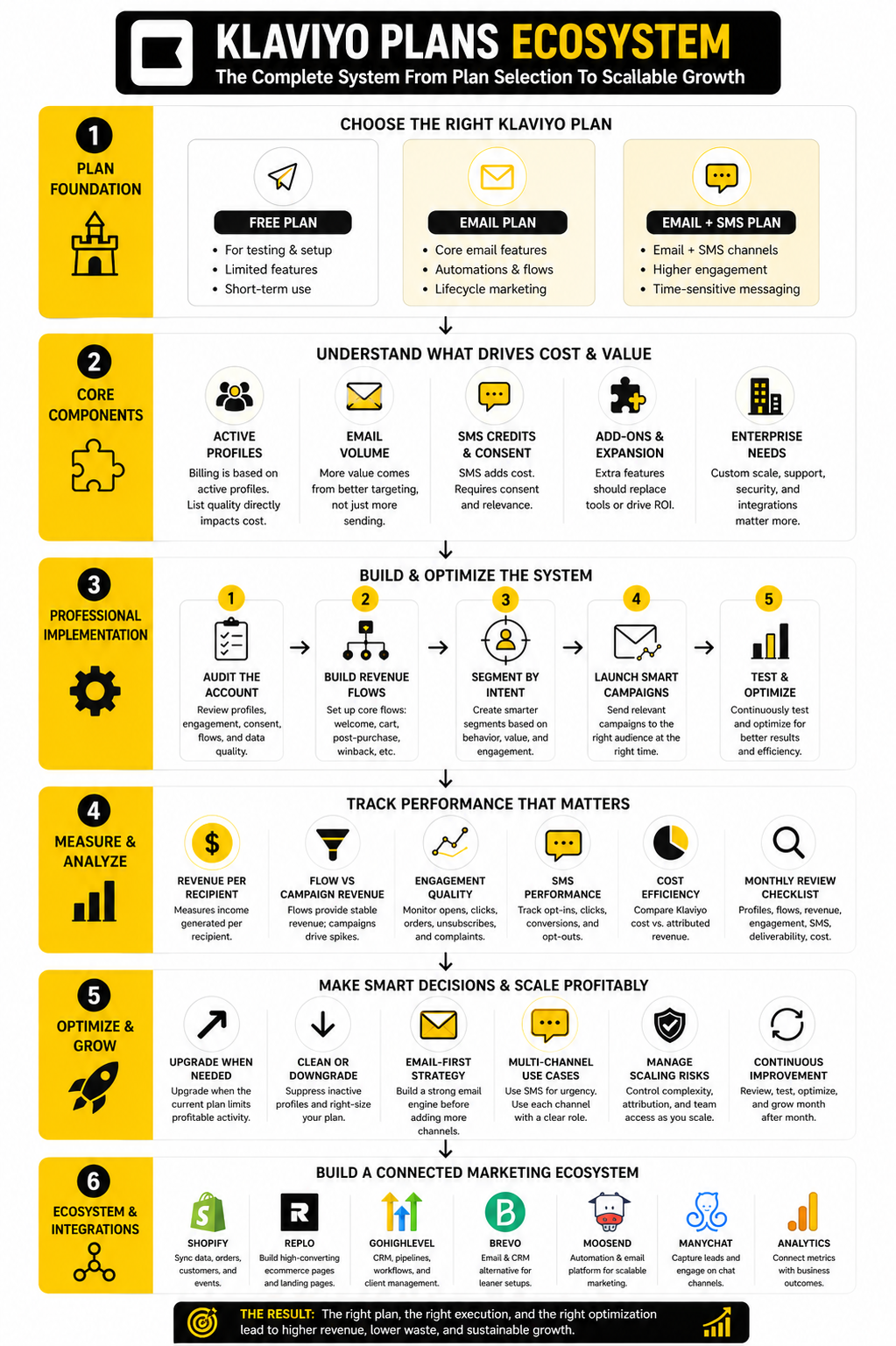
Klaviyo Plans Framework Overview
The cleanest way to understand Klaviyo plans is to separate them into three decisions. First, decide whether you only need email or whether SMS is a real part of your customer journey. Second, check how many active profiles you have, because Klaviyo billing is heavily shaped by profile count and plan limits. Third, decide whether you need advanced support, analytics, reviews, WhatsApp, or enterprise-level features.
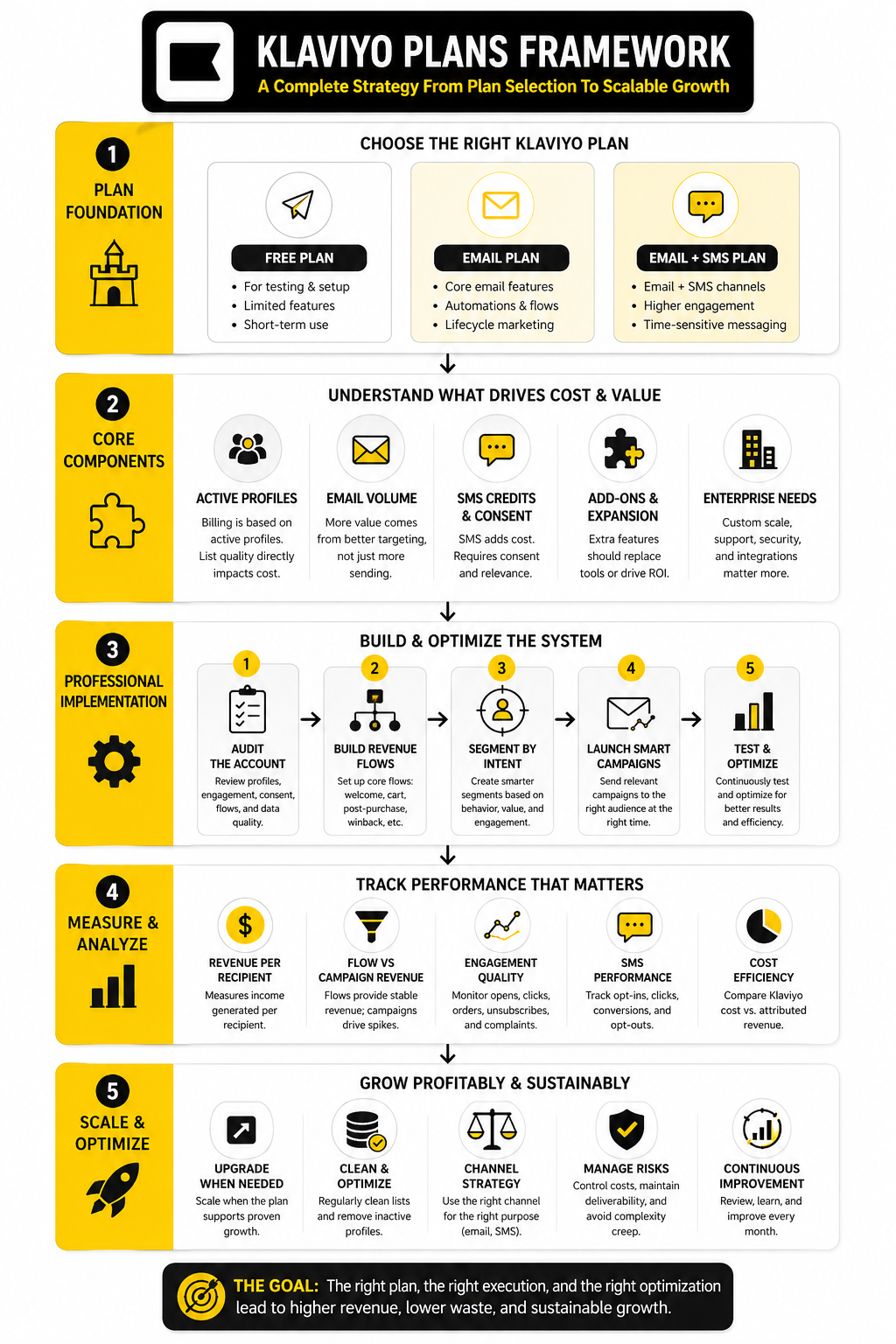
For most brands, the decision path is straightforward. New stores usually start with the free plan or the basic Email plan. Growing ecommerce brands often move into Email + SMS once they have a strong reason to use text messaging, not just because it sounds more advanced.
Larger teams need to think differently. At that stage, the question is not “Which Klaviyo plan is cheapest?” It becomes “Which plan gives us the cleanest data, strongest automations, best deliverability, and least operational drag?”
Free, Email, And Email + SMS Plans Explained
Klaviyo plans are easiest to compare when you treat them as stages, not random pricing boxes. The Free plan is for testing and early setup. The Email plan is for brands that are ready to make email a serious revenue channel. The Email + SMS plan is for teams that already know where text messaging fits in the customer journey.
That distinction matters because Klaviyo pricing is not only about features. It is also shaped by active profiles, message volume, and whether you add channels beyond email. Klaviyo’s own billing documentation says accounts are charged based on active profiles and messages sent, which is why list quality becomes a pricing issue, not just a marketing issue.
The Free Plan
The Free plan is useful when you are setting up Klaviyo for the first time, building your first signup forms, connecting your store, and learning how the platform works. It usually makes sense for new ecommerce brands, pre-launch stores, or small lists that are not ready for paid sending yet. You can use it to understand the interface, test core email features, and start building the foundation before committing to a monthly bill.
The limitation is that the Free plan should not be treated as a long-term growth plan. Once your list grows or you need more consistent campaign sending, the restrictions become obvious. You may also run into branding, support, and volume limitations that make the account feel more like a sandbox than a serious retention system.
Use the Free plan to validate your setup, not to delay building a proper lifecycle strategy. If you already have steady traffic, repeat customers, or a growing Shopify store, staying free for too long can cost more in missed revenue than the paid plan would cost in software fees.
The Email Plan
The Email plan is the main starting point for brands that want Klaviyo to do real work. This is where email campaigns, core automations, segmentation, forms, reporting, and ecommerce integrations become more practical. It is usually the right fit when your store has enough customer data to support flows like welcome series, abandoned cart, abandoned checkout, post-purchase, winback, and product recommendation emails.
This plan makes the most sense when email is your primary owned channel. You are not paying for SMS capacity you do not need, and you can focus on building a clean email engine first. That is the right move for many stores because email still gives you more room for storytelling, merchandising, education, and lifecycle content than SMS.
The mistake is assuming the Email plan automatically produces revenue because Klaviyo is powerful. It does not. The plan gives you the tools, but performance still depends on segmentation, creative quality, offer strategy, deliverability, and whether your flows are built around real customer behavior.
The Email + SMS Plan
The Email + SMS plan is for brands that have a clear reason to add text messaging. SMS can work well for time-sensitive launches, replenishment reminders, high-intent cart recovery, VIP drops, and transactional moments where speed matters. It should not be used as a louder version of email.
This plan becomes more attractive when you already have strong consent collection and a clear messaging strategy. SMS is more personal, more regulated, and easier to overuse, so it needs discipline. If you send weak campaigns too often, customers will opt out quickly, and then the extra channel becomes expensive noise.
For stores that are ready, combining email and SMS inside one Klaviyo account can make customer journeys cleaner. You can coordinate channels instead of blasting everyone everywhere. That is the point: SMS should sharpen the lifecycle, not inflate the bill.
Enterprise And Custom Needs
Larger brands may outgrow simple self-serve comparisons. At that point, Klaviyo plans become less about published starting prices and more about scale, support, governance, security, integrations, and contract structure. This is especially true for teams with multiple regions, large databases, high send volumes, or more complex customer data needs.
Klaviyo has been moving further upmarket, and its public investor materials show continued expansion across larger customers and international markets. The company reported over 193,000 customers at the end of fiscal year 2025, which gives useful context for why the platform now supports more than basic email marketing. It is increasingly positioned as a broader B2C CRM rather than a simple newsletter tool.
Enterprise buyers should evaluate more than the monthly price. They should look at implementation support, data architecture, team permissions, reporting needs, compliance requirements, and how Klaviyo fits beside the rest of the marketing stack. At that level, the wrong plan is not just expensive; it can slow the whole retention operation down.
Core Components That Change Your Real Cost
The visible price of Klaviyo plans is only the starting point. Your real cost depends on the quality of your profiles, the channels you activate, the number of messages you send, and how disciplined your team is with segmentation. A clean account can stay efficient for a long time, while a messy account can become expensive before it becomes profitable.
The biggest mistake is treating every contact as equally valuable. Klaviyo billing is built around active profiles, and Klaviyo’s billing guidance says accounts need a plan that covers the number of active profiles in the account. That means inactive subscribers are not harmless clutter; they can push you into a higher tier without helping revenue.
Active Profiles
Active profiles are the first cost driver to understand. These are the people Klaviyo considers reachable or usable in your account, and they can include customers, subscribers, and synced contacts from your ecommerce platform. If your database keeps growing but nobody cleans it, your plan can grow for the wrong reason.
This is where suppression strategy matters. Klaviyo recommends managing active profiles to avoid paying for contacts that do not generate revenue, especially when subscribers have stopped engaging for a sustained period. That is not just housekeeping. It is margin protection.
A practical review should look at who bought recently, who engaged recently, who has SMS consent, and who has gone quiet. You do not need to delete valuable customer history, but you do need to stop paying to market to people who are unlikely to respond.
Email Volume
Email volume affects how much value you get from the plan. A brand sending one weak newsletter per month will not get the same return as a brand using lifecycle flows, segmented campaigns, and product-aware messaging. Same tool, totally different outcome.
The goal is not to send more email for the sake of it. The goal is to send the right email at the right moment, especially when customer intent is high. Welcome flows, abandoned checkout flows, post-purchase flows, replenishment flows, and winback flows usually deserve attention before broad campaign volume gets increased.
This is also where deliverability enters the conversation. If you keep sending to cold segments, your email performance can drop even if your plan technically allows the volume. Better targeting often beats higher sending frequency.
SMS Credits And Consent
SMS changes the economics of Klaviyo plans because it adds another cost layer and a stricter consent standard. Klaviyo’s SMS guidance is clear that brands need permission before sending, and SMS performance depends heavily on consent quality, message relevance, and deliverability. That makes SMS a powerful channel, but not a casual add-on.
The smart way to use SMS is to reserve it for moments where urgency or personal attention genuinely improves the customer experience. A back-in-stock alert, VIP product drop, limited-time reminder, or high-intent cart recovery message can make sense. A generic “just checking in” text usually does not.
If you are not ready to collect SMS consent properly, do not force the Email + SMS plan yet. Build the email engine first, prove your retention strategy, and add SMS when it has a clear role. That one decision can keep your Klaviyo spend much cleaner.
Add-Ons And Expansion Features
Klaviyo has expanded beyond basic email, so the plan decision can include more than email and SMS. Reviews, advanced analytics, customer data features, WhatsApp in supported contexts, and other product extensions can all change how the platform fits into your stack. That can be a good thing, but only when the feature solves a real problem.
The question to ask is simple: does this add-on replace another tool, increase measurable revenue, or reduce operational work? If the answer is no, wait. Buying extra capability before the core lifecycle system is working usually creates more dashboards, not more profit.
For some brands, separate tools may still be useful around the edges. A store that needs dedicated landing pages might test Replo for ecommerce pages, while an agency managing broader client funnels may compare Klaviyo with a CRM-first platform like GoHighLevel. The point is not to stack tools randomly. The point is to make Klaviyo own the retention layer while every other tool has a clear job.
Professional Implementation For Growing Brands
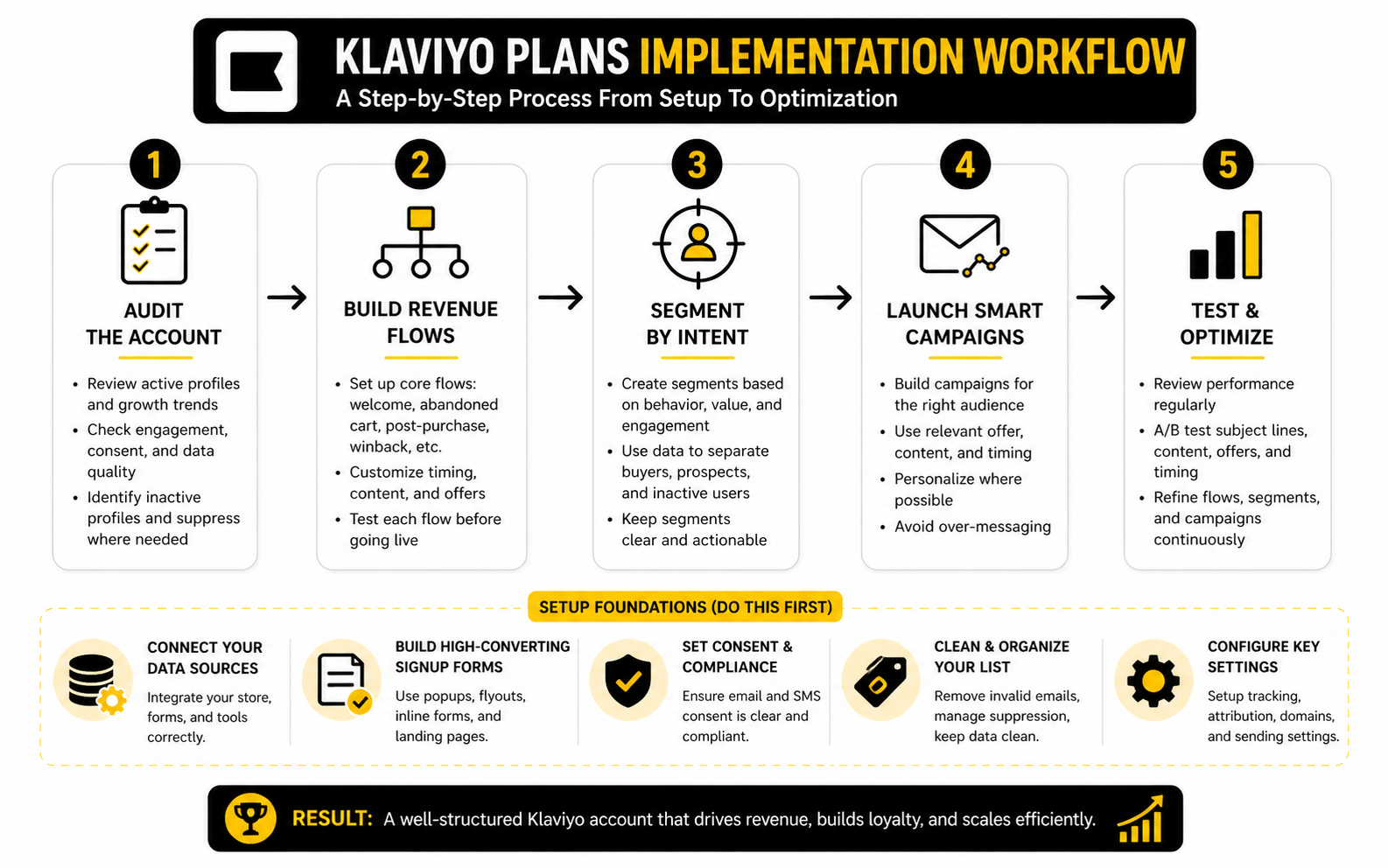
Professional implementation starts with the account structure, not the campaign calendar. Before choosing or upgrading Klaviyo plans, the team should know what data is syncing, which profiles are billable, which consent fields are reliable, and which flows are responsible for revenue. Without that foundation, every plan comparison is guesswork.
A good implementation process turns Klaviyo from a sending tool into an operating system for customer communication. It connects acquisition, purchase behavior, customer status, and lifecycle timing. That is where the platform starts to justify its cost.
Step 1: Audit The Account Before Upgrading
Start by reviewing profile count, suppressed contacts, recent engagement, consent status, flow performance, and campaign revenue. This gives you a clear view of whether your current plan is too small, too large, or simply underused. Do this before upgrading, because a bigger plan will not fix a messy account.
Next, check the ecommerce integration and event tracking. Your segments and flows are only as good as the data feeding them. If viewed product, added to cart, checkout started, placed order, and refund events are incomplete or duplicated, your automations will be weaker than they should be.
Finally, look at overlap. Many accounts send too many campaigns to the same high-value segment while ignoring lifecycle gaps elsewhere. A plan upgrade should come after you understand where the revenue opportunities actually are.
Step 2: Build The Revenue Flows First
Once the account is clean enough to trust, build the flows that match buyer intent. The welcome flow handles new subscribers. The abandoned checkout flow handles near-buyers. The post-purchase flow shapes the second purchase. The winback flow gives lapsed customers a reason to return.
These flows should not be treated as templates you publish once and forget. They need timing, offers, exclusions, creative, and testing logic that match your products. A replenishment brand, a fashion brand, and a high-ticket product brand should not have identical automation.
This is where Klaviyo plans begin to make more sense financially. You are not paying for software in the abstract. You are paying for a system that can turn customer behavior into timely communication.
Step 3: Segment Campaigns Around Intent
Campaigns should become more selective as the account grows. Sending every campaign to everyone is easy, but it is rarely the most profitable move over time. Segments based on recent engagement, purchase category, predicted behavior, VIP status, and product interest usually give you cleaner performance.
This does not mean every campaign needs twenty versions. It means the message should respect context. A loyal customer, a first-time buyer, and a cold subscriber should not always receive the same angle.
Better segmentation also protects deliverability and cost efficiency. When you send to people who are more likely to care, you reduce waste and improve the signal quality inside the account. That helps you get more from the plan you already have before spending more on the next one.
Statistics And Data That Actually Matter
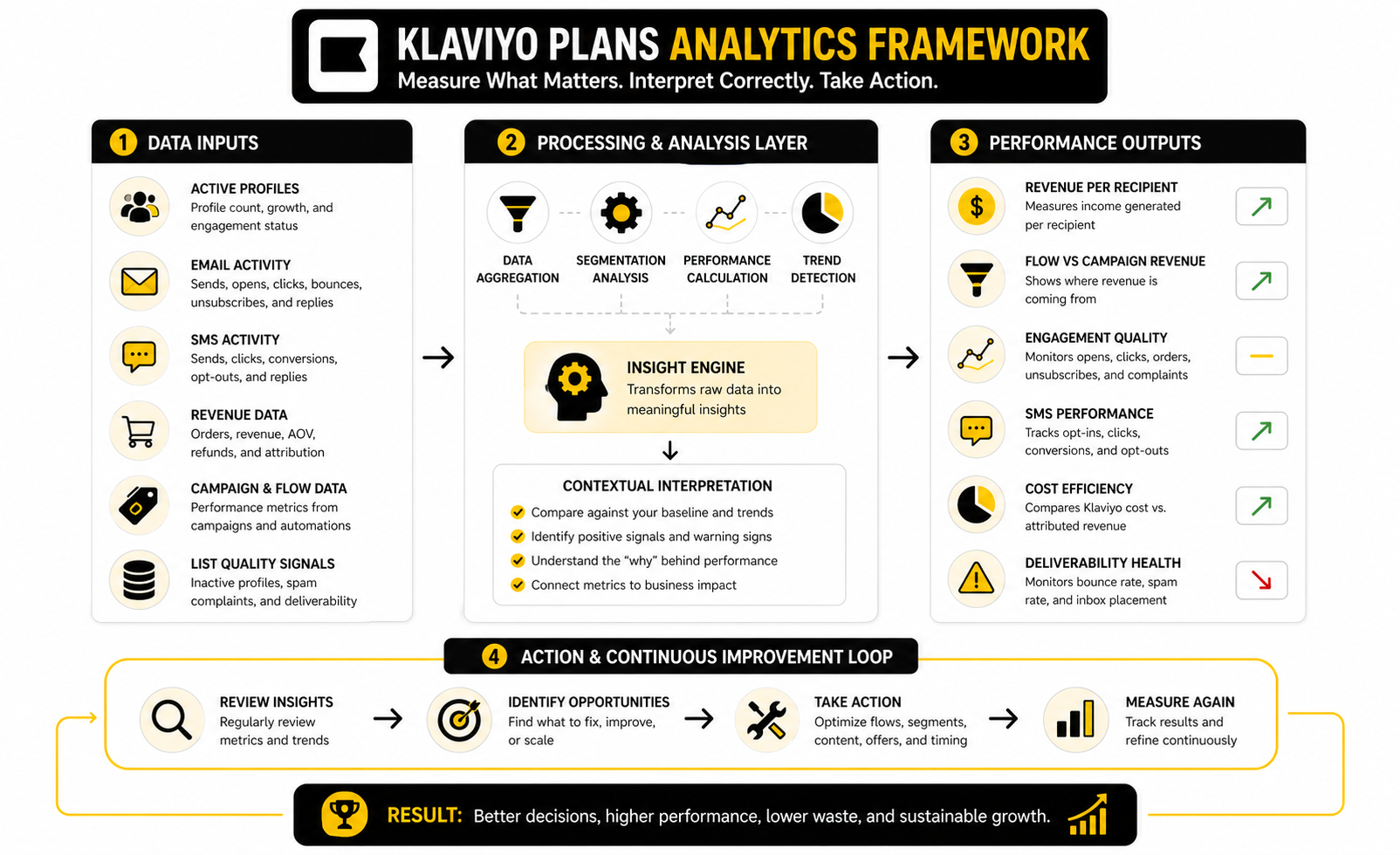
Measurement is where Klaviyo plans become much easier to judge. You are no longer asking whether the platform “feels expensive.” You are asking whether your active profiles, email sends, SMS credits, flows, and campaigns are producing enough value to justify the plan you are on.
The most useful data is not one big revenue number. It is a set of signals that show whether your account is healthy, whether your list is engaged, and whether your lifecycle system is getting sharper over time. Klaviyo’s benchmark tools compare performance by industry and business context, with benchmark data that refreshes monthly, which makes them more useful than generic averages pulled from old reports.
Revenue Per Recipient
Revenue per recipient is one of the cleanest metrics for judging Klaviyo performance. It shows how much revenue your email or SMS sends generate relative to the number of people who received them. That matters because a campaign sent to fewer people can still be better if it produces stronger revenue per recipient.
This is especially important when comparing broad campaigns against segmented campaigns. Klaviyo’s ecommerce benchmark material notes that campaigns sent to a narrower slice of a store’s contacts can outperform campaigns sent to most of the list across open rate, click rate, and revenue per recipient. That is the practical lesson: bigger sends are not automatically better sends.
When revenue per recipient drops, do not immediately blame the plan. Look at audience quality, offer strength, creative clarity, timing, and whether the campaign was sent to people with real buying intent. The fix may be better segmentation, not more software.
Flow Revenue Versus Campaign Revenue
A healthy Klaviyo account should not depend only on manual campaigns. Flows should generate revenue in the background because they respond to behavior, not a marketer’s calendar. Welcome, abandoned checkout, post-purchase, replenishment, and winback flows all help prove whether the plan is being used as a lifecycle system or just as a newsletter sender.
Campaign revenue is still important, but it is more volatile. Promotions, launches, holidays, and seasonal moments can swing results up or down. Flow revenue gives you a more stable view of whether the account is structured correctly.
The action is simple. If campaigns are doing all the work, build or improve the core flows. If flows are driving revenue but campaigns are weak, improve segmentation and campaign strategy. If both are weak, the plan is probably not the real problem yet; implementation is.
Engagement Quality
Open rate, click rate, placed order rate, unsubscribe rate, spam complaint rate, and bounce rate all help explain what is happening underneath revenue. You should not treat any one of them as the whole truth. A high open rate with low clicks can mean the subject line worked but the message did not.
Click rate is often a stronger creative signal than open rate because it shows whether people cared enough to act. Placed order rate goes one step further and shows whether that attention became revenue. Unsubscribes and complaints show whether your targeting, frequency, or promise is starting to annoy people.
This is where Klaviyo plans connect directly to list hygiene. If you keep sending to unengaged contacts, your costs can rise while engagement quality falls. That is a bad trade, and it usually means you need suppression rules, re-engagement logic, and tighter campaign audiences.
SMS Performance Signals
SMS should be measured differently from email. It is more direct, more interruptive, and usually more sensitive to timing. That means a small SMS list can be valuable if consent is strong and messages are used carefully.
The key numbers are opt-in rate, click rate, unsubscribe rate, conversion rate, and revenue per message. If opt-outs rise after every campaign, your SMS strategy is probably too aggressive or too generic. If clicks are strong but conversions are weak, the landing page, offer, or checkout experience may be the issue.
Do not upgrade into Email + SMS just because SMS looks exciting in benchmark reports. Upgrade when you have a real use case, a clear consent path, and enough buying intent to make the extra channel worth the cost.
Cost Efficiency
The simplest plan review metric is revenue generated compared with Klaviyo cost. This does not need to be complicated. Look at monthly Klaviyo spend, attributed revenue, flow revenue, campaign revenue, and the cost of any add-ons or SMS credits.
Then ask what would happen if you cleaned the list, improved flows, and sent fewer but better campaigns. Many brands can improve efficiency before upgrading. That is the part people skip because buying a bigger plan feels easier than fixing the account.
A useful monthly review should include:
- Active profiles added
- Active profiles suppressed
- Email revenue per recipient
- SMS revenue per message
- Flow revenue by automation
- Campaign revenue by segment
- Unsubscribe and complaint trends
- Total Klaviyo cost versus attributed revenue
These numbers keep the conversation grounded. They show whether Klaviyo plans are helping the business scale or quietly becoming a tax on a messy database.
How To Choose, Optimize, And Review Your Plan
Choosing between Klaviyo plans should be a quarterly decision, not a one-time setup choice. Your list size changes, your customer mix changes, your campaign calendar changes, and your retention strategy should mature with the business. A plan that made sense six months ago can become either too limited or unnecessarily expensive.
The best approach is to review Klaviyo like you would review paid ads. You are not just asking what it costs. You are asking what it returns, where the waste is, and what needs to improve before more money goes into the system.
When To Upgrade
Upgrade when your current plan is blocking profitable activity. That could mean you have outgrown the profile limit, need more sending capacity, want to remove branding, require better support, or have a clear SMS strategy ready to launch. The key word is clear.
Do not upgrade because the account feels busy. Busy is not the same as profitable. If the current account has weak flows, poor segmentation, and bloated active profiles, upgrading only gives the mess more room to grow.
A good upgrade decision should be tied to specific actions. You might upgrade because you are launching SMS for high-intent cart recovery, expanding lifecycle campaigns, or scaling a proven email program. That is very different from upgrading because the next tier looks more professional.
When To Downgrade Or Clean Up
Downgrading can be smart when the account is carrying too many inactive profiles. Many brands avoid this because it feels like moving backward, but it is often just discipline. Paying for contacts who do not open, click, buy, or consent is not growth.
Before downgrading, clean the list properly. Build unengaged segments, run a re-engagement campaign if appropriate, suppress people who stay inactive, and check whether your active profile count drops enough to change the economics. This is one of the fastest ways to make Klaviyo plans feel more reasonable without changing platforms.
You should also review add-ons with the same mindset. If a feature is not replacing another tool, improving revenue, or saving meaningful time, it may not deserve a permanent place in the stack. Keep the stack lean until the business has earned the complexity.
The Email-First Versus Multi-Channel Tradeoff
Email-first is usually the cleaner path for newer stores. It gives you more creative room, lower pressure, and a better foundation for lifecycle marketing. You can test offers, educate buyers, build trust, and segment audiences without the same urgency or compliance burden that comes with SMS.
Multi-channel becomes valuable when each channel has a defined role. Email can carry the story. SMS can handle urgency. Forms can capture consent. Reviews can build trust. Customer data can make the whole system smarter.
The risk is using every channel for every message. That is how brands burn attention. A better rule is simple: use the cheapest effective channel first, then use higher-friction channels only when they add something meaningful.
Platform Fit And Alternatives
Klaviyo is strongest when ecommerce behavior is central to the marketing system. If your business runs on Shopify, WooCommerce, BigCommerce, or a similar commerce platform, Klaviyo’s data model and automation logic can be a strong fit. The more your marketing depends on product behavior, purchase timing, and customer lifecycle signals, the more Klaviyo starts to make sense.
But not every business needs that level of ecommerce depth. A service business, agency, local business, course creator, or sales-led company may care more about pipelines, booking, CRM workflows, and follow-up automation than product-based email segmentation. In that case, a CRM-first platform like GoHighLevel may fit the operating model better.
Price-sensitive teams can also compare simpler email platforms before committing to a larger Klaviyo setup. Brevo can be a practical option for teams that want email marketing and CRM-style features without building around ecommerce data first. Moosend can also make sense for businesses that want automation without the same ecommerce-heavy positioning.
Scaling Risks
The biggest scaling risk is not the monthly bill. It is losing control of the account as more people touch it. More campaigns, more segments, more forms, more flows, and more add-ons can create a system nobody fully understands.
This is where naming conventions, documentation, permissions, and review cycles matter. Every flow should have a purpose. Every core segment should have a clear definition. Every recurring campaign should have a reason to exist beyond “we usually send something on Thursday.”
Scaling also creates attribution risk. Klaviyo may show revenue influence, but you still need judgment. A customer who buys after receiving an email may have already been planning to buy, so do not let attribution reports replace common sense.
The Expert-Level Review Checklist
A serious review of Klaviyo plans should look beyond the pricing page. It should connect cost, performance, deliverability, data quality, and team behavior. That gives you a much clearer answer than comparing monthly prices in isolation.
Review these areas every month if Klaviyo is a major revenue channel:
- Whether active profile growth is healthy or inflated
- Whether suppression rules are reducing waste
- Whether core flows are still producing revenue
- Whether campaigns are segmented by intent
- Whether SMS is earning its place in the plan
- Whether deliverability signals are improving or slipping
- Whether add-ons are replacing tools or adding clutter
- Whether the team can explain the account structure clearly
The best plan is not always the cheapest one. It is the plan where cost, capability, and execution line up. When those three are aligned, Klaviyo becomes easier to justify and much harder to waste.
Klaviyo Plans FAQ
What is the best Klaviyo plan for a new store?
The Free plan is usually the best starting point for a new store that is still setting up its email foundation. It gives you room to connect your ecommerce platform, build basic flows, test signup forms, and understand the interface before committing to a paid plan. Once you move past the free limits, the Email plan is usually the cleaner first upgrade unless SMS already has a clear role in your customer journey.
When should I move from Free to a paid Klaviyo plan?
Move to a paid plan when your list, sending needs, or revenue opportunities outgrow the free limits. Klaviyo’s Free plan includes up to 250 active profiles, 500 monthly email sends, and 150 mobile message credits, so the upgrade point usually becomes obvious once you have steady traffic and a growing subscriber base. Do not wait until every flow is perfect; upgrade when the account can realistically generate more value than the monthly cost.
Are Klaviyo plans based on subscribers or contacts?
Klaviyo plans are mainly shaped by active profiles, not just newsletter subscribers. Active profiles can include people synced from your store, customers, email subscribers, SMS subscribers, and other reachable contacts inside the account. That is why profile management matters so much.
What is an active profile in Klaviyo?
An active profile is a profile Klaviyo treats as available for marketing or messaging activity. Klaviyo’s billing documentation explains that billing can apply across Profiles, Emails, Mobile Messaging, Reviews, Advanced Klaviyo Data Platform, Marketing Analytics, and other products depending on what you use. In practical terms, active profiles are the people who can push your account into a higher plan tier.
Can I reduce my Klaviyo bill without switching platforms?
Yes, and list cleanup is usually the first place to look. Klaviyo’s own active profile guidance recommends suppressing contacts that have not engaged for a sustained period because they can increase costs without generating revenue. You can also improve efficiency by tightening segments, reviewing SMS usage, removing unnecessary add-ons, and improving flows before upgrading.
Is Email + SMS worth it?
Email + SMS is worth it when SMS has a specific job. Cart recovery, replenishment reminders, VIP drops, back-in-stock alerts, and urgent launch windows can all make sense. It is not worth it if SMS is just being used as a louder version of email.
Should every ecommerce brand use SMS?
No. SMS needs consent, restraint, and a strong reason to interrupt someone on their phone. A brand with weak offers, unclear timing, or poor consent collection should fix email first before adding SMS.
What metrics should I review before changing plans?
Review active profile count, suppressed profiles, campaign revenue, flow revenue, revenue per recipient, unsubscribe rate, complaint rate, bounce rate, and SMS opt-out rate. The goal is to see whether the plan is truly limiting growth or whether the account needs cleanup. A bigger plan should support proven activity, not hide poor execution.
How often should I review Klaviyo plans?
Review your plan monthly if Klaviyo is a major revenue channel. At minimum, review it every quarter. List growth, campaign frequency, SMS usage, and add-ons can change quickly, so old assumptions can quietly become expensive.
Is Klaviyo expensive?
Klaviyo can feel expensive when the account is messy or underused. It can also be very reasonable when flows, segmentation, and list hygiene are producing measurable revenue. The real question is not whether Klaviyo plans are cheap; it is whether your account is structured well enough to earn its cost.
What is the biggest mistake brands make with Klaviyo pricing?
The biggest mistake is paying for database size instead of customer quality. If your active profiles grow faster than engagement and revenue, the bill rises while efficiency falls. That is the exact moment to clean the account before assuming you need another tool.
Can service businesses use Klaviyo?
They can, but Klaviyo is usually strongest for ecommerce and product-based customer journeys. If your business depends more on pipelines, appointments, sales follow-up, or agency workflows, a CRM-first platform like GoHighLevel may be a better fit. Klaviyo shines when purchase behavior, product interest, and lifecycle timing drive the marketing strategy.
What should I do before upgrading my Klaviyo plan?
Audit the account first. Check whether inactive profiles are inflating the bill, whether core flows are working, whether campaigns are segmented, and whether SMS has a clear use case. Upgrade only when the next plan supports activity that is already likely to pay for itself.
Work With Professionals
Explore 10K+ Remote Marketing Contracts on MarkeWork.com
Most marketers spend too much time chasing clients, competing on crowded platforms, and losing a percentage of every project to middlemen.
MarkeWork gives you a better way. Browse thousands of remote marketing contracts and connect directly with companies desperate to hire skilled marketers like you, without platform commissions and without unnecessary gatekeepers.
If you are serious about finding better opportunities and keeping 100% of what you earn, explore available contracts and create a profile for free at MarkeWork.com.