

For a lot of ecommerce brands, the real problem is not getting traffic. It is turning first-time buyers into second and third purchases without burning margin on paid ads every month. That is exactly why the Klaviyo Shopify combination matters so much right now.
Shopify gives you the commerce engine. Klaviyo gives you the messaging, segmentation, and automation layer that turns store data into campaigns people actually receive at the right time. When the setup is clean, you stop treating email and SMS like a newsletter tool and start using them like a revenue system.
That distinction matters more than it used to. As ecommerce keeps expanding globally and brands push harder on retention, operators need more than basic blasts and generic discount sends. They need purchase data, consent signals, product behavior, and market context flowing into one place so they can act on it fast.
- Why Klaviyo and Shopify Work So Well Together
- The Operating Model Behind a High-Performing Setup
- Data, Consent, and Segmentation Foundations
- Core Flows That Usually Move Revenue First
- Professional Implementation and Optimization
- Common Mistakes, FAQs, and Final Recommendations
Why Klaviyo and Shopify Work So Well Together
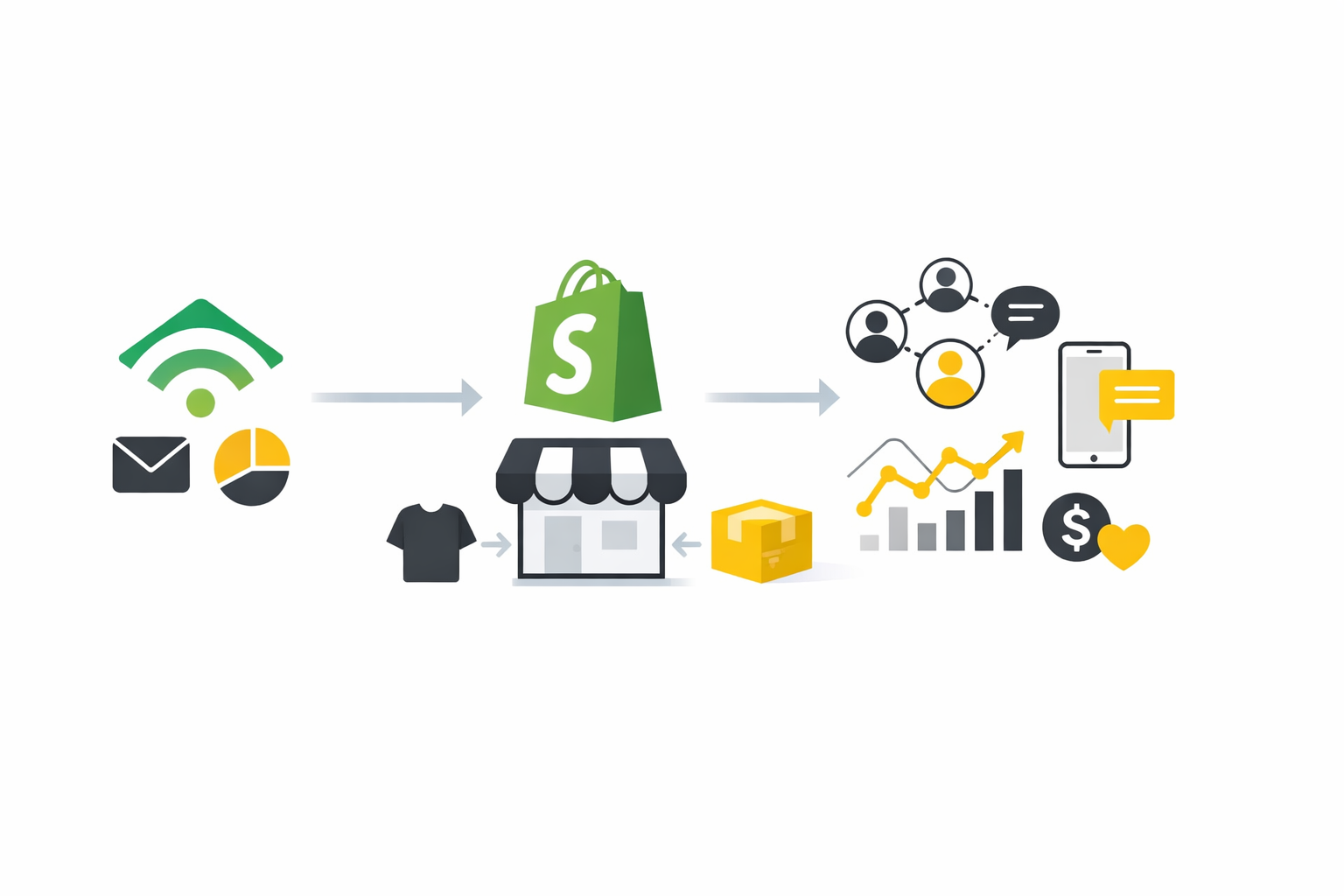
Klaviyo and Shopify fit because the relationship is not just cosmetic. Shopify runs the storefront, checkout, and customer transaction layer, while Klaviyo is built to use that commerce data for segmentation, automation, and retention messaging. That is why this setup keeps showing up inside serious DTC brands, especially when the goal is to build repeat purchase revenue instead of relying on one-off campaigns.
The practical advantage is speed to relevance. Once the integration is configured properly, your marketing stack is no longer guessing who bought, who browsed, who abandoned checkout, who subscribed, or what product catalog data should be used in a message. That gives operators a cleaner path to triggered communication instead of broad sends that feel disconnected from actual customer behavior.
There is also a strategic reason this pair stays popular. Shopify and Klaviyo have had a formal partnership for years, and that matters because it tends to improve native compatibility, access to new platform features, and implementation stability as stores grow. For brands planning international expansion, multi-market merchandising, or more advanced customer journeys, that alignment becomes even more valuable.
The other reason it matters is economic. Email and lifecycle automation remain some of the highest-leverage retention channels in ecommerce, and abandoned cart workflows continue to rank among the strongest performers when brands implement them properly. When your store data is already living inside Shopify, using Klaviyo as the activation layer is often the shortest path between customer intent and revenue recovery.
The Operating Model Behind a High-Performing Setup
Most brands think about Klaviyo and Shopify as an app connection. The better way to think about it is as an operating model. You are connecting commerce data, consent collection, segmentation logic, automated flows, campaigns, and measurement into one system that should get smarter as the store grows.
At a high level, the model is simple. Shopify captures shopper actions and customer records, Klaviyo ingests and organizes that data, then your team uses it to trigger communication based on behavior, lifecycle stage, geography, product interest, and purchase history. The setup only works well when each layer is intentional, because weak consent rules, messy lists, and random flow logic will drag the whole machine down.
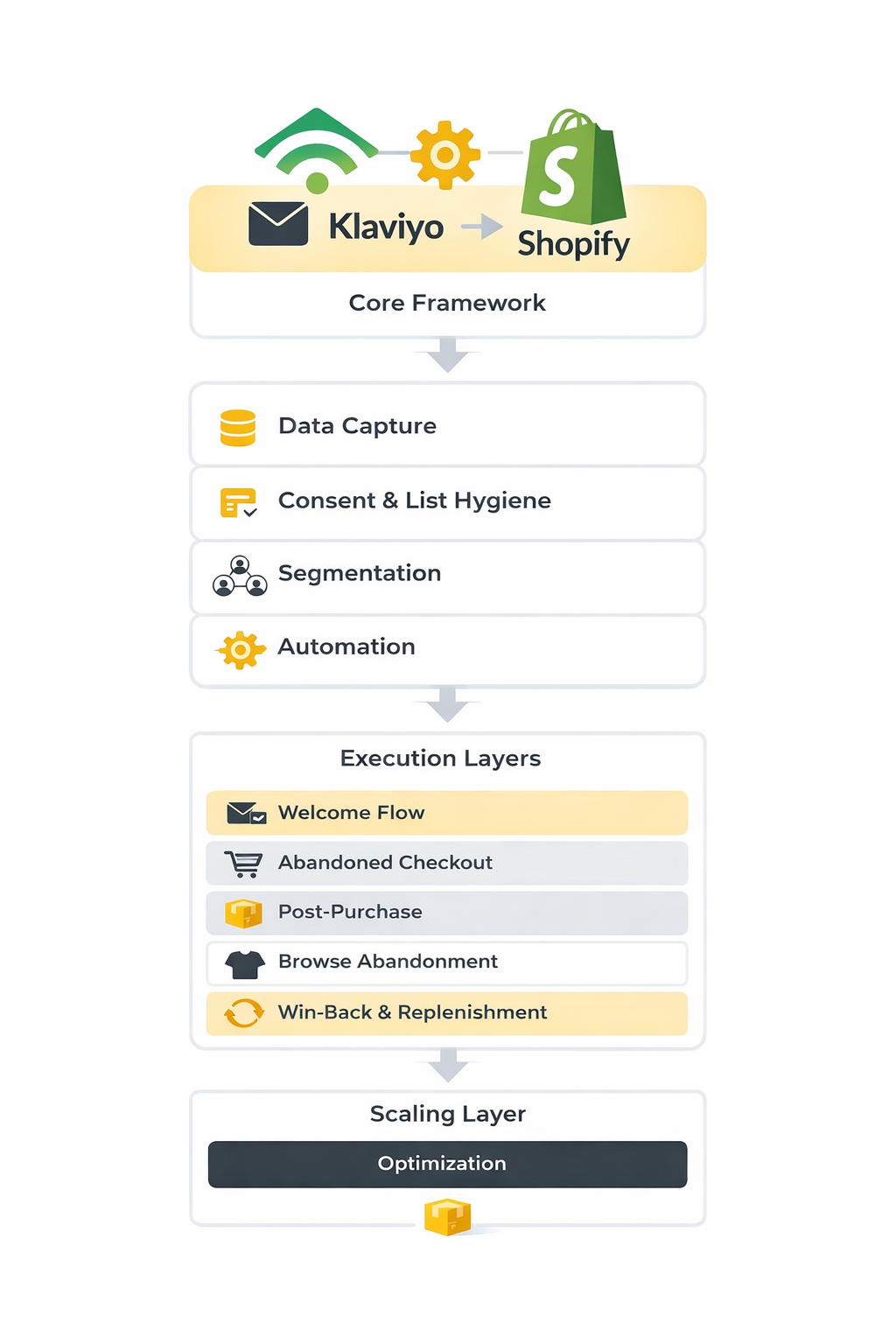
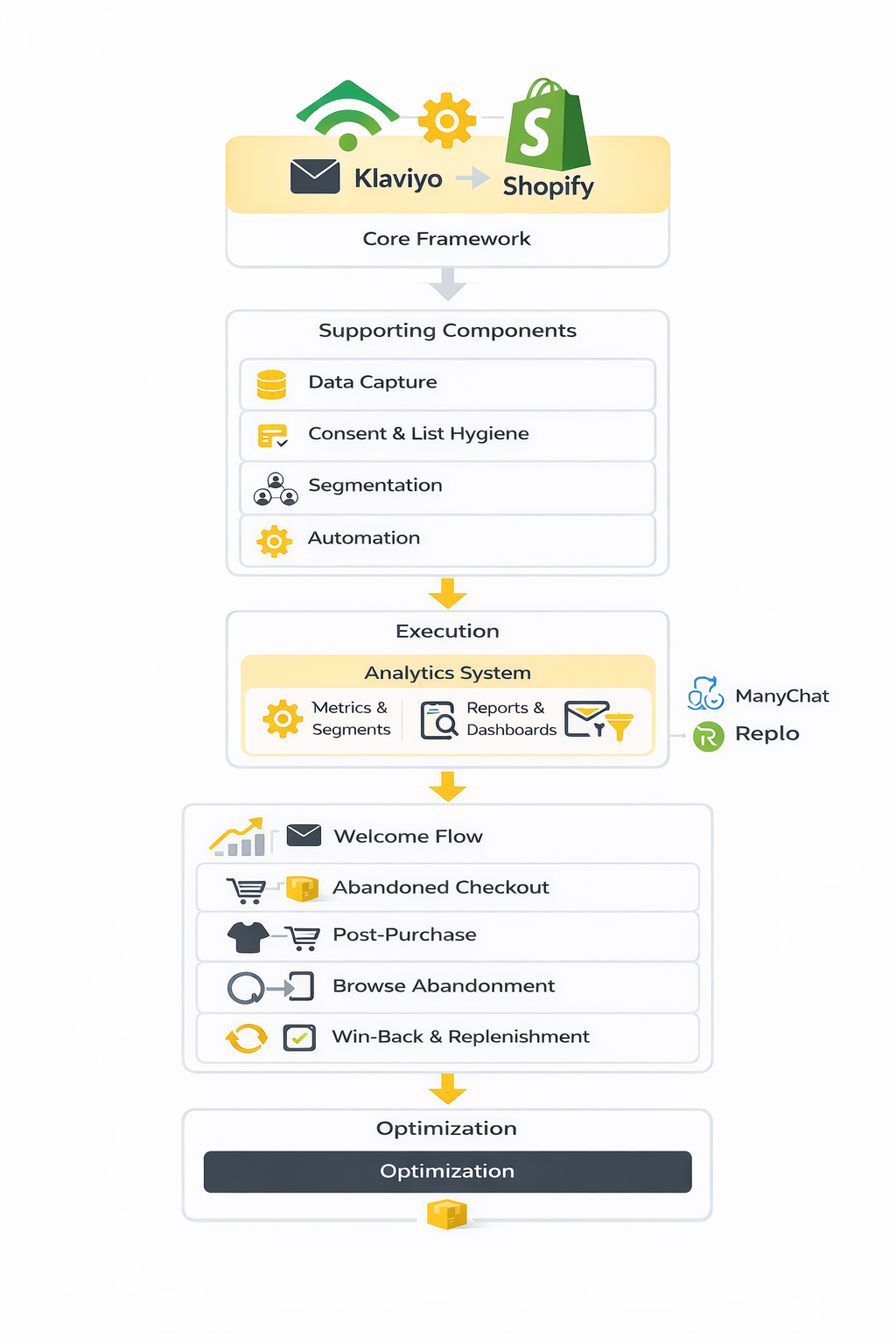
A strong framework usually looks like this:
- Data capture
Shopify feeds order, product, customer, and onsite behavior signals into Klaviyo. This is the base layer, and if it is incomplete, everything above it gets less useful.
- Consent and list hygiene
Email and SMS growth need to be permission-based and clearly mapped. This is where a lot of brands get sloppy, especially during migrations or when multiple tools are still connected.
- Segmentation
Once the data is clean, you can split audiences by buyer status, purchase cadence, product category interest, discount dependency, market, and engagement level. This is where generic email marketing starts turning into lifecycle marketing.
- Automation
Flows then sit on top of those signals. Welcome, browse abandonment, abandoned checkout, post-purchase, replenishment, win-back, and cross-sell sequences all become more effective when they are tied to real store behavior instead of arbitrary time delays.
- Optimization
After the foundation is stable, you improve timing, creative, offer logic, deliverability, and reporting. This is the difference between “we installed Klaviyo” and “retention is becoming a real growth channel.”
This is also the point where implementation maturity starts to show. Beginner setups focus on getting emails out. Professional setups focus on making sure the right profile enters the right path with the right consent status, product context, and suppression logic. That sounds less exciting, but it is usually where the money is.
For brands that want to tighten the onsite experience around this stack, tools like Replo can make the landing page and merchandising side stronger, while conversational capture tools like ManyChat can support list growth and customer engagement outside the inbox. They are not substitutes for Klaviyo, but they can strengthen the surrounding system when the core Shopify retention engine is already in place.
The big takeaway is straightforward. Klaviyo Shopify works best when you stop viewing it as a plugin and start treating it like infrastructure. In the next part, the focus shifts to the foundation that makes that infrastructure dependable: data quality, consent handling, and segmentation logic.
Data, Consent, and Segmentation Foundations
This is the part most brands rush, and it is usually the reason their Klaviyo Shopify setup underperforms later. They install the app, import profiles, switch on a couple of flows, and assume the machine is ready. It rarely is.
The real foundation is not email design or even flow count. It is whether Shopify is passing clean customer and order data into Klaviyo, whether consent is being captured in a legally and operationally usable way, and whether the audience is structured well enough to support relevant messaging instead of bulk noise.
When that foundation is strong, everything downstream gets easier. Your welcome flow knows who is actually subscribed. Your post-purchase logic reflects real order behavior. Your campaigns stop going to the wrong people at the wrong time, which matters because customer fatigue is expensive even when it does not show up immediately in a dashboard.
Start With the Data Layer, Not the Creative Layer
A good Klaviyo Shopify build starts with the basic sync, but it should not stop there. Klaviyo’s Shopify integration is designed to pull in profile data, custom properties, subscription statuses, and commerce events, which is what allows campaigns and flows to reflect what shoppers actually did rather than what your team assumes they did in a planning doc. The whole point is to create a system where browsing, checkout, purchase, and customer profile changes can influence messaging automatically through the Shopify integration sync settings in Klaviyo and the broader Shopify integration overview.
This is where operators need to slow down and look closely at what is actually syncing. If product catalog data is messy, if customer properties are inconsistent, or if subscription status is split across old tools and new tools, you get the classic problem: the account looks integrated, but the segmentation logic becomes unreliable. That is how brands end up sending welcome sequences to existing buyers, suppressing people who should receive campaigns, or misreading attribution because the underlying identity layer is weak.
It is also worth remembering that Klaviyo is not a CRM miracle machine that fixes bad store data by itself. It becomes powerful when the Shopify side is organized enough to give it dependable inputs. The more intentional the store structure is, the more precise the marketing layer becomes.
Consent Is Not a Checkbox Task
Consent handling inside a Klaviyo Shopify stack is not just a compliance issue. It is a deliverability, list quality, and revenue issue too. If you collect subscribers carelessly, your list may grow faster on paper, but the quality of engagement usually gets worse, which makes every future send less efficient.
Shopify now gives merchants more direct control over privacy settings, cookie handling, regional behavior, and marketing consent workflows inside the admin, which makes the consent layer far more operational than it used to be in smaller ecommerce stacks. The important point is that email and SMS consent should be captured clearly and stored in a way your downstream tools can use, especially when you are working across multiple regions or want tighter control over checkout behavior through Shopify customer privacy settings and the store’s customer contact collection options.
SMS deserves extra discipline here. Klaviyo’s own documentation is very direct that Shopify checkout can be one of the fastest ways to grow an SMS list, but only when the setup is configured correctly and the consent state is passed properly into the account. That matters because SMS is more intimate than email, and bad targeting there feels intrusive fast, which is why brands should treat Shopify checkout SMS consent with Klaviyo as a precision task rather than a growth hack.
Double opt-in is another area where practical teams beat lazy teams. Not every list source needs to be handled the same way, but when a brand has spam risk, questionable lead quality, or international complexity, stronger confirmation steps often improve downstream performance even if top-line opt-in volume looks smaller. Fewer but cleaner profiles usually outperform bloated databases that never really wanted to hear from you in the first place.
Segmentation Is Where the Money Actually Starts
Once the data and consent layers are stable, segmentation is where a Klaviyo Shopify account begins to earn its keep. Not because segmentation sounds sophisticated, but because it is the mechanism that stops you from treating every subscriber like the same customer.
Klaviyo’s segment system is built to update dynamically as customer behavior changes, which is exactly what ecommerce brands need. Someone who has never purchased should not receive the same campaign as a VIP customer with five orders, and someone who only buys during promotions should not be evaluated the same way as a full-price repeat buyer. That sounds obvious, but a huge amount of ecommerce messaging still ignores those differences even though Klaviyo has long supported dynamic segments, channel-consent segmentation, and increasingly sophisticated segmentation strategy guidance through its own audience framework resources.
The smartest way to think about segmentation is not demographic first. It is behavioral first. Purchase history, browse behavior, predicted lifecycle stage, channel eligibility, discount dependency, category interest, and engagement recency usually tell you more about what message should be sent than age or broad persona language ever will.
This is also where a lot of brands make the wrong tradeoff. They create too many tiny segments too early and end up managing complexity instead of improving relevance. A better move is to start with a compact structure that is commercially useful and easy to maintain.
A practical starting segmentation model usually includes:
- Non-buyers who are subscribed
- First-time customers
- Repeat customers
- High-value or VIP customers
- Customers at risk of churning
- Recently engaged non-purchasers
- Email-only, SMS-only, and multi-channel consent groups
- Category or product-interest audiences based on browsing or purchase behavior
That is already enough to improve campaigns materially. It gives you cleaner targeting for launches, replenishment, seasonal promotions, educational content, and win-back efforts without turning the account into a maintenance nightmare.
Why This Foundation Changes Everything Later
The reason this section matters so much is simple: every strong flow in a Klaviyo Shopify account depends on it. Welcome series logic depends on accurate consent and profile state. Abandoned checkout depends on reliable event tracking. Post-purchase branching depends on product, order, and customer data being trustworthy. Win-back depends on lifecycle segmentation that actually reflects behavior instead of arbitrary date windows.
This is also where brands quietly protect future deliverability. Research from the DMA Email Benchmarking Report 2024 and the wider Customer Engagement Report 2024 points in the same direction: better engagement quality matters more than list volume theater. In plain English, a smaller and better-structured audience is often more valuable than a giant list filled with weak consent, stale profiles, and generic messaging.
If you want to improve the acquisition side feeding this system, tools like Shopify Forms cover the native basics, but brands pushing harder on customization often look at options like Replo for landing page control or ManyChat when conversational capture and channel handoff fit the offer. The key is that no acquisition tool fixes weak lifecycle foundations. It only feeds them.
That is the real takeaway from this stage of the build. Before you obsess over clever copy or advanced automation branches, make sure your Klaviyo Shopify account knows who the customer is, what they consented to, what they did, and where they belong. Once that is solid, the next layer becomes much more powerful: the core flows that usually move revenue first.
Core Flows That Usually Move Revenue First
Once the foundation is stable, the next job is not building ten clever automations at once. It is choosing the small set of flows that map to the highest-value moments in the customer journey. In a Klaviyo Shopify setup, that usually means starting where intent is already strong, where customer context is clear, and where the message can actually help someone move forward instead of interrupting them.
This is where a lot of brands either get disciplined or get distracted. Disciplined teams prioritize the flows that touch subscriber activation, purchase recovery, post-purchase education, and repeat-order timing. Distracted teams keep adding edge-case automations before the revenue-critical paths are even working properly.
The good news is that the order of operations is usually straightforward. You do not need a giant lifecycle architecture on day one. You need a reliable sequence of core flows that reflect how people actually move through a Shopify store.
Start With the Flows Closest to Revenue
The first flow is usually the welcome sequence. Not because it is the most exciting, but because it handles new subscribers at the exact moment their attention is highest. If someone has just opted in, that is your window to set expectations, explain the brand, highlight bestsellers, and give them a reason to visit before they drift away.
After that, abandoned checkout tends to be one of the clearest priorities because it sits close to purchase intent. Klaviyo’s own implementation guidance is direct here: the platform recommends using the ecommerce integration first, then building the abandoned cart or checkout flow from the prebuilt library so event timing, targeting, and branching logic work as expected. That makes sense because these shoppers are not cold leads. They were already close enough to start moving through checkout, which means the follow-up should feel precise, timely, and friction-reducing rather than loud or desperate.
Post-purchase is the next major layer, and this is where many stores leave money on the table. A post-purchase flow is not just a thank-you message. It is the system that confirms the purchase, reduces buyer anxiety, introduces complementary products, requests reviews at the right moment, and eventually triggers replenishment or reorder messaging when the product type supports it. Klaviyo’s current help content still frames this category broadly for a reason: this is often where retention starts becoming operational instead of aspirational.
Browse abandonment comes after those core flows for most brands, not before. It is useful, but it usually belongs behind welcome, checkout recovery, and post-purchase because browse intent is weaker than checkout intent. The logic still matters though, especially when product recommendations and recently viewed items are working properly, because this is one of the cleanest ways to bring interested visitors back without overusing discount language.
The Core Flow Stack Most Shopify Brands Should Build First
A practical Klaviyo Shopify rollout usually starts with this order:
- Welcome flow
- Abandoned checkout flow
- Post-purchase flow
- Browse abandonment flow
- Back-in-stock flow
- Win-back or replenishment flow
That stack works because it follows the commercial journey instead of the internal org chart. You are moving from new subscriber to near-buyer, then from customer onboarding to repeat-purchase support. It is simple, but that is the point.
What matters more than the number of flows is the quality of the logic inside them. A three-flow system with clean segmentation, strong timing, and product-aware content will usually beat a bloated account full of half-finished automations. This is especially true in Shopify environments where customer behavior moves quickly across mobile, accelerated checkout, guest checkout, and returning-account experiences. Shopify’s own recent work around checkout speed, one-page experiences, and expanded consent collection shows how much purchase behavior is still shaped by small frictions at the point of conversion.
What Each Flow Should Actually Do
The welcome flow should orient, qualify, and move the subscriber toward a first order. That means the first message should not read like a random campaign blast. It should explain what the brand is about, what kind of products matter most, and what the subscriber should look at next.
The abandoned checkout flow should remove friction, not just repeat the cart back to the shopper. Sometimes the friction is price, but often it is uncertainty, distraction, delivery timing, or simple hesitation. The best versions of this flow answer those concerns through timing, product reminders, social proof, support access, and only then selective incentive logic if the brand truly needs it.
The post-purchase flow should build confidence immediately after the sale. That includes confirming what happens next, reducing refund anxiety, and helping the customer get value from the product fast. Then, depending on the product and purchase cycle, it can shift into education, cross-sell, review collection, subscription encouragement, or replenishment timing.
Browse abandonment should feel lighter than checkout recovery. Someone who viewed a product is showing interest, not commitment. That means the copy should invite them back, remind them what they were exploring, and use product context intelligently rather than pretending they were already sold.
Back-in-stock and replenishment flows are where product catalog structure starts to pay off. If the Shopify catalog is organized cleanly and Klaviyo is receiving dependable product data, these flows can feel highly relevant without much creative complexity. They are useful because they match a clear customer need instead of manufacturing urgency.
The Execution Process That Makes These Flows Work
This is where the implementation becomes real. A good Klaviyo Shopify setup is not just about deciding which flows to build. It is about sequencing the work so each flow is technically correct, commercially useful, and maintainable by the team after launch.
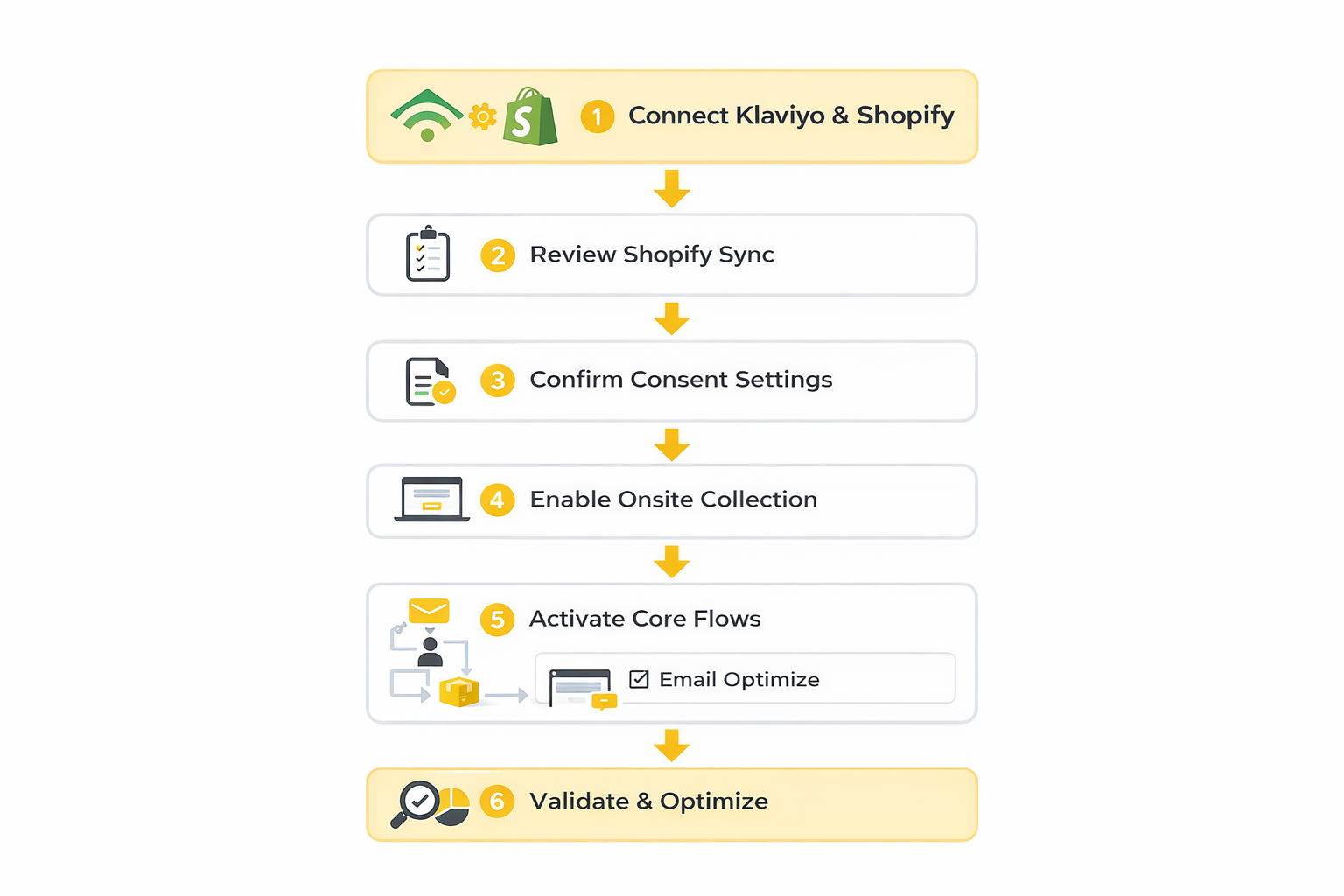
A clean execution process usually looks like this:
- Confirm the integration is syncing the right events
Make sure Shopify customer, product, and order data is flowing into Klaviyo as expected. If the triggers are wrong, the flow strategy is wrong before it even starts.
- Choose the trigger and exclusion logic
Decide what event starts the flow, who should be filtered out, and what counts as successful exit behavior. This is where you prevent welcome emails from going to existing buyers or abandoned checkout reminders from going to people who already purchased.
- Map the message sequence
Set the number of messages, the delay between them, and the role of each send. Every message should have a job. If the second or third message does not change the angle, it probably does not need to exist.
- Add content that reflects the event
Use product-aware blocks, customer state, and relevant recommendations. This is the difference between automation that feels intelligent and automation that feels like a mail merge.
- Layer in channel logic
Decide when email is enough, when SMS adds value, and when silence is better. Klaviyo’s current guidance continues to treat SMS as a complementary layer for certain high-intent and post-purchase moments, not something that should automatically be added everywhere.
- Test every branch before going live
Check entry conditions, dynamic content, coupon behavior, links, suppressions, and purchase exits. This sounds obvious, but it is the step that prevents embarrassing logic failures and broken customer experiences.
- Review performance before expanding
Let the first set of flows gather signal. Then improve send timing, branch logic, creative angle, and incentives before building more automation.
That is the process professionals follow because it protects both customer experience and account performance. It also keeps teams from shipping half-broken lifecycle assets just to say the automation is live.
Where Brands Usually Get the Process Wrong
The most common mistake is trying to perfect every flow at once. That usually leads to shallow execution, messy QA, and inconsistent brand messaging. You are better off shipping fewer flows with stronger logic than launching a big automation map that nobody trusts.
Another mistake is confusing volume with sophistication. More messages do not automatically create more revenue. In some cases, they just create faster fatigue, especially when segmentation is weak or product context is missing.
There is also a technical trap that deserves attention in current Shopify environments: noisy or distorted intent signals. Public merchant discussions through 2025 and early 2026 show ongoing concern around fake cart or checkout activity from bots, which can distort abandoned-flow logic if teams are not monitoring anomalies carefully. That does not mean these flows are broken. It means operators should sanity-check traffic quality and event patterns instead of treating every trigger as equally credible.
Build for Repeatability, Not Just Launch Day
A smart Klaviyo Shopify implementation is one the team can keep improving without rebuilding the account every quarter. That means naming conventions should be clear, flow goals should be obvious, and the decision logic inside the automations should be understandable by someone other than the person who originally built them.
This is also where a stronger surrounding stack can help. If the store needs sharper landing pages or campaign destinations, Replo can make that side of execution more flexible. If list growth or channel handoff is part of the play, ManyChat can support acquisition and conversational qualification before people enter the lifecycle machine.
The key point is this: flows are not the strategy by themselves. They are the execution layer. When they are built in the right order and with the right process, they turn the Klaviyo Shopify stack from a basic app connection into a real retention system.
The next part goes one level deeper into professional implementation. That is where timing, deliverability, measurement, and ongoing optimization separate decent accounts from the ones that compound month after month.
What the Numbers Actually Mean
Once your Klaviyo Shopify setup is live, the temptation is to stare at headline metrics and declare success or failure too early. That is how teams end up overreacting to open rates, underreacting to weak conversion signals, and missing the real problem sitting one layer deeper in the funnel.
The job of analytics in this stack is not to make you feel good. It is to help you answer very specific questions. Are the right people entering the right flows, are messages creating action instead of curiosity, and is Shopify’s store funnel converting the demand that Klaviyo is helping generate?
That is why the most useful measurement model is not channel-only and not store-only. It is both. Klaviyo tells you what your messaging is doing. Shopify tells you what the storefront and checkout are doing with that traffic once it lands.
The Metrics That Matter First
A lot of operators still overvalue opens because they are easy to see and easy to celebrate. The problem is that opens are only an attention signal. They can tell you whether your subject line, sender name, and audience selection were good enough to earn a look, but they do not tell you whether the message actually moved revenue.
Klaviyo’s current benchmark data is useful here because it gives a realistic baseline for context, not a target to copy blindly. Its 2026 email benchmark reporting shows average ecommerce open rates around 39.74%, click rates around 1.47%, revenue per recipient around $0.11, and placed order rates around 0.09% for ecommerce email broadly. Those numbers matter because they remind you that high opens with weak clicks or weak order rates usually mean the message created curiosity without enough commercial momentum to drive action. Klaviyo’s benchmark snapshot
The more revealing metric for many brands is revenue per recipient. Klaviyo defines it as total attributed revenue divided by total recipients, which makes it one of the cleanest ways to compare message efficiency across campaigns, flows, and segments without getting distracted by list size. If one campaign gets decent opens but weak revenue per recipient, while another gets fewer opens but much stronger revenue per recipient, the second campaign is often the healthier asset even if it looks less impressive at first glance. Klaviyo’s analytics glossary
Placed order rate matters for the same reason. It pulls the conversation back toward actual business impact. Klaviyo’s own analytics guidance emphasizes reviewing placed order rate and adjusting the conversion metric where appropriate, because the real question is not whether someone opened. It is whether the message created a meaningful next step. Klaviyo campaign analytics guidance
Why Flow Metrics Should Be Judged Differently From Campaign Metrics
One of the easiest mistakes in a Klaviyo Shopify account is comparing campaigns and automated flows as if they should perform the same way. They should not. They serve different jobs, hit different levels of intent, and operate with different timing advantages.
Klaviyo’s own benchmark material makes that gap obvious. Automated flows consistently outperform campaigns on order rate because they are triggered by behavior rather than sent as broad calendar-based messages, and its enterprise benchmark summary highlights just how much stronger flow placed order rates can be than campaign placed order rates. That matters because it tells you what to optimize first: if flows are weak, your foundation is probably off; if campaigns are weak while flows are healthy, your segmentation, offer, creative angle, or send strategy is more likely the problem. Klaviyo enterprise benchmark summary
Welcome flow metrics deserve separate interpretation too. Klaviyo’s current ecommerce email material points out that welcome emails average a 1.97% placed order rate, and top performers go much higher. The takeaway is not that every brand should chase the same number. It is that the welcome sequence is one of the few lifecycle moments where the combination of fresh attention and clear intent can produce unusually strong returns when the offer, brand framing, and audience quality are aligned. Klaviyo’s ecommerce email benchmarks
This is exactly why you should read each flow against its own job:
- Welcome flow should be judged on activation and first-order movement
- Abandoned checkout should be judged on recovery efficiency and timing
- Post-purchase should be judged on retention, repeat behavior, and downstream engagement
- Browse abandonment should be judged on re-engagement and assisted conversion, not just direct order count
That framing stops you from cutting useful flows just because they do not behave like checkout recovery.
Read Klaviyo and Shopify Together, Not Separately
A strong operator does not just look at Klaviyo dashboards. They connect messaging performance to Shopify funnel performance. Shopify’s behavior and marketing analytics reports are useful because they break the store journey into sessions, sessions with cart additions, sessions that reached checkout, and sessions that completed checkout. That funnel view helps you identify where the real leakage is happening. Shopify behavior reports Shopify marketing performance reports
If Klaviyo campaign traffic is clicking through at a healthy rate but Shopify shows weak cart-add behavior, the issue is probably not the email itself. It is more likely the landing page, offer alignment, product page clarity, pricing perception, or merchandising. If cart additions are healthy but checkout completion is poor, the problem shifts toward checkout friction, payment confidence, shipping clarity, or final-step trust issues.
Shopify’s analytics field definitions make that especially actionable because they separate metrics like completed checkout rate from earlier funnel stages. That means you can diagnose whether you have a messaging problem, a product-page problem, or a checkout problem instead of guessing. Shopify analytics field reference
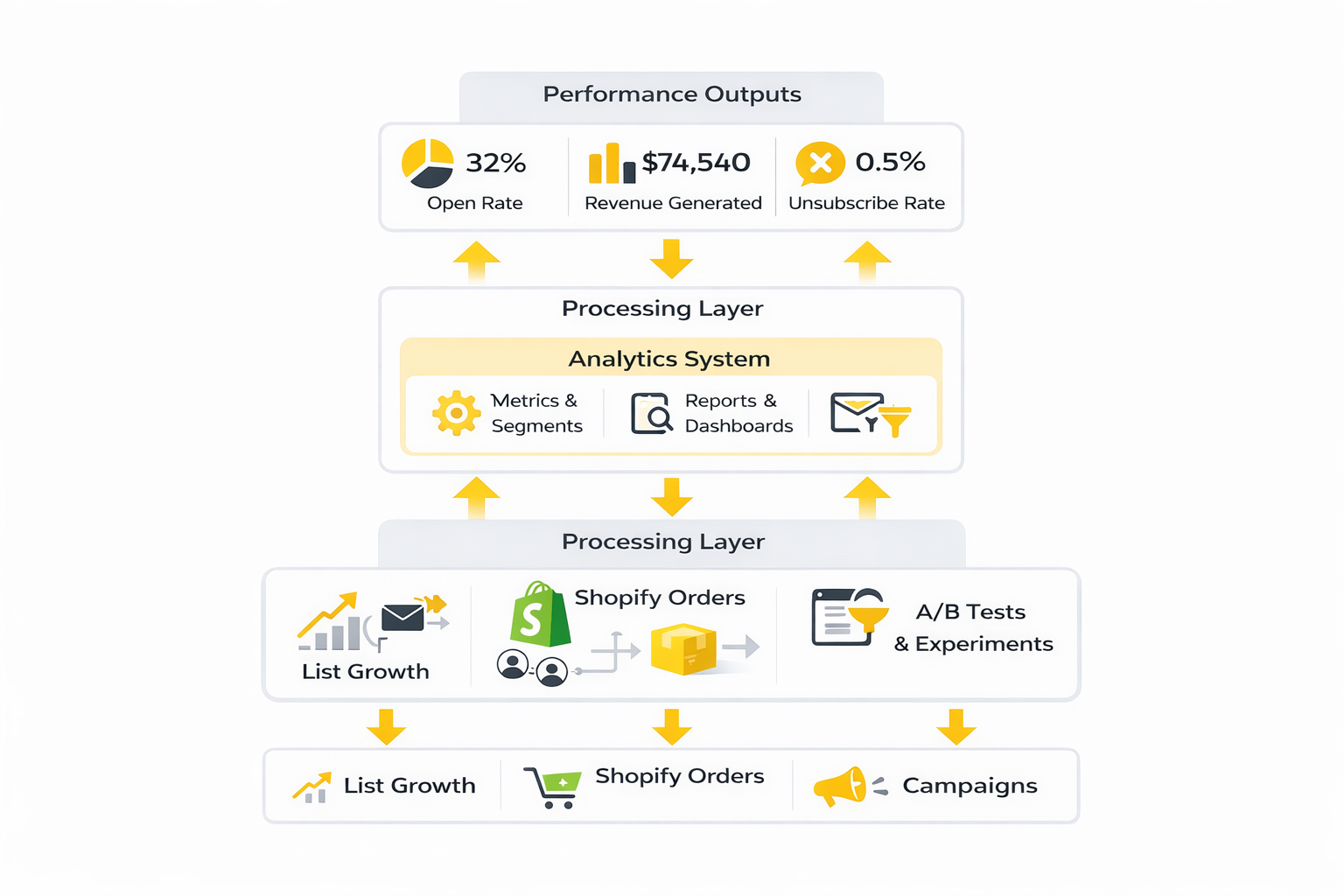
This is the cleanest way to build a useful analytics system for Klaviyo Shopify:
- Measure message engagement in Klaviyo
Look at deliveries, clicks, placed order rate, revenue per recipient, unsubscribe rate, and spam complaints.
- Measure funnel movement in Shopify
Check sessions, cart additions, checkout starts, and completed checkouts.
- Compare segment performance
Review whether new subscribers, first-time buyers, repeat customers, and high-value cohorts behave differently.
- Review flow-by-flow intent quality
Benchmark high-intent flows like checkout recovery separately from lower-intent flows like browse abandonment.
- Decide the action
Change subject lines, revise segmentation, improve landing pages, simplify checkout, adjust timing, or reduce send pressure.
That is how data becomes operational instead of decorative.
Benchmarks Are Context, Not a Script
Benchmarks are useful when they stop you from guessing. They become dangerous when teams treat them like universal targets. Shopify’s own 2026 conversion guidance notes that ecommerce conversion rates often sit around 2% to 3% globally, while another recent Shopify retail conversion article points to external benchmark ranges that vary meaningfully by sector and device mix. In other words, context matters a lot more than people want it to. Shopify’s ecommerce conversion overview Shopify’s retail conversion article
The same logic applies inside Klaviyo. A luxury brand with high AOV, long consideration cycles, and lower send frequency should not expect the same click behavior as a low-AOV impulse brand. A replenishment business will read post-purchase timing differently from a fashion brand with more episodic buying. A multi-country store with privacy constraints and language variation will not behave like a domestic single-market brand.
So use benchmarks to ask better questions:
- Are you below average because the account is weak, or because the category behaves differently?
- Are you beating benchmarks with a small engaged segment but failing at scale?
- Are opens high because the audience is healthy, or because list size is still too small to reveal deeper issues?
- Is revenue per recipient rising because targeting improved, or because discounts got more aggressive?
Those are grown-up questions. They keep the team honest.
Deliverability Signals Matter More Than Most Teams Admit
A Klaviyo Shopify account can look fine on the surface while quietly losing inbox placement quality underneath. That is why negative engagement metrics deserve more attention than they usually get. Klaviyo’s current deliverability monitoring guidance is refreshingly specific: healthy bounce rates should stay below 1%, unsubscribe rates under 0.3%, and spam complaint rates below 0.01%. Klaviyo deliverability monitoring guidance
Those numbers matter because they are not vanity indicators. They are early warning signals that your targeting, frequency, consent quality, or creative relevance is drifting in the wrong direction. If unsubscribe rates climb, it usually means the audience-message fit is weakening. If spam complaints rise, the problem is often even more serious because mailbox providers may begin filtering future sends more aggressively. Klaviyo’s spam complaint guidance points back to the same core fix: clearer signup expectations, cleaner consent, and more relevant targeting. Klaviyo spam complaint guidance
This is also where some brands make an expensive mistake. They see a good revenue day from a heavy campaign schedule and assume the strategy is working, even though fatigue is building under the surface. The short-term lift can be real, but the long-term damage shows up later in weaker engagement, inbox placement issues, and lower campaign efficiency. That is why deliverability should be treated as part of performance, not as a technical side note.
What Actions the Data Should Drive
The point of measurement is action. If a welcome flow has healthy opens but weak order rate, the likely move is not “send more messages.” It is usually to improve offer clarity, product framing, or first-click destination. If abandoned checkout is getting clicks but weak recovered revenue, the likely issue is not subject lines. It is probably something unresolved in checkout, shipping presentation, pricing confidence, or mobile usability.
If revenue per recipient is climbing while unsubscribe and complaint rates stay healthy, that is usually a strong signal that segmentation and message-market fit are improving. If open rates are steady but clicks fall, the content body or CTA structure may be losing relevance. If Shopify shows good add-to-cart behavior but weak checkout completion, the store experience deserves more attention than the email calendar.
This is where a stronger stack can help, but only when the diagnosis is correct. If the issue is landing page clarity or merchandising alignment, Replo can be useful because the post-click experience often matters just as much as the message that earned the click. If the issue is list growth quality or conversational qualification before email capture, ManyChat can support a cleaner acquisition path. But the order matters. Diagnose first. Tool up second.
That is the practical lens for Klaviyo Shopify measurement. Do not collect numbers just to report them. Use them to identify where intent is being created, where it is being lost, and which lever actually deserves your next hour of work.
The next part moves from analytics into professional implementation and optimization. That is where teams turn these signals into testing priorities, resource allocation, and a retention program that keeps compounding instead of plateauing.
Professional Implementation and Optimization
This is where the Klaviyo Shopify setup stops being a clean build and starts becoming an operating discipline. A lot of brands can get the first flows live. Far fewer can keep the system sharp as product lines expand, markets multiply, consent rules evolve, and team handoffs start introducing small mistakes that compound over time.
That is why professional implementation is less about adding more automation and more about protecting signal quality. Once the basics are in place, the real work becomes managing tradeoffs between growth and deliverability, personalization and complexity, speed and governance, and local relevance versus operational simplicity.
Scaling Breaks Weak Systems First
A small account can survive messy segmentation, loose naming, and inconsistent logic longer than people expect. A larger account usually cannot. As soon as a brand adds more regions, more channels, more product categories, or more internal stakeholders, every loose decision in the original Klaviyo Shopify build becomes more expensive.
That is exactly why the recent expansion of Shopify Markets data into Klaviyo matters. It gives merchants a more native way to work with localized catalogs, regional storefront context, and market-aware customer experiences, which is a much better foundation than trying to patch global complexity together manually with duplicate assets and brittle workarounds. Klaviyo’s Shopify Markets integration update Klaviyo’s localized catalog sync overview
The practical point is simple. If the business is scaling internationally, the lifecycle system has to respect that reality. Language, currency, catalog availability, shipping expectations, and promotion logic should not be treated as minor details. They affect whether a message feels relevant or careless.
The Real Tradeoff Is Personalization Versus Maintainability
Everyone likes the idea of advanced personalization. Fewer people enjoy maintaining the logic behind it. That is where smart operators draw a hard line between useful personalization and overengineered personalization.
Useful personalization makes the message more relevant in a way the customer will actually notice. Product-aware blocks, replenishment timing, region-specific content, and lifecycle-based targeting all qualify. Overengineered personalization usually creates a fragile system full of conditions, exceptions, and one-off branches that nobody wants to touch six months later.
Klaviyo’s current segmentation and personalization direction is clearly moving toward making dynamic targeting easier to manage as customers move across lifecycle stages, which is good news for teams that want more relevance without constant manual rebuilds. But the discipline still has to come from the operator. Just because a platform can support more logic does not mean every account should use it. Klaviyo’s segmentation framework guidance Klaviyo’s personalization guidance
A practical rule helps here: if a branch exists, it should serve a meaningful commercial purpose. If it does not clearly improve targeting, experience, or conversion, it is probably clutter.
Frequency Strategy Is an Executive Decision Hiding Inside a Marketing Task
Send frequency is one of the most misunderstood levers in a Klaviyo Shopify account. Teams often frame it as a content calendar question when it is really a brand and customer experience decision. More volume can absolutely create more short-term revenue, but it can also create list fatigue, lower engagement quality, and long-term deliverability drag if the targeting is loose.
Klaviyo’s own deliverability guidance stays consistent on this point: sender reputation depends on how recipients engage, and maintaining that reputation means monitoring opens, clicks, bounces, spam rates, and list health rather than treating growth as a pure send-volume game. The community guidance around engagement-based sending points in the same direction. Heavier schedules are far safer when they are focused on the most engaged audiences, while lower-engagement cohorts usually need fewer sends or much stricter message qualification. Klaviyo deliverability best practices Klaviyo deliverability overview Klaviyo community discussion on engagement-based sending
This is one of those moments where being disciplined really matters. If a brand is relying on constant pressure to hold revenue together, that is usually a sign the broader system needs work. Better segmentation, better merchandising, better landing pages, and better post-purchase retention often solve more than simply adding another weekly campaign.
Governance Becomes Critical as Teams Grow
One person can hold a smaller lifecycle program together from memory. A team cannot. Once multiple marketers, agencies, designers, and operators are touching the account, governance becomes a serious performance factor.
That means naming conventions should be fixed, flow ownership should be clear, segmentation rules should be documented, and testing standards should be repeatable. Without that structure, the account starts drifting. Duplicate segments appear, old campaigns keep getting cloned, regional logic gets mixed up, and nobody is fully sure which assets are still trustworthy.
This also applies to migrations and replatforming. Shopify’s own recent migration guidance emphasizes protecting customer data, reducing risk, and planning the transition in a way that does not damage revenue. In lifecycle terms, that means you do not wait until after a migration to think about identity, consent, and event continuity. You plan those dependencies before the move happens. Shopify’s ecommerce migration guide
Privacy and Consent Should Shape the System, Not Sit Beside It
As brands scale, privacy stops being a legal footnote and becomes a design constraint. That is healthy. It forces the lifecycle system to respect customer permission instead of treating every profile as a usable record by default.
Shopify’s own recent privacy and AI guidance keeps pushing in that direction: protect personally identifiable information, respect consent settings, and build safeguards into the operating model from day one. That matters in a Klaviyo Shopify setup because personalization only works well when the data practices behind it are sound. If consent handling is fuzzy or customer expectations are unclear, even technically sophisticated messaging can damage trust. Shopify privacy policy Shopify’s 2026 retail transformation guidance Shopify’s privacy policy guide
The strongest teams do not treat privacy as friction. They treat it as quality control. Clearer consent usually produces better audiences, better engagement, and fewer downstream problems.
Advanced Operators Optimize the Whole Journey, Not Just the Channel
This is the trap mediocre lifecycle teams fall into. They look at the email or SMS asset, tweak the copy, and assume the job is done. Better teams know the message is only one piece of the journey.
If a campaign wins the click but the landing page is weak, the message was not enough. If the flow creates purchase intent but the checkout experience introduces hesitation, the automation did not really solve the problem. If post-purchase onboarding is strong but the product-page expectations were wrong, support pressure and refund risk rise anyway.
That is why expert-level Klaviyo Shopify work often expands into adjacent surfaces. Sometimes the right fix is better onsite merchandising or stronger destination pages, which is where tools like Replo can make sense. Sometimes the issue is top-of-funnel qualification or conversational capture, where something like ManyChat fits naturally. But the principle stays the same: optimize the full customer path, not just the outbound message.
The Best Accounts Get Boring in the Right Way
This might sound strange, but a mature Klaviyo Shopify program becomes less dramatic over time. Fewer fires. Fewer last-minute campaigns trying to save the month. Fewer random automations built on instinct. More stable systems, cleaner audience logic, better forecastability, and more deliberate experimentation.
That kind of maturity does not look flashy from the outside, but it is powerful. It means the retention engine is not relying on heroics. It means the team can scale without breaking the customer experience. It means lifecycle revenue becomes more dependable because the account is built on operating discipline, not scattered tactics.
That is also the right place to head into the final section. The closing part brings everything together, answers the most common questions, and makes the decision clearer for brands still wondering whether Klaviyo Shopify is just a popular stack or a system worth building seriously.
The final takeaway is not complicated. Klaviyo Shopify is worth serious attention when a brand wants retention to operate like a system instead of a side channel. Shopify gives you the transaction and storefront engine, while Klaviyo turns that data into segmentation, automation, and customer communication that can scale with the business.
That matters even more as brands grow across markets, channels, and product lines. Recent Klaviyo and Shopify updates around deeper integration and Shopify Markets support show that this stack is moving toward richer localization and better operational control, which is exactly what scaling ecommerce brands need.
The practical decision is not whether the tools can do enough. They can. The real decision is whether the business is willing to implement them with enough discipline to keep the data clean, the consent model trustworthy, the flows relevant, and the measurement loop honest.
FAQ
Is Klaviyo the best option for Shopify stores?
For a lot of ecommerce brands, it is one of the strongest native-fit options because it is built around ecommerce data and has a long-standing Shopify integration. That makes segmentation, automation, and product-aware messaging easier to execute than in tools that are less commerce-native. The better answer, though, is that it is the best fit when a brand will actually use the data depth and lifecycle logic instead of only sending occasional newsletters.
Can you use Klaviyo with Shopify without custom development?
Usually yes. Klaviyo’s Shopify integration is designed to install quickly and sync customer, order, and product data without a custom build for standard use cases. Custom work becomes more relevant when brands want unusual event models, advanced warehouse logic, or deeper system connections beyond the native setup.
What should a brand build first after connecting Klaviyo to Shopify?
The smartest first move is not building everything. It is getting the sync right, confirming consent handling, and then prioritizing a small set of flows like welcome, abandoned checkout, and post-purchase before expanding further. Klaviyo’s own flow guidance supports starting from prebuilt flows after the ecommerce integration is properly connected.
Is email enough, or should a Shopify store also use SMS?
Email is still the foundation for many brands because it is flexible, high leverage, and less intrusive. SMS becomes powerful when it is used selectively for high-intent or high-importance moments, but the consent rules are stricter and the margin for annoying people is much smaller. That is why SMS should be layered in carefully, not sprayed across every flow just because the option exists.
How important is SMS consent in a Klaviyo Shopify setup?
It is critical. Klaviyo’s guidance is explicit that SMS consent must be collected clearly and separately, and that customers must explicitly agree to receive text messages from the brand. If that process is sloppy, the problem is not just compliance risk. It also damages message quality, customer trust, and channel performance.
What is the difference between campaigns and flows in Klaviyo?
Campaigns are scheduled sends to a chosen audience, while flows are automated sequences triggered by customer behavior or lifecycle events. That distinction matters because flows usually reach people at moments of stronger intent, which is why they often outperform campaigns on conversion efficiency. A healthy account normally uses both, but it does not judge them by the same standard.
What metrics should matter most in a Klaviyo Shopify account?
Opens are useful, but they are not enough. More important signals include clicks, placed order rate, revenue per recipient, unsubscribes, spam complaints, and the Shopify-side funnel metrics that show what happened after the click. Those are the numbers that tell you whether the system is creating actual commercial movement rather than superficial engagement.
How should a store interpret benchmark data?
Benchmarks are context, not commandments. Klaviyo’s 2026 benchmark data is useful because it gives merchants a grounded view of how ecommerce email is performing across a very large customer base, but category, price point, region, purchase cycle, and audience quality all affect what “good” actually looks like. Use benchmarks to frame better decisions, not to force every brand into the same mold.
Does Klaviyo Shopify still make sense for international brands?
Yes, and the case is stronger now than it was for many brands a few years ago. Klaviyo’s recent support for Shopify Markets points toward a more scalable way to use localized catalog and market data inside customer engagement programs. That matters because international growth breaks simplistic lifecycle setups very quickly.
When does a brand outgrow a basic Klaviyo Shopify setup?
Usually when the account starts carrying more complexity than the original build was designed for. More markets, more channels, more product lines, more stakeholders, and more segmented promotions create operational pressure fast. At that point, the issue is rarely that Shopify or Klaviyo cannot do the job. It is that the implementation needs stronger governance and cleaner system design.
Is Shopify’s own marketing stack enough without Klaviyo?
For some smaller merchants, Shopify’s native tools can cover the basics. Shopify offers its own marketing apps and forms, and that can be enough when the goal is simple list growth and lightweight campaign activity. But brands that want deeper segmentation, stronger flow logic, and more advanced lifecycle control often move toward Klaviyo because the retention layer becomes more sophisticated over time.
What is the biggest mistake brands make with Klaviyo and Shopify?
They treat the integration like the strategy. Installing the connection is easy compared with building a reliable system around data quality, consent, segmentation, flow priority, and analytics. The brands that win with Klaviyo Shopify are usually not the ones doing the flashiest tactics. They are the ones doing the fundamentals consistently well.
Work With Professionals
Explore 10K+ Remote Marketing Contracts on MarkeWork.com
Most marketers spend too much time chasing clients, competing on crowded platforms, and losing a percentage of every project to middlemen.
MarkeWork gives you a better way. Browse thousands of remote marketing contracts and connect directly with companies desperate to hire skilled marketers like you, without platform commissions and without unnecessary gatekeepers.
If you're serious about finding better opportunities and keeping 100% of what you earn, explore available contracts and create a profile for free at MarkeWork.com.