

Lead generation sounds simple until you try to make it predictable. Most businesses can get attention for a week, maybe even a month, but building a system that consistently turns strangers into qualified opportunities is a different game. That is where most teams get stuck.
The problem is not usually effort. It is usually structure. Teams publish content, launch ads, tweak landing pages, and chase tools, yet the pipeline still feels unstable because the pieces are not connected around how people actually buy.
That matters more now than it did a few years ago. In 6sense’s B2B Buyer Experience research, most buyers had already chosen a preferred vendor before speaking with sales, which means lead generation now starts long before a demo request or contact form. HubSpot also continues to show in its marketing trends data that generating leads remains one of the biggest challenges for marketers, while Content Marketing Institute found in its 2025 B2B benchmarks that generating demand and leads remains one of the top outcomes teams want from content.
This article breaks lead generation into a practical system you can actually use. Instead of treating it like a single tactic, we will look at it as a sequence of decisions: who you want to attract, how you earn attention, how you capture intent, how you qualify interest, and how you move real buyers toward revenue.
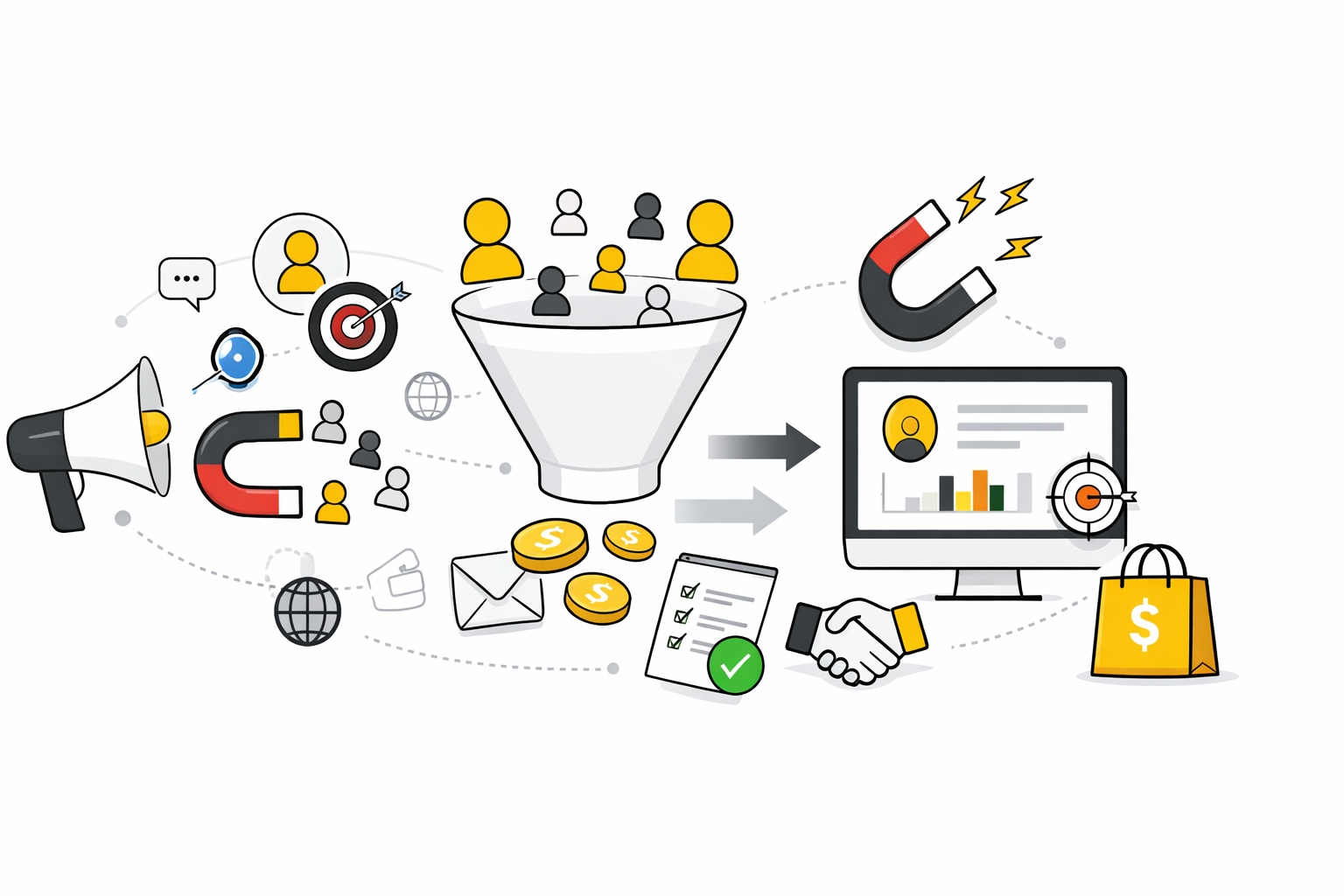
Article Outline
- Why Lead Generation Still Drives Growth
- The Lead Generation Framework
- Core Components of a Reliable Lead Engine
- Channels and Tactics That Actually Produce Qualified Leads
- Measuring, Optimizing, and Scaling Performance
- Professional Implementation Without the Chaos
Why Lead Generation Still Drives Growth
Lead generation matters because attention alone does not build a pipeline. You can have traffic, reach, engagement, and even brand awareness, but without a clear path to capture intent and move prospects forward, those signals stay soft and hard to monetize. A serious growth strategy needs a mechanism that turns curiosity into conversations and conversations into customers.
The stakes are even higher in markets where buyers self-educate. Google’s Think Lead Gen guidance makes the case for connecting first-party data to the full lead funnel, because the companies that understand which leads become revenue can make better investment decisions instead of optimizing for cheap form fills. That is a big shift: the win is no longer getting more leads at any cost, but generating the right leads and proving which sources deserve more budget.
There is also a practical sales reason this matters. Salesforce highlighted in its State of Sales research that reps spend a huge amount of time on non-selling work, which makes poor lead quality even more expensive. When marketing hands over weak, mismatched, or badly timed leads, sales teams lose time, trust, and momentum.
That is why strong lead generation is not just a marketing KPI. It sits right in the middle of brand, demand creation, sales efficiency, data quality, and revenue forecasting. When it works, the entire commercial system gets cleaner.
The Lead Generation Framework
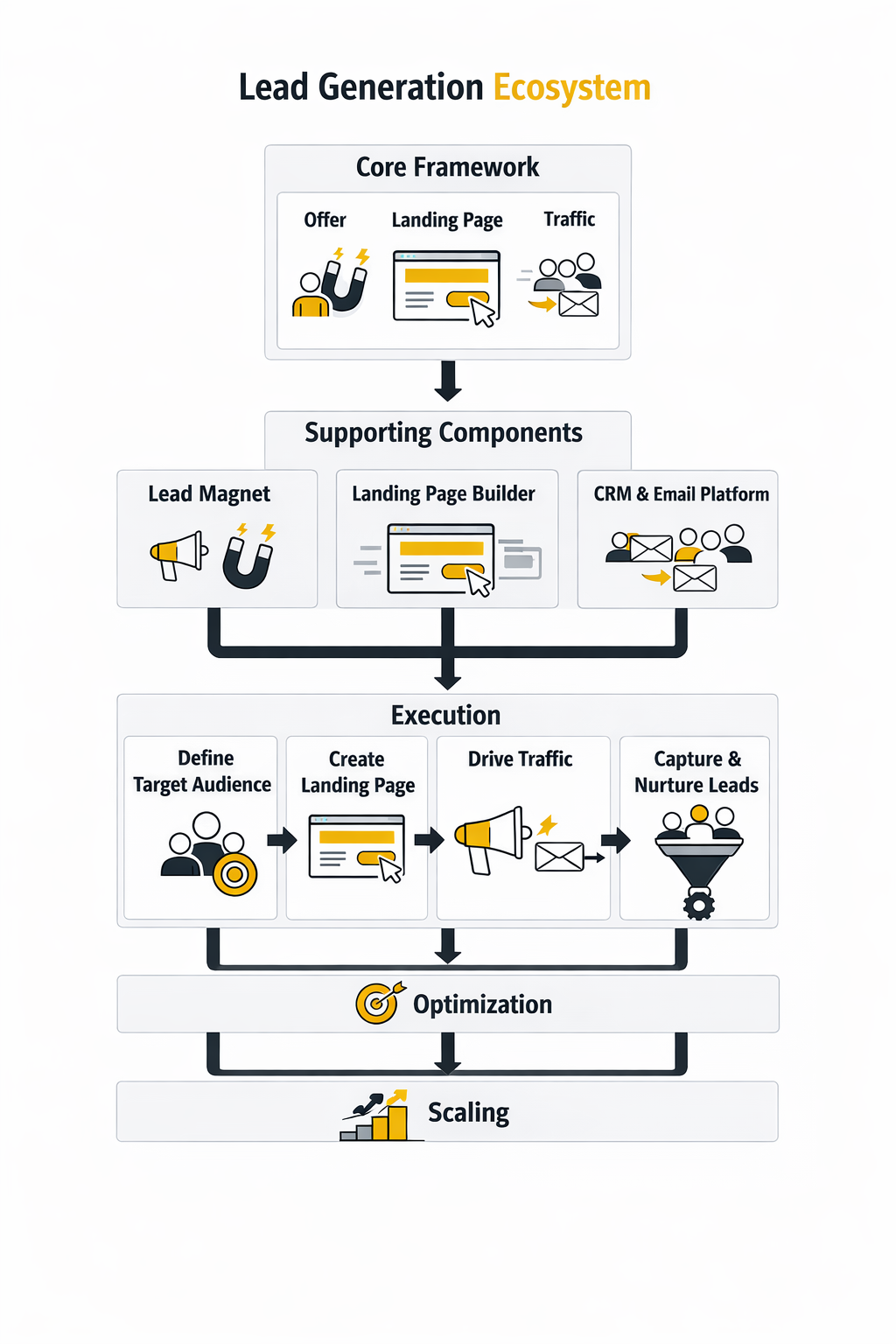
A useful lead generation framework has five connected layers: audience, offer, acquisition, capture, and follow-up. Most underperforming campaigns fail because they over-focus on one layer, usually traffic, while ignoring the others. More clicks do not solve a weak offer, and better software does not fix fuzzy targeting.
At the audience layer, you need clarity on who you want and who you do not want. At the offer layer, you need a reason for someone to raise their hand now instead of “later.” At the acquisition layer, you earn attention through channels like search, social, referrals, partnerships, outbound, and paid campaigns. At the capture layer, you turn that attention into identifiable intent through forms, bookings, chats, trials, or consultations. Then the follow-up layer determines whether the lead gets nurtured, qualified, routed, and converted before interest fades.
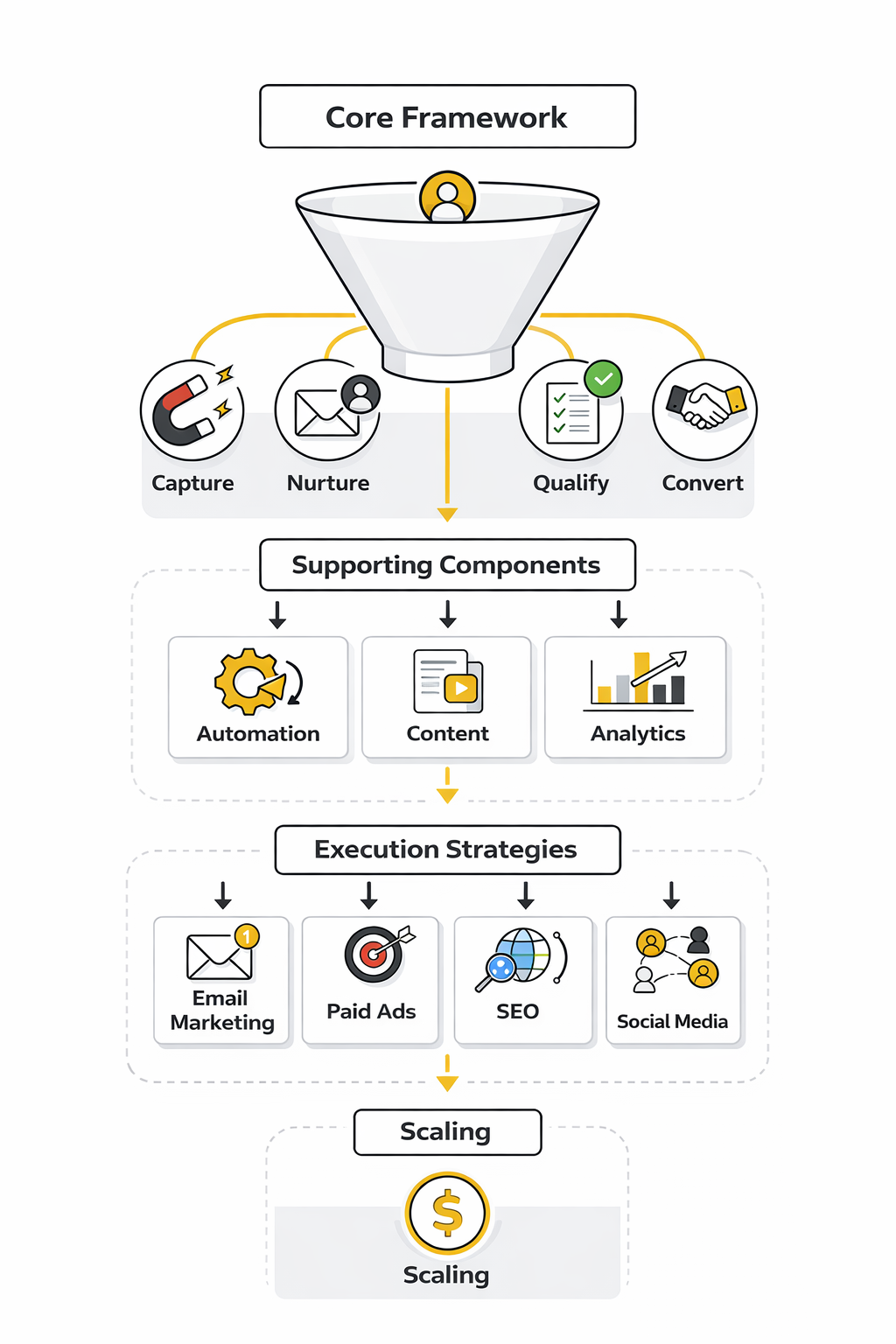
This is the part many teams miss: lead generation is not the form. The form is only the handoff point. The real system starts earlier with message-market fit and continues later with qualification, nurturing, and sales execution.
That is also why platform decisions should serve the framework, not replace it. If you need a fast way to build landing pages, funnels, and follow-up sequences, tools like ClickFunnels or Systeme.io can help with the capture and nurture layers, but they only perform well when the audience, offer, and qualification logic are already clear.
A good framework also keeps you honest. It forces you to ask where the bottleneck really is. Are you attracting the wrong people, giving them a weak reason to convert, losing them on the page, or failing to follow up well enough once they respond? Once you see lead generation as a system instead of a tactic, those questions get much easier to answer.
Core Components of a Reliable Lead Engine
A lead generation system gets reliable when a few core parts work together instead of fighting each other. You need the right audience, a clear offer, a conversion path that feels easy to act on, and follow-up that shows up while intent is still alive. Miss one of those pieces and the whole machine starts leaking value.
This is also where a lot of businesses overcomplicate things. They assume better lead generation comes from adding more tools, more channels, or more automation, when the real fix is usually tighter fundamentals. The companies that generate better leads consistently tend to be sharper about positioning, clearer about intent, and more disciplined about what happens after someone converts.
Audience Clarity Comes First
You cannot generate qualified leads at scale if you are vague about who you are trying to attract. Broad targeting usually feels safer because it creates the illusion of a larger market, but in practice it weakens your message, your offer, and your conversion rate. Strong lead generation starts when you know which problems you solve, which buyers feel them most intensely, and which segments are worth pursuing.
That shift matters because modern buyers do a huge amount of independent research before ever speaking to a vendor. The 2025 B2B Buyer Experience report from 6sense makes it clear that first conversations often reflect existing preference more than active persuasion, which means your targeting and positioning do heavy lifting before sales ever enters the picture. If your message lands with the wrong audience, the funnel may still fill, but the pipeline will not get healthier.
Audience clarity also improves every downstream decision. It makes content more relevant, paid campaigns less wasteful, landing pages more specific, and sales conversations more productive. That is why serious lead generation work often begins with narrowing, not expanding.
The Offer Has To Match Buying Intent
Even good traffic will not convert if the offer feels disconnected from the buyer’s level of readiness. Someone researching a problem usually does not want the same next step as someone comparing vendors, and treating both people the same is one of the fastest ways to depress conversion quality. A useful offer meets the prospect where they are and gives them a reason to move one step forward without creating unnecessary friction.
This is where many lead generation programs quietly break. They send cold or low-intent visitors to a hard sales ask, then wonder why conversion quality is weak or volume is unstable. A better approach is to align the offer to intent, such as educational assets for early-stage research, calculators or templates for active evaluation, and demos or consultations for buyers close to decision.
That also explains why thought leadership still matters. LinkedIn highlighted findings from the 2024 Edelman-LinkedIn B2B Thought Leadership Impact research showing that decision-makers often see thought leadership as a more trustworthy basis for evaluating a company’s capabilities than traditional marketing materials. In plain English, buyers respond better when your lead magnet or offer helps them think better, not just hand over an email address.
Conversion Paths Should Feel Friction-Light, Not Lazy
A conversion path needs to be easy enough to act on and serious enough to qualify intent. That balance matters. If the path is too demanding, you scare off good prospects. If it is too loose, you invite low-intent submissions that waste ad spend and sales time.
This is why the best lead generation systems do not chase the highest raw conversion rate at all costs. Google’s Think Lead Gen guidance emphasizes connecting first-party data with lead outcomes so businesses can optimize toward lead quality and downstream performance, not just top-of-funnel form fills. A lead form, booking page, or chatbot should make the next step obvious, but it should also collect enough signal to help you route and prioritize the response.
The practical move here is to remove unnecessary friction, not all friction. Ask for what the next step genuinely requires. Keep the page focused, the promise clear, and the action singular. Lead generation improves fast when people understand what they get, why it matters, and what happens after they submit.
Follow-Up Is Part of Lead Generation, Not a Separate Department
Many teams talk about lead generation as if the job ends when a form is submitted. It does not. The moment after conversion is where lead value either compounds or decays, and that makes follow-up a core component of the system, not a handoff detail.
Salesforce has been blunt in its sales guidance on follow-up and alignment and broader 2024 sales trends research: lead quality, timing, and coordination between marketing and sales directly affect whether opportunities move forward or stall. If marketing generates interest but sales lacks context, or if sales responds without useful content or timing, the lead did not really fail at the top of funnel. The system failed in transition.
That is why good follow-up is designed in advance. The first email, the booking option, the qualification rule, the owner assignment, and the nurture path should already exist before traffic starts arriving. Lead generation becomes much more predictable when post-conversion behavior is treated like infrastructure instead of improvisation.
Measurement Must Reach Beyond the Form Fill
You cannot improve what you only partially measure. A lot of businesses still evaluate lead generation using volume metrics alone, which sounds sensible until you realize cheap leads can be wildly expensive once sales time, no-shows, and poor-fit opportunities enter the picture. The better question is not how many leads you generated, but which inputs produced leads that actually moved toward revenue.
This is why first-party data and offline conversion tracking have become so important. Google’s documentation on enhanced conversions for leads and its broader web conversion measurement guidance both point in the same direction: better measurement helps advertisers connect campaign activity to qualified outcomes and optimize with much stronger signals. Once that connection is in place, budget decisions get smarter fast.
At a practical level, every lead generation system should track at least four layers: source, conversion event, qualification outcome, and pipeline result. Without that chain, optimization becomes guesswork. With it, you can see which campaigns attract interest, which offers attract fit, and which traffic sources deserve more investment.
Channels and Tactics That Actually Produce Qualified Leads
Once the core engine is in place, channel strategy starts to matter more. Not every channel works the same way, and not every channel deserves equal investment. The best lead generation mix depends on buyer behavior, sales cycle length, deal value, and how much trust a prospect needs before they act.
That said, a pattern keeps showing up across recent research: channels you own and channels that compound tend to create more durable results than channels you rent. HubSpot’s 2025 marketing data continues to show strong ROI from website and SEO, email marketing, content, and paid social in different contexts, while Content Marketing Institute’s 2025 B2B benchmarks point to continued investment in video, thought leadership, webinars, and paid distribution. The signal is clear: the strongest lead generation strategies rarely rely on one source.
SEO and High-Intent Content
Search remains one of the most attractive lead generation channels because it captures people who are already looking for answers. That creates a different quality profile than interruption-based channels. When someone searches with a commercial or problem-aware query, you are not inventing interest. You are stepping into it.
The catch is that search only works well when content aligns with intent. A page built to rank but not convert will generate traffic without pipeline. A page built to sell without answering the searcher’s real question usually will not rank well enough to matter. The sweet spot is practical content that helps the reader make progress and gives them a relevant next step when they are ready.
This is also where templates, calculators, checklists, and comparison content can outperform generic blog posts. They create immediate utility, they naturally filter for interest, and they can move a visitor from passive reading into active evaluation without feeling forced.
Email Still Does Serious Work
Email continues to be one of the most dependable channels in lead generation because it sits right in the middle of capture, nurture, and conversion. It gives you a direct line to people who have already shown intent, and it lets you build momentum over time instead of forcing every visitor to convert on the first visit. That matters in any market where buyers need multiple touches before making a decision.
The key is to stop treating email like a dumping ground for newsletters and random promotions. Good lead generation email sequences are tied to the original offer, the prospect’s likely intent, and the next best action. They answer objections, add proof, and keep the conversation moving.
If you want a lightweight way to build those sequences without adding enterprise-level complexity, platforms like Brevo or Moosend can fit nicely into a practical nurture setup. The tool matters less than the logic, though. The real win comes from sending the right message to the right lead at the right point in the buying journey.
Landing Pages and Funnels
Landing pages are where message quality gets exposed. You can hide weak positioning in a broad ad campaign or a polished brand presentation for a while, but once a visitor lands on a page and has to decide whether to act, clarity wins and confusion gets punished immediately. That is why landing pages deserve more strategic thinking than they usually get.
A strong lead generation page does not try to say everything. It connects one audience, one problem, one promise, and one next step. It makes the outcome feel tangible, reduces hesitation, and removes anything that distracts from the decision.
When you need to launch pages quickly or test different offers, ClickFunnels and Systeme.io can be useful because they let you connect pages, forms, and follow-up without a huge implementation burden. That said, no funnel builder can rescue a weak offer or muddy positioning. The page works when the underlying sales logic works.
Paid Media Works Best When It Learns From Revenue, Not Just Leads
Paid acquisition can absolutely support lead generation, but only when the platform is optimized toward outcomes that matter. If you feed ad systems weak conversion signals, they will happily deliver more of the same, which is how teams end up buying cheap leads that never become real opportunities. Google’s guidance on enhanced conversions for leads, first-party data in GA4, and Performance Max inputs all point in the same direction: better signals produce better optimization.
That changes how you should think about paid media. Instead of asking which campaign gets the lowest cost per lead, ask which campaign generates qualified conversations, booked meetings, and pipeline. Lead generation gets much stronger when ad platforms learn from real business outcomes instead of vanity conversions.
Social Distribution and Owned Reach Still Matter
Not every lead is captured in the first click. A lot of demand gets built through repeated exposure, useful content, and trust that compounds over time. Recent HubSpot marketing trends data and CMI’s 2025 B2B research both reinforce the idea that content distribution still matters because buyers need multiple signals before they act.
That means your lead generation strategy should include a practical publishing rhythm, not random bursts of activity. Tools like Buffer or Flick can help keep distribution consistent, but consistency only helps when the content is tied to a clear audience problem and a real next step. The goal is not to post more. The goal is to stay visible long enough for intent to mature.
Measuring, Optimizing, and Scaling Performance
Lead generation gets expensive when measurement stops at the form submission. You may feel progress because numbers are moving, but if those leads do not become qualified pipeline, the system is lying to you. Real performance work starts when you track the chain from source to conversion to qualification to revenue movement.
That is why measurement now has to be full-funnel. Google keeps expanding conversion attribution controls in Analytics and its lead measurement guidance for a reason: marketers need tighter visibility into what actually drives downstream value. Once that connection exists, optimization becomes less emotional and a lot more precise.
Track the Metrics That Change Decisions
The most useful lead generation metrics are the ones that change what you do next. Cost per lead can be useful, but on its own it is incomplete. A lower CPL is meaningless if qualification rates fall, meetings no-show, or pipeline value drops.
A more practical measurement stack usually includes lead-to-MQL rate, lead-to-meeting rate, sales acceptance rate, opportunity rate, pipeline created, and customer acquisition cost by source. HubSpot’s CPL and CAC benchmarks discussion is useful here because it pushes teams to compare cost with actual business value instead of celebrating isolated top-of-funnel efficiency. That is the shift that makes lead generation scalable rather than noisy.
Fix Bottlenecks One Stage at a Time
When a funnel underperforms, the instinct is often to change everything. That usually makes the problem harder to diagnose. Better lead generation optimization is slower, cleaner, and far more boring in the best possible way.
Start by locating the actual constraint. If traffic is healthy but conversions are weak, the issue is usually message, offer, or page clarity. If leads convert but never qualify, the problem is usually targeting, friction, or intent mismatch. If qualified leads stall after capture, the issue often sits in follow-up, routing, or sales execution rather than marketing.
This is where discipline matters. One change at a time, enough volume to learn, and a clear read on what success looks like. That approach is less exciting than constant reinvention, but it is how lead generation systems become dependable.
Use Automation Carefully So It Improves Timing, Not Just Volume
Automation can make lead generation better or much worse. It helps when it speeds up response time, routes leads properly, triggers relevant nurture, and keeps records clean. It hurts when it floods people with generic messaging, hides weak data, or creates the illusion of process without real qualification.
That tradeoff shows up clearly in HubSpot’s marketing automation guidance, which stresses how much automation depends on data quality, and in Salesforce’s recent writing on AI-powered lead qualification and follow-up. The big takeaway is simple: automate the repeatable mechanics, not the thinking. Lead generation scales best when automation supports judgment instead of replacing it.
Professional Implementation Without the Chaos
Most businesses do not need a massive martech stack to improve lead generation. They need a clean process, clear ownership, and enough infrastructure to capture intent without losing it. The smartest implementation work usually looks smaller and more focused than people expect.
This is also the point where execution becomes real. It is one thing to talk about framework, channels, and metrics. It is another to turn that into a working system that your team can actually run every week without constant firefighting.
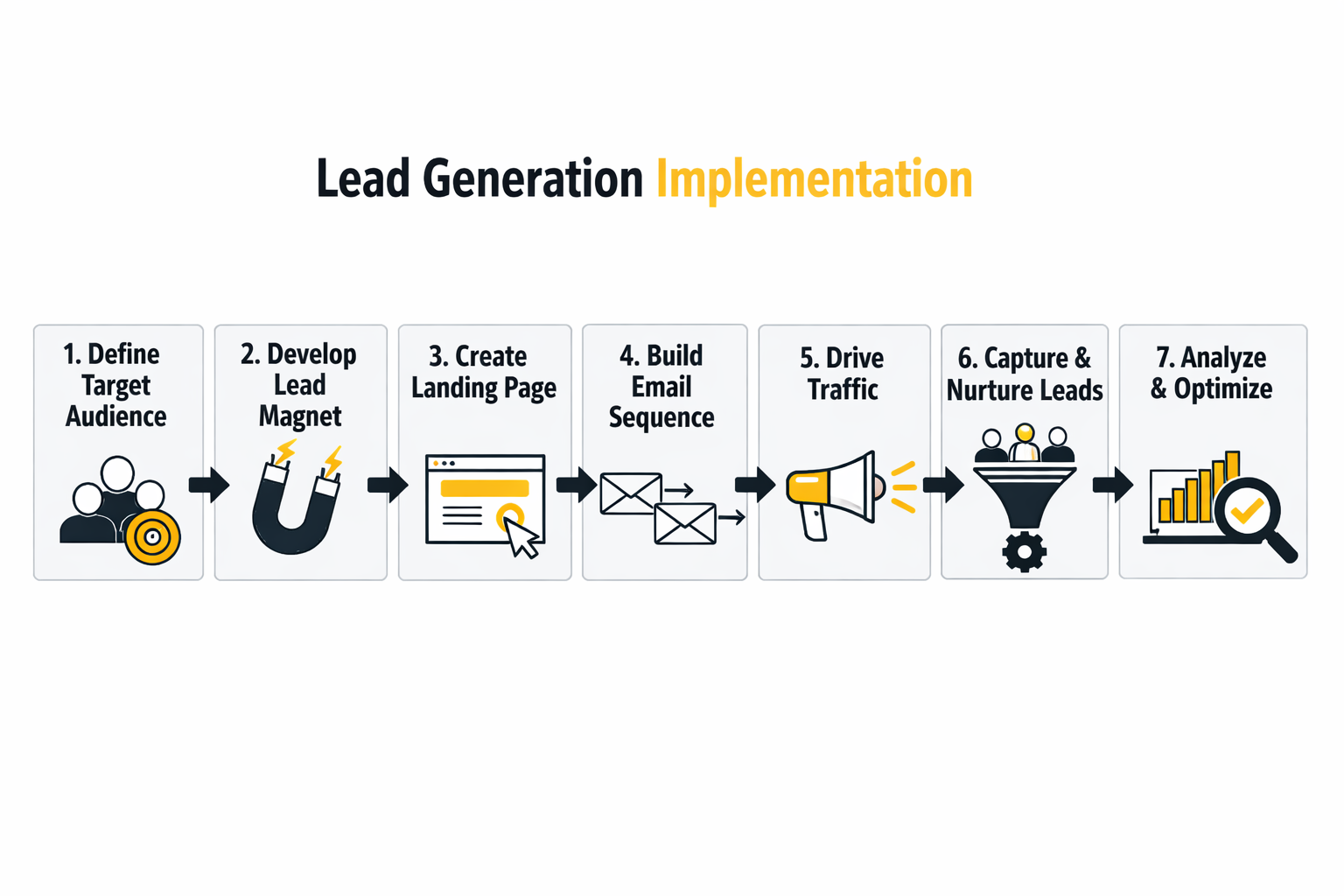
A Practical Lead Generation Buildout
The easiest way to implement lead generation professionally is to build it in layers. Start with the minimum system that can attract, capture, qualify, route, and follow up on intent. Then strengthen each layer once the basics are working.
- Define the audience segment and the specific problem you want to target first.
- Create one offer that matches that segment’s buying intent.
- Build one focused landing page with one clear conversion action.
- Connect the form, scheduler, or chat flow to your CRM and notification system.
- Set qualification rules so every lead is categorized consistently.
- Route leads to the right owner and trigger immediate follow-up.
- Track outcomes in a way that connects source data with pipeline results.
- Optimize the weakest stage before adding new channels.
This sequence works because it prevents random expansion. Instead of launching five disconnected campaigns, you build one lead generation path end to end, prove that it works, and then scale from something real.
Keep the Tech Stack Tight
Too many businesses create implementation headaches by stacking tools before they understand the workflow. The result is duplicated data, broken handoffs, and reporting that nobody trusts. A smaller stack with clearer logic usually performs better than a bloated one held together by workarounds.
For many teams, the essential stack is straightforward: a page builder or funnel platform, a form or chat capture layer, a scheduler, an email system, and a CRM. Depending on your setup, that could look like ClickFunnels or Systeme.io for pages, Fillout for cleaner forms, Cal.com for booking, Brevo for nurture, and Copper if you want a simple CRM layer. The best stack is the one your team will actually maintain.
Speed-to-Lead Needs To Be Designed, Not Hoped For
A lot of lost pipeline happens in the first few minutes after conversion. Interest is highest right after a form fill, chat interaction, or booking request, yet many teams still rely on slow manual follow-up and vague internal ownership. That gap kills more lead generation performance than most landing page tweaks ever will.
This is where routing and scheduling should be intentional. Salesforce’s recent piece on sales and marketing alignment makes the point clearly: sales needs context, timing, and shared qualification standards, not just a name in the CRM. If your model includes consultations or demos, embedding a direct booking option through Cal.com can reduce that dead time dramatically because it shortens the path between intent and conversation.
Qualification Should Happen Before the Lead Reaches Sales
Sales teams do better when they inherit context, not mystery. A lead record should tell the rep what the person wanted, where they came from, what company they represent, what action they took, and how urgent the opportunity appears to be. Without that context, sales ends up redoing work the system should have handled earlier.
Qualification can happen through forms, chat, behavioral rules, or a mix of all three. Salesforce’s overview of lead generation chatbots is a useful reminder that chat can do more than answer questions. It can capture intent, ask routing questions, and move qualified visitors toward the right next step while the session is still live. For some teams, a tool like Chatbase can support that layer without forcing a giant implementation project.
Document the Process Before You Try To Scale It
Scale magnifies whatever already exists. If your lead generation process is messy, scaling it just creates more mess at a higher volume. If the process is clean, scaling becomes a resource question rather than a chaos question.
That is why a documented workflow matters so much. Salesforce’s overview of the sales process keeps coming back to structured stages for a reason. Teams need shared definitions, handoff rules, response standards, and reporting logic before they add more budget, more reps, or more automation. Lead generation becomes professional the moment the process stops living only in someone’s head.
Lead Generation by the Numbers
Statistics only help when they change behavior. In lead generation, the dangerous move is grabbing isolated benchmarks and treating them like a universal truth. A strong team uses data to diagnose where the system is healthy, where it is leaking, and which decisions deserve action first.
That is why context matters more than raw averages. A 4% conversion rate can be fantastic for a high-ticket offer and weak for a low-friction lead magnet. A cheap lead can be excellent in one sales model and completely useless in another. The point is not to worship benchmarks. The point is to use them as reference points while staying anchored to your own funnel economics.
What Landing Page Data Actually Tells You
Landing page conversion rate is one of the most overused lead generation metrics because it is visible and easy to compare. Unbounce’s 2024 conversion benchmark dataset put the median landing page conversion rate at about 6.6% across industries, based on hundreds of millions of visits and tens of millions of conversions. That number is useful, but only if you read it correctly.
First, it gives you a baseline, not a target. If your page converts at 1% or 2%, that is usually a sign to review message match, page clarity, friction, or traffic quality. If your page converts at 8% or 10%, that does not automatically mean the page is excellent, because you still need to know whether those leads qualify and move forward.
Second, median landing page data helps you ask better questions. Are you underperforming because the offer is weak, because the page is confusing, or because the traffic source brings low-intent visitors? Lead generation gets better fast when conversion rate stops being a vanity badge and starts becoming a diagnostic tool.
Email Metrics Are Useful, but Easy To Misread
Email still plays a major role in lead generation, especially in nurture and reactivation, but surface-level metrics can fool you. Mailchimp’s current email marketing benchmarks show an average open rate of 35.63% across users, with average click rates around 2.62%. HubSpot’s more recent email benchmark roundup cites a 2025 average open rate of 42.35% across industries, which tells you immediately that methodology, audience mix, privacy changes, and sample design all affect the number.
That is exactly why lead generation teams should avoid treating opens as the main signal. Open rates can indicate subject-line strength or audience familiarity, but they do not tell you much about business impact on their own. Click rate, reply rate, booking rate, and conversion to the next funnel stage are more actionable because they reflect behavior, not just visibility.
The better interpretation is simple. If opens are solid and clicks are weak, your promise inside the email is probably off. If clicks are healthy and downstream conversions are weak, the problem is likely the landing page, offer, or qualification path. That is how useful email data works: not as a scoreboard, but as a trail of evidence.
Buyer Behavior Data Changes the Way You Judge Lead Quality
One of the biggest shifts in modern lead generation is that buyers do more work before they ever identify themselves. The 2025 B2B Buyer Experience Report from 6sense reinforces a point smart teams already feel in practice: buyers often come into sales conversations with strong preferences, substantial self-education, and a narrower consideration set than marketers assume.
That changes how you interpret lead quality. A lower lead volume does not automatically mean weaker performance if those leads arrive better informed and closer to action. On the other hand, a high-volume campaign can look strong at the dashboard level while quietly feeding sales a stream of people who were never serious buyers in the first place.
This is where lead generation metrics need to grow up. Volume matters, but intent matters more. A good analytics system should help you distinguish between activity and actual buying motion, because those are not the same thing.
Making Sense of the Analytics Stack
Once you start taking lead generation seriously, you need a measurement system that follows the lead beyond the form. Source data, on-page conversion data, CRM status changes, meeting outcomes, and closed revenue all need to connect. Otherwise you are optimizing the front of the funnel while staying blind to what happens after submission.
Google’s documentation on enhanced conversions for leads, lead measurement setup, and the shift toward Salesforce data handling through Data Manager all point in the same direction: platforms want richer first-party signals because they produce better attribution and stronger optimization. That matters because ad systems can only learn from the quality of the signals you send back.
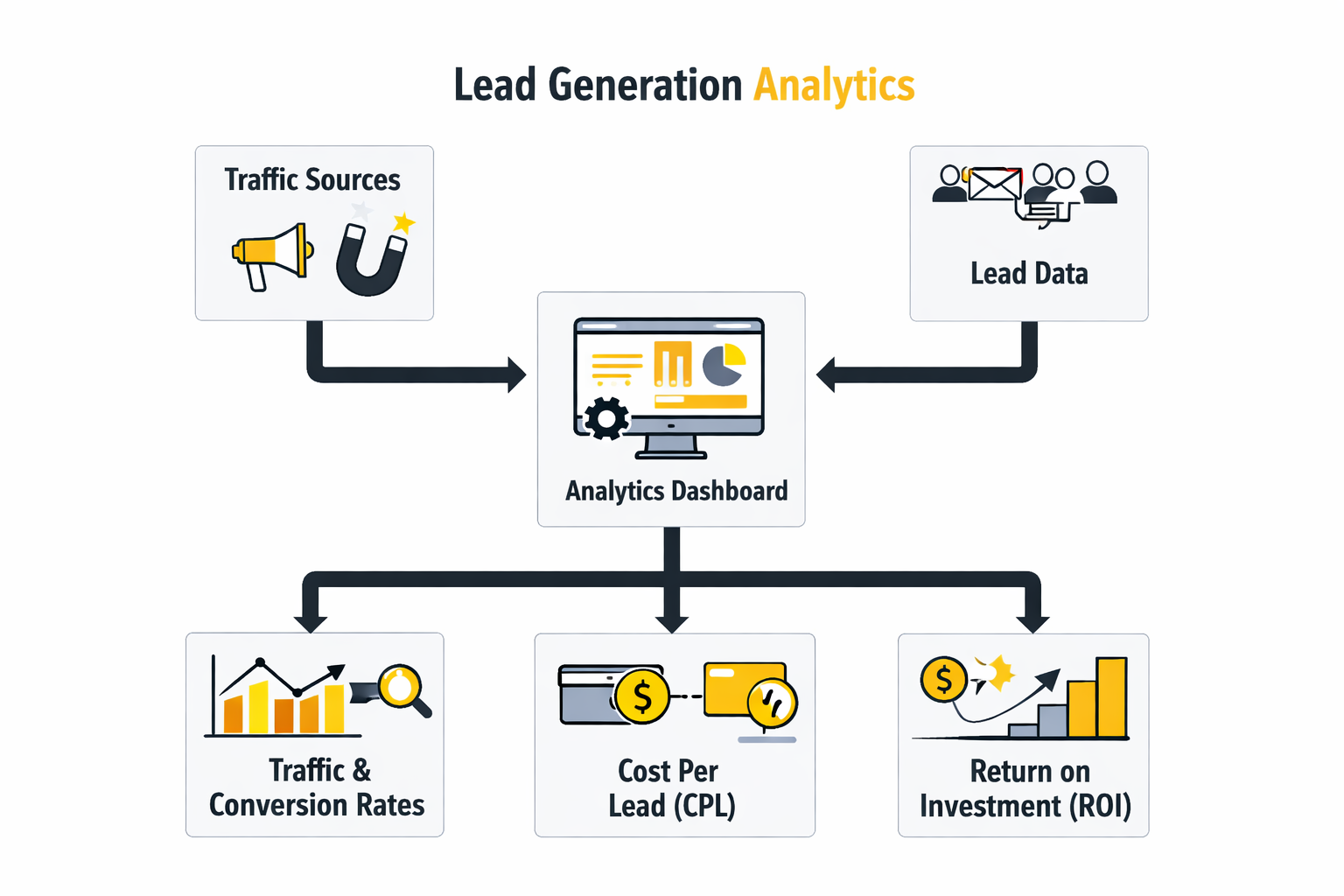
A practical analytics setup usually has four layers. The first layer is acquisition, which tells you where the visitor came from. The second is conversion, which records the action they took. The third is qualification, which captures whether that lead met your standard. The fourth is commercial outcome, which shows whether the lead became a meeting, opportunity, pipeline, or customer.
That sequence matters because it keeps the story intact. Lead generation data becomes misleading when those layers are disconnected. A campaign may look brilliant at layer two and terrible at layer four. If you only measure the easy part, you end up scaling the wrong thing.
The Numbers That Usually Matter Most
Some metrics are more useful than others because they lead to better decisions. Lead generation teams often drown in dashboards while still missing the handful of indicators that actually explain performance. The smartest move is to focus on the metrics that reveal momentum and waste.
The most practical set usually includes these measures:
- visitor-to-lead conversion rate
- cost per lead
- lead-to-qualified-lead rate
- lead-to-meeting rate
- sales acceptance rate
- opportunity creation rate
- pipeline value by source
- customer acquisition cost
These numbers work well together because each one answers a different question. Conversion rate tells you whether the page and offer are doing their job. Cost per lead tells you what acquisition is demanding. Qualification and sales acceptance tell you whether marketing and sales agree on quality. Opportunity rate and pipeline value tell you whether the system is creating real business potential. Customer acquisition cost tells you whether the model is economically sustainable.
Why Benchmarks Should Trigger Questions, Not Panic
Benchmarks are helpful when they force honest reflection. They become dangerous when they trigger blind copying. A landing page benchmark from SaaS may not help a local service business much. An email benchmark from ecommerce may be useless for enterprise lead generation. Even channel benchmarks inside the same industry can vary based on brand strength, sales cycle, and audience maturity.
That is why recent benchmarks should be treated as directional guidance. Unbounce’s landing page benchmark data can help you spot when you are significantly below normal. Mailchimp’s industry email metrics can tell you whether engagement is unusually weak. HubSpot’s marketing statistics hub can give you broader market patterns. But none of these can replace your own revenue data.
The right action is to compare external data with internal reality. If your metrics are weaker than the market and your downstream pipeline is also weak, you probably have a real performance problem. If your top-of-funnel metrics look average but your sales efficiency is strong, the system may be healthier than surface comparisons suggest.
What the Data Should Make You Do Next
Good lead generation analytics should lead to action, not admiration. When the numbers are clear, the next move should usually become obvious. If conversion is low, improve message match, page clarity, or offer relevance. If conversion is healthy but qualification is weak, tighten targeting or introduce better filtering. If qualification is strong but meetings stall, fix follow-up speed, routing, or rep context.
This is where a lot of teams get stuck because they collect data without defining decision rules. They know their cost per lead, but not what threshold makes a campaign unacceptable. They know their email click rate, but not what action follows a drop. They know how many leads entered the CRM, but not what share became something sales actually wanted.
A better system makes action part of reporting. Every major metric should have a plain-language interpretation and an expected response. That is how data starts improving lead generation instead of merely describing it.
Revenue Feedback Beats Surface Optimization Every Time
The strongest performance signal in lead generation is not the first conversion. It is what happens after that conversion enters the real business. Google keeps pushing advertisers toward better lead measurement and offline conversion feedback because campaigns perform better when platforms can learn which leads eventually mattered. That is not a technical side note. It is the difference between optimizing for appearances and optimizing for outcomes.
This is also why leadership teams should be cautious about celebrating cheap top-of-funnel wins too early. A campaign that delivers low-cost leads but weak pipeline is not efficient. It is noisy. A campaign that looks more expensive at the front end but produces strong opportunities may be the real winner.
That is the core interpretation shift. Lead generation data should not just tell you what happened at capture. It should tell you whether the system is creating commercial momentum. Once you start reading the numbers that way, your optimization decisions get much sharper.
Scaling Lead Generation Without Breaking What Already Works
Scaling sounds exciting until it exposes every weak assumption in the system. A lot of businesses think they are ready to scale because they found one campaign or one channel that performs well, but scale tests whether that performance is repeatable under more pressure, more budget, and more complexity. Lead generation gets harder, not easier, when volume rises faster than process quality.
This is why the smartest teams scale in layers. They do not just increase spend and hope the economics hold. They protect message quality, qualification standards, response time, and reporting integrity while they expand reach. That is slower than brute-force growth, but it is how you avoid turning a healthy funnel into an expensive mess.
More Leads Can Actually Lower Performance
One of the biggest lead generation mistakes is assuming volume equals progress. More leads only help when the added volume keeps a similar quality profile and your team can still process the flow properly. If either of those conditions breaks, the system starts producing more work without producing more value.
This is where the gap between marketing success and commercial success becomes painfully obvious. The 2025 B2B Buyer Experience Report from 6sense and Salesforce’s 2024 sales trends research both reinforce a practical reality: buying is complex, sales capacity is finite, and trust still matters. Flooding the pipeline with low-fit leads does not create momentum. It creates noise that slows everyone down.
The action here is straightforward. Before scaling lead generation, test whether sales can handle the extra volume, whether qualification stays stable, and whether pipeline per lead remains healthy. If those numbers slip, the real bottleneck is not traffic. It is system readiness.
Channel Diversification Needs a Real Reason
Diversification sounds responsible, but it often becomes a distraction. Businesses jump into new channels because they are afraid of dependency on one source, yet they end up spreading budget and attention too thin. Lead generation usually performs better when a team dominates a few aligned channels before expanding into the next one.
That does not mean staying dependent forever. It means earning the right to diversify. HubSpot’s marketing trends coverage for 2025 and CMI’s 2025 B2B content research both suggest that teams are investing across formats and platforms, but the lesson is not “do everything.” The real lesson is that different channels serve different roles in trust-building, discovery, nurture, and demand capture.
A good diversification move solves a specific weakness. Maybe search is strong but social reach is weak. Maybe paid acquisition works but owned audience is too small. Maybe email nurture performs well but top-of-funnel discovery is fragile. When lead generation expands for a reason, it tends to hold up. When it expands from panic or boredom, performance usually gets diluted.
Lead Quality Standards Have To Tighten as You Grow
At small scale, teams can survive with loose definitions because people still talk enough to fill in the gaps. At larger scale, ambiguity becomes expensive. If marketing, SDRs, and sales all define a qualified lead differently, the argument never ends and the reporting becomes fiction.
That is why qualification needs sharper rules as lead generation grows. Salesforce’s lead qualification guide is useful here because it highlights structured ways to judge fit and readiness instead of relying on gut feel alone. You do not need an overly rigid framework, but you absolutely need a shared one.
The practical move is to define what counts as a lead, what counts as a qualified lead, what gets routed to sales, what stays in nurture, and what gets disqualified entirely. Once those standards exist, scale becomes much easier to manage because every team is reacting to the same signals instead of inventing its own version of reality.
AI Can Improve Throughput, but It Cannot Rescue Weak Strategy
AI is now woven into nearly every lead generation conversation, usually with a mix of real opportunity and exaggerated promises. Used well, it can improve research, scoring, personalization, response speed, summarization, and workflow efficiency. Used badly, it can generate generic noise faster than your audience can ignore it.
That tradeoff matters more as systems grow. Salesforce’s writing on AI for follow-up and HubSpot’s broader 2026 State of Marketing reflect the same tension: teams want speed and leverage, but trust and relevance still determine whether a lead progresses. Lead generation does not improve just because more text, messages, or automations appear.
The right way to use AI is to remove repetitive friction around a strong strategy. Use it to enrich records, surface patterns, summarize calls, route faster, or help teams respond with more context. Do not use it as a substitute for knowing your audience, clarifying your offer, or earning attention.
Data Quality Becomes a Strategic Issue Faster Than Most Teams Expect
Messy data does not stay a reporting problem for long. In lead generation, weak naming conventions, duplicate contacts, bad attribution, incomplete forms, and inconsistent status updates eventually distort both optimization and decision-making. Once leadership starts funding based on broken data, the damage spreads quickly.
This is where mature teams pull ahead. They treat CRM hygiene, source tracking, and lifecycle stages as operating infrastructure, not admin chores. Google’s continued push toward richer lead measurement and first-party conversion feedback only makes this more important, because the ad platforms themselves now reward cleaner downstream data with better optimization.
The lesson is simple and it matters. If your lead generation data cannot be trusted, your scaling decisions cannot be trusted either. Before adding more campaigns, make sure the system can still tell the truth.
The Best Strategy Usually Looks Less Dramatic Than People Expect
There is a strong temptation to search for the secret tactic, the hidden channel, or the breakthrough hack. In reality, strong lead generation usually comes from things that look almost boring from the outside. Clear positioning, strong offers, tight pages, fast response times, clean qualification, disciplined measurement, and steady optimization still do most of the heavy lifting.
That is also why execution beats inspiration in this field. The 2025 B2B Buyer Experience research from 6sense keeps pointing back to a buyer who is informed, selective, and already deep into the journey before raising a hand. Those buyers do not need more noise. They need clarity, confidence, and a smooth path forward.
If you remember one thing, let it be this: lead generation becomes scalable when the system gets simpler, sharper, and more honest. Not louder. Not busier. Just better aligned with how real buyers move.
Where Strong Lead Generation Usually Ends Up
By this point, the pattern should be clear. Good lead generation is not one page, one ad, one tool, or one clever trick. It is a connected commercial system built around audience clarity, offer strength, conversion design, follow-up discipline, and revenue-aware measurement.
That is the real advantage. When those pieces are aligned, you do not just generate more leads. You generate leads that make more sense, convert with less friction, and create far less waste across the pipeline. The business feels calmer because the engine is cleaner.
In the final part, we will close this out with the questions people still ask most often when they try to implement lead generation properly, especially around cost, timing, quality, channel choice, and what to fix first.
FAQ - Built for Complete Guide
What is lead generation in simple terms?
Lead generation is the process of turning anonymous interest into identifiable potential customers. It usually starts with attracting attention and ends with capturing contact details or intent signals like bookings or demo requests. The real goal is not just collecting leads, but identifying people who are likely to become customers.
How long does lead generation take to work?
Lead generation can produce early signals quickly, especially with paid campaigns, but consistent results usually take time. Organic channels like SEO and content often require several months before they stabilize. Faster channels can deliver leads within days, but quality and efficiency improve only after testing and optimization cycles.
What is a good conversion rate for lead generation?
Conversion rates depend heavily on the offer, traffic quality, and industry. Median landing page conversion rates sit around 6% in many datasets like Unbounce’s benchmark research, but high-ticket services often convert lower and still perform well. The more important metric is how many of those leads become qualified opportunities.
What is the difference between a lead and a qualified lead?
A lead is anyone who expresses interest, while a qualified lead meets predefined criteria that suggest a real buying opportunity. Qualification can include budget, authority, need, timing, or behavioral signals. Strong lead generation systems focus more on qualified leads than raw volume.
Which channel is best for lead generation?
There is no universal best channel. Search works well for high-intent demand, social helps build awareness and trust, email supports nurture, and paid ads accelerate reach. The best channel is the one that consistently produces qualified pipeline at a sustainable cost for your specific business model.
How much should you spend on lead generation?
Budget should be tied to expected return, not arbitrary percentages. The key number is customer acquisition cost relative to customer value. If your system produces profitable customers, increasing spend makes sense. If not, scaling budget just amplifies inefficiencies.
Why do some lead generation campaigns fail?
Most failures come from weak alignment between audience, offer, and follow-up. Traffic might be correct, but the message does not resonate. Or leads convert but are not qualified properly. Or sales follow-up is too slow. The breakdown is usually in the system, not the effort.
Should you prioritize volume or quality?
Quality wins in most cases, especially in B2B or high-ticket environments. High lead volume without qualification creates more work but not more revenue. The best systems balance both by attracting the right audience and filtering effectively.
How important is speed in lead generation?
Speed is critical. Response time strongly affects whether a lead turns into a conversation. Faster follow-up captures intent while it is still fresh. This is why systems often include immediate booking options using tools like Cal.com or instant email sequences.
Can small businesses compete in lead generation?
Yes, and often more effectively than larger companies in niche markets. Smaller teams can move faster, specialize more deeply, and create more relevant messaging. Lead generation rewards clarity and execution, not just budget size.
Do you need expensive tools to succeed?
No. A simple stack with clear logic usually outperforms a complex one. Tools like Systeme.io or ClickFunnels can handle most use cases when combined with a CRM and email platform. The strategy matters more than the software.
What is the biggest mistake in lead generation?
Treating it like a tactic instead of a system. Many teams focus only on ads, content, or landing pages without connecting the full journey. Lead generation becomes predictable only when every stage, from targeting to revenue tracking, works together.
Work With Professionals
Explore 10K+ Remote Marketing Contracts on MarkeWork.com
Most marketers spend too much time chasing clients, competing on crowded platforms, and losing a percentage of every project to middlemen.
MarkeWork gives you a better way. Browse thousands of remote marketing contracts and connect directly with companies desperate to hire skilled marketers like you, without platform commissions and without unnecessary gatekeepers.
If you're serious about finding better opportunities and keeping 100% of what you earn, explore available contracts and create a profile for free at MarkeWork.com.