

Lead generation meaning is simple: it is the process of attracting people who may become customers and capturing enough information to continue the conversation. In practice, that usually means turning anonymous attention into a named contact, a qualified inquiry, a booked call, a demo request, a trial signup, or another measurable sales opportunity.
That definition matters because “more leads” is not always the goal. A business does not need random names in a spreadsheet. It needs the right people, with the right problem, at the right level of interest, entering a system that can educate, qualify, and move them toward a buying decision.
Modern lead generation is less about chasing people and more about building useful paths for buyers. Gartner has reported that many B2B buyers prefer digital self-service, while McKinsey’s B2B research shows buyers now expect flexible interaction across multiple channels. That means your lead generation system has to work before, during, and after a person speaks with sales.
Article Outline
- Lead Generation Meaning And Why It Matters
- The Lead Generation Framework
- Core Components Of A Strong Lead Generation System
- Professional Implementation Across Channels
- Lead Quality, Measurement, And Optimization
- Tools, Mistakes, Examples, And FAQ
Lead Generation Meaning And Why It Matters
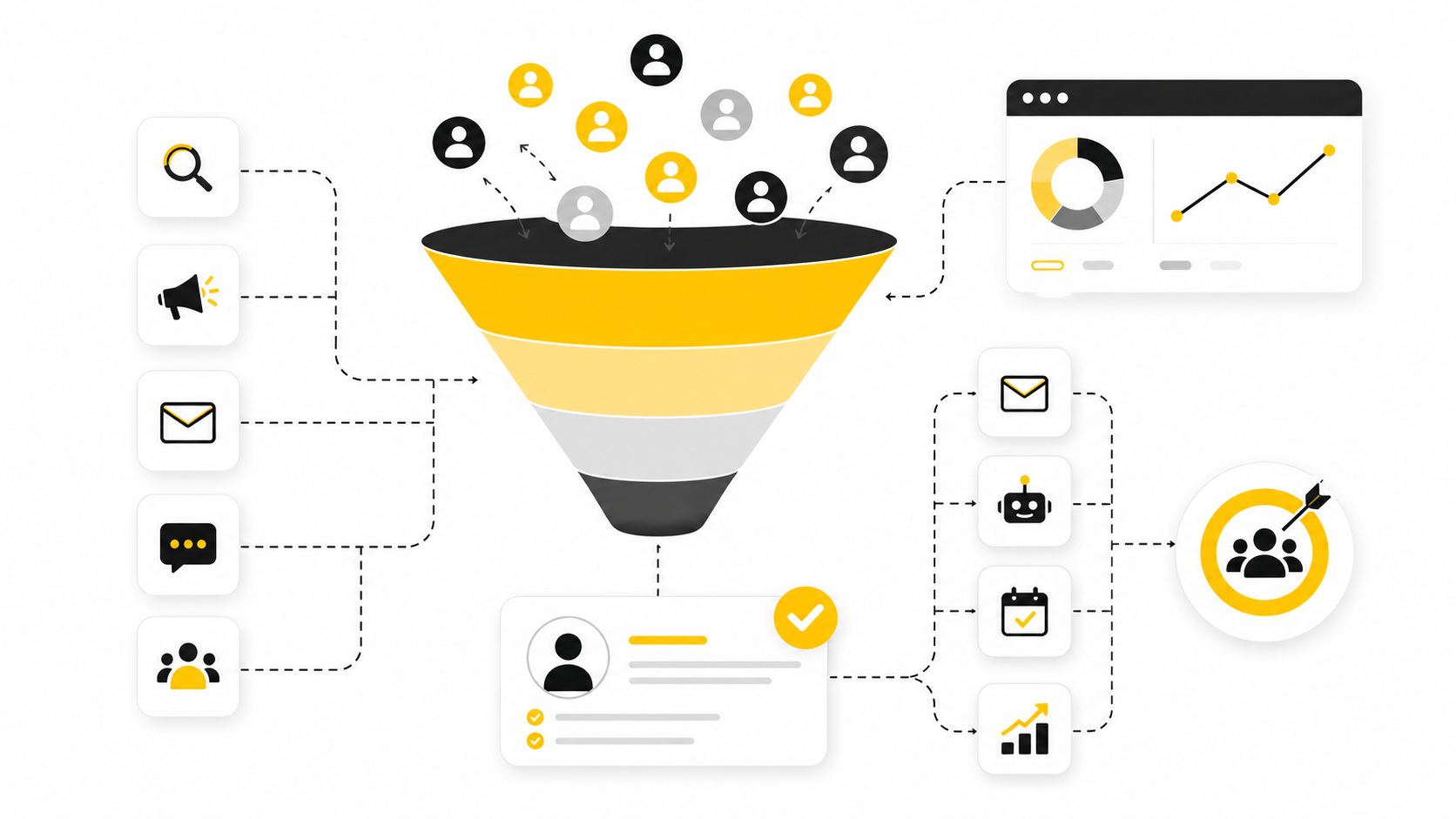
Lead generation is the bridge between marketing attention and sales action. Someone may read your content, visit your website, click an ad, join a webinar, message your brand, or compare your offer against competitors. Lead generation turns that interest into a trackable relationship.
The key word is trackable. Without a lead capture point, you may get traffic, views, followers, or engagement, but you do not have a reliable way to follow up. A good lead generation process gives you permission to continue the conversation through email, SMS, chat, retargeting, sales outreach, or a booked appointment.
This is why lead generation matters for almost every business model. Service businesses use it to book consultations. SaaS companies use it to drive demos and trials. Ecommerce brands use it to capture subscribers before and after purchase. Creators, agencies, coaches, and local businesses use it to build an audience they can actually convert.
The Lead Generation Framework
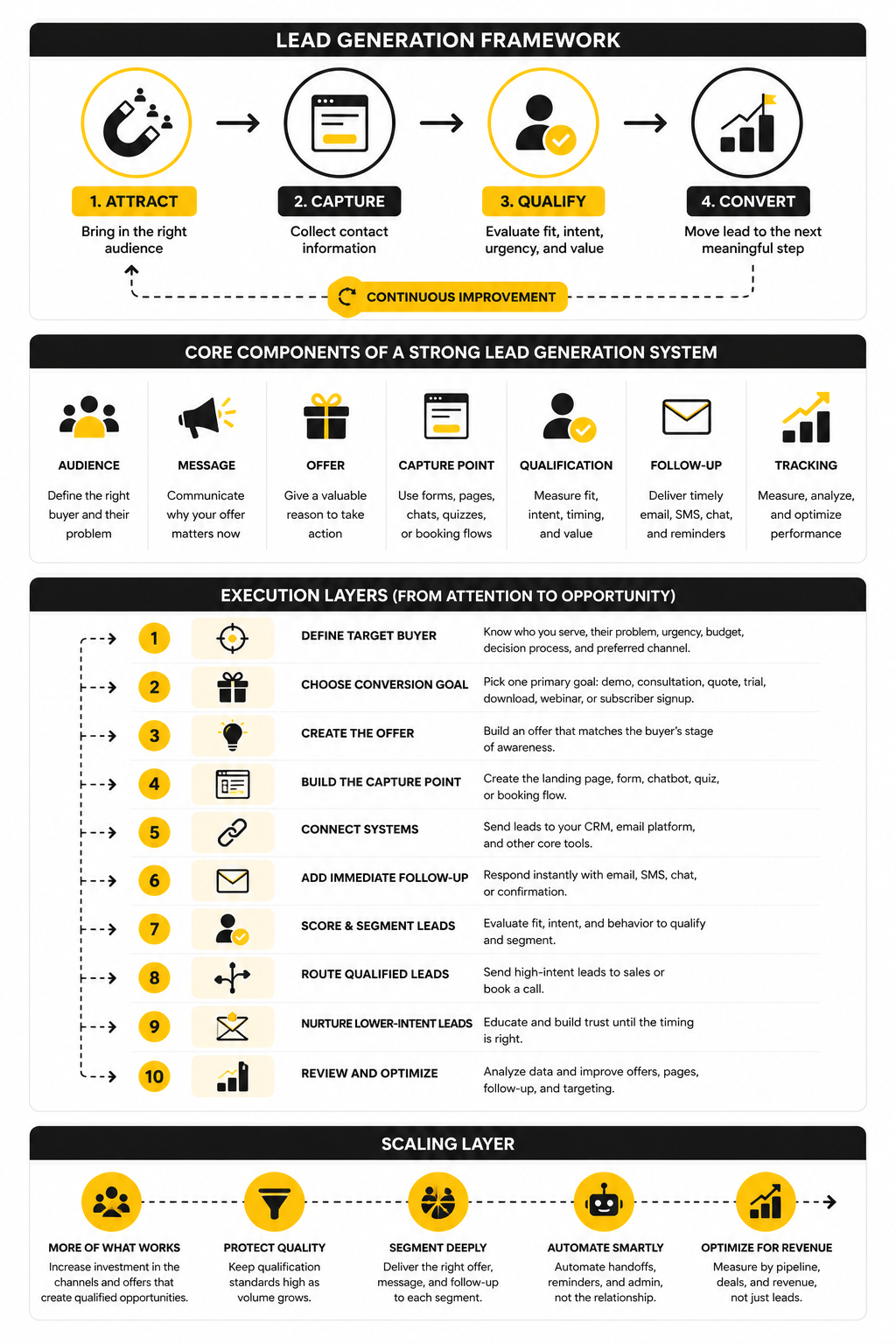
A practical lead generation framework has four stages: attract, capture, qualify, and convert. First, you attract the right audience through content, search, ads, referrals, partnerships, social media, or outbound campaigns. Then you capture contact details through a form, landing page, quiz, chatbot, checkout flow, calendar booking, or message automation.
After capture, the lead needs to be qualified. Qualification means you decide whether the person fits your ideal customer profile, has a real need, has enough urgency, and is worth a sales conversation. This can happen through form questions, lead scoring, CRM data, chatbot flows, email behavior, call notes, or sales discovery.
Finally, the lead has to be converted into the next meaningful step. That next step may be a purchase, a booked call, a demo, a proposal, a trial activation, or a sales-qualified opportunity. Tools such as GoHighLevel, ManyChat, and Fillout can support parts of this system when they genuinely match the business model, but the strategy comes first.
The Lead Generation Framework
A useful lead generation framework starts before the form, funnel, or CRM. It starts with one question: who is this actually for? If that answer is vague, the whole system gets noisy fast.
The first layer is audience clarity. You need to know the buyer’s problem, urgency, budget level, decision process, and preferred channel. Lead generation meaning changes slightly depending on the business, but the principle stays the same: attract people who are likely to become valuable customers, not just people who are easy to collect.
The second layer is the offer. A lead magnet, demo, audit, quote, webinar, free trial, consultation, checklist, or calculator only works when it gives the buyer a reason to exchange their information. Weak offers create weak leads. Strong offers filter for intent.
The third layer is the capture mechanism. This could be a landing page, form, chatbot, booking page, quiz, checkout step, or direct message flow. The best capture points feel natural because they match what the visitor already wants to do next.
The fourth layer is follow-up. This is where many businesses lose the lead. A person who fills out a form today may not remember your brand tomorrow, so your system needs timely email, SMS, CRM reminders, retargeting, or sales outreach that keeps the conversation alive.
Attract The Right People First
Lead generation starts with attention, but not all attention is useful. A viral post can bring thousands of visitors who never buy. A specific search page, partner referral, or targeted campaign can bring fewer people but produce far better opportunities.
This is why channel selection matters. SEO can work well when buyers are actively searching for answers. Paid ads can work when the offer and economics are clear. Social content can work when trust and repeated exposure matter. Outbound can work when the target account is specific and the message is relevant.
The mistake is treating every channel as if it should produce the same kind of lead. Someone downloading a beginner checklist is usually not in the same buying stage as someone booking a strategy call. Good lead generation respects that difference instead of forcing every visitor into the same follow-up sequence.
Capture Intent Without Adding Friction
A lead capture point should ask for enough information to continue the conversation, but not so much that it kills momentum. For a newsletter, an email address may be enough. For a high-ticket consultation, asking about budget, company size, timeline, and main challenge can save everyone time.
This is where forms, funnels, and chat flows need to be designed carefully. A simple page built with tools like Fillout can work well when the goal is clean qualification. A funnel builder like ClickFunnels can make sense when the offer needs multiple steps, upsells, appointment booking, or structured follow-up.
The point is not to make the capture process fancy. The point is to make it clear. Tell the visitor what they get, why it matters, what happens next, and how much effort is required.
Qualify Leads Before Sales Time Gets Wasted
Lead qualification separates interest from fit. Someone can be curious and still not be a good prospect. Someone can love your content and still have no budget, no authority, no urgency, or no real need.
A practical qualification system looks at four things: fit, intent, timing, and value. Fit means the person matches the type of customer you can actually help. Intent means their behavior shows more than casual interest. Timing means the problem matters soon enough to justify follow-up. Value means the opportunity is worth the cost of acquiring and serving the customer.
This is where a CRM becomes useful. A platform like GoHighLevel can help teams track leads, automate follow-up, assign opportunities, and keep pipeline activity visible. But the tool only helps if the business has already defined what a qualified lead actually means.
Core Components Of A Strong Lead Generation System
A strong lead generation system is built from connected parts, not random tactics. The traffic source, offer, landing page, form, follow-up, CRM, and sales process all need to support the same goal. If one part is weak, the whole system leaks.
This is where lead generation meaning becomes more operational. It is not just “getting leads.” It is designing a repeatable path from first attention to qualified opportunity, then improving that path with real data.
The most important components are simple:
- Audience: who the campaign is meant to attract
- Message: why the offer matters now
- Offer: what the person gets in exchange for taking action
- Capture point: where contact details are collected
- Qualification: how fit and intent are measured
- Follow-up: what happens after the lead enters the system
- Tracking: how performance is measured and improved
Professional Implementation Across Channels
Professional implementation starts with mapping the buyer journey. A person who just discovered the problem needs education. A person comparing vendors needs proof. A person ready to buy needs a clear next step with low friction.
That is why a lead generation process should not depend on one generic landing page. Search visitors may need a direct answer and a relevant offer. Social traffic may need more trust before converting. Paid traffic usually needs a tighter message-to-offer match because every click costs money.
A practical process looks like this:
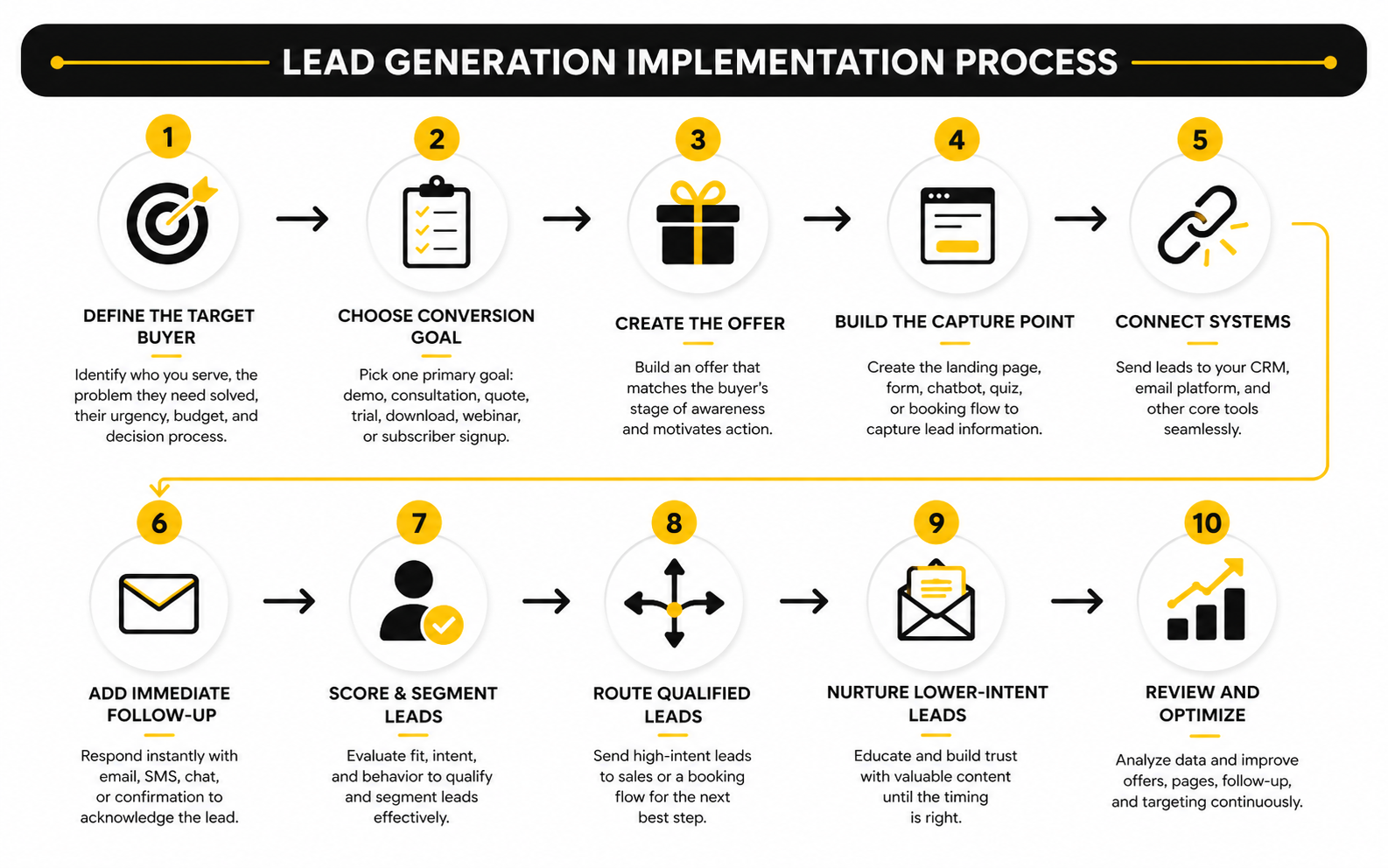
- Define the target buyer and the exact problem they want solved.
- Choose one primary conversion goal, such as a demo, consultation, quote, download, trial, or subscriber signup.
- Create an offer that matches the buyer’s stage of awareness.
- Build the capture page, form, chatbot, or booking flow.
- Connect the lead source to your CRM or email platform.
- Add immediate follow-up so the lead is not left waiting.
- Score or segment the lead based on fit, intent, and behavior.
- Route qualified leads to sales or a booking flow.
- Nurture lower-intent leads with useful content.
- Review conversion, cost, quality, and revenue data.
This is not complicated, but it does require discipline. Businesses often skip steps because they want the campaign live quickly. Then they wonder why leads are cheap but useless, or why strong prospects disappear after submitting a form.
Build The Capture Flow Around The Next Best Step
The capture flow should match the buyer’s level of commitment. A cold visitor may not be ready to book a call, but they may download a guide, take a quiz, use a calculator, or ask a question through chat. A warm visitor who has already compared options may want pricing, a demo, or a direct consultation.
For ecommerce and direct-response offers, a funnel tool like ClickFunnels can make sense when the path includes multiple conversion steps. For service businesses, agencies, and local businesses, GoHighLevel can be useful when the workflow depends on CRM pipelines, appointment booking, SMS, email, and sales follow-up in one place. For conversational capture on social channels, ManyChat can help turn comments, clicks, and messages into structured follow-up.
The tool should never decide the strategy. Start with the next best step for the buyer, then choose the software that makes that step easier to complete. That order matters.
Follow Up While Intent Is Still Fresh
Speed matters because intent fades. When someone submits a form, they are usually in a moment of attention. If the follow-up comes hours or days later, the emotional momentum is gone and competitors may already be in the conversation.
Immediate follow-up does not have to mean aggressive selling. It can be a confirmation email, a useful resource, a calendar link, a short SMS, a chatbot reply, or a sales task in the CRM. The goal is to make the lead feel guided, not abandoned.
This is especially important in B2B, where buyers often move across digital self-service, remote communication, and human sales conversations. McKinsey’s B2B research shows that buyers use many channels across the journey, so the follow-up system has to connect those interactions instead of treating each one as separate.
Lead Quality, Measurement, And Optimization
Lead generation meaning gets sharper when measurement enters the picture. A lead is not just a contact record, and a campaign is not successful just because it fills the CRM. The real question is whether those leads move through the pipeline, create revenue opportunities, and justify the cost of getting them.
That is why measurement has to go beyond surface-level numbers. Traffic, impressions, clicks, and form submissions are useful early signals, but they do not prove business impact by themselves. A campaign with fewer leads can outperform a campaign with more leads if those leads convert faster, spend more, or require less sales effort.
Statistics And Data That Actually Matter
Good benchmarks give context, not commandments. For example, Norwest’s 2025 B2B Sales and Marketing Benchmark Report found that the definition of an MQL is shifting away from simple scoring models and toward a mix of engagement, persona fit, and high-intent actions. That matters because teams can no longer treat every download or email click as equal.
The same report noted that scoring-model-based MQL definitions dropped from 55% in 2023 to 25% in 2025, while high-intent signals such as demo or sales requests rose from 19% to 30%. The lesson is direct: lead generation should not reward activity for its own sake. It should reward signals that suggest the buyer is both relevant and closer to action.
Benchmarks also help you avoid panic. A low conversion rate might be normal for cold paid traffic, but a serious warning sign for branded search or referral traffic. A high cost per lead might be acceptable if close rates and deal size are strong. The number only becomes useful when it is tied to the stage, source, offer, and revenue outcome.
The Metrics Worth Tracking
A practical lead generation dashboard should show the full path from attention to revenue. If the dashboard stops at leads captured, it will encourage the team to optimize for volume. That usually creates more work for sales and less profit for the business.
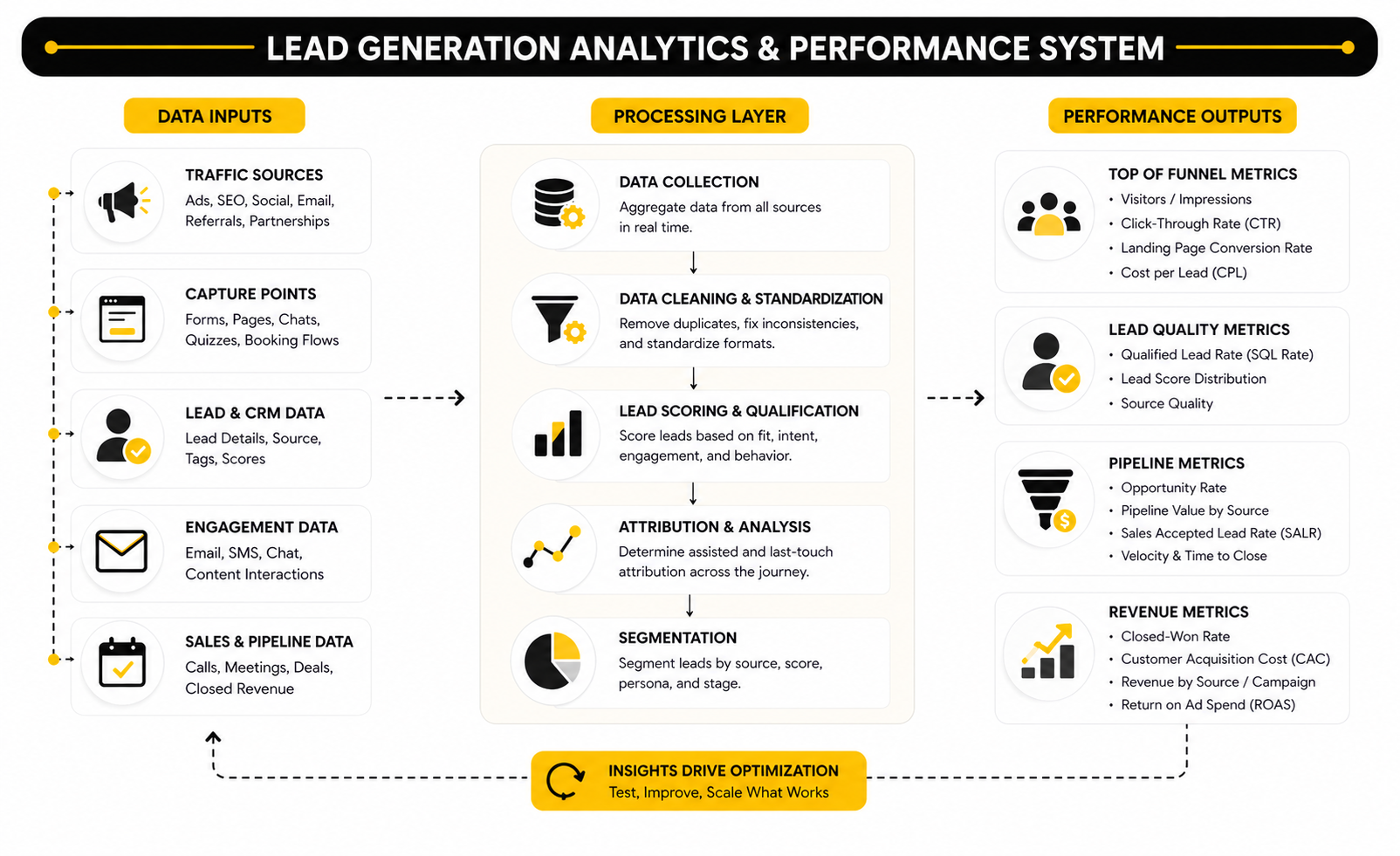
The core metrics to track are:
- Visitor-to-lead conversion rate: how well the page, offer, and audience match
- Cost per lead: how much it costs to generate each new contact
- Lead-to-qualified-lead rate: how many leads meet your fit and intent criteria
- Qualified-lead-to-opportunity rate: how many qualified leads become real sales opportunities
- Opportunity-to-customer rate: how well sales converts the pipeline
- Customer acquisition cost: the total cost of winning a customer
- Sales cycle length: how long it takes leads to become revenue
- Lead source revenue: which sources produce customers, not just contacts
These metrics work together. Cost per lead without quality data can mislead you. Conversion rate without revenue data can make weak offers look strong. Sales cycle length without source data can hide which campaigns bring buyers who are ready now versus people who need months of nurturing.
How To Interpret Lead Generation Performance
Start by separating volume problems from conversion problems. If traffic is low but conversion is strong, the campaign may need more distribution. If traffic is high but conversion is weak, the problem is likely message, offer, audience, page clarity, or friction.
Then look at quality. If leads are coming in but few become qualified, your targeting or offer may be too broad. If qualified leads are not becoming opportunities, sales handoff, timing, qualification rules, or follow-up may be the issue.
Finally, connect the numbers to action. A weak landing page conversion rate may call for better copy, a stronger offer, or fewer form fields. A weak lead-to-opportunity rate may call for tighter qualification and better routing. A weak opportunity-to-customer rate may mean the lead generation system is working, but positioning, pricing, sales process, or proof needs attention.
Optimization Is A System, Not A One-Time Fix
Optimization should be methodical. Change one major variable at a time, give the campaign enough data to learn from, and judge performance by downstream results. Random changes create random learning.
The best teams review lead generation performance in layers. They check channel performance, then offer performance, then page performance, then qualification, then sales outcomes. This prevents the common mistake of blaming ads when the real issue is follow-up, or blaming sales when the real issue is low-intent lead capture.
A clean CRM setup makes this much easier. Tools like Copper can help teams manage relationships and pipeline visibility, while platforms like GoHighLevel can connect capture, follow-up, booking, and pipeline tracking in one place. The tool matters less than the discipline: every lead source should be measured by what it contributes to pipeline and revenue.
Advanced Lead Generation Strategy
Advanced lead generation is not about adding more channels just because they are available. It is about knowing which channels deserve more investment, which ones should be limited, and which ones create hidden costs. This is where the simple definition of lead generation meaning turns into a strategic decision about growth, capacity, and risk.
The biggest tradeoff is usually volume versus quality. Broad offers can generate more leads, but they often create more sorting, more follow-up, and more wasted sales time. Narrow offers may produce fewer leads, but those leads can be easier to qualify, easier to serve, and more likely to turn into revenue.
Another tradeoff is speed versus trust. A direct booking page can work when the buyer already understands the problem and trusts the brand. A longer nurture path may work better when the buyer needs education, comparison, internal approval, or proof before taking action.
Scaling Without Breaking Lead Quality
Scaling lead generation does not mean doing more of everything. It means finding the few inputs that reliably create qualified opportunities and then increasing those inputs without weakening the system. If quality drops as volume rises, the system is not scaling; it is just getting louder.
The first scaling rule is to protect qualification standards. If the team lowers the bar just to report more MQLs, pipeline reports may look better for a while, but sales trust will drop. That is dangerous because once sales stops trusting marketing leads, even good leads get slower follow-up.
The second scaling rule is to segment aggressively. New leads should not all receive the same message, same offer, or same sales motion. Segment by source, problem, company type, urgency, deal size, and buyer stage so each lead gets the most relevant next step.
The Risks That Quietly Damage Lead Generation
The most obvious risk is poor lead quality, but the quieter risks are often more expensive. Bad tracking can make the wrong channel look profitable. Weak attribution can over-credit the last click while ignoring the content, referral, or nurture sequence that created trust. Slow follow-up can make a strong campaign look weak because intent disappears before sales acts.
Privacy and data quality are also becoming more important. First-party data is valuable because it comes directly from your audience, but it has to be collected with clear consent and a real value exchange. A privacy-first lead generation system asks for what it needs, explains why it matters, and avoids collecting data just because a form builder makes it easy.
There is also a brand risk. Over-automated follow-up, spammy outreach, misleading lead magnets, and aggressive retargeting can create short-term activity while damaging long-term trust. That is a bad trade. A lead generation system should make people feel understood, not hunted.
When Automation Helps And When It Hurts
Automation helps when it removes delays, reduces manual admin, and keeps the buyer moving. Confirmation emails, appointment reminders, CRM routing, lead scoring, segmentation, and nurture sequences are strong use cases. These tasks are repetitive, time-sensitive, and easy to systemize.
Automation hurts when it replaces judgment too early. A high-value lead may need a human response, not another generic email. A confused buyer may need a simple explanation, not a 14-step sequence. A complaint or objection should not be treated like normal engagement.
The right approach is simple: automate the handoffs, not the relationship. Use tools like Brevo or Moosend for email workflows when nurturing is the priority. Use Chatbase when a website needs a guided AI chat experience, but make sure important buying signals can still reach a real person.
Expert-Level Lead Generation Principles
The best lead generation systems are built around buyer intent, not vanity activity. They do not treat every click as equal. They look for patterns that suggest a person is moving from curiosity to evaluation to action.
Strong teams also align marketing and sales before campaigns launch. They agree on what counts as a qualified lead, how fast follow-up should happen, what information sales needs, and which objections marketing should address earlier in the journey. Without that alignment, lead generation turns into a blame game.
Finally, advanced teams optimize for learning speed. Every campaign should teach you something about the market, the offer, the message, or the buyer’s decision process. Even a campaign that underperforms can be valuable if it reveals which audience, angle, or promise does not deserve more budget.
Tools, Mistakes, Examples, And FAQ
The final piece of the lead generation system is the ecosystem around it. Your content, ads, landing pages, forms, CRM, email platform, calendar, chatbot, sales process, and reporting should not behave like separate islands. They should work together so the buyer experiences one clear path and the team can see what is actually happening.
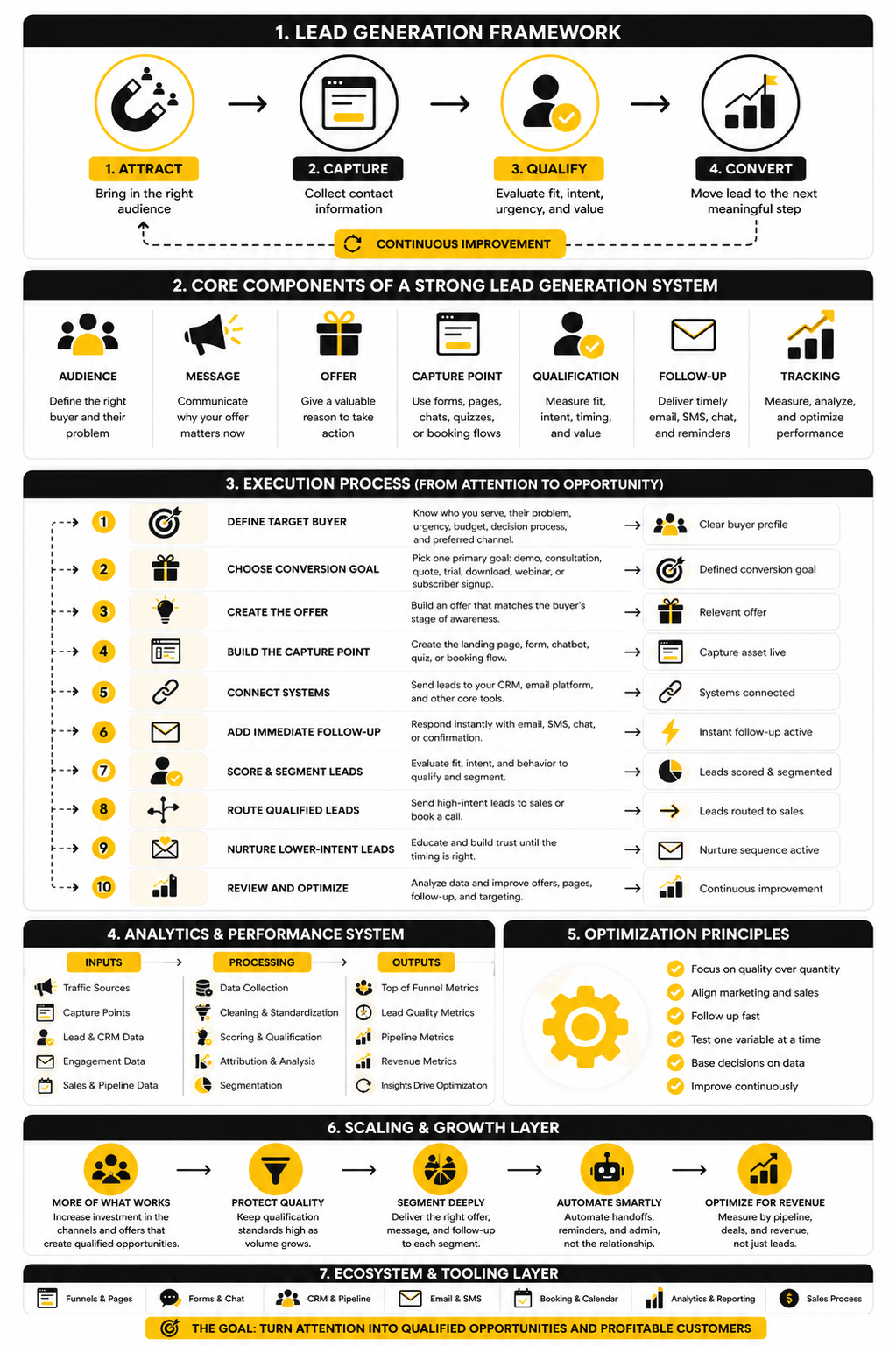
This is where many businesses overcomplicate things. They buy too many tools before fixing the offer, message, qualification rules, and follow-up process. Start with the journey first, then choose the stack that supports it.
A lean lead generation stack usually includes:
- A traffic source, such as SEO, paid ads, social, referrals, partnerships, or outbound
- A conversion asset, such as a landing page, funnel, quiz, form, chatbot, or booking page
- A CRM or pipeline system to store and manage leads
- An email, SMS, or messaging tool for follow-up
- A calendar or sales routing process for high-intent leads
- Analytics that connect source, quality, pipeline, and revenue
Tools like GoHighLevel, ClickFunnels, Systeme.io, ManyChat, Brevo, Fillout, and Cal.com can all fit different parts of the ecosystem. The right choice depends on the business model, channel mix, team size, and how much automation you actually need.
Common Lead Generation Mistakes
The first mistake is chasing lead volume before defining lead quality. This creates impressive-looking reports and painful sales conversations. A business may celebrate 500 new leads, then discover that almost none of them have the budget, authority, urgency, or problem fit to buy.
The second mistake is using one offer for every buyer stage. A cold audience usually needs education and trust. A warm audience may need comparison, proof, or a stronger reason to act now. A hot audience needs a clear path to talk, book, buy, or start.
The third mistake is failing to follow up fast enough. Lead generation meaning includes the handoff after capture, not just the capture itself. If a lead submits a form and hears nothing useful, the system has already started losing value.
FAQ - Built For Complete Guide
What Is The Simple Meaning Of Lead Generation?
Lead generation means attracting potential customers and collecting their contact information so the business can continue the conversation. It usually happens through forms, landing pages, calls, chatbots, email signups, quote requests, demos, trials, or booking pages. The goal is not just to collect names, but to create real sales opportunities.
Why Is Lead Generation Important?
Lead generation is important because most businesses need a predictable way to create future revenue. Without it, growth depends too heavily on referrals, luck, or one-off campaigns. A clear lead generation system gives marketing and sales a repeatable way to find, qualify, and convert interested buyers.
What Is The Difference Between A Lead And A Prospect?
A lead is someone who has shown interest and shared some information. A prospect is usually a lead that has been reviewed and appears to fit the business’s target customer profile. In simple terms, every prospect can be a lead, but not every lead deserves to be treated as a serious prospect.
What Makes A Lead High Quality?
A high-quality lead has fit, intent, timing, and potential value. They match the type of customer you serve, show signs of real interest, have a problem that matters, and could become a profitable customer. Quality matters because cheap leads can become expensive if they waste sales time.
What Is An Example Of Lead Generation?
A simple example is a business offering a free consultation on a landing page. A visitor fills out a form, answers a few qualification questions, and books a time on the calendar. The business then follows up with reminders, context, and a sales conversation.
Is Lead Generation Only For B2B Companies?
No, lead generation works for B2B, B2C, ecommerce, local services, SaaS, agencies, creators, and professional services. The format changes depending on the business. A software company may generate demo requests, while a local service business may generate quote requests or booked appointments.
What Is The Difference Between Lead Generation And Demand Generation?
Demand generation creates awareness, interest, and market demand. Lead generation captures that interest and turns it into contactable opportunities. The two work best together because demand without capture is hard to measure, while lead capture without demand often produces weak results.
What Is The Best Channel For Lead Generation?
There is no universal best channel. SEO works well when people are already searching for answers. Paid ads work when the offer and economics are clear. Referrals, partnerships, social content, webinars, email, and outbound can all work when they match the buyer and the offer.
How Do You Measure Lead Generation Success?
Measure lead generation by looking at the full funnel, not just form submissions. Track conversion rate, cost per lead, lead quality, qualified lead rate, opportunity rate, close rate, customer acquisition cost, and revenue by source. The best campaign is not always the one with the most leads; it is the one that creates profitable customers.
What Is A Lead Magnet?
A lead magnet is something valuable offered in exchange for contact information. Examples include guides, checklists, templates, webinars, calculators, audits, reports, free trials, and consultations. A good lead magnet solves a specific problem and attracts the type of buyer the business actually wants.
How Fast Should You Follow Up With A New Lead?
Follow up as quickly as possible while the person still remembers why they took action. For high-intent leads like quote requests, demo requests, and booked consultations, speed can make a major difference. For lower-intent leads, the follow-up can be more educational, but it should still start promptly.
Can Lead Generation Be Automated?
Yes, parts of lead generation can be automated. You can automate form routing, email sequences, SMS reminders, chatbot replies, lead scoring, calendar booking, and CRM tasks. The important part is knowing when automation should support the relationship and when a real human should step in.
What Is The Biggest Lead Generation Mistake?
The biggest mistake is optimizing for quantity instead of quality. More leads do not automatically mean more revenue. A smaller number of qualified, high-intent leads can be far more valuable than a large list of people who were never likely to buy.
Work With Professionals
Explore 10K+ Remote Marketing Contracts on MarkeWork.com
Most marketers spend too much time chasing clients, competing on crowded platforms, and losing a percentage of every project to middlemen.
MarkeWork gives you a better way. Browse thousands of remote marketing contracts and connect directly with companies desperate to hire skilled marketers like you, without platform commissions and without unnecessary gatekeepers.
If you're serious about finding better opportunities and keeping 100% of what you earn, explore available contracts and create a profile for free at MarkeWork.com.