

Leads marketing is the discipline of attracting, capturing, qualifying, nurturing, and converting people who show measurable interest in your offer. Done well, it does not stop at collecting email addresses. It connects traffic, messaging, forms, CRM data, follow-up, sales handoff, and revenue feedback into one system.
That matters because modern buyers are harder to move with generic campaigns. In B2B, 67% of buyers now prefer a rep-free buying experience, but they still need trust, clarity, and timing before they convert. In consumer marketing, the same pattern shows up differently: people expect fast answers, useful content, and personalized next steps before they give a brand permission to keep talking.
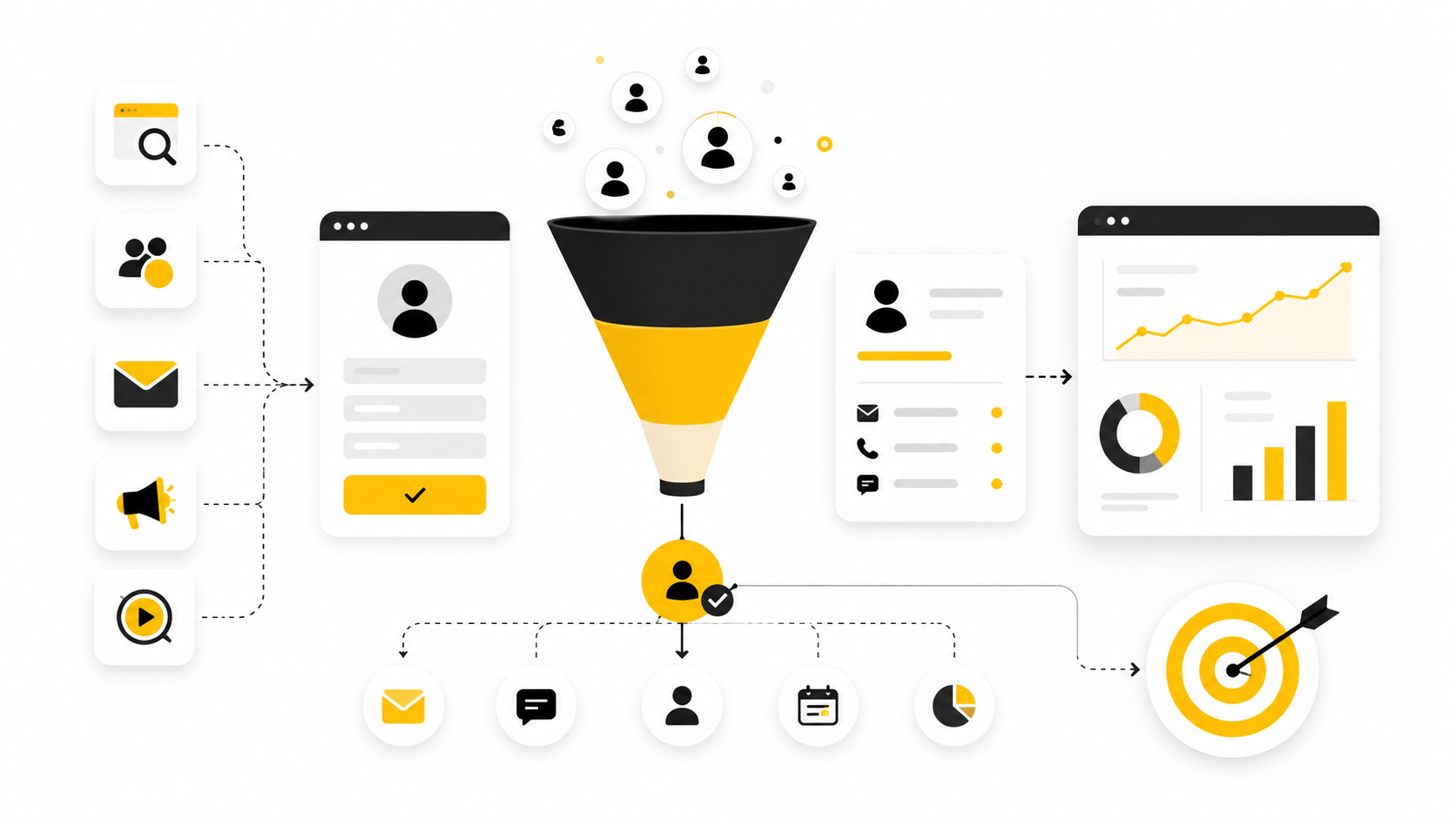
This article breaks leads marketing into a practical system you can actually build. The goal is not more leads at any cost. The goal is better-fit leads, cleaner attribution, stronger follow-up, and a pipeline your sales or checkout process can realistically convert.
Article Outline
- Part 1: Why Leads Marketing Matters Now
- Part 2: The Leads Marketing Framework
- Part 3: Core Components of a High-Converting Lead System
- Part 4: Lead Capture, Qualification, and Nurture
- Part 5: Professional Implementation Across Channels and Tools
- Part 6: Measurement, Optimization, Mistakes, and FAQ
Why Leads Marketing Matters Now
Leads marketing matters because attention is no longer enough. A post, ad, webinar, landing page, or search result only becomes valuable when it creates a next step the buyer actually wants to take. That next step might be a form submission, a booked call, a quiz result, a trial signup, a newsletter opt-in, or a product recommendation.
The pressure is also rising because marketing teams are being asked to prove business impact, not just activity. Salesforce’s latest marketing research shows that 83% of marketers recognize the shift toward personalized, two-way messaging, yet only one in four are satisfied with how they use data to power those moments. That gap is where many lead systems break: the business has traffic, tools, and content, but the experience still feels disconnected.
The practical opportunity is simple. When your leads marketing system is clear, every campaign has a job. Content educates, lead magnets segment intent, forms collect only useful data, automation responds quickly, and sales teams know which conversations deserve attention first.
The Framework at a Glance
A strong leads marketing framework has four layers: attraction, capture, qualification, and conversion. Attraction brings the right people into the system. Capture gives them a clear reason to identify themselves. Qualification separates curiosity from serious intent. Conversion moves the right lead toward a call, demo, checkout, quote, or sales conversation.
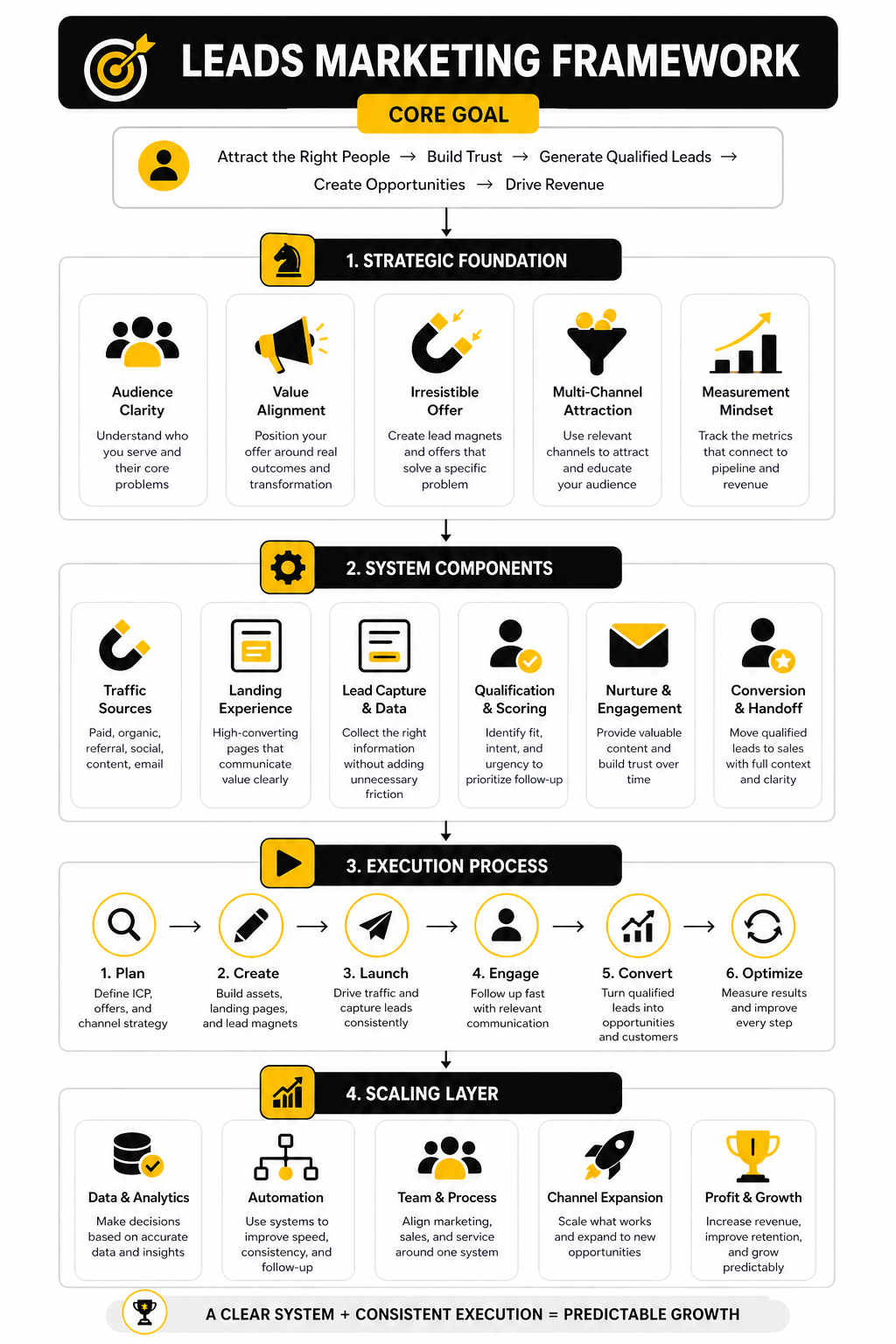
The framework works best when each layer feeds the next one with clean information. A landing page should not just collect a name and email. It should help you understand the person’s problem, urgency, fit, and likely next step.
This is where tools matter, but tools are not the strategy. A platform like GoHighLevel can help agencies and service businesses manage funnels, CRM, messaging, automations, and follow-up in one place. A tool like ManyChat can make sense when lead capture happens through conversations on social or messaging channels. The real decision is whether the tool supports your buyer journey without adding unnecessary complexity.
The Leads Marketing Framework
The next step is turning the overview into an operating model. Leads marketing becomes easier when you stop treating every lead the same and start designing around intent. A person downloading a checklist, requesting pricing, joining a webinar, and booking a demo may all be “leads,” but they are not in the same buying moment.
A practical framework has five stages: demand creation, lead capture, qualification, nurture, and conversion. Demand creation builds awareness before the person is ready to act. Lead capture turns interest into a known contact. Qualification decides what kind of follow-up makes sense. Nurture keeps the conversation alive. Conversion moves the right people into a sales process, checkout, consultation, or onboarding flow.
This matters because buyers are doing more research before they talk to a company. Gartner’s 2026 sales research found that 67% of B2B buyers prefer a rep-free experience, which means your content, landing pages, forms, automations, and follow-up have to carry more of the buying journey. That does not make sales less important. It makes the handoff between marketing and sales much more important.
Demand Creation Comes Before Capture
A lot of lead systems fail because they ask for the conversion too early. The business runs ads, pushes traffic to a form, and wonders why the numbers look weak. The missing piece is usually demand creation: useful content, clear positioning, proof, comparison pages, education, and reasons to trust the brand before the form appears.
Demand creation is not fluffy brand work when it is connected to a commercial path. It gives people the language to understand their problem, compare options, and recognize why your offer is relevant. In leads marketing, this stage should answer the buyer’s early questions before they are comfortable giving you their email, phone number, or calendar slot.
The key is to match content to intent. Educational content works well for broad awareness. Comparison content works better when the buyer is already evaluating options. Demo pages, calculators, audits, quizzes, consultations, and trials work when the buyer is close enough to action that they want a more specific next step.
Lead Capture Should Feel Like a Fair Exchange
Lead capture works when the value exchange feels obvious. Nobody wants another generic newsletter signup unless they already trust the brand. People give contact details when they believe the next thing is useful, relevant, and worth the small loss of privacy.
That is why strong lead capture assets are specific. A useful audit, template, calculator, benchmark, consultation, product recommendation, webinar, or private training usually converts better than vague “updates.” The offer should help the person make progress even before your team follows up.
The form matters too. Ask for enough information to route and qualify the lead, but not so much that you create friction for no reason. For early-stage leads, an email and one segmentation question may be enough. For sales-ready leads, company size, budget range, timeline, and main challenge can make the follow-up much sharper.
Qualification Protects Your Pipeline
Qualification is where leads marketing becomes disciplined. Without it, every new contact looks like progress, even when many of them are poor-fit, low-intent, or unlikely to convert. That creates fake momentum and clogs the sales pipeline.
Good qualification uses both explicit and behavioral signals. Explicit signals come from what the lead tells you: role, company size, budget, location, use case, timeline, and goal. Behavioral signals come from what the lead does: pages visited, emails clicked, forms submitted, events attended, messages sent, and calls booked.
This is also where lead scoring can help, as long as it stays practical. A score should not be a mysterious number nobody trusts. It should reflect fit and intent clearly enough that marketing, sales, and customer-facing teams agree on what happens next.
Nurture Turns Timing Into Revenue
Most leads are not ready to buy the moment they enter your system. That does not make them useless. It means the follow-up has to match their stage, problem, and level of urgency.
Lead nurturing should educate, segment, and move people toward a better decision. That can include email sequences, retargeting, SMS reminders, webinar follow-ups, sales alerts, product education, case studies, and objection-handling content. The best nurture flows feel helpful, not needy.
Automation is useful here, but only when the message is grounded in context. Platforms like Brevo, Moosend, and GoHighLevel can support this, but the strategy still comes first. The tool sends the message; your framework decides whether the message deserves to exist.
Conversion Is a Designed Next Step
Conversion is not always a sale. In leads marketing, conversion may be a booked call, a trial, a quote request, a checkout, a diagnostic session, or a proposal. The right conversion depends on how complex the offer is and how much trust the buyer needs before moving forward.
Simple offers can often move from lead capture to checkout quickly. Higher-ticket services, B2B software, agencies, and consulting offers usually need more qualification and a stronger sales conversation. That is why forcing every lead into the same call funnel often creates poor show rates and weak close rates.
A better approach is to design the next step around intent. High-intent leads should get fast response, clear scheduling, and direct sales support. Medium-intent leads should receive proof, education, and comparison content. Low-intent leads should stay warm until their behavior shows they are ready for a stronger ask.
Core Components of a High-Converting Lead System
A strong leads marketing system is not one funnel, one form, or one email sequence. It is a connected process that moves people from first touch to meaningful action without making the journey feel forced. The best systems are simple enough to manage, but structured enough to show where each lead came from, what they care about, and what should happen next.
The foundation is audience clarity. Before you build a landing page or launch a campaign, you need to know who the lead should be, what problem they are trying to solve, and what level of intent they are showing. Without that clarity, every channel looks attractive and every lead looks equal, which is how budgets get wasted.
The second component is message-market fit. Your lead magnet, ad, landing page, email, and sales follow-up should all speak to the same core pain. Content Marketing Institute’s 2025 B2B research shows that many teams are still investing more into video, thought leadership, paid ads, webinars, and AI optimization, but those assets only work when they are tied to a clear customer journey. More content does not fix a weak offer.
Build Around One Primary Conversion Path
Every leads marketing system needs one primary conversion path before it needs ten side campaigns. That path should define the main journey from traffic source to lead capture to follow-up to sales action. It can be simple, but it has to be intentional.
For a service business, the path might be: educational content, audit page, qualification form, calendar booking, confirmation sequence, consultation, proposal. For ecommerce, it might be: social ad, quiz, product recommendation, email capture, offer sequence, checkout. For software, it might be: comparison content, demo page, firmographic form, sales routing, demo, trial or proposal.
The mistake is trying to optimize every piece at once. Start with the main path that has the highest commercial value. Then improve the weak points one by one instead of rebuilding the whole system every time performance dips.
Map the Process Before Choosing Tools
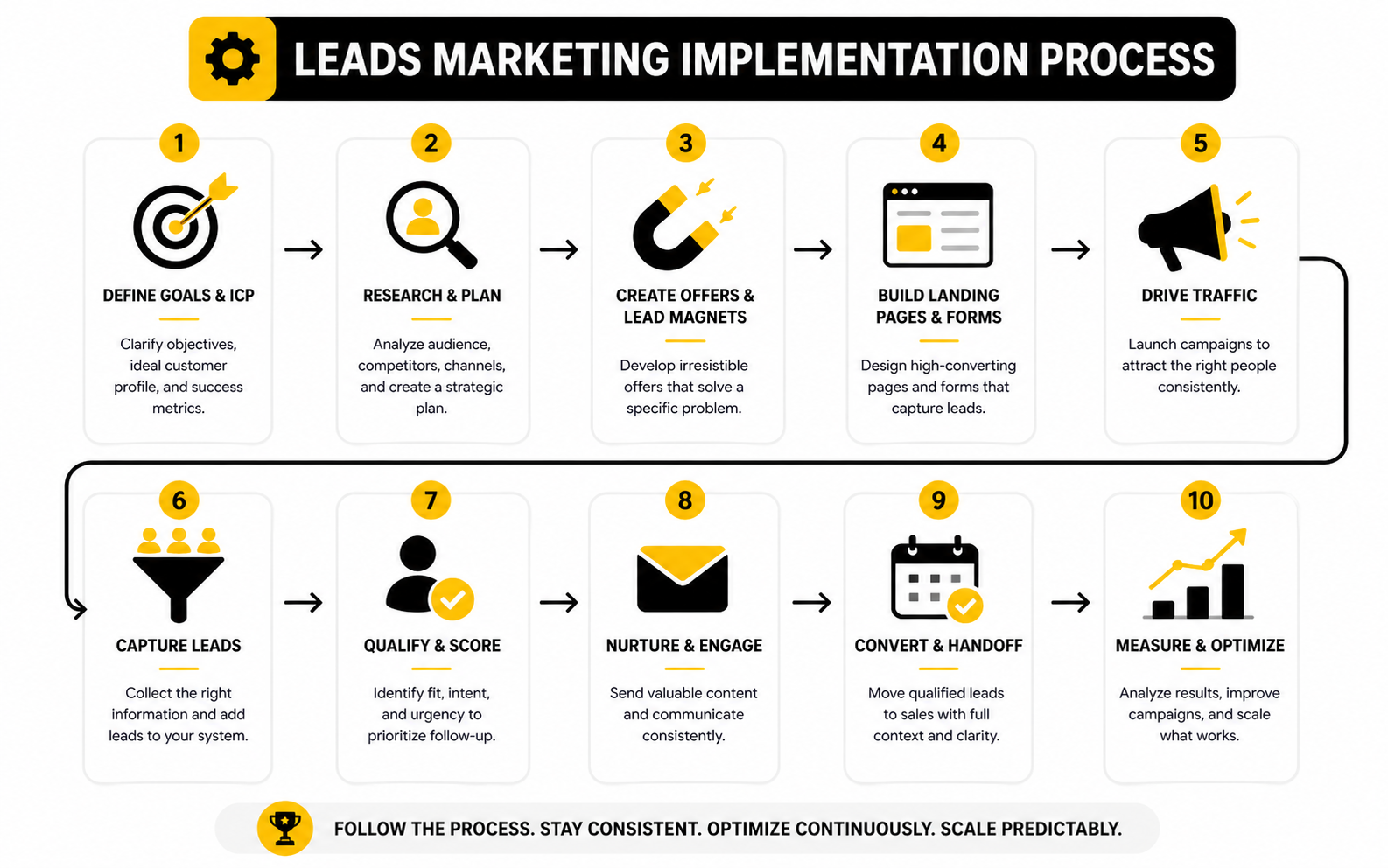
The cleanest implementation starts on paper. Write down where leads come from, what they see, what action they take, where the data goes, who follows up, and how the outcome is measured. This exposes gaps fast.
A basic process map should answer five questions:
- What traffic source creates the lead?
- What offer captures the lead?
- What data is collected at the point of capture?
- What follow-up happens in the first 24 hours?
- What result tells us the lead was valuable?
This is where many teams overcomplicate things. You do not need a massive tech stack to start. You need a reliable capture point, clean CRM fields, fast follow-up, and a clear next step. A funnel builder like ClickFunnels can work when the priority is building focused lead pages and sales paths quickly. A broader platform like GoHighLevel can make more sense when you need CRM, pipelines, automations, messaging, and client management under one roof.
Create Offers for Different Levels of Intent
Not every lead should be pushed into the same offer. Some people are problem-aware but not solution-aware. Some are comparing vendors. Some are ready to speak with someone now. Your leads marketing system should give each group a natural next step.
Low-intent offers usually help people understand the problem. These include guides, checklists, newsletters, templates, and educational webinars. Mid-intent offers help people evaluate solutions, such as calculators, comparison pages, audits, quizzes, and buying guides. High-intent offers invite action, including demos, consultations, quotes, free trials, and strategy calls.
The important part is alignment. A high-intent lead should not be buried in a slow educational sequence before anyone responds. A low-intent lead should not receive aggressive sales messages five minutes after downloading a basic resource. When the offer matches intent, the entire experience feels more useful and less pushy.
Capture the Right Data Without Killing Conversions
Lead forms should collect enough information to improve follow-up, but not so much that they scare people away. The right amount of friction depends on the value of the offer and the seriousness of the buying moment. A newsletter form should be light. A demo request can ask more.
The best fields are the ones your team will actually use. Name, email, company, role, use case, timeline, budget range, and main challenge can all be valuable, but only when they change what happens after submission. If a field does not affect routing, segmentation, scoring, or the sales conversation, it is probably just friction.
Progressive profiling can help when the journey is longer. Instead of asking for everything at once, collect more information as the relationship develops. That keeps early conversion easier while still improving lead quality over time.
Route Leads Based on Fit and Urgency
Lead routing decides how quickly a lead gets attention and who should handle it. This is not glamorous, but it is one of the most important parts of professional implementation. A good lead that sits untouched for days is not a lead system problem anymore. It is a revenue leak.
Routing should be based on clear rules. High-fit, high-intent leads should trigger immediate notifications, fast booking options, and direct sales follow-up. Medium-fit leads can enter nurture while receiving helpful proof and comparison content. Poor-fit leads may still be valuable for audience growth, but they should not consume sales time.
This is also where automation needs human judgment. Automations can assign leads, send reminders, update pipelines, and trigger follow-up, but someone still needs to define what quality means. If your scoring model rewards random clicks more than real buying intent, the system will look busy while producing weak opportunities.
Make Follow-Up Fast, Specific, and Useful
The first follow-up should prove the lead made a good decision by engaging. It should reference the action they took, connect to the problem they care about, and offer the next useful step. Generic “thanks for reaching out” messages are better than silence, but they rarely create momentum.
Speed matters most when the lead is high intent. Someone requesting a demo, quote, consultation, or callback is in a different state than someone downloading a guide. That person should get a clear confirmation, calendar details, expectations, and a path to speak with the right person quickly.
For lower-intent leads, specificity matters more than pressure. Send content that helps them make progress, then use behavior to decide when to invite a stronger action. That is how leads marketing becomes a relationship-building system instead of a database-filling exercise.
Statistics and Data That Actually Matter
Measurement in leads marketing is not about collecting impressive-looking dashboards. It is about knowing which campaigns create qualified opportunities, which leads deserve faster follow-up, and which parts of the journey are quietly leaking revenue. If the data does not change a decision, it is probably noise.
The most useful numbers show movement through the system. Traffic alone does not tell you much. Lead volume alone can be misleading. Even cost per lead can create bad incentives if cheap leads never convert into pipeline, customers, or repeat revenue.
A better measurement model looks at the whole path: visitor, lead, qualified lead, opportunity, customer, revenue, and retention. That is where the real story appears. You stop asking, “How many leads did we get?” and start asking, “Which leads are worth creating more of?”
The Core Metrics to Track
Start with conversion rate, but be specific about which conversion you mean. Visitor-to-lead rate shows whether the page and offer are strong enough to capture interest. Lead-to-qualified-lead rate shows whether the campaign is attracting the right people. Qualified-lead-to-customer rate shows whether the sales process, offer, pricing, and timing are aligned.
Cost per lead is useful, but only when paired with lead quality. A campaign producing low-cost contacts can still be a loss if those contacts never become opportunities. A more expensive channel can be more profitable if it produces better-fit leads with higher close rates and larger order values.
You also need speed-to-lead, especially for demo requests, consultations, quotes, and other high-intent actions. In practical terms, a hot lead cools down fast when nobody responds. The metric matters because it turns follow-up from a vague team habit into a measurable performance lever.
What Benchmarks Can and Cannot Tell You
Benchmarks are useful for context, not strategy. Industry averages can help you spot whether your page, emails, ads, or sales process are wildly underperforming. But they should never replace your own baseline, because your offer, audience, price point, sales cycle, and traffic source can change the numbers completely.
For example, email engagement benchmarks vary by market, list quality, and message type. The GDMA Email Benchmark 2025 reported an average confirmed open rate of 32.40%, click-to-open rate of 7.62%, and click-through rate of 2.91%, but those numbers should not become your only target. A smaller list with lower clicks can still outperform a bigger list if it generates more qualified calls, demos, or purchases.
The same logic applies to lead forms and landing pages. A simple opt-in for a broad guide may convert at a higher rate than a serious demo request, but that does not mean it is better. Lower conversion with higher intent can be more valuable than high conversion with weak buying fit.
Build a Simple Analytics System
Your analytics system should connect source, offer, lead quality, follow-up, and outcome. That sounds obvious, but most teams lose the thread somewhere between the ad click and the sales conversation. When that happens, marketing optimizes for form fills while sales complains about quality, and nobody can prove where the best opportunities really came from.
A clean setup should track these layers:
- Source: where the lead came from, including channel, campaign, keyword, content, or referral.
- Offer: what the person responded to, such as a guide, quiz, webinar, demo, audit, or quote request.
- Fit: whether the lead matches the business’s target customer profile.
- Intent: how serious the action was and what behavior followed it.
- Outcome: whether the lead became qualified, booked, attended, proposed, closed, or retained.
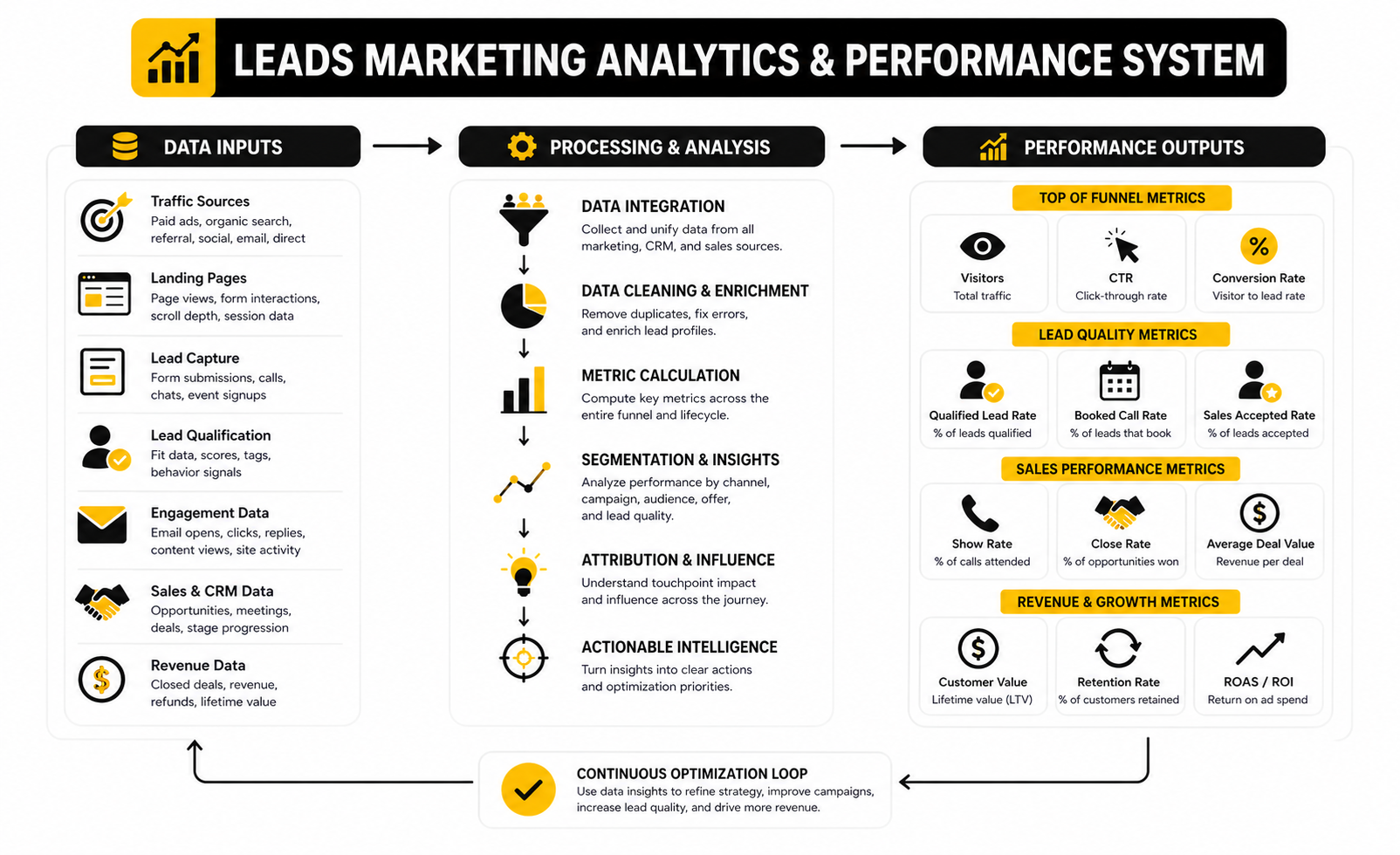
This does not have to be complicated at the beginning. Use consistent UTM naming, clean CRM fields, and a small set of lifecycle stages everyone understands. If you are running funnels and CRM together, GoHighLevel can keep capture, pipeline tracking, automations, and follow-up closer together. If your lead capture depends heavily on forms, surveys, or qualification flows, Fillout can be useful for collecting structured data before it moves into your CRM.
Read Performance Signals in Context
Good measurement is not just reporting numbers. It is interpreting what they mean. A low visitor-to-lead conversion rate could mean the offer is weak, the traffic is mismatched, the page is unclear, or the form is asking too much too soon.
A strong lead capture rate with weak sales conversion usually points to a different problem. The campaign may be attracting curiosity instead of urgency. The lead magnet may be too broad. The qualification questions may be too light. The follow-up may be too slow or too generic.
A high cost per lead is not automatically bad either. If those leads convert into high-value customers, the economics may work. The better question is cost per qualified opportunity, cost per customer, payback period, and lifetime value. That is the level where leads marketing becomes a business system instead of a marketing scoreboard.
Separate Leading and Lagging Indicators
Leading indicators tell you whether the system is likely to produce results. These include page conversion rate, form completion rate, email clicks, booked calls, show rate, reply rate, and qualification rate. They help you diagnose problems early, before revenue data is fully visible.
Lagging indicators tell you what actually happened. These include closed deals, revenue, customer acquisition cost, retention, refund rate, repeat purchase rate, and lifetime value. They matter most, but they often arrive too late to guide day-to-day optimization on their own.
You need both. Leading indicators help you improve the machine while it is running. Lagging indicators keep you honest about whether the machine is actually profitable.
Turn Data Into Action
Every metric should have an action attached to it. If landing page conversion is weak, test the offer, headline, proof, form length, or traffic match. If lead quality is weak, tighten targeting, add better qualification fields, or change the lead magnet. If booked calls are strong but show rates are poor, improve confirmation, reminders, calendar friction, and expectation-setting.
If sales close rates are weak, do not blame marketing automatically. Review lead source, qualification, offer fit, sales script, pricing, objection handling, and follow-up cadence. The data should create better conversations between teams, not finger-pointing.
The best leads marketing teams review performance in layers. They look at campaign numbers weekly, pipeline movement monthly, and customer economics over a longer window. That rhythm keeps optimization practical, prevents panic decisions, and makes the system stronger with every campaign.
Professional Implementation Across Channels and Tools
At this stage, the question changes. You are no longer asking whether leads marketing works. You are asking how to scale it without breaking the quality of the pipeline, annoying the audience, or creating a stack your team cannot manage.
The advanced version is less about adding more campaigns and more about making sharper tradeoffs. You need enough automation to move quickly, but not so much that every lead gets treated like a workflow object. You need enough data to personalize follow-up, but not so much collection that the experience feels invasive. You need enough channels to reach buyers where they are, but not so many that your message becomes thin everywhere.
This is where strategy gets real. Scaling leads marketing is not “do more.” It is “protect what already converts, then expand carefully.”
Choose Channels by Buying Intent, Not Popularity
A channel is only valuable if it reaches the right person in the right buying moment. Search can capture people who are already looking for a solution. Paid social can create demand before the buyer knows exactly what they want. Email and retargeting can keep the relationship warm after the first touch.
The wrong move is copying a channel mix because another business is using it. A B2B software company with long evaluation cycles should not measure social ads the same way an ecommerce brand measures quiz opt-ins. A local service business should not build a complicated content engine before it has a reliable offer, booking path, and follow-up process.
Start with the channel closest to commercial intent, then expand outward. If search demand exists, build around high-intent pages first. If the market needs education, build useful content and retarget engaged visitors. If the offer depends on trust, use webinars, case studies, comparison content, and strong follow-up instead of pushing cold traffic straight into a hard sale.
Balance Automation With Human Timing
Automation is powerful when it removes delay and protects consistency. It can send confirmations, assign leads, trigger reminders, update CRM stages, notify sales, and deliver helpful content based on behavior. That is good leverage.
But automation becomes a problem when it hides weak thinking. If every lead gets the same sequence, the system may be efficient while still being ineffective. The more complex or expensive the buying decision, the more important it becomes to combine automated follow-up with human judgment.
A practical rule is simple: automate the predictable parts and personalize the moments that affect trust. Confirmation emails, reminders, routing, tagging, and basic nurture can be automated. Discovery, objection handling, proposal strategy, and high-value follow-up should still feel human. That balance is what keeps leads marketing scalable without making it robotic.
Build for Privacy and Trust From the Start
Lead generation depends on permission. That permission gets weaker when brands collect too much data, hide what happens next, or use contact details in ways people did not expect. Privacy is not just a legal issue. It directly affects conversion, deliverability, and brand trust.
Modern marketing is moving toward cleaner first-party data because brands need direct relationships with their audiences. Deloitte’s 2025 marketing trends emphasize privacy-friendly first-party data strategies as a way to build trust and improve customer experiences. That matters because lead capture is not just a technical event. It is a trust moment.
Make the value exchange clear. Tell people what they are getting, what happens after they submit, and how communication will work. Do not bury consent behind vague copy. A smaller list of people who genuinely want to hear from you will usually beat a larger list built through confusion.
Watch for Scaling Problems Early
A small lead system can look healthy before scale exposes the weak points. More traffic creates more form fills, but it can also create more bad-fit leads, slower follow-up, messier CRM data, and weaker sales conversations. Growth magnifies whatever is already inside the system.
The first scaling risk is lead quality dilution. When you broaden targeting too fast, the cost per lead may look better while pipeline quality drops. The second risk is operational drag. If routing rules, ownership, and lifecycle stages are unclear, more leads simply create more confusion.
The third risk is attribution overconfidence. It is tempting to credit the last form, ad, or email before conversion, but many buyers interact with several touchpoints before they act. Use attribution as a guide, not a religion. The job is to understand influence well enough to make better investment decisions, not to pretend every buyer journey fits neatly into one report.
Align Marketing, Sales, and Delivery
Leads marketing breaks when marketing, sales, and delivery define quality differently. Marketing celebrates volume. Sales wants better conversations. Delivery wants customers who are actually a good fit. The system only works when all three perspectives are connected.
Define what makes a lead qualified before campaigns scale. That definition should include fit, intent, urgency, and the type of problem your offer solves best. Then review closed customers, lost deals, no-shows, refunds, and poor-fit accounts to refine the definition over time.
This feedback loop is non-negotiable. If sales never tells marketing which sources produce strong conversations, marketing keeps optimizing for surface-level conversions. If delivery never reports which customers succeed, the business may keep acquiring leads that close but do not retain. Real growth comes from attracting leads who can become successful customers, not just signed deals.
Use AI Carefully and Practically
AI can make leads marketing faster, but it should not replace strategy. It can help draft follow-up, summarize calls, score engagement, personalize content, analyze patterns, and support chat-based qualification. Used well, it removes busywork and helps teams respond with more context.
The risk is using AI to create more noise. More automated emails, more generic landing pages, and more synthetic content will not fix unclear positioning. Buyers already have too much information. Your advantage comes from relevance, timing, proof, and clarity.
Use AI where it improves the experience or the operation. A tool like Chatbase can support website conversations and basic qualification when visitors need fast answers. GoHighLevel’s AI tools can be useful when the goal is faster follow-up and workflow support inside a broader CRM system. The point is not to look advanced. The point is to reduce friction for the buyer and the team.
Know When to Simplify
Advanced marketers often create advanced messes. Too many segments, too many automations, too many offers, too many dashboards, and too many tools can slow the system down. Complexity feels sophisticated until nobody can explain what is working.
Simplification is not a step backward. It is often the fastest path to better performance. Cut channels that do not produce qualified opportunities. Remove form fields nobody uses. Merge overlapping nurture sequences. Clean CRM stages. Rewrite vague offers. Shorten the path for high-intent leads.
The strongest leads marketing systems are not the most complicated. They are the clearest. They make it easy for the right person to take the right next step, and they make it easy for the business to respond in a way that creates revenue.
Measurement, Optimization, Mistakes, and FAQ
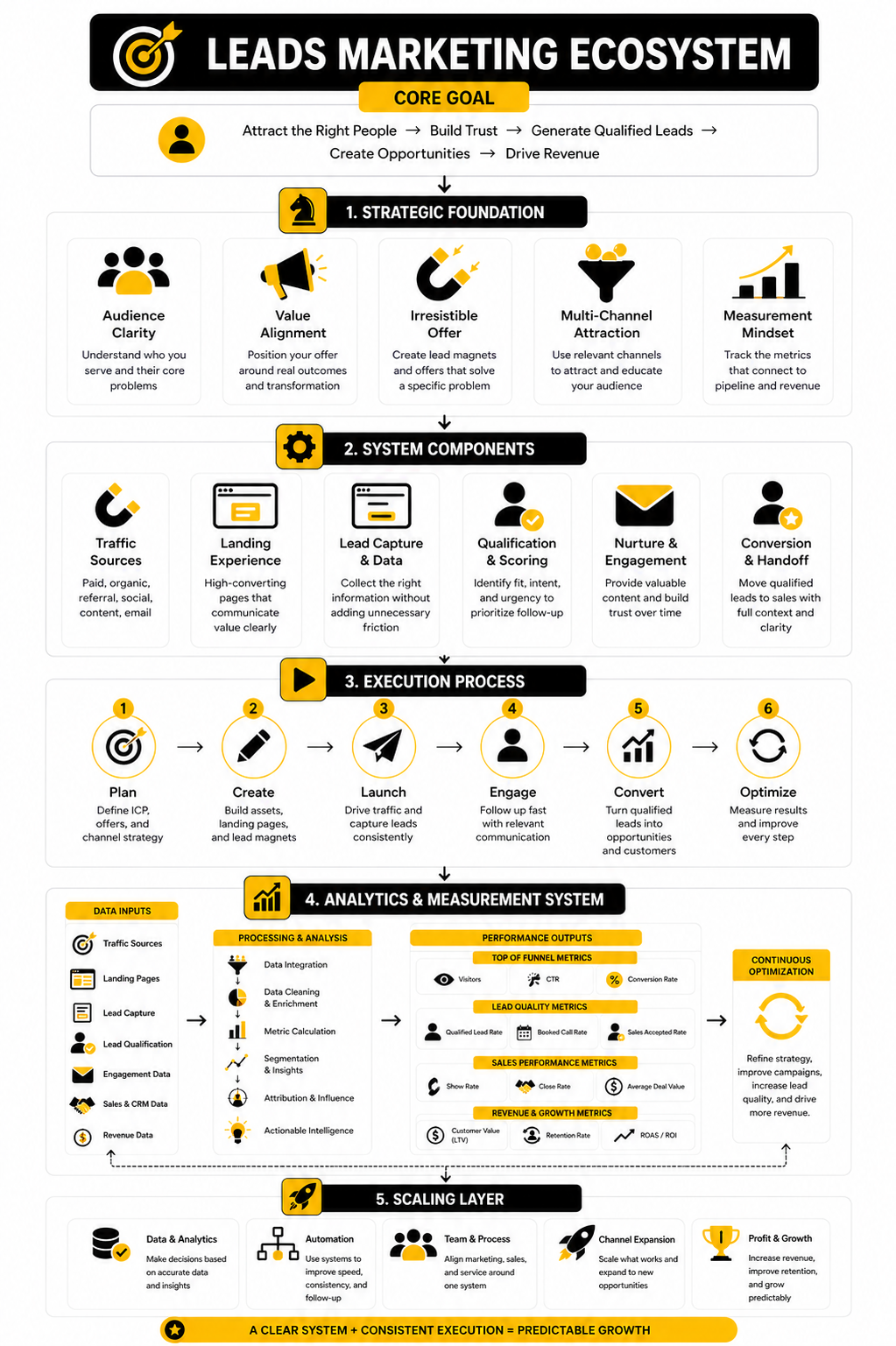
The final layer is the ecosystem view. Leads marketing works best when every part of the system supports the same commercial goal. Traffic creates attention, offers turn attention into permission, qualification protects the pipeline, follow-up builds trust, and measurement shows what deserves more investment.
The biggest mistake is managing those pieces separately. One team optimizes ads, another edits landing pages, another writes emails, and sales handles the conversations with limited context. That can work for a while, but it rarely scales cleanly because nobody owns the full journey.
The stronger approach is to treat the lead system like one connected revenue asset. Every form, automation, message, and report should help the right person take the right next step. That sounds simple, but it is exactly where most messy funnels lose money.
Common Mistakes to Fix First
The first mistake is chasing lead volume before defining lead quality. More leads only help when they create better opportunities, stronger sales conversations, or profitable customers. If the campaign creates noise, volume becomes a burden.
The second mistake is using the same follow-up for every lead. Someone who requested a quote needs a different path than someone who downloaded a beginner checklist. Intent should shape speed, message, channel, and next step.
The third mistake is measuring too shallowly. A cheap cost per lead can hide weak qualification, poor show rates, low close rates, or bad retention. Look beyond the first conversion and track whether leads become customers who actually make sense for the business.
FAQ - Built for Complete Guide
What is leads marketing?
Leads marketing is the process of attracting, capturing, qualifying, nurturing, and converting people who show interest in your offer. It connects marketing activity to a measurable pipeline instead of treating traffic or awareness as the final goal. The best systems focus on lead quality, not just lead volume.
Why is leads marketing important?
Leads marketing matters because most buyers do not convert the first time they see your brand. They need useful information, trust, timing, and a clear next step. A strong system helps you stay relevant until the buyer is ready to act.
What is the difference between lead generation and leads marketing?
Lead generation usually focuses on capturing contact details. Leads marketing is broader because it includes the full journey before and after capture. That includes positioning, content, qualification, follow-up, sales handoff, measurement, and optimization.
What makes a lead qualified?
A qualified lead matches your target customer profile and shows enough intent to justify a specific next step. Fit can include company size, role, budget, location, or use case. Intent can include actions like booking a call, requesting a demo, visiting pricing pages, or replying to follow-up.
What are the best channels for leads marketing?
The best channels depend on the buying journey. Search works well when people are already looking for a solution. Paid social can create demand and test offers quickly. Email, retargeting, webinars, and comparison content help nurture people who need more trust before converting.
How do you measure lead quality?
Measure lead quality by looking at what happens after the form submission. Track qualified lead rate, booked call rate, show rate, sales acceptance, close rate, average deal value, retention, and lifetime value. If a source creates many leads but few customers, it is not as strong as it looks.
How fast should you follow up with leads?
High-intent leads should receive fast follow-up because timing affects momentum. Demo requests, quote requests, consultation forms, and booked calls should trigger immediate confirmation and clear next steps. Lower-intent leads can move through a slower nurture path focused on education and trust.
How many fields should a lead form have?
A lead form should ask only for information that changes what happens next. Early-stage offers usually need fewer fields. High-intent offers can justify more questions because the buyer expects a more specific response.
Should small businesses use automation for leads marketing?
Yes, but automation should stay simple at first. Use it for confirmations, reminders, tagging, routing, and basic nurture. Keep human judgment involved for high-value conversations, proposals, and situations where trust matters.
What is the biggest leads marketing mistake?
The biggest mistake is optimizing for the wrong conversion. A business may celebrate form fills while ignoring whether those leads become qualified opportunities or customers. The real goal is not more contacts. The real goal is more profitable customer conversations.
Can AI improve leads marketing?
AI can help with summaries, segmentation, chat support, follow-up drafts, content ideas, and workflow speed. It becomes risky when it creates generic communication at scale. Use AI to remove friction and improve relevance, not to flood people with more low-value messages.
What tools are useful for leads marketing?
Useful tools depend on the system you are building. GoHighLevel can support CRM, funnels, automations, messaging, and pipeline management. ClickFunnels can help build focused funnel paths. Brevo can support email and customer communication. The tool should fit the process, not replace the strategy.
Work With Professionals
Explore 10K+ Remote Marketing Contracts on MarkeWork.com
Most marketers spend too much time chasing clients, competing on crowded platforms, and losing a percentage of every project to middlemen.
MarkeWork gives you a better way. Browse thousands of remote marketing contracts and connect directly with companies desperate to hire skilled marketers like you, without platform commissions and without unnecessary gatekeepers.
If you're serious about finding better opportunities and keeping 100% of what you earn, explore available contracts and create a profile for free at MarkeWork.com.