

A legendary marketer is not just someone who knows how to get clicks. The real difference is bigger than traffic, funnels, or ad hacks. It is the ability to make an offer feel clear, credible, and easy to choose in a market that is louder, faster, and more skeptical than ever.
That matters more now because modern marketing is being squeezed from both sides. On one side, AI has made content cheaper and easier to produce. On the other, buyers are still rewarding brands and people who feel specific, trustworthy, and memorable, a pattern you can see running through recent work from Google, HubSpot, and McKinsey.
This article is built for readers who do not want vague motivation or recycled internet clichés. We are going to break down what makes a legendary marketer different, why that standard still matters, how the framework works, which components actually drive results, how professionals implement the work, and where most marketers quietly lose momentum.
Article Outline
- What a Legendary Marketer Really Means
- Why It Matters More Than Ever
- The Legendary Marketer Framework
- The Core Components That Create Market Pull
- How Professionals Put It to Work
- Common Mistakes, Smart Metrics, and the Long Game

What a Legendary Marketer Really Means
A legendary marketer is not defined by fame, follower count, or one lucky campaign. The better definition is someone who understands human behavior deeply enough to create demand, reduce friction, and make action feel natural. They know how to connect positioning, message, offer, trust, timing, and distribution into one system instead of treating marketing like a pile of disconnected tactics.
That is why the best marketers tend to look simple from the outside. Their landing pages are clearer, their hooks feel more relevant, their offers are easier to understand, and their follow-up feels deliberate instead of desperate. What looks like charisma is usually structure, discipline, and a long habit of paying attention to what buyers actually care about.
This also explains why “legendary marketer” should not be confused with “growth hacker.” Growth hacks can create spikes. Legendary marketers build assets: sharper positioning, stronger buyer insight, better customer language, more durable trust, and a brand people remember when they are finally ready to buy. Research traditions from Ehrenberg-Bass and long-running effectiveness work from WARC keep pointing to the same truth: marketing works better when memory, meaning, and performance are working together.
Why It Matters More Than Ever
The standard matters now because average marketing is getting easier to produce, which means average marketing is getting easier to ignore. Buyers are surrounded by competent-looking content, polished ads, AI-generated copy, and cloned offers. In that kind of environment, the marketer who wins is usually the one who can make the message more distinct, the promise more believable, and the path to action more obvious.
There is also a practical business reason this matters. Teams that chase only short-term conversions usually end up paying more for attention over time, while teams that combine demand capture with stronger brand signals give performance channels more leverage. You can see that tension across recent work from Nielsen, IPA, and WARC: the strongest marketing systems do not treat brand and performance like enemies.
For founders, creators, agencies, and in-house teams, this changes the job description. Being a legendary marketer today means building trust fast without looking manipulative, using personalization without sounding creepy, and using automation without making the brand feel dead. It means understanding that tools can help, but the real edge still comes from judgment, positioning, message control, and professional implementation.
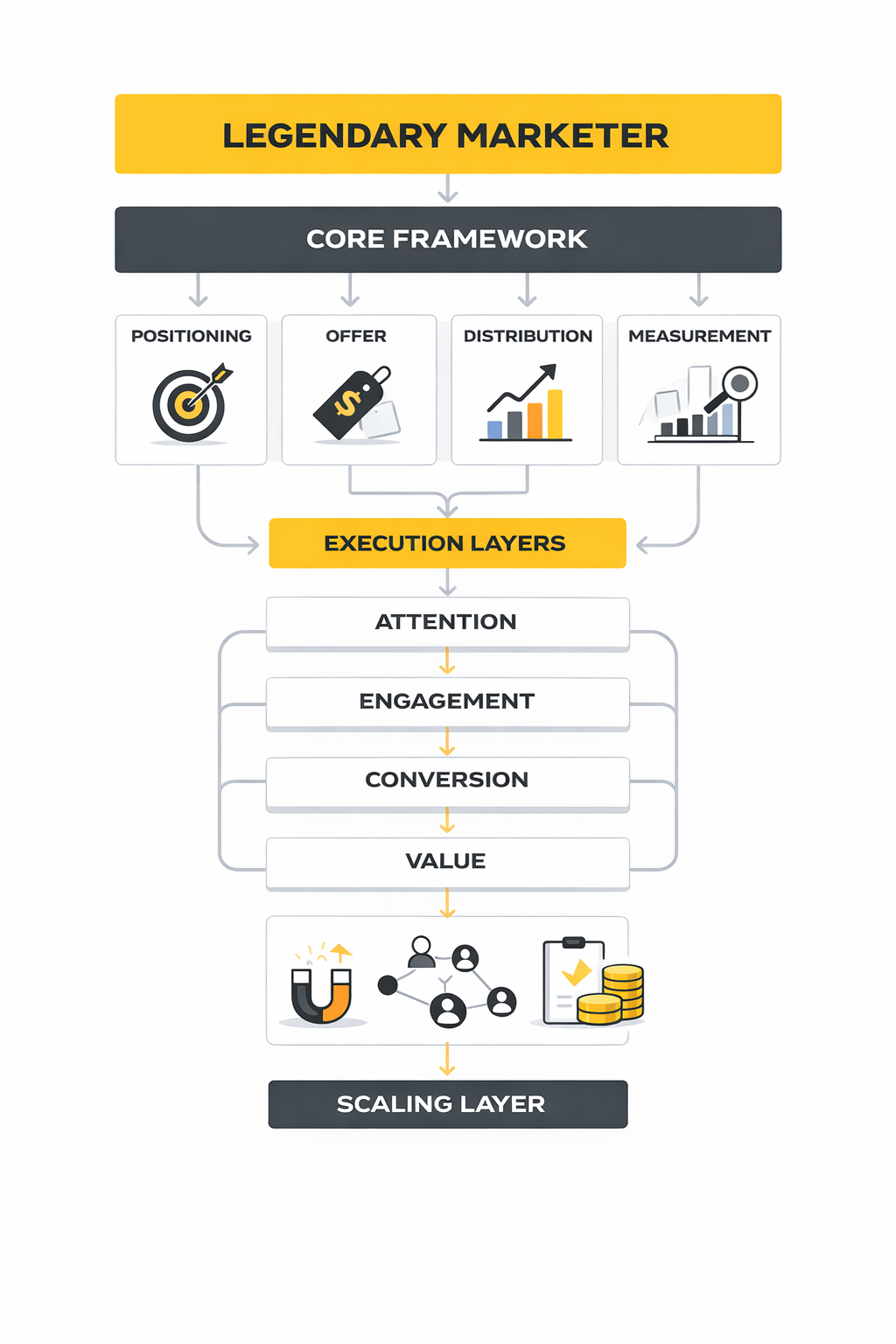
The framework in the next part will make that concrete. Instead of talking about marketing as inspiration, we will break it into a practical operating model you can use to diagnose weak campaigns, strengthen your message, and build a system that keeps working after the first burst of attention is gone.
The Legendary Marketer Framework
The easiest way to understand a legendary marketer is to stop thinking in isolated tactics and start thinking in sequence. The work usually follows a simple progression: earn attention, build trust, sharpen desire, remove friction, and create momentum after the first conversion. That sequence fits what recent research keeps showing about modern buying behavior, where consumer journeys are non-linear, touchpoints carry different levels of influence, and marketers need to evaluate attention, relevance, and trust together rather than forcing everything into an old funnel model BCG’s work on moving beyond the linear funnel and its follow-up research on influence maps.
What makes this framework useful is that it is practical. It gives you a way to diagnose why a campaign is underperforming without guessing. If a message is getting seen but not remembered, that is an attention problem. If people are clicking but not committing, that is usually a trust or offer problem. If people buy once and disappear, the issue is often what happens after the conversion rather than before it.
A legendary marketer treats these stages like linked gears. Strong creative cannot rescue weak positioning forever. Great targeting cannot compensate for a vague promise. Fast automation cannot fix a message that never earned belief in the first place. That is why the best marketers look more strategic than busy: they spend less time collecting random tactics and more time strengthening the few levers that actually move demand.
Stage 1: Earn the Right Attention
Attention is not the same thing as reach. A lot of campaigns get exposure and still fail because the message lands as generic, forgettable, or visually interchangeable. The first job of a legendary marketer is to create attention that has meaning attached to it, which is exactly why current marketing effectiveness work keeps pulling brands back toward distinction, creative quality, and memorable signals instead of pure volume Nielsen’s 2025 marketing report and Google’s 2025 growth guidance both point in that direction.
This is where many marketers quietly lose the plot. They optimize for impressions, hooks, and surface-level click-through rates while ignoring whether the audience can later recall the brand, the promise, or the reason to care. BCG’s recent touchpoint research makes this point sharply by treating influence as the combination of impact on the buying decision and the consumer’s recall of that touchpoint, which is a much tougher standard than simply getting noticed BCG’s influence mapping research.
In practice, earning the right attention means being specific. It means clearer category framing, stronger contrast, better language, and a point of view that feels owned rather than borrowed. Legendary marketers know that the first win is not getting seen. The first win is getting mentally filed in the buyer’s mind as relevant, distinct, and worth another moment of attention later.
Stage 2: Build Trust Fast
Once attention is earned, trust becomes the multiplier. This is the stage where the audience decides whether the promise feels real, whether the brand understands their situation, and whether taking the next step feels safe. In a market flooded with polished creative and AI-generated messaging, that trust layer matters even more because buyers can now see professional-looking marketing everywhere, which raises the premium on credibility rather than just competence McKinsey’s 2025 personalization research and BCG’s 2024 global personalization study both show the upside of relevance and the downside of getting it wrong.
Trust is built through consistency, proof, tone, and restraint. The message has to match the landing page. The landing page has to match the offer. The offer has to match the actual experience after signup or purchase. Legendary marketers understand that every mismatch is a tax on conversion, and every clean alignment makes the next action feel less risky.
This is also why over-automation can backfire. AI can help scale copy, segmentation, and content production, but a legendary marketer uses it to increase relevance, not to mass-produce empty persuasion. The strongest teams are using AI to improve execution speed and personalization while still keeping judgment, positioning, and governance in human hands, a pattern highlighted in BCG and Google’s research on AI-powered marketing and reinforced by McKinsey’s broader 2025 work on AI adoption inside organizations.
Stage 3: Sharpen Desire With a Better Offer Story
A lot of marketers talk about desire as if it appears automatically once the product is visible. It does not. Desire grows when the buyer can clearly see the change being offered, why that change matters now, and why this solution feels more compelling than the alternatives. That is why legendary marketers spend so much time on framing, not just promotion.
This stage is less about hype than about compression. The marketer has to compress complexity into something the buyer can understand quickly without feeling oversold. The strongest version of that usually includes four things: a defined problem, a believable transformation, a reason to trust the mechanism, and a reason to act before the opportunity goes cold. When those pieces are clear, the offer starts pulling the buyer forward instead of needing constant pressure.
Professional marketers often use specialized tools to sharpen that offer story across pages, follow-up, and conversion paths. For example, fast page iteration with Replo, automated chat journeys with ManyChat, or CRM-driven follow-up in GoHighLevel can help operationalize the message. But the tool only amplifies what is already there. If the offer story is muddy, more software just helps you scale confusion faster.
Stage 4: Remove Friction Before It Kills Intent
The difference between a decent marketer and a legendary marketer often shows up here. Decent marketers stop at persuasion. Legendary marketers keep going and ask what could interrupt the decision at the last second. They look for confusing copy, slow pages, weak calls to action, unnecessary form fields, poor follow-up timing, and offer details that create hesitation right when intent is highest.
This matters because modern journeys are fragmented. Buyers search, compare, leave, return, ask friends, check reviews, watch videos, and revisit pages across multiple devices. Recent BCG research argues that marketers need a touchpoint view built around influence because different touchpoints contribute differently across the journey, and underestimating those touchpoints leads to overspending in some places and lost momentum in others BCG’s consumer touchpoint research.
Friction removal is rarely glamorous, but it is where serious gains come from. Better marketers make the next step obvious, reduce uncertainty, and tighten the handoff between message and action. They know that the buyer is not evaluating the brand in theory. The buyer is evaluating whether this next click, reply, booking, or checkout feels easy enough to complete right now.
Stage 5: Create Momentum After the Conversion
One reason some marketers become genuinely legendary is that they do not treat the sale as the finish line. They know the first conversion is often just the start of the real economics. If onboarding is weak, customer communication is inconsistent, or the promised outcome takes too long to feel real, acquisition performance will eventually suffer because word of mouth weakens, referrals slow down, retention falls, and paid media has to work harder to replace what the experience failed to keep.
This is where the framework becomes a business system rather than a campaign checklist. Post-purchase messaging, retention sequences, community, education, customer support, and upsell timing all shape future demand. They also shape how believable your next campaign feels, because every customer experience becomes part of the market’s memory of your brand.
Legendary marketers think in loops, not one-off wins. They want campaigns that create customers, customers who create proof, proof that strengthens trust, and stronger trust that lowers acquisition resistance on the next cycle. That is the framework in its cleanest form. In the next section, we will break down the specific components that make this system work at a professional level instead of staying as a nice theory.
The Core Components That Create Market Pull
Once the framework is clear, the next question is what a legendary marketer is actually building inside that system. The answer is not a single campaign or a clever funnel. It is a set of components that make demand easier to create, easier to convert, and easier to sustain over time.
These components work together. When one is weak, the others have to compensate, and that usually gets expensive fast. When they are aligned, the market starts responding with less resistance because the message feels sharper, the offer feels more relevant, and the buying path feels more believable.
Positioning That Makes the Choice Easier
Positioning is the component most marketers say they care about and then quietly neglect under deadline pressure. A legendary marketer knows that weak positioning creates downstream chaos because every ad, page, email, and sales call has to work harder to explain what should have been obvious from the start. Strong positioning does the opposite. It pre-sorts the audience, clarifies the category, and gives the buyer a reason to remember you when alternatives start blending together.
This is why professional marketers spend real time defining who the offer is for, what problem it solves, what makes the approach different, and why that difference matters now. They are not doing this for branding theater. They are doing it because cleaner positioning lowers copy friction, improves creative decisions, and makes performance channels more efficient.
Messaging That Sounds Like the Buyer Thinks
Positioning is strategic, but messaging is where that strategy becomes usable. A legendary marketer listens for buyer language, emotional cues, objections, and decision triggers, then turns them into copy that feels precise without sounding forced. That is the difference between a message that gets skimmed and one that creates the small internal reaction every conversion path needs: this feels like it is for me.
Great messaging is not louder. It is more accurate. It names the struggle without exaggeration, frames the desired outcome without fantasy, and explains the mechanism without drowning the reader in jargon. When that happens, the message stops feeling like persuasion and starts feeling like clarity.
Offers That Reduce Hesitation
A lot of mediocre marketing is really an offer problem wearing a copy costume. The marketer keeps rewriting headlines, testing buttons, and changing creative, while the real issue is that the value exchange still feels fuzzy. Legendary marketers are brutally honest about this. They know that if the offer does not feel easy to understand, easy to trust, and easy to justify, no amount of tactical polish will fully fix it.
A strong offer answers the buyer’s silent questions before they become objections. What exactly am I getting. How soon will I feel progress. Why should I trust this path. What makes this worth doing now instead of later. When those answers are built into the offer itself, conversion starts feeling less like pressure and more like forward motion.
Distribution That Matches Buyer Behavior
Even strong offers fail when they are pushed through the wrong channels in the wrong format. A legendary marketer does not assume that every platform deserves the same message, cadence, or creative treatment. They study how attention behaves in each environment and then adapt distribution without diluting the core idea.
That usually means separating the job of discovery from the job of conversion. Social content, search intent, email follow-up, landing pages, community touchpoints, and remarketing all play different roles. Professional marketers win here because they understand sequence. They do not just show up everywhere. They show up in the right order with the right ask.
How Professionals Put It to Work
This is where the theory has to become a process. A legendary marketer is not legendary because they understand the right ideas in private. They become effective because they can turn those ideas into a repeatable operating rhythm that a team can run every week without losing the plot.
The cleanest implementation process is simple enough to repeat but structured enough to stay sharp. It starts with research, moves into positioning and offer refinement, turns into asset production, then flows into launch, feedback, and iteration. That sounds obvious, but most teams break the chain by rushing into production before they have true message clarity.
Step 1: Start With Signal, Not Guesswork
Serious implementation starts with signal collection. That means customer interviews, sales-call notes, support tickets, search behavior, comment patterns, page analytics, CRM history, and close-rate friction. The goal is not to gather more data for the sake of it. The goal is to find recurring language, recurring hesitation, recurring desire, and recurring moments where buyers either lean in or check out.
This step matters because legendary marketers do not build from internal opinions alone. They build from live market evidence. They are looking for the gap between how the company describes the offer and how the buyer actually experiences the problem, because that gap is often where better messaging and better conversion rates come from.
Step 2: Tighten the Positioning Before You Build Assets
Once the signal is clear, the next move is to tighten the strategic core. This is where the team defines the audience segment, the problem frame, the promised outcome, the unique mechanism, and the reasons to believe. If that work is still muddy, launching fast is usually the wrong move because you are about to scale uncertainty.
Professional marketers often create a short internal messaging brief here. Not a bloated brand document nobody reads, but a practical reference for the campaign. It should tell the team what the buyer wants, what they fear, what language resonates, what promise is being made, and what proof points will support that promise across every channel.
Step 3: Build the Conversion Path as One System
Now the execution gets tangible. The page, the lead magnet, the form, the scheduler, the email follow-up, the chat layer, the sales handoff, and the post-conversion experience should be designed as one connected path. Legendary marketers do not let these assets drift into separate mini-projects because disconnected execution creates friction right where intent is hottest.
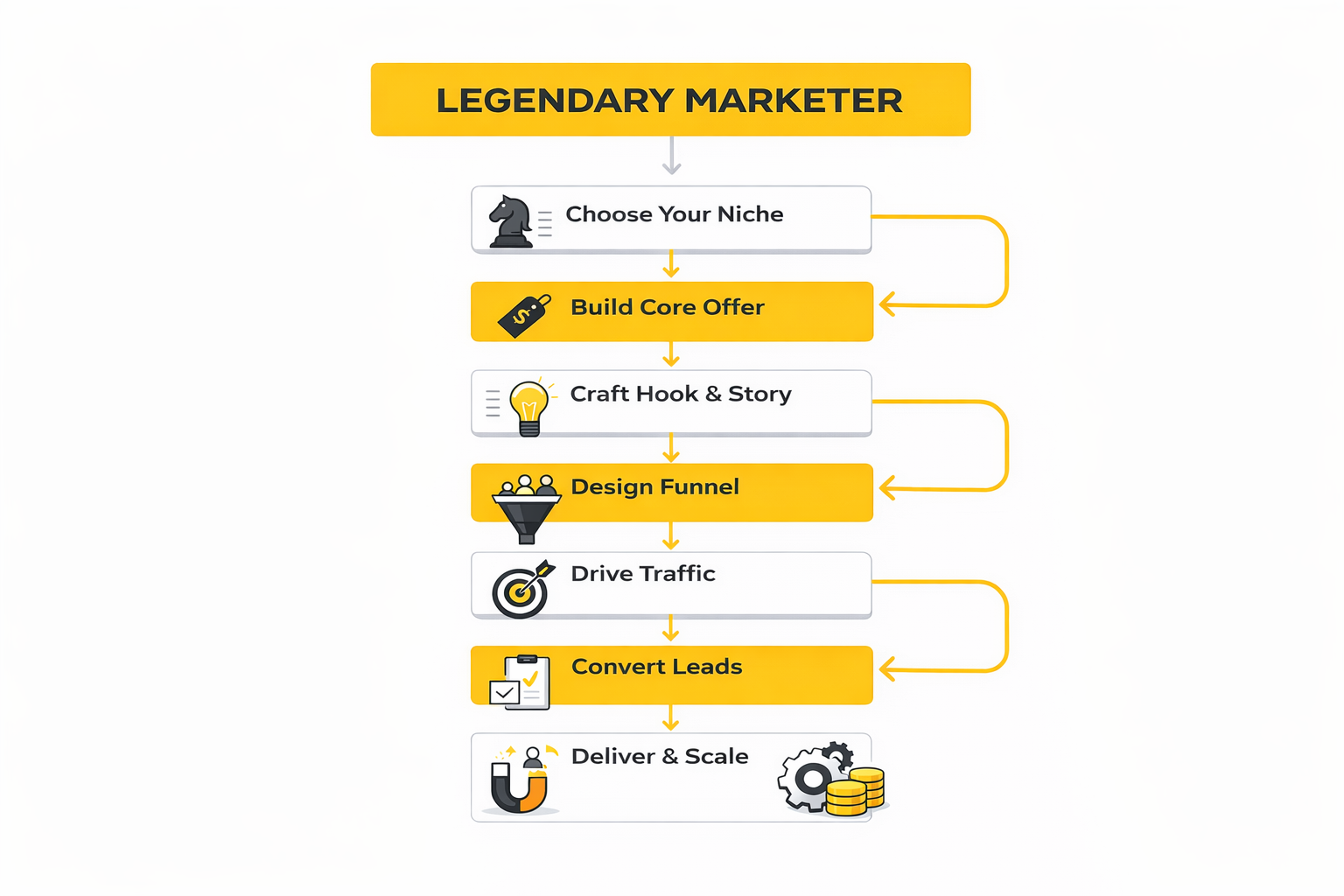
This is also where tools become useful in the right way. A landing page builder like Replo can help teams test faster and keep message-to-page consistency tight. Automated conversation flows in ManyChat can capture intent and continue the conversation while attention is still fresh. A centralized system like GoHighLevel can keep follow-up, pipeline visibility, and lifecycle messaging from getting fragmented across too many disconnected tools.
The point is not that one stack makes someone a legendary marketer. The point is that professionals design systems that preserve intent instead of leaking it away. Every asset should answer one question: does this make the next step easier or harder for the buyer?
Step 4: Launch Narrow, Learn Fast, Expand Deliberately
Weak marketers treat launch as a reveal. Strong marketers treat it as the first live diagnostic. They do not expect the market to reward them just because the assets are finally finished. They watch where attention gathers, where drop-off begins, where objections cluster, and where the message starts resonating harder than expected.
That is why the smartest rollout is often narrower than teams want. A tighter launch gives cleaner feedback. It lets you compare segments, offers, hooks, and traffic sources without drowning in noise. Once the signal is strong, then you expand distribution with far more confidence.
Step 5: Turn Performance Into Insight, Not Vanity
After launch, the work is not just optimization. It is interpretation. A legendary marketer does not stare at dashboards hoping that more numbers will produce more wisdom. They look for the few metrics that explain what is actually happening: qualified response rate, lead-to-call rate, show-up rate, close rate, conversion by traffic source, time-to-value, repeat purchase, and message resonance across segments.
That discipline matters because vanity metrics can make a bad campaign look exciting for far too long. High reach, cheap clicks, and broad engagement can still hide weak trust, poor offer fit, or broken handoffs deeper in the system. Professional implementation means tracing performance back to the actual component that needs work instead of spraying random changes across the entire funnel.
Step 6: Build Feedback Loops That Compound
The final step is the one most teams underinvest in. Legendary marketers build loops. They feed customer objections back into copy. They feed sales questions back into content. They feed onboarding friction back into positioning. They feed wins back into proof, testimonials, retention, and stronger future offers.
This is what turns marketing from campaign production into market learning. Over time, the team gets faster because it is not starting from zero every quarter. It is working from a growing base of real customer intelligence, cleaner execution patterns, and stronger message control. In the next part, we will look at the mistakes and blind spots that stop good marketers from becoming genuinely hard to beat.
Reading the Numbers That Matter
A legendary marketer does not drown in dashboards. They use measurement to answer a small set of hard questions: is the message attracting the right attention, is the offer converting real intent, are channels creating incremental lift, and is the system producing profitable customers instead of expensive activity. That is a very different mindset from reporting on every available metric just because the platform makes it easy.
This distinction matters more now because the industry has a measurement confidence problem. In Nielsen’s 2025 ROI work, 85% of marketers said they felt confident tracking holistic performance, but only 32% said they were actually measuring holistically. That gap is exactly where weak decisions happen. Teams start overvaluing what is easy to count, undervaluing what takes longer to see, and mistaking platform visibility for business truth.
A legendary marketer reads numbers in context. Reach without recall can mean wasted exposure. Clicks without qualified actions can mean the promise is attracting curiosity instead of buying intent. Low acquisition cost can still be bad news if the leads do not convert, stay, or expand. The job is not to collect numbers. The job is to know which numbers deserve action.
The Four Layers of a Useful Analytics System
The cleanest way to read performance is to organize it into layers. The first layer is attention, which includes reach, frequency, view quality, branded search movement, and any sign that the market is not just seeing the message but mentally registering it. The second layer is engagement, where you look at actions that suggest genuine interest rather than passive scrolling, such as qualified page depth, replies, demo requests, message completions, and return visits.
The third layer is conversion, which covers the commercial actions that move the business forward: opt-ins, booked calls, checkouts, opportunities created, and closed revenue. The fourth layer is value, which is where many teams finally realize whether the system is healthy. That layer includes payback, repeat purchase, retention, expansion revenue, and customer lifetime value. If this final layer is weak, earlier wins can be dangerously misleading.
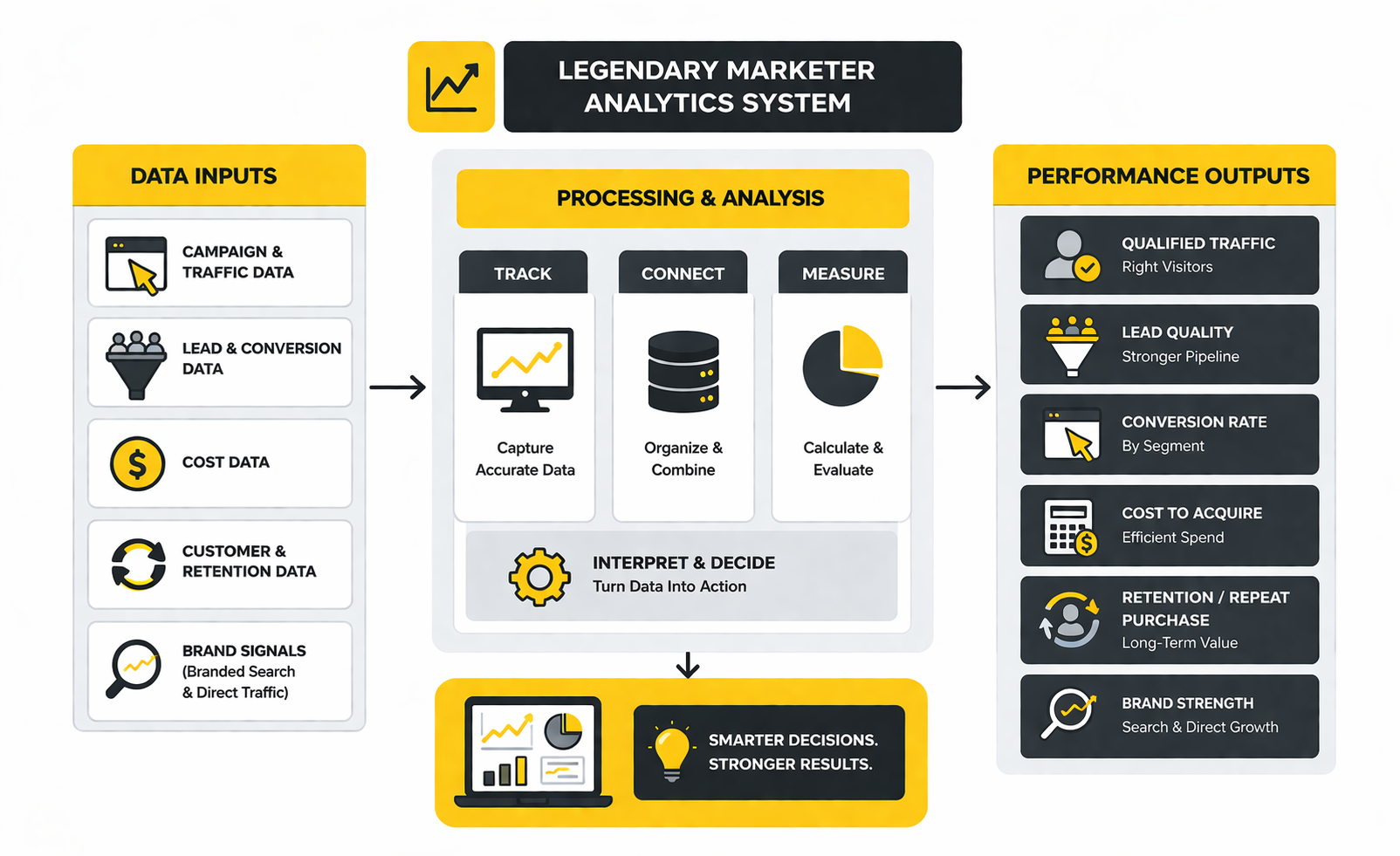
This layered view helps explain why marketers get trapped by the wrong benchmarks. A strong click-through rate is not automatically a win if the downstream conversion rate collapses. A low cost per lead is not impressive if the leads are low-intent and sales teams cannot close them. A legendary marketer keeps tracing performance forward until the number connects to business value, not just media output.
What Today’s Benchmarks Are Really Telling You
Modern benchmarks are useful, but only when they are interpreted correctly. Gartner’s 2025 CMO Spend Survey found that marketing budgets stayed flat at 7.7% of company revenue, while the 2025 Deloitte-backed CMO Survey reported a mean of 9.35% of revenue and a median of 3%. The gap between those numbers is the point. Averages hide enormous variation by sector, growth stage, business model, and strategic posture, so using one “normal” budget target without context is sloppy thinking.
The same problem shows up in channel interpretation. Nielsen’s 2025 reporting notes that marketers continue to favor digital channels because they appear easier to measure, yet its analysis warns that ease of measurement does not automatically equal effectiveness or higher ROI. That should hit hard because a lot of bad allocation decisions begin with exactly that mistake. Teams pour money into channels that produce clean dashboards while starving harder-to-measure channels that may be doing more real demand creation.
BCG’s 2025 work sharpens this further by arguing that marketers should evaluate touchpoints by influence, not just presence, using a combination of impact on the purchase decision and consumer recall of the touchpoint itself in its touchpoint mapping research. That changes what a legendary marketer pays attention to. Instead of asking only which channel got credit, they ask which touchpoints actually moved the buyer and remained memorable enough to matter later.
Attention Metrics Need Better Interpretation
Not all attention is equal, and this is where measurement often gets lazy. McKinsey’s 2025 attention research found that a 10% increase in average focus paid across media was associated with a 17% increase in spend, and consumers in the top quartile of focus spent twice as much as those in the bottom quartile. That does not mean every campaign should chase “attention” in the abstract. It means attention quality matters because focused attention is more commercially useful than superficial exposure.
For a legendary marketer, this creates a practical rule. If a channel is delivering cheap impressions but weak recall, weak branded demand, and weak downstream conversion, the exposure is likely inflated in value. On the other hand, if a campaign is lifting branded search, direct traffic, repeat visits, and qualified pipeline even when last-click attribution looks modest, that campaign may be doing more real work than the dashboard first suggests.
This is one reason branded search movement is so underrated. It is not perfect, but it often acts as a pressure gauge for whether awareness is turning into mental availability. When branded demand rises alongside stronger direct traffic and better close rates, the signal is usually telling you the market is becoming warmer, not just more exposed.
Conversion Signals Are Only Useful When They Stay Qualified
A lot of marketing reporting stops at the lead. That is a mistake. A legendary marketer wants to know whether the conversion action predicts revenue, not whether it makes the weekly dashboard look active. The closer the metric is to business value, the more seriously it should be treated.
That is why conversion metrics need qualification layers. An opt-in matters more when it leads to a booked call. A booked call matters more when the show-up rate holds. A show-up rate matters more when the sales team can actually close the lead profitably. When any handoff breaks, the top-of-funnel number can look healthy while the business quietly underperforms.
This is also where email and lifecycle benchmarks are often misunderstood. Industry-level engagement ranges can be useful directional references, but they should never be used as proof that nurture is working in your business. Even campaign benchmark pages such as Salesforce’s email benchmarks overview emphasize that metrics like click-through rate and conversion rate are meaningful only when compared against your own goals, audience, and industry context. A legendary marketer treats benchmarks as prompts for investigation, not as trophies.
Incrementality Is the Number Behind the Number
One of the most important measurement ideas in modern marketing is incrementality. It asks a simple but uncomfortable question: what happened because of the marketing, and what would have happened anyway. That question matters because platform-reported performance can make existing demand look like created demand, especially in retargeting-heavy systems or mature branded search environments.
Google has been blunt about this, calling incrementality testing the industry’s gold standard for understanding advertising’s true impact in a privacy-first way. Its more recent measurement guidance also frames experimentation as a way to turn marketing from a cost center into a growth engine by proving causal lift rather than relying on convenient attribution alone in its 2026 measurement guidance. That is a serious shift in mindset. It pushes marketers away from reporting what the platform claims and toward testing what the business can actually verify.
A legendary marketer does not need to run a perfect experiment every week. But they do need an incrementality mindset. They should be asking whether retargeting is capturing people who were already coming back, whether branded search is absorbing demand generated elsewhere, and whether a supposedly efficient channel still performs when tested against a control. That is where the real reading of performance begins.
Measurement Should Change Budget Decisions
The point of analytics is not prettier reporting. It is better allocation. BCG’s 2025 measurement research found that senior marketers who share certain stronger measurement approaches can deliver up to 70% higher revenue growth than peers. That number matters not because it promises a magic formula, but because it reinforces the operational truth: better measurement creates better decision quality, and better decision quality compounds.
So what action should the numbers drive? If attention is broad but weakly remembered, improve creative distinctiveness and message clarity. If click volume is high but qualified conversion is low, fix the offer or landing path before spending more. If acquisition looks efficient but retention or expansion is poor, the problem is not media alone. It may be onboarding, product fit, lifecycle messaging, or expectation setting.
This is where a legendary marketer becomes dangerous in the best way. They stop reacting to isolated metrics and start diagnosing the full system. They know which number is a signal, which number is a symptom, and which number should force a real change in offer, channel mix, or customer experience.
Smart Benchmarks for a Legendary Marketer
The best benchmarks are not random averages copied from someone else’s report. They are a balanced scorecard that helps you judge system health across stages. That scorecard should include enough leading indicators to spot trouble early and enough lagging indicators to prove commercial value later.
A practical benchmark stack often includes:
- branded search trend over time
- qualified traffic share by source
- visitor-to-lead rate by landing page
- lead-to-opportunity or lead-to-call rate
- show-up rate and close rate
- payback period
- repeat purchase or retention by cohort
- contribution of each channel to incremental lift, not just attributed conversions
What matters is not having more metrics. It is having a small set that can explain what changed and what should happen next. That is how a legendary marketer reads data: not as noise, not as theater, and definitely not as an excuse to avoid hard decisions. The numbers should tell you where trust is leaking, where intent is being wasted, and where the next profitable move actually is.
The Strategic Tradeoffs That Separate Good Marketers From Legendary Ones
By this point, the difference between a competent marketer and a legendary marketer is not knowledge. It is judgment. The advanced work is mostly about tradeoffs: how much to automate without making the brand feel generic, how fast to scale without breaking trust, how aggressively to chase efficiency without starving future demand, and how much complexity the team can absorb before execution quality starts slipping.
That matters because the market is now rewarding two things at once that do not naturally coexist. Buyers want more relevance and more personalization, but they also want more transparency, more credibility, and fewer signs that the brand is just running a machine on autopilot. Recent research from McKinsey and BCG points in the same direction: AI and personalization can create real value, but only when they are supported by governance, operating discipline, and a clear strategy for trust rather than treated like shortcuts to scale.
A legendary marketer understands that every gain has a shadow cost. More channels can increase reach but also dilute message discipline. More creative testing can improve learning but also fragment the brand if no one is protecting the core positioning. More automation can lower manual workload but also increase the risk of over-messaging, compliance mistakes, and a customer experience that feels efficient rather than persuasive.
Scaling Without Losing Message Control
Scaling usually breaks in one of two places. Either the team expands distribution faster than it expands strategic clarity, or it adds tools and workflows faster than it adds standards. In both cases, performance may look fine at first because volume hides the drift. Then the symptoms show up: inconsistent promises across channels, confused handoffs between marketing and sales, bloated nurture sequences, rising acquisition costs, and weaker close quality.
This is why legendary marketers standardize the important things before they scale the visible things. They lock the buyer language, the offer hierarchy, the proof structure, the objection handling, and the non-negotiable message points. Then they allow variation inside those boundaries. That is how you get speed without turning every channel into a slightly different company.
There is a direct operating lesson here from current AI adoption research. McKinsey’s 2025 global AI survey found that more organizations are using AI, but scaled value still depends on management practices across strategy, operating model, data, technology, talent, and adoption rather than on tool access alone. In other words, scale is not a software feature. It is an organizational capability.
Personalization Works Best When It Still Feels Human
A lot of marketers now know they should personalize. Fewer know where the line is. Good personalization makes the experience more relevant. Bad personalization makes the customer feel watched, misread, or pushed into a flow that is technically optimized but emotionally off.
That is why a legendary marketer uses personalization to clarify, not to impress. They use it to improve the match between intent and message, not to show how much data the system can access. The strongest versions are often simple: segment-specific proof, context-aware follow-up, landing pages that align with source intent, onboarding that reflects the promised outcome, and lifecycle messaging that changes as the customer matures.
The risk of getting this wrong is not just lower conversion. It is trust erosion. BCG’s personalization work has shown that consumers want relevant interactions, but they are also quick to punish experiences that feel irrelevant, invasive, or careless. When marketers push personalization past the point of usefulness, they do not create intimacy. They create friction disguised as sophistication.
AI Is an Amplifier, Not a Substitute for Taste
This is the part many teams still underestimate. AI can help a legendary marketer research faster, generate drafts faster, test ideas faster, and adapt content faster. But it does not replace taste, strategic restraint, or the ability to decide which message should never be diluted. Those are still human jobs, and they matter more as content volume rises.
The danger is subtle because AI usually improves speed before it improves quality. That makes it easy for teams to feel productive while slowly flattening their brand into a series of competent but interchangeable outputs. BCG’s 2025 work on brand equity in the age of AI argues that influence, trust, and choice still depend on distinctiveness and disciplined brand building even as AI changes execution. That should be taken seriously. If everybody can produce polished content, then polished content stops being the moat.
So the expert move is not rejecting AI. It is assigning AI the right role. Use it to accelerate research synthesis, production support, workflow speed, and testing volume. Do not let it own final judgment on positioning, promise structure, emotional nuance, or the kind of message that can strengthen or weaken trust in one sentence.
Compliance and Credibility Are Now Growth Issues
This used to be treated like legal cleanup. It is not anymore. Once reviews, testimonials, influencer messaging, and AI-generated persuasion become central parts of distribution, credibility rules stop being optional. They become part of the growth model because enforcement risk, reputation damage, and buyer skepticism all hit the same system.
The FTC’s consumer review rule, which took effect on October 21, 2024, directly targets deceptive conduct involving reviews and testimonials, and the agency’s 2025 warning letters made clear that fake reviews, undisclosed insider reviews, and sentiment-conditioned incentives can trigger enforcement and civil penalties. For any marketer building proof into the conversion path, that is not a side note. It is a hard boundary.
A legendary marketer understands that proof has to be real, representative, and responsibly presented. That means cleaner testimonial sourcing, better disclosure habits, stronger approval processes, and much more caution with anything that looks overly curated. Trust compounds, but so does sloppiness. And sloppiness gets more expensive the more visible the brand becomes.
Channel Expansion Can Quietly Destroy Focus
One of the most common scaling mistakes is expanding channel count before the team has earned channel depth. The logic sounds smart on paper: diversify acquisition, meet the audience everywhere, reduce dependence on one platform. But when the core message is not yet strong enough, that move usually spreads mediocrity faster instead of spreading advantage.
This is harder now because media fragmentation keeps increasing. Nielsen’s 2025 analysis highlights how scattered attention has become across formats and environments, which makes it tempting for marketers to chase coverage everywhere. The smarter response is not maximum presence. It is better sequencing, clearer role definition for each channel, and tighter standards for deciding when a new channel has earned the right to join the mix.
A legendary marketer expands only after the existing system is teaching them something reliable. They know which hook works, which audience converts, which promise holds, which proof moves decisions, and which handoffs are stable. Then expansion becomes multiplication. Before that, it is usually just noise with a budget.
The Long Game Is Still the Hardest Advantage to Copy
The final expert-level lesson is simple, but it is not easy: legendary marketers are usually playing a longer game than they appear to be. They care about this quarter, but they are also building memory, proof, trust, systems, and decision quality that will matter six quarters from now. That is why they look calmer under pressure. They are not relying on one launch, one ad account, one creator partnership, or one clever angle to carry the entire business.
That long-game mindset becomes even more valuable when budgets are tight and measurement is messy. Marketing organizations are under pressure to show fast returns, yet current research also shows persistent struggles with cross-channel comparability, alignment, and holistic ROI measurement. The practical implication is clear: the teams that win are not the ones with the cleanest-looking platform dashboards. They are the ones that protect strategic coherence while still learning faster than the market around them.
A legendary marketer does not try to win by doing everything. They win by knowing what not to dilute. They protect positioning, they protect trust, they protect message discipline, and they protect the customer experience after the click. That is the real expert move. In the final part, we will bring this together with the most common questions, the biggest misconceptions, and the closing principles that make the whole system usable in the real world.
The final takeaway is simple. A legendary marketer is not the person with the loudest feed, the biggest tool stack, or the most complicated funnel map. It is the marketer who can consistently turn market insight into clear positioning, clear positioning into persuasive execution, and persuasive execution into measurable business growth without burning trust in the process.
That standard is harder now, but it is also more valuable. AI can accelerate production, automation can tighten follow-up, and better measurement can improve allocation, yet none of those things replace judgment. The marketer who keeps message discipline, respects the customer, reads data in context, and compounds learning over time is still the one who becomes difficult to beat.
If you want the whole system to hold together, think in loops. Better research sharpens positioning. Better positioning improves messaging. Better messaging strengthens conversion. Better conversion improves customer quality. Better customer quality creates better proof, better retention, and stronger future demand. That is how a good marketer becomes a legendary marketer in a way that actually lasts.
FAQ: Legendary Marketer Questions That Actually Matter
What is a legendary marketer, really?
A legendary marketer is someone who can create trust, demand, and commercial momentum repeatedly, not just once. They understand how positioning, messaging, offer design, distribution, and measurement work together as one system. The reason this matters more now is that AI has made content production easier, while strategic clarity and execution judgment are still scarce, a pattern highlighted in McKinsey’s 2025 AI survey on the gap between adoption and scaled value here.
Is a legendary marketer born with talent or built through practice?
Natural instinct can help, but the stronger answer is that this skill is built. Legendary marketers get there by studying buyers, testing real offers, learning channel behavior, and developing better judgment under pressure. The proof is in how repeatable the work becomes once systems, governance, and learning loops are in place, which is exactly what current AI and growth research keeps pointing toward here and here.
Do you need a huge audience to become a legendary marketer?
No, and this is one of the most common misconceptions. A legendary marketer does not need celebrity status if they can make the right audience care, trust, and act. In many businesses, a smaller audience with stronger intent is far more valuable than broad attention that never converts.
What skills matter most for becoming a legendary marketer?
The most important skills are positioning, buyer research, persuasive writing, offer design, channel sequencing, conversion thinking, and interpretation of data. Leadership and communication also matter because marketing gets weak fast when sales, product, content, and operations are all speaking different languages. The best marketers can connect those functions without making the work feel bureaucratic.
Is brand building still worth it when performance marketing is under pressure?
Yes, and that question matters because too many teams now think in false opposites. Brand and performance are not enemies. Stronger brand memory usually makes performance channels work harder because the market reaches the click already warmer, more familiar, and more willing to trust. That broader measurement problem is one reason Nielsen found a large gap between marketers who believe they are measuring holistically and those who actually are here.
How should a legendary marketer use AI without sounding generic?
Use AI as an amplifier, not a substitute for taste. It can speed up research synthesis, draft generation, workflow support, and iteration, but the marketer should still own the final call on tone, promise, proof, and positioning. When AI is allowed to flatten the message into average-sounding output, the team may gain speed while losing distinctiveness.
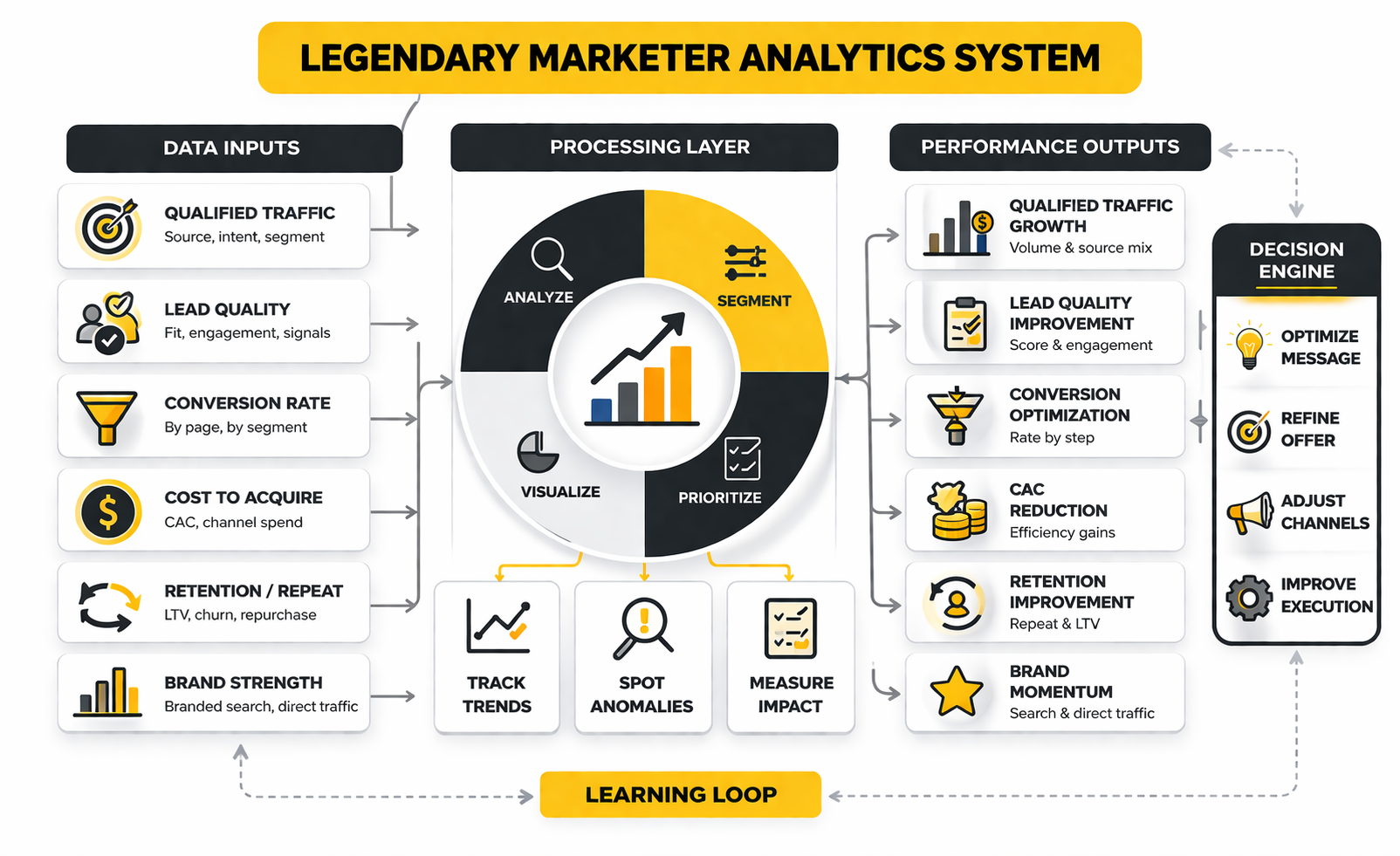
What metrics should matter most?
The best metrics depend on the business model, but a legendary marketer usually watches a compact set of numbers tied to system health. That includes qualified traffic, lead quality, conversion rate by segment, cost to acquire a customer, retention or repeat purchase, payback period, and signs of brand strength like branded search trend or direct traffic movement. Gartner’s 2025 CMO budget reporting and channel allocation work is a useful reminder that budget pressure makes this prioritization more important, not less here and here.
What is the biggest mistake marketers make when trying to scale?
They scale distribution before they lock message discipline. That usually creates inconsistent offers, disconnected handoffs, and a lot of paid activity built on a weak strategic core. Scaling works far better when the team has already proven what the buyer cares about, what promise resonates, and what execution path converts without breaking trust.
Can automation help, or does it hurt trust?
It can absolutely help, but only when it reduces friction instead of replacing judgment. Automated follow-up, CRM workflows, segmentation, scheduling, and lead routing can all improve the buyer experience when used carefully. The danger begins when automation increases noise, over-messaging, or obvious template behavior that makes the brand feel efficient but not credible.
How important are reviews, testimonials, and proof?
They are critical, but only if they are real and responsibly presented. Proof is one of the fastest ways to reduce risk in the buyer’s mind, yet it also carries serious compliance and trust consequences when handled carelessly. The FTC’s consumer review rule, which took effect on October 21, 2024, makes deceptive review and testimonial practices a direct legal risk, not just a reputation issue here and here.
Do legendary marketers focus more on channels or on the message?
The message comes first because channels amplify whatever is already there. If the offer is muddy, the positioning is weak, or the trust layer is thin, more channels usually just spread the problem faster. Legendary marketers do care about channels, but they treat them as delivery systems for a sharper strategic idea, not as the strategy itself.
How long does it take to become a legendary marketer?
There is no clean timeline because this is not a certificate or a title you claim after one campaign. It is a compounding process built through repeated exposure to real markets, real buyers, real mistakes, and real feedback. The faster someone learns from evidence instead of ego, the faster they improve.
Are tools necessary, or can a strong marketer win with a simple stack?
A strong marketer can do excellent work with a lean stack if the fundamentals are right. Still, the right tools can remove friction and improve execution speed once the strategy is already clear. For example, Replo can help teams move faster on page execution, ManyChat can keep conversations moving while intent is still live, and GoHighLevel can centralize follow-up and pipeline visibility. The key is not having more tools. The key is making sure every tool protects clarity instead of creating more operational noise.
What is the fastest way to improve if you are serious about this craft?
Start by tightening one complete loop instead of trying to fix everything at once. Improve the research, sharpen the positioning, rewrite the message, simplify the conversion path, and measure what changes downstream. That kind of disciplined iteration is where real marketers separate themselves from people who only collect tactics.
Work With Professionals
Explore 10K+ Remote Marketing Contracts on MarkeWork.com
Most marketers spend too much time chasing clients, competing on crowded platforms, and losing a percentage of every project to middlemen. MarkeWork gives you a better way. Browse thousands of remote marketing contracts and connect directly with companies desperate to hire skilled marketers like you, without platform commissions and without unnecessary gatekeepers.
That positioning is not just a nice headline. MarkeWork currently presents itself as a place to explore 10K+ remote marketing contracts and create a freelancer account for free here. If you're serious about finding better opportunities and keeping 100% of what you earn, explore available contracts and create a profile for free at MarkeWork.com.
Jaký obrázek se ti líbí víc?
12