

LinkedIn marketing works best when you stop treating the platform like a social side project and start treating it like a business channel. The audience is different, the buying context is different, and the content that wins is different. People open LinkedIn to learn, evaluate, compare, and signal professional intent, which is exactly why it matters so much for B2B brands, consultants, agencies, recruiters, and high-trust service businesses.
That matters even more now because the platform has real scale. LinkedIn’s own ad platform says you can reach more than 1 billion active professionals, while broader 2025 market tracking puts the network at roughly 1.2 to 1.3 billion members globally. Big reach alone is not the point, though. The real advantage is that LinkedIn lets you target and attract people by job title, function, seniority, industry, and company context instead of hoping the right person stumbles across your message.
The other reason LinkedIn marketing deserves serious attention is trust. In the latest Edelman-LinkedIn research, 73% of decision-makers said thought leadership is a more trustworthy way to assess a company’s capabilities than traditional marketing materials, and 54% of decision-makers and 52% of C-suite executives spend an hour or more each week consuming thought leadership. That changes the job of marketing on LinkedIn. You are not just chasing impressions there. You are building enough clarity and authority that the right buyer starts to take you seriously before sales ever enters the room.
Article Outline
- Why LinkedIn Marketing Matters Right Now
- The LinkedIn Marketing Framework
- Building the Right Foundation for Profiles and Pages
- Creating Content That Earns Reach, Trust, and Response
- Turning Attention Into Leads With Paid Distribution and Capture
- Measuring What Matters and Scaling What Works
Why LinkedIn Marketing Matters Right Now
LinkedIn has become one of the few platforms where business content still makes natural sense. That sounds obvious, but it is a huge strategic advantage. You do not have to fight the same context mismatch you get on entertainment-first platforms, because the audience is already in a professional mindset when they see your post, ad, newsletter, or company page.
The numbers back that up. Recent industry summaries built on Content Marketing Institute data show that LinkedIn delivers the best value for 85% of B2B marketers, and 2025 reporting also shows that video investment and thought leadership investment are rising fast across B2B teams. At the same time, LinkedIn’s 2025 benchmark with Ipsos found that 95% of B2B marketers use AI at least weekly, which means the feed is getting more crowded, more polished, and more competitive.
That is exactly why sloppy LinkedIn marketing now fails faster. Generic advice posts, recycled carousels, and vague brand updates are easier to produce than ever, so they are easier to ignore too. The brands and operators getting traction are the ones bringing real expertise, sharper positioning, stronger proof, and a clear path from attention to action.
The LinkedIn Marketing Framework
The simplest way to think about LinkedIn marketing is this: authority first, distribution second, conversion third. Most people reverse that order. They push offers before they have built trust, or they run ads before their profile, page, and content give buyers a reason to believe them.
A better framework starts with your market position, then moves into consistent content, then adds amplification, and only then leans hard into lead capture. That sequence matches how buyers actually behave on LinkedIn. They notice you, check whether you sound credible, consume a few more touchpoints, and only then decide whether you are worth a click, a follow, a reply, or a meeting.
Here is the structure the rest of this article will build on:
- Foundation: clarify who you want to reach, what you want to be known for, and whether your profile and page support that message.
- Content: publish posts, articles, videos, and newsletters that teach, differentiate, and prove expertise instead of just filling the calendar.
- Distribution: expand reach through employee advocacy, smart engagement, newsletters, events, and paid support when the economics make sense.
- Conversion: route attention into the right next step, whether that is a lead form, newsletter signup, demo request, webinar registration, or sales conversation.
- Measurement: track quality signals such as profile views, qualified engagement, follower growth, click-throughs, conversion rate, and pipeline influence instead of obsessing over vanity metrics.
This framework is practical because it matches the tools LinkedIn actually gives you. A company page can become a dynamic growth asset when you use it consistently, and LinkedIn’s own guidance notes that complete pages get 30% more weekly views, while companies that post at least weekly can see a 2x lift in engagement. On the content side, newsletters deserve a place in the mix too, especially because LinkedIn allows creators and pages to build recurring editorial products directly on-platform through LinkedIn newsletters.
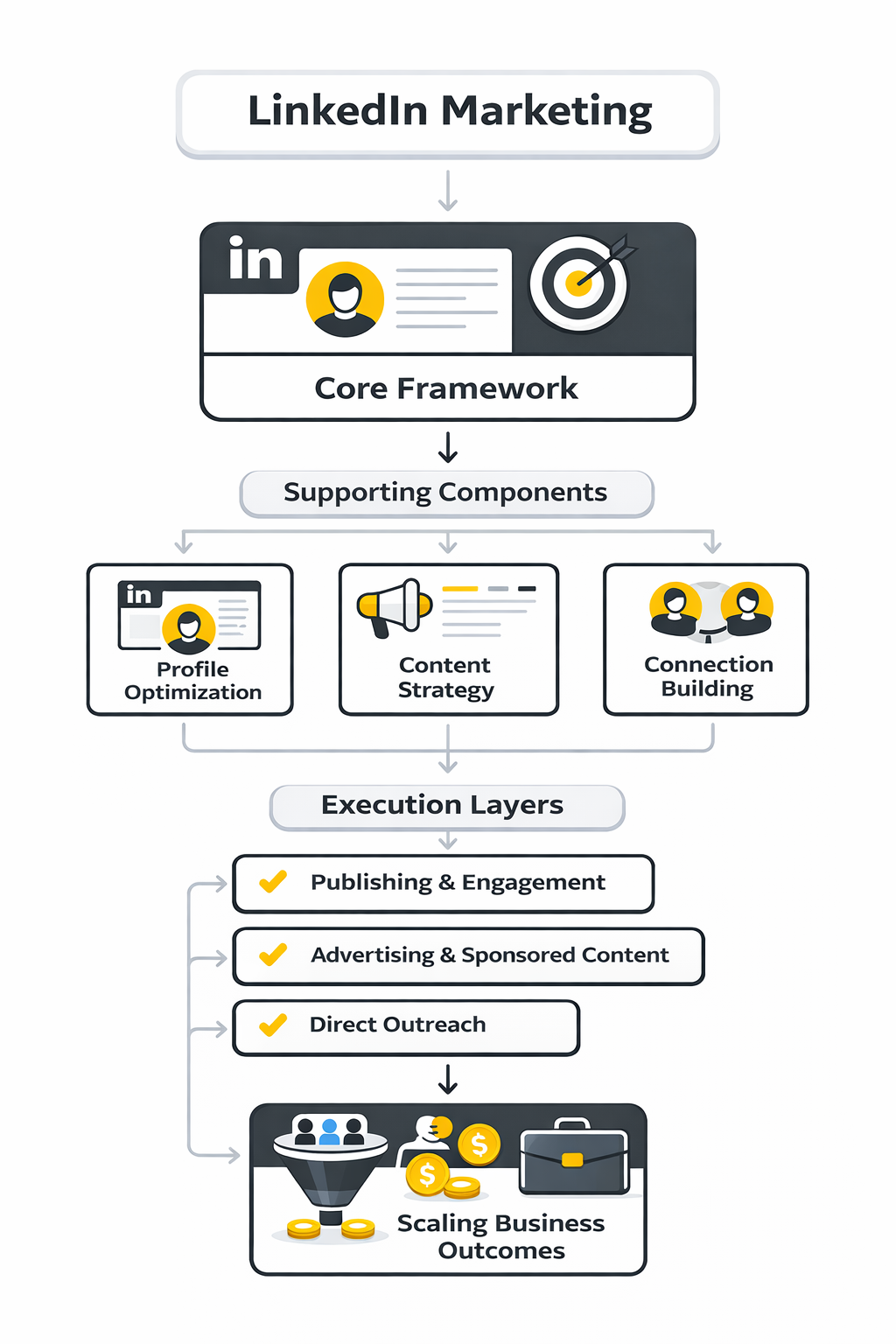
The point is not to use every feature. The point is to build a system where each feature has a job. Your profile builds confidence, your content earns attention, your page supports credibility, your paid media expands reach, and your conversion assets turn interest into something measurable. In the next part, we will start with the foundation, because weak positioning makes every LinkedIn tactic more expensive and less effective.
Building the Right Foundation for Profiles and Pages
Most LinkedIn marketing problems are not content problems. They are positioning problems. When your profile, company page, and offer path are unclear, even strong posts end up attracting the wrong audience or creating attention that never turns into business.
This is where a lot of teams waste time. They publish consistently, maybe even get decent engagement, but the people landing on the profile or page still cannot answer the basic questions. Who is this for, what do they actually do, and why should I trust them enough to take the next step?
A strong foundation fixes that before you scale anything else. It gives every future post, comment, article, ad, and newsletter a place to land. That is what makes LinkedIn marketing feel coherent instead of random.
Start With Positioning Before You Touch the Profile
Before you rewrite a headline or update a banner, get specific about the market you want to own. LinkedIn rewards clarity because users make fast judgments there. They scan your headline, your first few lines, your featured section, and your recent activity, then decide whether you are relevant.
That means broad positioning usually underperforms. “Helping businesses grow” is forgettable because it says almost nothing. A much stronger approach is to define the audience, the problem, the mechanism, and the outcome so your profile instantly tells the right person they are in the right place.
In practice, that means answering four questions in plain English:
- Who do you help
- What problem do you solve
- How do you solve it
- What result do you help create
If your LinkedIn marketing is tied to a service business, this part matters even more. Prospects often view a profile before they visit a website, and LinkedIn’s own profile guidance pushes users to make the headline more than a job title and use it to show specialty, value, and direction in a way that helps people understand fit right away tips for refreshing your LinkedIn profile and crafting a LinkedIn profile that stands out in 2025. LinkedIn+1
Build a Personal Profile That Carries Commercial Weight
For most founders, consultants, and sales-led operators, the personal profile does the heavy lifting. People trust people faster than they trust logos, especially on LinkedIn. That does not mean the company page is useless. It means the human profile usually earns the first click, the first follow, and the first serious read.
Your headline should not just announce your role. It should frame your expertise and give a clear reason to care. LinkedIn’s own guidance explicitly recommends using the headline to go beyond a job title, while newer profile advice on the platform emphasizes explaining who you help, what sets you apart, and why your work matters 12 steps to a better LinkedIn profile and crafting a LinkedIn profile that stands out in 2025. LinkedIn+1
The profile photo and banner matter for the same reason. They do not close deals on their own, but they heavily influence whether someone reads further or bounces. If your current photo is weak and you need a fast upgrade without booking a full shoot, BetterPic is one practical option that fits this exact use case.
Your About section should read like a sharp market narrative, not a résumé dump. Lead with the problem you work on, explain your angle, show proof where you have it, and end with a simple next step. This is not the place for buzzwords, mission-statement fog, or paragraphs full of self-congratulation.
Make the Experience Section Prove the Case
A lot of LinkedIn profiles fall apart here. The headline is decent, the banner looks clean, and then the experience section reads like it was copied from an HR database. That is a waste because this section is one of the best places to turn curiosity into confidence.
Instead of listing responsibilities, show relevance. Explain what each role or business actually involved, what kind of work you led, and what kind of outcomes you helped create. Numbers help when you can support them, but even without big metrics, specificity beats vagueness every time.
This is also where consistency matters. If your content talks about one positioning but your experience section points in another direction, people feel the mismatch immediately. Good LinkedIn marketing reduces friction, and that means your profile story should line up from top to bottom.
Use Featured Content as a Conversion Bridge
The featured section is one of the most underused assets on LinkedIn. It is where attention starts turning into intent. Someone likes a post, clicks your profile, and now you have a chance to guide what they see next instead of leaving that decision to chance.
This section works best when it does three jobs. First, it proves expertise with a strong post, article, case breakdown, or interview. Second, it provides a practical next step such as a newsletter, guide, booking link, or lead magnet. Third, it reinforces the core message of your positioning rather than sending people in five different directions.
For service businesses, simple usually wins. A booking link through Cal.com, a clean lead capture form via Fillout, or a newsletter signup connected to Brevo can create a much smoother path from LinkedIn traffic to actual conversation. The important thing is not the tool itself. The important thing is that the next step is obvious and relevant.
Turn the Company Page Into a Credibility Asset
Company pages usually do not create momentum by themselves in the same way strong personal profiles can. But they absolutely influence whether a brand feels established, trustworthy, and current. When a prospect checks your page and sees outdated branding, weak descriptions, and months of silence, that creates doubt you did not need.
The fix is straightforward. Complete every important field, make the description audience-centered, use a clear banner, and keep the page visually and verbally aligned with what your people are saying elsewhere. LinkedIn states that pages with complete information can receive 30% more weekly views, and the company’s page guidance repeats the same principle across its business resources create a LinkedIn company page and LinkedIn Pages best practices. LinkedIn+2
Just as important, the page should not sound like a legal filing. Write it for buyers, recruits, partners, and industry peers who want to know what the business does and why it matters. Clear language wins here too.
Align the Page With the People Behind It
This is where stronger LinkedIn marketing starts to compound. Your company page should not operate in isolation from your team. It should support the expertise, voice, and market position already being built by founders, executives, marketers, and subject-matter experts.
LinkedIn has pushed this angle for years through its employee advocacy resources because the combined reach and authenticity of employee voices can extend brand distribution far beyond what a page can do alone official guide to employee advocacy and introducing the official guide to employee advocacy. Even though some of that guidance is older, the operating principle still holds: the page gives structure and proof, while people give the brand personality, trust, and reach. business.linkedin.com+1
That means your internal messaging cannot be sloppy. If the company page says one thing, the founder profile says another, and the sales team all describe the business differently, your market gets a fragmented impression. Tight alignment makes every impression work harder.
Create One Clear Next Step for Each Audience
Not every profile visitor wants the same thing. Some people want to follow and learn. Some want to book a call. Some want to subscribe to a newsletter. Some want to check whether your company is credible enough to put on a shortlist. The mistake is forcing all of them toward the same CTA.
A better approach is to decide which next step matters most for each audience segment and then make that route easy to find. For example, a consultant may want profile visitors to book a call, while a SaaS brand may care more about demo requests, webinar signups, or email capture. A creator-led business may prioritize newsletter subscriptions first because that grows an owned audience before the sales conversation begins.
This is exactly why the foundation stage matters so much. Once you know the audience and the desired action, everything else gets easier. Your banner, featured section, call to action, page description, and content themes can all point in the same direction.
The Foundation Should Make Content Easier, Not Harder
When the positioning is right, content creation gets simpler. You stop trying to sound smart for everyone and start speaking clearly to the people who matter. That shift makes better LinkedIn marketing possible because your posts now sit on top of a real strategy instead of improvisation.
It also helps you decide what not to post. That is just as important. If a topic does not support your positioning, attract the right audience, or move someone toward trust, it probably does not belong in the plan.
With that foundation in place, the next step is content. Not content for volume, not content for vanity reach, and definitely not content built around whatever generic template is trending this week. The goal is to create posts and formats that earn attention, deepen trust, and move the right people closer to action.
Creating Content That Earns Reach, Trust, and Response
Once your foundation is clear, LinkedIn marketing becomes a content game with very specific rules. Not content for the sake of posting, but content that builds authority fast enough to matter and consistently enough to compound. That is where most strategies either start working or quietly stall.
The platform itself is pushing this direction. LinkedIn reports that video watch time has grown significantly year over year, while its B2B benchmark research shows that thought leadership directly influences shortlisting decisions for buyers. That means the goal is not just visibility. The goal is credibility at scale.
Focus on Ideas That Actually Matter to Buyers
The easiest way to lose momentum on LinkedIn is to post content that feels generic. The feed is already saturated with recycled frameworks, vague motivational advice, and surface-level takes. None of that builds real positioning.
Strong LinkedIn marketing content is grounded in real problems your audience is actively trying to solve. That means talking about decisions, trade-offs, mistakes, results, and patterns you have seen firsthand. Not theory. Not fluff. Real signals.
In practice, your best-performing content usually falls into a few clear categories:
- Breakdowns of what works and why, based on actual execution
- Contrarian takes that challenge common assumptions in your niche
- Process insights that show how something gets done step by step
- Proof-driven posts that highlight outcomes, not just effort
- Sharp opinions backed by experience, not noise
This is where most people underestimate how much specificity matters. The more concrete your insight, the more it resonates. And the more it resonates, the more LinkedIn’s algorithm rewards it with reach.
Build a Repeatable Content System
Consistency beats bursts of effort. But consistency does not mean posting daily with no structure. It means having a system that lets you produce high-quality content without starting from scratch every time.
The simplest way to do that is to define a small number of content pillars that directly support your positioning. For example, if your LinkedIn marketing focuses on lead generation, your pillars might include funnel strategy, conversion mistakes, campaign breakdowns, and client-side lessons.
From there, turn each pillar into multiple content formats:
- Short text posts for quick insights
- Carousels for structured teaching
- Video for deeper explanation and personality
- Long-form posts or articles for authority building
- Comments that extend your reach into other conversations
This is where tools can reduce friction. Scheduling platforms like Buffer help maintain consistency, while content ideation tools like Flick can support topic discovery without replacing your actual thinking.
The Execution Process That Actually Works
At this point, LinkedIn marketing stops being abstract and becomes operational. You need a workflow that takes ideas and turns them into published content that performs.
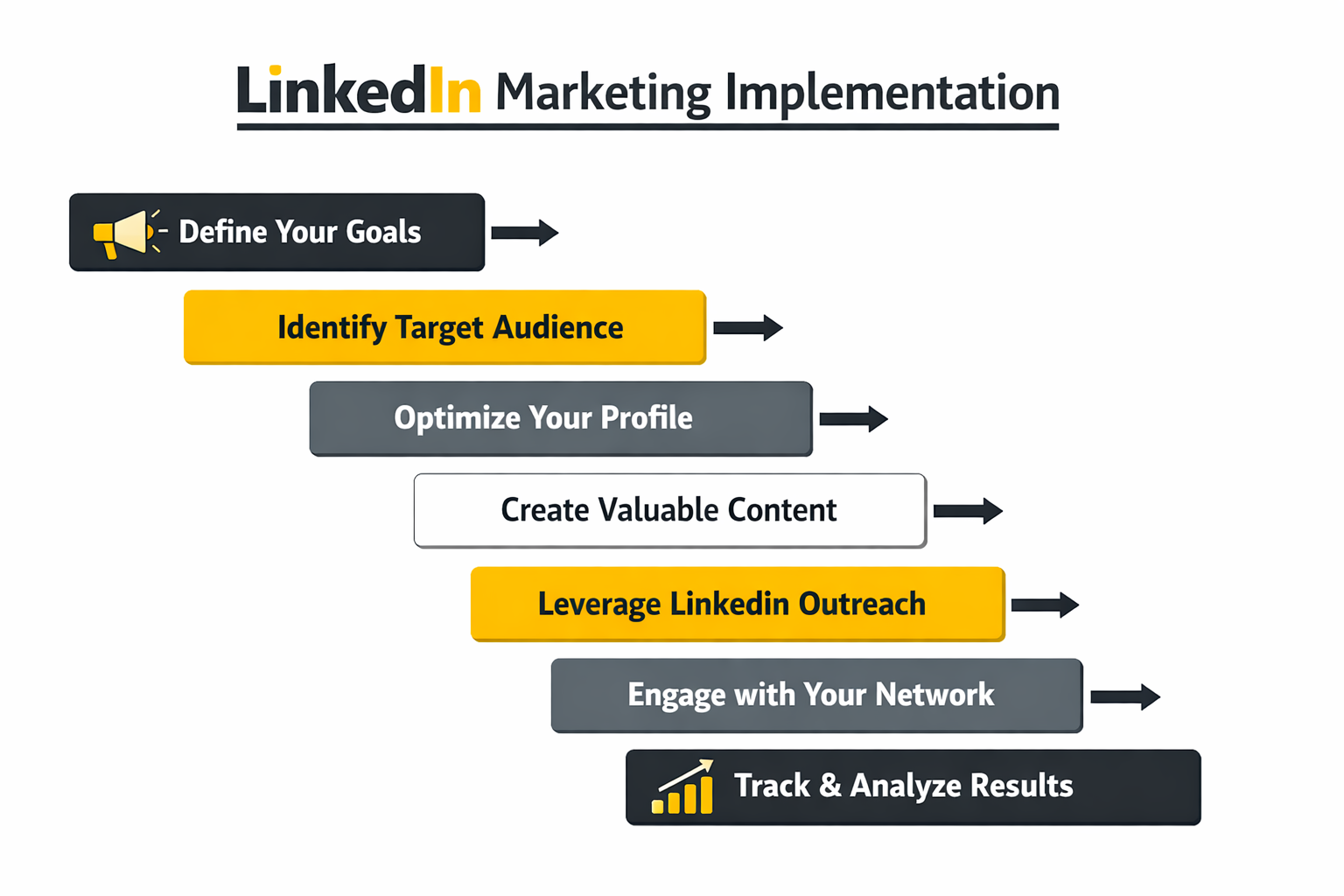
A practical execution process looks like this:
- Capture raw ideas daily Ideas do not come when you sit down to write. They show up during client calls, conversations, research, and even mistakes. Capture them immediately so you build a backlog instead of staring at a blank page.
- Filter for relevance and strength Not every idea deserves a post. Focus on ideas that are specific, useful, and aligned with your positioning. If it does not help your target audience think or act differently, it is not worth publishing.
- Turn ideas into structured posts Strong posts usually follow a simple structure: a clear hook, a valuable body, and a natural close. The hook earns attention, the body delivers insight, and the close either reinforces the idea or leads into a next step.
- Publish with intent, not randomness Timing matters less than consistency and quality, but publishing when your audience is active can still help early traction. More importantly, each post should have a purpose, whether that is reach, authority, or conversion.
- Engage immediately after posting The first 30–60 minutes after publishing often influence distribution. Reply to comments, engage with responses, and stay active. This is not gaming the system. It is participating in the conversation you just started.
- Analyze what actually worked Look beyond likes. Pay attention to profile views, connection requests, inbound messages, and click-throughs. These are stronger indicators that your LinkedIn marketing is attracting the right audience.
Write in a Way That Matches How People Read on LinkedIn
LinkedIn is not a blog platform in how people consume content. It is a feed-first environment where attention is limited and competition is constant. That changes how you write.
Short paragraphs, clear spacing, and direct language perform better because they are easier to scan. Hooks matter because they decide whether someone stops scrolling. And clarity always beats cleverness.
At the same time, depth still wins once you earn attention. A strong post can be longer if every line adds value. This is why many high-performing creators combine simple formatting with dense, practical insight.
The goal is not to sound impressive. The goal is to be understood quickly and remembered clearly.
Use Calls to Action Without Killing Trust
This is where many LinkedIn strategies break. Either there is no call to action at all, or every post pushes too hard and starts feeling like a sales pitch.
The balance is simple. Most content should build authority and trust. Some content should guide people toward a next step. That step needs to feel natural, not forced.
For example, if someone has been consistently reading your content about funnels and lead generation, offering a deeper resource or a practical system makes sense. That could be a funnel template, a short guide, or a structured program delivered through a platform like ClickFunnels or Systeme.io.
The key is alignment. The offer should feel like a logical continuation of the content, not a sudden pivot.
Turn Content Into a Long-Term Asset
The best LinkedIn marketing does not just generate short-term engagement. It builds assets over time. Posts turn into articles. Articles turn into newsletters. Newsletters turn into audience ownership.
LinkedIn’s own data shows growing adoption of on-platform publishing formats, especially newsletters, which allow creators and brands to build recurring touchpoints directly inside the platform LinkedIn newsletters guide. That matters because attention is rented, but audience relationships can be extended.
The long-term play is simple. Use content to earn attention, then convert a portion of that attention into something you control. Email lists, communities, and direct connections all extend the value of your LinkedIn marketing beyond the feed.
At this stage, you have attention and authority working together. The next step is distribution and conversion at scale, where you take what already works and push it further without breaking what made it effective in the first place.
LinkedIn Marketing Metrics That Actually Matter
Most people track the wrong things on LinkedIn. They look at likes, impressions, and follower counts, then try to optimize for more of the same. That creates activity, but not necessarily results.
Effective LinkedIn marketing uses metrics as signals, not vanity validation. The goal is to understand whether your content is attracting the right people, building trust, and moving them toward action. That requires looking at a smaller set of metrics more carefully instead of a large set of metrics superficially.
LinkedIn itself pushes this shift. Its internal research highlights that marketers are focusing more on quality engagement and pipeline influence rather than raw reach, especially as competition increases and AI-driven content raises the baseline level of production 2025 B2B benchmark report.
Why Vanity Metrics Mislead Most Strategies
Impressions tell you that your content was seen. They do not tell you who saw it, whether they cared, or whether it influenced anything meaningful. A post with 50,000 views from the wrong audience can be less valuable than a post with 2,000 views from the exact buyers you want.
The same applies to likes. Likes are easy. They require almost no commitment. That is why high-like posts often create the illusion of success without actually generating conversations, leads, or opportunities.
This is why many LinkedIn strategies feel busy but ineffective. They are optimized for visible engagement instead of business outcomes. Once you shift your focus to deeper signals, the entire system becomes more honest.
The Metrics That Actually Signal Progress
If you want your LinkedIn marketing to drive real results, you need to track metrics that reflect intent, not just attention. These signals show whether your positioning, content, and conversion paths are working together.
The most useful metrics fall into four layers:
1. Attention Quality
This is where reach starts to matter, but only in context.
- Impressions from your target audience
- Engagement rate relative to reach
- Shares and saves, which indicate deeper value
LinkedIn’s own engagement benchmarks vary by format, but industry summaries consistently show that content with higher relevance and specificity drives disproportionately higher engagement, especially when it aligns with professional intent B2B content marketing benchmarks.
2. Profile and Page Intent
This is where curiosity turns into evaluation.
- Profile views after content engagement
- Follower growth from relevant audiences
- Company page visits and follower quality
This layer is critical because it shows whether your content is strong enough to make people check who you are. If profile views are low relative to impressions, your content may be entertaining but not compelling enough to drive interest.
3. Action Signals
This is where LinkedIn marketing starts to produce measurable outcomes.
- Click-through rates on links
- Newsletter subscriptions
- Lead form submissions
- Demo or call bookings
LinkedIn ads data shows that average click-through rates in B2B contexts often sit around 0.4% to 0.6% depending on format and targeting, which means even small improvements in relevance and messaging can significantly impact results.
4. Pipeline and Revenue Influence
This is the layer most people skip because it requires better tracking.
- Qualified leads generated
- Sales conversations started
- Opportunities created
- Revenue influenced by LinkedIn touchpoints
This is where your CRM becomes essential. Tools like Copper help connect LinkedIn activity to actual deal flow so you can see which content, campaigns, and interactions are contributing to revenue instead of just engagement.
Building a Simple Analytics System You Will Actually Use
You do not need a complex dashboard to make LinkedIn marketing work. You need a system that is simple enough to maintain and clear enough to guide decisions.
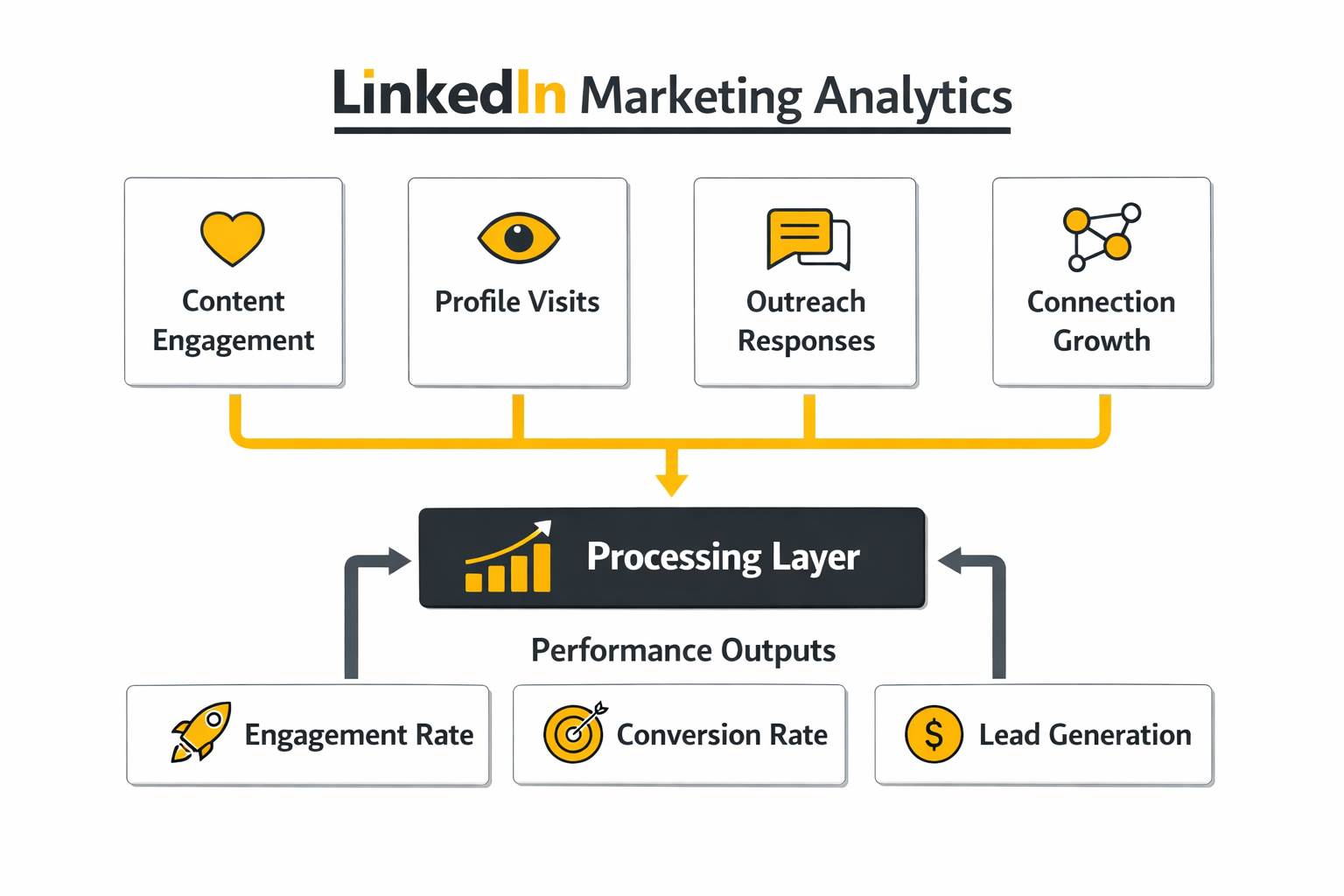
A practical system looks like this:
- Weekly content review Identify your top 3–5 posts based on meaningful signals, not just likes. Look at profile clicks, comments from relevant people, and inbound messages.
- Monthly pattern analysis Review which topics, formats, and angles consistently perform best. This is where you identify your real content strengths instead of guessing.
- Conversion tracking Monitor how many people move from LinkedIn into your funnel. This could be through booking links, email capture, or direct messages that turn into calls.
- Pipeline attribution Track how many deals include LinkedIn as a touchpoint. Even if it is not the final conversion channel, it often plays a major role in awareness and trust.
- Iteration loop Double down on what works, refine what shows promise, and eliminate what consistently underperforms. This is where most growth actually comes from.
Interpreting Data Without Overreacting
One of the biggest mistakes in LinkedIn marketing is reacting too quickly to individual posts. A single post can overperform or underperform for reasons that have nothing to do with your strategy. Timing, competition, and distribution all play a role.
What matters is the trend. If a content type consistently drives profile views and inbound messages, that is a signal worth scaling. If another type consistently gets likes but no deeper engagement, that is a signal worth questioning.
This is where patience becomes a competitive advantage. Most people abandon strategies too early or chase trends too aggressively. The operators who win are the ones who let patterns emerge, then act decisively on those patterns.
Use Data to Sharpen Positioning, Not Just Content
The most valuable insight you can get from your LinkedIn analytics is not which post performed best. It is which message resonated most with the right audience.
If certain topics consistently attract decision-makers, that tells you something about your positioning. If certain offers convert better, that tells you something about your market demand. If certain formats drive more meaningful engagement, that tells you how your audience prefers to learn.
This is why measurement is not the final step. It feeds back into everything else. Your positioning becomes sharper, your content becomes more focused, and your conversion paths become more effective.
At this point, you have a system that generates attention, builds trust, and gives you feedback on what is working. The next step is scaling that system through smarter distribution and conversion strategies without losing the quality that made it work in the first place.
Turning Attention Into Leads With Paid Distribution and Capture
Organic reach is useful, but it is not a full LinkedIn marketing strategy once you know what message actually works. At some point, you need a way to push proven content in front of more of the right people, capture intent without unnecessary friction, and connect that activity to pipeline. That is where paid distribution starts to make sense. business.linkedin.com+2
The mistake is moving into paid too early. If your positioning is weak, your profile does not convert, or your content has not shown organic traction with the right audience, ads will usually amplify the problem instead of solving it. Strong LinkedIn marketing scales best when paid is used as a force multiplier for signals you already trust. business.linkedin.com+2
Start With Amplification, Not Cold Promotion
The smartest paid move is rarely “launch a big campaign from zero.” It is usually taking content, offers, or audience segments that already show signs of traction and giving them more distribution. That keeps the learning loop tighter and reduces the chance that you burn budget proving something the market already could have told you for free.
This matters even more on LinkedIn because the platform is built around professional relevance. If a post earns strong engagement from the right buyers organically, that is a meaningful signal. Once you see those signals, sponsored content, retargeting, and lead capture become much more strategic because you are scaling evidence, not hope. business.linkedin.com+2
Match the Offer to the Buyer’s Level of Intent
One of the biggest conversion mistakes in LinkedIn marketing is asking for too much too soon. A cold audience usually does not want a sales call. A warm audience may not need another awareness post. The offer has to match where the buyer is in the journey.
That creates a practical ladder. Cold audiences respond better to useful resources, strong insights, webinars, newsletters, and educational assets. Warmer audiences are more likely to engage with demos, consultations, assessments, and direct conversations. LinkedIn’s own lead generation guidance centers on reducing friction with pre-filled forms, while its newer Qualified Leads Optimization updates are explicitly pushing advertisers to optimize around lead quality rather than raw volume. business.linkedin.com+2
Use Lead Capture Systems That Reduce Friction
This is where conversion mechanics matter. If your LinkedIn marketing finally gets the right person interested and then sends them to a slow, confusing, badly matched destination, you lose momentum fast. The simpler the next step, the more value you preserve from the attention you earned.
For many campaigns, native lead forms work well because they remove typing friction and keep the user inside the platform. LinkedIn highlights Lead Gen Forms as a way to collect quality leads with pre-filled member data, and its lead generation resource points to real campaign outcomes like Bynder’s 20% conversion rate when the format fits the offer. If you want more control over qualification, routing, and follow-up logic, sending traffic into a focused flow built in ClickFunnels, Systeme.io, or a streamlined form stack like Fillout can be the better move. business.linkedin.com+2
The right choice depends on what happens after the click. Native forms usually win on ease. External funnels usually win when qualification, messaging sequence, upsell logic, or calendar routing matters more than pure submission volume.
Retargeting Is Where LinkedIn Starts Feeling Smarter
A lot of paid LinkedIn marketing becomes much more efficient once you stop treating every impression like a first impression. Retargeting lets you stay in front of people who already visited your site, engaged with your brand, or showed prior interest. That makes your message more relevant and usually makes your spend work harder.
This is exactly why the LinkedIn Insight Tag matters. LinkedIn describes it as the layer that enables conversion tracking, audience insights, and retargeting of website visitors, which turns the platform from a top-of-funnel channel into a measurable demand system. If you are serious about proving ROI, this is not optional. It is foundational. business.linkedin.com+2
Scale Carefully or You Will Dilute What Made It Work
This is where advanced LinkedIn marketing gets tricky. The content or offer that performs well at small scale can weaken once you broaden targeting, hand off execution to more people, or force higher posting volume. Growth creates pressure, and pressure often creates compromise.
There are a few common failure patterns:
- Expanding targeting before message-market fit is clear
- Publishing more often while lowering content quality
- Turning every strong post into an ad, even when it was built for engagement rather than conversion
- Optimizing only for cost per lead and ignoring lead quality
- Sending leads into a follow-up system that is too slow or too generic
LinkedIn’s own product direction is a pretty good warning sign here. The platform is investing in tools like Qualified Leads Optimization because too many advertisers learned the hard way that cheap leads and useful leads are not the same thing. Scaling only works when quality controls get stricter, not looser. business.linkedin.com+2
Protect Trust While You Push for Conversion
This matters more than people think. LinkedIn is still a trust-heavy environment. Buyers are evaluating not just your offer, but your judgment, your expertise, and your commercial maturity. If your content feels thoughtful but your conversion layer feels pushy, the disconnect is obvious.
That is why the best LinkedIn marketing keeps the tone consistent all the way through the funnel. Helpful content should lead to a helpful offer. A smart positioning angle should lead to a landing page or form that sounds like the same company, not a different one. When the experience is consistent, conversion gets easier because the buyer never feels tricked into the next step.
Email follow-up is part of that trust equation too. Once a lead comes in, speed matters, but relevance matters more. A clean nurture sequence in Brevo or Moosend helps you continue the conversation without dropping people into a generic autoresponder that feels disconnected from why they converted in the first place.
Advanced LinkedIn Marketing Is Really About Tradeoffs
At the expert level, this stops being a tactics problem and becomes a tradeoff problem. Do you want scale or precision? Lead volume or lead quality? Founder-led authority or brand-led consistency? Native conversion or external funnel control? Faster testing or tighter qualification?
There is no universal answer. But there is a useful principle: keep the path as simple as possible until the data forces you to add complexity. That usually means one clear audience, one strong offer, one primary conversion path, and one follow-up system before you start layering on more segments, assets, and automation.
This is also where support tools can help without replacing judgment. A lightweight CRM like Copper can keep relationship and pipeline visibility tight, while a meeting layer like Cal.com removes friction when direct conversations are the right next step. The stack matters, but only after the strategy is already coherent.
The Real Risk Is Looking Busy Instead of Getting Results
A lot of teams look sophisticated on LinkedIn while quietly producing weak business outcomes. They have content calendars, paid experiments, dashboards, newsletters, and polished pages, but the system is fragmented. Nothing compounds because nothing connects.
That is the final expert-level point. LinkedIn marketing works best when authority, distribution, capture, and follow-up operate as one system. Once that happens, every post can support the brand, every campaign can reinforce trust, and every conversion path can point toward revenue instead of just reporting activity.
The final part is where all of this comes together. We will close with the practical takeaways, the common questions that still trip people up, and the decisions that matter most if you want your LinkedIn marketing to produce real business results instead of just visible effort.
Making LinkedIn Marketing Work as One System
The final step is seeing LinkedIn marketing as an ecosystem instead of a list of disconnected tactics. Your profile is not separate from your content. Your content is not separate from your offer. Your offer is not separate from your follow-up. When those pieces finally line up, the platform starts compounding instead of draining your time.
That is the shift most people need. They keep asking which post format works best or whether they should run ads yet, when the better question is whether the whole system makes sense from first impression to final conversion. If the system is clear, even modest reach can produce strong business results.
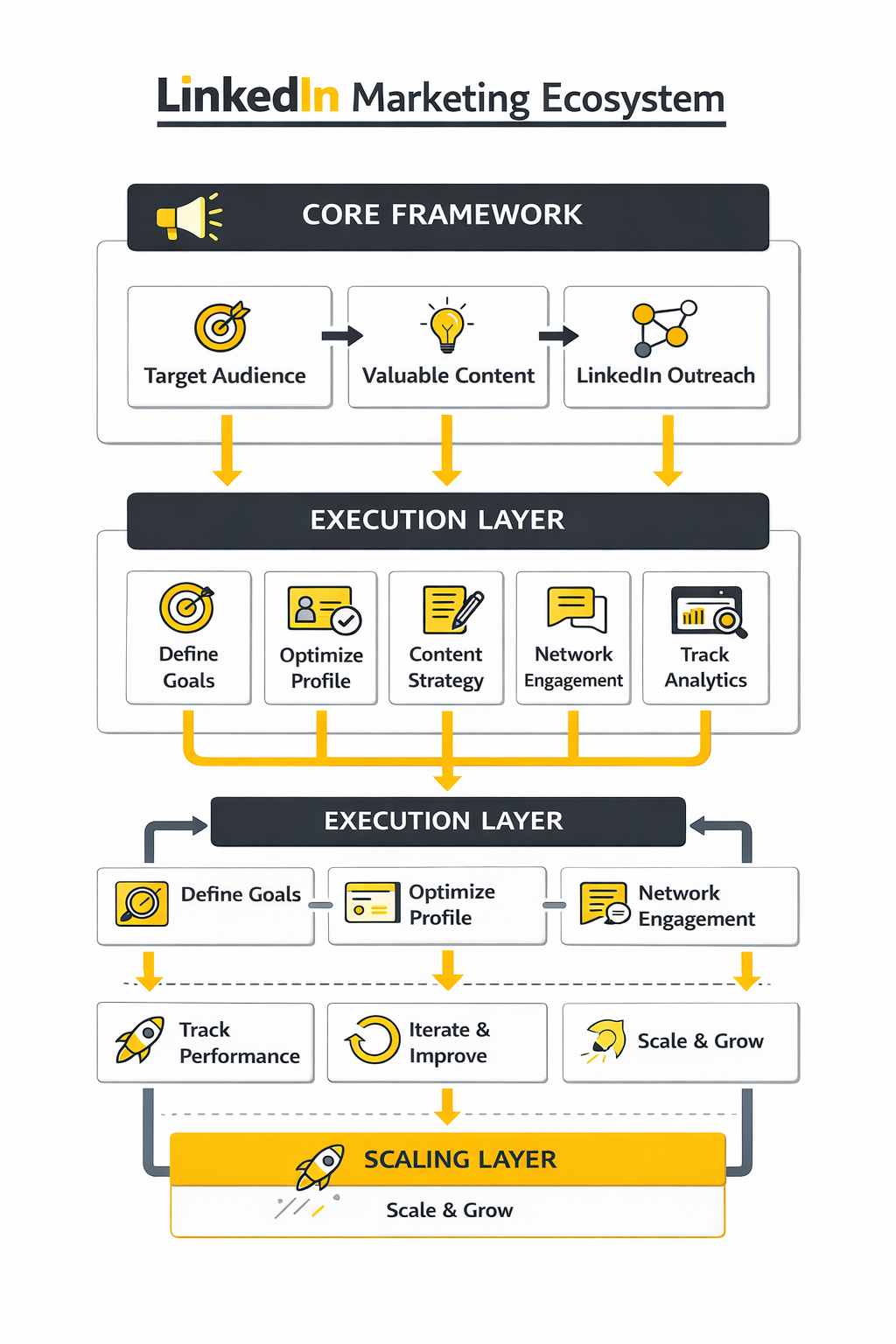
A working LinkedIn ecosystem usually has five moving parts:
- A clear position that tells the right audience why you matter
- A content engine that teaches, proves, and differentiates
- A conversion path that matches buyer intent
- A measurement loop that shows what is actually working
- A follow-up process that turns attention into pipeline
This is why advanced LinkedIn marketing often looks simpler from the outside than beginners expect. It is not about using every feature. It is about removing friction between stages so attention can move naturally toward trust, action, and revenue.
FAQ - Built for Complete Guide
Is LinkedIn marketing really worth it for small businesses?
Yes, especially if the business sells expertise, services, software, recruiting, consulting, or any offer that depends on trust. LinkedIn gives smaller brands access to professional targeting and buyer context that is hard to recreate elsewhere, which is why the platform continues to position itself around reaching decision-makers and professional audiences through LinkedIn Ads. For a small business, that does not automatically mean ads first. It usually means sharper positioning, stronger organic content, and a cleaner path from profile visit to conversation.
How often should I post on LinkedIn?
The right answer is often enough to stay relevant without lowering your standards. If you can publish two strong posts a week consistently, that usually beats posting every day with weak ideas. LinkedIn’s own publishing and newsletter guidance emphasizes consistency and topic clarity over random output, especially for recurring formats like LinkedIn newsletters and newsletter best practices.
Should I focus on a personal profile or a company page?
For most expert-led businesses, the personal profile usually creates momentum faster. People evaluate people more quickly than they evaluate logos, especially in trust-heavy categories where expertise and judgment matter. The company page still matters as a credibility layer, but in practical LinkedIn marketing, the page often supports the story while the personal profile carries the first wave of reach and trust.
What type of content works best on LinkedIn right now?
The best content is still the content that feels specific, useful, and grounded in real experience. That can be text, carousel-style education, long-form articles, newsletters, or video, but the format is not the main point. LinkedIn has clearly been investing in both long-form publishing and video, with official resources around articles and newsletter ads and growing emphasis on video across its business content, so the winning move is to pick formats you can execute well and sustain consistently.
How long does LinkedIn marketing take to show results?
It depends on what you mean by results. Reach and engagement signals can show up quickly, but trust, pipeline, and deal creation usually take longer because buyers rarely convert from one touchpoint alone. In most serious LinkedIn marketing systems, the early wins are profile views, better conversations, and clearer audience response, while the bigger commercial results come after a few months of consistent execution and iteration.
Do I need paid ads to succeed on LinkedIn?
No, but paid distribution becomes powerful once your message already works organically. Running ads before you have strong positioning, solid content, and a clean offer usually just makes expensive problems more visible. The better sequence is organic proof first, then amplification, then conversion tracking and lead capture through tools like Lead Gen Forms or campaign assets built in Campaign Manager.
Are LinkedIn Lead Gen Forms actually effective?
They can be, especially when speed and low friction matter. LinkedIn’s own help documentation explains that Lead Gen Forms are pre-filled with member profile information, which reduces effort for the user and can improve form completion when the offer is strong and the form is kept tight through choices like using only a few fields in Lead Gen Forms best practices. They are not automatically better than external landing pages, though. If qualification, multi-step education, or custom routing matters more, an external funnel can still be the smarter move.
Is LinkedIn newsletter publishing worth doing?
Yes, if you have a clear topic and something useful to say on a recurring basis. LinkedIn supports newsletters for both profiles and pages, and its help documentation notes that you can create recurring editions while building a subscription-based audience through LinkedIn newsletters and LinkedIn Page newsletters. The practical advantage is simple: newsletters create a repeatable habit with your audience instead of forcing every post to start from zero.
What metrics should I care about most?
Start with signals that show intent, not just attention. Impressions and likes can help with context, but profile views, qualified comments, inbound messages, link clicks, lead submissions, and pipeline influence are more useful if you actually want business outcomes. Once you start using LinkedIn marketing this way, analytics stop being a scoreboard and start becoming a decision system.
How do I know if my LinkedIn content is attracting the wrong audience?
The signs are usually pretty obvious once you stop focusing only on engagement totals. If your content gets attention but generates weak profile visits, irrelevant comments, low-quality DMs, or no movement toward your offer, the audience-message fit is probably off. That does not always mean the content is bad. It often means the positioning is too broad, the topic is misaligned, or the content is optimized for applause instead of relevance.
Can AI help with LinkedIn marketing without making everything sound robotic?
Yes, but only if AI stays in a support role. It can help you brainstorm angles, organize rough ideas, repurpose strong material, and speed up production, but the strategy, judgment, and real insight still need to come from you. That matters even more now because LinkedIn’s own B2B benchmark research shows weekly AI use is widespread among marketers, which means generic output is becoming easier to spot and easier to ignore through the 2025 B2B benchmark report.
What is the biggest mistake people make with LinkedIn marketing?
They confuse activity with progress. They post without a clear position, collect engagement without a conversion path, or launch ads without knowing what message already resonates. The fix is not more tactics. The fix is building a connected system where each part of your LinkedIn marketing supports the next part.
What should I do first if I want better results quickly?
Start by tightening the basics. Rewrite your headline so it says something meaningful, clean up your profile so it supports your offer, define two or three content pillars, and make one clear next step visible in your featured section or landing flow. That is not flashy, but it is usually the fastest route to turning LinkedIn marketing from random effort into something commercially useful.
Work With Professionals
Explore 10K+ Remote Marketing Contracts on MarkeWork.com
Most marketers spend too much time chasing clients, competing on crowded platforms, and losing a percentage of every project to middlemen. MarkeWork gives you a better way. Browse thousands of remote marketing contracts and connect directly with companies desperate to hire skilled marketers like you, without platform commissions and without unnecessary gatekeepers.
If you're serious about finding better opportunities and keeping 100% of what you earn, explore available contracts and create a profile for free at MarkeWork.com.