

LinkedIn Marketing Solutions sits in a very different category from most paid social platforms. It is built for reaching professional audiences with context that already feels business-related, which changes the quality of attention you can buy. When a platform gives you access to 1 billion+ business professionals across more than 200 countries and territories, the conversation is no longer just about reach. It becomes a question of whether you can turn that reach into relevance, trust, pipeline, and eventually revenue.
That is why serious B2B teams keep coming back to LinkedIn Marketing Solutions even when the cost per click looks high at first glance. LinkedIn says its network includes 180 million senior-level influencers, 63 million decision-makers, and 10 million C-level executives, while Microsoft reported 11% LinkedIn revenue growth in fiscal Q2 2026 and highlighted 30% growth in paid video ads. Those numbers matter because they point to two things at once: buyer concentration and continuing advertiser demand.
The bigger opportunity, though, is strategic. LinkedIn’s own B2B research argues that 95% of potential buyers are not in-market right now, while the latest Edelman-LinkedIn study says more than 40% of B2B deals stall because of misalignment in buying groups. So the real job of LinkedIn Marketing Solutions is not simply to collect leads. It is to build mental availability with future buyers, stay visible with hidden buyers, and capture demand when timing finally shifts.
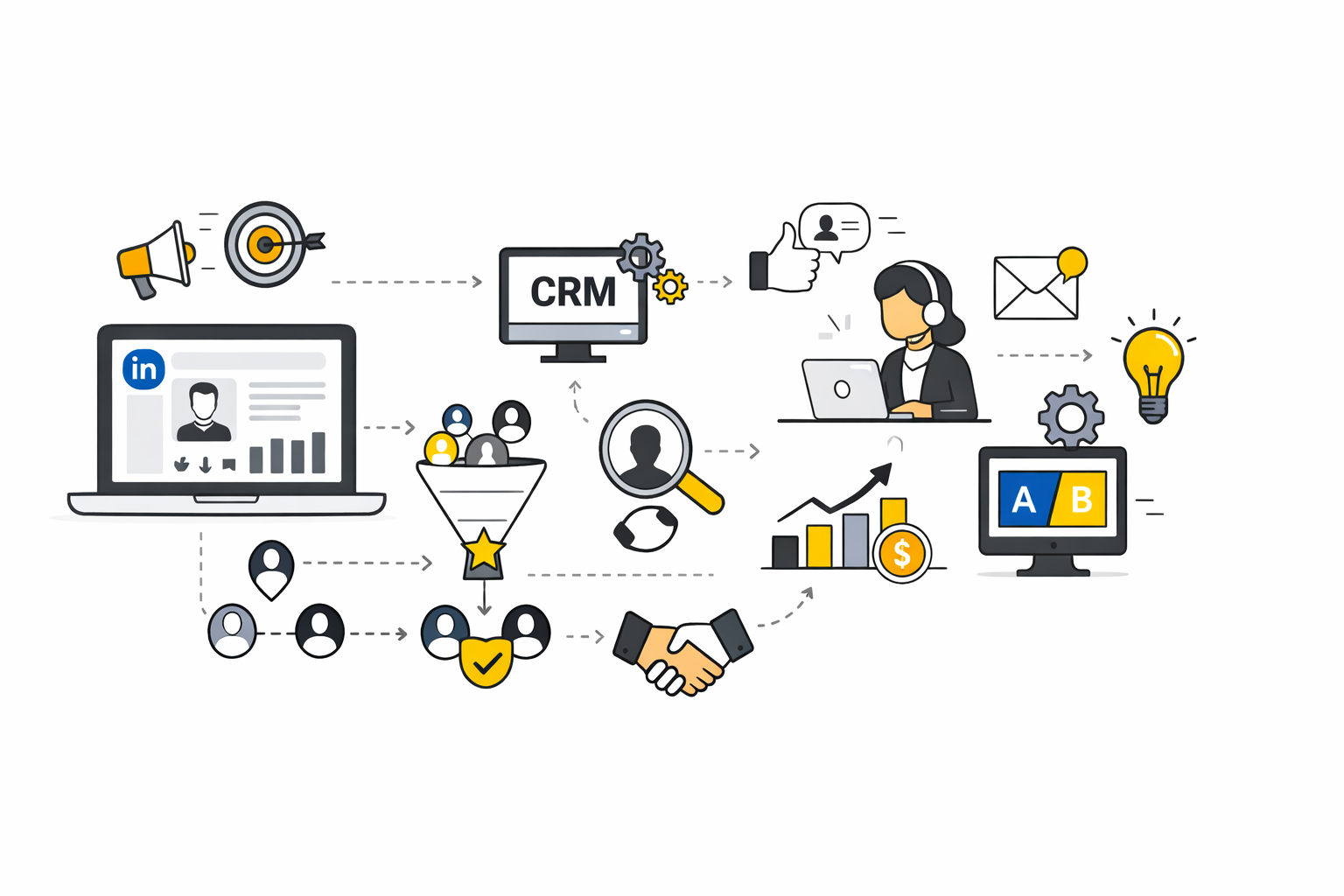
Article Outline
- Why LinkedIn Marketing Solutions Matters
- The LinkedIn Marketing Solutions Framework
- Core Channels and Ad Formats
- Targeting and Audience Design
- Measurement, Lead Quality, and Revenue Signals
- Professional Implementation, Optimization Mistakes, and FAQ
Why LinkedIn Marketing Solutions Matters
LinkedIn Marketing Solutions matters because it gives marketers access to professional identity data that most other ad platforms simply do not have in the same form. You are not guessing as much about whether someone works in operations, owns budget, influences software selection, or sits inside a target account. You can build campaigns around job function, seniority, company, industry, skills, interests, and matched data, which makes the platform especially strong for B2B demand generation and account-based marketing.
That precision changes the economics of attention. LinkedIn positions Campaign Manager around awareness, consideration, and conversion objectives, and that framing is more important than it sounds. Too many teams come in treating LinkedIn like a fast lead machine, then get frustrated when narrow conversion campaigns underperform because the market is still cold. The platform works best when you respect the full buying journey instead of trying to force bottom-of-funnel results from audiences that barely know you.
There is also a quality argument here that often gets overlooked. LinkedIn states that its ad platform supports brand awareness, engagement, lead generation, and conversions, and its own materials point to stronger brand lift and conversion outcomes when companies combine brand and acquisition messaging rather than isolating one from the other. That lines up with the broader B2B reality: long sales cycles, multiple stakeholders, and a lot of buying activity happening before a form fill ever appears in your CRM.
For marketers who only look at front-end metrics, LinkedIn can feel expensive. For marketers who care about deal size, sales acceptance, account penetration, and pipeline quality, the platform often makes more sense. LinkedIn Lead Gen Forms, for example, are designed to use pre-filled professional profile data, which is a practical advantage when your real goal is getting cleaner business information and lowering friction for the right person to respond.
The LinkedIn Marketing Solutions Framework
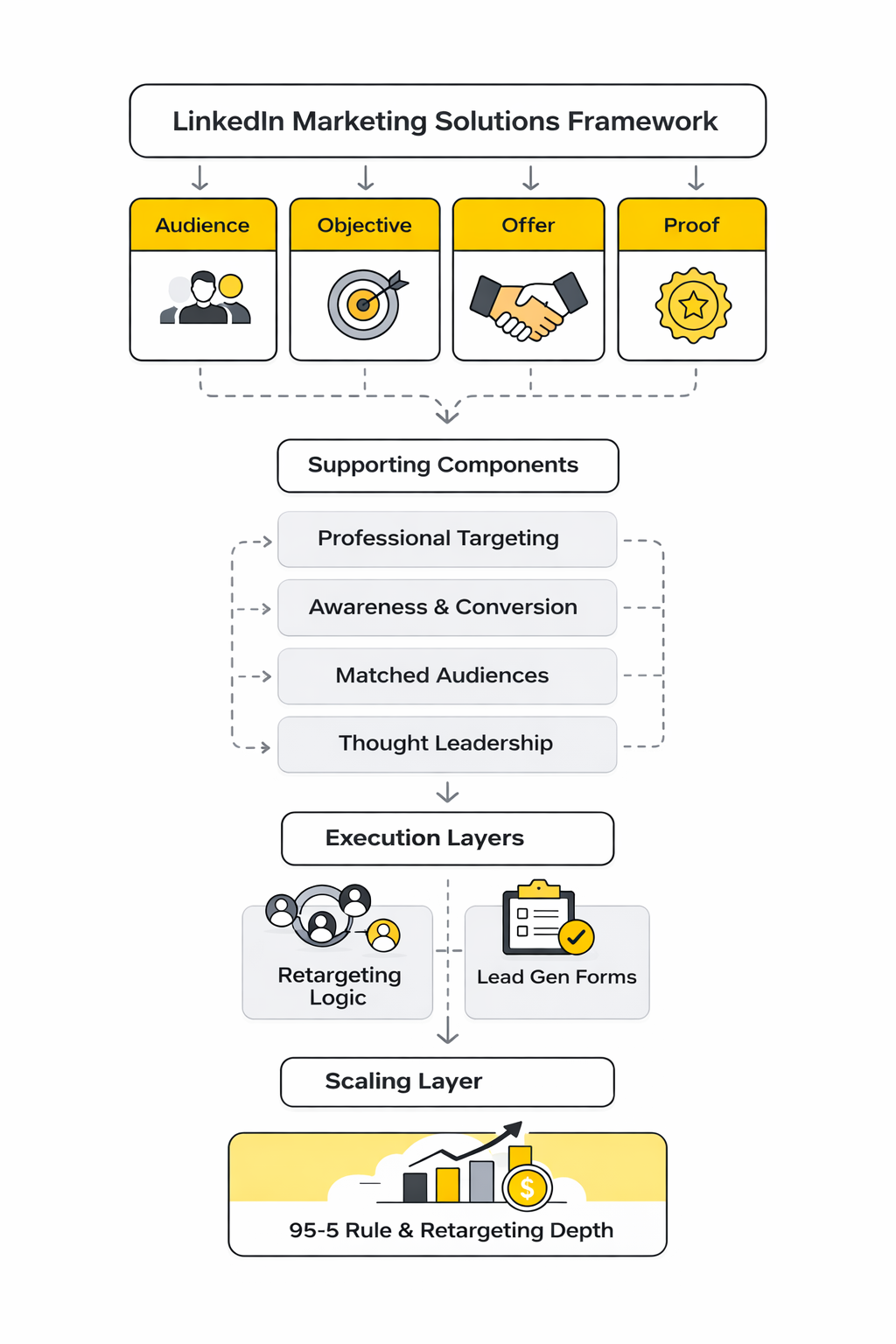
The easiest way to think about LinkedIn Marketing Solutions is as a four-part system: audience, objective, offer, and proof. Audience comes first because LinkedIn’s main advantage is who you can reach and how precisely you can shape that reach. Objective comes second because the platform itself is structured around awareness, consideration, and conversion, and your campaign setup should reflect the buying temperature of the people you are targeting.
Offer is where many campaigns either become compelling or completely forgettable. A LinkedIn user is still a person scrolling through a busy feed, not a spreadsheet waiting to be optimized. That means your message has to match intent. If the audience is cold, the offer may need to be a useful insight, a strong point of view, or a problem-framing asset. If the audience is warm, the offer can move closer to product education, demos, event registration, or direct response.
Proof is what makes the whole system hold together. On LinkedIn, proof can show up as customer evidence, category authority, executive point of view, research-backed thought leadership, or a frictionless capture experience like Matched Audiences plus retargeting and Lead Gen Forms. This is where LinkedIn Marketing Solutions becomes more than an ad dashboard. It becomes a professional influence engine that helps your brand stay credible across the long, messy middle of B2B buying.
A practical framework also forces discipline around timing. The 95-5 rule is useful here because it reminds you that most of the market is not ready to buy today. That does not mean your campaigns are failing. It means your brand-building, education, retargeting, and conversion motions need to work together instead of competing for budget in isolation.
By the end of this framework, the right question is no longer whether LinkedIn Marketing Solutions works. The better question is what role it should play in your growth model. For some companies, it is the best channel for reaching buying committees inside defined accounts. For others, it is the cleanest place to combine thought leadership, paid distribution, and conversion infrastructure without losing the professional context that makes the message believable.
Core Channels and Ad Formats
Once the strategy is clear, the next question is execution. LinkedIn Marketing Solutions gives you several ways to show up, but they do not all do the same job. The mistake is treating every format like a lead ad when some of them are far better at earning attention, creating recall, or moving a skeptical buyer one step closer to action.
Sponsored Content is still the center of gravity because it blends into the feed while giving you enough room to teach, frame, or persuade. LinkedIn’s own ads guide positions single image, video, carousel, document, and lead gen experiences as distinct tools tied to different objectives, which is exactly how they should be used. If you are trying to build familiarity in a market that barely knows you, a thoughtful feed experience usually does more than a hard sell.
Video has become more important than many B2B teams expected. Microsoft highlighted 30% growth in paid video ads on LinkedIn, which is a strong signal that advertisers are putting more budget behind motion-based creative. That does not mean every campaign needs polished brand film. It means the market is rewarding formats that communicate faster, create more presence, and let complex ideas land without asking the audience to work too hard.
Document Ads deserve more attention than they usually get. LinkedIn says Document Ads can be used for awareness, engagement, and lead generation, which makes them one of the more flexible formats on the platform. They are especially useful when your real edge comes from insight, not entertainment, because they let you distribute a strong point of view without forcing the audience to leave the feed too early.
Lead Gen Forms are one of the clearest examples of LinkedIn Marketing Solutions being built for business use cases rather than general social media behavior. LinkedIn explains that Lead Gen Forms use pre-filled professional profile data, which reduces friction at the exact moment when a prospect might otherwise drop off. That matters most when the offer is already relevant and the audience is warm enough to respond, not when the creative is trying to compensate for weak positioning.
Thought Leader Ads have become a meaningful lever because they close the distance between company marketing and human credibility. LinkedIn’s official material says Thought Leader Ads let brands sponsor posts from employees or other members with permission, and the practical value is obvious. In B2B, buyers often trust people before they trust pages, so promoting the right expert voice can outperform polished brand copy that feels anonymous.
Message-based formats can still work, but they require restraint. The professional context of LinkedIn makes inbox attention feel valuable, which is exactly why clumsy promotional messaging can backfire fast. This is one of those areas where discipline matters more than volume. If the offer is weak, the channel becomes intrusive. If the offer is highly relevant and the targeting is tight, the format can create focused response from a narrow audience that actually cares.
The best media plans rarely rely on one format alone. Strong LinkedIn Marketing Solutions execution usually looks more like a sequence than a single ad. A buyer sees a strong video or founder post first, then a document that sharpens the problem, then a retargeted lead or demo offer when interest is real. That sequence respects how B2B attention actually develops.
Targeting and Audience Design
Targeting is where LinkedIn Marketing Solutions stops being generic paid media and starts becoming strategically dangerous in a good way. Most platforms can help you find broad interest clusters. LinkedIn gives you access to professional identity signals that let you shape campaigns around business reality, not vague consumer intent.
LinkedIn’s targeting options include professional attributes such as job title, job function, seniority, company, company size, industry, member interests, and skills, all documented in its targeting overview. That range matters because buying decisions in B2B are rarely made by one perfectly labeled person. They come from groups of influencers, users, budget owners, blockers, and executives, which means the audience design has to reflect committee dynamics rather than a fantasy version of the buyer.
This is also where marketers get into trouble by narrowing too early. It is tempting to stack titles, industries, seniority bands, geographies, company sizes, and extra filters until the audience looks surgically precise. In practice, that can kill delivery, raise costs, and make learning painfully slow. Better audience design usually starts with one strong control variable, then adds only the filters that genuinely improve relevance.
Matched Audiences are one of the most powerful pieces of the whole system. LinkedIn’s documentation and Microsoft Learn materials explain that Matched Audiences include uploaded company lists, contact lists, and retargeting workflows, and LinkedIn help pages show how company and contact targeting lists are uploaded in Campaign Manager. This is where account-based marketing becomes practical instead of theoretical, because you can align paid distribution with the exact accounts your sales team already cares about.
Company list targeting is especially valuable when your market is small and expensive. LinkedIn’s help documentation says company lists are part of Matched Audiences and are used to target priority companies, organizations, and schools. That means you can stop paying for random professional traffic and start concentrating impressions on accounts that actually belong in your pipeline plan.
Retargeting adds the second layer of intelligence. LinkedIn’s own best-practice material for Matched Audiences highlights website retargeting, contact targeting, and company targeting as core options, which is exactly how most serious programs should think about the platform. Cold targeting gets you into the conversation. Retargeting helps you stay there once intent starts to surface.
The smartest audience structures usually separate three groups. First, cold but strategically relevant audiences built from professional criteria. Second, named-account audiences built from company lists and CRM logic. Third, engaged audiences built from site visits, ad engagement, or form interactions. That structure gives LinkedIn Marketing Solutions room to support both scale and precision without forcing one campaign to do everything.
There is also a timing advantage here that is easy to miss. When most of your market is not actively shopping, audience design is not just about who can convert now. It is about who should remember you later. That is why broader, role-based audiences often belong in awareness and consideration campaigns, while matched and retargeted audiences belong closer to lead capture, sales activation, and revenue-focused follow-up.
Audience design becomes far more useful when sales and marketing stop operating from different account maps. If your paid team is targeting one version of the market while your outbound and AE teams pursue another, LinkedIn performance will always look weaker than it should. The platform works best when campaign structure reflects actual go-to-market priorities, not just whatever is easiest to set up in Campaign Manager.
Measurement, Lead Quality, and Revenue Signals
This is where a lot of LinkedIn Marketing Solutions programs either become serious or stay stuck in vanity-land. Impressions, clicks, and CTR can tell you whether the creative is getting attention, but they do not tell you whether the platform is helping the business win. If you want to judge LinkedIn properly, you need to connect campaign activity to qualified leads, sales acceptance, pipeline creation, and closed revenue.
LinkedIn has made that process more practical by expanding its measurement stack beyond basic pixel tracking. Its conversion tracking resources now push advertisers toward cleaner setup across online and offline actions, and Microsoft’s latest LinkedIn marketing documentation says the Conversions API can improve attribution reliability and help decrease cost per action by sending more complete data directly from your server. That matters because B2B buying journeys rarely stay on one device, one session, or one neat digital path.
Lead quality matters more than raw lead count, especially on a platform where the traffic is expensive enough to punish lazy measurement. LinkedIn’s own lead gen guidance emphasizes pre-filled professional data in Lead Gen Forms, and its form specs recommend keeping forms to three to four fields as a best practice. That combination tells you something important. LinkedIn is not just trying to make forms easier to submit. It is trying to make the captured data more usable for actual business follow-up.
That said, more leads does not automatically mean better outcomes. If your campaign is producing contacts outside your ICP, junior people with no buying influence, or accounts your sales team would never pursue, the dashboard can still look healthy while the business gets nothing useful. The point of LinkedIn Marketing Solutions is not to collect names. It is to create commercially relevant movement inside the market you actually want.
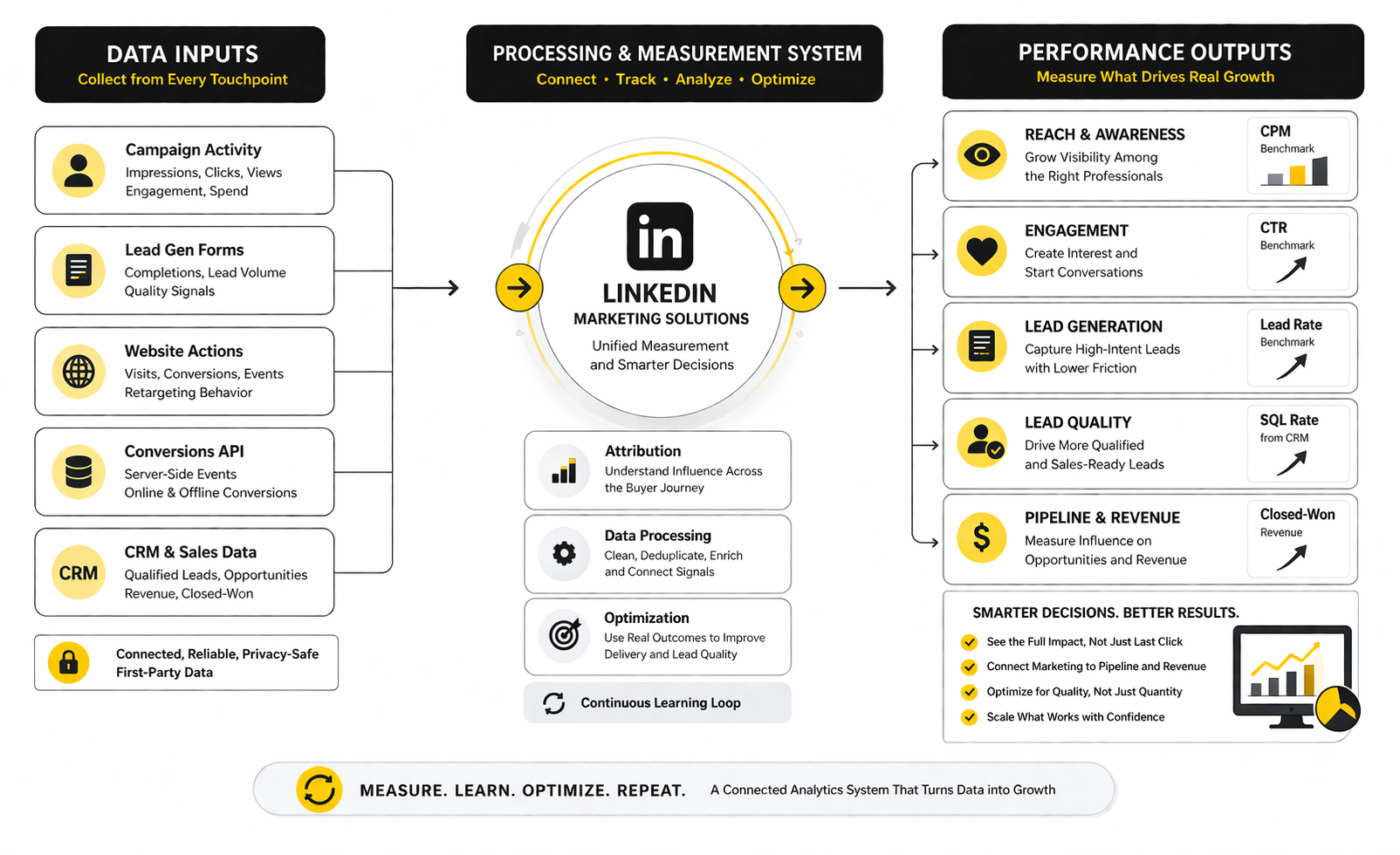
A better reporting model usually starts with four layers. The first layer is media efficiency: CPM, CPC, CTR, view rate, and form completion rate. The second is lead quality: target account match, target role match, work email rate, and sales acceptance. The third is pipeline signal: meetings booked, opportunity creation, opportunity value, and influenced accounts. The fourth is revenue signal: closed-won deals, win rate, deal size, and sales cycle movement. Once you see all four layers together, LinkedIn performance gets much easier to judge honestly.
The platform becomes especially useful when you stop asking it to prove itself only through last-click attribution. LinkedIn’s own Conversions API help documentation explains that online and offline data can be connected to show how campaigns influenced website actions, phone sales, or event-generated leads. For B2B teams, that is a big deal. Buyers often consume content, ignore the first offer, come back later through another channel, talk to sales offline, and then convert under a completely different source label. If your reporting cannot see that, it will undervalue LinkedIn almost by definition.
How to Build a Measurement System That Actually Helps
The cleanest way to implement LinkedIn Marketing Solutions is to treat measurement as part of campaign design, not as an afterthought you patch in later. Before you launch anything, define the exact business actions that matter most. That might be a booked demo, a qualified consultation, a sales-accepted lead, or a product trial started by the right company type. If that part is fuzzy, everything downstream gets noisy.
From there, set up conversions in Campaign Manager with intent. LinkedIn’s latest help documentation says conversions can now be created from website actions, Conversions API sources, and offline activity. That gives you room to track more than thank-you-page events. You can align the account with how your business actually closes deals rather than forcing every success signal through a shallow web-only lens.
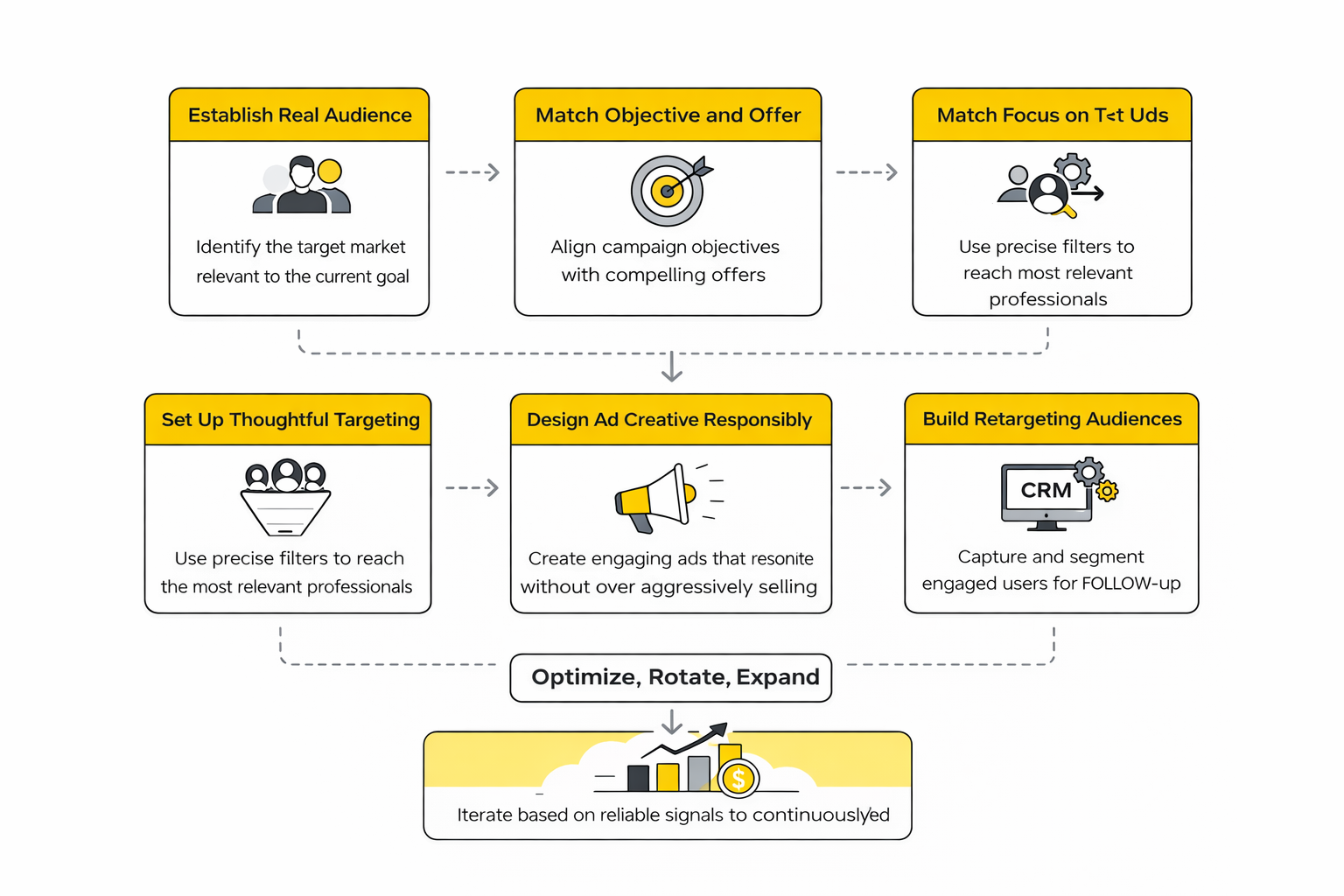
A practical execution process usually looks like this:
- Define one primary business outcome for each campaign group.
- Map that outcome to a LinkedIn objective that matches buying temperature.
- Install or validate Insight Tag tracking where it still makes sense.
- Add server-side measurement through Conversions API for stronger attribution and optimization.
- Create audience segments that separate cold reach, named accounts, and engaged retargeting pools.
- Match the offer to the audience stage instead of pushing the same CTA everywhere.
- Send lead data into the CRM fast enough for real follow-up.
- Report on quality and pipeline, not just platform metrics.
That process sounds obvious, but it is where most execution gaps show up. Teams often launch campaigns before conversions are defined clearly, before CRM routing is tested, or before sales agrees on what counts as a worthwhile lead. Then the platform gets blamed for a process problem that was there from the start.
The follow-up layer is just as important as the ad itself. LinkedIn can deliver qualified interest, but it cannot rescue slow response times, weak SDR outreach, or landing pages that break trust. This is exactly why many companies pair LinkedIn campaigns with stronger routing, automation, and nurture systems in tools like GoHighLevel, Brevo, or Fillout when they need cleaner intake, qualification, and handoff. The ad platform gets the click. The system after the click determines whether that attention turns into revenue.
There is also a creative measurement lesson here. Do not only measure whether someone converted immediately. Measure whether certain messages improve downstream quality. A thought-leadership asset might generate fewer front-end leads than a direct-response offer, but if those leads produce more target-account opportunities or larger deal value, that creative is doing more business work than the cheaper-looking option.
This is where LinkedIn Marketing Solutions becomes powerful for mature teams. You stop optimizing for whatever is easiest to count and start optimizing for what the business actually values. That shift sounds small. It is not. It changes the audience structure, the creative mix, the offers you use, and the patience you bring to the channel.
The Numbers That Matter
Once your LinkedIn Marketing Solutions setup is live, the next challenge is interpretation. This is where marketers often get fooled by surface metrics, because a dashboard can look active without proving the campaign is commercially strong. The useful question is never just “what happened in-platform?” It is “what do these signals tell us about audience fit, creative strength, buying intent, and likely revenue impact?”
A few current benchmarks give you a starting point, not a verdict. AgencyAnalytics’ 2025 benchmark analysis puts median LinkedIn Ads CTR at 0.52% across industries, with finance and insurance slightly higher at 0.56%, based on a large cross-account dataset. That matters because LinkedIn is not built to produce consumer-social click volume. It is built to produce more selective clicks from a more commercially specific audience, so a lower CTR is not automatically bad if downstream quality is stronger.
The same caution applies to conversion rates. Platform-level conversion benchmarks can help you sanity-check performance, but they are weak if detached from audience quality and sales outcome. On LinkedIn, one cheap conversion from the wrong company can be less valuable than a far more expensive form fill from the right buying committee. That is exactly why LinkedIn and Microsoft have been pushing harder into server-side and qualified-lead measurement rather than relying on shallow front-end success signals alone.
How to Read LinkedIn Benchmarks Without Misleading Yourself
Benchmarks are useful when they help you diagnose direction. They become dangerous when they turn into universal pass-fail thresholds. A CTR below a published median can mean weak creative, but it can also mean you are targeting a more senior audience, a narrower account list, or a harder category where attention is naturally more selective.
Start with CTR as a relevance check, not as the final score. If CTR is weak and impressions are healthy, your message likely is not landing with the audience you chose. If CTR is solid but conversions are weak, the problem is usually further down the chain: the offer is not compelling enough, the form creates friction, or the landing experience breaks momentum. This is a much better use of the metric than obsessing over whether you cleared some generic industry average.
CPC should be read the same way. High CPC on LinkedIn is normal relative to broader social platforms, so the useful question is whether that cost is buying meaningful access to the right people. When LinkedIn gives you ways to reach decision-makers, named accounts, and role-specific audiences, the cost of a click only makes sense when judged against deal quality, not traffic volume.
Form completion and lead rate deserve context too. If a campaign is driving a respectable click rate but poor form completion, that usually signals a mismatch between the ad promise and the conversion experience. LinkedIn’s own lead gen specs recommend keeping forms lean, often around three to four fields, because friction compounds quickly once a user decides to act. The action here is simple: tighten the ask, remove unnecessary fields, and make sure the offer feels worth the interruption.
The Analytics System You Actually Need
A useful analytics system for LinkedIn Marketing Solutions has to separate media performance from business performance. Media performance tells you whether the campaign is moving. Business performance tells you whether it matters. If those two layers are not connected, optimization becomes guesswork.
The cleanest reporting model has four levels. First, delivery metrics such as impressions, frequency, CPM, view rate, and spend. Second, engagement metrics such as CTR, CPC, landing page view rate, and form completion. Third, quality metrics such as target-role match, target-account match, qualified lead rate, and sales acceptance. Fourth, revenue metrics such as opportunity creation, influenced pipeline, win rate, and closed-won value. That stack gives you a chain of evidence instead of a pile of disconnected numbers.
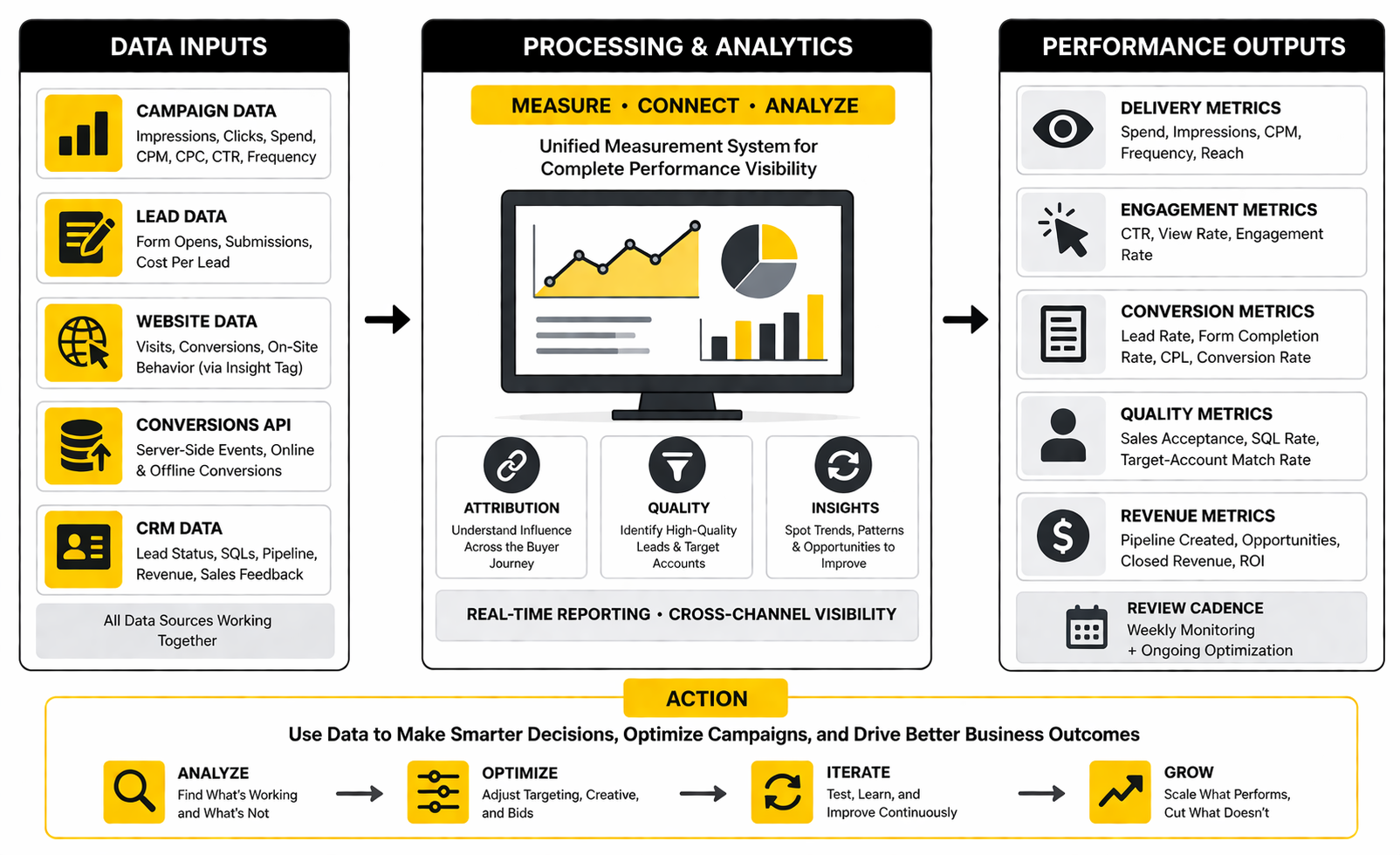
This layered view is exactly why the current LinkedIn measurement stack matters. Microsoft’s March 2026 Conversions API documentation says the system is designed to measure campaign performance “no matter where the conversion happens” and can improve reliability while helping reduce cost per action through more complete attribution. That is not a technical footnote. It changes how confidently you can evaluate campaigns that influence offline sales, CRM-qualified leads, or longer B2B journeys that would otherwise disappear from the platform view.
LinkedIn’s newer optimization direction points the same way. In the 202602 marketing API changes, LinkedIn introduced MAX_QUALIFIED_LEAD for lead generation campaigns, allowing optimization toward higher-quality lead outcomes using Conversions API or CRM data. That tells you what the platform itself is signaling: not all leads are equal, and better data lets the system optimize toward what your business actually wants more of.
What Specific Signals Should Trigger Action
If reach is strong but CTR is weak, the action is usually creative or message correction. The audience is seeing you, but the pitch is not earning the next click. Rewrite the hook, sharpen the problem framing, test a different format, or move from generic brand language to something more concrete and useful.
If CTR is healthy but conversion rate is poor, the problem is often offer friction or landing-page disconnect. This is where many teams waste time blaming targeting even though the audience already proved it was interested enough to click. The right move is to review the post-click experience, simplify the ask, and decide whether a native lead form would outperform a slower external page.
If conversion volume is acceptable but sales quality is poor, the issue is usually audience design or optimization input. You are getting action, but not the right kind. That is where matched audiences, tighter ICP definition, CRM feedback loops, and qualified-lead optimization start to matter much more than minor bid tweaks.
If platform performance looks expensive but opportunity creation is strong, resist the urge to “fix” the campaign into mediocrity. LinkedIn often looks worse than other channels in front-end efficiency and better in downstream business quality. That is not a contradiction. It is the whole reason many B2B teams keep investing in the platform even when the media costs make newcomers nervous.
What the Broader Data Is Really Saying
The broader signal from current LinkedIn data is not just that the platform is large. It is that advertiser demand and product development are still moving toward richer B2B execution. Microsoft highlighted low-double-digit LinkedIn revenue expectations and 30% growth in paid video ads in January 2026, which suggests brands are still increasing spend where they see strategic value. That kind of growth does not prove every advertiser is winning, but it does show the market still sees LinkedIn as a serious channel for professional demand generation.
The product side points in the same direction. Microsoft Learn’s current LinkedIn Marketing API documentation emphasizes reporting, conversions, direct data connection, and scalable ad management. That matters because mature channels tend to deepen around measurement and optimization once advertisers move beyond simple traffic buying. LinkedIn Marketing Solutions is clearly in that phase now.
So the practical takeaway is simple. Use benchmarks to orient yourself, not to flatten strategy. Watch CTR, CPC, conversion rate, and form performance for early signals. But make decisions based on qualified leads, pipeline movement, and revenue outcomes whenever possible. That is how the numbers stop being interesting trivia and start becoming operating guidance.
Professional Implementation and Scaling
The next level of LinkedIn Marketing Solutions is not about launching more campaigns. It is about building a system that can scale without getting sloppier as spend rises. That sounds obvious, but it is exactly where many teams break things. They get early traction with one audience, one offer, or one format, then they try to scale by copying the same setup everywhere and performance starts slipping.
This is where strategic tradeoffs become real. The same platform that gives you high-quality professional targeting can also become expensive fast when you over-segment, over-optimize for weak signals, or push sales-heavy creative into audiences that are still cold. LinkedIn works well when you respect how B2B buying actually happens. It gets frustrating when you expect it to behave like a cheap consumer acquisition channel.
A more mature operating model starts with accepting that LinkedIn Marketing Solutions is often best used as a layered influence channel rather than a one-step conversion machine. The 95-5 rule is still one of the clearest explanations for why that matters. Most of your category buyers are not ready to buy right now, so scaling usually comes from widening qualified reach, improving message recall, and building retargeting depth, not from squeezing harder on the same bottom-funnel audience.
The Biggest Tradeoff: Precision Versus Scale
At small budgets, marketers love precision because it feels efficient. You can target specific functions, seniority bands, industries, and account lists, then tell yourself every impression is highly intentional. The problem is that ultra-precise audience design can also limit learning, inflate delivery costs, and trap your campaign inside a tiny slice of the market.
That does not mean broad targeting is automatically better. It means scale on LinkedIn usually comes from structured breadth, not from random expansion. You want enough reach to learn, enough relevance to stay credible, and enough separation between cold, warm, and account-based audiences that your reporting still means something. If you collapse all that into one campaign, the platform may still spend your budget, but you will not learn much from the result.
A smart scaling move is often to broaden one variable at a time. Expand geography, or seniority, or adjacent job functions, or supporting company segments, but do not loosen everything at once. That keeps the learning interpretable. It also helps you avoid the common mistake of thinking “more spend” and “more market fit” are the same thing. They are not.
Why Retargeting Depth Matters More as You Grow
As spend increases, retargeting stops being optional and becomes structural. LinkedIn’s own help documentation shows how advertisers can build retargeting audiences from single image engagement, document interactions, video view thresholds from 25% to 97%, and Lead Gen Form opens or submissions over windows ranging from 30 to 365 days. That matters because scaling a B2B program without a warm follow-up layer usually means paying cold-market prices over and over again. (linkedin.com)
Retargeting is not just about lower acquisition cost. It is about sequencing. A prospect who watched most of a video, engaged with a document, or opened a lead form is telling you something useful about interest level. LinkedIn Marketing Solutions becomes much stronger when those signals shape the next message rather than disappearing into a generic audience pool.
This is also why content variety matters. LinkedIn’s O’Reilly case study describes rotating a high-value content asset with other creatives across markets to prevent ad fatigue and learn which messaging resonates best. That is a practical reminder that scale is not only a budget problem. It is a creative refresh problem too. If your audience keeps seeing the same angle, performance deterioration is not mysterious. It is predictable. (business.linkedin.com)
The Advanced Measurement Shift: Optimize for Better Leads, Not More Leads
One of the most important recent changes in LinkedIn Marketing Solutions is the move toward qualified lead optimization. Microsoft’s 2026 LinkedIn Marketing API changes introduced MAX_QUALIFIED_LEAD for lead generation campaigns, and LinkedIn’s help documentation says qualified lead optimization can use data from Conversions API or CRM Sync to improve toward higher-quality outcomes. That is a serious upgrade in how sophisticated teams can use the platform. (learn.microsoft.com) (linkedin.com)
The practical implication is simple. If your sales team keeps rejecting leads that look good in Campaign Manager, then your optimization target is too shallow. A campaign can be technically successful and commercially weak at the same time. Qualified lead optimization is one of the clearest signals that LinkedIn itself understands this problem and is building the platform around better downstream feedback.
There is one important implementation risk here. LinkedIn’s help guidance says advertisers should not use both Conversions API qualified lead events and CRM Sync qualified lead events at the same time for optimization because duplication can hurt accuracy. That is exactly the sort of detail that separates an advanced setup from a messy one. More data is not automatically better if your feedback loop is noisy. (linkedin.com)
Thought Leadership Becomes a Scaling Asset, Not Just a Brand Extra
As LinkedIn gets more crowded, polished corporate messaging becomes less differentiated. That is one reason Thought Leader Ads matter more at scale than many teams assume. LinkedIn’s official guidance explains that brands can sponsor employee posts with permission through Campaign Manager, which creates a way to distribute expertise through human voices rather than only through brand pages. (business.linkedin.com)
This is not just a creative preference. It is a market-trust issue. Edelman and LinkedIn’s hidden buyer research has pushed more attention toward the people inside buying groups who are not always visible in standard demand capture, and LinkedIn’s own Hidden Buyer Gap research says hidden buyers vetoed around half the vendors on shortlists in its study. That means scaling LinkedIn Marketing Solutions is not only about reaching target buyers. It is also about building enough credibility that unseen stakeholders do not quietly kill the deal later. (business.linkedin.com) (edelman.com)
That is why thought leadership is not fluff when used properly. It can widen receptivity, reduce perceived risk, and make later direct-response offers perform better because the market has already seen useful thinking from the brand or its people. In practice, this often means combining brand-led ads, expert-led posts, and retargeted conversion offers rather than forcing one ad type to do every job.
The Real Risks Teams Underestimate
The first risk is over-optimizing early. A campaign that has only modest data does not need endless bid changes, audience edits, and creative swaps every few days. Constant intervention can make it harder to understand what is actually working. LinkedIn’s own conversion optimization help content leans toward improving setup quality and conversion signal integrity, which is a useful reminder that better inputs usually beat hyperactive tweaking. (linkedin.com)
The second risk is misalignment with sales. If marketing defines success as lead volume while sales defines success as pipeline potential, LinkedIn will look broken even when it is doing its job. This gets worse as spend scales because low-quality gains become more visible, more expensive, and harder to defend.
The third risk is creative fatigue hiding inside stable delivery. A campaign can keep spending and even keep producing acceptable CTR while the audience quality underneath starts slipping. That is why advanced teams rotate angles, not just assets. New headlines are helpful, but new arguments, new proof, and new ways of framing the problem usually matter more.
The fourth risk is treating LinkedIn as a closed system. It is not. The platform is strongest when it is connected to a serious post-click experience, fast lead routing, CRM feedback, and sales follow-up that matches the quality of the audience being reached. Many companies strengthen that layer with tools like GoHighLevel, Copper, or Brevo because better routing and nurture can make LinkedIn traffic materially more valuable. The ad is only one part of the system.
What Expert-Level LinkedIn Execution Usually Looks Like
At the advanced level, LinkedIn Marketing Solutions stops looking like a set of isolated campaigns and starts looking like a coordinated operating model. Cold audiences are used to build awareness and shape category perception. Retargeting pools are used to deepen consideration. Account lists are used to align paid media with sales priorities. CRM feedback is used to improve optimization quality. Creative rotation is used to protect performance as reach expands.
There is also usually more patience in the system. Not passive patience. Strategic patience. Mature teams know that some campaigns are there to generate immediate pipeline, while others are there to make the market easier to convert three months from now. They do not confuse those roles, and because of that, they tend to make better budget decisions.
That is the real difference between basic and advanced use of LinkedIn Marketing Solutions. Basic use asks whether the ads got clicks. Advanced use asks whether the platform is increasing the number of the right people who know you, trust you, engage with you, and eventually enter your revenue engine. That is a much harder standard. It is also the one that actually matters.
The final piece is understanding that LinkedIn Marketing Solutions does not live on its own. At the best-performing companies, it sits inside a wider growth system that includes CRM data, sales feedback, retargeting logic, creative iteration, and faster follow-up. That ecosystem view matters because LinkedIn rarely fails in isolation. More often, the weak point is the handoff after the click, the way lead quality is judged, or the lack of a real sequence between awareness, consideration, and conversion.
This is also where marketers stop thinking only in campaigns and start thinking in operating systems. LinkedIn’s current product direction keeps reinforcing that shift. Microsoft’s latest documentation highlights Conversions API, reporting, CRM-connected qualified lead workflows, and scalable campaign management as part of the modern LinkedIn stack, while LinkedIn’s own help center keeps expanding around Website Actions, retargeting, Insight Tag sharing, and measurement recommendations. The signal is pretty clear: the platform is moving toward more connected, more data-aware execution, not just more ads. (learn.microsoft.com) (linkedin.com)
If you want the channel to scale, treat it like infrastructure. That means your audience logic should connect to real ICP definitions. Your conversion setup should reflect outcomes the business actually values. Your content should warm up the market before you ask too much from it. And your sales team should be able to tell marketing, with evidence, which LinkedIn-sourced signals are turning into real commercial opportunities. That is how LinkedIn Marketing Solutions becomes a compounding asset instead of a recurring media expense.
FAQ
Is LinkedIn Marketing Solutions only useful for large B2B companies?
No. LinkedIn Marketing Solutions is often strongest for B2B companies, but it is not limited to enterprise brands with huge budgets. Smaller companies can still win when they target a narrow ICP, use stronger offers, and build around commercial relevance rather than trying to buy broad reach they cannot afford. LinkedIn’s own platform positioning is built around objectives like awareness, engagement, lead generation, and conversions, which means smaller advertisers can align spend to the specific stage they need most. (business.linkedin.com)
Why are LinkedIn ads usually more expensive than other social ads?
Because the audience is different and the data is different. LinkedIn gives you access to professional identity signals like company, seniority, function, and business role, which usually makes the inventory more valuable for B2B marketers. High CPC by itself does not mean poor performance. The real question is whether those clicks produce better-fit leads, stronger account penetration, or higher-value opportunities than cheaper traffic elsewhere. (learn.microsoft.com)
What is the best first campaign objective to choose?
It depends on audience temperature, not marketer preference. If the market is cold, starting with awareness or engagement usually makes more sense than forcing conversion campaigns too early. LinkedIn’s campaign setup guidance is built around objective-based advertising, and that structure matters because the platform performs better when the objective matches the actual stage of the buyer journey. (business.linkedin.com)
Are LinkedIn Lead Gen Forms better than sending traffic to a landing page?
Sometimes yes, sometimes no. Lead Gen Forms reduce friction because they use pre-filled professional profile data, which can improve completion rates when the offer is already strong and the audience is ready to act. But an external page can still be better when you need more education, deeper qualification, or stronger message control before asking for the conversion. The right choice depends on complexity, buyer readiness, and how much explanation the offer needs. (business.linkedin.com) (linkedin.com)
How should I think about matched audiences?
Think of matched audiences as your bridge between market strategy and platform execution. They let you use company lists, contact lists, website activity, and other first-party data to target the accounts and people you already know matter. That is one of the biggest reasons LinkedIn Marketing Solutions works so well for ABM and sales-aligned paid media. It gives the ad platform a way to reflect the real-world priorities of your go-to-market team. (learn.microsoft.com) (business.linkedin.com)
What does qualified lead optimization actually change?
It changes the thing you are asking the system to chase. Instead of optimizing toward generic lead volume, LinkedIn can now optimize lead generation campaigns toward higher-quality leads using qualified lead data coming from Conversions API or CRM-connected data sources. That matters because a campaign can look good on raw lead count and still be commercially disappointing. Qualified lead optimization moves the platform closer to how serious revenue teams actually judge success. (learn.microsoft.com) (learn.microsoft.com)
Should I still use the Insight Tag if I plan to use Conversions API?
Usually yes, because the two approaches solve slightly different problems. Website Actions and Insight Tag setup still help with web-based conversion tracking and retargeting, while Conversions API improves reliability by sending data directly from your server and can capture conversions regardless of where they happen. The strongest setups tend to use the full measurement system thoughtfully rather than choosing one method by habit. (linkedin.com) (learn.microsoft.com)
How much audience segmentation is too much?
Too much is when your targeting looks impressive on paper but weakens delivery, slows learning, and makes scale difficult. LinkedIn’s professional filters are powerful, which is exactly why marketers overuse them. A better approach is usually to anchor on one or two meaningful variables first, then add constraints only when they improve commercial relevance in a measurable way. Precision is useful. Artificial tightness is expensive. (business.linkedin.com)
Do Thought Leader Ads really matter, or are they just a nice extra?
They matter more than many teams assume. LinkedIn officially supports sponsoring posts from employees or other members with permission, which gives brands a way to distribute trusted human perspectives instead of relying only on company-page creative. In B2B, that is not cosmetic. It can improve credibility, widen engagement, and make later conversion-focused messages perform better because the audience has already seen useful expertise attached to a real person. (business.linkedin.com)
What should I monitor weekly in Campaign Manager?
Weekly monitoring should focus on movement, not just activity. Watch delivery metrics like spend, CPM, and frequency, engagement metrics like CTR and view rate, conversion metrics like form completion or lead rate, and quality metrics that come back from the CRM such as sales acceptance or target-account match. LinkedIn’s current documentation around reporting and conversion tracking is built for exactly this more connected view of performance. If you only review front-end metrics, you will miss the business signal. (learn.microsoft.com) (linkedin.com)
What is a realistic way to scale LinkedIn Marketing Solutions?
Scale usually comes from systems, not hacks. That means broader but still disciplined audience expansion, stronger retargeting depth, better creative rotation, faster lead routing, and more accurate conversion feedback. LinkedIn’s campaign guidance includes features like Dynamic Group Budget and objective-based setup, which help with operational control, but the real scaling edge comes from aligning media, messaging, measurement, and sales follow-up. (business.linkedin.com)
How do I know whether LinkedIn is influencing pipeline even when last-click reporting looks weak?
Use a wider evidence model. LinkedIn’s Conversions API is explicitly designed to measure performance regardless of where the conversion happens, and LinkedIn’s conversion tracking ecosystem now supports online, offline, and CRM-linked signals. That makes it much easier to see whether campaigns are influencing qualified leads, contacts, or downstream sales activity that would otherwise disappear in a last-click model. If your platform metrics look expensive but your pipeline quality improves, that is not a contradiction. It is often the real story. (learn.microsoft.com) (linkedin.com)
Is LinkedIn Marketing Solutions a replacement for outbound or content marketing?
No. It works better as a force multiplier. LinkedIn can amplify thought leadership, support ABM, reinforce outbound motion, warm up hard-to-reach accounts, and capture demand when timing shifts. The platform gets stronger when it is connected to email, sales outreach, CRM qualification, and content strategy rather than being expected to carry the whole pipeline on its own. That ecosystem mindset is what separates tactical advertisers from durable operators.
What is the biggest mistake marketers make with LinkedIn?
They ask the platform to deliver bottom-funnel results from an audience that has not been educated, warmed up, or convinced yet. That is the root mistake behind a lot of failed campaigns. LinkedIn’s own B2B thinking around the 95-5 rule makes the problem obvious: most of your market is not ready to buy today. If your strategy ignores that, your execution will keep feeling harder than it should.
Work With Professionals
Explore 10K+ Remote Marketing Contracts on MarkeWork.com
Most marketers spend too much time chasing clients, competing on crowded platforms, and losing a percentage of every project to middlemen. MarkeWork gives you a better way. Browse thousands of remote marketing contracts and connect directly with companies desperate to hire skilled marketers like you, without platform commissions and without unnecessary gatekeepers.
If you're serious about finding better opportunities and keeping 100% of what you earn, explore available contracts and create a profile for free at MarkeWork.com.
Pilujeme detaily
Image generation failed
Skicujeme
Making the first draft
Chystáme scénu
Pilujeme detaily
Dokončujeme
Poslední úpravy
Ještě poslední úprava...
Dokončujeme