

A strong linkedin marketing strategy is no longer a nice extra for B2B brands, consultants, recruiters, and service businesses. LinkedIn now reaches more than 1.3 billion members across 200+ countries and regions, which means the platform is large enough to support awareness, demand generation, lead capture, recruiting, partnerships, and executive visibility from the same ecosystem. That scale matters, but scale alone is not the real opportunity.
What makes LinkedIn different is intent. People do not open the platform to watch random entertainment for ten minutes and disappear. They show up to learn, assess expertise, compare vendors, follow industry shifts, and pay attention to people who sound like they understand the market better than everyone else. That is why a serious linkedin marketing strategy has to do more than publish posts. It needs to connect audience clarity, content quality, distribution, conversion, and measurement into one system.
The timing matters too. LinkedIn reported 9% revenue growth in Microsoft’s Q4 FY25 results, while its own marketing research keeps pointing to the same conclusion: trust is now one of the main growth levers in B2B. In the latest Edelman and LinkedIn research, nearly three in four decision-makers said thought leadership is a more trustworthy way to assess a company’s capabilities than traditional marketing materials. That changes how smart teams should approach content, leadership visibility, and paid amplification.
Article Outline
- Why LinkedIn Marketing Strategy Matters
- The LinkedIn Marketing Strategy Framework
- Audience, Positioning, and Content Pillars
- Organic Distribution and Executive-Led Growth
- Paid Campaigns, Lead Capture, and Conversion Paths
- Measurement, Optimization, and Long-Term Scale
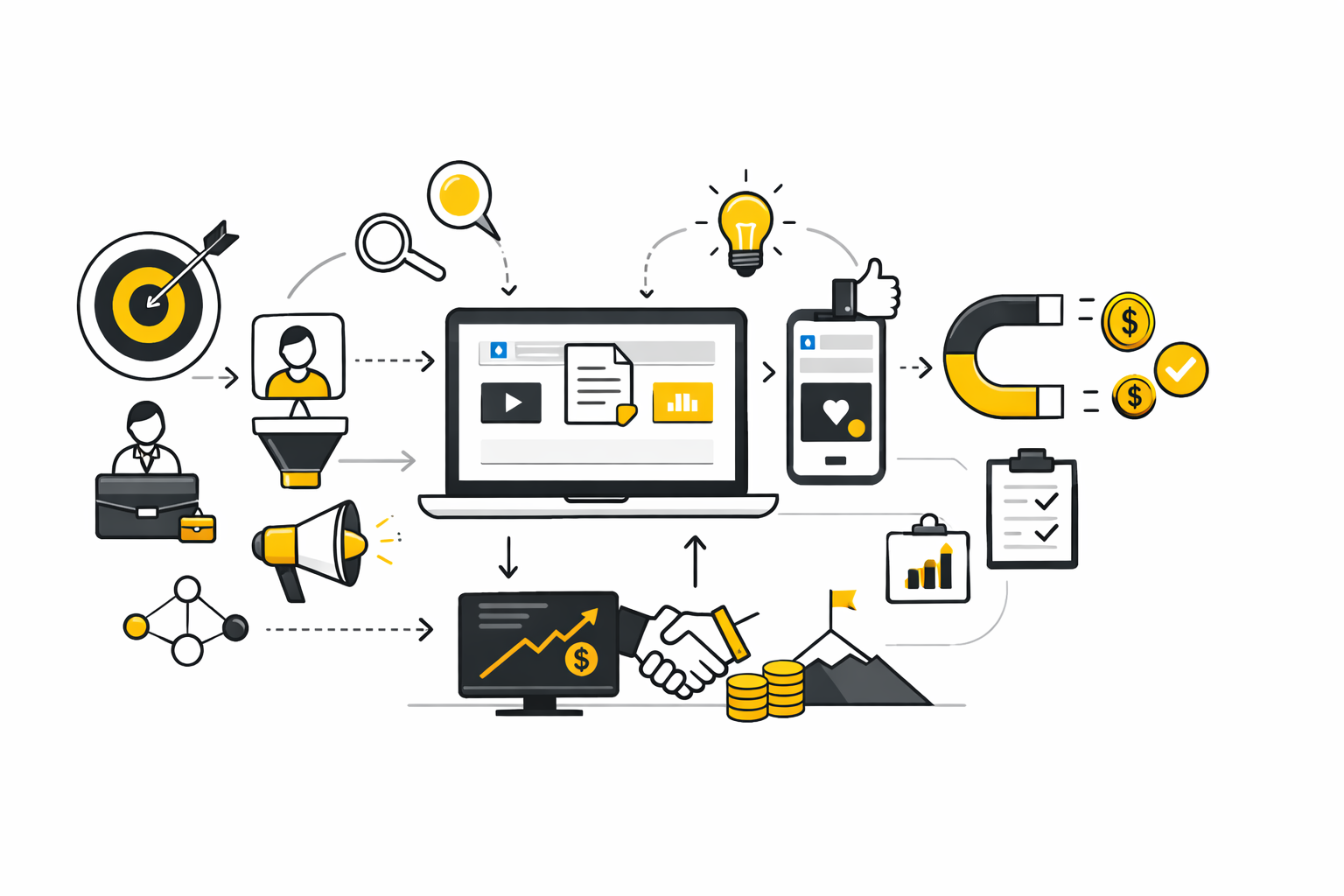
Why LinkedIn Marketing Strategy Matters
LinkedIn matters because modern B2B buying is harder to influence than most companies want to admit. The 2025 Edelman and LinkedIn report found that 71% of hidden decision-makers have relatively little or no interaction with sales. In plain English, a big part of the buying group is forming opinions before your sales team ever gets a real shot.
That is exactly where content starts doing the heavy lifting. The same research shows that 95% of hidden decision-makers become more receptive to outreach when an organization consistently produces strong thought leadership. This is the shift a lot of brands still miss. LinkedIn is not just a publishing platform. It is a trust-building environment that can make future sales conversations easier before they happen.
There is also a practical performance reason to take the platform seriously. LinkedIn’s own marketing research says 77% of B2B CMOs feel pressure to prove campaign ROI. When pressure rises, random posting stops working. You need a linkedin marketing strategy that can explain who you are targeting, why your content exists, what action you want next, and how that action connects to pipeline or qualified demand.
The creative side matters more than many teams expect. Hidden buyers are not looking for bland corporate filler. Edelman and LinkedIn found that 60% of hidden decision-makers associate a unique format or style with higher-quality thought leadership, and 57% prefer quick takeaway content over academic-style deep dives. So the goal is not just to be insightful. It is to be clear, useful, distinctive, and easy to engage with.
The LinkedIn Marketing Strategy Framework
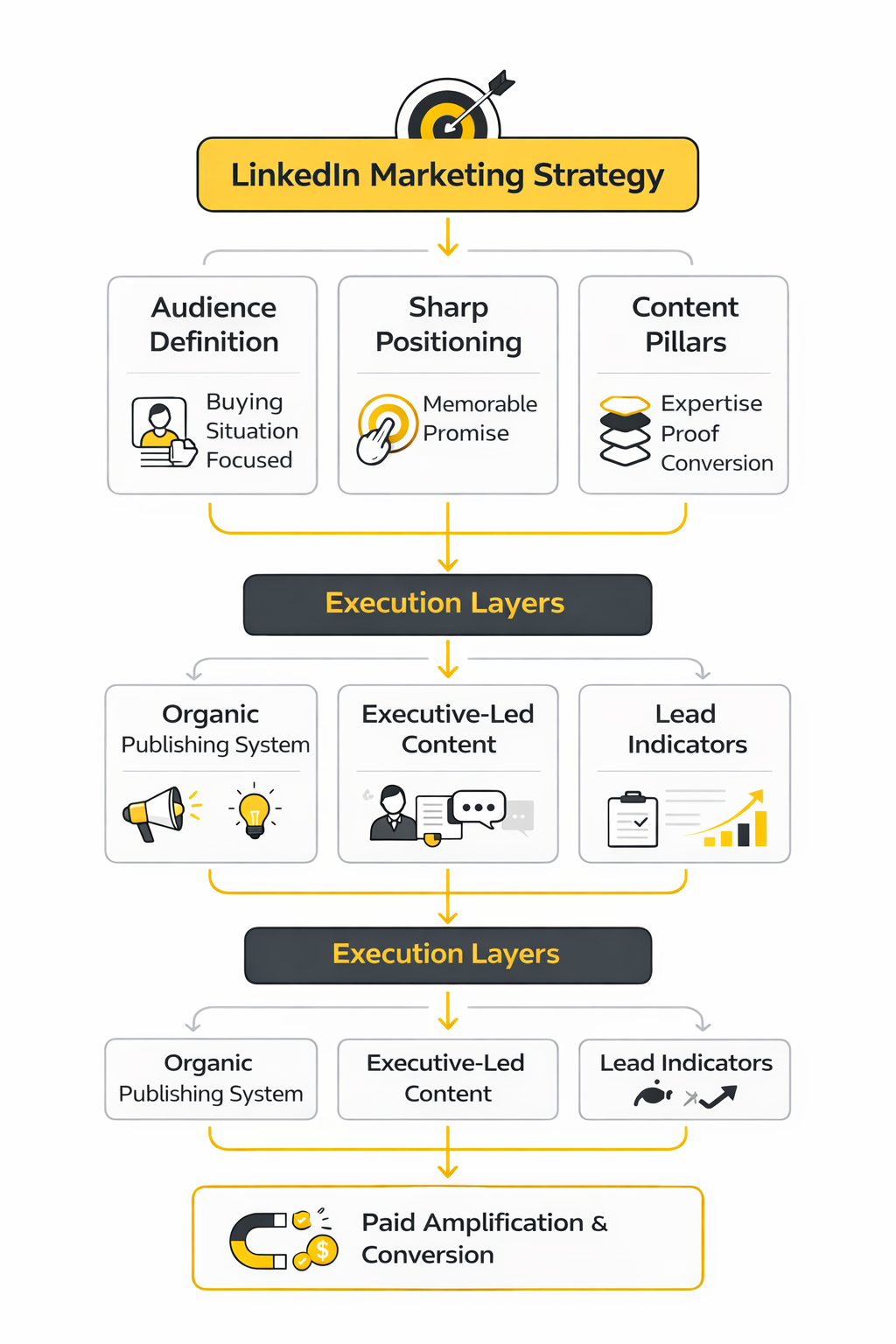
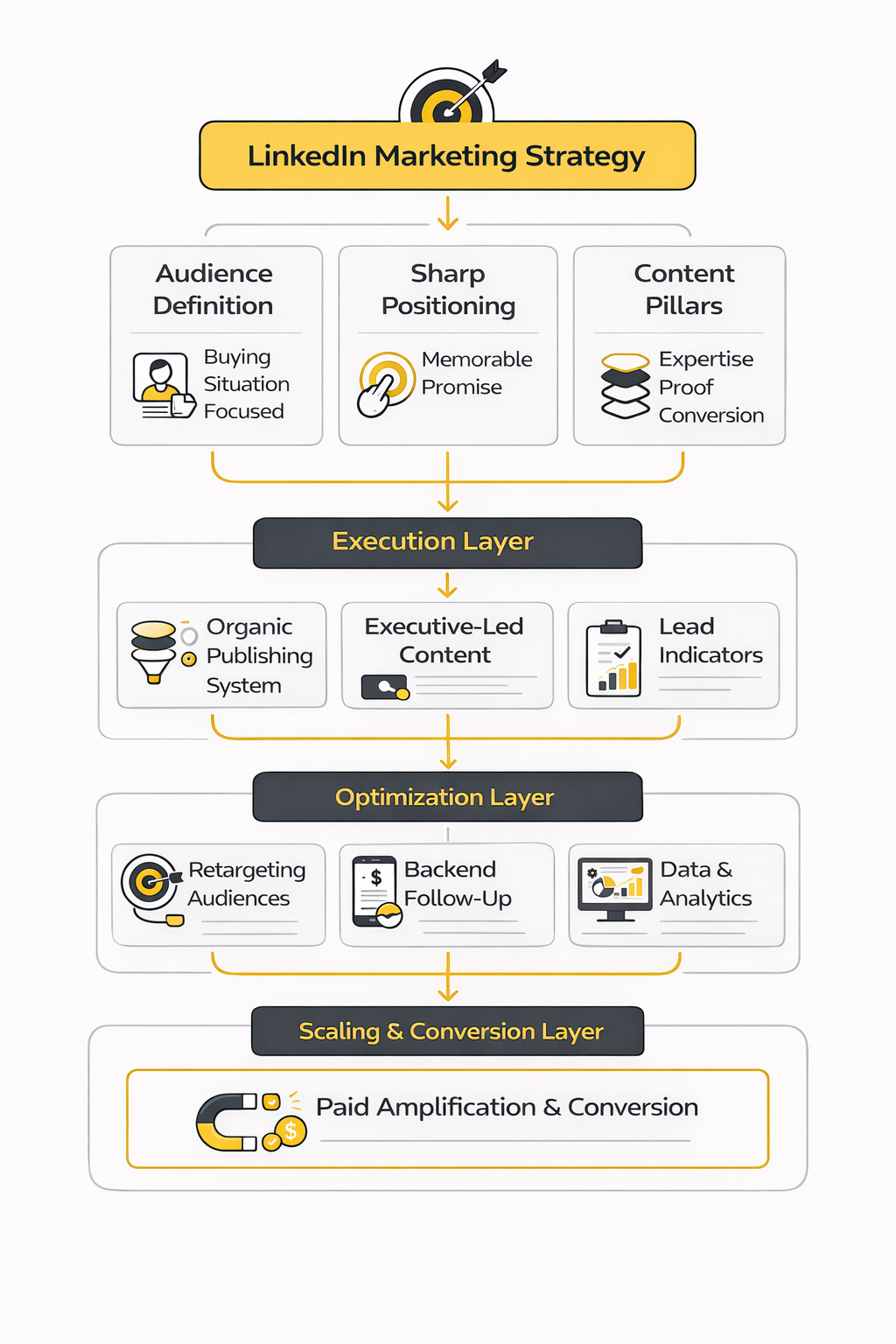
The simplest way to think about a linkedin marketing strategy is as a four-part system: audience, authority, activation, and attribution. First, you define exactly who you want to influence and where they sit in the buying group. Then you build authority with content that earns attention from those people. After that, you activate demand through distribution, offers, ads, and follow-up. Finally, you measure what actually moved the business.
This matters because LinkedIn has matured into a multi-format platform, not just a feed of text posts. The platform now supports company page growth, executive-led content, newsletters, video, document ads, lead gen forms, thought leader ads, and multiple campaign types designed around awareness, engagement, and lead generation. LinkedIn’s own ad guide explains that brands can align different formats to different goals, from video storytelling and newsletter promotion to lead gen forms with pre-filled profile data and document ads that can stay ungated for reach or gated for lead capture.
A professional implementation also requires understanding who should carry the message. Company pages still matter, especially for credibility and consistency, and LinkedIn explicitly positions pages as a place to build thought leadership, strengthen brand awareness, and move audiences to action. But the strongest programs rarely rely on the brand page alone. They combine the page with executives, subject matter experts, sales leaders, and selected employees who can publish in a more human voice.
That human layer is becoming even more important as LinkedIn keeps leaning into creator-style distribution. LinkedIn says short-form uploads are up 45% year over year, and the platform’s Thought Leader Ads product is built around the idea that authentic member posts can be promoted without losing the voice that made them credible in the first place. In other words, the best linkedin marketing strategy today is not brand-only and it is not organic-only. It is a coordinated mix of brand authority, personal credibility, and paid amplification.
The rest of this article follows that exact framework. We will start with audience definition, positioning, and content pillars, then move into organic reach, executive-led growth, paid campaigns, lead capture, and the measurement model that keeps the whole thing from turning into vanity metrics. That is where LinkedIn stops being “something marketing should probably do” and starts becoming a real growth channel.
Audience, Positioning, and Content Pillars
The next step in a linkedin marketing strategy is getting brutally clear on who you want to influence and why they should care. This is where a lot of teams go vague. They say they want to reach “B2B decision-makers” or “founders” or “HR leaders,” and then wonder why the content feels generic and the results never compound.
That is not an audience. That is a label. A real audience definition tells you which buying situation you want to own, which people influence it, what they are worried about, and what kind of proof they need before they trust you.
Start With the Buyer Group, Not a Job Title
LinkedIn itself keeps pushing marketers beyond simplistic targeting because modern B2B decisions are rarely made by one person. Its ad targeting guidance encourages marketers to combine location, audience attributes, and matched audience options while avoiding hyper-targeting that shrinks reach too early in the process, which is a useful reminder that precision and scale have to work together, not against each other, on the platform in LinkedIn’s own targeting best practices. That lines up with the broader shift in B2B research toward buying groups instead of isolated leads.
A good linkedin marketing strategy starts by mapping the visible buyer and the quiet influences around them. The 2025 Edelman and LinkedIn thought leadership report makes this impossible to ignore because hidden decision-makers are still actively consuming content, shaping preferences, and affecting vendor choice throughout the purchase process. If your content only speaks to the obvious buyer, you will miss the people helping form the final opinion behind the scenes.
This is why job title targeting is just the start. You need to understand the committee around the purchase, the objections each role brings, and the language each one trusts. On LinkedIn, that affects everything from your organic hooks to your paid audience filters to the examples you choose in your posts.
Build Audience Segments Around Real Buying Situations
The smartest way to segment your audience is not by demographics first. It is by the commercial problem they are trying to solve. Someone looking for better attribution, someone trying to increase qualified pipeline, and someone under pressure to shorten sales cycles may all work in marketing leadership, but they are not the same audience in practice.
This is where the platform gives you an advantage. LinkedIn’s targeting options let advertisers combine company, job experience, interests, retargeting, and predictive or matched audiences, which means you can build segments around a specific commercial context rather than broad professional categories inside Campaign Manager’s targeting system. Organic content should follow the same logic. Speak to the buying situation first, then the role.
In practical terms, that means your audience definition should answer four questions:
- What outcome is this group under pressure to produce right now?
- What blocks them from getting that outcome?
- What bad options are they already tired of hearing about?
- What proof would make them take you seriously?
When you answer those questions well, your linkedin marketing strategy becomes easier to execute because content ideas stop feeling random. You are no longer guessing what to post. You are building for a clear commercial context.
Position for a Buying Situation, Not for General Awareness
Once the audience is clear, positioning becomes much easier. Most LinkedIn content fails because it tries to be broadly impressive instead of specifically useful. It talks about trends, motivation, leadership, AI, productivity, or “growth” in a way that sounds polished but never creates a memorable reason to choose one brand over another.
Better positioning starts with a sharper promise. Research from the LinkedIn B2B Institute argues that business growth depends on making a clear promise to the customer and reinforcing that promise consistently across brand, marketing, sales, and customer experience rather than treating messaging as a disconnected exercise. That matters on LinkedIn because the feed punishes fuzzy messaging fast. If people cannot tell what territory you own, they will not remember you when the buying moment arrives.
So instead of saying you help companies “grow,” define the category of result more precisely. You might help mid-market SaaS teams improve demo quality from paid social, help founders turn personal branding into pipeline, or help recruiting leaders attract hard-to-hire talent through executive-led content. The tighter the promise, the easier it becomes to write posts, create offers, and decide what does not belong in your content mix.
That does not mean you should sound narrow or boring. It means you should sound unmistakable. A strong linkedin marketing strategy creates recognition by repeating the same strategic promise in different forms until the market starts connecting your name with that outcome automatically.
Build Three Content Pillars You Can Sustain
Once audience and positioning are locked in, content pillars keep the whole system coherent. LinkedIn’s own creator guidance recommends sticking to a small number of recurring themes your audience actually cares about instead of posting disconnected ideas that dilute recognition and confuse the algorithm and the reader at the same time. That advice sounds simple, but it is one of the highest-leverage decisions in the entire strategy.
For most brands and experts, three pillars are enough. One should build authority, one should create relevance, and one should move people toward action. That balance matters because a linkedin marketing strategy cannot survive on educational content alone, and it definitely cannot survive on nonstop promotion.
A practical pillar structure usually looks like this:
- Expertise content that teaches the audience how the market works, what is changing, and what mistakes to avoid.
- Proof content that shows evidence, process, lessons from execution, or behind-the-scenes decision-making.
- Conversion content that connects the insight to a next step such as a newsletter, audit, consultation, demo, event, or lead magnet.
That mix gives you range without making the brand feel scattered. It also makes planning easier because every post idea has a home. If it does not fit one of the pillars, it probably should not be published.
Match the Format to the Message
A content pillar is not a format. That distinction matters. The same pillar can appear as a text post, short native video, carousel, newsletter issue, comment strategy, interview clip, founder post, or document ad depending on the goal and the stage of the audience.
This is where platform behavior should influence strategy. LinkedIn has reported strong momentum in creator-style formats, including short-form video growth and more investment in member-led thought leadership distribution through its B2B creator and thought leadership ad push. At the same time, the platform keeps expanding practical ad and content formats such as document ads and lead gen forms, which means marketers can now align format choice much more tightly to the intent behind the message inside LinkedIn’s ad format guide.
The rule is simple. Use the format that makes the point easiest to understand and easiest to act on. If the idea needs nuance, a document or newsletter may do more than a short post. If the goal is trust and familiarity, video or executive commentary may outperform something that looks like standard brand copy. If the goal is conversion, a strong offer with a clear CTA matters more than chasing engagement for its own sake.
Keep the Brand Voice Human Enough to Be Believed
Even strong content pillars can fall flat if the voice sounds overprocessed. Corporate LinkedIn pages and executive accounts both perform better when the message feels like it came from a thinking human rather than a committee trying not to offend anyone. LinkedIn’s own best practices for pages and organic presence repeatedly lean toward authenticity, active conversation, and content that feels useful instead of ceremonial because Pages are built to foster communities and real interaction.
This matters more than ever because trust is now tied to tone as much as topic. The latest Edelman and LinkedIn thought leadership research shows that buyers respond better to distinctive, accessible, quick-to-grasp ideas than overly polished corporate abstractions when judging the quality and credibility of thought leadership. So clarity wins. Specificity wins. Strong points of view win.
That does not mean you need to sound casual all the time. It means you need to sound real. A professional implementation of linkedin marketing strategy should feel informed, sharp, and confident, but never sterile.
Turn Pillars Into a Repeatable Editorial System
This is the part that separates serious operators from inconsistent creators. Once your pillars are set, you should be able to generate weeks of content from one customer call, one webinar, one campaign review, one internal debate, or one product launch. The goal is not to make every post feel brand new. The goal is to make every post feel aligned.
A simple editorial system works well here. Take one strategic topic, turn it into a strong opinion, then expand it into practical formats for different attention spans. A newsletter becomes a short post. A short post becomes a video. A webinar becomes a document. A customer objection becomes a contrarian hook. Suddenly the linkedin marketing strategy is no longer dependent on inspiration.
That consistency is what builds mental availability over time. Most of your market is not ready to buy today, which is why repeating a clear promise across useful content matters so much in B2B. If the market sees you often enough, in the right context, with a message it can remember, you increase the odds that your brand comes to mind later when the buying window opens.
What a Strong Foundation Looks Like
At this stage, you do not need a bloated content machine. You need an audience definition rooted in buying situations, a positioning angle that stakes out clear territory, and a small set of content pillars you can actually sustain. That is the foundation of a linkedin marketing strategy that has a real chance of producing both trust and demand.
Get this part right and the next layer becomes much easier. Organic distribution gets sharper because every post has a job. Executive-led content gets stronger because leaders know what they are supposed to talk about. Paid amplification gets more efficient because you are promoting messages that already make sense.
That is where we go next: how to turn this strategic foundation into consistent organic reach, stronger executive visibility, and distribution that compounds instead of resetting every week.
Organic Distribution and Executive-Led Growth
Once the audience, positioning, and content pillars are clear, the next job is execution. This is where most linkedin marketing strategy plans either become real or die quietly in a shared document. Good ideas are not enough. You need a publishing and distribution process that keeps showing up, keeps learning, and keeps moving the same message through different voices and formats.
The practical shift is simple: stop treating LinkedIn like a content calendar and start treating it like an operating system. LinkedIn’s own page guidance pushes marketers to post a variety of formats, use update analytics to see what resonates, and then boost strong organic posts to reach new audiences. That is not a random social tip. It is a repeatable growth loop built right into the platform.
Build Around a Distribution Triangle
The most reliable implementation model is a three-part distribution triangle: the company page, internal thought leaders, and the employee network around them. The page creates brand consistency and long-term credibility, while leaders and subject matter experts give the message a human voice that buyers are more likely to trust. LinkedIn’s current ad and content system clearly supports this structure through company page posting, article and newsletter promotion, and Thought Leader Ads that amplify posts from executives, experts, or employees directly in the feed.
This matters because each layer does a different job. The company page is the institutional memory of the brand, the place where prospects can verify that the business is real, active, and serious. Personal accounts are where opinions travel faster, comments feel more natural, and authority gets built through repetition rather than brand polish.
A strong linkedin marketing strategy does not force these layers to compete with each other. It gives each one a role. The page publishes the brand’s core themes, leaders interpret those themes through experience, and employees extend distribution by commenting, reposting, and reinforcing the message with their own perspective.
Publish With a Weekly Rhythm, Not Random Bursts
Consistency matters on LinkedIn because trust compounds through repeated exposure. In LinkedIn’s page posting guide, the platform recommends working toward posting at least once a day, testing different posting times for your audience, and responding to engagement as close to real time as possible. That advice is more operational than inspirational, and that is exactly why it is useful.
That does not mean every brand needs a huge daily production machine on day one. It means the publishing cadence should be steady enough that your audience can actually build familiarity with your point of view. A linkedin marketing strategy works better when the market sees the same themes return in slightly different angles over time, rather than disappearing for two weeks and then showing up with six disconnected posts.
The same rhythm should apply to interaction, not just posting. LinkedIn’s organic guidance emphasizes authentic conversation and strategic engagement because publishing without joining relevant discussions leaves distribution on the table. A post may introduce your view, but comments and follow-up conversations are often where trust starts to deepen.
Turn Organic Content Into an Execution System
A professional implementation needs a process simple enough to repeat under pressure. The easiest way to do that is to run LinkedIn weekly instead of post by post. When the system is weekly, you can plan themes, assign owners, repurpose source material, and review results before the platform starts feeling chaotic.
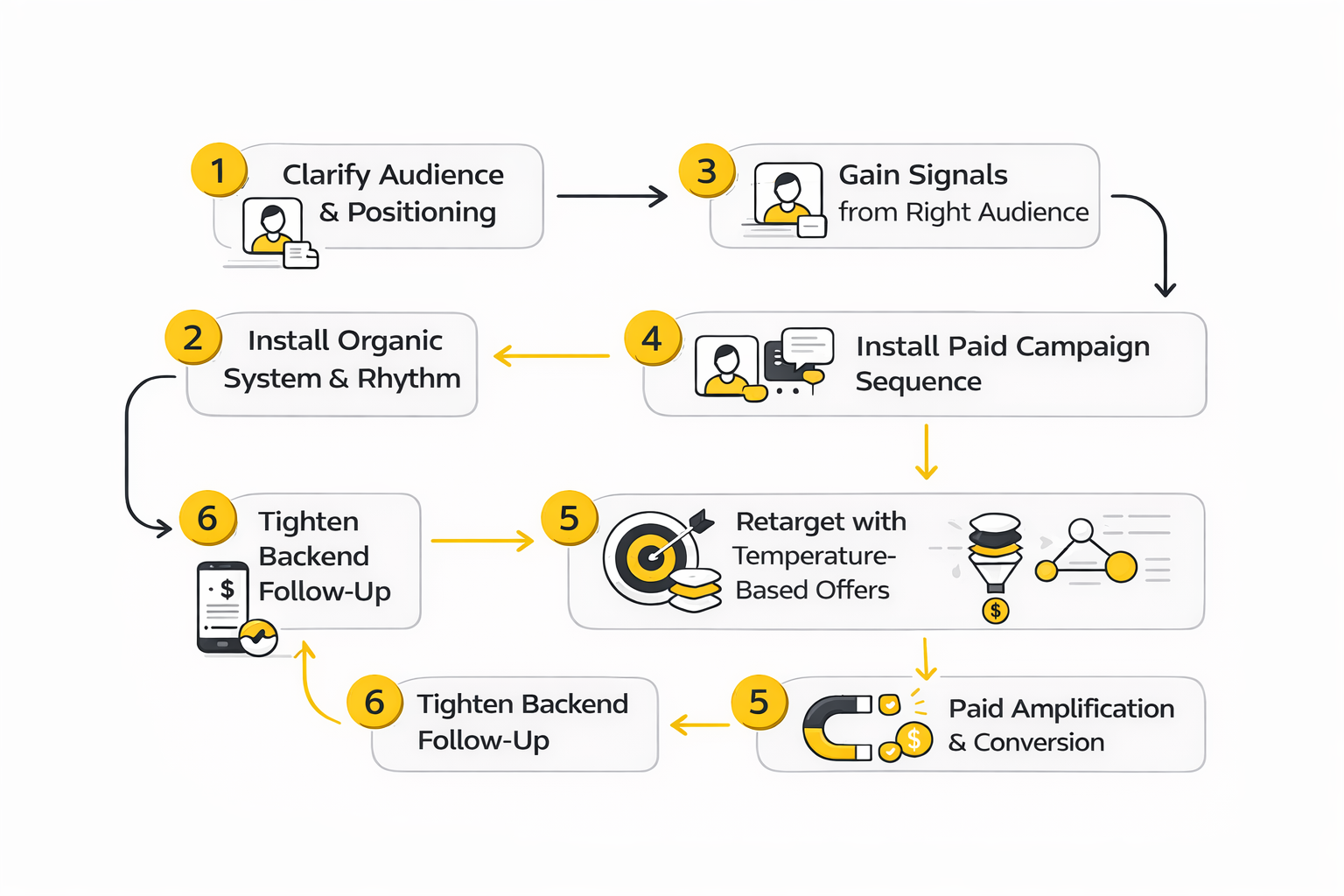
A practical weekly process usually looks like this:
- Pick one commercial theme for the week. Tie it to a real buyer problem, market shift, objection, or customer question so the content stays commercially relevant instead of turning into empty motivation.
- Create one anchor asset. This can be a strong founder post, a short video, a document, a newsletter issue, a webinar recap, or a customer insight that deserves more than one sentence. LinkedIn explicitly supports long-form and recurring formats like articles, videos, events, and newsletters because they help build thought leadership and deeper engagement.
- Break the anchor asset into smaller posts. Pull out one opinion, one practical lesson, one myth to challenge, one proof point, and one CTA angle. That gives you multiple posts without making the message feel diluted.
- Assign the right voice to each post. Some ideas belong on the company page, some should come from the founder, and some work best from a practitioner who is closer to delivery or product. This is where authority and authenticity start working together instead of fighting each other.
- Engage on purpose after publishing. Respond fast, encourage internal comments where relevant, and look for adjacent conversations where the post can keep traveling. LinkedIn’s own page guidance treats engagement speed and conversation participation as part of the process, not an optional extra.
- Review what earned attention, saves, clicks, and downstream action. Then carry the winners forward into reposts, boosted posts, newsletters, ads, or lead magnets. LinkedIn explicitly recommends using analytics to see what is resonating and boosting top-performing organic posts to reach new audiences.
This is the point where linkedin marketing strategy becomes tangible. You are no longer asking, “What should we post today?” You are running a repeatable system that starts with a strategic theme and ends with data, follow-up, and better inputs for the next cycle.
Use the Right Format for the Right Job
Execution gets easier when each format has a job. A short text post can introduce an opinion quickly, while a document ad or carousel can explain a framework in more depth. A newsletter works when you want subscribers and recurring attention, and video works when tone, credibility, and face-to-camera trust matter more than dense detail.
LinkedIn’s current ad guide is useful here because it maps formats directly to intent. Video Ads are built for richer storytelling and explaining complex ideas in-feed, Carousel Ads work for multi-part stories and process walkthroughs, Article and Newsletter Ads help promote recurring long-form insights, and Document Ads let marketers share downloadable content directly in the feed for awareness, engagement, or lead generation. That format-to-goal alignment is exactly how a mature linkedin marketing strategy should be managed.
One important point: do not force every good organic asset into a gated conversion play too early. LinkedIn’s Document Ads product specifically allows marketers to keep content ungated for thought leadership and awareness or gate it with a Lead Gen Form when collecting leads makes sense. That flexibility is valuable because some assets should earn trust first before they start asking for contact details.
Make Leaders Part of the System, Not Occasional Guests
Executive visibility only works when it is built into the process. Too many brands treat leadership content as a special project, which usually means the CEO posts three times, gets busy, and disappears. A better linkedin marketing strategy gives leaders a narrow set of themes they can own repeatedly so publishing feels easier, more natural, and more defensible internally.
LinkedIn’s thought leadership guidance is clear on this point. The platform recommends activating employees and especially company leaders because people relate to people more than to logos, and it now offers Thought Leader Ads so brands can amplify high-performing posts from those individuals without stripping out the original voice. That is one of the biggest implementation advantages on LinkedIn right now.
There is also a creative constraint here that is actually helpful. LinkedIn’s Thought Leader Ads specifications note that the ad creative is the person’s original post, and marketers cannot add a separate headline or intro text on top of it. In practice, that forces teams to get the organic post right first, which is exactly the discipline most brands need anyway.
Promote What Already Proved Itself Organically
One of the easiest ways to waste budget on LinkedIn is to pay for content the audience never wanted in the first place. The smarter move is to use organic performance as a signal. If a post sparked comments from the right people, led to profile visits, generated quality saves, or started sales conversations, it has already earned the right to become a larger asset or a paid unit.
LinkedIn directly recommends boosting top-performing organic posts to gain exposure to new target audiences, and the broader ad system supports that escalation path with promoted posts, Article and Newsletter Ads, Document Ads, Lead Gen Forms, and Thought Leader Ads depending on the goal. That creates a clean implementation path from message testing to scaled distribution.
This is where execution gets much more efficient. Instead of inventing paid creative in a vacuum, you let the market help choose what deserves amplification. A good linkedin marketing strategy listens before it scales.
Keep the Process Tight Enough to Survive Real Life
The final test of implementation is whether the system still works when the team gets busy. If your process depends on constant brainstorming, perfect writing conditions, or unlimited executive time, it will break. The better model is lean: one weekly theme, one anchor asset, a handful of derivative posts, active engagement, and a simple review rhythm tied to business goals.
That is how linkedin marketing strategy becomes sustainable instead of performative. It stops being a stream of isolated posts and becomes a repeatable way to build authority, extend reach, and create buying momentum. From there, the next logical step is paid amplification and conversion infrastructure, because once the organic engine starts proving what resonates, you are ready to turn that attention into leads and pipeline.
Measurement, Analytics, and What the Data Actually Means
A linkedin marketing strategy gets dangerous when teams confuse visibility with progress. More impressions can be useful, but impressions alone do not tell you whether the right people are paying attention, whether the message is landing, or whether attention is turning into pipeline. LinkedIn’s own Campaign Manager reporting dashboard is built around that reality, with separate views for delivery, engagement, professional demographics, and conversions because one number never tells the whole story. LinkedIn’s reporting dashboard overview
That is why measurement needs to work in layers. The top layer tells you whether the market is noticing you. The middle layer tells you whether the audience cares enough to engage or click. The bottom layer tells you whether the attention is creating leads, opportunities, or revenue. If your linkedin marketing strategy only tracks one of those layers, you will make bad decisions very quickly.
The Metrics That Matter at Each Stage
At the awareness stage, reach, impressions, follower growth, and audience fit are useful signals, but only when they are interpreted together. A post that reaches far beyond your ICP may look good on paper and still be commercially weak. That is why LinkedIn includes professional demographic breakdowns in reporting, because relevance matters as much as scale when you are trying to influence a B2B buying group. LinkedIn’s reporting dashboard overview
At the engagement stage, the useful question is not “Did people interact?” but “What kind of interaction happened?” Comments from peers, saves, profile visits, document opens, and qualified clicks usually tell you more than lightweight reactions. This matters because social benchmarks can make engagement look healthy even when no buying intent is developing. Socialinsider’s 2026 LinkedIn benchmark report found an average engagement rate of 5.20% across LinkedIn content, but that number is only helpful when you compare it to audience quality, content type, and commercial outcome.
At the conversion stage, the platform becomes more explicit. LinkedIn’s own measurement guidance points marketers toward conversion tracking for conversions, conversion rate, and cost per conversion, while Lead Gen Forms reporting surfaces leads and cost per lead directly inside Campaign Manager. Those are not vanity metrics. They are the first place where attention starts turning into something the business can actually count. LinkedIn’s campaign analysis guidance LinkedIn’s Lead Gen Forms guide
Why Benchmarks Help and Why They Can Mislead
Benchmarks are useful because they stop you from overreacting to one campaign or one post. If your click-through rate is wildly below the range other B2B advertisers are seeing, that usually points to a message problem, an audience problem, or a format mismatch. But benchmarks become misleading the moment they replace strategy.
That is especially true on LinkedIn because performance varies heavily by industry, offer, audience seniority, geography, and funnel stage. The B2B House’s rolling LinkedIn ad benchmark guide places average sponsored content CTR in the 0.44% to 0.65% range globally, while HockeyStack’s 2025 benchmark report, based on more than 70 B2B SaaS companies and $28 million in LinkedIn ad spend over three years, showed quarterly CTR figures like 0.82% in Q1 and 0.96% in Q3. Those numbers are not contradictory. They are a reminder that context changes the benchmark.
The same goes for cost metrics. LinkedIn traffic is often more expensive than broader social traffic, but that does not automatically make it worse. HockeyStack’s report explicitly argues that in-platform metrics such as CPC, CPM, and CTR do not tell the full story because pipeline progression and revenue outcomes are the real test in B2B. That is an important correction for anyone building a linkedin marketing strategy around cheap clicks instead of qualified commercial movement. HockeyStack’s 2025 benchmark report
What Good Organic Data Usually Tells You
Organic measurement should answer three practical questions. First, are the right people seeing the content? Second, are they showing signs of real interest? Third, is the content creating enough momentum to justify repetition, repurposing, or paid amplification? If you cannot answer those three, you are probably collecting numbers without using them.
This is where format-level data becomes useful. Socialinsider’s 2026 benchmark data shows native document posts averaging a 7.00% engagement rate, ahead of the broader platform average, while text, image, and video formats all showed year-over-year engagement growth. That should not push you to turn everything into a document. It should push you to test whether your audience responds better to structured, swipeable teaching assets than to short status-style updates.
A good linkedin marketing strategy reads organic data as a signal for next actions. If document posts consistently earn more saves, more qualified comments, and more profile visits from the right audience, that is a clue to create more frameworks, more checklists, and more educational assets. If a founder’s text posts trigger more inbound conversations than polished brand-page posts, that is a clue about voice, not just format.
The Analytics Stack Should Be Simple Enough to Use
The right analytics system is not the most complex one. It is the one your team will actually check every week. LinkedIn’s native tools already cover a lot of ground with page analytics, post analytics, demographic reporting, Campaign Manager data, conversion tracking, and Lead Gen Form reporting, so the first priority is not more dashboards. It is tighter interpretation. LinkedIn’s reporting dashboard overview LinkedIn’s Lead Gen Forms guide
A clean analytics system usually works in four levels:
- Content signals such as impressions, engagement rate, saves, comments, follows, and profile visits.
- Traffic signals such as clicks, CTR, landing page sessions, and on-page behavior.
- Lead signals such as form completion rate, leads, cost per lead, and conversion rate.
- Revenue signals such as qualified pipeline, opportunity creation, sales velocity, and closed revenue.
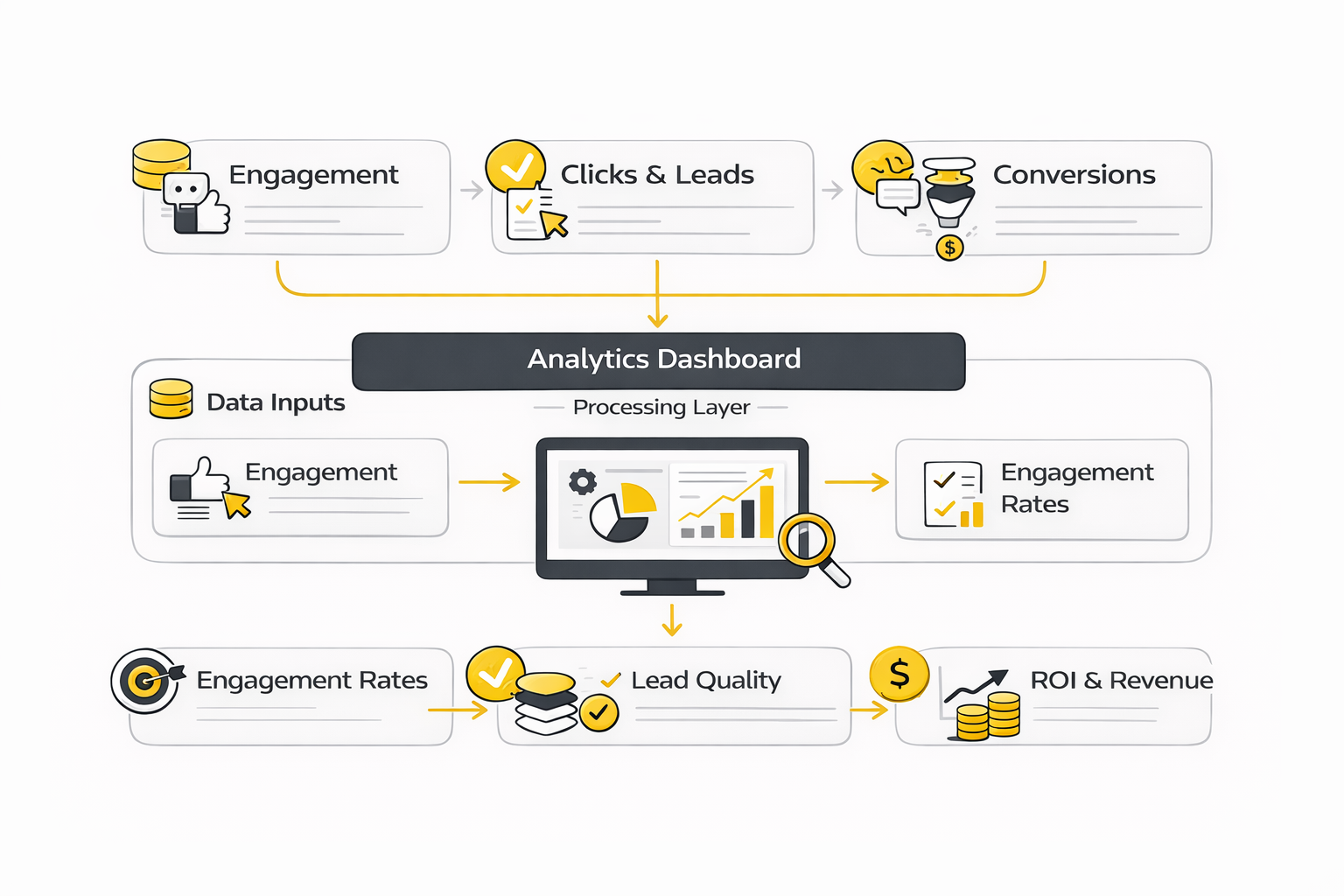
Once you see those layers together, the numbers become much easier to interpret. A post with low engagement but high-quality clicks may deserve more budget than a post with flashy reactions and weak downstream behavior. A campaign with an expensive CPL may still be a winner if the leads turn into opportunities at a much higher rate than cheaper sources.
That is the point. Measurement should reduce confusion, not create more of it. A linkedin marketing strategy becomes more effective when the analytics stack shows which signals belong to awareness, which belong to demand capture, and which belong to revenue contribution.
Read Engagement as a Diagnostic Tool, Not a Trophy
Engagement is useful, but only if you ask what kind of engagement is happening. A broad wave of likes can mean the content was pleasant. A focused set of comments from potential buyers can mean the content hit an active pain point. Those are very different outcomes, even if the raw engagement count looks smaller in the second case.
This is why interpretation matters more than ego. LinkedIn’s own thought leadership ecosystem is built around the idea that distinctive, relevant content moves trust and preference among decision-makers, including hidden buyers who may not visibly raise their hand right away. The 2025 Edelman and LinkedIn report, based on nearly 2,000 global professionals, makes the bigger point clear: strong thought leadership helps open doors that traditional sales contact and standard marketing materials often miss.
So when a post creates comments from senior operators, invitations to talk, mentions in DMs, or repeat visits from target accounts, treat that as signal. It may not look as glamorous as a giant vanity number, but it is usually much closer to real buying behavior. This is one of the biggest mindset shifts in a mature linkedin marketing strategy.
Paid Performance Should Be Judged Beyond CTR and CPL
Paid reporting is where many teams become too impatient. CTR and CPL matter because they show whether the ad is getting attention efficiently, but they are still front-end metrics. LinkedIn’s own campaign analysis guidance tells marketers to set up conversion tracking and Lead Gen Forms specifically so bottom-of-funnel metrics become visible, which is a strong hint that media efficiency is not the same as business efficiency. LinkedIn’s campaign analysis guidance
HockeyStack’s benchmark report says this directly. Its main argument is that in-platform metrics should be measured alongside funnel outcomes because the real question is whether LinkedIn ads are progressing leads into pipeline and revenue, not whether the click looked cheap inside the ad account. In the same report, quarterly ROI figures ranged from 2.44x pipeline ROI in Q1 to 6.01x pipeline ROI in Q3, with 2.46x revenue ROI in Q4. Those numbers will vary by company, but the lesson is clear: performance has to be read at the funnel level.
That means a strong linkedin marketing strategy should compare campaigns using at least three lenses. Start with delivery and engagement, then look at lead quality, then look at pipeline progression. If a campaign produces mediocre CTR but consistently creates better opportunities, it may be outperforming the “winner” everyone wants to celebrate.
Use Lead Gen Data to Fix Friction, Not Just Report Volume
Lead Gen Forms are powerful on LinkedIn because they reduce friction with pre-filled profile data, but the real value is in the diagnostic layer. LinkedIn’s own guide tells marketers to monitor total leads, form completion rate, and cost per lead inside Campaign Manager, and it also reminds them that lead data is only available for 90 days unless it is downloaded or synced into CRM or marketing automation systems. That operational detail matters more than it looks.
A weak form completion rate usually points to a mismatch between the offer and the ask. Either the asset is not compelling enough, the form is asking for too much, or the post-click experience breaks the promise made in the ad. LinkedIn’s own optimization advice for lead gen campaigns pushes marketers to keep questions concise, minimize manual-entry fields, and keep the message consistent from ad to form to thank-you experience. LinkedIn’s Lead Gen Forms guide
This is exactly how data should drive action. If completion rate is weak, simplify the form or tighten the offer. If CPL rises while lead quality improves, do not panic too early. If volume is high but sales rejects most leads, fix targeting or qualification instead of congratulating the campaign.
The Best Performance Signal Is Forward Motion
In the end, the best measurement question is brutally simple: did this move the right people one step closer to buying? That step could be a save, a click, a newsletter subscription, a form fill, a demo request, a return visit, or a sales conversation, depending on the stage. But it has to be forward motion.
That is why random statistics are not enough. A linkedin marketing strategy needs metrics that explain what happened, why it happened, and what should happen next. Benchmarks give you perspective, native analytics give you visibility, and funnel data gives you business meaning. Put those together and the numbers start working for you instead of distracting you.
The next layer is where those insights become budget and scale decisions. Once measurement is clear, you can make sharper choices about paid amplification, lead capture, retargeting, and the conversion paths that deserve more investment.
Paid Campaigns, Lead Capture, and Conversion Paths
Once organic content starts producing useful signals, the next question is not whether to run paid campaigns. It is how to scale without destroying efficiency, trust, or message quality. This is where a serious linkedin marketing strategy needs more judgment than most playbooks admit. Paid reach can accelerate learning and pipeline, but it can also amplify weak positioning, bad offers, and sloppy follow-up much faster than organic ever could.
The first strategic tradeoff is between immediate lead volume and long-term market memory. LinkedIn’s B2B Institute keeps making the same point in different ways: most of your future buyers are not ready to buy right now, which is the core idea behind the 95-5 rule, and effective B2B growth depends on balancing brand activity with activation rather than starving one to feed the other. LinkedIn’s own Brand to Demand guidance says marketers are allocating an average of 46% of budgets to long-term brand investment, which is close to the balance LinkedIn recommends for healthy growth.
That matters because a linkedin marketing strategy breaks when every dollar is pushed into bottom-funnel capture. You may get leads, but the audience pool gets exhausted faster, costs rise, and your conversion engine starts depending on people who were already close to buying. The better model is to treat paid LinkedIn as a connected system: broad enough to build familiarity, focused enough to capture intent, and disciplined enough to move people from one stage to the next without pretending every impression should become a form fill.
Scale With Sequencing, Not With One Offer
A lot of teams try to run LinkedIn with a single campaign and one CTA. That usually creates a blunt system. Cold audiences see a hard conversion ask too early, warm audiences get the same educational message they already consumed, and the account starts looking inefficient when the real problem is sequencing, not demand.
LinkedIn’s current guidance for scaling businesses is more practical than that. In its recent getting-started guide, the platform suggests warming up cold audiences for two to four weeks and then retargeting them with Lead Gen Forms. Its retargeting documentation also shows how marketers can build audiences from website visits, company page engagement, events, lead gen form interactions, document ads, single image ads, and video views, including thresholds like 25%, 50%, 75%, or 97% of a video watched.
That is the real opportunity. A strong linkedin marketing strategy does not ask one ad to do everything. It builds a sequence. One asset creates recognition. Another deepens understanding. A third creates a conversion moment. When that sequence is working, paid LinkedIn starts feeling less like rented attention and more like a guided buyer journey.
Match the Offer to Buying Temperature
This is one of the biggest expert-level mistakes on LinkedIn. Brands often build offers based on what they want to collect rather than what the audience is ready to exchange. Then they blame the platform when conversion rates disappoint.
Cold audiences usually respond better to low-friction assets that teach, clarify, or reframe a problem. Warm audiences can handle stronger asks such as demos, consultations, comparison sheets, or event registrations. LinkedIn’s retargeting guidance is explicit that marketers can use retargeting to surface assets like videos, demos, comparison sheets, and other mid-funnel content to move prospects through the buying journey and shorten the sales cycle.
So the action is straightforward. If a campaign is underperforming, do not just rewrite the headline and hope. Check whether the offer matches the audience’s temperature. A linkedin marketing strategy improves faster when you diagnose friction at the journey level instead of blaming one asset in isolation.
Lead Capture Only Works if the Back End Is Tight
Lead generation on LinkedIn is often discussed as a front-end problem, but the real leverage is in what happens after the form submission. If routing is slow, lead data is messy, sales has no context, or nurture is generic, the campaign can look good in-platform and still fail commercially. That is why the operational side matters just as much as targeting or creative.
LinkedIn’s Lead Gen ecosystem is designed to reduce friction, but reduced friction cuts both ways. It can improve completion rates, yet it can also create larger volumes of lightly qualified leads if the offer is weak or the handoff is poor. In practice, this means a linkedin marketing strategy needs clear qualification logic, CRM sync, and fast follow-up before budget gets scaled.
This is exactly where a cleaner stack helps. If you are tightening lead handoff and sales follow-up, tools like Copper or GoHighLevel can make routing, pipeline visibility, and nurture much easier to manage. The point is not to add more software for the sake of it. The point is to make sure the lead experience after the click is strong enough to justify scaling acquisition in the first place.
Avoid the Over-Targeting Trap
Advanced teams often assume better targeting means narrower targeting. On LinkedIn, that is only partly true. If you keep stacking filters, you can end up with an audience that looks precise in theory but is too small to learn, too expensive to scale, and too fragile to survive creative fatigue.
That is why LinkedIn repeatedly warns marketers against getting too narrow too early and why its matched audience system is meant to work alongside broader professional targeting rather than replace it entirely. Broad reach creates the raw material for future retargeting, while matched audiences help you capitalize on signals of intent later in the journey. A linkedin marketing strategy becomes more resilient when it uses broad and narrow targeting at different stages instead of trying to force perfect precision from the first impression.
There is a second risk here too. Over-targeting can make the account feel efficient for a while because spend is concentrated, but it often pushes costs up and limits creative testing. When that happens, teams mistakenly think LinkedIn has become too expensive, when the real issue is that they made the addressable audience too small to support healthy delivery and learning.
Treat Thought Leader Ads as a Scale Layer, Not a Shortcut
Thought Leader Ads are one of the most interesting scaling tools on LinkedIn because they let brands promote posts from executives, employees, or other members in a way that keeps the original voice intact. That is powerful, especially in B2B categories where personal trust often moves faster than brand campaigns. LinkedIn’s current ad inventory highlights Thought Leader Ads as a distinct format alongside document, event, article, and newsletter promotion.
But there is a trap here too. Thought Leader Ads are not a shortcut around weak strategy. If the person behind the post has no real point of view, no audience fit, or no consistent theme, promotion just magnifies the emptiness. The right way to use them is after a leader has already established recognizable territory organically. Then paid support can extend the reach of proven messages instead of manufacturing authority from scratch.
That distinction matters a lot. A linkedin marketing strategy scales better when personal authority is earned first and amplified second. Not the other way around.
The Smartest Scaling Move Is Usually Better Follow-Through
When teams think about scaling, they usually think about spending more. That is not always the best first move. Often the bigger gain comes from improving what happens between impression and opportunity: stronger landing pages, tighter retargeting windows, better CTA alignment, clearer qualification, faster follow-up, or more intelligent nurture.
This is why LinkedIn’s retargeting and lead generation tools are so important strategically. They let you build continuation rather than repetition. Someone who engaged with a document ad should not necessarily see the same message again. Someone who opened a form but did not submit might need proof or clarity, not another aggressive CTA. Someone who watched most of a video may be ready for a different kind of ask than someone who bounced after two seconds.
That is a more advanced way to think about linkedin marketing strategy. Scaling is not just about adding budget to the top of the funnel. It is about making each stage of the path work harder so more of the attention you already paid for turns into real commercial movement.
Where Advanced Teams Usually Win
The strongest teams on LinkedIn usually do four things better than everyone else. They protect budget for both brand and activation. They build campaign sequences instead of isolated ads. They connect lead capture to serious backend process. And they let real audience behavior decide what gets scaled.
None of that is flashy, but it is effective. It also makes the whole system easier to defend internally because every major choice connects back to buyer behavior, platform capability, and commercial outcome rather than social media superstition. That is exactly what a mature linkedin marketing strategy should do.
The final part is about bringing the whole thing together. After the tradeoffs, the formats, the signals, and the scaling choices, what remains is a practical synthesis: what to prioritize first, what to avoid, and the questions most teams still get wrong when they try to turn LinkedIn into a real growth channel.
Bringing the Whole LinkedIn System Together
At this point, the pattern should be clear. A linkedin marketing strategy works best when it is treated as one connected system instead of a pile of tactics. Audience clarity shapes positioning, positioning shapes content, content shapes distribution, distribution creates signals, and signals tell you what deserves amplification. LinkedIn’s own objective-based advertising framework follows the same logic by aligning ad formats to specific goals rather than pushing every campaign into the same mold. LinkedIn’s objective-based ad framework
That system mindset matters because LinkedIn is not just a publishing platform anymore. It is an environment where company pages, executive voices, document ads, newsletters, lead gen forms, retargeting, and thought leader ads can all work together when the sequencing is right. The mistake is trying to use every feature at once. The smarter move is to build the machine in order, then add layers only when the earlier ones are proving they can carry more weight. LinkedIn Ads Guide Thought Leader Ads overview
A practical linkedin marketing strategy usually matures in four stages. First, you get the message right. Second, you get the organic rhythm right. Third, you identify which formats and voices actually pull attention from the right people. Fourth, you scale those winners with paid distribution, lead capture, and retargeting. That sequence is slower than chasing quick wins, but it is far more stable. LinkedIn ad formats by objective
The other big lesson is that trust is not a soft metric. It is often the thing that makes later conversion possible. Edelman and LinkedIn’s 2025 B2B thought leadership research found that hidden buyers actively consume thought leadership and that 95% of hidden buyers become more open to outreach when an organization consistently publishes compelling thought leadership. That is why the best linkedin marketing strategy is not just about lead forms and CPC. It is about earning credibility before the formal buying conversation starts.
FAQ
What is a linkedin marketing strategy in practical terms?
A linkedin marketing strategy is a structured plan for using LinkedIn to build awareness, trust, leads, and pipeline with a specific professional audience. In practice, that means defining the audience, clarifying the positioning, publishing repeatable content, distributing it through the right accounts, and measuring whether that attention is turning into real commercial movement. LinkedIn’s own ad and campaign structure supports this kind of objective-led planning rather than one-size-fits-all promotion. LinkedIn’s objective-based ad framework
Why is LinkedIn especially important for B2B marketing?
LinkedIn matters in B2B because buyer attention on the platform is usually more professionally aligned than on entertainment-first networks. The buying group is also larger than many brands assume, and Edelman with LinkedIn found in 2025 that hidden decision-makers play a major role in shaping outcomes before sales gets direct access. That makes LinkedIn valuable not just for lead capture, but for influence earlier in the decision process. 2025 Edelman-LinkedIn thought leadership report
Should I focus more on a company page or personal profiles?
You usually need both, but they do different jobs. A company page supports credibility, consistency, and institutional messaging, while personal profiles tend to create more human trust, stronger conversation, and faster distribution when the voice is sharp and relevant. LinkedIn now supports this blended model directly through features like Thought Leader Ads, which let brands sponsor posts from members instead of relying only on brand-page publishing. Thought Leader Ads overview Thought leader ads help page
How often should a business post on LinkedIn?
There is no magic number that works for everyone, but consistency matters much more than sporadic bursts. LinkedIn’s own page posting guidance encourages brands to work toward regular posting, test timing, and stay active in conversations after publishing. The right cadence is the one your team can sustain without sacrificing clarity or quality, because a broken content system is worse than a modest but steady one. LinkedIn page posting best practices
What content formats tend to work best on LinkedIn?
The right format depends on the job the content needs to do. Text posts can work well for opinions and fast insights, while documents, newsletters, and videos often do better when the idea needs more structure, education, or face-to-camera trust. LinkedIn’s current ad guide shows how different formats are built for different objectives, which is exactly how marketers should think about organic and paid content too. LinkedIn Ads Guide
Are document posts and document ads worth testing?
Yes, especially when your audience responds well to frameworks, checklists, swipeable teaching assets, or process breakdowns. LinkedIn supports document ads for awareness, engagement, and lead generation, which makes them one of the more flexible formats on the platform. They are especially useful when you want to make expertise tangible instead of leaving it trapped in short feed posts. Document ads within LinkedIn ad formats LinkedIn Ads Guide
When should I use Lead Gen Forms instead of sending traffic to a landing page?
Lead Gen Forms make the most sense when reducing friction is a priority and the offer is strong enough to justify an in-feed conversion. LinkedIn’s own documentation highlights that the forms use pre-filled profile data, which reduces manual entry and can improve completion rates, while best-practice guidance recommends keeping forms concise and typically using three to four fields. That said, a landing page can still be the better choice when you need more qualification, storytelling, or controlled post-click experience. Lead Gen Forms overview Lead Gen Form best practices How to use LinkedIn Lead Gen Forms
What makes Thought Leader Ads different from normal ads?
Thought Leader Ads are built from a member’s original post rather than from brand-created ad creative. LinkedIn’s specs make that very clear: you cannot add a separate headline or intro text, and any edits must come from the original author’s post itself. That makes the format powerful for scaling authentic content, but it also means weak or generic leadership content will not suddenly become persuasive just because budget is attached to it. Thought Leader Ads specifications
How should I measure whether my linkedin marketing strategy is working?
You should measure it in layers. Start with visibility and audience fit, then examine engagement quality, then check traffic and conversion behavior, and finally review lead quality, opportunity creation, and revenue contribution. LinkedIn’s reporting environment is already built around that multi-layer view, which is useful because it prevents marketers from overreacting to impressions, vanity engagement, or cheap clicks that never turn into commercial value. Reporting dashboard overview
Which metric gets overrated the most on LinkedIn?
Usually it is raw engagement or cheap lead volume without enough context. A post can collect a lot of reactions and still fail to reach the right buying group, and a campaign can produce affordable leads that sales does not want. The better question is whether the content or campaign moved the right people forward, because LinkedIn performance is much more useful when it is connected to buyer quality and funnel progression. Reporting dashboard overview Lead generation best practices
How broad should LinkedIn targeting be?
Broad enough to learn, but focused enough to stay commercially relevant. Many advertisers get into trouble by stacking too many filters too early, which can shrink the audience, raise costs, and make testing unreliable. LinkedIn’s own targeting and retargeting structure works best when broader professional targeting creates reach at the top and matched or retargeted audiences capture stronger intent later. LinkedIn retargeting guidance
Does organic content still matter if I plan to run paid ads?
Yes, because organic content is often the cheapest way to test message-market fit before you pay to scale it. It also helps build the trust layer that paid campaigns alone often struggle to create, especially in B2B categories with longer decision cycles. LinkedIn itself now supports this progression by letting marketers boost proven content and sponsor thought leader posts once they have already shown signs of resonance. Thought leader ads help page LinkedIn Ads Guide
What is the biggest mistake companies make with LinkedIn?
They treat it like a place to “post more” instead of building a real operating system. That leads to vague audience targeting, generic content, random format choices, disconnected lead capture, and measurement that never gets tied back to business outcomes. A linkedin marketing strategy works when each part supports the next one, not when every tactic is managed in isolation. LinkedIn’s objective-based ad framework
How long does it usually take for LinkedIn marketing to start working?
Longer than most impatient teams want, but faster than many assume when the system is built properly. Organic momentum usually takes repetition, while paid campaigns can accelerate learning if the message and offer are already sharp. The reason to stay patient is simple: Edelman and LinkedIn’s 2025 research shows that strong thought leadership can increase receptiveness among hidden buyers, which means some of the real payoff happens before prospects ever fill out a form. 2025 Edelman-LinkedIn thought leadership report
What should I prioritize first if I am starting from scratch?
Start with audience clarity, positioning, and a small set of content pillars you can sustain. Then create a steady publishing rhythm, watch for signals from the right audience, and only after that begin adding paid amplification, retargeting, and more sophisticated conversion paths. Starting with complicated ad setups before the message is proven usually creates noise, not growth. LinkedIn Ads Guide LinkedIn page posting best practices
Work With Professionals
Explore 10K+ Remote Marketing Contracts on MarkeWork.com
Most marketers spend too much time chasing clients, competing on crowded platforms, and losing a percentage of every project to middlemen.
MarkeWork gives you a better way. Browse thousands of remote marketing contracts and connect directly with companies desperate to hire skilled marketers like you, without platform commissions and without unnecessary gatekeepers.
If you're serious about finding better opportunities and keeping 100% of what you earn, explore available contracts and create a profile for free at MarkeWork.com.