

Local marketing is how a business gets discovered, trusted, and chosen by people in a specific area. It includes Google visibility, reviews, local content, social media, email, offers, partnerships, ads, and the simple follow-up systems that turn nearby attention into booked calls, visits, orders, and repeat customers.
This matters because local buying intent is usually immediate. People are not casually researching “plumber near me,” “best dentist in town,” or “coffee shop open now.” They are trying to make a decision, and the business that looks credible, relevant, nearby, and easy to contact has the advantage. Recent local search research shows that Google still dominates general search behavior, with 70% of general online searches happening on Google, which makes local visibility a revenue channel, not just a branding task.
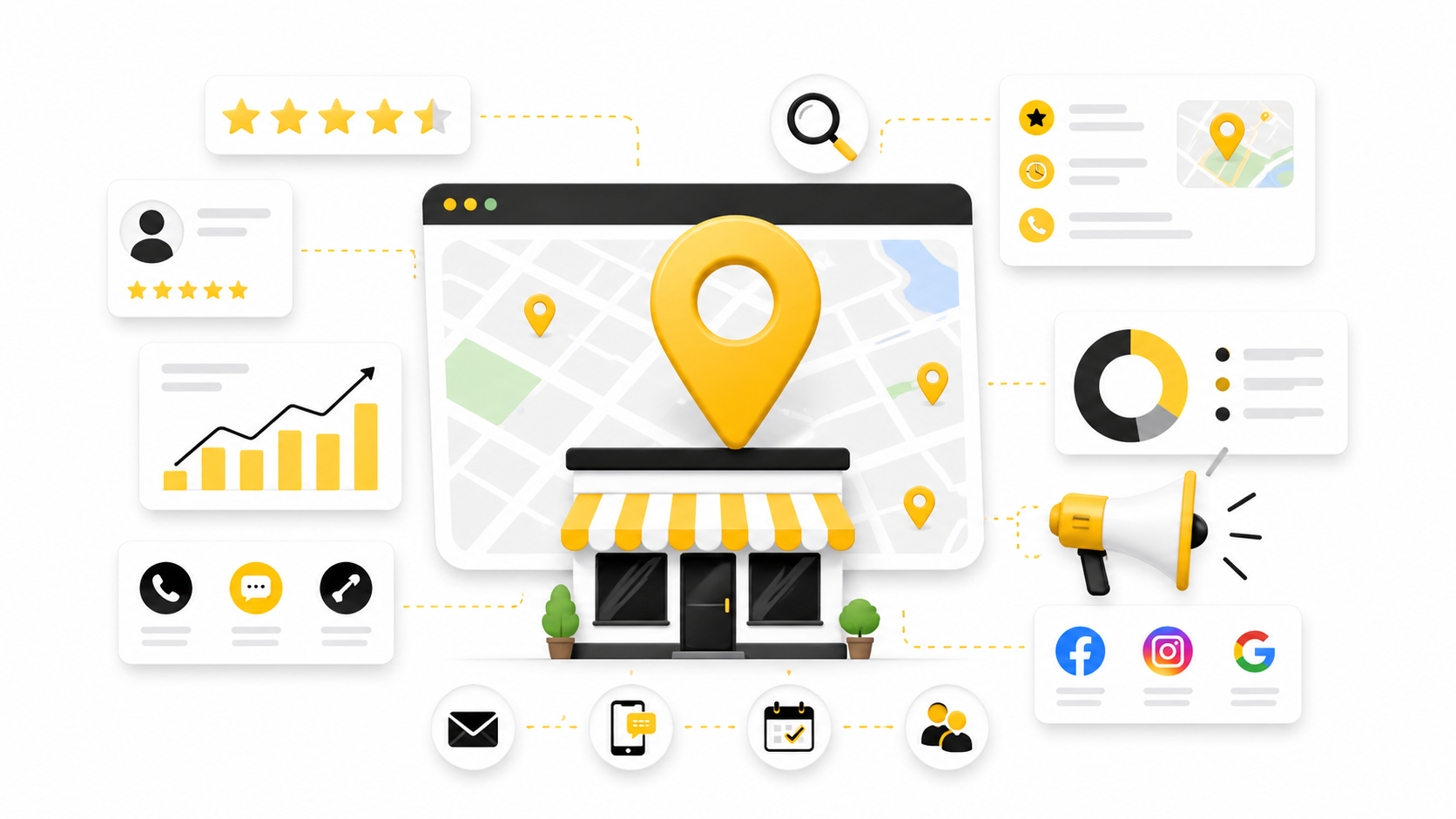
Local marketing works best when you stop treating channels as separate chores. Your Google Business Profile, website, reviews, social posts, email list, landing pages, offers, and sales follow-up should all support the same customer journey. Someone finds you, checks your proof, understands your offer, takes action, and hears from you again before they forget.
This article will break local marketing into six connected parts:
- Part 1: Local Marketing Strategy And Article Roadmap
- Part 2: Why Local Marketing Matters More Than Ever
- Part 3: The Local Marketing Framework
- Part 4: Core Local Marketing Components
- Part 5: Professional Implementation And Measurement
- Part 6: Local Marketing Tools, FAQs, And Next Steps
Local Marketing Strategy And Article Roadmap
A strong local marketing strategy starts with one question: how does someone nearby decide to trust you? The answer is rarely one channel. A customer might see your sign, search your name, compare reviews, visit your website, check Instagram, ask a friend, and finally call after seeing a clear offer.
That means your strategy needs to connect discovery, trust, conversion, and retention. Discovery gets you seen. Trust makes you believable. Conversion makes the next step obvious. Retention keeps the relationship alive after the first sale, which is where many local businesses quietly make most of their profit.
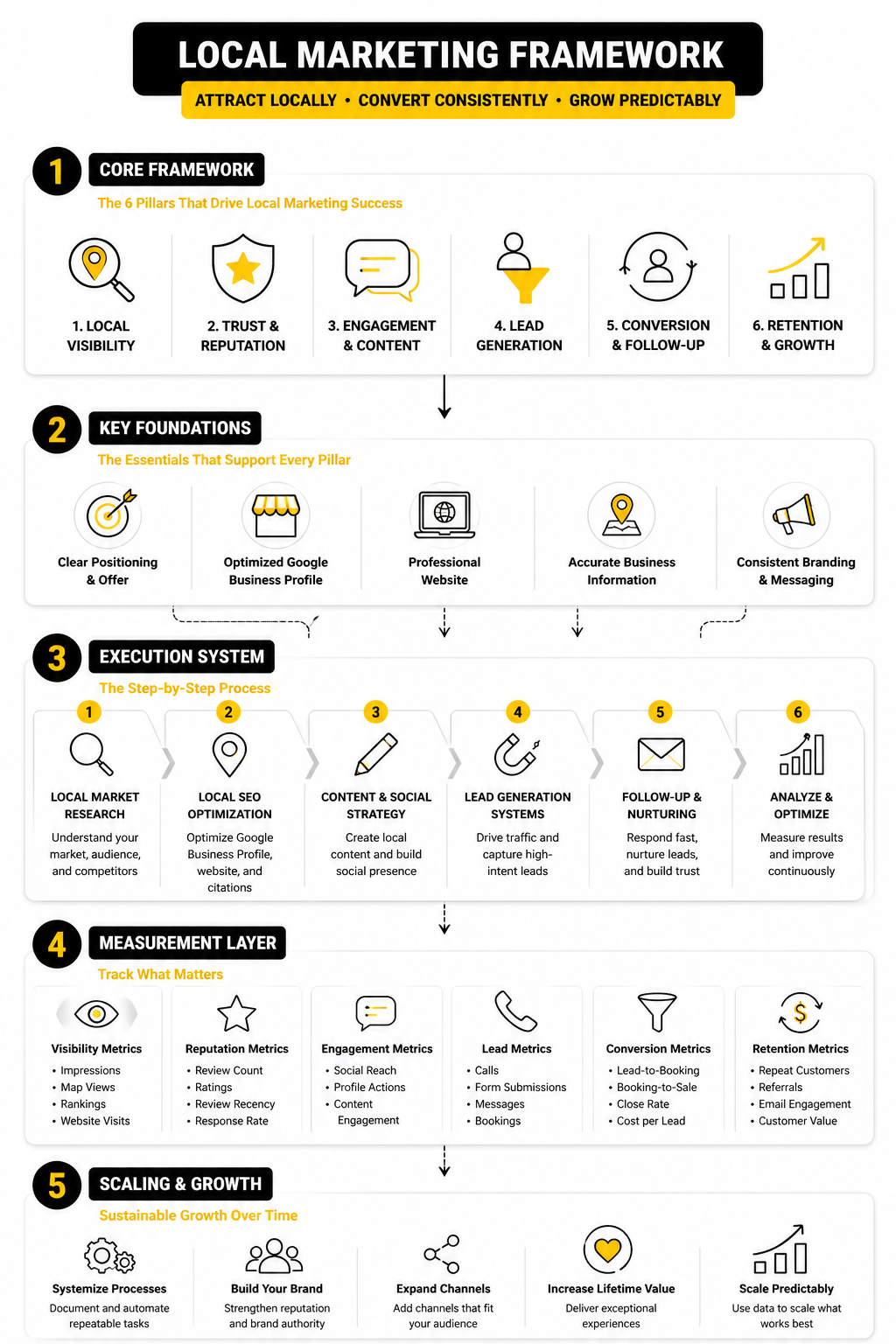
The rest of this guide will use a practical framework built around four local marketing jobs:
- Be findable when people search locally.
- Look trustworthy when they compare options.
- Make action easy with clear offers and simple contact paths.
- Follow up consistently so leads and customers do not disappear.
Why Local Marketing Needs A System
Most local businesses do some marketing, but not enough of it works together. They post on social media without a follow-up path. They run ads to weak landing pages. They collect reviews only when they remember. They update their Google profile once and then hope it keeps performing.
That creates leaks. A business can be good at the service and still lose customers because the online experience feels incomplete, outdated, or hard to act on. Local marketing fixes that by turning scattered activity into a repeatable system.
For example, a local business using GoHighLevel can connect forms, booking, email, SMS, pipelines, reviews, and follow-up in one place. A restaurant, salon, gym, agency, clinic, or home service company does not need more random tools first. It needs a cleaner path from “I found you” to “I booked” to “I came back.”
The Framework This Guide Will Use
The framework is simple: visibility, credibility, conversion, and retention. Visibility helps people discover you through local search, maps, social media, directories, ads, and community presence. Credibility gives them enough proof to believe you are the right choice.
Conversion removes friction. That includes fast pages, clear calls to action, booking links, phone numbers, quote forms, offers, and landing pages. Tools like Fillout, Cal.com, and ClickFunnels can fit here when the business needs forms, scheduling, or dedicated offer pages.
Retention is where local marketing becomes less expensive over time. Email, SMS, loyalty offers, review requests, referral prompts, and seasonal campaigns help a business stay visible after the first interaction. That is where tools like Brevo, ManyChat, and Buffer can support the system without making it overcomplicated.
Why Local Marketing Matters More Than Ever
Local marketing matters because nearby customers are no longer choosing businesses from memory alone. They are searching, comparing, reading reviews, checking maps, scanning social profiles, and making fast decisions from whatever proof appears first. When 70% of general online searches happen on Google, your local presence becomes part of the sales process before anyone calls, visits, or books.
This is why local marketing is not just “getting your name out there.” It is the work of becoming visible at the exact moment someone has a problem, a need, or a reason to buy. A business that shows up clearly, looks active, earns trust quickly, and makes the next step easy will beat a better business that stays invisible.
Local Buyers Have Higher Intent
A local search usually carries more urgency than a broad informational search. Someone looking for “emergency dentist near me,” “best gym in Cluj,” or “roof repair today” is not browsing for entertainment. They are close to taking action, and every weak point in your presence creates room for a competitor to win the click.
That is why local marketing should focus on buying moments, not vanity exposure. Rankings, reach, and impressions are useful only when they move people toward calls, bookings, directions, quote requests, visits, or purchases. The goal is not to be everywhere at random; the goal is to be convincing where local buyers already make decisions.
Strong intent also changes the way you write offers. Local customers want clarity fast: what you do, where you serve, why they should trust you, how soon you can help, and what to do next. If your website, Google profile, and follow-up system answer those questions better than everyone else, your marketing becomes much easier to convert.
Trust Is Now Built Before The First Conversation
Most local customers form an opinion before they ever speak with the business. Reviews, photos, response quality, opening hours, service pages, and recent activity all shape whether a business feels real and reliable. BrightLocal’s 2025 review research found that consumers still heavily rely on reviews when evaluating local businesses, which means reputation is not a side project.
The important part is not just having reviews. The pattern matters. A steady flow of recent, specific, authentic reviews feels more trustworthy than a few old five-star ratings with no detail. People want signals that the business is still active, still good, and still serving customers like them.
This is where many local businesses lose easy revenue. They do good work, but they do not ask for reviews consistently, respond professionally, or turn customer proof into marketing assets. A simple review request system inside a platform like GoHighLevel can make that process less dependent on memory and more dependent on a repeatable workflow.
Competition Is No Longer Just Local
Your competitors are not only the businesses on the same street anymore. You are competing with polished websites, aggregator platforms, franchise brands, marketplace listings, social media recommendations, AI summaries, and sponsored results. Even a tiny local business can look bigger online if its marketing system is cleaner.
That can feel unfair, but it also creates opportunity. A smaller business can move faster, publish more specific local content, collect better customer proof, and create offers that feel more personal than a national chain. Local marketing rewards relevance, consistency, and trust more than massive budgets.
The mistake is assuming “people know us already.” Some do. Many do not. And even people who know your name may still search online to confirm hours, reviews, pricing clues, services, location, or availability before choosing you.
Customer Attention Is Fragmented
People do not follow one neat path anymore. They may discover a business on Google Maps, check Instagram, read reviews, visit the website, leave, get retargeted, ask a friend, and come back through a branded search. Local marketing has to support that messy journey instead of pretending one channel will carry everything.
That is why social content, search visibility, email, SMS, landing pages, and reviews should not compete with each other. They should reinforce the same promise. A simple tool stack can help: Buffer for consistent social publishing, Brevo for email follow-up, and ManyChat for messaging flows when social conversations are part of the sales path.
The key is not adding tools for the sake of it. The key is reducing the number of leads who disappear because no one replied, followed up, reminded them, or made the next step obvious. Local marketing gets stronger when every touchpoint has a job.
Rising Costs Make Organic Trust More Valuable
Paid ads can work well for local businesses, but they are rarely cheap forever. As more competitors bid on the same keywords and platforms become more crowded, businesses need assets that keep working after the ad spend stops. Reviews, local SEO, helpful service pages, customer photos, referral systems, and email lists create leverage over time.
This matters even more when small businesses are under pressure. BrightLocal’s SMB marketing research found that cost holds 36% of SMBs back from investing in marketing channels, which makes efficient execution critical. You cannot afford random campaigns that produce attention but no pipeline.
A good local marketing system balances short-term demand with long-term trust. Ads can create immediate visibility, but organic proof makes those clicks convert better. The strongest businesses do both without letting paid traffic become the only engine.
Local Marketing Turns Familiarity Into Revenue
People often buy from businesses they feel they know. That familiarity can come from seeing your posts, reading helpful content, noticing your reviews, receiving useful emails, or hearing your name from other local customers. The more often those signals appear in a relevant way, the easier the buying decision becomes.
This is not about shouting louder. It is about showing up with useful, consistent, credible messages in the places that matter. A local business that explains problems clearly, shares proof, answers common objections, and follows up politely starts to feel like the obvious choice.
That is the real reason local marketing matters now. It turns scattered visibility into commercial momentum. And once that is clear, the next step is building the framework that makes the whole system easier to run.
The Local Marketing Framework
Local marketing becomes easier when you stop thinking in campaigns and start thinking in systems. A campaign has a start date, an end date, and a result you hope for. A system keeps improving the way people discover, trust, contact, buy from, and return to your business.
The framework is simple: visibility, credibility, conversion, and retention. Each layer supports the next one. If visibility is weak, people never find you. If credibility is weak, they compare you and leave. If conversion is weak, interested buyers do nothing. If retention is weak, you keep paying to reacquire people who already know you.
Step 1: Build Local Visibility
Visibility means showing up where nearby buyers already look. That includes Google Search, Google Maps, Apple Maps, Bing, social platforms, directories, community pages, and referral touchpoints. Google’s own local ranking guidance still centers on relevance, distance, and prominence, with complete and accurate business information helping businesses appear in local results more confidently through a well-maintained Google Business Profile.
Start with the basics before chasing advanced tactics. Your name, address, phone number, business hours, services, website, booking link, photos, and categories should be accurate everywhere important. If those details conflict across platforms, customers hesitate and search engines get weaker signals.
Then add local relevance. Service-area pages, neighborhood references, customer questions, location-specific offers, and content around real buying moments help searchers understand that you serve their exact need in their exact place. This is where local marketing becomes sharper than generic marketing because the message can speak to a specific area, not a broad audience.
Step 2: Strengthen Local Credibility
Credibility is what makes a stranger feel safe choosing you. Reviews, photos, team information, proof of work, clear policies, certifications, guarantees, and recent activity all help. BrightLocal’s 2025 research shows that local customers continue to use reviews heavily when judging businesses, which makes review quality and recency part of the buying experience.
Do not treat reviews as a passive outcome. Build a simple process that asks happy customers at the right moment, sends them to the right platform, and reminds them politely if they forget. Then respond like a real business owner, not a template machine.
Credibility also needs consistency. If your website says one thing, your Google profile says another, and your social media has not been updated in months, customers notice. A local business does not need to look corporate, but it does need to look alive, organized, and trustworthy.
Step 3: Turn Attention Into Action
Once people trust you, the next step should be obvious. That sounds basic, but it is where many local marketing systems break. A person who wants to book, call, request a quote, ask a question, or visit should never have to hunt for the next move.
Your conversion path should match the way customers prefer to act. Some people want to call. Some want to book online. Some want a fast quote form. Some want to message first, especially when the purchase feels personal or expensive. Tools like Fillout, Cal.com, and ManyChat can support those paths when they fit the customer journey.
The offer matters too. “Contact us” is usually weaker than a clear next step with a reason to act. A gym can offer a trial session, a clinic can offer a consultation, a contractor can offer an inspection, and a restaurant can promote a timely special. The more specific the action, the easier it is for a local buyer to move forward.
Step 4: Capture And Follow Up
Local businesses lose money when they rely on memory. A lead submits a form, someone calls back too late, the customer goes quiet, and the opportunity disappears. That is not a traffic problem. That is a follow-up problem.
The fix is a basic pipeline. Every lead should have a source, a status, a next action, and a follow-up sequence. A platform like GoHighLevel is useful here because it can connect forms, calendars, calls, texts, emails, reviews, and pipelines inside one operating system instead of forcing the team to jump between disconnected tools.
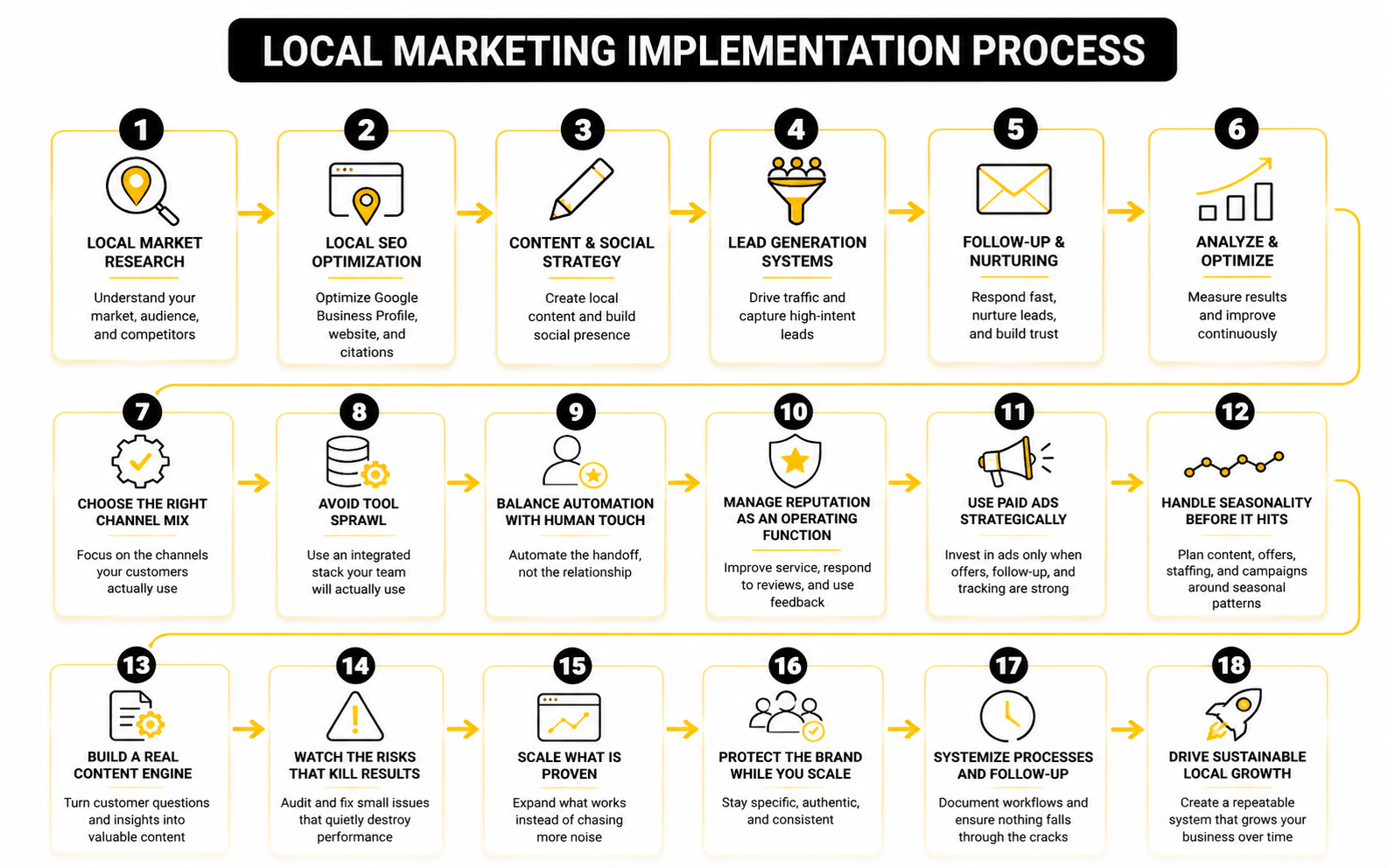
A practical local marketing process looks like this:
- Audit the current local presence.
- Fix business information, categories, hours, photos, and service details.
- Improve the website or landing page so the offer and next step are clear.
- Build a review request process for happy customers.
- Create a simple content rhythm around local buying questions.
- Add forms, booking, calls, or messaging paths based on customer behavior.
- Track every lead source and every conversion step.
- Follow up until the person books, buys, says no, or becomes inactive.
- Review performance monthly and improve the weakest part of the system.
Step 5: Keep Customers Coming Back
Retention is the part of local marketing that does not get enough attention. A customer who already bought from you is easier to reach, easier to educate, and often easier to convert again than a cold stranger. The problem is that many businesses stop marketing after the first sale.
Follow-up does not need to be annoying. It can be useful reminders, seasonal offers, maintenance prompts, loyalty perks, appointment nudges, event updates, or helpful local content. Email tools like Brevo and Moosend can help when the business has enough contacts to make regular communication worthwhile.
The best retention messages are timely and relevant. A dental clinic can remind patients about checkups. A home service company can send seasonal maintenance tips. A restaurant can promote weekday specials to nearby regulars. The channel is less important than the habit of staying useful after the first transaction.
Step 6: Measure What Actually Moves Revenue
Local marketing gets messy when the business tracks everything except the numbers that matter. Likes, impressions, and rankings can be useful signals, but they are not the end goal. Calls, direction requests, booked appointments, quote requests, walk-ins, repeat purchases, reviews, and revenue are closer to the truth.
Set up a simple monthly scorecard. Track visibility, reputation, leads, conversion rate, follow-up speed, cost per lead when paid traffic is involved, and customer retention activity. This gives you enough information to make decisions without drowning in dashboards.
The point is not perfect attribution. Local buyers move through messy paths, and some offline influence will always be hard to track. The point is to see where the system is leaking so you can fix the next bottleneck instead of guessing.
Statistics And Data
Data only matters when it changes what you do next. Local marketing is full of numbers, but most of them are distractions unless they connect to visibility, trust, conversion, retention, or revenue. The job is not to collect reports; the job is to find the weakest part of the local customer journey and improve it.
A useful measurement system should answer four practical questions. Are enough local people finding you? Do they trust you when they compare options? Are they taking action once they land on your profile, website, or offer page? Are you following up well enough to turn interest into booked appointments, visits, sales, reviews, and repeat business?
The Numbers That Actually Matter
The first group of numbers is visibility data. This includes Google Business Profile views, search terms, map appearances, website visits, local rankings, social reach, directory visibility, and branded search growth. Google explains that Business Profile performance data shows how people find a profile on Search and Maps and what actions they take afterward through views, clicks, calls, bookings, directions, and other interactions.
The second group is trust data. This includes review volume, review rating, review recency, review response rate, photo engagement, testimonial quality, and how often prospects mention reviews or proof during calls. BrightLocal’s 2025 review research shows that consumers still use reviews as a major decision signal when judging local businesses, which makes review behavior one of the clearest reputation metrics to watch.
The third group is conversion data. This includes calls, form fills, booking completions, message starts, quote requests, landing page conversion rate, cost per lead, lead-to-sale rate, and speed to lead. These numbers tell you whether your local marketing is producing real buying conversations or just surface-level attention.
Benchmarks Are Useful, But They Are Not The Goal
Benchmarks help you spot whether performance looks healthy, but they should not become the strategy. A dentist, restaurant, gym, law firm, med spa, roofer, and local agency will all have different search demand, sales cycles, margins, and customer behavior. Comparing them too directly creates bad decisions.
Use benchmarks as a diagnostic tool, not a scoreboard. If your Google Business Profile gets plenty of views but few calls, the issue may be offer clarity, review quality, photos, categories, or how your profile compares against nearby competitors. If your website gets local traffic but few leads, the issue may be page speed, weak calls to action, unclear service pages, poor proof, or too much friction in the form.
This is why local marketing data should always be interpreted in context. A low number is not automatically bad, and a high number is not automatically good. What matters is whether the number moves the business closer to revenue.
Build A Simple Local Marketing Scorecard
A local marketing scorecard should be simple enough to review every month. If it needs a data analyst to understand, most local teams will stop using it. Keep it practical, visible, and tied to actions.
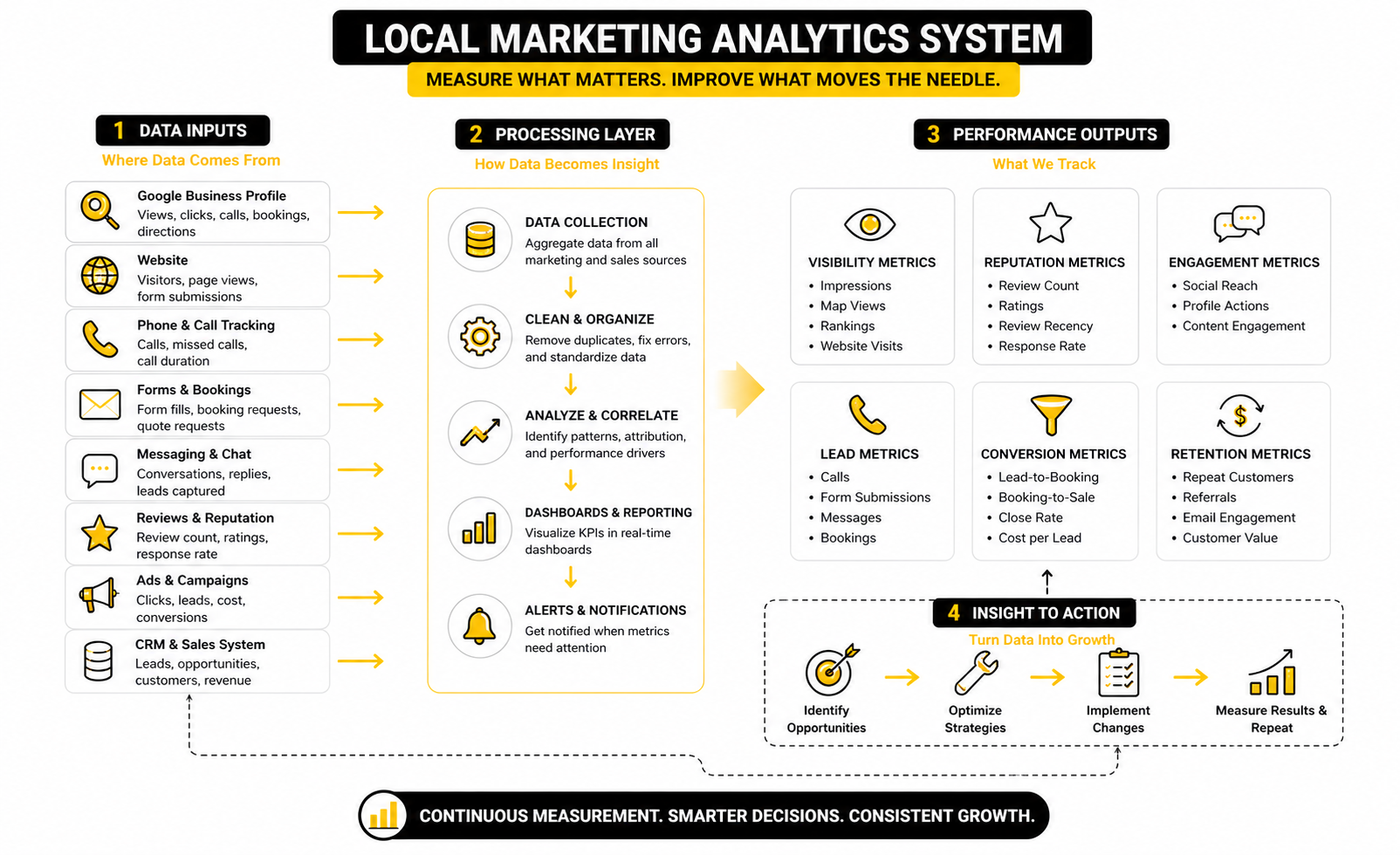
Track these core performance signals:
- Local visibility: search impressions, map views, local ranking movement, website visits, and social reach.
- Reputation strength: review count, average rating, review recency, review response rate, and customer photo activity.
- Lead generation: calls, forms, messages, bookings, direction requests, and quote requests.
- Conversion quality: lead-to-booking rate, booking-to-sale rate, close rate, show-up rate, and average order value.
- Follow-up performance: response time, contact rate, appointment reminders, nurture sequence engagement, and reactivation results.
- Retention: repeat purchase rate, referral volume, loyalty activity, email engagement, and review generation after service.
This scorecard keeps the conversation grounded. Instead of asking, “Did marketing work?” you can ask, “Where did the customer journey improve, and where did it leak?” That is a much better way to run local marketing because it turns analytics into decisions.
What Google Business Profile Data Tells You
Google Business Profile data is one of the most useful starting points because it sits close to local buying intent. Profile views show discovery. Calls, direction requests, website clicks, bookings, and messages show action. Search terms show how customers describe their needs before they know which business to choose.
Do not judge profile performance from views alone. A profile with fewer views but more calls may be healthier than a profile with lots of passive exposure. The real question is whether the profile attracts relevant local searches and turns them into measurable actions.
Look for patterns over time. If direction requests rise on weekends, the business may need stronger weekend offers or updated hours. If calls rise but bookings do not, the problem may be phone handling or appointment availability. If website clicks rise but form submissions stay flat, the website needs work.
What Website And Landing Page Data Tells You
Your website should explain, prove, and convert. Analytics can show whether people arrive from local search, paid campaigns, social posts, email, or referral links, but the deeper question is what they do after they arrive. Pages with high local traffic and low action usually need clearer offers, stronger proof, faster loading, or a simpler path to contact.
For campaigns, dedicated landing pages are often easier to measure than sending everyone to the homepage. A local gym promoting a trial, a clinic promoting consultations, or a contractor promoting inspections can track one offer, one audience, and one conversion path. Tools like ClickFunnels, Systeme.io, and Replo can fit when the business needs offer-specific pages instead of a full site rebuild.
The most important website metric is not traffic. It is qualified action. A page that gets 300 visits and produces 30 real leads is better than a page that gets 3,000 visits and produces noise.
What Lead And Sales Data Tells You
Lead data connects marketing to money. You need to know where leads came from, how quickly they were contacted, how many booked, how many showed up, how many bought, and how much revenue they produced. Without that chain, local marketing becomes guesswork.
This is where a CRM matters. A business using GoHighLevel or Copper can track pipeline stages, follow-up tasks, booked appointments, and lead sources in one place. That makes it easier to see whether the problem is traffic, conversion, sales handling, or follow-up.
Response speed is especially important for high-intent local leads. If someone requests a quote from three businesses and only one replies quickly, the fastest competent option often wins. Your analytics should expose slow follow-up because slow follow-up quietly kills campaigns that otherwise look successful.
What Review Data Tells You
Reviews are not just reputation signals. They are customer language. The words people use in reviews tell you what they value, what they feared before buying, what surprised them, and why they would recommend the business.
Read reviews for patterns, not just ratings. If customers repeatedly praise speed, friendliness, cleanliness, communication, expertise, or transparency, those themes should appear in your website copy, Google profile, ads, and social posts. If customers repeatedly mention confusion, delay, pricing concerns, or missed expectations, that is operational feedback, not just marketing feedback.
Review data should also drive timing. Ask too early and the customer may not feel ready. Ask too late and the emotional peak has passed. The best process asks when the outcome is fresh and the customer has a clear reason to say yes.
What Social And Email Data Tells You
Social metrics are easy to misread. Likes and reach are useful signals, but they do not prove revenue by themselves. In local marketing, social media is most valuable when it creates familiarity, shows proof, answers objections, and moves people into a clearer action path.
Track saves, comments, profile visits, message starts, link clicks, and offer responses more seriously than vanity engagement. A post that gets fewer likes but brings in qualified messages may be stronger than a viral post that attracts people outside your service area. Tools like Buffer and Flick Social can help keep publishing consistent, but the content still needs a clear business purpose.
Email data should be judged by relationship quality. Opens, clicks, replies, bookings, repeat purchases, and reactivation results all matter. If your email list contains past customers and warm leads, even a modest campaign can outperform colder channels because the trust gap is smaller.
How To Turn Data Into Action
The best local marketing review is brutally practical. Pick one bottleneck per month and fix it. Do not try to rebuild everything at once unless the system is completely broken.
Use this decision flow:
- If visibility is low, improve local SEO, profile completeness, local content, citations, and distribution.
- If visibility is high but action is low, improve reviews, photos, offers, calls to action, and landing pages.
- If leads are coming in but sales are low, improve follow-up speed, scripts, qualification, reminders, and sales process.
- If sales are happening but repeat revenue is weak, improve email, SMS, loyalty, referrals, and seasonal campaigns.
- If reporting is unclear, fix tracking before spending more money.
Data should make the next move obvious. That is the standard. If a report looks impressive but does not help you decide what to improve, it is decoration, not analytics.
Professional Implementation And Scaling
Local marketing gets more complicated when it starts working. More leads come in, more channels need attention, more customers expect fast replies, and more people inside the business touch the customer journey. That is a good problem, but it becomes expensive if the system is not built to handle growth.
The goal is not to do more marketing forever. The goal is to build a local marketing operation that can grow without creating chaos. That means better processes, clearer ownership, stronger tracking, tighter offers, and fewer disconnected tools.
Choose The Right Channel Mix
A local business does not need to be active on every platform. It needs to be strong where customers actually make decisions. For many businesses, that means Google Search, Google Maps, reviews, a conversion-focused website, email or SMS follow-up, and one or two social platforms that match the audience.
Channel choice should follow customer behavior, not trends. If buyers compare providers on Google, local SEO and reviews deserve serious attention. If the business is visual, social proof and short-form content may matter more. If the sales cycle is longer, email, reminders, and CRM follow-up become more important.
BrightLocal’s SMB research found that cost holds 36% of small and medium businesses back from investing in marketing channels, so spreading the budget too thin is not harmless. Every channel needs enough attention to work. Half-building five channels is usually worse than building two channels properly.
Avoid Tool Sprawl
Tool sprawl happens when every problem gets solved with another subscription. One tool handles forms, another handles booking, another handles email, another handles reviews, another handles CRM, and nobody knows where the truth lives. At first, this feels flexible. Later, it becomes a reporting and follow-up mess.
A better approach is to decide what the operating system should be. Some businesses will want an all-in-one platform like GoHighLevel because it can connect CRM, automation, booking, messaging, funnels, and reputation workflows. Others may prefer a lighter stack with Fillout for forms, Cal.com for scheduling, and Brevo for email.
The right stack is the one your team will actually use. If the owner, receptionist, salesperson, or manager ignores the system, the tool does not matter. Simple beats powerful when powerful becomes unused.
Protect The Brand While You Scale
Scaling local marketing can accidentally weaken the brand. A business starts posting generic content, running broad offers, using stock images, or copying competitors because it wants more output. More content is not automatically better content.
Local brands win when they feel specific. Real photos, real service areas, real customer language, real team expertise, and real local context build trust faster than polished but generic marketing. Google’s local ranking guidance still emphasizes relevance, distance, and prominence, and complete business information helps Google match businesses to relevant searches through Google Business Profile.
This is especially important for multi-location businesses. Each location needs enough local detail to feel legitimate, not like a duplicated page with a city name swapped in. Location pages should reflect services, hours, staff, photos, reviews, parking details, nearby landmarks when useful, and the actual customer experience in that area.
Balance Automation With Human Follow-Up
Automation is useful when it removes delay and prevents leads from being forgotten. It is dangerous when it makes a local business feel cold or careless. A reminder text, review request, booking confirmation, or missed-call follow-up can improve the experience. A robotic sequence that ignores context can damage trust.
The rule is simple: automate the handoff, not the relationship. Let software confirm appointments, route leads, trigger reminders, request reviews, and notify the team. Let humans handle judgment, reassurance, objections, complaints, and high-value conversations.
This is where tools like ManyChat can help when social messaging is a real lead source. A simple flow can answer common questions and collect contact details, but the business still needs a clean process for real follow-up. Automation should make the team faster, not invisible.
Manage Reputation Like An Operating Function
Reputation management is not just replying to reviews. It includes service quality, expectation setting, staff communication, review requests, complaint handling, and how quickly problems are resolved. Marketing can amplify trust, but operations create the proof.
Review patterns should be discussed inside the business, not just inside the marketing team. If customers praise speed, mention it in marketing. If customers complain about communication, fix the process before asking for more reviews. If a service gets great feedback, turn that insight into stronger website copy, offers, and sales scripts.
BrightLocal’s review research shows that consumers continue to rely on local business reviews when evaluating providers, so review quality and recency are not cosmetic metrics. They affect whether people feel safe choosing you. A business that treats reputation as an operating function will usually outperform one that treats it as a monthly marketing task.
Know When To Use Paid Ads
Paid ads are useful when the business has a clear offer, a strong follow-up process, and enough margin to support acquisition costs. They are risky when the website is weak, reviews are thin, phone handling is slow, or nobody tracks lead quality. Paid traffic exposes the system. It does not fix it.
Before scaling ads, check the basics. The landing page should match the search intent or campaign promise. The form or booking path should be easy. Calls should be answered or followed up quickly. Leads should enter a CRM, not disappear into an inbox.
For offer-specific campaigns, dedicated pages built with ClickFunnels, Systeme.io, or Replo can make testing cleaner than sending every click to a homepage. The offer, audience, message, and conversion action are easier to measure when the page has one job.
Handle Seasonality Before It Hits
Most local businesses have seasonal patterns. Demand may spike before holidays, slow down in summer, increase during tax season, change with weather, or follow local events. The mistake is reacting after the pattern is already obvious.
Seasonality should shape content, offers, staffing, inventory, and follow-up. If demand usually rises in a certain month, the campaign should start before customers feel the urgency. If demand usually drops, the business needs reactivation, referral, bundle, or loyalty campaigns ready in advance.
This is where historical data becomes useful. Look at last year’s calls, bookings, sales, cancellations, and campaign performance. Local marketing becomes more profitable when you stop treating predictable patterns like surprises.
Build A Real Content Engine
A content engine is not just posting more. It is a repeatable way to turn customer questions, objections, reviews, services, seasonal needs, and local context into useful content. The business should never be stuck wondering what to say next.
Start with the questions customers already ask before buying. Turn those into service pages, short posts, emails, videos, FAQs, comparison content, and sales enablement. Then use reviews and call notes to sharpen the language so the content sounds like the customer, not like a brochure.
Tools can speed up execution, but strategy still matters. Buffer can keep publishing organized, Flick Social can support social planning, and Wispr Flow can help turn spoken ideas into draft content faster. But the edge comes from specific insight, not from volume alone.
Watch The Risks That Quietly Kill Performance
The biggest local marketing risks are usually boring. Wrong hours. Broken forms. Slow replies. Old photos. Thin reviews. Untracked calls. Duplicate listings. Weak service pages. Generic offers. Confusing handoffs between marketing and sales.
These problems rarely look dramatic in a dashboard, but they compound. A campaign can bring in the right people and still fail because the call was missed or the landing page created doubt. A Google profile can rank well and still underperform because competitors look more trustworthy.
Run a monthly friction audit. Search for the business like a customer, click the ads, fill out the form, call the number, book an appointment, read the reviews, and inspect the follow-up. You will usually find the next improvement faster by experiencing the journey than by staring at another report.
Scale What Is Proven, Not What Is Loud
Local marketing should scale from evidence. If a service page ranks and converts, build more around that topic. If one offer brings profitable customers, test variations before inventing something new. If one neighborhood responds well, deepen the local presence before expanding everywhere.
Do not scale noise. More ads, more posts, more emails, and more automations can multiply confusion if the message is weak. The smart move is to find what is already creating qualified demand and make it easier for more local buyers to experience that path.
This is the difference between growth and chaos. Growth comes from strengthening a working system. Chaos comes from adding activity without understanding why anything works.
Local Marketing Tools, FAQs, And Next Steps
At this stage, the point is not to add more noise. A good local marketing system should feel connected, measurable, and easy enough for the team to keep using. The right tools support the process, but the process comes first.
Think of the final system as one ecosystem. Search and maps create discovery. Reviews and content build confidence. Forms, calls, booking pages, and messaging turn interest into action. CRM, email, SMS, and retention campaigns keep the relationship alive after the first click.
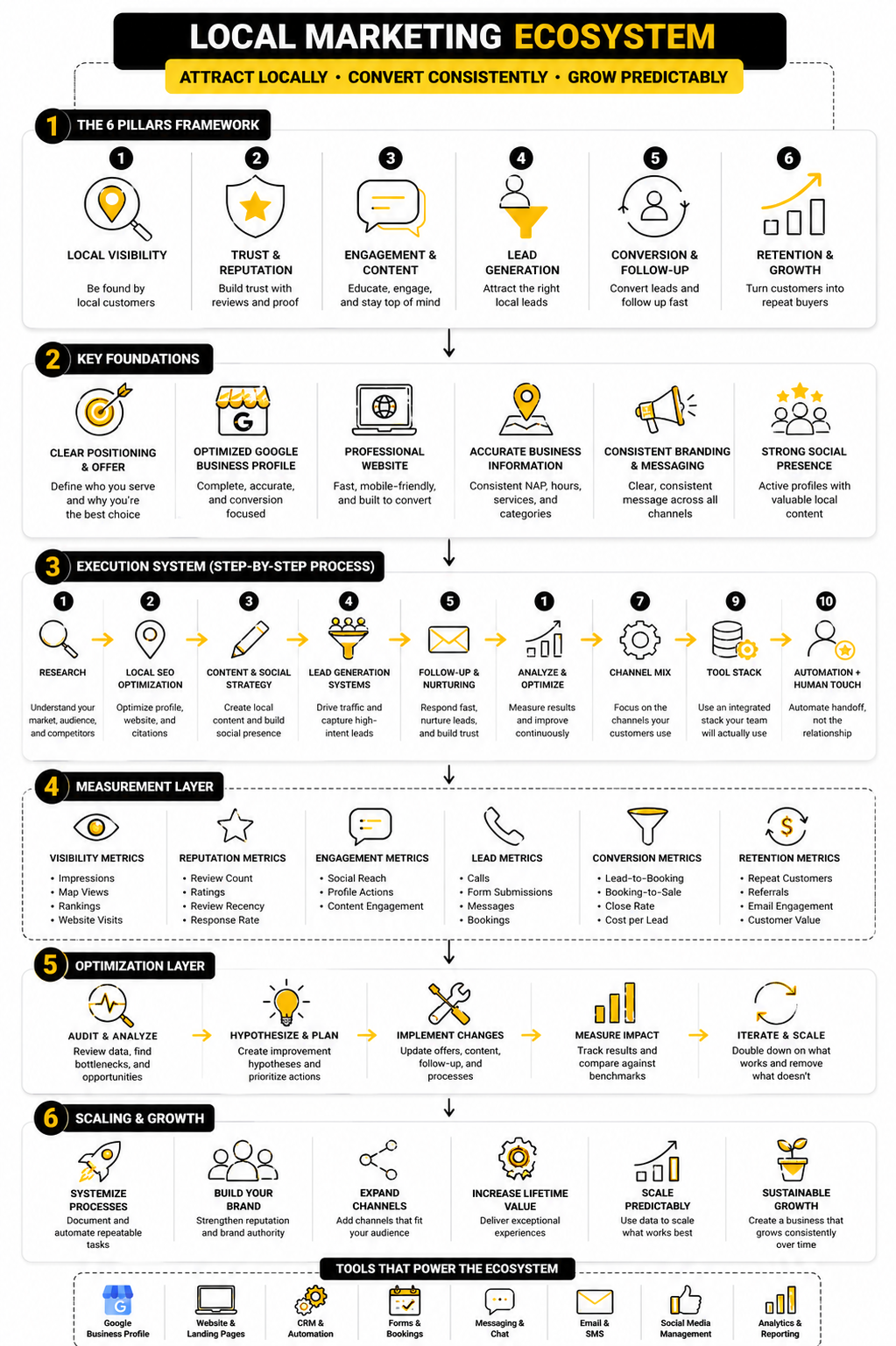
The strongest setup is usually the simplest one that covers the full customer journey. A local business might use GoHighLevel as the main operating system, Buffer for social scheduling, Brevo for email, ManyChat for social messaging, and ClickFunnels or Systeme.io for specific offers. That is enough for most businesses to build serious momentum without drowning in software.
FAQ - Built for Complete Guide
What is local marketing?
Local marketing is the process of attracting, converting, and retaining customers in a specific geographic area. It includes local SEO, Google Business Profile optimization, reviews, social media, paid ads, email, SMS, partnerships, referrals, and local content. The goal is simple: help nearby customers find you, trust you, and take action.
Why is local marketing important?
Local marketing matters because many buying decisions happen close to the moment of need. People search for nearby businesses when they want directions, appointments, quotes, availability, menus, services, or reviews. BrightLocal’s consumer search research found that 70% of general online searches happen on Google, so being visible and credible online directly affects local demand.
What is the difference between local marketing and digital marketing?
Digital marketing is broad and can target anyone online. Local marketing is more specific because it focuses on customers in a defined area. That changes the strategy because location, reviews, maps, service areas, opening hours, local proof, and nearby intent become much more important.
What are the most important local marketing channels?
The most important channels are usually Google Search, Google Maps, your website, reviews, email or SMS follow-up, and the social platforms your customers actually use. Some businesses also benefit from paid search, local partnerships, community sponsorships, and referral campaigns. The right mix depends on how customers choose your type of business.
How do reviews affect local marketing?
Reviews help customers decide whether they can trust you. They also give prospects real language from other buyers, which often feels more believable than brand copy. BrightLocal’s review research shows that consumers continue to use local business reviews when evaluating providers, so review volume, quality, recency, and responses all matter.
How often should a local business post on social media?
A local business should post often enough to stay visible without sacrificing quality. For many businesses, three to five useful posts per week is more realistic than daily posting forever. A tool like Buffer can help keep the rhythm consistent, but the content still needs to show proof, answer questions, and support real offers.
Should local businesses use paid ads?
Paid ads can work well when the business has a clear offer, strong reviews, a useful landing page, and fast follow-up. They are risky when the customer journey is weak because ads simply send more people into a broken system. Before increasing ad spend, make sure calls, forms, booking links, and lead tracking actually work.
What should a local marketing dashboard include?
A useful dashboard should track visibility, trust, leads, conversions, follow-up, and retention. That means local search impressions, calls, direction requests, website clicks, form fills, bookings, reviews, close rate, response time, repeat purchases, and referral activity. Google’s Business Profile performance reporting shows customer interactions such as views, clicks, calls, bookings, and directions, which makes it a practical starting point.
How long does local marketing take to work?
Some parts can work quickly, especially paid ads, offer pages, missed-call follow-up, review requests, and reactivation campaigns. Local SEO, reputation building, content, and organic trust usually take longer because they compound over time. The best approach is to combine short-term conversion fixes with long-term visibility and reputation work.
What is the biggest local marketing mistake?
The biggest mistake is treating local marketing as disconnected tasks. Posting, running ads, collecting reviews, updating Google, and sending emails are not enough if they do not connect to one customer journey. The business needs a system that moves people from discovery to trust, action, follow-up, and repeat purchase.
Do small businesses need a CRM for local marketing?
A CRM becomes important as soon as leads can be missed, delayed, forgotten, or mishandled. Even a small business needs a clear place to track who contacted them, what they wanted, where they came from, and what happens next. Tools like GoHighLevel or Copper can help when the team needs better lead visibility and follow-up control.
How can a local business get more repeat customers?
Repeat customers come from good service plus consistent follow-up. Send useful reminders, seasonal offers, loyalty updates, referral prompts, and relevant education after the first purchase. Email tools like Brevo or Moosend can support that without making the process heavy.
What should a local business improve first?
Start with the point closest to revenue. If people cannot find you, improve visibility. If people find you but do not trust you, improve reviews, photos, proof, and service pages. If people trust you but do not act, improve offers, calls to action, forms, booking, and follow-up.
Work With Professionals
Explore 10K+ Remote Marketing Contracts on MarkeWork.com
Most marketers spend too much time chasing clients, competing on crowded platforms, and losing a percentage of every project to middlemen.
MarkeWork gives you a better way. Browse thousands of remote marketing contracts and connect directly with companies desperate to hire skilled marketers like you, without platform commissions and without unnecessary gatekeepers.
If you're serious about finding better opportunities and keeping 100% of what you earn, explore available contracts and create a profile for free at MarkeWork.com.