

A mail campaign is a planned sequence of emails sent to a defined audience with a clear business goal. That goal might be sales, onboarding, retention, event attendance, lead nurturing, or reactivation. The important word is planned, because random emails are not a campaign.
Email is still one of the few channels where you can speak directly to people who gave you permission to contact them. But the bar is higher now. Gmail, Yahoo, and Microsoft have all tightened sender requirements around authentication, complaint rates, and easy unsubscribes, which means a strong mail campaign has to combine strategy, relevance, and deliverability from the start: Google sender requirements, Yahoo sender best practices, and Microsoft high-volume sender requirements.
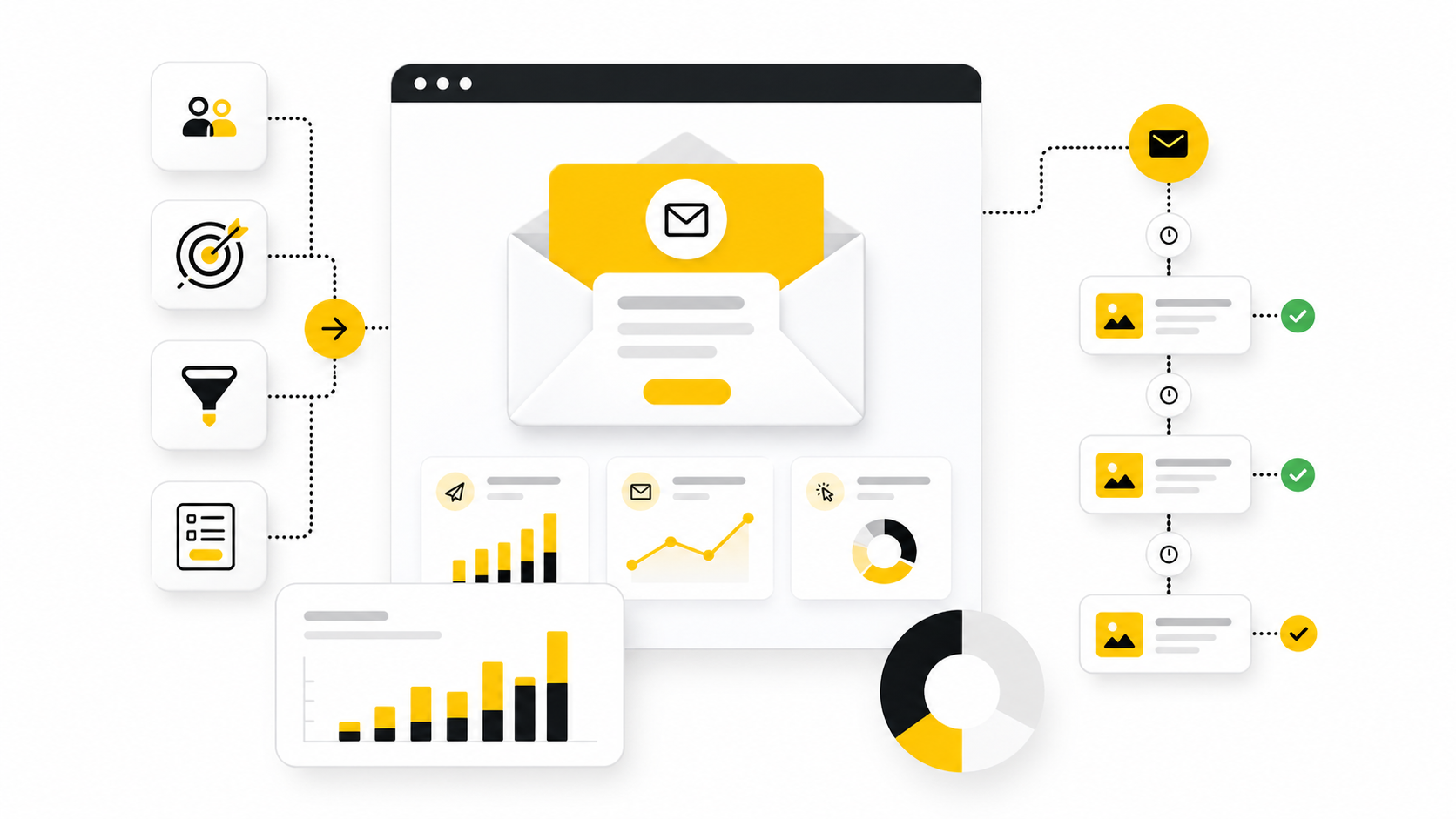
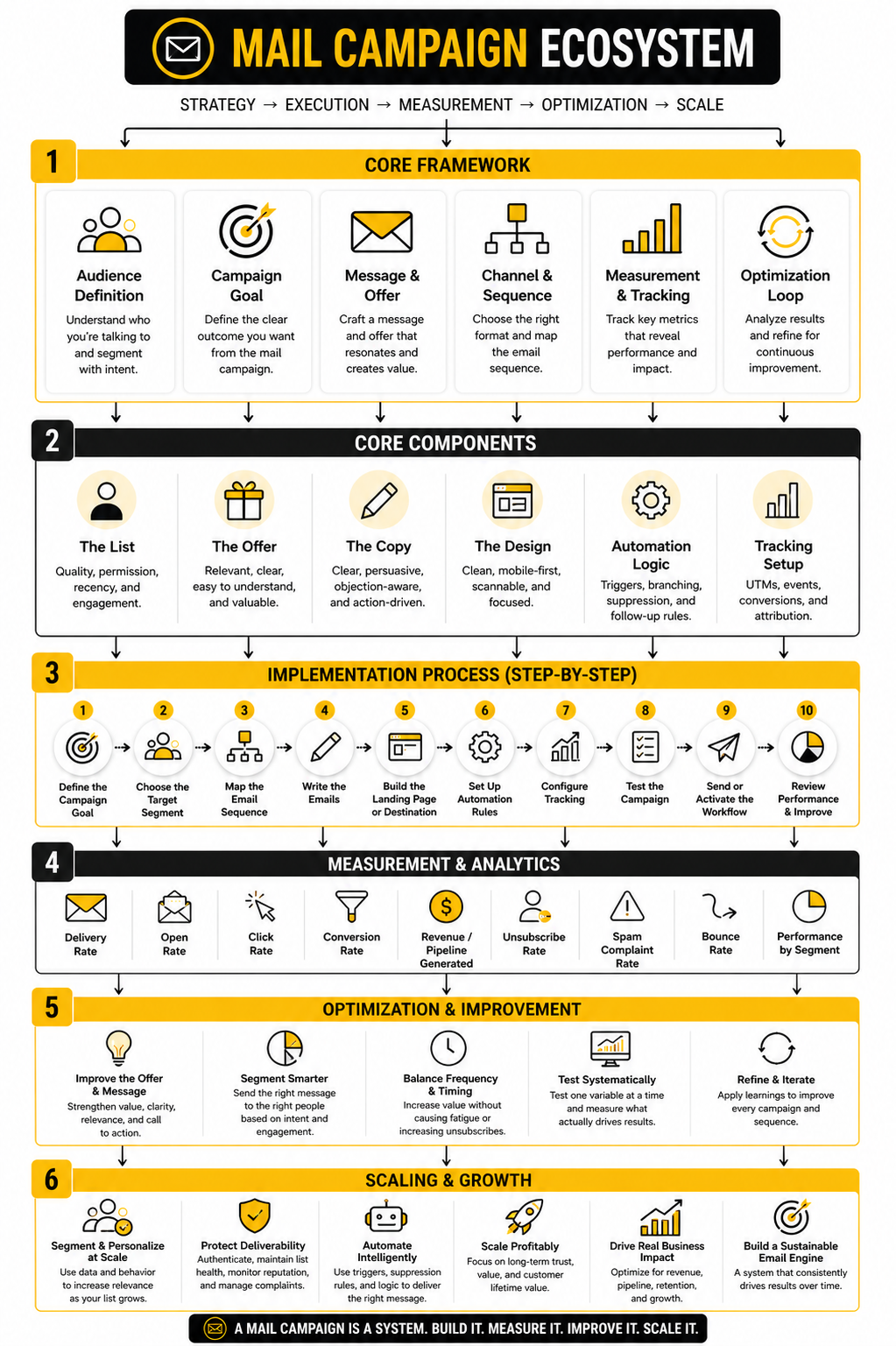
This guide will break the full process into six connected parts. We will move from the business reason behind a mail campaign, into the framework, the assets, the implementation, the measurement process, and finally the FAQ.
- Part 1: Why A Mail Campaign Still Matters
- Part 2: The Mail Campaign Framework
- Part 3: Core Components Of A High-Performing Mail Campaign
- Part 4: Building The Campaign From Strategy To Send
- Part 5: Measuring, Improving, And Scaling Results
- Part 6: Mail Campaign FAQ
Why A Mail Campaign Still Matters
A good mail campaign gives you control that rented channels do not. Social reach can drop overnight, ad costs can change without warning, and search behavior keeps shifting as AI answers become more common. Your email list is not magic, but it is a direct relationship with people who have already shown interest.
That direct relationship matters because email can support every stage of the customer journey. You can welcome new subscribers, educate leads, recover abandoned carts, announce offers, ask for feedback, and keep existing customers engaged without starting from zero each time. The channel works best when it feels useful instead of noisy.
The big mistake is treating a mail campaign like a one-off blast. A campaign should have a clear audience, a clear promise, a clear sequence, and a clear next action. When those pieces are missing, even a large list can underperform.
Framework Overview
A strong mail campaign has four layers: audience, message, timing, and measurement. Audience decides who should receive the emails. Message decides what they need to hear. Timing decides when they should hear it. Measurement decides what to improve next.
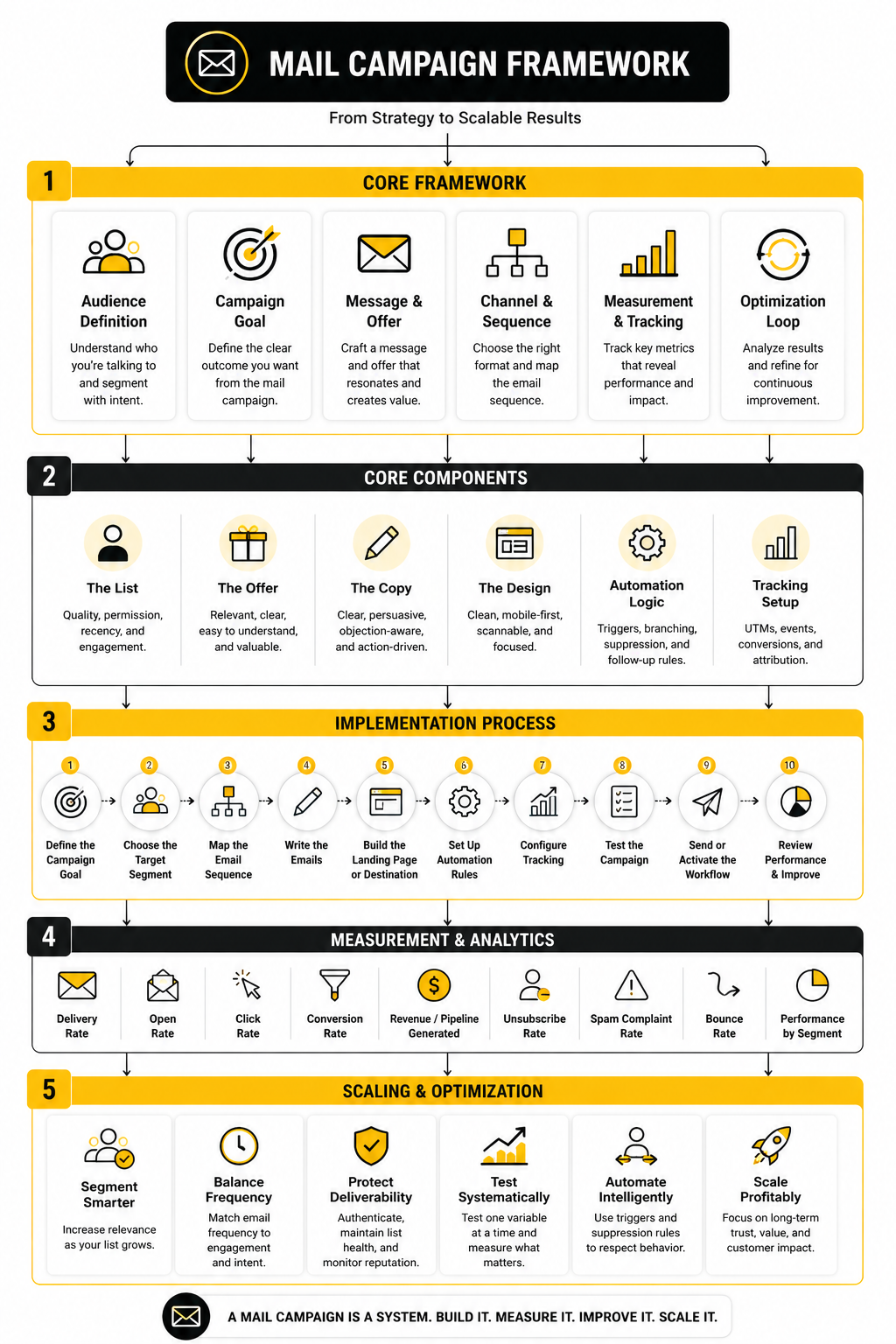
This framework keeps the campaign practical. Instead of obsessing over one subject line or one design choice, you look at the whole system. That is where better results usually come from.
The rest of this article will use this same structure. We will start with the strategic foundation, then move into the components, execution, optimization, and common questions.
The Mail Campaign Framework
A mail campaign works best when it is built like a system, not a single send. Before writing subject lines or choosing templates, you need to know who the campaign is for, what action you want, and what has to happen before someone is ready to act. That sounds basic, but it is where most weak campaigns break.
The practical framework is simple:
- Audience
- Goal
- Message
- Sequence
- Delivery
- Measurement
Each layer supports the next one. If the audience is unclear, the message gets vague. If the goal is unclear, the call to action feels random. If delivery is ignored, even a strong campaign can disappear into spam or promotions.
Audience
The audience is the first decision because a mail campaign is only persuasive when it feels relevant. A new subscriber, a warm lead, an inactive customer, and a recent buyer should not receive the same message. They have different levels of trust, different objections, and different reasons to care.
Start by segmenting based on behavior before demographics. Someone who clicked a pricing page is showing stronger intent than someone who only downloaded a free checklist. Someone who bought once but has not returned in six months needs a different angle than someone who just joined your list yesterday.
This is also where modern personalization matters. Personalization is not just using a first name in the subject line. Strong campaigns use signals like purchase history, page visits, content interests, lifecycle stage, and engagement patterns to make the next email feel timely and useful.
Goal
Every mail campaign needs one primary goal. Not five goals. One. The goal might be to book a call, sell a product, register people for a webinar, recover abandoned carts, or move leads toward a sales conversation.
A single goal makes every creative decision easier. The subject line should support the goal. The body copy should support the goal. The call to action should support the goal. When an email tries to educate, sell, survey, announce, and upsell all at once, the reader has to do too much work.
The goal should also match the audience’s readiness. A cold lead may need a useful educational sequence before seeing a direct offer. A repeat customer may be ready for a loyalty offer or product recommendation much sooner. Good campaign strategy respects the stage the reader is actually in.
Message
The message is the argument your campaign makes over time. It should answer three questions clearly: why this matters, why now, and why this next step is worth taking. If those answers are weak, better design will not save the campaign.
Strong messaging usually starts with the customer’s problem, not the product. The reader should quickly recognize that you understand what they are trying to achieve or avoid. Then you can connect that problem to the offer, resource, product, service, or action your campaign is built around.
This is where clarity beats cleverness. A mail campaign does not need to sound dramatic to work. It needs to make the next step feel obvious, valuable, and low-friction.
Sequence
Most campaigns need more than one email because most decisions do not happen instantly. A sequence gives you room to build context, handle objections, show value, and remind people without cramming everything into one message. That is especially important for higher-ticket offers, B2B services, events, and products with longer consideration cycles.
A simple sequence might include:
- A welcome or context-setting email
- A value email that teaches or explains
- A proof email that builds confidence
- An offer email with a clear call to action
- A reminder email for people who did not act
The sequence should feel like a conversation, not a pile of disconnected messages. Each email should move the reader one step closer to the goal. If an email does not have a job, remove it.
Delivery
Delivery is the technical layer that decides whether your campaign actually reaches people. This includes authentication, sender reputation, complaint rates, unsubscribe handling, and list quality. It is not glamorous, but it is non-negotiable.
Google’s sender guidelines require proper authentication, low spam complaint rates, and easy unsubscribe options for bulk senders reaching personal Gmail accounts: Google email sender guidelines. Yahoo also emphasizes authentication, low complaints, and subscriber-first sending practices in its sender guidance: Yahoo sender best practices. Microsoft has also moved toward stricter requirements for high-volume senders, including SPF, DKIM, DMARC, and unsubscribe expectations: Microsoft sender requirements.
This means a professional mail campaign is not only a copywriting project. It is also a trust project. Clean lists, clear permission, useful content, and proper authentication all work together to protect performance.
Measurement
Measurement turns a mail campaign from a guess into a repeatable asset. You need to know what happened after the send, where people dropped off, and what should change next time. Opens can still be useful directionally, but clicks, replies, conversions, revenue, bookings, and unsubscribe behavior tell you much more.
Benchmarks can help you sanity-check performance, but they should not become the strategy. Mailchimp’s benchmark data is useful for comparing broad industry patterns: Mailchimp email marketing benchmarks. MailerLite’s 2025 benchmark report also shows how performance varies by industry, region, and campaign type: MailerLite email marketing benchmarks.
The real win is building your own baseline. Once you know your normal click rate, conversion rate, reply rate, and revenue per send, every campaign becomes easier to improve. That is how email stops being random activity and becomes a dependable growth channel.
Core Components Of A High-Performing Mail Campaign
A mail campaign becomes much easier to build when you separate the moving parts. You are not just writing emails. You are creating a path from attention to trust to action, and every component has to support that path.
The core components are the list, the offer, the copy, the design, the automation logic, and the tracking setup. If one of those pieces is weak, the campaign can still run, but it will usually leak performance somewhere. The goal is not perfection before launch. The goal is a clean, controlled system you can actually improve.
The List
The list is the foundation because it decides who receives the campaign in the first place. A smaller list of people who asked to hear from you will usually beat a larger list of people who barely remember signing up. Permission, recency, and engagement matter more than raw subscriber count.
Before launching a mail campaign, clean the segment you plan to use. Remove invalid addresses, suppress people who have unsubscribed, and avoid repeatedly sending to contacts who have ignored you for a long time. Yahoo’s sender guidance specifically pushes senders to remove invalid recipients quickly and manage complaints through feedback loops where available: Yahoo sender best practices.
List quality also affects deliverability. Google recommends SPF, DKIM, and DMARC authentication for sending domains, and bulk senders have to meet stricter requirements around authentication and unsubscribe handling: Google email sender guidelines. So yes, your list is a marketing asset, but it is also a reputation asset.
The Offer
The offer is the reason someone should take action now. It could be a discount, consultation, webinar, free trial, product launch, downloadable resource, renewal reminder, or simple next step in a sales process. The format matters less than the fit between the offer and the audience.
A strong offer has three qualities. It is relevant to the segment. It is easy to understand. It gives the reader a clear reason to act without feeling manipulated. If the reader has to decode what is being offered, the campaign is already working too hard.
For service businesses and agencies, the offer might be a booked call or audit. For ecommerce, it might be a product recommendation, bundle, or replenishment reminder. For creators and course businesses, it might be a training, workshop, or limited enrollment window.
The Copy
The copy turns the offer into a clear argument. It should explain the problem, show the value, reduce friction, and guide the reader to one next step. Good email copy is not about sounding clever. It is about making the decision feel simple.
Start each email with the reader’s context. What are they likely thinking about? What do they already know? What objection might stop them from clicking? When the copy meets the reader where they are, the message feels helpful instead of pushy.
Keep the call to action specific. “Learn more” can work, but it is often weaker than a CTA that tells people exactly what happens next. “Book your demo,” “Start the free trial,” “See the campaign workflow,” or “Get the checklist” usually creates a cleaner expectation.
The Design
Email design should make the message easier to act on, not harder to read. A beautiful layout that buries the point is still a weak campaign. The best design choices support scanning, clarity, mobile readability, and fast loading.
Use hierarchy deliberately. The subject line earns the open, the headline confirms relevance, the body builds the case, and the button or link makes the next step obvious. If every element is competing for attention, nothing stands out.
For simple campaigns, plain-text or lightly designed emails can work extremely well. For ecommerce or product-led campaigns, visuals may matter more because people need to see what they are considering. The right choice depends on the audience, offer, and decision being asked for.
The Automation Logic
Automation is where a mail campaign becomes responsive. Instead of sending every contact the same fixed path, you can branch based on behavior. A person who clicks the offer can receive a different follow-up than someone who never opens, and a buyer can be removed from the sales sequence automatically.
This is especially useful when the campaign supports a funnel, booking process, or customer journey. Tools like GoHighLevel, Brevo, and Moosend can help manage sequences, segmentation, and follow-up rules in one place. The tool does not replace the strategy, but it makes the strategy easier to execute consistently.
The automation logic should stay simple at first. Trigger the right message, suppress the wrong people, and avoid sending unnecessary emails after someone converts. Complexity is only useful when it improves the customer experience.
Building The Campaign From Strategy To Send
Once the components are clear, the process becomes much more practical. You move from strategy into assets, then from assets into setup, testing, sending, and review. This is the point where the mail campaign stops being an idea and becomes an operating workflow.
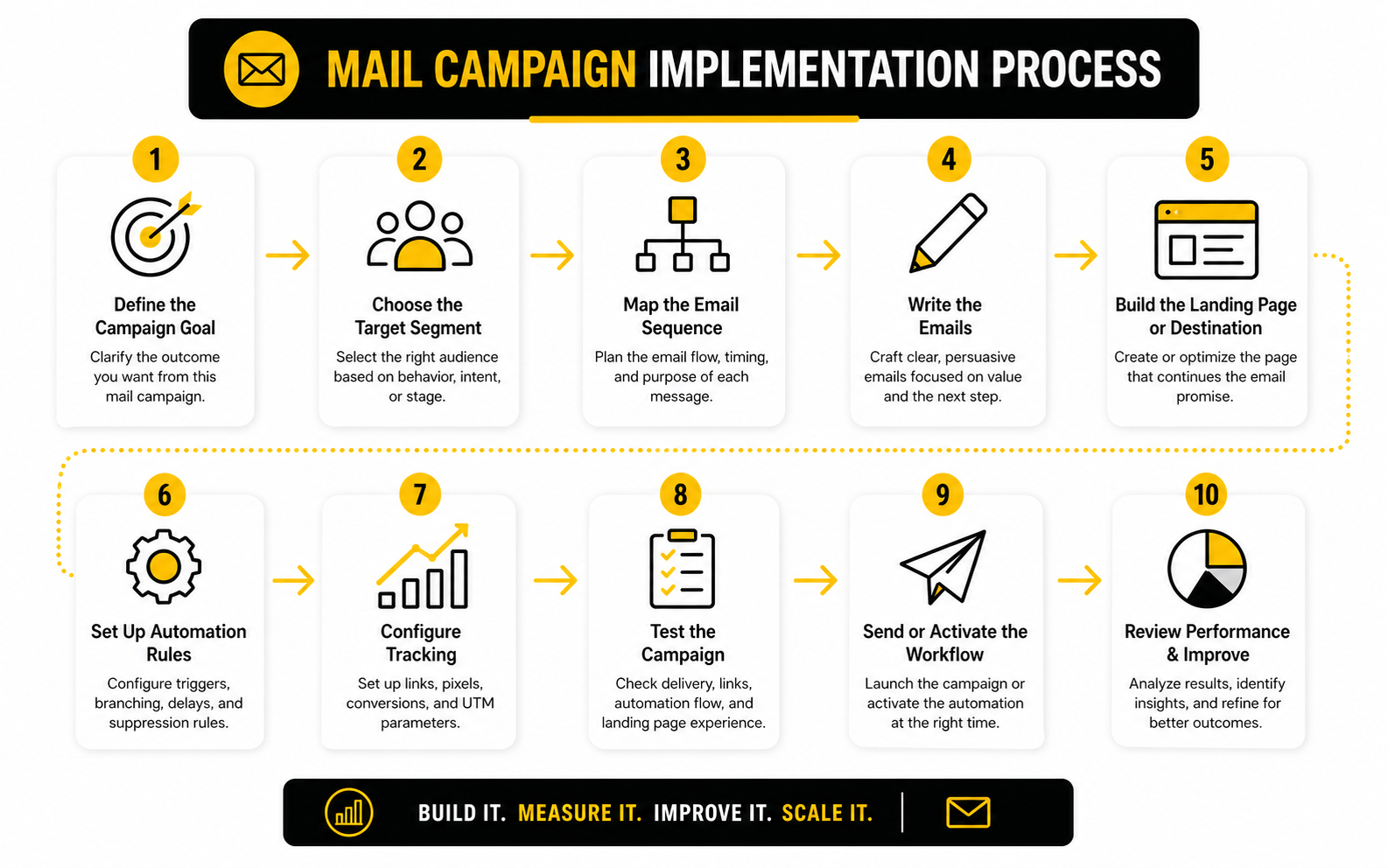
The easiest way to keep the build under control is to work in order:
- Define the campaign goal.
- Choose the target segment.
- Map the email sequence.
- Write the emails.
- Build the landing page or next-step destination.
- Set up automation rules.
- Configure tracking.
- Test the campaign.
- Send or activate the workflow.
- Review performance and improve the next version.
This order prevents wasted work. There is no point designing a beautiful email before the offer is clear. There is no point building automation rules before the sequence is mapped. There is no point sending traffic to a page that does not match the promise made in the email.
Map The Sequence Before Writing
Before writing individual emails, map the full sequence in plain language. Write down what each email is supposed to do, who receives it, when it sends, and what action it encourages. This makes the campaign easier to review before anyone gets lost in details.
A simple campaign map might say: email one introduces the problem, email two explains the solution, email three handles objections, email four makes the offer, and email five reminds non-clickers before the deadline. That is enough structure to start writing with purpose. You do not need a complicated diagram to make a professional campaign.
This step also helps prevent repetition. If three emails are making the same point, the sequence is probably too thin. Each email should earn its place by moving the reader forward in a slightly different way.
Build The Destination Before Launch
Every campaign needs a destination. That might be a checkout page, booking calendar, webinar registration page, product page, lead form, or reply-based sales process. The destination has to match the promise in the email.
If the email says “book a quick strategy call,” the landing page should make booking obvious. If the email promotes a product, the product page should reinforce the same value angle. If the email invites people to a training, the registration page should clearly explain what they will learn and when it happens.
This is where tools like ClickFunnels, Systeme.io, and Replo can be useful when the campaign needs a dedicated page, funnel, or product landing experience. The key is not the platform itself. The key is keeping the email promise and the page experience aligned.
Test Before You Send
Testing is not optional. Send test emails to yourself, check desktop and mobile formatting, click every link, confirm tracking parameters, and make sure the unsubscribe link works. Also check that the right people are included and the wrong people are excluded.
Authentication should be reviewed before larger sends. SPF, DKIM, and DMARC are now baseline requirements for serious email programs, not advanced extras. If those records are missing or misconfigured, the campaign can suffer before the copy even gets a chance.
Finally, test the full user journey. Click from the email to the destination, submit the form, book the call, complete the purchase, or trigger the next automation step. A mail campaign is only ready when the full path works from the subscriber’s point of view.
Statistics And Data
A mail campaign should be measured like a business system, not a popularity contest. Opens, clicks, replies, conversions, unsubscribes, spam complaints, and revenue all tell different parts of the story. The mistake is looking at one number in isolation and pretending it explains everything.
Benchmarks are useful, but only as context. MailerLite’s 2025 benchmark report analyzed more than 3.6 million campaigns from 181,000 approved accounts and shows median performance across open rate, click rate, click-to-open rate, and unsubscribe rate: MailerLite email marketing benchmarks. Klaviyo’s benchmark data is especially useful for ecommerce because it separates campaign performance from flows like welcome series, abandoned cart, browse abandonment, and winback emails: Klaviyo ecommerce benchmarks.
The point is not to chase a universal “good” number. A newsletter, abandoned cart flow, cold reactivation campaign, webinar invite, and product launch email will naturally perform differently. Your job is to understand what each number says about the campaign stage it belongs to.
Open Rate Shows Attention, Not Revenue
Open rate tells you whether your sender name, subject line, preview text, and timing created enough curiosity for someone to open. It is useful, but it is not clean enough to be the main success metric. Privacy changes, image loading behavior, and inbox filtering can all distort open tracking.
That does not mean open rate is useless. It still helps you compare campaigns sent to similar audiences under similar conditions. If one subject line consistently beats another inside the same list segment, you have a useful signal.
The action is simple. Use open rate to improve positioning, timing, and subject lines, but do not declare a mail campaign successful just because opens look strong. If people open but do not click, reply, book, buy, or continue the journey, the campaign has attention without momentum.
Click Rate Shows Message Fit
Click rate is usually a stronger signal than open rate because it shows that the email created enough interest for someone to take the next step. It reflects the quality of the offer, the clarity of the message, and the strength of the call to action. When click rate is weak, the issue is often relevance, not button color.
Brevo’s 2025 benchmark overview highlights how much email engagement can vary by industry and channel mix, which is why broad averages should be treated carefully: Brevo email marketing benchmarks. A high-intent segment should usually produce better click behavior than a broad newsletter list. A campaign to recent buyers should not be judged against a cold reactivation send.
The action here is to review the promise and the path. If clicks are low, tighten the audience, make the offer more specific, reduce competing links, and make the next step obvious. One clear CTA usually beats a menu of half-related options.
Conversion Rate Shows Business Impact
Conversion rate is where the mail campaign proves whether it can create the outcome it was built for. A conversion might be a purchase, booked call, demo request, webinar registration, reply, application, or renewal. The metric depends on the goal, but the logic is always the same: did the campaign move people to the intended action?
This is where many teams misread performance. A campaign can have a modest click rate but still produce strong revenue if the audience is qualified and the offer is high-value. Another campaign can generate lots of clicks but weak results if the landing page, checkout, form, or calendar creates friction.
The action is to measure the full journey, not just the email. Track the email click, the landing page view, the form start, the form completion, the purchase, and the follow-up result where possible. A mail campaign does not end at the click.
Unsubscribes And Complaints Show Trust
Unsubscribes are not automatically bad. Some people leaving your list is normal, and a clean list is better than a large list full of people who no longer want your emails. Spam complaints are different. They are a stronger warning that the campaign may be misaligned, too aggressive, or being sent to people who did not clearly expect it.
Google’s sender guidance for bulk senders emphasizes keeping spam complaint rates low and making unsubscribes easy: Google email sender guidelines. Yahoo’s sender guidance also focuses on authentication, complaint management, and list hygiene: Yahoo sender best practices. These are not minor technical details. They protect whether your future emails reach the inbox.
The action is to watch negative signals after every send. If unsubscribes rise, check whether the campaign promise matched the subscriber’s expectations. If complaints rise, pause and review consent, targeting, frequency, and message tone before scaling.
Revenue Per Recipient Shows Efficiency
Revenue per recipient is one of the cleanest ecommerce metrics because it connects email performance to money without overvaluing vanity metrics. It tells you how much revenue each recipient generated on average. That makes it easier to compare segments, flows, and campaign types.
For ecommerce brands, benchmark reports from platforms like Klaviyo are useful because they separate automated flows from manual campaigns: Klaviyo benchmark report. A welcome series and an abandoned cart flow usually behave differently because the customer intent is different. Treating them as the same type of campaign leads to bad decisions.
The action is to compare like with like. Measure promotional campaigns against other promotional campaigns. Measure abandoned cart against abandoned cart. Measure winback against winback. That gives you data you can actually use.
The Dashboard Should Lead To Decisions
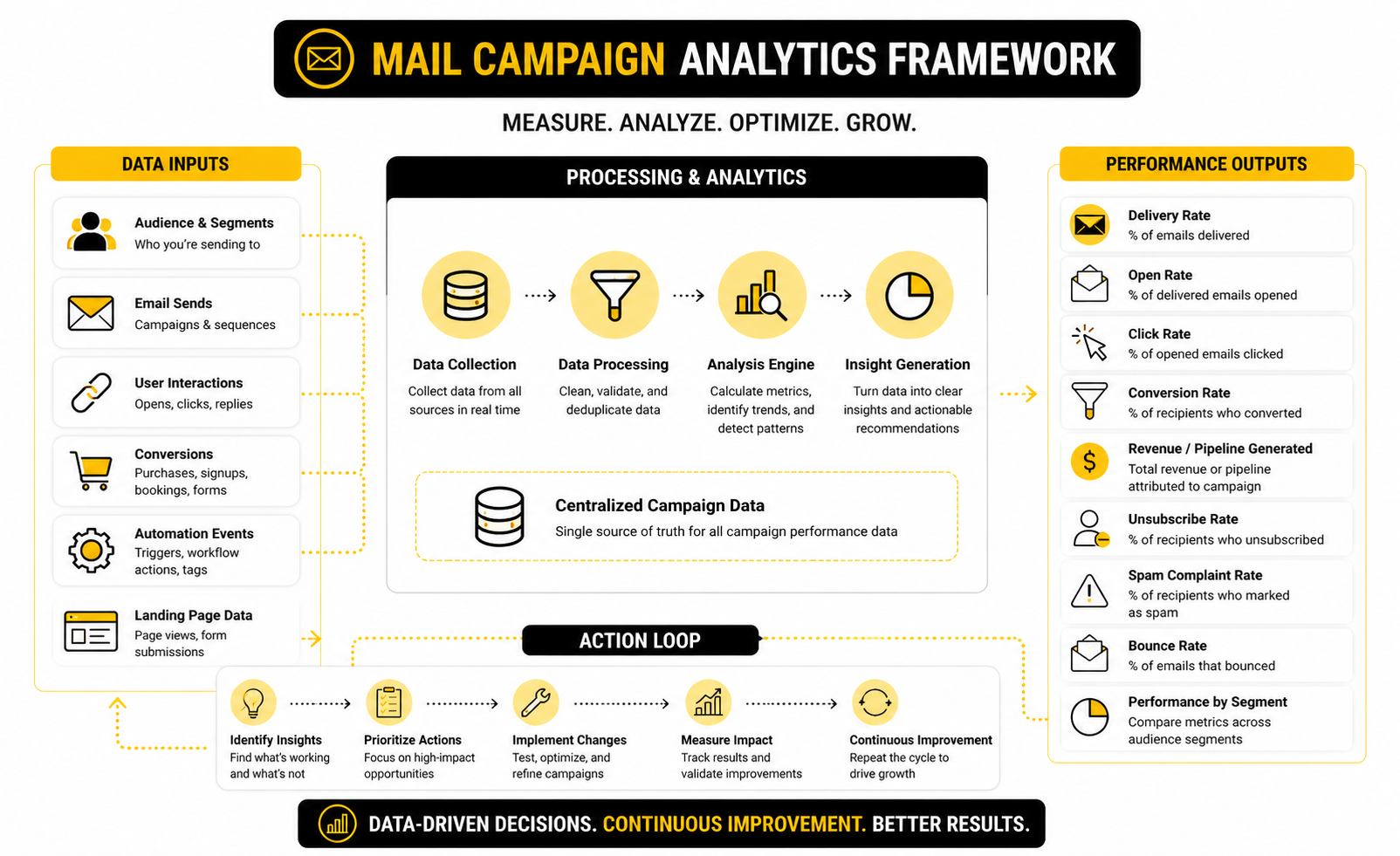
A good analytics setup should answer four questions quickly. Who received the campaign? What did they do? Where did they drop off? What should change next? If your dashboard cannot answer those questions, it is reporting activity instead of guiding decisions.
For most teams, the core campaign dashboard should include:
- Delivery rate
- Open rate
- Click rate
- Click-to-open rate
- Conversion rate
- Revenue or pipeline generated
- Unsubscribe rate
- Spam complaint rate
- Bounce rate
- Performance by segment
The real value is in the pattern between these numbers. High opens and low clicks usually mean the subject line worked but the message or offer did not. Good clicks and poor conversions usually mean the page or next step needs work. Strong conversions with high unsubscribes may mean the offer worked, but the targeting or frequency was too aggressive.
Measuring, Improving, And Scaling Results
Once a mail campaign is working, the next challenge is control. You want more revenue, more booked calls, more registrations, or more repeat purchases, but you do not want to burn the list that created those results in the first place. Scaling email is not just “send more.” It is send smarter, protect trust, and increase relevance.
The best campaigns improve through small, disciplined changes. You test one important variable at a time, learn from the result, and apply that learning to the next send. That is slower than guessing, but it is much more reliable.
Improve The Offer Before Tweaking Tiny Details
When a campaign underperforms, it is tempting to immediately rewrite subject lines or change button text. Sometimes that helps. But bigger gains usually come from improving the offer, the audience match, or the next-step experience.
If the offer is weak, cosmetic changes will not create strong demand. If the segment is too broad, even sharp copy will feel generic. If the landing page does not match the email promise, the campaign will lose people after the click.
Start with the big levers first:
- Is the offer specific enough?
- Is the audience ready for this ask?
- Is the value clear within the first few seconds?
- Is there one obvious next step?
- Does the landing page continue the same promise?
- Are buyers, bookers, or registrants removed from the remaining sales emails?
That last point matters more than people think. Nothing makes an automated mail campaign feel sloppy faster than receiving “last chance” emails after already buying or booking.
Segment More Carefully As You Scale
Segmentation is where scaling starts to feel more professional. Early campaigns can often use broad groups because the list is small. As the list grows, broad sending becomes riskier because people have different interests, intent levels, and tolerance for frequency.
A practical segmentation model can be simple. Separate new subscribers, recent buyers, active prospects, inactive contacts, high-intent clickers, and customers who may be ready for a next offer. Then adjust the message and frequency based on what each group is likely to need.
This also helps protect deliverability. Google, Yahoo, and Microsoft have all tightened requirements around authentication, unsubscribe handling, and complaint control for bulk senders, so relevance is no longer just a conversion advantage. It is part of staying trusted in the inbox: Google sender requirements, Yahoo sender best practices, and Microsoft high-volume sender requirements.
Balance Automation With Human Timing
Automation is powerful because it keeps follow-up consistent. But automation becomes a problem when it ignores context. If someone has just complained, unsubscribed, purchased, booked, or replied, the campaign should respond to that behavior.
This is why suppression rules are just as important as trigger rules. A trigger says, “send this when someone does X.” A suppression rule says, “do not send this when someone has already done Y.” That second layer is what makes a campaign feel intelligent instead of mechanical.
For agencies, local businesses, coaches, consultants, and service providers, a platform like GoHighLevel can be useful when the mail campaign has to connect with calendars, pipelines, SMS, forms, and sales follow-up. For simpler newsletter or ecommerce workflows, tools like Brevo or Moosend may be enough. The right tool is the one that supports the customer journey without making the system harder to manage.
Watch Frequency Before It Becomes A Problem
Sending more often can increase revenue in the short term. It can also increase fatigue, unsubscribes, and complaints if the audience is not getting enough value back. This is the tradeoff every serious email program has to manage.
Frequency should be based on engagement and intent, not just your launch calendar. A subscriber who recently clicked three offer emails can probably handle more follow-up than someone who has not engaged in months. A recent buyer may welcome onboarding or usage tips but resent aggressive upsells too soon.
Use engagement signals to create pressure relief. Reduce frequency for inactive contacts, pause people who are in sensitive customer stages, and give subscribers clear preference options where possible. A list that trusts you for years is worth more than a short spike from over-mailing.
Treat Deliverability As A Growth Constraint
Deliverability problems usually appear after the damage has already started. Opens decline, clicks soften, spam placement rises, and the team starts blaming creative. Sometimes the creative is fine. The sender reputation is not.
This is why deliverability needs regular maintenance. Monitor bounce rates, complaint rates, authentication status, blocklist issues, and engagement trends by domain where your platform allows it. Use Google Postmaster Tools when sending meaningful volume to Gmail users, and keep your authentication records clean.
The strategic point is simple. A mail campaign cannot scale if inbox providers stop trusting the sender. Protecting that trust is part of growth, not a technical chore for later.
Build A Testing Rhythm
Testing should not be random. A good testing rhythm focuses on the decision that matters most right now. If opens are weak, test positioning and subject lines. If clicks are weak, test the offer angle and CTA. If conversions are weak, test the landing page, form, checkout, or sales handoff.
Do not test tiny details before the major parts are working. Button color, punctuation, and small wording changes can wait. Audience, offer, timing, and page-message match should come first.
A simple testing rhythm looks like this:
- Choose one campaign goal.
- Identify the weakest stage in the funnel.
- Create one clear hypothesis.
- Test one meaningful change.
- Measure against the right metric.
- Keep the winner and document the learning.
That documentation is important. Without it, every campaign starts from memory and opinion. With it, your mail campaign system gets smarter every month.
Know When Not To Send
One of the most underrated email skills is restraint. Not every announcement deserves a campaign. Not every segment needs every promotion. Not every inactive subscriber should be pushed harder.
Sometimes the right move is to delay the send until the offer is stronger. Sometimes it is better to send only to the highest-intent segment. Sometimes it is smarter to clean the list, fix tracking, or improve the landing page before adding more traffic.
This is the expert-level shift: you stop asking, “Can we send this?” and start asking, “Will this make the relationship stronger?” If the answer is no, the short-term send is probably not worth the long-term cost.
Mail Campaign FAQ
A complete mail campaign system is not just the email sequence. It includes the list, offer, copy, automation, landing page, tracking, deliverability, and follow-up process working together. When those pieces are aligned, email becomes a dependable growth channel instead of another task on the marketing calendar.
What Is A Mail Campaign?
A mail campaign is a planned set of emails sent to a specific audience for a specific goal. That goal might be sales, lead nurturing, onboarding, retention, event registration, or customer reactivation. The key difference between a campaign and a random email is that a campaign has structure, timing, and a measurable outcome.
How Many Emails Should A Mail Campaign Include?
Most campaigns need between three and seven emails, but the right number depends on the goal and audience. A simple announcement may only need one or two emails, while a launch, webinar, onboarding flow, or reactivation campaign usually needs a longer sequence. The better question is whether every email has a clear job.
What Makes A Mail Campaign Successful?
A successful mail campaign reaches the right people with the right message at the right time and drives the intended action. That action could be a purchase, reply, booking, registration, renewal, or click to a key page. Opens are useful, but the real success metric should match the business goal.
What Is The Most Important Metric To Track?
The most important metric is the one tied to the campaign goal. For sales campaigns, that may be revenue, orders, or revenue per recipient. For lead generation, it may be booked calls, demo requests, replies, or qualified leads created.
Are Open Rates Still Reliable?
Open rates are useful as a directional signal, but they should not be treated as the final truth. Privacy protections, image loading, and inbox behavior can affect open tracking. Use open rate to evaluate subject lines and positioning, then use clicks, conversions, replies, and revenue to judge performance.
How Do I Improve A Low Click Rate?
A low click rate usually means the message, offer, segment, or call to action is not strong enough. Start by checking whether the email makes one clear promise and leads to one obvious next step. Then review whether the audience actually has enough intent for the offer being presented.
How Often Should I Send Mail Campaigns?
Send frequency should depend on audience engagement, intent, and the value of the message. Highly engaged subscribers can usually handle more frequent emails than inactive contacts. The safest approach is to increase frequency gradually while watching unsubscribes, complaints, clicks, and conversions.
What Is The Difference Between A Campaign And An Automation?
A campaign is usually tied to a specific goal, promotion, launch, or communication window. An automation is triggered by behavior or timing, such as joining a list, abandoning a cart, booking a call, or becoming inactive. Many strong mail campaign systems use both together.
Should I Use Plain Text Or Designed Emails?
Use the format that best supports the decision you want the reader to make. Plain-text or lightly designed emails often work well for personal, service-based, and B2B communication. More visual emails can work better when the product, offer, or brand experience benefits from imagery.
What Tools Do I Need For A Mail Campaign?
At minimum, you need an email platform, a clean list, a destination page or next step, tracking, and proper domain authentication. For funnel-heavy campaigns, tools like ClickFunnels, Systeme.io, or GoHighLevel can help connect pages, automation, forms, calendars, and follow-up. The tool matters, but the strategy matters more.
How Do I Avoid Spam Problems?
Use permission-based lists, authenticate your domain, make unsubscribing easy, remove invalid contacts, and avoid sending irrelevant emails. Google, Yahoo, and Microsoft all emphasize authentication, complaint management, list hygiene, and clear unsubscribe handling in their sender guidance: Google sender requirements, Yahoo sender best practices, and Microsoft high-volume sender requirements. Deliverability is not a hack. It is the result of being a trustworthy sender over time.
When Should I Stop Sending To Inactive Subscribers?
Stop or reduce sending when subscribers have ignored multiple campaigns over a meaningful period and show no buying, clicking, replying, or site behavior. Before removing them completely, you can run a reconfirmation or winback campaign. If they still do not engage, suppressing them can protect list quality and sender reputation.
What Should I Test First?
Test the biggest levers first: audience, offer, subject line angle, call to action, landing page match, and send timing. Do not waste early testing cycles on tiny design details before the core campaign is working. A better offer to a better segment will usually beat a minor copy tweak.
Work With Professionals
Explore 10K+ Remote Marketing Contracts on MarkeWork.com
Most marketers spend too much time chasing clients, competing on crowded platforms, and losing a percentage of every project to middlemen.
MarkeWork gives you a better way. Browse thousands of remote marketing contracts and connect directly with companies desperate to hire skilled marketers like you, without platform commissions and without unnecessary gatekeepers.
If you are serious about finding better opportunities and keeping 100% of what you earn, explore available contracts and create a profile for free at MarkeWork.com.