

Email used to be the backbone of digital marketing. It still matters, but it’s no longer enough on its own. Open rates are unpredictable, inboxes are crowded, and attention spans are getting shorter every year.
That’s where SMS comes in—and specifically how businesses are starting to use Mailchimp SMS as a direct revenue channel instead of just a notification tool. Text messages don’t sit unread for hours. Data shows SMS open rates consistently exceed 90%, with most messages read within minutes, as highlighted in recent mobile messaging benchmarks.
The shift is simple: brands are moving from passive communication (email) to immediate, action-driven communication (SMS). And when done right, it doesn’t feel intrusive—it feels timely, relevant, and valuable.
But most businesses still approach Mailchimp SMS the wrong way. They treat it like email, just shorter. That’s a mistake. The real advantage comes from how SMS fits into a broader system, not as a standalone channel.
Article Outline
- Why Mailchimp SMS matters more than ever
- How the Mailchimp SMS framework actually works
- Core components of a high-performing SMS strategy
- How professionals implement SMS inside real funnels
- Advanced optimization and scaling tactics
- Common mistakes and FAQ
Why Mailchimp SMS Matters More Than Ever
The biggest misconception about SMS marketing is that it’s just “faster email.” It’s not. It’s a completely different behavior channel.
People don’t casually check text messages. They react to them. That behavioral difference is why SMS consistently outperforms email in urgency-driven campaigns like flash sales, appointment reminders, and abandoned cart recovery.
Recent ecommerce performance studies show that SMS-driven campaigns can generate conversion rates 2–3x higher than email in time-sensitive scenarios, especially when combined with segmentation and behavioral triggers. You can see similar patterns across multiple industry reports summarized in Omnisend’s SMS vs email data.
But here’s the real reason Mailchimp SMS matters now: consolidation.
Businesses don’t want 10 different tools anymore. They want one ecosystem where:
- email automation
- customer data
- SMS messaging
- segmentation
- analytics
all work together.
Mailchimp has been evolving toward that all-in-one model, especially as brands demand tighter integration between channels.
That said, many growing companies eventually outgrow single-channel tools and move toward platforms like GoHighLevel, where SMS, funnels, CRM, and automation are deeply connected. The difference becomes obvious when you start scaling campaigns across multiple touchpoints.
Still, Mailchimp SMS is often the entry point—and a powerful one when used correctly.
The Mailchimp SMS Framework Explained
Most people think SMS is about sending messages. Professionals know it’s about timing, context, and sequencing.
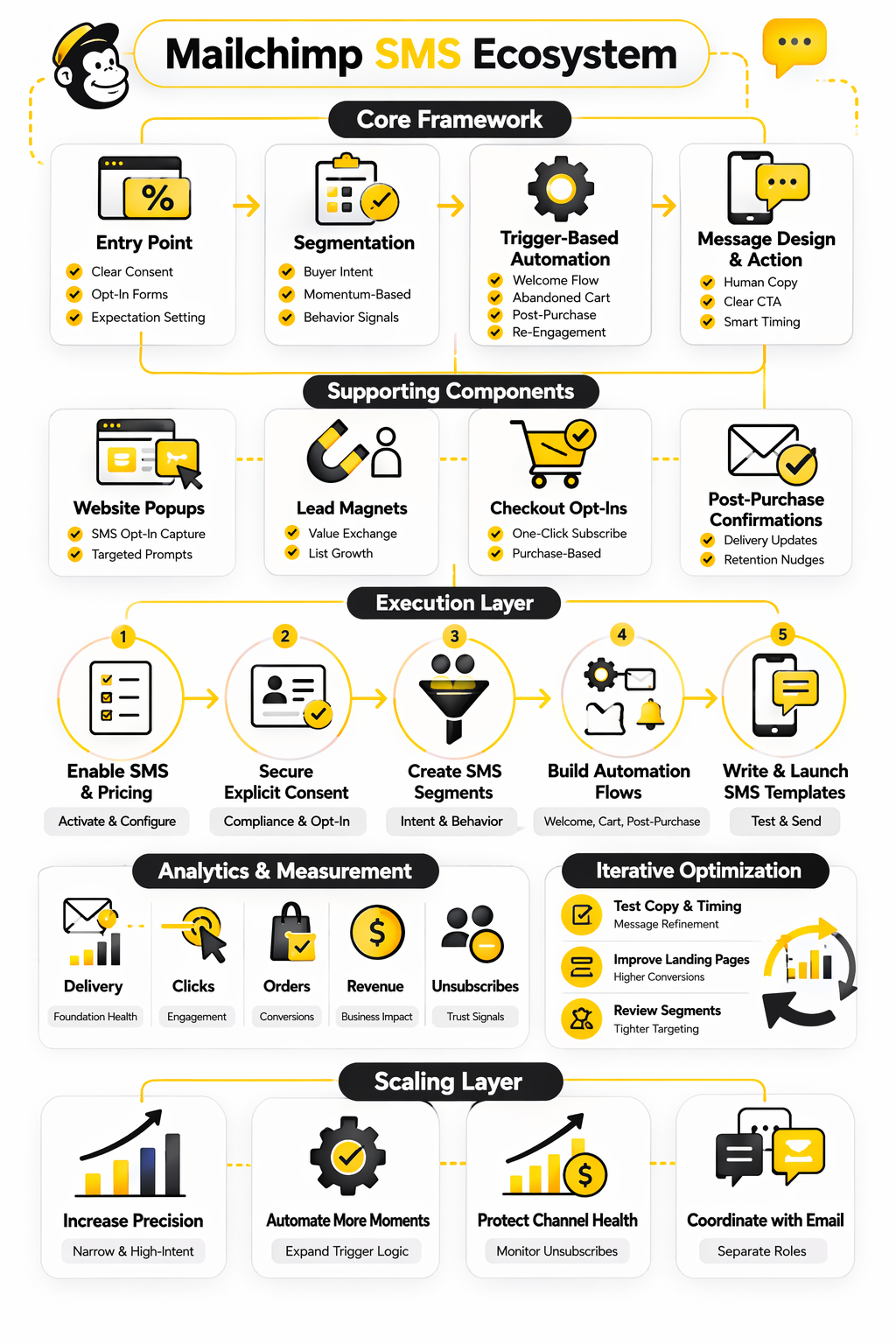
A proper Mailchimp SMS setup follows a simple but powerful structure:
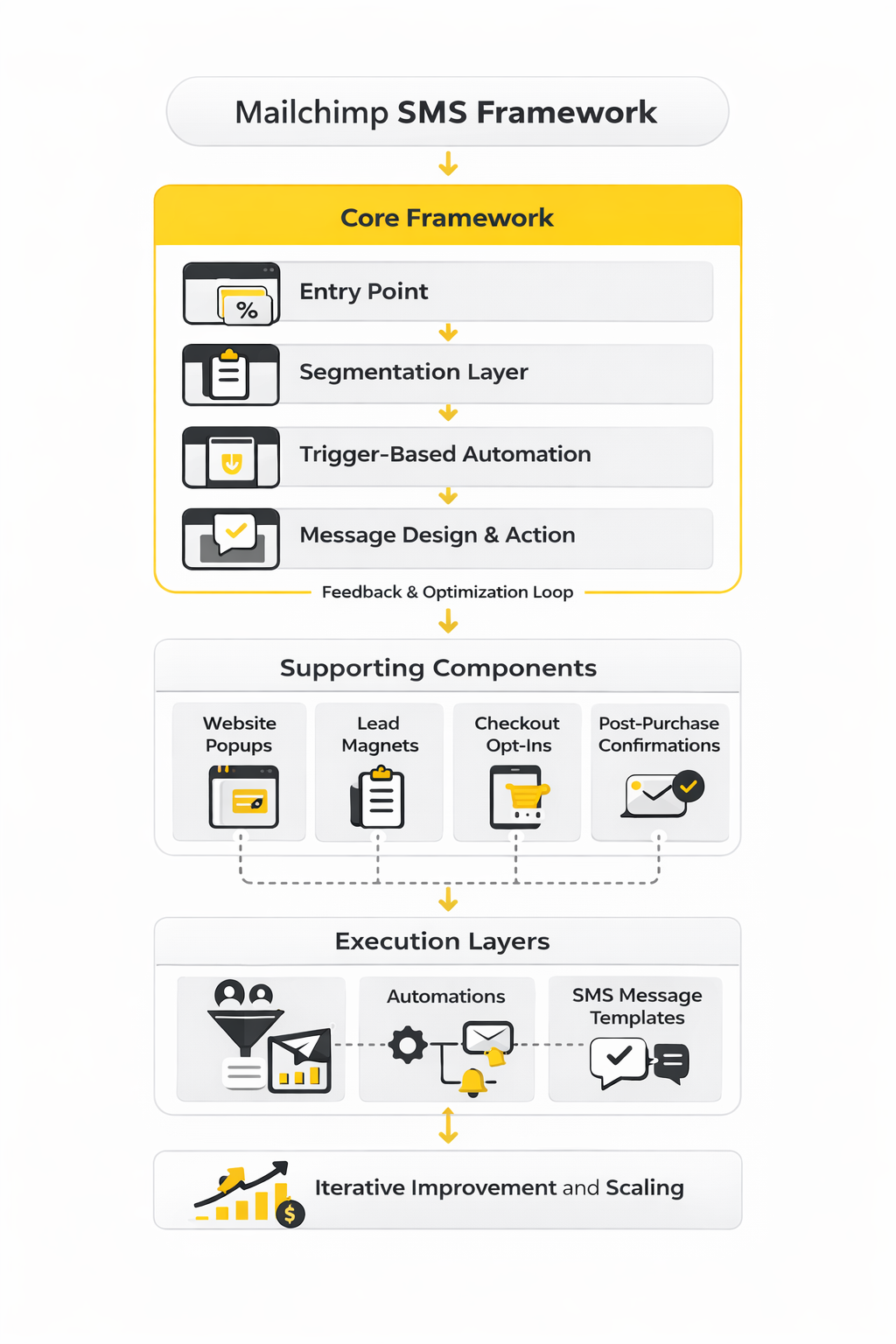
1. Entry Point (How Contacts Join SMS)
Everything starts with consent. Without it, nothing else matters.
Common entry points include:
- website popups offering discounts
- checkout opt-ins
- lead magnets
- post-purchase confirmations
The key is clarity. Users must know they’re signing up for text messages, not just emails. Compliance isn’t optional—it directly affects deliverability and trust.
2. Segmentation Layer
This is where most beginners fail.
Sending the same SMS to your entire list kills performance fast. Instead, high-performing brands segment based on:
- purchase behavior
- browsing activity
- engagement level
- geographic location
Mailchimp allows basic segmentation, but if you want deeper behavioral targeting, tools like Brevo or CRM-first systems often provide more flexibility.
3. Trigger-Based Automation
This is where SMS becomes a revenue engine.
Instead of sending campaigns manually, you set triggers like:
- abandoned cart
- product viewed but not purchased
- order shipped
- subscription renewal
Each trigger launches a pre-written sequence designed to move the user toward a specific action.
This is the difference between “sending messages” and building a system that prints revenue.
4. Message Design That Drives Action
SMS is short, but that doesn’t mean random.
High-performing SMS messages follow a structure:
- context (why they’re receiving this)
- value (what’s in it for them)
- urgency (why now matters)
- action (what to do next)
For example, instead of:
“Sale today. Check it out.”
You get:
“Your cart is still waiting—complete your order in the next 2 hours and get 10% off: [link]”
That clarity is what converts.
5. Feedback and Optimization Loop
Every SMS campaign generates data:
- click rates
- conversion rates
- unsubscribe rates
The mistake is ignoring it.
Professionals constantly refine:
- timing (morning vs evening)
- message length
- offer type
- segmentation rules
Over time, small improvements compound into massive revenue gains.
Where Most Businesses Get It Wrong
They treat Mailchimp SMS like a broadcast channel instead of a system.
They send:
- too many messages
- irrelevant offers
- poorly timed campaigns
And then they wonder why unsubscribe rates spike.
The reality is simple: SMS amplifies both good and bad strategy. If your targeting is weak, SMS makes it worse. If your timing is off, SMS makes it obvious.
But when everything aligns—right message, right person, right moment—it becomes one of the highest ROI channels in your entire stack.
And that’s exactly what we’ll break down next: the core components that separate average SMS campaigns from ones that consistently drive revenue.
Core Components of a High-Performing SMS Strategy
Once the basic Mailchimp SMS framework is in place, performance comes down to the pieces inside it. This is where a lot of brands either become disciplined operators or turn into noisy senders that burn trust fast. The best-performing programs are usually not the ones sending the most messages, but the ones building the cleanest system.
Clear Consent and Expectation Setting
Everything starts with permission, but strong SMS programs go one step further and set expectations before the first campaign ever goes out. That means people know what kind of messages they’re signing up for, how often they’ll hear from you, and what kind of value they’ll get in return. When that part is vague, complaints rise, unsubscribes come faster, and the channel becomes harder to scale.
This matters even more with Mailchimp SMS because the platform works best when your list quality is already strong. If your contact collection process is sloppy, no amount of automation will fix it later. Clean acquisition beats clever copy every single time.
A practical rule here is simple: promise less, deliver more. If the opt-in says subscribers will get early access, make sure that is actually true. If it says order updates and special offers, don’t suddenly turn that list into a daily promo machine.
Segmentation That Reflects Buyer Intent
Segmentation is where SMS goes from decent to dangerous in a good way. A subscriber who just joined your list should not get the same message as a repeat buyer, and a customer who abandoned a cart should not get the same tone as someone who has not engaged in 60 days. Mailchimp SMS works far better when messages follow intent instead of list size.
The easiest way to think about this is to separate people by momentum. Some contacts are warming up, some are actively shopping, and some are already customers who need retention messaging instead of first-purchase offers. When you send one generic text to all of them, you flatten the signal and lose revenue.
This is also the point where some teams realize they need a deeper stack around Mailchimp. If your business needs more aggressive CRM logic, multi-step nurture flows, and tighter lead management, platforms like GoHighLevel become attractive because they connect messaging, automation, and pipeline behavior more tightly. Mailchimp SMS can absolutely work, but it works best when your segmentation logic is intentional.
Offers That Fit the Channel
Not every offer belongs in a text message. SMS is strongest when the action is obvious, the value is immediate, and the message does not require a long explanation. That is why limited-time discounts, restock alerts, cart recovery nudges, booking reminders, and VIP early access tend to outperform broad brand storytelling inside this channel.
This is where marketers get themselves in trouble. They assume urgency alone is enough, so every message starts sounding like a countdown timer. That approach works for a minute, then people stop caring because false urgency trains the audience to ignore you.
A better approach is to match the offer to the moment. First-time subscribers respond well to a clean welcome incentive. Existing customers often respond better to relevance than discounting, especially when the message reflects what they already viewed, bought, or asked about.
Landing Pages That Don’t Waste the Click
A text message can earn the click, but the destination earns the sale. If the page is slow, confusing, or disconnected from the message, the campaign underperforms even if the SMS itself was strong. This is one of the most overlooked parts of any Mailchimp SMS setup.
The fix is usually not complicated. The landing page should continue the exact promise from the text, remove friction, and make the next action obvious. If the text offers early access, the page should not feel like a generic homepage. If the message references one product category, the click should land there directly.
This is why conversion-focused page builders often become part of the stack. A tool like Replo is useful when you need faster testing around campaign-specific landing pages without waiting on a full development cycle. SMS moves fast, and the page behind the message has to keep up.
Copy That Sounds Human
SMS has almost no room for wasted words. That does not mean every message has to sound robotic. In fact, the brands that win with Mailchimp SMS usually sound more human, not less.
Good SMS copy feels like it came from a sharp operator who respects the reader’s time. It gives context fast, communicates value clearly, and ends with one obvious action. It does not try to sound clever at the expense of clarity, and it definitely does not read like a keyword-stuffed promo blast.
There is also a pacing issue here. One strong sentence is often better than three mediocre ones. When the message is relevant, short copy feels confident. When the message is weak, marketers often add more words to compensate, and that almost always makes it worse.
Timing and Cadence That Respect Attention
Timing is not just a scheduling decision. It is part of the strategy. The same offer sent at the wrong moment can feel annoying instead of helpful, which is why cadence needs just as much discipline as copy.
This is especially true with Mailchimp SMS because text messaging carries more interruption energy than email. People forgive crowded inboxes more easily than they forgive crowded text threads. So the brand that wins is usually the one that knows when not to send.
A useful operating mindset is to reserve SMS for moments that deserve it. Send when speed matters, when relevance is high, or when the user already showed strong intent. If the message could comfortably wait in email, it probably should.
How Professionals Implement SMS Inside Real Funnels
This is where strategy stops being theoretical. Strong teams do not bolt Mailchimp SMS onto the side of their marketing and hope it works. They place it inside specific funnel moments where response time and buyer intent matter most.
The Welcome Flow
The welcome flow is one of the cleanest places to start because the contact is fresh, attention is high, and expectations are still being formed. A new subscriber does not need a complex sequence right away. They need a clear reason to stay subscribed and a fast first win.
In practice, that usually means a simple text that delivers the promised incentive or benefit, followed by a message that reinforces what kind of value will come next. This is also where brands establish tone. If the first text feels pushy or generic, the relationship starts weak.
Mailchimp SMS works well here because the workflow is simple enough to manage without overengineering it. The goal is not to show off automation. The goal is to turn a new opt-in into an engaged contact who is open to the next message.
The Abandoned Cart Flow
This is one of the most practical uses of SMS because the buyer has already shown intent. They were close, something interrupted the process, and the message only needs to bridge that gap. Done well, this flow feels useful rather than intrusive.
The mistake is sending a desperate discount too early. That trains customers to wait for rescue offers instead of finishing the purchase. A stronger setup starts with a reminder, then adds urgency or support only if the cart remains inactive.
This is also the flow where page continuity matters a lot. The text should bring the shopper back to the exact cart or product context they left behind. If the click drops them into a generic experience, the recovery chance weakens immediately.
The Post-Purchase Retention Flow
A lot of brands treat the sale as the finish line. Professionals know it is the beginning of retention. Once someone buys, Mailchimp SMS becomes useful for onboarding, reorder timing, review requests, loyalty nudges, and cross-sell opportunities that actually make sense.
This is where restraint matters. The customer already converted, so the next message should help them get value faster, not just squeeze another purchase out of them. When retention texts feel genuinely helpful, they strengthen the brand instead of exhausting the buyer.
This is also where broader customer communication tools can support the stack. For brands combining email, chat, and recurring engagement, something like ManyChat can complement SMS by handling conversations that should not live inside a text blast. The point is not to add tools for the sake of it. The point is to let each channel do the job it is best at.
The Re-Engagement Flow
Not every inactive contact is lost. Some just stopped paying attention because the messaging got repetitive, the timing drifted, or the offer stopped matching their current intent. A smart re-engagement flow gives those subscribers a reason to respond without hammering them with the same generic discount.
The best reactivation texts are specific. They reference a category, a product type, a new release, or a reason to care now. The goal is to restart relevance, not just force a click.
This is also where list hygiene shows its value. If people keep ignoring your messages, eventually the smartest move is to reduce cadence or let them go. Professionals protect the channel by treating attention like a scarce asset.
The Operational Layer Behind the Funnel
What separates professional implementation from amateur execution is not just messaging. It is the operating discipline behind it. Teams that win with Mailchimp SMS usually have documented trigger logic, clean ownership, performance review habits, and a clear definition of what each flow is supposed to do.
That structure matters because SMS can create fast feedback, both positive and negative. A good message can generate revenue quickly, but a bad one can create unsubscribes just as fast. Without a process behind the channel, brands end up reacting instead of improving.
In the next part, that is where the conversation needs to go. Once the core components and funnel placement are solid, the next challenge is optimization—how to test, refine, and scale Mailchimp SMS without turning it into a noisy revenue shortcut.
Advanced Optimization and Scaling Tactics
Once the core flows are live, the next job is not to send more. It is to make Mailchimp SMS more precise. This is the stage where good operators stop thinking like campaign managers and start thinking like system builders.
The big shift is simple: early SMS execution is about getting the channel running, but long-term performance comes from tightening the rules behind it. That means testing message timing, trimming weak segments, improving destination pages, and using channel roles more deliberately. It also means accepting that some ideas look exciting in theory and quietly underperform in practice.
Recent consumer research shows why this matters. In the UK, 84% of respondents said they want more control over the types of brand messages they receive by channel, and 70% said email and SMS should serve distinct roles. That is a useful reminder that scaling Mailchimp SMS is not about blasting harder. It is about making the channel feel more relevant as volume increases.
Start With a Controlled Testing Framework
A lot of brands say they test, but what they really do is change five things at once and guess why revenue moved. That is not testing. It is noise.
A useful Mailchimp SMS testing framework isolates one variable at a time. You test send time, or opening copy, or offer structure, or destination page. Then you give it enough volume to mean something before making the next move.
The reason this matters is that SMS reacts fast. A stronger first line can lift clicks quickly, but that does not always mean the message is better if unsubscribes also rise. You are not just testing for engagement. You are testing for profitable engagement.
Separate Channel Jobs More Aggressively
This is one of the cleanest upgrades you can make. Email is better for depth, storytelling, product education, and richer promotional detail. SMS is better for urgency, reminders, confirmations, and high-intent nudges that need immediate attention.
Mailchimp itself leans into that combined-channel model through its email and SMS automation positioning. The practical takeaway is that you should stop trying to make text messages do email’s job. The more clearly those roles are defined, the easier it is to scale without fatiguing the list.
That usually leads to a better operating rule:
- email explains
- SMS accelerates
- the landing page closes
When those roles are mixed up, the channel gets noisy fast.
Make Revenue Flows Beat Broadcasts
Broadcast campaigns still matter, especially around launches, seasonal pushes, or inventory events. But the highest-leverage part of Mailchimp SMS usually sits inside automated flows tied to buyer behavior. That is where timing becomes hard to replicate and revenue becomes more durable.
Mailchimp has pushed this logic hard in its automation messaging, including claims around stronger order volume from automated workflows inside its ecosystem, as shown on its automation pages and email and SMS automation overview. The exact numbers will vary by business, but the directional point is solid: flows usually scale better than constant manual sends because they react to intent instead of calendar pressure.
This is where operators get sharper. Instead of asking, “What campaign should we send this week?” they ask, “What customer moment are we still failing to capture?”
Professional Implementation
At this stage, Mailchimp SMS needs a real operating process. Not a loose idea. Not a pile of campaigns. A process. That is what separates a channel that produces occasional spikes from one that becomes part of predictable revenue.
The cleanest implementation path is to build in layers. You do not need ten flows on day one. You need the right flows in the right order, with measurement tight enough that you can improve them without guessing.
Step 1: Lock Down Compliance and Audience Quality
Before you scale anything, make sure your opt-in process is clean and your permissions are explicit. Mailchimp’s own SMS guidance puts compliance front and center, including supported countries, consent rules, and program setup requirements in its SMS overview and privacy and compliance guidance. That is not just a legal issue. It is a performance issue.
Low-quality acquisition ruins the channel early. If people do not fully understand what they signed up for, the first few sends may still get attention, but the relationship is already weak. That weakness shows up later as unsubscribes, spam complaints, and a list that becomes harder to monetize.
A strong implementation rule is to audit every collection point before writing a single campaign. Website forms, checkout opt-ins, popups, and post-purchase capture should all say exactly what the subscriber is agreeing to. Clean inputs make everything downstream easier.
Step 2: Map the Customer Moments That Deserve SMS
Not every event deserves a text message. This is where discipline matters. You want to identify the moments where speed, visibility, and intent are strong enough that SMS clearly beats email.
For most businesses, that means starting with a short list:
- welcome opt-in delivery
- abandoned cart recovery
- post-purchase updates or onboarding nudges
- win-back or reactivation
- restock or limited inventory alerts
That sequence keeps the implementation focused. It also gives you the best chance of learning quickly, because each use case has a different kind of buyer energy behind it.
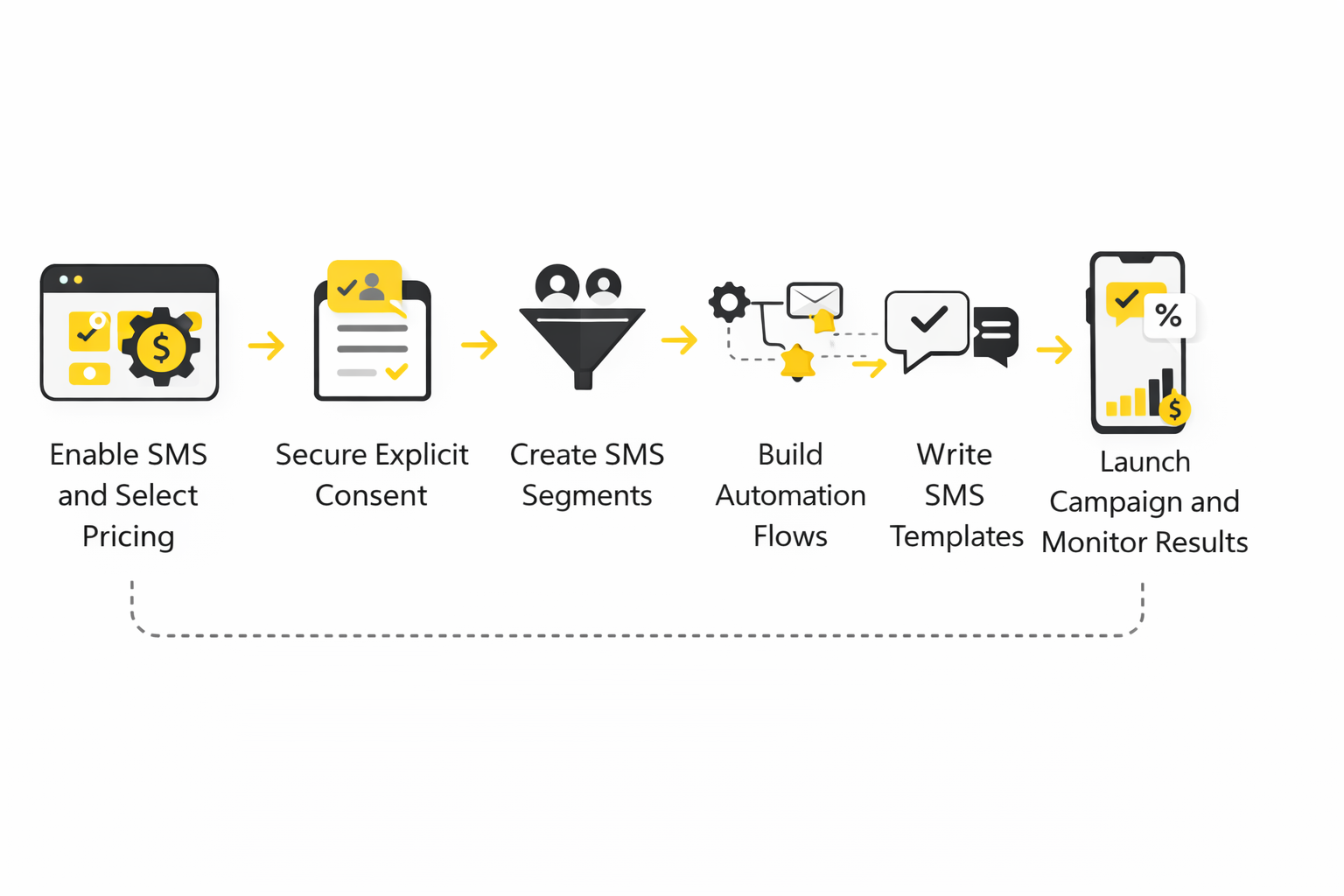
Step 3: Build the Flows in Priority Order
This is where Mailchimp SMS becomes tangible. Start with the welcome flow because it is simple, immediate, and easy to evaluate. Then move to abandoned cart, because it typically sits closest to revenue. After that, build post-purchase and re-engagement only once the first two are stable.
Do not rush this part. One polished abandoned cart flow with strong copy, timing logic, and page continuity is worth more than four weak automations running half-broken. Mailchimp’s own create and send SMS documentation is useful for the platform mechanics, but the strategic quality still depends on what you build around those tools.
A practical workflow looks like this:
- define the trigger
- define the audience filter
- write the first message
- decide whether a second message is necessary
- set the destination page
- set the success metric
- review unsubscribe and click behavior after launch
That sounds obvious, but most underperforming SMS programs skip at least two of those steps.
Step 4: Tighten the Destination Experience
This is the point where marketers often lose money without realizing it. The SMS gets the click, but the page fails to convert because the promise is diluted, the product context is lost, or the page simply asks the user to think too much.
Implementation should always include a landing page review. Not a design review in the abstract. A campaign-matching review. If the message says early access, the page should feel like early access. If the text references one product line, the page should not force the visitor to re-navigate the entire site.
This is where conversion tooling earns its keep. If your internal team moves slowly, a focused page builder like Replo can make it easier to launch and test campaign-specific experiences faster. Mailchimp SMS performs better when the click lands somewhere built for the message rather than somewhere merely available.
Step 5: Create Review Loops Before You Scale
A surprising number of teams wait too long to formalize performance review. They send messages, watch revenue, and keep moving. That works for a while, but it eventually creates blind spots. By the time the channel feels weaker, nobody knows which decisions caused it.
A better implementation process includes a simple recurring review:
- which flows are driving the most clicks
- which flows are producing the cleanest revenue
- which sends are increasing unsubscribes
- which segments respond best by timing or offer type
- which landing pages are wasting traffic
This review process matters because SMS performance is sensitive. Small mistakes compound quickly, but so do small gains. If one message format consistently produces better click-to-order performance, that insight should shape the next ten sends, not just sit in a dashboard.
Step 6: Add Supporting Systems Only When They Earn Their Place
There is a temptation to stack tools too early. Sometimes that helps. A lot of the time, it just adds complexity before the core Mailchimp SMS engine is working properly.
The smarter approach is to add adjacent tools only when a real bottleneck appears. If landing page speed is slowing tests, add a builder. If multichannel conversation management becomes messy, add a conversation layer like ManyChat. If deeper CRM orchestration becomes the real growth constraint, a more integrated platform such as GoHighLevel may make sense.
The key word is constraint. Tools should solve a proven problem, not create a more impressive-looking stack.
That leads naturally into the next stage of the article: what usually breaks, what most teams get wrong, and how to avoid turning Mailchimp SMS into an expensive attention leak instead of a reliable growth channel.
What the Numbers Actually Tell You
Once Mailchimp SMS is live, the next mistake is obsessing over the wrong number. A lot of teams stare at clicks, feel good for five minutes, and miss the fact that the campaign barely drove revenue or pushed unsubscribes higher. Data only becomes useful when each metric answers a specific operating question.
That is the real purpose of measurement here. You are not collecting numbers to decorate a dashboard. You are using them to decide whether your message reached the right people, whether the offer was strong enough, whether the landing experience held up, and whether the channel is getting healthier or noisier over time.
Mailchimp’s own reporting framework reflects that logic by surfacing delivery, clicks, orders, and revenue in its SMS reports overview and broader email and SMS analytics pages. That makes sense, because a healthy Mailchimp SMS program is never judged by one signal alone.
Delivery Rate Tells You Whether the Foundation Is Solid
Delivery is the first gate. If messages are not getting through cleanly, the rest of the funnel is almost irrelevant. Poor delivery usually points to list quality problems, compliance issues, unsupported sending patterns, or contact data that should have been cleaned earlier.
This is why delivery should be interpreted as a systems metric, not a creative metric. If delivery slips, rewriting copy is not the first fix. You look at acquisition quality, opt-in clarity, suppression logic, and whether your program is respecting the rules that keep the channel healthy.
That also explains why high delivery by itself is not enough. A campaign can deliver beautifully and still underperform because the message, offer, or audience targeting was weak. Delivery is the foundation, not the finish line.
Click Rate Shows Whether the Message Earned Action
Click rate is where many teams start to feel momentum. It tells you the text was compelling enough to get people moving. Mailchimp includes click reporting because it is one of the clearest signs that the message itself connected with subscriber intent, as shown in its SMS reporting documentation.
Industry benchmark studies still show why SMS gets so much attention from marketers. SimpleTexting’s recent survey found that many businesses report SMS click-through rates in the 21% to 35% range in strong-performing programs, with large differences by industry and use case in its 2025 SMS statistics report and benchmark breakdown. That is a useful directional benchmark, but it should not tempt you into lazy comparisons.
The number only matters in context. A 20% click rate on a weak audience may still produce poor revenue. A lower click rate on a tighter, higher-intent segment can be far more profitable. Clicks tell you whether the message created momentum, not whether the campaign created business value.
Conversion Rate Reveals Whether Intent Survived the Click
This is where truth shows up. If click rate is healthy but conversion rate is weak, the issue often sits after the message. The audience may have been right and the copy may have done its job, but the offer, page, checkout flow, or product fit broke the sequence.
That is why conversion rate should be treated like a handoff metric. It measures whether the promise made in the SMS remained intact once the user landed. When conversion falls short, the fix is often not inside the text message at all.
Recent ecommerce-specific benchmark data keeps reinforcing that triggered SMS tends to outperform broad campaigns when the user already has clear intent. Postscript’s current benchmark materials show especially strong performance for high-intent automations like back-in-stock messages, with click-through and conversion figures that meaningfully outpace generic sends in its 2026 benchmark page and message-type analysis. The practical lesson is simple: stronger intent usually matters more than louder promotion.
Revenue Per Message Keeps You Honest
This is one of the most useful metrics because it forces discipline. It stops the team from celebrating engagement that does not translate into business impact. A campaign with average clicks and strong revenue is usually more valuable than one with flashy engagement and weak commercial results.
Mailchimp highlights revenue attribution directly in its SMS reporting help article, and that is exactly where smart operators spend their attention. If a Mailchimp SMS flow is generating consistent revenue from a narrow but valuable audience, that is often a sign to scale carefully. If it is generating attention without revenue, something in the sequence is misaligned.
This is also the metric that protects you from vanity testing. Subjectively “better” copy means nothing if average order behavior weakens. Revenue per send, per flow, or per recipient forces the discussion back to what matters.
Building an SMS Analytics System
A single campaign report is useful, but it does not give you a system. A real analytics setup helps you see whether performance is improving, stalling, or eroding over time. That is the difference between reacting to one send and actually managing the channel.
The easiest way to build that system is to group metrics by job. Some numbers tell you whether the message reached the audience. Some tell you whether it created action. Some tell you whether the action turned into revenue. And some tell you whether the channel is slowly damaging trust.
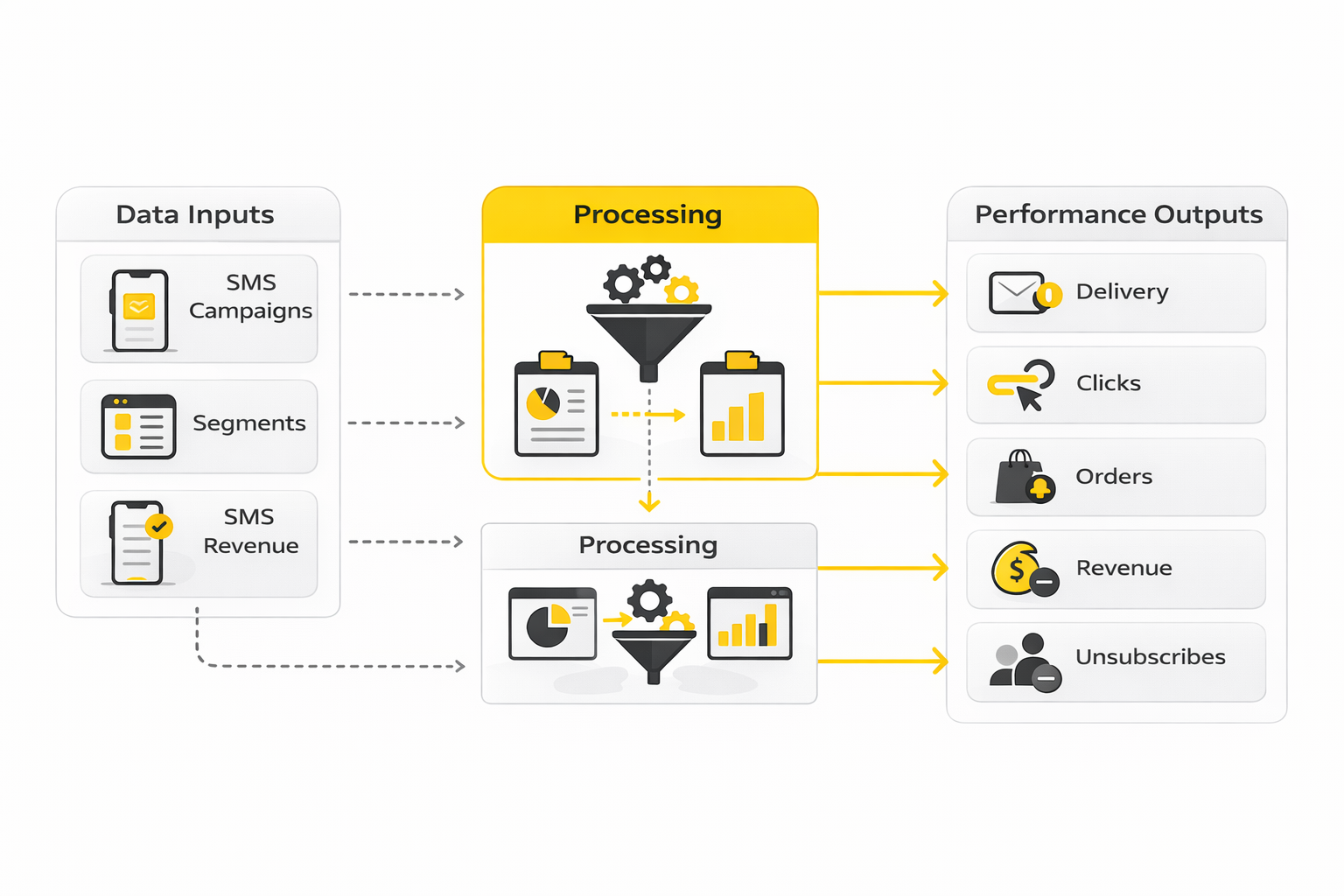
The Four Signal Groups That Matter Most
A clean Mailchimp SMS analytics system usually centers on four signal groups:
- Reach signals
These include delivery and send volume. They tell you whether the channel is technically healthy and whether your audience is large enough to make tests meaningful. When these signals weaken, the issue is usually structural.
- Engagement signals
These include click rate and response behavior. They tell you whether the message matched intent strongly enough to create movement. When these weaken, the issue is often copy, timing, segmentation, or offer relevance.
- Commercial signals
These include orders, conversion rate, and revenue. They tell you whether the campaign actually created business value. When these weaken while clicks remain strong, the issue is often the page, checkout path, or offer economics.
- Trust signals
These include unsubscribe rates and negative engagement patterns. They tell you whether the channel is becoming more valuable or more annoying. When these rise, scaling harder usually makes the problem worse.
This structure matters because it helps you diagnose faster. Without it, teams tend to grab the most visible number and misread what is actually happening.
Why Unsubscribe Rate Deserves More Attention
Most teams look at unsubscribe rate only when it becomes ugly. That is too late. Unsubscribes are one of the earliest signs that message frequency, relevance, or expectation setting is drifting out of alignment.
Benchmark research keeps pointing to this balance. Postscript’s benchmark material includes unsubscribe ranges that show how quickly performance quality separates strong programs from weaker ones in its 2025 benchmark report PDF and live benchmark page. The exact threshold will vary by industry and message type, but the operating principle stays the same: an SMS program with rising unsubscribes is usually spending trust faster than it is earning revenue.
That is why unsubscribe rate should trigger action, not just observation. If it rises after a specific campaign type, tighten targeting. If it rises across the board, revisit cadence and list expectations. If it spikes after acquisition changes, audit the opt-in process immediately.
Benchmarks Are Useful, but Only When You Use Them Correctly
Benchmark data is valuable for calibration, not imitation. It helps you know whether your numbers are broadly normal, weak, or unusually strong. What it cannot do is tell you what your business should send next.
Mailchimp SMS performance depends heavily on audience quality, product economics, urgency level, and funnel structure. That means benchmark comparisons should be treated as directional guardrails rather than commandments. If your click rate is below common industry ranges, that is a reason to investigate. It is not proof that your program is broken.
This is also where brands get overconfident. Seeing high open and click behavior in industry articles can tempt teams into thinking SMS is naturally easy. It is not. The channel is powerful because attention is high, but that also means mistakes are amplified faster.
What Good Data Should Make You Do Next
Every metric should lead to a practical response. If delivery weakens, clean the list and review collection sources. If clicks weaken, test timing, copy, or segmentation. If clicks stay healthy but conversion drops, inspect the landing page and checkout path. If revenue is fine but unsubscribes are climbing, reduce pressure before the channel gets damaged.
That is the mindset professionals use. They do not just report numbers. They connect each number to a decision. Mailchimp SMS gets more valuable when analytics reduce guesswork rather than creating more of it.
A simple decision model looks like this:
- low delivery means fix the foundation
- low clicks mean fix the message
- low conversion means fix the handoff
- high unsubscribes mean fix the trust balance
- strong revenue with stable trust means scale carefully
That last point matters. Scale should come after evidence, not optimism.
Reading the Data Like an Operator
The most useful question is not “Was this campaign good?” It is “Why did this campaign perform the way it did?” That question forces you to read the numbers together instead of chasing one isolated win or loss.
For example, a high-click campaign with weak revenue is usually a promise problem after the click. A lower-click campaign with strong revenue often means the message reached a smaller but more purchase-ready segment. A campaign with decent revenue and rising unsubscribes may still be a bad long-term trade if it is slowly exhausting the list.
That is how operators think about Mailchimp SMS. They do not chase pretty metrics. They watch for patterns that tell them whether the system is becoming more efficient, more profitable, and more sustainable. And once you start reading the channel that way, the next step becomes obvious: you can finally see the mistakes that quietly kill performance before most teams even realize they are making them.
Strategic Tradeoffs, Risks, and Scaling Realities
By the time a team reaches this stage, Mailchimp SMS is no longer just a channel experiment. It becomes a strategic decision about how much urgency, automation, and direct-response pressure the brand can use without damaging trust. That is the real tradeoff at scale: SMS can accelerate revenue, but it can also expose weak targeting, sloppy consent practices, and lazy offer strategy much faster than email.
This is why advanced operators stop asking whether SMS works. They start asking where SMS should stop, where email should take over, and how the brand keeps the channel profitable without turning every customer interaction into a high-alert interruption. The bigger the list gets, the more important those decisions become.
The Real Risk Is Not Low Performance
Most teams worry about underperformance. In practice, one of the bigger risks is getting decent short-term results from a strategy that quietly weakens the channel. A sequence can drive sales for a few weeks while unsubscribe behavior, complaint risk, and message fatigue build underneath the surface.
That is why Mailchimp SMS should be managed like a finite-attention asset. The problem is not usually one bad message. The problem is repeated pressure with weak relevance. Once subscribers start feeling that the brand texts too often, too broadly, or too predictably, recovery gets harder because the channel has already lost its edge.
Scaling Volume Forces You to Choose Between Reach and Relevance
Early on, it is tempting to grow by sending to bigger and bigger segments. That feels efficient because volume rises quickly, but broadening reach usually lowers message relevance at the exact moment the list is becoming more valuable. This is one of the first serious scaling traps in Mailchimp SMS.
The stronger move is usually the opposite. As the audience grows, segmentation should get narrower, not looser. Larger lists create more opportunities to match the right message to the right buyer state, which is why mature programs lean harder into behavior-based targeting instead of treating growth as permission to broadcast more aggressively.
Compliance Gets More Important as Success Increases
This part is easy to ignore when everything is going well. Then a brand scales, adds new forms, expands campaigns, or changes acquisition flows, and suddenly compliance is no longer a checklist item. It becomes an operational risk with real financial consequences. Mailchimp’s own guidance emphasizes explicit consent, clear opt-in language, quiet hours, and compliant program setup, while the FCC states that robotexts generally require prior consent and updated 2025 rules made opt-out revocation easier for consumers.
That changes the way good teams scale. They do not just ask whether a campaign can be sent. They ask whether the subscriber clearly understood what they agreed to, whether opt-out paths are obvious, and whether frequency decisions still match the original promise. At higher volume, governance matters as much as copy.
Channel Fatigue Is a Strategic Problem, Not Just a Creative Problem
When performance softens, marketers often blame the copy first. Sometimes that is true. But long-term SMS fatigue usually comes from structural repetition, not a weak sentence.
If subscribers keep receiving the same kind of offer, the same cadence, and the same style of urgency, the channel loses surprise. Recent consumer preference data points in the same direction: people want more control over brand messaging and they respond better when channels have distinct roles rather than collapsing into one endless stream of promotions.
This is why the best Mailchimp SMS programs protect novelty. They rotate message purpose, vary sending logic, and keep the channel focused on moments where immediacy genuinely matters. SMS should feel like an escalation of relevance, not just another slot in the weekly content calendar.
At Some Point, Tool Fit Becomes a Real Question
Mailchimp SMS can absolutely support strong programs, especially when a business wants email, audience management, and text messaging inside one familiar environment. But there is a strategic ceiling for some teams. The more complex the business becomes, the more pressure there is for deeper CRM workflows, more advanced lead routing, more aggressive funnel orchestration, and tighter multichannel coordination.
That does not automatically mean switching platforms. It means being honest about the operating model. If the business starts needing tighter CRM and pipeline behavior, a platform like GoHighLevel may fit better. If the bottleneck is more about conversational engagement across channels, ManyChat can make more sense as a complement rather than a replacement. The point is to let business complexity drive tooling decisions, not the other way around.
SMS Should Not Carry the Entire Revenue Burden
This is one of the most important expert-level judgments in the whole article. When a team discovers that Mailchimp SMS converts well, the temptation is to keep leaning harder into it. That works for a while, but eventually it turns SMS into the channel that has to save every launch, every weak week, and every stale campaign. That is not scale. That is dependency.
Better operators keep SMS powerful by protecting its role. Email handles more depth. On-site experiences carry more persuasion. Paid traffic creates acquisition. SMS steps in where timing, urgency, and clarity make it disproportionately strong. If your business needs stronger post-click experiences to support that structure, a focused builder like Replo can help tighten the handoff without forcing the text message itself to do all the work.
The Best Scaling Decision Is Usually Restraint
There is a point in every growing SMS program where the smartest move is not another send. It is a cleaner segment, a slower cadence, a stronger landing page, or a better sequence rule. That can feel less exciting than launching a big campaign, but it is usually where the real gains come from.
Mailchimp SMS rewards operators who think in systems. The channel gets stronger when each text has a reason to exist, each flow has a job, and each performance review leads to a concrete decision. Scale comes from precision, not noise. And once that is clear, the final piece of the article becomes straightforward: the most common mistakes, the questions people keep asking, and the practical answers that help avoid expensive missteps.
Bringing the Full Mailchimp SMS System Together
By this point, the bigger picture should be clear. Mailchimp SMS works best when it is not treated like a random blast tool, but as one piece of a broader revenue system that includes consent, segmentation, automations, landing pages, reporting, and channel discipline. Mailchimp’s current SMS setup supports signup forms, multi-country programs in supported markets, automations, quiet hours, and campaign reporting, which is exactly why the system becomes more effective when those pieces are connected instead of managed in isolation.
The final lesson is simple but important: Mailchimp SMS is powerful because it gets attention quickly, and that same strength is why sloppy execution gets punished quickly too. Teams that win with it usually keep the channel narrow, intentional, and tightly measured rather than trying to turn every marketing problem into a text message.
FAQ
Is Mailchimp SMS available in every country?
No. Mailchimp SMS is not universally available, and the platform’s current documentation says SMS is offered as an add-on for paid plans in supported countries, including the US, UK, Canada, and Australia, with country-specific setup and sending rules. That matters because expansion plans, list strategy, and compliance workflows all depend on where your subscribers are located.
Do I need explicit consent before sending Mailchimp SMS campaigns?
Yes, and this is non-negotiable. Mailchimp’s SMS guidance emphasizes explicit opt-in requirements, and broader US rules also reinforce that consumers can revoke consent at any time in any reasonable way, which means permission has to be real, documented, and respected operationally.
Can Mailchimp SMS and email be used together in the same automation?
Yes, and that is one of the strongest reasons to use it. Mailchimp’s current automation and pricing pages describe coordinated email and SMS workflows, including trigger-based sends like cart reminders and date-based campaigns, which makes the platform more useful when you want email to handle depth and SMS to handle urgency.
What is the best use case for Mailchimp SMS?
The strongest use cases are usually high-intent, time-sensitive moments. That includes welcome delivery, abandoned cart recovery, limited-time offers, restock alerts, and post-purchase updates where faster visibility changes the outcome. Mailchimp itself positions SMS around direct, personalized communication and transactional or promotional moments where speed matters.
How often should I send Mailchimp SMS messages?
There is no perfect universal number, but Mailchimp’s own educational guidance currently suggests keeping frequency restrained, often around 1 to 2 sends per week, while also staying inside quiet-hour expectations and local rules. In practice, the better question is not “How much can I send?” but “How many messages can I send before relevance drops?”
What are quiet hours, and why do they matter?
Quiet hours are time windows when promotional text messages should not be sent, typically late at night or very early in the morning. Mailchimp specifically includes quiet-hour guidance to help marketers stay compliant and avoid sending at times that feel intrusive, which means timing is not just a performance choice but also a trust and compliance choice.
What metrics matter most inside Mailchimp SMS reporting?
The most useful metrics are delivery, clicks, orders, revenue, and unsubscribe behavior. Mailchimp’s reporting documentation centers exactly those kinds of signals, and that is the right way to read the channel because one number alone rarely tells you what is actually working. Delivery tells you whether the foundation is healthy, clicks show whether the message earned action, and revenue tells you whether the campaign was commercially worth sending.
Is Mailchimp SMS a replacement for email marketing?
No, and treating it that way usually weakens both channels. The stronger strategy is role separation: email handles explanation, depth, and richer product context, while SMS handles urgency, reminders, and short high-intent nudges. Mailchimp’s own positioning around coordinated email and SMS workflows supports that division of labor.
What happens when someone wants to stop getting texts?
You need to honor that request quickly and cleanly. FCC rules clarify that consumers can revoke consent in any reasonable manner, and Mailchimp’s SMS resources also stress making unsubscribing easy, which means opt-out handling should be treated as a core system requirement rather than a minor support task.
Can I collect SMS subscribers with a Mailchimp signup form?
Yes. Mailchimp provides an SMS signup landing page and tools to promote SMS consent collection once a program is approved, which makes it easier to create a dedicated opt-in path instead of trying to bolt SMS acquisition onto a generic form with vague language. That matters because clean list growth is one of the biggest predictors of whether the channel scales well later.
Is Mailchimp SMS enough for every business as it scales?
Not always. For many businesses, Mailchimp SMS is a strong fit because it keeps email, audience data, and text messaging close together. But once a company needs deeper CRM orchestration, more complex funnel logic, or a broader multi-tool operating model, the question becomes less about whether Mailchimp SMS works and more about whether it still matches the business’s current complexity.
What is the biggest mistake people make with Mailchimp SMS?
The biggest mistake is using it too broadly and too often. The channel works because it feels immediate, and once that immediacy turns into constant interruption, unsubscribes rise, trust drops, and results become harder to sustain. Mailchimp’s own best-practice content around timing, opt-in quality, and unsubscribe clarity points in the same direction: relevance protects performance.
Work With Professionals
Explore 10K+ Remote Marketing Contracts on MarkeWork.com
Most marketers spend too much time chasing clients, competing on crowded platforms, and losing a percentage of every project to middlemen. MarkeWork gives you a better way. Browse thousands of remote marketing contracts and connect directly with companies desperate to hire skilled marketers like you, without platform commissions and without unnecessary gatekeepers.
If you're serious about finding better opportunities and keeping 100% of what you earn, explore available contracts and create a profile for free at MarkeWork.com.