

Most marketing channels are fighting for attention. SMS doesn’t.
When a message lands on someone’s phone, it doesn’t sit in a crowded inbox or get buried by algorithms. It gets seen—almost immediately. That’s why businesses are aggressively moving toward Mailchimp texting as part of their core communication stack, not just an add-on.
The numbers explain everything. SMS campaigns routinely see open rates close to 98%, with the majority of messages read within minutes of delivery (source). Compared to email or social, that’s not just better—it’s a completely different level of access to attention.
But here’s the catch: attention alone doesn’t guarantee results. Most brands either underuse SMS or use it poorly—sending generic blasts that feel like spam. The real opportunity lies in combining Mailchimp’s texting capabilities with strategy, timing, and personalization.
That’s exactly what this guide breaks down.
Article Outline
- What Mailchimp Texting Really Is
- Why SMS Marketing Is Becoming Essential
- How the Mailchimp SMS System Works
- The Core Components of High-Performing SMS Campaigns
- How Professionals Actually Use SMS With Email and Automation
- Advanced Strategies, Mistakes, and Scaling SMS Revenue
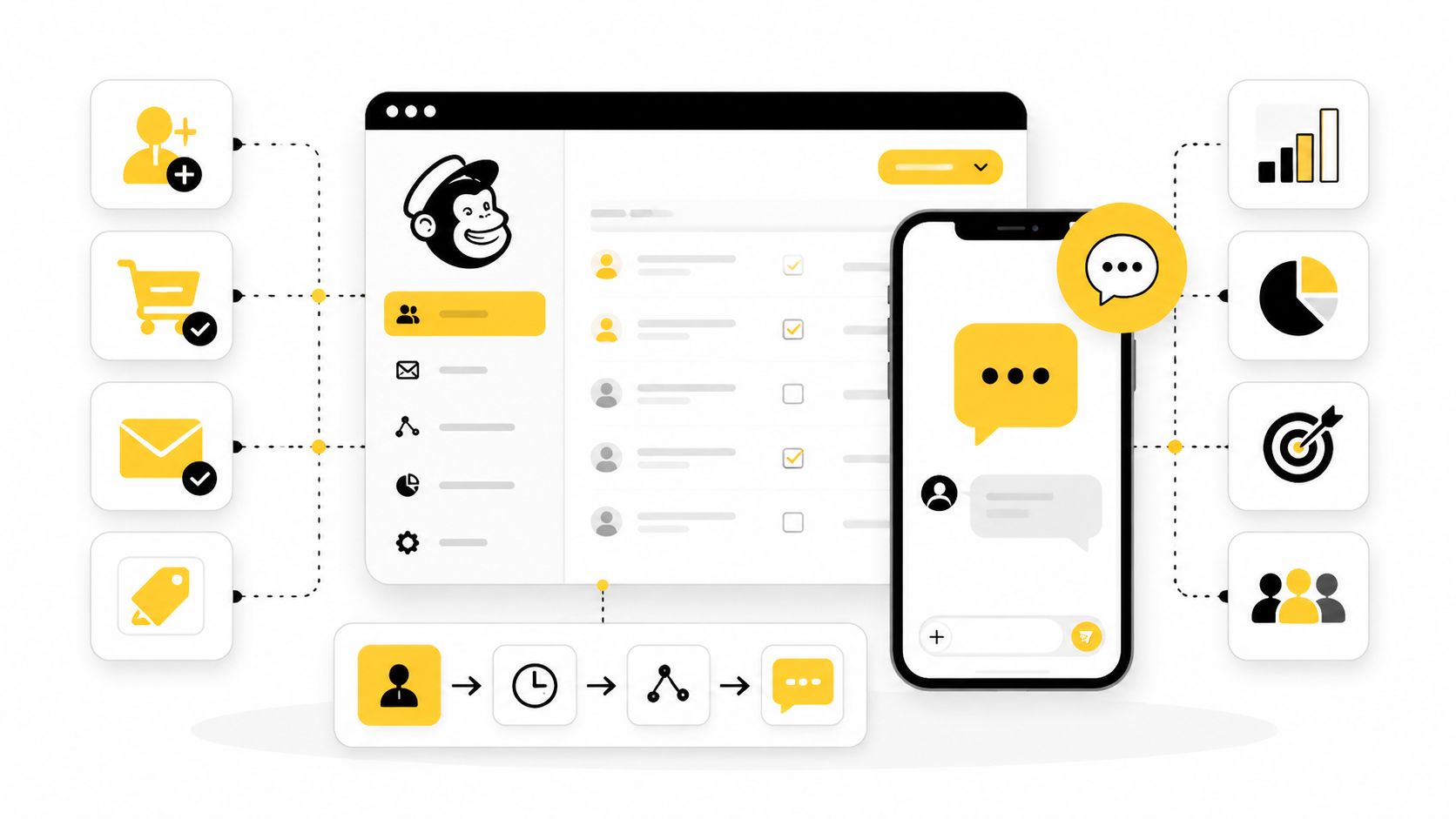
What Mailchimp Texting Really Is
Mailchimp texting is not just about sending bulk messages. It’s a structured SMS marketing system built into a broader marketing platform.
At its core, it allows businesses to collect consent from users, build a subscriber list, and send targeted text messages directly to their phones. Unlike standalone SMS tools, Mailchimp integrates texting into the same ecosystem as email, automation, and customer data.
This matters more than most people realize. Instead of treating SMS as a separate channel, it becomes part of a unified customer journey—where email nurtures, and SMS triggers action.
Mailchimp’s SMS feature operates as an add-on to its main platform, meaning you can manage contacts, segmentation, and analytics in one place. Businesses can send promotions, reminders, alerts, or follow-ups directly to opted-in subscribers, all while tracking performance metrics like clicks, conversions, and revenue attribution (source).
The real shift is this: texting stops being a campaign and becomes infrastructure.
Why SMS Marketing Is Becoming Essential
The rise of Mailchimp texting isn’t a trend—it’s a response to declining performance in traditional channels.
Email open rates often hover around 20–30%, while SMS consistently reaches near-total visibility. More importantly, SMS creates immediacy. Around 95% of text messages are read within three minutes, making it one of the fastest ways to reach customers at scale (source).
That immediacy changes behavior.
Instead of hoping someone checks their inbox, you’re entering a channel people check instinctively. That’s why SMS campaigns are commonly used for:
- Flash sales and limited-time offers
- Appointment reminders and confirmations
- Product drops and restocks
- Time-sensitive updates
The engagement doesn’t stop at opens. SMS campaigns can generate response rates approaching 45%, which is almost unheard of in other digital channels (source).
This is why marketers are shifting budgets. SMS isn’t replacing email—it’s amplifying it.
Platforms like Brevo and GoHighLevel have already leaned heavily into multi-channel messaging for this reason. Mailchimp is simply catching up—and integrating it into a familiar ecosystem.
How the Mailchimp SMS System Works
Understanding how Mailchimp texting works removes most of the confusion around implementation.
The system is built around a few key mechanics:
- Opt-in collection – Users must explicitly consent to receive SMS messages
- Audience integration – SMS contacts live inside your existing Mailchimp audience
- Credit-based sending – You purchase SMS credits to send messages
- Country-based setup – You must register sending numbers depending on regions
This structure ensures compliance while still giving flexibility. You’re not just blasting messages—you’re building a permission-based communication channel.
Once set up, businesses can create campaigns, schedule texts, and trigger automated messages. For example:
- A customer signs up → receives a welcome SMS
- A purchase happens → gets a follow-up text
- A promotion launches → segmented users receive targeted offers
Everything is measurable. Mailchimp provides analytics on delivery, clicks, and conversions so you can continuously refine your messaging (source).
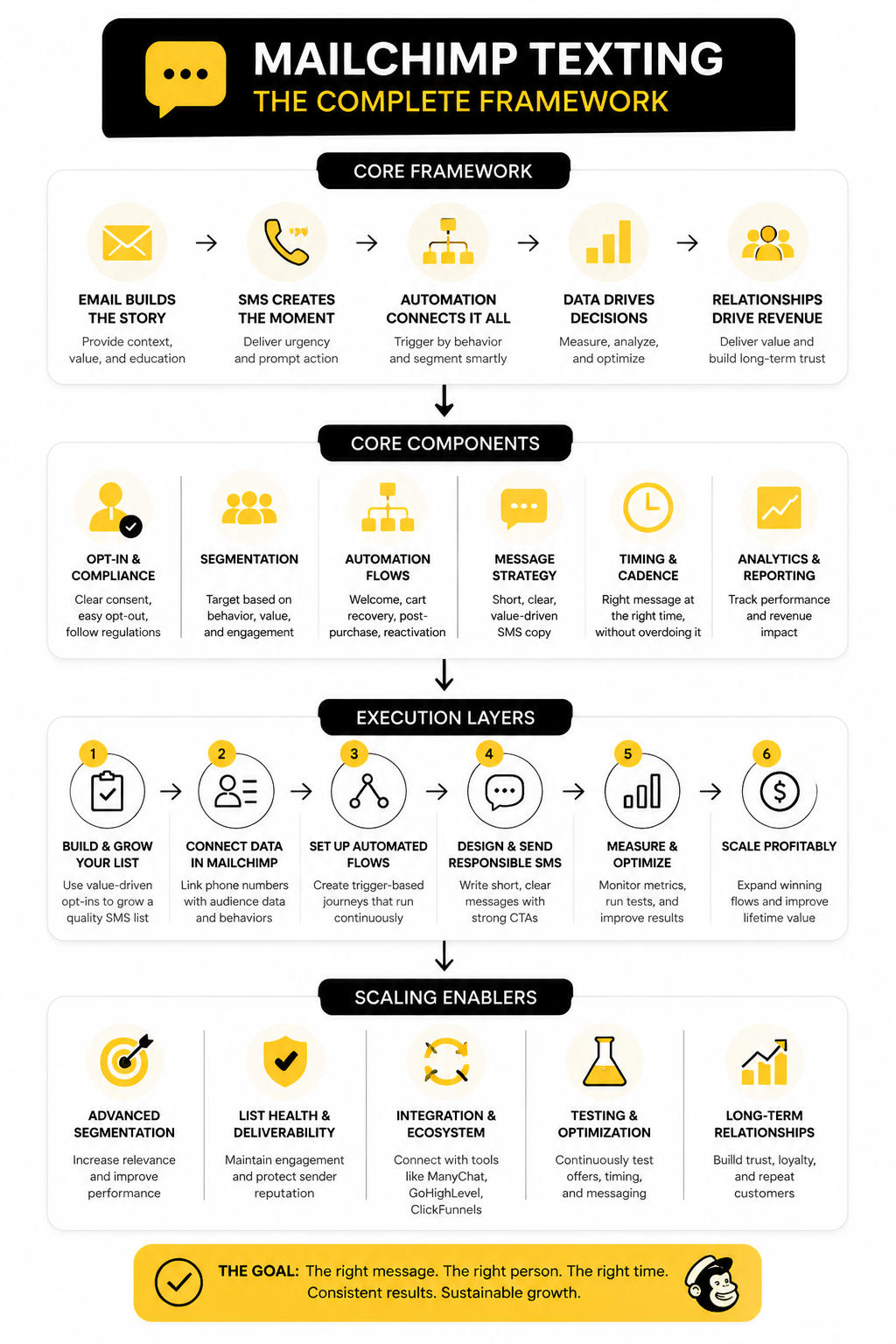
The Core Components of High-Performing SMS Campaigns
Most SMS campaigns fail for one simple reason: they ignore fundamentals.
High-performing Mailchimp texting campaigns consistently rely on a few non-negotiable elements.
1. Timing and Context
SMS is immediate. That’s its advantage—and its risk.
Sending a message at the wrong time doesn’t just reduce engagement—it increases opt-outs. Messages must align with user behavior, time zones, and intent.
A morning promotion for a coffee shop works. A midnight notification does not.
2. Personalization and Segmentation
Generic SMS messages feel intrusive. Personalized messages feel relevant.
Mailchimp allows segmentation based on behavior, location, and purchase history. Using that data transforms a message from noise into something useful.
Even simple personalization—like referencing a past purchase—can significantly increase engagement.
3. Clear Value and CTA
SMS has limited space. Every word must earn its place.
Effective messages:
- Get to the point quickly
- Offer clear value
- Include a direct action
The difference between “Check this out” and “Get 20% off today—link inside” is massive.
4. Frequency Control
Too many messages lead to unsubscribes. Too few lead to forgetfulness.
Mailchimp’s analytics help monitor opt-out rates and engagement so you can find the right balance. Spikes in unsubscribe rates are usually a sign of poor timing or irrelevant content (source).
5. Integration With Other Channels
SMS works best when it’s not alone.
Combining email and SMS creates layered communication:
- Email builds context
- SMS drives action
That’s why many marketers pair SMS with automation tools like ManyChat or funnel builders like ClickFunnels to create complete customer journeys instead of isolated messages.
This is where most guides stop—at tactics.
But the real leverage comes from how professionals structure SMS as part of a broader system. That’s where we’re going next.
How Professionals Actually Use SMS With Email and Automation
This is where Mailchimp texting stops being a feature and becomes a system.
Most beginners treat SMS like a broadcast tool—send a message, hope for clicks, repeat. Professionals do the opposite. They design flows where SMS plays a specific role inside a larger automated journey, usually paired with email, behavioral triggers, and timing logic.
The key idea is simple: email builds the story, SMS closes the loop.
The Multi-Channel Flow That Actually Works
High-performing teams rarely rely on a single touchpoint. Instead, they layer communication across channels to guide users from awareness to action.
A typical structure looks like this:
- User joins a list or opts in
- Email delivers context, value, or education
- SMS follows with urgency or a clear action
- Automation reacts to behavior (click, purchase, ignore)
- Follow-ups adjust based on what the user does next
This approach works because it respects how people consume information. Email gives space to explain. SMS creates a moment of decision.
Campaign data consistently shows that combining channels increases engagement compared to single-channel campaigns (source). The difference isn’t small—it’s often the gap between passive readers and actual buyers.
Behavioral Triggers Change Everything
The real power of Mailchimp texting comes from triggers, not campaigns.
Instead of sending messages at fixed times, professionals tie SMS to specific actions:
- Abandoned cart → reminder text within 1–2 hours
- Product viewed → follow-up offer next day
- Purchase completed → upsell or onboarding message
- Inactive user → re-engagement sequence
These aren’t guesses. They’re reactions.
Mailchimp’s automation tools allow these triggers to be built directly into workflows, meaning the system runs continuously without manual intervention. That’s how SMS scales—by becoming reactive instead of scheduled.
If you want to push this even further, platforms like GoHighLevel are designed specifically around automation-first messaging, where SMS, email, and even calls are orchestrated from one place.
Segmentation Is Where Most Revenue Comes From
Sending the same text to everyone is the fastest way to kill performance.
Segmentation is what turns Mailchimp texting into a revenue channel instead of a notification tool. When messages are tailored to behavior, purchase history, or engagement level, they feel relevant—and relevance drives clicks.
Some high-impact segmentation strategies include:
- New vs returning customers
- High spenders vs first-time buyers
- Engaged vs inactive subscribers
- Location-based targeting for local offers
Even basic segmentation can significantly improve performance. Targeted campaigns consistently outperform generic ones in both engagement and conversion rates (source).
The takeaway is simple: the more specific the message, the higher the return.
Automation Tools That Extend Mailchimp Texting
Mailchimp is powerful, but it’s not always the full stack.
Many teams extend its capabilities with specialized tools that enhance automation, personalization, or funnel building.
For example:
- ManyChat adds conversational automation across SMS, Messenger, and Instagram
- Systeme.io simplifies funnel creation and campaign automation for lean teams
- ClickFunnels focuses on high-converting sales funnels that pair perfectly with SMS follow-ups
The goal isn’t to stack tools unnecessarily. It’s to fill gaps where needed—especially when scaling beyond basic campaigns.
Timing, Cadence, and Message Stacking
One of the biggest mistakes with SMS is poor timing.
Professionals think in sequences, not single messages. Instead of sending one text, they design a cadence:
- Day 1: Email with full context
- Day 2: SMS reminder with urgency
- Day 3: Follow-up email with added value
- Day 5: Final SMS with a deadline
This creates momentum without overwhelming the user.
Timing also affects compliance and user experience. Sending too frequently increases opt-outs, while sending too rarely reduces impact. Monitoring engagement trends—especially unsubscribe rates—is critical to finding the right balance.
The Real Goal: Orchestrated Attention
At a high level, Mailchimp texting is not about sending messages. It’s about orchestrating attention.
You’re guiding users across multiple touchpoints, using each channel for what it does best. Email explains. SMS prompts. Automation connects everything together.
Once that system is in place, campaigns stop feeling random—and start producing consistent results.
The next step is understanding how to push this even further, where advanced strategies, scaling tactics, and common mistakes start to define the difference between average and elite performance.
Professional Implementation: Turning Strategy Into a Working System
Up to this point, everything sounds logical. SMS is powerful, automation is key, and integration drives results.
But this is where most people get stuck—execution.
Mailchimp texting only works when it’s implemented as a system, not a collection of disconnected campaigns. That means setting up infrastructure first, then layering strategy on top.
Step 1: Build a Clean, Compliant SMS List
Everything starts with consent.
SMS marketing is regulated heavily, and for good reason. Users must explicitly opt in, and that opt-in must be clear, documented, and easy to revoke. Mailchimp enforces this by requiring proper permission collection before sending messages (source).
The best-performing brands don’t hide this—they make it part of the value exchange.
Instead of generic “Sign up for texts,” they offer:
- Exclusive discounts
- Early access to product drops
- Priority notifications
- Members-only deals
This shifts the mindset from interruption to benefit. People don’t feel marketed to—they feel included.
Step 2: Connect SMS to Your Existing Audience Data
This is where Mailchimp texting becomes powerful.
Because SMS lives inside your Mailchimp audience, you can immediately connect phone numbers with existing customer data. That includes purchase behavior, engagement history, and segmentation tags.
This integration allows you to avoid the biggest mistake in SMS marketing: sending blind messages.
Instead, you’re sending messages based on context:
- What someone bought
- What they clicked
- What they ignored
That context is what turns a message into something relevant.
Step 3: Set Up Your First Automation Flows
This is the turning point.
Manual SMS campaigns can work, but automation is what creates consistency and scale. Mailchimp allows you to build automated customer journeys that trigger SMS messages based on behavior.
Start simple. You don’t need a complex system on day one.
Focus on these core flows:
- Welcome flow – Introduce your brand and set expectations
- Abandoned cart – Recover lost revenue with timely reminders
- Post-purchase – Reinforce trust and encourage repeat buying
- Re-engagement – Bring inactive users back
These flows align with real user behavior, which is why they consistently outperform random campaigns.
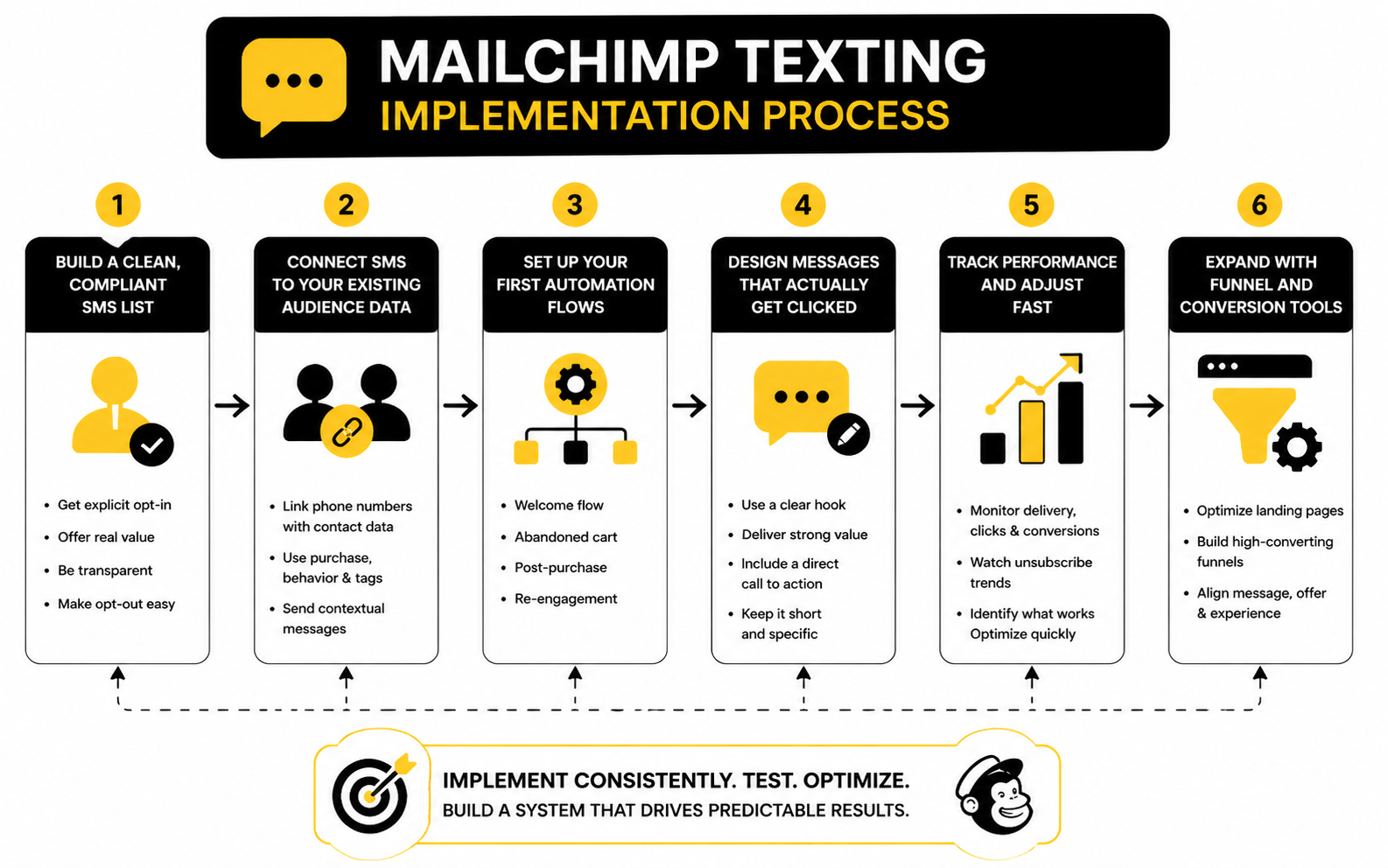
Step 4: Design Messages That Actually Get Clicked
Writing SMS copy is different from writing emails.
You don’t have space for storytelling. You have space for clarity.
High-performing SMS messages usually follow a simple structure:
- Personal or contextual hook
- Clear value proposition
- Direct call to action
For example, instead of vague messaging, effective texts focus on immediacy and specificity. Limited-time offers, clear benefits, and direct links consistently outperform generic announcements.
Shorter messages also tend to perform better, especially when they include a single, obvious action.
Step 5: Track Performance and Adjust Fast
One of the biggest advantages of Mailchimp texting is visibility.
You can track:
- Delivery rates
- Click-through rates
- Conversion data
- Unsubscribe trends
These metrics tell you exactly what’s working and what isn’t.
For example, rising unsubscribe rates often signal poor targeting or over-messaging. Low click rates usually mean weak offers or unclear CTAs. This feedback loop allows rapid iteration, which is critical for improving results over time.
Businesses that actively optimize their SMS campaigns see significantly higher returns compared to those that “set and forget” (source).
Step 6: Expand With Funnel and Conversion Tools
Once the basics are working, the next level is optimization.
This is where tools outside Mailchimp can amplify results. SMS is powerful, but it performs best when paired with high-converting landing pages and funnels.
For example:
- Replo helps build optimized landing pages that match SMS intent
- ClickFunnels creates structured funnels designed to convert SMS traffic
- GoHighLevel offers deeper automation for businesses scaling beyond basic workflows
The goal here isn’t complexity—it’s alignment. When your SMS message, landing page, and offer all match, conversions increase dramatically.
The Implementation Mindset Most People Miss
The biggest difference between average and high-performing Mailchimp texting setups isn’t tools.
It’s discipline.
- Consistent testing
- Clear segmentation
- Structured automation
- Relentless optimization
Most businesses skip these steps. They send a few campaigns, see mixed results, and assume SMS “doesn’t work.”
In reality, they never built the system.
Once you do, SMS becomes one of the most predictable and scalable revenue channels available.
SMS Performance Metrics That Actually Matter
At this point, you’ve built the system. Messages are going out, automation is running, and users are responding.
Now comes the part most people misunderstand: interpreting the data.
Mailchimp texting gives you a clean set of metrics, but numbers alone don’t mean anything unless you know what they signal and what action they should trigger. The goal isn’t tracking—it’s decision-making.
The Core SMS Metrics You Should Watch
Not all metrics carry equal weight. Some are vanity, others are directional, and a few directly tie to revenue.
Here are the ones that actually matter:
- Delivery rate – Tells you if your list quality and compliance are solid
- Click-through rate (CTR) – Shows how compelling your message and offer are
- Conversion rate – Measures how well your funnel completes the action
- Unsubscribe rate – Signals message fatigue or poor targeting
- Revenue per message – The clearest indicator of real performance
SMS consistently outperforms email in raw visibility. Open rates often exceed 95%, and engagement is significantly higher across industries (source).
But here’s the important part: open rates don’t matter in SMS.
When almost everyone sees the message, the real question becomes: what did they do next?
Why Clicks Are the First Real Signal
Click-through rate is the first meaningful indicator of performance.
If people are opening but not clicking, the issue is usually one of three things:
- Weak or unclear offer
- Poor timing
- Lack of relevance
High-performing SMS campaigns often see click rates between 10–30%, depending on the audience and intent (source).
The takeaway is simple: clicks tell you whether your message resonates.
If clicks are low, don’t change everything. Start with the offer and the wording. Small changes here often create outsized improvements.
Conversion Rate: Where Strategy Gets Tested
Clicks are only half the equation. Conversions are where the system proves itself.
If users are clicking but not converting, the problem is almost never the SMS itself. It’s what happens after the click.
This is where funnel alignment becomes critical. Your landing page, offer, and messaging must match the expectation set by the SMS.
Tools like Replo are built specifically to optimize that transition, ensuring the experience after the click doesn’t break momentum.
Even small mismatches—like confusing layouts or slow load times—can dramatically reduce conversions.
Unsubscribe Rates: The Early Warning System
Most people ignore unsubscribe data until it’s too late.
In reality, unsubscribe rates are one of the most valuable signals you have. They tell you when your messaging is crossing the line from helpful to intrusive.
A spike in opt-outs usually points to:
- Too many messages in a short period
- Irrelevant targeting
- Poor timing
Healthy SMS programs maintain low unsubscribe rates by controlling frequency and prioritizing relevance. Once users start leaving, it’s much harder to win them back.
Revenue Per Message: The Metric That Changes Everything
This is where things get serious.
Revenue per message connects your SMS activity directly to business outcomes. It answers a simple question: is this channel worth scaling?
High-performing brands track how much revenue each SMS generates and use that data to justify increased volume or budget.
For example:
- If one message generates predictable revenue, you can scale frequency carefully
- If performance drops, you adjust segmentation or offers before sending more
This is how SMS becomes a controllable growth lever instead of a guessing game.
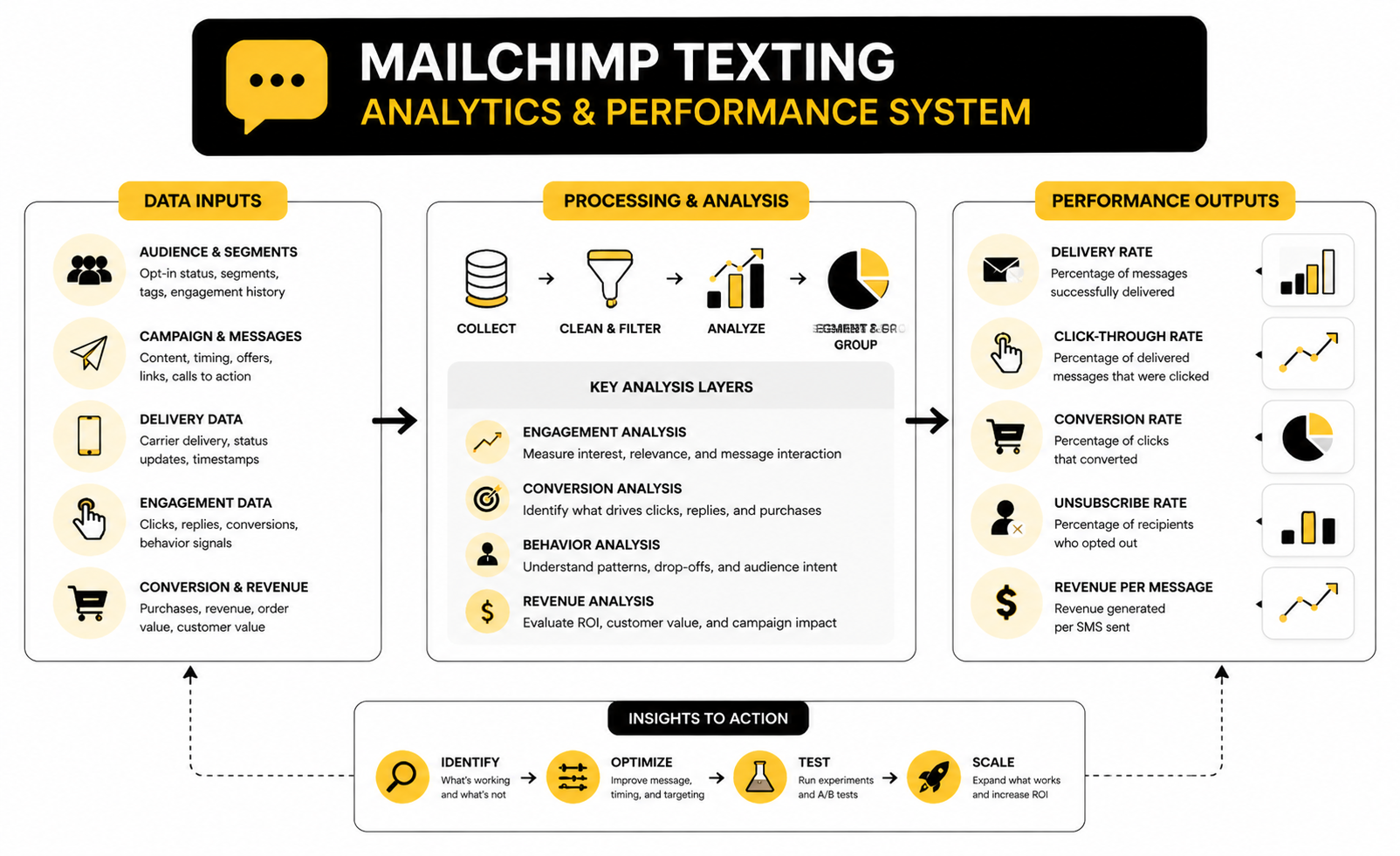
How to Build a Simple Analytics System
You don’t need a complex dashboard to get this right.
A practical SMS analytics system focuses on three layers:
- Message performance – clicks and engagement
- Funnel performance – conversions after the click
- Revenue impact – total return per campaign
Mailchimp provides most of this data natively, but connecting it with your funnel tools gives a clearer picture of what’s actually driving results.
If you’re running multi-channel campaigns, platforms like GoHighLevel help centralize reporting across SMS, email, and automation, making it easier to see the full customer journey.
What the Data Should Actually Drive
Metrics are only useful if they lead to action.
Here’s how professionals interpret and respond:
- Low clicks → improve copy, offer, or timing
- High clicks, low conversions → fix landing page or funnel
- Rising unsubscribes → reduce frequency or refine targeting
- Strong revenue per message → scale carefully and test expansion
This feedback loop is what separates consistent performers from everyone else.
Most businesses send messages and hope. High-performing teams send, measure, adjust, and repeat.
That’s how Mailchimp texting evolves from a tactic into a predictable growth system.
Advanced Strategy: Scaling Mailchimp Texting Without Breaking It
Once your system is working, the instinct is obvious—send more messages, reach more people, and scale faster.
This is exactly where most SMS strategies break.
Mailchimp texting is powerful because it’s direct. But that same directness creates risk. Push too hard, and performance drops fast. Scale correctly, and it becomes one of the most reliable revenue channels you have.
The Tradeoff Between Volume and Trust
Every SMS you send has a cost—not just in credits, but in attention.
Unlike email, where inbox clutter is expected, SMS feels personal. That means users are far less tolerant of irrelevant or excessive messaging. The more you increase volume, the more you risk eroding trust.
This creates a core tradeoff:
- More messages → more immediate opportunities
- Too many messages → higher opt-outs and long-term damage
The best-performing systems don’t maximize volume. They maximize precision.
That means sending fewer, better-targeted messages instead of increasing frequency blindly.
Scaling Through Segmentation, Not Frequency
If you want to grow results, don’t start by sending more texts.
Start by sending smarter ones.
Advanced segmentation is what allows you to scale without overwhelming your audience. Instead of one campaign to everyone, you create multiple targeted campaigns that feel personalized.
Examples of scaling through segmentation:
- Sending VIP offers only to top customers
- Running reactivation campaigns only for inactive users
- Launching product-specific messages based on browsing behavior
This approach increases total message volume across segments without increasing perceived spam for any individual user.
It’s a subtle shift, but it changes everything.
The Hidden Risk: List Fatigue
List fatigue is one of the biggest silent killers of SMS performance.
It doesn’t happen instantly. It builds over time as users start ignoring messages, clicking less, and eventually unsubscribing.
Early signs include:
- Gradual drop in click-through rates
- Slight increases in unsubscribe rates
- Lower conversion despite similar offers
The mistake most people make is reacting too late. By the time unsubscribe rates spike, damage has already been done.
Preventing fatigue requires proactive management:
- Rotating message types (offers, updates, value content)
- Adjusting frequency based on engagement levels
- Giving users control over preferences when possible
Some platforms extend this further. For example, ManyChat allows multi-channel engagement, so users can interact across SMS, chat, and social instead of being overloaded in one channel.
Compliance and Deliverability at Scale
As you grow, compliance becomes more than a checkbox—it becomes operational risk.
SMS regulations vary by region, and enforcement is strict. Fines for non-compliance can be significant, especially when dealing with large lists. Mailchimp enforces opt-in requirements, but responsibility still sits with the business.
Key compliance factors include:
- Clear opt-in language
- Easy opt-out mechanisms
- Proper sender identification
- Respecting quiet hours and regional rules
Deliverability also becomes more sensitive at scale. Poor practices—like sending to unengaged users or inconsistent messaging—can impact how messages are handled by carriers.
Scaling safely means treating compliance and deliverability as part of your growth strategy, not an afterthought.
When Mailchimp Alone Isn’t Enough
At a certain point, you may hit limitations.
Mailchimp is strong for integrated marketing, but high-volume or highly complex operations sometimes require additional infrastructure. This doesn’t mean replacing it—it means extending it.
For example:
- GoHighLevel offers deeper CRM and automation capabilities for scaling agencies or multi-client setups
- Systeme.io simplifies funnel and campaign management for lean teams
- Brevo provides additional messaging flexibility across email and SMS
The decision to expand should be driven by complexity, not curiosity. If your current system is working, optimize it before adding more tools.
Advanced Optimization: Testing What Actually Moves the Needle
At scale, small improvements compound quickly.
Instead of testing random ideas, focus on variables that directly impact performance:
- Offer structure (discount vs bonus vs urgency)
- Message framing (informational vs direct CTA)
- Timing (day, hour, trigger delay)
- Audience segmentation (broad vs narrow targeting)
Testing in SMS doesn’t require massive datasets. Because engagement is high, patterns emerge faster than in most channels.
The key is consistency. Run controlled tests, measure results, and apply learnings systematically.
The Long-Term View Most People Ignore
Short-term wins in SMS are easy.
You can run a promotion, send a message, and see immediate results. That’s why so many businesses treat SMS as a quick-win channel.
The real value, though, comes from long-term relationship building.
When done right, Mailchimp texting becomes:
- A retention channel, not just acquisition
- A loyalty driver, not just a promotion tool
- A direct line to your most engaged customers
This requires restraint, consistency, and strategy.
Most businesses burn their lists chasing short-term gains. The ones that treat SMS as a long-term asset end up with something much more valuable: predictable, repeatable revenue from an audience that actually wants to hear from them.
The final step is tying everything together—so the system runs clean, scales safely, and continues delivering results without constant rebuilding.
Bringing the Full Mailchimp Texting System Together
By now, the pattern should be clear.
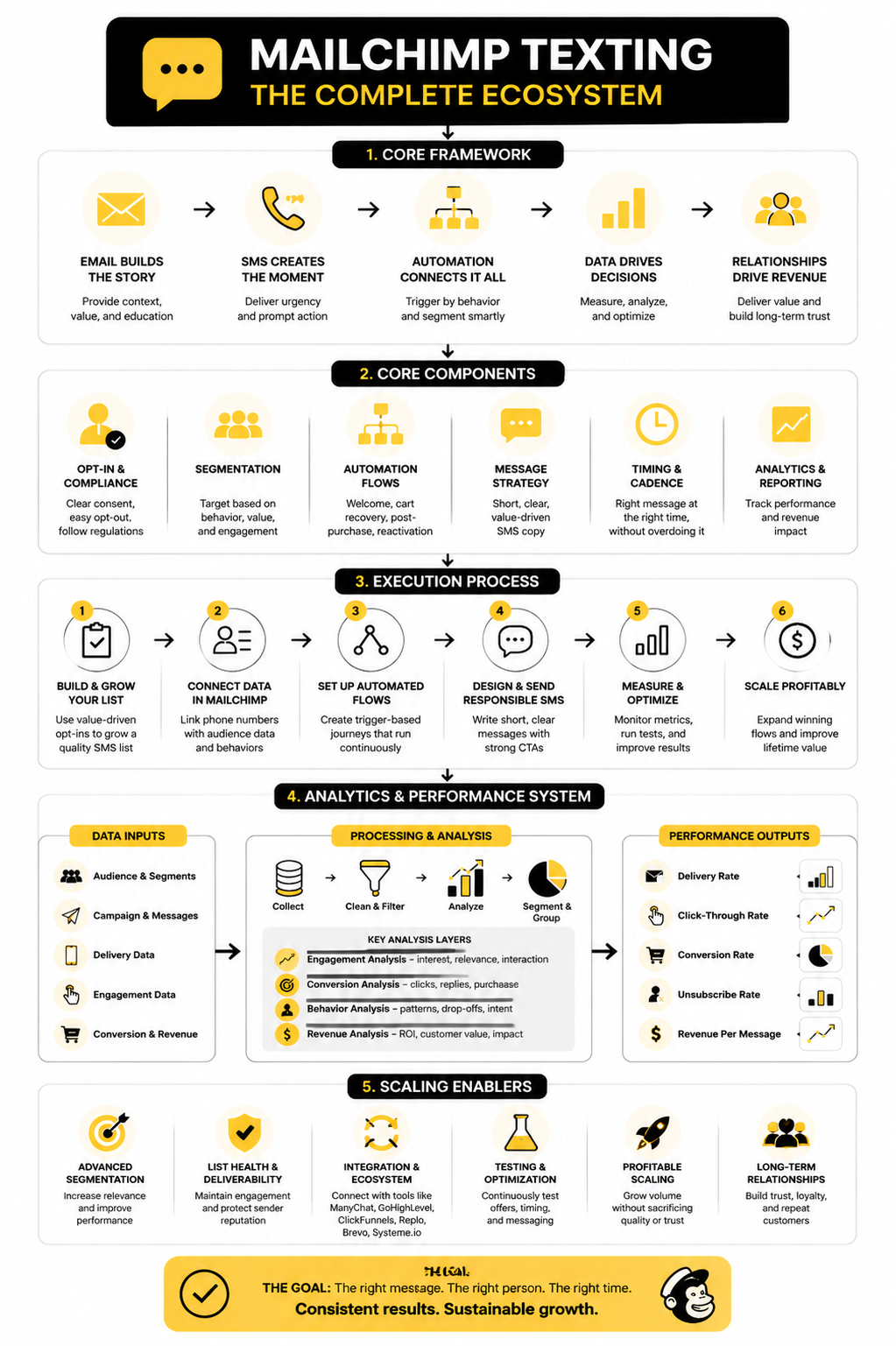
Mailchimp texting works best when it is not treated as a quick promotional blast. It works when the list, consent, segmentation, automation, timing, analytics, and follow-up experience all support one clear goal: sending the right message to the right person at the right moment.
That final system looks simple from the outside, but every layer matters. Consent protects trust. Segmentation protects relevance. Automation protects consistency. Analytics protect profitability. When those pieces work together, SMS becomes far more than another marketing channel.
The strongest operators build SMS like an ecosystem, not a campaign calendar.
FAQ - Built for Complete Guide
What is Mailchimp texting?
Mailchimp texting is Mailchimp’s SMS marketing feature. It allows businesses to send text messages to contacts who have opted in to receive SMS communication. The strongest use case is combining SMS with email, automation, segmentation, and reporting inside the same customer journey.
Is Mailchimp texting the same as email marketing?
No, and that difference matters. Email is better for longer explanations, storytelling, product education, and nurture sequences. SMS is better for timely reminders, urgent offers, confirmations, and action-driven moments.
Do people need to opt in before receiving texts?
Yes. SMS marketing requires clear consent before you send promotional messages. Mailchimp’s SMS setup is built around permission, opt-outs, quiet hours, and compliance basics, which helps protect both the business and the customer relationship.
Can Mailchimp send automated text messages?
Yes. Mailchimp texting can be used inside automated journeys, which makes it useful for welcome sequences, cart recovery, post-purchase follow-ups, reactivation campaigns, and time-sensitive reminders. Automation is where SMS becomes scalable instead of manual.
What kind of businesses should use Mailchimp texting?
Mailchimp texting is especially useful for ecommerce brands, appointment-based businesses, local services, events, memberships, coaches, creators, and companies with time-sensitive offers. The common thread is urgency. If the customer benefits from hearing quickly, SMS can make sense.
How often should a business send SMS campaigns?
There is no universal perfect frequency. The right cadence depends on audience expectations, offer quality, industry, and engagement behavior. A practical starting point is to send only when the message is clearly useful, then adjust based on clicks, conversions, and unsubscribes.
What metrics matter most for Mailchimp texting?
The most important metrics are delivery rate, click-through rate, conversion rate, unsubscribe rate, and revenue per message. Open rate is less useful in SMS because visibility is already high. The real question is whether the message created action.
What causes SMS unsubscribes?
Unsubscribes usually come from poor relevance, weak offers, bad timing, or excessive frequency. People are protective of their text inbox. If your message feels intrusive instead of useful, they leave quickly.
Can SMS replace email?
No. SMS should not replace email. The best systems use both channels together, with email carrying context and SMS driving timely action. Treating them as partners produces a much stronger customer journey than relying on either channel alone.
Is Mailchimp texting good for abandoned cart recovery?
Yes, abandoned cart recovery is one of the clearest use cases for SMS. The timing is natural, the intent is already present, and the message can be short. It works best when the link leads to a simple checkout experience rather than a cluttered landing page.
What are the biggest mistakes with Mailchimp texting?
The biggest mistakes are sending without clear consent, blasting the entire list, ignoring quiet hours, sending too often, using weak CTAs, and failing to track revenue. Most SMS failures are not caused by the platform. They happen because the strategy is lazy.
When should a business consider tools beyond Mailchimp?
A business should consider additional tools when it needs deeper CRM logic, more advanced funnels, stronger landing pages, multi-channel conversations, or agency-level client management. For example, GoHighLevel, ManyChat, and ClickFunnels can extend the system when the operation becomes more complex.
What is the best way to start with Mailchimp texting?
Start with one high-intent use case. A welcome flow, abandoned cart reminder, or post-purchase follow-up is better than launching random promotional blasts. Once that first flow performs reliably, expand into segmentation, testing, and revenue-based optimization.
Work With Professionals
Explore 10K+ Remote Marketing Contracts on MarkeWork.com
Most marketers spend too much time chasing clients, competing on crowded platforms, and losing a percentage of every project to middlemen.
MarkeWork gives you a better way. Browse thousands of remote marketing contracts and connect directly with companies desperate to hire skilled marketers like you, without platform commissions and without unnecessary gatekeepers.
If you're serious about finding better opportunities and keeping 100% of what you earn, explore available contracts and create a profile for free at MarkeWork.com.