

MailerLite pricing looks simple at first glance, and that is exactly why people misread it. A lot of buyers focus on the starting number, assume the cheapest tier will be enough, and only realize later that their real cost is shaped by subscriber growth, automation needs, sending volume, and the features they expected to be included from day one.
That is why this article is not going to treat pricing like a single line item. The smarter way to evaluate MailerLite pricing is to look at what you are actually buying, what triggers the next upgrade, and what hidden tradeoffs show up once your newsletter, store, or client operation starts moving faster.
MailerLite also sits in a crowded market where simple pricing can feel attractive next to broader platforms like Brevo, Moosend, or more all-in-one stacks like GoHighLevel. So the real question is not whether MailerLite is cheap. The real question is whether it stays cost-effective for your exact stage of growth.

Article Outline
- What MailerLite Pricing Looks Like Today
- Why MailerLite Pricing Matters More Than the Sticker Price
- A Practical Framework for Choosing the Right Plan
- The Core Components That Shape Your Real Cost
- How MailerLite Compares With the Main Alternatives
- How to Implement MailerLite Professionally Without Overpaying
Why MailerLite Pricing Matters More Than the Sticker Price
Most email platforms are easy to buy and harder to outgrow gracefully. What feels affordable when you have a small list can become inefficient when you need stronger automations, more advanced segmentation, better landing pages, or cleaner workflows across forms, campaigns, and ecommerce activity.
MailerLite pricing matters because it influences more than software spend. It affects how quickly you can launch campaigns, how much manual work your team keeps doing, and whether your tech stack stays lean or starts fragmenting into extra tools for popups, pages, forms, booking flows, or CRM-style follow-up.
This is also where a lot of comparisons go wrong. People compare entry prices across platforms, but serious buyers should compare use cases. A creator with a newsletter, a Shopify operator with product flows, and an agency managing multiple brands will not experience the same value even if they all start on a similar monthly budget.
A Practical Framework for Choosing the Right Plan
The cleanest way to evaluate MailerLite pricing is to stop asking, “What does it cost?” and start asking, “What job does this plan need to do?” That shift sounds small, but it changes the whole buying decision from reactive to strategic.
A practical framework starts with four filters. First, define your list size today and your likely growth over the next year. Second, map the features you will actually use, not the ones that merely sound nice on a comparison page. Third, estimate the operational cost of missing features, because a cheaper tool becomes expensive the moment it creates extra manual work. Fourth, compare MailerLite against realistic alternatives that serve the same stage of business, whether that is Brevo, Systeme.io, or GoHighLevel.
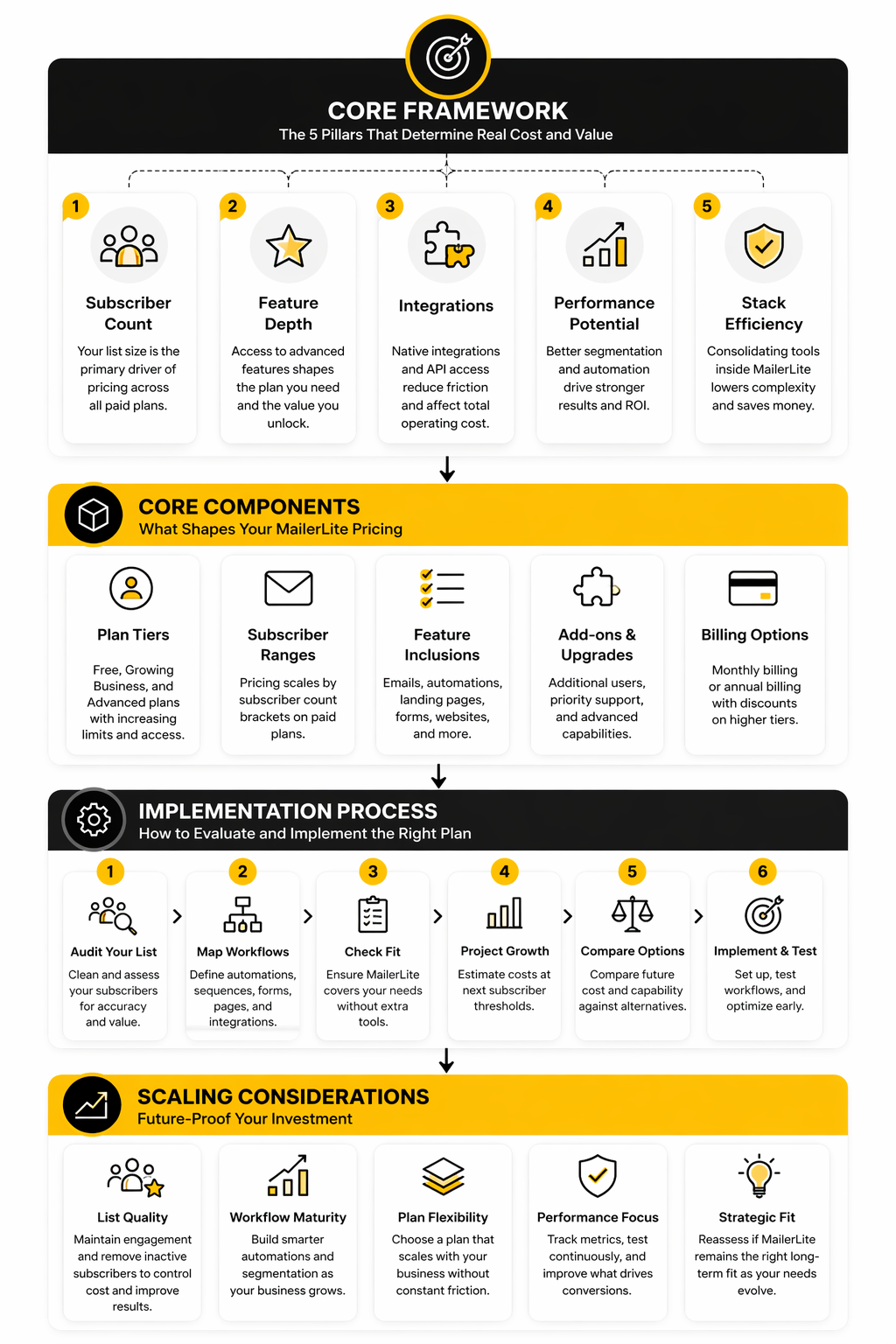
Used properly, this framework keeps you from making the two classic mistakes. The first is overbuying features you will not touch for a year. The second is underbuying and then patching the gap with more tools, more integrations, and more complexity than the original savings were ever worth.
What MailerLite Pricing Looks Like Today
MailerLite keeps its pricing model relatively straightforward, which is part of its appeal. The platform currently separates users into four plan types: Free, Growing Business, Advanced, and Enterprise, with billing available monthly or annually through its plan and billing documentation and pricing page.
The Free plan is built for smaller lists and early-stage senders. MailerLite states that free accounts cover up to 500 active subscribers and up to 12,000 emails every 30 days, which makes it useful for testing the platform, launching a first newsletter, or building an audience before revenue becomes predictable through the free plan details. That setup is generous enough to get started, but it is still a starter environment, not a long-term operating system for a business with heavier automation or advanced segmentation needs.
The paid structure begins with Growing Business. MailerLite positions that tier as the entry point for brands that want to remove platform branding, unlock more sending flexibility, and use more of the growth-oriented tools described on the official pricing page. The Advanced tier sits above it for teams that need more sophisticated workflows and deeper operational control, while Enterprise is reserved for larger-scale requirements that need custom pricing and account-level support.
What matters here is not just the plan names. It is the fact that MailerLite pricing scales primarily with subscriber volume and feature access, so the number on the pricing page is only the starting point. The moment your list grows, your automation stack gets more serious, or your brand starts relying on email as a primary revenue channel, the cheap-looking entry price stops being the real decision metric.
That is also why headline comparisons can be misleading. MailerLite’s own comparison with Brevo alternatives highlights that the pricing logic is different, because MailerLite prices by subscriber tier while other tools may price around sending limits or broader platform packaging. A cheap plan on paper can become restrictive fast if the pricing model does not match how your business actually sends, segments, and converts.
Why the Price Structure Needs a Second Look
The strongest thing about MailerLite pricing is clarity. The weakest thing about MailerLite pricing is that clarity can make people stop their evaluation too early. When the setup looks simple, buyers often assume the platform will remain equally efficient as their operation becomes more complex.
That is where disciplined buying matters. A newsletter creator may care most about affordable list growth and simple automations. An ecommerce brand may care more about store triggers, abandoned cart sequences, and revenue capture. A service company may need email to work alongside funnels, forms, calendars, and lead follow-up, which is where broader systems like GoHighLevel or lean funnel-focused tools like Systeme.io start entering the conversation.
This is not just theory. Email remains one of the strongest-performing owned channels, with current benchmark reporting from Litmus and HubSpot continuing to show strong return expectations when teams have the right segmentation, automation, and analytics in place. If email is capable of producing that kind of leverage, then the platform decision should be evaluated on total business performance, not just monthly software cost.
So yes, MailerLite pricing can be attractive. But the serious question is whether it stays aligned with your growth path once email shifts from “something you send” to a core system for acquisition, nurture, and conversion. That is exactly where the next layer of the analysis becomes useful, because the real cost is shaped by specific components inside the plan, not the plan label itself.
The Core Components That Shape Your Real Cost
Once you move past the headline price, MailerLite pricing becomes a question of cost drivers. The platform itself is not confusing, but the real bill is shaped by how many active subscribers you carry, which features you need unlocked, how sophisticated your automations become, and whether you can keep your stack consolidated inside one system.
Subscriber count is the most obvious variable. MailerLite explains in its plan and billing guide that paid plans are tied to recipient ranges, which means growth is directly connected to spend. That sounds fair, and often it is, but it also means sloppy list hygiene can become a pricing problem, not just a deliverability problem.
Feature depth is the second cost driver, and this is where many buyers underestimate the gap between “can send emails” and “can run email properly.” MailerLite bundles email campaigns, automations, signup forms, landing pages, websites, and ecommerce tools across its product experience on the pricing page and across its feature pages. The key issue is not whether those features exist. It is whether the plan you choose gives you enough of them to avoid bolting on extra software later.
Integrations are the third cost driver because they determine how much friction sits between audience capture and conversion. MailerLite states that it supports 100+ integrations, including ecommerce and workflow tools, and its API documentation makes clear that more custom setups are possible through the developer access flow. That matters because the real cost of a platform includes the time your team spends stitching systems together when the native workflow is not enough.
Performance expectations also matter more than people admit. Segmentation and relevance remain central to better email results, which is reinforced by recent benchmark reporting from the APSIS Email Benchmark Report 2025, Higher Logic’s 2025–2026 benchmark release, and Mailchimp’s benchmark resource. If stronger segmentation and automation are what produce better commercial outcomes, then the plan decision should be judged by how effectively it supports those actions, not by the cheapest monthly number.
How to Evaluate MailerLite Pricing Before You Commit
The cleanest process is to test MailerLite pricing against your operating model before you buy emotionally. Too many people look at the entry price, compare it with a few competitors, and call it a day. That is how software that looked efficient in month one becomes annoying and expensive by month six.
Start with the list itself. You need to know how many active subscribers you have today, how fast that number is growing, and how many of those contacts are actually valuable enough to justify keeping them on a billable plan. If you are carrying cold subscribers, duplicate records, or low-intent leads that have not engaged in months, your pricing decision is already distorted.
Then map the workflows you actually need. For some brands, that means a welcome sequence, a weekly campaign, a few embedded forms, and one landing page. For others, it means lead magnets, popup logic, ecommerce triggers, customer tagging, abandoned cart recovery, product follow-up, and reporting that can guide the next decision instead of merely documenting the last one.
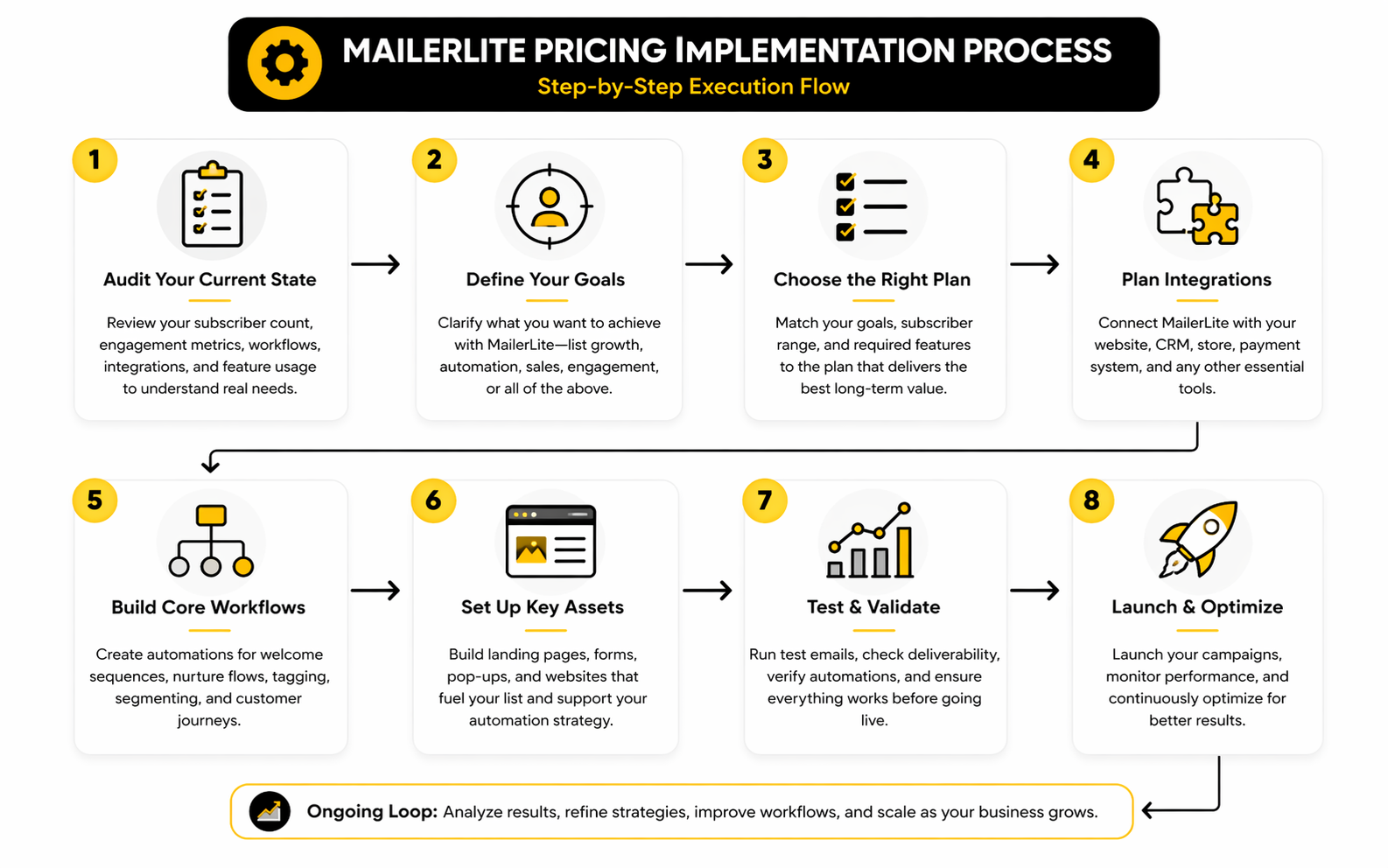
After that, compare MailerLite pricing through a practical execution sequence:
- Audit your subscriber base and remove contacts that do not deserve to stay on a paid tier.
- List the automations you need in the next 90 to 180 days, not just this week.
- Check whether your forms, landing pages, and integrations can live inside MailerLite without forcing extra tools.
- Estimate what your monthly cost becomes at the next one or two subscriber thresholds.
- Compare that future-state cost against alternatives like Brevo, Moosend, or broader systems like GoHighLevel if your needs stretch beyond email.
This is where the decision gets honest. If MailerLite can carry your capture, nurture, and campaign work cleanly, it can be a very efficient buy. If you already know you will need deeper CRM workflows, funnel infrastructure, or more aggressive multi-channel orchestration, the cheaper entry point may stop looking like the best value.
What a Professional Setup Actually Looks Like
A professional implementation does not begin with templates. It begins with structure. The best MailerLite pricing decision usually comes from teams that know what subscriber enters which path, what event triggers which automation, and what metrics define success before they ever touch the editor.
That means your setup should start with audience architecture. Groups, segments, forms, and automation triggers need to reflect actual business logic, not random experiments left over from past campaigns. MailerLite’s help center and automation tutorials show that the platform is capable of handling structured workflow design through its automation overview, signup form tools, and landing page builder, but the leverage comes from how deliberately you connect them.
It also means implementation has to respect the revenue model of the business. An ecommerce store should not build the same setup as a media newsletter or a lead-generation business. MailerLite’s WooCommerce integration and its guide on connecting WooCommerce to MailerLite make that clear, because the platform is strongest when subscriber behavior, product data, and follow-up logic work together instead of existing as separate tasks.
This is the point where MailerLite pricing becomes operational, not theoretical. A cheap plan with a sharp implementation can outperform a more expensive tool that is poorly configured. But the reverse is also true, and it matters: a plan that saves money while forcing weak segmentation, shallow automation, or workaround-heavy execution can quietly cost more than it saves.
What the Numbers Actually Tell You
This is where a lot of MailerLite pricing decisions either become smart or become lazy. Looking at plan cost without looking at performance data is incomplete, because the software bill only makes sense when you compare it to the output you are getting from your list, your campaigns, and your automations.
The right way to read the data is not to hunt for one magic benchmark. It is to understand whether your current results justify staying lean on cost, whether weak performance is coming from poor execution rather than the platform, and whether better analytics would change what plan makes sense. That distinction matters because bad email economics are often caused by weak segmentation, stale lists, or shallow workflow design, not by paying too much for software.
Recent benchmark reporting points in a useful direction. The DMA Email Benchmarking Report 2025 showed delivery rates rising to 98% in 2024, open rates reaching 35.9%, and unique click rates climbing to 2.3%. MailerLite’s own 2025 benchmark analysis reported an average open rate of 43.46%, an average click rate of 2.09%, an average click-to-open rate of 6.81%, and an unsubscribe rate of 0.22% in 2025 through its benchmark summary, while the APSIS Email Benchmark Report 2025 reinforces the point that marketers now rely on real-time campaign metrics, segmentation, and conversion visibility more than raw send volume.
Those numbers matter because they reframe the pricing conversation. If you are paying less for MailerLite but your list quality is weak, your automation is shallow, and your click performance is lagging, then the cheap plan is not really cheap. On the other hand, if your delivery is strong, your clicks are healthy, and your list is monetizing cleanly, then even a higher monthly tier can be an excellent deal.
Which Metrics Matter Most When Evaluating MailerLite Pricing
Open rates still tell you something, but they are no longer enough on their own. Privacy changes and inbox behavior have made opens directionally useful rather than fully trustworthy, which is exactly why more recent performance analysis from Litmus and Higher Logic puts more emphasis on the relationship between engagement, segmentation, and downstream business outcomes.
Click rate is usually more revealing because it shows whether the message moved someone to act. Click-to-open rate adds another layer by showing how effective the email was once it was actually viewed. If opens look fine but clicks stay weak, the problem is rarely solved by switching platforms immediately. More often, it points to weak offer structure, poor audience matching, or email creative that is simply not compelling enough.
Unsubscribe rate is another underrated pricing signal. A low monthly bill can still be wasteful if the content strategy burns through attention and pushes people out of the list. MailerLite pricing scales with subscriber count, so every unnecessary contact you carry costs money, but every good subscriber you lose also has a cost. That is why the job is not just list growth. It is profitable list quality.
How to Build an Analytics System That Supports the Pricing Decision
You do not need a huge reporting stack to judge whether MailerLite pricing is working for you. You need a measurement system that connects cost, engagement, and conversion. Without that, you are just reacting to line items on an invoice.
The simplest useful model has four layers. First, track list health through growth, churn, unsubscribe rate, and inactive subscriber volume. Second, track campaign engagement through delivery, opens, clicks, and click-to-open rate. Third, track business impact through leads, sales, booked calls, or whatever conversion event matters most. Fourth, track operational efficiency, meaning how much manual work your current setup still creates.
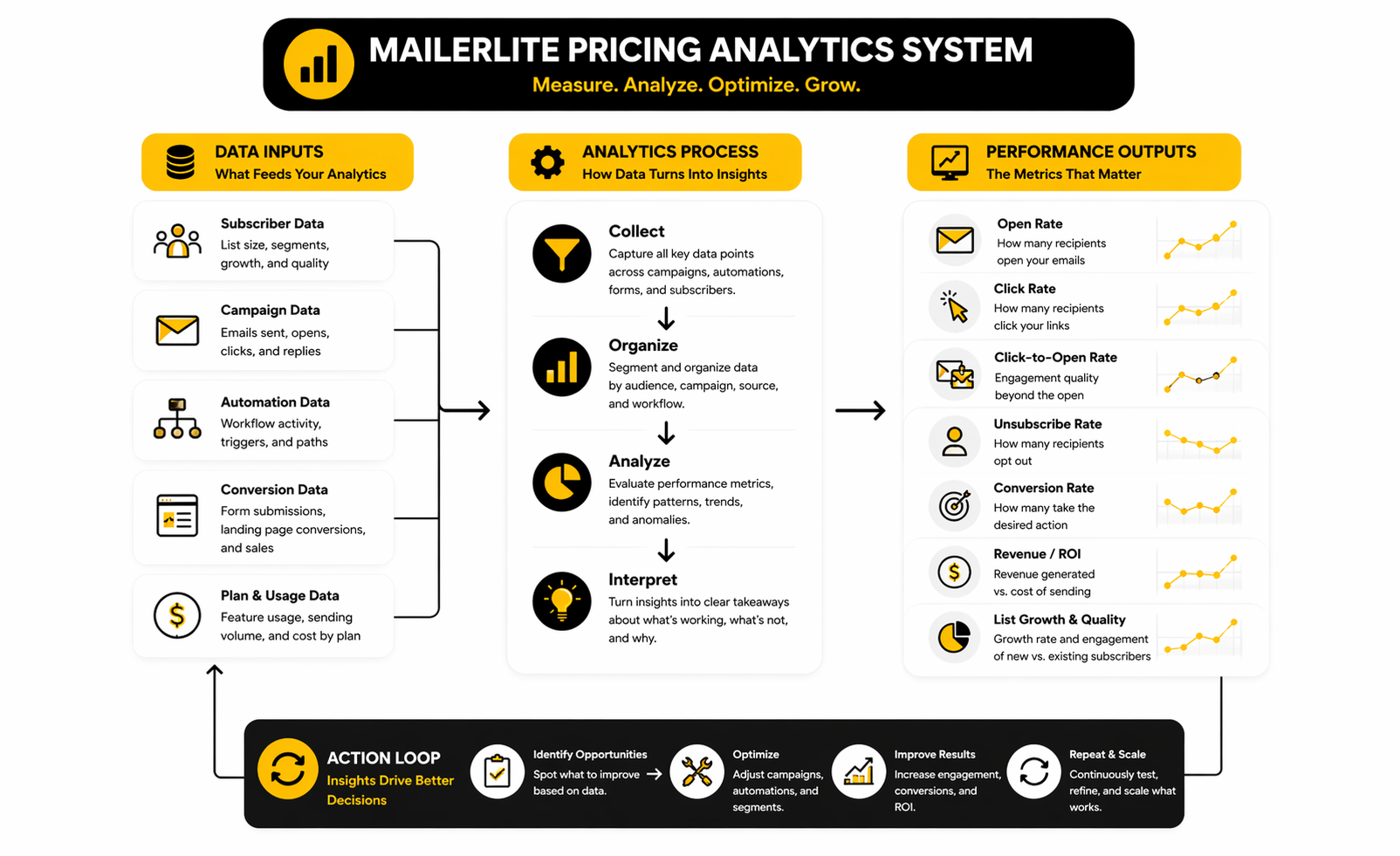
When you look at those four layers together, the decision becomes much clearer. A lower-cost plan works when it supports healthy engagement and efficient execution. A higher-cost plan becomes justified when it unlocks better segmentation, stronger automation, or cleaner workflows that improve the economics of the channel.
This is also why benchmark numbers should guide action, not ego. If your open rates are above average but your clicks and conversions are flat, you probably do not have a pricing problem. You have a messaging or offer problem. If your delivery is falling behind the DMA benchmark levels, then the urgent move is not necessarily upgrading plans. It is cleaning the list, tightening consent practices, and improving sender reputation.
What the Data Should Make You Do Next
Good analytics should drive decisions, not just dashboards. If your list is growing quickly and engagement is holding steady, MailerLite pricing may still be highly efficient even as you move into higher subscriber tiers. In that case, the right action is to keep investing in the workflows that are already working.
If engagement is sliding while subscriber count keeps rising, that is a warning sign. You may be paying more to email more people while producing less value per send. That usually means it is time to cut inactive contacts, rebuild segmentation logic, and tighten the connection between forms, automations, and offers before you blame the platform itself.
And if your business now depends on email plus CRM, sales workflows, landing pages, multi-step funnels, and cross-channel follow-up, the data may be telling you something more structural. At that point, comparing MailerLite pricing against broader systems like GoHighLevel, simpler all-in-one paths like Systeme.io, or email-first alternatives like Brevo becomes a business systems decision, not just a newsletter tool comparison.
That is the big takeaway. The numbers are not there to impress you. They are there to tell you whether your current setup deserves to stay exactly as it is, whether it needs better execution, or whether your business has already grown beyond the plan logic that made MailerLite feel attractive in the first place.
How MailerLite Compares With the Main Alternatives
By this point, the MailerLite pricing question is no longer about whether the platform is affordable. It is about whether its pricing logic still fits the way your business actually operates. That is the right moment to compare it against alternatives, because the biggest mistake at this stage is optimizing for monthly cost while ignoring system design.
MailerLite stays attractive when you want a relatively clean email-first platform with landing pages, forms, websites, and automation in one place. Brevo becomes more interesting when you want a broader customer engagement stack that leans into marketing, sales, and transactional messaging under one roof, while Brevo also frames pricing around different usage patterns than pure subscriber-led scaling. HighLevel plays a different game entirely, because GoHighLevel is built around sub-accounts, agency workflows, and rebilling logic rather than simply being an email platform with a few extras.
That difference matters more as complexity rises. If you are a creator, small brand, or lean operator who mainly needs newsletters, automations, pages, and list growth infrastructure, MailerLite pricing can still be a very rational choice. If you run a service business, an agency, or a more layered revenue operation where CRM, booking, pipeline management, and multi-client management matter, then a broader system can look expensive upfront but cheaper in total once the stack is consolidated.
The Scaling Risks Most Buyers Miss
The first scaling risk is paying for list growth that is not matched by list quality. MailerLite pricing scales with recipient ranges, so bad hygiene becomes a direct cost issue. When inactive contacts pile up, the platform does not become overpriced overnight, but your economics weaken because you are funding dead weight while your engagement metrics become harder to interpret.
The second risk is workflow fragmentation. MailerLite gives you a lot inside one product, but every business reaches a point where the question becomes whether the built-in tools are enough for the next phase. When a team starts layering on outside form builders, more advanced CRM logic, extra funnel tools, or separate transactional infrastructure, the software bill stops being the only cost worth tracking. The real issue becomes operational drag.
The third risk is choosing a platform based on what you do today instead of what you are building toward. That sounds obvious, but it is where a lot of software decisions go wrong. A simple newsletter business can live happily with a simpler stack for a long time, while an operator building client services, sales workflows, or more aggressive lifecycle marketing may hit the ceiling faster than expected.
Advanced Buying Logic for Serious Operators
Here is the expert-level filter: do not evaluate MailerLite pricing as software in isolation. Evaluate it as a layer inside your revenue engine. The question is whether it reduces cost and complexity at the same time, or whether it saves money on paper while pushing complexity elsewhere.
That means you should look at three horizons. The first is the current-state horizon, where you ask whether MailerLite covers what you need right now without compromise. The second is the next-stage horizon, where you ask what happens after the next growth jump in subscribers, campaigns, and automations. The third is the structural horizon, where you ask whether this platform still makes sense once email has to work alongside sales, client management, or deeper funnel logic.
This is why some businesses should stay simple on purpose. If you do not need the operational weight of an all-in-one system, forcing that move too early can create its own inefficiency. But the opposite is true too, and it is a more expensive mistake: when your business already needs broader orchestration, staying on a lighter setup because the monthly fee looks friendlier can quietly slow execution, weaken attribution, and multiply manual work across the team.
When MailerLite Pricing Is the Smart Choice and When It Is Not
MailerLite pricing is usually the smart choice when your core need is still email-centric growth. That includes newsletters, lead capture, basic-to-strong automation, landing pages, and a clean user experience without turning your marketing stack into a maintenance project. In those cases, staying lean is not being cheap. It is being disciplined.
It becomes a weaker fit when your operation is no longer primarily about email delivery and audience nurture. If your business now depends on account hierarchies, advanced rebilling, deep CRM behavior, or cross-channel orchestration as a built-in operating model, a platform like GoHighLevel may align better with how the business actually runs. If your priority is broader customer communication with sales and transactional layers closer to the core product, Brevo deserves a harder look, and if you want a lighter all-in-one funnel path, Systeme.io can make sense for certain simpler sales flows.
That is the real advanced takeaway. MailerLite pricing is not just about finding the cheapest acceptable tool. It is about recognizing the point where simplicity is still an advantage and the point where simplicity starts costing you leverage. Part 6 will bring that together into a practical conclusion and the questions people usually ask right before they make the decision.
Final Decision: Is MailerLite Worth the Price?
After everything above, the honest answer is simple. MailerLite pricing is worth it when you want a clean, capable email platform that can handle newsletters, automations, forms, landing pages, and basic website support without dragging you into a bloated stack. It is not the automatic best choice for every business, but it is a very rational one for operators who still live primarily inside email-led growth.
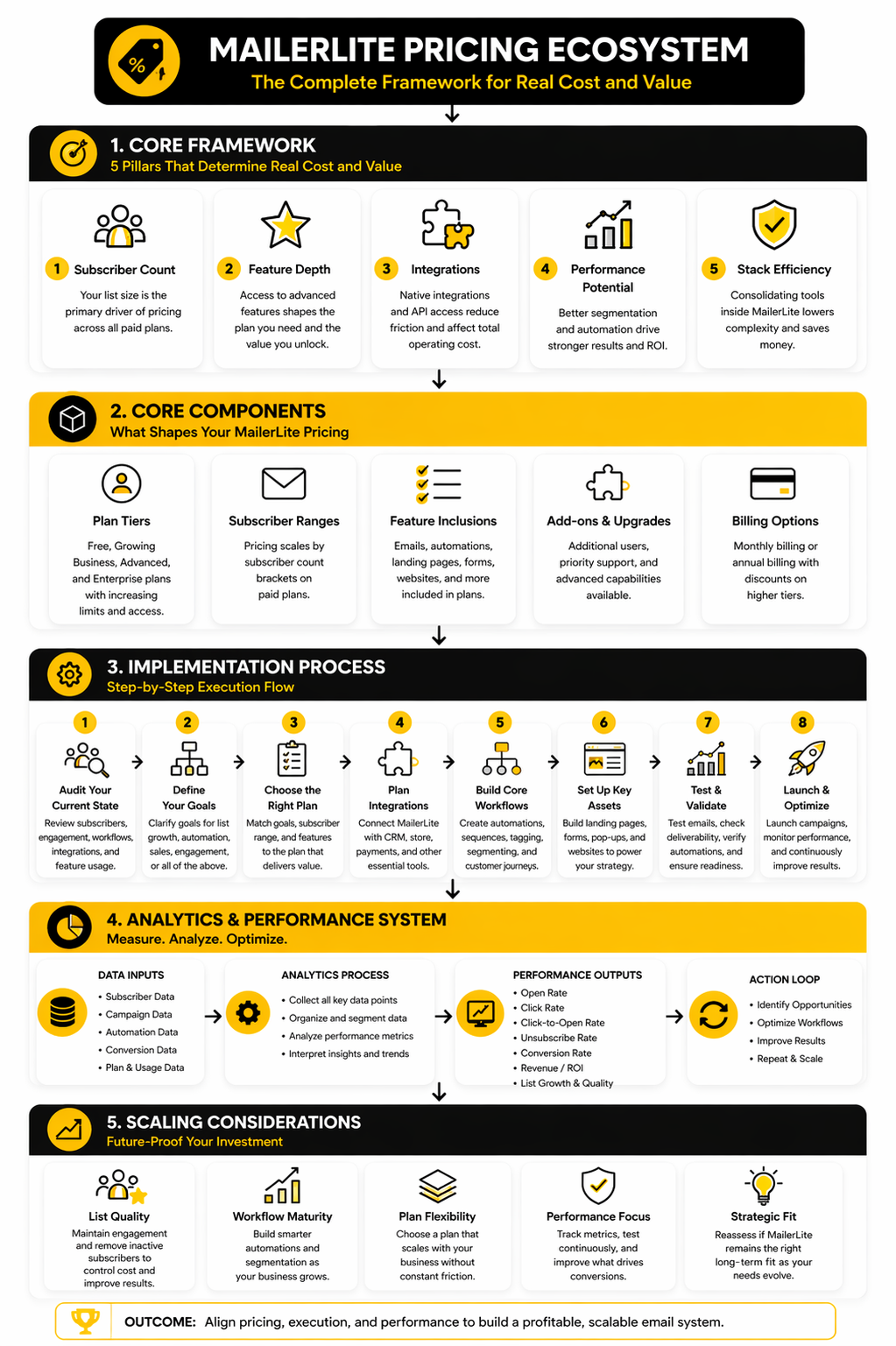
The smartest buyers do not choose MailerLite because it is merely cheaper. They choose it because the platform-to-business fit is right. If your team can keep list quality high, build sensible automations, measure clicks and conversions properly, and avoid unnecessary tool sprawl, MailerLite pricing can stay efficient for a long time.
But this is the part that really matters. If your business is already moving toward deeper CRM workflows, agency account structures, multi-channel lifecycle systems, or more aggressive sales orchestration, then the “good value” of MailerLite can become a local maximum. It still looks good, but it may no longer be the best strategic position for where you are going next.
FAQ
Is MailerLite pricing good for beginners?
Yes, for many beginners it is. The structure is easier to understand than a lot of bloated software pricing pages, and the free plan plus entry-level paid tiers make it easier to start without overcommitting. The bigger issue is not beginner friendliness but whether a beginner builds the right setup, because even affordable software gets wasted when the list, offer, and automation logic are weak.
Does MailerLite have a free plan?
Yes, MailerLite still offers a free plan for smaller lists. That makes it appealing for creators, early-stage businesses, and anyone who wants to validate a newsletter or lead capture idea before paying monthly. The important thing is to treat the free tier as a testing ground, not proof that your long-term cost will stay tiny once the list starts growing.
When does MailerLite pricing start to feel expensive?
It usually starts feeling expensive when subscriber growth outruns list quality or when your operation needs more complexity than the platform is designed to handle comfortably. In other words, the pain often shows up through inefficiency before it shows up through the invoice. If you are paying for more contacts while engagement quality drops, the platform is not necessarily overpriced, but your system probably is.
Is MailerLite cheaper than Brevo?
That depends on how your business sends and stores contacts. Brevo uses a different pricing logic that can be more attractive for some sending patterns, especially when you care about broader communication use cases beyond classic newsletter growth. So this is not a clean “which one is cheaper” question. It is a “which pricing model matches your business behavior better” question.
Is MailerLite better than all-in-one platforms?
Not always, and that is exactly why comparing categories can be misleading. MailerLite is often better when you want focused email marketing, lean execution, and fewer moving parts. A broader system like GoHighLevel can make more sense when email is just one part of a bigger client acquisition, CRM, and follow-up machine.
Can MailerLite work for ecommerce businesses?
Yes, but the quality of the fit depends on how advanced your ecommerce lifecycle needs are. If you need solid forms, campaigns, segments, and practical automation around store activity, it can absolutely work. If your ecommerce engine depends on deeper retention flows, channel orchestration, and heavier behavioral logic, then you should compare it harder against more specialized or broader platforms before committing.
Does annual billing make MailerLite pricing meaningfully better?
Annual billing can improve the economics, but only if you are already confident in the fit. A discount is helpful, but it does not fix the wrong platform decision. Locking into a tool too early because the annual price looks better is one of the easiest ways to save a little cash while buying yourself a bigger migration problem later.
What metrics should I watch before upgrading?
The most useful ones are list growth quality, click rate, click-to-open rate, unsubscribe rate, and conversion performance tied to campaigns and automations. Open rates still have some directional value, but they should not carry the whole decision because privacy changes have made them less reliable as a standalone signal. If those deeper metrics are healthy, upgrading can make sense. If they are weak, upgrading plans without fixing execution is usually wasted motion.
Is MailerLite enough for agencies?
Sometimes, but not always. A small agency running straightforward email programs for a limited client set may be fine, especially if the workflows stay relatively simple. Once the agency model starts demanding sub-account structures, client-specific pipelines, rebilling logic, and broader operational control, platforms like GoHighLevel usually become much more relevant.
What is the biggest mistake people make with MailerLite pricing?
They confuse low entry cost with low total operating cost. That sounds like a subtle distinction, but it is huge. A platform is only cheap if it helps you execute well without piling extra manual work, fragmented tools, or weak performance on top of the bill.
Should creators and newsletter operators choose MailerLite?
In many cases, yes. If your main game is content distribution, audience building, lead capture, and lightweight automation, MailerLite pricing can be very attractive because the product stays focused on what you actually need. That is especially true when the alternative is buying a broader platform full of features you will barely touch.
When should I look at Systeme.io instead?
You should look harder at Systeme.io when your priority shifts toward simple funnels, entry-level selling systems, and a more bundled path for offers and conversions rather than a primarily email-first operating model. It can be a better fit for some direct-response style businesses that want fewer separate tools. The tradeoff is that “more all-in-one” is not automatically “better,” so the choice should still come back to workflow fit.
Is switching away from MailerLite hard later?
Any switch gets harder once your list, automations, forms, and reporting logic become deeply embedded. That does not mean you should avoid MailerLite. It means you should choose intentionally, document your setup, and avoid building messy systems you cannot migrate cleanly later. The real risk is not the act of switching. The real risk is drifting into complexity without noticing until the migration bill becomes painful.
Work With Professionals
Explore 10K+ Remote Marketing Contracts on MarkeWork.com
Most marketers spend too much time chasing clients, competing on crowded platforms, and losing a percentage of every project to middlemen. MarkeWork gives you a better way. Browse thousands of remote marketing contracts and connect directly with companies desperate to hire skilled marketers like you, without platform commissions and without unnecessary gatekeepers.
If you're serious about finding better opportunities and keeping 100% of what you earn, explore available contracts and create a profile for free at MarkeWork.com.