

Mailing marketing is the strategic use of email to attract, educate, convert, and retain customers through permission-based communication. It is not just sending newsletters. Done properly, it becomes a controlled revenue channel built on audience ownership, segmentation, automation, strong offers, and measurable follow-up.
That matters because attention is getting more expensive everywhere else. Paid ads fluctuate. Social reach changes overnight. Search traffic can shift after one update. Email is different because you are building a direct relationship with people who have already given you permission to contact them.
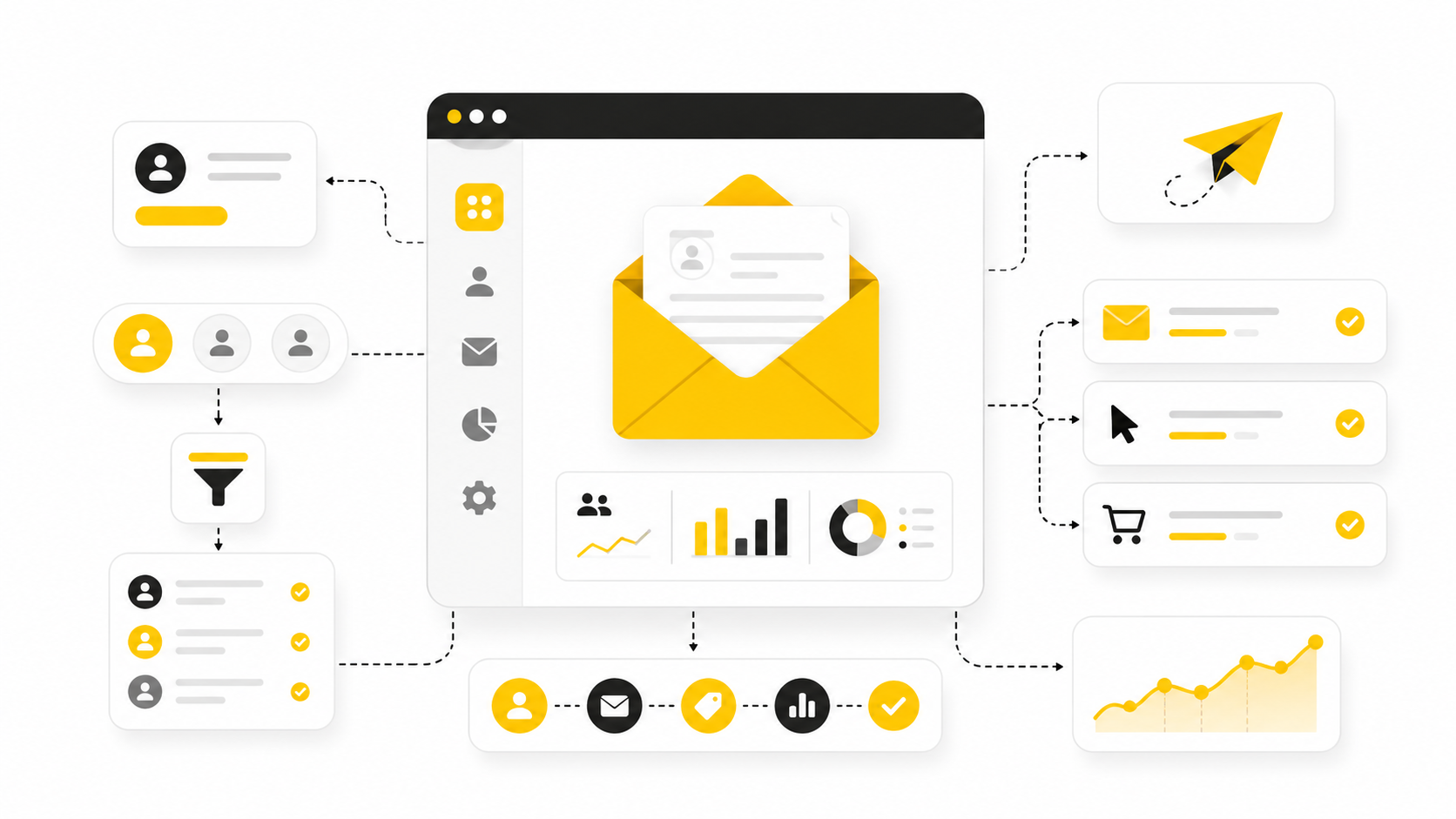
This full guide will continue across six parts using this structure:
- Why Mailing Marketing Still Matters
- The Mailing Marketing Framework
- Audience, Permission, And List Quality
- Segmentation, Messaging, And Offers
- Automation, Deliverability, And Measurement
- Professional Implementation, Tools, And FAQ
Why Mailing Marketing Still Matters
Mailing marketing works because it sits close to the buying decision. A subscriber has already taken a small action: joined a list, downloaded something, bought a product, booked a call, or asked for more information. That means the relationship is warmer than a random ad impression.
The channel also gives businesses more control. You can send product launches, onboarding emails, abandoned checkout reminders, educational sequences, reactivation campaigns, and customer retention messages without depending entirely on an algorithm. That does not mean email is free or easy, but it does mean the asset is yours in a way social followers rarely are.
Recent industry data keeps showing why this channel deserves serious attention. Litmus reported that many teams still see strong returns from email, with a meaningful share of marketers seeing email ROI in the 10:1 to 36:1 range or higher through their email programs. Brevo’s 2025 benchmark analysis of more than 44 billion emails also shows that email remains measurable at scale, with performance varying by region, industry, and list quality.
The Mailing Marketing Framework
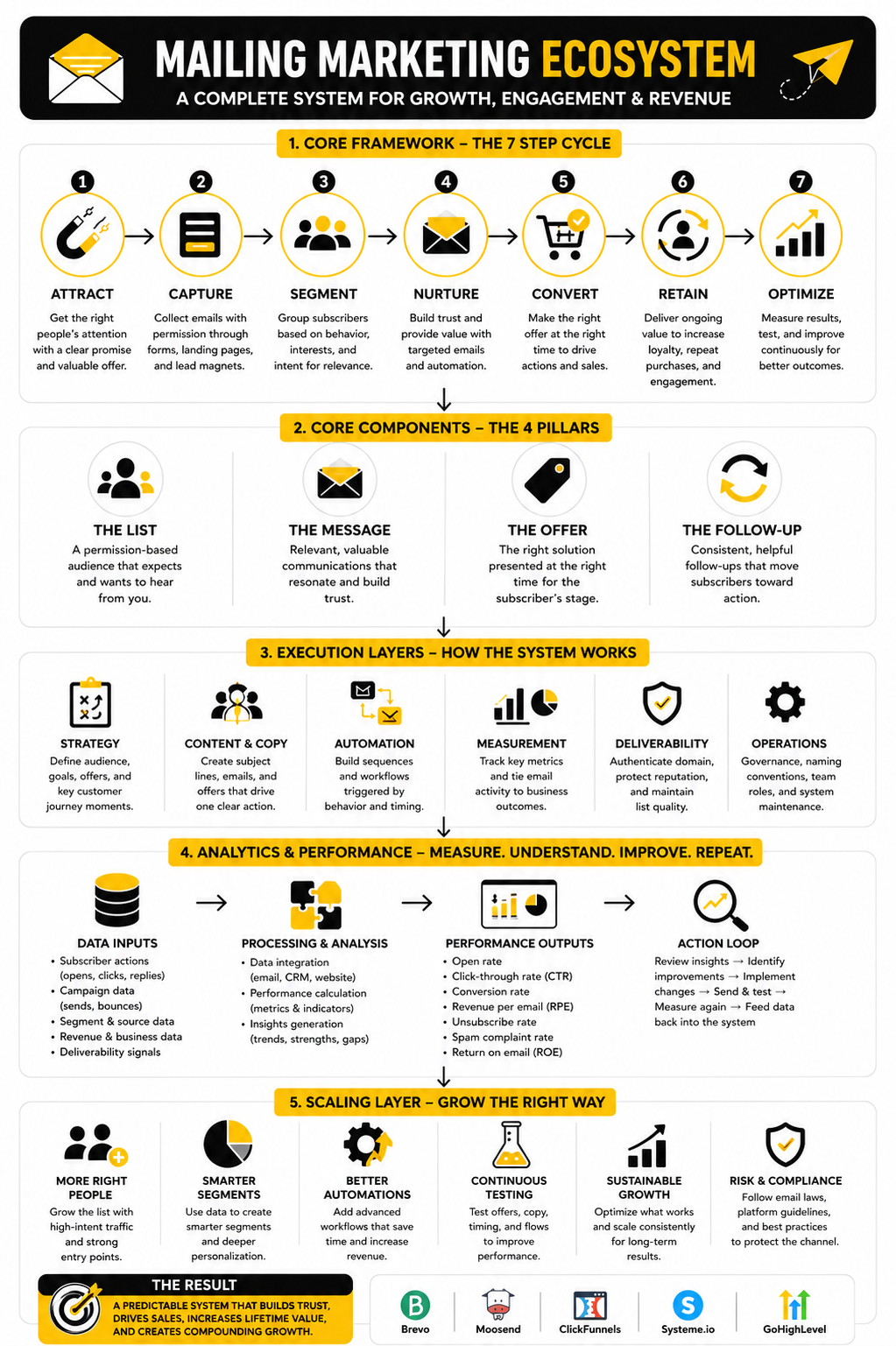
Strong mailing marketing is not built around random broadcasts. It is built around a repeatable framework that connects the right subscriber to the right message at the right moment. The practical version looks like this: attract, capture, segment, nurture, convert, retain, and optimize.
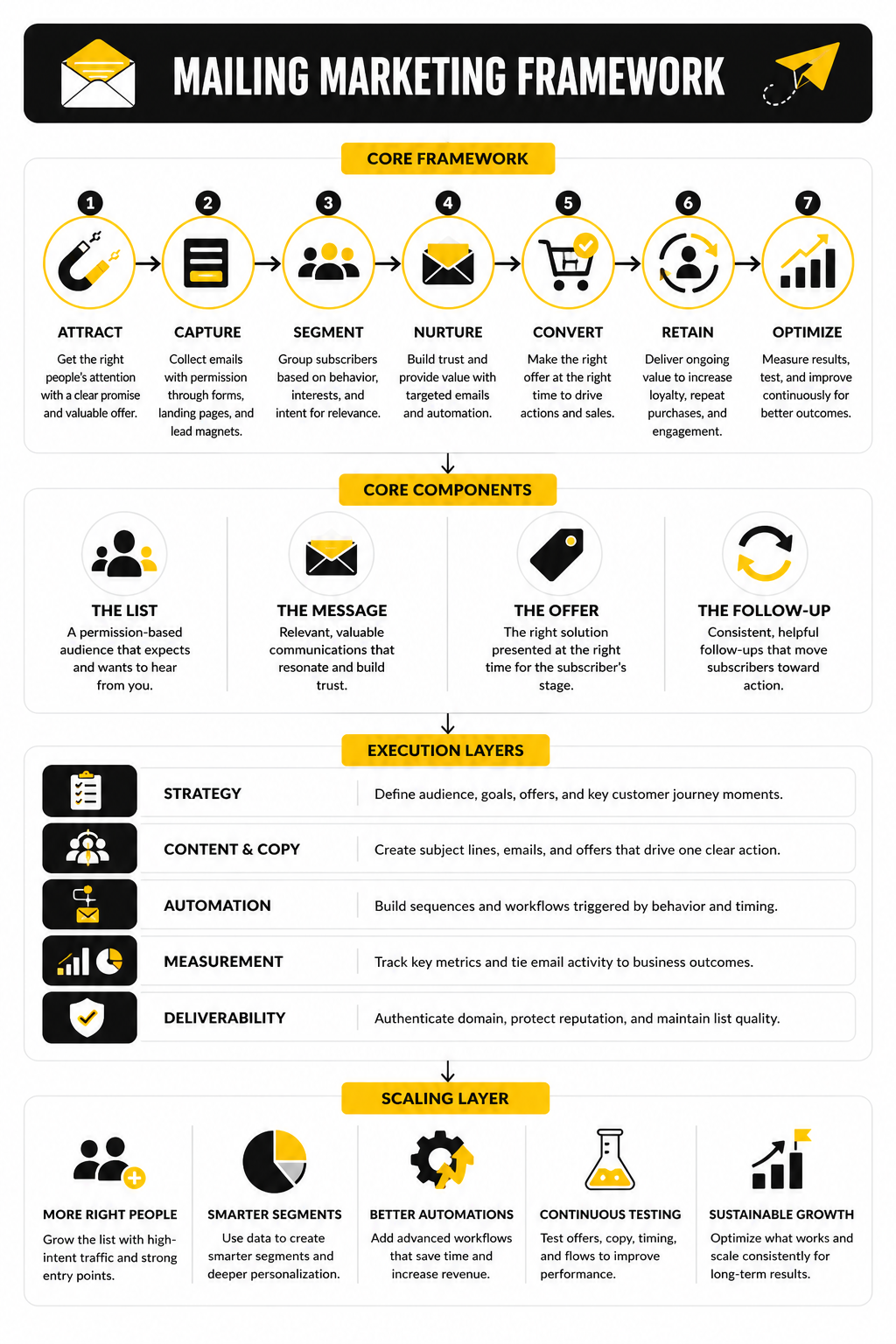
The first step is attraction. People need a reason to join your list, and that reason must be stronger than “subscribe for updates.” Good list growth usually starts with a clear promise, such as a useful checklist, a discount, a webinar, a calculator, a private training, or a product-specific guide.
The second step is capture and permission. This is where forms, landing pages, checkout opt-ins, and lead magnets matter. Tools like Brevo, Moosend, and GoHighLevel can support that workflow when the business needs email capture, automation, CRM, or campaign management in one place.
Core Components Of Mailing Marketing
Every serious mailing marketing system has four core components: the list, the message, the offer, and the follow-up. The list determines who receives the email. The message determines whether they care. The offer determines whether they act.
The follow-up is where most weak campaigns lose money. One email is rarely enough because people are busy, distracted, skeptical, or simply not ready yet. A good follow-up sequence creates useful repetition without becoming annoying.
The best systems also connect behavior to timing. Someone who clicked a pricing link should not receive the same email as someone who ignored the last five campaigns. Someone who just purchased should not immediately receive a generic discount meant for new leads. This is where mailing marketing becomes a real business system instead of a batch-and-blast habit.
Audience, Permission, And List Quality
A mailing marketing system is only as strong as the people on the list. A big list looks impressive, but size alone does not pay invoices. The real asset is a list of people who understand why they joined, expect your emails, and have a reason to keep opening them.
Permission is the foundation here. If someone did not clearly agree to hear from you, the relationship starts with friction. That friction shows up later as low engagement, spam complaints, poor deliverability, and weak sales performance.
List quality also protects your numbers. Brevo’s 2025 benchmark, based on more than 44 billion analyzed emails, shows how much performance can vary by region, industry, and mailbox provider, which is why healthy consent and engagement are not optional. You can use tools like Brevo to understand benchmarks, but your own list behavior matters more than any average.
Build The List Around A Clear Promise
People do not join a mailing list because a brand wants more subscribers. They join because they expect value. That value could be a discount, a useful guide, early access, a private training, a quote, a product update, or simply better ideas than they see elsewhere.
The promise needs to be specific. “Join our newsletter” is weak because it puts the work on the reader to imagine the benefit. “Get one practical ecommerce retention idea every Tuesday” is stronger because it explains what arrives, when it arrives, and why it matters.
This is where many businesses create problems they later blame on email. They collect leads with one promise, then send something completely different. Good mailing marketing keeps the original promise visible all the way from signup to follow-up.
Use Better Entry Points
Your list should not depend on one generic form in the footer. Different visitors have different intent, and your signup points should reflect that. A blog reader, product page visitor, checkout abandoner, webinar attendee, and past customer should not all be treated like the same person.
Good entry points usually connect to the moment someone is already in. A product page can offer a comparison guide. A blog post can offer a checklist related to the topic. A service page can offer a consultation, calculator, or short diagnostic.
For funnel-heavy businesses, tools like ClickFunnels, Systeme.io, or GoHighLevel can help connect landing pages, forms, follow-up, and offers in one workflow. The tool is not the strategy, but the right setup makes the strategy easier to execute consistently.
Clean Lists Beat Bloated Lists
A stale list is not harmless. It can drag down engagement, confuse your reporting, and make your best subscribers harder to reach. Keeping inactive contacts forever may feel safe, but it often creates a false sense of scale.
A cleaner list gives you clearer signals. When engaged subscribers open, click, reply, buy, or ignore an email, you can learn from that behavior. When thousands of cold contacts sit on the list doing nothing, they blur the picture.
This does not mean deleting people aggressively without a plan. It means using re-engagement campaigns, preference options, suppression rules, and sensible sunset policies. Mailing marketing gets sharper when the list reflects real interest instead of old vanity metrics.
Segmentation, Messaging, And Offers
Once the list is healthy, the next job is relevance. Mailing marketing gets stronger when the message feels like it was written for the subscriber’s current situation, not dumped into their inbox because Tuesday was “newsletter day.” That does not require creepy personalization or overcomplicated data work, but it does require a clear reason for each person to receive each email.
Segmentation is the practical bridge between a list and a sale. You can group subscribers by source, interest, product viewed, purchase history, lead stage, location, engagement, or intent. The point is not to create dozens of tiny segments just to look sophisticated; the point is to stop sending the same message to people with different problems.
Good segmentation also improves the way you think. Instead of asking, “What should we email this week?” you start asking, “Who needs what message next?” That shift is where mailing marketing becomes more strategic, because every campaign has a job instead of just filling space on a calendar.
Map The Subscriber Journey
Before writing campaigns, map the journey from first touch to repeat purchase. A new subscriber needs orientation. A warm lead needs proof and clarity. A first-time buyer needs confidence that they made the right decision. A loyal customer needs reasons to stay engaged, upgrade, refer, or buy again.
This journey does not need to be complicated at the start. Build around the major moments first: signup, welcome, education, offer, objection handling, purchase, onboarding, retention, and reactivation. Once those are working, you can add more advanced branches based on clicks, purchases, replies, or sales conversations.
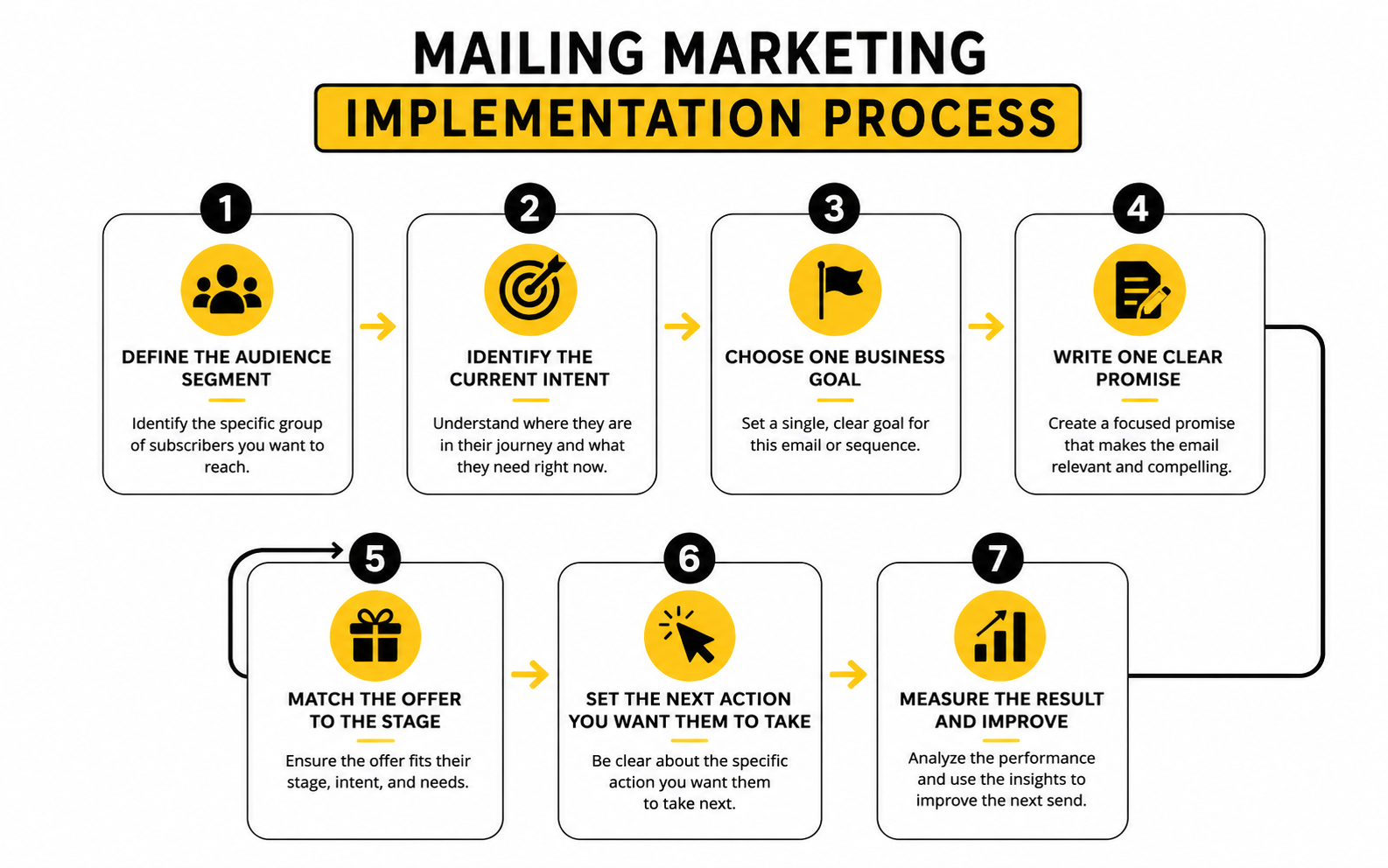
A simple process keeps execution clean:
- Define the audience segment.
- Identify the subscriber’s current intent.
- Choose one business goal for the email or sequence.
- Write one clear promise for the message.
- Match the offer to the subscriber’s stage.
- Set the next action you want them to take.
- Measure the result and improve the next send.
Write Messages Around One Clear Action
Every email should have a job. Sometimes the job is to get a click. Sometimes it is to earn a reply, book a call, watch a training, complete a checkout, read a case study, or simply understand one important idea. The problem starts when one email tries to do everything.
A focused email is easier to write and easier to read. The subject line opens the loop, the first lines make the email feel relevant, the body builds desire or clarity, and the call to action tells the reader what to do next. That structure sounds basic, but it beats clever emails that entertain without moving the relationship forward.
For sales funnels, this is where tools like ClickFunnels or Systeme.io can make the handoff cleaner between email, landing page, checkout, and follow-up. For service businesses and agencies, GoHighLevel can be useful when the email sequence needs to connect with pipeline stages, SMS, booking, and CRM activity.
Match Offers To Intent
Weak mailing marketing often pushes the same offer to everyone. That creates noise because the reader may be interested in the topic but not ready for that level of commitment. A cold subscriber may need a useful resource, while a high-intent lead may need pricing clarity, a demo, or a direct consultation.
Offer fit matters because email is a trust channel. If every message asks for a sale too early, subscribers learn to ignore you. If every message teaches without ever making an offer, the list becomes an audience but not a business asset.
A better approach is to use offers in layers. Start with low-friction actions such as reading a guide, taking a quiz, downloading a checklist, or watching a short training. Then move warm subscribers toward stronger actions such as booking, buying, upgrading, or joining a higher-value program when their behavior shows intent.
Turn Campaigns Into Reusable Sequences
One-off campaigns have a place, but reusable sequences create leverage. A welcome sequence can serve every new subscriber. An abandoned checkout sequence can recover people who were close to buying. A post-purchase sequence can reduce confusion, increase satisfaction, and prepare customers for the next logical offer.
Automation is not about removing the human feel. It is about making sure important follow-up happens when it should, even when the team is busy. That matters because missed timing is one of the easiest ways to lose revenue without noticing.
Start with the sequences closest to money and trust. Build the welcome flow first, because it sets expectations. Then build the offer sequence, abandoned checkout or booking follow-up, customer onboarding, and reactivation. Mailing marketing becomes much easier to scale when these core paths are working before you chase advanced tactics.
Statistics And Data
Measurement is where mailing marketing stops being opinion and starts becoming a business system. Without data, teams argue about subject lines, send times, design, and frequency based on taste. With data, you can see where attention drops, where intent appears, and where revenue is actually created.
But the goal is not to collect every metric. That only creates a dashboard nobody uses. The goal is to track the few numbers that explain whether your emails are being delivered, opened, clicked, trusted, and converted.
The Metrics That Actually Matter
Open rate is useful, but it is not the whole truth. Privacy changes, mailbox behavior, and image-loading rules can make opens less reliable than they used to be. Treat opens as a directional signal, not a final verdict on whether a campaign worked.
Click-through rate is usually more useful because it shows action. Brevo’s 2025 benchmark, built from more than 44 billion emails, shows an average click-through rate of 3.96%, but the useful question is not whether you beat a global average. The useful question is whether the right people clicked the right offer for the right reason.
Conversion rate is where the conversation gets serious. A campaign with average opens and strong sales may be more valuable than a campaign with beautiful engagement and no revenue. Mailing marketing should be judged by business outcomes, not applause metrics.
Read Benchmarks Without Worshiping Them
Benchmarks help you understand the range of normal performance. Brevo’s 2025 data shows major variation by region, with EMEA averaging 33.21% open rate and 4.05% click-through rate, while North America averaged 29.42% open rate and 3.38% click-through rate. That difference is useful context, but it does not automatically mean one campaign is better than another.
Industry also changes the picture. The same benchmark shows ecommerce at 38.58% open rate and 2.08% click-through rate, while marketing and advertising sits at 33.62% open rate and 2.02% click-through rate. A business should compare against its own trend first, then use external benchmarks as a sanity check.
ROI data tells the same story. Litmus reported in 2025 that 35% of marketing leaders receive $10 to $36 back for every $1 spent on email, while 30% receive $36 to $50. That proves the channel can perform, but it does not prove your program is healthy unless your tracking connects email activity to pipeline, sales, retention, and customer lifetime value.
Build A Simple Measurement System
The cleanest analytics setup follows the subscriber journey. First, measure whether the email reached the inbox. Then measure whether the subject and sender earned attention. Then measure whether the message created a click. Finally, measure whether the landing page, checkout, booking page, or sales process turned that click into value.
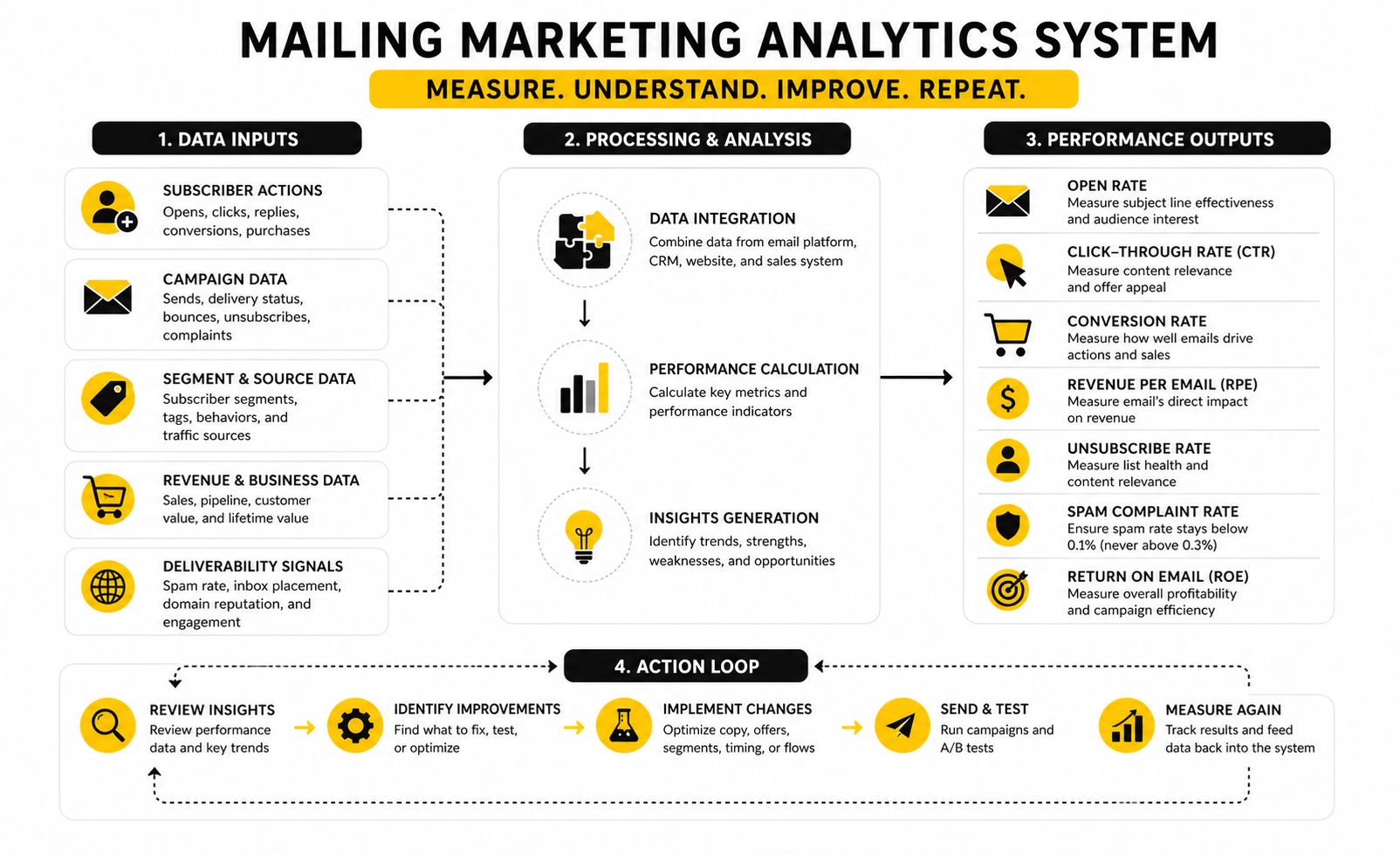
A practical mailing marketing dashboard should separate leading indicators from business results. Leading indicators include deliverability, open rate, click-through rate, click-to-open rate, unsubscribe rate, bounce rate, spam complaints, and reply rate. Business results include purchases, booked calls, pipeline value, upgrades, renewals, churn reduction, and revenue per subscriber.
This matters because each number points to a different fix. Low delivery suggests sender reputation or authentication issues. Low opens suggest weak positioning, poor timing, list fatigue, or sender trust problems. Low clicks suggest the message or offer is not compelling enough. Low conversions after strong clicks usually means the problem is on the destination page, sales page, checkout, or booking flow.
Watch Deliverability Before You Blame Copy
Many teams rewrite emails when the real problem is that the emails are not landing properly. Google’s sender guidelines flag issues such as missing DMARC, missing one-click unsubscribe on promotional messages, spam rates above 0.3%, and unsubscribe requests not being honored within 48 hours. Yahoo’s sender guidance also points to authentication, complaint control, DNS records, and bulk sender requirements as core deliverability basics.
That means deliverability is not a technical side quest. It directly affects revenue because an email that never reaches the inbox cannot get opened, clicked, or converted. If your numbers suddenly drop across campaigns, check inbox placement, bounces, complaints, authentication, and list quality before assuming the offer is dead.
The practical move is simple: monitor the health metrics every week. Keep spam complaints low, remove hard bounces, avoid sending to dead segments forever, and make unsubscribing easy. Counterintuitive, but true: making it easy for the wrong people to leave often helps the right people keep receiving your emails.
Turn Data Into Decisions
Data only matters when it changes what you do next. If open rates are healthy but clicks are weak, improve the email body, offer angle, and call to action. If clicks are strong but conversions are poor, fix the landing page, checkout, calendar flow, proof, pricing clarity, or sales follow-up.
If unsubscribes rise after every sales email, the issue may not be selling itself. It may be that the list was built with the wrong promise, the offer is mismatched, or the sales emails arrive without enough context. Good mailing marketing does not avoid selling; it earns the right to sell by making the next step feel relevant.
This is why a simple weekly review beats a massive quarterly autopsy. Look at the trend, find the bottleneck, make one improvement, and send again. The teams that win with email are not always the ones with the biggest lists. They are usually the ones that learn faster from each send.
Professional Implementation, Tools, And Scaling
The deeper you go with mailing marketing, the more the work becomes operational. Strategy gets you the right direction, but execution determines whether the system keeps producing when the list grows, the team gets busy, and campaigns become more complex. This is where businesses either build a reliable channel or create a messy pile of automations nobody wants to touch.
Scaling email is not just “send more.” Sending more to the wrong people, from a weak domain, with unclear segmentation, and no measurement discipline can damage the exact asset you are trying to grow. The professional move is to scale the system only after the basics are stable: consent, deliverability, segmentation, offer fit, tracking, and follow-up.
Choose Tools Around The Workflow
The right tool depends on the workflow, not the logo. A simple creator or small ecommerce brand may only need clean email campaigns, basic automation, forms, and reporting. A service business may need email tied to a CRM, calendar bookings, pipeline stages, SMS follow-up, and sales tasks.
For straightforward email marketing, Brevo and Moosend can fit teams that want campaign sending, automation, and list management without building a heavy stack. For funnel-first businesses, ClickFunnels or Systeme.io can make sense when landing pages, checkout, and follow-up need to sit close together. For agencies and local-service businesses, GoHighLevel is often more relevant because the CRM, automations, reputation tools, pipelines, and client workflows can live in one system.
Do not overbuy because a platform has impressive features. A complex tool will not fix unclear offers, weak copy, poor list quality, or missing follow-up logic. Pick the simplest system that can support your next twelve months of execution without forcing you into manual work every week.
Balance Automation With Human Timing
Automation is powerful, but it can also make bad thinking scale faster. If a sequence is pushy, confusing, or disconnected from the subscriber’s action, automation will repeat that mistake every day. That is why every automated flow should have a clear trigger, a clear promise, and a clear exit condition.
The best mailing marketing systems use automation for predictable moments and human review for sensitive ones. A welcome sequence, abandoned checkout flow, webinar reminder, customer onboarding sequence, or reactivation campaign can run automatically. A high-value lead, enterprise prospect, angry customer, or complex support situation may need a real person to step in.
This is a strategic tradeoff. More automation gives speed and consistency. More human involvement gives nuance and trust. The right mix depends on deal size, customer complexity, sales cycle length, and how much risk there is in sending the wrong message at the wrong time.
Protect The Channel As You Grow
Email has rules, and ignoring them gets expensive. Google’s sender guidelines require easy unsubscribe options for marketing messages, and bulk senders sending more than 5,000 messages per day to Gmail accounts need one-click unsubscribe support. Google also says senders should keep spam rates below 0.1% and avoid ever reaching 0.3%, which is a serious warning for any business scaling aggressive campaigns.
Yahoo’s sender guidance points in the same direction: send wanted email, authenticate with SPF, DKIM, and DMARC, respect the frequency people signed up for, and avoid purchased lists. This matters because the inbox is not your property. You earn access every time people engage and risk it every time they complain, ignore, or unsubscribe because the promise was broken.
The simple rule is this: protect trust before chasing volume. Do not buy lists. Do not hide unsubscribe links. Do not send daily promotions to people who joined for a monthly educational email. Mailing marketing scales best when subscribers feel like staying on the list is still in their interest.
Create Governance Before The System Gets Messy
As soon as more than one person touches email, you need governance. Not bureaucracy. Just clear rules so the system does not turn into chaos. Decide who owns campaign planning, who approves offers, who checks compliance, who monitors deliverability, and who reviews performance after sends.
You also need naming conventions for lists, tags, segments, campaigns, automations, and forms. This sounds boring until you inherit a system with twelve different tags that mean “lead,” five abandoned cart flows, and no idea which sequence is live. Clean structure saves real money because it prevents mistakes that damage trust and reporting.
A basic governance checklist should cover:
- Who can create or edit automations
- Which segments can receive promotional campaigns
- How inactive subscribers are handled
- What happens before a large send goes live
- How unsubscribe, bounce, and complaint data is reviewed
- Which metrics are reviewed weekly
- When old campaigns and unused tags are archived
Scale With Better Inputs, Not Just More Emails
More emails do not automatically mean more revenue. Better inputs usually matter more: better lead sources, stronger segmentation, clearer offers, better landing pages, cleaner data, and tighter sales follow-up. If those inputs are weak, volume only exposes the weakness faster.
This is especially true when mailing marketing is connected to paid traffic. A lead from a high-intent search campaign may behave very differently from a lead who joined through a giveaway. If both enter the same sequence, the data becomes muddy and the subscriber experience gets weaker.
The expert move is to scale by source and segment. Track where subscribers came from, what they were promised, what they clicked, and what they eventually bought. Then invest more into the sources and sequences that create quality customers, not just cheap subscribers.
FAQ - Built For Complete Guide
What Is Mailing Marketing?
Mailing marketing is the use of email to build relationships, educate subscribers, promote offers, and drive measurable business results. It works best when people have clearly opted in and expect to hear from you. At a professional level, it combines list growth, segmentation, copywriting, automation, deliverability, and analytics.
Is Mailing Marketing The Same As Email Marketing?
Yes, in most business contexts, mailing marketing and email marketing refer to the same core practice. The difference is usually wording, not strategy. What matters is whether the system is permission-based, relevant, measurable, and connected to real business goals.
Why Is Mailing Marketing Still Effective?
Mailing marketing is still effective because it gives businesses a direct communication channel with people who have already shown interest. Unlike social media, email does not depend entirely on a feed algorithm deciding who sees your message. That direct access makes it useful for launches, retention, onboarding, reactivation, and long-term customer relationships.
How Often Should A Business Send Marketing Emails?
The right frequency depends on the list, the promise made at signup, and the value of each message. A daily email can work for an audience that expects daily insight, while a monthly email may be better for a slower buying cycle. The real test is whether engagement, conversions, unsubscribes, and complaints show that the frequency still feels useful.
What Makes A Good Mailing Marketing List?
A good list is built from clear permission, strong intent, and relevant expectations. It is not just a large database of contacts. A smaller list of engaged subscribers will usually outperform a bloated list full of inactive, confused, or low-intent contacts.
What Should A Welcome Email Include?
A welcome email should remind the subscriber why they joined, deliver the promised value, set expectations, and guide them toward the next useful step. It should feel personal, clear, and immediate. This is not the place to overload people with every offer you have.
How Do You Improve Email Open Rates?
Start with sender trust, list quality, and subject-line relevance. People open emails from senders they recognize and value. If open rates fall, check whether the list is cold, the promise is unclear, the subject lines are vague, or the emails are arriving at the wrong time.
How Do You Improve Click-Through Rates?
Improve click-through rates by making the email more focused. One message should usually lead to one main action. If subscribers are opening but not clicking, the problem is often weak offer positioning, unclear benefits, too many links, or a call to action that does not feel worth the effort.
What Is The Biggest Mistake In Mailing Marketing?
The biggest mistake is treating every subscriber the same. New leads, warm prospects, first-time buyers, repeat customers, and inactive contacts need different messages. When everyone receives the same campaign, relevance drops and the list slowly becomes less responsive.
Should Mailing Marketing Be Automated?
Yes, but only when the logic is clear. Automations are excellent for welcome flows, abandoned checkout recovery, booking follow-up, onboarding, reactivation, and post-purchase education. They become dangerous when they send irrelevant messages automatically without checking behavior, timing, or subscriber intent.
Which Tools Are Best For Mailing Marketing?
The best tool depends on the business model. Brevo and Moosend can fit teams focused on campaigns and automation. ClickFunnels and Systeme.io can fit funnel-driven businesses, while GoHighLevel can make sense for agencies, local businesses, and service teams that need CRM, automation, pipelines, and follow-up in one place.
How Do You Know If Mailing Marketing Is Working?
You know it is working when the list is growing with the right people, engagement is stable, complaints stay low, and email activity creates measurable revenue or pipeline. Do not judge the channel only by open rates. Look at clicks, conversions, replies, purchases, retention, and revenue per subscriber.
Work With Professionals
Explore 10K+ Remote Marketing Contracts on MarkeWork.com
Most marketers spend too much time chasing clients, competing on crowded platforms, and losing a percentage of every project to middlemen.
MarkeWork gives you a better way. Browse thousands of remote marketing contracts and connect directly with companies desperate to hire skilled marketers like you, without platform commissions and without unnecessary gatekeepers.
If you're serious about finding better opportunities and keeping 100% of what you earn, explore available contracts and create a profile for free at MarkeWork.com.