

Market analysis sounds simple until real money is on the line. On paper, it is just the process of understanding demand, customers, competitors, pricing pressure, and market timing. In practice, it is the work that stops a good idea from entering the wrong market, with the wrong offer, at the wrong moment.
That matters even more right now because businesses are operating in an environment shaped by slower growth, trade friction, policy uncertainty, and uneven productivity gains across regions. The IMF’s April 2025 outlook described global growth as weakening under new uncertainties, while the OECD’s 2025 productivity data showed only modest average productivity growth across OECD economies in 2024. That combination makes surface-level research dangerous and disciplined market analysis far more valuable.
The other reason this topic matters is that markets are moving faster than many planning cycles. McKinsey’s 2025 consumer research, based on surveys spanning 18 markets and roughly 25,998 consumers, showed that behavior shifts around value, trust, and spending are still reshaping large categories well after the first wave of pandemic disruption. If customer behavior keeps changing while operators rely on stale assumptions, the analysis is not just weak. It becomes actively misleading.
Strong market analysis also goes beyond demand charts and trend decks. The World Bank’s Business Ready framework now evaluates business conditions through regulatory framework, public services, and operational efficiency, and it treats market competition as a core topic rather than a side note. That is a useful reminder: a market is not only customers and competitors, but also distribution friction, regulatory drag, information quality, and the actual ease of operating once you enter.
The goal of this article is practical. We are going to build a clear way to think about market analysis so you can use it before launching a product, expanding into a new segment, or deciding whether an opportunity is real enough to deserve capital and attention. By the end, you should have a framework that is simple enough to apply quickly and rigorous enough to keep you out of obvious mistakes.
Article Outline
This article is organized as one continuous system, not a collection of disconnected tips. Each part builds on the last one so the process moves from context, to structure, to evidence, to execution, to judgment, and finally to action. These are the six sections the full article will use from start to finish.
- Why Market Analysis Matters
- A Practical Framework for Reading a Market
- The Core Components of Strong Market Analysis
- How Professionals Turn Research Into Decisions
- Common Mistakes That Break Market Analysis
- How to Build an Actionable Market Analysis Process
Why Market Analysis Matters
A lot of teams treat market analysis like a slide deck they build to justify a decision they already want to make. That is exactly backwards. Good market analysis is supposed to pressure-test the decision before you commit budget, people, inventory, messaging, and time.
That discipline matters more in a market where growth is still real but harder to win. The IMF’s April 2025 World Economic Outlook described global growth as weakening under policy shifts, trade tension, and elevated uncertainty, while the OECD’s 2025 productivity indicators estimated average labor productivity growth across OECD economies at only around 0.4% in 2024. In plain English, that means many companies are chasing growth in markets that are less forgiving than they look from a distance.
The customer side is not getting simpler either. McKinsey’s 2025 State of the Consumer drew on surveys of more than 25,000 consumers across 18 markets representing roughly 75% of global GDP and found that value, trust, and shifting habits still shape buying behavior in major categories. PwC’s 2025 Voice of the Consumer reached a similar conclusion, showing that price continues to dominate trade-off decisions when consumers are forced to choose. When demand is unstable and buyers are more selective, weak market analysis does not just miss upside. It creates false confidence.
That is why market analysis is not only about estimating market size. It is about understanding whether a category is attractive, whether customers are reachable, whether switching behavior is realistic, and whether the economics still work once competition reacts. The World Bank’s Business Ready 2025 framework makes the same point from a different angle by evaluating not just rules on paper but also public services and operational efficiency in practice. A market can look exciting in a headline and still be painful to enter once you account for friction.
There is also a practical reason this work matters before launch. The U.S. Census Bureau’s Business Formation Statistics show a constant flow of new business applications, including 491,941 business applications in March 2026, which means competition is not standing still. New entrants keep arriving, but the Bureau of Labor Statistics survival data also shows that survival rates vary meaningfully by year, cycle, and geography. In other words, starting is common. Lasting is harder. Market analysis is one of the few tools that improves your odds before the market teaches the lesson the expensive way.
The biggest payoff is not perfection. It is better decisions. A solid market analysis helps you decide whether to enter, where to position, what to price, which segment to prioritize, and what assumptions are so risky they need real-world testing before scale. That is the real point of the exercise.
A Practical Framework for Reading a Market
Most market analysis fails because it jumps straight to surface metrics. People look at trend charts, search volume, funding activity, or category growth and assume they understand the opportunity. They do not. A usable framework has to move from context to evidence in a sequence that reflects how markets actually work.
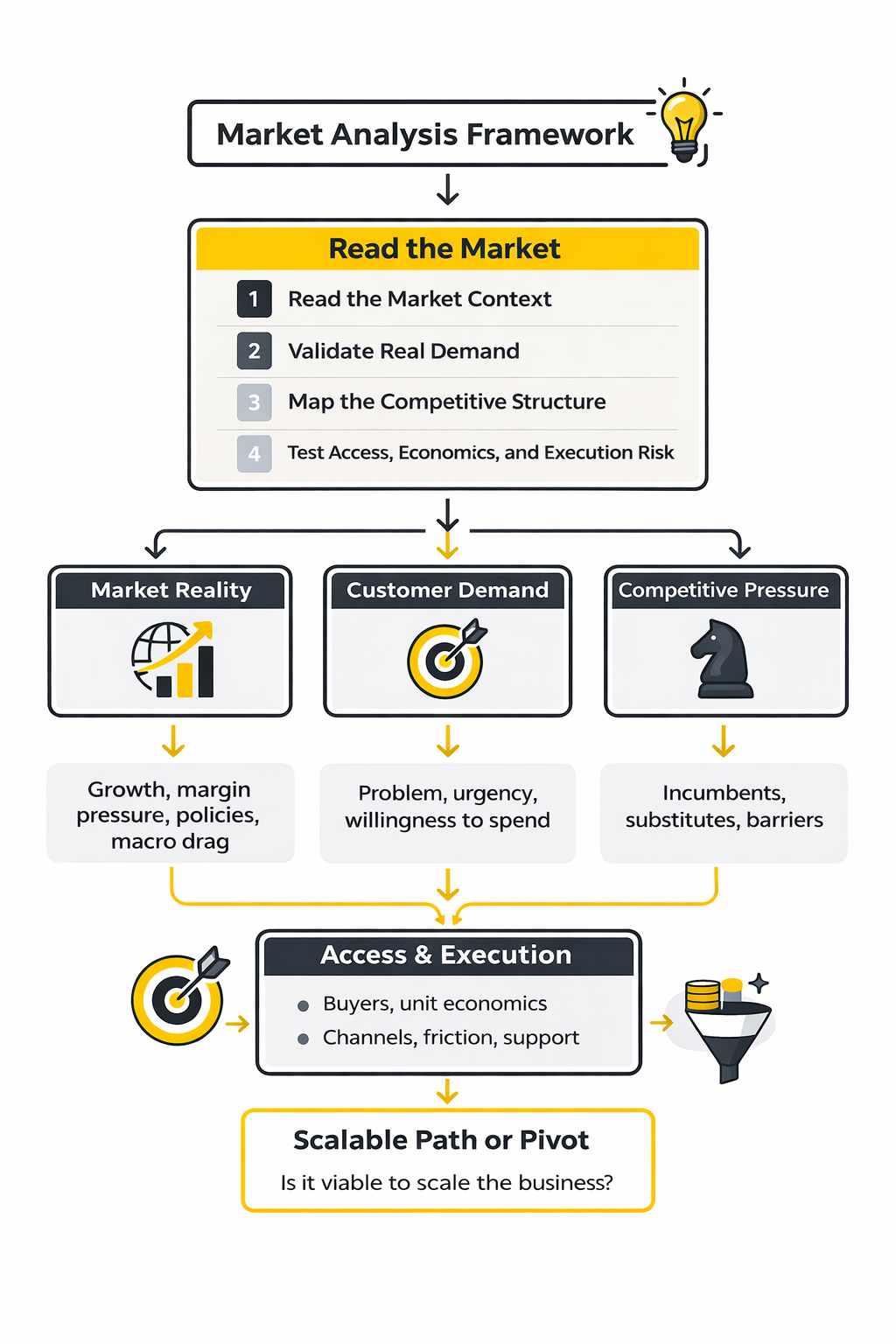
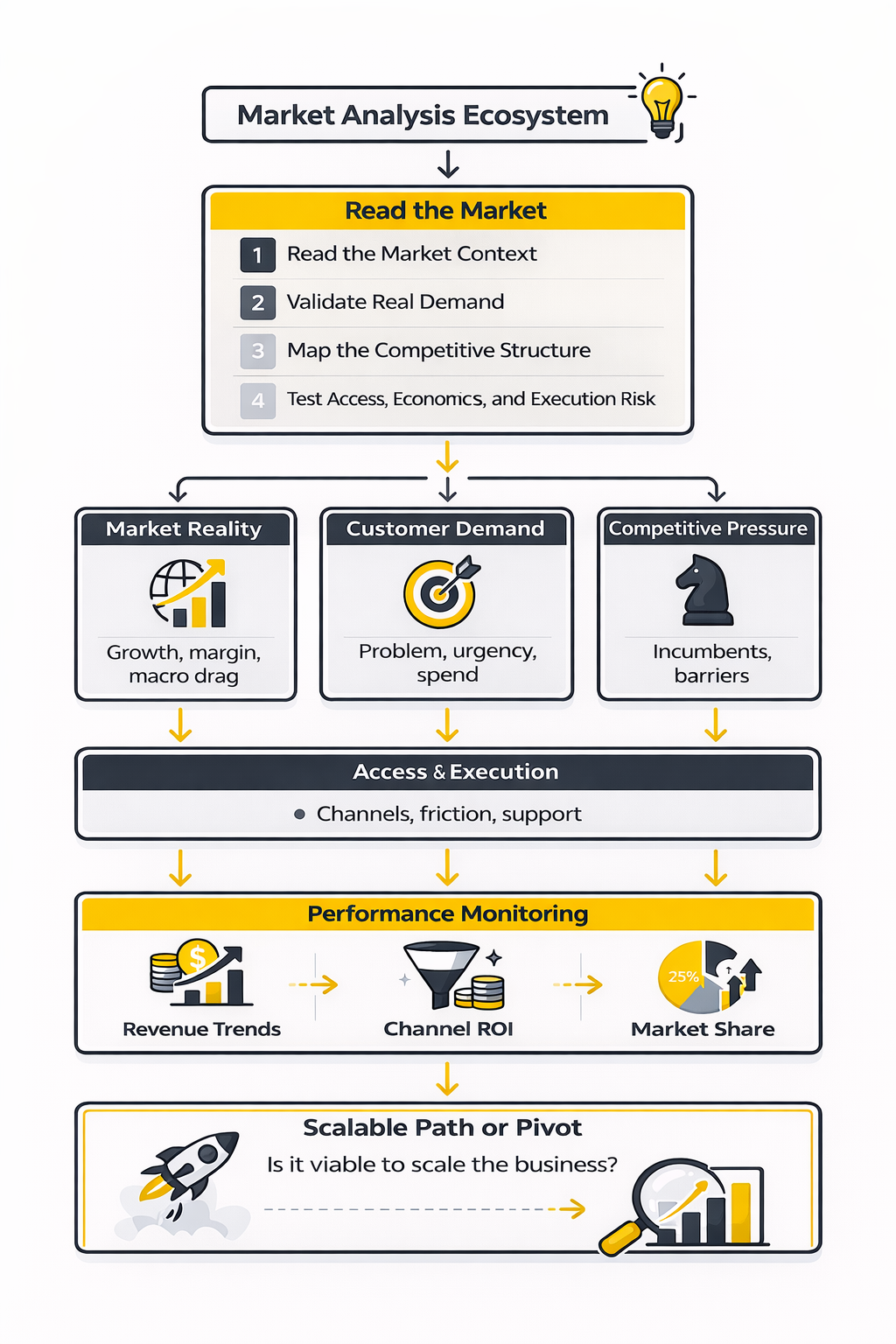
The first layer is market reality. This is the broad context around the opportunity: category growth, margin pressure, regulatory conditions, customer mood, and macroeconomic drag. If the wider environment is deteriorating, your offer has to be strong enough to beat that headwind. That is why the IMF’s warning on downside risks from trade tension and policy uncertainty matters even for operators building in very specific niches. Macro conditions do not decide everything, but they shape the level of difficulty.
The second layer is customer demand. Here the question is not whether people “like” the idea. It is whether a definable group has a repeated problem, meaningful urgency, and willingness to spend to solve it. That is where much of market analysis gets lazy. Interest is not demand, traffic is not intent, and attention is not conversion. Research from McKinsey, PwC, and Deloitte’s 2025 value-seeking consumer work all points in the same direction: buyers are more deliberate, more value-sensitive, and less automatically loyal than many companies assume.
The third layer is competitive pressure. A market can have healthy demand and still be a bad target because the incumbents are entrenched, distribution is locked up, switching costs are high, or the category has trained buyers to expect a price point you cannot profitably meet. This is why professional market analysis has to look past named competitors and examine substitutes, customer habits, and structural barriers. The World Bank’s market competition topic is useful here because it frames competition as part of the operating environment, not just a list of rival brands.
The fourth layer is access and execution. This is where strategy gets real. Can you reach the buyer efficiently, onboard them without friction, support them at scale, and keep the unit economics healthy after acquisition costs, channel fees, and service overhead are included? Plenty of categories look attractive until you model the operational path between awareness and retained revenue. That is why market analysis should always end in execution questions, not just descriptive research.
Put together, the framework is simple:
- Read the market context.
- Validate real demand.
- Map the competitive structure.
- Test access, economics, and execution risk.
That sequence matters. If you reverse it, you end up optimizing tactics before you know whether the market is worth entering. If you follow it properly, market analysis becomes what it should be: a decision tool, not a content exercise.
The next section builds this out in detail by breaking market analysis into its core components. That is where we move from the framework itself into the specific elements you need to measure, compare, and validate before calling an opportunity attractive.
The Core Components of Strong Market Analysis
Once the framework is clear, the next step is knowing what a serious market analysis actually needs to measure. This is where many teams get sloppy. They collect interesting facts, but they do not gather the specific evidence that helps them decide whether a market is attractive, reachable, defensible, and profitable.
A strong market analysis usually stands on five components: demand reality, customer economics, competitive structure, go-to-market feasibility, and evidence quality. Miss one of those, and the whole thing can still look polished while pointing you toward the wrong conclusion. That is why professionals do not treat market analysis as a single data set. They treat it as a system of cross-checks.
Demand Reality
The first component is real demand, not visible activity. Search interest, social engagement, and trend chatter can help you notice a category, but they do not tell you whether buyers will act. Real demand shows up when a specific group has a persistent problem, enough urgency to solve it, and enough willingness to pay to make the opportunity commercially meaningful.
This matters because customers are still trading down, delaying purchases, and becoming more selective about what earns their money. The latest State of the Consumer research from McKinsey and PwC’s 2025 consumer survey both point to the same practical takeaway: value is being judged harder than many brands expect. When that is true, demand cannot be inferred from noise. It has to be validated against buyer behavior.
That is also why demand quality matters more than top-line category growth. A market may be expanding, but if the growth is concentrated in low-margin segments or in products dominated by incumbents, the opportunity for a new entrant can still be weak. Good market analysis separates category excitement from addressable demand.
Customer Economics
The second component is customer economics. This is where you ask the blunt questions most early analyses avoid: what does it cost to acquire the buyer, how long do they stay, what do they spend, how sensitive are they to price, and how much service do they require after conversion. If the economics do not work, the market is not attractive enough, no matter how strong the story sounds.
This is especially important in digital markets where conversion friction destroys value quietly. Baymard’s current checkout research still places average documented cart abandonment above 70%, which is a brutal reminder that interest is easy to create and hard to convert. In practical terms, market analysis has to account for the leakage between awareness, consideration, checkout, activation, and retention.
Customer economics also force clarity around segment selection. One segment may be larger, but another may convert faster, churn less, and require fewer sales resources. That is why professionals do not just ask, “How big is the market?” They ask, “Which buyers create the cleanest path to profitable growth?”
Competitive Structure
The third component is competitive structure. Most weak market analysis reduces competition to a few obvious brands and a pricing table. That is not enough. You need to understand who already owns attention, who controls distribution, what substitutes buyers use today, and what switching costs make customer movement harder than it looks.
This is where a market can go from promising to dangerous very quickly. A category may have room on paper, but if buyer trust is locked into a handful of established players or the dominant acquisition channels are too expensive, new entrants will struggle even with a solid offer. The World Bank’s Business Ready work on market competition is useful because it treats competition as a broader structural condition, not just a brand list.
The important thing here is realism. You are not only competing against direct rivals. You are competing against habit, inertia, internal procurement processes, legacy tools, existing agency relationships, and in many cases the customer’s decision to do nothing. Serious market analysis always includes that wider lens.
Go-To-Market Feasibility
The fourth component is go-to-market feasibility. This is the bridge between opportunity and execution. A market may have demand and weak incumbents, but if you cannot reach buyers efficiently, educate them fast enough, or support delivery at a sustainable cost, the opportunity is weaker than it appears.
This is why channel fit belongs inside market analysis rather than after it. You need to know whether the category is won through outbound sales, partnerships, organic search, retail distribution, paid social, creator ecosystems, or account-based motion. The wrong channel can make a good market look broken.
This is also the point where implementation starts to become concrete. A usable market analysis should tell you where the buyer is, what proof they need, what friction blocks adoption, and what kind of operating model the market rewards. If it does not do that, it is still too abstract to guide real action.
Evidence Quality
The fifth component is evidence quality, and this one is wildly underrated. Bad inputs create bad strategy, even when the framework is good. Gartner continues to cite that poor data quality costs organizations an average of $12.9 million per year, which is not just a data governance problem. It is a decision problem.
In market analysis, weak evidence usually shows up in familiar ways: old reports, vendor-sponsored claims with no verification, tiny sample sizes, anecdotal customer interviews treated like market truth, or traffic metrics being used as a stand-in for revenue potential. Once that happens, the analysis starts rewarding confidence instead of accuracy.
The fix is simple but non-negotiable. Cross-check meaningful claims across independent sources, favor recent data when the category is changing quickly, and separate direct evidence from assumption. If the evidence is thin, say it is thin. That honesty is more useful than false precision.
Turning Market Analysis Into a Working Process
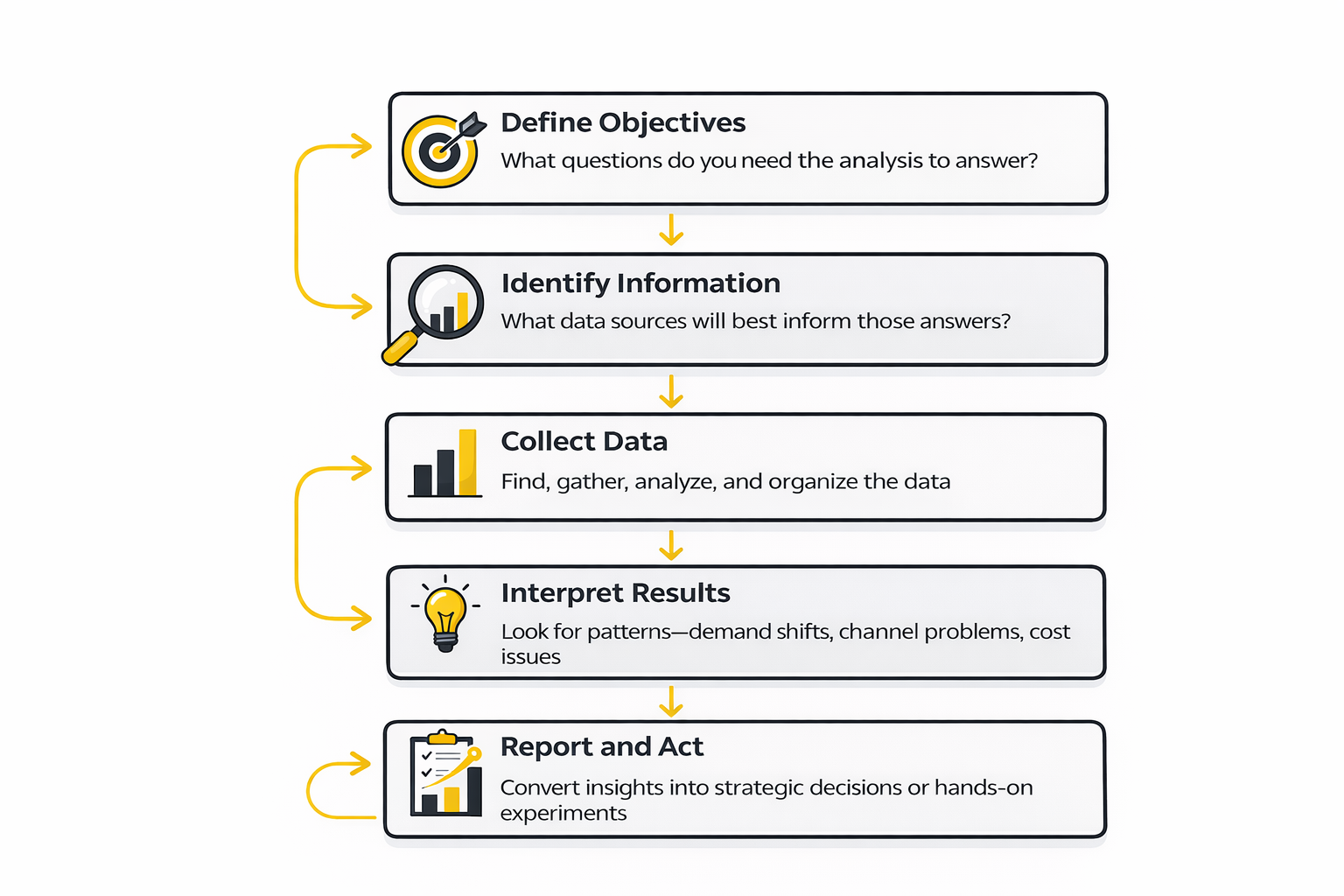
Once you have the right components, the next job is building a process that a team can actually run. This is where market analysis stops being a research document and becomes an operating habit. The goal is not to collect everything. The goal is to collect enough of the right evidence, in the right order, to make a confident decision.
The cleanest way to do that is to move from wide context to narrow validation. Start by reading the category, then narrow into the target segment, then compare buyer economics, then map competitive pressure, and only then decide whether the market deserves a test, a pilot, or a full push. That order prevents you from falling in love with execution tactics before the core opportunity is proven.
A Practical Sequence You Can Use
A professional market analysis process usually follows a sequence like this:
- Define the market clearly.
- Identify the specific buyer segment you want to evaluate.
- Measure demand signals and purchase urgency.
- Model customer economics and conversion friction.
- Map direct, indirect, and substitute competition.
- Evaluate channel access and operational feasibility.
- Score the market against your own entry criteria.
- Turn the findings into a decision, not just a report.
Each step matters because it reduces a different type of risk. Defining the market stops you from mixing unrelated segments together. Modeling economics stops you from chasing demand that looks large but cannot support profitable acquisition or retention.
This kind of sequence is also easier to use across teams. Product, growth, sales, finance, and operations can all pressure-test different parts of the same market analysis instead of arguing from disconnected assumptions. That alone makes the output far more useful.
What the Output Should Look Like
By the time this process is done, you should not be left with a pile of notes. You should have a judgment. A strong output usually answers a small number of hard questions: is the market attractive enough, which segment is most promising, what barriers are likely to slow entry, what assumptions are still unproven, and what test should happen next.
That is the standard worth holding. A market analysis that ends with “the market is growing” has not finished the job. A real one tells you whether to move, where to focus, and what needs to be true for the move to work.
The next section pushes further into how professionals use this in practice. That is where the article shifts from the core components of market analysis into the way strong teams turn research into decisions, resource allocation, and real implementation.
How Professionals Turn Research Into Decisions
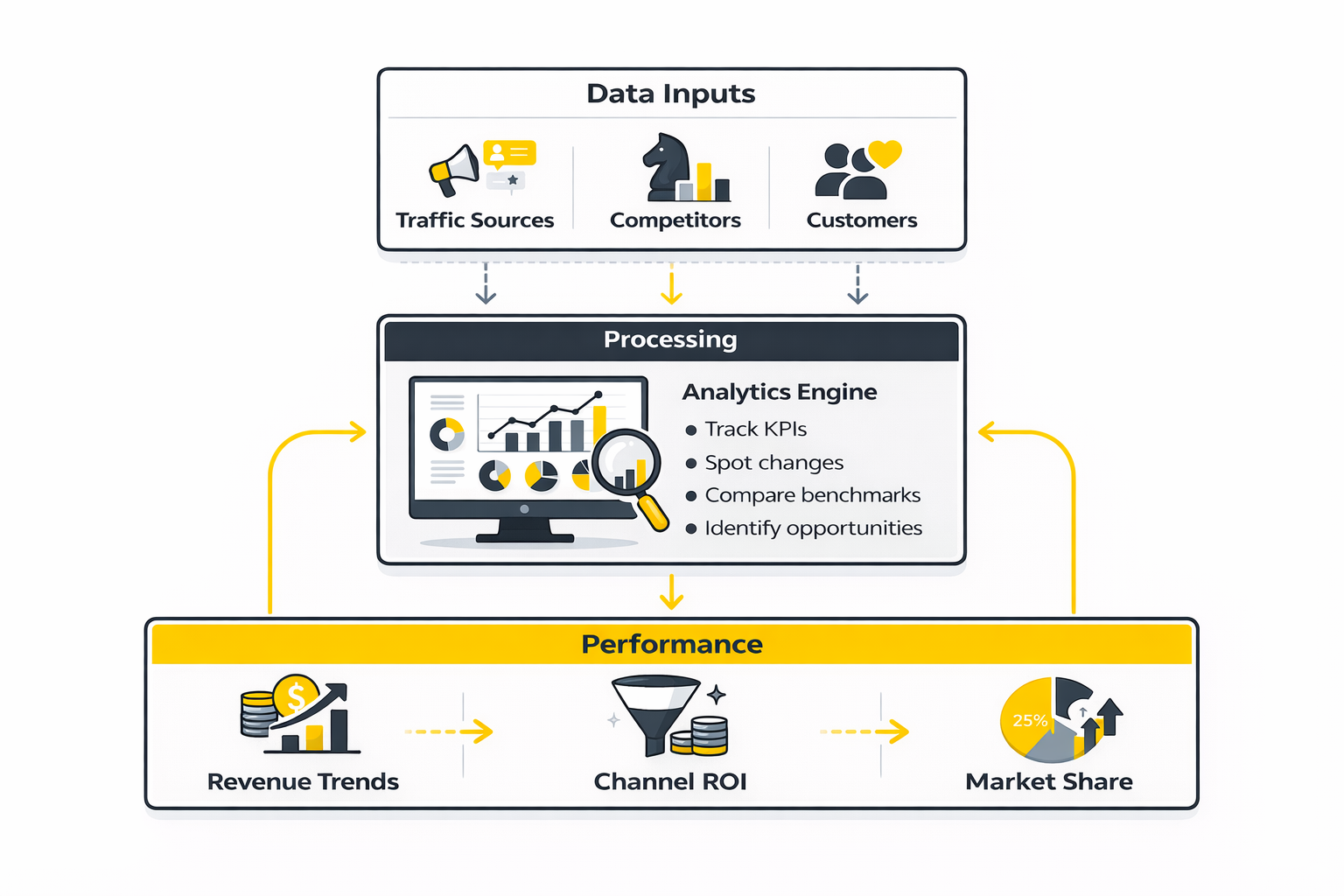
The difference between amateur and professional market analysis usually comes down to measurement. Amateur work collects facts. Professional work builds a scoring system that helps a team decide whether the market deserves investment, a test launch, a niche entry, or a hard no.
That means the numbers have to do more than sound impressive. They need to explain market quality, buyer behavior, competitive pressure, and execution risk. If a metric does not change what you do next, it is probably noise.
The cleanest way to handle this is to track a small set of signals and read them together. A single number can mislead you. A pattern of numbers is far more useful.
What the Numbers Are Actually Telling You
Market analysis gets dangerous when people throw in statistics without context. A large total addressable market can hide weak customer intent. A fast-growing category can still be impossible to enter profitably. A decent conversion rate can still produce bad economics if retention is weak or acquisition costs are rising.
That is why the point of data is interpretation, not decoration. You are trying to answer a practical question: does this market reward entry strongly enough to justify the cost and risk. Every metric in this section should be read through that lens.
Demand Signals Need Context
The first job is to measure whether demand is real, timely, and commercial. Macro reports can tell you whether a category is expanding or cooling, but they do not tell you whether your specific segment is attractive. That is where you need segment-level signals like purchase behavior, intent patterns, pricing tolerance, and repeat need.
Consumer behavior research is useful here because it reminds you that market demand is not static. The 2025 McKinsey consumer research showed that value perception, trust, and channel preferences continue to shift across major markets, and PwC’s 2025 consumer survey found that price remains one of the strongest forces shaping trade-offs. In plain terms, market analysis has to test not just whether people want something, but whether they will still want it at the price and delivery model you need.
So when you look at demand data, ask a harder question than “Is this market growing?” Ask whether the growth is landing in your target segment, whether that segment buys often enough, and whether the problem is painful enough to survive economic pressure. That is what turns demand data into decision data.
Conversion Metrics Reveal Friction, Not Just Performance
Conversion numbers are often misunderstood. People see them as proof of success or failure, but in market analysis they are more useful as evidence of friction. A weak conversion rate often means the market is not convinced, the offer is misaligned, the buying process is clumsy, or the wrong audience is being targeted.
That is why checkout and funnel benchmarks matter. Baymard’s latest benchmark roundup still places average cart abandonment above 70%, and its checkout usability research reports a similar rate around 70.19%. The lesson is not that every market is broken. The lesson is that late-stage buying friction is normal, expensive, and easy to underestimate.
That should shape your action. If the market analysis shows high interest but weak progression through evaluation or purchase, the next move is not always more traffic. Often it is better proof, a clearer value proposition, simpler checkout, stronger onboarding, or a more credible offer structure. The number matters because it tells you where resistance lives.
Customer Economics Tell You Whether Growth Is Worth Buying
This is where market analysis becomes financially honest. You need to know what the buyer is worth, what it costs to acquire them, how fast payback happens, and how long the relationship stays valuable. Without that, you are not evaluating a market. You are just describing one.
That is also why broad CAC benchmarks should be handled carefully. They can be directionally useful, but they vary wildly by model, channel, segment, and maturity. The more reliable approach is to compare your acquisition cost assumptions against your own realistic conversion path and retention expectations, then stress-test them with outside benchmarks where the methodology is clear.
The same logic applies to retention. A market with slightly slower acquisition but much stronger retention can be better than a market that converts fast and churns hard. Good market analysis does not chase the cheapest click. It looks for the strongest long-term economics.
Data Quality Changes the Quality of the Conclusion
Bad analysis is often a data quality problem wearing a strategy costume. If the source data is old, biased, inconsistent, or thin, the output becomes fragile no matter how confident the presentation sounds. This matters more than most teams admit.
Gartner continues to estimate that poor data quality costs organizations an average of at least $12.9 million a year, and IBM’s 2025 research found that more than a quarter of organizations estimate they lose over $5 million annually because of poor data quality, with a smaller share reporting losses above $25 million. Those figures are not just about enterprise reporting. They are a warning that weak inputs quietly distort pricing, forecasting, segmentation, and market selection.
For market analysis, the action is simple. Weight primary evidence more heavily than recycled commentary. Favor recent data when the category is shifting quickly. Separate observed facts from inferred conclusions. And when the evidence is incomplete, mark that uncertainty clearly instead of hiding it behind a neat narrative.
Benchmarking Only Works When the Comparison Is Fair
Benchmarks can be useful, but only when you compare like with like. A B2B SaaS funnel should not be judged against a low-ticket ecommerce store. A premium category should not be judged against a discount-driven mass market. A mature operator should not be used as the standard for a new entrant still finding channel fit.
This is where market analysis needs judgment. The benchmark itself is not the point. The point is whether your performance signals are strong or weak relative to the right peer set, business model, and buyer journey. Otherwise benchmarking becomes a source of false urgency or false comfort.
The best operators use benchmarks as calibration, not as truth. They ask whether the market is outperforming expectations, underperforming because of structural friction, or producing mixed signals that need a smaller test before a larger commitment. That is how measurement becomes strategic instead of cosmetic.
The Metrics That Usually Deserve a Place on the Scorecard
A practical market analysis scorecard usually tracks a few categories rather than dozens of disconnected numbers:
- Demand quality through purchase intent, repeat need, pricing tolerance, and category momentum.
- Funnel efficiency through conversion progression, abandonment, activation, and onboarding friction.
- Customer economics through acquisition cost, payback logic, gross margin room, and retention strength.
- Competitive intensity through concentration, substitution risk, and channel crowding.
- Operational feasibility through service burden, sales cycle length, fulfillment complexity, and compliance drag.
- Evidence confidence through source freshness, source independence, and consistency across datasets.
That list works because it keeps the analysis tied to decisions. You are not measuring for the sake of reporting. You are measuring to decide whether to enter, how aggressively to invest, and what needs to be fixed before scale.
The next section turns that into judgment under pressure. That is where market analysis usually breaks down: not in collecting the data, but in misreading it, over-trusting weak signals, and making avoidable mistakes that look smart right up until the market pushes back.
Common Mistakes That Break Market Analysis
Most bad market analysis does not fail because the team forgot to gather data. It fails because the team read the market through the lens of what they hoped would be true. Once that happens, the work stops being diagnostic and starts becoming political.
The first mistake is confusing category momentum with company opportunity. A market can be growing while your likely segment is overcrowded, price-sensitive, hard to reach, or structurally unprofitable. This is exactly why strong market analysis keeps separating overall market expansion from the narrower question of whether a specific entrant can win there.
The second mistake is overvaluing demand signals that sit too high in the funnel. Search trends, social attention, newsletter growth, or product demo interest can all look encouraging, but none of them prove durable commercial intent. Market analysis breaks when awareness metrics are treated as if they carry the same weight as conversion, retention, pricing tolerance, or repeat purchase behavior.
The third mistake is underestimating competitive response. In many categories, the real danger is not existing competition at the moment you enter. It is what happens after incumbents notice movement. The OECD’s recent work on competition and market dynamism and its 2025 research on concentration and business dynamics in product markets points to a practical reality: in many sectors, concentration and markups have increased while dynamism has weakened. That should make any operator more cautious about assuming easy entry.
Another mistake is building the whole analysis around the average customer. Average customers are convenient for decks and dangerous for strategy. Real markets are uneven. Some subsegments are price-led, some are trust-led, some move fast, some require heavy education, and some look attractive until support costs destroy the margin. Good market analysis does not flatten those differences. It uses them.
There is also a common timing mistake. Teams often assume that if the category is promising, speed is everything. Sometimes speed matters. But sometimes the smarter move is delayed entry with a sharper position, stronger economics, or a cleaner channel. The market does not reward being early by default. It rewards entering with an advantage that matters.
The Cost of Treating Pricing as a Footnote
Pricing is one of the easiest places for market analysis to go wrong. Teams often talk about demand and positioning while leaving pricing for later, as if price is just a commercial detail. It is not. Price shapes segment fit, channel viability, margin room, retention behavior, and the kind of competitors you end up attracting.
That matters even more when conditions are unstable. McKinsey’s 2024 work on pricing during disinflationary times argued that businesses should stay disciplined rather than relaxing pricing management too early, and Bain’s 2025 research on intelligent pricing found that 55% of surveyed B2B companies managed to raise list prices by at least as much as input costs. The practical lesson is clear: pricing pressure does not disappear just because inflation cools.
So the advanced version of market analysis has to ask harder pricing questions. Is the market trained to buy on discount. Can premium positioning survive comparison shopping. Do buyers judge value mainly through brand trust, feature depth, service quality, or speed. And if competitors defend share aggressively, do your margins still survive. That is the kind of pricing analysis that actually changes strategy.
Scaling Risk Usually Hides in the Middle
Early-stage market analysis often imagines a straight line from initial traction to scale. Real markets rarely behave like that. Many opportunities work at small volume because the founder is close to the customer, the channel is still underexploited, and service quality is manually protected. Then the business grows, complexity rises, and the market starts charging a different price for scale.
This is where advanced market analysis needs to think beyond initial entry. You have to ask whether the acquisition channel gets more expensive as you scale, whether the product requires service layers that compress margins, whether the sales cycle lengthens with larger accounts, and whether retention changes once early adopters are no longer the majority. Scaling issues are rarely visible in the first clean cohort. That is why they need to be modeled before growth.
There is also a structural risk that teams ignore because it is harder to quantify. As categories mature, incumbents often improve, channels saturate, and differentiation gets copied faster. The OECD’s work on weaker business dynamism and stronger concentration in many sectors is useful here because it reminds you that markets do not stay equally open forever. An opportunity that looks wide open at the niche level can become much harder once you try to expand.
Strategic Tradeoffs That Strong Teams Make On Purpose
At an expert level, market analysis is less about finding perfect markets and more about choosing the right tradeoff. Every good opportunity comes with a cost. The question is whether the tradeoff fits your capabilities, time horizon, and appetite for risk.
One common tradeoff is large market versus reachable market. A huge market looks exciting, but a smaller segment with weak incumbents, obvious pain, and cheaper acquisition can be a far better entry point. Strong operators often win by entering through the reachable edge of a market, not by trying to attack the whole thing at once.
Another tradeoff is speed versus certainty. Moving fast can help when the market window is narrow or attention is forming quickly. But certainty matters when customer education is expensive, the delivery model is operationally heavy, or the cost of a wrong move is high. Market analysis should help you decide which side deserves priority instead of pretending you can maximize both.
A third tradeoff is margin versus growth rate. Some markets reward rapid adoption but punish profitability. Others grow more slowly but produce cleaner economics and stronger retention. The right answer depends on your model, but the mistake is pretending those tradeoffs do not exist. Advanced market analysis forces them into the open.
The final tradeoff is focus versus optionality. It is tempting to target multiple segments, multiple channels, and multiple use cases because it feels like reducing risk. In practice, it often creates confusion and weakens the evidence. Better market analysis usually narrows the bet, tests one meaningful wedge, and expands only after the signal is strong enough.
This is where the article starts to close. The next section turns everything into a practical operating process you can actually use, and it answers the last question that matters: how to build a market analysis routine that leads to clearer decisions instead of more research drift.
How to Build an Actionable Market Analysis Process
By this point, the big idea should be clear. Market analysis is not a one-time research assignment. It is a repeatable operating system for deciding where to play, how to enter, what to test, and when to scale.
The best version of that system is simple enough to run often and strict enough to stop lazy thinking. It starts with market context, moves into demand quality, checks customer economics, pressure-tests the competitive structure, and ends with a decision that is specific enough to act on. That is the standard worth keeping because it turns market analysis from a report into a management tool.
A practical process usually works best when it is updated on a rhythm. In fast-moving markets, that may mean monthly reviews of demand, conversion, pricing pressure, and competitive changes. In slower markets, quarterly review cycles may be enough. What matters is consistency. A market analysis that is never refreshed quietly becomes historical content pretending to be strategy.
The final test is whether the process changes what the team does next. If it tells you to delay entry, narrow the segment, rework pricing, change channels, or run a smaller pilot first, then it is doing its job. If it only confirms what the team already wanted to believe, it is not market analysis. It is theater.
FAQ
What is market analysis in simple terms?
Market analysis is the process of understanding whether a market is worth entering or expanding in. It looks at demand, customer behavior, competition, pricing pressure, channel access, and the economics behind the opportunity. The goal is not to collect facts for the sake of it, but to decide whether the market can support profitable growth.
Why is market analysis important before launching a product?
Because it reduces expensive guesswork. A launch can fail even with a strong product if the market is too crowded, buyers are too price-sensitive, or distribution is harder than expected. Market analysis helps you catch those issues before you commit serious money and time.
What is the difference between market research and market analysis?
Market research is the raw input. It includes surveys, interviews, reports, competitor reviews, and trend data. Market analysis is the interpretation layer that turns those inputs into a judgment about opportunity, timing, risk, and strategic fit.
How often should a business update its market analysis?
That depends on how quickly the market moves. In volatile categories, monthly or at least quarterly updates make sense because buyer behavior and competitive pressure can shift fast. In more stable sectors, the analysis can be refreshed less often, but it still needs a routine because stale assumptions create weak decisions.
What are the main components of a strong market analysis?
A strong market analysis usually covers demand reality, customer economics, competitive structure, go-to-market feasibility, and evidence quality. Those components matter because they reveal whether the opportunity is real, reachable, defensible, and worth the effort. If one of those pieces is missing, the final conclusion becomes much less reliable.
How do you know if demand is real and not just hype?
You look for signs of repeated buyer need, willingness to pay, and movement beyond surface attention. Broad consumer data is useful context, but the real question is whether your target segment will act under real-world constraints. That matters in a climate where more than 25,000 consumers surveyed across 18 markets still show ongoing shifts in value perception and buying behavior.
What metrics matter most in market analysis?
The most useful metrics are the ones that change your next decision. That usually means demand quality, conversion progression, retention strength, customer acquisition economics, pricing tolerance, and competitive intensity. Generic big-market numbers can help with context, but decision-grade market analysis leans much harder on metrics tied to execution and profitability.
Should small businesses do market analysis too?
Yes, and in many ways they need it even more. Smaller companies have less room for expensive mistakes, which means entering the wrong segment or choosing the wrong pricing model hurts faster. Good market analysis helps small businesses focus on reachable opportunities instead of chasing markets that only look attractive from a distance.
How does competition affect market analysis?
Competition shapes everything from pricing to distribution to customer trust. A market with healthy demand can still be a bad target if incumbents dominate attention, buyers are locked into existing relationships, or switching costs are high. That is why recent OECD work on concentration and business dynamics in product markets matters so much: it reinforces the reality that some markets become structurally harder to enter over time.
What role does pricing play in market analysis?
Pricing is central because it affects segment fit, margin room, conversion behavior, and retention. If the market expects discounts, your premium positioning may struggle. If the market rewards trust, service, or speed, higher pricing may be sustainable. Market analysis should test these realities early instead of treating pricing like something to figure out later.
How do you benchmark performance in market analysis without misleading yourself?
You compare against the right peer set, not just any visible benchmark. A premium B2B offer should not be measured against a mass-market ecommerce benchmark, and an early-stage entrant should not assume mature operators are a fair standard. Benchmarks are useful when they calibrate expectations, but they become dangerous when they ignore context.
What does customer behavior data actually tell you?
It tells you how buyers make trade-offs under pressure. Right now, that matters a lot because consumer priorities are still shifting. Research like PwC’s 2025 Voice of the Consumer and McKinsey’s current consumer work shows that price, trust, and value perception remain major drivers of behavior, which means market analysis has to account for buyer caution rather than assuming demand will simply convert.
How do you use funnel data in market analysis?
You use it to identify where market friction lives. For example, if interest is strong but late-stage conversion is weak, the issue may be offer clarity, trust, checkout friction, or onboarding complexity rather than demand itself. That interpretation matters because Baymard still places average documented cart abandonment above 70%, which is a reminder that weak conversion does not always mean weak market interest.
What is a common mistake people make with market analysis?
A very common one is treating a growing category as proof of a good opportunity. Growth at the category level does not guarantee reachable customers, healthy margins, or realistic channel access. Another major mistake is using weak evidence with too much confidence, which is exactly why source quality matters so much when the analysis will shape real investment decisions.
How do you know when a market is attractive enough to enter?
A market is attractive enough when several things line up at once: demand is real, the target segment is reachable, the economics are workable, competitive pressure is manageable, and the team has a believable path to differentiation. That is why the best market analysis does not end with “the market is large.” It ends with a hard answer on whether the market deserves action now, later, or not at all.
Work With Professionals
Explore 10K+ Remote Marketing Contracts on MarkeWork.com
Most marketers spend too much time chasing clients, competing on crowded platforms, and losing a percentage of every project to middlemen.
MarkeWork gives you a better way. Browse thousands of remote marketing contracts and connect directly with companies desperate to hire skilled marketers like you, without platform commissions and without unnecessary gatekeepers.
If you're serious about finding better opportunities and keeping 100% of what you earn, explore available contracts and create a profile for free at MarkeWork.com.