

Most startups don’t fail because of bad products. They fail because nobody notices them.
Even in a world where distribution channels are more accessible than ever, attention is brutally competitive. Early-stage founders are often forced to juggle product development, fundraising, hiring, and marketing—all at once. That’s where a specialized marketing agency for startups becomes less of a luxury and more of a leverage point.
The stakes are high. Startups that prioritize structured go-to-market strategies are significantly more likely to scale efficiently, while those relying on random tactics burn through cash without traction. Data from CB Insights consistently shows that lack of market need and poor marketing execution remain among the top reasons startups fail.
This article breaks down what a modern startup marketing agency actually does, why it matters, and how to evaluate whether it’s the right move for your stage.
Article Outline
- Why Startup Marketing Is a Different Game
- What a Marketing Agency for Startups Actually Does
- How the Startup Growth Framework Works
- The Core Components of Startup Marketing Execution
- How Professional Agencies Implement Growth Systems
- How to Choose the Right Marketing Agency for Your Startup
Why Startup Marketing Is a Different Game
Marketing for startups is not just “doing ads” or “posting on social media.” It’s fundamentally about finding repeatable growth under extreme uncertainty.
Unlike established companies, startups don’t have brand equity, stable budgets, or proven channels. Every dollar spent needs to move the needle. That’s why traditional agencies often fail startups—they apply enterprise tactics to problems that require experimentation and speed.
The biggest difference is the feedback loop. Startups need rapid validation cycles. Campaigns aren’t just about conversions; they’re about learning what resonates. That’s why tools like GoHighLevel are becoming central in startup ecosystems—they allow founders and agencies to unify CRM, automation, and funnel tracking in one place without fragmented data.
Another key shift is channel saturation. Paid acquisition costs have increased dramatically across platforms like Meta and Google, pushing startups toward multi-channel strategies. Email, SMS, community, and conversational marketing are no longer optional—they’re foundational.
What a Marketing Agency for Startups Actually Does
A true marketing agency for startups doesn’t just execute tasks. It builds growth systems.
At its core, the agency’s role is to shorten the path between product and traction. This involves identifying the fastest route to product-market fit and scaling only what works.
This typically includes:
- Rapid experimentation across acquisition channels
- Building conversion-optimized funnels
- Setting up lifecycle marketing automation
- Creating positioning and messaging that resonates
- Establishing analytics infrastructure for decision-making
The difference between a generic agency and a startup-focused one is strategic depth. Startup agencies understand that early traction often comes from unconventional combinations of tactics.
For example, combining landing page optimization platforms like Replo with funnel builders such as ClickFunnels allows rapid iteration of messaging without relying on engineering resources. This drastically reduces the time between hypothesis and validation.
How the Startup Growth Framework Works
Most successful startup marketing agencies operate on a structured framework rather than random tactics. This framework is designed to create predictable growth loops.
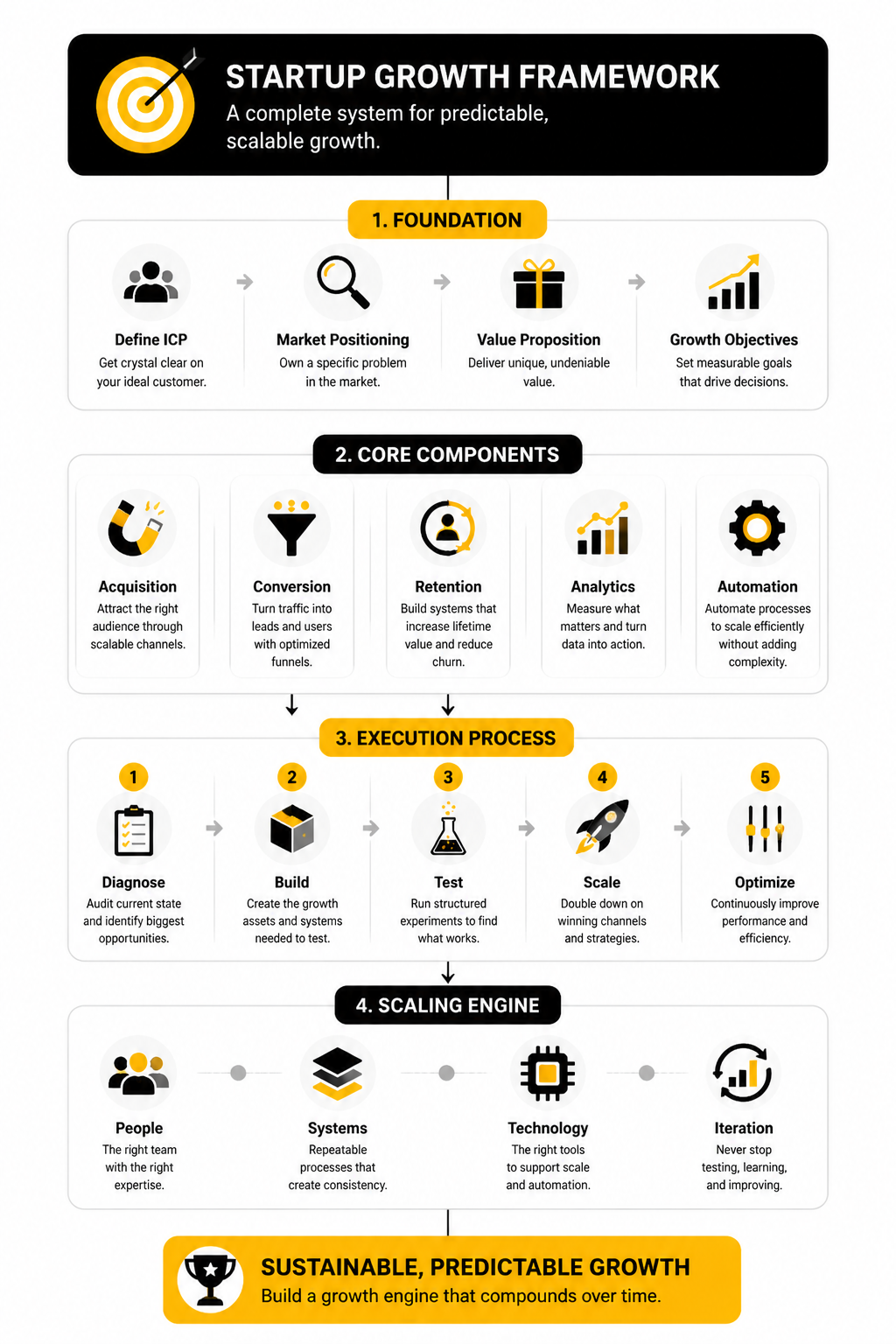
At a high level, the framework looks like this:
- Positioning and Market Clarity
The agency helps define who the product is for and why it matters. Without this, no campaign performs consistently.
- Acquisition Engine Setup
Paid, organic, and partnership channels are tested quickly to identify scalable sources of traffic.
- Conversion Optimization
Traffic without conversion is wasted spend. Landing pages, funnels, and onboarding flows are continuously improved.
- Retention and Monetization Systems
Email, SMS, and automation flows increase lifetime value and reduce churn.
- Data and Feedback Loops
Every action feeds back into decision-making. Metrics drive iteration, not opinions.
Tools like ManyChat are often integrated into this framework to automate conversations and capture leads in real time, especially from social channels where startups gain early traction.
What makes this framework powerful is not complexity—it’s consistency. The same structure applies whether a startup is pre-seed or scaling to Series B. The difference is in execution depth and budget allocation.
This is just the foundation. In the next part, we’ll break down the core components that actually drive startup growth and how agencies turn these frameworks into real traction.
The Core Components of Startup Marketing Execution
Once the framework is clear, execution becomes the real differentiator. This is where most startups struggle—not because they lack ideas, but because they lack structured systems that compound results over time.
A strong marketing agency for startups focuses on a few core components that consistently drive traction. These aren’t random tactics. They are interconnected systems designed to move a startup from zero to scalable growth.
Acquisition Channels That Actually Scale
Early-stage founders often chase every channel at once. That usually leads to shallow execution and no real signal. The smarter approach is concentrated testing followed by aggressive scaling of what works.
High-performing agencies typically prioritize:
- Paid acquisition (Meta, Google, TikTok) for fast feedback
- Organic content for compounding reach
- Partnerships and integrations for leveraged growth
- Community-driven channels like Discord or Slack
Customer acquisition costs have risen significantly, with WordStream data showing steady increases across major ad platforms. That’s why startups can’t rely on a single channel anymore. Diversification isn’t optional—it’s survival.
The key is sequencing. Agencies test fast, kill underperformers quickly, and double down on the few channels that show early traction signals.
Conversion Systems That Turn Traffic Into Revenue
Traffic without conversion is just expensive noise. This is where many startups burn through funding—driving clicks without building systems that convert those clicks into users or revenue.
Conversion systems include:
- High-performing landing pages
- Funnel architecture tailored to user intent
- Clear messaging aligned with positioning
- Frictionless onboarding experiences
Tools like ClickFunnels and Replo allow startups to iterate quickly without engineering bottlenecks. That speed matters. The faster you test variations, the faster you find what converts.
Even small improvements compound. Increasing conversion rates by just a few percentage points can significantly reduce acquisition costs and extend runway.
Lifecycle Marketing and Retention Engines
Most startups obsess over acquisition and completely ignore retention. That’s a mistake.
Retention is where profitability happens. Acquiring a user is expensive. Keeping them and increasing their lifetime value is where real growth comes from.
A modern marketing agency for startups builds lifecycle systems that include:
- Email onboarding sequences
- Behavioral triggers based on user actions
- Re-engagement campaigns for inactive users
- Upsell and cross-sell flows
Platforms like Brevo and Moosend make it easier to automate these flows without complex infrastructure. The goal is simple: maximize the value of every user that enters the ecosystem.
Retention isn’t just a metric. It’s a multiplier.
Data Infrastructure and Decision-Making
Startups don’t fail because they lack data. They fail because they don’t use it correctly.
A strong agency builds a data layer that connects every part of the marketing system. This includes tracking user behavior, attribution, and revenue across channels.
Core elements include:
- Funnel tracking and attribution
- Cohort analysis
- A/B testing frameworks
- Real-time performance dashboards
Without this, decisions become guesswork. With it, growth becomes predictable.
Platforms like GoHighLevel consolidate CRM, automation, and analytics into one system, reducing fragmentation and giving founders a clearer view of what’s actually working.
Speed of Execution as a Competitive Advantage
One of the most overlooked components is speed.
Startups that win don’t necessarily have better ideas—they move faster. They test more hypotheses, learn quicker, and adapt before competitors even realize what’s happening.
A marketing agency for startups accelerates this process by:
- Running parallel experiments instead of sequential ones
- Eliminating internal bottlenecks
- Bringing proven playbooks from other startups
- Maintaining consistent execution cadence
Speed compounds just like capital. The faster you iterate, the faster you find scalable growth.
These components are what turn strategy into results. But execution alone isn’t enough without the right implementation approach.
In the next part, we’ll break down how professional agencies actually deploy these systems in real startup environments—and what separates average execution from elite growth.
How Professional Agencies Implement Growth Systems
Understanding the components is one thing. Turning them into a working growth engine is something completely different.
This is where a real marketing agency for startups separates itself from freelancers or generalist teams. Implementation is not about doing more—it’s about sequencing the right actions at the right time and building systems that don’t break under pressure.
Most startups fail here because they try to execute everything at once. Agencies that win simplify the process into structured phases that build on each other.
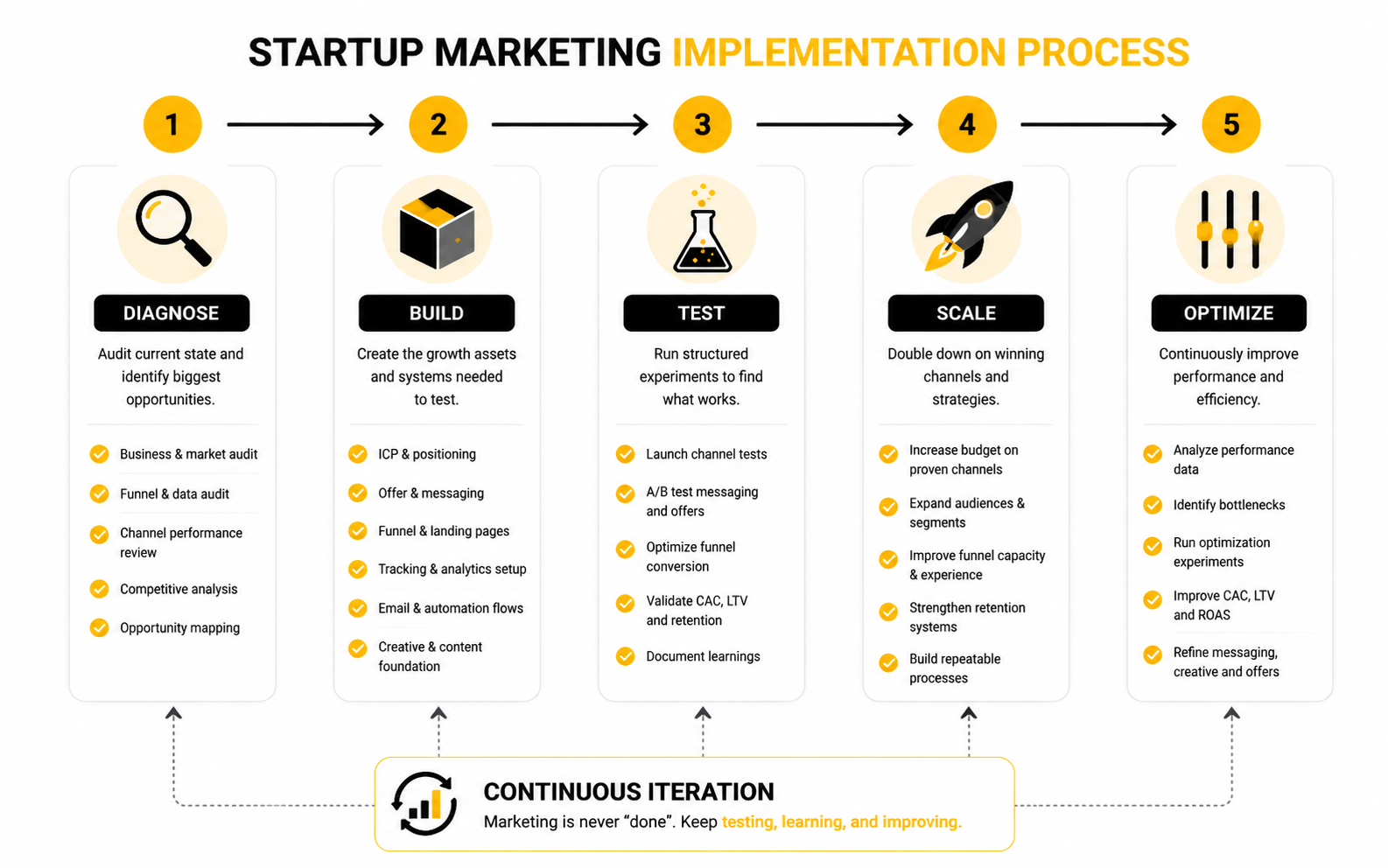
Phase 1: Deep Market and Funnel Diagnosis
Before launching anything, a serious agency audits the entire growth environment. This includes positioning, competitors, existing funnels, analytics, and customer behavior.
This phase is often skipped by inexperienced teams, but it’s critical. Without understanding what already exists, new campaigns are just guesses layered on top of flawed assumptions.
The goal here is clarity:
- Who is the ideal customer right now (not theoretically)?
- What messaging already resonates based on real data?
- Where are users dropping off in the current funnel?
- Which channels show early traction signals?
Agencies often centralize this data inside systems like GoHighLevel, where CRM, funnel tracking, and automation live together. This avoids fragmented insights and speeds up decision-making.
Phase 2: Rapid Build and Launch of Growth Assets
Once the diagnosis is clear, the next step is building the minimum viable growth system.
This is not about perfection. It’s about launching fast with enough structure to test real hypotheses.
Typical assets include:
- Landing pages tailored to specific audiences
- Conversion-focused funnels
- Initial ad creatives and messaging angles
- Basic email and SMS automation flows
Tools like ClickFunnels and Systeme.io are commonly used at this stage because they allow full funnel deployment without heavy development work.
Speed is the priority. The faster the system goes live, the faster real data starts coming in.
Phase 3: Structured Experimentation and Signal Detection
Once the system is live, the focus shifts to testing.
This is where most startups either gain traction—or waste months spinning their wheels.
A strong marketing agency for startups runs structured experiments instead of random tests. That means:
- Testing one variable at a time
- Running parallel experiments across channels
- Defining clear success metrics before launching
- Killing losing experiments quickly
The objective is not immediate profitability. It’s identifying signals—early indicators of what could scale.
For example, a specific ad angle generating high engagement but low conversion might signal messaging-market mismatch, not channel failure. Agencies interpret these signals and adjust accordingly.
Phase 4: Scaling What Works Without Breaking the System
Once clear winners emerge, scaling begins. This is where many startups make critical mistakes.
Instead of gradually increasing spend and optimizing systems, they often jump too quickly and lose efficiency. Costs spike, performance drops, and momentum stalls.
Professional agencies approach scaling methodically:
- Increasing budgets in controlled increments
- Expanding winning creatives and variations
- Strengthening backend systems like email and retention
- Monitoring performance metrics in real time
Automation becomes essential at this stage. Tools like ManyChat help capture and nurture leads instantly, especially when traffic volumes increase.
Phase 5: System Optimization and Compounding Growth
After scaling, the focus shifts again—from growth to efficiency.
This is where the best agencies create long-term advantage. Instead of constantly chasing new channels, they optimize existing systems to improve margins and lifetime value.
Key optimization areas include:
- Conversion rate improvements across funnels
- Better segmentation in email and SMS campaigns
- Refinement of onboarding experiences
- Advanced retargeting strategies
Over time, these improvements compound. Small gains at each stage of the funnel can dramatically increase overall performance.
What This Process Looks Like in Practice
When you zoom out, the implementation process follows a clear path:
- Diagnose the current state with real data
- Build a fast, testable growth system
- Run structured experiments to find signals
- Scale proven channels carefully
- Optimize for efficiency and long-term growth
This is what a real marketing agency for startups delivers. Not random tactics. Not vanity metrics. A repeatable system that turns uncertainty into measurable progress.
In the next part, we’ll break down how to evaluate agencies themselves—because choosing the wrong partner at this stage can cost far more than doing nothing at all.
Understanding the Numbers That Actually Drive Growth
By this point, the strategy and execution should be clear. But none of it matters if you can’t read the signals correctly.
This is where most founders get misled. They look at dashboards full of numbers but don’t know what those numbers actually mean or what actions they should trigger. A good marketing agency for startups doesn’t just report metrics—it translates them into decisions.
The difference is huge. Metrics without context create noise. Metrics with interpretation create leverage.
The Only Metrics That Matter Early On
In the early stages, simplicity wins. Tracking everything usually leads to confusion, not clarity.
The most important metrics at this stage are:
- Customer Acquisition Cost (CAC)
- Conversion Rate (per funnel stage)
- Activation Rate (users reaching first value)
- Retention Rate (short-term and long-term)
- Lifetime Value (LTV)
These metrics tell a complete story. CAC tells you how expensive growth is. Conversion rates show where friction exists. Retention reveals whether your product actually sticks.
If you can’t connect these together, scaling becomes dangerous. Many startups scale acquisition before validating retention, which leads to burning cash faster instead of growing.
What Benchmarks Actually Tell You
Benchmarks are useful—but only if you understand their limitations.
For example, average landing page conversion rates often sit between 2% and 5% across industries, based on aggregated campaign data from platforms like ClickFunnels. But that number alone is meaningless without context.
A 3% conversion rate could be excellent or terrible depending on:
- The traffic source quality
- The price point of the offer
- The stage of the funnel
- The level of audience awareness
What matters is not hitting a universal benchmark. It’s improving your own baseline consistently.
Strong agencies focus on relative gains. If a funnel moves from 2% to 4%, that’s a 100% improvement. That’s what drives real growth—not chasing arbitrary industry averages.
Reading Funnel Data Without Guessing
A startup funnel is essentially a chain. Every weak link reduces overall performance.
The key is breaking the funnel into stages and analyzing each one individually:
- Traffic → Click
Measures how compelling your ad or content is.
- Click → Lead
Reflects how well your landing page converts interest into action.
- Lead → Activation
Shows whether users experience value quickly.
- Activation → Retention
Determines if the product solves a real problem.
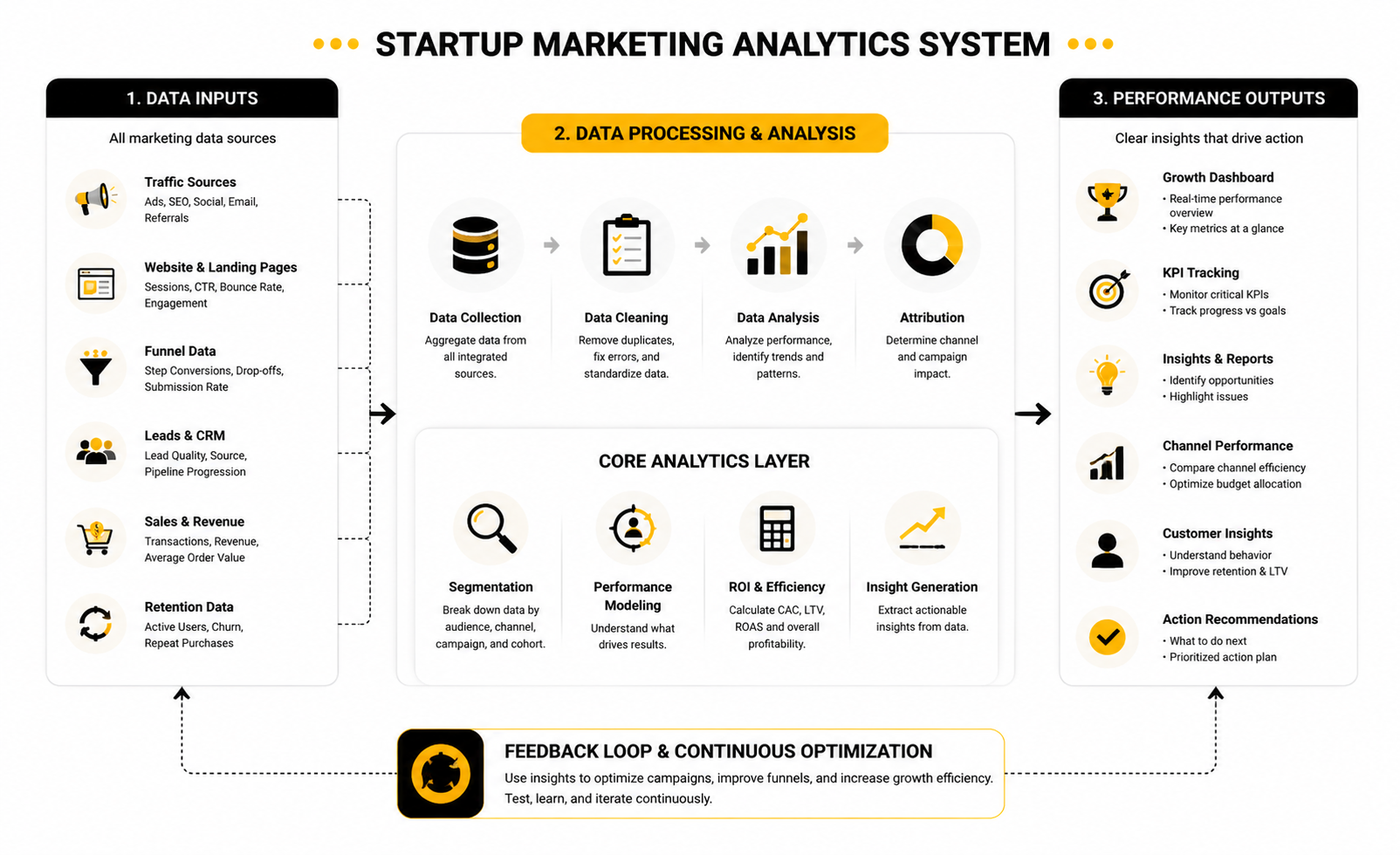
This is where analytics systems become critical. Tools like GoHighLevel allow startups to track every step in one place, instead of stitching together fragmented tools.
When you can see the entire funnel clearly, decisions become obvious. If traffic is high but leads are low, fix the landing page. If activation is weak, improve onboarding. No guessing required.
Signals vs Noise: What to Ignore
One of the biggest mistakes is reacting to the wrong data.
Vanity metrics are everywhere:
- Impressions
- Likes and shares
- Raw traffic numbers
- Email open rates without context
These can feel good, but they don’t necessarily correlate with growth.
What matters are behavioral signals tied to revenue. For example, a lower click-through rate with higher conversion downstream is often more valuable than high engagement with no revenue impact.
A marketing agency for startups filters out the noise and focuses only on signals that drive meaningful outcomes.
How Data Should Drive Action
Data is only useful if it leads to action.
Every metric should answer a simple question: what do we do next?
Here’s how that typically looks:
- High CAC + low conversion → optimize funnels before scaling
- Strong acquisition + weak retention → fix product or onboarding
- High engagement + low sales → refine messaging and offer
- Low traffic + strong conversion → scale acquisition channels
This is why speed matters again. The faster you interpret and act on data, the faster you improve.
Platforms like Brevo help automate parts of this process, especially on the retention side, where behavioral triggers can immediately respond to user actions.
The Real Goal of Analytics
The goal isn’t more data. It’s better decisions.
A well-structured analytics system reduces uncertainty. It tells you where to focus, what to fix, and when to scale. Without it, even the best strategies fall apart under real-world conditions.
This is where a strong marketing agency for startups becomes invaluable. Not because they have access to more tools—but because they know how to interpret the signals those tools produce.
In the next part, we’ll move into a critical decision point: how to choose the right agency, what to look for, and how to avoid the expensive mistakes most founders make.
Advanced Realities of Scaling With a Marketing Agency
By now, the mechanics are clear. But this is the part most founders underestimate—the tradeoffs, risks, and second-order effects that show up only when you start scaling.
Working with a marketing agency for startups is not just about getting results. It’s about navigating complexity as growth accelerates. What works at $10K/month rarely works the same way at $100K/month.
This is where strategic thinking becomes non-negotiable.
The Tradeoff Between Speed and Efficiency
Early on, speed is everything. You need data, traction, and proof that something works.
But as you scale, efficiency starts to matter more than speed. Aggressive spending without control leads to rising CAC and shrinking margins.
This creates a tension:
- Move fast → higher burn, faster learning
- Optimize deeply → slower growth, stronger unit economics
Strong agencies know when to shift gears. They don’t optimize too early, but they also don’t let inefficiencies compound for too long.
A practical example: scaling paid ads without tightening funnel conversion is one of the fastest ways to lose money. That’s why agencies often revisit tools like ClickFunnels during scaling phases—not to rebuild everything, but to squeeze more value out of existing traffic.
When Growth Breaks Your Systems
Growth doesn’t just amplify success—it exposes weaknesses.
As traffic increases, small issues become major problems:
- Slow page load times reduce conversion rates
- Weak onboarding creates churn at scale
- Poor segmentation leads to irrelevant messaging
- Manual processes collapse under volume
This is where infrastructure becomes critical. Startups that rely on disconnected tools often hit a ceiling because their systems can’t keep up.
Platforms like GoHighLevel are often introduced or expanded at this stage to unify operations, automate workflows, and maintain performance under pressure.
Scaling without system stability is fragile. It works—until it doesn’t.
The Hidden Risk of Channel Dependency
One of the most dangerous patterns in startup growth is over-reliance on a single channel.
It usually starts innocently. One channel works—Meta ads, SEO, TikTok—and the team doubles down. Growth accelerates. Everything looks great.
Then something changes:
- Ad costs spike
- Algorithms shift
- Competition increases
- Policies restrict reach
Suddenly, growth stalls or reverses.
This isn’t hypothetical. Many startups have experienced sudden drops in performance due to platform changes, especially in paid acquisition ecosystems.
That’s why experienced agencies diversify early—not because it’s trendy, but because it reduces risk. Even if one channel drives the majority of growth, having secondary channels ready creates resilience.
The Reality of Diminishing Returns
Every channel has a ceiling.
What works at low spend often becomes less efficient as you scale. Audiences saturate. Costs increase. Performance plateaus.
This is not a failure—it’s a natural curve.
The key is recognizing it early and adapting:
- Expanding into new audiences or geographies
- Testing new creative angles and offers
- Layering in retention and upsell strategies
- Exploring new acquisition channels
Agencies that understand this don’t panic when performance dips. They treat it as a signal to evolve the strategy.
The Shift From Tactics to Systems Thinking
At a certain point, tactics stop being the bottleneck. Systems become the limiting factor.
This is where many founders get stuck. They keep asking:
- Which ad should we run?
- Which platform should we test?
But the real questions are different:
- How do all channels work together?
- Where are we losing value across the funnel?
- How do we increase lifetime value, not just acquisition?
This shift is what separates short-term wins from long-term growth.
A marketing agency for startups operating at a high level focuses on the entire ecosystem, not isolated tactics. Every decision connects back to the bigger system.
The Role of Automation and AI in Modern Scaling
As complexity increases, manual execution becomes a bottleneck.
Automation is no longer optional—it’s required to maintain speed and consistency. This includes:
- Lead capture and qualification
- Email and SMS workflows
- Customer support interactions
- Data synchronization across tools
Tools like ManyChat and Chatbase are increasingly used to automate conversations and support, especially as inbound volume grows.
The goal is not just efficiency. It’s consistency. Automation ensures that every lead, user, and customer gets a structured experience—even at scale.
Why the Right Agency Matters More as You Grow
Ironically, the cost of choosing the wrong agency increases as you scale.
At early stages, mistakes cost time. At later stages, they cost serious money.
A weak agency might:
- Scale inefficient channels too aggressively
- Ignore retention and focus only on acquisition
- Misinterpret data and make wrong decisions
- Fail to adapt when performance shifts
The result is not just wasted budget—it’s lost momentum.
The right agency, on the other hand, becomes a strategic partner. They help you navigate complexity, avoid predictable mistakes, and maintain growth even as conditions change.
In the final part, we’ll bring everything together with a clear framework for choosing the right marketing agency for your startup—and how to make sure the partnership actually delivers results.
Choosing the Right Marketing Agency for Your Startup
At this point, the biggest risk is not doing marketing—it’s choosing the wrong partner to execute it.
A marketing agency for startups should not just promise growth. It should demonstrate a repeatable process, clear thinking, and the ability to adapt when things inevitably change. The wrong agency won’t just waste budget—it will distort your understanding of what actually works.
So the question becomes practical: how do you evaluate an agency without falling for surface-level signals?
What Actually Signals a Strong Agency
The best agencies don’t hide behind vanity metrics or generic case studies. They show how they think.
Here’s what to look for:
- Clear explanation of their growth framework
- Willingness to challenge your assumptions
- Focus on systems, not just campaigns
- Transparency around testing, failure, and iteration
- Ability to connect metrics to business outcomes
If an agency can’t explain how they move from hypothesis to validation to scale, that’s a red flag. Execution without structure rarely works in startup environments.
Red Flags Most Founders Miss
Some of the most dangerous agencies look impressive at first glance. That’s why knowing what to avoid matters just as much as knowing what to look for.
Watch out for:
- Overpromising specific results without context
- Heavy focus on impressions, clicks, or vanity metrics
- No clear testing or experimentation process
- Rigid strategies that don’t adapt to feedback
- Lack of ownership over outcomes
A common pattern is agencies that scale ad spend quickly without fixing conversion or retention. It feels like progress—until costs rise and growth stalls.
How to Structure the Relationship Properly
Even the best agency will fail if the working relationship is misaligned.
Startups need speed and flexibility. Agencies need clarity and access. When those don’t match, execution breaks down.
A strong setup includes:
- Clear KPIs tied to business outcomes
- Fast feedback loops between founder and agency
- Access to product insights and user data
- Defined experimentation cadence (weekly or bi-weekly)
- Shared visibility into analytics and performance
Tools like GoHighLevel often become central here, giving both sides real-time access to funnels, leads, and campaign performance without delays.
When to Bring Marketing In-House
At some point, every startup faces the same question: should we keep the agency or build an internal team?
There’s no universal answer, but there are clear signals.
You might stay with an agency if:
- You’re still testing channels and offers
- You need speed and external expertise
- You don’t yet have repeatable growth
You might move in-house if:
- Your acquisition channels are predictable
- You need tighter control over execution
- You’re optimizing at scale rather than experimenting
In reality, many startups run hybrid models. Agencies handle strategy and experimentation, while internal teams manage ongoing execution.
The Long-Term View: Building a Growth Engine
The goal isn’t to “run marketing.” It’s to build a system that produces growth consistently.
This system includes:
- Reliable acquisition channels
- High-converting funnels
- Strong retention and monetization flows
- Integrated data and decision-making
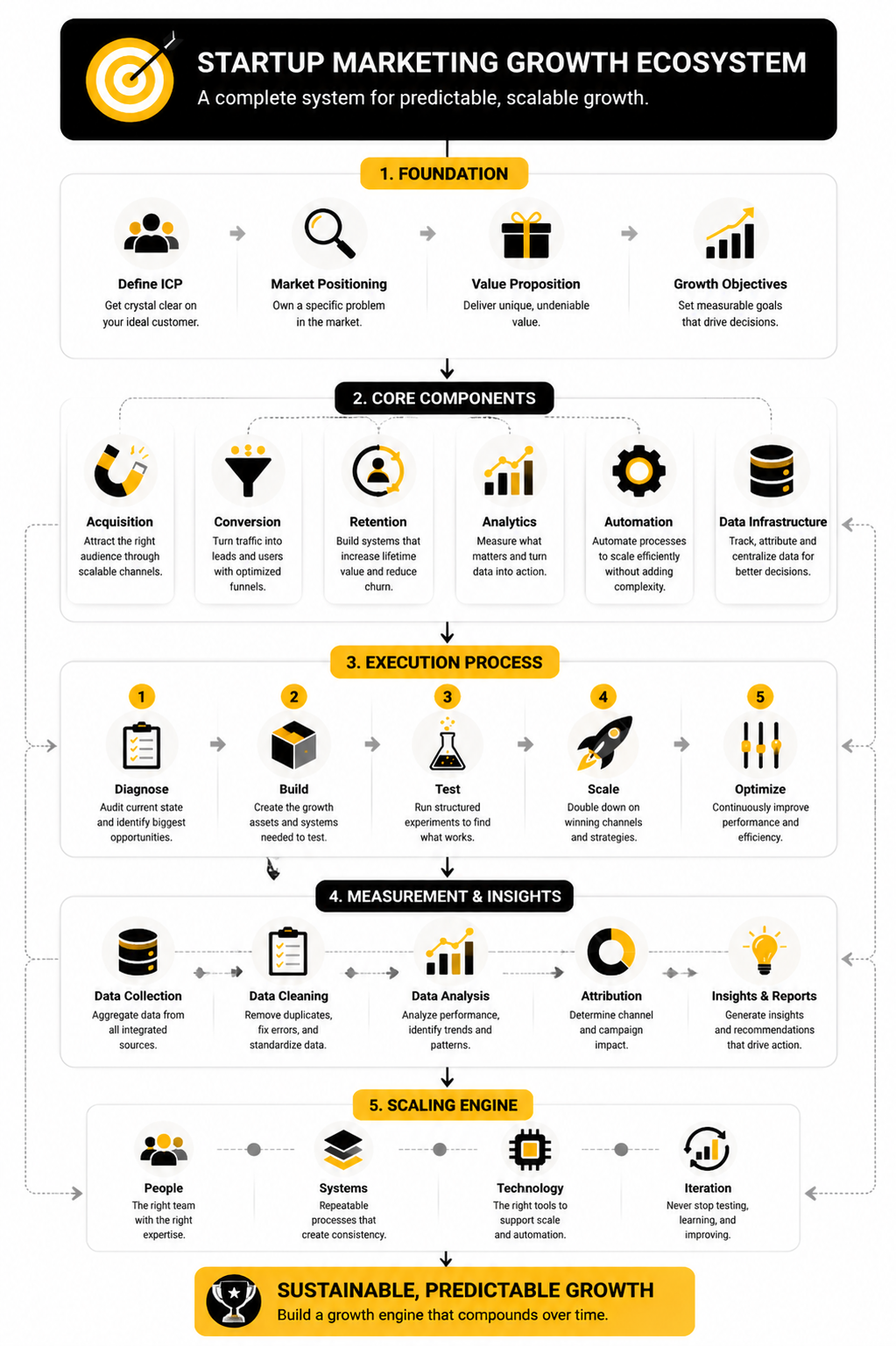
When all of these elements work together, marketing stops feeling chaotic. It becomes predictable, measurable, and scalable.
That’s the outcome a real marketing agency for startups should help you achieve—not just short-term wins, but a long-term growth engine.
FAQ - Built for Complete Guide
What does a marketing agency for startups actually do?
A startup-focused agency builds and manages growth systems, not just campaigns. This includes acquisition, conversion optimization, retention, and analytics. The goal is to find scalable growth, not just generate traffic.
How is a startup marketing agency different from a traditional agency?
Traditional agencies often rely on fixed strategies and brand-driven campaigns. Startup agencies prioritize experimentation, speed, and adaptability. They focus on finding what works quickly rather than executing long-term plans without validation.
When should a startup hire a marketing agency?
Most startups benefit from an agency when they need faster experimentation or lack in-house expertise. This usually happens after building an MVP but before achieving consistent traction.
How much should a startup spend on marketing?
There’s no fixed number, but many early-stage startups allocate 10–20% of their budget to growth experiments. The key is not the amount—it’s whether the spend produces learnings and signals.
What channels work best for startups?
It depends on the audience, but common starting points include paid social, search, content, and partnerships. The right agency will test multiple channels quickly and double down on what shows traction.
How long does it take to see results?
Initial signals can appear within weeks, especially with paid channels. However, building a scalable system typically takes a few months of structured experimentation and iteration.
What tools are essential for startup marketing?
Tools that unify systems are critical. Platforms like GoHighLevel help manage CRM, funnels, and automation in one place, while tools like Systeme.io simplify funnel building and product delivery.
Should startups focus more on acquisition or retention?
Both matter, but retention is often undervalued. Without retention, acquisition becomes expensive and unsustainable. Strong agencies balance both from the beginning.
What is the biggest mistake startups make in marketing?
The most common mistake is scaling too early without validating conversion and retention. This leads to higher costs and wasted budget without real growth.
Can a startup succeed without a marketing agency?
Yes, but it’s harder and slower. Agencies accelerate learning and execution. For founders who want to move quickly and avoid common mistakes, the right agency can be a major advantage.
Work With Professionals
Explore 10K+ Remote Marketing Contracts on MarkeWork.com
Most marketers spend too much time chasing clients, competing on crowded platforms, and losing a percentage of every project to middlemen.
MarkeWork gives you a better way. Browse thousands of remote marketing contracts and connect directly with companies desperate to hire skilled marketers like you, without platform commissions and without unnecessary gatekeepers.
If you're serious about finding better opportunities and keeping 100% of what you earn, explore available contracts and create a profile for free at MarkeWork.com.