

Typing marketing agency near me usually feels like a practical shortcut. You want someone close enough to understand your market, easy enough to reach when something breaks, and experienced enough to turn attention into leads instead of vague monthly reports.
That search matters more than most business owners realize because local discovery is still driven by visibility, relevance, reviews, and trust. Google states that local results are primarily shaped by relevance, distance, and prominence, while newer consumer research shows that reviews, recency, and cross-platform validation now heavily influence which businesses people contact first.

Article Outline
- What “Marketing Agency Near Me” Really Means Today
- Why Local Fit Still Matters
- The Decision Framework for Choosing an Agency
- The Core Services Worth Paying For
- How to Vet Strategy, Reporting, and Contracts
- How to Make the Final Choice and Start Strong
What “Marketing Agency Near Me” Really Means Today
A search for marketing agency near me is no longer just about geography. It is really a search for proximity, accountability, and context. You are looking for a team that understands your market, your buyers, your competitors, and the local signals that shape whether someone clicks, calls, or keeps scrolling.
That matters because local search has become more fragmented, not simpler. Google still plays the biggest role in local discovery, but consumers also compare businesses through reviews, social platforms, maps, and increasingly AI-assisted recommendations before they make contact. Recent local search research shows that consumers often validate a business across multiple platforms, and younger audiences in particular now use several apps before choosing a local provider.
It also means the best nearby agency is not automatically the one with the closest office. A local agency should be able to connect place-based knowledge with real execution: strong Google Business Profile management, credible local SEO, useful paid search, better landing pages, and reporting that ties activity to leads and revenue. If all they really offer is “more posts” or “more impressions,” distance will not save the relationship.
Why Local Fit Still Matters
Local fit still matters because Google’s own guidance makes clear that local visibility depends on how well a business matches a search, how close it is, and how established it appears online. A good agency near you should understand how your city, service area, and local competition shape that equation. That is very different from running generic national campaigns with your city name pasted into headline copy.
It also matters because trust is now fragile and highly visible. BrightLocal’s 2026 survey found that consumers increasingly care about fresh reviews, higher star ratings, and business responses that feel timely rather than robotic. When someone is comparing two similar providers in the same area, those signals can be the difference between a booked call and a lost opportunity.
There is also a practical side. A strong local agency can usually spot market-specific problems faster: weak map visibility in a target suburb, poor conversion intent on location pages, mismatched service-area targeting, or ads that attract the wrong zip codes. That kind of pattern recognition is where “near me” becomes useful, because the agency is not just close by; it is close to the buying behavior that actually drives your pipeline.
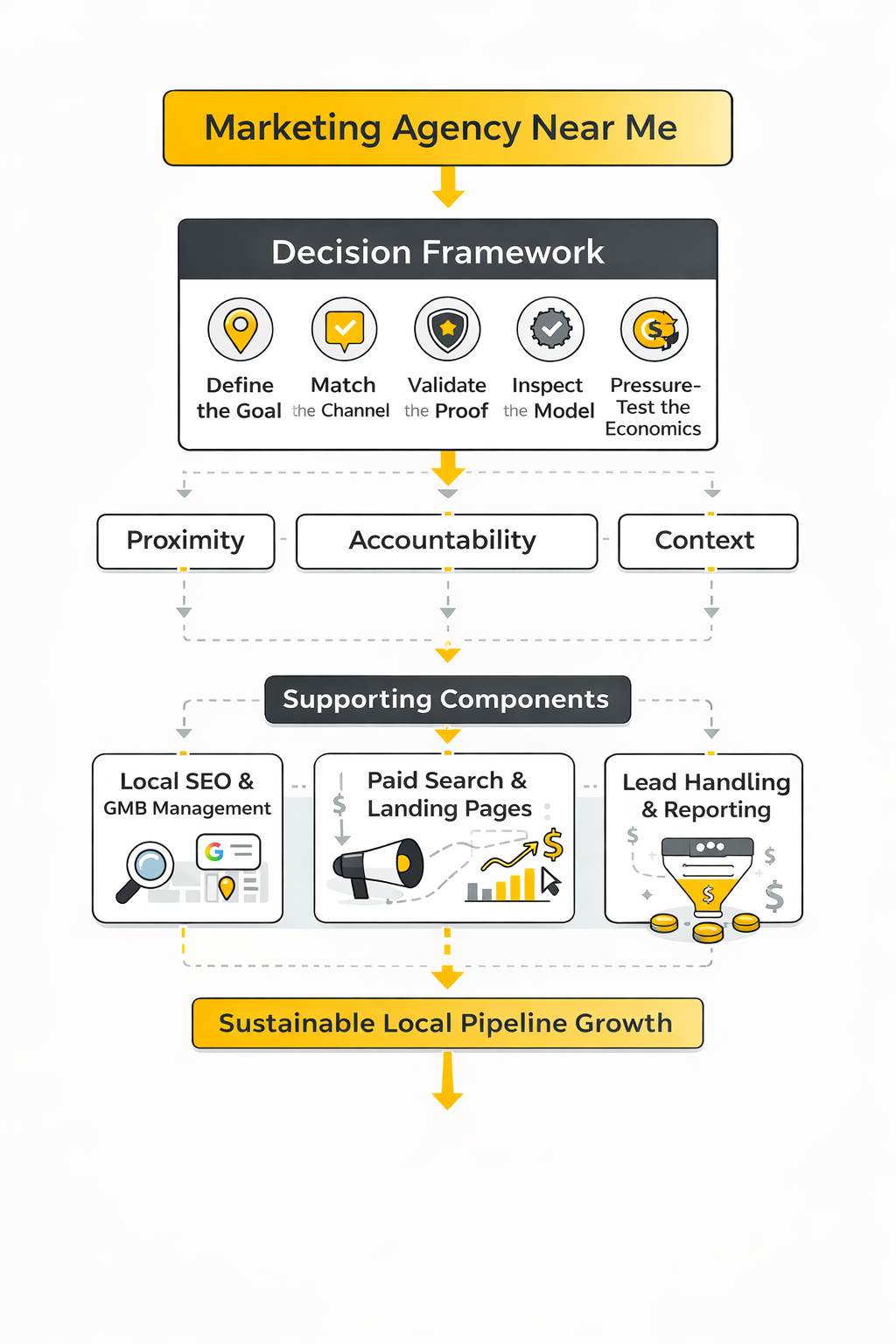
The Decision Framework for Choosing an Agency
The smartest way to evaluate a marketing agency near me is to stop thinking in terms of charm, size, or presentation quality and start thinking in terms of fit. The right framework is simple: goals, channel match, proof, process, and economics. If an agency cannot clearly connect those five pieces, the partnership usually gets expensive before it gets effective.
That approach lines up with current vendor-selection guidance as well. Clutch’s latest agency selection framework emphasizes defining goals first, setting a realistic budget, shortlisting carefully, and using interviews to test strategic depth rather than just sales polish. Their marketplace also leans heavily on verified reviews and portfolio evidence, which is exactly how serious buyers should narrow the field.
In the next part, the article will break that framework down step by step so you can tell the difference between a genuinely capable local partner and an agency that only sounds convincing on a discovery call. From there, we will move into the specific services that are worth paying for, the red flags that show up in proposals and contracts, and the way to choose a firm you can actually grow with.
The Decision Framework for Choosing an Agency
The cleanest way to evaluate a marketing agency near me is to stop asking who sounds the smartest and start asking who fits the job. Most bad agency decisions happen because the client buys confidence, branding, or a polished sales call instead of testing whether the agency can solve the exact problem in front of them. The framework that actually helps is simple: define the goal, match the channel, validate the proof, inspect the operating model, and then pressure-test the economics.
That order matters. Google’s local ecosystem still runs on relevance, distance, and prominence, so a local business cannot afford a marketing plan that treats every channel equally or every city the same. The agency you choose should be able to explain why your next dollar belongs in local SEO, paid search, landing page work, review generation, CRM follow-up, or some mix of those, instead of hiding behind a vague “full-service” label.
A good framework also protects you from a very common mistake: hiring for activity instead of outcomes. More content, more campaigns, and more meetings can look productive while leads stay flat. If the agency cannot tie its work to pipeline movement, booked appointments, qualified leads, or revenue trends, you are not buying strategy. You are buying motion.
Start With the Business Goal, Not the Service Menu
Before you compare agencies, get painfully clear on what success looks like. That could mean more qualified phone calls, more estimate requests from a specific service area, better close rates from existing traffic, or lower acquisition costs on paid campaigns. Without that clarity, almost any proposal can sound reasonable because there is no fixed target to measure it against.
This is where a lot of “marketing agency near me” searches go sideways. The business owner wants growth, but the agency conversation starts with services instead of outcomes, so the discussion becomes SEO versus PPC versus social rather than what bottleneck is actually choking revenue. A serious agency will slow that down and ask what part of the funnel is broken first.
That first diagnostic step matters even more in local markets because the problem is often narrower than it looks. Sometimes the issue is weak visibility in Maps. Sometimes it is poor conversion on service pages. Sometimes traffic is fine and the real leak is slow follow-up after a form fill or missed call. The right agency should be able to identify that quickly and explain the tradeoffs in plain English.
Match the Agency to the Channel That Drives Demand
Not every local business needs the same channel mix, and that is exactly why agency specialization matters. A home services company with strong buyer intent may need local SEO, paid search, reviews, and fast lead handling long before it needs elaborate organic social campaigns. A clinic, law firm, or higher-ticket B2B service may need tighter landing pages, better attribution, and a stronger nurture system because the sales cycle is longer and trust takes more touches.
This is the point where you should get suspicious of agencies that claim to do everything equally well. Clutch’s current selection guidance still pushes buyers to define goals, shortlist carefully, and test real strategic depth during interviews, which is another way of saying specialization and fit beat broad promises. A nearby agency that truly understands your demand channels is usually more valuable than a bigger one that spreads itself thin across every service line under the sun.
You also want channel match because local discovery is no longer linear. Recent consumer behavior research points to platform-hopping, cross-checking, and fragmented journeys before someone chooses a local provider. That means the agency needs to understand how search, reviews, website experience, and follow-up connect, not just how to make one dashboard metric look better for a month.
Look for Proof That Matches Your Market
Proof is not a logo wall. It is not a slideshow full of vanity metrics. It is evidence that the agency has solved similar problems in a similar context, ideally for businesses with comparable geography, sales cycles, margins, and lead quality requirements.
For a local business, context is everything. An agency that grew an ecommerce brand through influencer content may still be a poor fit for a roofing company, med spa, multi-location dental group, or regional legal practice. You want proof that shows they understand local intent, review dynamics, Google Business Profile visibility, and what happens after the lead comes in.
The strongest evidence usually comes from a mix of verified reviews, relevant case studies, and the way the agency talks through constraints. Clutch’s marketplace emphasizes verified client reviews and service-specific filtering for a reason: buyers need signals that are closer to reality than agency self-description. When you are evaluating options, look for proof that feels specific enough to be audited, not just admired.
Evaluate How the Agency Actually Works Day to Day
Even a smart strategy can fail inside a messy operating model. You need to know who owns the account, how often priorities are reset, how reporting works, what gets tested monthly, and how fast the team responds when a campaign breaks or lead quality drops. These details sound boring during the sales process, but they usually determine whether the relationship becomes productive or frustrating.
This is also where local businesses should pay close attention to lead handling and visibility into performance. Google gives Business Profile owners access to interaction data such as views, clicks, and customer actions, which means a competent agency should be comfortable combining platform data with CRM outcomes rather than hiding behind disconnected charts. If they cannot show how traffic, calls, form fills, and follow-up connect, reporting will stay cosmetic.
The best nearby agencies usually feel operationally sharp, not theatrically impressive. They can explain what they do every month, what they do not do, how they prioritize, and when they change course. That kind of clarity is a much better predictor of results than a fancy proposal deck.
Pressure-Test the Economics Before You Sign
A local agency can be the right strategic fit and still be the wrong commercial fit. You need to understand the fee structure, media spend expectations, setup costs, contract length, ownership of assets, and what happens if performance is mixed in month two or three. If those answers are fuzzy, the risk is usually being pushed onto you.
This is where business owners often get distracted by the cheapest proposal. That is understandable, but local marketing costs do not exist in a vacuum. BIA’s latest forecast projects substantial local advertising spend in 2026, which is a reminder that competition for attention in local markets is not going away. The real question is not whether an agency is cheap. It is whether the economics give you a believable path to profitable growth.
A strong agency should be able to explain that path without drama. They should tell you what needs to happen for the relationship to make financial sense, how long early signals usually take, and which indicators deserve patience versus immediate intervention. That kind of commercial honesty is rare, and it is one of the clearest signs you are talking to professionals rather than closers.
The Core Services Worth Paying For
Once the decision framework is clear, the next question becomes practical: what should a marketing agency near me actually do for the money? This is where buyers need to get sharper, because plenty of retainers look comprehensive while leaving out the work that moves local demand. The right service mix is not the one with the longest list. It is the one that improves visibility, conversion, and follow-up in the order your business actually needs.
The Core Services Worth Paying For
When you hire a marketing agency near me, you are not paying for “marketing” in the abstract. You are paying for a small number of systems that should make your business easier to find, easier to trust, and easier to contact. If an agency cannot show how its services improve one of those three things, the retainer is probably bloated.
The best local agencies usually earn their keep in four places. They strengthen your visibility in local search, they run paid acquisition where intent is already high, they improve the pages where prospects decide whether to call or leave, and they tighten the follow-up system so leads do not die after business hours. That combination reflects how local buying actually works now, with discovery, validation, and response time all influencing who wins.
Local SEO and Google Business Profile Management
This is still the foundation for many local businesses because high-intent searches often start in Google Search or Maps. Google is very clear that local ranking depends on relevance, distance, and prominence, which means a business profile cannot be treated like a set-it-and-forget-it directory listing. It needs accurate categories, complete services, consistent information, strong supporting pages, and a steady flow of credible customer feedback.
That last point matters more than ever. BrightLocal’s 2026 review survey shows that recency is carrying more weight in consumer decisions, with many people now paying close attention to how new reviews are and whether the business actively responds. That means a nearby agency should not only optimize your profile but also build a review-generation process that keeps trust signals fresh.
A serious local SEO service also goes beyond the profile itself. It should include location-page quality, internal linking, service-area clarity, citation hygiene where relevant, and ongoing testing of what drives profile interactions such as calls, website clicks, direction requests, or messages. Google’s own Business Profile performance tools make those interaction patterns visible, so there is no excuse for running local SEO as guesswork.
Paid Search and Local Lead Capture
Paid search is worth paying for when you need demand now, not just six months from now. That is especially true for service businesses, urgent-need categories, and local markets where organic visibility is competitive or uneven across neighborhoods. Google’s local lead-generation guidance makes this pretty plain: local businesses can use search and related formats to attract and nurture leads more consistently, especially when the offer and follow-up are built for intent rather than reach.
What matters here is not whether the agency runs ads. Plenty of agencies run ads badly. What matters is whether they can separate expensive clicks from qualified leads, route spend to the right services and locations, and continuously cut waste without starving the campaign.
For some businesses, that also includes Local Services Ads or similar high-intent formats where trust signals and responsiveness matter as much as budget. The agency should be able to explain when that model beats traditional search campaigns and when it does not. If they cannot explain the tradeoff clearly, they are probably reselling tactics they do not fully understand.
Landing Pages, Offers, and Conversion Paths
Traffic is not the goal. Contact is the goal. A local agency worth hiring should care deeply about what happens after the click, because weak pages quietly waste both organic visibility and paid spend.
This is where many “marketing agency near me” relationships underperform. The agency improves impressions, rankings, or click volume, but the site still makes it hard to trust the business, hard to understand the offer, or hard to reach someone quickly. That is not a traffic problem. It is a conversion problem.
Good local landing pages do not need to be flashy, but they do need to be specific. The service, area served, proof, offer, CTA, and contact options should be obvious within seconds, especially on mobile where many local decisions happen fast. When an agency also has the ability to build and test pages quickly in tools like Replo or ClickFunnels, it becomes much easier to launch focused service pages instead of waiting months for development bottlenecks. That kind of implementation speed matters when campaigns are live and wasted clicks are real.
CRM, Follow-Up, and Marketing Automation
This is the service too many businesses underestimate. They search for a marketing agency near me, sign the contract, get more leads, and then discover the real issue was missed calls, slow replies, weak routing, or inconsistent follow-up. At that point, the agency is blamed for poor lead quality when the actual breakdown happened after the inquiry came in.
Speed still matters enormously in lead handling. The broader speed-to-lead research is not new, but the operational lesson remains brutal: businesses that respond faster qualify and close more often, while slow handoffs leak value immediately. For a local business, that means the agency should either help fix routing, messaging, appointment workflows, and attribution or openly admit that a major part of revenue performance sits outside their scope.
This is one area where the right platform stack can genuinely make the relationship better. A local agency that knows how to run follow-up inside GoHighLevel, use automated chat capture with ManyChat, or route scheduling through Cal.com can often solve practical response-time problems faster than a business can solve them internally. That only helps, of course, if the agency uses automation to improve service instead of to hide behind generic templated outreach.
How to Vet Strategy, Reporting, and Contracts
Once you know which services are worth paying for, the next step is making sure the agency can implement them professionally. This is where a lot of deals fall apart in the real world. The proposal sounds smart, the service list looks complete, but nobody can clearly explain how the work will be prioritized, tracked, and adjusted once the contract starts.
That is the gap between selling marketing and running it. A credible local agency should be able to walk you through the first 90 days in a way that feels operational, not theatrical. You should hear what gets audited first, what gets fixed first, what success signals matter early, and what they will do if the initial assumptions are wrong.
What Strong Implementation Actually Looks Like
Professional implementation starts with a baseline, not a brainstorm. The agency should audit the business profile, local rankings, paid account structure, site conversion path, call handling, form routing, review velocity, and tracking setup before they start pitching bold growth numbers. If they skip that and jump straight into content calendars or media recommendations, they are usually decorating a problem they have not diagnosed.
From there, the work should move in a clear order. First fix visibility blockers and conversion leaks. Then stabilize lead capture and follow-up. Then scale the channels that are already proving they can turn intent into revenue. That sequence sounds simple, but it is exactly what separates a mature agency from one that confuses constant activity with disciplined execution.
A good implementation plan should also feel measurable from week one. That does not mean demanding instant ROI from SEO or overreacting to every daily fluctuation. It means knowing which early indicators matter, which lagging outcomes matter more, and who is responsible for interpreting both.
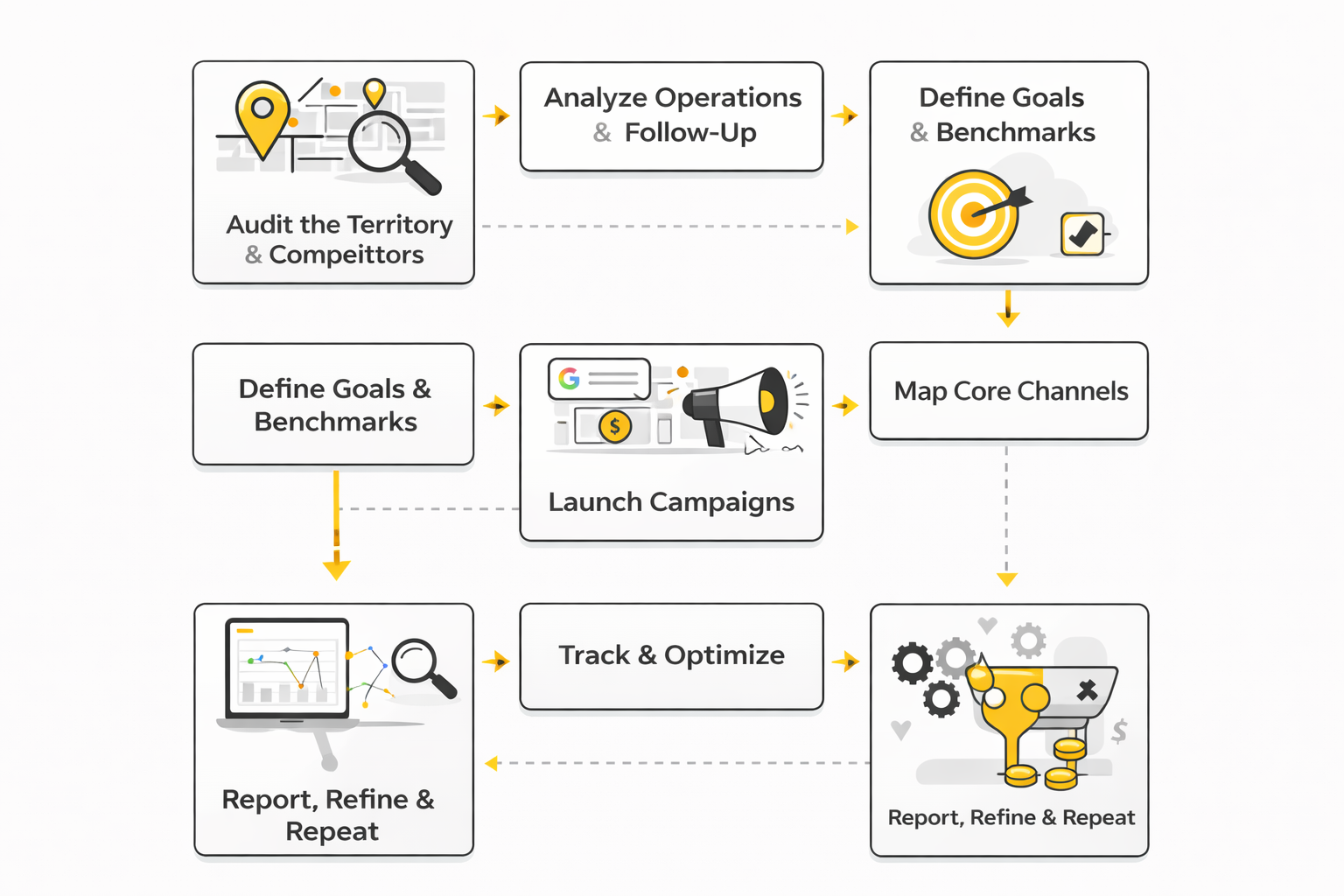
A Practical 90-Day Rollout
In the first 30 days, the agency should clean the fundamentals. That usually means tightening your Google Business Profile, checking tracking and attribution, fixing obvious landing-page friction, validating service-area targeting, and making sure leads are actually reaching a human fast enough to matter. If they cannot show tangible movement in those basics, the rest of the plan sits on weak foundations.
In days 31 to 60, the focus should shift toward controlled execution. Paid campaigns should be narrowed around intent, local pages should start reflecting actual service demand, review acquisition should become a repeatable process, and follow-up workflows should be tested in real conditions, not just mapped in a slide deck. This is usually the stage where weak agencies get exposed, because strategy now has to survive contact with messy operational reality.
In days 61 to 90, the agency should be making smarter decisions, not just delivering more output. They should know which neighborhoods, services, keywords, pages, and lead sources are pulling weight and which ones need to be cut, rebuilt, or deprioritized. By this point, you do not need perfection, but you absolutely need evidence that the system is getting sharper instead of just getting busier.
Reporting Should Explain Decisions, Not Just Display Numbers
A lot of agency reporting is still designed to look impressive instead of useful. Screens full of impressions, reach, clicks, and charts can create the feeling of sophistication while avoiding the harder question: what changed this month, why did it change, and what are we doing next? That is not reporting. That is camouflage.
Google’s Business Profile reporting already shows core interaction signals, and ad platforms provide more than enough raw campaign data. The real value of an agency report is interpretation. You need someone to connect visibility, engagement, lead quality, close trends, and operational issues into one honest story.
That is also why good agencies tend to keep their dashboards close to the business, not just the platform. If calls are up but qualified leads are weak, that matters. If form fills are steady but response time is slipping, that matters more. Reporting should help you make better decisions, not just admire prettier graphs.
Contracts Should Protect the Work, Not Trap the Client
This part is unglamorous, but it matters. A contract should define scope, responsibilities, asset ownership, communication rhythm, and exit terms clearly enough that neither side has to guess later. If the agency becomes evasive when you ask who owns the ad account, landing pages, CRM data, call recordings, or creative assets, slow down immediately.
Good contracts also reflect the truth that different channels move at different speeds. SEO needs time. Paid search needs tighter weekly management. Review generation and follow-up improvements can create earlier wins. A credible local agency should explain that without using “it takes time” as a blanket excuse for weak execution.
The next step is the final one that matters most: making the choice. Not the most exciting choice, or the cheapest one, or the one with the nicest sales process. The one that gives your business the clearest path to stronger visibility, better leads, and fewer unforced mistakes.
What the Numbers Actually Tell You
Once you get past the sales pitch, the real test of a marketing agency near me is whether the numbers are pointing to a healthier business or just a busier dashboard. This is where a lot of owners get misled, because agencies love metrics that look active even when the underlying system is still leaking money. The job is not to collect more numbers. It is to understand which numbers deserve action and which ones are just background noise.
That distinction matters more now because local buyer journeys are getting messier, not cleaner. Google’s own lead-gen guidance notes that people often move across 5.5 online touchpoints before submitting a lead form, and SOCi’s 2025 consumer behavior research shows younger buyers are platform-hopping across search, social, maps, and review sites before making local decisions. (soci.ai) That means no single metric tells the whole story anymore.
A good local agency should be able to simplify that complexity. They should help you separate visibility metrics, engagement metrics, lead metrics, and revenue metrics so you can see where the real bottleneck sits. Without that structure, it becomes very easy to celebrate more traffic while booked jobs stay flat.
Visibility Metrics Tell You Whether You Are Even in the Game
Visibility comes first because a local business cannot convert demand it never appears for. Google Business Profile performance data shows how often people find your business on Search and Maps and what actions they take from there, including calls, website clicks, direction requests, bookings, and messages. (support.google.com) These are not vanity metrics, but they are still top-of-funnel signals.
The mistake is treating them like outcomes. More profile views can be a good sign, and more map visibility can absolutely matter, but those numbers only become commercially useful when they start producing qualified actions. If impressions are rising while calls, direction requests, or site visits stay flat, the business may be ranking more often without becoming more compelling.
That usually points to a practical fix. The profile may need better categories, stronger photos, more complete services, better review signals, or sharper landing pages behind the clicks. Visibility metrics tell you whether you are showing up. They do not tell you whether people trust what they see.
Review Data Is Now a Competitive Signal, Not Just Social Proof
Review numbers have become much sharper as a decision tool because consumer expectations have moved. BrightLocal’s 2026 survey found that 31% of consumers will only use a business with 4.5 stars or higher, while 68% want at least 4 stars. That is not just a reputation issue. It is a conversion issue.
The bigger shift is freshness. The same 2026 BrightLocal research found that 74% of consumers only care about reviews written within the last three months. In practice, that means an agency should stop bragging about an old review total if the profile has gone quiet. A business with fewer but newer, credible reviews can look more trustworthy than one with a large but stale review base.
This changes what action the data should drive. If the rating is solid but review recency is weak, the fix is not “more branding.” It is a real review acquisition system, better response discipline, and a cleaner customer experience that makes good reviews easier to earn. Review data should tell the agency whether trust is compounding or decaying.
Engagement Metrics Show Whether Interest Is Turning Into Intent
Once people see the business and trust the business, the next question is whether they are leaning in. This is where clicks, calls, route requests, booking actions, form fills, chat starts, and call-answer rates become useful. Google’s Business Profile performance tools make many of those interaction patterns visible directly inside the profile environment. (support.google.com)
These numbers matter because they usually reveal which part of the journey is getting stronger. If direction requests rise, that can signal stronger local buying intent. If website clicks rise but form fills do not, the problem may be the page experience rather than the ranking. If calls rise but sales quality falls, the targeting may be broadening in the wrong direction.
Agencies that know what they are doing use engagement data diagnostically. They do not just report “up and to the right.” They explain whether the increase came from better ranking, stronger creative, improved trust signals, seasonal demand, or looser targeting that may not be worth keeping. That interpretation is the difference between analytics and decoration.
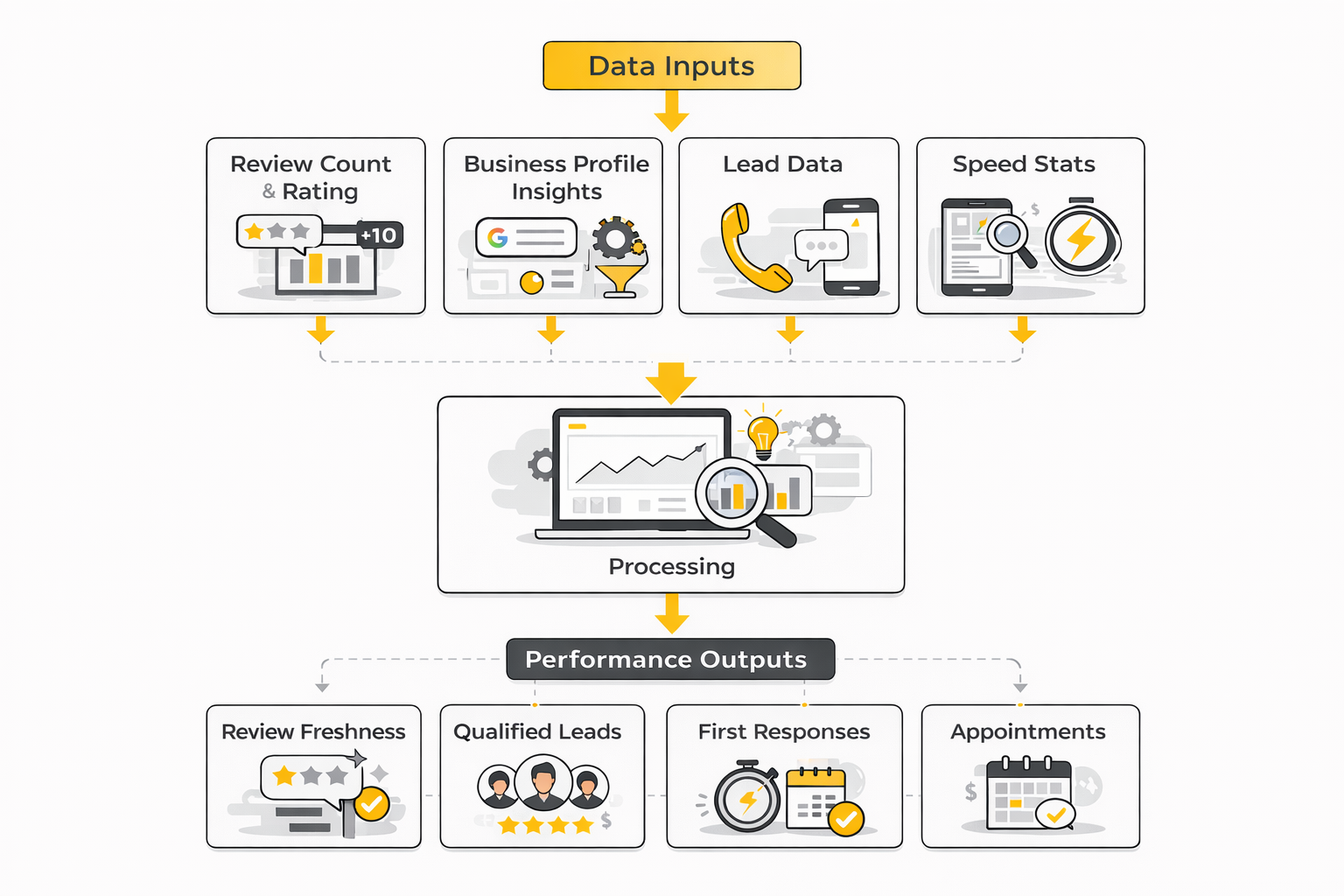
Build One Measurement System Instead of Five Disconnected Dashboards
The clearest analytics setup for a local business is simple: visibility at the top, engagement in the middle, lead quality below that, and revenue at the bottom. In other words, you want to see whether people can find you, whether they act, whether the leads are real, and whether those leads produce profitable work. That sounds obvious, but many agencies still report those layers in separate tools without connecting them.
A better system pulls together Business Profile data, ad-platform conversion data, website behavior, call tracking, CRM status, and close outcomes. If the agency runs automation or lead routing, it should also track first-response timing and appointment progression so you can see whether marketing is creating demand that operations can actually convert. This is where platforms like GoHighLevel, Brevo, or Copper can help if they are used to unify follow-up rather than create more software clutter.
The key is that every layer should answer a different question. Visibility asks whether the market can find you. Engagement asks whether your offer is attractive enough to trigger action. Lead quality asks whether the right people are showing up. Revenue asks whether the whole system deserves more budget or needs intervention first.
Benchmarks Are Useful Only When They Trigger Better Decisions
Benchmarks can be helpful, but only if they are handled carefully. A star rating benchmark can tell you whether your trust signals are competitive. A response-time benchmark can show whether leads are going cold before your team speaks to them. A close-rate benchmark can reveal whether the issue is marketing quality or sales execution.
Where people go wrong is treating benchmarks like universal truths. A med spa, criminal defense firm, HVAC company, and B2B consultancy do not share the same buying behavior, urgency window, or acceptable acquisition cost. So the right question is not “Is this number good in general?” It is “Is this number strong enough for our category, our market, and our margin structure?”
That is also why agencies should resist flooding clients with random industry averages. A benchmark should create a decision. If your review recency is weak, build a review engine. If map visibility is fine but website actions are weak, fix the page. If lead volume is solid but close rates are soft, examine routing, qualification, and follow-up before spending more on traffic.
Speed and Follow-Up Data Often Explain More Than Traffic Data
One of the most useful measurement habits for local businesses is tracking how quickly and how consistently new leads are handled. Google’s own lead-generation materials emphasize a more complex path to conversion, which means by the time someone finally submits a form or calls, they are already deep into evaluation. (support.google.com) Losing that lead because nobody replied quickly enough is a painful and very common failure.
That is why follow-up data deserves a permanent place in agency reporting. Time to first response, missed-call rate, booked-call rate, show rate, and lead-to-opportunity rate often explain performance swings that traffic metrics miss entirely. A campaign can look healthy on the front end while collapsing operationally after the lead arrives.
For a business searching marketing agency near me, this matters because a strong local agency should care about the full journey, not just ad delivery or rankings. If they never ask how fast calls are answered, how form leads are routed, or how many qualified inquiries actually become jobs, they are probably measuring only the part they can control, not the part you actually pay for.
What Good Performance Signals Usually Look Like
Healthy local performance usually has a recognizable pattern. Visibility becomes more stable, review recency improves, interactions rise in the right places, lead quality gets easier to qualify, and reporting starts sounding more confident because the agency can explain cause and effect. You do not need every metric to climb at once, but you do need the story to make operational sense.
The opposite pattern is just as recognizable. Impressions rise, maybe even clicks rise, but reviews stay stale, form quality feels inconsistent, close rates do not improve, and nobody can clearly explain what changed besides “we launched more campaigns.” That is the kind of data story that should make you nervous.
The next step is turning all of this into a decision. Not just how to measure an agency, but how to choose one, onboard one, and avoid the mistakes that make local partnerships expensive before they become useful.
How to Make the Final Choice and Start Strong
By the time you have narrowed down a marketing agency near me, the real question is no longer who looks best on paper. It is who can help you build a system that still works when the easy wins are gone, the market gets noisier, and the business needs more than one channel to keep growing. That is where the final choice gets more strategic.
A lot of agency relationships feel good in month one because everything is new, attention is high, and the first fixes are obvious. The harder test comes later, when local competition increases, ad costs climb, reviews slow down, and the business needs cleaner operations instead of more marketing theater. Recent coverage of BIA’s 2026 forecast points to a larger and more competitive local advertising market, with local ad spend projected to reach $184.5 billion in 2026. That should tell you something important: the agency you choose needs to be able to adapt, not just launch.
Choose the Agency That Understands Constraints
The best local agency is rarely the one promising the biggest upside in the shortest time. It is usually the one that understands what could stop growth before growth starts. That includes capacity limits, close-rate problems, weak follow-up, thin margins, seasonal volatility, and the fact that some channels simply take longer to mature than others.
This matters because local marketing is not just a traffic problem anymore. Google still bases local results on relevance, distance, and prominence, but consumer behavior is getting more fragmented, especially among younger buyers who increasingly move across multiple platforms before deciding who to trust. SOCi’s 2025 consumer behavior work highlighted that kind of platform-hopping in local discovery, which means the agency has to think beyond a single channel if the business wants resilient growth. (soci.ai)
A smart agency should be comfortable talking about those limits. They should be able to say, clearly, what your current demand ceiling looks like, where more spend would start getting inefficient, and what has to improve operationally before scaling makes sense. That kind of honesty is not a nice extra. It is one of the clearest signs you are dealing with adults.
Know the Tradeoff Between Specialization and Breadth
One of the biggest strategic tradeoffs in hiring a nearby agency is deciding whether you need a specialist or a broader operator. A specialist can be excellent when the bottleneck is obvious, like weak map visibility, underperforming paid search, or poor landing page conversion. A broader agency can be better when the business has multiple weak points and needs coordination across SEO, ads, automation, and reporting.
Neither option is automatically right. The mistake is hiring breadth when you need depth or hiring depth when the real problem is fragmentation. If your business already gets attention but loses leads in handoff and follow-up, a narrowly SEO-focused firm may improve rankings without fixing revenue. If your local visibility is weak and your market is crowded, a broad agency that treats local SEO like a side task may never solve the core issue.
That is why the final choice should come back to the bottleneck. The agency should not just describe what they sell. They should describe what they believe is constraining growth right now, why they believe it, and what will happen if that issue is left alone for another six months.
Watch for the Scaling Problems That Show Up After Early Wins
Early wins are often the most misleading part of local marketing. A cleaned-up Business Profile, better landing page, tighter call routing, or sharper ad structure can create visible improvements fairly quickly. Then the business assumes the system is solved, when in reality it has only become functional enough to expose the next constraint.
That next constraint is often one of four things. Lead quality gets less predictable as spend expands. Close rates weaken because the sales process has not matured with volume. Review recency fades because nobody built a repeatable customer feedback loop. Or reporting becomes harder to trust because more channels create more attribution noise.
BrightLocal’s 2026 findings on review recency are a good example of why this matters. If 74% of consumers mainly care about reviews from the last three months, then a business cannot treat review momentum as a one-time project. The same goes for paid efficiency, local visibility, and follow-up speed. Growth systems decay when they are not actively maintained.
Protect Yourself From Platform Dependence
A lot of local businesses quietly become dependent on one platform without realizing how exposed that makes them. Sometimes it is Google Maps. Sometimes it is paid search. Sometimes it is one social platform or one referral source. That can work for a while, but it creates fragility the moment costs rise, rankings shift, or consumer attention moves somewhere else.
This is another reason the phrase marketing agency near me should be interpreted more carefully. You are not just hiring local hands. You are hiring a team to reduce business risk while growing demand. That means building some balance across discoverability, conversion, retention, and reputation instead of putting the entire growth model on one algorithm.
A competent agency should actively manage that risk. They should help the business protect owned assets, keep access to ad accounts and CRM data, and make sure lead capture does not disappear the moment one channel gets more expensive or less predictable. If they are building dependency on their tools without clear ownership and portability, that is not strategy. That is lock-in.
Make Sure the Tech Stack Serves the Process
Software can make a good agency better, but it will not save a weak one. Local businesses often get sold a stack that sounds modern yet creates more dashboards, more alerts, more automations, and less clarity. The right question is not which platform is trendy. It is whether the tech stack makes lead handling, reporting, and campaign iteration easier.
That is where practical tools can help when they are matched to a clear process. A nearby agency might run follow-up and pipeline management through GoHighLevel, use ManyChat for conversational lead capture, or coordinate scheduling through Cal.com. Those tools can genuinely reduce friction when the business already knows how leads should move.
But this is where you need discipline. If the agency cannot explain why each tool exists, who owns the data, and what happens if you leave, the stack is probably serving the agency more than the client. Good implementation feels cleaner over time, not more complicated.
Judge the Agency by How It Handles Uncertainty
Every local market has uncertainty built into it. Search behavior shifts. Competitors improve. Review patterns change. Consumer journeys get messier. Even Google’s own ad and lead-generation guidance reflects a world where buyers move across several digital touchpoints before taking action. (support.google.com) That means no serious agency can promise a straight-line path.
What they can do is show you how they think when the first plan stops working perfectly. Do they diagnose before reacting? Do they explain tradeoffs calmly? Do they tighten targeting when lead quality drops? Do they push back when the business is trying to scale before operations are ready? Those are the behaviors that matter once the honeymoon period ends.
This is the part many owners miss during selection. They judge the agency by certainty instead of judgment. In reality, judgment is the far more valuable trait. The right partner will not always have perfect answers on day one, but they will have a better process for adapting when reality gets messy.
The Best Choice Is Usually the Clearest One
By this stage, the decision should feel less emotional than it did at the start. You are not choosing who had the best deck, the nicest website, or the most impressive vocabulary. You are choosing the team that most clearly understands your local demand, your operational limits, your economics, and the next few moves that actually matter.
That clarity usually shows up in simple ways. They can define success without jargon. They can explain risk without panic. They can tell you what they would do first, what they would ignore for now, and how they will know whether the work is improving the business. That kind of clarity is rare, and it is usually worth more than a lower monthly fee.
The final part brings everything together with the practical questions business owners still ask after all the strategy talk is done. That includes when to hire, when to wait, what to ask on sales calls, and how to avoid choosing the wrong agency for reasons that feel smart in the moment.
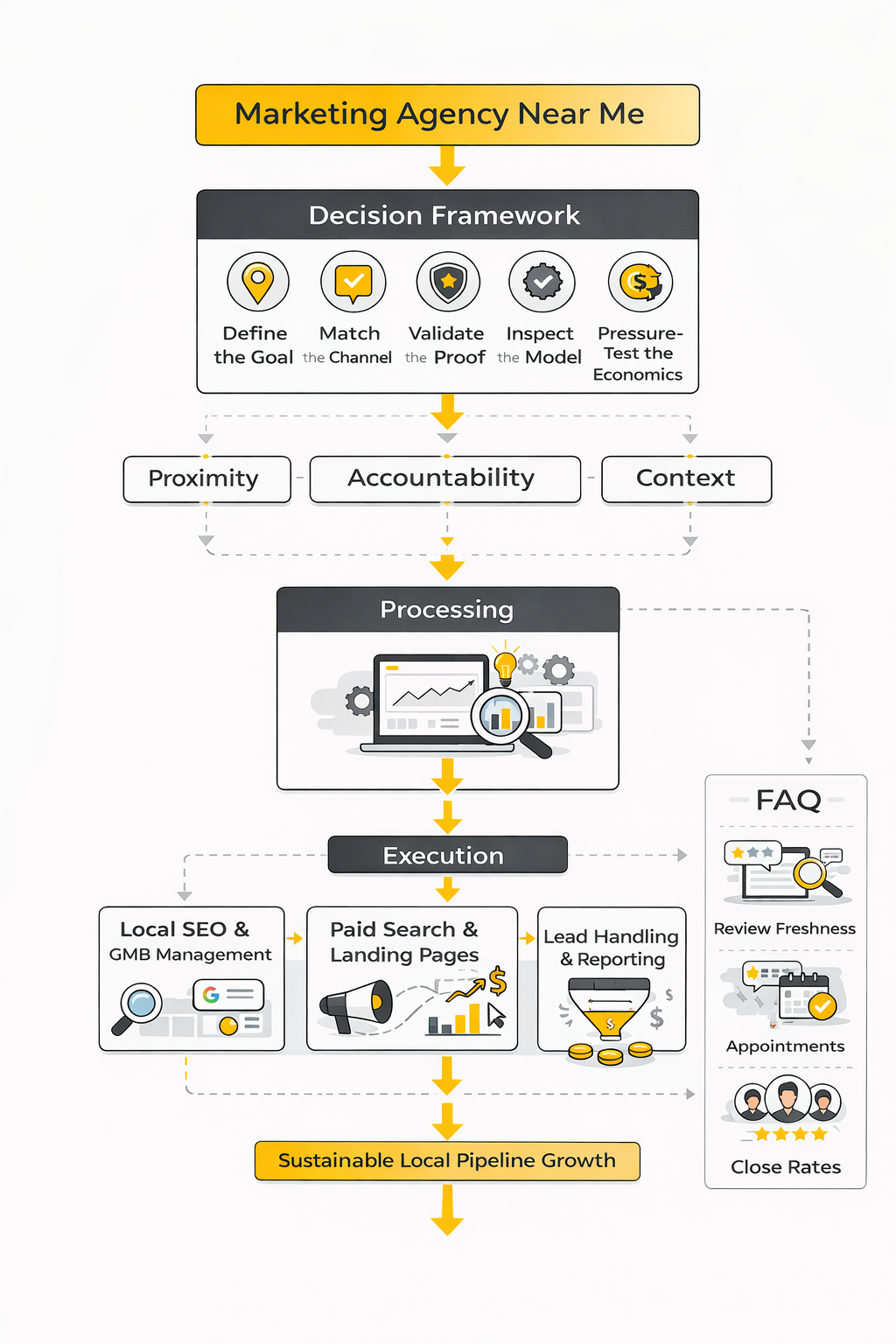
FAQ
How do I know whether I really need a marketing agency near me?
You usually need a local agency when your business depends on local discovery, local trust, and fast lead response. That is especially true if customers are finding you through Google Search, Maps, reviews, and service-area comparisons instead of through national brand awareness. Google still frames local ranking around relevance, distance, and prominence, which means local context is not a minor detail. It is part of how demand gets distributed.
Is a nearby agency always better than a remote one?
No. A nearby agency is better only when it combines local market understanding with strong execution. Geography helps, but it does not fix weak strategy, bad reporting, or sloppy follow-up.
What you really want is a team that understands your service area, your competitive set, and the way local buyers make decisions. If a remote specialist can do that better than a local generalist, the remote team may still be the stronger choice. The point of searching marketing agency near me is not just proximity. It is practical fit.
What should I ask on the first call?
Start with questions that expose thinking, not charisma. Ask what they believe your biggest growth constraint is, what they would audit first, what early signals they watch in the first 30 to 90 days, and what would make them advise against scaling budget too quickly.
You should also ask who owns the accounts, who owns the creative assets, who owns the CRM data, and how reporting will connect visibility to actual sales outcomes. Those questions cut through polished sales language very quickly. If the answers feel vague, that tells you something useful immediately.
How long should I expect before results show up?
That depends on the channel and on how broken the current system is. Review generation, response-time improvements, call routing, and landing-page fixes can create earlier gains. Local SEO usually needs more time, especially in competitive markets, because you are building trust and relevance signals rather than flipping a switch.
The bigger point is that progress should still be visible before final outcomes arrive. A good agency should show movement in the right leading indicators early, then connect those to stronger commercial results over time. If nothing is changing anywhere, patience is not the issue.
Which metrics matter most when comparing agencies?
The best metrics are the ones that explain business movement, not just platform movement. Review recency, Business Profile interactions, qualified lead volume, time to first response, booked appointments, and close rates tend to tell a much more useful story than impressions alone.
That matters because consumers increasingly care about fresh trust signals, and BrightLocal’s latest survey found that 74% focus on reviews from the last three months. In other words, some of the most important local metrics are not glamorous, but they are commercially powerful.
Should my agency handle reviews too, or just traffic?
For most local businesses, reviews are part of growth, not a side task. They influence whether people trust the business after they discover it, and that trust affects click-through, contact behavior, and final selection.
This has become even more important as review expectations rise. BrightLocal’s recent consumer data shows people care not only about star rating but also about volume and freshness, so an agency that ignores review systems is ignoring a meaningful part of conversion.
What is the biggest red flag in an agency proposal?
One of the biggest red flags is a proposal that promises activity without explaining prioritization. If the agency gives you a long service menu but cannot say what gets fixed first, what gets ignored for now, and what signals would cause them to change course, the plan is probably decorative rather than strategic.
Another major red flag is measurement that stops at traffic or clicks. A business does not hire a local agency to buy motion. It hires one to improve visibility, trust, lead quality, and revenue. If the proposal does not connect those pieces, it is incomplete.
Can one agency manage SEO, ads, CRM, and automation well?
Sometimes yes, but only if the agency has a disciplined operating model. The problem is not breadth by itself. The problem is fake breadth, where a firm sells several services but only truly excels at one of them.
That is why you should test how they think about sequencing. A strong agency knows when to tighten local SEO, when to use paid search for faster demand capture, and when the bigger win sits inside response handling or nurture workflows. Breadth is useful only when it leads to better coordination.
Why do some agencies produce more leads but not more revenue?
Because lead volume and lead value are not the same thing. An agency can widen targeting, loosen keyword intent, or push more top-of-funnel traffic and create the appearance of progress while qualified demand barely improves.
There is also the operational side. Google’s own lead-generation guidance points to a buying journey that often spans 5.5 online touchpoints before someone even submits a form, which means by the time a lead appears, a lot of trust-building has already happened. If the handoff is slow or messy, revenue can stall even while inquiry volume rises.
When should I stop working with an agency?
You should think seriously about leaving when the agency cannot explain results honestly, avoids operational accountability, or keeps repeating the same activity without clearer insight month after month. Every campaign has fluctuations, but confusion should not become the permanent reporting style.
You should also be cautious when the agency becomes the sole owner of your critical assets or makes it difficult to understand what happens if the relationship ends. A good partner should increase your control and clarity over time, not reduce it.
How important is local behavior data for younger audiences?
It matters more than many traditional agencies realize. Local discovery is increasingly fragmented, especially for younger consumers who move across search, maps, social platforms, and review environments before making a choice.
SOCi’s 2025 consumer behavior research highlighted this platform-hopping pattern clearly. That means a local agency now has to think beyond one channel and understand how trust gets assembled across multiple touchpoints, not just how to rank for one keyword.
Should I hire an agency before fixing my internal sales process?
You can, but you should do it with your eyes open. Marketing can increase opportunity, but it cannot magically repair a broken handoff, poor qualification, slow response, or inconsistent closing process.
In many cases, the right agency will help expose those weaknesses faster, which is useful. But if your business is missing calls, delaying responses, or failing to track outcomes, more traffic may just make the underlying problem more expensive.
What is the smartest final test before signing?
Ask the agency to explain your business back to you in simple language. Not their service list, not their credentials, and not their process diagram. Your business. Your demand. Your likely bottleneck. Your next three priorities. Your biggest risks.
The best agencies usually pass that test cleanly. They sound clear, grounded, and practical. The weaker ones hide behind jargon, generic ambition, or long-winded confidence. When you hear the difference, it is obvious.
Work With Professionals
Explore 10K+ Remote Marketing Contracts on MarkeWork.com
Most marketers spend too much time chasing clients, competing on crowded platforms, and losing a percentage of every project to middlemen.
MarkeWork gives you a better way. Browse thousands of remote marketing contracts and connect directly with companies desperate to hire skilled marketers like you, without platform commissions and without unnecessary gatekeepers.
If you're serious about finding better opportunities and keeping 100% of what you earn, explore available contracts and create a profile for free at MarkeWork.com.