

A marketing agency used to be easy to describe. You hired a team, they ran ads, designed campaigns, maybe handled your website, and sent a monthly report. That picture is outdated now. The modern marketing agency sits at the intersection of strategy, channel execution, analytics, creative production, automation, and customer experience, which is exactly why the category feels both more valuable and more confusing than ever.
That confusion is happening at the worst possible time for businesses that need growth. Marketing budgets have been under pressure, with Gartner reporting that budgets fell to 7.7% of company revenue in 2024, while digital channels now account for 61.1% of total marketing spend. In plain English, companies are being asked to do more with tighter budgets inside a more fragmented, more technical, and more measurable environment.
That is a big reason the right marketing agency still matters. The best agencies do not just “post on social” or “run Google Ads.” They help a business decide where growth will actually come from, what systems are missing, which channels deserve investment, and how to turn messy marketing activity into something that compounds.
Article Outline
This article is built as one complete guide in six parts, moving from definition to execution. The goal is not to glorify agencies or pretend every business needs one. The goal is to show what a marketing agency should do when it is worth paying for, how the model works today, and how to tell the difference between real capability and polished sales talk.
- What a Marketing Agency Actually Does
- Why a Marketing Agency Still Matters
- The Modern Agency Framework
- Core Services That Drive Results
- How Professional Implementation Works
- How to Choose the Right Agency and Measure Success
Why a Marketing Agency Still Matters
Most businesses do not struggle because they lack marketing ideas. They struggle because execution gets scattered across too many tools, too many channels, and too many disconnected specialists. A founder hires a freelancer for paid ads, an internal marketer for email, a designer for assets, an SEO contractor for blog posts, and suddenly nobody owns the full growth system.
That problem gets sharper as customer expectations rise. Salesforce’s latest State of Marketing report, based on nearly 4,500 marketing leaders, found that 83% of marketers see a shift toward personalized, two-way messaging, yet only one in four are satisfied with how they use data to power those moments. A good marketing agency matters because it can connect strategy, data, creative, and channel management instead of letting each function run in its own silo.
The rise of AI has not made agencies irrelevant either. It has raised the standard. HubSpot found that 65% of marketing leaders planned to increase investment in AI and automation during 2025, which means businesses now need partners who can use AI to speed up research, content operations, testing, and reporting without turning the brand into generic sludge.
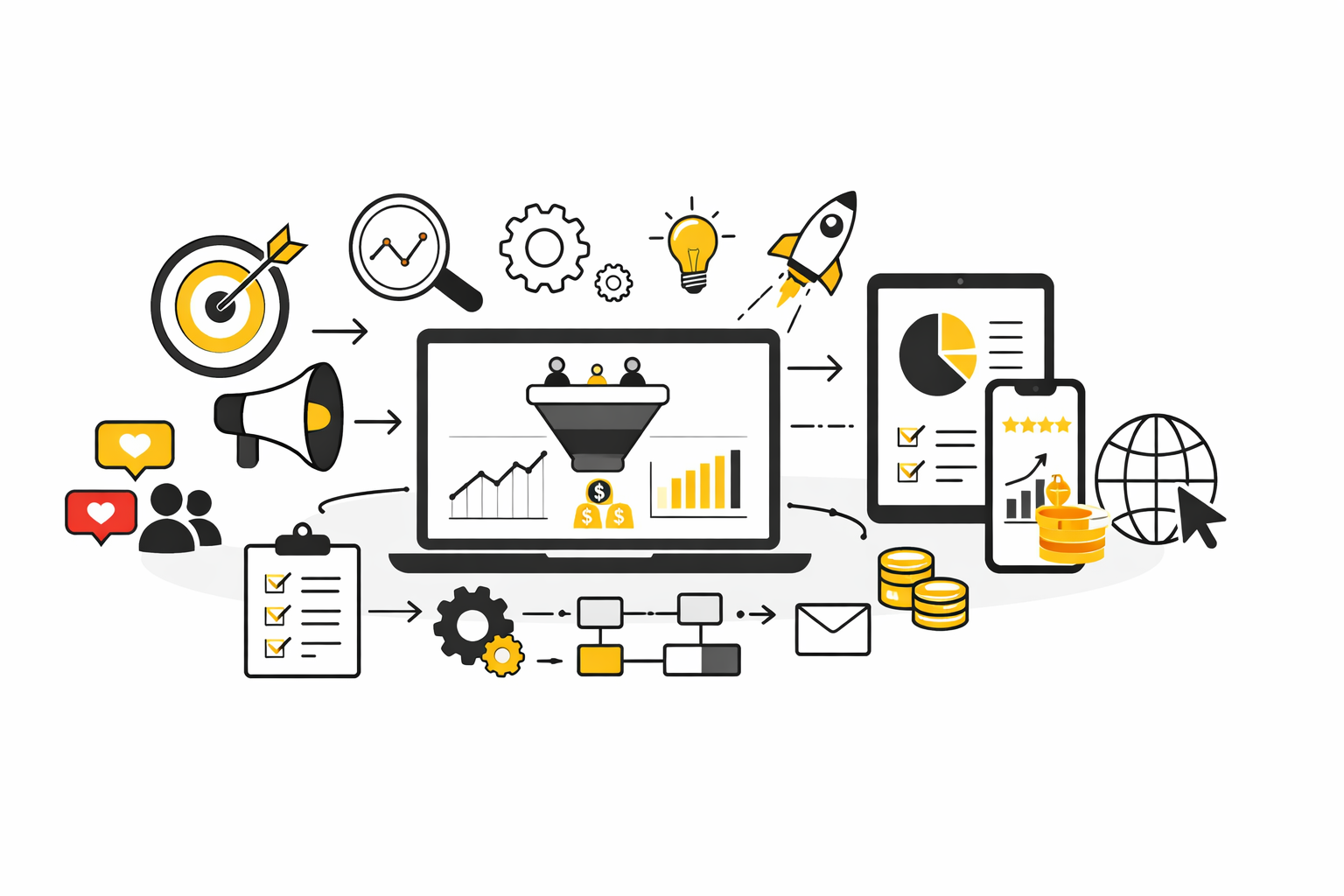
This is the real shift: businesses are not just buying labor anymore. They are buying clarity, coordination, and leverage. When a marketing agency is doing its job, it reduces decision fatigue, shortens the path from strategy to launch, and gives leadership a cleaner line of sight into what is driving pipeline, revenue, or qualified demand.
The Modern Agency Framework
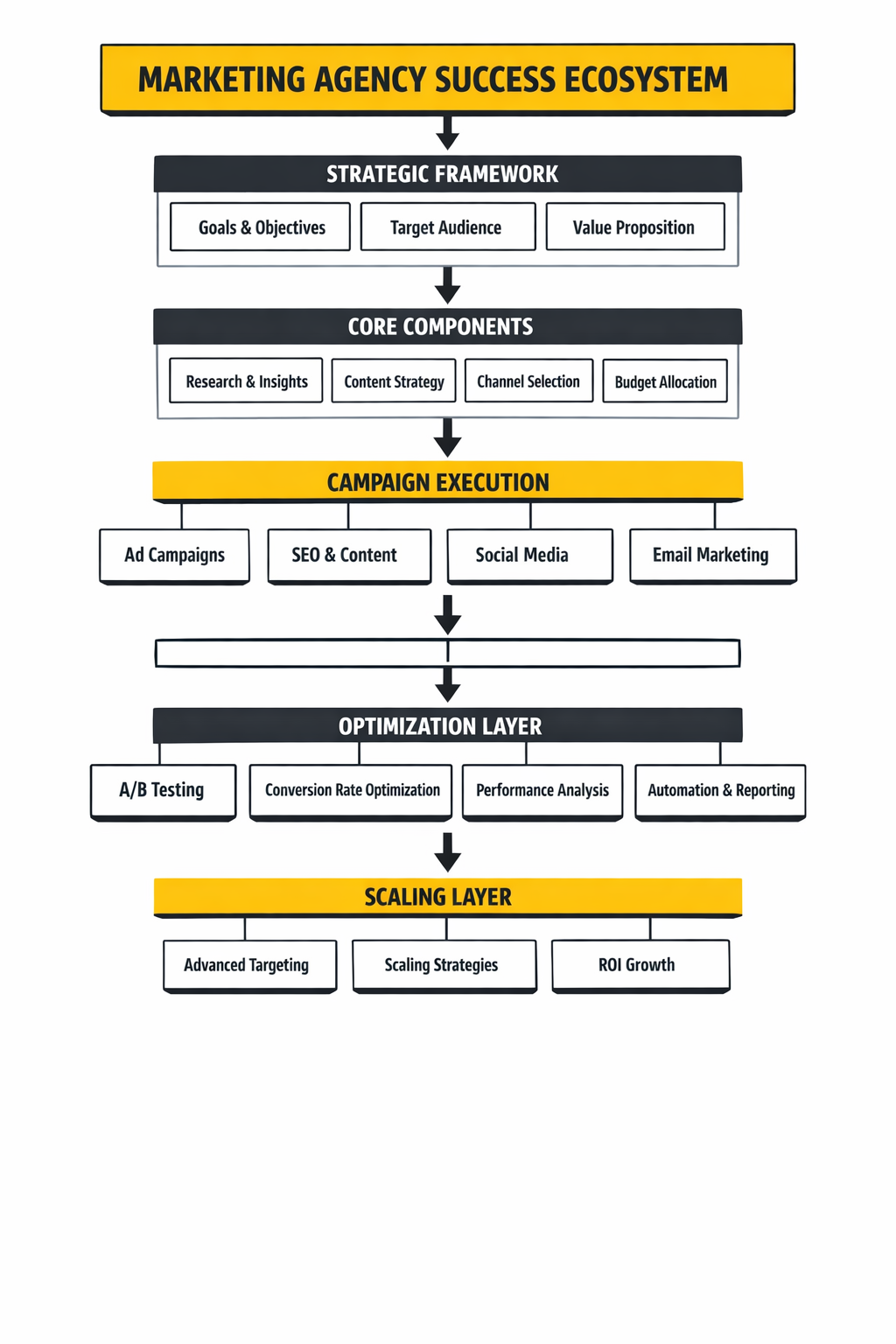
The easiest way to understand a modern marketing agency is to stop thinking about it as a vendor and start thinking about it as a growth operating system. The strongest agencies combine four things: diagnosis, strategy, execution, and optimization. If one of those pieces is weak, the entire engagement usually turns into noise.
Diagnosis comes first because no serious agency should start with tactics before it understands the business model, margins, sales cycle, offer strength, funnel leaks, historical performance, and competitive position. Strategy comes next, where priorities get narrowed and translated into channel choices, messaging angles, audience segments, and measurable goals. Execution is the visible part clients notice, but it only works when it is built on the first two layers.
McKinsey’s work on the next frontier of personalized marketing makes this point well: better results come from aligning people, processes, and platforms, not from adding more disconnected tools. That is the framework smart agencies use now. They are not winning because they have a secret ad trick. They are winning because they create a system where research, creative, campaigns, analytics, and iteration reinforce each other.
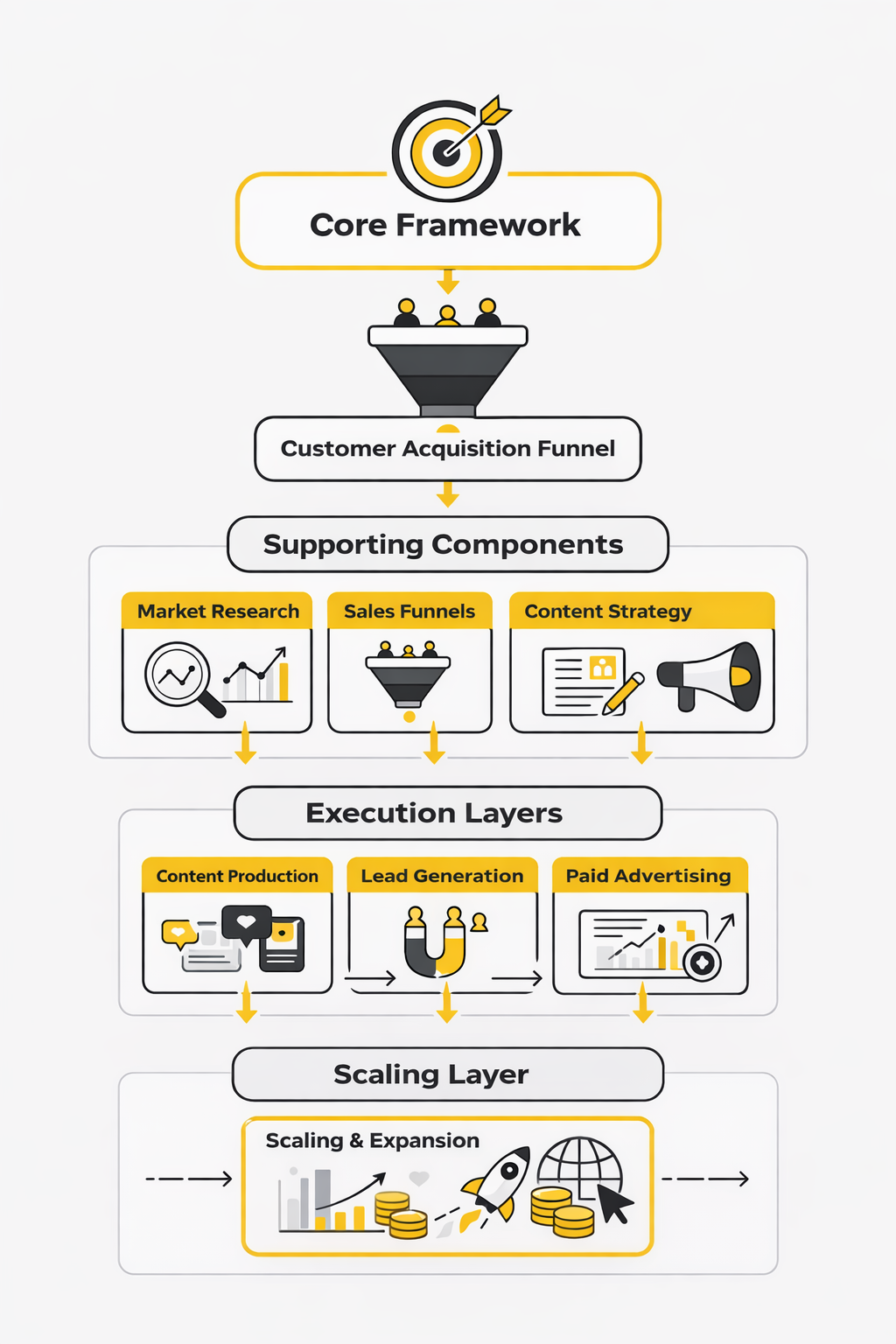
This is also why agency selection has become harder. Plenty of firms can sell a channel. Far fewer can build a framework that survives changing algorithms, privacy rules, rising acquisition costs, and the new reality that search advertising benchmarks now vary across a dataset of 16,446 campaigns analyzed by WordStream, making lazy “best practices” much less useful than disciplined testing. The modern agency framework is not about doing everything. It is about knowing what matters most, in what order, and why.
What a Marketing Agency Actually Does
A marketing agency is supposed to do far more than ship tasks. At its best, it helps a business make smarter growth decisions, turn those decisions into campaigns, and then measure whether the work is producing qualified leads, sales, retention, or stronger brand demand. That sounds obvious, but in practice a lot of companies still hire a marketing agency for output when what they actually need is direction.
The real job starts with diagnosis. A serious agency looks at the offer, the market, the pricing logic, the sales process, existing traffic sources, conversion bottlenecks, CRM setup, attribution gaps, and content performance before it recommends anything. That approach matters because channel tactics behave very differently depending on the business model, and even strong execution can fail when the underlying offer or funnel is weak. Salesforce+2
From there, the agency turns business goals into an operating plan. That usually means deciding what the company is optimizing for first, which audiences matter most, what message should lead, which channels deserve budget, what assets need to be built, and how performance will be reviewed. Without that layer, marketing becomes a pile of disconnected activity that feels busy but does not compound.
This is also why businesses get disappointed when they hire the wrong partner. Some firms sell production dressed up as strategy, so the client receives content calendars, ad variations, and reporting dashboards without ever getting a clear answer to the only question that matters: what is the path to profitable growth? A good marketing agency keeps that question in the center of every recommendation.
Strategy Comes Before Channels
One of the biggest misconceptions in the market is that agencies are channel specialists first. In reality, the strongest ones are prioritization specialists. They know that an SEO-heavy plan, a paid acquisition plan, a lifecycle email plan, or a social-led content plan can all work, but not equally well for every company at every stage.
That matters more now because the environment is shifting under everyone’s feet. HubSpot’s 2026 marketing statistics page notes that more than 92% of marketers plan to optimize for both traditional and AI-powered search, while nearly 30% reported lower search traffic as users increasingly get answers directly from AI tools. In other words, choosing channels is no longer about following a default playbook. It is about matching the right system to the right business. HubSpot+1
A competent agency should be able to explain why a channel belongs in the plan, what role it plays, what timeline to expect, and how it connects to the rest of the funnel. If it cannot do that, the business is not buying expertise. It is buying motion.
Execution Is Only Valuable When It Is Coordinated
Execution still matters, obviously. Campaigns have to launch, landing pages need to convert, emails need to go out, reports need to be read, and creative has to be produced on time. But execution without coordination is where a lot of engagements quietly break down.
This is the hidden reason many companies feel like they are “doing marketing” without seeing enough business impact. Paid media may be driving traffic to weak pages, email may be talking to the wrong segments, content may target keywords that never move prospects forward, and sales may not be following up quickly enough on inbound demand. The problem is not effort. The problem is orchestration.
That orchestration role is where a good marketing agency earns its keep. It aligns message, media, funnel design, tracking, and follow-up so each piece strengthens the others. When that happens, the business stops relying on random wins and starts building a repeatable system.
Core Services That Drive Results
Not every service offered by a marketing agency carries the same weight. Some services generate attention, some improve conversion, some lift retention, and some simply make the overall machine easier to run. The best agencies know which services belong in the first phase and which ones should wait.
Paid media is usually the fastest lever when a business has a proven offer and clean unit economics. Search ads capture active demand, paid social can generate new demand, and remarketing helps recover interest that would otherwise disappear. But paid acquisition has become less forgiving, which is why expertise matters. WordStream’s 2025 benchmark study pulled data from 16,446 U.S. search campaigns and showed just how widely performance can vary by category, which is a useful reminder that averages are not strategy. WordStream
Content and SEO remain core services, but the job is changing. It is not enough to publish surface-level blog posts and hope traffic arrives. Strong agencies now build content around search intent, authority, distribution, conversion paths, and increasingly the reality that AI-driven search experiences are reshaping how clicks reach websites in the first place. HubSpot+1
Email and lifecycle marketing are often undervalued, which is a mistake. For many businesses, especially those with longer sales cycles or repeat purchase potential, the money is in follow-up, segmentation, reactivation, and better customer communication. Mailchimp’s current benchmark data shows an average open rate of 35.63% and an average click rate of 2.62% across all users, which gives a useful baseline for judging whether a nurturing system is merely active or actually effective. Mailchimp
Analytics, CRM, and automation are no longer side services either. They are the infrastructure that makes the rest of the work intelligible. When an agency sets up proper lead routing, event tracking, pipeline visibility, and campaign reporting, leadership can finally see what marketing is contributing instead of arguing about guesses.
Paid Media Should Be Connected to Economics
A lot of businesses think paid ads are about creative angles and bid strategies. Those matter, but they are not the foundation. The foundation is whether customer acquisition cost, close rate, retention, margin, and payback period make the campaign commercially viable.
That is why the best marketing agency teams talk about economics early. They want to know how much a lead is worth, how fast sales responds, what percentage of demo requests close, and whether the company can tolerate an aggressive learning phase. Without those numbers, even polished paid campaigns are built on sand.
This is also where landing page and funnel work becomes part of the same service, not a separate add-on. Driving more traffic into a weak conversion path is one of the most expensive ways to waste budget. For businesses that need to move faster with page testing or campaign funnels, tools such as ClickFunnels or Systeme.io can make implementation easier, but the tool still comes second to the offer, message, and economics.
Content Works Best When It Supports Demand, Not Just Traffic
Content marketing is still one of the most durable agency services because it compounds. A strong article, case study, webinar, comparison page, or email series can keep creating value long after launch. But compounding only happens when the content strategy serves the buyer journey instead of treating publishing volume as the goal.
That is why current content data matters. Content Marketing Institute’s 2025 B2B research found that 61% of B2B marketers expected investment in video to increase, while 52% expected more investment in thought leadership and 40% in paid advertising. That mix tells you something important: content is not living on its own anymore. It is being integrated with authority building, distribution, and performance channels. Content Marketing Institute
A smart marketing agency builds content with a job in mind. Some assets are meant to attract discovery, some to educate mid-funnel buyers, some to handle objections, and some to help sales close faster. When content has that level of purpose, it becomes a revenue asset instead of a publishing routine.
Email, Social, and Automation Are Multipliers
Email is one of the few channels a business truly controls. Social reach can collapse, search can change overnight, ad costs can spike, but a healthy permission-based email list remains an owned asset. That is one reason lifecycle marketing keeps outperforming its reputation.
Social media plays a different role. It helps with attention, trust signals, distribution, community contact, and increasingly top-of-funnel discovery. HubSpot’s 2025 social media marketing report surveyed more than 1,100 global marketers, which reinforces how much effort is still flowing into social as both a content distribution engine and a brand-building layer. blog.hubspot.com
Automation multiplies both channels when it is used well. Instead of sending everyone the same message, a marketing agency can trigger onboarding sequences, abandoned-form reminders, nurture campaigns, lead scoring workflows, internal notifications, and re-engagement paths based on real behavior. Platforms such as Brevo, Moosend, and Buffer can support that work, but only when the underlying segmentation and messaging logic are sound.
CRM and Reporting Separate Real Agencies From Content Factories
This part is less glamorous, but it is where a lot of value lives. When a marketing agency owns reporting discipline, it helps the client stop confusing activity metrics with business metrics. Traffic, reach, and impressions have their place, but they are not enough on their own.
The more useful questions are sharper. Which campaigns are generating qualified pipeline? Which landing pages create the highest-intent leads? Which email sequences move prospects toward a call, a demo, or a purchase? Which content assets assist revenue even when they are not the final touch?
That reporting layer also forces honesty. It reveals whether the agency’s work is improving conversion efficiency, expanding demand, or simply generating prettier dashboards. And that honesty is exactly what makes the next phase matter: professional implementation.
How Professional Implementation Works
This is where a marketing agency proves whether it is actually strategic or just good at pitching. Plenty of firms can talk about growth, brand, funnels, and performance, but professional implementation is where the abstraction disappears and the work becomes operational. The difference is simple: a real agency turns priorities into a system with owners, timelines, assets, tracking, and feedback loops.
That matters because the modern marketing environment is not linear anymore. HubSpot’s Loop Marketing playbook frames execution as a continuous cycle of defining brand identity, tailoring messaging, diversifying channels, and optimizing in real time, which is much closer to how strong agencies actually operate today. Salesforce’s Tenth State of Marketing report points in the same direction, with nearly 4,500 marketers describing a landscape where AI, data, personalization, and ROI pressure are all colliding at once.
A business hiring a marketing agency should expect implementation to feel disciplined, not theatrical. That means fewer vague brainstorms, fewer vanity deliverables, and more clarity around what gets launched first, why it matters, how success will be measured, and what gets adjusted when reality disagrees with the plan. Good implementation feels calm because the chaos has already been handled upstream.
The First Step Is Getting the Foundation Clean
The first stage of implementation is usually less glamorous than clients expect. Before campaigns scale, the agency needs to audit the basics: analytics, pixels, CRM structure, conversion events, forms, attribution logic, email flows, lead routing, and the current state of landing pages. This step is unsexy, but it is where a lot of expensive failure gets prevented.
That foundation matters even more now because data quality keeps showing up as a blocking issue. HubSpot’s marketing automation guide highlights poor data quality as the top challenge marketers face in understanding target audiences, and Salesforce’s 2026 State of Marketing coverage says siloed systems and poor data quality remain the top barriers to AI-driven personalization. If the data is messy, the campaigns may still launch, but the learning gets distorted and optimization slows down.
This is the point where a smart marketing agency earns trust quickly. It does not rush past broken infrastructure just to look busy. It fixes measurement, confirms baselines, cleans segmentation, and makes sure future wins will be visible when they happen.
Then the Agency Builds an Execution Sequence
Once the foundation is stable, implementation shifts into sequencing. Not everything should be launched at once, even if the client wants motion everywhere. A good marketing agency decides what has to happen first, what can run in parallel, and what should wait until more data comes in.
In practical terms, that sequence often starts with the shortest path to signal. That could be a paid acquisition test, a landing page rebuild, a sales-qualified lead campaign, a new nurture flow, or a content cluster aimed at high-intent search demand. The point is not to create activity across every channel. The point is to create the first reliable feedback loop.
This is also why strong agencies push back on random requests. They know scattered launches create noisy data and fragmented accountability. Professional implementation is not about doing more at the same time. It is about creating the right order so each move makes the next one easier.
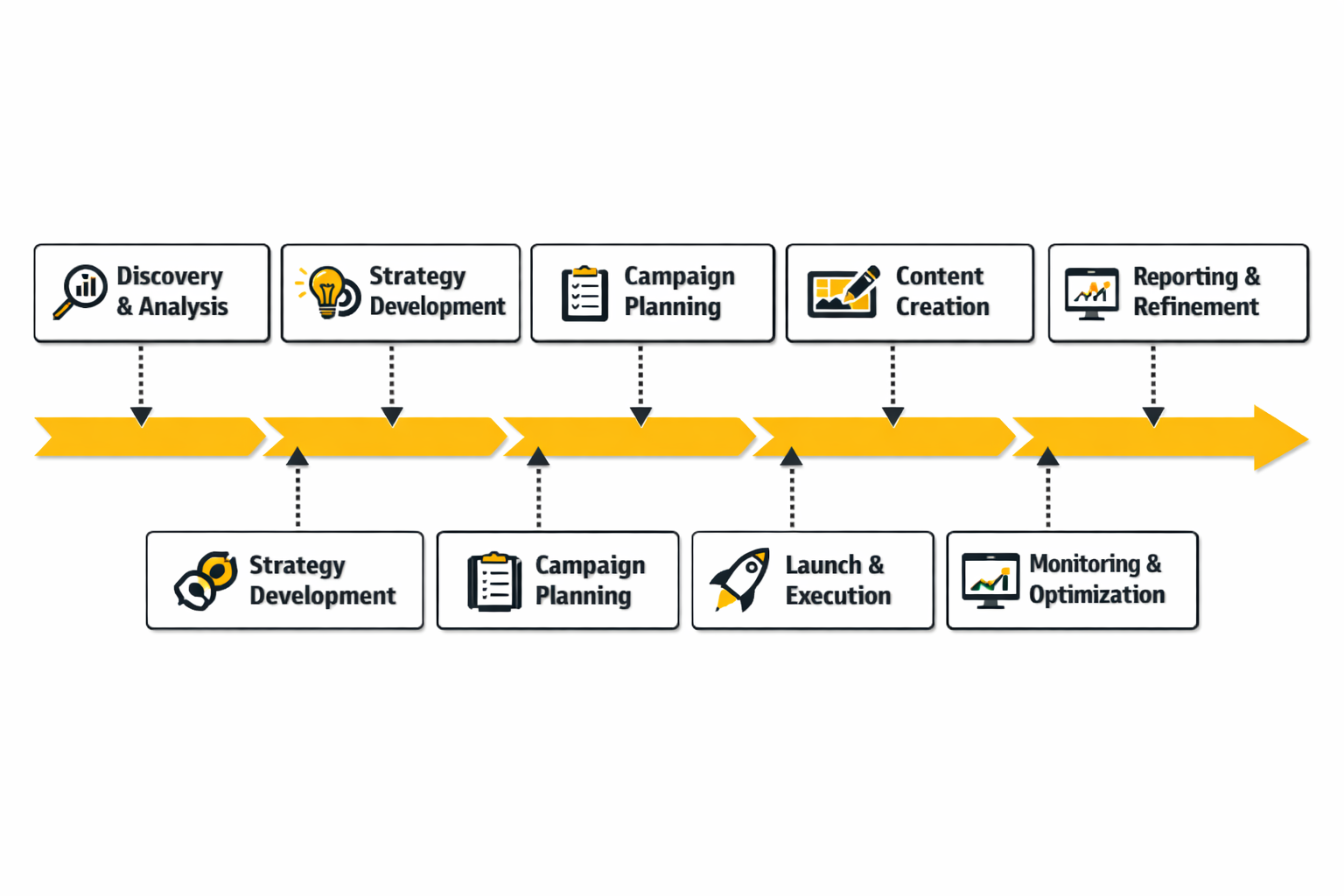
A Strong Process Usually Follows Five Operational Phases
Most good agency execution models look different on the surface, but under the hood they follow a similar process. The names change, the slides look nicer, and the frameworks get branded, but the underlying logic is usually consistent. Once you understand that logic, it becomes much easier to judge whether a marketing agency actually has a process or just a presentation.
- Audit and diagnosis This phase gathers the evidence. The agency reviews existing performance, channel mix, funnel structure, offer-market fit signals, audience data, content assets, CRM workflows, and reporting gaps. The output should be a sharper view of where growth is being lost, not a bloated deck with recycled advice.
- Strategy and prioritization This is where the agency chooses the first battles worth fighting. Messaging gets clarified, audience segments get narrowed, goals get translated into metrics, and the launch order gets defined. Without this phase, implementation turns into a task list detached from business impact.
- Build and launch Now the work becomes tangible. Ads are built, landing pages are designed, forms are connected, automations are configured, creative is produced, content goes live, and dashboards are structured. This phase should move fast, but not recklessly, because broken launches create fake urgency later.
- Measurement and learning The first live data matters because it reveals whether the assumptions were right. A serious marketing agency reads not just top-line performance, but also conversion quality, channel efficiency, response speed, audience behavior, and drop-off points inside the funnel. That is how early campaigns become smarter instead of merely busier.
- Optimization and expansion Once the system starts producing signal, the agency can widen the playbook. Budgets can be reallocated, winning messages can be scaled, automation can be deepened, new content assets can support sales conversations, and additional channels can be tested. This is the phase where growth begins to compound because the business is no longer guessing from zero.
Implementation Fails When Ownership Gets Blurry
A lot of agency relationships do not fail because the tactics were terrible. They fail because ownership was never made explicit. The client assumes the agency owns the funnel, the agency assumes the client owns the internal handoff, sales assumes marketing will fix lead quality, and suddenly everyone has explanations but nobody has control.
That is why the best marketing agency teams make responsibilities painfully clear. They define who approves creative, who updates the CRM, who owns sales follow-up, who reviews weekly reporting, who signs off on offers, and who is responsible for speed when leads come in. It feels overly structured at first, but that structure protects performance later.
This is especially important in multi-channel work. A content team can publish useful assets, a paid media team can drive demand, and an email specialist can build nurture flows, but the full system still breaks if nobody owns the connection points. Professional implementation is really an exercise in eliminating orphaned steps.
Tools Matter, but Only After the Operating Logic Is Clear
A lot of businesses overfocus on platforms during agency selection. They want to know which ad manager, CRM, email system, automation builder, social scheduler, AI assistant, or landing page tool will be used. Those questions are not wrong, but they come second.
The better question is whether the marketing agency has a clear operating logic for the tools it recommends. A funnel builder like ClickFunnels or Systeme.io can speed up landing page deployment. A form tool like Fillout can make lead capture cleaner. A CRM option like Copper can help with pipeline visibility. But none of those tools will rescue a weak offer, a confused message, or a broken follow-up process.
The same is true for automation and AI. Salesforce’s latest marketing research shows that many teams need more personalized content than they can currently produce, while HubSpot’s 2025 AI report shows 65% of marketing leaders planned to increase investment in AI and automation tools. That makes implementation more powerful, but also less forgiving. More tooling without better process just creates faster confusion.
Reporting Should Drive Decisions, Not Decoration
Once campaigns are live, implementation becomes a reporting discipline. This is where weak agencies lean on activity updates and strong agencies focus on decisions. The client does not need a prettier dashboard if nobody knows what action it should trigger.
Useful reporting answers operational questions. Which campaign is producing qualified demand instead of cheap clicks? Which landing page variation is improving form completion without hurting lead quality? Which nurture emails move people closer to a reply, a demo, or a purchase? Where are the delays between acquisition and revenue?
Benchmarks help here, but only when they are used carefully. Mailchimp’s current email benchmark data puts the all-user average open rate at 35.63% and the average click rate at 2.62%, which gives context, not a final verdict. A strong marketing agency uses benchmarks as a reference point, then interprets performance in light of the client’s offer, audience, sales cycle, and economics.
Professional Implementation Feels Repetitive for a Reason
There is a moment in most good engagements when the work starts to look less exciting from the outside. The agency is reviewing data again, refining copy again, adjusting audience filters again, tightening handoffs again, and revisiting reporting again. That is not stagnation. That is what competence looks like.
The best implementation work is repetitive because it is built on iteration. Content Marketing Institute’s 2025 B2B research showed that marketers were increasing investment not just in video and thought leadership, but also in AI for optimization and performance. That shift says a lot. Mature marketing teams are not only producing more assets. They are building better feedback loops around the assets they produce.
A capable marketing agency understands that rhythm. It launches, reads, learns, adjusts, and relaunches without needing to reinvent the strategy every Tuesday. That discipline is what turns implementation from a campaign burst into a growth system.
How to Choose the Right Agency and Measure Success
Once you understand how professional implementation works, the selection question becomes much easier. You are no longer choosing between prettier websites or louder promises. You are choosing between operating systems.
The right marketing agency should be able to explain its process in plain English, tie channel decisions to business economics, define ownership clearly, and show how reporting leads to action. That is the bar. Not charisma, not jargon, not screenshots of impressive dashboards without context. The next step is knowing exactly how to evaluate that bar before you sign anything.
Performance Data That Actually Matters
This is where most marketing conversations go sideways. Data is everywhere, dashboards look impressive, and reports get longer every month, but very little of it translates into better decisions. A marketing agency earns its value here by filtering signal from noise and turning numbers into action.
The key shift is simple: not all metrics deserve equal attention. Some numbers describe activity, some describe efficiency, and a smaller set actually reflects business impact. If those layers are mixed together, the client sees movement without understanding whether anything meaningful is improving.
That is why serious agencies structure measurement around outcomes first, then work backward to supporting indicators. Revenue, pipeline, qualified leads, and conversion rates sit at the top. Traffic, impressions, clicks, and engagement sit underneath as supporting context. When that hierarchy is clear, reporting becomes useful instead of overwhelming.
The Difference Between Vanity Metrics and Decision Metrics
Vanity metrics are not useless, but they are easy to misinterpret. High traffic can feel like growth, but if the visitors are unqualified or not converting, it becomes expensive noise. Strong engagement on social can look like momentum, but if it does not translate into demand or brand lift, it rarely justifies long-term investment.
Decision metrics behave differently. They directly influence what the business does next. If cost per qualified lead drops, budgets can scale. If landing page conversion improves, more traffic can be pushed into the funnel. If close rates increase, acquisition can become more aggressive. These are the numbers that change behavior.
This distinction matters more now because channel complexity has increased. WordStream’s 2025 Google Ads benchmark data shows wide variation in click-through rates and cost per click across industries, which means surface-level comparisons can easily mislead. A marketing agency that leans too heavily on averages risks pushing clients toward the wrong conclusions.
Benchmarks Are Context, Not Targets
Benchmarks are useful, but only when they are interpreted properly. They tell you what is typical, not what is optimal for your business. That difference is where many marketing strategies quietly break.
Email marketing is a good example. Mailchimp’s latest email marketing benchmarks show an average open rate of 35.63% and a click rate of 2.62% across all users. Those numbers can help you spot obvious underperformance, but they do not define success. A high-ticket B2B funnel might work with lower engagement but stronger conversion quality, while an ecommerce brand may need higher volume with faster purchase cycles.
The same applies to conversion rates, cost per acquisition, and return on ad spend. A benchmark gives you a reference point, but the right question is always: is this profitable given our model? That is the filter a good marketing agency applies consistently.
Attribution Is Messy, So Focus on Directional Truth
Attribution has become one of the hardest parts of modern marketing. Privacy changes, multi-device behavior, longer buying cycles, and platform-level data limitations mean no report is perfectly accurate anymore. That is not a reason to ignore data. It is a reason to interpret it differently.
Salesforce’s latest State of Marketing insights highlight how fragmented data and disconnected systems still block clear visibility for many teams. That reality means agencies and clients need to focus on directional truth instead of perfect attribution.
Directional truth answers practical questions. When we increase spend here, does qualified demand go up? When we change messaging, do conversion rates improve? When we introduce a new nurture sequence, does lead quality shift? These patterns matter more than arguing over which channel gets credit for a conversion.
The Analytics System Should Be Simple Enough to Act On
A useful analytics system is not the one with the most charts. It is the one that helps a team decide what to do next without hesitation. That requires structure.
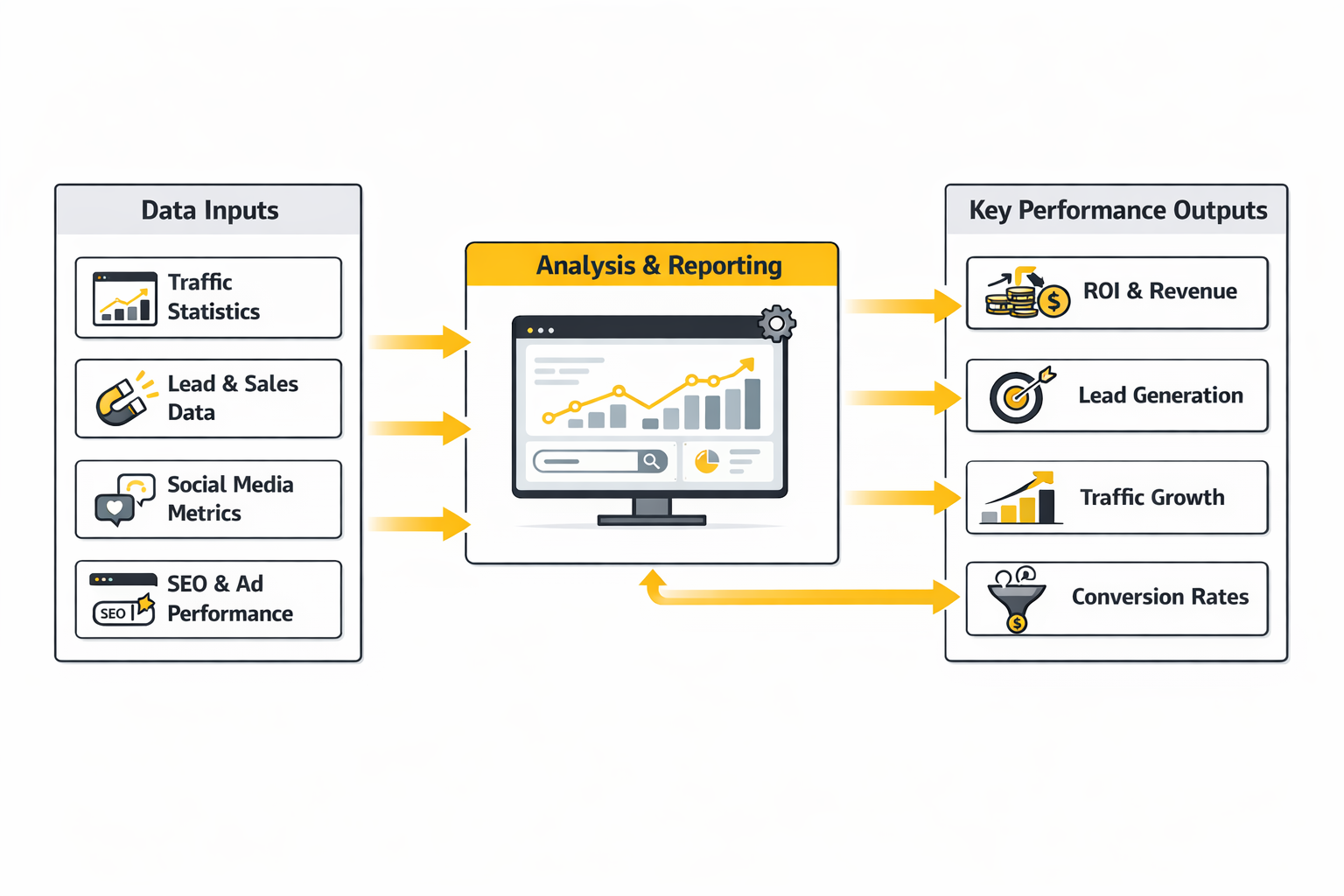
At a minimum, a marketing agency should build reporting around three layers:
- Top-line outcomes Revenue, pipeline value, qualified leads, and close rates. These numbers answer whether marketing is contributing to growth in a meaningful way.
- Funnel performance Landing page conversion rates, cost per lead, lead-to-opportunity ratios, email engagement across stages, and drop-off points. These numbers show where improvement is possible.
- Channel efficiency Cost per click, click-through rates, engagement rates, and reach. These numbers explain how traffic and attention are being generated.
When those layers are connected, the system becomes actionable. If top-line outcomes are weak, you look at funnel performance. If funnel performance is strong but volume is low, you look at channel efficiency. That flow turns reporting into a diagnostic tool instead of a passive update.
Data Should Trigger Specific Actions
Every metric should be tied to a decision. If a number changes and nothing happens, it probably did not matter in the first place. This is where many marketing agency reports fail quietly. They present information without linking it to action.
A better approach looks like this:
- If conversion rates drop, review landing page clarity, offer strength, and audience targeting.
- If cost per acquisition rises, evaluate creative fatigue, bidding strategy, and channel mix.
- If lead quality declines, tighten targeting, adjust messaging, or improve qualification steps.
- If engagement improves but revenue does not, look at handoff between marketing and sales.
This is not complicated, but it requires discipline. A marketing agency that builds these feedback loops into its reporting creates momentum. One that does not leaves the client guessing.
AI Is Changing Measurement, But Not the Fundamentals
AI is making reporting faster, more predictive, and easier to automate, but it is not replacing the need for clear thinking. HubSpot’s 2025 AI report shows that 65% of marketing leaders are increasing investment in AI and automation, which means more data will be processed and surfaced automatically.
That creates a new problem. When insights become easier to generate, it becomes easier to drown in them. The role of a marketing agency shifts from producing reports to interpreting them. The agency needs to decide which signals matter, which patterns are meaningful, and which changes deserve action.
In other words, the fundamentals stay the same. Good measurement still depends on clear goals, clean data, structured reporting, and disciplined decision-making. AI just increases the speed at which those systems operate.
Strong Data Discipline Builds Long-Term Advantage
This is the part most businesses underestimate. Better measurement does not just improve current campaigns. It compounds over time. Each iteration becomes smarter, each test becomes more informed, and each investment decision becomes less risky.
That is why the best marketing agency relationships feel like they get more efficient over time. Early work may focus on fixing fundamentals and building initial momentum. Later work benefits from accumulated insight, stronger data, and clearer patterns.
At that point, marketing stops feeling like a cost center that needs constant justification. It starts behaving like an investment system that can be scaled with confidence.
How to Choose the Right Agency and Measure Success
Choosing a marketing agency gets easier once you stop asking who looks the most impressive and start asking who fits the actual job. A startup trying to validate an offer has different needs from a mid-market company trying to scale paid acquisition, and both are different from an established brand trying to fix measurement, retention, and operational drag. The right partner is not the one with the broadest service menu. It is the one whose operating model matches the stage, economics, and internal capabilities of the business.
That matters because the pressure on marketing teams is not going away. Gartner’s 2025 CMO Spend Survey shows budgets holding at 7.7% of company revenue, while Gartner’s 2025 digital spend update shows digital channels now taking 61.1% of total marketing spend. That combination creates a familiar problem: more channels, more pressure, and less room for wasted motion.
A good marketing agency should reduce that pressure, not add to it. If the engagement introduces more complexity than clarity, the fit is wrong no matter how polished the proposal looks. That is the standard worth using.
The Best Agency Model Depends on Business Stage
Early-stage companies often need strategic compression more than scale. They need help narrowing the audience, tightening the offer, building a usable funnel, and proving that one or two channels can produce real demand. Hiring a giant full-service marketing agency at that stage often creates overhead before there is enough signal to justify it.
Growth-stage companies usually face a different wall. They already know the offer has traction, but performance stalls because messaging drifts, attribution gets messy, handoffs break, or the internal team cannot keep up with content, paid media, landing page testing, and automation all at once. This is where a marketing agency can be most valuable, because the main job is no longer invention. It is coordinated scale.
More mature businesses often need a sharper kind of help. They may already have in-house marketers, external freelancers, and a crowded tech stack, but results plateau because the system has become fragmented. Gartner’s 2025 marketing technology research says martech utilization sits at 49%, which is better than older lows but still means roughly half the stack is not being fully used. In that environment, the right agency is often the one that simplifies, integrates, and prioritizes rather than adding more tools and more noise.
In-House, Agency, or Hybrid Is a Real Strategic Tradeoff
A lot of businesses frame this as a binary choice, but that is usually too simplistic. The smarter question is which capabilities should live in-house, which should be outsourced, and which need shared ownership. Brand voice, customer insight, internal sales alignment, and executive priorities are usually strongest inside the company. Deep channel execution, specialist testing, and cross-client pattern recognition often sit more naturally inside a strong marketing agency.
This balance is becoming more important as AI changes production economics. Forrester’s 2025 marketing agency predictions note that AI-powered content production is slowing the push toward full in-housing, with agencies often moving faster than internal teams in applying generative AI to execution. The useful takeaway is not that agencies are automatically better. It is that specialization now compounds faster when the workflows, prompts, quality control, and channel experience already exist.
For many companies, the best answer is hybrid. Internal teams own positioning, approvals, customer context, and cross-functional coordination. The marketing agency owns specialized execution, testing velocity, reporting structure, and performance optimization. That model works well because it keeps strategic truth close to the business while still giving the company access to broader execution depth.
The Biggest Risks in Agency Relationships Usually Show Up Early
Most bad agency engagements do not collapse because of one dramatic mistake. They erode through smaller signals that clients ignore at the start. The agency talks in outputs instead of outcomes, avoids hard questions about economics, gives vague reporting, overpromises speed, or says yes to every channel before proving the first one works.
Another common risk is structural mismatch. A business with a long sales cycle and complex buying committee hires a marketing agency built for ecommerce velocity. Or a founder-led company hires a corporate-style agency that needs six layers of approval before anything ships. The issue is not competence in the abstract. It is the lack of fit between the agency’s operating rhythm and the company’s reality.
There is also a newer risk now: tool theater. Teams buy into AI workflows, automation layers, content systems, and reporting platforms because the setup looks advanced. But when the operating logic is weak, the technology just scales confusion. HubSpot’s 2025 AI report shows that 65% of marketing leaders planned to increase investment in AI and automation, which makes disciplined adoption even more important. More capability without stronger process is not leverage. It is clutter at speed.
A Good Agency Should Be Able to Explain Its Tradeoffs
One underrated sign of agency quality is whether the team can explain what it is not doing yet. Any competent marketing agency should be able to say why paid search comes before SEO in one case, why lifecycle email matters before more traffic in another, or why the website does not need a full redesign before funnel fixes are tested. That kind of restraint is usually a better sign than enthusiasm.
Tradeoffs also show up in budget allocation. If a company has weak conversion infrastructure, scaling media spend may be the wrong move even if traffic acquisition looks attractive. If the sales team is slow to respond, generating more leads can actually make performance worse. If the brand lacks clear differentiation, more content volume may just produce more interchangeable noise.
This is where agency selection becomes less about charm and more about judgment. The right marketing agency does not pretend every business needs the same mix of ads, content, automation, and creative production. It shows that it understands sequencing, constraint, and commercial reality.
Scaling Breaks Systems That Were Never Built Properly
A lot of businesses think they have a growth problem when they really have an infrastructure problem. Things look stable at low volume because manual work, founder involvement, and heroic effort are quietly holding the system together. Then demand increases and the cracks become obvious. Lead routing slows down, reporting gets messy, creative production bottlenecks, attribution becomes unreliable, and sales starts complaining about quality.
That is why scale should be treated as an operational test, not just a budget increase. Salesforce’s Tenth State of Marketing report centers many of the same pressures modern teams keep running into: personalization demands, data fragmentation, and the need to use AI without losing control of quality or consistency. When a marketing agency helps a business scale well, it is usually because the agency fixed the underlying operating system before trying to force more volume through it.
This is also where the practical stack matters. Not because tools are magical, but because clean systems reduce friction. A faster funnel build in ClickFunnels, simpler automation in Brevo, or cleaner form capture in Fillout can help a business move faster once the strategic logic is sound. But the order matters. Process first, then tooling.
Success Should Be Measured in Compounding Improvement
The healthiest way to judge a marketing agency is not by asking whether every campaign wins immediately. That is fantasy. The better question is whether the business is getting clearer, faster, and more efficient over time. Are the offers sharper? Are the reports more useful? Is lead quality improving? Are decisions getting easier because the system is generating better signal?
Compounding improvement is the real sign that the relationship is working. Content Marketing Institute’s 2025 B2B trends research showed rising investment in video, thought leadership, paid distribution, and AI for optimization. That mix reflects a broader truth: mature marketing systems do not rely on one tactic. They improve by coordinating multiple levers and learning faster than they did before.
That is why success should be evaluated across time horizons. In the short term, you want cleaner implementation, clearer reporting, and faster iteration. In the medium term, you want stronger conversion efficiency, better lead quality, and more reliable pipeline contribution. In the longer term, you want the business to become less dependent on random wins and more capable of generating repeatable growth on purpose.
What Great Agency Relationships Eventually Feel Like
The best agency relationships become less dramatic over time. There is less panic, less chasing, less debate over what the numbers mean, and less wasted effort. Work still gets hard, but the system becomes more predictable. That is a big deal.
A strong marketing agency should eventually feel like an extension of the company’s growth function, not an external machine spraying deliverables into Slack. It should understand the business model, know where the friction lives, push back when needed, and help leadership make sharper decisions with less guesswork.
That is the point where the relationship stops being about outsourced execution. It becomes an advantage. And that is exactly where the final part belongs: the common questions, the practical objections, and the decisions businesses still need to make before choosing their next move.
FAQ - Built for Complete Guide
What does a marketing agency actually cost?
Pricing varies widely depending on scope, specialization, and stage. Small engagements can start in the low thousands per month, while more advanced growth partnerships often reach five figures monthly. The real question is not cost alone, but whether the agency is improving revenue efficiency, reducing wasted spend, and building a system that compounds.
How long does it take to see results from a marketing agency?
Some signals appear quickly, especially in paid acquisition or funnel optimization. But meaningful business impact usually takes time because it depends on testing, iteration, and alignment across channels. In most cases, you should expect early indicators within 30–60 days and clearer performance patterns within 90–120 days.
Should I hire a marketing agency or build an in-house team?
It depends on what you need right now. If you lack strategic clarity and execution capacity, a marketing agency can accelerate progress quickly. If you already have a strong internal system, hiring in-house may give you more control. Many companies land on a hybrid model where strategy and coordination stay internal while execution and optimization are supported externally.
What are the biggest red flags when choosing a marketing agency?
The most common warning signs include vague strategy, overpromising timelines, focusing on outputs instead of outcomes, and avoiding discussions about economics. If an agency cannot clearly explain how it drives qualified demand or revenue, it is unlikely to deliver meaningful results.
How do I know if my marketing agency is performing well?
Look beyond activity and focus on progression. Are leads becoming more qualified? Is cost per acquisition improving? Are conversion rates increasing? Is reporting getting clearer over time? A strong marketing agency creates momentum, not just movement.
Do marketing agencies guarantee results?
Serious agencies do not guarantee results because too many variables sit outside their control, including offer quality, pricing, competition, and internal sales performance. What they can guarantee is process discipline, testing velocity, and clear reporting that shows what is working and what needs adjustment.
Which services should I prioritize first?
That depends on your current bottleneck. If you lack traffic, focus on acquisition channels like paid media or SEO. If you have traffic but low conversions, focus on landing pages and messaging. If you generate leads but struggle to close, improve follow-up systems and sales alignment. A good marketing agency will help identify that constraint early.
Can a marketing agency help with automation and AI?
Yes, but only if it understands how to integrate those tools into a working system. AI can speed up research, content production, and analysis, but it does not replace strategy. The value comes from combining automation with clear messaging, structured funnels, and disciplined testing.
What tools should a marketing agency use?
There is no single correct stack. The right tools depend on the business model and workflow. Funnel builders like ClickFunnels, email platforms like Brevo, and automation systems like Systeme.io can all be useful, but only when the underlying strategy is clear.
How important is communication in an agency relationship?
It is critical. Even strong execution can fail if communication breaks down. You should expect regular updates, clear reporting, and direct conversations about what is working and what is not. A marketing agency should feel like a partner in decision-making, not just a vendor delivering tasks.
What is the biggest mistake businesses make with marketing agencies?
The biggest mistake is expecting the agency to fix everything without internal alignment. If the offer is weak, the sales process is slow, or decision-making is inconsistent, even the best agency will struggle. Growth is always a shared responsibility.
When should I stop working with a marketing agency?
If there is no measurable progress, no clarity in reporting, and no improvement in decision-making over time, it is a strong signal the relationship is not working. The same applies if the agency resists accountability or cannot explain its own process. Ending the engagement is often the right move in those cases.
Work With Professionals
Explore 10K+ Remote Marketing Contracts on MarkeWork.com
Most marketers spend too much time chasing clients, competing on crowded platforms, and losing a percentage of every project to middlemen.
MarkeWork gives you a better way. Browse thousands of remote marketing contracts and connect directly with companies desperate to hire skilled marketers like you, without platform commissions and without unnecessary gatekeepers.
If you're serious about finding better opportunities and keeping 100% of what you earn, explore available contracts and create a profile for free at MarkeWork.com.