

Marketing and advertising are two of the most talked‑about concepts in business today, yet they’re often misunderstood or used interchangeably. In practice they serve distinct but deeply interconnected functions that drive how brands connect with audiences and grow over time. At its core, marketing is the broad, strategic discipline that defines why, who, and how a business delivers value, while advertising is a tactical execution focused on paid promotion to attract attention and drive action within that strategy.
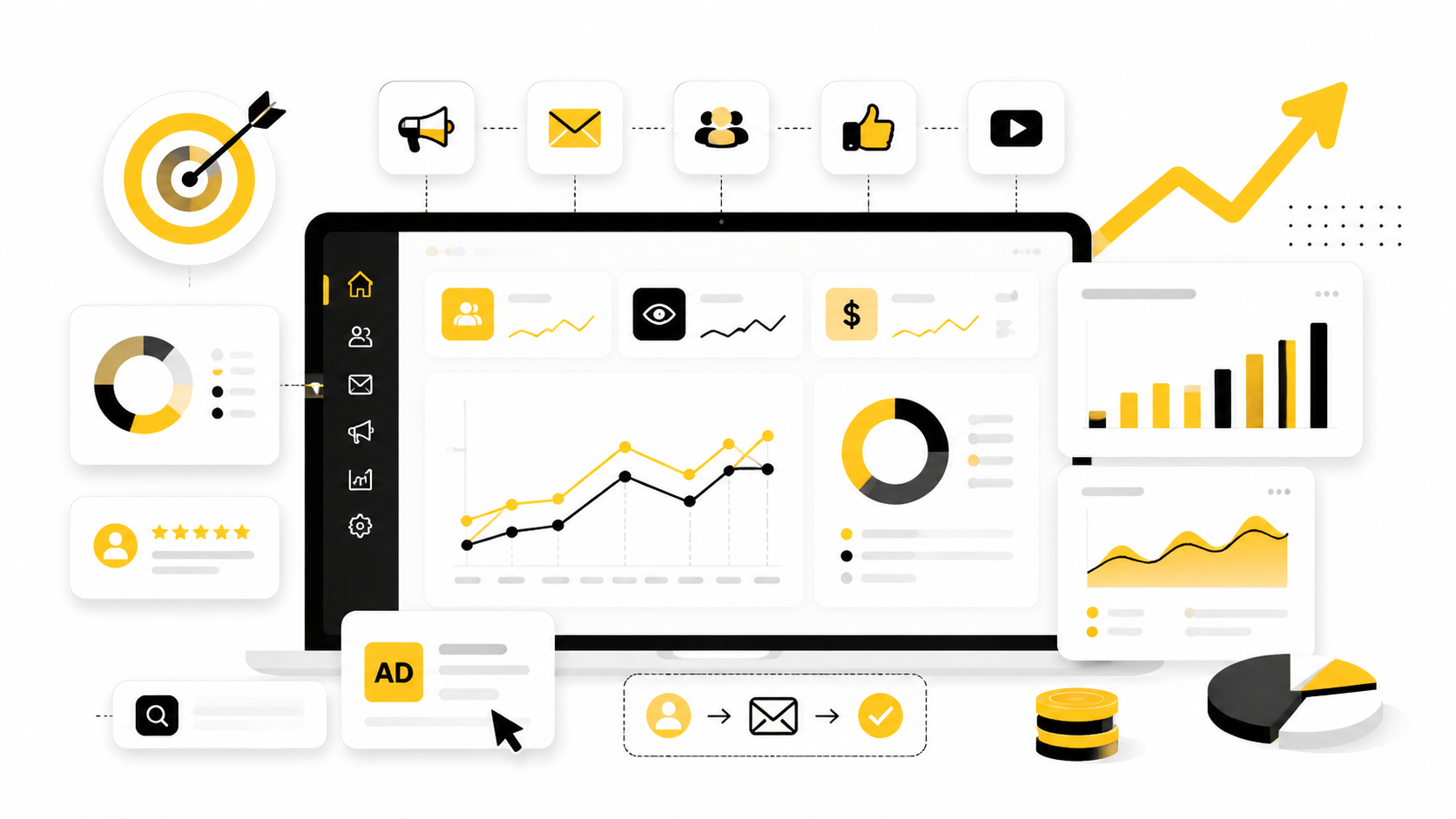
Below is an outline of the full article you’ll read in six parts:
- Why Marketing and Advertising Matter
- Framework for Marketing and Advertising
- Core Components of Effective Marketing
- How Advertising Fits Within Marketing
- Professional Implementation Strategies
- Future Trends and Integration Insights
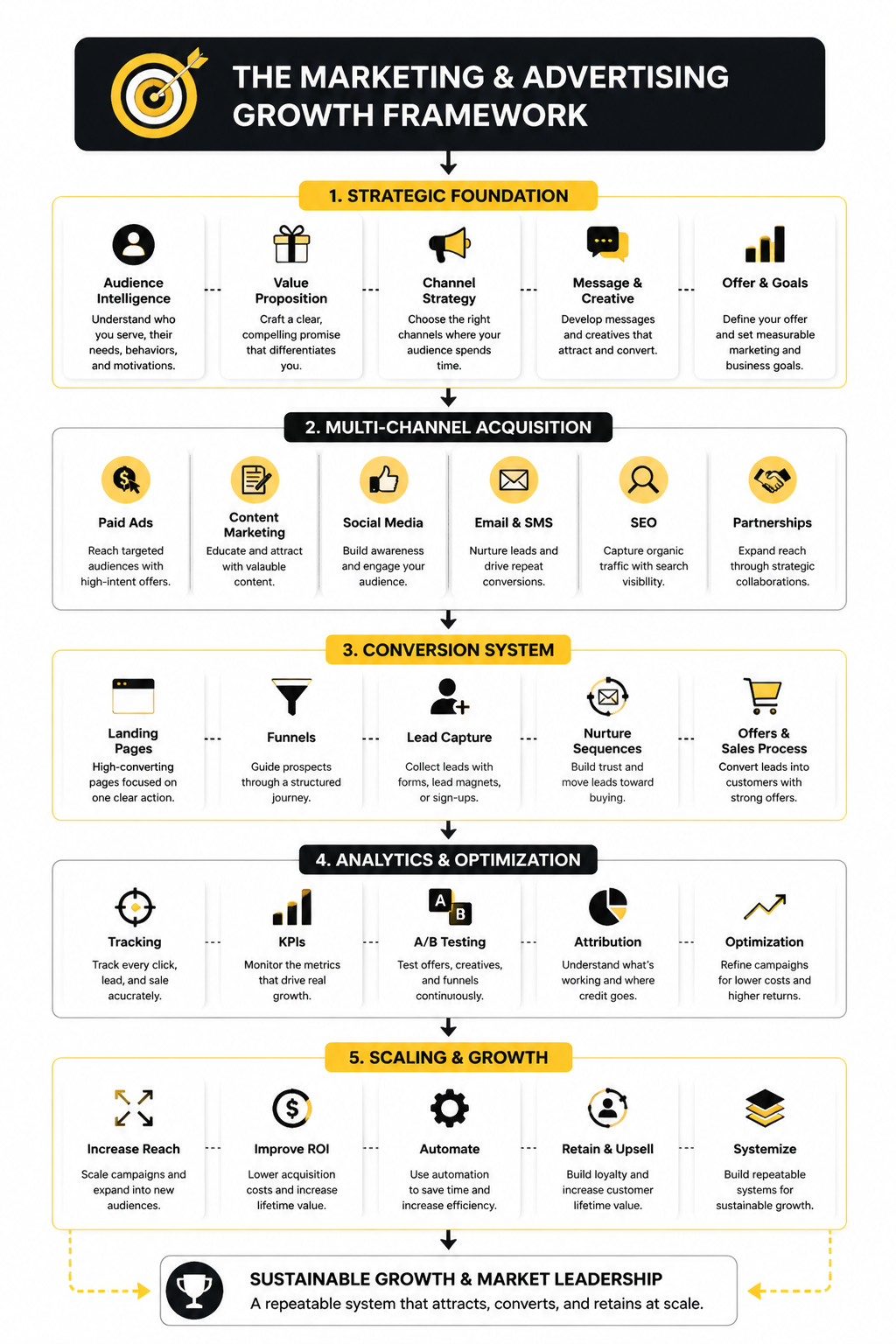
This article will help you understand not just what these disciplines are, but how they function together in strategic business growth — from foundational planning to real‑world execution.
In the next section, we’ll explore why marketing and advertising continue to be essential in today’s competitive, digitally driven economy.
Why Marketing and Advertising Matter
To grasp the value of marketing and advertising, you need to see how they drive real business outcomes in today’s competitive landscape. At its essence, marketing helps businesses understand customer needs, build value, and position offerings so they resonate with target audiences. Without that foundation, even innovative products risk obscurity because potential customers simply don’t know they exist or why they should care. Effective marketing builds awareness, shapes perception, and ultimately drives revenue growth over time.
Marketing doesn’t stop at visibility. It informs how a brand communicates with its audience, how it differentiates from competitors, and how it sustains relationships long after a purchase. When companies invest strategically in marketing, they often see stronger brand loyalty and increased customer lifetime value — key drivers of long‑term business success.
Advertising complements marketing by delivering those strategic messages directly to audiences across channels. It’s the tactical force that brings marketing plans to life, from digital ads and search campaigns to broadcast spots and influencer partnerships. Advertising amplifies awareness, encourages trial, and accelerates sales in ways that purely organic outreach can’t always achieve.
In fact, globally, marketing and advertising spending continues to expand as companies recognize their importance in capturing audience attention. Between 2021 and 2025, worldwide marketing expenditures grew significantly, reflecting rising investment in brand building and customer engagement.
Instead of being optional expenses, both marketing and advertising have become central to how modern businesses survive and thrive. When done right, they make your products discoverable, your value understandable, and your customer relationships sustainable. Professional strategies in these areas are not just beneficial — they are essential business infrastructure.
Core Components of Effective Marketing Implementation
Implementing marketing and advertising isn’t just about having good ideas — it’s about turning strategy into coordinated, measurable action. This stage is where plans either thrive or fall flat because execution demands clarity, alignment, and accountability. A solid implementation process ensures every activity maps directly back to your strategic goals and is tracked for performance.
Establish Clear, Achievable Goals
At the heart of implementation is clarity on what success looks like. Early steps should define specific and measurable targets — such as increasing web traffic, generating leads, or improving conversion rates — and assign timeframes for each. Like any disciplined approach, using a framework such as SMART (Specific, Measurable, Achievable, Relevant, Time‑bound) helps teams stay focused and avoids vague ambitions.
Goals that are too broad or unrealistic make it difficult to allocate budget, choose the right channels, or measure success, so start here before moving into tactical planning.
Align Resources and Roles
Once goals are defined, implementation requires matching resources to responsibilities. This includes people, tools, and budgets. Identify who owns each part of the plan — from content creators and designers to campaign analysts and ad buyers — and ensure everyone understands how their work contributes to shared objectives. Clear ownership prevents bottlenecks and improves accountability.
Similarly, ensure you’ve provisioned the right tools: project management platforms, analytics suites, advertising dashboards, and creative production systems. These aren’t optional — they underpin communication and measurement throughout execution.
Build a Tactical Timeline
With goals and teams in place, it’s time to sequence the specific tasks that make your strategy real. This means crafting a detailed timeline that outlines:
- What needs to be done
- Who does it
- When it must be complete
- Which resources are required
By structuring work into tangible steps with deadlines, you reduce confusion and streamline execution. Using workflows and checklists helps teams stay organized and replicable across campaigns.
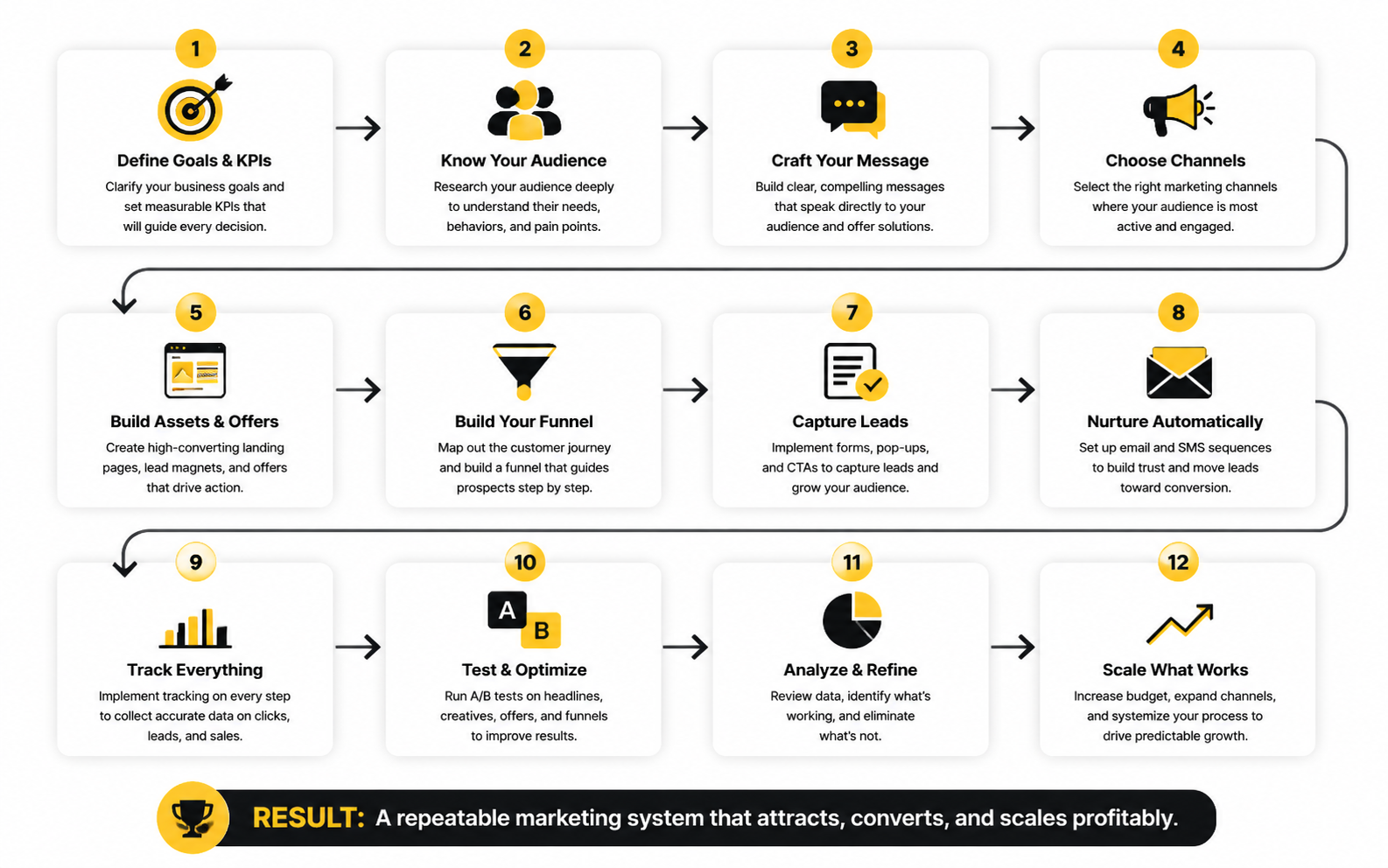
Step‑by‑Step Marketing and Advertising Execution
Bringing marketing and advertising plans to life happens in stages. Below is a practical workflow that teams can follow to structure and measure execution effectively:
- Kick‑Off and Onboarding
Before any work begins, align all stakeholders — internal teams, agencies, and partners — around objectives, budget, and timelines. This shared understanding reduces miscommunication later.
- Content and Creative Development
Whether you’re launching paid ads, email sequences, or organic content, develop creative work that reflects your brand positioning and resonates with your audience. Creative assets should be tested early with internal reviews to catch issues before they go live.
- Channel‑Specific Setup
Set up each advertising and distribution channel according to best practices. For digital ads, configure targeting, bidding strategies, and tracking pixels; for email and social channels, ensure segmentation and scheduling are aligned with your plan.
- Launch and Monitor
Deploy your campaigns and begin collecting performance data. Early monitoring — ideally daily or weekly — lets you spot issues quickly, such as low engagement or high cost per action.
- Measure, Report, and Optimize
Compare results against your predefined metrics. Use dashboards and regular reporting to surface insights. When data shows opportunities to improve — e.g., underperforming channels or creative variants — adjust tactics appropriately.
- Iterate and Improve
Marketing and advertising are iterative. The best teams build learning loops into their processes so that each campaign informs the next, driving stronger performance over time.
This structured approach turns strategy into predictable execution, allowing teams to deliver measurable results rather than vague outcomes. Effective implementation is the bridge between planning and growth — and mastering it is what separates successful campaigns from those that underperform.
Measuring and Interpreting Data in Marketing and Advertising
In modern marketing and advertising, data isn’t optional — it’s the compass that tells you whether your efforts are on course or off track. Without solid measurement, even the best‑crafted campaigns can become guesswork, leading to wasted budget and missed opportunities. The real power of analytics lies in connecting measurable outcomes to business goals and using that insight to make better decisions.
Why Metrics Matter
Measuring campaign performance gives you actionable insight rather than abstract numbers. For example, tracking how many impressions your ads receive shows reach, but that’s only part of the story. Metrics like conversion rate, customer acquisition cost (CAC), and return on investment (ROI) actually show whether your campaigns are driving value in revenue and growth. High‑level executives, marketing leaders, and analysts use this information to justify budgets and calibrate strategies across channels.
Measurement also puts a spotlight on efficiency. With marketing budgets often representing a significant share of company revenue, understanding how well each dollar performs lets teams cut waste and invest in what truly delivers results. Choosing the right metrics avoids the common pitfall of focusing on vanity numbers that don’t drive decisions.
Key Performance Indicators You Should Track
Business and Revenue‑Focused Metrics
These are the metrics most directly tied to financial outcomes and strategic value:
- Return on Investment (ROI): Compares net revenue from marketing campaigns to their cost. A positive ROI means your marketing and advertising return more than you invest.
- Return on Ad Spend (ROAS): Focuses specifically on revenue generated per dollar spent on advertising. For many businesses, ROAS in the range of 4–7x is seen as strong performance.
- Customer Acquisition Cost (CAC): Measures how much it costs to acquire a new customer. When CAC is low relative to customer value, growth becomes sustainable.
- Customer Lifetime Value (CLV): Estimates total revenue from a customer over their relationship with your brand. Tracking CLV against CAC helps guide long‑term investment.
These metrics turn campaign activity into real business consequences — they tell you whether your teams are driving profitable growth or just generating activity without impact.
Channel and Engagement Indicators
Understanding behavior and engagement adds nuance beyond pure profitability:
- Click‑Through Rate (CTR): Percentage of people who clicked on an ad after seeing it — a quick read on message relevance.
- Conversion Rate: Tracks how many site visitors or ad responders complete a desired action, such as purchasing or filling a lead form.
- Cost per Lead (CPL) and Cost per Acquisition (CPA): Help you assess cost efficiency at the top and bottom of the funnel.
- Engagement Metrics: Likes, shares, and comments on content can indicate resonance, but should always be paired with conversion metrics for real meaning.
While reach and impressions matter for awareness, they shouldn’t be interpreted in isolation. A high number of impressions can hide poor engagement or weak conversion if you’re not correlating them with deeper performance signals.
From Data to Action
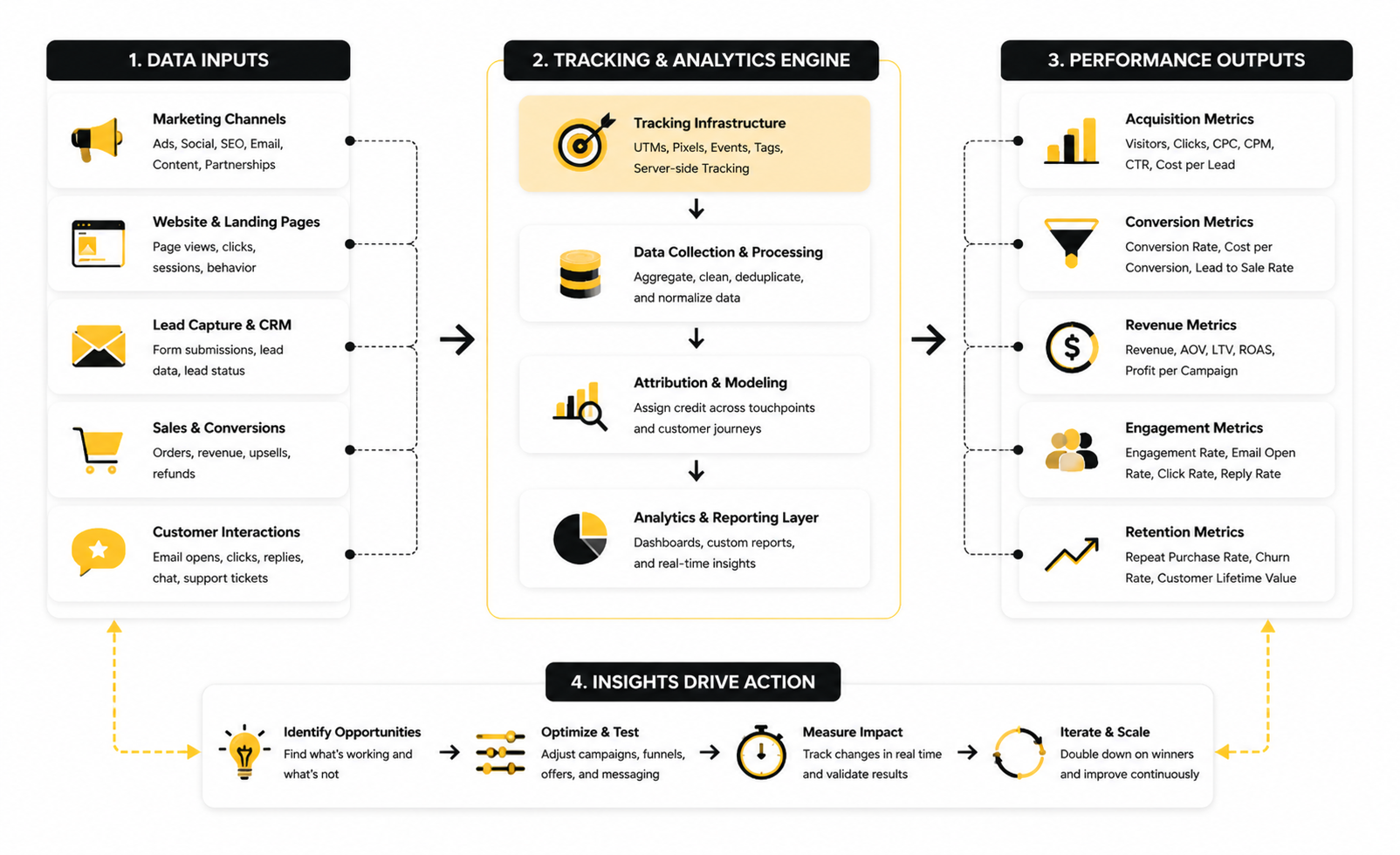
The heart of analytics is not collecting data — it’s interpreting it to make decisions. A few practical steps:
- Define what success means before gathering data.
Different campaigns have different goals, so selecting relevant KPIs is crucial. For example, a brand‑awareness initiative might emphasize reach and impressions, while response campaigns should focus on conversion and CAC.
- Correlate metrics across systems.
Pull data from ads platforms, web analytics, and CRM together — siloed numbers can be misleading. Unified dashboards help teams see how front‑end engagement maps to back‑end revenue.
- Benchmark against industry standards.
Conversion and CAC benchmarks vary by sector, so compare your performance to relevant industry data to understand where you stand. Aim to outperform common thresholds for metrics like CTR and conversion rates.
- Use insights to optimize.
If ROI and CAC are below targets, adjust audience targeting, creative messaging, or even the product offer. Iterative analysis and testing help campaigns improve over time.
By focusing on the right metrics — ones tied to business value rather than superficial counts — marketing and advertising teams can prove their impact and steer strategy with confidence.
Advanced Considerations in Marketing and Advertising
At this stage in your marketing and advertising journey, it’s vital to move beyond basic implementation and measurement into strategic depth. When you’re ready to scale, optimize, or reframe your efforts, the decisions you make carry amplified impact — both upside and risk. Growth at scale isn’t just about spending more on campaigns; it’s about understanding trade‑offs, anticipating challenges, and building resilient processes that keep performance predictable and sustainable. Research and industry discussions highlight that scaling and strategy are complex phenomena with no single “silver bullet,” requiring thoughtful trade‑offs and adaptive leadership.
Strategic Trade‑offs and Scaling Risks
When scaling marketing and advertising, leaders must make difficult trade‑offs between speed and stability, breadth and depth, or experimentation and consistency. For instance, rapidly increasing ad spend without a clear framework for measurement and learning can destroy performance efficiency because platforms often reset optimization phases when budgets change too fast. This reduces machine‑learning effectiveness and drives up acquisition costs as algorithms struggle to stabilize.
Other common pitfalls include:
- Audience and content fatigue: Overexposure to the same audiences or creatives leads to diminishing engagement and rising costs, making it essential to refresh ads and expand audiences thoughtfully.
- Budget inefficiencies: Scaling without data on which channels deliver true incremental value — beyond simple last‑click attributions — can waste corporate resources. Deep analytics and holdout testing help isolate genuinely incremental lift.
- Team and infrastructure gaps: Growth increases operational complexity. Without scalable processes, automation, and aligned teams, marketing execution can become siloed and ineffective, impairing both messaging coherence and cycle speed.
Balancing these risks requires more than intuition — it demands a framework that treats each expansion phase as both a test and a commitment. Scaling isn’t linear; it’s iterative and often involves returning to core strategy as external conditions shift.
Organizational Readiness and Strategic Alignment
Growth in marketing and advertising is as much an organizational challenge as it is a tactical one. Scaling requires alignment with broader business goals, cross‑functional collaboration, and a culture that prioritizes both speed and quality. Misalignment between marketing and executive leadership — for example, focusing heavily on impressions when leadership prioritizes revenue — creates inefficiencies and disconnects that hurt outcomes.
Advanced teams build alignment by:
- Defining clear enterprise‑level success metrics that connect marketing performance to business outcomes.
- Ensuring cross‑department collaboration so that sales, product, and support functions integrate with marketing planning and execution.
- Using adaptive structures — such as integrated dashboards and agile workflows — that centralize performance data and streamline decision‑making.
Future‑Proofing Through Strategic Discipline
Another expert‑level consideration is how strategy evolves with market conditions. Markets today are noisy and increasingly driven by customer experience rather than mere message frequency. Consumers are exposed to thousands of ads daily, making differentiation through meaningful engagement and brand authenticity a priority for long‑term equity.
Strategic leaders also embed resilience into their operations by:
- Prioritizing adaptive capabilities that allow quick responses to market shifts, technological change, or consumer behavior signals.
- Maintaining a disciplined balance between exploration and exploitation — testing new channels or creative concepts while deepening investments in proven tactics.
- Investing in measurement sophistication so that teams can assess not just tactical performance but structural contributions to business growth.
In the end, expert‑level marketing and advertising strategies are about managing the interplay of people, processes, and platforms. You scale not just because your campaigns are working, but because your organization can sustain — and continuously improve — how those campaigns are planned, executed, and interpreted across the full customer journey.
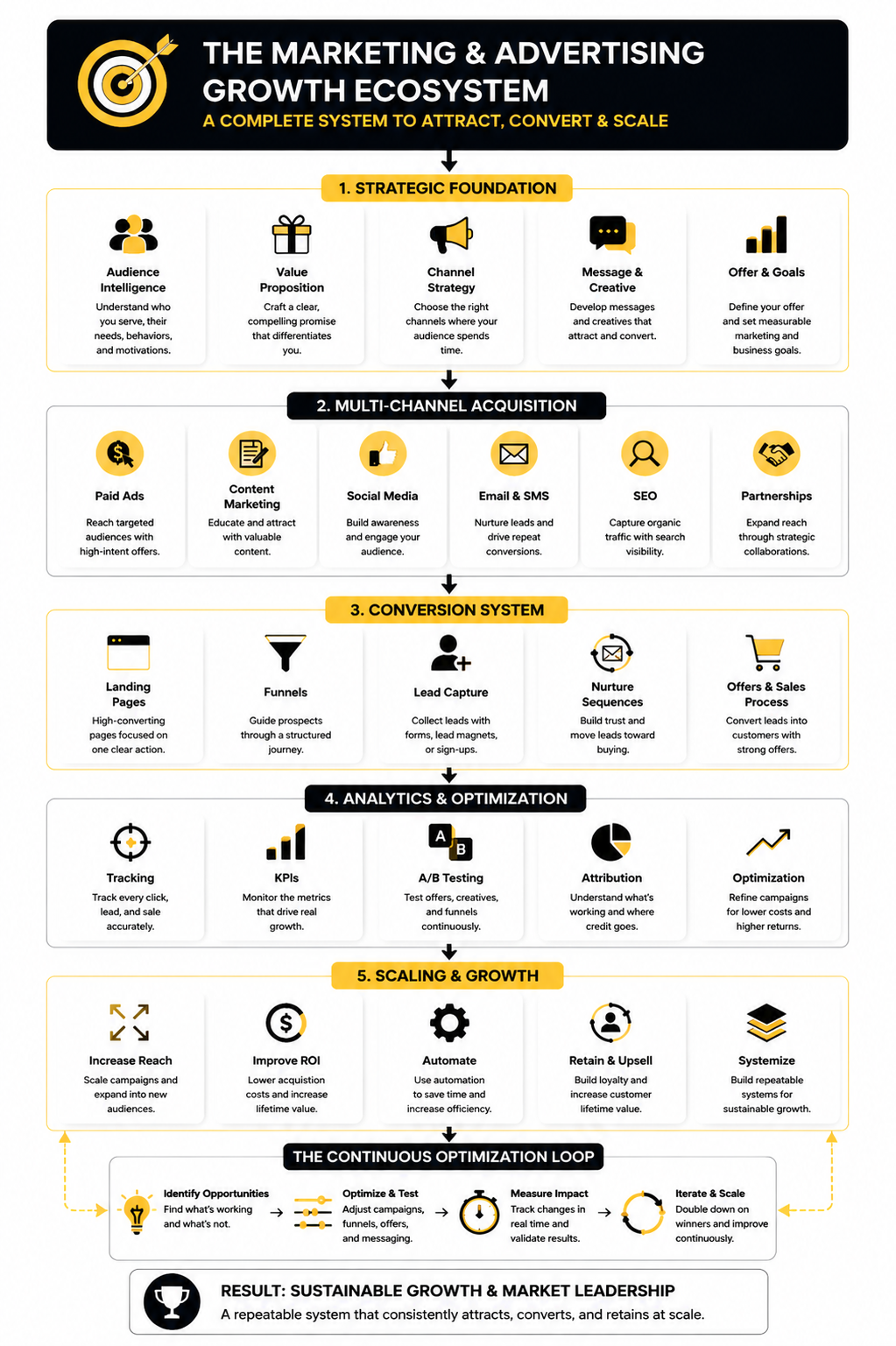
Final Ecosystem Illustration
FAQ - Built for Complete Guide
What is the difference between marketing and advertising?
Marketing is a broad strategic discipline focused on understanding customers and creating value across the entire customer journey, while advertising is a specific subset of marketing that involves paid messaging to promote products or services to an audience.
How do I know which marketing channels to invest in?
Start by aligning channels with your business goals and audience behaviors. Use data from early campaigns to see where you get the best mix of engagement, leads, and conversions relative to cost, then scale those channels.
What’s a realistic budget for marketing and advertising?
There isn’t a one‑size‑fits‑all number. Budgets depend on industry, audience size, and growth stage. A common approach is to allocate a percentage of projected revenue to marketing, then adjust based on performance data.
Why is tracking metrics important?
Metrics like conversion rates, CAC, and ROI show if your efforts are driving real business value rather than just activity. Without tracking, you can’t optimize or justify spending.
How often should I evaluate campaign performance?
Evaluate performance regularly — weekly for active campaigns and monthly or quarterly for strategic reviews. Frequent checks help you catch issues early and reallocate budget faster.
When should a business hire outside help for marketing and advertising?
Bringing in professionals makes sense when internal teams lack specific expertise, when scaling performance, or when you need a fresh perspective that drives measurable results.
Can small businesses benefit from advertising?
Absolutely. Even limited advertising can boost awareness and generate leads when targeted carefully and paired with a solid marketing strategy.
What role do analytics tools play in marketing?
Analytics tools collect and visualize data, helping teams understand customer behavior, channel performance, and conversion paths. They’re essential for making informed decisions.
How do I improve my return on ad spend (ROAS)?
Focus on refining audience targeting, testing creatives, optimizing landing pages, and allocating budget to the highest‑performing segments.
Is social media advertising necessary for all businesses?
Not necessarily. It depends on where your audience spends time and what your goals are. For some industries, search advertising, email, or referrals deliver better ROI.
Work With Professionals
Explore 10K+ Remote Marketing Contracts on MarkeWork.com
Most marketers spend too much time chasing clients, competing on crowded platforms, and losing a percentage of every project to middlemen. MarkeWork gives you a better way. Browse thousands of remote marketing contracts and connect directly with companies desperate to hire skilled marketers like you, without platform commissions and without unnecessary gatekeepers.
If you're serious about finding better opportunities and keeping 100% of what you earn, invite readers to explore available contracts and create a profile for free at MarkeWork.com.