

A marketing campaign is not just a burst of ads, a batch of emails, or a social media calendar with a deadline. The stronger definition is much more practical: it is a coordinated push built around one objective, one audience decision, and one clear story carried across channels in a way people can actually recognize. That broader view shows up consistently in recent guidance on campaign strategy, integrated marketing, and Google’s modern measurement playbook.
That matters because the market has become less forgiving. Brands are dealing with fragmented attention, more channels, rising expectations for relevance, and a measurement environment that keeps shifting underneath them. Recent work on marketing effectiveness, brand lift, and creative measurement all points in the same direction: disconnected tactics are easy to launch, but much harder to justify.
So when people ask how to build a marketing campaign, the real question is usually this: how do you create something that feels coherent from strategy to execution to results. That is the thread running through this article. We are going to break the topic into the six parts that actually matter in practice, then build from the strategic layer down into implementation.

Article Outline
- Why Marketing Campaigns Matter
- Marketing Campaign Framework Overview
- Core Components of a High-Performing Marketing Campaign
- Planning the Offer, Message, and Channel Mix
- Launch, Optimization, and Measurement
- Professional Implementation for Sustainable Growth

Why Marketing Campaigns Matter
A marketing campaign matters because it turns random activity into a focused business move. Without that structure, teams usually end up shipping assets instead of building momentum, and the audience experiences each touchpoint as a separate event rather than one persuasive narrative. That is exactly why current thinking around cross-channel campaigns keeps emphasizing orchestration instead of isolated execution.
The other reason it matters is that campaigns create pressure-tested clarity. They force a team to decide what outcome they want, who they want it from, what promise they are making, and how success will be judged. Once those decisions are explicit, the campaign stops being a collection of marketing tasks and starts acting like a real growth system.
This is also where many brands get into trouble. They confuse presence with persuasion, or consistency with effectiveness, and assume that being active in more places automatically strengthens the result. In reality, the campaign gets stronger when the audience can feel a single idea being carried across the journey, which is the basic logic behind integrated marketing and modern campaign management.
Marketing Campaign Framework Overview
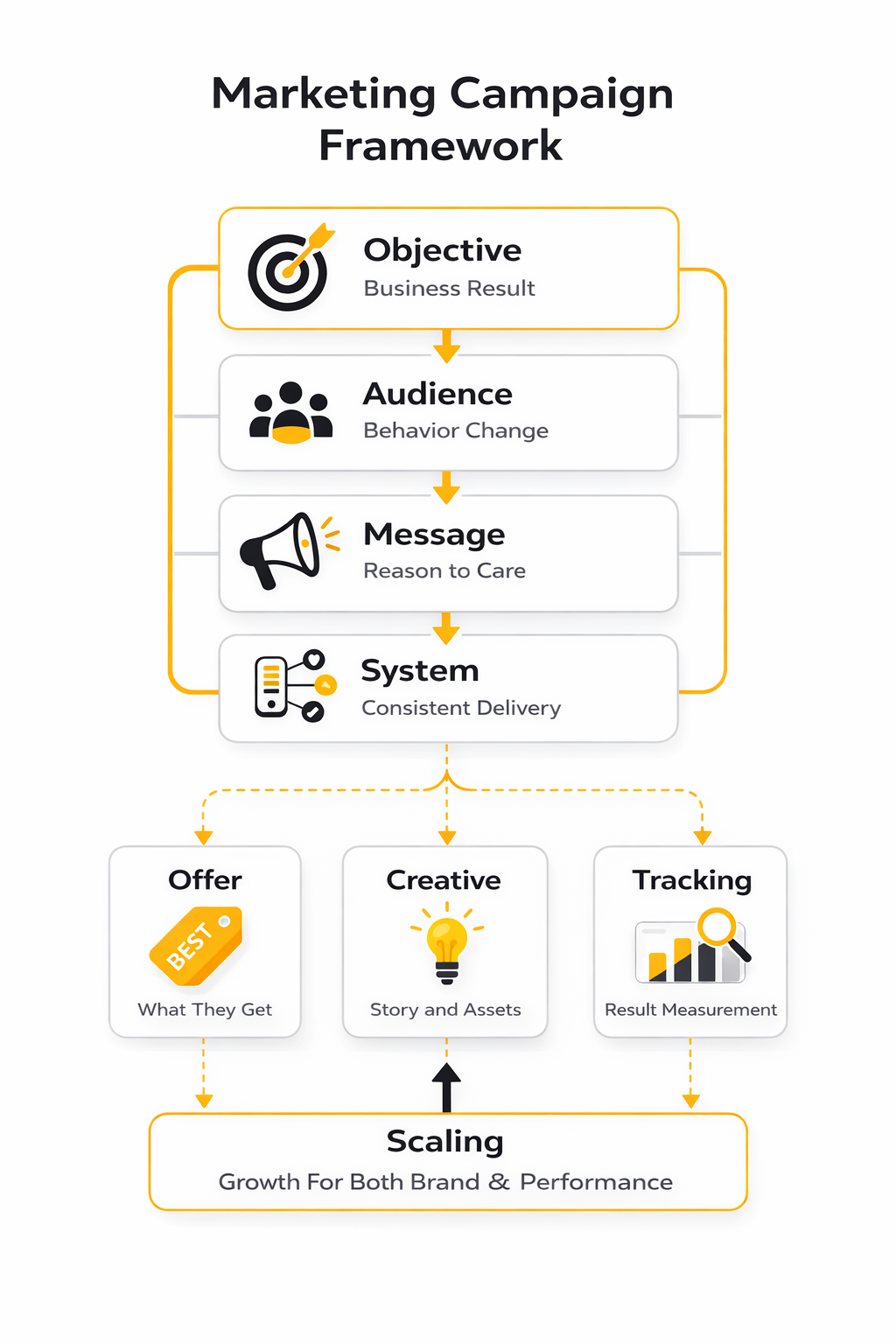
The simplest useful framework for a marketing campaign has four layers: objective, audience, message, and system. The objective defines the business result you are trying to create. The audience tells you whose behavior needs to change, the message gives them a reason to care, and the system makes sure that reason shows up consistently across the places where they are most likely to act.
That sounds obvious, but it is where most campaign breakdowns start. Teams often jump straight to channels, content formats, or budget allocation before they have agreed on the decision they want the campaign to drive. The better sequence is to start with strategic intent, then translate it into creative and distribution, which is the same logic behind newer guidance on campaign strategy and measurement and Google’s business-goal measurement framework.
A good framework also leaves room for both brand and performance. Strong campaigns do not treat those as enemies. They use creative, targeting, and measurement in a way that helps the campaign generate immediate response while also strengthening memory, recognition, and future demand, which is why tools like Brand Lift and broader media effectiveness models keep showing up in serious campaign planning.
Core Components of a High-Performing Marketing Campaign
A strong marketing campaign usually looks more complex from the outside than it really is. Underneath the creative, media plan, landing pages, and reporting dashboards, the campaigns that hold together tend to share the same core components. They start with a sharp objective, build around a real audience insight, make a concrete offer, carry a distinct message, and run on a measurement setup that can tell the team what is actually working.
That sounds basic, but basic is where campaigns usually break. Teams overcomplicate execution while underdefining the strategic pieces that should guide every decision. Recent work on marketing effectiveness, creative measurement, and the shift toward first-party data and privacy-ready planning all point to the same practical truth: the campaign gets stronger when the foundations are clearer, not when the stack gets more complicated.
A Clear Objective Comes First
Every marketing campaign needs one primary job. That job might be product adoption, qualified lead generation, demo bookings, subscriber growth, launch awareness, or direct sales, but it has to be specific enough that the rest of the campaign can align behind it. The moment a campaign is expected to do everything at once, it usually starts saying too much, targeting too broadly, and measuring the wrong outcomes.
This is even more important in a budget environment where teams are being pushed to show efficiency. Gartner’s 2025 CMO spend survey found that average marketing budgets remained flat at 7.7% of company revenue, which means weak prioritization is more expensive than ever. A campaign with a defined objective gives the team permission to ignore distractions and make cleaner tradeoffs on spend, channels, creative, and timing.
A useful test is simple: if someone outside the team cannot explain the campaign goal in one sentence, the objective is still too fuzzy. That lack of clarity usually leaks into the brief, then the assets, then the performance data. By the time the campaign is live, the problem is no longer tactical. It is structural.
Audience Insight Beats Audience Description
A lot of campaign plans still confuse demographics with insight. Age range, job title, company size, or location may help with targeting, but they do not explain why someone would care, hesitate, click, convert, or ignore you. A better marketing campaign is built on a sharper view of the audience tension, desire, frustration, or trigger that sits behind the action you want them to take.
That is part of why first-party data has become more valuable. The conversation has moved beyond simply collecting it and toward using it to understand real customer behavior across the journey, which has become a bigger focus in 2025 marketing planning and broader privacy-forward marketing strategy. When you know which pages people revisit, where they drop off, what messages they respond to, and which segments actually convert, the campaign stops relying on vague assumptions.
This is where many teams quietly improve results without changing their budget. They stop describing the audience in abstract language and start identifying the exact friction that keeps the audience from moving. That shift makes the rest of the campaign much easier to write, design, and distribute.
The Offer Has to Be Worth Noticing
A campaign can have strong targeting and polished creative and still fail because the offer is weak. People do not respond because the design is clean or the media buyer is clever. They respond when the value exchange feels clear enough and relevant enough to interrupt what they were already doing.
The offer is not only a discount. It can be a product launch, a demo, a trial, a limited bundle, a useful piece of content, a clear transformation, or a strong reason to switch. What matters is that the campaign makes the benefit feel immediate and concrete instead of vague and brand-safe.
This is one place where practical execution tools can help, but only after the strategy is solid. If a team needs to turn campaign traffic into leads or booked conversations, a funnel builder such as ClickFunnels or an all-in-one CRM system like GoHighLevel can support the delivery side. The important part is not the software itself. It is whether the campaign makes a real promise the audience can understand in seconds.
Message and Creative Carry the Campaign
Once the objective, audience, and offer are clear, the campaign finally has something worth saying. This is where messaging and creative stop being cosmetic and start doing the heavy lifting. The best marketing campaign creative is not just attractive. It helps the audience recognize the problem, feel the relevance, and understand why this brand or offer deserves attention right now.
Creative quality is still undermeasured relative to how important marketers know it is. Research from Google, Kantar, and Marketing Week found that 8 in 10 marketers see creative quality as a key driver of effectiveness, while fewer than half are measuring its impact properly. That gap matters because teams often optimize placements, bids, and workflows while leaving the biggest persuasion variable underexamined.
The practical takeaway is blunt: if the message is forgettable, the campaign becomes expensive very quickly. Distinct creative angles, consistent narrative, and a strong link between audience tension and promised outcome usually matter more than adding one more channel. A campaign starts feeling powerful when every asset sounds like it belongs to the same idea.
Measurement Is Part of the Build, Not the Debrief
Too many campaigns treat measurement like a wrap-up task. They launch first, then scramble to define success after the numbers arrive. A better marketing campaign defines the measurement logic early, including which signals matter at each stage and which outcomes are strong enough to justify scaling.
That approach fits the broader industry push toward more disciplined measurement. Nielsen’s 2025 annual report highlights how marketers are trying to measure media more holistically, while Google’s current measurement guidance keeps pushing teams toward business-goal alignment, incrementality, and more resilient evaluation methods instead of overrelying on easy platform metrics alone. The point is not to make reporting more complex. It is to make campaign decisions more trustworthy.
When these core components are in place, the campaign stops feeling like a bundle of disconnected tactics. It becomes much easier to plan the offer depth, message hierarchy, landing experience, and channel mix without guessing. That is the next step, and it is where campaign strategy either becomes operational or falls apart.
Planning the Offer, Message, and Channel Mix
Once the core pieces are in place, the next job is to turn strategy into a campaign plan people can actually execute. This is the point where a marketing campaign either becomes coordinated or starts breaking into disconnected tasks owned by different people. The difference usually comes down to whether the team has made three hard decisions clearly enough: what the audience is being offered, what the campaign is really saying, and which channels are doing which jobs.
That order matters more than most teams admit. If you pick channels first, you usually end up forcing the message to fit the media. If you start with the offer and message, the channel mix becomes much easier to design because each platform gets used for a reason rather than because it is available.
Build the Offer Around a Specific Decision
A campaign offer should be tied to one clear audience action, not a vague sense of brand exposure. That action might be starting a trial, booking a call, joining a list, requesting a demo, redeeming a launch promotion, or buying a featured product. The tighter the action, the easier it is to build the rest of the campaign around it.
This is where teams often dilute their own results. They try to bundle too many angles into one campaign, which makes the offer less immediate and the message less memorable. A better marketing campaign gives the audience one clean next step and then removes as much friction as possible between attention and response.
The offer also has to match intent. A cold audience usually needs a lower-friction commitment than a warm audience that already knows the brand. That sounds obvious, but it is one of the easiest places to lose momentum because the campaign can look polished while still asking for too much too early.
Turn the Message Into a Usable Hierarchy
Most campaign messaging fails because it is written like a slogan instead of a system. What the team actually needs is a message hierarchy: the main promise, the supporting proof, the emotional tension, the practical reason to act now, and the call to action. When that structure is missing, every asset starts improvising and the campaign loses its shape.
A useful rule is that the core message should stay stable while the expression changes by channel. Your paid social ad does not need to sound identical to your email or landing page, but it should still feel like the same marketing campaign. That kind of consistency is a big part of why cross-channel orchestration keeps showing up in current guidance from Salesforce on cross-channel marketing and Adobe’s orchestrated campaign workflows.
This is also where proof earns its place. Proof can be product evidence, customer language, speed, guarantees, pricing logic, implementation clarity, or category authority. Whatever form it takes, it should reduce uncertainty rather than just decorate the copy.
Assign Real Jobs to Each Channel
A good channel mix is not about being everywhere. It is about deciding what each channel contributes to the campaign and how the handoff works between them. One channel may create reach, another may deepen consideration, another may capture demand, and another may handle follow-up once the audience has shown intent.
That is why cross-channel planning works best when it is role-based. Email is often strong for nurturing, recap, and conversion support. SMS can work well for urgency, reminders, and short response cycles when used carefully, which is why current guidance on email and SMS together keeps framing them as complementary rather than interchangeable. Social can create recognition and repetition, while the landing page carries the burden of conversion.
The mistake is assuming every channel should do everything. A stronger marketing campaign lets each channel do one or two jobs extremely well, then builds the path between them. That is how the campaign starts feeling intentional instead of noisy.
Launching the Campaign Without Creating Chaos
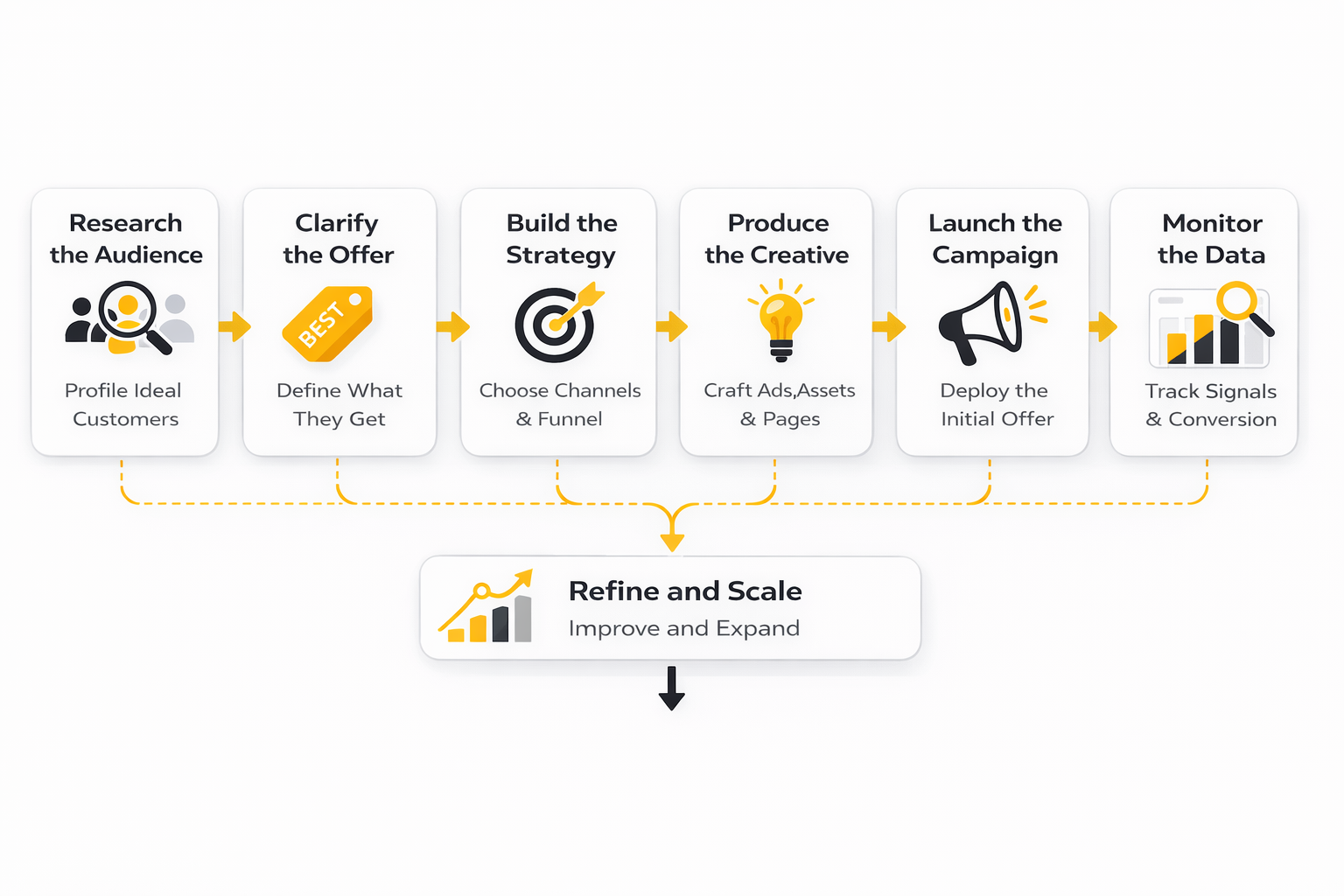
Execution gets much easier when the process is visible before launch. Teams do better when they can see the sequence, the dependencies, and the handoffs rather than treating campaign delivery as a pile of assets with the same due date. This is where implementation becomes tangible and where the campaign either picks up operational momentum or starts stalling.
A Practical Campaign Rollout Process
A clean rollout process usually follows a sequence like this:
- Finalize the campaign objective, audience segment, and offer.
- Lock the message hierarchy and approve the campaign brief.
- Build the landing page or conversion destination.
- Create channel-specific assets based on the same campaign idea.
- Set up tracking, attribution logic, automations, and internal reporting.
- Launch in phases rather than pushing every channel live at once.
- Review early signals, fix friction fast, and then scale what is working.
This sequence matters because it protects the campaign from the most common operational mistake: launching traffic before the destination, tracking, or follow-up logic are truly ready. That one error can waste good creative, distort the data, and make a decent campaign look weaker than it is. The fix is not glamorous, but it is reliable: launch more deliberately.
Start With the Conversion Destination
The campaign destination deserves more attention than it usually gets. If the landing page, form flow, booking page, or checkout experience is weak, the rest of the campaign has to work much harder just to stand still. A lot of teams treat the page as a design task, but in practice it is the conversion engine that either validates the campaign or quietly kills it.
That is why message match matters so much. The promise that earns the click has to show up again on the page with enough continuity that the visitor feels they arrived in the right place. If the page needs to be built fast with stronger merchandising control or campaign-specific layouts, tools like Replo, ClickFunnels, or Systeme.io can help operationally. But the important thing is still the campaign logic, not the page builder.
A practical page check is simple. Can a first-time visitor understand the offer, trust the claim, and act within a few seconds without hunting for context. If not, the campaign is probably sending traffic to a destination that is not ready.
Set Up Follow-Up Before You Need It
A lot of campaigns are built as if the first click should close the deal. In reality, many campaigns win because the follow-up is stronger than the initial impression. That means email sequences, SMS reminders, retargeting, calendar booking flows, chatbot handling, and CRM routing should be considered part of the campaign build, not optional extras added after launch.
This is where implementation platforms become genuinely useful. A team that needs email and automation may lean on Brevo or Moosend, a team running conversational lead capture may use ManyChat, and a team managing leads across channels may centralize response in GoHighLevel. The real point is not the stack. It is that the marketing campaign should have a built-in second move.
That second move often determines whether intent turns into pipeline. Someone clicks, browses, abandons, replies later, books after a reminder, or converts after seeing the right proof at the right time. When follow-up is part of the original plan, those moments stop being accidental.
Phase the Launch and Protect Early Learning
One of the smartest ways to launch a marketing campaign is in controlled phases. That may mean rolling out one paid channel first, testing a warm audience segment before broadening reach, or validating the landing page with lower spend before pushing harder. The point is to create a window where the team can learn without burning too much budget.
This also gives creative and operations a chance to breathe. Early data can expose friction in the form, weak message match, broken automations, or underperforming creative angles before the campaign goes wide. Recent guidance from Google Ads announcements around AI-driven media and creative workflows and Kantar’s work on agile campaign asset optimization both reinforce the same practical idea: campaigns improve when optimization starts early and happens continuously.
The best launch process is rarely the loudest. It is the one that gives the team usable signal quickly, fixes obvious friction fast, and scales only after the fundamentals are holding. That discipline is what turns campaign execution from stressful motion into repeatable performance.
Campaign Performance Data That Actually Matters
Once a marketing campaign is live, the most dangerous thing you can do is stare at a dashboard full of numbers and assume more data automatically means more clarity. It usually does not. Good measurement is less about collecting every possible metric and more about understanding which signals reveal real momentum, which ones expose friction, and which ones are just noise.
This is where a lot of teams go sideways. They celebrate cheap clicks that never turn into pipeline, panic over conversion dips before traffic quality stabilizes, or compare campaign results against generic benchmarks that have nothing to do with their offer, sales cycle, or audience temperature. A better marketing campaign uses data to answer a narrower question: are we creating meaningful movement from attention to action to revenue, and where is the biggest leak right now.
Separate Signal From Noise
The easiest metrics to see are rarely the most useful ones to act on. Impressions, clicks, open rates, and engagement can help diagnose reach or creative resonance, but they are weak proxies for business impact on their own. They only become valuable when they are read in sequence with deeper signals such as qualified leads, booked calls, trial starts, purchase rate, retention, or revenue contribution.
That is why interpretation matters more than volume. A high click-through rate can mean the message is resonating, but it can also mean the ad is overpromising and sending the wrong people into the funnel. A lower click-through rate with stronger downstream conversion can be the healthier campaign because it is filtering for better-fit intent instead of rewarding curiosity alone.
Build a Measurement System Around the Funnel
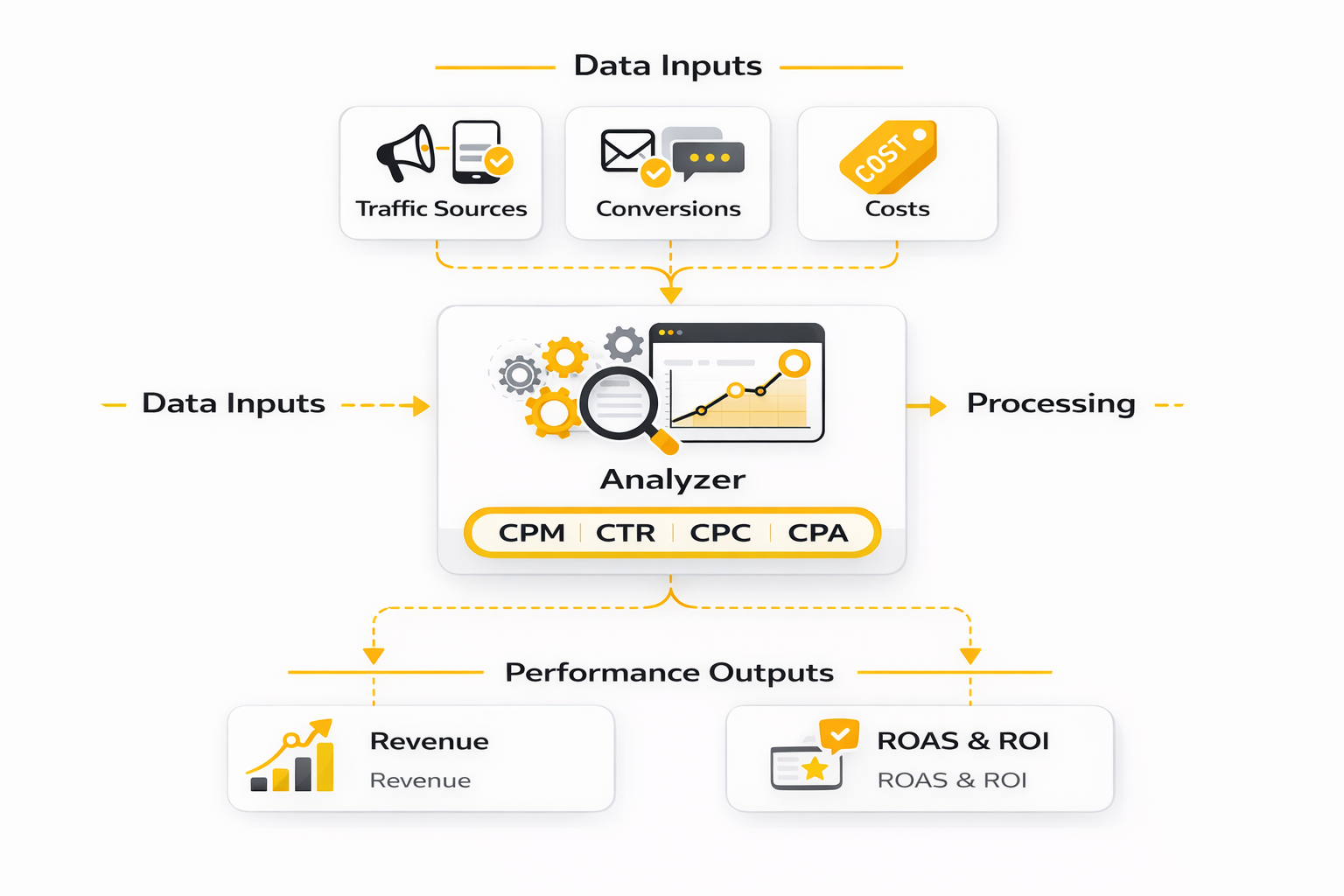
A cleaner way to measure a marketing campaign is to assign one or two primary signals to each stage of the journey. At the awareness layer, you are usually watching reach quality, frequency, video completion, or brand lift direction rather than obsessing over immediate sales. In the consideration layer, you care more about landing-page engagement, return visits, lead quality, or cost per meaningful action. At the conversion layer, the focus narrows to pipeline, purchases, booked meetings, qualified demos, and revenue efficiency.
This kind of structure matters because it stops teams from asking the wrong metric to do the wrong job. Awareness media should not be judged only by last-click revenue, and bottom-funnel conversion assets should not be excused forever on the basis of “brand building.” The moment each stage has a clear job, the campaign becomes easier to optimize because underperformance can be located instead of guessed at.
If the reporting layer feels too fragmented, this is usually where a centralized campaign stack becomes useful. A tool like GoHighLevel can help unify lead capture, follow-up, and attribution across touchpoints, while Buffer can make organic distribution data easier to compare over time. The tool is not the strategy, but it can make the strategy measurable.
Benchmarks Are Directional, Not Universal Truth
Benchmarks can be helpful, but only when they are used with some discipline. They are best treated as directional reference points, not verdicts. Channel costs, conversion rates, and response patterns vary wildly by industry, audience awareness, price point, sales friction, geography, and creative quality, which means a benchmark from another business can be useful for context and still completely mislead your decisions.
The smarter move is to build internal benchmarks fast. Compare creative angles against each other, compare warm and cold audiences separately, compare the first week of launch against the stabilized period, and compare campaign cohorts by downstream quality rather than headline volume. That gives you a performance baseline rooted in your own economics instead of someone else’s dashboard.
This matters even more in a tighter budget environment. When budgets flatten, the value of cleaner interpretation goes up because there is less room to fund vanity performance or muddled experimentation. Recent budget guidance for CMOs reflects that pressure directly, which is exactly why sharper allocation decisions now matter more than broader activity.
What Strong Early Signals Usually Look Like
Healthy early signals in a marketing campaign do not always look dramatic, but they usually look coherent. The message is attracting the right kind of traffic, the landing experience is holding attention long enough for the offer to register, and follow-up sequences are producing a second wave of engagement instead of dead silence. That coherence is usually more trustworthy than one isolated metric spike.
You also want to watch for alignment between upstream and downstream behavior. If ad engagement is rising while lead quality is collapsing, the campaign is pulling in the wrong people or setting the wrong expectation. If traffic is modest but conversion quality is improving, that often signals a campaign that is ready for smarter scale rather than a complete rewrite.
Another useful sign is whether performance becomes more stable after the first round of adjustments. Campaigns that keep improving after message refinement, audience cleanup, and friction removal are usually built on real demand. Campaigns that only survive through constant budget force often have a deeper structural problem that reporting alone will not fix.
What Weak Signals Usually Mean
Weak signals are useful too, as long as you read them honestly. Cheap traffic with poor conversion usually points to weak audience fit, shallow intent, or a message that is attracting attention without creating commitment. Strong page visits with low form completion often suggest friction in the destination, not necessarily a media problem.
When engagement looks healthy but sales lag badly, the issue is often in the offer or the handoff. The audience may like the campaign and still not find the value proposition compelling enough to act. In that case, the fix is rarely “more content.” It is usually sharper positioning, better proof, cleaner sales flow, or a more convincing reason to move now.
This is also where follow-up data becomes valuable. If leads respond only after reminders, retargeting, or sales outreach, the campaign may still be healthy, but the buying window is longer than the initial dashboard suggests. That is one reason automation platforms like Brevo, ManyChat, or Moosend often become part of performance improvement rather than just operations.
Measure Incrementality, Not Just Attribution Comfort
A campaign can look efficient inside a platform and still be overstating its real contribution. That is why more serious measurement conversations keep coming back to incrementality, experimentation, and media mix understanding rather than pure last-click comfort. If you want to know whether the marketing campaign changed behavior, not just captured existing intent, you need some way to test lift rather than rely entirely on platform-reported success.
That does not mean every business needs a giant analytics department. It means the team should ask harder questions before scaling. Did the campaign create new demand, speed up demand, improve conversion quality, or just harvest people who were already on their way. Those questions are less convenient, but they are the ones that protect budget from being wasted on flattering reporting.
The practical action is simple. Use attribution to monitor, use experiments to validate important changes, and use trend analysis to spot where the system is strengthening or breaking. That blend is much more useful than pretending one dashboard can explain the whole campaign by itself.
Let the Data Trigger Specific Actions
The best measurement system does not stop at reporting. It tells the team what to do next. If click-through is weak, the first move is usually message and creative testing. If clicks are strong but the page underperforms, fix the destination before touching media. If lead volume is fine but sales acceptance is poor, tighten targeting, qualify better, or rework the offer.
This is why the numbers only matter when they are tied to decisions. Metrics should trigger creative revisions, page changes, audience refinement, budget reallocation, or follow-up improvements. When a marketing campaign is measured that way, analytics becomes operational instead of decorative.
That transition sets up the final part of the article well. Once you know how to interpret campaign data properly, the next question is how professionals turn that discipline into a repeatable system instead of reinventing the process every time.
Professional Implementation for Sustainable Growth
The real test of a marketing campaign is not whether it launches cleanly once. It is whether the team can run it, learn from it, improve it, and repeat that process without creating more chaos every quarter. That is where professional implementation starts to matter, because sustainable growth usually comes from systems that hold up under pressure rather than one-off wins that look good in a recap deck.
At this level, the campaign is no longer just a creative exercise or a media plan. It becomes an operating model that connects planning, production, distribution, response handling, reporting, and decision-making. That shift is what separates a campaign that feels promising from one that becomes reliable.
Balance Short-Term Performance With Long-Term Demand
One of the hardest tradeoffs in a marketing campaign is deciding how much energy to put into immediate conversion versus future demand creation. Lean too hard into short-term capture and the brand starts exhausting the same pool of obvious buyers. Lean too far into broad awareness without commercial discipline and the campaign becomes difficult to defend when budgets tighten.
Professional teams do not solve this by picking one side forever. They solve it by giving both jobs a place inside the system. Some assets are built to convert now, some are built to improve recall and preference, and the measurement setup is clear enough that those roles do not get confused.
This matters because scale changes the economics. A message that works on a warm audience often breaks when it is pushed wider, and a performance asset that prints for a few weeks can burn out once frequency climbs. The smarter move is to build a campaign portfolio, not a single hero asset you hope never wears out.
Scale Without Letting Creative Quality Collapse
Scaling a marketing campaign usually increases operational stress before it increases return. More channels, more audience segments, more asset variations, more landing pages, and more follow-up paths sound like progress, but they can quietly destroy clarity if the team is just multiplying output instead of protecting the central idea. The campaign gets bigger, but not better.
That is why creative governance matters. You need a way to keep the campaign message consistent while still allowing channel-specific adaptation, localization, and testing. If every new asset drifts away from the strategic core, scale starts to erode the very thing that made the campaign work in the first place.
This is also where workflow tools start to matter in a practical way. For example, a team using Buffer for organic scheduling or Dub for cleaner link tracking still needs a disciplined system behind the software. The tool can make execution easier, but it cannot protect campaign quality if the team has already lost the plot.
Keep the Stack Useful, Not Impressive
A lot of campaign operations get worse as the software stack gets bigger. Different tools collect different versions of the truth, handoffs become harder to trace, and the team starts spending more time managing platforms than improving performance. At that point, the marketing campaign is being slowed down by its own infrastructure.
Professional implementation is usually more selective. The question is not how many tools can be added, but which few systems are doing real work across capture, follow-up, reporting, and collaboration. When one platform can replace three weakly connected ones, simplification is often a performance win, not just an ops preference.
That is one reason teams often consolidate around an operating hub. A platform like GoHighLevel can reduce fragmentation when the campaign depends on lead intake, nurture, booking, and pipeline visibility across multiple touchpoints. The value is not in having another dashboard. The value is in shortening the distance between signal and action.
Design for Follow-Through, Not Just Launch
Many campaigns look sophisticated at launch and amateurish two weeks later. The ads are live, the page is up, the audience is flowing in, but internal response times slip, lead routing breaks, creative refreshes stall, and nobody is fully sure which decisions are owned by whom. That is not a creative problem. It is an implementation problem.
A professionally run marketing campaign has defined ownership after launch, not just before it. Someone owns creative iteration, someone owns the landing experience, someone owns automation health, someone owns sales feedback loops, and someone owns the final decision on budget shifts. Without that, the campaign becomes everybody’s project and nobody’s responsibility.
This is where lightweight systems beat heroic effort. A simple review rhythm, a clear escalation path, and documented action thresholds usually outperform a more complicated process that nobody follows consistently. The campaign gets stronger because the team can respond quickly without reinventing the workflow every time something underperforms.
Treat First-Party Data Like a Strategic Asset
As campaigns become more privacy-aware and less dependent on old tracking habits, first-party data stops being a side topic and becomes part of the core strategy. That does not just mean collecting emails. It means understanding which interactions indicate intent, which segments deserve more budget, and where the campaign is creating relationship value rather than one-time traffic.
The advanced move is to connect data collection to audience value, not just compliance language. If the campaign gives people a meaningful reason to opt in, return, self-identify, or engage across multiple touchpoints, the business ends up with a stronger foundation for future campaigns. That makes the next launch smarter before it even begins.
This also changes how teams think about forms, quizzes, chat flows, booking pages, and lead magnets. Tools like Fillout or ManyChat can support that collection layer, but only when the campaign is clear about what information is genuinely useful and why the audience should want to share it.
Use AI to Increase Speed, Not to Lower Standards
AI can absolutely speed up a marketing campaign. It can help with drafts, variations, summaries, tagging, routing, and some forms of analysis. But the advanced mistake is letting speed replace judgment. When that happens, campaigns become faster to produce and easier to forget.
Professional teams use AI inside a controlled system. They define what can be automated, what still needs human review, and where brand voice, factual accuracy, compliance, or category nuance are too important to delegate casually. That balance matters because the campaign is competing for attention in an environment already flooded with generic content.
The smartest use of AI is usually operational. It helps the team generate more useful options, identify patterns faster, or reduce manual drag around repetitive tasks. It should create room for stronger strategic thinking, not become an excuse to publish weaker material at a higher volume.
Build a Playbook Before You Need One
If a marketing campaign performs well and nobody documents why, the team ends up paying tuition twice. They learn the lesson once in the market, then lose it internally because nothing was captured clearly enough to reuse. That is one of the biggest hidden costs in campaign work.
A useful campaign playbook is not a giant document full of theory. It is a practical record of what mattered: the audience logic, the offer framing, the winning message angles, the asset types that held attention, the conversion blockers that had to be fixed, and the metrics that were most predictive of real success. That kind of documentation makes future campaigns faster without making them lazy.
This is where professional implementation becomes cumulative. Instead of starting from zero every time, the team starts with sharper assumptions, cleaner workflows, and better judgment about where the real leverage sits. That is how a marketing campaign evolves from a project into a capability.
By this point, the pattern should be clear. A marketing campaign performs better when strategy, execution, measurement, and follow-through are treated as one connected system rather than separate jobs. That system mindset is what makes the difference between a campaign that looks busy and one that compounds results over time.
The final layer is ecosystem thinking. You are not just launching ads, emails, pages, or automations. You are building a repeatable environment where audience insight, creative production, channel orchestration, first-party data, sales feedback, and measurement all reinforce each other instead of pulling in different directions.
FAQ for a Complete Marketing Campaign Guide
What is a marketing campaign in simple terms?
A marketing campaign is a coordinated push designed to move a specific audience toward a specific action. That action could be buying, booking, subscribing, signing up, or engaging with a launch, but the campaign only works when the objective is clear enough to guide every decision. The practical difference between a campaign and random marketing activity is alignment across message, channel, offer, and measurement.
How long should a marketing campaign run?
There is no universal campaign length because timing depends on the offer, buying cycle, budget, and audience temperature. A short launch campaign may need intense activity over a few days or weeks, while a demand-generation campaign may need a longer window to build recognition and convert later. What matters most is giving the campaign enough time to generate useful signal without leaving weak execution untouched for too long.
What is the most important part of a marketing campaign?
The most important part is clarity around the objective and audience decision you are trying to create. If that is weak, the offer gets fuzzy, the message gets generic, and the metrics become hard to interpret. Everything else in a marketing campaign becomes easier once the team knows exactly who needs to act and why they should care now.
How many channels should a marketing campaign use?
A campaign should use as many channels as it can support well, not as many as the brand can technically access. For some campaigns, two or three tightly coordinated channels will outperform a broader mix because the message stays clearer and the operational burden stays manageable. Cross-channel effectiveness matters, but only when each channel has a real job inside the campaign system, which is the logic behind modern measurement and orchestration frameworks in Google’s updated media effectiveness guidance and current cross-channel personalization thinking.
How do you know whether a marketing campaign is actually working?
You know it is working when the numbers line up across the journey instead of producing isolated vanity spikes. That usually means the campaign is attracting the right traffic, holding attention on the destination, producing qualified actions, and creating downstream commercial value rather than empty engagement. Stronger teams increasingly validate that with a mix of attribution, testing, and incrementality rather than relying on one flattering dashboard, which is exactly where Google’s modern measurement playbook keeps pushing the market.
What metrics matter most in a marketing campaign?
The answer depends on the campaign goal, but the best metrics are the ones closest to meaningful business movement. Reach, click-through, and engagement can help diagnose creative or distribution performance, but they should not be mistaken for final proof of value. A better measurement stack connects early signals to qualified leads, booked meetings, purchases, retention, or revenue impact so the team can see where momentum is real and where it is just surface-level activity.
Should every marketing campaign include paid ads?
No, and forcing paid media into every campaign can actually weaken the plan. Some campaigns work better through partnerships, email, organic distribution, community, events, sales enablement, or customer advocacy, especially when the audience is already reachable through owned channels. Paid media becomes useful when it has a defined role inside the campaign, not when it is added out of habit.
How often should you refresh campaign creative?
Creative should be refreshed when performance patterns show fatigue, message drift, or weaker audience response, not on an arbitrary calendar alone. In practice, that means watching frequency, conversion quality, engagement decay, and downstream performance rather than assuming the first creative winner will carry the campaign forever. The need for ongoing creative optimization keeps getting reinforced in newer measurement and effectiveness conversations, including Google’s AI and measurement leadership guidance and broader data-driven investment trends from Deloitte Digital’s 2025 perspective on marketing certainty.
What role does first-party data play in a marketing campaign?
First-party data helps a campaign become smarter with every interaction because it shows what people actually do, not just what a platform estimates about them. It can improve segmentation, follow-up, personalization, and performance interpretation when the campaign is designed to collect useful signals with a clear value exchange. That matters more in today’s environment because customer data, CRM modernization, and personalized activation are increasingly central to sustainable campaign performance, which you can see in Deloitte Digital’s CRM modernization guidance and Salesforce’s real-time personalization framework.
Can AI improve a marketing campaign?
Yes, but mostly when it improves speed, pattern recognition, and workflow efficiency without lowering strategic standards. AI can help generate variations, summarize findings, support analysis, and reduce repetitive production work, but it still needs human judgment around positioning, factual accuracy, and brand distinctiveness. The strongest use case is not replacing thinking, but giving the team more room to do better thinking faster.
What is the biggest mistake people make with a marketing campaign?
The biggest mistake is treating the campaign like a content project instead of a decision system. That usually shows up as weak objectives, broad targeting, disconnected assets, bad handoffs, or dashboards full of numbers that do not lead to action. Another common problem is trying to do too much with too little focus, which is especially dangerous in a budget environment where average marketing budgets have stayed at 7.7% of revenue in 2025.
What tools are useful when building a marketing campaign system?
Useful tools depend on the job that needs to be done, not on what happens to be popular. A team may need funnel infrastructure from ClickFunnels, CRM and automation from GoHighLevel, landing-page flexibility from Replo, or conversational capture from ManyChat. The important thing is that the stack supports the campaign workflow instead of making it more fragmented.
Work With Professionals
Explore 10K+ Remote Marketing Contracts on MarkeWork.com
Most marketers spend too much time chasing clients, competing on crowded platforms, and losing a percentage of every project to middlemen. MarkeWork gives you a better way. Browse thousands of remote marketing contracts and connect directly with companies desperate to hire skilled marketers like you, without platform commissions and without unnecessary gatekeepers.
If you're serious about finding better opportunities and keeping 100% of what you earn, explore available contracts and create a profile for free at MarkeWork.com.