

When people search for marketing companies near me, they usually are not looking for another generic list of agencies with polished websites and vague promises. They want a team that understands their market, can see the local competitive landscape clearly, and knows how to turn nearby searches into calls, bookings, store visits, and revenue. That is a different job from running broad brand campaigns, and it is exactly why choosing a nearby marketing partner takes more than comparing price tags or skimming testimonials.
The hard part is that many agencies sound similar on the surface. Almost all of them mention SEO, ads, social media, content, and lead generation, but those services can produce wildly different outcomes depending on how they are planned, executed, and measured. A local business needs more than activity. It needs a marketing company that can connect visibility to actual business results in the area it serves.
This guide is built to help you make that decision with more confidence. Instead of throwing random tips at you, it breaks the process into a practical path: what local marketing companies really do, what matters most when evaluating them, which services move the needle, how professional implementation works, what red flags to watch for, and how to choose a partner that fits your business stage and goals.
What Makes Local Marketing Support Worth Taking Seriously
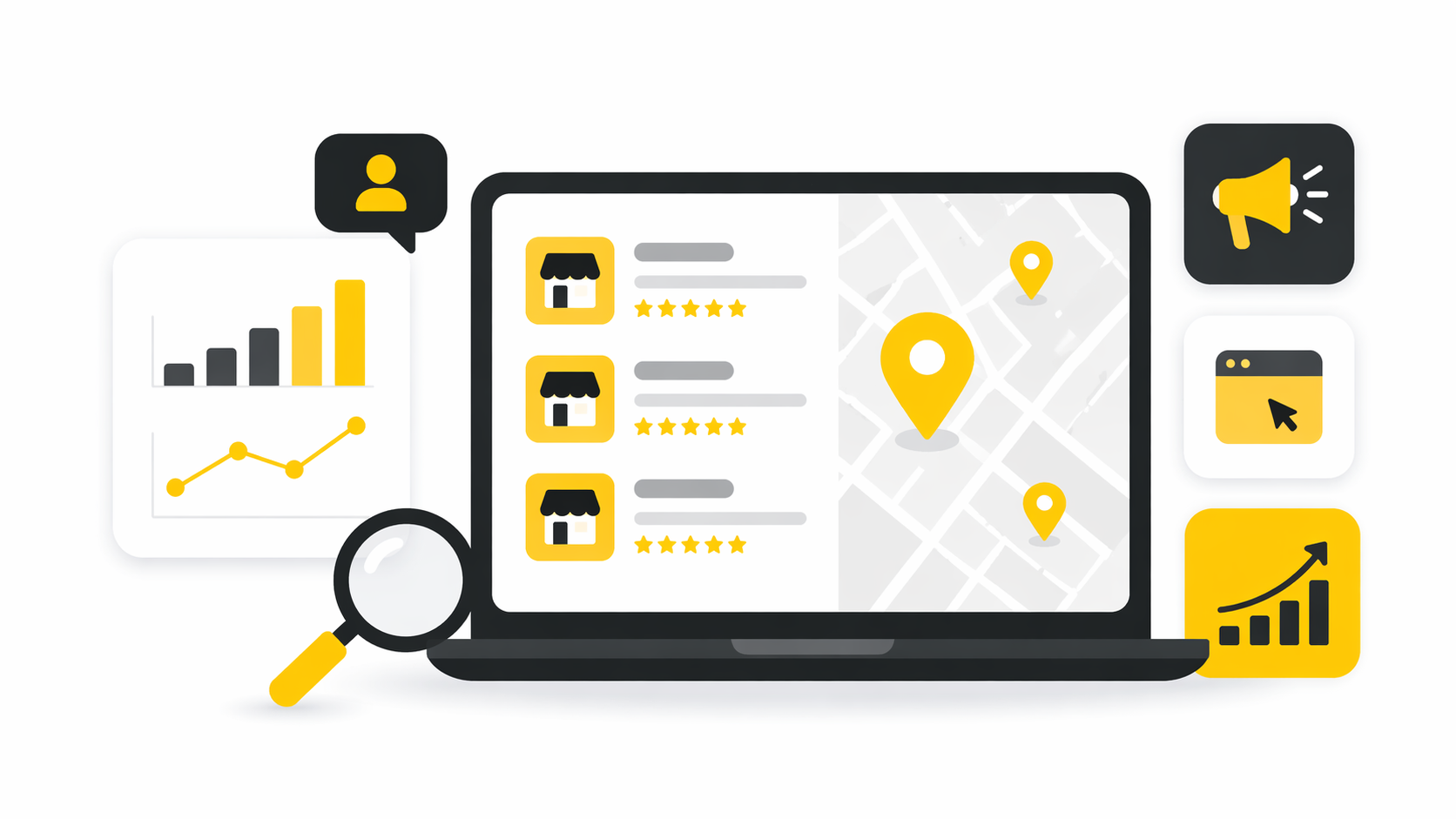
A nearby agency can be valuable for a simple reason: local growth is usually won in the details. It comes from showing up in the right searches, building trust through reviews, keeping business information accurate, publishing location-relevant content, and making sure your website converts the traffic you already have. None of that is flashy, but it compounds when it is handled well.
That also explains why the wrong agency can waste a lot of time. If a company focuses on vanity metrics, uses one-size-fits-all packages, or talks more about impressions than revenue, the relationship starts drifting almost immediately. The right local partner creates clarity, prioritizes the channels that matter in your market, and makes it obvious how their work connects to leads and sales.
The local landscape has also become more competitive. Google Business Profile optimization, review management, local landing pages, paid search, short-form content, and CRM follow-up now overlap much more than they used to. A solid marketing company does not treat these as isolated tactics. It builds them into one system.
Article Outline
- Why Local Marketing Companies Matter More Than Ever
- A Simple Framework for Comparing Marketing Companies Near You
- Core Services That Separate Strong Agencies From Average Ones
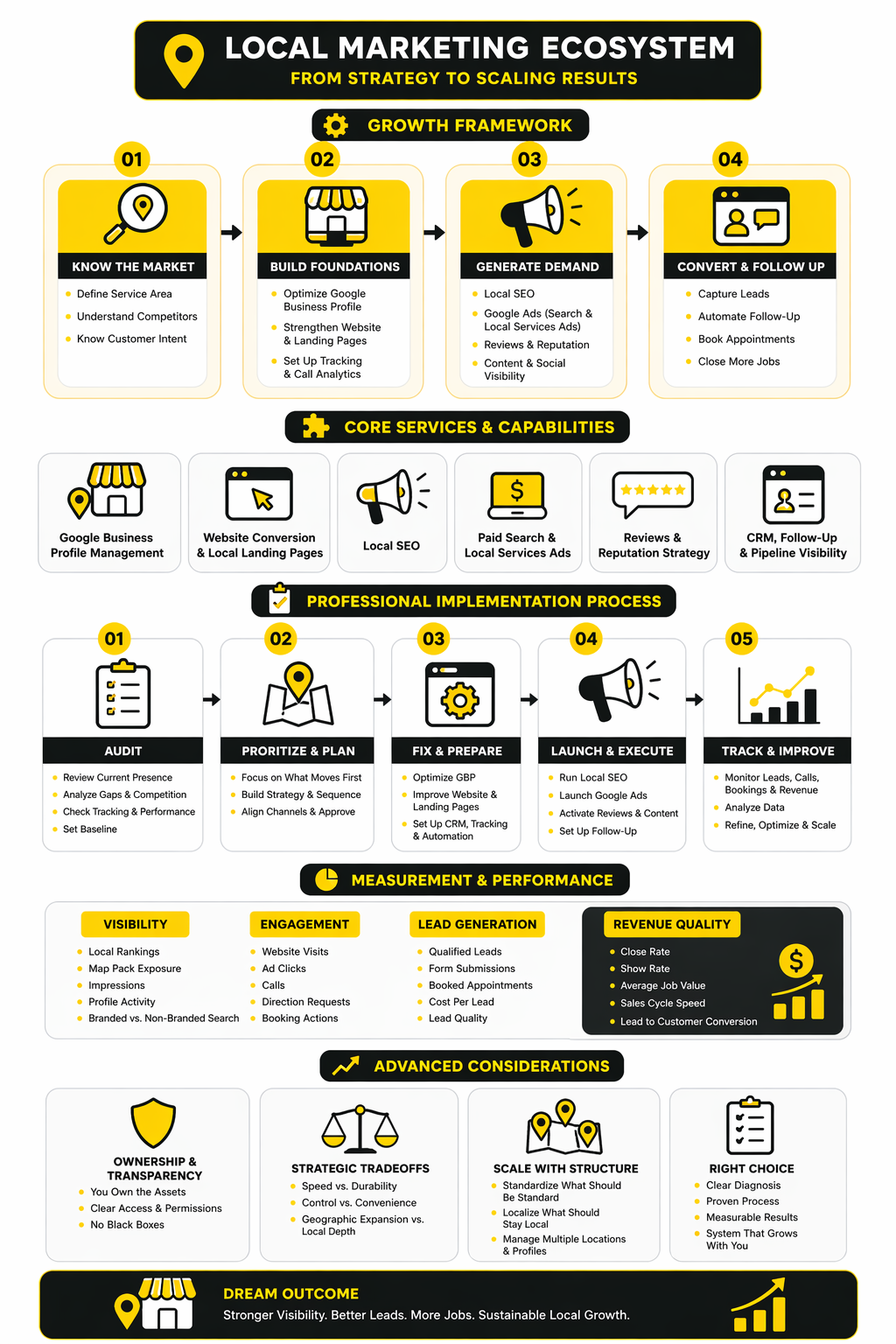
- How Professional Local Marketing Implementation Actually Works
- Red Flags, Pricing Traps, and Questions to Ask Before You Sign
- How to Choose the Best Marketing Company for Your Business
How the Rest of This Guide Will Work
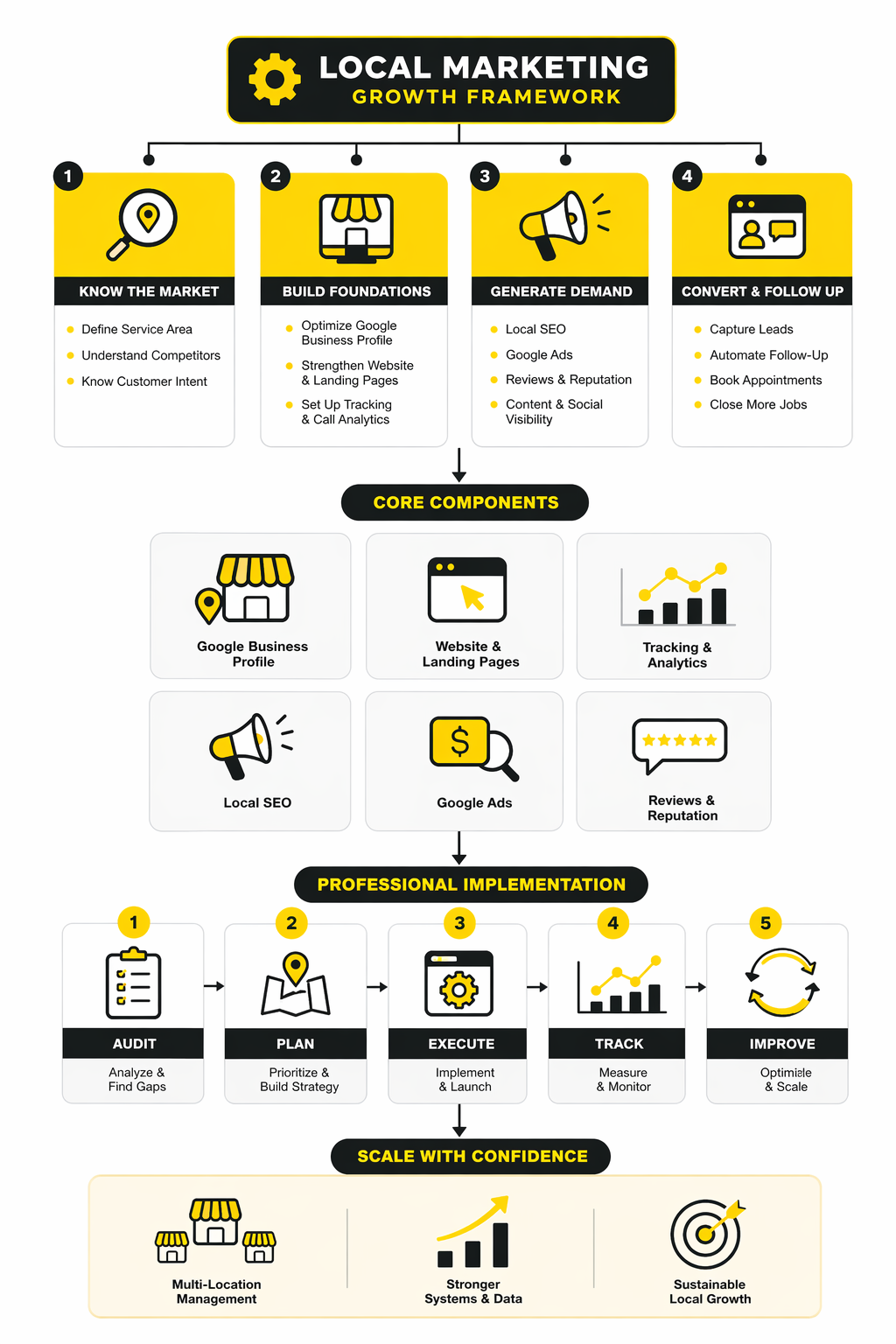
The next section looks at why local agencies matter now, especially for businesses competing in crowded search results and service areas. After that, the guide introduces a clear comparison framework so you can evaluate nearby firms without getting distracted by sales language or bloated service menus. That framework becomes the backbone for the rest of the article.
From there, the article moves into the core components you should expect from a capable local marketing company. It then shifts into implementation, because strategy only matters when it shows up in execution, reporting, and ongoing optimization. The final sections focus on practical decision-making, including how to spot weak offers, how to ask better questions, and how to choose a partner you will not regret hiring.
By the end of the full article, you should be able to look at any shortlist of marketing companies near me and judge it more like an operator than a shopper. That is the goal. Not to make the decision feel more complicated, but to make it much harder for the wrong agency to impress you for the wrong reasons.
Why Local Marketing Companies Matter More Than Ever
Local competition is sharper now because buyers do more of their filtering before they ever call, book, or visit. Google still frames local visibility around relevance, distance, and prominence, which means a business can lose ground even when its service is strong if its profile, website, reviews, and local signals are messy or incomplete. That is exactly why businesses searching for marketing companies near me are not really buying marketing in the abstract. They are buying better positioning in the places where local decisions actually happen.
Reviews are part of that pressure. Local buyers keep using reviews as a filtering tool, and inaccurate listings or weak review profiles can push them away before the sales conversation even starts. A serious local marketing company understands that trust is not built by one campaign. It is built by keeping the business visible, credible, and easy to choose across search, maps, site pages, and follow-up.
The other big shift is operational. Marketing is no longer just about traffic or reach. It now overlaps with CRM, lead routing, review generation, response speed, and reporting, which is why the better agencies think more like system builders than channel managers. That matters because a business does not benefit much from more clicks if the handoff after the click is slow, unclear, or completely broken.
Why Nearby Agencies Can Have a Real Advantage
A local agency is not automatically better, but it can have a practical edge when it understands the geography, buying patterns, and competitive dynamics of your area. That includes knowing which suburbs produce better leads, which service terms are actually used by local customers, which competitors dominate the map pack, and what kind of messaging fits the market. Those details are easy to miss from a distance and expensive to misunderstand.
That local context also helps with prioritization. A strong nearby partner can tell the difference between a business that needs better Google Business Profile management, one that needs tighter paid search targeting, and one that has enough traffic already but leaks leads through slow follow-up. This is where many broad, templated agency offers start falling apart. They sell the same bundle to everyone because it is easier to deliver, not because it is the right fix.
There is also a trust advantage when the agency can evaluate the local reality instead of guessing from a dashboard. For some businesses, local growth is about increasing branded demand and cleaning up reputation signals. For others, it is about winning non-branded searches, building landing pages for service areas, and tightening conversion paths. The point is simple: local marketing works better when the plan starts with local facts.
A Simple Framework for Comparing Marketing Companies Near You
Most business owners make agency decisions in the wrong order. They start with price, then they look at service lists, then they react to confidence and presentation. A better approach is to compare companies across four things: diagnosis, strategy, execution, and accountability. If an agency is weak in even one of those areas, the relationship usually becomes frustrating fast.
Diagnosis comes first because the agency needs to prove it understands the actual business problem. That means it should be able to identify whether the bottleneck is visibility, trust, conversion, follow-up, or retention. If the conversation jumps straight into selling SEO, ads, or social media without a clear diagnosis, that is already a warning sign. Good agencies do not prescribe before they understand the constraints.
Strategy comes next. This is where the agency explains what it will prioritize, what it will ignore for now, and why that sequencing makes sense for your business model. A real strategy feels selective. It does not try to do everything at once, and it does not hide behind vague language like “brand awareness” when the business clearly needs booked appointments or qualified leads.
Execution is where nice proposals get tested. The right agency should be able to show how it handles local pages, Google Business Profile updates, review generation, ad account structure, reporting rhythm, and speed of iteration. Plenty of agencies sound smart in sales calls. Far fewer have delivery discipline.
Accountability is the last filter, and it matters more than most owners expect. The agency should define what success looks like, how often results will be reviewed, which numbers matter most, and what happens if something underperforms. Without that structure, even decent work becomes hard to evaluate because nobody agrees on the scoreboard.
The Four Filters That Make This Framework Useful
1. Can they explain the local opportunity clearly
A capable agency should be able to describe your opportunity in plain English. That includes how customers are likely finding businesses like yours now, where competitors are getting stronger, and where the biggest performance gaps sit today. If they cannot explain the local opportunity simply, they probably do not understand it deeply enough to lead it well.
This is also where you can separate real thinking from recycled sales language. Strong agencies talk about your category, service area, reputation profile, and conversion path. Weak agencies talk mostly about themselves.
2. Do they match tactics to business stage
A business with inconsistent lead flow needs something different from a business with steady demand but poor close rates. A multi-location brand needs something different from a single-location service company trying to dominate one city. The right marketing company makes those distinctions early, because the growth plan should fit the stage of the business, not just the agency’s preferred package.
This is why generic offers often disappoint. They are built for delivery convenience, not for business fit. The better firms adapt their stack and priorities based on what the company actually needs right now.
3. Can they connect marketing to operations
Modern local marketing does not end at the lead form. It reaches into contact handling, automation, follow-up, scheduling, and pipeline visibility. That is why tools such as GoHighLevel or Brevo can make sense in a local setup when the issue is not just visibility, but what happens after a lead comes in.
The agency does not need to force a complicated tech stack on day one. But it does need to understand how lead capture, routing, reminders, and follow-up affect ROI. When that layer is ignored, businesses often blame marketing for problems that are really operational leaks.
4. Will they show their work
Transparency matters more than polish. You want a company that can show what it changed, why it changed it, what happened after the change, and what it plans to test next. That level of visibility keeps the relationship grounded in evidence instead of optimism.
This is also how you avoid being trapped in vague monthly retainers. The best local partners make it easy to see progress, friction, and next steps without making you decode a thirty-page report full of vanity charts. Clear reporting is not a bonus. It is part of the service.
What This Framework Helps You Avoid
The biggest benefit of a framework is not that it helps you pick faster. It helps you reject bad-fit agencies earlier. That matters because many companies searching for marketing companies near me are choosing under pressure, usually after growth has slowed, lead quality has dropped, or an earlier vendor underdelivered.
When you compare local agencies through diagnosis, strategy, execution, and accountability, weak offers become easier to spot. You stop being impressed by jargon, oversized service menus, or aggressive promises. You start asking a better question: can this team understand my local market, prioritize correctly, execute consistently, and own the result?
That shift changes the whole buying process. Instead of shopping for marketing, you are evaluating whether a team can become a useful growth partner. That is the standard that actually matters, and it sets up the next part of this guide well: the specific services and capabilities that separate strong agencies from average ones.
Core Services That Separate Strong Agencies From Average Ones
Once you have a framework for evaluating marketing companies near me, the next question is more practical: what should a good local agency actually be doing for you. This is where a lot of business owners get distracted by long service menus. The better move is to focus on the services that directly improve visibility, trust, conversion, and follow-up in your market.
A strong agency does not try to sell every possible channel at once. It usually builds around a smaller set of services that match how local customers search, compare, and act. That focus is what separates a team with a real operating model from one that is just bundling popular tactics together.
Local search and Google Business Profile management
For many local businesses, this is the foundation. Google still explains local visibility through relevance, distance, and prominence, which is why business categories, service descriptions, review signals, accurate hours, photos, and consistent business data still matter so much in practice. A local agency worth hiring should know how to improve those basics without turning them into superstition or busywork. Google’s local ranking guidance
This work also has to connect to your site, not live in a separate silo. Your Google Business Profile is often the first trust checkpoint, but your website is what usually carries the comparison process further. That means the agency should be aligning profile optimization with service pages, location pages, offer clarity, and contact paths.
Review strategy belongs here too, but not in the spammy way many vendors pitch it. The point is not to chase ratings blindly. It is to build a credible review profile that reflects real customer experience, because people still use reviews heavily when deciding which local business to contact next. BrightLocal’s 2026 review research
Paid search and high-intent lead capture
Not every business should start with paid media, but many local businesses benefit from it once core tracking is in place. The reason is simple: search ads can capture demand that already exists, especially when customers are looking for a provider right now instead of casually browsing. That makes paid search very different from broad awareness campaigns.
For eligible categories, Local Services Ads can be especially useful because Google positions them around direct lead generation rather than click volume. That changes the economics and the conversation. A good agency should be able to tell you clearly whether standard search campaigns, Local Services Ads, or a mix of both makes more sense for your business model. Google’s Local Services Ads overview and setup documentation
The important part is not just launching ads. It is controlling search terms, geography, call handling, landing-page alignment, and lead quality. Weak agencies talk about traffic first. Strong ones talk about qualified demand and cost per real opportunity.
Website conversion and local landing pages
A lot of businesses assume their problem is reach when the real issue is conversion. They are already getting enough visits, but the site does not make the next step obvious. That is why a capable agency looks closely at page structure, mobile usability, offer clarity, trust elements, contact friction, and location relevance before it starts promising dramatic growth.
This matters even more in local search because intent is often immediate. People want to know what you do, where you work, whether they can trust you, and how to reach you without digging. If the agency cannot improve that journey, it will eventually waste whatever traffic it helps create.
For businesses that depend heavily on landing pages, especially in service-area or lead-gen models, page speed and message clarity can become a real lever. Tools like Replo are more relevant for some brands than others, but the wider point stands: the page experience has to support local buying intent, not just look polished.
CRM, follow-up, and pipeline visibility
This is the service layer many local agencies still underplay, and it is one of the reasons performance gets misread. A lead that sits untouched for hours does not behave like a lead that gets a fast call, text, or booking prompt. Once you understand that, it becomes obvious why serious local marketing has to connect with lead routing, reminders, nurture flows, and reporting.
That is where platforms like GoHighLevel, Brevo, or Cal.com can fit naturally into local lead handling. The exact stack matters less than the underlying discipline. If an agency cannot show how leads are captured, assigned, followed up, and tracked toward revenue, it is leaving a major part of the system to chance.
This is also the point where reporting becomes real. Not just clicks, impressions, or followers, but booked calls, qualified leads, close rates, and time-to-response. That is the difference between channel management and business support.
How Professional Local Marketing Implementation Actually Works
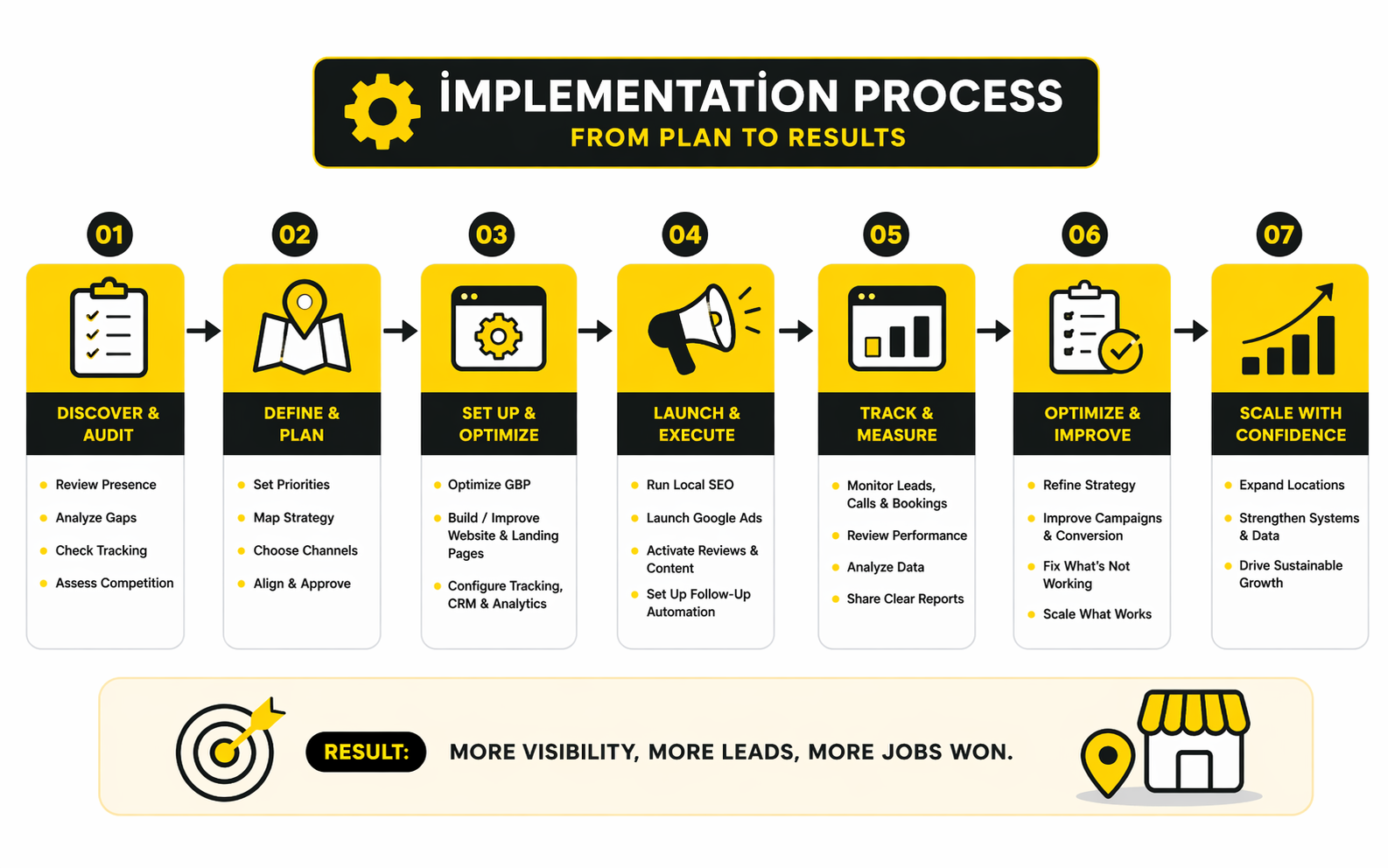
A lot of agencies make implementation sound mysterious because it helps them sell confidence. In reality, good local marketing execution is structured, repetitive, and surprisingly operational. It is less about one clever breakthrough and more about getting the fundamentals aligned fast, then compounding improvements over time.
This is where business owners should raise their standards. If a company shows you a shiny proposal but cannot explain the first 30, 60, and 90 days in concrete terms, you still do not know how they work. Professional implementation should feel understandable, not theatrical.
Step 1: Audit what is already happening
The first step is not launching campaigns. It is figuring out where the current leaks are. That usually means reviewing search visibility, Google Business Profile completeness, reviews, local rankings, site conversion paths, form performance, call handling, ad history, and CRM setup.
This stage matters because most local businesses are not starting from zero. They already have traffic, brand searches, customer feedback, and some level of demand capture. The job is to identify what is underperforming and what can be improved fastest without rebuilding everything from scratch.
A good agency also uses this stage to set a baseline. That baseline is essential, because without it, every future report becomes easier to spin and harder to judge.
Step 2: Prioritize the channels that can move first
After the audit, the agency should narrow the focus. Not every channel deserves equal investment in the beginning, and trying to do everything at once is one of the fastest ways to create noise instead of momentum. The right priorities depend on where demand already exists and where the business is currently losing ground.
For one company, the first win might be local SEO and review generation. For another, it might be better search campaigns paired with faster lead follow-up. For another, it might be rebuilding core service pages so existing traffic starts converting better. The point is that sequencing matters.
This is also where good agencies show restraint. They know that clarity usually beats complexity in the early stages of implementation.
Step 3: Fix the conversion path before scaling traffic
This step is where many mediocre engagements go wrong. They send more visitors into a messy system and then act surprised when the numbers stay soft. A stronger agency will tighten forms, calls to action, booking paths, mobile UX, trust signals, and lead routing before it starts pushing harder on acquisition.
That work may not look dramatic in a proposal, but it has a direct effect on economics. When the website and follow-up flow improve, the same traffic can produce more value. That gives the agency more room to scale with less waste and fewer excuses.
If automation is part of the stack, this is also where it should be introduced carefully. A platform like ManyChat or Chatbase can support lead capture or first-response workflows in the right context, but only when the business process underneath is already clear.
Step 4: Launch, measure, and tighten fast
Once the fundamentals are in place, the agency can start pushing more aggressively on the chosen channels. That may include search campaigns, local landing-page expansion, review workflows, content support, or CRM nurture sequences. The key is that launch is not the finish line. It is the start of learning.
A strong local agency looks for signal quickly. Which search terms are producing qualified calls. Which pages are getting visits but not conversions. Which locations are performing better. Which response delays are hurting close rates. Implementation becomes valuable when those questions get answered fast enough to change decisions.
This is also why tight reporting cadence matters. Monthly summaries are fine, but waiting a full month to spot obvious friction is too slow in most local markets.
Step 5: Turn wins into a repeatable system
The best agencies do not stop at finding a few wins. They turn them into a process the business can keep benefiting from. That usually means clearer operating rhythms, cleaner dashboards, better sales handoff, stronger review generation habits, and a more reliable content or campaign calendar.
At this stage, the work starts feeling less like outsourced marketing and more like an extension of the company’s growth infrastructure. That is exactly what you want. If the relationship stays dependent on constant mystery, last-minute fixes, or heroic effort, the implementation was not strong enough in the first place.
This is where many business owners finally see the real difference between average agencies and serious operators. One sells activity. The other builds a system that keeps making the next decision easier.
What Good Execution Feels Like From the Client Side
From the outside, professional implementation should feel steady, not chaotic. You should know what is being worked on, why it matters now, what has been completed, and what the next checkpoint is. That does not mean every week will be dramatic. It means the work should feel coherent.
You should also notice that the conversation gets more specific over time. Early on, the agency is learning the terrain. Later, it should be talking with more precision about lead sources, service areas, messaging angles, sales friction, and where marginal gains still exist. That growing precision is a healthy sign.
Most importantly, execution should reduce ambiguity. When businesses search for marketing companies near me, they are often trying to solve uncertainty as much as underperformance. The right agency does both by making the path forward clearer, more measurable, and much easier to manage.
Reading the Numbers Behind Local Marketing Performance
By this point, the conversation shifts from execution to evidence. Once a local agency starts working, the obvious question is whether the system is actually getting stronger or just getting busier. This is where measurement matters, but it only helps if the numbers are tied to decisions instead of being dumped into a dashboard and forgotten.
That distinction is important because local marketing data can look healthy while the business still feels stuck. Traffic can rise while lead quality drops. Calls can increase while close rates fall. Reviews can improve while search visibility stays flat. Good measurement is not about collecting more numbers. It is about understanding which numbers explain movement and which ones are just noise.
The Metrics That Actually Matter for Local Growth
A local business does not need fifty KPIs. It needs a smaller group of metrics that show whether visibility is improving, whether intent is turning into action, and whether the business is handling demand well after the lead arrives. That means the best reporting usually sits across four layers: visibility, engagement, lead generation, and revenue quality.
Visibility tells you whether the business is showing up in the places that matter. That includes Google Business Profile activity, local rankings, map exposure, branded versus non-branded searches, and impressions from paid or organic local queries. Google’s local ranking guidance still frames the environment around relevance, distance, and prominence, which is why a visibility problem should not automatically be treated like a conversion problem. Google’s local ranking explanation
Engagement tells you whether people who find the business are interested enough to interact. For local companies, that usually means calls, direction requests, website visits, booking actions, ad clicks, and form starts. These numbers matter because they show intent forming, but they are still mid-funnel. On their own, they do not prove commercial value.
Lead generation is where things become more accountable. Here the agency should be tracking qualified calls, form submissions, booked appointments, message inquiries, and cost per lead where paid media is involved. For businesses using Local Services Ads, Google explicitly positions the format around pay-per-lead rather than pay-per-click, which changes how performance should be evaluated from day one. Google’s Local Services Ads overview and setup documentation
Revenue quality is the final layer, and it is the one most agencies still underweight. It includes close rate, show rate, average job value, sales-cycle speed, repeat purchase behavior where relevant, and lead-to-customer conversion. This is the layer that tells you whether the marketing engine is attracting the right demand or just creating more admin.
What Good Benchmarks Tell You and What They Do Not
Benchmarks are useful when they create perspective, but they become dangerous when people use them like guarantees. For example, broad conversion averages can tell you whether your site is dramatically underperforming, but they cannot tell you what your business should convert at in your market, price point, and category. That is why benchmark data should guide questions, not replace diagnosis.
The same goes for reviews. Local review research still shows that consumers rely heavily on review signals when choosing businesses, and freshness matters, not just average star rating. BrightLocal’s recent survey work and local SEO guidance both point to the commercial importance of recent, credible review activity, which means a flat review profile should usually trigger action rather than passive monitoring. BrightLocal’s current review survey and their local SEO analysis of review freshness
Response speed is another good example. It is one of those metrics that sounds operational rather than strategic, but it often changes the economics of lead generation more than another round of campaign tweaks. If a business responds slowly, the agency may look like it has an acquisition problem when the real issue is that demand is leaking out after contact. That is why modern local marketing reporting has to reach into CRM and sales handling, not stop at the form fill. HubSpot’s marketing and sales data library and its 2025 sales trends material
Why Most Agency Dashboards Miss the Point
A dashboard can be technically accurate and still practically useless. This usually happens when reporting is built around what platforms make easy to export rather than what the business needs to know. Impressions, clicks, followers, reach, and sessions are not worthless, but they become misleading when they are presented without context or without a direct link to business outcomes.
The real problem is that vanity metrics create emotional comfort. They make it look like activity is happening, and sometimes that is enough to keep a weak client relationship alive for another quarter. But a business searching for marketing companies near me is not trying to buy reassurance. It is trying to buy a stronger local pipeline.
That is why useful reporting should answer a short list of sharp questions. Are we getting seen more often by the right local audience. Are more of those people taking action. Are those actions turning into qualified opportunities. Are the opportunities becoming revenue at a healthy rate. If the dashboard does not help answer those questions, it needs to be rebuilt.
How to Build an Analytics System That Helps You Decide
The best local analytics systems are not huge. They are clean, connected, and hard to misread. They typically bring together website analytics, call tracking, CRM data, booking data, paid platform data, and Google Business Profile signals so the agency and the client can see the same commercial story from multiple angles.
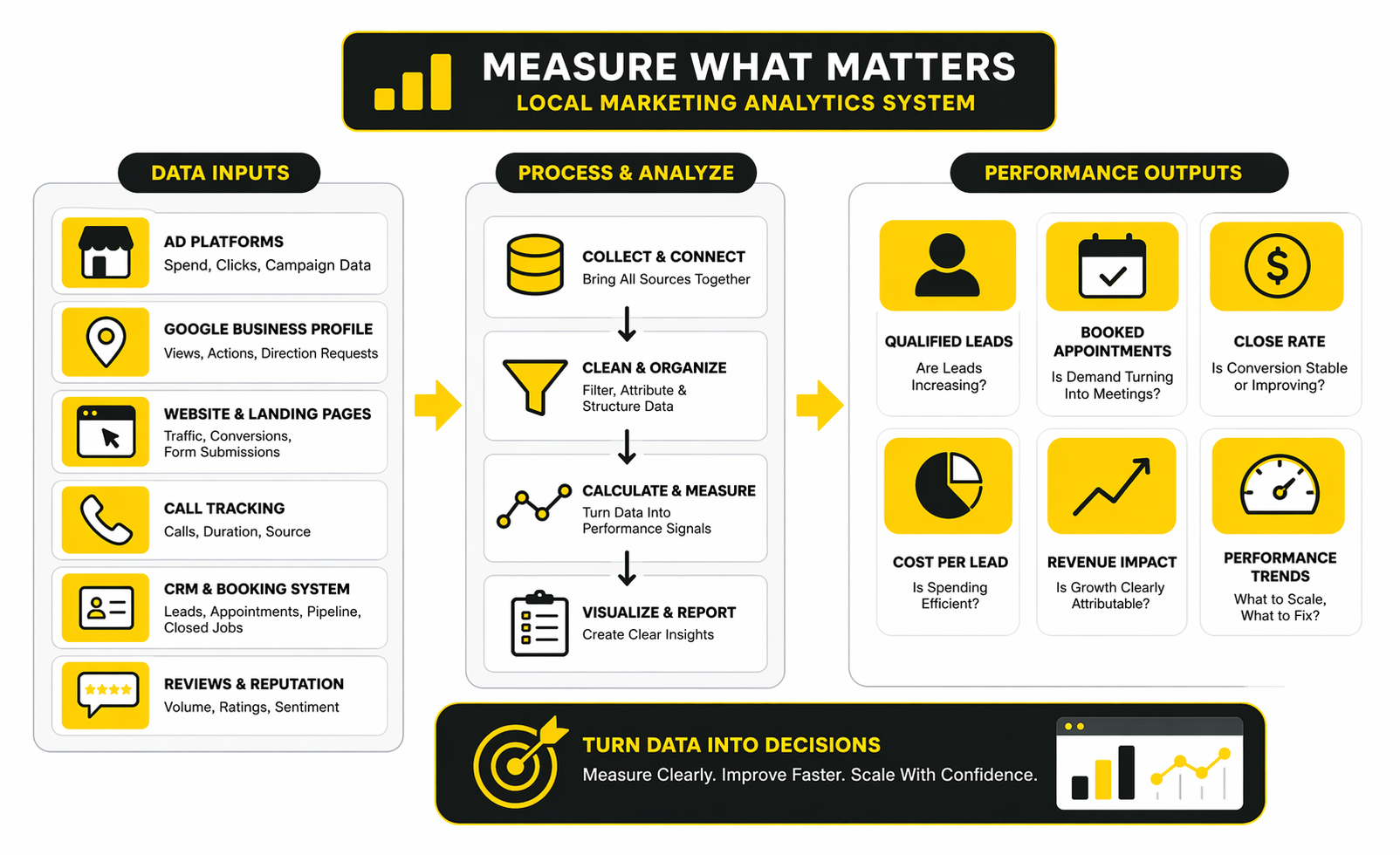
This is where integration becomes more than a tech preference. If your forms, calls, automations, and pipeline live in separate tools without proper handoff, reporting gets distorted fast. A platform such as GoHighLevel or Brevo can help centralize follow-up and reporting for some local businesses, but the real value is not the software itself. It is the fact that every lead can be tracked from source to outcome with fewer blind spots.
A useful analytics system also separates leading indicators from outcome metrics. Leading indicators include search visibility, clicks, calls, review growth, landing-page engagement, and booking starts. Outcome metrics include qualified leads, appointments held, customer acquisition cost, and revenue. You need both, because one tells you what is changing now and the other tells you whether those changes are economically worth keeping.
How to Interpret Performance Signals Without Overreacting
This part matters more than most people think. Data becomes dangerous when every weekly fluctuation gets treated like a crisis. Local marketing moves through uneven cycles, especially when seasonality, promotions, geographic coverage, or review trends affect demand. Good agencies know how to spot signal without panicking over normal variance.
A drop in traffic, for example, is not always bad news. If traffic falls while qualified leads and close rates improve, that may mean targeting got sharper. On the other hand, rising calls do not necessarily mean progress if those calls are low quality, irrelevant, or coming from outside the service area. This is why numbers need interpretation, not just display.
The better way to read performance is by asking what changed, where it changed, and whether the business result improved. If rankings rose, did calls also rise. If calls rose, did booked appointments rise too. If bookings rose, did revenue quality hold up. Each metric should pull the next question forward.
The Actions the Data Should Drive
Measurement is only useful if it leads to a decision. If branded search is strong but non-branded visibility is weak, the action may be to invest more in local SEO and service-area content. If paid leads are arriving but cost per qualified opportunity is too high, the action may be to tighten targeting, change landing pages, or improve screening.
If review volume is thin and recent feedback is inconsistent, the right move is not to complain about reputation generally. It is to build a repeatable review request process and improve the customer moments that shape sentiment. If lead volume is healthy but sales remain soft, the agency may need to shift the conversation away from acquisition and into response speed, booking friction, and follow-up quality.
That is the real purpose of statistics in local marketing. They are not there to decorate reports. They are there to tell you what deserves attention next.
What a Healthy Reporting Rhythm Looks Like
A healthy reporting rhythm is consistent enough to catch issues early but calm enough to avoid random overcorrection. Weekly check-ins are useful for paid campaigns, lead flow, and urgent conversion issues. Monthly reviews are better for trend analysis, budget allocation, local ranking patterns, and strategic changes.
The best reviews also compare performance against a baseline, not just the previous few days. That baseline could be the month before, the same period last year, or the pre-engagement starting point. Without that context, even true numbers become hard to evaluate properly.
This is one of the easiest ways to judge whether an agency is serious. Strong agencies use measurement to sharpen priorities. Weak agencies use it to defend themselves. That difference becomes even more important in the next section, because once you understand what the numbers should say, it becomes much easier to spot pricing traps, reporting theater, and red flags before you sign anything.
Red Flags, Pricing Traps, and Questions to Ask Before You Sign
By the time you get this far, the big risk is no longer misunderstanding what local marketing is. The real risk is signing with the wrong team because the proposal sounds polished, the package looks complete, and the sales process feels reassuring. This is exactly where a lot of businesses searching for marketing companies near me make an expensive mistake.
The trap is usually not obvious fraud. It is misalignment. You hire a company that talks like a growth partner but operates like a fulfillment vendor, and the relationship slowly fills with vague updates, unclear ownership, and work that never quite connects to revenue. That is why the final stretch of evaluation matters so much.
Red flag 1: They want control, but not accountability
One of the clearest warning signs is when an agency wants deep access to your core assets but stays vague about what it will actually own. Your Google Business Profile, ad accounts, analytics, website assets, call tracking, and CRM should never disappear into a black box. Google’s own agency guidance around Business Profile access points toward manager-level access and structured permissions, not sloppy ownership setups that are hard to unwind later. Google’s agency dashboard guidance and Google’s getting started guide
This matters even more if the relationship goes bad. If an agency builds everything inside accounts you do not control, you can lose history, reporting continuity, review workflows, and campaign data the moment the contract ends. That is not just inconvenient. It can reset your local marketing momentum at exactly the wrong time.
A good local agency is comfortable with transparency. It should be happy for you to own the core assets while it manages execution. If a firm gets slippery here, take that seriously.
Red flag 2: The package is broad, but the priorities are blurry
A lot of local agencies sell confidence through breadth. They list SEO, PPC, social media, email, automation, content, reputation management, design, CRO, and analytics in one neat retainer. The problem is not that these services are bad. The problem is that most local businesses do not need all of them at once.
That is why you should push for sequencing. Ask what the first priority is, what the second priority is, and what they are deliberately not focusing on yet. If they cannot answer that clearly, the package is probably built for sales convenience rather than business fit.
This is where experienced operators sound different. They are willing to tell you that some things can wait. That usually means they have a real point of view instead of a memorized service stack.
Red flag 3: They report on activity instead of business movement
If you have read the earlier sections, you already know this one matters. Weak agencies often protect themselves with dashboards that look busy but do not clarify performance. They show impressions, sessions, follower growth, keyword movements, and platform screenshots while avoiding harder conversations about qualified leads, booked appointments, close rates, or customer acquisition cost.
That reporting style is not just annoying. It blocks decision-making. Google Ads’ own documentation on conversion measurement is direct about the purpose of tracking: better ROI decisions and better optimization against real business goals, not just surface-level campaign activity. Google Ads conversion measurement guidance and Smart Bidding documentation
A serious agency should make the commercial story easier to understand over time. If months go by and you still cannot explain where growth is coming from, the reporting is failing its job.
Red flag 4: They treat local pages like a scaling shortcut
This is one of the more advanced problems, and it matters a lot for service-area businesses and multi-location brands. Some agencies create thin location pages at scale, change a few place names, and call it a local SEO strategy. That is getting harder to defend, both because local competition is tighter and because generic location content does not build much trust with users. BrightLocal’s 2025 local marketing commentary makes this shift clear: local content needs to be more relevant, specific, and useful than the old templated playbook. BrightLocal’s 2025 local marketing predictions and their multi-location SEO guide
This is where scaling can quietly damage performance. A business thinks it is expanding local reach, but it is really multiplying weak pages that do not rank well, do not convert well, and do not help the brand stand out. A better agency will scale local content more selectively and tie it to real service differences, proof, and user intent.
That takes more effort, but it produces something more durable. And that is the whole point.
The Strategic Tradeoffs Most Business Owners Underestimate
A lot of local marketing decisions are not about right versus wrong. They are about tradeoffs. The problem is that weak agencies often hide those tradeoffs because nuance makes selling harder. Strong agencies surface them early.
One tradeoff is speed versus durability. Paid search can usually create demand capture faster than local SEO, but local SEO can produce stronger economics over time if the business earns stable visibility in the right searches. The right answer depends on urgency, competition, margins, and operational readiness. You do not want an agency that is ideologically attached to one channel when your situation clearly points to another.
Another tradeoff is control versus convenience. All-in-one systems can simplify lead capture, follow-up, and reporting, which is why platforms like GoHighLevel often appeal to local businesses that need tighter operational visibility. But convenience should not come at the cost of account opacity, weak documentation, or vendor lock-in. The system is only helping if it makes the business stronger, not more dependent.
There is also the tradeoff between geographic expansion and local depth. Many businesses want to widen their service footprint quickly, but local marketing usually gets stronger when the business first becomes difficult to ignore in a tighter area. Expansion sounds ambitious. Density often performs better.
What Changes When You Start Scaling Beyond One Location
A company with one strong local presence can often get by with tighter informal processes. Once multiple locations or service areas are involved, that stops working. The brand has to manage profile ownership, location data consistency, review workflows, local pages, campaign segmentation, and reporting discipline at a much higher level. Google’s bulk verification and profile management guidance exists for a reason: scale creates administrative risk as well as marketing opportunity. Google’s bulk verification guide and Google’s business representation guidelines
This is where many agencies reveal whether they are built for growth or just for small retainers. Managing one location well is not the same as scaling a coherent local system across ten, fifty, or hundreds of profiles. The operational complexity goes up fast, and sloppy structure starts creating expensive inconsistency.
A stronger agency prepares for that by standardizing the things that should be standardized and localizing the things that should stay local. Brand rules, reporting logic, profile governance, and conversion tracking should become more structured. Messaging, proof, offers, and page detail should still reflect real differences between places.
Questions That Separate Strong Agencies From Smooth Sales Teams
The best questions are not aggressive. They are clarifying. You are trying to see how the agency thinks when the conversation gets specific.
Ask who owns the assets, where the accounts will live, and what happens if the contract ends. Ask what the first ninety days will focus on and which channels are intentionally not the priority yet. Ask how they define a qualified lead, how they handle attribution gaps, and what they expect from your internal team for the engagement to work.
Then ask something even more revealing: what usually goes wrong in engagements like this. A serious agency will have a grounded answer. It may mention weak follow-up, unrealistic timelines, poor internal handoff, messy data, or budget mismatch. A weak one will dodge the question because it wants to sound frictionless.
That answer tells you a lot. Real operators understand where the system breaks. Sales teams mostly want you to keep feeling good.
The Kind of Agency Relationship That Actually Scales
The right relationship should become more useful as the business grows, not more confusing. Over time, the agency should understand your market more deeply, tighten decisions faster, improve signal quality, and make the commercial picture easier to read. That is what maturity looks like in a local marketing partnership.
You should also notice that the relationship becomes less dependent on charisma. Early sales confidence matters less and less. What matters instead is planning quality, execution discipline, reporting clarity, and the ability to adapt when conditions change. Google Ads’ recent documentation around steering AI-powered search campaigns is a good reminder here: even as automation gets stronger, human judgment around local constraints, priorities, and business goals still matters. Google’s guide to steering AI-powered Search ads
That is the standard worth using before you sign. Not whether the agency sounds impressive on a call, but whether it can help your business grow with more clarity, more control, and fewer blind spots as the stakes get higher. That leads naturally into the final section of the guide, where all of this gets distilled into the actual choice: how to pick the best local marketing company for your business, right now, without overcomplicating it.
How to Choose the Best Marketing Company for Your Business
At this stage, the decision should feel simpler, not harder. You do not need to find the agency with the loudest pitch or the longest service menu. You need the one that understands your local market, can explain the real bottleneck clearly, and has a process strong enough to improve both visibility and conversion without hiding behind reporting theater.
That also means the best choice is not always the biggest firm or the cheapest one. Sometimes the right partner is a focused local team that knows your category cold and communicates clearly. Other times it is a more specialized agency with stronger systems, better attribution discipline, and enough operational depth to support faster scaling. The point is fit, not prestige.
A good final decision usually comes down to a few non-negotiables. You should understand what they are going to do first, how they will measure success, who owns the assets, what support they need from your side, and what evidence they have that they can execute in a business like yours. If any of that still feels blurry after the sales process, the relationship will probably feel worse once the contract starts.
Pick the agency that can diagnose before it prescribes
This is still the cleanest filter. A useful agency should be able to look at your local presence and tell whether the real issue is discoverability, trust, conversion, follow-up, or sales handling. If every problem somehow leads to the same prebuilt package, you are not getting strategy. You are getting inventory.
That matters because local marketing only works when the first fix is the right fix. Google’s local visibility framework still depends on relevance, distance, and prominence, which means some businesses need stronger local search signals, while others already have visibility and need better lead handling instead. Google’s local ranking explanation
The right agency makes that distinction early. It saves time, protects budget, and gives you a much better chance of seeing momentum from the first wave of work.
Choose clarity over charisma
A polished sales process can be helpful, but it is not the same thing as a strong delivery system. In fact, some of the weakest agency relationships start with the best presentations because the entire operation is optimized for closing, not execution. That is why clarity matters more than charm.
You should be able to understand the first ninety days in plain language. What gets audited. What gets fixed first. Which channels are being prioritized. How leads will be tracked. When reporting happens. What counts as a win. If the answers are vague now, they will be even vaguer later.
Strong local operators tend to sound calmer. They are less interested in dazzling you and more interested in aligning the work correctly from the start. That is usually a very good sign.
Favor ownership, transparency, and transferability
This part becomes critical the moment the relationship has friction. Your core assets should stay portable. That includes ad accounts, CRM records, analytics access, Google Business Profile permissions, site infrastructure, and reporting history. Google’s business profile documentation is built around structured access and accurate representation, not fuzzy ownership that leaves clients stuck. Google’s getting started guide and business representation guidelines
The best agency relationships are strong because trust exists, not because escape is difficult. If the company insists on controlling everything inside its own systems without a good operational reason, that should lower your confidence fast.
Transparency also helps performance. When both sides can see the system clearly, bad assumptions get corrected faster and stronger decisions happen more often.
Make sure the system can grow with you
The right local agency should not only help you improve the next quarter. It should also set up the business to handle more demand without everything becoming chaotic. That means better attribution, stronger follow-up, cleaner local page logic, clearer reporting, and operating rhythms that do not collapse when volume increases.
This is where stack decisions can become relevant. For some businesses, using tools like GoHighLevel, Cal.com, or Brevo can make the system easier to manage as lead volume grows. The tools themselves are not the strategy, but the right infrastructure can make a strong agency much more effective.
That is what you want in the end: a partner that does not just run campaigns, but helps build a cleaner growth engine around them.
FAQ
What should I look for first when comparing marketing companies near me
Start with problem diagnosis, not price. You want to know whether the agency understands if your main issue is local visibility, weak conversion, poor reviews, bad follow-up, or something else entirely. Price only becomes meaningful after you know what job actually needs to be done.
A strong agency should also explain its first priorities clearly. If it cannot tell you what it would fix first and why, the proposal is probably too generic to trust.
Are local marketing companies better than national agencies
Not automatically. A local agency can have an advantage when market context, neighborhood intent, service area nuance, and competitor familiarity matter a lot. But a national or specialized agency can still be the better fit if it has stronger systems, better attribution, and deeper experience in your vertical.
The better question is whether the team truly understands your market mechanics. Local presence helps, but operational quality matters more.
How much should I expect to pay a local marketing company
There is no honest universal number because pricing depends on scope, geography, competition, channel mix, and how much infrastructure already exists. A business needing light local SEO support and review management is not buying the same thing as a multi-location company that needs paid search, CRM automation, landing pages, and attribution.
What matters more than headline price is whether the agency can explain deliverables, priorities, and expected business impact. Cheap retainers become expensive very quickly when the work is unclear or badly sequenced.
How long does local marketing usually take to work
Different channels move at different speeds. Paid search can generate useful signal quickly if tracking and landing pages are already in good shape. Local SEO, review growth, and service-area authority usually take longer because they compound over time rather than spike immediately.
That is why realistic timelines matter. A good agency should separate quick operational wins from slower visibility gains instead of pretending everything improves on the same schedule.
Should I hire one agency for everything
Only if that agency is genuinely strong across the priorities that matter most for your business. In many cases, one coordinated partner is useful because local marketing now overlaps with CRM, follow-up, conversion tracking, and reporting. But “full service” is not a benefit by itself.
The real question is whether the agency can integrate the moving parts without becoming vague. Breadth is only helpful when it improves clarity and execution.
What services matter most for local businesses
For many businesses, the most important areas are Google Business Profile management, local SEO, review generation, website conversion, paid search, and lead follow-up. The exact mix depends on whether the business already has demand and where the current leakage is happening.
Google still explains local rankings through relevance, distance, and prominence, which is why profile quality and local signals still matter. Review trust also remains commercially important in local decision-making. Google’s local ranking explanation and BrightLocal’s current review survey
How do I know whether an agency is actually performing
Look beyond traffic and impressions. The useful questions are whether qualified leads are increasing, whether booked appointments are rising, whether close rates are stable or improving, and whether the source of growth is clear enough to scale with confidence.
A good agency should make those answers easier to see over time. If reporting still feels foggy after a few months, the performance picture is probably not being handled well.
Should I prioritize SEO or paid ads first
That depends on urgency and current conditions. Paid ads are often useful when you need to capture existing demand faster. Local SEO is usually more durable and can produce better economics over time once authority and visibility strengthen.
The best agencies do not treat this like a religious debate. They look at demand, margins, competition, and operational readiness, then decide what deserves to move first.
What questions should I ask before signing
Ask who owns the assets, what the first ninety days look like, how success will be measured, what your internal team needs to provide, and what usually causes engagements like yours to underperform. Those questions tell you much more than “how many years have you been in business.”
You should also ask how they define a qualified lead. If that answer is weak, reporting and accountability are likely to be weak too.
Can a marketing company help if my business already gets leads
Yes, and sometimes that is where the biggest gains are hiding. If leads already exist but response time is slow, the website converts poorly, or follow-up is inconsistent, a good agency can improve economics without needing massive new traffic.
That is why stronger agencies look at the full local growth system. More demand is useful, but better handling of existing demand can be just as valuable.
What tools do strong local agencies usually use
The exact stack varies, but strong agencies usually rely on some mix of analytics, call tracking, CRM, booking tools, ad platforms, and local SEO workflows. For some businesses, all-in-one systems such as GoHighLevel make sense. For others, combinations like Brevo, ManyChat, and Cal.com fit better.
What matters is not the software brand. It is whether the stack helps the business see lead sources, respond faster, and make better decisions with less friction.
Is it worth switching agencies if my current one feels average
Usually yes, if the problem is persistent and clearly structural. If reporting is vague, asset ownership is messy, strategy never gets more specific, or the work feels disconnected from revenue, staying put just because the relationship is familiar can become a quiet drain on growth.
You do not switch for novelty. You switch when the current partner is no longer creating clarity, momentum, or confidence.
Work With Professionals
Explore 10K+ Remote Marketing Contracts on MarkeWork.com
Most marketers spend too much time chasing clients, competing on crowded platforms, and losing a percentage of every project to middlemen.
MarkeWork gives you a better way. Browse thousands of remote marketing contracts and connect directly with companies desperate to hire skilled marketers like you, without platform commissions and without unnecessary gatekeepers.
If you're serious about finding better opportunities and keeping 100% of what you earn, explore available contracts and create a profile for free at MarkeWork.com.