

Most businesses don’t fail because of bad products. They fail because nobody understands how to position, communicate, and scale those products in a crowded market. That’s where a marketing consultant becomes the difference between stagnation and real growth.
A skilled marketing consultant doesn’t just “give advice.” They diagnose hidden bottlenecks, uncover missed opportunities, and build systems that consistently generate revenue. In an environment where customer acquisition costs are rising and attention is shrinking, having someone who understands strategy, execution, and data is no longer optional.
Recent industry data shows that companies with clearly defined marketing strategies are significantly more likely to achieve revenue growth, with reports like HubSpot’s State of Marketing highlighting how structured marketing directly impacts ROI. The gap between guessing and executing strategically is massive—and a marketing consultant exists to close that gap.
Article Outline
- What a Marketing Consultant Actually Does
- Why Marketing Consulting Matters More Than Ever
- The Marketing Consultant Framework Explained
- Core Components of High-Impact Consulting
- How Professionals Implement Marketing Systems
- How to Choose the Right Marketing Consultant

What a Marketing Consultant Actually Does
At its core, a marketing consultant analyzes, plans, and improves how a business attracts and converts customers. But that simple definition doesn’t capture the depth of the role.
A real marketing consultant looks at your entire customer journey—from first touchpoint to final purchase—and identifies where things break. That might mean fixing weak messaging, restructuring funnels, improving conversion rates, or redefining the offer itself. In many cases, the biggest problem isn’t traffic—it’s what happens after the traffic arrives.
They also bring an external perspective that internal teams often lack. When you’re inside your own business, it’s easy to miss obvious inefficiencies. A consultant sees patterns across industries, platforms, and campaigns, allowing them to apply proven strategies instead of trial-and-error guessing.
Tools often play a role here, but they’re never the focus. For example, platforms like ClickFunnels or GoHighLevel can accelerate execution, but without the right strategy behind them, they’re just expensive software. A marketing consultant ensures the strategy comes first—and the tools support it.
Why Marketing Consulting Matters More Than Ever
Marketing has become exponentially more complex over the past decade. What used to be a simple mix of ads and branding is now a multi-channel ecosystem involving content, automation, data tracking, and personalization.
Customer behavior has changed as well. Buyers research more, compare more, and expect more before making decisions. Studies like Google’s consumer insights show that people interact with multiple touchpoints before converting, which means businesses need cohesive strategies—not isolated tactics.
This is where most companies struggle. They invest in ads without fixing their funnel. They create content without distribution. They automate processes that were broken to begin with.
A marketing consultant aligns all of these moving parts. Instead of disconnected efforts, they build systems where each component reinforces the others. That alignment is what turns marketing from a cost into a growth engine.
The Marketing Consultant Framework Explained
Behind every effective marketing consultant is a structured framework. Without one, results become inconsistent and difficult to scale.
Most high-performing consultants follow a sequence that looks like this:
- Diagnose the current situation
- Identify leverage points
- Design a strategy
- Implement systems
- Optimize based on data
This framework ensures that decisions are based on evidence rather than assumptions. It also prevents one of the most common mistakes in marketing—jumping straight into execution without understanding the underlying problem.
For example, a consultant might discover that a business doesn’t need more traffic at all. Instead, it needs better conversion systems, such as improved landing pages or automated follow-ups using tools like ManyChat or email platforms like Brevo.
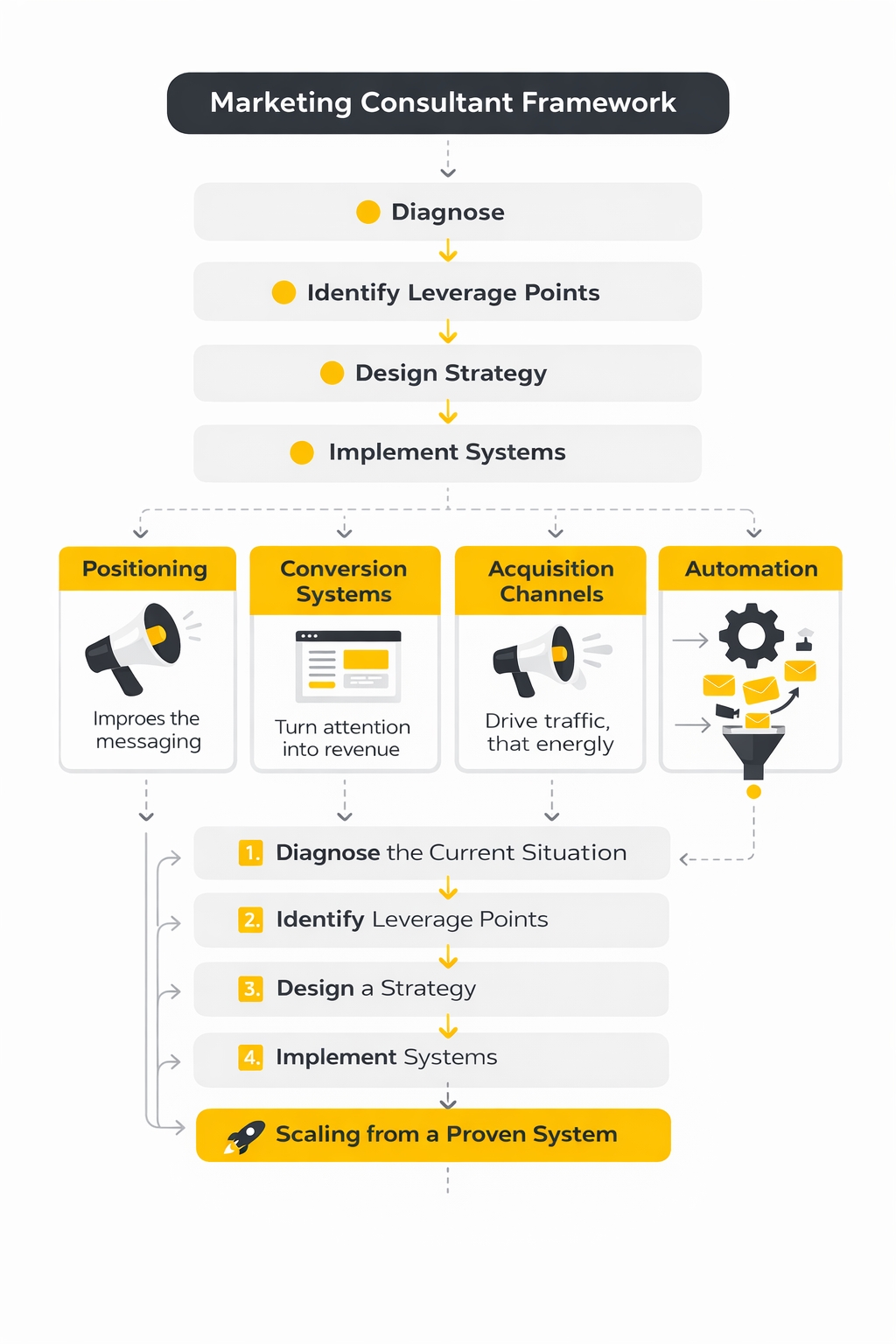
A clear framework removes guesswork. It creates repeatable processes that can be tested, improved, and scaled over time. And that’s ultimately what separates random marketing activity from predictable growth.
Core Components of High-Impact Consulting
Once the framework is clear, the real value of a marketing consultant shows up in the components they focus on. These are not random tactics. They are leverage points that consistently drive growth when executed correctly.
Positioning That Cuts Through Noise
Most businesses struggle because they sound like everyone else. Their messaging is vague, interchangeable, and easy to ignore. A marketing consultant fixes this by sharpening positioning so the offer becomes obvious and compelling.
Strong positioning answers three things instantly: who it’s for, what problem it solves, and why it’s different. When this is clear, everything else—ads, funnels, content—starts working better. Without it, even the best campaigns underperform because the message doesn’t stick.
Research from sources like McKinsey’s marketing insights consistently shows that brands with distinct positioning outperform competitors in both growth and customer retention. This isn’t branding fluff—it’s a measurable advantage.
Conversion Systems That Turn Attention Into Revenue
Traffic alone doesn’t grow a business. Conversion does. That’s why a marketing consultant prioritizes systems that turn visitors into leads and leads into customers.
This often includes:
- Landing pages designed for clarity, not creativity
- Funnels that guide users step-by-step toward action
- Follow-up sequences that recover lost opportunities
Platforms like ClickFunnels or Systeme.io make building these systems faster, but the real difference comes from understanding how people make decisions. A marketing consultant designs flows that reduce friction and increase trust at every step.
Acquisition Channels That Actually Scale
Not all traffic is equal. Some channels look impressive on the surface but don’t translate into real business results. A marketing consultant identifies which channels align with the business model and doubles down on those.
Instead of spreading effort across every platform, they focus on what works. That could be paid ads, organic content, partnerships, or email—but always with a clear strategy behind it.
For example, social media scheduling tools like Buffer can streamline content distribution, while platforms like Flick help optimize reach. But again, tools only amplify what’s already working—they don’t fix weak strategies.
Automation That Multiplies Output
Manual marketing doesn’t scale. At some point, growth requires automation—not to replace human interaction, but to support it.
A marketing consultant builds systems that handle repetitive tasks:
- Lead nurturing sequences
- Chat automation
- CRM pipelines
- Campaign triggers
Tools like GoHighLevel or ManyChat are commonly used here, but the key is not the automation itself—it’s what the automation is designed to achieve. Done right, it creates consistency, improves response times, and increases conversion rates without increasing workload.
How Professionals Implement Marketing Systems
Understanding components is one thing. Implementing them effectively is where most businesses fail. This is where a marketing consultant shifts from strategy into execution.
Starting With Data, Not Assumptions
Professional consultants don’t guess. They start with data—analytics, user behavior, conversion rates, and customer feedback.
This initial phase often reveals uncomfortable truths. For example, businesses frequently discover that their highest traffic pages have the lowest conversion rates, or that their best-performing channel is underfunded. These insights reshape priorities immediately.
Data-backed decisions reduce risk. They also create faster results because efforts are focused on proven opportunities instead of experimentation without direction.
Building Systems in the Right Order
One of the biggest mistakes is trying to do everything at once. A marketing consultant avoids this by implementing systems in a specific sequence.
Typically, the order looks like this:
- Fix positioning and messaging
- Improve conversion infrastructure
- Scale acquisition channels
- Add automation and optimization
This sequence matters. Scaling traffic before fixing conversions wastes budget. Automating broken systems only amplifies problems. A structured approach ensures each layer supports the next.
Continuous Optimization, Not One-Time Fixes
Marketing is not a one-time setup. It’s an ongoing process of testing, learning, and improving.
A marketing consultant constantly analyzes performance and makes adjustments:
- Testing headlines and offers
- Refining audience targeting
- Improving funnel steps
- Adjusting automation flows
This iterative approach is what creates long-term growth. Businesses that treat marketing as a static task fall behind, while those that optimize continuously stay competitive.
Tools like Brevo for email campaigns or GoHighLevel for full-stack automation make this process more efficient, but the real advantage comes from knowing what to optimize and why.
At this level, marketing stops being reactive. It becomes a controlled system—one that can be scaled, predicted, and improved over time.
Turning Strategy Into Execution
At this point, the difference between theory and results comes down to execution. This is where a marketing consultant earns their value—not by explaining what should happen, but by making it happen in a structured, measurable way.
Most businesses stall here. They have ideas, maybe even a plan, but no clear path from concept to consistent results. Execution feels messy, scattered, and unpredictable. A marketing consultant replaces that chaos with a defined process that can be followed, tracked, and improved.
The Step-by-Step Execution Process
When implementation is done correctly, it follows a predictable flow. Not rigid—but structured enough to remove guesswork and keep momentum.
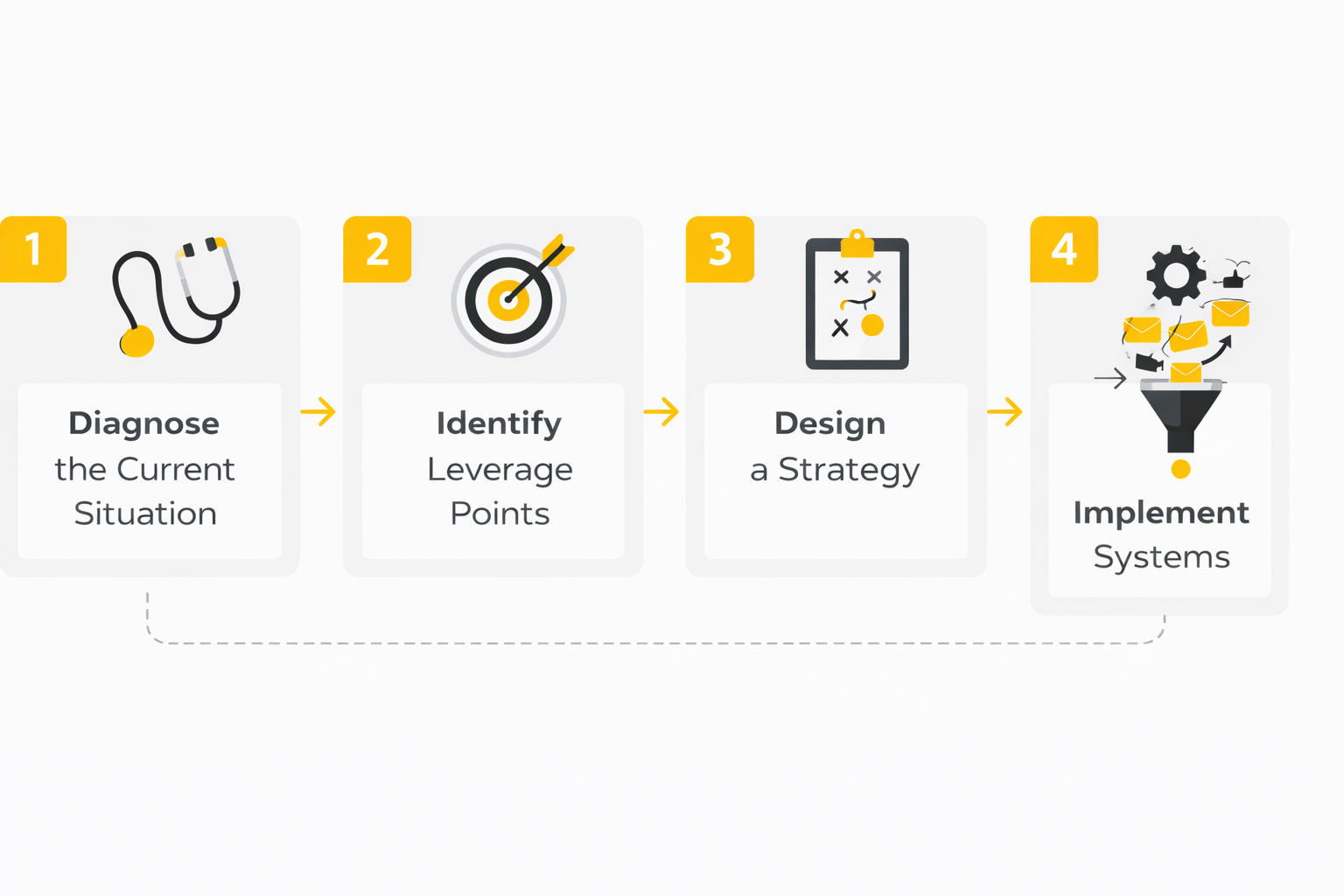
Here’s how a professional marketing consultant typically drives execution:
- Audit and baseline metrics
Everything starts with clarity. Current traffic, conversion rates, cost per acquisition, and retention metrics are mapped out. This creates a baseline so improvements can be measured instead of assumed.
- Define the core offer and funnel structure
Before building anything, the offer is refined and matched with a funnel that fits the buying behavior. This might be a simple lead capture funnel or a multi-step sales process depending on complexity.
- Build conversion assets
Landing pages, checkout flows, and lead magnets are created with one goal—move the user forward. Tools like ClickFunnels or Replo often accelerate this stage, but the structure always comes before design.
- Launch acquisition channels
Traffic is introduced strategically, not randomly. Whether it’s paid ads, organic content, or partnerships, each channel is aligned with the funnel and tracked from day one.
- Implement follow-up and nurturing systems
Most conversions don’t happen immediately. Email sequences, chat automation, and retargeting campaigns are set up to capture missed opportunities. Platforms like ManyChat or Brevo are commonly used here.
- Track, test, and refine
Once everything is live, the real work begins. Data is analyzed daily or weekly, and adjustments are made continuously. This is where small improvements compound into significant growth.
This process turns marketing into a system. Not a series of random actions, but a controlled environment where each input produces measurable output.
Where Most Implementations Break
Even with a solid plan, execution often fails for predictable reasons. A marketing consultant knows these failure points and builds around them.
The most common issue is overcomplication. Businesses try to launch too many funnels, channels, or automations at once. Instead of momentum, they create confusion. Simplifying the system almost always leads to better results.
Another major problem is inconsistency. Campaigns are launched, then abandoned too early. Optimization never happens because there’s no patience or process behind it. Data needs time to become meaningful, and without that, decisions become reactive.
Finally, there’s the issue of misaligned tools. Companies stack multiple platforms without integration, leading to fragmented data and inefficient workflows. Using centralized systems like GoHighLevel or connecting tools properly through platforms like Chatbase can eliminate this friction.
Execution Speed vs Execution Accuracy
There’s always tension between moving fast and getting things right. Most businesses lean too far in one direction.
Move too fast, and you launch broken systems that damage trust and waste traffic. Move too slow, and you miss opportunities while competitors take market share.
A marketing consultant balances both. They prioritize speed where it matters—getting campaigns live, testing ideas quickly—but slow down where precision is critical, like messaging, positioning, and conversion flows.
This balance is what creates momentum without chaos. It allows businesses to grow steadily instead of swinging between extremes of overactivity and stagnation.
At this stage, marketing stops feeling like a gamble. It becomes a process you can rely on, refine, and scale.
Reading the Numbers That Actually Matter
Once execution is live, a marketing consultant has to answer the question every business owner eventually asks: what is working, what is underperforming, and what needs to change next? This is where analytics stops being a reporting exercise and becomes a decision-making system.
The problem is that many teams measure too much and understand too little. Dashboards get crowded with vanity metrics, while the numbers that actually affect revenue get buried. A good marketing consultant simplifies measurement so the signal is obvious and the next action is clear.
The Core Metrics Worth Watching
Not every metric deserves equal attention. The best consultants track numbers that show movement across the full funnel, from attention to conversion to retention.
At a practical level, the metrics usually worth monitoring are:
- Traffic quality
- Landing page conversion rate
- Cost per lead
- Lead-to-customer conversion rate
- Customer acquisition cost
- Average order value
- Retention or repeat purchase rate
- Revenue by channel
These numbers matter because they reveal where the system is leaking. If traffic is rising but conversion is flat, the issue is not awareness. If lead volume looks healthy but sales remain weak, the problem usually sits in qualification, follow-up, or offer fit. That kind of diagnosis is exactly what a marketing consultant is there to provide.
Benchmarks Are Reference Points, Not Goals
Benchmarks are useful, but only if they are interpreted correctly. Too many businesses treat benchmark numbers like targets they should automatically hit, even when their model, market, and traffic sources are completely different.
For example, ClickFunnels points to a 2.35% average cross-industry landing page conversion rate. That number is helpful because it gives context. It tells you whether a page converting at 0.8% is likely underperforming or whether a page converting at 5% may already be healthy enough to justify scaling traffic instead of rebuilding the page from scratch.
The same logic applies to email. Brevo’s 2025 benchmark report, based on over 44 billion emails, shows overall open rates above 31% and click-through rates around 3.64%. Those numbers should not trigger lazy comparisons. They should push better questions: is your list healthy, is your segmentation weak, is your offer uninteresting, or are you simply judging performance in the wrong context?
How a Marketing Consultant Builds an Analytics System
The smartest approach is not chasing isolated metrics. It is building an analytics system that shows cause and effect across the funnel.
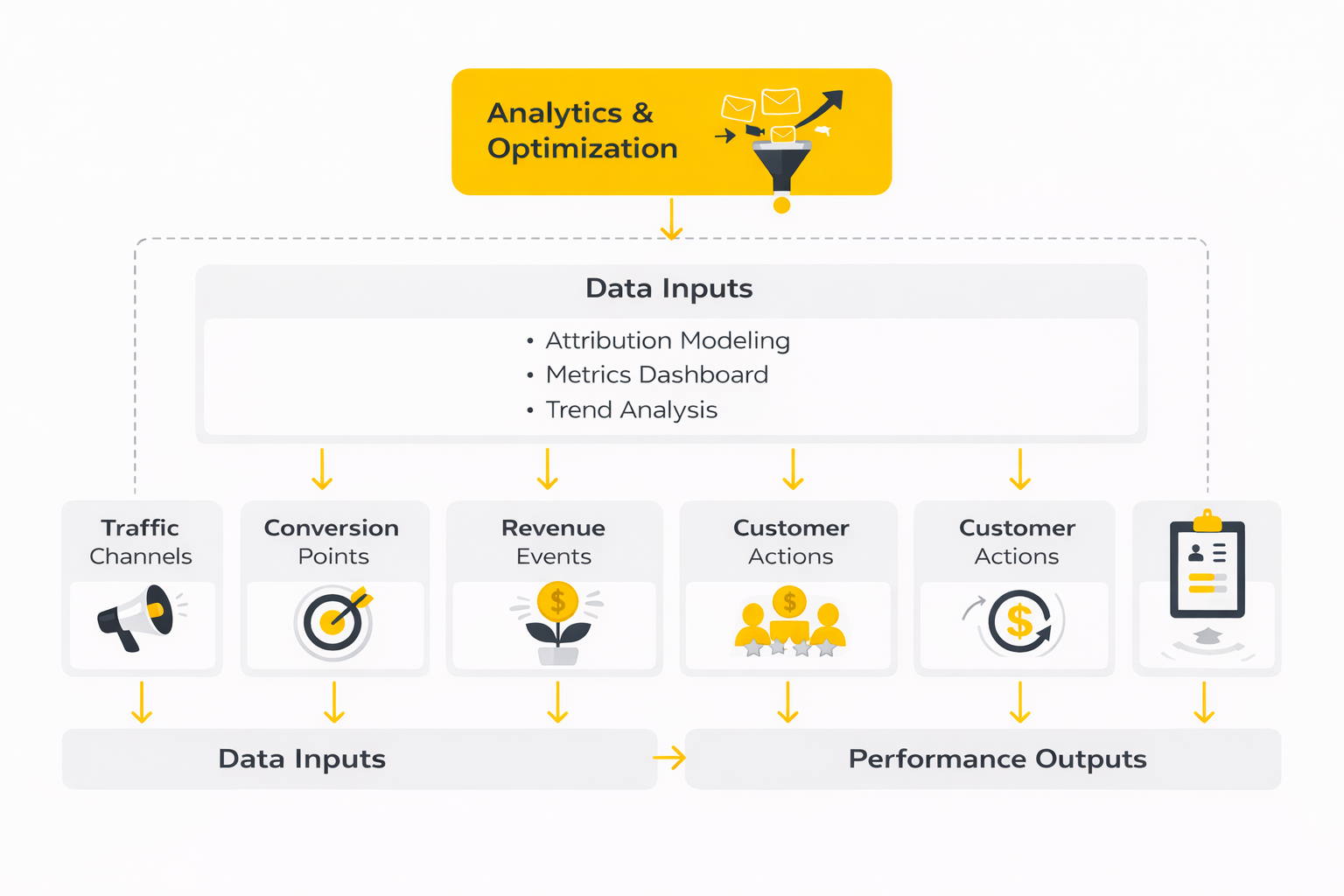
A practical measurement system usually works like this:
- Top-of-funnel metrics
Reach, impressions, clicks, and traffic sources reveal whether the message is attracting attention and whether the right audience is entering the funnel.
- Mid-funnel metrics
Opt-in rate, lead quality, booked calls, demo requests, or engaged sessions show whether interest is turning into real intent.
- Bottom-of-funnel metrics
Sales conversion rate, customer acquisition cost, average order value, and revenue per visitor show whether the campaign is commercially viable.
- Post-purchase metrics
Retention, upsell rate, repeat purchases, and customer lifetime value reveal whether growth is sustainable or just expensive acquisition disguised as progress.
This structure matters because it prevents bad decisions. A business that only looks at traffic can think growth is happening while profit falls. A business that only watches revenue can miss the fact that acquisition costs are quietly climbing and making the model fragile.
What Social and Email Benchmarks Really Mean
Channel metrics only become valuable when they are tied to business context. A marketing consultant uses benchmarks to identify opportunity, not to create false confidence.
Social media is a good example. Buffer’s 2025 engagement data and its newer 2026 engagement analysis show that engagement varies heavily by platform and format, with LinkedIn and Facebook posting stronger median engagement than many brands assume. That matters because low engagement is not always a content problem. Sometimes it is a channel mismatch, a weak format choice, or a sign that the audience itself is wrong.
Email tells a similar story. A campaign with a solid open rate but weak clicks usually has a messaging or offer problem, not a deliverability problem. A campaign with weak opens may point to list fatigue, bad segmentation, or a subject line issue. The point is simple: numbers only matter when they tell you what to fix.
The Difference Between Vanity Metrics and Performance Signals
Vanity metrics look impressive in a meeting but rarely improve the business. Performance signals are different. They change what a marketing consultant does next.
Follower growth is a classic vanity metric when it has no connection to leads, pipeline, or revenue. The same goes for page views without conversion data, or impressions without qualified traffic. These numbers can create the illusion of traction while hiding poor economics.
Real performance signals have operational value. If cost per lead rises while close rates stay flat, the consultant may need to change targeting or creative. If conversion rates improve but average order value drops, the issue may be offer structure rather than funnel design. That is the standard to use: does this metric help drive a specific next action?
How to Turn Analytics Into Better Decisions
Measurement only becomes useful when it changes behavior. That is why a marketing consultant translates analytics into action instead of flooding clients with dashboards they will never use.
A strong review process usually sounds like this:
- Which channel is creating the best customers, not just the cheapest clicks?
- Where is the biggest drop-off in the funnel?
- Which message is pulling stronger intent?
- Which step should be optimized first for the highest return?
This is also where tools can help, especially when reporting is fragmented. Platforms like GoHighLevel are often used to centralize lead flow, attribution, and follow-up visibility, which makes it easier to connect campaign activity to pipeline outcomes. But the tool is not the insight. The insight comes from knowing which number matters now, what it means, and what change it demands.
When analytics is handled properly, the numbers stop being abstract. They become a map. And for a marketing consultant, that map is what turns marketing from opinion into execution with proof.
Advanced Tradeoffs That Separate Good Consulting From Expensive Advice
By the time a business reaches this stage, the easy wins are usually gone. The obvious funnel fixes have been made, the biggest messaging problems are clearer, and the reporting system is finally showing what is really happening. Now the work gets more strategic, because growth starts coming with tradeoffs.
This is where a marketing consultant becomes far more than a campaign operator. They have to decide what should be optimized now, what should be left alone, and what risks the business is willing to accept in exchange for faster scale. That judgment matters, because the wrong move at this stage can erase earlier gains very quickly.
Scaling Usually Breaks What Worked at Smaller Volume
A campaign that performs well at low spend does not automatically survive when budget increases. Audience quality often drops, creative fatigue shows up faster, and economics that looked healthy at small scale start tightening once the easiest conversions are gone.
That is why a marketing consultant has to watch efficiency and scale at the same time. The goal is not just to increase lead volume. The goal is to protect margin while growing volume, which is much harder. Research highlighted in the 2025 CMO Survey and Deloitte’s broader 2025 marketing investment coverage reinforces the same point: more spending alone does not guarantee better outcomes, and channel mix by itself is not a shortcut to revenue growth.
This is why experienced consultants scale in layers. They increase spend gradually, validate quality at each step, and protect the parts of the funnel that drive profitability. When that discipline is missing, growth looks impressive for a quarter and painful the quarter after that.
Attribution Is Harder Than Most Teams Admit
One of the biggest traps in modern marketing is overconfidence in attribution. Teams often act as if the dashboard shows the whole truth, when in reality customer journeys are fragmented across devices, channels, and delayed decisions.
That matters because buyers now research more independently and across more touchpoints before they ever speak to a company. Gartner reported in mid-2025 that 61% of B2B buyers prefer a rep-free buying experience and 73% actively avoid irrelevant outreach. In practical terms, that means a marketing consultant cannot judge performance only by last-click reports. They have to understand assisted conversions, content influence, branded search lift, and the hidden role of follow-up.
This is also why first-party data matters more than ever. If a business does not own its customer data and lead history, attribution becomes even weaker. Using systems that centralize contact records, campaign responses, and follow-up timelines—such as GoHighLevel or Copper—can make the picture much clearer.
Efficiency and Brand Building Need Each Other
A lot of companies swing too far toward short-term performance marketing. They become obsessed with immediate returns, cut anything that does not convert instantly, and then wonder why acquisition gets harder and more expensive six months later.
A strong marketing consultant understands that brand and performance are not competing functions. They reinforce each other. Brand makes performance channels cheaper and more effective over time, while performance channels provide the feedback loop that sharpens positioning and offer-market fit.
This balance is especially important in crowded markets where attention is limited. Deloitte’s 2025 Digital Media Trends makes it clear that consumers are dividing their time across a growing mix of platforms and formats, while total available attention remains finite. That means the consultant’s job is not just to chase clicks. It is to build memory, trust, and repeated exposure in a market where distraction is the default.
AI Can Multiply Output, but It Also Multiplies Sloppiness
AI is now part of the workflow whether a business is ready for it or not. It can speed up content production, improve segmentation, assist with support, and reduce manual campaign work. But it also makes mediocre marketing easier to produce at scale, which is a dangerous combination.
A marketing consultant has to know where AI creates leverage and where it creates noise. Using AI for internal drafts, campaign variations, workflow automation, or lead qualification can save real time. Using it to mass-produce generic messaging often leads to weak differentiation and lower trust.
This is one reason expert implementation matters more now, not less. Tools such as Guideless, Chatbase, and Wispr Flow can support speed and execution, but they do not replace strategic judgment. Deloitte’s late-2025 reporting on AI investment ROI also showed that many leaders still expect a long path to measurable value, which is exactly why disciplined use matters.
How to Choose the Right Marketing Consultant
At this stage, picking the wrong consultant is expensive in more ways than one. You do not just lose fees. You lose time, team focus, market momentum, and confidence in decisions that may already be hard enough to make.
The right marketing consultant should make the business simpler, clearer, and more effective. If they add jargon, complexity, and endless tactical activity without better economics, that is not expertise. That is camouflage.
Look for Diagnostic Thinking First
A serious consultant does not rush into tactics. They ask better questions before they prescribe better answers.
That means they should be able to explain where growth is constrained, what evidence supports that view, and what sequence of changes would likely create the biggest return. If someone jumps straight to “run ads,” “post more content,” or “rebuild the funnel” without understanding the current system, that is a warning sign.
The best marketing consultant is usually the one who can simplify the problem with the least drama. They can explain what is broken, why it matters, and what to do next in plain language.
Prioritize Operators, Not Performers
Some consultants are brilliant in meetings and weak in execution. They know how to sound strategic, but once the work starts, everything becomes vague, delayed, or dependent on someone else.
A better standard is this: can they translate strategy into systems, assets, processes, and measurable outcomes? Can they define milestones? Can they explain how success will be judged? Can they tell the difference between a weak offer problem and a weak channel problem?
This is also where tool familiarity matters, but only in context. Someone who understands platforms like Replo, Fillout, or Cal.com can be useful. But what matters more is whether they know why a tool belongs in the system at all.
Make Sure Their Incentives Match Your Outcome
This part is easy to overlook and expensive to ignore. A consultant who gets rewarded for activity may create more activity than you need. A consultant who gets rewarded for outcomes tends to focus on what actually moves the business.
That does not mean every engagement needs performance pricing. It means expectations, scope, timelines, and decision rights need to be clear from the start. A marketing consultant should be able to define what success looks like, what depends on them, and what depends on the business.
When that alignment exists, the relationship becomes far more productive. The consultant is no longer selling motion. They are helping build a growth system that the company can actually sustain.
The Best Consultants Leave the Business Stronger Than They Found It
This may be the clearest test of all. A weak consultant creates dependency. A strong one creates capability.
That means better reporting, better messaging, cleaner systems, clearer priorities, and a team that understands the growth engine more deeply than before. Even if the consultant steps away, the business should be in a stronger position to keep moving.
That is the real standard. Not flashy deliverables. Not endless audits. Not a wall of dashboards. A great marketing consultant leaves behind clarity, momentum, and a system that keeps working after the engagement ends.
Final Thoughts on What a Marketing Consultant Really Brings
At the beginning, a marketing consultant can look like an outside expert who helps with messaging, funnels, and performance. By the end of a serious engagement, the role is much bigger than that. The right consultant helps a business see its growth engine clearly, remove expensive bottlenecks, and make better decisions with less noise.
That matters because most companies do not suffer from a lack of tactics. They suffer from scattered execution, weak prioritization, and no reliable way to connect activity to revenue. A strong marketing consultant closes that gap by turning strategy, systems, and measurement into one operating model.
When that happens, marketing stops being a constant source of confusion. It becomes a system the business can understand, improve, and scale with confidence.
FAQ
What does a marketing consultant actually do day to day?
A marketing consultant usually works across diagnosis, strategy, execution planning, and performance review. On a practical level, that can include auditing funnels, reviewing analytics, refining messaging, prioritizing channels, and helping teams improve conversion systems. The day-to-day work changes by client, but the core job stays the same: find what is slowing growth and fix it in the right order.
When should a business hire a marketing consultant instead of a full-time marketer?
A business usually hires a marketing consultant when it needs clarity before it needs headcount. If the problem is strategic confusion, poor funnel performance, weak positioning, or inconsistent channel results, an experienced consultant can often identify the leverage point faster than a new hire still learning the business. Full-time marketers are essential for long-term execution, but a consultant is often the better move when the company first needs diagnosis and direction.
Is a marketing consultant only useful for large companies?
Not at all. Smaller companies often benefit even more because they have less room for waste and fewer chances to absorb bad decisions. A marketing consultant can help a lean business focus on the highest-return actions instead of burning time across too many channels.
How is a marketing consultant different from a marketing agency?
An agency usually sells a defined service, such as paid ads, SEO, email, or creative production. A marketing consultant is more likely to start one level higher by identifying what the business actually needs before deciding which services make sense. In simple terms, agencies often execute a lane, while a consultant helps decide which lane matters most.
Can a marketing consultant help if traffic is already high but sales are weak?
Yes, and that is often where the best work happens. High traffic with weak sales usually points to a conversion, positioning, offer, or follow-up problem rather than an awareness problem. A good marketing consultant will trace the drop-off, identify where buyer intent is being lost, and fix the revenue path before recommending more traffic.
What skills should a strong marketing consultant have?
A strong marketing consultant needs strategic thinking, analytical ability, commercial judgment, and real execution awareness. It is not enough to understand branding or paid media in isolation. The best consultants can connect customer psychology, funnel mechanics, measurement, automation, and business economics into one clear plan.
How long does it usually take to see results from a marketing consultant?
That depends on the problem being solved. Some fixes, such as better messaging or cleaner funnel structure, can create visible gains relatively quickly, while deeper issues around positioning, attribution, or retention take longer to improve. What matters most is not instant results but whether the consultant is improving the system in a way that compounds over time.
What are the biggest red flags when hiring a marketing consultant?
The biggest red flags are vague promises, shallow diagnosis, and an obsession with tactics before strategy. If someone cannot explain where your current system is failing, what they plan to change, and how success will be measured, that is a serious warning sign. Another bad sign is overcomplication, because weak consultants often hide behind jargon and endless activity.
Should a marketing consultant also recommend tools and software?
Yes, but only when those tools solve a real operational problem. Software should support strategy, not become the strategy itself. A smart marketing consultant recommends tools only after the workflow, measurement model, and customer journey are clear.
Can a marketing consultant help with AI and automation too?
Absolutely, but the useful part is not just adding AI for the sake of novelty. A marketing consultant should identify where automation improves speed, consistency, lead handling, or reporting without damaging the customer experience. AI can create leverage, but without judgment it can also scale weak messaging and sloppy execution much faster.
How do you measure whether a marketing consultant is worth the investment?
You measure it by better decisions and better outcomes. That can show up in stronger conversion rates, lower acquisition costs, improved lead quality, clearer reporting, better retention, or a more focused growth plan. The consultant is worth the investment when the business becomes more efficient, more predictable, and more capable than it was before.
Can one marketing consultant handle every channel?
Usually not at expert depth, and that is perfectly normal. The best consultants understand the full system well enough to prioritize channels and coordinate specialists when needed, even if they are not personally the deepest operator in every discipline. What matters is their ability to direct the strategy, identify the bottleneck, and make sure the right work happens in the right sequence.
Work With Professionals
Explore 10K+ Remote Marketing Contracts on MarkeWork.com
Most marketers spend too much time chasing clients, competing on crowded platforms, and losing a percentage of every project to middlemen. MarkeWork gives you a better way. Browse thousands of remote marketing contracts and connect directly with companies desperate to hire skilled marketers like you, without platform commissions and without unnecessary gatekeepers.
If you're serious about finding better opportunities and keeping 100% of what you earn, explore available contracts and create a profile for free at MarkeWork.com.