

A marketing expert is not someone who simply knows how to post on social media, write ads, or talk about funnels. A real marketing expert understands markets, customers, positioning, offers, channels, creative, data, and execution as one connected system. That matters because modern marketing is no longer a collection of random tactics; it is a business growth function that has to prove where attention, trust, and revenue are actually coming from.
The job has also become harder. Marketing budgets are under pressure, with Gartner’s 2025 CMO Spend Survey showing average marketing budgets sitting at 7.7% of company revenue, while expectations keep rising. At the same time, AI, automation, privacy changes, fragmented channels, and more demanding buyers are forcing marketers to become sharper operators, not just better content creators.
That is why the best marketing experts do not chase every new platform or tool. They build a clear strategy, choose the right channels, create offers people understand, measure what matters, and improve the system over time. Tools like GoHighLevel, ManyChat, Buffer, and Brevo can help with execution, but the expert part is knowing what to automate, what to ignore, and what deserves human judgment.
Article Outline
This guide is split into six parts so the full article can move from definition to implementation without jumping around. Each section builds on the previous one, starting with the role of a marketing expert and ending with practical decision-making, tools, and common questions. The goal is not to make marketing sound more complicated than it is, but to give you a professional structure you can actually use.
- Part 1: What A Marketing Expert Really Does
- Part 2: Why A Marketing Expert Matters For Modern Growth
- Part 3: The Marketing Expert Framework
- Part 4: Core Skills Every Marketing Expert Needs
- Part 5: How Marketing Experts Implement Strategy Professionally
- Part 6: Tools, Mistakes, Hiring Guidance, And FAQ
What A Marketing Expert Really Does
A marketing expert helps a business understand who it should serve, why those people should care, and how to reach them in a way that creates measurable growth. That sounds simple, but it requires a mix of research, positioning, messaging, creative direction, analytics, and operational discipline. The strongest experts are not limited to one channel because the customer journey is not limited to one channel either.
They also know the difference between activity and progress. A company can publish daily, run ads, send emails, launch webinars, and still have weak marketing if the offer is unclear or the audience is wrong. A marketing expert looks beneath the surface and asks whether the business is attracting the right people, converting them efficiently, and learning from the data.
This is where many businesses get stuck. They hire for tasks before they understand the system, so they end up with disconnected campaigns, unclear reporting, and tools nobody uses properly. A marketing expert brings order to that mess by connecting strategy with execution and making sure every channel has a job.
Why A Marketing Expert Matters For Modern Growth
Marketing now moves faster than most teams can comfortably handle. HubSpot’s 2025 AI research found that 66% of marketers globally use AI in their roles, which means speed is no longer the advantage by itself. The advantage is knowing how to use faster tools without producing generic messaging, shallow campaigns, or noisy automation.
Buyers are also more selective. Adobe’s customer engagement research highlights that 78% of customers want consistent brand experiences, which puts pressure on teams to make every touchpoint feel connected. A marketing expert helps create that consistency across landing pages, ads, emails, social content, sales conversations, and post-purchase communication.
This is why the role matters even more in small teams. When resources are limited, every campaign has to do a real job. A good marketing expert helps decide what to focus on first, what to measure, and what to stop doing before the team burns time on tactics that look busy but do not move the business.
The Marketing Expert Framework
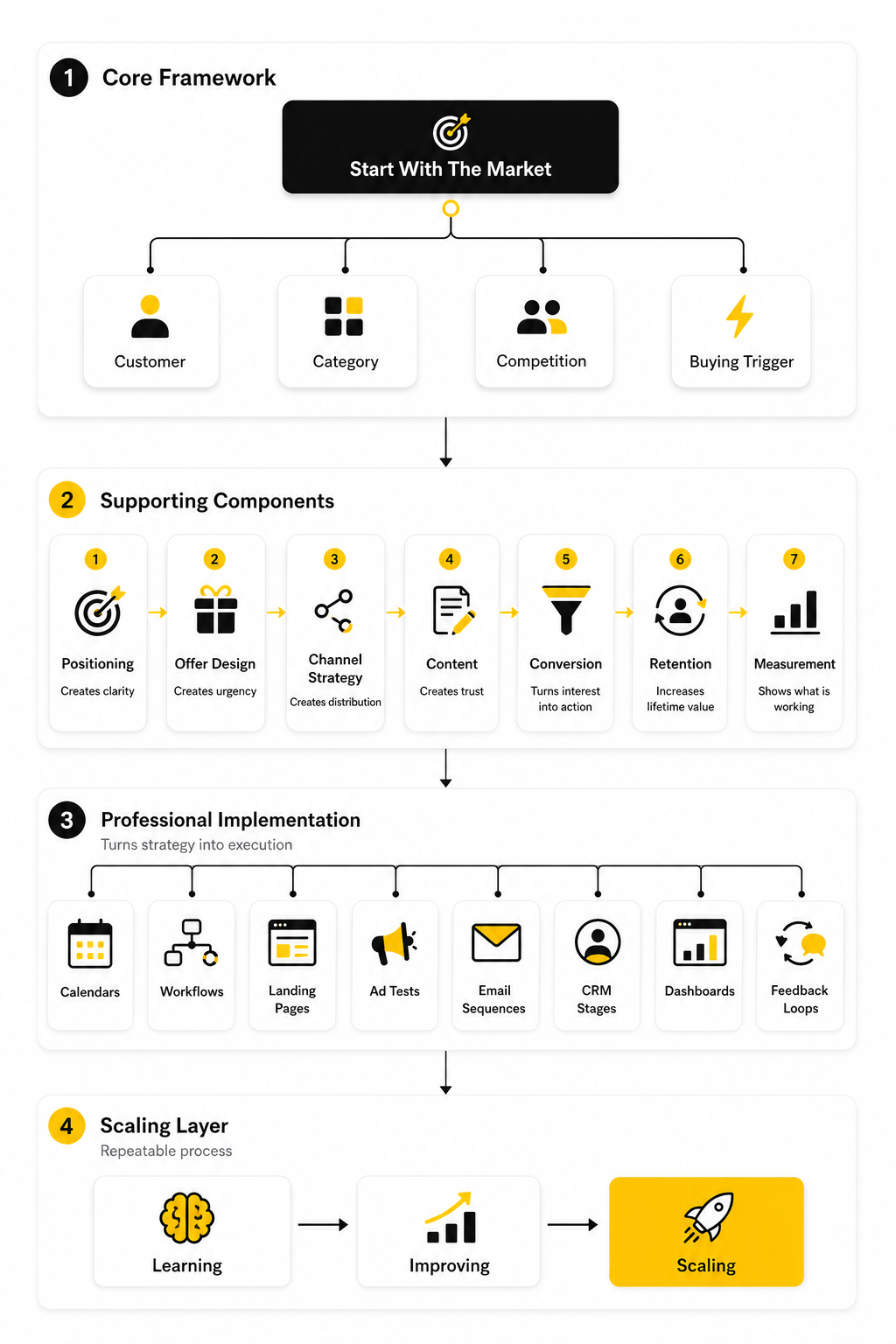
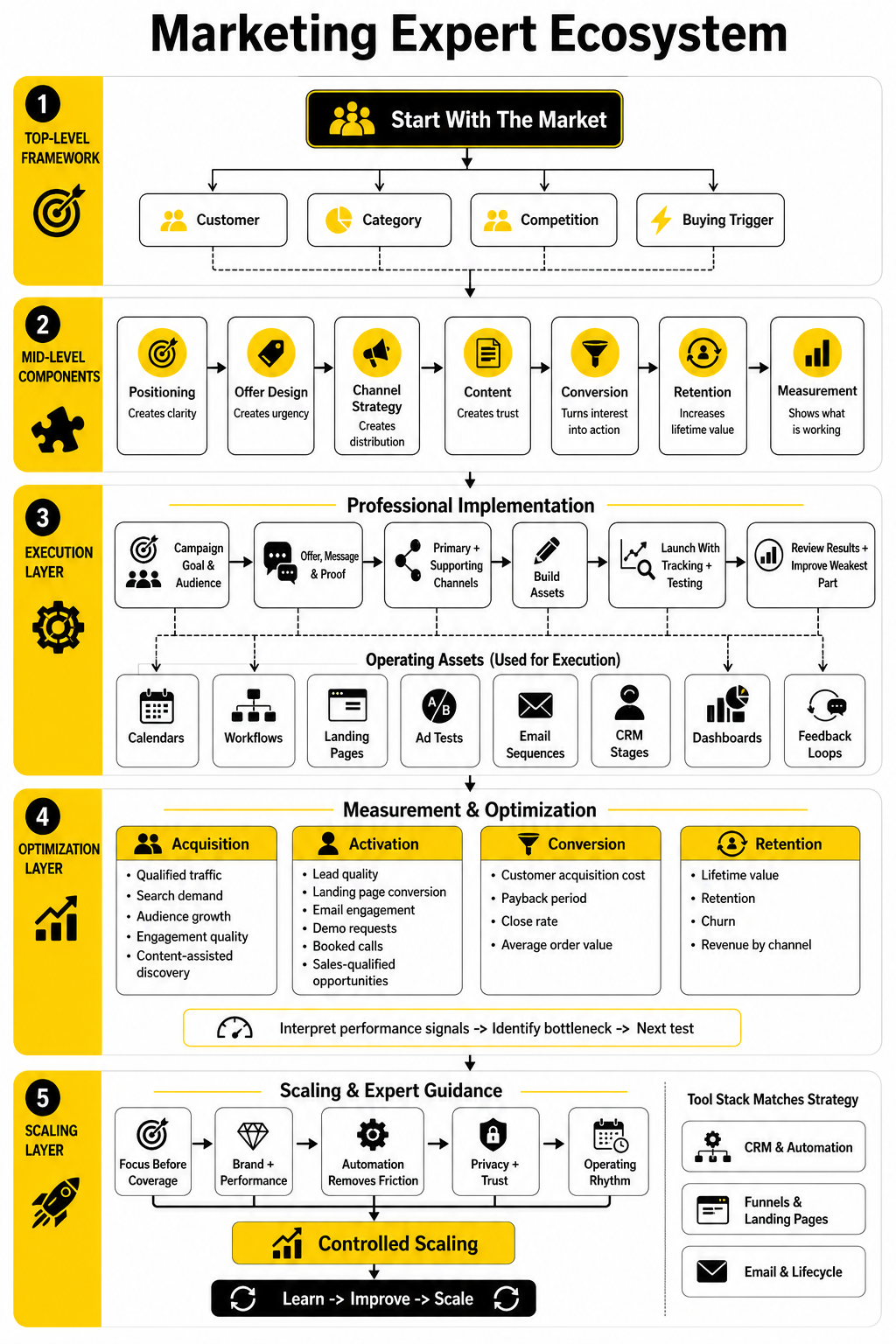
A practical marketing expert framework starts with the market, not the tool stack. Before choosing software, building funnels, or producing content, the expert needs to understand the customer, the category, the competition, and the buying trigger. Without that foundation, even the best creative or automation setup becomes expensive guesswork.
The framework then moves into positioning, offer design, channel strategy, content, conversion, retention, and measurement. Each part has a purpose: positioning creates clarity, the offer creates urgency, channels create distribution, content creates trust, conversion assets turn interest into action, retention increases lifetime value, and measurement shows what is working. When these parts are connected, marketing becomes a system instead of a pile of campaigns.
Professional implementation is the final layer. This is where a marketing expert turns strategy into calendars, workflows, landing pages, ad tests, email sequences, CRM stages, dashboards, and feedback loops. The difference is discipline: they do not just launch things; they build a repeatable process for learning, improving, and scaling.
Why A Marketing Expert Matters For Modern Growth
A marketing expert matters because growth has become too expensive to treat casually. When budgets are flat and competition keeps rising, the business cannot afford random campaigns, vague reporting, or content that sounds like everyone else. The companies that win are usually not the ones doing the most marketing; they are the ones making clearer decisions with better customer insight.
This is especially important now because marketing teams are being asked to produce more with the same or fewer resources. Gartner’s 2025 CMO Spend Survey showed marketing budgets holding at 7.7% of company revenue, which means many teams are not getting much extra room to experiment. A marketing expert helps protect the business from waste by turning limited resources into focused execution.
The real value is judgment. Anyone can publish posts, launch an ad, or connect an automation tool. A marketing expert knows which message deserves attention, which offer is worth testing, which audience is likely to convert, and which metric is actually tied to revenue.
Growth Needs Clarity Before More Activity
Most marketing problems are not volume problems at first. They are clarity problems. If the audience is too broad, the offer is weak, the positioning is fuzzy, or the message sounds generic, adding more content will only spread the confusion faster.
A marketing expert slows that down and forces the right questions. Who exactly are we trying to reach? What urgent problem are we solving? Why should the buyer choose this instead of doing nothing? These questions are basic, but skipping them is one of the fastest ways to waste time and budget.
This is why strategy comes before scale. Paid ads, SEO, email, webinars, short-form video, influencer campaigns, and outbound can all work, but none of them fixes a weak foundation by itself. The marketing expert’s job is to make sure each channel is carrying a message that deserves to be seen.
Buyers Expect A Connected Experience
Modern buyers do not experience your marketing in neat little boxes. They might discover you through a search result, check your LinkedIn page, read a comparison article, open an email, watch a short video, and then finally book a call. If those touchpoints feel disconnected, trust drops before the sales conversation even starts.
That consistency is not a “nice to have” anymore. Adobe’s 2025 customer engagement research found that 78% of customers want consistent brand experiences, which is exactly why scattered marketing hurts. People notice when the ad promises one thing, the landing page says another, and the follow-up email feels like it came from a different company.
A marketing expert helps connect those pieces. The message, visual direction, offer, customer proof, objections, and next step should feel aligned across the full journey. That does not mean every channel says the same thing word for word; it means every touchpoint reinforces the same belief.
AI Raises The Bar Instead Of Lowering It
AI has made marketing faster, but it has not made marketing easier to get right. HubSpot’s 2025 AI research found that 67% of marketers believe AI will significantly impact their work, which tells you where the industry is going. Speed is becoming normal, so the advantage shifts to taste, strategy, editing, customer understanding, and execution quality.
This is where weak marketers get exposed. AI can help generate ideas, draft emails, summarize research, build workflows, and repurpose content, but it cannot automatically know what your market believes, what your customer is afraid of, or what your offer needs to overcome hesitation. Without expert direction, AI often creates more output with less differentiation.
A strong marketing expert uses AI as leverage, not as a replacement for thinking. They still define the angle, check the logic, protect the brand voice, and make sure the campaign is tied to a real business goal. That is the difference between using AI to become more efficient and using AI to flood the market with forgettable content.
Data Only Helps When Someone Knows What To Do With It
Most businesses have more data than they use well. They can see traffic, clicks, form fills, open rates, call bookings, ad spend, pipeline, revenue, churn, and customer behavior, but the numbers often sit in separate tools. The problem is not access to data; the problem is interpretation.
Salesforce’s State of Marketing research is built around insights from nearly 4,500 marketers worldwide, with AI, data, and personalization becoming central themes. That makes sense because better marketing depends on seeing what customers do, not just what teams hope they will do. A marketing expert turns those signals into decisions.
This is practical work. If a campaign gets clicks but no qualified leads, the issue might be targeting, intent, landing page friction, or offer mismatch. If email engagement drops, the problem might be list quality, weak segmentation, poor timing, or messages that no longer match buyer priorities. The expert does not worship the dashboard; they use it to find the next move.
Better Marketing Protects Sales From Bad Demand
A marketing expert also matters because sales teams pay the price for poor marketing. If marketing attracts the wrong audience, sales spends time with people who cannot buy, do not understand the offer, or were pulled in by a misleading promise. That creates frustration on both sides and makes the business think it has a sales problem when the real issue started earlier.
Good marketing improves the quality of demand before a conversation happens. It educates buyers, filters poor-fit leads, frames the problem clearly, and sets expectations before someone books a call or starts a trial. That makes the sales process cleaner because the buyer arrives with more context and fewer basic objections.
This is why marketing and sales cannot be treated as separate worlds. A marketing expert should care about lead quality, close rates, sales feedback, objections, customer language, and revenue outcomes. If the work does not help the business win better customers, it is not expert-level marketing.
Expertise Creates Focus When Everything Looks Important
The hardest part of marketing is often deciding what not to do. There is always another trend, channel, campaign idea, tool, partnership, or content format asking for attention. Without strong judgment, teams spread themselves thin and mistake motion for momentum.
A marketing expert creates focus by ranking opportunities against the business model. A local service company, a B2B SaaS startup, an ecommerce brand, and a creator-led education business should not all use the same growth plan. The right strategy depends on deal size, buying cycle, customer awareness, margins, team capacity, and how trust is built in that market.
That focus is what makes execution stronger. The team knows which audience matters most, which channel deserves priority, which offer is being tested, and which metric decides whether the campaign continues. Marketing gets a lot calmer when the strategy is clear enough to say no.
The Marketing Expert Framework
A marketing expert needs a framework because marketing gets messy fast without one. There are too many channels, too many tools, too many opinions, and too many metrics that look useful but do not actually explain growth. The framework keeps the work grounded: understand the market, define the position, build the offer, choose the channels, execute the system, and improve it with data.
This is not theory for the sake of sounding smart. It is the practical sequence that stops a team from jumping straight into ads, emails, content, or automation before the business has answered the hard questions. When the structure is clear, every campaign has a purpose and every tool has a job.
The best marketing expert does not treat the framework as a rigid checklist. They use it as a decision system. If the business is early-stage, the work may lean heavily into research and positioning; if the business already has demand, the focus may shift toward conversion, lifecycle marketing, and better attribution.
Step 1: Understand The Market Before Touching The Campaign
The first step is market understanding. A marketing expert looks at who the customer is, what problem they are trying to solve, what alternatives they already consider, and what makes them hesitate. This includes customer interviews, review mining, sales call analysis, competitor research, search behavior, social listening, and direct feedback from support or sales teams.
This step matters because customers rarely describe their problems the way companies describe their products. The business might talk about features, integrations, workflows, or performance, while the buyer is thinking about risk, frustration, speed, trust, and whether the solution will make them look good internally. A marketing expert translates that gap into sharper messaging.
Strong market research also prevents lazy assumptions. If the team says “our audience is small businesses,” that is not enough. A useful audience definition should explain the buyer’s situation, pain, urgency, budget reality, decision process, and trigger event.
Step 2: Turn Positioning Into A Clear Reason To Choose You
Once the market is understood, the next step is positioning. Positioning defines where the offer sits in the buyer’s mind compared with every other option they could choose. That includes direct competitors, cheaper substitutes, internal workarounds, doing nothing, and delaying the decision until later.
A marketing expert makes positioning concrete by clarifying the category, the ideal customer, the main problem, the strongest promise, and the proof that supports it. This is where vague claims get cut. “We help businesses grow” is weak because almost every marketing service, SaaS tool, consultant, and agency can say the same thing.
Good positioning gives the buyer a reason to care quickly. It should make the right person feel understood and make the wrong person self-select out. That is not a problem; that is the point.
Step 3: Build An Offer That Makes Action Easier
Marketing gets much easier when the offer is strong. An offer is not just the product, service, or software being sold. It is the complete reason someone should act now, including the promise, outcome, pricing logic, guarantee, risk reversal, proof, urgency, and next step.
A marketing expert studies whether the offer matches the customer’s level of awareness. Someone who already knows they need a CRM may respond to a comparison, trial, or demo. Someone who only feels disorganized may need education first, because they have not yet connected their pain to the solution.
This is where tools can support the process, but they cannot replace the thinking. A funnel builder like ClickFunnels, an all-in-one CRM like GoHighLevel, or a landing page platform like Replo can help present the offer professionally. The marketing expert still has to decide what the offer should say, who it is for, and why the buyer should believe it.
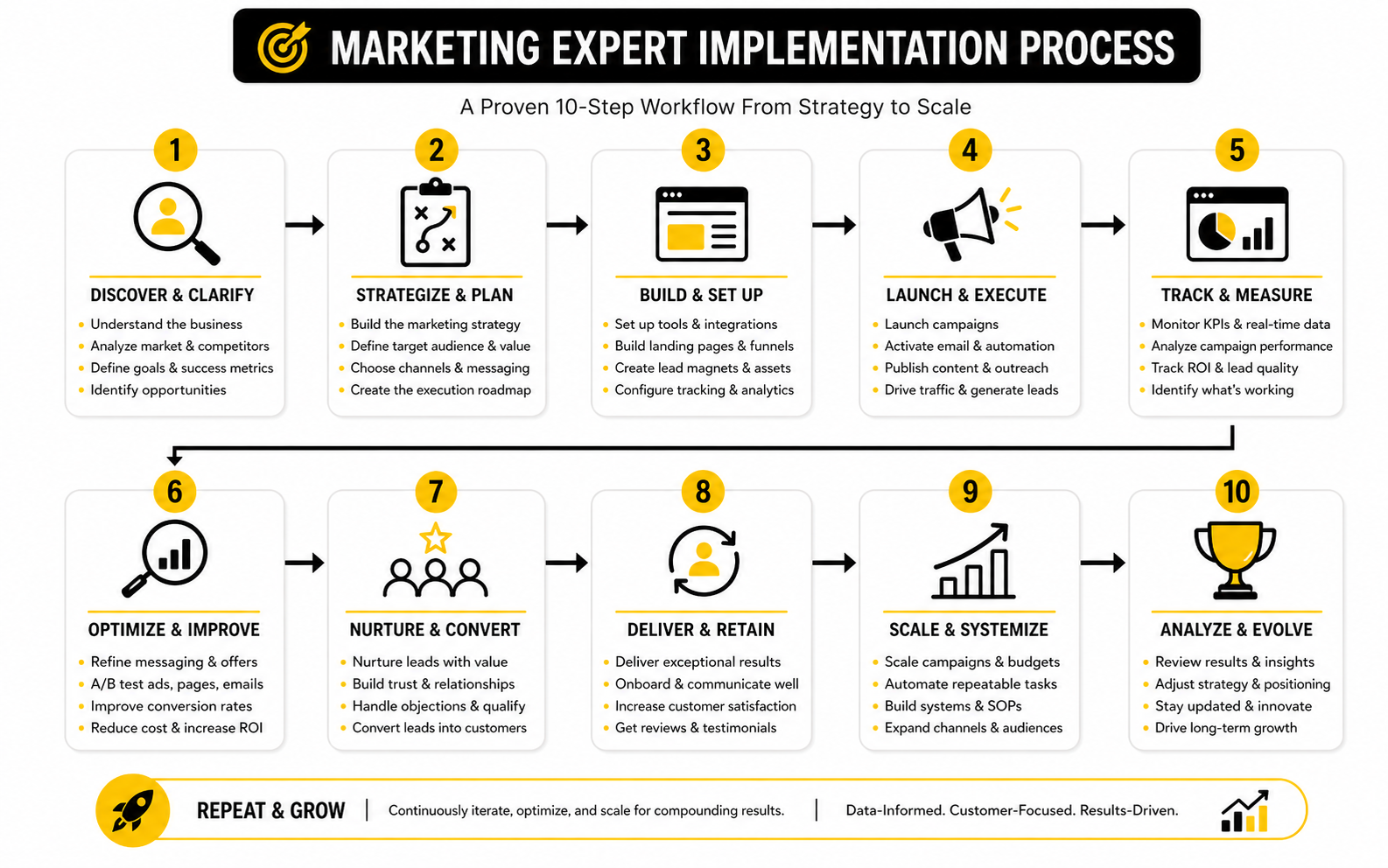
Step 4: Choose Channels Based On Buyer Behavior
A marketing expert chooses channels based on how the buyer actually discovers, evaluates, and buys. That sounds obvious, but many teams still pick channels because they are popular, familiar, or easy to outsource. The better question is not “Should we be on this platform?” but “Does this channel match the buyer’s intent and decision process?”
Search can work well when buyers already know the problem and are actively looking for a solution. Social content can work well when education, trust, authority, or category creation matters. Email can work well when the audience needs nurturing, follow-up, segmentation, and repeat communication.
The channel mix should also match team capacity. A business with no creative engine should be careful before committing to five short-form video platforms. A business with no sales follow-up process should be careful before spending aggressively on lead generation. The marketing expert protects the team from strategies that look good on paper but collapse in execution.
Step 5: Build The Execution System
This is where the framework becomes real. The marketing expert turns strategy into campaigns, content calendars, landing pages, lead magnets, email flows, tracking plans, CRM stages, sales handoff rules, and reporting dashboards. The work becomes tangible because every idea now needs an owner, deadline, asset, metric, and feedback loop.
A simple execution process often looks like this:
- Define the campaign goal and the audience segment.
- Clarify the offer, message, and proof points.
- Choose the primary channel and supporting channels.
- Build the assets needed for traffic, conversion, follow-up, and sales.
- Launch with clean tracking and a clear testing plan.
- Review results, identify the bottleneck, and improve the weakest part.
This is also where automation becomes useful. A platform like ManyChat can support conversational follow-up, while Brevo or Moosend can support email marketing. The key is to automate repeatable behavior without making the buyer feel like they are trapped in a machine.
Step 6: Measure The Bottleneck, Not Just The Outcome
A marketing expert does not only ask whether a campaign worked. They ask where the system slowed down. Was the traffic low quality, was the message unclear, did the landing page fail, did the follow-up break, did sales miss the timing, or did the offer simply not feel strong enough?
That is why measurement needs to go beyond surface metrics. Clicks, impressions, views, and open rates can be useful, but they do not tell the whole story. The important question is how each stage contributes to qualified demand, sales opportunities, customers, retention, and profit.
This is becoming more important as marketing teams deal with more data and more pressure to prove impact. Salesforce’s latest State of Marketing report is built around insights from nearly 4,500 marketers worldwide, with AI, data, and personalization sitting at the center of modern marketing operations. The marketing expert’s role is to turn that complexity into decisions the team can actually act on.
Step 7: Improve The System In Cycles
Marketing improvement should happen in cycles, not random reactions. After a launch, the expert reviews performance, identifies the biggest constraint, forms a clear hypothesis, changes one meaningful thing, and measures again. This keeps the team from changing everything at once and learning nothing.
For example, if a landing page gets traffic but few conversions, the next test might focus on the headline, offer framing, proof, form friction, or call to action. If leads convert but do not close, the next test may involve qualification, sales enablement, objection handling, or follow-up timing. Different bottlenecks need different fixes.
This is where expert marketing starts to compound. Each cycle creates sharper messaging, cleaner targeting, better assets, and stronger customer understanding. Over time, the business stops guessing and starts building a growth system that improves because the team knows exactly what it is learning.
Statistics And Data
A marketing expert does not use statistics to decorate a strategy. The numbers need to explain what is happening, why it is happening, and what the team should do next. Data only becomes useful when it changes a decision.
This is where a lot of marketing teams go wrong. They collect impressions, clicks, views, followers, open rates, conversion rates, pipeline, and revenue, but they do not connect those numbers into one readable system. A marketing expert separates performance signals from vanity metrics so the business can see where growth is actually coming from.
The goal is not to stare at dashboards all day. The goal is to build a measurement rhythm that helps the team spot bottlenecks early, test better ideas, and stop wasting time on campaigns that look active but do not create qualified demand.
The Numbers That Actually Matter
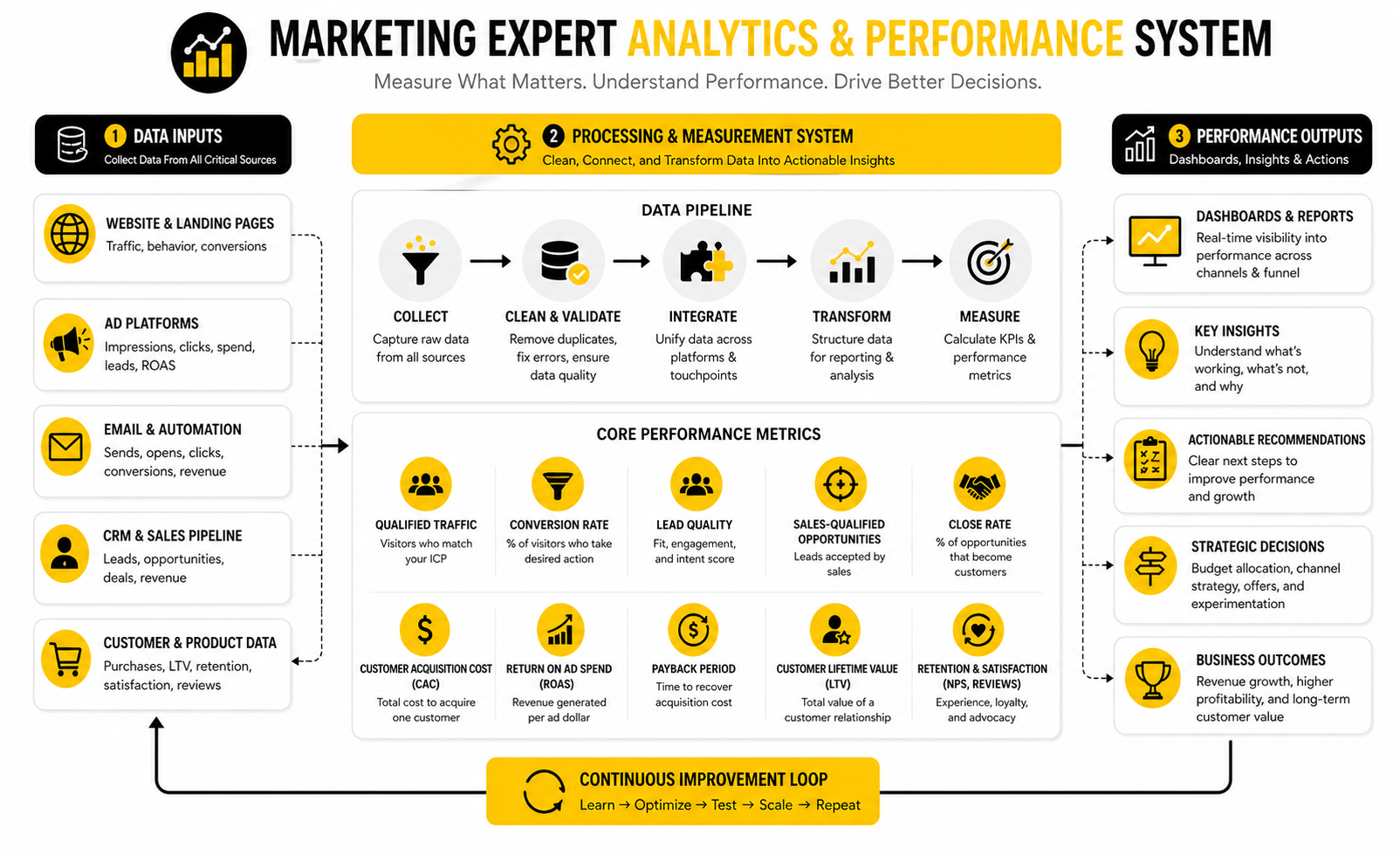
The most useful marketing numbers are the ones tied to movement through the customer journey. At the top, that might include qualified traffic, search demand, audience growth, engagement quality, and content-assisted discovery. In the middle, it usually includes lead quality, landing page conversion, email engagement, demo requests, booked calls, and sales-qualified opportunities.
At the bottom, the numbers get even more important. A marketing expert looks at customer acquisition cost, payback period, close rate, average order value, lifetime value, retention, churn, and revenue by channel. These metrics tell the business whether marketing is creating profitable growth or just buying attention.
The mistake is judging every channel by the same metric. A thought leadership article, a retargeting ad, a webinar, a sales email, and a direct-response landing page do different jobs. The expert’s job is to measure each asset against the role it is supposed to play.
Benchmarks Are Starting Points, Not Targets
Benchmarks can be useful, but they are not the truth. A conversion rate that looks weak in one business model might be strong in another because the deal size, buyer intent, price point, and sales cycle are completely different. A marketing expert uses benchmarks for context, then quickly shifts the conversation back to the company’s own baseline.
This matters because average numbers can make teams lazy. If a landing page is converting above a public benchmark, the team may stop improving it even though the offer could still perform much better. If an email campaign is below average, the team may panic even though the list is colder, the buying cycle is longer, or the message is intentionally qualifying people out.
The better question is simple: are we improving the right number for the right reason? If the answer is yes, the team is learning. If the answer is no, the benchmark is just noise.
Budget Pressure Makes Measurement More Important
Marketing teams are not operating with unlimited room to experiment. Gartner’s 2025 CMO Spend Survey reported that marketing budgets remained at 7.7% of overall company revenue, which means efficiency matters. When budgets are tight, weak measurement gets expensive very quickly.
A marketing expert helps the business decide where money is producing leverage and where it is leaking. That might mean cutting a campaign with cheap leads but poor close rates, or increasing spend on a channel that looks expensive upfront but creates better customers. The surface number is rarely enough.
Budget discipline also protects the team from emotional decisions. Without clean measurement, one loud opinion can kill a good campaign too early or keep a bad one alive too long. Data does not remove judgment, but it gives judgment something solid to stand on.
A Simple Analytics System For Marketing Decisions
A useful analytics system should show the journey from first touch to revenue without burying the team in noise. The marketing expert should be able to see where people come from, what they respond to, where they drop off, what converts, what sales accepts, and what eventually becomes revenue. If the system cannot answer those questions, it is not finished.
A practical setup usually tracks four layers:
- Acquisition: where attention and traffic come from.
- Activation: which visitors or leads take a meaningful next step.
- Conversion: which opportunities become customers.
- Retention: which customers stay, buy again, refer, or expand.
This does not require a complicated tech stack from day one. A CRM like GoHighLevel, email platforms like Brevo or Moosend, and clean campaign tracking can already give a small team enough visibility to make better decisions. The important part is not having the fanciest dashboard; it is having numbers the team trusts.
Attribution Should Inform Decisions, Not Start Fights
Attribution is useful, but it can become a trap. If a team argues endlessly about whether paid search, organic content, email, social, or sales “deserves credit,” they can miss the bigger picture. Buyers rarely move through one clean channel, so attribution should help explain influence instead of pretending the journey is perfectly linear.
A marketing expert looks at attribution with context. First-touch data can show what creates discovery. Last-touch data can show what pushes action. Assisted conversion data can show which assets help buyers move forward even when they are not the final click.
This is especially important for content and brand activity. A strong article, video, comparison page, or newsletter may influence a buyer long before they submit a form. If the business only measures the final click, it may underinvest in the very assets that create trust.
Performance Signals Need Interpretation
A number by itself does not tell you what to do. A low conversion rate could mean the traffic is wrong, the headline is unclear, the offer is weak, the page loads slowly, the form asks for too much, or the buyer is not ready yet. A marketing expert treats the metric as a clue, not a verdict.
The same is true for strong performance. A campaign with a high click-through rate may still attract poor-fit leads. A webinar with lower attendance may still create better opportunities if the audience is more qualified. A smaller email list may outperform a large one if segmentation and intent are stronger.
This is why interpretation matters more than reporting volume. The expert does not just say what happened. They explain what probably caused it, what risk remains, and what the next test should be.
AI Makes Clean Data More Valuable
AI is changing marketing operations, but it also makes data quality more important. HubSpot’s 2025 AI research found that 67% of marketers believe AI will significantly impact their work, which means more teams are using AI to speed up research, content, reporting, personalization, and campaign planning. That speed only helps when the inputs are reliable.
If customer data is messy, AI can scale the mess. Poor segmentation creates irrelevant messages faster. Bad attribution creates confident but misleading reports. Weak customer insight creates content that sounds polished but misses the real buying trigger.
A marketing expert keeps the human layer in the system. They use AI to accelerate analysis, summarize patterns, draft variations, and organize information, but they still check whether the output matches the market. That judgment is non-negotiable.
Personalization Depends On Data Discipline
Personalization sounds powerful, but it gets awkward when the data behind it is poor. Salesforce’s State of Marketing report is based on insights from nearly 4,500 marketers worldwide and centers heavily on AI, data, and personalization. That focus makes sense because modern buyers expect relevance, not random blasts.
A marketing expert does not personalize just to show off. They personalize when it helps the buyer receive a clearer message, a better next step, or a more relevant offer. That might mean segmenting by industry, lifecycle stage, behavior, company size, use case, or level of intent.
The action point is simple: collect only the data you can use responsibly. More fields, tags, and segments do not automatically create better marketing. Clean, meaningful data beats bloated data every time.
The Best Reports Lead To Action
A good marketing report should make the next decision easier. It should show what changed, why it matters, what the team learned, and what should happen next. If a report only lists metrics without interpretation, it is not really a report; it is a screenshot collection.
A marketing expert usually builds reporting around a few direct questions. Are we attracting the right audience? Are the right people taking the next step? Are leads becoming opportunities? Are opportunities becoming customers? Are customers staying long enough to justify the acquisition cost?
This keeps measurement practical. The team does not need more noise. It needs a clear view of the growth system and the confidence to improve the weakest link.
How Marketing Experts Implement Strategy Professionally
A marketing expert becomes most valuable when strategy turns into pressure. It is easy to talk about positioning, channels, data, and customer journeys when nothing has launched yet. The real test starts when budgets are live, deadlines move, sales wants more leads, leadership wants clearer reporting, and the market does not respond exactly how the plan predicted.
Professional implementation is about making better decisions under those conditions. It means building a system that can absorb feedback without becoming chaotic. A marketing expert does not panic every time a metric moves; they look for the signal, compare it against the goal, and decide whether the team needs patience, a better test, or a sharper change.
This is also where experience matters. A beginner often treats every campaign as a separate project. An expert treats every campaign as one more learning cycle inside a larger growth system.
Strategy Has To Survive Real Constraints
The best strategy is not the one that sounds impressive in a document. It is the one the team can actually execute with the budget, talent, time, data, and tools they have. That is why a marketing expert always looks at constraints before recommending a plan.
A small team with one marketer should not copy the playbook of a large company with specialists for SEO, paid media, lifecycle marketing, analytics, design, video, and partnerships. A business with a long sales cycle should not judge campaigns the same way an impulse-buy ecommerce brand does. A company with weak customer proof should not pretend it can scale cold traffic before fixing trust.
This is where practical judgment beats generic advice. The expert looks at the business model and asks what has the highest chance of working now, not what sounds exciting in a trend report. That one distinction saves a lot of money.
Scaling Creates New Problems
Early marketing problems are usually about finding traction. Scaling problems are different. Once something starts working, the business has to keep performance stable while increasing volume, improving operations, and avoiding message fatigue.
A campaign that works with a small audience can weaken when pushed to a broader market. A sales team that handles ten qualified calls well may struggle with fifty. A nurture sequence that felt personal at one stage can become generic once the list grows and segmentation gets ignored.
A marketing expert plans for this before the system breaks. They watch lead quality, customer fit, sales capacity, onboarding friction, retention, and margin as volume increases. Growth is only healthy if the business can deliver on the demand it creates.
The Biggest Tradeoff Is Focus Versus Coverage
Every marketing team feels the temptation to be everywhere. Search, paid ads, email, LinkedIn, TikTok, YouTube, partnerships, webinars, communities, affiliates, newsletters, podcasts, events, and outbound can all look important. The problem is that most teams cannot do all of them well at the same time.
A marketing expert helps the team choose focus before coverage. Focus means going deep enough on a few channels to understand the audience, improve the assets, and learn what drives conversion. Coverage means appearing in more places, but often with weaker consistency and less learning.
There are times when broader coverage makes sense, especially for mature brands with the resources to maintain quality. But for most growing businesses, the smarter move is to win one or two channels before expanding. Depth creates insight; scattered activity creates exhaustion.
Brand And Performance Need Each Other
One of the worst marketing debates is brand versus performance. Treating them as enemies misses how buyers actually make decisions. Performance marketing can capture demand, but brand, trust, category awareness, and reputation often influence whether that demand exists in the first place.
A marketing expert balances both sides. Performance channels need clear offers, tracking, and conversion discipline. Brand activity needs consistency, distinctiveness, customer relevance, and patience.
This balance matters even more when customer experience is fragile. PwC’s 2025 Customer Experience Survey found that 52% of consumers stopped using or buying from a brand because of a bad experience with its products or services. Marketing can create interest, but the full business has to protect trust after that interest turns into action.
Automation Should Remove Friction, Not Humanity
Automation is powerful when it helps the buyer move faster and helps the team follow up consistently. It becomes a problem when it makes every interaction feel cold, generic, or disconnected from the customer’s actual behavior. A marketing expert knows the difference.
The right automation handles repeatable steps: lead capture, routing, reminders, segmentation, onboarding prompts, abandoned actions, appointment follow-ups, and post-purchase communication. Tools like GoHighLevel, ManyChat, and Brevo can support that kind of system when the strategy is already clear. The tool should make the experience cleaner, not noisier.
The risk is over-automation. If every lead gets the same message, every segment receives the same offer, and every follow-up ignores context, the business trains people to tune out. Better automation feels timely, relevant, and useful.
Privacy And Trust Are Now Strategic Issues
Data-driven marketing only works when customers trust how their data is being used. Personalization can improve relevance, but it can also feel invasive when it is poorly explained or based on weak permission. A marketing expert treats privacy as part of the strategy, not a legal detail shoved to the bottom of the page.
This matters because buyers are more aware of data use than they used to be. Qualtrics’ 2025 research on privacy and personalization shows that consumers want more relevant experiences while also being highly concerned about how their data is collected and used. That tension is exactly where careless marketing creates risk.
The practical move is simple: collect data with a clear purpose, use it to improve the customer experience, and avoid creepy personalization. Trust is hard to earn and very easy to burn. No campaign is worth damaging it.
Expert-Level Marketing Requires Better Questions
At a certain point, the marketing expert’s value is not just knowing more tactics. It is asking better questions than the team would ask on its own. Better questions reveal the hidden constraint behind the obvious symptom.
If leads are low, the question is not only “How do we get more traffic?” It might be “Is the offer strong enough for cold demand?” or “Are we trying to convert buyers before they understand the problem?” If conversion is weak, the question is not only “Should we redesign the page?” It might be “Does the page answer the real objection?”
This is why expert-level guidance can feel slower at first. The expert resists jumping to the easiest fix because the easiest fix is often cosmetic. They look for the decision that changes the system.
Scaling Requires Operating Rhythm
Marketing does not scale on ideas alone. It scales through rhythm. The team needs a predictable way to plan, launch, measure, learn, and improve without reinventing the process every month.
A strong operating rhythm usually includes weekly performance reviews, monthly campaign planning, quarterly strategy resets, and regular feedback from sales or customer success. The point is not bureaucracy. The point is to make learning consistent enough that the business does not depend on heroic last-minute pushes.
A marketing expert keeps that rhythm honest. They make sure the team is not hiding behind dashboards, chasing trends, or launching campaigns with no clear hypothesis. Calm, consistent execution is underrated, but it is often what separates serious growth from random bursts of activity.
The Best Experts Know When Not To Scale
Not every working campaign should be scaled immediately. Sometimes the audience is too small, the margin is too thin, the sales team is not ready, the offer needs stronger proof, or the early results are based on a narrow segment that will not hold up at higher volume. A marketing expert knows that scaling too early can damage both performance and reputation.
This is especially important with paid acquisition. If the business increases spend before understanding lead quality, close rates, retention, and payback, it can turn a promising channel into an expensive problem. More traffic does not fix a weak system; it exposes it faster.
The smarter move is controlled scaling. Increase volume gradually, watch the full funnel, protect customer experience, and keep improving the offer as demand grows. That is how a marketing expert turns early traction into something the business can actually sustain.
Tools, Mistakes, Hiring Guidance, And FAQ
By this point, the role of a marketing expert should feel less mysterious and much more practical. The job is not to know every tactic on the internet. The job is to understand the market, build a growth system, measure the right signals, and keep improving the parts that matter.
This final section brings the ecosystem together. It covers the tools that can support expert execution, the mistakes that weaken marketing teams, the signs that a business is ready to hire help, and the questions people usually ask before working with a marketing expert. The point is simple: better marketing comes from better decisions, not just more software or more content.
The Tool Stack Should Match The Strategy
A marketing expert does not build a tech stack by collecting trendy tools. They choose tools based on the work the business needs to do repeatedly. If the strategy depends on lead capture, appointment booking, nurture sequences, pipeline management, and follow-up, then a CRM and automation platform like GoHighLevel can make sense.
If the business needs funnels, checkout flows, lead magnets, or campaign pages, a platform like ClickFunnels may fit the execution plan. If ecommerce landing pages need more control, Replo can be useful. For email and lifecycle communication, tools like Brevo, Moosend, and ManyChat can support specific parts of the system.
The mistake is expecting the tool to create the strategy. A weak offer inside a polished funnel is still a weak offer. A messy message inside an advanced automation workflow is still messy. Tools amplify the thinking behind them, so the thinking has to be strong first.
Common Mistakes That Make Marketing Feel Harder Than It Is
The first mistake is chasing channels before defining the market. When a team does not know who it is speaking to or why those people should care, every channel feels unpredictable. The team ends up blaming the platform when the real problem is unclear positioning.
The second mistake is measuring activity instead of progress. Publishing more, launching faster, and sending more emails can look productive, but none of that matters if the right people are not moving closer to a buying decision. A marketing expert keeps the team focused on meaningful movement, not just visible motion.
The third mistake is scaling too early. A business should not pour money into traffic before the offer, conversion path, sales handoff, and customer experience can handle it. PwC’s 2025 customer experience research found that 52% of consumers stopped using or buying from a brand after a bad product or service experience, so demand generation has to be matched by delivery quality.
When To Hire A Marketing Expert
You should consider hiring a marketing expert when the business has enough traction to know there is demand, but not enough clarity to scale it predictably. That might look like inconsistent leads, unclear channel performance, weak conversion rates, poor reporting, or a team that is busy but unsure what is actually working. These are not small problems; they are growth constraints.
You may also need expert help when leadership keeps asking the same questions and nobody has a confident answer. Which channel creates the best customers? Why are leads not closing? What should we stop doing? Where should the next dollar go? A strong marketing expert brings structure to those decisions.
Hiring also makes sense when the team has tools but no operating system. If the CRM is messy, campaigns are not tagged properly, follow-up is inconsistent, and reporting is manual, the issue is not only tactical. The business needs someone who can connect strategy, systems, and accountability.
How To Evaluate A Marketing Expert Before Hiring
Do not judge a marketing expert only by how confident they sound. Confidence is easy. What matters is how they think through the business, the customer, the offer, and the constraints.
Ask them how they would diagnose the current growth system before launching anything new. A strong expert should talk about research, positioning, conversion paths, lead quality, sales feedback, data reliability, and customer experience. If they jump straight to “run ads” or “post more content,” be careful.
You should also look for clear communication. The best experts can explain complex tradeoffs in plain language. They do not hide behind jargon, and they do not pretend marketing is magic. They make the next decision easier.
FAQ - Built For Complete Guide
What Is A Marketing Expert?
A marketing expert is a professional who helps a business understand its market, position its offer, reach the right audience, and turn attention into measurable growth. They usually work across strategy, messaging, channels, analytics, conversion, and execution. The best ones connect those areas instead of treating marketing as a set of disconnected tasks.
What Does A Marketing Expert Actually Do?
A marketing expert diagnoses the current growth system, identifies the strongest opportunities, and helps the team execute campaigns with clear goals. That can include customer research, positioning, funnel planning, content strategy, email marketing, paid acquisition, CRM setup, analytics, and sales alignment. Their real job is to improve decisions so marketing creates better business outcomes.
How Is A Marketing Expert Different From A Marketing Specialist?
A specialist usually focuses on one area, such as SEO, paid ads, email, social media, design, or analytics. A marketing expert usually sees the broader system and understands how those areas work together. Specialists are valuable, but an expert helps decide which specialist work should happen first and why.
Does Every Business Need A Marketing Expert?
Not every business needs a full-time marketing expert immediately. Very early businesses may first need founder-led sales, customer conversations, and basic proof that people want the offer. Once the business has demand but needs clearer positioning, better execution, or more predictable growth, expert marketing support becomes much more valuable.
What Skills Should A Marketing Expert Have?
A strong marketing expert should understand customer research, positioning, copywriting, channel strategy, analytics, offer design, conversion optimization, and project execution. They should also be comfortable with tools, but not dependent on them. The most important skill is judgment because the wrong priority can waste months.
How Do I Know If A Marketing Expert Is Good?
A good marketing expert asks sharp questions before giving answers. They want to understand the business model, customer, offer, sales process, margins, constraints, and data before recommending tactics. They should be able to explain what they would test, why it matters, and how success would be measured.
Should A Marketing Expert Handle Ads?
A marketing expert can handle ads, but ads should not be the default answer to every growth problem. Paid acquisition works best when the offer, landing page, tracking, follow-up, and sales process are already strong enough to convert demand. If those pieces are weak, more ad spend usually exposes the problem faster.
Should A Marketing Expert Use AI?
Yes, but AI should support expert thinking instead of replacing it. HubSpot’s 2025 AI research shows that AI is now a major part of marketing work, with marketers using it for tasks like content, research, analysis, and planning through its 2025 AI trends research. A strong expert uses AI to move faster while still protecting strategy, accuracy, brand voice, and customer insight.
What Marketing Metrics Should A Marketing Expert Track?
The right metrics depend on the business model, but the core system usually includes qualified traffic, conversion rate, lead quality, sales-qualified opportunities, close rate, customer acquisition cost, payback period, lifetime value, retention, and revenue by channel. Surface metrics can still be useful, but only when they explain movement toward revenue or trust. A marketing expert should make the dashboard easier to act on, not harder to understand.
How Much Should A Business Spend On Marketing?
There is no universal number because spend depends on the market, margins, growth stage, competition, and sales cycle. Gartner’s 2025 CMO Spend Survey reported that average marketing budgets remained at 7.7% of overall company revenue, but averages should not become automatic targets. A marketing expert helps decide what level of spend is justified by the return, not by a generic benchmark.
Can A Marketing Expert Help With Sales?
Yes, especially when marketing and sales are closely connected. A marketing expert can improve lead quality, buyer education, qualification, follow-up, objection handling, and sales enablement assets. They do not replace the sales team, but they can make sales conversations cleaner by improving what happens before the call.
What Is The Biggest Red Flag When Hiring A Marketing Expert?
The biggest red flag is a one-size-fits-all answer. If someone recommends the same channel, funnel, content plan, or ad strategy before understanding the business, they are probably selling a tactic instead of solving a problem. Real expertise adapts to the customer, offer, market, and constraints.
How Long Does It Take To See Results From Expert Marketing?
Some improvements can show up quickly, especially when the problem is obvious, such as broken follow-up, weak landing page messaging, or poor offer clarity. Bigger gains usually take longer because the team has to test positioning, build assets, collect data, and improve the system. The important thing is to look for early learning signals, not just final revenue outcomes.
What Tools Should A Marketing Expert Know?
A marketing expert should understand CRMs, analytics platforms, landing page builders, email marketing tools, automation platforms, social scheduling tools, and reporting systems. The exact tool names matter less than knowing how the tools fit together. Still, platforms like GoHighLevel, ClickFunnels, Buffer, Brevo, and ManyChat are useful when they support the strategy.
Is A Marketing Expert Worth It For Small Businesses?
A marketing expert can be worth it for a small business when the business has a real offer, some proof of demand, and a need for better focus. Small teams cannot afford to waste effort across too many channels, so expert guidance can prevent expensive detours. The value comes from choosing the right next move, not from doing everything at once.
Work With Professionals
Explore 10K+ Remote Marketing Contracts On MarkeWork.com
Most marketers spend too much time chasing clients, competing on crowded platforms, and losing a percentage of every project to middlemen.
MarkeWork gives you a better way. Browse thousands of remote marketing contracts and connect directly with companies desperate to hire skilled marketers like you, without platform commissions and without unnecessary gatekeepers.
If you're serious about finding better opportunities and keeping 100% of what you earn, explore available contracts and create a profile for free at MarkeWork.com.