

Marketing for small business is not about being everywhere. It is about being easy to find, easy to trust, and easy to buy from when the right customer is ready. That matters more now because discovery is fragmented, buyer journeys are messier, and people move between search, social, reviews, maps, video, and direct messages before they make a decision.
The upside is that small businesses do not need enterprise budgets to compete. They need a clear message, a tight channel mix, and a way to measure whether marketing is producing calls, bookings, website clicks, store visits, and repeat purchases. That is exactly what this article will build.
Article Outline
- Why Marketing Matters for Small Businesses
- The Small Business Marketing Framework
- The Core Channels That Pull Their Weight
- How to Turn Attention Into Leads and Sales
- How to Implement Marketing Professionally on a Small Budget
- Frequently Asked Questions About Marketing for Small Business
Why Marketing Matters for Small Businesses
Small businesses operate in a market where trust is earned in public. A verified Google Business Profile can help customers find a business, build trust, and send people to its website, social profiles, booking links, and more. Google also gives owners visibility into calls, website clicks, bookings, messages, and search terms, which means even a lean team can tie visibility to real customer actions instead of guessing](https://support.google.com/business/answer/9918094?hl=en).
That visibility matters because people do not discover brands through one neat funnel anymore. The latest global digital research shows that the typical internet user discovers brands through an average of 5.8 different sources, while search engines remain the top source of brand discovery at 32.8%. In plain English, marketing for small business works best when search, reviews, content, and follow-up support each other instead of operating like separate projects.
Reputation now carries more weight than many owners realize. BrightLocal’s 2026 Local Consumer Review Survey describes reviews as one of the most powerful drivers of trust and decision-making, while its 2025 edition found that over three-quarters of U.S. consumers consume video content when researching local businesses. That combination changes the job of marketing: you are not just promoting an offer, you are proving credibility in the places customers already check.
The Small Business Marketing Framework
Most small businesses get stuck because they treat marketing like a pile of disconnected tactics. The better approach is to run a simple system: attract the right people, help them trust you quickly, give them an obvious next step, and follow up until they either buy or clearly opt out. The U.S. Small Business Administration’s marketing guidance reflects the same basic logic by starting with target market, sales plan, and measurable goals before tactics.
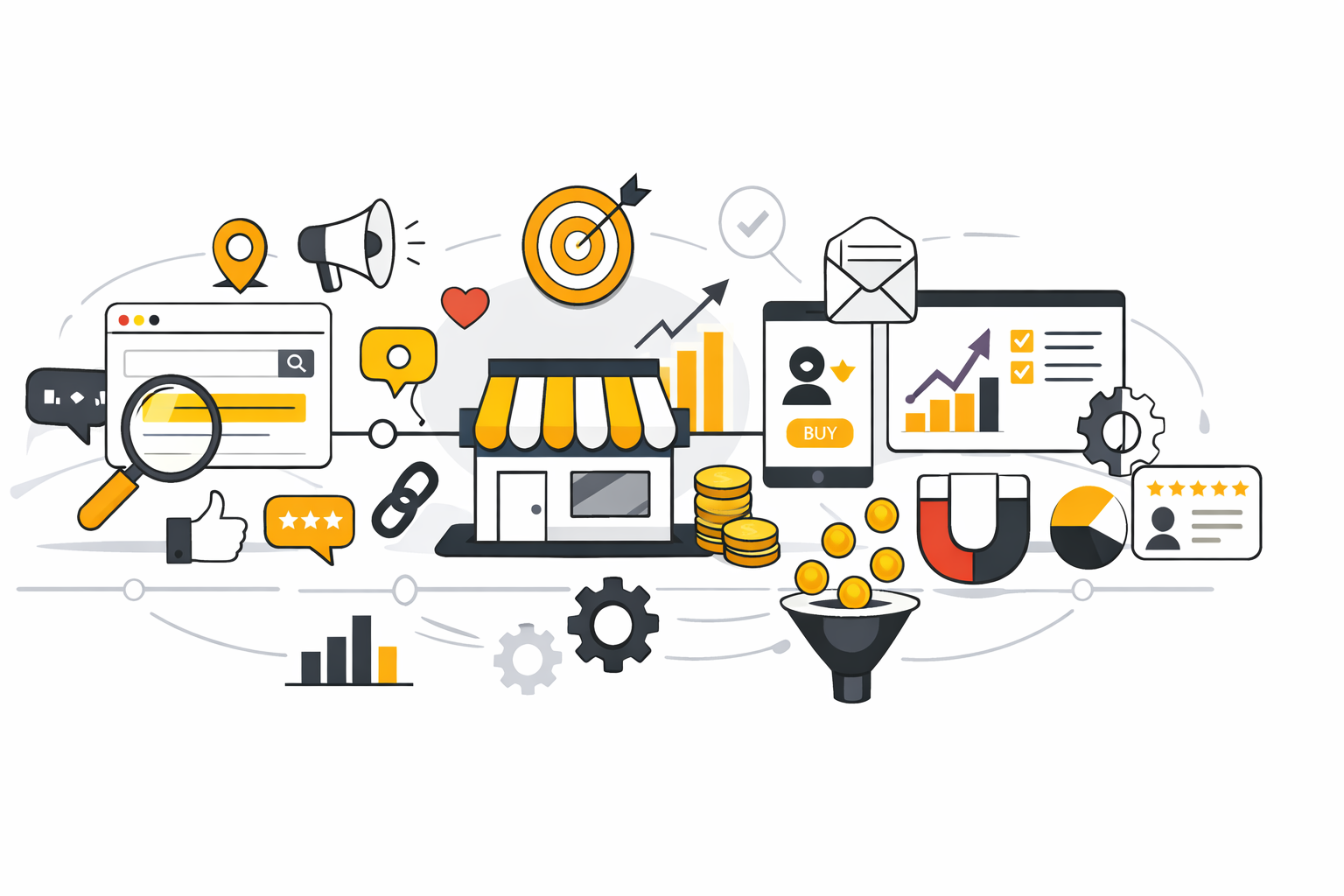
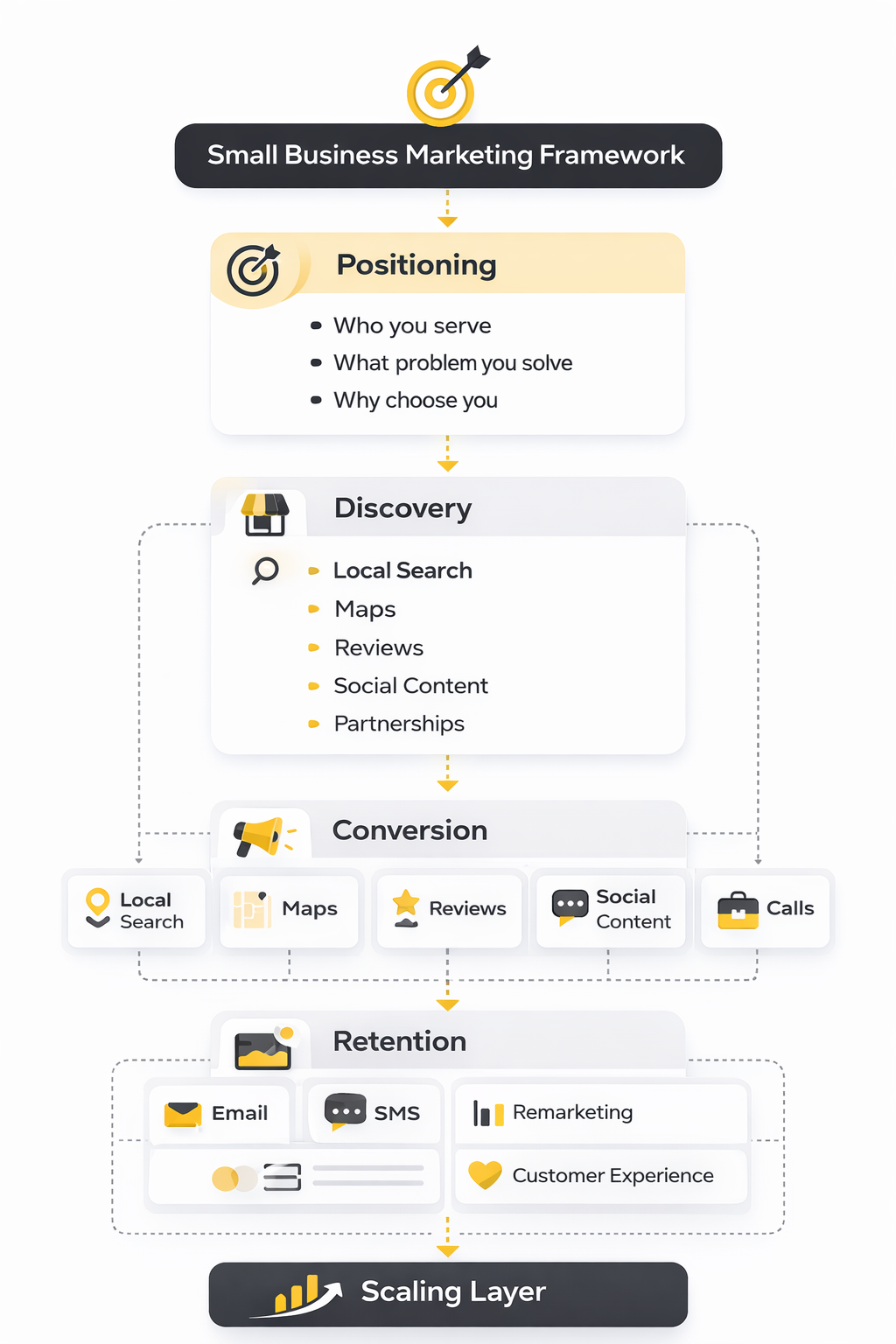
A practical framework for marketing for small business has four layers. First comes positioning, which answers who you serve, what problem you solve, and why someone should choose you. Second comes discovery, which includes local search, maps, reviews, social content, partnerships, and any channel that puts you in front of in-market buyers. Third comes conversion, where your website, landing pages, offers, forms, calls, and booking flow make it easy to take action. Fourth comes retention, where email, SMS, remarketing, and customer experience turn one sale into repeat revenue.
This framework works because it matches how real customers behave now. Google’s own guidance on modern buying behavior shows that consumer journeys have become more fluid, with people moving across streaming, scrolling, searching, and shopping instead of following a straight line to purchase](https://business.google.com/en-all/think/consumer-insights/new-consumer-decision-making-process/?ucbcb=1). At the same time, Verizon’s 2025 State of Small Business Survey found that sales and social media marketing were each used by 52% of decision-makers as leading outreach tactics, which reinforces a practical truth: small businesses need coordinated channels, not random activity.
The rest of this article will stay anchored to that system. We will move from the channels that deserve budget, to the mechanics of turning attention into leads, to the operational side of implementing marketing professionally without wasting time or cash. That way, you are not left with abstract advice; you get a structure you can actually run.
The Core Channels That Pull Their Weight
A lot of advice about marketing for small business falls apart because it treats every channel like it deserves equal time. It does not. The channels that matter most are the ones that match buyer intent, help people trust you fast, and give you a clean path from attention to action.
For most small businesses, that means starting with local search and reviews, then tightening your website or landing pages, and then building a follow-up layer through email, SMS, or direct messaging. That order matters because discovery without conversion wastes traffic, and conversion without follow-up leaves money sitting on the table.
Local Search and Reviews Come First
If your business serves a geographic area, local search is usually the highest-intent starting point. Google explains that local visibility is shaped by relevance, distance, and prominence, and it also states that complete and accurate profile information improves the odds of appearing for relevant searches](https://support.google.com/business/answer/7091?hl=en). That is why marketing for small business should begin with the basics that many owners skip: precise categories, accurate hours, updated services, strong photos, review generation, and a landing page that matches what the profile promises.
This is not just about showing up. It is about turning search visibility into measurable actions. Google’s own profile reporting lets owners track calls, website clicks, direction requests, bookings, and other interactions from Search and Maps](https://support.google.com/business/answer/9918094?hl=en), which makes local search one of the few channels where even a lean operator can connect visibility to real business outcomes.
Reviews sit inside this channel, not next to it. BrightLocal’s 2026 review survey and its 2026 review strategy findings show that consumers are paying close attention not just to star ratings, but to recency and review quality as well. So if you are serious about marketing for small business, stop treating reviews as a passive byproduct and start treating them like an active acquisition asset.
Your Website Has to Close the Gap
Once someone discovers you, your website has one job: reduce hesitation. The SBA’s marketing and sales guidance emphasizes planning around your target customer and sales process, and that is exactly how a small-business website should be built. It should answer who you help, what you offer, why people trust you, and what they should do next without making them hunt for the basics.
This is where many small businesses quietly lose deals. A profile on search or social can earn the click, but the website has to finish the job with clear service pages, proof, FAQs, pricing cues where appropriate, and an obvious call to action. If a visitor cannot tell within a few seconds whether you are relevant, available, and credible, your marketing is forcing them to do extra work, and most people will not.
You do not need a bloated site to fix that. You need focused pages built around real buying intent, which is why some businesses prefer simple funnel-style builds through tools like ClickFunnels, Systeme.io, or Replo when speed and clarity matter more than complexity. The right choice depends on your model, but the principle stays the same: every page should move the visitor one step closer to calling, booking, buying, or replying.
Email, SMS, and Messaging Turn Interest Into Revenue
Small businesses often obsess over reach and ignore follow-up. That is a mistake because not every prospect buys on the first visit, and not every past customer remembers to come back without a nudge. The businesses that win here are usually the ones that build an owned audience and stay in touch consistently.
That is one reason channel mix matters so much. The global brand discovery data shows that people find brands through multiple touchpoints rather than a single source, and even the top channel reaches only about a third of connected consumers](https://datareportal.com/reports/digital-2025-global-overview-report). Once someone has clicked, visited, asked a question, or joined a list, marketing for small business becomes much more efficient when you can follow up directly instead of paying to reintroduce yourself every time.
This is where practical tools can do real work. An email platform like Brevo or Moosend helps you stay in front of leads and customers you already earned, while ManyChat and GoHighLevel can make follow-up across forms, chat, SMS, and pipeline stages far more organized. The point is not to pile on software. The point is to make sure that when a lead raises a hand, your business responds like a professional one.
Social Media Works Best as Proof and Distribution
Social media matters, but usually not in the way small businesses hope. It is rarely the best standalone engine for demand if the offer, website, and follow-up system are weak. It works better as proof, distribution, retargeting fuel, and ongoing visibility once the rest of your foundation is solid.
That lines up with what small businesses are actually doing. Verizon’s 2025 State of Small Business Survey found that social media marketing and sales or deals were both used by 52% of decision-makers as leading outreach tactics over the prior year. In other words, owners are already leaning into social, but the businesses that get more out of it usually connect it to offers, traffic, and customer follow-up instead of chasing vanity metrics.
The smart move is to pick the role social will play. For some businesses, it is credibility and repetition. For others, it is short-form education, community engagement, or remarketing support, with tools like Buffer helping keep publishing consistent without turning the week into content chaos. Either way, the rule is simple: social should support your broader system, not replace it.
How to Choose the Right Mix Without Burning Out
The right channel mix depends on how customers buy, not on which platform feels exciting this month. A local home service business will usually get more from search, reviews, referrals, and follow-up than from trying to become a mini media company. A product brand might need stronger creative, landing pages, and retention messaging because purchase paths are more visual and repeatable.
That is why the best marketing for small business is selective. The SBA’s market research guidance recommends understanding your market and competitive position before deciding how to compete, and that is exactly the discipline most owners need here. You do not need more channels. You need a better reason for using the few that truly fit your business.
The next step is to connect these channels to conversion. Once discovery is working and the right traffic is reaching your site, profile, or inbox, the question changes from How do I get seen? to How do I turn that attention into leads and sales consistently?
How to Turn Attention Into Leads and Sales
Getting attention is only half the job. Marketing for small business starts paying off when the path from discovery to action feels obvious, low-friction, and trustworthy. That matters even more now because Google’s latest work on AI search and buying behavior shows that decision journeys are getting faster and more compressed, which means people reach judgment sooner and have less patience for vague offers or clunky handoffs](https://business.google.com/us/think/ai-excellence/customer-decision-journey-ai-search/).
The practical implication is simple. When someone lands on your site, profile, or booking page, they should understand three things almost immediately: what you do, who it is for, and what to do next. If any of those are fuzzy, your marketing is making the customer do extra thinking, and extra thinking usually kills momentum.
Start With a Stronger Offer, Not More Traffic
A weak offer cannot be rescued by more posting, more ad spend, or more content. Small businesses often assume they have a traffic problem when they really have a clarity problem. If a visitor has to decode your service, compare too many options, or guess what makes you different, conversion suffers before design tweaks even matter.
This is why the best marketing for small business usually starts with message sharpening. The page, ad, email, or profile should lead with the outcome, not the internal language the business uses every day. The SBA’s sales guidance keeps coming back to the same discipline: know your target market, understand the buying process, and build sales activity around what that customer actually needs.
A strong offer also removes unnecessary hesitation. That can mean clearer pricing logic, a faster quote request, a stronger guarantee, a tighter service package, or a simpler first step like a consultation, audit, estimate, or demo. You are not trying to say more. You are trying to make the next move feel easier.
Build Pages That Match Buying Intent
Not every visitor wants the same thing, so not every page should try to do the same job. Someone searching for a branded local service usually wants speed, proof, and a direct way to contact you. Someone comparing solutions may need more explanation, examples, and trust signals before they act.
That is why dedicated landing pages often outperform generic websites for specific campaigns or offers. The real win is not fancy design. It is message match. When the promise in the ad, profile, email, or post lines up with the page headline, supporting copy, proof, and call to action, conversion usually improves because the visitor does not feel like they took a wrong turn.
The mechanics matter too. Google’s PageSpeed Insights and its PageSpeed documentation exist for a reason: slow, frustrating mobile experiences reduce the chances that visitors keep moving. That is not a design preference. It is a revenue issue, especially for small businesses that rely on phone calls, form fills, bookings, and location-based intent.
Reduce Friction at the Moment of Action
This is where a lot of good marketing quietly breaks. A business earns the click, the prospect is interested, and then the form is too long, the booking flow is awkward, the CTA is unclear, or the follow-up takes too long. The person does not always reject the offer. They just drift.
For service businesses especially, scheduling and form design are not operational details. They are conversion tools. A 2025 benchmark built from 4 million form submissions focused on the gap between a form fill and an actual booked meeting, which is useful because it highlights where intent often leaks out of the funnel. The lesson is broader than B2B demos: every extra step between interest and commitment gives buyers a chance to disappear.
This is where scheduling and funnel tools can genuinely help when used with restraint. A direct booking flow through Cal.com, a simple funnel in ClickFunnels, or a lightweight system in Systeme.io can reduce that drop-off when the current process is messy. The tool is not the strategy, but the wrong handoff can absolutely choke a good strategy.
Follow Up Like a Professional Business
Most small businesses lose leads after the first touch, not before it. Someone fills out a form, sends a message, replies to a campaign, or starts a booking flow, and then the response is slow, generic, or inconsistent. By that point, the marketing already did its job. The business failed at conversion operations.
Fast follow-up matters because buyer intent decays. Google’s view of the modern customer journey makes this even clearer: people are searching, scrolling, streaming, and shopping in fast cycles, not patiently waiting for one company to get back to them](https://business.google.com/us/think/consumer-insights/new-consumer-decision-making-process/). If your reply arrives after they have already checked competitors, read reviews, or booked elsewhere, the lead is effectively gone.
This is why automation earns its place in marketing for small business when it supports speed and relevance. A platform like GoHighLevel, Brevo, or ManyChat can make that first response immediate, route leads correctly, and keep basic nurture from depending on memory. The important part is not the automation itself. It is that the lead feels helped, not ignored.
How to Implement Marketing Professionally on a Small Budget
A professional marketing system does not need a huge team. It needs a repeatable process, clear ownership, and a small set of numbers that tell you whether the engine is working. That is the difference between disciplined execution and random activity.
The easiest way to implement marketing for small business is to work backward from revenue. Start with the number of sales, booked jobs, consultations, or qualified leads you need each month. Then connect your channels, pages, follow-up steps, and reporting to that target so every action has a purpose.

A Simple Execution Process You Can Actually Run
- Pick one core goal for the next 90 days.
Do not optimize for everything at once. Choose the one outcome that matters most right now, whether that is more booked appointments, more qualified leads, more store visits, or more repeat purchases. This forces the rest of your marketing to support a real business priority instead of becoming a collection of disconnected tasks.
- Build one primary offer around that goal.
Your offer should fit the buying temperature of the audience. Cold traffic may need a lighter first step, while branded or referral traffic can handle a direct quote request, booking link, or checkout. The sharper the offer, the easier it becomes to write ads, pages, emails, and social posts that all pull in the same direction.
- Create one conversion path and remove extra choices.
Give prospects one obvious next move on the page or profile you are driving them to. That might be a call button, form, booking widget, checkout page, or chat entry point. This is where tools like Fillout for cleaner forms or Replo for faster landing-page builds can make execution smoother when your current setup is fighting you.
- Set up immediate follow-up and basic nurture.
Every form fill, booking request, lead magnet signup, and inbound message should trigger a fast acknowledgment and a clear next step. For some businesses, that is email. For others, SMS or direct messages work better. The channel matters less than the consistency.
- Track only the numbers that expose bottlenecks.
Most small businesses do not need a huge dashboard. They need to know traffic volume, inquiry rate, booked rate, close rate, average order value, and repeat purchase rate where relevant. Google Business Profile reporting already gives many local businesses a direct view into calls, clicks, bookings, messages, and directions](https://support.google.com/business/answer/9918094?hl=en), which is often enough to spot whether the problem is visibility, conversion, or follow-up.
This process is deliberately simple because simplicity survives contact with reality. The goal is not to build a perfect marketing machine on day one. The goal is to build one that runs every week, exposes weak points quickly, and improves without drama.
Where Small Businesses Usually Get Stuck
The first trap is trying to launch too many channels before the conversion path is ready. That creates motion but not progress. The second trap is relying on memory and manual follow-up for critical lead handling, which works only until the business gets busy and starts dropping opportunities.
The third trap is measuring the wrong things. Reach, likes, and impressions can be useful context, but they are not the scoreboard. Professional implementation means tying activity back to business outcomes, even if the setup is simple and the budget is tight.
That is where the article goes next. Once the system is live, the question becomes how to keep marketing consistent, make smarter use of tools, and avoid wasting money on tactics that look advanced but do not move the business forward.
What the Numbers Are Really Telling You
The biggest mistake in marketing for small business is confusing activity metrics with business metrics. More impressions, more reach, and more clicks can look encouraging, but they do not automatically mean the business is healthier. The numbers only become useful when they help you answer a harder question: where is the system leaking money right now?
That is why measurement has to follow the structure we built earlier. Discovery metrics tell you whether people are finding you. Conversion metrics tell you whether the offer and page are doing their job. Follow-up and retention metrics tell you whether the business is capitalizing on demand it already created.
Discovery Metrics That Actually Matter
Search visibility matters because it often reflects active intent, especially for local businesses. Google Business Profile performance data includes views, calls, website clicks, bookings, messages, and direction requests, which gives small businesses a direct way to see whether local visibility is generating customer actions instead of just passive exposure](https://support.google.com/business/answer/9918094?hl=en). That matters because the right response to weak calls is very different from the right response to weak profile views.
You should also interpret discovery in context, not in isolation. The current global digital benchmark shows that the typical adult internet user discovers brands through 5.8 different sources, while search engines account for 32.8% of brand discovery. That means a drop in traffic from one source does not always signal collapse, but it does confirm something important: marketing for small business works best when search, social, reviews, referrals, and owned channels reinforce one another.
Review data belongs in this layer too because trust affects click-through and conversion long before a customer reaches out. BrightLocal’s 2026 Local Consumer Review Survey and its 2025 edition both reinforce the same pattern: consumers keep using reviews as a major decision input, but they are also reading more critically and often checking multiple sources. The action this should drive is not begging for random five-star volume. It should push you to generate recent, specific reviews that make your value easier to believe.
Conversion Metrics Tell You Where Friction Lives
Once people arrive, the next question is whether they move. This is where marketing for small business becomes brutally honest, because conversion numbers expose whether the message, offer, page, form, and next step actually fit the buyer’s intent. If traffic is stable but leads are weak, the problem is usually not awareness. It is friction.
A useful recent benchmark comes from Chili Piper’s 2025 report based on 4 million form submissions, which looked at the gap between a submitted form and a booked meeting. That research is B2B-heavy, but the lesson applies far beyond software demos: the handoff between “I’m interested” and “I committed” is where a lot of demand disappears. For a small business, that same drop-off can show up between page visit and call, form fill and quote request, or inquiry and actual appointment.
So do not just monitor top-of-funnel traffic. Watch the sequence. If profile views are rising but calls are flat, your listing, offer, or CTA may be weak. If landing-page visits are healthy but forms do not convert, the page likely has a message problem, a trust problem, or a friction problem. If forms convert but appointments do not happen, follow-up speed and scheduling experience are probably the real bottleneck.
A Practical Analytics System for Small Businesses
A small business does not need a giant reporting stack to make smart decisions. It needs a compact dashboard that tracks the handful of signals tied directly to revenue. The cleaner the dashboard, the easier it is to see what deserves attention this week.
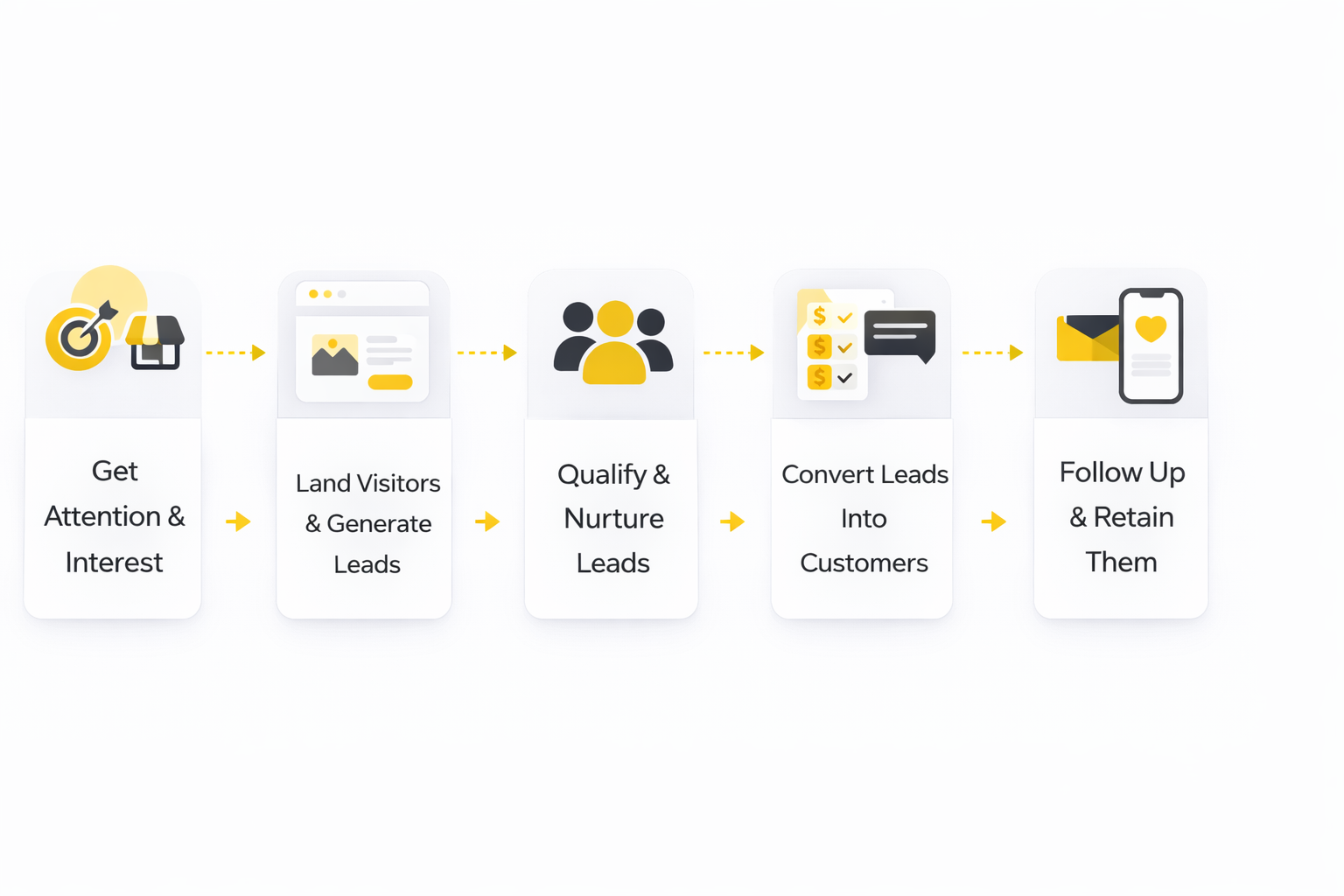
A simple analytics system for marketing for small business should cover four stages. First, track visibility through profile views, search appearances, social reach, referral traffic, and campaign traffic. Second, track engagement through website clicks, call clicks, form starts, booking starts, and replies. Third, track conversion through form submissions, booked appointments, qualified leads, closed sales, and revenue. Fourth, track retention through repeat purchases, rebooking rate, list growth, and returning customer share.
That structure matters because it keeps you from overreacting to the wrong number. A spike in traffic without a rise in leads is not a win yet. A decline in website sessions during the same month that calls and booked jobs rise may actually mean your targeting got sharper. The point of analytics is not to produce prettier charts. It is to tell you which action has the highest odds of improving results.
The Benchmarks That Are Actually Useful
Benchmarks are helpful only when they keep you honest without making you copy another business blindly. The value is not in chasing a magic conversion rate. The value is in seeing whether your numbers are improving, stalling, or underperforming badly enough that something obvious needs fixing.
There are a few anchor points worth remembering. The global discovery data showing 5.8 average brand discovery sources is a reminder not to build your whole growth plan on one channel. The local review data from BrightLocal is a reminder that trust signals remain central to local buying decisions. The Google Business Profile performance framework is a reminder that local visibility should be judged by actions like calls, clicks, messages, bookings, and direction requests, not by impressions alone.
The right move is to benchmark yourself in motion. Compare this month to the last three months. Compare your close rate by lead source. Compare pages by inquiry rate, not just by visits. Compare response time on leads that book versus leads that disappear. That is how statistics become useful instead of decorative.
What to Do When the Data Looks Bad
Bad numbers are not the problem. Misreading them is. If your discovery metrics are weak, the likely fix is visibility work: local search, profile completeness, reviews, referral generation, content distribution, or clearer targeting. If discovery is healthy but conversion is weak, the fix is usually message clarity, better offers, stronger proof, shorter forms, or simpler scheduling.
If conversion looks decent but revenue still feels soft, go further down the system. Look at close rate, average order value, upsell rate, repeat purchase rate, and reactivation. This is where many businesses learn that their marketing is not broken at all. Their sales process, pricing structure, or follow-up discipline is.
That is the real value of data in marketing for small business. It tells you where to stop guessing. And once you stop guessing, you can make tighter decisions, spend less money in the wrong places, and build a system that gets stronger instead of busier.
Advanced Moves, Tradeoffs, and Scaling Risks
Once the basics are working, marketing for small business gets less about finding new tactics and more about making better decisions. This is the stage where growth can either become more efficient or more fragile. The difference usually comes down to whether the business is building a durable system or just stacking more activity on top of shaky foundations.
That distinction matters now because the environment is changing fast. Google’s recent guidance on AI-powered search behavior and the customer decision journey makes it clear that discovery is becoming more compressed, query behavior is getting more complex, and buyers are moving toward decisions with less patience for weak signals](https://business.google.com/us/think/ai-excellence/customer-decision-journey-ai-search/). In plain English, scaling does not reward businesses that simply publish more. It rewards businesses that are clearer, more trustworthy, and faster to respond.
Do Not Scale a Broken Funnel
A lot of small businesses try to scale by buying more traffic before they have fixed the experience after the click. That usually feels productive for a few weeks, then the numbers flatten, lead quality gets messy, and acquisition costs start looking ugly. More volume does not solve structural weakness. It just makes the weakness more expensive.
This is where discipline matters. If your close rate is weak, your offer may need work. If your inquiry rate is weak, your page or CTA may be the issue. If leads come in but few turn into appointments or sales, the handoff and follow-up system are probably the real bottleneck. Marketing for small business scales best when each layer is strengthened in order, not when spend outruns process.
Use AI as Leverage, Not as a Substitute for Judgment
AI can absolutely help small businesses move faster. Verizon’s 2025 State of Small Business Survey highlights rising use of AI and content tools among SMBs, while Google’s AI in Search update for businesses shows how AI-driven discovery is changing the way brands get found. That creates an obvious opportunity: small teams can produce faster drafts, better organization, quicker analysis, and more responsive customer communication than they could a few years ago.
But speed is not the same as quality. The risk is that businesses start publishing generic content, automating tone-deaf replies, or trusting AI outputs that have not been checked. NIST’s AI Risk Management Framework exists because AI systems introduce real risks around reliability, governance, and harmful errors. For a small business, the practical takeaway is simple: use AI to accelerate research, outlines, summaries, first drafts, and internal workflows, but keep human judgment on messaging, customer-facing claims, compliance, and brand voice.
Build Owned Audience Assets Before Platforms Change Again
One of the most important strategic tradeoffs in marketing for small business is rented reach versus owned reach. Search platforms, social networks, maps, and marketplaces can generate demand, but they control the rules. Algorithms shift, organic visibility fluctuates, and platform features change whether your business is ready or not.
That is why owned audience assets matter so much as you grow. Email lists, SMS databases, customer records, remarketing audiences, and clean CRM data give you a direct path back to people who already know you. The 2025 Constant Contact report on newer small businesses describes a market where marketing effort is high but confidence remains low, which is exactly why owned channels matter: they reduce dependency on constantly re-winning attention from scratch](https://assets.ctfassets.net/t21gix3kzulv/5sRBN8CVrckZ44YoYe1aWy/b2bc44431ee8830fc25255f9c2f576d5/Constant_Contact_2025_Small_Business_Now_Report.pdf).
This is where infrastructure choices start to matter more. A lightweight CRM like Copper, a central automation layer in GoHighLevel, or a cleaner list-building and form stack through Brevo and Fillout can help a small business keep its data usable instead of scattered. The exact stack is less important than the principle: the business should own its customer relationships, not just borrow access to them.
Protect Trust as You Grow
Trust gets harder to maintain when marketing volume rises. More campaigns, more content, more reviews, and more customer touchpoints create more chances to cut corners. That is where businesses often make decisions that feel small in the moment and expensive later.
Reviews are a perfect example. The FTC’s final rule on consumer reviews and testimonials and its official Q&A on the rule that took effect on October 21, 2024 make the legal direction unmistakable: fake or deceptive review practices are not a clever shortcut. They are a liability. At the same time, BrightLocal’s 2026 review research shows consumers are becoming more demanding about ratings and review quality, which means the strategic case against manipulation is just as strong as the legal one.
The lesson is broader than reviews. As marketing for small business becomes more automated, you need stronger standards around claims, disclosures, customer proof, testimonial use, and follow-up sequences. Trust compounds, but so does sloppiness. The businesses that scale well usually become more precise as they grow, not more reckless.
Keep Your Stack Lean Enough to Operate
Software can absolutely improve execution, but too many small businesses build a tool stack they cannot realistically manage. They end up paying for overlapping features, fragmenting their reporting, and creating workflows that only make sense to the person who set them up. That is not leverage. That is hidden complexity.
A better approach is to choose tools based on bottlenecks, not trends. If your issue is inconsistent posting, something like Buffer can help. If your issue is fragmented lead handling, GoHighLevel may earn its place. If your issue is message routing or conversational lead capture, ManyChat or Chatbase may be more relevant. The principle is straightforward: each tool should solve a real operational problem and make the system easier to run, not harder.
What Expert-Level Marketing Looks Like in a Small Business
At an advanced level, marketing for small business becomes less flashy and more intentional. You know which channels create demand, which assets convert demand, which follow-up steps protect demand, and which numbers tell you when something is drifting off course. That kind of clarity is what lets a small company behave like a much larger one without bloating into one.
The final advantage is strategic patience. Google’s latest search guidance points toward faster, more contextual discovery](https://blog.google/products/ads-commerce/google-search-ai-brand-discovery/), while small-business research continues to show that many owners are active in marketing without feeling fully confident about what is working](https://assets.ctfassets.net/t21gix3kzulv/5sRBN8CVrckZ44YoYe1aWy/b2bc44431ee8830fc25255f9c2f576d5/Constant_Contact_2025_Small_Business_Now_Report.pdf). The businesses that win from here are not the ones chasing every new tactic. They are the ones that keep improving clarity, trust, speed, measurement, and ownership of customer relationships.
The last piece is to answer the questions small business owners usually have once they start putting this into practice. That is where we will wrap up.
Bringing the Whole System Together
By this point, marketing for small business should look a lot less mysterious. It is not a bag of disconnected hacks. It is a working system that starts with discoverability, earns trust fast, converts attention into action, follows up professionally, and improves through measurement instead of guesswork.
The reason this matters is simple. The latest global digital benchmark still shows people discovering brands through multiple touchpoints, with an average of 5.8 brand discovery sources per user and search engines leading discovery at 32.8%. That means the businesses that win are usually not the loudest. They are the ones whose message, proof, pages, reviews, and follow-up feel consistent wherever the buyer encounters them.
A strong final system is boring in the best way. It gives customers a clear path, gives owners better visibility into what is working, and gives the business room to grow without reinventing marketing every month. That is what good marketing for small business is supposed to do.
What is the best type of marketing for a small business?
The best type depends on how your customers buy, but for many local and service businesses the strongest starting point is local search plus reviews plus a clean conversion path. Google’s business guidance makes clear that profile completeness, relevance, and customer-facing information matter for discovery](https://support.google.com/business/answer/7091?hl=en), while the SBA’s marketing guidance pushes owners to begin with target market and sales planning instead of random tactics](https://www.sba.gov/business-guide/manage-your-business/marketing-sales). In practice, the best marketing for small business is usually the channel mix that matches real buying intent and is simple enough to run every week.
How much should a small business spend on marketing?
There is no universal number that fits every business, and treating budget as a fixed rule usually leads to bad decisions. A smarter approach is to work backward from the number of leads, appointments, or sales you need, then test whether your current channel mix can produce those outcomes efficiently. The SBA’s planning resources are useful here because they frame marketing as part of a larger business plan rather than a standalone expense bucket](https://www.sba.gov/business-guide).
Is social media enough for marketing for small business?
Usually not on its own. Social can be useful for proof, reach, repetition, community, and remarketing support, but it is rarely enough if the business is weak in search visibility, conversion pages, reviews, or follow-up. The current digital behavior data showing people discover brands through several sources rather than one single channel is a good reminder that social works better as part of a system than as the whole plan.
Should a small business focus on SEO or paid ads first?
That depends on urgency, margin, and intent. If you need demand quickly, paid campaigns can accelerate testing, while SEO and local search often build stronger long-term efficiency if the business depends on recurring discovery. Google’s support materials for local businesses and ad products both point to a practical split: organic visibility helps buyers find you consistently, while paid formats can generate leads faster when timing matters](https://support.google.com/business/answer/7091?hl=en) https://support.google.com/localservices/answer/6224841?hl=en&co=GENIE.CountryCode%3DUS.
How long does marketing for small business take to work?
Some parts can work fast, and some parts take time to compound. A cleaner offer, a better booking flow, faster follow-up, or a stronger landing page can improve results quickly, while search authority, review depth, and owned audience growth usually take longer to build. The right expectation is not instant magic. It is steady improvement through clearer messaging, tighter execution, and better measurement.
What should a small business track first?
Start with the few numbers that expose bottlenecks. For most businesses that means profile actions, website visits, inquiry rate, booked rate, close rate, revenue per customer, and repeat purchase or rebooking rate where relevant. Google Business Profile performance reporting is especially useful because it shows concrete actions like calls, website clicks, bookings, and direction requests, which helps separate visibility problems from conversion problems.
Are online reviews really that important?
Yes, and not just for vanity. Reviews influence trust, click behavior, and conversion, especially in local buying situations where people are comparing several options quickly. BrightLocal’s 2026 Local Consumer Review Survey and its 2025 review findings both show that consumers continue to rely heavily on reviews, but they also read them more critically, which means quality and recency matter more than simply chasing volume.
Can AI help with marketing for small business?
Yes, but it works best as leverage, not as a replacement for judgment. NIST’s AI Risk Management Framework and its generative AI profile are useful reminders that AI systems can introduce reliability and governance risks even while improving speed and productivity. The practical move is to use AI for brainstorming, outlines, first drafts, internal analysis, and workflow support, while keeping humans responsible for customer-facing claims, compliance, tone, and strategic decisions.
What are the biggest mistakes small businesses make in marketing?
One common mistake is trying to be active on too many channels before the core offer and conversion path are strong. Another is measuring attention metrics without connecting them to inquiries, bookings, sales, or repeat business. A third is treating follow-up like an afterthought even though modern customer journeys are fast and fragmented, something Google’s recent guidance on AI search and decision behavior makes especially clear](https://business.google.com/us/think/ai-excellence/customer-decision-journey-ai-search/).
Should a small business hire help or keep marketing in-house?
That depends on capability, speed, and how expensive delay has become. If the owner or team can execute consistently, measure results, and improve based on data, keeping core marketing close to the business can work well. But when marketing is inconsistent, reactive, or bottlenecked by time, bringing in specialists often makes sense because the opportunity cost of poor execution becomes bigger than the cost of help.
How do I know whether my website is hurting conversions?
Look for signs of friction rather than obsessing over aesthetics. If traffic is coming in but calls, forms, or bookings are weak, the site may have a message problem, a trust problem, a speed problem, or a CTA problem. Google’s PageSpeed Insights and its PageSpeed documentation are useful because they reinforce a basic truth: performance and usability are not cosmetic issues when mobile visitors are deciding quickly.
Is it worth building an email or SMS list if my business is mostly local?
Yes, because owned audience assets protect you from overdependence on platforms. Search, social, and reviews can help people discover you, but email, SMS, and CRM records help you reconnect with people who already showed interest or bought before. That matters even more in an environment where discovery is spread across multiple channels and buyer attention is fragmented.
Are there legal risks in review generation and testimonials?
Absolutely, and small businesses should take this seriously. The FTC’s Consumer Reviews and Testimonials Rule Q&A explains that the rule took effect on October 21, 2024, and it targets deceptive practices involving reviews and testimonials. The practical takeaway is simple: do not buy fake reviews, do not misrepresent endorsements, and do not treat trust signals like a shortcut.
What should a small business do first after reading this guide?
Pick one growth goal for the next 90 days and build one focused marketing path around it. Then tighten the offer, the landing page or profile, the call to action, and the follow-up process before adding more channels. Marketing for small business gets stronger when execution becomes more disciplined, not more complicated.
Work With Professionals
Explore 10K+ Remote Marketing Contracts on MarkeWork.com
Most marketers spend too much time chasing clients, competing on crowded platforms, and losing a percentage of every project to middlemen. MarkeWork gives you a better way. Browse thousands of remote marketing contracts and connect directly with companies desperate to hire skilled marketers like you, without platform commissions and without unnecessary gatekeepers.
If you're serious about finding better opportunities and keeping 100% of what you earn, explore available contracts and create a profile for free at MarkeWork.com.