

Most lists of marketing ideas are useless because they give you tactics without a system. Post more. Run ads. Start a newsletter. Make short videos. Fine — but none of that helps if you do not know what problem the idea is supposed to solve.
Good marketing ideas are not random sparks of creativity. They are practical ways to move people from “I have never heard of you” to “I trust you enough to buy.” That means every idea needs a job: attract attention, earn trust, capture demand, convert buyers, or bring people back.
This article is built as a six-part guide, so you can move from strategy to execution without getting buried in noise.
- Part 1: Why Marketing Ideas Need a System
- Part 2: Audience and Offer Ideas
- Part 3: Content and Social Media Ideas
- Part 4: Lead Generation and Funnel Ideas
- Part 5: Retention, Referral, and Partnership Ideas
- Part 6: How to Choose, Test, and Scale the Right Ideas
Why Marketing Ideas Need a System
Marketing feels chaotic when every idea competes for attention at the same time. One person wants more Instagram content, another wants paid ads, another wants SEO, and someone else wants a full funnel rebuild. The real issue is rarely a lack of ideas. It is usually a lack of structure.
A useful marketing system starts with the customer journey. Before you choose a tactic, you need to know where the business is leaking growth. If people do not know you exist, you need awareness ideas. If they know you but do not trust you, you need credibility ideas. If they trust you but do not buy, you need conversion ideas.
That is why this guide will not treat marketing ideas like a grab bag. Each section will connect ideas to a business function. You will be able to look at your current situation and choose the ideas that match the actual bottleneck.
The Marketing Ideas Framework
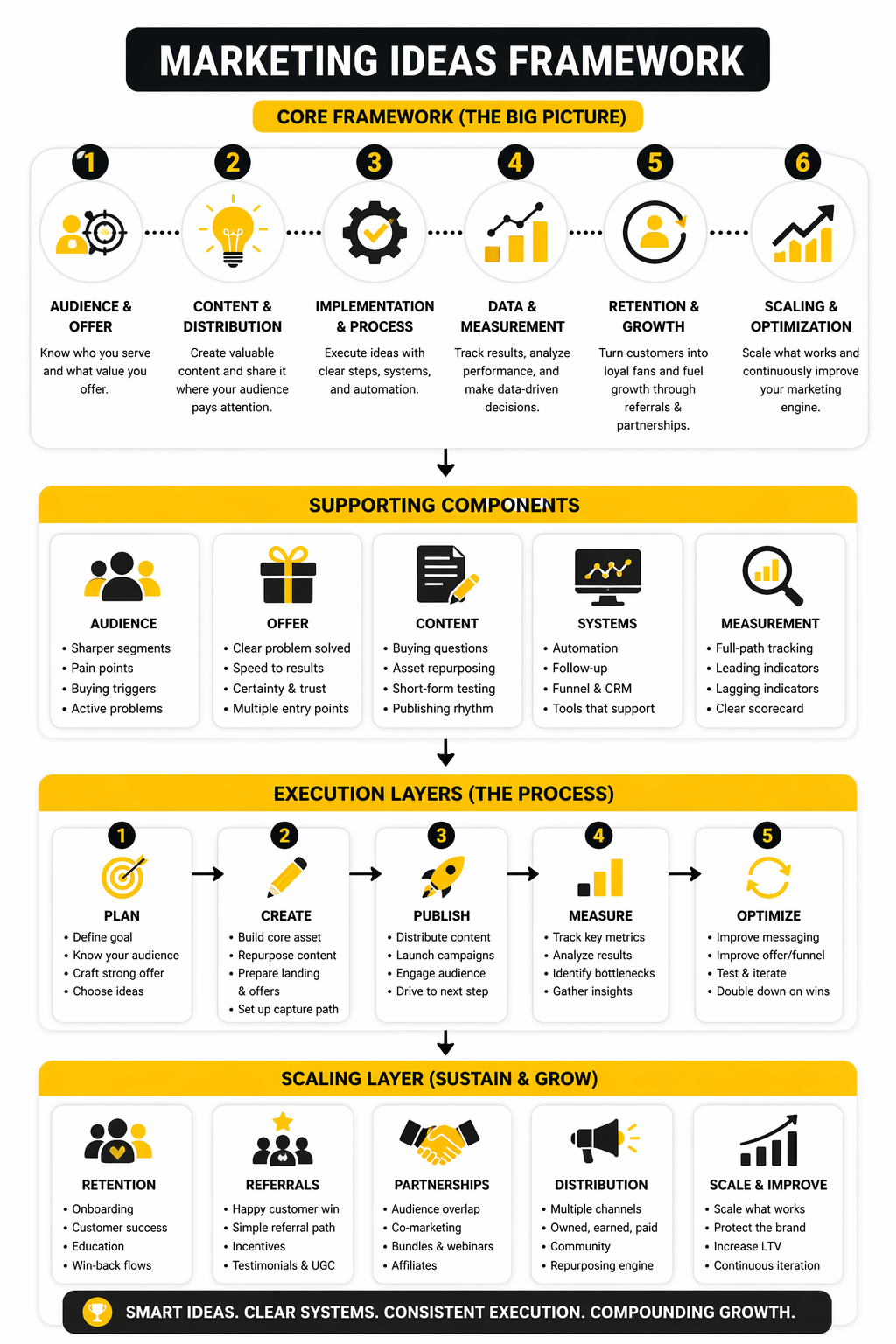
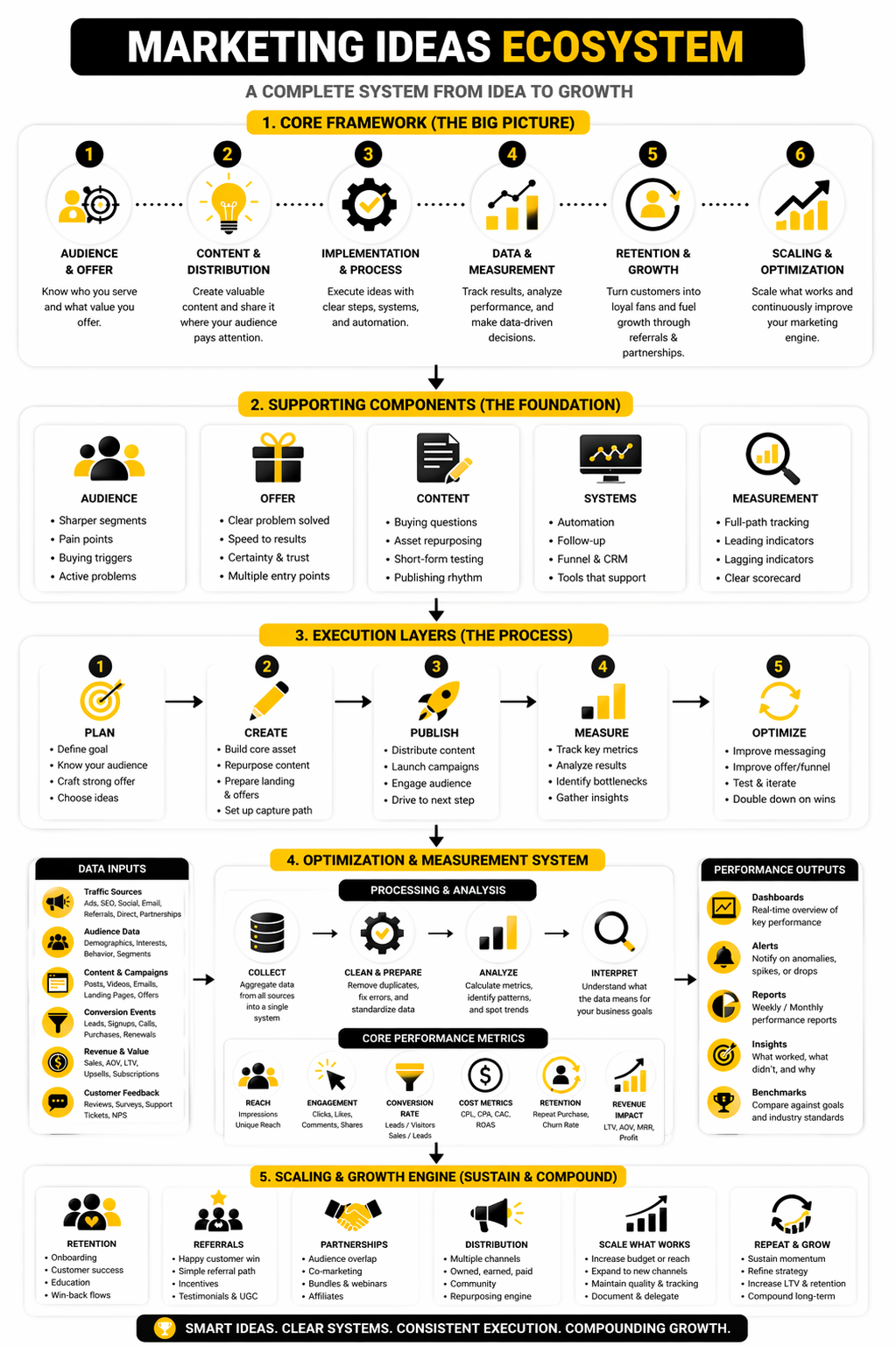
A strong marketing plan usually needs four layers working together. The first layer is attention, where people discover you. The second is trust, where they understand your point of view and see proof. The third is conversion, where they take action. The fourth is retention, where buyers come back, refer others, or expand the relationship.
This matters because most businesses over-focus on one layer. They create content but never capture leads. They run ads but send people to weak offers. They build funnels but forget follow-up. They chase new customers while ignoring the people who already bought.
The best marketing ideas strengthen the whole system, not just one channel. A simple lead magnet can support email growth, paid ads, partnerships, and sales follow-up. A customer success story can become a landing page section, a social post, a sales asset, and a retargeting angle. One good idea can do more than one job when it is built properly.
Audience and Offer Ideas
The next layer is simple: before you chase channels, fix the match between the audience and the offer. A weak offer makes every marketing idea harder than it needs to be. A clear offer makes even simple marketing feel sharper because people understand who it is for, why it matters, and what they should do next.
This is where many businesses get lazy. They describe what they sell instead of the problem they solve. Then they wonder why their content feels flat, their ads feel expensive, and their landing pages do not convert. The issue is not always traffic. Sometimes the issue is that the market cannot quickly see the value.
Start With a Sharper Audience Segment
A broad audience sounds safe, but it usually creates vague marketing. “Small business owners” is too wide. “Local service businesses that need more booked appointments from follow-up automation” is much easier to market to because the pain is more specific.
The best marketing ideas usually come from narrowing the audience until the message becomes obvious. You can narrow by industry, business model, pain point, urgency, budget, buying trigger, or desired outcome. The goal is not to exclude everyone forever. The goal is to create a message strong enough that the right people feel like it was written for them.
A practical way to do this is to write three versions of your audience. First, write the broad category. Second, write the specific segment. Third, write the segment with the active problem they are trying to solve right now. That third version is where useful marketing starts.
Build Offers Around Pain, Speed, and Certainty
An offer is not just a product, service, or package. It is the promise someone believes they are buying. People do not only compare features. They compare risk, effort, speed, confidence, and the cost of staying where they are.
A better offer usually answers four questions fast. What problem does this solve? Who is it best for? How quickly can someone see progress? Why should they trust this instead of doing nothing or choosing someone else? If those answers are unclear, no marketing idea can fully compensate.
This does not mean you need hype. In fact, hype often weakens trust. A strong offer can be calm and specific: a clearer onboarding process, a fixed-scope service, a faster setup path, a stronger guarantee, a better demo, or a more useful first step.
Turn Customer Questions Into Marketing Ideas
Your audience is already giving you content and campaign ideas. They ask questions before buying. They raise objections during sales calls. They compare you against alternatives. They hesitate at specific moments. Those moments are raw material.
Write down the real questions people ask before they buy. Then turn each question into a useful asset. A pricing objection can become a comparison page. A trust objection can become a proof section. A setup concern can become an onboarding walkthrough. A “how does this work?” question can become a short video, email, or landing page block.
This is one of the easiest ways to create marketing ideas that feel relevant instead of random. You are not guessing what the market cares about. You are answering what buyers already reveal through their behavior.
Create Entry-Point Offers
Not everyone is ready to buy your main offer today. That does not mean they are worthless leads. It means they need a lower-friction next step that helps them move closer to a buying decision.
An entry-point offer could be a checklist, audit, calculator, template, workshop, diagnostic call, low-ticket product, or short email course. The key is that it must solve a real problem, not just collect an email address. People can smell lazy lead magnets from a mile away.
For service businesses, tools like GoHighLevel can make this easier because the capture, follow-up, booking, and pipeline stages can sit in one place. For creators or small teams that want a simpler funnel path, Systeme.io can be a practical option. The tool is not the strategy, though. The strategy is giving people a useful first step that naturally leads to the next one.
Package the Same Offer in More Than One Way
Sometimes the marketing idea is not a new product. It is a better package. The same expertise can be sold as done-for-you, done-with-you, training, templates, audits, retainers, workshops, or implementation sprints.
This matters because different buyers want different levels of help. Some want speed and will pay for implementation. Some want control and prefer training. Some are not ready for the full offer but will pay for a focused diagnostic. Better packaging lets you meet the market at more than one buying stage.
Do not create ten packages just to look flexible. Start with two or three clear paths. Make the difference between them obvious. A confused buyer does not choose the perfect package. They leave.
Content and Social Media Ideas
Once the audience and offer are sharper, content becomes much easier to execute. You are no longer posting because the calendar is empty. You are creating assets that move people from curiosity to trust.
This is where marketing ideas become visible. Content turns your positioning into something people can actually experience. Social media, email, video, search content, and community posts all give your audience small reasons to keep paying attention.
Build Content Around Buying Questions
The strongest content does not start with “What should we post today?” It starts with “What does the buyer need to believe before they take the next step?” That question keeps your content connected to revenue instead of vanity metrics.
Make a list of the questions people ask before buying, then group them by stage. Early-stage buyers need education. Mid-stage buyers need comparison and proof. Late-stage buyers need clarity around pricing, implementation, risk, and timing.
That gives you a simple content map:
- Awareness content that explains the problem.
- Trust content that shows your method and point of view.
- Proof content that reduces doubt.
- Conversion content that makes the next step obvious.
- Retention content that helps customers get more value.
Turn One Idea Into Multiple Assets
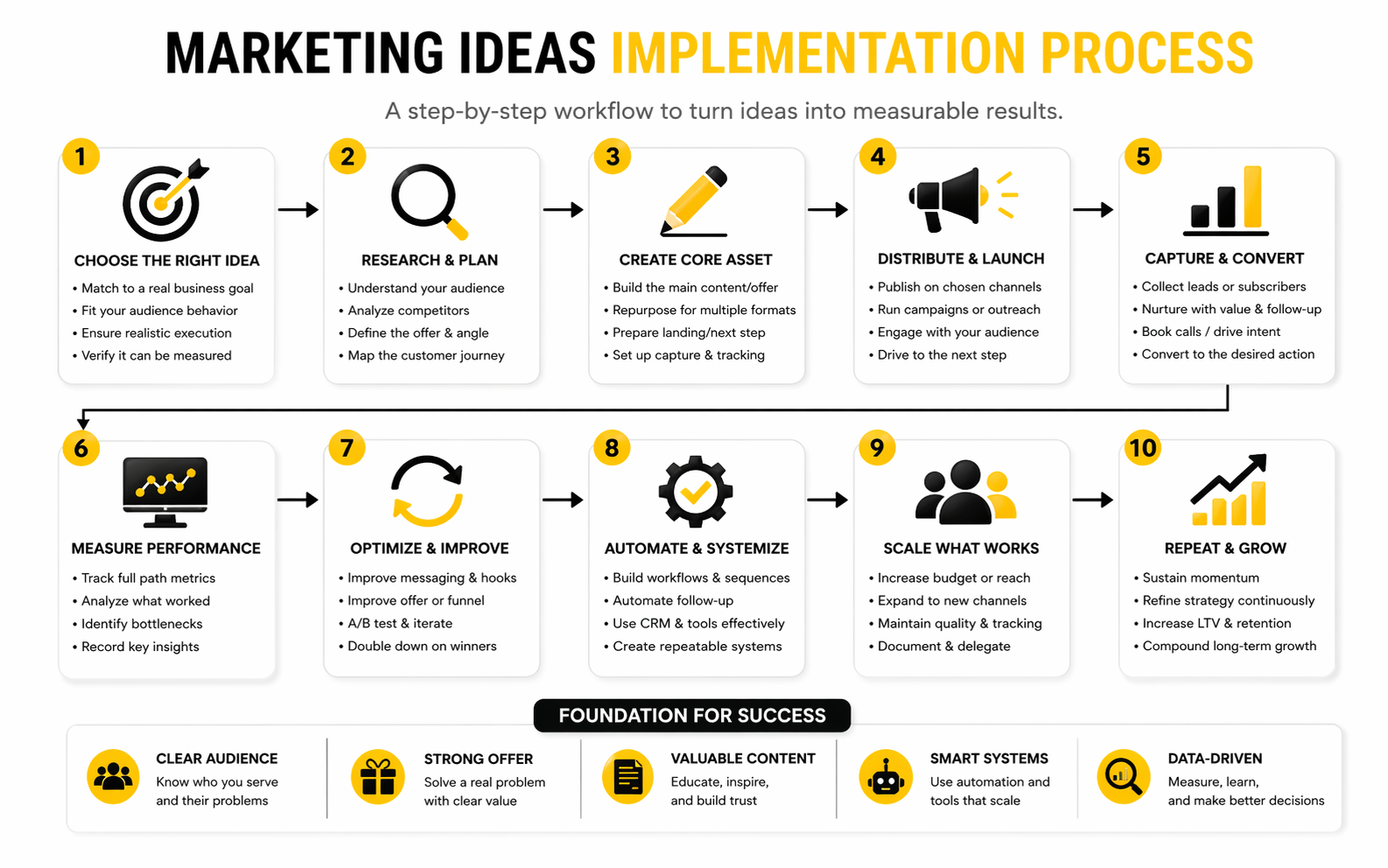
Most teams do not need more ideas. They need better reuse. One strong idea can become a long-form article, a short video, a carousel, an email, a sales script, a landing page section, and a few social posts.
Start with the deepest version first. That could be a guide, a webinar, a podcast episode, a customer breakdown, or a detailed newsletter. Then pull out the strongest angles and turn them into shorter assets for different channels.
This is how you avoid the content treadmill. You stop treating every post like a new creative project. Instead, you build a small library of strong ideas and distribute them in formats your audience already consumes.
Use Short-Form Content for Testing
Short-form content is useful because it gives you fast feedback. You can test hooks, objections, pain points, comparisons, and offers before investing in bigger campaigns. The point is not to go viral. The point is to learn what gets attention from the right people.
A simple process works best. Write ten angles around one problem. Publish them across the channels where your audience already pays attention. Watch which ones create saves, replies, comments, clicks, demos, or conversations.
Then use the winners in bigger assets. A strong post can become an email subject line. A high-performing video hook can become ad copy. A comment thread can reveal objections you should answer on your landing page.
Create a Practical Publishing Rhythm
Consistency matters, but only when the quality stays useful. Publishing every day with weak content will not build trust. Publishing less often with sharper thinking usually works better than flooding people with filler.
A realistic rhythm might include one deep asset per week, three to five short-form posts, one email, and one sales-focused asset every month. That is enough to build momentum without turning your team into a content factory. The right rhythm depends on your capacity, not someone else’s template.
Tools can help here when they reduce friction. Buffer can make scheduling easier when you want a cleaner social workflow. Flick Social can help with social planning and hashtag research when Instagram is a serious channel. Use tools to support the process, not to replace the thinking.
Add Simple Automation Without Losing the Human Feel
Automation is powerful when it removes repetitive work. It becomes a problem when it makes the brand feel lazy, cold, or generic. The goal is not to automate the relationship. The goal is to automate the handoffs so the relationship can happen faster.
For example, a social comment can trigger a useful resource. A form can send a tailored follow-up. A booked call can start a reminder sequence. A new lead can be tagged by interest so the next email is more relevant.
For conversational campaigns, ManyChat can fit naturally when your audience interacts through Instagram, Messenger, or WhatsApp. For email-heavy campaigns, Brevo or Moosend can support newsletters, nurturing, and promotional sequences. The important part is that every automated message should feel like it was written for a real person, not pushed through a machine.
Make Execution Easier With Repeatable Formats
Repeatable formats are underrated. They reduce decision fatigue and make your marketing easier to recognize. When people know what kind of value to expect from you, they are more likely to keep paying attention.
You can create formats around recurring problems. For example, a weekly teardown, a mistake breakdown, a myth-versus-reality post, a customer question, a before-and-after analysis, or a practical checklist. The format stays familiar, but the topic changes.
This is where content becomes a system instead of a scramble. You still need creativity, but you no longer depend on inspiration every morning. You have a process that turns real audience problems into useful marketing assets.
Statistics and Data
Measurement is where marketing ideas either become business assets or expensive distractions. A campaign can look successful because it gets attention, but attention alone does not pay the bills. The real question is whether that attention moves people closer to a measurable business outcome.
This is why benchmarks are useful, but only when you interpret them correctly. A low conversion rate can mean the offer is weak, the audience is wrong, the page is unclear, or the traffic source is low intent. A high click rate can still be meaningless if the people clicking are not qualified buyers.
Track the Full Path, Not Just the First Click
The biggest mistake is measuring each channel in isolation. Social media reports engagement. Email reports opens and clicks. Paid ads report cost per click. The CRM reports deals. None of that tells the full story unless the data connects.
A better measurement system follows the buyer from first touch to final outcome. You want to know where people came from, what they consumed, what they clicked, what they requested, how long they took to buy, and which ideas influenced the decision. That gives you a real view of performance instead of a pile of disconnected numbers.
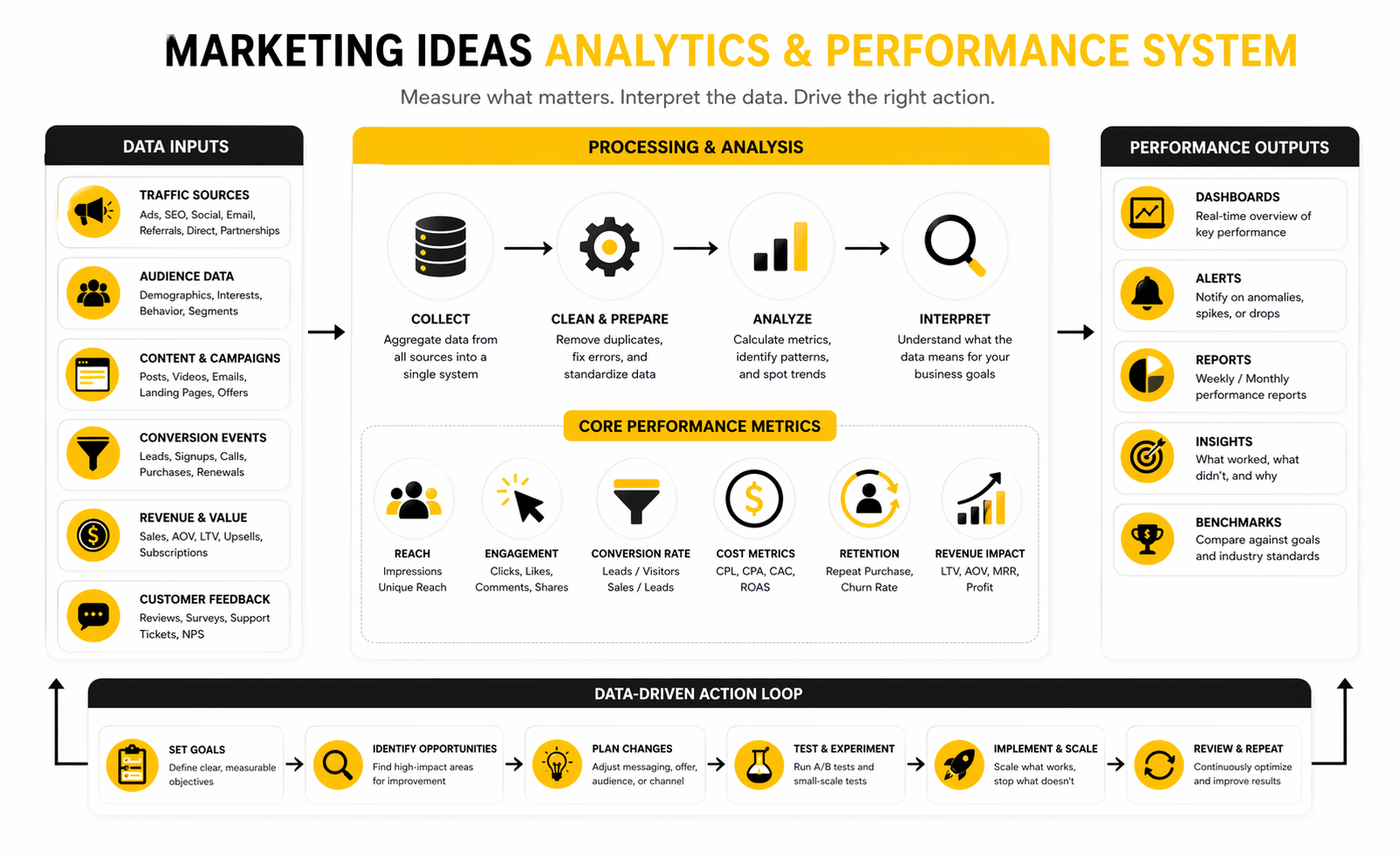
The basic flow should look like this:
- Reach: how many relevant people saw the message.
- Engagement: how many showed meaningful interest.
- Capture: how many became leads or subscribers.
- Conversion: how many booked, bought, requested, or replied.
- Revenue: how much money the campaign influenced.
- Retention: how many customers stayed, upgraded, or referred.
Understand What Benchmarks Are Really Telling You
Benchmarks should give you context, not excuses. If your numbers are below average, that does not automatically mean the campaign failed. It means you need to isolate the weak point and test the next improvement.
For example, email remains one of the strongest channels because it gives you direct access to people who already raised their hand. HubSpot’s marketing data lists email as one of the highest-ROI channels for B2C brands, alongside paid social and content marketing, which matters because owned attention usually becomes more valuable as ad costs rise HubSpot marketing statistics. But that does not mean every email campaign deserves more volume. If people open but do not click, the message may be interesting but not compelling. If they click but do not convert, the landing page or offer probably needs work.
Content has the same issue. The Content Marketing Institute’s 2025 B2B research found that many marketers still struggle with ROI attribution and scalable content creation, while top performers put strong emphasis on audience understanding B2B content marketing benchmarks. That is the lesson. Better results usually come from clearer audience insight, not just more publishing.
Separate Leading Indicators From Lagging Indicators
Not every metric has the same job. Leading indicators tell you whether the campaign is gaining traction. Lagging indicators tell you whether it created business value. You need both, but you should not confuse them.
Leading indicators include impressions, watch time, saves, replies, comments, email clicks, form starts, demo page visits, and return visits. These numbers help you spot early momentum. They are useful because they show whether your marketing ideas are creating interest before the sales data arrives.
Lagging indicators include booked calls, qualified leads, sales, customer acquisition cost, payback period, repeat purchases, expansion revenue, and churn. These numbers matter more for decisions about budget and scaling. A campaign with weak engagement but strong qualified pipeline may be worth keeping. A campaign with huge engagement and no buyer intent may need to be repositioned or killed.
Measure Offers Differently From Content
Content and offers should not be judged by the exact same metrics. Content often earns attention, builds trust, and creates future demand. Offers are supposed to capture demand and drive action. When you mix those roles, you make bad decisions.
A useful article, video, or social post may not convert immediately, but it can still make future sales easier. Look at return visitors, assisted conversions, email signups, sales conversations, branded search, and how often the asset gets reused by your team. That tells you whether the content is becoming a trust asset.
Offers need stricter measurement. Look at landing page conversion rate, cost per lead, lead quality, booking rate, show-up rate, close rate, and revenue per lead. If you are building funnel pages, tools like ClickFunnels or Replo can be useful when the priority is testing pages, offers, and conversion paths faster.
Build a Simple Weekly Marketing Scorecard
You do not need a giant dashboard to make better decisions. In fact, giant dashboards often hide the truth. A simple weekly scorecard works better because it forces you to focus on the numbers that actually change behavior.
Your scorecard should include only the metrics tied to the current bottleneck. If awareness is the problem, track reach, qualified traffic, and branded search movement. If lead generation is the problem, track opt-ins, booking rate, and lead quality. If sales conversion is the problem, track offer page conversion, show-up rate, close rate, and objections.
For service businesses, GoHighLevel can make this easier because leads, conversations, appointments, and pipeline stages can sit closer together. That matters because measurement gets weaker when every step lives in a different tool. The cleaner the handoff, the easier it is to see which marketing ideas deserve more budget and which ones need to be fixed.
Turn Data Into Better Decisions
Data is only useful when it changes what you do next. If a report does not lead to a decision, it is decoration. The point is not to admire the numbers. The point is to improve the system.
Use a simple decision rule after every campaign. If the idea attracted the wrong people, change the audience or channel. If it attracted the right people but did not convert, change the offer or page. If it converted but did not produce profitable customers, change the qualification process. If it worked across the full path, scale it carefully.
This is how marketing gets sharper over time. You stop arguing about opinions and start looking at evidence. The best marketing ideas are not always the loudest ones. They are the ones the data keeps proving are worth another round.
Retention, Referral, and Partnership Ideas
Growth gets more expensive when every marketing idea depends on finding brand-new people. That is why advanced marketing is not just about acquisition. It is about turning customers, partners, and existing attention into a stronger growth system.
This is where the strategy becomes more mature. You stop asking only, “How do we get more leads?” You start asking better questions: How do we increase lifetime value? How do we create more reasons to come back? How do we make referrals easier? How do we build distribution through people who already have trust?
Keep Customers Before You Chase More Traffic
Retention is not glamorous, but it is powerful. Bain’s research on loyalty found that a 5% increase in customer retention can increase profits by 25% to 95% Bain loyalty research. That number matters because it changes how you should think about marketing ideas.
If your business is losing customers too quickly, more traffic can hide the problem for a while. It can also make the business more fragile. You spend more, work harder, and still feel like growth is slipping through your fingers.
Start with the customer experience after the sale. Improve onboarding, first results, support speed, product education, renewal communication, and win-back sequences. These are marketing ideas too, even if they do not look like ads or social posts.
Build Referral Loops People Actually Use
Referral programs fail when they ask customers to do too much work. A happy customer may like you, but that does not mean they will remember to promote you. You need to make the referral simple, timely, and worth sharing.
The best referral moments usually happen after a clear win. A client gets a result, saves time, solves a painful issue, or receives a surprisingly good experience. That is when you ask for a review, testimonial, introduction, or referral because the value is fresh.
Do not overcomplicate this. Give customers a short message they can forward. Create a simple referral page. Offer a clean incentive when it fits the business model. Most importantly, make the referred person feel respected, not pushed into a sales machine.
Use Partnerships for Trust Transfer
Partnerships work because trust can move faster through the right relationship than through cold traffic. If another brand, creator, agency, newsletter, community, or consultant already has your ideal audience’s attention, a smart collaboration can create qualified demand faster than starting from zero.
Good partnerships are not random shoutouts. They need audience overlap, clear value, and a reason for both sides to care. A webinar, bundle, newsletter swap, workshop, co-created resource, affiliate arrangement, or implementation partnership can work well when the offer naturally helps the same audience.
The tradeoff is control. Paid ads give you more control but less borrowed trust. Partnerships give you trust but require coordination, alignment, and follow-through. Choose based on what your business needs most right now.
Scale What Is Already Working
Scaling is where many marketing ideas break. A campaign that works manually may not work when automated. A channel that works with a small budget may become inefficient when spend increases. A message that works for one segment may fall apart when pushed to a broader market.
Before scaling, check the foundation. Is the audience still specific? Is the offer still clear? Are leads qualified? Can fulfillment handle more customers? Is follow-up consistent? If the answer is no, scaling will amplify the weakness.
A clean CRM helps when growth starts getting messy. Copper can fit teams that want sales relationships tracked clearly, especially when pipeline visibility matters. For businesses that want acquisition, follow-up, booking, and pipeline automation closer together, GoHighLevel can support a more centralized growth setup.
Protect the Brand While You Optimize
Performance marketing can make teams impatient. When every decision is judged by short-term conversion, the brand can slowly become louder, cheaper, and less trusted. That is dangerous because trust is hard to measure until it is gone.
Optimization should make the customer journey clearer, not more manipulative. Better headlines, stronger proof, clearer offers, faster pages, and smarter follow-up are healthy improvements. Fake urgency, exaggerated promises, bait-and-switch lead magnets, and endless discounting are not.
This is the expert-level tradeoff: you want measurable performance without training the market to distrust you. The strongest marketing ideas increase conversion and credibility at the same time. When those two work together, growth becomes much easier to sustain.
How to Choose, Test, and Scale the Right Ideas
At this point, the goal is not to collect more marketing ideas. The goal is to choose the few that fit your business, execute them properly, and improve them with real feedback. That is how marketing becomes a system instead of a calendar full of disconnected tasks.
The right idea depends on your current constraint. If nobody knows you exist, focus on awareness and distribution. If people know you but do not trust you yet, build proof and useful content. If trust exists but revenue is flat, improve the offer, funnel, follow-up, or sales process.
Use a Simple Prioritization Filter
A good marketing idea should pass three tests before it gets serious time or budget. First, it should match a real business goal. Second, it should fit the audience’s behavior. Third, it should be realistic for your team to execute consistently.
Do not choose ideas only because they are popular. Short-form video, AI content, SEO, webinars, newsletters, referrals, and paid ads can all work. They can also all fail when they are forced into the wrong business model.
Use this filter before you commit:
- Goal fit: What problem does this idea solve?
- Audience fit: Does the target buyer actually pay attention here?
- Offer fit: Does the idea naturally lead to the next step?
- Capacity fit: Can the team execute it without breaking quality?
- Measurement fit: Can you tell whether it worked?
Test Before You Scale
The safest way to improve marketing is to test small before making big changes. You do not need to rebuild the whole business to learn something useful. You can test a hook, lead magnet, landing page section, email sequence, webinar angle, referral prompt, or sales follow-up.
A clean test needs one clear hypothesis. For example, “This offer will convert better if we lead with speed instead of price.” That is much stronger than “Let’s try a new campaign.” One gives you learning. The other gives you activity.
Keep the test focused, run it long enough to collect meaningful feedback, and decide the next action before emotions take over. If it works, improve and expand it. If it fails, diagnose the weak link. If the result is unclear, simplify the test and run another round.
Know When to Stop
Not every idea deserves another chance. This is uncomfortable, but it matters. Some marketing ideas fail because the execution was weak. Others fail because the audience, offer, or channel was wrong from the start.
Stop when the idea attracts the wrong people, creates low-quality leads, damages trust, or requires more effort than the potential upside justifies. Keep going when you see signs of qualified attention, better conversations, stronger conversion, or useful customer insight. The difference is not always obvious immediately, so look at the full path instead of one surface metric.
This is also where AI needs discipline. Research from the Content Marketing Institute found that only 4% of B2B marketers reported a high level of trust in generative AI outputs, while 67% reported medium trust B2B content marketing benchmarks. That is the right mindset. Use AI to speed up research, drafting, repurposing, and analysis, but do not let it replace judgment.
FAQ - Built for Complete Guide
What are the best marketing ideas for a small business?
The best marketing ideas for a small business are usually the ones that create trust quickly and are realistic to execute. Start with a clear offer, a focused audience, useful educational content, a simple lead capture path, and consistent follow-up. Small businesses do not need every channel at once; they need a few ideas that connect directly to leads, sales, and customer retention.
How do I choose the right marketing ideas?
Choose marketing ideas based on your current bottleneck. If awareness is weak, choose ideas that increase relevant reach. If leads are weak, improve your offer, lead magnet, landing page, or call to action. If sales are weak, improve proof, follow-up, objections, and conversion points.
How many marketing ideas should I test at once?
Most businesses should test one to three serious ideas at a time. Testing too many ideas creates messy data and weak execution. A focused test gives you clearer feedback and makes it easier to decide whether to scale, adjust, or stop.
What marketing ideas work without a big budget?
Organic content, email marketing, partnerships, referrals, SEO-focused articles, community participation, and customer education can all work without a big budget. They require consistency, not just money. The tradeoff is that they usually take more time than paid acquisition.
Are social media marketing ideas still worth it?
Yes, but only when social media is connected to a bigger system. Posting without an offer, lead capture path, or follow-up plan often creates attention without revenue. Social content works better when it tests messages, builds trust, drives conversations, and sends people toward a clear next step.
What is the most overlooked marketing idea?
The most overlooked marketing idea is improving the post-purchase experience. Better onboarding, customer education, referral prompts, renewal sequences, and win-back campaigns can increase revenue without needing a constant stream of new traffic. Retention is not as flashy as acquisition, but it often has a stronger impact on profit.
How do I know if a marketing idea is working?
A marketing idea is working when it moves the right people closer to a business outcome. That may show up as qualified traffic, email signups, replies, booked calls, sales, repeat purchases, or referrals. Do not judge the idea only by likes, views, or clicks unless those metrics clearly connect to the next step.
Should I use AI for marketing ideas?
AI can help you brainstorm angles, repurpose content, summarize research, draft emails, and analyze patterns. It should not replace your customer insight or strategic thinking. The best use of AI is to speed up execution while a human still controls positioning, claims, tone, and final decisions.
What marketing ideas are best for B2B companies?
B2B companies usually benefit from thought leadership, case studies, comparison content, webinars, email nurturing, LinkedIn content, partnerships, and sales enablement assets. The key is to support a longer buying process. B2B buyers often need proof, internal alignment, and risk reduction before they move.
What marketing ideas are best for ecommerce brands?
Ecommerce brands usually benefit from product education, user-generated content, email and SMS flows, landing page tests, creator partnerships, retargeting, bundles, quizzes, and loyalty campaigns. The best ideas make product value easier to understand and buying easier to complete. Strong ecommerce marketing also pays close attention to repeat purchase behavior, not just first orders.
How often should I update my marketing strategy?
Review performance weekly, but do not rewrite the strategy every week. Weekly reviews should focus on signals and small improvements. Bigger strategy updates usually make sense monthly or quarterly, depending on campaign volume, buying cycle length, and how quickly you collect reliable data.
What is the biggest mistake with marketing ideas?
The biggest mistake is treating ideas as isolated tactics. A post, ad, email, funnel, webinar, or referral program works better when it fits the wider customer journey. Marketing becomes stronger when every idea has a clear job and a measurable next step.
Work With Professionals
Explore 10K+ Remote Marketing Contracts on MarkeWork.com
Most marketers spend too much time chasing clients, competing on crowded platforms, and losing a percentage of every project to middlemen.
MarkeWork gives you a better way. Browse thousands of remote marketing contracts and connect directly with companies desperate to hire skilled marketers like you, without platform commissions and without unnecessary gatekeepers.
If you're serious about finding better opportunities and keeping 100% of what you earn, explore available contracts and create a profile for free at MarkeWork.com.