

Marketing management is no longer just about campaigns, branding, or advertising budgets. It has evolved into a complex, data-driven discipline that sits at the core of business growth. Companies that understand how to manage marketing effectively outperform competitors not because they spend more, but because they execute smarter.
Recent industry data shows that companies using structured marketing strategies are significantly more likely to report higher ROI and faster revenue growth, as highlighted in this global marketing trends report. The gap between those who “do marketing” and those who manage it strategically is widening every year.
At its core, marketing management is about making deliberate decisions: who you serve, how you position, how you communicate, and how you scale. Without structure, marketing becomes noise. With the right system, it becomes a predictable growth engine.
That’s exactly what this guide is designed to help you build.
Article Outline
- What Marketing Management Really Means Today
- Why Marketing Management Matters More Than Ever
- The Marketing Management Framework Explained
- Core Components of Effective Marketing Management
- How Professionals Implement Marketing Systems at Scale
- Future Trends and Strategic Takeaways
What Marketing Management Really Means Today
Marketing management is the process of planning, executing, analyzing, and optimizing strategies that connect a business with its target market. That sounds simple on paper, but in practice, it involves coordinating dozens of moving parts across channels, teams, and technologies.
Traditionally, marketing management focused heavily on the 4Ps: product, price, place, and promotion. While those principles still matter, modern marketing management has expanded into areas like customer experience, automation, lifecycle marketing, and data analytics.
Today, it’s less about isolated campaigns and more about building systems. For example, businesses now rely on tools like GoHighLevel to unify CRM, automation, funnels, and communication into a single ecosystem. This shift reflects a deeper truth: marketing is no longer a department—it’s infrastructure.
What separates strong marketing management from weak execution is alignment. Every action must connect back to a clear strategy, and every strategy must connect to measurable outcomes.
Why Marketing Management Matters More Than Ever
The digital landscape has fundamentally changed how customers discover, evaluate, and choose products. Buyers now interact with brands across multiple touchpoints before making a decision, often researching independently long before speaking to a salesperson.
Data from McKinsey’s consumer decision journey research shows that modern purchase paths are nonlinear, meaning brands must be present and consistent across every stage.
Without structured marketing management, this complexity quickly becomes chaos. Teams run disconnected campaigns, messaging becomes inconsistent, and budgets get wasted on channels that don’t convert.
Effective marketing management solves this by creating clarity:
- Clear positioning ensures the right audience is targeted
- Structured funnels guide prospects through decisions
- Consistent messaging builds trust across channels
- Data tracking reveals what actually works
This is also where automation becomes critical. Platforms like ClickFunnels allow businesses to design structured customer journeys instead of relying on random interactions.
In other words, marketing management is what turns effort into results. Without it, even great ideas fail to scale.
The Marketing Management Framework Explained
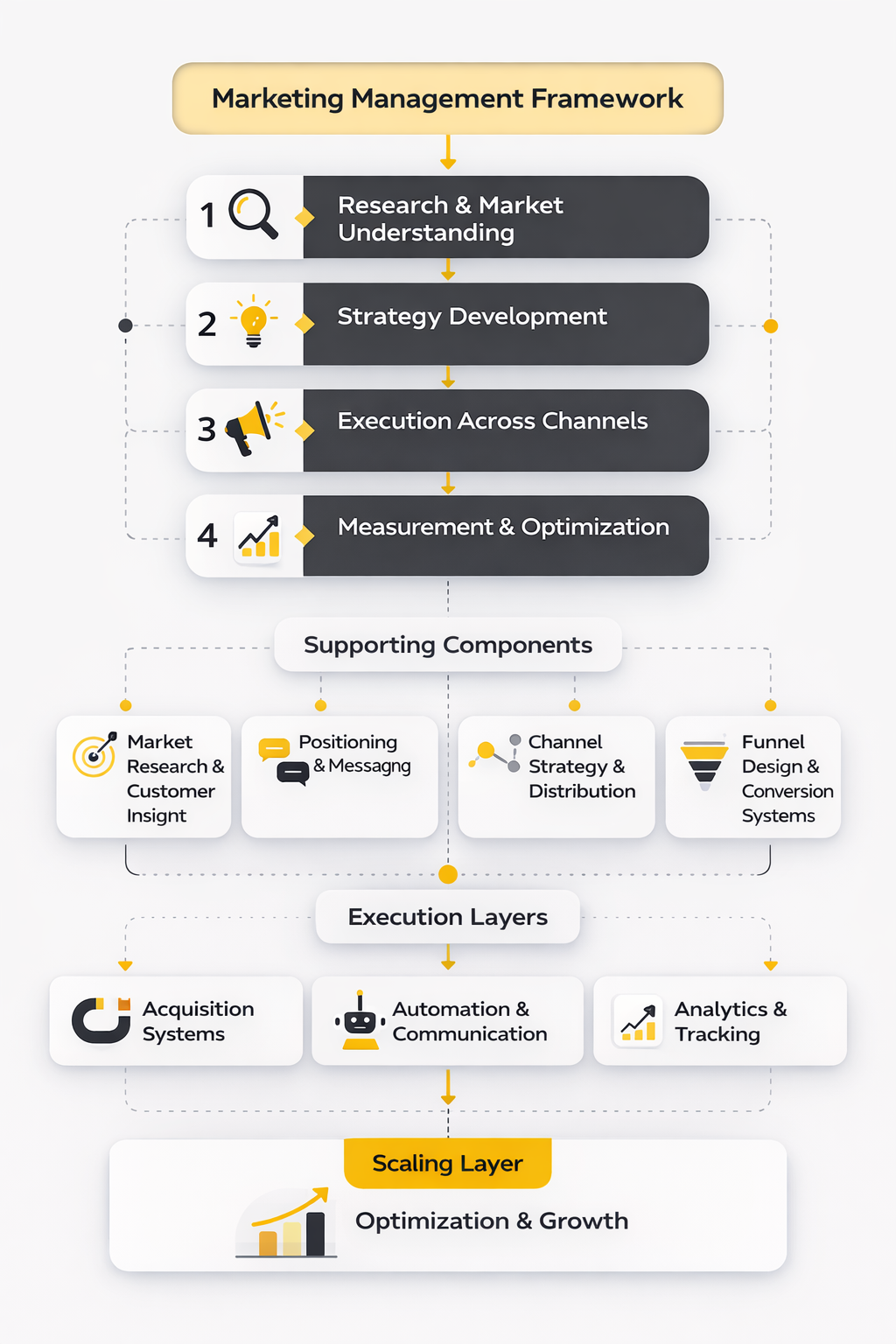
At a high level, marketing management operates as a structured system rather than a series of isolated tasks. The most effective organizations follow a repeatable framework that aligns strategy, execution, and optimization.
While frameworks can vary, most successful marketing systems include four key phases:
- Research and Market Understanding
- Strategy Development
- Execution Across Channels
- Measurement and Optimization
Each phase builds on the previous one. Skipping steps or rushing through them is one of the most common reasons marketing efforts fail.
Research defines the battlefield. Strategy defines how you win. Execution puts that plan into motion. Optimization ensures continuous improvement.
Modern tools accelerate this framework significantly. For example, platforms like Systeme.io combine funnel building, email marketing, and automation into a single workflow, making it easier to implement structured strategies without fragmentation.
The key insight here is that marketing management is not about doing more—it’s about doing the right things in the right order.
Core Components of Effective Marketing Management
To make the framework actionable, you need to understand the core components that drive successful marketing management. These are the building blocks that every strategy relies on, regardless of industry.
Market Research and Customer Insight
Everything starts with understanding your audience. This goes beyond basic demographics and into behavior, motivations, and pain points.
High-performing teams rely on continuous data collection, not one-time research. Customer feedback loops, analytics platforms, and behavioral tracking all feed into smarter decision-making.
Positioning and Messaging
Positioning defines how your brand is perceived in the market. Messaging communicates that position clearly and consistently.
Weak positioning leads to confusion. Strong positioning creates instant recognition and differentiation.
Channel Strategy and Distribution
Choosing the right channels is critical. Not every platform fits every business, and spreading efforts too thin often reduces effectiveness.
Tools like Buffer help manage multi-channel distribution while maintaining consistency across social platforms.
Funnel Design and Conversion Systems
Traffic without conversion is wasted effort. This is where funnel strategy becomes essential.
A well-structured funnel guides prospects from awareness to decision using intentional steps. Platforms like ManyChat enable automated conversations that increase engagement and conversion rates without manual effort.
Analytics and Performance Tracking
If you can’t measure it, you can’t improve it. Modern marketing management relies heavily on real-time data to guide decisions.
Metrics such as customer acquisition cost, lifetime value, and conversion rates provide insight into what’s working and what needs adjustment.
This foundation sets the stage for deeper execution. In the next part, we’ll break down how these components come together in real-world marketing systems and how professionals turn strategy into scalable results.
How Professionals Implement Marketing Systems at Scale
Understanding marketing management conceptually is one thing. Turning it into a system that consistently generates results is something entirely different. This is where most businesses struggle—not because they lack ideas, but because they lack structure, discipline, and integration.
At scale, marketing management becomes less about creativity and more about orchestration. High-performing teams don’t guess what to do next. They operate within defined systems that guide decisions, automate execution, and continuously improve performance.
Building a Centralized Marketing Engine
The first shift professionals make is moving away from fragmented tools and toward centralized systems. When data, campaigns, and communication are scattered across platforms, decision-making slows down and insights get lost.
This is why many companies consolidate operations using platforms like GoHighLevel. Instead of juggling separate tools for CRM, email, funnels, and automation, everything runs in one environment. That alignment alone removes a massive amount of friction.
Centralization also improves visibility. Teams can track the entire customer journey—from first interaction to final conversion—without relying on disconnected reports. That clarity is what enables better decisions and faster iteration.
Designing Repeatable Acquisition Systems
One-off campaigns don’t scale. What scales are repeatable acquisition systems that consistently bring in qualified leads.
This typically involves:
- A defined traffic strategy (paid ads, organic content, partnerships)
- A structured funnel that converts visitors into leads
- Automated follow-up sequences that nurture prospects
- Clear conversion points that drive revenue
Tools like ClickFunnels are built specifically for this purpose. They allow teams to design and optimize funnels that guide users step by step, rather than leaving conversions to chance.
The key insight here is predictability. When acquisition becomes a system, growth becomes measurable and controllable.
Automating Customer Communication
Manual communication does not scale. As lead volume increases, response times slow down, and opportunities get missed.
Automation solves this by ensuring every prospect receives timely, relevant interactions without requiring constant manual effort.
For example:
- Chat automation can qualify leads instantly
- Email sequences can nurture prospects over time
- SMS reminders can increase show-up rates
- Behavioral triggers can personalize communication
Platforms like ManyChat make this process accessible without requiring complex development. Businesses can build conversational flows that guide users through decision-making in real time.
The result is not just efficiency, but improved customer experience. People get faster answers, more relevant information, and smoother interactions.
Aligning Content, Distribution, and Timing
Content alone doesn’t drive results. Distribution and timing are just as important.
Professional marketing management ensures that content is not only created strategically, but also distributed consistently across the right channels at the right time.
This requires:
- A clear content calendar tied to business goals
- Consistent posting schedules across platforms
- Data-driven adjustments based on engagement and performance
Tools like Buffer help teams manage this process without losing consistency. Instead of posting randomly, content becomes part of a structured system that supports the broader marketing strategy.
This alignment ensures that every piece of content contributes to a larger objective rather than existing in isolation.
Creating Feedback Loops That Drive Improvement
One of the most overlooked aspects of marketing management is feedback. Without structured feedback loops, teams repeat the same mistakes and miss opportunities for optimization.
Effective systems continuously collect and act on data:
- Funnel metrics reveal drop-off points
- Campaign analytics highlight high-performing channels
- Customer feedback uncovers objections and pain points
Modern platforms like Systeme.io integrate analytics directly into execution workflows, making it easier to adjust strategies in real time.
The goal is simple: shorten the gap between action and insight. The faster you learn, the faster you improve.
At this stage, marketing management becomes a living system rather than a static plan. Every component—tools, processes, and strategies—works together to create momentum.
In the next part, we’ll go deeper into advanced optimization strategies and how top teams refine their marketing systems to maximize performance and profitability.
Turning Strategy Into Execution: The Real Marketing Process
By now, the structure of marketing management should feel clear. But clarity alone doesn’t create results. Execution does. And this is exactly where most strategies break down.
The difference between theory and performance is process. Professionals don’t rely on motivation or creativity to drive marketing forward. They rely on systems that turn decisions into consistent action.
What follows is the exact way effective marketing management gets implemented in the real world.
Step-by-Step Marketing Execution System
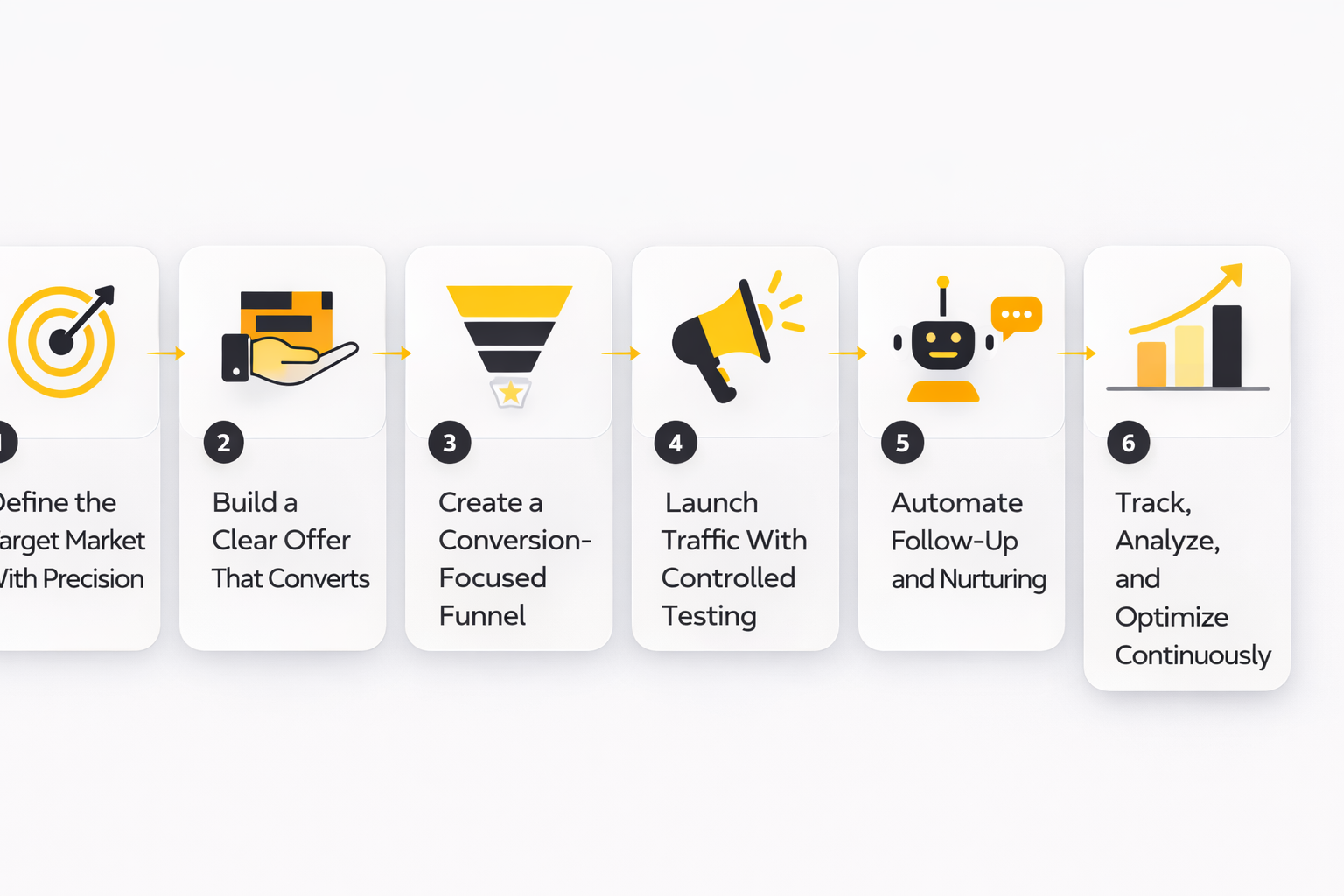
When marketing is done right, it follows a repeatable process. Not rigid, but structured enough to eliminate guesswork. This is how teams move from planning to measurable outcomes without losing control.
Step 1: Define the Target Market With Precision
Everything starts with clarity. Not vague audience definitions, but specific, actionable segments.
Strong marketing management requires knowing:
- Who the ideal customer is
- What problem they are actively trying to solve
- What triggers them to take action
- What objections stop them from buying
This level of understanding often comes from a mix of analytics, customer interviews, and behavioral data. Tools like GoHighLevel allow businesses to track customer interactions across channels, giving deeper insight into real behavior instead of assumptions.
Without this step, every other action becomes inefficient. You’re essentially guessing.
Step 2: Build a Clear Offer That Converts
A strong offer is not just a product or service. It’s a structured solution to a specific problem, presented in a way that feels obvious to the buyer.
This is where many marketing efforts fail. The messaging may be good, the design may look professional, but the offer itself lacks clarity or urgency.
Effective offers typically include:
- A clear outcome or transformation
- Defined benefits tied to real problems
- Risk reduction (guarantees, trials, proof)
- Urgency or incentive to act
Funnels built with platforms like ClickFunnels are designed specifically to present offers in a structured, persuasive sequence. Instead of dumping information on a page, they guide the user through a decision.
The key principle here is simple: if the offer doesn’t resonate, no amount of traffic will fix it.
Step 3: Create a Conversion-Focused Funnel
Once the offer is clear, the next step is designing the path that leads people toward it. This is where marketing management becomes highly tactical.
A typical funnel includes:
- Entry point (ad, content, or organic discovery)
- Lead capture (landing page or opt-in)
- Nurture sequence (email, SMS, or chat)
- Conversion point (purchase, booking, or signup)
Each step must be intentional. Random pages and disconnected touchpoints reduce conversion rates significantly.
Platforms like Systeme.io simplify this process by allowing businesses to build entire funnels—from landing pages to automation—inside one system. That reduces technical complexity and keeps execution focused.
Step 4: Launch Traffic With Controlled Testing
Traffic is where many businesses waste money because they skip structure. Instead of testing systematically, they scale too early or chase trends without data.
Professional marketing management treats traffic as an experiment first, not a growth lever.
This means:
- Starting with small budgets
- Testing multiple creatives and messages
- Measuring early signals like click-through and engagement
- Scaling only what proves effective
This approach is supported by performance benchmarks shared in Meta’s advertising best practices, where iterative testing consistently outperforms single large campaigns.
The goal is not immediate scale. The goal is validated performance.
Step 5: Automate Follow-Up and Nurturing
Most conversions don’t happen on the first interaction. In fact, multiple studies show that a significant percentage of leads require several touchpoints before making a decision, as outlined in HubSpot’s marketing statistics.
This is why follow-up systems are critical.
Automation ensures that every lead is nurtured consistently without manual effort. This includes:
- Email sequences that educate and build trust
- Chat automation that answers questions instantly
- Retargeting campaigns that bring users back
Tools like ManyChat allow businesses to create automated conversations that feel personal while operating at scale.
Without this layer, most potential revenue is left on the table.
Step 6: Track, Analyze, and Optimize Continuously
Execution doesn’t end after launch. In fact, this is where real marketing management begins.
Every campaign, funnel, and channel produces data. The difference between average and high-performing teams is how they use it.
Key areas to monitor include:
- Conversion rates at each funnel stage
- Cost per lead and cost per acquisition
- Engagement metrics across channels
- Customer lifetime value
Optimization is not about making random changes. It’s about identifying bottlenecks and improving them systematically.
This continuous loop—launch, measure, adjust—is what turns marketing into a predictable system rather than a gamble.
At this point, marketing management is no longer theoretical. It becomes operational, measurable, and scalable.
In the next part, we’ll go deeper into advanced optimization strategies and how elite teams push performance beyond baseline results.
Reading the Right Marketing Numbers
A lot of marketing teams track plenty of numbers and still have no idea what is actually happening. That is not a data problem. It is a measurement problem. Good marketing management does not improve because you have more dashboards open. It improves because you know which signals deserve action and which ones are just noise.
That distinction matters more now because the measurement environment is getting harder, not easier. Privacy changes, channel fragmentation, and longer buying journeys all make simplistic reporting less reliable. Even the best teams are still dealing with this gap, which is why Salesforce found only 26% of marketers are completely satisfied with their data unification. If the data is fragmented, the decisions built on top of it will be fragmented too.
The Metrics That Actually Matter
The first job of measurement is to separate activity from performance. Impressions, reach, traffic, and followers can help explain visibility, but they do not tell you whether marketing is creating profitable demand. In marketing management, the numbers that matter most are the ones tied to movement through the funnel and commercial outcomes.
The most useful core signals usually include:
- Cost per qualified lead
- Conversion rate by funnel stage
- Customer acquisition cost
- Customer lifetime value
- Revenue by channel or campaign
- Retention and repeat purchase behavior
This is also why marketers keep struggling with ROI. HubSpot’s 2025 survey of U.S. marketing leaders showed that measuring ROI was the top challenge for 40.8% of them. That number matters because it explains why so many teams over-focus on top-of-funnel activity. It is easier to report traffic than to prove contribution to revenue.
Why Benchmarks Need Context
Benchmarks are helpful, but only when you use them as context instead of a scoreboard. A benchmark tells you where you stand. It does not tell you why you are there.
Take email as a simple example. Mailchimp’s benchmark data shows broad averages such as a 35.63% open rate, a 2.62% click rate, and a 0.22% unsubscribe rate across all users. Those numbers are useful, but only if you interpret them correctly. A campaign with an above-average open rate and weak clicks usually points to strong subject lines but weak offer-message alignment. A campaign with average clicks and high unsubscribes can signal that the targeting is off, the cadence is too aggressive, or the promise made at signup is not being fulfilled.
This is where a lot of marketers go wrong. They chase the benchmark itself instead of diagnosing the story behind it. In strong marketing management, a metric is never the conclusion. It is the starting point for investigation.
How to Build a Measurement System That Guides Decisions
The best teams do not treat analytics as a reporting task at the end of the month. They treat it as an operating system for the entire funnel. That means every metric has an owner, every dashboard has a purpose, and every result is tied to a decision.
A practical analytics system usually works in three layers. The first layer tracks channel-level efficiency, such as spend, clicks, cost per click, and landing-page conversion rate. The second layer tracks pipeline movement, such as lead quality, booked calls, opportunities, and close rates. The third layer tracks business outcomes, including customer acquisition cost, payback period, retention, and lifetime value.
This kind of structure matters because single-method reporting is not enough anymore. Think with Google, citing research with BCG, reported that only 44% of senior marketing analytics professionals use attribution, marketing mix models, and incrementality experiments together. That gap matters because each method answers a different question. Attribution helps you understand touchpoints. Incrementality helps you understand causality. Marketing mix modeling helps you understand budget allocation across channels over time.
What Each Performance Signal Should Trigger
A number is only useful if it leads to action. This is where disciplined marketing management starts looking different from passive reporting.
If click-through rate is low, the first action is usually to test message-market fit, creative angle, or audience targeting. If landing-page conversion is low, the next move is rarely “buy more traffic.” It is usually to improve clarity, offer strength, form friction, or trust elements. If lead volume is healthy but revenue is weak, the issue often sits deeper in qualification, sales follow-up, or offer positioning.
This is why unified systems matter so much. Platforms like GoHighLevel are useful when you want campaign data, funnel behavior, lead status, and follow-up performance in one place instead of scattered across tools. And if your lead capture is weak at the point of entry, something as simple as improving form logic and data collection with tools like Fillout can make downstream reporting dramatically more reliable.
The Benchmark That Changes Budget Decisions
One of the most important lessons in analytics is that poor ROI does not always mean you should spend less. Sometimes it means you are underinvesting and never reaching the level where a channel can work properly.
That sounds counterintuitive, but Nielsen’s ROI research found that 50% of media plans were underinvested by a median of 50%, and that reaching the ideal budget could improve ROI by 50%. That is a big deal. It means marketers can misread a weak result and cut a channel that was never funded enough to perform in the first place.
This is exactly why measurement has to go beyond surface efficiency. A channel with a high cost per acquisition might still deserve more budget if it improves blended customer quality or assists other channels. A channel with cheap leads might deserve less budget if those leads do not convert into revenue. Good marketing management looks at the entire system, not just isolated spreadsheet cells.
The Danger of Vanity Metrics
Vanity metrics are dangerous because they create false confidence. A spike in traffic feels good. A growing follower count looks impressive. A high video view count can make a campaign appear successful long before anyone checks whether it influenced pipeline or sales.
The problem is not that these numbers are useless. The problem is that they are often overvalued. In most cases, they should be treated as directional indicators, not final proof of performance.
That is why experienced teams ask tougher questions. Did this campaign generate qualified demand. Did the leads progress. Did the customers stay. Did the economics improve. When marketing management becomes accountable to those questions, reporting gets sharper and strategy gets better.
How to Know Your Analytics Are Mature
You can usually tell the maturity of a marketing team by how fast it can answer basic performance questions. If it takes days to reconcile data, the system is weak. If every team uses a different definition of a lead, the system is weak. If reporting explains what happened but not what to do next, the system is weak.
Mature analytics usually have a few clear traits:
- Shared metric definitions across marketing, sales, and leadership
- A dashboard that connects spend to pipeline and revenue
- Regular testing built into campaign operations
- Clear thresholds that trigger action
- First-party data collection that improves over time
That last point matters more every year. Deloitte’s 2025 marketing trends research highlighted privacy-friendly data strategies and stronger first-party data as a core priority for marketers. In practical terms, that means the companies that own more of their customer insight will make better decisions than the ones still renting fragmented visibility from ad platforms.
What the numbers mean, then, is simple. Strong marketing management is not about reporting more. It is about seeing clearly enough to act decisively. Once your analytics system can do that, it stops being a dashboard problem and starts becoming a growth advantage.
In the next part, we’ll shift from measurement to what comes next: the strategic changes shaping modern marketing management, from AI and automation to first-party data and the future of competitive advantage.
Advanced Strategy: Where Marketing Management Breaks or Scales
At this point, the mechanics of marketing management are clear. You understand the framework, the execution process, and how to measure performance. What separates average results from elite performance now comes down to strategic decisions.
This is where tradeoffs start to matter. You cannot optimize everything at once. You cannot scale every channel equally. And you cannot rely on tactics without understanding the underlying economics of your system.
The difference between companies that plateau and companies that scale is not effort. It is strategic clarity.
The Tradeoff Between Growth and Efficiency
One of the hardest decisions in marketing management is choosing between short-term efficiency and long-term growth. These goals often pull in opposite directions.
If you optimize purely for efficiency, you cut anything that does not produce immediate ROI. That often means reducing top-of-funnel investment, brand awareness, and experimentation. In the short term, your numbers improve. In the long term, growth slows down because demand shrinks.
If you optimize purely for growth, you invest heavily in reach, content, and new channels. That expands demand, but can hurt profitability if not controlled.
Strong marketing management balances both. It treats performance marketing as a cash flow engine and brand investment as a demand generator. Research from Binet and Field’s effectiveness studies consistently shows that combining long-term brand building with short-term activation delivers stronger overall results than focusing on one alone.
The key is intentional allocation. Not guessing.
Scaling Without Breaking the System
Scaling sounds simple: increase budget, increase output, grow results. In reality, scaling exposes weaknesses.
When you increase traffic, weak funnels convert worse. When you increase leads, weak follow-up systems collapse. When you increase campaigns, inconsistent messaging creates confusion.
This is why many businesses hit a ceiling. The system was built for a certain level of volume, and when that volume increases, everything starts to break.
To scale properly, marketing management must evolve in three areas:
- Infrastructure: Systems must handle higher volume without slowing down
- Processes: Workflows must be documented and repeatable
- Data clarity: Reporting must remain accurate even as complexity increases
This is where all-in-one systems like GoHighLevel become more valuable over time. At small scale, fragmented tools can work. At larger scale, they create bottlenecks that slow down decision-making and execution.
The Risk of Channel Dependency
One of the biggest hidden risks in marketing management is over-reliance on a single channel. Many businesses grow quickly by mastering one platform—paid ads, SEO, or social media—only to struggle when that channel changes.
Algorithm updates, rising costs, or platform restrictions can disrupt performance overnight. This is not theoretical. It happens constantly.
Diversification is not about being everywhere. It is about reducing risk while maintaining focus.
A strong system usually includes:
- At least one paid acquisition channel
- At least one owned channel (email, SMS, community)
- At least one organic or content-driven channel
Owning your audience becomes critical here. Email platforms like Brevo allow businesses to build direct relationships that are not dependent on algorithms or ad platforms.
The goal is not complexity. The goal is resilience.
When Automation Becomes a Competitive Advantage
Automation is often misunderstood. Many businesses treat it as a way to save time. In reality, it is a way to increase precision and consistency.
The more complex your marketing system becomes, the more important automation gets. Not just for efficiency, but for maintaining quality at scale.
This includes:
- Automated lead qualification
- Behavior-based messaging
- Dynamic segmentation
- Real-time response systems
Tools like Chatbase allow businesses to deploy AI-driven interactions that handle customer questions instantly while collecting valuable data. That changes how quickly leads move through the funnel.
The real advantage is not speed. It is consistency. Every lead gets the same level of attention, regardless of volume.
The Hidden Cost of Misalignment
One of the most expensive problems in marketing management is misalignment between teams. Marketing generates leads. Sales complains about quality. Leadership questions ROI. Everyone works, but results stagnate.
This usually comes down to inconsistent definitions and disconnected systems.
For example:
- Marketing defines a lead differently than sales
- Sales follow-up timing is inconsistent
- Data is tracked in separate platforms with no shared view
Fixing this requires more than better tools. It requires shared metrics, shared accountability, and shared visibility.
This is why integrated platforms like Systeme.io or CRM-driven workflows become critical. They create a single source of truth where every stage of the customer journey is visible and measurable.
Without alignment, even the best strategies fail.
The Strategic Shift Toward First-Party Data
One of the biggest shifts happening right now is the move toward first-party data. As tracking becomes more restricted, businesses can no longer rely on third-party platforms to provide full visibility.
This changes how marketing management operates.
Instead of depending on external data, companies need to:
- Collect their own customer data directly
- Build stronger relationships with their audience
- Use owned channels to maintain communication
- Structure systems around long-term customer value
This shift is not optional. It is already happening. The businesses that adapt early will have a major advantage over those that continue relying on rented data.
At this level, marketing management becomes a strategic discipline rather than a tactical one. Every decision—budget allocation, channel selection, system design—has long-term consequences.
In the final part, we’ll bring everything together with clear takeaways, practical summaries, and answers to the most common questions about marketing management.
Bringing It All Together: The Marketing Management Ecosystem
At this point, marketing management is no longer a collection of tactics. It is a connected ecosystem where strategy, execution, automation, and analytics reinforce each other.
When everything is aligned, the system becomes self-improving. Data feeds decisions. Decisions improve execution. Execution generates better data. That loop is where real growth happens.
The goal is not perfection. The goal is coherence. Every part of your marketing—from your offer to your follow-up—should feel like it belongs to the same system.
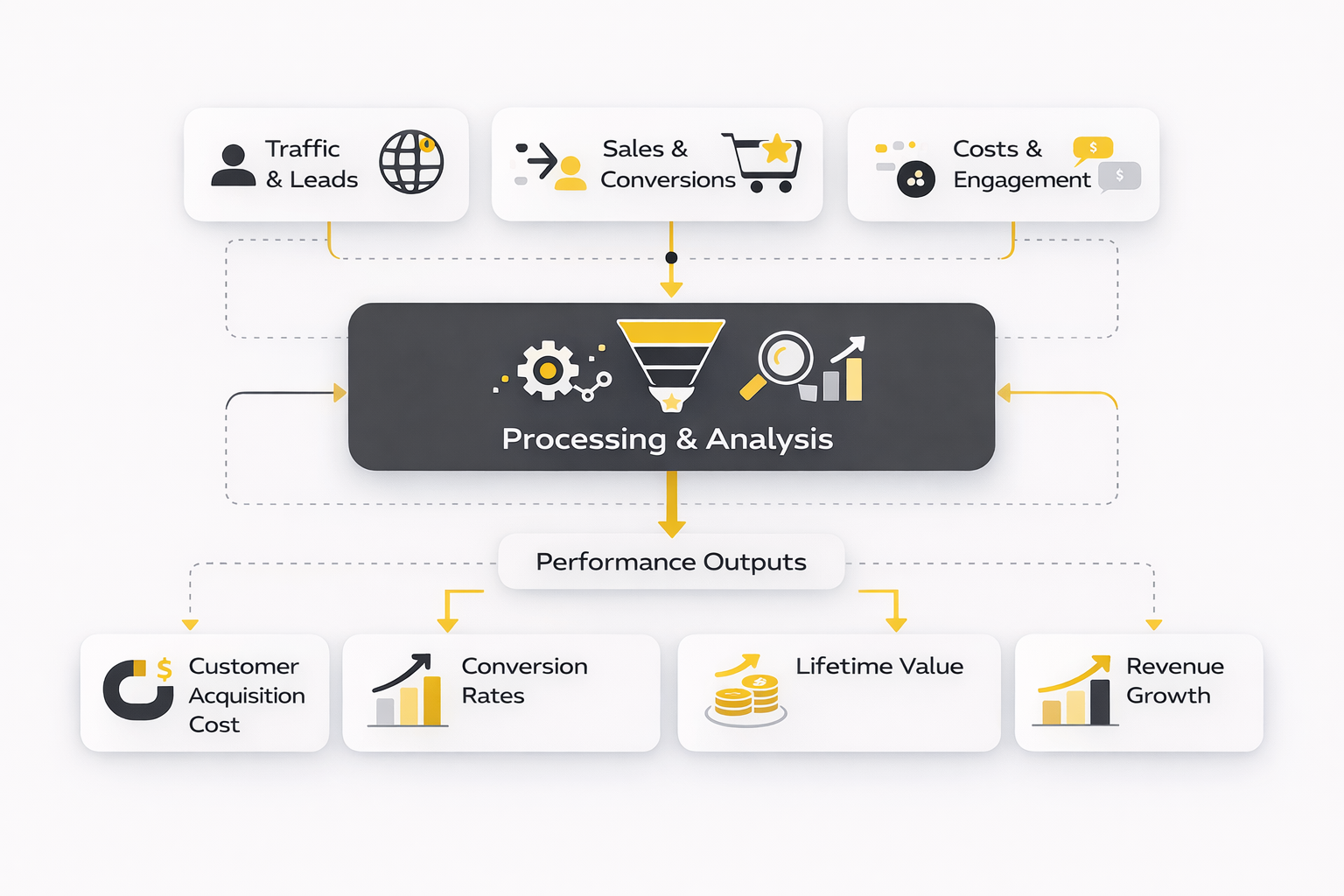
In practical terms, a complete marketing management ecosystem includes:
- A clear target audience and positioning
- A structured funnel guiding users from awareness to conversion
- Automated communication that nurtures and qualifies leads
- Centralized data that connects marketing to revenue
- Continuous optimization based on real performance signals
Platforms like GoHighLevel or Systeme.io make it easier to build this ecosystem without fragmentation. The tools themselves are not the advantage. The way you connect them is.
Once this system is in place, marketing stops feeling unpredictable. It becomes something you can scale, adjust, and rely on.
FAQ - Built for Complete Guide
What is marketing management in simple terms?
Marketing management is the process of planning, executing, and optimizing how a business attracts and converts customers. It connects strategy with real-world execution and measurable results. Instead of random campaigns, it creates a structured system for growth.
How is marketing management different from marketing?
Marketing is the activity. Marketing management is the system behind it. One focuses on doing campaigns, the other focuses on making those campaigns work consistently and profitably.
What are the most important parts of marketing management?
The most important parts include audience understanding, offer creation, funnel design, traffic acquisition, automation, and analytics. Each part supports the others. If one breaks, the entire system weakens.
Why do most marketing strategies fail?
Most strategies fail because they are not implemented as systems. Businesses focus on tactics without connecting them. They also fail to measure correctly, which leads to poor decisions and wasted resources.
How long does it take to see results from marketing management?
Initial signals can appear within weeks, especially in paid channels. However, stable and scalable results usually take several months because optimization, data collection, and system refinement require time.
What tools are essential for marketing management?
At a minimum, you need a CRM, funnel builder, automation system, and analytics platform. Tools like ClickFunnels help with funnel structure, while Brevo supports communication and email marketing. The key is integration, not the number of tools.
How do you measure success in marketing management?
Success is measured through metrics tied to business outcomes. This includes customer acquisition cost, conversion rates, lifetime value, and revenue growth. Vanity metrics like traffic or followers are secondary.
Can small businesses apply marketing management effectively?
Yes, and they often benefit the most. Smaller teams can move faster and implement systems without complex internal barriers. Using platforms like ManyChat allows them to automate processes that would otherwise require larger teams.
What is the biggest mistake in marketing management?
The biggest mistake is lack of alignment. When strategy, execution, and data are disconnected, performance suffers. Even strong individual tactics fail when they are not part of a cohesive system.
How important is automation in modern marketing management?
Automation is critical. It ensures consistency, reduces manual workload, and allows systems to scale without losing quality. Without automation, growth quickly becomes inefficient.
What role does data play in marketing management?
Data is the feedback loop. It shows what is working, what is not, and where to improve. Without reliable data, decisions become guesswork, and growth becomes unpredictable.
How do you scale marketing without increasing costs too much?
Scaling efficiently requires improving conversion rates, increasing customer lifetime value, and optimizing existing channels before expanding into new ones. It is not just about spending more, but about improving the system.
Work With Professionals
Explore 10K+ Remote Marketing Contracts on MarkeWork.com
Most marketers spend too much time chasing clients, competing on crowded platforms, and losing a percentage of every project to middlemen.
MarkeWork gives you a better way. Browse thousands of remote marketing contracts and connect directly with companies desperate to hire skilled marketers like you, without platform commissions and without unnecessary gatekeepers.
If you're serious about finding better opportunities and keeping 100% of what you earn, explore available contracts and create a profile for free at MarkeWork.com.