

Marketing management sounds like a textbook phrase, but in practice it is one of the clearest ways to understand how growth actually gets organized inside a business. It is the discipline that turns customer insight, strategy, messaging, pricing, channel choices, and measurement into a system instead of a pile of disconnected campaigns. The American Marketing Association defines marketing itself as the activity and processes for creating, communicating, delivering, and exchanging offerings with value, and marketing management is the part that makes those processes intentional, coordinated, and accountable.
That matters more now than it used to. Customer journeys are less linear, media is more fragmented, and leadership teams expect marketing to show commercial impact rather than just activity. Recent work from Google, BCG, Nielsen, Gartner, and The CMO Survey all points in the same direction: marketers are under pressure to connect strategy, execution, and measurement far more tightly than before.
A good way to think about marketing management is simple: it is how a company decides where to play, how to win attention, how to create value for the right audience, and how to measure whether that effort is producing real business results. Done well, it aligns brand, demand generation, customer experience, and performance management. Done badly, it creates noise, internal friction, and wasted budget.
- What Marketing Management Really Means
- Why Marketing Management Matters
- The Marketing Management Framework
- Core Components of an Effective Marketing System
- How Professionals Put Marketing Management Into Practice
- Common Mistakes, FAQs, and Final Takeaways
Why Marketing Management Matters
Marketing management matters because markets do not reward random effort. They reward businesses that understand customers clearly, choose a position deliberately, and execute consistently across channels and teams. That is why mainstream marketing frameworks still start with planning, research, segmentation, targeting, positioning, and performance review rather than jumping straight to tactics.
It also matters because the job of marketing has expanded. In many companies, marketing now influences acquisition, retention, pricing communication, lifecycle journeys, ecommerce performance, and even product feedback loops. Deloitte’s CMO research and Gartner’s recent budget findings show a function that is expected to drive growth while proving efficiency at the same time, which is exactly why management discipline matters more than campaign volume.
There is another reason this topic is so important: modern marketing breaks when nobody owns the full system. Teams often have content calendars, paid media dashboards, CRM automations, and brand guidelines, yet still struggle because those pieces do not connect to one clear objective. Marketing management is the mechanism that links customer understanding, strategic choices, execution plans, and measurable outcomes into one operating logic.

When that operating logic is missing, companies usually feel it in obvious ways. Messaging becomes inconsistent, channels compete with each other, reporting focuses on vanity metrics, and the team starts optimizing for what is easy to measure instead of what actually creates long-term value. Nielsen’s recent measurement work, Google’s guidance on modern measurement, and McKinsey’s analysis of personalization all reinforce the same point: marketing performs better when decisions are integrated, not isolated.
The Marketing Management Framework
The core framework of marketing management is not complicated, even if the execution can be. It starts with understanding the market, moves into strategic choices, turns those choices into programs and channels, and then loops back through measurement and adaptation. The process is continuous, which is why the AMA describes marketing management as ongoing goal setting, planning, execution, and progress measurement rather than a one-time plan.
In practical terms, the framework usually runs through a sequence like this:
- Research the market, customers, competitors, and internal capabilities
- Segment the market and choose the audiences that matter most
- Define positioning and value proposition
- Build the offer, pricing logic, distribution approach, and communication plan
- Execute across brand, content, media, sales support, and lifecycle channels
- Measure outcomes, learn, and adjust
That sequence still holds up, but the modern version is less linear than older textbook diagrams suggest. Google and BCG have both argued that customer behavior now moves through overlapping moments like searching, scrolling, streaming, and shopping, which means marketers need a management model that is coordinated enough to handle non-linear journeys without losing strategic clarity.
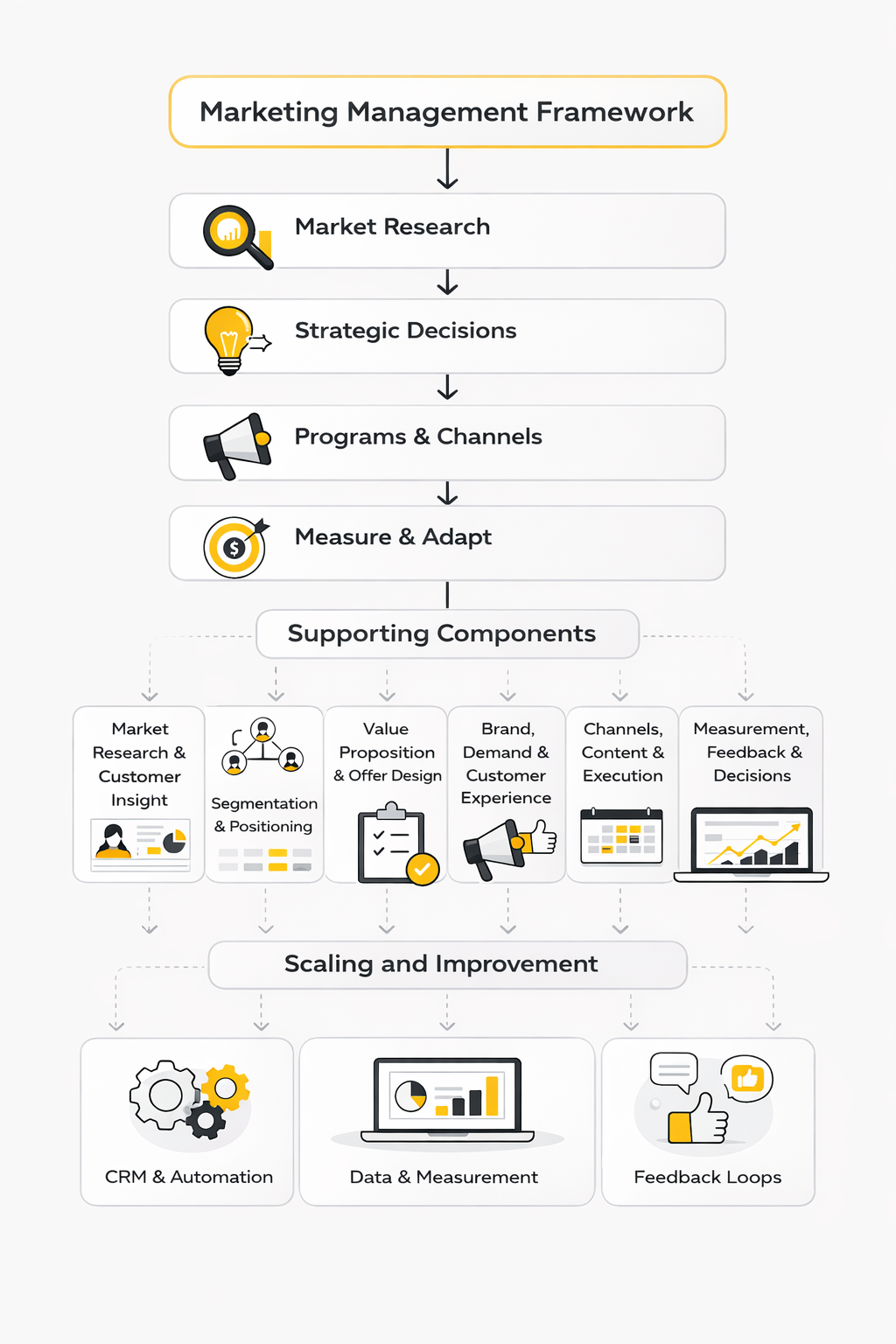
The real value of a framework is not that it looks neat on a slide. The value is that it gives teams a shared language for decision-making. When a business has a working marketing management framework, people know how research informs positioning, how positioning shapes campaigns, how campaigns support revenue goals, and how performance data feeds the next cycle of planning.
This is also where many companies separate themselves. McKinsey has highlighted the need for a more connected marketing operating model, while Bain has pointed to the advantage of a mature marketing technology stack that actually supports growth instead of creating more fragmentation. So the framework is not just about strategy on paper. It is about building a system that keeps strategy, execution, technology, and accountability moving in the same direction.
Core Components of an Effective Marketing System
A strong marketing management system is built from a few components that reinforce each other. This is where the topic stops being abstract and starts becoming operational. You can usually tell whether a company has real marketing management in place by how clearly it handles audience choice, positioning, offer design, channel coordination, and measurement.
The important thing is that these components are not separate checkboxes. They work as one system, and the system gets weaker every time one piece is missing. Great creative with weak positioning struggles, strong traffic with a poor offer underperforms, and detailed reporting without strategic focus turns into busywork.
Market Research and Customer Insight
Everything starts with understanding the market well enough to make better decisions than your competitors. That means looking beyond surface-level demographics and getting serious about customer needs, buying triggers, objections, switching behavior, and category expectations. Marketing management depends on this because every later decision, from targeting to messaging to pricing, gets sharper when the team actually understands how people choose.
Good research also prevents one of the most common management mistakes: building campaigns around internal assumptions. Teams often think they know why customers buy, why deals stall, or why retention slips, but those assumptions are often incomplete. Solid customer interviews, search behavior analysis, CRM data, sales-call feedback, and post-purchase insights give marketing management a much stronger base than opinions ever will.
There is also a practical point here. Research should not sit in a slide deck nobody opens again. In a well-run system, customer insight becomes a working input for planning, creative briefs, landing pages, lifecycle messaging, and offer design.
Segmentation, Targeting, and Positioning
Once the market is understood, marketing management has to decide who the business is really for. This is where segmentation, targeting, and positioning become useful, not as academic jargon, but as a filter that helps the team stop trying to appeal to everyone at once. Clear choices create stronger messaging, better media efficiency, and more relevant customer experiences.
Segmentation divides a broad market into meaningful groups with shared needs, behaviors, or value potential. Targeting decides which of those groups deserve the most attention based on fit, economics, and strategic importance. Positioning then defines how the brand or offer should be understood in the mind of that chosen audience.
This is where many marketing systems either become powerful or fall apart. If targeting is vague, campaigns become generic. If positioning is weak, the team ends up competing on noise, price, or convenience alone instead of giving customers a real reason to choose.
Value Proposition and Offer Design
A lot of marketing underperforms because the problem is not promotion. The problem is the offer. Marketing management has to make sure the value proposition is clear enough, specific enough, and relevant enough that the right audience immediately understands why it matters.
That includes the product or service itself, but it also includes packaging, pricing logic, proof, urgency, onboarding, guarantees, and the emotional framing around the offer. In other words, value is not just what the company sells. Value is how the full offer is experienced and interpreted by the market.
This is why good marketing managers stay close to product, sales, and customer success. They know that messaging can amplify value, but it cannot invent value that is not there. When the underlying offer is strong, marketing management has something real to scale.
The Marketing Mix in Modern Form
The classic marketing mix still matters because businesses still have to decide what they are offering, what it costs, where customers encounter it, and how it is promoted. In many cases, the broader 7Ps model is even more useful because people, process, and customer-facing experience often shape results just as much as advertising does. That is especially true in service businesses, software, ecommerce, and high-consideration B2B categories.
What matters is not whether a team memorizes a model. What matters is whether the model helps the team notice weak spots before the market does. If promotion is strong but the buying process is clunky, conversion suffers. If price signals the wrong level of value, even strong demand generation can struggle.
This is where marketing management becomes more than campaign execution. It becomes a way to coordinate commercial decisions so that the customer experience feels coherent from first impression to purchase and beyond.
Brand, Demand, and Customer Experience
One of the biggest shifts in modern marketing management is that brand and performance can no longer be treated like separate worlds. The same customer may see a short-form video, read reviews, visit a pricing page, ignore an email, click a retargeting ad, and finally convert after a sales conversation. That means brand perception, conversion paths, and customer experience are now tightly connected.
A good marketing system respects both time horizons. It builds brand memory and trust while also improving near-term conversion. When companies ignore brand, performance often gets more expensive over time. When they ignore demand capture, brand investment can drift too far from commercial outcomes.
Customer experience belongs in this component too. Marketing management is not finished once a lead comes in or a sale happens. The post-click and post-purchase experience affect retention, referrals, reviews, and future acquisition efficiency, which means they are part of the marketing system whether the org chart says so or not.
Channels, Content, and Lifecycle Execution
Channels are not the strategy. They are delivery mechanisms. Marketing management has to decide which channels deserve attention, what role each one plays, and how messaging should adapt without losing consistency.
That includes acquisition channels like search, paid social, partnerships, and outbound, but it also includes retention and nurture systems such as email, SMS, community, and remarketing. Content sits across all of this because every channel needs assets that match the customer’s stage, intent, and level of awareness. Without that coordination, teams end up publishing constantly while saying very little that moves people forward.
This is also where process matters. A business that wants tighter execution often needs a cleaner operational backbone for CRM, automation, scheduling, and lead handling. Tools such as GoHighLevel, Brevo, ManyChat, and Buffer can support execution, but the real advantage comes from having a system that defines ownership, timing, handoffs, and feedback loops.
Measurement, Feedback, and Decision-Making
Marketing management is incomplete without measurement, but measurement has to do more than populate dashboards. Its real job is to improve decisions. The point is not to report activity more elegantly. The point is to understand what is creating movement in revenue, retention, customer quality, and long-term brand strength.
That requires choosing metrics that match the stage and objective of the work. Some efforts are about awareness, some about conversion efficiency, some about sales velocity, and some about lifetime value. A mature system knows the difference and does not force every tactic to justify itself with the same narrow metric.
Just as important, feedback needs to move quickly. Insights from campaigns, sales conversations, win-loss analysis, support tickets, and retention data should reshape the next round of execution. That is how marketing management becomes a living process instead of a static plan.
How the Pieces Work Together
These components only create leverage when they connect. Research sharpens segmentation. Segmentation improves positioning. Positioning strengthens the offer. The offer performs better when channels and content are aligned. Measurement then shows where the system is working and where it needs adjustment.
That full chain is what separates true marketing management from disconnected activity. A company may have a paid media specialist, a content lead, a CRM manager, and a designer, but without a management system those functions often pull in different directions. Once the components are connected, the same team can look far more effective without necessarily getting bigger.
That is the real takeaway from this section. Marketing management is not one tactic, one campaign type, or one software stack. It is the discipline of making all the critical marketing choices fit together well enough to create repeatable commercial momentum.
How Professionals Put Marketing Management Into Practice
This is the point where marketing management either becomes real or stays theoretical. A professional team does not stop at a strategy deck, a list of channels, or a handful of campaign ideas. It turns decisions into a repeatable operating process with priorities, owners, timelines, feedback loops, and clear commercial goals.
That sounds obvious, but it is where a lot of teams struggle. Recent work on marketing operating models from McKinsey and budget pressure from Gartner point to the same reality: marketing leaders are expected to deliver more disciplined execution with tighter resources. That makes implementation a management issue, not just a creative one.
The good news is that effective marketing management usually follows a clear process. The details vary by company size, business model, and market maturity, but the logic stays surprisingly consistent. Professionals move from diagnosis to planning, from planning to execution, and from execution to structured learning.
Start With a Sharp Commercial Objective
The first step is to define what the marketing system is actually trying to accomplish. That objective needs to be commercial enough to matter and specific enough to guide choices. Broad goals like “grow awareness” or “do more content” are too vague to anchor serious marketing management.
A better starting point is something like increasing qualified pipeline in a specific segment, improving conversion from first purchase to repeat purchase, reducing customer acquisition cost without damaging lead quality, or supporting expansion into a clearly defined market. Once the objective is concrete, the rest of the process gets cleaner. Channel choices become easier, messaging gets more focused, and reporting stops drifting toward vanity metrics.
This is also where alignment matters. Marketing management works far better when leadership, sales, and marketing agree on what success looks like before the work begins. If those teams define success differently, execution gets messy fast.
Translate Strategy Into a Working Plan
Once the objective is clear, strategy has to become a plan people can actually use. This is the bridge between thinking and doing. It usually includes the target audience, core message, offer, channel roles, budget assumptions, campaign calendar, measurement logic, and the operational handoffs required to make execution work.
A practical plan does not try to answer every possible question. It answers the right ones. Who are we targeting first, what promise are we leading with, which channels are core versus supporting, what asset production is required, and how will results be evaluated after launch?
This is where professional marketing management looks calmer than amateur execution. Instead of running ten disconnected initiatives, a strong team narrows the field and builds around a few linked priorities. That focus is usually what makes the work feel more coherent to customers and more manageable internally.
Build the Operating Rhythm Before You Launch
A surprising amount of marketing underperformance has nothing to do with the market and everything to do with poor operating rhythm. The campaign goes live, but the sales team is not briefed. The landing page is live, but tracking is incomplete. The leads arrive, but follow-up is inconsistent. The dashboard exists, but nobody has agreed on what actions certain numbers should trigger.
That is why professional marketing management sets the rhythm before execution starts. Teams define who owns each stage, how often results are reviewed, what signals matter most, and where decisions get made. A weekly execution review, a monthly performance review, and a quarterly strategy reset often do more for results than adding another tactic.
This is also the stage where technology should support the process rather than complicate it. For businesses that need tighter coordination across CRM, automation, and lead handling, platforms like GoHighLevel, Brevo, and ManyChat can make execution more reliable, but only when the underlying operating logic is already clear.
Use a Step-by-Step Execution Process
At this stage, marketing management becomes tangible. The abstract framework from earlier parts turns into a sequence the team can follow, measure, and improve. This is where strong implementation creates momentum because everyone can see how the work moves from strategy to market.
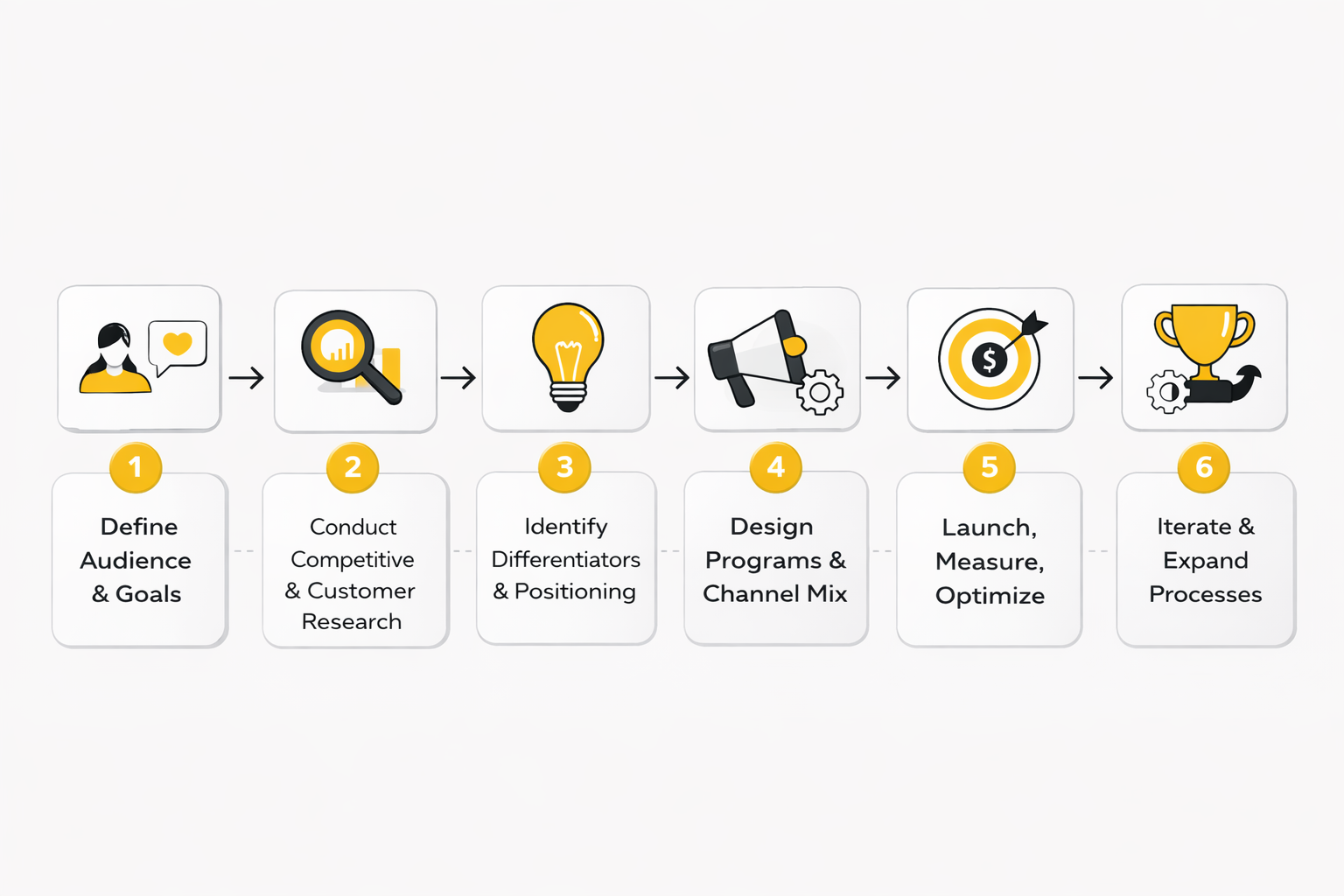
A practical execution process usually looks like this:
- Confirm the business goal and the audience priority
- Finalize the positioning, message hierarchy, and offer
- Map the funnel or customer journey for the campaign
- Build the required assets, pages, automations, and sales enablement materials
- Launch with tracking, attribution, and lead-routing in place
- Review early signals without overreacting to noise
- Optimize based on conversion data, sales feedback, and customer behavior
- Fold the lessons into the next planning cycle
This matters because implementation quality compounds. When teams follow a clear process, they make fewer avoidable errors, launch faster, and learn faster. When they skip steps, they usually create hidden friction that shows up later as weak conversion, poor lead quality, missed follow-up, or conflicting reporting.
Coordinate Content, Creative, and Conversion Paths
Execution is not just about publishing assets. It is about making sure those assets work together. In professional marketing management, content is tied to a job, creative is tied to a message, and conversion paths are tied to a defined audience and desired action.
That sounds basic, but it changes the quality of execution. A campaign performs differently when the ad promise matches the landing-page promise, the page matches the offer, and the follow-up sequence reflects the same intent. When those elements are disconnected, the user experiences friction even if the creative itself looks polished.
For teams working heavily in landing pages, funnels, or ecommerce experiences, tools like Replo, ClickFunnels, or Systeme.io can make deployment easier. But the bigger point is strategic: the page, the message, the offer, and the follow-up should feel like one experience, not four separate decisions.
Make Measurement Useful, Not Decorative
This is where many teams lose the plot. They collect a lot of numbers, but those numbers do not improve decisions. Real marketing management uses measurement to answer questions that affect action: Is the audience right, is the offer resonating, are we creating the right type of demand, where is conversion friction, and which channels deserve more or less investment?
That is why implementation should define measurement before launch rather than after it. The team needs to know which leading indicators matter in the first days, which lagging indicators matter later, and what thresholds justify changes to budget, creative, or channel mix. Work from Nielsen and broader commentary on measurement confidence in fragmented channels shows why this matters so much: marketers are still under pressure to prove impact more clearly across a messy media environment.
Useful measurement is also contextual. Early-stage demand generation, high-ticket B2B pipeline work, ecommerce conversion, and retention marketing should not all be judged by the same scoreboard. A professional implementation process reflects that difference instead of flattening everything into one dashboard.
Create Fast Feedback Loops With Sales and Customer Teams
One of the biggest differences between average and excellent marketing management is how quickly the team learns from the front lines. Sales hears objections that ad data cannot explain. Customer success sees onboarding friction that acquisition reports never show. Support teams spot recurring confusion that should have been addressed in the offer or messaging.
That feedback should not be treated as anecdotal noise. It should be part of the process. A well-run marketing system captures those signals, compares them with campaign data, and adjusts messaging, qualification, nurture, and channel strategy in response.
This is especially important in longer buying cycles and service businesses. Marketing management gets stronger when the team stops pretending that campaign reporting alone tells the whole story. The closer execution stays to real buyer behavior, the better the decisions become.
Use AI and Automation Carefully but Intentionally
AI and automation can speed up implementation, but they do not replace management judgment. They are useful for drafting, summarizing, personalizing at scale, automating responses, routing leads, accelerating analysis, and reducing repetitive work. They are much less useful when they are deployed without clear guardrails, clear positioning, or human review.
That is why the best use of AI inside marketing management is usually operational, not magical. It helps the team execute faster and learn faster, but it still depends on the quality of the strategy, data, and offer underneath it. Current marketing research and industry reporting keep reinforcing this point: AI creates leverage, but only when it is plugged into a disciplined system rather than layered on top of chaos.
In practice, that often means starting small. Use automation where speed and consistency matter most, then expand once the team can see a real gain in cycle time, cost, or output quality. That approach is less exciting than sweeping transformation language, but it is usually how serious implementation actually improves.
Protect Execution With Clear Ownership
A marketing plan without ownership is just a document. The implementation process gets stronger the moment every important piece has a named owner. That includes strategy sign-off, creative production, funnel build, launch readiness, lead routing, reporting, and post-launch optimization.
Ownership does not mean one person does everything. It means everyone knows who is accountable for moving each part forward and resolving blockers when they appear. That clarity reduces delay, reduces duplicated effort, and makes marketing management much easier to scale across multiple channels or campaigns.
This is one of those points that sounds unglamorous but matters a lot. Weak ownership quietly kills strong strategies all the time. Clear ownership, on the other hand, is one of the simplest ways to make a marketing system more dependable.
Treat Implementation as a Loop, Not a Finish Line
The biggest mistake in execution is thinking launch is the end of the work. In good marketing management, launch is the start of the learning cycle. The team watches early performance, compares it with expectations, studies where friction is appearing, and improves the system while the work is live.
That is what makes implementation professional. It is not just about getting campaigns out the door. It is about building a repeatable cycle where each round of execution improves the next one. Over time, that creates sharper positioning, better offers, stronger conversion paths, and more confident investment decisions.
That loop is the heart of modern marketing management. It turns strategy into action, action into data, and data into better judgment. Once a team can do that consistently, marketing stops feeling reactive and starts working like a real growth function.
What the Data Is Really Telling You
By the time you get to measurement, marketing management stops being about opinion and starts being about evidence. This is where teams find out whether their positioning is resonating, whether their channel mix is efficient, whether their offers are converting, and whether the business is building durable demand or just buying short-term spikes. The problem is not a lack of numbers. The problem is knowing which numbers matter, what they actually mean, and what decision they should trigger.
That distinction matters because modern marketing produces an enormous amount of data and still leaves many teams unclear about real performance. In Gartner’s 2025 CMO spend survey, marketing budgets stayed flat at 7.7% of company revenue, and 59% of CMOs said they do not have enough budget to execute their strategy. When budgets are tight and accountability rises, weak measurement stops being an inconvenience and becomes a growth constraint.
The First Rule of Measurement: Match the Metric to the Job
A lot of reporting becomes misleading because teams use the wrong metric for the wrong stage of the funnel. Awareness work, demand capture, conversion optimization, and retention each create value differently, so they need different scorecards. Treating them all as if they should behave the same way is one of the fastest ways to make smart work look ineffective or weak work look stronger than it is.
This is where good marketing management stays disciplined. Early-stage campaigns may need reach, branded search lift, engaged visits, and assisted conversions to show whether attention is moving in the right direction. Mid-funnel programs often need stronger signals around qualified leads, demo requests, sales acceptance, and funnel progression. Later-stage optimization usually deserves harder commercial metrics like customer acquisition cost, payback period, repeat purchase rate, contribution margin, or pipeline efficiency.
The practical takeaway is simple. Before any campaign launches, the team should know what the leading indicators are, what the lagging indicators are, and what would count as a meaningful improvement. That one habit makes analytics dramatically more useful.
Why So Many Dashboards Still Miss the Real Picture
There is a reason teams can feel data-rich and insight-poor at the same time. In the 2024 Nielsen Annual Marketing Report, 84% of global marketers said they felt confident in their ROI measurement capabilities, yet only 38% said they measure traditional and digital marketing together. That gap is more revealing than the confidence number itself.
What it tells you is that many teams are still measuring fragments of performance instead of the system as a whole. They know what happened in a platform dashboard, what happened in paid search, what happened in email, or what happened on a landing page. But they do not always know how those signals interact across brand, media, organic demand, sales conversations, and customer retention.
That is why marketing management has to push beyond channel reporting. Customers do not experience your brand in silos, and your measurement model cannot stay siloed either. If it does, budget gets pushed toward whatever is easiest to count rather than whatever is actually driving business growth.
Build an Analytics System, Not Just a Reporting Habit
A real analytics system has layers. It does not rely on one method and pretend that method tells the whole truth. It uses fast operational reporting for day-to-day management, attribution for journey visibility, experiments for causal confidence, and broader modeling for budget decisions across channels and time horizons.
Google has been unusually clear on this point. In its guidance on incrementality testing, it calls incrementality the gold standard for understanding advertising’s true impact in a privacy-first environment. In its newer measurement guidance, Google also argues that the strongest setup combines incrementality, marketing mix models, and attribution, because each method answers a different question.
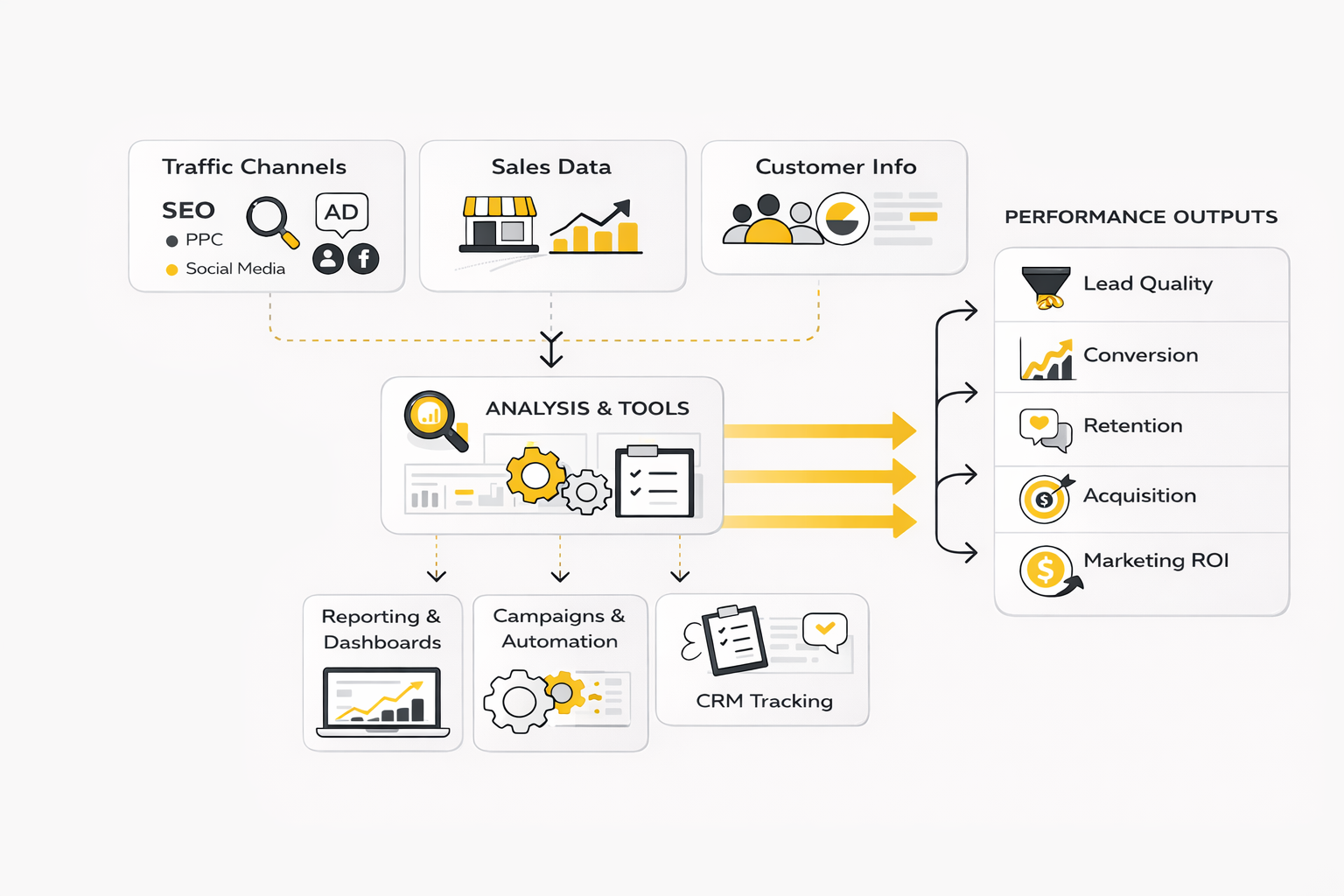
That combined view is where marketing management gets much sharper. Attribution helps you see paths and touchpoints. Incrementality helps you understand causation and whether a campaign created additional business that would not have happened otherwise. Marketing mix models help you think at the portfolio level, especially when you need to make broader allocation decisions across channels, seasonality, and external market factors.
This is the part many teams miss. They keep asking one tool to answer every question. It cannot. A better analytics system accepts that different methods are useful for different decisions and builds the measurement stack around that reality.
The Most Useful Signals to Watch
Not every signal deserves equal weight. Some numbers are useful because they help diagnose friction early. Others matter because they show whether marketing is creating economic value. A strong marketing management system knows the difference and does not confuse diagnostic signals with success metrics.
The most useful signal categories usually include:
- Attention signals, such as reach quality, video completion trends, share of search, branded search movement, and engaged visits
- Response signals, such as click-through rate, landing-page engagement, form completion, demo requests, and reply rates
- Quality signals, such as lead-to-opportunity rate, sales acceptance, meeting show rate, repeat purchase rate, and customer retention
- Economic signals, such as customer acquisition cost, contribution margin, pipeline velocity, revenue per customer, payback period, and lifetime value
The point is not to track all of these at once just because they exist. The point is to choose the signals that reveal whether your current objective is progressing. If the goal is profitable acquisition, low-cost clicks with poor lead quality are not a win. If the goal is category growth, short-term conversion data on its own will not tell the full story.
Benchmarks Are Useful, but Only if You Use Them Properly
Benchmarks help when they create perspective. They hurt when they replace thinking. That is especially true in marketing management because benchmarks vary heavily by industry, price point, sales cycle, geography, traffic source, and business model.
A benchmark should work like a reference point, not a verdict. If your conversion rate is lower than a category average, that may signal friction in the offer, the page, the traffic quality, or the audience fit. But the number itself is not enough to diagnose the problem. You still have to look at context, especially customer intent, average order value, buying complexity, and the difference between new and returning users.
This is why internal benchmarks are often more useful than generic market averages. Year-over-year improvement, segment-by-segment differences, and pre-versus-post test comparisons usually tell you more than broad industry numbers by themselves. Good marketing management uses external benchmarks to frame questions, then uses internal data to make decisions.
What Budget and Measurement Trends Actually Mean
Some data matters because of what it signals about the operating environment, not because it gives you a direct campaign benchmark. The Gartner 2025 survey is a good example. Flat budgets and rising pressure on marketing productivity tell you that leadership teams want sharper prioritization, better measurement, and clearer proof of commercial value.
The Nielsen report adds another layer. Its findings on digital concentration, fragmented media, and incomplete cross-channel measurement suggest that overcommitting to a narrow set of channels can weaken overall reach and distort perceived performance. That does not mean digital is the problem. It means channel-level success can still produce a weak overall portfolio if measurement remains fragmented.
The broader signal is hard to ignore. Marketing management now has to balance efficiency with coverage, short-term proof with long-term demand creation, and channel reporting with business reality. That is why analytics matters more than ever. It is not just about proving what happened. It is about making better allocation decisions before the next quarter arrives.
How to Interpret Performance Without Overreacting
One of the most expensive habits in marketing is overreacting to early data. A campaign launches, a few metrics wobble, and suddenly the team changes audiences, creative, bids, pages, or offers before enough signal has accumulated to support the change. That is not data-driven management. That is anxious management dressed up as optimization.
A better approach is to separate weak signal from strong signal. Early indicators can tell you whether tracking works, whether traffic quality is wildly off, whether messaging is mismatched, or whether conversion is completely blocked. But they are usually less reliable for sweeping budget or strategy decisions. Stronger decisions need a longer view, especially in complex sales cycles or multi-touch buying journeys.
This is where marketing management earns its keep. The team needs to know when to hold steady, when to investigate, and when to intervene. That judgment is part analytics, part commercial understanding, and part discipline.
What the Data Should Make You Do Next
Numbers matter only when they change action. If measurement shows healthy response but weak sales acceptance, the likely next move is not more top-of-funnel spend. It is fixing qualification, messaging precision, or offer clarity. If traffic is strong but conversion is weak, the priority may shift to page structure, proof, onboarding friction, or pricing communication. If acquisition looks efficient but retention is weak, the growth problem may actually sit in the customer experience, not the campaign.
This is the practical value of measurement in marketing management. It tells you where the constraint is. That is much more useful than simply telling you whether a graph went up or down. Great teams use analytics to locate friction, prioritize fixes, and protect budget from being spent in the wrong place.
This is also why performance reviews should end with decisions, not summaries. Every reporting cycle should answer a small set of hard questions. What is improving, what is underperforming, what does the pattern likely mean, and what will we change next? If a dashboard cannot help answer those questions, it is probably too decorative and not operational enough.
The Best Measurement Culture Is Honest, Not Performative
There is one last point that matters more than it gets credit for. The strongest analytics culture is not the one with the most polished reporting. It is the one that is most honest about uncertainty, trade-offs, and what the team still does not know.
That matters because marketing management often operates under imperfect information. Privacy changes reduce visibility. Buying journeys stay messy. Brand effects show up slowly. Attribution models simplify reality. A mature team accepts those limits and still builds a system that gets smarter over time.
That is the real role of statistics and data in marketing management. They are not there to impress the board with charts or to justify every past decision. They are there to make the next decision better. When teams use analytics that way, measurement stops feeling like a reporting burden and starts becoming one of the strongest strategic advantages they have.
Advanced Realities That Separate Good Marketing Management From Great Marketing Management
Once the fundamentals are in place, marketing management becomes less about learning the framework and more about navigating tradeoffs. This is the part that usually separates decent teams from high-performing ones. The basics still matter, but the real challenge shifts to resource allocation, operating discipline, data constraints, organizational design, and the ability to scale without turning the whole system into a bloated mess.
That matters because the environment has become less forgiving. Marketing budgets have stayed under pressure, AI adoption is uneven, privacy rules keep changing measurement assumptions, and many companies are still struggling to connect strategy to actual execution. The result is that strong marketing management now depends as much on judgment and organizational design as it does on creative quality or channel expertise. Gartner’s February 2025 survey and McKinsey’s work on operating models both point in that direction.
Scaling Usually Breaks What Worked at Smaller Size
A lot of marketing systems look effective when the team is small, the founder is close to the customer, and the channel mix is still narrow. Then the company grows, adds specialists, introduces more reporting layers, brings in more tools, and starts expanding into new segments or regions. That is often the point where marketing management gets harder, not easier.
The reason is simple. What worked through intuition and proximity now has to work through process and coordination. Messaging has to stay consistent across more campaigns, handoffs have to survive more people, and measurement has to remain credible even as the customer journey becomes more fragmented. McKinsey’s research on the marketing operating model argues that growth increasingly depends on a more connected model that links brand, performance, data, content, and commercial execution rather than letting them run as isolated functions. McKinsey’s 2024 analysis makes that point clearly.
This is why scaling marketing management is not just about adding headcount. It is about preserving clarity while complexity rises. If that does not happen, the company often ends up with more activity and less real control.
More Technology Does Not Automatically Mean Better Marketing
One of the easiest traps in modern marketing management is assuming the next tool will fix an operating problem. Sometimes it helps. A better CRM, cleaner automation, or more flexible page builder can absolutely remove friction. But when the real issue is weak positioning, unclear ownership, poor data discipline, or conflicting incentives, more software just gives the confusion better dashboards.
That is exactly why mature organizations tend to get more value from their stack than immature ones. In Bain’s recent research, companies classified as marketing leaders were twice as likely to have a fully mature marketing technology stack as laggards, but the deeper point was orchestration, not tool count. Bain’s 2025 report on marketing technology argues that competitive advantage comes from coordinated use of technology rather than accumulation.
For practical marketing management, that means every technology decision should answer a real operational need. If the need is lifecycle automation, a platform like Brevo or GoHighLevel may fit. If the need is faster funnel deployment, ClickFunnels, Systeme.io, or Replo may be useful. But the tool should follow the operating model, not the other way around.
AI Creates Leverage, but It Also Exposes Weak Management
There is a lot of noise around AI in marketing, but the most useful way to think about it is operationally. AI helps teams move faster, test faster, summarize faster, personalize faster, and automate repetitive work. It can compress cycle times in content creation, research support, workflow routing, and campaign iteration.
At the same time, AI makes weak marketing management more visible. If positioning is vague, AI can produce more vague assets. If the brand voice is inconsistent, AI can amplify inconsistency at scale. If teams have no review process, no measurement discipline, and no clear commercial objective, AI mostly accelerates clutter. Gartner’s February 2025 survey found that 27% of marketing organizations had limited or no GenAI adoption in campaigns, while among adopters 77% were using it for creative development tasks, which suggests many teams are still in an uneven, practical early stage rather than a fully transformed one. The Gartner findings are useful here because they show both adoption and its limits.
That creates a real management challenge. The goal is not to chase AI everywhere. The goal is to use it where it improves quality, speed, or consistency without weakening judgment. That usually means building clear review layers, controlled prompts, approval logic, and performance feedback into the process.
Privacy Changes Force Better First-Party Thinking
Another advanced consideration is privacy. For years, many marketers got used to abundant tracking, granular targeting, and easy reporting inside ad platforms. That world has been getting weaker, and marketing management has had to adapt. Google’s privacy-focused guidance has repeatedly stressed the need to future-proof data practices, strengthen first-party data, and build measurement approaches that are resilient even as old tracking assumptions disappear. Google’s privacy-first marketing guidance and its newer measurement updates make that direction clear.
This changes more than media buying. It changes the way companies think about relationships with customers. First-party data becomes more valuable, consent becomes more operationally important, and owned channels start carrying more strategic weight. Email, CRM, direct audiences, community touchpoints, and post-purchase engagement become more than retention tactics. They become part of the company’s measurement and resilience strategy.
That is why good marketing management treats privacy as a strategic design issue, not just a legal one. Teams that build stronger first-party systems now tend to be in better shape when external data gets weaker later.
The Brand Versus Performance Tension Never Fully Goes Away
One of the oldest tensions in marketing management is still one of the most important: how much to prioritize short-term measurable performance versus longer-term brand building. That tension is harder now because budgets are tight and executive teams often want direct proof quickly. But overcorrecting toward only what is immediately countable can quietly damage future efficiency.
Google’s recent measurement thinking has pushed marketers to look more holistically at ROI, including effects that unfold over longer periods rather than only within short reporting windows. Its 2025 discussion of hidden marketing ROI argues that much of the long-term value of marketing often goes unrecognized when teams rely too heavily on narrow short-term views. Bain’s March 2026 survey also adds a useful strategic signal: companies with a clear and consistent value proposition achieved 19% revenue growth in 2025 versus 12% for those without one, and nearly 40% of revenue and margin leaders cited brand perception as a top factor in winning, retaining, or expanding accounts. Bain’s 2026 survey release reinforces that point.
The practical implication is not that every company should suddenly overspend on brand. It is that strong marketing management should protect some investment in memory, trust, distinctiveness, and category perception while still demanding commercial discipline. That balance is hard, but it matters a lot.
Retention and Expansion Are No Longer Secondary
As acquisition gets more competitive and growth expectations stay high, companies are paying more attention to existing customers. That shift shows up clearly in current leadership priorities. Gartner reported in May 2025 that 73% of chief sales officers were prioritizing growth from existing customers for 2025, which says a lot about where commercial pressure is moving. That Gartner survey is technically about sales leadership, but the implication for marketing management is obvious.
Marketing cannot treat retention, expansion, and customer engagement as somebody else’s department anymore. Messaging, onboarding support, lifecycle automation, education, loyalty, and reactivation all affect revenue quality. Bain’s client work on customer engagement also shows how fragmented retention efforts often improve only when the company builds a unified journey view and standardizes the way it identifies and fixes customer friction. Bain’s retention case study illustrates that well.
For advanced marketing management, this means the system should not stop at acquisition reporting. It should follow the customer deeper into value realization, expansion potential, and churn risk. That is where a lot of hidden growth sits.
Organizational Design Is a Strategic Choice
At some point, the question is no longer just what campaigns to run. It becomes how the team itself should be designed. Centralized teams can protect standards and efficiency. Decentralized teams can move closer to the customer and react faster in specific segments. Hybrid structures often look attractive but can create confusion if decision rights are not clear.
There is no universal best model, but there is a universal principle: the structure has to match the strategy. McKinsey’s broader work on operating models argues that performance gaps often come from the way organizations are set up to execute, not just from the quality of the strategy itself. Its June 2025 operating model research highlights how even strong companies often leave a significant share of strategic value unrealized because the operating model falls short.
This matters in marketing management because structure influences speed, ownership, accountability, and customer closeness. A poor structure can make a smart strategy feel clumsy. A well-designed structure can make the exact same strategy far more effective.
The Hardest Tradeoff Is Focus
If there is one expert-level lesson that keeps showing up, it is this: focus is usually more valuable than breadth. Most marketing systems do not fail because they lack ideas. They fail because they spread attention too thinly across too many audiences, too many channels, too many offers, and too many priorities.
That pressure only gets worse as teams scale. Every new segment, product line, region, or executive request competes for attention. Marketing management has to act as the discipline that protects prioritization. Otherwise the team ends up looking productive while actually weakening its impact.
This is where confident leadership matters. Not every audience deserves the same investment. Not every channel deserves the same depth. Not every metric deserves the same urgency. Strong marketing management is willing to make those choices early, explain them clearly, and defend them long enough for the work to compound.
What Expert-Level Marketing Management Really Looks Like
At a high level, expert marketing management looks less flashy than people expect. It is usually not built on one viral campaign, one genius tactic, or one magical dashboard. It is built on consistency, prioritization, operating discipline, and the ability to make better decisions under pressure.
That is why advanced teams often look calmer than average ones. They still move fast, but they do not chase every trend. They use technology, but they do not worship it. They measure aggressively, but they do not confuse noise with insight. And they keep the entire system close enough to the customer that growth decisions still make sense in the real world.
That is also why the final part of this article matters. Once you understand the framework, the components, the implementation process, the analytics layer, and the advanced tradeoffs, the remaining job is to simplify the whole thing into clear principles people can actually remember and use.
Bringing the Whole System Together
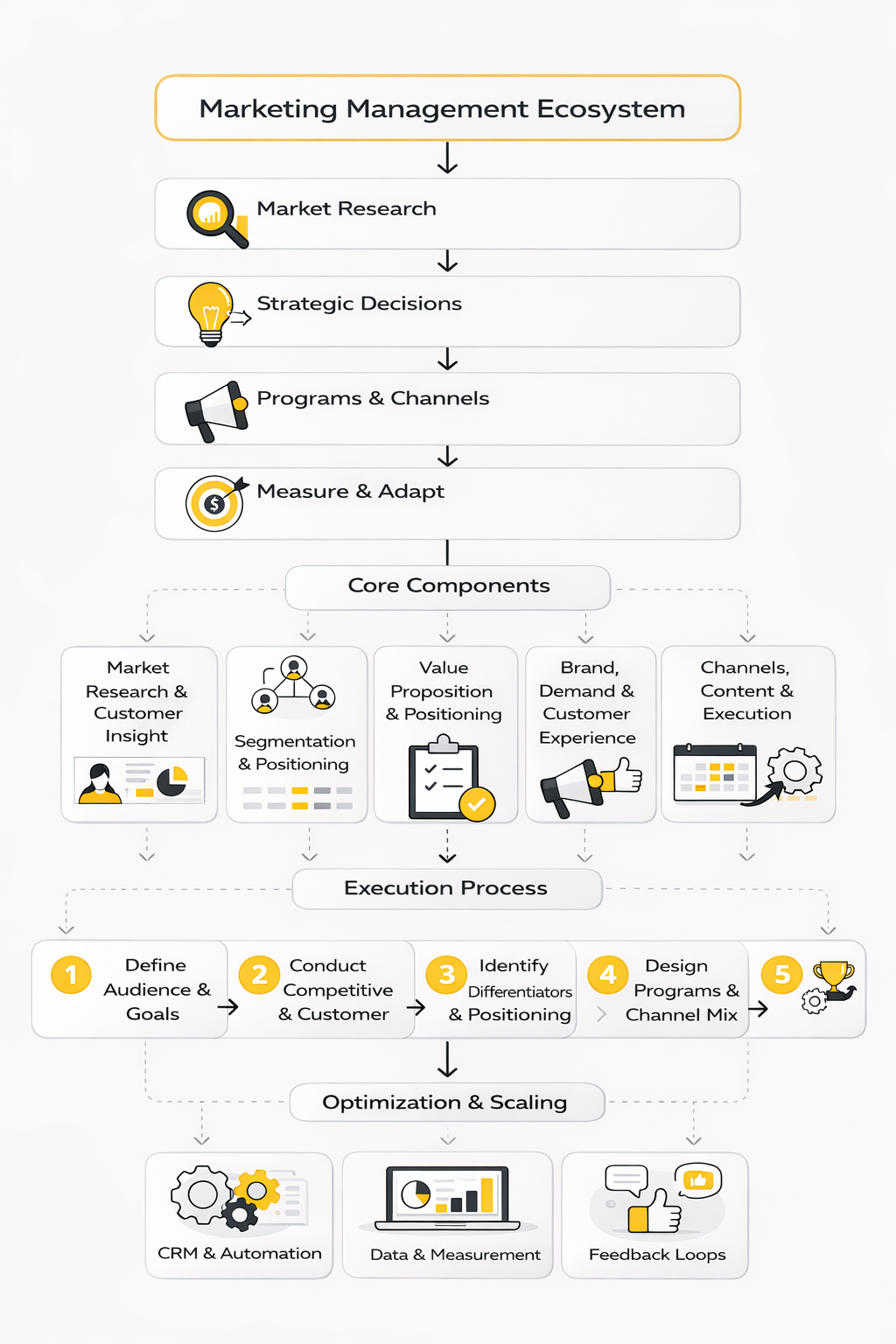
At this point, the big picture of marketing management should feel a lot clearer. It is not a campaign type, a reporting habit, or a stack of software. It is the operating system that connects customer insight, strategic choice, execution, measurement, and continuous improvement into one commercial discipline.
That is also why strong marketing management feels different from random marketing activity. It has priorities, tradeoffs, ownership, and a learning loop. In an environment where budgets remain tight, measurement is getting more complex, and many teams are still trying to turn AI and data into actual business value, that discipline matters even more than it used to. Gartner’s 2025 CMO spend survey, Google’s recent measurement updates, and Bain’s 2025 work on marketing technology all point to the same reality.
The companies that handle this well usually do a few things consistently. They stay close to the customer, keep their value proposition sharp, choose channels with intent, measure what matters, and refine the system without overcomplicating it. They do not expect perfect information. They build a process that helps them make better decisions with the information they have.
FAQ
What is marketing management in simple terms?
Marketing management is the process of planning, executing, measuring, and improving how a business reaches customers and creates demand. It gives structure to decisions around audience, positioning, channels, offers, and performance. In simple terms, it is how marketing stops being a collection of tactics and starts operating like a real growth system.
Why is marketing management important for business growth?
It matters because growth gets harder when marketing is fragmented. Teams waste money faster when campaigns, messaging, offers, and measurement are not aligned. Good marketing management improves focus, reduces friction, and makes it easier to turn customer understanding into revenue-producing action.
Is marketing management the same as marketing strategy?
Not quite. Marketing strategy is the directional choice about where to play, who to target, and how to position the business. Marketing management is broader because it includes the operating side too, meaning planning, coordination, execution, measurement, and optimization.
What are the core functions of marketing management?
The core functions usually include research, segmentation, targeting, positioning, planning, campaign execution, budget allocation, measurement, and performance review. In practice, it also includes cross-functional coordination with sales, product, and customer success. That wider role is one reason modern marketing management has become more commercially important.
How does marketing management differ from brand management?
Brand management focuses more narrowly on how the brand is perceived, expressed, and strengthened over time. Marketing management includes brand, but it also extends into demand generation, channel execution, customer journeys, analytics, budgeting, and performance improvement. You can think of brand management as one important part inside the larger marketing management system.
What skills are most important in marketing management?
The strongest marketing managers usually combine strategic thinking with execution discipline. They need customer understanding, prioritization, communication skills, commercial judgment, data literacy, and the ability to coordinate people around a shared goal. Technical knowledge helps, but the biggest advantage often comes from making better decisions consistently.
How do you measure whether marketing management is working?
You measure it by looking at whether the system is producing the outcomes it was built to create. That can include stronger lead quality, better conversion, healthier retention, more efficient acquisition, faster learning cycles, and clearer alignment between marketing activity and business goals. The exact metrics should change based on the objective, but the underlying question stays the same: is marketing creating useful commercial movement?
What is the biggest mistake companies make with marketing management?
One of the biggest mistakes is confusing activity with effectiveness. Teams publish more, launch more, buy more traffic, and produce more reports, but they never fix the underlying issues in positioning, targeting, offer clarity, or execution quality. That is why more effort does not automatically create better results.
How often should a company review its marketing management process?
The process should be reviewed at multiple speeds. Weekly reviews help teams catch execution issues, monthly reviews help them interpret performance patterns, and quarterly reviews are usually better for bigger strategic decisions. That rhythm keeps the system responsive without making it unstable.
Can small businesses benefit from marketing management, or is it mainly for large companies?
Small businesses may benefit even more because they have less room for waste. A large company can sometimes absorb weak prioritization longer than a small one can. For smaller teams, marketing management is often the difference between a focused growth effort and scattered trial and error.
How does AI change marketing management?
AI changes speed more than it changes fundamentals. It can help teams draft content, analyze patterns, automate workflows, and improve responsiveness, but it still depends on clear positioning, good data, and sound judgment. In other words, AI can strengthen marketing management, but it does not replace it.
What role does customer experience play in marketing management?
A bigger role than many teams admit. Marketing does not end when someone clicks an ad, fills out a form, or buys for the first time. Onboarding, support, retention, and the overall customer experience shape referrals, reviews, repeat revenue, and future acquisition efficiency, which makes them part of the marketing system whether the org chart reflects that or not.
What is the best way to improve marketing management quickly?
Start by simplifying. Get clear on the main business objective, the highest-value audience, the core message, the main offer, the channel priorities, and the few metrics that actually matter. Most teams improve faster by reducing confusion and building a better operating rhythm than by adding more tactics.
Does marketing management require expensive software?
No, although software can help once the process is clear. Weak marketing management does not become strong just because the stack gets bigger. The best approach is usually to define the operating need first, then choose tools that support execution, measurement, and coordination without adding unnecessary complexity.
Work With Professionals
Explore 10K+ Remote Marketing Contracts on MarkeWork.com
Most marketers spend too much time chasing clients, competing on crowded platforms, and losing a percentage of every project to middlemen.
MarkeWork gives you a better way. Browse thousands of remote marketing contracts and connect directly with companies desperate to hire skilled marketers like you, without platform commissions and without unnecessary gatekeepers.
If you're serious about finding better opportunities and keeping 100% of what you earn, explore available contracts and create a profile for free at MarkeWork.com.