

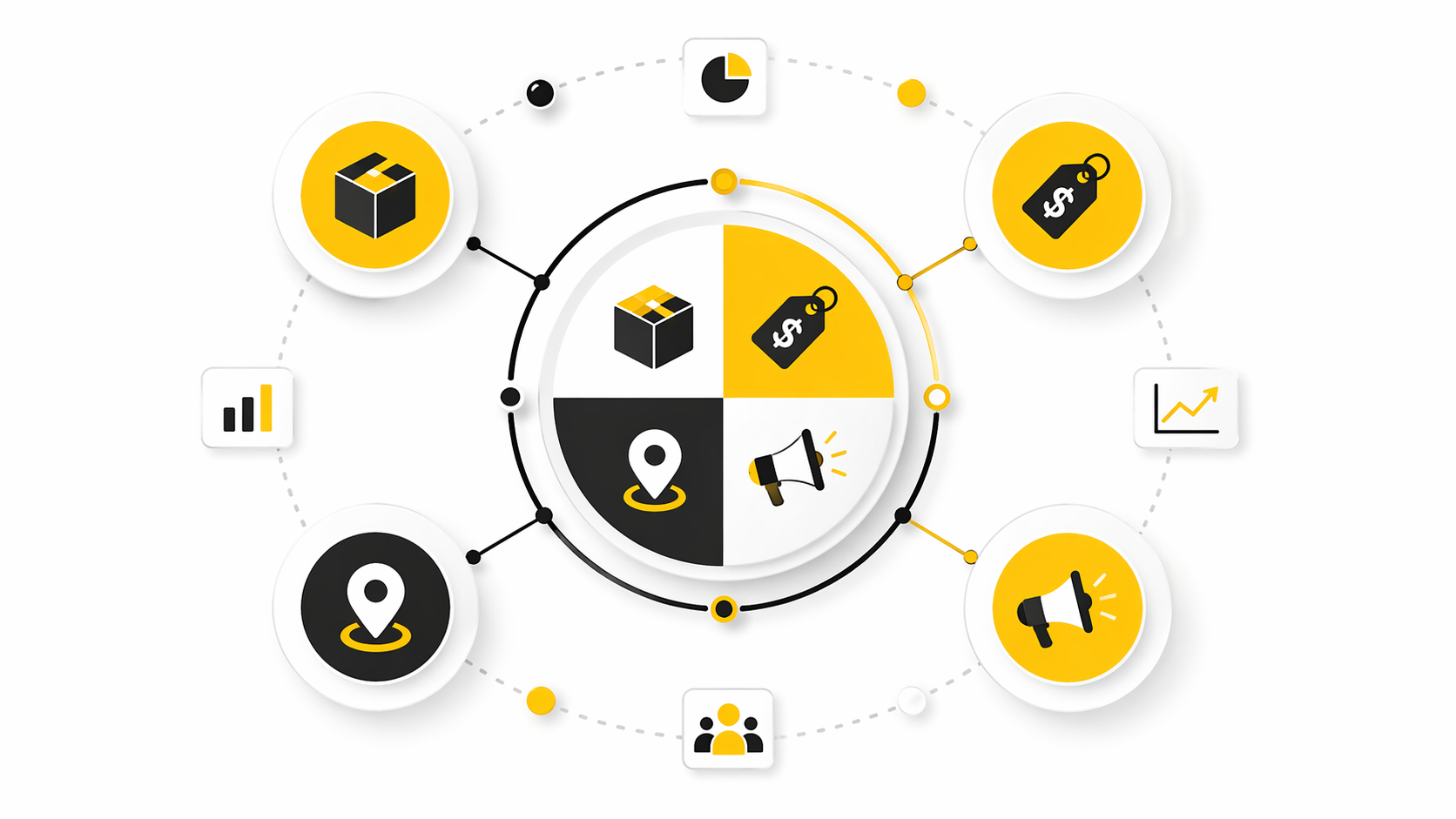
The marketing mix is one of those ideas that sounds basic until you try to use it under real pressure. When a company is struggling to grow, the problem usually is not just the ad creative, the landing page, or the price tag on its own. It is the way the whole offer fits together: what is being sold, how it is priced, where it is available, and how it is presented to the market. The classic structure is still built around product, price, place, and promotion, and that is exactly why it remains useful.
That framework still matters because marketing is not only about communication. The American Marketing Association defines marketing as the activity and processes for creating, communicating, delivering, and exchanging offerings that have value, which makes the marketing mix much bigger than advertising alone. In practice, the mix helps teams connect strategy to execution so they are not optimizing one tactic while the rest of the customer experience pulls in a different direction.
Article Outline
- Why the marketing mix still matters
- How the marketing mix framework works
- The four core elements of the marketing mix
- When the extended marketing mix becomes necessary
- Common mistakes that weaken the mix
- How to build a marketing mix that stays relevant over time
Why the Marketing Mix Still Matters
The reason this model has lasted is simple: it forces clearer decisions. A business can have strong demand and still lose momentum when the product promise is vague, the pricing logic feels off, the buying experience creates friction, or the promotion says one thing while the offer delivers another. The marketing mix gives teams a way to look at those decisions together instead of in isolation.
It also keeps marketers honest. A promotion campaign can create attention, but it cannot permanently rescue a weak product-market fit or a broken distribution model. That is why strong marketing work usually starts with the full mix rather than with channel tactics alone.
How the Marketing Mix Framework Works
At its simplest, the framework helps you match business decisions to customer needs. Britannica describes the marketing mix as part of tactical marketing, where product, price, place, and promotion are shaped to serve a targeted set of customer needs. That is the key point: the mix is not a checklist to complete once, but a set of choices that should reinforce one another.
Modern teams often expand the model when they sell services, subscriptions, or more complex experiences. The Chartered Institute of Marketing’s current overview uses the 7Ps model, adding people, process, and physical evidence to the original four. That extension matters because the customer does not experience your business in categories; they experience the whole system at once.
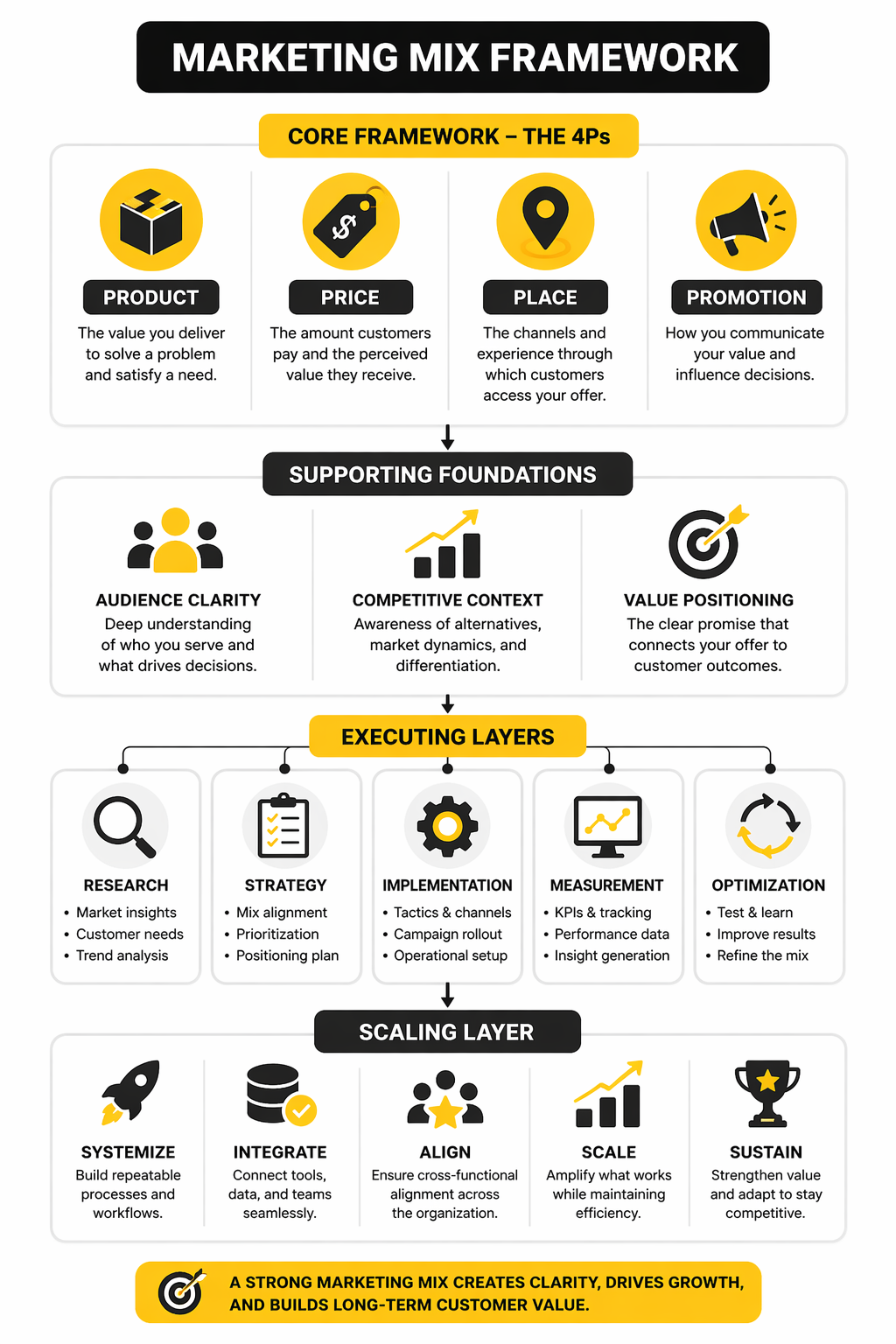
In the next part, the article moves into the four core elements of the marketing mix and shows how product, price, place, and promotion work together in practice. That is where the framework stops being theoretical and starts becoming useful.
The Four Core Elements of the Marketing Mix
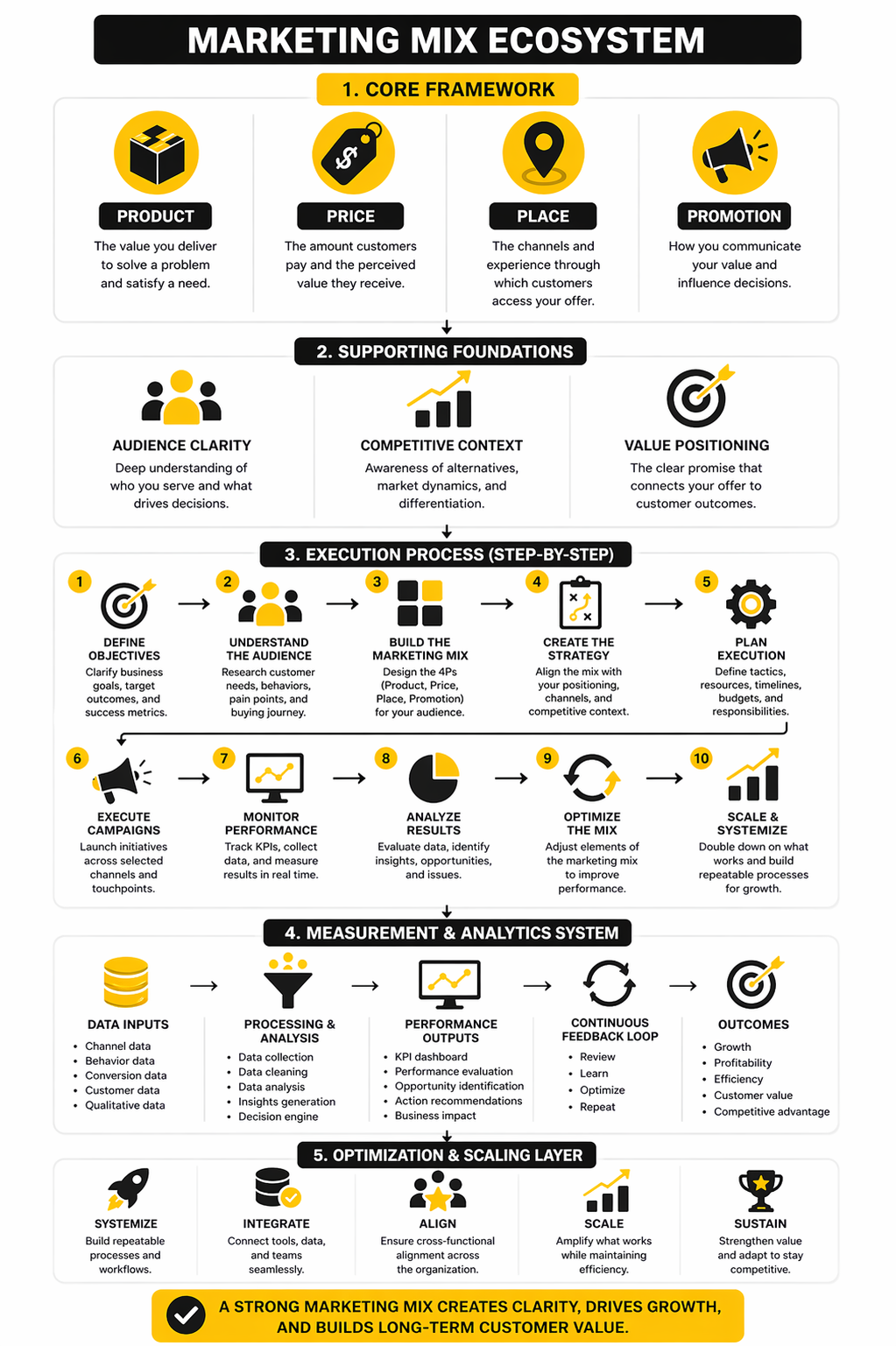
Once you get past definitions, the marketing mix becomes a decision system. The four elements are not independent levers you pull one by one. They work best when each one reinforces the same promise, the same audience, and the same reason to buy.
That is why the marketing mix still holds up in modern strategy work. Even in markets shaped by subscriptions, marketplaces, AI tools, and omnichannel buying behavior, businesses still have to decide what they are offering, what it should cost, how people will get it, and how the value will be communicated. The framework is old, but the pressure it solves is current.
Product: The Value Has to Be Real
Product is not just the item on a shelf or the software behind a login. In a serious marketing mix, product includes the design, features, quality level, packaging, positioning, and the specific job the offer is meant to do for the customer. If that value is fuzzy, everything downstream gets harder, because pricing becomes harder to justify, distribution becomes harder to prioritize, and promotion starts sounding inflated.
This is where a lot of teams make an expensive mistake. They assume marketing begins when the product is finished, when in reality the product itself is part of the marketing decision. Strong product thinking starts earlier, with customer needs, competitive context, and a clear sense of why this offer deserves attention in the first place.
A useful way to think about it is simple: the product is the promise made tangible. If the promise is convenience, the experience has to feel easy. If the promise is premium quality, the details have to signal that consistently. If the promise and the experience drift apart, the rest of the marketing mix starts leaking trust.
Price: More Than a Number on the Page
Price is the fastest way to signal positioning, but it is also one of the easiest places to get lazy. Companies often treat pricing like a finance decision or a reaction to competitors, when it is really part of how the market understands value. Harvard Business Review has long framed pricing as a strategic choice tied to demand, target markets, promotional strategy, and channel decisions, not just cost recovery.
Good pricing does two jobs at once. It protects margins, and it helps the right buyer say yes with less hesitation. That can mean premium pricing, penetration pricing, bundling, tiering, or value-based packaging, but the important part is alignment. A product positioned as high-trust and high-performance cannot be priced in a way that makes it feel disposable, and a mass-market offer usually cannot carry premium economics without a much stronger product story.
This is where the marketing mix becomes brutally practical. If conversion is weak, the issue may not be the price itself. It may be a mismatch between what the customer thinks they are getting and what the price asks them to believe.
Place: Access Changes Demand
Place sounds old-fashioned until you remember what it actually means. It is about access: where the offer appears, how it is distributed, how easily it can be purchased, and whether the route to purchase fits customer behavior. In other words, place is not just retail shelves anymore; it includes marketplaces, direct-to-consumer sites, partners, platforms, resellers, logistics, and fulfillment.
That matters because distribution shapes perception as much as convenience. The U.S. International Trade Administration notes that channel choice depends heavily on the nature of the goods and services involved, which is exactly why place should never be treated as a generic operational detail. A premium brand sold everywhere can lose its edge, while a convenience-driven product hidden behind a clumsy purchase path creates unnecessary friction.
In a modern marketing mix, place is also where strategy meets economics. Direct channels can improve control and customer data, but they also demand stronger acquisition and retention systems. Intermediated channels can expand reach faster, but they can dilute margin, messaging, and customer ownership if the model is not designed carefully.
Promotion: Visibility Has to Match Reality
Promotion is the most visible part of the marketing mix, which is why people often overestimate it. Yes, it includes advertising, content, sales promotion, email, social media, PR, and direct outreach. But promotion works best when it communicates a value proposition that the product, price, and place decisions already support.
This is also why integrated messaging matters. The core idea behind integrated marketing communication is coordination: different channels should reinforce the same message rather than compete with each other. When the ad promises one thing, the landing page says another, the sales team pitches a third angle, and the checkout experience feels disconnected, promotion stops compounding and starts creating doubt.
Execution tools can help here, but only after the strategic work is done. A scheduling platform like Buffer or an email platform like Brevo can improve consistency, speed, and campaign control, but they do not fix a weak offer. Promotion amplifies what is already true about the business. If the underlying mix is strong, that amplification is powerful. If it is weak, it just makes the disconnect easier to notice.
Why the Four Ps Have to Work Together
This is the part too many articles miss. The marketing mix is not a menu where you optimize each category separately and hope the customer connects the dots. It is a system, and systems break when one part sends a message the others cannot support.
A simple example makes the point. A company may build a premium-looking product, set a premium price, and then distribute it through low-trust channels while running discount-heavy promotions. Every individual decision might look defensible on its own, but together they create confusion. Customers do not buy isolated tactics. They buy the overall signal.
That is why the strongest marketing mix decisions usually feel boring from the inside and obvious from the outside. The product solves the right problem. The price feels consistent with the value. The buying path feels natural. The promotion sounds like the truth rather than a performance. When those pieces click, growth gets easier because the business stops fighting itself.
The next section expands the model beyond the original four Ps and explains when the extended marketing mix becomes necessary, especially for service businesses, complex customer journeys, and experience-driven brands.
When the Extended Marketing Mix Becomes Necessary
The original four Ps still do a lot of work, but they stop being enough the moment the customer experience becomes more complex. That usually happens in service businesses, software, subscriptions, consulting, healthcare, education, hospitality, and any model where delivery matters just as much as the offer itself. The Chartered Institute of Marketing makes this point clearly in its current overview of the 7Ps of marketing: people, process, and physical evidence were added because customers do not only judge what they buy, but also how it is delivered and how credible it feels.
This is where the marketing mix gets more realistic. In a product-heavy model, you can sometimes hide a weak handoff or messy service layer for a while. In a service or digital experience, you usually cannot. The brand promise gets tested in the onboarding flow, the response time, the handoff between teams, the clarity of the interface, and the confidence the customer feels at each step.
People: The Brand Becomes Human
People matter because customers do not experience a company as an org chart. They experience sales calls, support tickets, onboarding messages, delivery updates, and account conversations. That is why the people layer belongs inside the marketing mix, not outside it.
If a brand promises simplicity but support feels confused, the promise breaks. If a company positions itself as premium but the team handling customers feels rushed or underprepared, the market notices faster than most executives expect. In practice, people are not a soft extra; they are part of the product the customer thinks they bought.
Process: Friction Quietly Kills Demand
Process is where a lot of otherwise good marketing falls apart. A campaign can generate demand, but poor onboarding, delayed fulfillment, confusing approval steps, or weak follow-up can burn through that demand before it turns into revenue. That is one reason customer experience leaders keep pushing companies to look beyond isolated touchpoints and manage journeys across channels instead of treating every interaction as a separate event, as outlined in McKinsey’s explainer on what customer experience actually includes.
This is also why process belongs in the marketing mix even when it feels operational. Buyers do not care which department owns the friction. They only feel whether the experience is smooth, slow, reassuring, or chaotic.
Physical Evidence: Trust Needs Something Concrete
Physical evidence sounds like an old services term, but it is extremely relevant now. Customers look for signals that help them judge credibility before and after purchase: product packaging, reviews, interface quality, case studies, location design, proposals, documentation, email polish, and even the tone of transactional messages. The CIM summary of what marketing includes today treats physical evidence as part of the mix for exactly this reason.
For digital-first brands, physical evidence is often replaced by visible proof. That might be the clarity of a pricing page, the professionalism of a demo flow, the quality of onboarding assets, or the consistency of the brand across channels. People want reassurance, and reassurance is rarely built by slogans alone.
How to Build a Marketing Mix That Works in Practice
Once the full marketing mix is on the table, the next move is execution. This is where strategy either becomes a working system or turns into a slide deck nobody uses. The point is not to make the framework more complicated. The point is to turn it into a sequence of decisions that teams can actually run.
A useful implementation process is not glamorous. It is structured, honest, and specific enough that different functions can align around the same reality. That matters because the mix touches product, finance, operations, sales, customer success, and marketing all at once.
Start With Customer Reality, Not Internal Preferences
The first step is getting painfully clear on the customer problem, buying context, and decision criteria. Too many teams build a marketing mix around what they want to sell rather than what the customer is actually trying to solve. That creates a nice-looking plan with weak traction.
This is where research earns its place. Customer interviews, sales-call patterns, win-loss feedback, search behavior, support logs, and retention data usually tell a much more useful story than internal opinion. If the starting diagnosis is wrong, the rest of the marketing mix will look polished and still underperform.
Define the Offer Before You Touch the Channels
The second step is shaping the offer clearly enough that the rest of the mix has something solid to support. That means defining who the offer is for, what outcome it promises, what is included, what makes it different, and what level of trust or proof is needed before someone buys. If this part stays vague, pricing gets weird, promotion gets noisy, and distribution becomes guesswork.
For digital businesses, this is often the stage where the experience has to be translated into concrete assets. A landing page builder like Replo can help teams turn positioning into a cleaner storefront faster, but the tool only works when the offer itself is already sharp. The page cannot rescue a fuzzy promise.
Build the Journey Before You Scale Promotion
The third step is mapping how a buyer moves from attention to action to retention. This is where the marketing mix becomes tangible because you can finally see where product, price, place, promotion, people, process, and proof connect in the real world. McKinsey’s work on omnichannel marketing is useful here because it frames channel choice as an integrated experience rather than a collection of disconnected touchpoints.
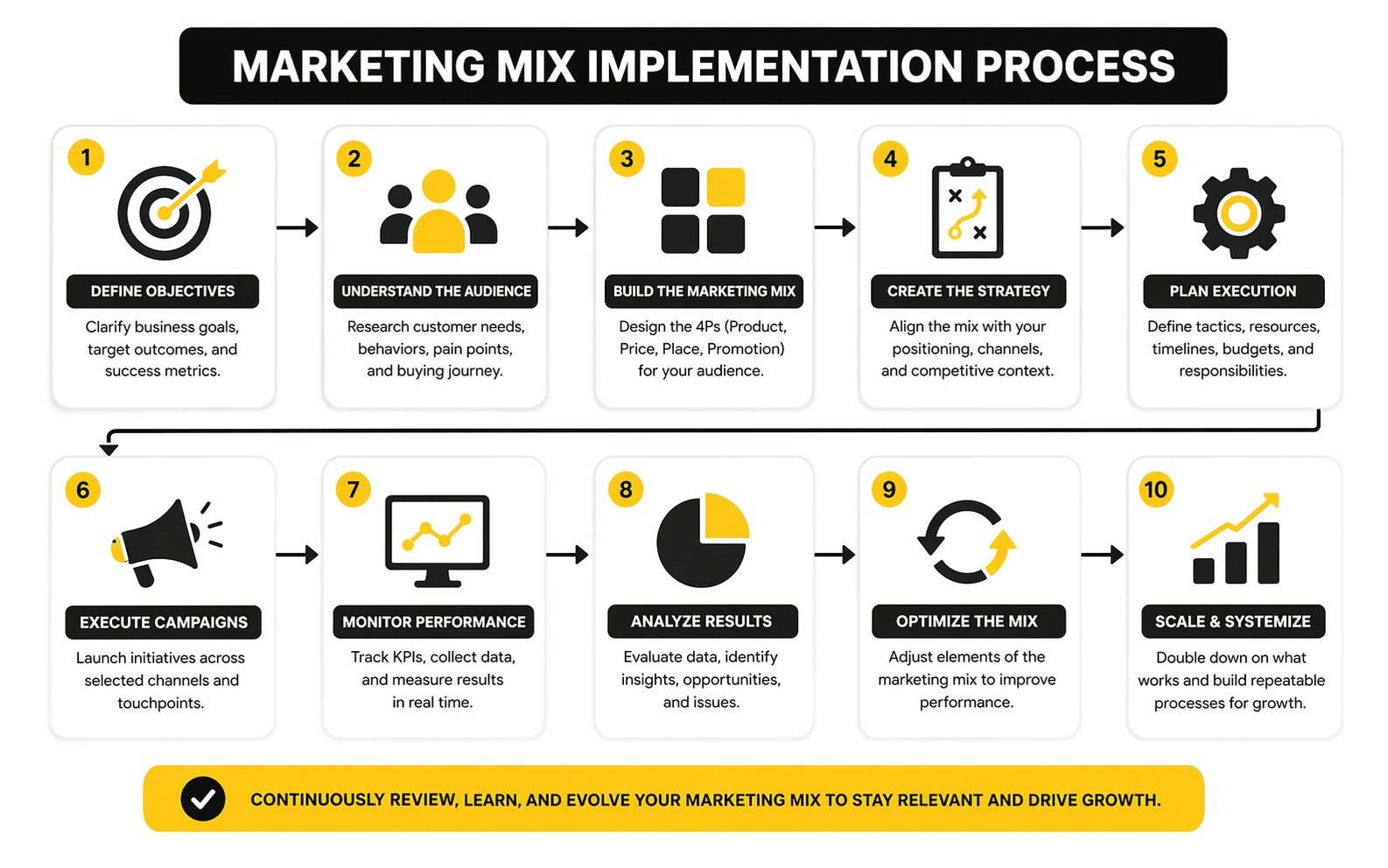
A practical implementation flow usually looks like this:
- Define the audience and the job they are hiring the offer to do.
- Clarify the offer, value proposition, and proof needed to earn trust.
- Set pricing in a way that supports positioning and margin logic.
- Choose the channels that make access easy for the right buyer.
- Build promotion around one clear message instead of scattered claims.
- Tighten the handoff from lead capture to onboarding to retention.
- Review the whole system regularly and fix friction before scaling traffic.
This sequence matters because promotion should come after the journey makes sense, not before. When teams skip ahead and pour spend into acquisition, they often discover that the real bottleneck sits in follow-up speed, booking friction, CRM mess, or weak onboarding. That is not a media problem. That is a broken marketing mix.
Put the Operating System Behind the Strategy
Implementation becomes much easier when the execution layer is centralized. A platform like GoHighLevel can support lead capture, automation, nurture, and pipeline management inside one system, which helps when the process side of the marketing mix is the real weakness. The reason this matters is simple: if your customer journey lives across too many disconnected tools, consistency becomes fragile.
The same logic applies to specific touchpoints. Fillout can reduce friction in forms and qualification flows, Cal.com can make scheduling cleaner, and Copper can help keep relationship data usable instead of scattered. These are execution details, but that is exactly the point. In the marketing mix, execution details often decide whether strategy feels credible.
Use Automation Carefully, Not Blindly
Automation belongs in implementation, but only after the message and journey are already coherent. Otherwise you just scale noise faster. Tools like ManyChat, Chatbase, and Brevo can strengthen response speed and follow-up consistency, but only if they are extending a sound process rather than compensating for a weak one.
This is where a lot of teams fool themselves. They think they need more top-of-funnel activity when they really need tighter qualification, better handoffs, clearer proof, or faster response times. Automation is powerful, but it should support the marketing mix, not distract from fixing it.
The next part moves into the mistakes that weaken a marketing mix even when the framework looks right on paper. That is where the hidden failures show up: mismatched positioning, channel confusion, pricing signals that backfire, and execution gaps that quietly kill performance.
Reading the Numbers Without Losing the Plot
A marketing mix is only useful if you can tell whether it is working. That sounds obvious, but plenty of teams still measure the loudest channel instead of the full system. They track impressions, clicks, and traffic spikes, then miss the more important question: did the product, price, place, and promotion decisions create profitable movement, or did they just create activity.
That is why measurement has to connect back to the structure of the mix. Product decisions should show up in retention, repeat purchase behavior, and customer satisfaction. Price decisions should show up in conversion efficiency, average order value, gross margin, and payback. Place decisions should show up in channel performance, fulfillment quality, and drop-off points. Promotion decisions should show up in reach, engagement, assisted conversions, and incrementality rather than vanity alone.
The Performance Signals That Actually Matter
The easiest mistake is treating all metrics as equally useful. They are not. Some numbers help you diagnose where the marketing mix is working, while others mostly tell you that something happened on the surface.
A practical way to read the data is to split performance signals into four layers:
- Attention signals such as reach, impressions, traffic, and branded search volume.
- Response signals such as click-through rate, landing page conversion rate, lead completion, and booking rate.
- Economics signals such as customer acquisition cost, average order value, gross margin, and payback period.
- Durability signals such as repeat purchase rate, retention, expansion, referral, and lifetime value.
When teams only focus on the first layer, they often mistake motion for progress. The marketing mix gets stronger when those four layers move together. That is the whole game.
Conversion Rate Is a Diagnostic Tool, Not a Trophy
Conversion rate matters because it reveals whether the mix makes sense to the buyer at the point of decision. Shopify’s current guidance says ecommerce conversion rates often land around 2% to 3%, while another recent benchmark summary points to 1.6% of global ecommerce visits converting in Q3 2025 and shows how much that number shifts by device, sector, and traffic quality. Shopify’s conversion rate explainer and its retail benchmark summary both make the same point: there is no single “good” number without context.
What matters is what the number is telling you. If traffic is strong but conversion is weak, the issue may be product-market clarity, pricing confidence, landing page trust, or channel mismatch. A falling conversion rate does not automatically mean the promotion is bad. It can just as easily signal that the audience quality dropped or that the offer is losing credibility at the point of purchase.
Average Order Value Tells You Whether the Offer Is Structured Well
Average order value is one of the most underrated signals inside the marketing mix. Shopify’s current AOV guidance keeps the formula simple: revenue divided by total orders. That sounds basic, but what it reveals is not basic at all. Shopify’s AOV breakdown shows why changes in packaging, bundles, pricing tiers, and upsell logic often move profitability faster than trying to squeeze more reach from the same channels.
This matters because a low AOV can break the economics of an otherwise healthy acquisition engine. If your product and pricing structure do not leave enough room to acquire customers profitably, your promotion starts carrying impossible pressure. That is not a paid media issue. It is a marketing mix issue.
Email Metrics Only Matter When They Connect to Revenue
Email is useful for measurement because it shows how people respond after the first touch. Mailchimp’s current benchmarks put average email open rates around 34.23%, with industry variation from 27.34% to 40.55%, and its reporting guidance makes clear that opens, clicks, bounces, and unsubscribes each tell a different story. Mailchimp’s benchmark page and its reporting documentation are good reminders that open rates are only a starting point.
That is the important part. A high open rate may mean the subject line worked, but it does not prove the marketing mix is healthy. If opens are strong and clicks are weak, the message may be misaligned with the offer. If clicks are strong and conversions are weak, the problem may sit in pricing, landing page proof, or friction in the buying path. Email metrics become valuable when they help you identify which part of the system is failing.
Build a Measurement System, Not a Dashboard Graveyard
A lot of analytics setups look sophisticated and still do not help decision-making. They collect everything, report everything, and clarify almost nothing. The fix is to build a measurement system that mirrors the structure of the marketing mix itself.
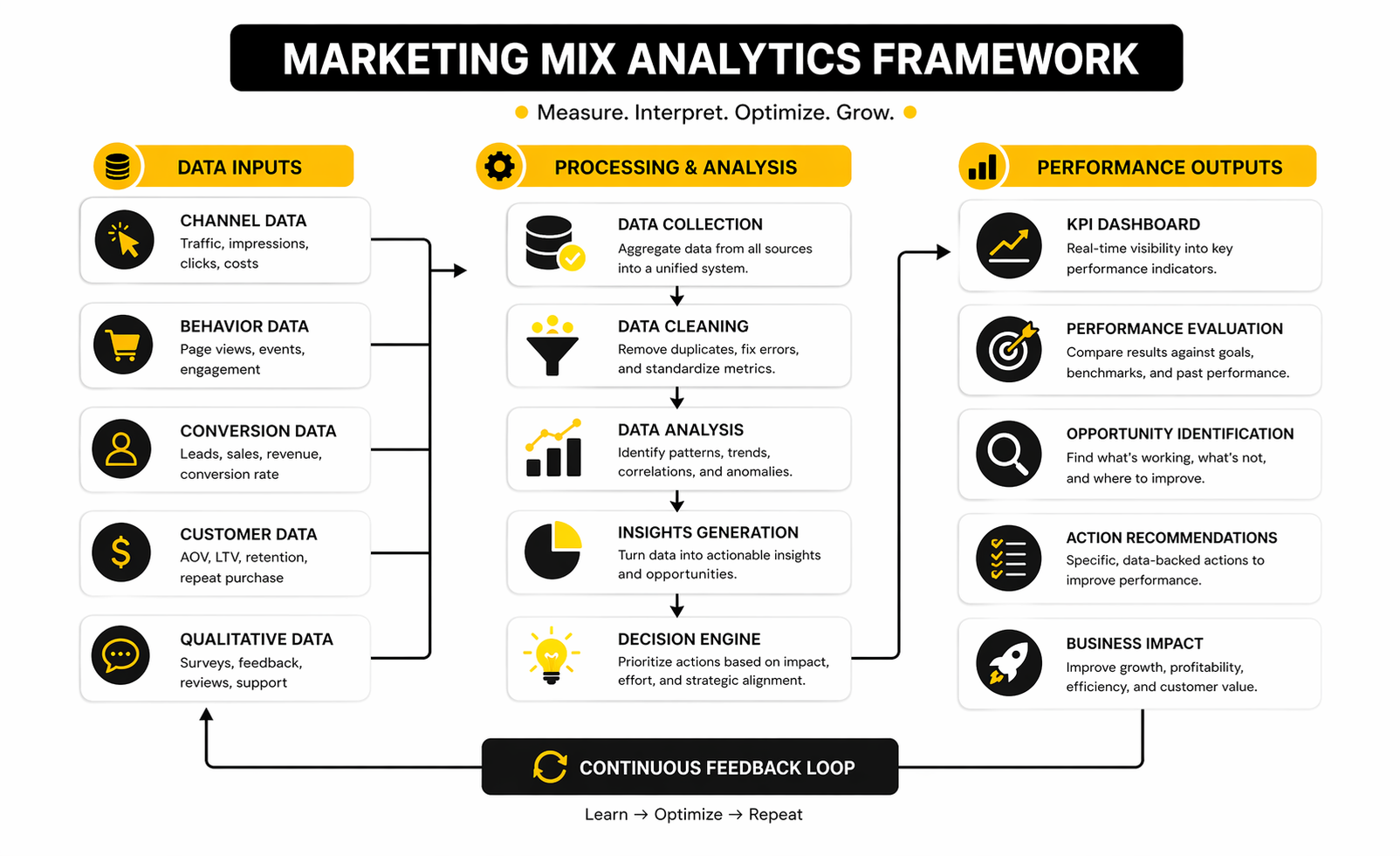
A simple but effective analytics model looks like this:
- Track awareness metrics to see whether the market is noticing you.
- Track journey metrics to see where interest turns into action or dies.
- Track unit economics to see whether growth is profitable.
- Track retention metrics to see whether the value actually lasts.
- Run experiments to separate correlation from causation.
That fifth point matters more than most teams admit. Google’s current measurement guidance describes incrementality testing as a cornerstone of modern measurement, and its broader effectiveness framework argues that marketers should balance experiments, attribution, and marketing mix modeling rather than rely on one lens alone. Google’s explanation of incrementality testing and its effectiveness report both push the same idea: attribution can suggest patterns, but experiments are what help you understand true lift.
What Good Benchmarks Should Drive You to Do
Benchmarks are useful, but only if they trigger better decisions. They are there to help you ask sharper questions, not to copy another company’s numbers and call it strategy.
If your conversion rate is below a reasonable range for your model, start by checking message-to-offer alignment before you blame the channel. If AOV is low, look at bundling, pricing logic, and what the customer is encouraged to buy next. If email engagement is fine but downstream revenue is not moving, look at the landing experience, follow-up sequence, and sales handoff. If CAC is climbing, the response should not automatically be “spend less.” It may be “improve the offer, sharpen the targeting, increase AOV, or fix the buying path.”
This is where execution tooling can help, but only when it supports a clear measurement logic. GoHighLevel is useful when you need one view across leads, pipelines, and follow-up. Buffer helps when promotion tracking is fragmented across social scheduling and engagement workflows. Brevo can make it easier to connect campaign performance with lifecycle messaging. The tools are not the insight. They just make insight easier to operationalize.
Common Mistakes in Marketing Mix Measurement
One of the most common mistakes is measuring channels separately and never reconnecting them to the offer. That leads to strange decisions like killing a campaign with weak last-click attribution even though it improved search demand, lifted branded traffic, and increased downstream conversion quality. The marketing mix is cross-functional, so the measurement model has to be cross-functional too.
Another mistake is overreacting to single metrics. A lower conversion rate might be acceptable if AOV and retention improve. A higher CAC might be fine if payback stays healthy and customer value rises. A lower open rate might not matter if the people clicking are more qualified and revenue per send improves. Numbers matter, but they only become useful when interpreted as a system.
The next part turns to the failures that quietly weaken a marketing mix even when the dashboard looks acceptable. That is where the article gets practical about what breaks alignment, what creates false confidence, and what to fix before scaling harder.
Common Mistakes That Weaken the Marketing Mix
Most marketing mix problems do not start with a dramatic collapse. They usually start with small misalignments that look manageable in isolation and then compound over time. A positioning tweak here, a discount there, another acquisition channel added under pressure, and suddenly the whole system is harder to explain, harder to manage, and less profitable than it should be.
The dangerous part is that a weak marketing mix can still produce short-term wins. Promotions can temporarily hide pricing issues, wider distribution can mask product confusion, and aggressive acquisition can distract from retention problems. But once growth gets more expensive or competition tightens, those hidden weaknesses show up fast.
Mistaking Channel Growth for Strategic Strength
One of the most common scaling mistakes is assuming that a winning channel means the full marketing mix is healthy. It does not. A paid social campaign can perform for a while even when the product is poorly differentiated, the onboarding process is messy, or pricing is too weak to support long-term margin.
This gets riskier as brands scale across more touchpoints. Deloitte’s latest retail trend coverage highlights how AI-assisted shopping and omnichannel expectations are changing the way consumers discover and evaluate products, which means channel performance is becoming more interconnected rather than less. Deloitte’s 2026 retail trends report is useful here because it reinforces a hard truth: winning one channel is not the same as designing a coherent route to purchase.
That is why expert teams treat channels as delivery systems, not strategy on their own. If a channel is working, the next question is not just how to spend more. It is whether the rest of the marketing mix can absorb that growth without damaging trust, margin, or customer experience.
Using Discounts to Solve Positioning Problems
Discounting is one of the fastest ways to weaken a marketing mix when the real problem sits elsewhere. It can create movement, but it can also retrain customers to wait, dilute the perceived value of the product, and start a race that gets harder to win with every round. The classic Harvard Business Review piece on how price wars work is old, but the warning still holds: price cuts can erode perceived quality and pull companies into conflicts that damage everyone involved.
That risk is even clearer in recent research. McKinsey’s 2024 work on pricing during disinflationary times shows how consumer companies can struggle to protect gross margins even after raising prices, while Bain’s luxury analysis found that profitability eroded as brands faced both rising costs and limited room for further price increases. Bain’s 2024 luxury report makes the broader lesson pretty obvious: pricing power has limits, and once value perception gets shaky, the whole mix becomes harder to defend.
A strong marketing mix uses pricing strategically. A weak one uses discounts as painkillers. That distinction matters more than most teams want to admit.
Expanding Distribution Without Protecting the Brand
Growth often creates pressure to expand faster through more channels, more geographies, more marketplaces, and more partners. Sometimes that is the right move. Sometimes it quietly damages the very positioning that made the offer desirable in the first place.
This is one of the hardest tradeoffs in the marketing mix. Wider access can increase volume, but it can also reduce control over presentation, customer data, fulfillment quality, and pricing consistency. For brands that compete on trust, premium perception, or carefully managed experience, loose distribution can create long-term damage that does not show up in the first quarter.
That is why “more places” is not automatically a better place strategy. Expert teams ask a tougher question: which channels increase customer access without weakening the brand signal or breaking the economics? If the answer is unclear, expansion should slow down until the model is clearer.
Advanced Tradeoffs as the Marketing Mix Scales
The marketing mix gets more complicated as the business grows because each choice starts affecting more functions at once. Product changes affect support and retention. Pricing changes affect conversion and brand perception. Distribution changes affect margins and ownership of the customer. Promotion changes affect demand patterns the operations team then has to handle.
At a small scale, teams can often improvise around those tensions. At a larger scale, improvisation gets expensive. This is where expert-level marketing work becomes less about creativity alone and more about coordination, sequencing, and disciplined tradeoffs.
Efficiency Versus Brand Strength
Scaling pressure often pushes companies toward short-term efficiency. That usually means cheaper acquisition, faster creative cycles, broader targeting, heavier promotional cadence, and more conversion-focused messaging. None of that is automatically bad, but it becomes dangerous when efficiency starts eating the brand layer that made conversion easier in the first place.
Google’s effectiveness guidance argues for balancing short-term measurement with broader effectiveness thinking instead of overcommitting to narrow attribution signals. The effectiveness framework Google published matters here because it supports something experienced marketers already know: not every valuable marketing input shows up immediately in last-click reporting. Brand strength often gets undercounted right before people start missing it.
A resilient marketing mix protects both sides. It improves efficiency without collapsing into purely transactional messaging. It captures demand without forgetting that demand also has to be built.
Personalization Versus Complexity
Personalization can make a marketing mix stronger because it improves relevance across product recommendations, pricing packages, channel experience, and communication timing. But personalization also increases operational complexity. More segments, more offers, more automation paths, and more conditional logic can create fragility faster than teams expect.
This is where tooling can either help or make the problem worse. A platform like Guideless or Trycomp can support more structured workflows and experimentation, but only if the business is clear about what should be personalized and what should stay standardized. Complexity without discipline is not sophistication. It is just harder-to-debug chaos.
The best teams personalize selectively. They focus on moments where relevance clearly improves conversion, retention, or customer confidence. They do not personalize everything just because the stack makes it possible.
Automation Versus Human Judgment
As the marketing mix grows, automation becomes more attractive because manual coordination stops scaling. That makes sense. Follow-up, routing, messaging triggers, qualification, content scheduling, and reporting can all benefit from automation when the underlying logic is sound.
But automation also creates a new risk: it can hide weak judgment behind smooth workflows. McKinsey’s 2026 research on AI in B2B pricing shows how quickly organizations expect AI adoption in pricing to accelerate, which makes governance and decision quality much more important. If the rules are flawed, automation just scales the flaw.
That is why advanced marketing mix work still needs human supervision in the critical places. Automation can execute, but leadership still has to decide what the brand stands for, which customers matter most, where the value truly comes from, and what tradeoffs are worth making.
How Experts Keep the Marketing Mix Adaptable
A strong marketing mix is not static. Markets change, input costs shift, customer expectations move, competitors reposition, and channels lose efficiency. The teams that stay strong are usually the ones that treat the mix as something to revisit deliberately rather than something to “set” once and defend emotionally.
That means reviewing the mix at the system level, not just in channel reports. If margins tighten, do not only cut media. Revisit the product structure, packaging logic, pricing architecture, and service process. If acquisition weakens, do not only blame creative fatigue. Recheck whether the value proposition is still distinct and whether the channel mix still fits buyer behavior.
There is also a practical side to keeping the system adaptable. Teams need usable documentation, visible customer data, and workflows that make it easy to update offers and funnels without starting from scratch every time. A builder like ClickFunnels or Systeme.io can help when the main issue is speed of iteration, but again, tools only matter when the strategic logic is already there.
The final part brings everything together with a practical close and a focused FAQ. That is where the article shifts from analysis to decision-making so the marketing mix becomes something you can actually use, not just understand.
How to Keep the Marketing Mix Relevant Over Time
A good marketing mix is never really finished. Markets move, channels saturate, customer expectations shift, and competitors copy faster than most teams expect. What worked a year ago can quietly become inefficient, and what looked like a stable advantage can turn into a maintenance problem if nobody revisits the system.
That is why the smartest way to use the marketing mix is as a review framework, not just a planning framework. Recheck the offer when conversion softens. Recheck pricing when margins compress. Recheck place when buyer behavior changes. Recheck promotion when attention gets more expensive or less predictable. The point is not to rebuild everything every quarter. The point is to keep the core pieces aligned before drift turns into drag.
A lot of businesses also underestimate how connected the system becomes once they scale. Product changes affect pricing power. Pricing changes affect channel fit. Channel changes affect brand perception. Promotional changes affect the type of customer that enters the funnel. Keeping the marketing mix relevant means watching those connections instead of treating each change as isolated.
For teams that need tighter coordination across pages, funnels, follow-up, and lifecycle communication, a stack built around GoHighLevel, Replo, Buffer, and Brevo can make execution cleaner. That only helps, though, when the underlying decisions are already clear. Tools strengthen a system. They do not invent one.
FAQ
What is a marketing mix in simple terms?
The marketing mix is the set of decisions a business makes about what it sells, what it charges, where people can buy it, and how it communicates value. In its classic form, that means product, price, place, and promotion, a framework still widely used in current summaries from the American Marketing Association and the Chartered Institute of Marketing. It matters because customers do not experience these decisions separately. They experience the combined signal.
Why is the marketing mix still relevant today?
It is still relevant because businesses still have to align value, pricing, access, and communication. Digital channels changed execution, but they did not remove the need for strategic fit. The American Marketing Association definition of marketing still centers on creating, communicating, delivering, and exchanging value, which is exactly what the marketing mix is meant to organize.
What are the 4 Ps of the marketing mix?
The 4 Ps are product, price, place, and promotion. Product covers the offer itself, price covers what the customer pays, place covers distribution and access, and promotion covers how the value is communicated. The framework remains a useful shorthand in the AMA’s current guide because it forces teams to think beyond advertising alone.
What are the 7 Ps of the marketing mix?
The 7 Ps expand the classic model by adding people, process, and physical evidence. This becomes especially useful in services, subscriptions, and customer-experience-heavy businesses where delivery quality shapes perceived value just as much as the core offer. The CIM’s explanation of the 7Ps is still one of the clearest modern summaries.
What is the difference between the marketing mix and a marketing strategy?
A marketing strategy sets direction. The marketing mix turns that direction into actual decisions. Strategy answers who you serve, where you want to win, and why customers should care. The marketing mix answers how the product, price, place, promotion, people, process, and proof will work together in practice.
How do you know when your marketing mix is not working?
The warning signs usually show up as misalignment rather than total collapse. Conversion falls even with healthy traffic. Margins weaken even when revenue grows. Retention slips even though acquisition looks fine. Channel performance becomes unstable because the offer or pricing logic is doing more damage than the campaign can overcome. That is why recent measurement thinking from Google’s effectiveness framework stresses looking beyond narrow attribution signals and balancing broader business outcomes.
Which metric matters most when evaluating a marketing mix?
There is no single metric that can do the whole job. Conversion rate, average order value, customer acquisition cost, payback period, retention, and lifetime value each reveal a different part of the system. That is also why benchmark sources like Shopify’s conversion rate guide and Shopify’s AOV explainer are useful only when tied to context. A number is only helpful when it leads to a better decision.
Can a strong promotion strategy fix a weak product?
Not for long. Promotion can generate attention and maybe create a temporary lift, but it cannot permanently cover a weak value proposition or poor customer experience. If the product does not solve a real problem clearly enough, promotion usually just accelerates disappointment. That is why the marketing mix has to be read as a system.
How often should a company review its marketing mix?
Most companies should review it continuously at the signal level and more deliberately at key planning intervals. Major reviews usually make sense when conversion shifts, margins tighten, channel economics change, or customer behavior moves. The goal is not constant reinvention. It is preventing drift before it gets expensive.
Does the marketing mix apply to personal brands and creators?
Yes, absolutely. A creator still has a product, even if that product is content, consulting, a course, a membership, or a service. They still choose pricing, distribution, and promotion. The marketing mix often becomes even more visible in creator businesses because the person and the brand are tightly linked, which makes people, process, and proof matter even more.
Is price always the main reason customers do not convert?
No, and that assumption causes a lot of bad decisions. Weak conversion can come from unclear positioning, weak proof, poor landing page structure, slow follow-up, bad channel targeting, or friction in the purchase flow. Cutting price when the real issue is trust or clarity usually weakens the marketing mix further instead of fixing it.
What is the biggest mistake companies make with the marketing mix?
The biggest mistake is optimizing one part while ignoring the others. Teams often over-focus on promotion because it is visible and easier to tweak quickly. But a high-performing campaign cannot fully compensate for a weak product story, confused pricing, broken distribution logic, or messy delivery experience. The mix works when the parts reinforce each other.
Do small businesses need the full marketing mix framework?
Yes, but they do not need to overcomplicate it. A small business still benefits from getting clear on the offer, pricing logic, route to purchase, and messaging. In many cases, smaller businesses benefit more because the framework helps them avoid random marketing activity and focus on the decisions that actually move revenue.
Work With Professionals
Explore 10K+ Remote Marketing Contracts on MarkeWork.com
Most marketers spend too much time chasing clients, competing on crowded platforms, and losing a percentage of every project to middlemen.
MarkeWork gives you a better way. Browse thousands of remote marketing contracts and connect directly with companies desperate to hire skilled marketers like you, without platform commissions and without unnecessary gatekeepers.
If you're serious about finding better opportunities and keeping 100% of what you earn, explore available contracts and create a profile for free at MarkeWork.com.