

A marketing program is the backbone of any successful business strategy. It brings together all marketing efforts into a cohesive, measurable, and scalable system. When properly structured, a marketing program not only drives customer acquisition but also ensures brand consistency, operational efficiency, and long-term growth. Businesses that implement organized programs report improved campaign performance and reduced resource waste.

Article Outline
- Why a Marketing Program Matters
- Framework Overview
- Core Components
- Professional Implementation
- Analytics and Performance Insights
- Scaling and Optimization
Why a Marketing Program Matters
A well-designed marketing program ensures that every campaign, channel, and tactic aligns with your business objectives. Companies with integrated programs achieve higher engagement rates and more predictable ROI because efforts are coordinated rather than fragmented. Centralized programs also streamline reporting, making it easier to identify which tactics generate the best outcomes.
Without a structured program, marketing activities risk becoming disjointed, wasting time and budget on redundant or misaligned campaigns. Programs provide clarity for teams, guiding resource allocation and ensuring consistent messaging across all touchpoints, from social media to email campaigns.
Framework Overview
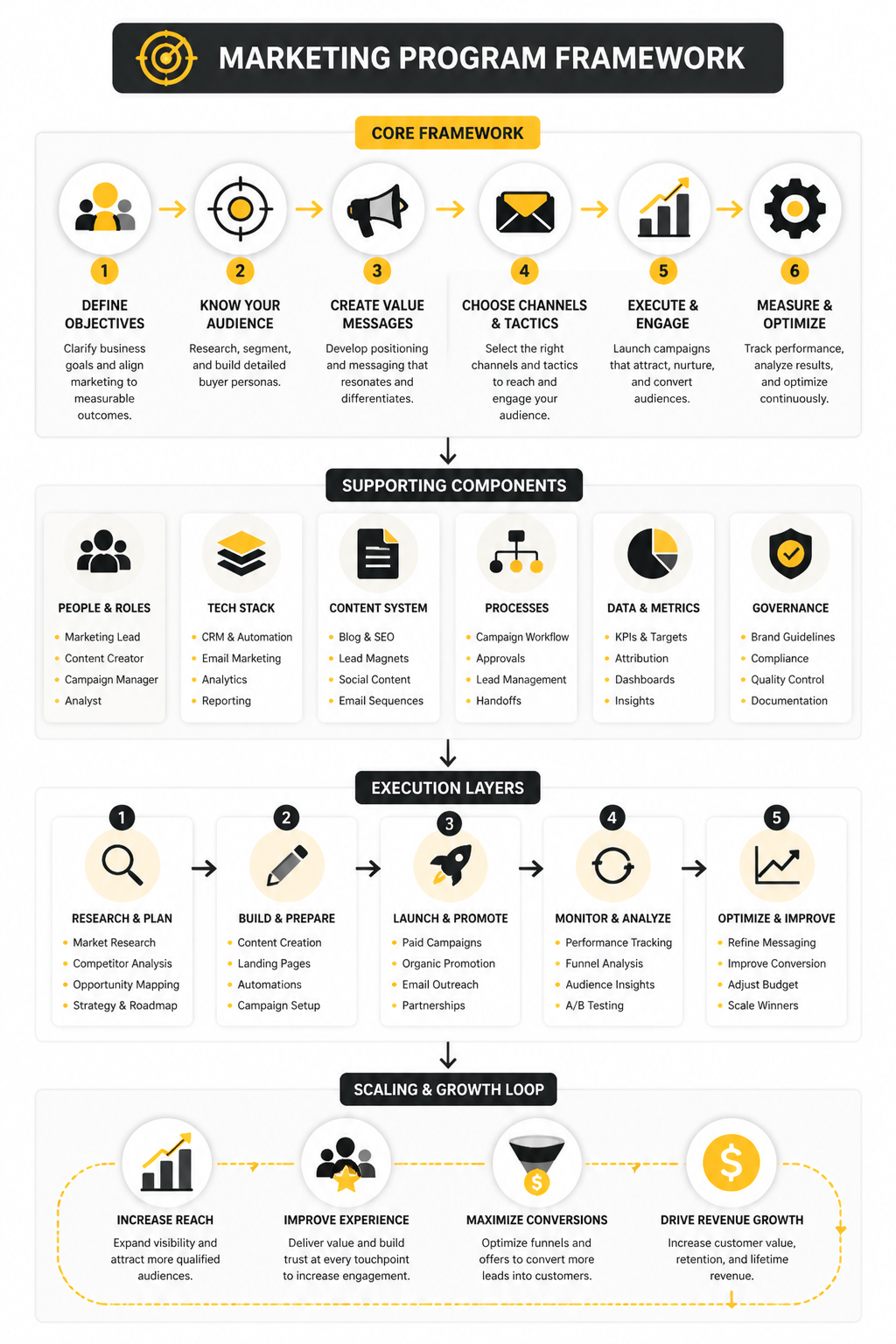
The marketing program framework is organized in hierarchical layers. At the top sits the strategic layer, defining overall objectives, target audiences, and brand positioning. Below that, supporting components manage channel selection, content planning, and audience segmentation. Execution layers implement the campaigns, while the bottom layer focuses on scalability, enabling the program to grow efficiently while maintaining cohesion.
This layered approach allows teams to see how each element contributes to the overall strategy. It also makes it easier to identify gaps, optimize workflows, and adapt tactics as market conditions evolve, ensuring that campaigns consistently reinforce the program’s objectives.
Core Components of a Marketing Program
A marketing program is more than a collection of campaigns; it’s a system of interconnected components that work together to achieve business objectives. The core components form the operational backbone, enabling teams to execute, monitor, and optimize campaigns effectively.
1. Audience Segmentation
Identifying the right audience is fundamental. Segmentation goes beyond basic demographics, incorporating behavior, purchase history, engagement levels, and psychographics. Well-defined segments allow for personalized messaging, which significantly improves engagement and conversion rates. For example, companies using behavioral targeting have reported higher click-through rates compared to generic campaigns.
2. Messaging and Content Strategy
Your messaging must resonate across all touchpoints. A content strategy defines the type of content, frequency, and channels that align with the audience segments. The goal is to maintain consistency while adapting the message to context—emails, social media posts, and landing pages should all tell a unified story.
3. Channel Selection and Integration
Selecting the right channels—email, social media, PPC, webinars, or affiliate programs—is critical to reach your audience efficiently. Integration ensures that campaigns reinforce each other rather than working in silos. Multi-channel integration has been linked to increased ROI as audiences encounter consistent messaging across multiple platforms.
4. Campaign Planning and Calendar
A structured calendar maps campaigns against business cycles, product launches, and seasonal trends. It reduces overlaps, prevents resource bottlenecks, and ensures timely execution. Companies that implement campaign calendars report smoother workflows and improved team coordination.
5. Analytics and Performance Monitoring
Monitoring performance in real-time allows teams to adjust tactics quickly. Metrics such as engagement, conversions, and ROI provide actionable insights. Advanced programs often leverage marketing automation platforms to track performance and trigger optimized responses without manual intervention. Systems like GoHighLevel enable these automated performance insights for more efficient campaigns.
6. Feedback Loops and Optimization
Continuous improvement is built into effective marketing programs. Feedback loops—from customer surveys, A/B testing, and analytics—inform future campaigns, helping refine audience targeting, messaging, and channel strategies. Iterative optimization ensures campaigns remain relevant and effective over time.
These components work together in a cohesive system, forming a strong foundation for professional implementation, which we’ll explore in the next part.
Implementing a Marketing Program
Implementation transforms strategy into tangible action. While planning defines what needs to happen, execution determines whether the marketing program achieves its goals. A structured process ensures every component—from audience targeting to campaign analytics—is deployed efficiently and consistently.
Step 1: Align Team and Resources
Before launching any campaigns, confirm that all team members understand the program’s objectives and their specific responsibilities. Allocate resources—both human and technological—according to priorities. Ensuring alignment prevents delays and confusion during execution.
Step 2: Campaign Setup
Each campaign requires precise configuration. Define objectives, set timelines, allocate budgets, and select channels. Establish clear KPIs that reflect both short-term actions and long-term business outcomes. For example, using platforms like GoHighLevel can automate campaign deployment and track multiple KPIs simultaneously.
Step 3: Content Deployment
Content must be deployed according to the planned schedule. This includes social posts, email sequences, landing pages, and ad creatives. Ensure messaging consistency across channels to reinforce the program’s narrative and brand voice.
Step 4: Monitoring and Adjustment
Real-time monitoring allows teams to react swiftly to performance data. Adjust targeting, messaging, or creative elements based on engagement metrics and conversion rates. This proactive approach reduces wasted spend and increases campaign efficiency.
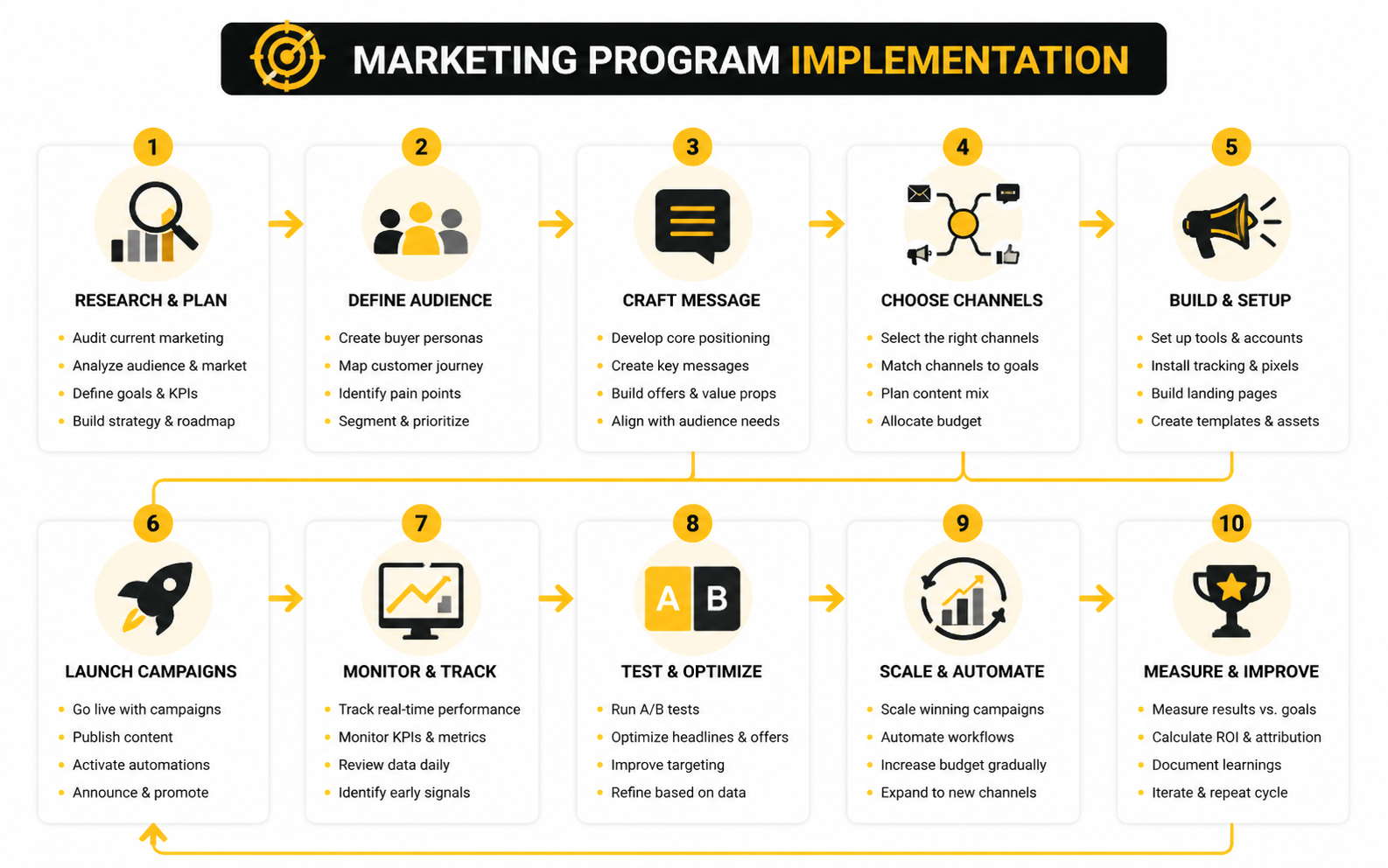
Step 5: Reporting and Feedback Integration
Gather data from all channels and compile comprehensive performance reports. Highlight what worked, what didn’t, and why. Feed these insights back into future campaign planning to continuously refine the marketing program, creating a cycle of ongoing improvement.
Step 6: Scaling Successful Campaigns
Once campaigns demonstrate consistent success, expand their reach. Scale budgets, add additional channels, or replicate effective strategies for other segments. Using analytics-driven decision-making ensures scaling maintains ROI while extending program impact.
Each of these steps connects the planning framework to actionable execution, creating a fully operational marketing program capable of delivering measurable business results.
Measuring the Marketing Program: Statistics and Data
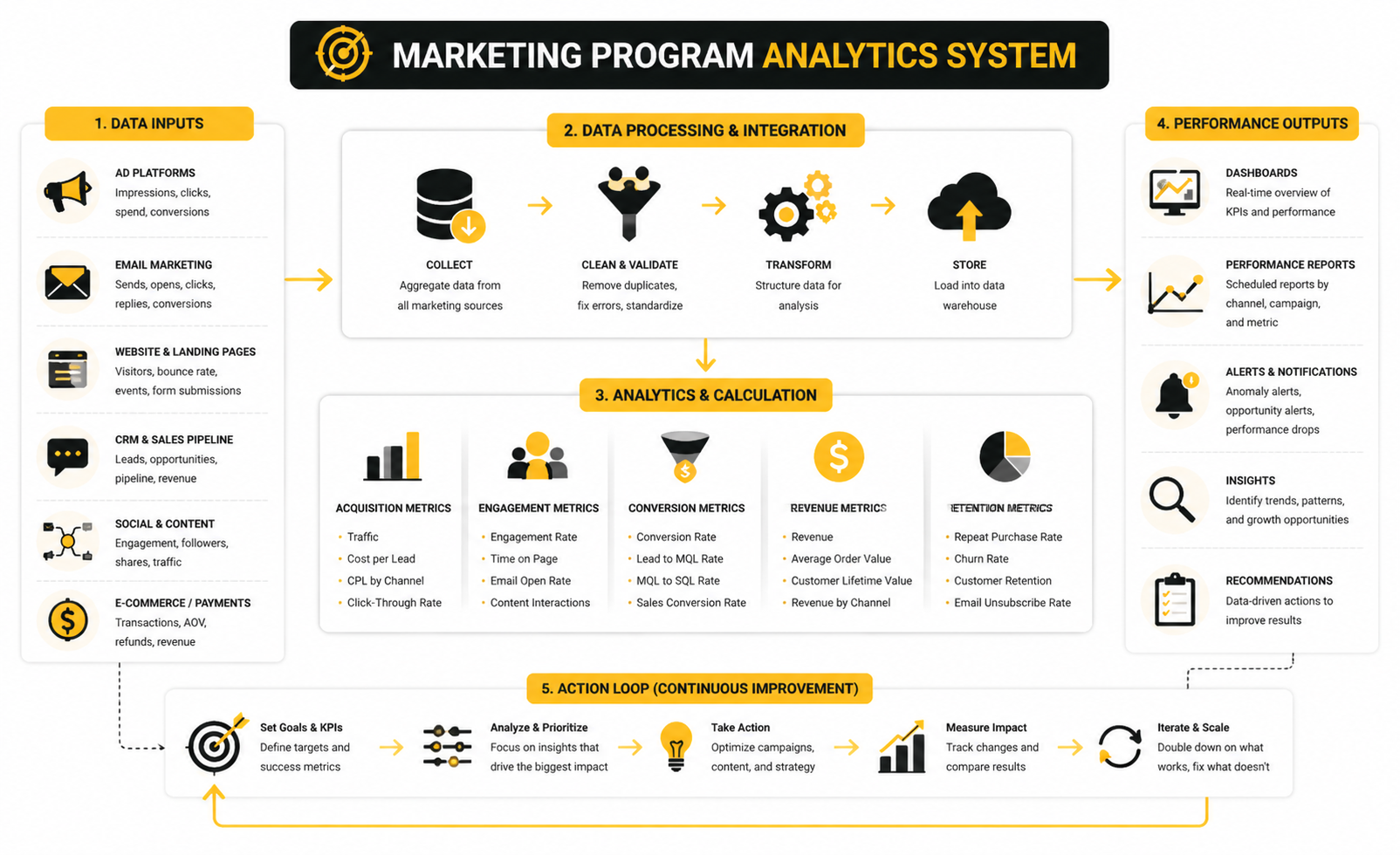
A marketing program isn’t complete without a robust analytics framework. Measuring performance gives you the insights needed to optimize campaigns, allocate resources wisely, and demonstrate ROI to stakeholders. The key is not just collecting data, but understanding what it actually signifies for your program.
Defining Key Metrics
Before diving into analytics, identify the metrics that align with your program goals. These may include:
- Conversion rates across campaigns
- Engagement metrics such as clicks, shares, or opens
- Cost per acquisition (CPA) and return on ad spend (ROAS)
- Funnel progression and lead quality indicators
Tracking these ensures every action can be quantified and evaluated against objectives.
Establishing Benchmarks
Benchmarks act as a reference point for performance. Use historical data or industry standards to set realistic expectations. For instance, if your email campaigns historically achieve a 25% open rate, anything significantly below indicates underperformance, while exceeding it suggests potential to scale efforts.
Performance Signals
Look for signals that reveal trends, not just isolated outcomes. A sudden drop in engagement across multiple channels may indicate messaging misalignment, while steady improvement in conversion metrics can justify additional investment. Understanding these patterns is essential for proactive decision-making.
Interpreting the Data
Raw numbers alone are insufficient. Contextual interpretation is critical:
- High engagement but low conversions suggests optimizing landing pages or call-to-action clarity.
- High cost per acquisition might indicate poor targeting or low-quality leads.
- Cross-channel discrepancies highlight where certain channels are outperforming others and where resources should shift.
Effective interpretation translates data into actionable strategy adjustments, ensuring the marketing program continually improves and scales.
By combining the right metrics, benchmarks, and performance signals, your marketing program gains a transparent measurement system that drives smarter execution and stronger results.
Implementing a Marketing Program: From Strategy to Execution
Once a marketing program is defined and structured, the real work begins in implementation. This phase transforms conceptual plans into tangible actions that reach the target audience effectively. Execution requires careful orchestration of multiple components, from content creation to campaign management, ensuring alignment with overarching objectives.
Step-by-Step Execution Process
A marketing program’s implementation should follow a sequential approach to reduce errors and optimize results:
- Campaign Design – Craft campaigns with clear goals, defined audiences, and messaging that resonates. Every piece of content, offer, or promotion should support the program’s core objectives.
- Channel Allocation – Decide where each campaign element will live, whether in email, social media, paid ads, or other channels. Allocating the right channels based on audience behavior increases efficiency.
- Resource Coordination – Ensure teams and tools are aligned. Content creators, designers, and data analysts must collaborate seamlessly to execute campaigns without bottlenecks.
- Monitoring Systems Setup – Implement tracking and analytics tools before launch. Accurate data collection ensures every metric is captured from day one.
Optimizing Launch and Early Performance
During the initial stages, monitor campaigns closely. Look for early signals of success or areas needing adjustment. Key indicators include engagement rates, lead quality, and preliminary conversions. Rapid feedback loops allow teams to iterate quickly and avoid wasting resources on ineffective tactics.
Balancing Automation and Human Oversight
Automation tools can scale operations efficiently, but human oversight remains critical. Automated email flows, social scheduling, or ad bidding need context-sensitive adjustments to prevent costly mistakes. Teams should establish clear rules for automation while maintaining the ability to intervene when anomalies or unexpected trends appear.
Strategic Tradeoffs in Execution
Every marketing program faces tradeoffs between reach, cost, and quality. For example:
- Prioritizing broad audience reach may reduce message personalization.
- Highly tailored campaigns may deliver better engagement but require more resources.
- Investing heavily in one channel may starve others of potential value.
Understanding these tradeoffs and making informed decisions ensures the program remains balanced and performance-focused.
By combining structured execution, ongoing optimization, and a strategic approach to tradeoffs, marketing programs move from theoretical plans to measurable results, setting the stage for advanced analytics and scaling considerations in subsequent phases.
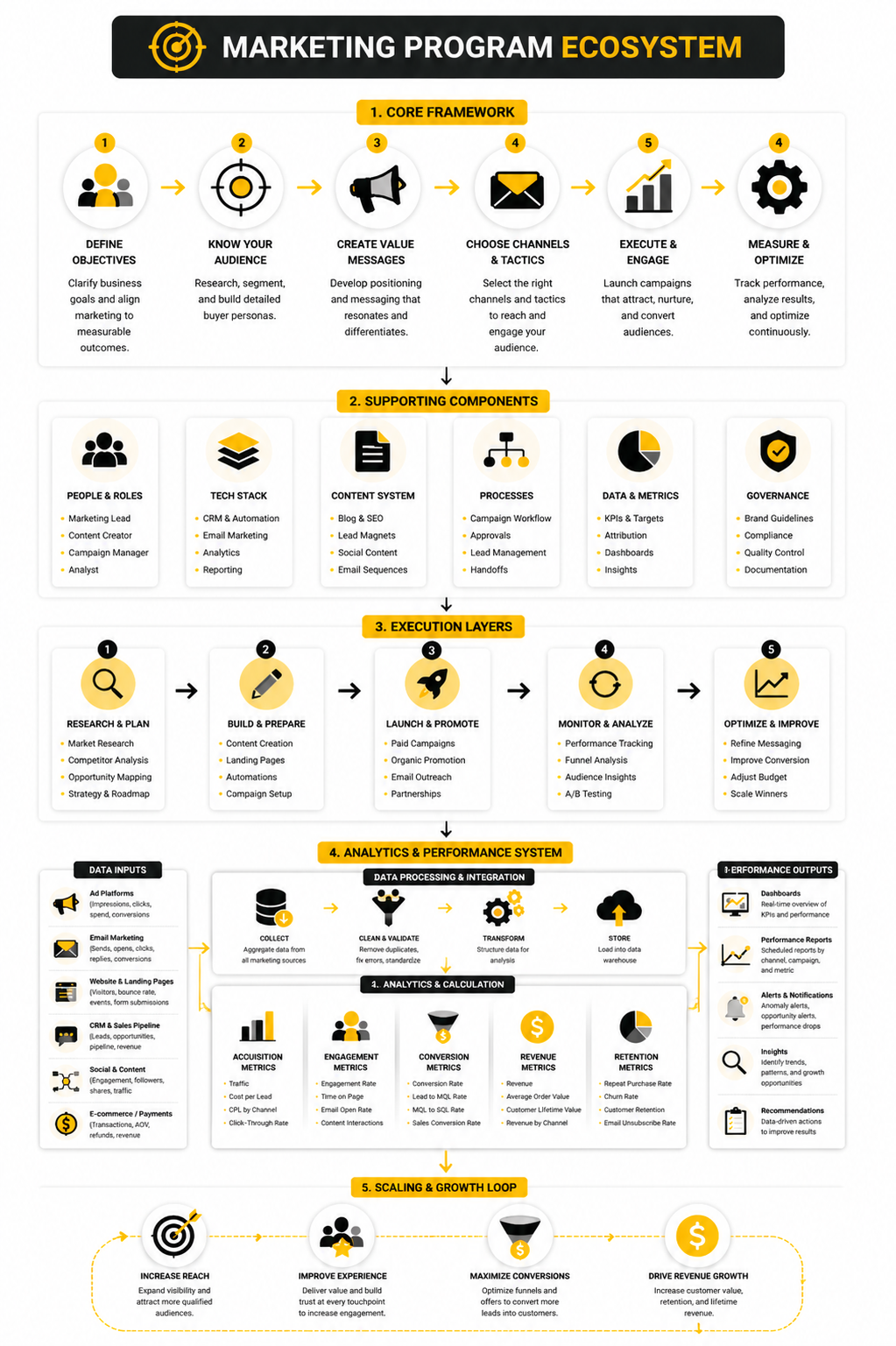
The Complete Marketing Program Ecosystem
To fully understand a marketing program, it’s essential to see how every component interacts—from strategy to execution, analytics, and scaling. A cohesive ecosystem ensures each element supports the others, creating a cycle of continuous improvement and measurable results.
FAQ - Built for Complete Guide
1. What is a marketing program?
A marketing program is a structured plan that coordinates campaigns, content, channels, and analytics to achieve specific business objectives.
2. How do I define the scope of a marketing program?
Start by identifying target audiences, key objectives, and measurable outcomes. Align campaigns and resources to these priorities for clarity and efficiency.
3. What are the core components of a marketing program?
Core components typically include strategy, content creation, channel management, campaign execution, and performance measurement.
4. How do I measure success?
Success is measured through KPIs relevant to your goals, such as lead generation, conversion rates, engagement, and ROI.
5. How often should I review performance metrics?
Review metrics regularly—weekly for ongoing campaigns and monthly for broader strategic programs. This ensures timely adjustments and optimization.
6. Can automation replace human oversight?
No. Automation enhances efficiency, but humans must monitor context, interpret data, and make judgment calls for optimal outcomes.
7. What risks should I watch for?
Common risks include misaligned messaging, over-reliance on a single channel, budget misallocation, and poor integration of analytics.
8. How do I scale a marketing program effectively?
Scaling requires a proven process, strong automation infrastructure, and a feedback loop from analytics to guide expansion without losing quality.
9. What tradeoffs are involved in program decisions?
Tradeoffs often exist between reach, personalization, and resource allocation. Strategic prioritization ensures the program meets objectives efficiently.
10. How do I ensure continuous improvement?
Implement iterative testing, monitor key metrics, gather feedback, and adapt campaigns. A culture of data-driven experimentation keeps the program effective over time.
Work With Professionals
Explore 10K+ Remote Marketing Contracts on MarkeWork.com
Most marketers spend too much time chasing clients, competing on crowded platforms, and losing a percentage of every project to middlemen. MarkeWork gives you a better way. Browse thousands of remote marketing contracts and connect directly with companies desperate to hire skilled marketers like you, without platform commissions and without unnecessary gatekeepers.
If you're serious about finding better opportunities and keeping 100% of what you earn, invite readers to explore available contracts and create a profile for free at MarkeWork.com.