

Most businesses do not fail because marketing is unimportant. They struggle because marketing turns messy fast. One channel becomes three, one campaign becomes a dozen moving parts, and suddenly the team is juggling positioning, content, ads, email, analytics, automation, and conversion problems at the same time.
That is where marketing services become valuable. In practice, marketing services are the specialist functions, systems, and execution layers that help a company attract attention, turn interest into demand, and keep growth from depending on guesswork. The best ones do not just make a brand look active. They make the business easier to discover, easier to trust, and easier to buy from.
Article Outline
- Why Marketing Services Matter More Now
- The Modern Marketing Services Framework
- Core Service Categories That Drive Growth
- How Professional Implementation Changes Outcomes
- Choosing the Right Marketing Partner
- Measuring Performance and Scaling Results
Why Marketing Services Matter More Now
Marketing services matter more today because customer journeys are no longer clean, predictable, or owned by a single channel. People move between search, social platforms, email, recommendations, reviews, video, and direct visits before they ever make contact. That means companies need coordinated execution, not random activity.
The second reason is pressure. Businesses are expected to produce clearer positioning, faster follow-up, better content, stronger conversion paths, and more accountable reporting at the same time. A modern marketing function has to connect brand, demand generation, sales support, and retention instead of treating each one like a separate island.
That is also why so many companies reach for outside support. Marketing services let a business access specialized skills without hiring a full in-house team for every channel and system. When done well, they reduce wasted spend, tighten execution, and give leadership a clearer line between marketing effort and business outcome.
The Modern Marketing Services Framework
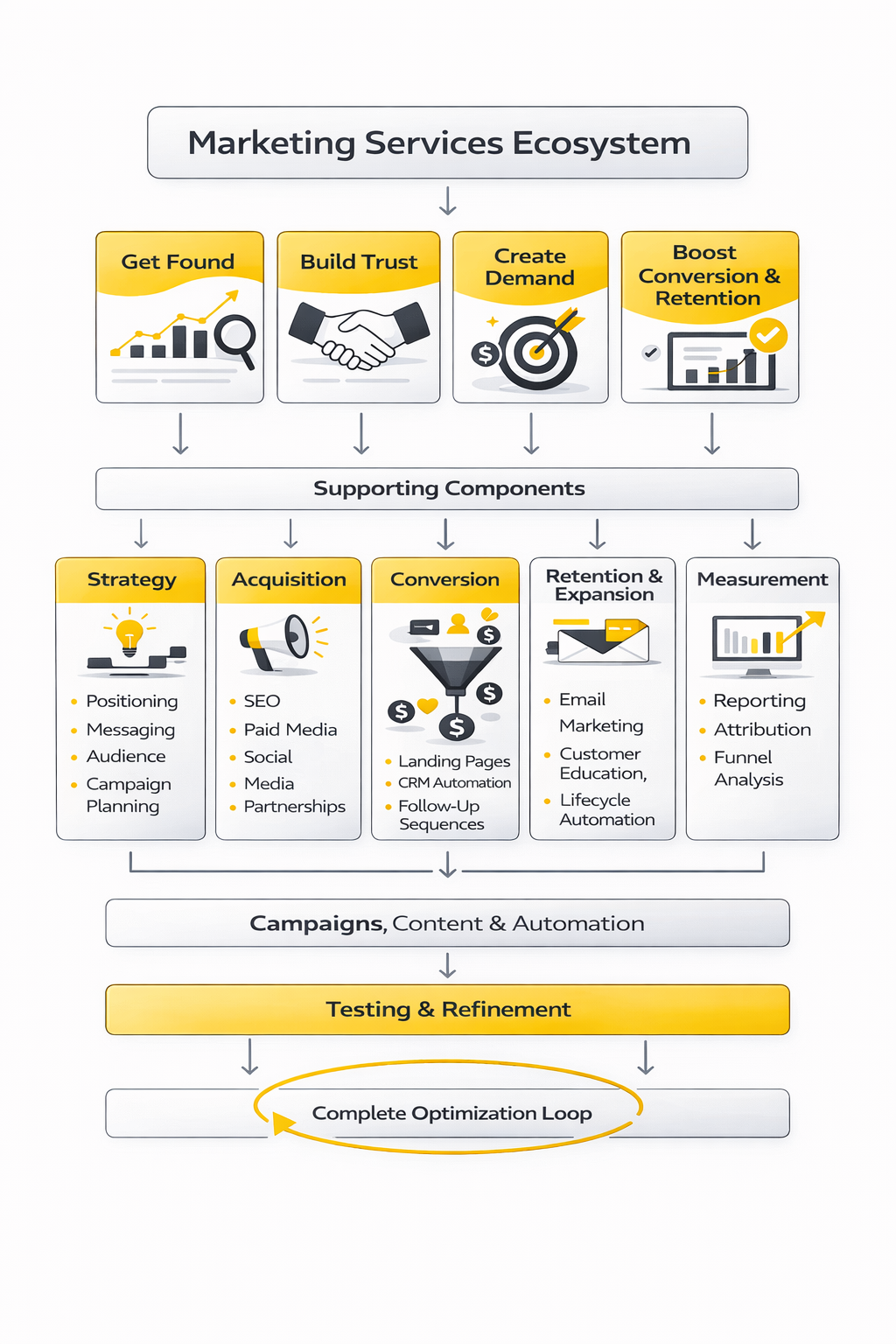
A useful way to think about marketing services is to stop grouping them by trendy tactic and start grouping them by job. Every service should help the business do one of four things: get found, build trust, create demand, or improve conversion and retention. That framing makes decisions much easier because it ties activity back to the role it plays in growth.
Some services sit close to visibility. Search engine optimization, paid media, local search, social distribution, and partnerships all help a brand get in front of the right people. Other services sit closer to persuasion, such as messaging, creative strategy, landing pages, case studies, lifecycle email, and sales enablement content.
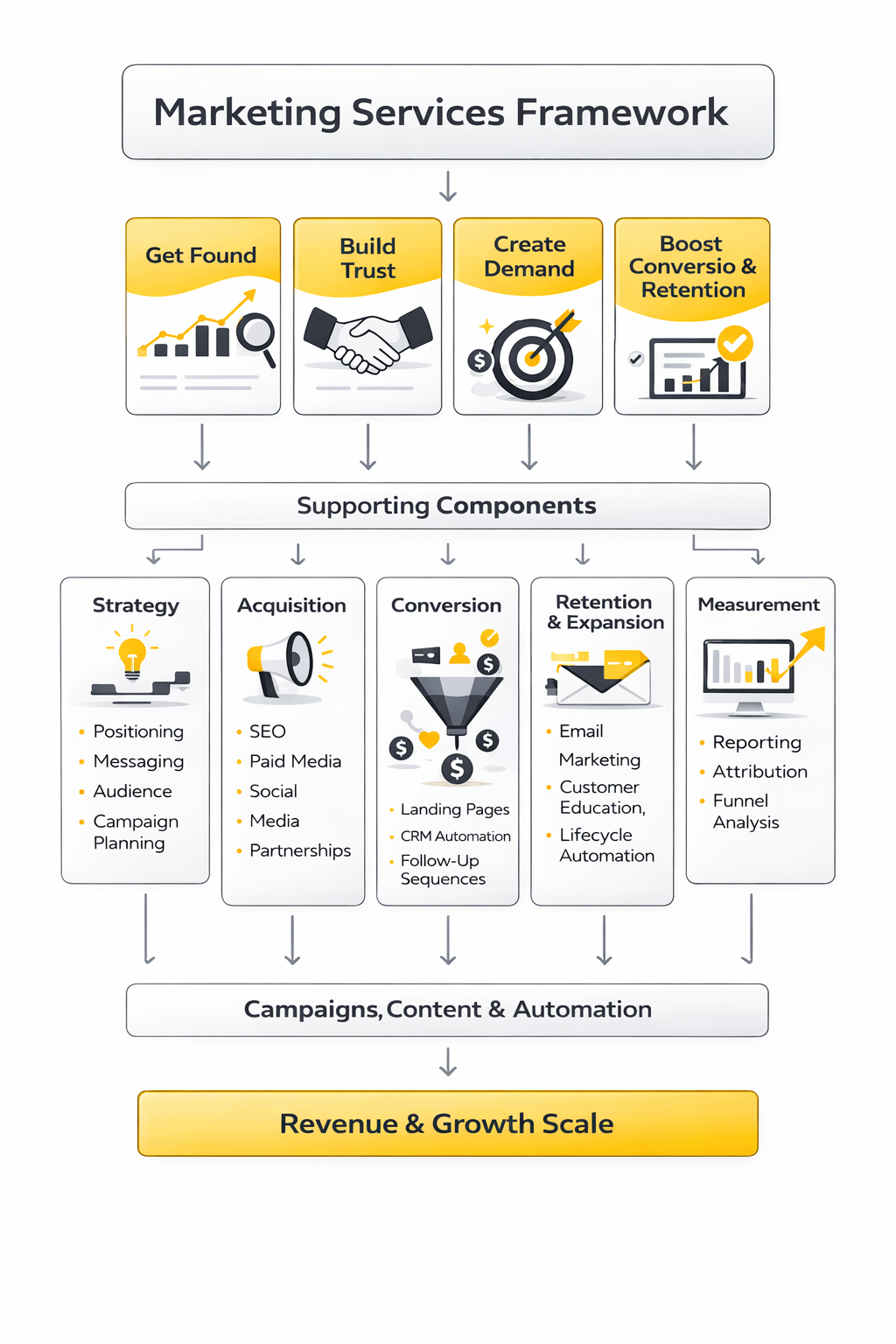
The strongest marketing service mix usually combines both. Traffic without trust is expensive, and trust without distribution stays invisible. A practical framework keeps those functions connected so the business is not overinvesting in one stage while neglecting the rest.
Core Service Categories That Drive Growth
The first core category is strategy. This includes positioning, audience definition, offer clarity, messaging architecture, campaign planning, and channel prioritization. Without this layer, execution tends to look busy while still feeling disconnected, because teams keep producing assets before they agree on what the market actually needs to hear.
The second category is acquisition. This is where services like SEO, paid search, paid social, organic social, influencer outreach, local marketing, and referral systems do their work. Their job is not simply to generate clicks. Their real job is to create qualified attention from people who are likely to become customers.
The third category is conversion. This covers landing pages, website copy, creative testing, lead capture, forms, CRM routing, chat flows, appointment booking, nurture sequences, and follow-up automation. A lot of businesses think they have a traffic problem when they actually have a handoff problem, a weak offer, or a friction-heavy conversion path.
The fourth category is retention and expansion. Email marketing, customer education, review generation, community building, upsell campaigns, remarketing, and lifecycle automation all belong here. This is one of the most overlooked areas in marketing services, even though it is often where profitability improves fastest.
The fifth category is measurement. Reporting, attribution, call tracking, dashboard design, funnel analysis, and experiment management are not glamorous, but they are what keep marketing honest. Without measurement, the business cannot tell the difference between activity that looks impressive and work that genuinely moves revenue.
How Professional Implementation Changes Outcomes
Professional implementation is where marketing services stop being a list and start becoming an operating system. The difference is not just expertise in one channel. It is the ability to connect strategy, execution, data, and iteration so that every move informs the next one.
That usually shows up in small but important ways. A professional team defines the goal before launching the campaign. They connect creative to intent, connect intent to landing pages, connect landing pages to follow-up, and connect follow-up to reporting. That discipline is what turns scattered tactics into a repeatable growth process.
It also changes tool selection. A business that needs stronger lead capture and CRM automation may lean toward a platform like GoHighLevel, while a brand focused on social scheduling and consistency may prioritize Buffer. If lifecycle email is the weak point, Brevo can fit naturally, and if conversational follow-up is critical, ManyChat or Chatbase can play a real role.
The key point is simple: tools are not the service. They are multipliers for good implementation. When the underlying strategy is weak, more software just creates faster confusion. When the strategy is clear, the right marketing services and systems make execution faster, cleaner, and much easier to scale.
Choosing the Right Marketing Partner
Picking a marketing partner is not really about finding the loudest agency, the cheapest freelancer, or the team with the prettiest case study deck. It is about finding a group that can diagnose the actual growth problem, translate that into a clear operating plan, and execute without hiding behind jargon. A lot of businesses buy marketing services based on channel hype, then realize too late that they hired for output when they actually needed judgment.
The first filter is strategic clarity. A serious partner should be able to explain where growth is breaking down right now, whether that is weak positioning, poor traffic quality, low conversion rates, broken follow-up, or weak retention. If they cannot connect their recommendation to a business bottleneck, the engagement is already drifting toward wasted spend.
The second filter is commercial alignment. Marketing budgets are under pressure, with Gartner reporting that average budgets fell to 7.7% of company revenue in 2024, down from 9.1% in 2023, which means every outside hire has to justify itself faster than before (Gartner’s CMO Spend Survey). In plain English, that means a partner should understand payback periods, not just impressions and engagement charts.
What Good Evaluation Looks Like
A good evaluation process is simple, but not casual. You want to know how the partner thinks, how they prioritize, how they report, and what they do when a campaign underperforms. That last part matters more than most people admit, because nearly every decent growth program hits a rough patch before it stabilizes.
Ask them how they scope work. Ask what they need from your team. Ask how they handle attribution disputes, creative fatigue, CRM gaps, and slow sales follow-up. Good marketing services feel practical from the beginning, because the partner is already thinking about dependencies, handoffs, and execution risks rather than trying to win the room with vague promises.
You also want evidence of operating discipline. Deloitte Digital found that organizations investing more in martech than working media saw 18% greater sales lift from marketing and 7% greater overall revenue growth than those investing more heavily in working media alone (Deloitte’s 2025 marketing investment trends). That does not mean every company should buy more software. It means the right partner should know how systems, data, and process improve the output of creative and media instead of treating tools like decoration.
Red Flags That Usually Cost More Later
One red flag is channel obsession. If a provider insists that SEO, paid ads, content, social, or AI automation is the answer to almost every business problem, they are probably selling a delivery model, not solving your problem. Strong partners can absolutely have a specialty, but they should still be honest about where their specialty stops helping.
Another red flag is reporting theater. If everything is framed around reach, clicks, followers, or platform screenshots with no connection to pipeline, booked calls, qualified leads, revenue, or retention, you are looking at activity reporting instead of business reporting. Marketing services should reduce uncertainty, not make it harder to tell what is actually working.
A third red flag is weak implementation ownership. Too many providers build strategy decks that quietly assume your team will fix the website, write the email sequences, wire the CRM, clean the data, and follow up with leads at speed. That is how good-looking plans die in ordinary business conditions.
The Best Fit Is Usually Narrower Than You Think
A lot of companies think they need a full-service solution when they actually need one sharp intervention. Sometimes that is conversion work, not more traffic. Sometimes it is CRM automation, not another content calendar. Sometimes it is landing page speed, better sales handoff, or cleaner lead qualification.
That is why the best marketing partner is often the one that says no to work that does not matter yet. If your follow-up is slow and your funnel leaks, buying more traffic just increases the cost of failure. If your offer is unclear, better creative may get more attention but still not produce better economics.
This is also where tooling can help once the strategic fit is clear. A business that needs tighter lead capture, nurture flows, and pipeline visibility may get real value from GoHighLevel, while a team that needs cleaner publishing workflows and social coordination may prefer Buffer. The important part is not the logo on the software. The important part is whether the partner knows how to use the system to remove friction from the customer journey.
Measuring Performance and Scaling Results
Once a company has the right marketing services in place, the next challenge is measurement. This is where a lot of growth programs either become durable or start drifting into self-deception. The goal is not to measure everything. The goal is to measure the handful of things that tell you whether the engine is getting healthier.
That starts with choosing the right level of evidence. Top-of-funnel signals still matter, but they are not enough on their own. Leaders want to know whether the marketing system is creating qualified demand, moving prospects through the funnel, and generating profitable growth rather than just producing visible motion.
The measurement gap is real. Nielsen found that while confidence in ROI measurement has risen, only 38% of global marketers say they evaluate marketing holistically across traditional and digital channels together (Nielsen’s Annual Marketing Report). That gap explains why so many companies can describe channel performance in detail but still struggle to explain total business impact.
The Metrics That Matter Most
The most useful metrics usually sit in layers. The first layer covers efficiency, such as cost per click, cost per lead, cost per booked call, or content production velocity. Those numbers help teams spot friction early, but they are not where the real judgment should end.
The second layer covers quality. That means lead-to-opportunity rates, sales acceptance rates, meeting show rates, demo-to-close rates, customer acquisition cost, and retention. This is where marketing services start proving whether they are feeding the business the right kind of demand instead of simply increasing traffic volume.
The third layer covers financial outcome. That includes pipeline contribution, revenue influenced, payback period, customer lifetime value, and incremental profit. Once you have these measures in place, scaling becomes more rational because you are no longer making spend decisions based on platform enthusiasm.
Why Last-Click Reporting Is Not Enough
Last-click reporting is convenient, which is exactly why it misleads so many teams. It over-rewards the final touchpoint and understates everything that made the conversion possible earlier in the journey. For businesses using multiple marketing services across content, paid media, email, search, and social, that creates distorted decisions very quickly.
Google has been pushing harder toward incrementality and broader measurement for exactly this reason. Its recent guidance argues that experimentation and incrementality testing reveal business impact more clearly than narrow touchpoint logic, and Google says lower spend thresholds have made these tests accessible to more advertisers than before (Think with Google on incrementality testing, Google Ads product updates). That matters because scaling should come from evidence of lift, not just from whichever dashboard looks most flattering.
A more mature approach blends attribution, funnel reporting, and controlled testing. Attribution helps you understand patterns. Funnel reporting helps you find operational leaks. Testing helps you separate correlation from actual business lift. Put together, they give management a much stronger basis for budget decisions.
How Scaling Should Actually Work
Scaling should not mean turning every dial up at once. It should mean doubling down on the combination of offer, audience, message, channel, and follow-up sequence that has already shown reliable economics. That sounds obvious, but plenty of businesses skip that discipline and mistake temporary momentum for a repeatable model.
A smarter path is phased expansion. First, prove that one funnel or one campaign can produce stable conversion quality. Then expand spend, creative variation, audience segments, or adjacent channels in a controlled way. McKinsey’s recent work on personalization makes the same broader point: better growth comes from relevance and orchestration, not from simply increasing message volume across disconnected channels (McKinsey on the next frontier of personalized marketing).
This is where operational tools become force multipliers again. If you need better landing page iteration for paid traffic, Replo can help speed deployment. If you need stronger lifecycle email or nurture logic, Brevo or Moosend may fit. If lead qualification and AI-assisted conversations are the bottleneck, Chatbase can be useful. But again, tools scale what already works. They do not rescue a weak growth model.
What Sustainable Success Looks Like
Sustainable success in marketing services is usually less dramatic than people expect. It looks like cleaner offers, better targeting, faster response times, better conversion paths, more trustworthy reporting, and more confident budget allocation. It feels calmer because fewer decisions are being made on hope alone.
That is the real payoff. Good marketing services do not just create campaigns. They create a system the business can understand, manage, and improve over time. And when that system is built properly, scaling stops feeling like a gamble and starts looking like controlled growth.
How Professional Implementation Changes Outcomes
The difference between average and effective marketing services usually shows up in implementation, not in strategy slides. Plenty of teams can describe a funnel, map a campaign, and talk confidently about positioning. Far fewer can turn that thinking into a working system that launches on time, routes leads correctly, follows up fast, and improves week after week.
That is why professional implementation matters so much. It translates goals into operating rules, assigns ownership, sets measurement standards, and removes friction before that friction starts killing results. When companies skip this layer, they often blame the channel, the market, or the budget when the real problem is execution quality.
Start With a Diagnostic Before You Build Anything
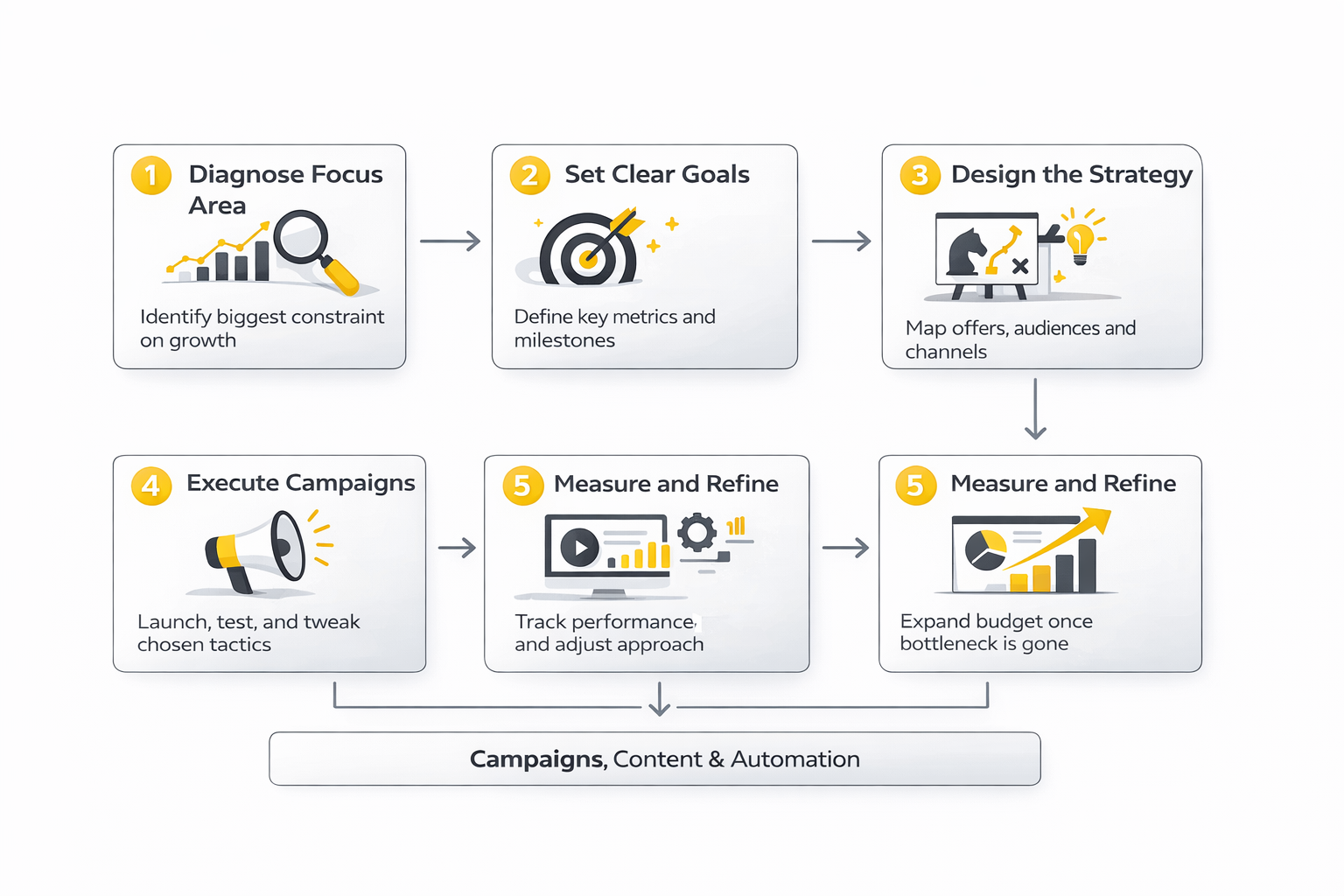
A smart implementation process begins with diagnosis, not production. Before new campaigns go live, the team needs to understand what is already in place, what is broken, and where the handoff points fail. That means reviewing traffic sources, conversion paths, CRM stages, follow-up timing, reporting logic, and the actual experience a prospect gets after taking action.
This step sounds basic, but it prevents expensive mistakes. Marketing services often underperform because businesses launch new ads, pages, or automations on top of unclear offers, poor routing, or weak sales follow-up. When the foundation is off, more activity just hides the real issue under a bigger pile of data.
The diagnostic stage should end with a short list of priorities, not a giant wishlist. You want to know which constraint matters first: message clarity, page conversion, form quality, automation gaps, response speed, or reporting accuracy. Once that is clear, implementation becomes a sequence instead of a scramble.
Build the Operating System, Not Just the Campaign
After the diagnostic work, the next step is to build the operating system behind the marketing. That includes campaign structure, landing pages, forms, CRM pipelines, automation rules, tracking, calendar flows, and reporting dashboards. This is the part many businesses underestimate because it is less visible than creative, but it often has more impact on outcomes.
A working system gives each step a job. Traffic sources attract the right audience, landing pages frame the offer clearly, forms capture the right information, automation keeps momentum moving, and the CRM makes sure no qualified lead disappears into silence. When those pieces connect properly, marketing services stop feeling fragmented and start behaving like a coordinated revenue function.
This is also where platforms matter in a practical way. A business that needs central control over pipelines, forms, nurture flows, and appointment booking may benefit from GoHighLevel, while a brand that needs faster landing page deployment for performance campaigns may prefer Replo. The point is not to stack tools for the sake of it. The point is to pick infrastructure that makes execution cleaner and easier to maintain.
A Practical Implementation Process Looks Like This
Once the system design is clear, implementation becomes much more tangible. The process is usually less glamorous than people expect, but that is exactly why it works. It is a disciplined sequence of setup, launch, observation, and refinement.
- Clarify the offer and the audience.
- Build or fix the conversion path.
- Connect forms, CRM stages, and routing rules.
- Create follow-up sequences for the first minutes, hours, and days.
- Launch a controlled amount of traffic or distribution.
- Review quality signals before scaling spend.
- Adjust creative, messaging, qualification, or automation based on real behavior.
This sequence matters because every later step depends on the earlier ones being clean enough to trust. If the offer is vague, testing ad creative will not save it. If the routing is broken, more leads will not help. If follow-up is weak, better targeting may still fail to produce better economics.
Speed, Handoff, and Follow-Up Are Not Small Details
One of the easiest ways to waste good marketing services is to treat post-conversion follow-up like an administrative detail. It is not. Response speed changes the quality of the opportunity because intent fades, distractions pile up, and competitors move in fast.
Recent marketing and sales data keeps pointing in the same direction: teams struggle with prompt customer response, and businesses using better systems report materially faster lead response times. That is not just a workflow benefit. It directly affects whether paid traffic, inbound content, or referral demand turns into real conversations.
That is why professional implementation pays so much attention to handoffs. The team needs rules for who gets notified, how fast they respond, what happens if a lead goes cold, and how the next touchpoint is triggered automatically. Tools like ManyChat, Chatbase, and Cal.com fit naturally here when the business needs conversational follow-up, qualification, or faster booking flow.
Testing Should Start Early, Not After Everything Feels Perfect
A lot of teams delay testing because they want the whole system to feel polished first. That instinct is understandable, but it usually slows learning. Strong implementation starts testing early because real user behavior reveals more than internal opinions ever will.
That does not mean testing randomly. It means choosing high-leverage variables such as headline clarity, offer framing, CTA language, page layout, form friction, and first-response timing. Conversion benchmark data shows that landing page performance varies widely and that even basic page changes can shift outcomes meaningfully, which is exactly why structured testing belongs inside implementation instead of being treated as an optional extra.
This is where many marketing services separate into two camps. One camp launches and reports. The other launches, learns, and iterates. The second camp is almost always more valuable because it treats the first version as a starting point, not a final answer.
Good Implementation Creates Calm
When implementation is done well, the whole marketing function gets calmer. People know what the offer is, where leads go, which numbers matter, and what to improve next. Meetings become more useful because the conversation shifts from blame and guesswork to decisions and tradeoffs.
That calm is not accidental. It comes from having a defined process, clear ownership, and systems that support the work instead of complicating it. This is also why recent martech research keeps emphasizing integration, data activation, and composability: the more fragmented the stack becomes, the more disciplined implementation has to be to make the whole system usable.
And that is the real advantage of professional implementation in marketing services. It does not just help you launch. It helps you keep improving without rebuilding the machine every month.
What the Numbers Actually Tell You
Once marketing services are running, the next job is not collecting more dashboards. It is learning which numbers actually explain business performance and which ones only describe surface activity. That distinction matters because teams often react to whatever is easiest to see, not whatever is most useful to act on.
The data is pointing in a pretty clear direction. Budgets are tight, leadership wants stronger proof, and marketers are being pushed to connect spend to outcomes faster than before. Gartner’s 2025 CMO spend survey found that marketing budgets stayed flat at 7.7% of company revenue, while 59% of CMOs still said they do not have enough budget to execute their strategy fully (Gartner’s 2025 CMO Spend Survey). That matters because it changes how marketing services should be judged: not by volume of activity, but by clarity, efficiency, and commercial impact.
The bigger point is simple. In a tighter environment, weak measurement becomes expensive. When a team cannot tell whether growth came from better targeting, a stronger offer, faster follow-up, or just seasonal demand, it becomes much harder to scale with confidence.
The Metrics That Deserve the Most Attention
Not every metric deserves equal weight. Some numbers help you diagnose friction early, while others tell you whether the entire system is becoming more profitable. Good marketing services use both, but they do not confuse one for the other.
The first layer is traffic and engagement quality. That includes click-through rate, cost per click, session depth, returning visitor rate, landing page bounce patterns, and channel-level conversion rates. These numbers are useful because they tell you whether the message is attracting the right kind of attention, but they should never be treated as proof of business success on their own.
The second layer is funnel health. This is where metrics like cost per lead, lead-to-meeting rate, sales acceptance rate, opportunity creation rate, and pipeline contribution become more meaningful. These numbers show whether marketing services are attracting people who are actually moving closer to revenue instead of simply responding to content or ads in a low-intent way.
The third layer is financial impact. That includes customer acquisition cost, payback period, revenue influenced, retention, expansion revenue, and contribution margin. Once those numbers are visible, decision-making improves fast because the team can finally separate channels that look busy from channels that produce durable growth.
Cross-Channel Measurement Is Still a Weak Spot
One of the most important findings in recent research is that many teams still do not measure marketing as one connected system. Nielsen’s 2025 Annual Marketing Report found that only 32% of marketers measure traditional and digital media together in a holistic way (Nielsen’s 2025 Annual Marketing Report). That is a serious issue because customers do not experience your brand in neat reporting categories.
If your reporting splits channels into separate boxes, you will usually over-credit the last touch and under-credit the earlier touches that created trust or intent. Search may get the final click, but video, email, social proof, and direct visits may have done most of the persuasion. That is why fragmented measurement often leads businesses to cut the very activities that are quietly making the rest of the funnel work.
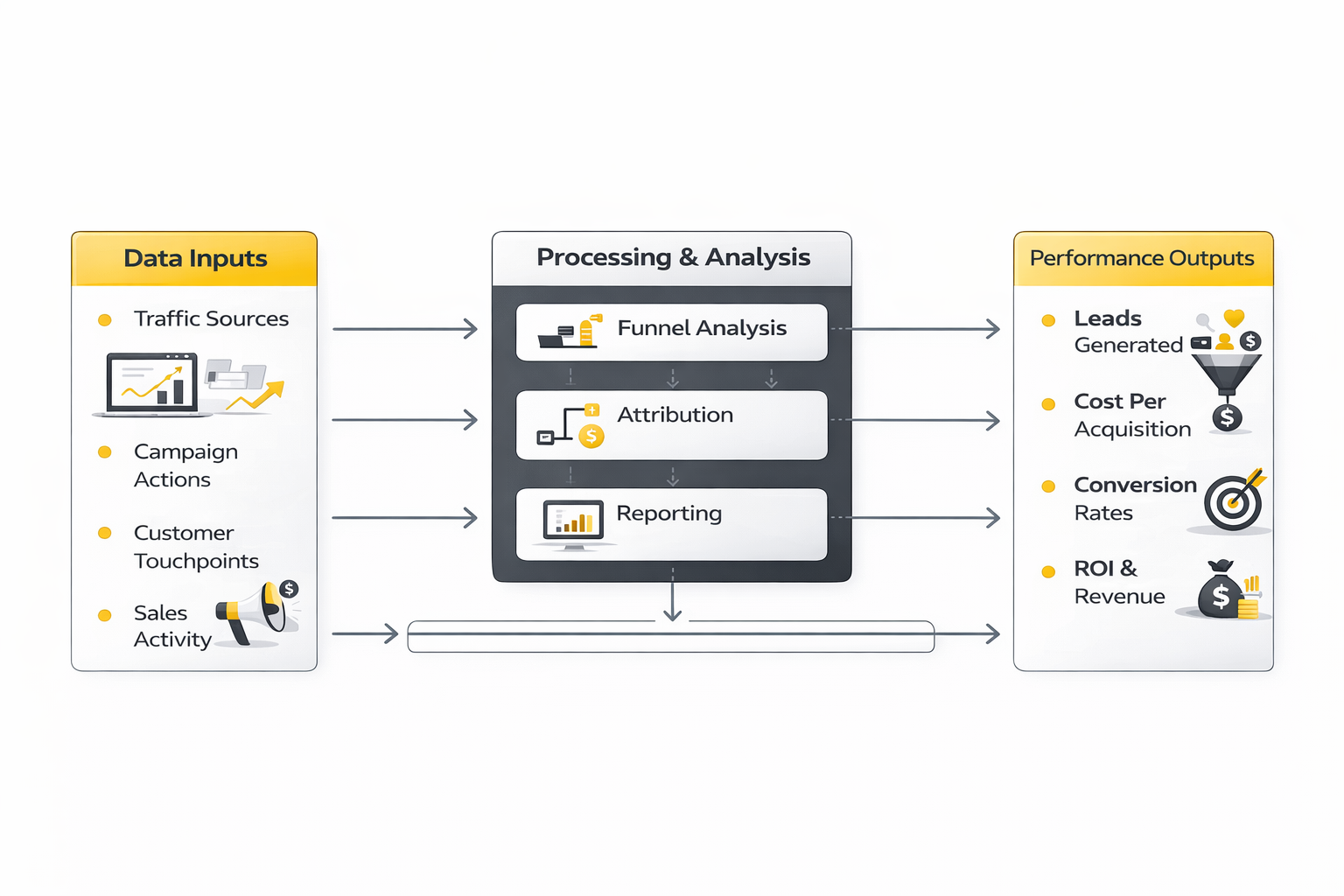
This is also where marketing services need a more mature measurement model. The goal is not perfect attribution, because that does not exist. The goal is to combine attribution, funnel reporting, and testing well enough that budget decisions become smarter over time.
Why Data Quality Is a Bigger Deal Than Most Teams Admit
Analytics gets a lot of attention, but data quality is still the quiet bottleneck. If naming conventions are inconsistent, forms are capturing weak information, CRM stages are messy, or offline outcomes are not being pushed back into reporting, then the numbers will look precise while being structurally unreliable. That is one of the fastest ways to make good teams argue over bad evidence.
Salesforce’s latest State of Marketing research says 83% of marketers recognize the shift toward personalized, two-way engagement, yet only one in four are satisfied with how they use data to power those moments (Salesforce’s 10th State of Marketing report). That gap matters because better personalization and better optimization both depend on cleaner data. If the system cannot identify audience intent, source quality, and downstream outcomes properly, then even strong creative and strong execution hit a ceiling.
This is where better infrastructure starts to matter. Teams that need tighter contact records, cleaner routing, and stronger lifecycle visibility often benefit from a unified CRM and automation setup like GoHighLevel or a dedicated CRM like Copper. The reason is not that software magically fixes reporting. It is that good systems make disciplined measurement much easier to maintain.
Conversion Benchmarks Are Useful, but Only When You Read Them Correctly
Benchmarks can help, but they are easy to misuse. A benchmark should tell you whether you are in a normal range, whether you are clearly underperforming, and where to investigate next. It should not become a vanity contest where teams chase an industry average without looking at offer quality, traffic intent, device mix, or sales cycle length.
That nuance matters because conversion rates vary a lot by context. Unbounce’s latest benchmark dataset is built on 41,000+ landing pages, 464 million unique visitors, and 57 million conversions, which makes it useful as directional reference rather than anecdotal guesswork (Unbounce Conversion Benchmark Report). But even with a dataset that large, the practical lesson is not “copy the average.” The real lesson is to compare your result against similar traffic conditions and then figure out why the gap exists.
For example, a weak conversion rate can mean the page is poor, but it can also mean the offer is misaligned, the audience is too cold, the form is asking for too much, or the follow-up sequence is slow enough to waste intent. Good marketing services read benchmarks diagnostically. They use them to narrow the problem, not to pretend every brand should perform the same way.
Measurement Should Drive Action, Not Just Reporting
The most valuable data is the data that changes behavior. If a channel generates cheap leads but poor sales acceptance, the action is not to celebrate lead volume. It is to tighten qualification, rework targeting, or shift budget. If a landing page gets strong traffic but weak conversion, the action is not to buy more impressions. It is to test message clarity, page structure, CTA language, and form friction.
That is why a strong analytics system should answer a small set of practical questions every week. Which channels are producing qualified demand, not just clicks? Where is the funnel slowing down? What changed in conversion quality after the last creative or offer adjustment? Which improvements are likely to create lift fastest?
When analytics is built this way, marketing services become easier to manage because the team stops drowning in numbers. They start operating from a decision framework instead. That shift alone can improve performance more than adding another reporting tool.
Last-Click Metrics Miss Too Much
Last-click reporting is attractive because it is clean and easy to explain. The problem is that it usually rewards the final touchpoint while ignoring most of the journey that created intent in the first place. That leads teams to overinvest in bottom-funnel capture and underinvest in demand creation, education, and trust-building.
Google has been leaning harder into this issue with its recent guidance around incrementality testing. Its measurement updates highlight lower barriers to running incrementality tests, while its broader measurement guidance makes the case for identifying whether media generated net-new demand instead of merely intercepting existing intent (Think with Google on incrementality testing, Google Ads product updates). That matters because it changes the question from “Which click got credit?” to “What actually caused lift?”
For businesses using layered marketing services across content, search, paid social, email, chat, and outbound follow-up, that is a much better question. It gives management a clearer picture of which investments are driving incremental growth and which ones are mostly harvesting demand that already existed.
The Best Analytics Stack Is the One That Gets Used
A measurement system does not need to be flashy. It needs to be trusted, readable, and tied to action. Most businesses are better served by a straightforward stack that connects traffic, forms, CRM stages, meetings, sales outcomes, and retention than by a beautiful dashboard that never gets questioned and rarely changes decisions.
That usually means choosing tools based on operational fit. If the priority is page iteration and faster testing, Replo can help shorten the path from insight to page update. If the weak point is lead capture or data collection, Fillout can fit naturally into a cleaner measurement flow. If scheduling speed is part of conversion performance, Cal.com can reduce friction where intent is highest.
The key is to treat the analytics stack as part of the growth system, not as a separate reporting layer. When the tools, the process, and the weekly decisions are connected, numbers stop being decorative. They become operational.
What Good Data Should Make You Do Next
The best interpretation of data is almost always action-focused. If costs are rising while quality is stable, the next move may be creative testing, offer improvement, or landing page refinement instead of an immediate budget cut. If traffic is healthy but meetings are weak, the next move may be routing, qualification, or follow-up speed. If conversion is good but retention is poor, the next move is probably not acquisition at all.
That is the real purpose of measurement inside marketing services. It should show where the next constraint is hiding and what kind of response is most likely to improve the whole system. McKinsey’s recent work on predictive personalization and content effectiveness points in the same direction: better marketing performance comes from using data to improve relevance and decision quality, not from generating more reports for their own sake (McKinsey on the next frontier of personalized marketing).
In other words, numbers matter most when they help the business act with more confidence. That is what separates reporting from real measurement. And that is what turns marketing services from a cost center people debate into a growth system people can trust.
Advanced Tradeoffs That Shape Marketing Services
Once the basics are working, the hard part is no longer “Should we invest in marketing services?” The harder question is how to allocate limited time, budget, data, and team attention without creating a bloated system. That tradeoff matters more now because marketing budgets have stayed stuck at 7.7% of company revenue in Gartner’s latest CMO survey, which leaves much less room for waste, experimentation without discipline, or duplicated work across vendors.
The first tradeoff is specialization versus coordination. Specialist providers can outperform generalists inside a narrow channel, but every extra handoff raises the risk of slower launches, broken attribution, and inconsistent messaging. The more vendors you add, the more important central ownership becomes, because great channel execution still underperforms when nobody is responsible for the whole customer journey.
The second tradeoff is short-term capture versus long-term demand creation. Bottom-funnel tactics feel safer because they produce quick dashboards, but overreliance on them usually means the business is harvesting existing intent instead of building future demand. Strong marketing services keep those two jobs connected so the company can generate revenue now without starving the pipeline it will need later.
Where Scaling Usually Breaks
Scaling rarely fails because a business suddenly stops getting attention. It usually fails because the system underneath that attention cannot absorb more volume cleanly. More leads arrive, but qualification weakens, follow-up slows, reporting becomes less trustworthy, and leadership starts making bigger budget decisions from lower-quality evidence.
That risk gets worse when measurement is fragmented. Nielsen’s 2025 Annual Marketing Report found that only 32% of marketers measure traditional and digital media together holistically, which means most teams are still making decisions from partial visibility. When marketing services scale on top of that kind of blind spot, it becomes easy to reward channels that capture the final click and underinvest in the channels that actually created trust earlier in the journey.
This is why advanced teams scale constraints, not channels. They identify the current bottleneck, fix it, and only then widen spend, audience reach, or service scope. If the bottleneck is handoff speed, adding more traffic makes the economics worse. If the bottleneck is conversion quality, broader distribution only hides the real problem for another month.
AI Changes the Service Model, but Not the Need for Judgment
AI is changing how marketing services are delivered, and pretending otherwise is not serious. Salesforce’s current marketing research shows that 63% of marketers are already using generative AI, while the company’s latest State of Marketing report frames AI, data quality, and personalization as central operating issues for modern teams.
But there is an important distinction here. AI improves speed, throughput, drafting, summarization, testing support, and workflow assistance. It does not remove the need for positioning judgment, offer strategy, channel prioritization, or commercial accountability. In fact, the faster teams can produce assets, the more damage they can do when the underlying strategy is weak.
That is why the most useful AI question is not “How much can we automate?” It is “Which parts of this system benefit from acceleration without lowering trust, clarity, or quality?” Used well, AI lets marketing services produce more relevant variants, faster responses, and quicker reporting loops. Used badly, it floods the funnel with generic content and makes weak thinking scale faster.
Tools can help at this stage, but only when they solve a real operating problem. If conversational qualification is the constraint, Chatbase can support faster lead handling. If workflow speed and communication are becoming bottlenecks, Wispr Flow may fit naturally. The principle stays the same: automate the friction, not the judgment.
Privacy, Data Ownership, and Trust Are Now Strategic Constraints
As marketing services mature, privacy stops being a compliance side note and becomes a growth issue. Businesses that depend too heavily on rented audiences, platform-level opacity, or weak customer data practices end up with less control over targeting, less confidence in performance, and more vulnerability when policies change. That is one reason current marketing strategy keeps moving toward first-party data, cleaner CRM infrastructure, and permission-based lifecycle communication.
This changes what “good marketing” looks like. It is no longer enough to drive clicks efficiently. The business needs to capture useful consented data, connect it to real customer behavior, and use it in ways that feel helpful rather than invasive. The companies that do this well tend to build more resilient marketing systems because they are not relying on borrowed targeting forever.
That also affects tool choices. Email and lifecycle systems like Brevo or Moosend become more valuable when a company wants stronger direct relationships instead of permanent dependence on paid reach. That is not just a channel preference. It is a strategic hedge.
Expert-Level Guidance Before You Expand Further
The most advanced mistake in marketing services is confusing complexity with maturity. More dashboards, more vendors, more automations, and more campaign types can make a company look sophisticated while making it slower, noisier, and harder to manage. Expert operators know that the goal is not maximum activity. The goal is a system that can keep improving without becoming fragile.
That is why consolidation becomes attractive at the right stage. If multiple tools are creating duplicate contact records, reporting gaps, or workflow confusion, simplifying the stack can improve output faster than adding another service line. A platform like GoHighLevel can make sense when the business wants tighter control over capture, nurture, pipeline, and reporting in one place, but consolidation only helps when the team is clear on process first.
The final tradeoff is patience versus pressure. Strong marketing services should create momentum, but not every gain appears instantly and not every dip means failure. The companies that scale well usually keep a tight weekly operating rhythm, a realistic testing horizon, and a low tolerance for vanity metrics. That balance matters because disciplined patience is what lets the best systems compound instead of getting rebuilt every quarter.
Bringing the Whole Marketing System Together
By this point, the shape of good marketing services should be clear. They are not a random bundle of ads, posts, emails, and reports. They are a coordinated system built to help a business get discovered, earn trust, convert interest, keep customers engaged, and improve performance without starting from scratch every quarter.
That is the real goal at the end of all this. You want a marketing system that can handle strategy, execution, measurement, and optimization as one connected loop. When those parts are aligned, the business stops reacting to noise and starts making better decisions with much less friction.
This is also where ecosystem thinking matters. The more advanced your marketing becomes, the more important it is to connect tools, handoffs, data, and decision-making into one usable flow. That might include a CRM backbone like GoHighLevel, conversation tools like ManyChat or Chatbase, a cleaner email layer like Brevo, or faster page deployment through Replo. The exact stack matters less than the logic behind it.
FAQ
What are marketing services, exactly?
Marketing services are the specialist activities and systems used to attract attention, generate demand, improve conversion, and support retention. They can include strategy, content, SEO, paid ads, email marketing, CRM automation, social media, landing pages, analytics, and conversion optimization. The term matters because it describes both the thinking and the execution needed to make growth more reliable.
What is the difference between marketing services and advertising?
Advertising is only one part of the picture. It usually focuses on paid promotion, while marketing services cover the full process from positioning and audience research to conversion systems and retention. A business can run ads without having strong marketing services, but that usually means paying to amplify weak messaging or a broken funnel.
Do small businesses actually need marketing services?
Yes, but they usually do not need everything at once. Small businesses benefit most when marketing services are focused on the current bottleneck, whether that is local visibility, lead generation, follow-up, conversion, or retention. The smartest move is usually to solve the most expensive weakness first instead of trying to imitate a large company’s full stack.
When should a company hire outside marketing help instead of building in-house?
A company should look outside when it needs speed, specialist knowledge, or broader execution than the current team can handle well. That often happens when internal staff are stretched thin, campaigns are inconsistent, or growth decisions are being made without enough expertise. Outside marketing services make the most sense when the business knows the problem it needs solved and wants stronger execution without hiring several full-time roles immediately.
How do I know which marketing service matters most right now?
Start with the constraint. If nobody is finding you, the issue may be visibility. If people visit but do not act, the issue may be conversion. If leads arrive but disappear, the issue may be follow-up or sales handoff. Good marketing services always begin by identifying the stage where momentum is being lost.
Are full-service agencies better than specialists?
Not automatically. Full-service teams can be useful when the business needs coordination across several channels and wants one operating partner. Specialists can be stronger when the problem is narrow and clear, like paid search efficiency, landing page conversion, or email deliverability. The better choice depends on whether your biggest risk is execution depth or system fragmentation.
How long does it take for marketing services to show results?
That depends on the service, the market, and the condition of the existing funnel. Paid campaigns, landing page changes, and follow-up improvements can create useful signals quickly, while SEO, content authority, and brand-building usually take longer. The more important question is whether the system is producing better leading indicators and better decision quality early, because those are often the first signs that results are becoming more durable.
What should I measure first?
Measure the numbers that reveal movement through the funnel, not just surface activity. That usually means traffic quality, lead quality, conversion rate, response speed, booked meetings, pipeline creation, retention, and customer acquisition efficiency. The point of measurement is not to collect dashboards. It is to know what action the team should take next.
Can automation replace human marketing work?
Automation can remove repetitive work, improve speed, and make follow-up far more consistent. It can schedule messages, route leads, trigger reminders, support segmentation, and reduce manual errors. But it cannot replace judgment about positioning, customer psychology, strategic tradeoffs, or brand trust, which is why the best marketing services use automation to support human decision-making rather than replace it.
Which tools are worth looking at for modern marketing services?
That depends on the operating problem. If you need centralized lead management and automation, GoHighLevel is one option. If you need stronger chat-led engagement, ManyChat or Chatbase may fit. If email and lifecycle campaigns are the weak spot, Brevo or Moosend are worth a look. The best tool is the one that supports a clear process instead of adding more clutter.
Are marketing services worth the cost?
They are worth the cost when they improve commercial outcomes, reduce waste, and make growth easier to manage. They are not worth the cost when they create more activity without improving decision-making, conversion quality, or revenue efficiency. The right way to judge value is to ask whether the business is becoming easier to grow, not just whether more marketing is happening.
What is the biggest mistake companies make with marketing services?
The biggest mistake is treating marketing like a set of disconnected tactics instead of a system. Companies launch new channels, buy new software, and hire new providers without fixing the offer, the conversion path, the follow-up process, or the reporting logic underneath. That creates motion, but not always progress.
Work With Professionals
Explore 10K+ Remote Marketing Contracts on MarkeWork.com
Most marketers spend too much time chasing clients, competing on crowded platforms, and losing a percentage of every project to middlemen.
MarkeWork gives you a better way. Browse thousands of remote marketing contracts and connect directly with companies desperate to hire skilled marketers like you, without platform commissions and without unnecessary gatekeepers.
If you're serious about finding better opportunities and keeping 100% of what you earn, explore available contracts and create a profile for free at MarkeWork.com.