

Effective marketing solutions are more than a collection of tools — they’re structured, strategic systems that help businesses connect with customers, solve real problems, and grow sustainably. In today’s crowded digital economy, a comprehensive marketing solution aligns people, technology, and processes to create measurable impact and competitive advantage.
Below is the structure we’ll follow throughout this six‑part article:
- Why Marketing Solutions Matter
- Overview of Marketing Solution Frameworks
- Core Components of Effective Marketing Solutions
- Implementing Marketing Solutions Professionally
- Real‑World Applications and Trends
- Future Directions and Strategic Insights
Why Marketing Solutions Matter
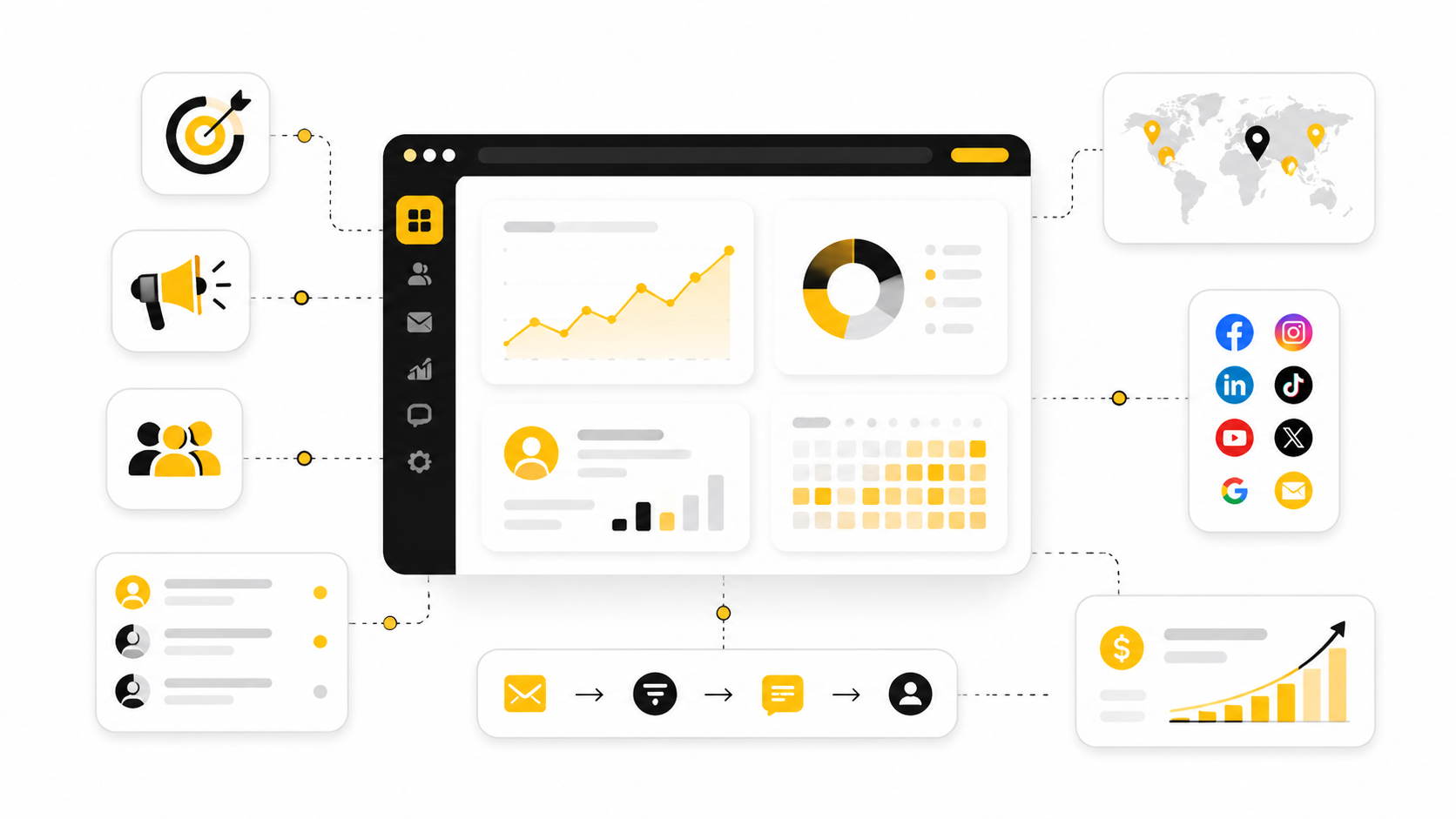
Marketing solutions are strategic responses to business challenges that go beyond isolated tactics or standalone tools. They integrate strategy, technology, and execution to help organizations reach, engage, and retain customers more effectively. These systems empower businesses to centralize data, automate processes, and align marketing activities with measurable outcomes rather than guesswork.
In a landscape where buyers interact across multiple channels — from search and social media to email and in‑store experiences — marketing solutions offer the visibility and control businesses need to deliver consistent, personalized engagement. The right solution can increase efficiency, deepen customer insights, and significantly boost ROI compared with ad‑hoc methods.
Overview of Marketing Solution Frameworks
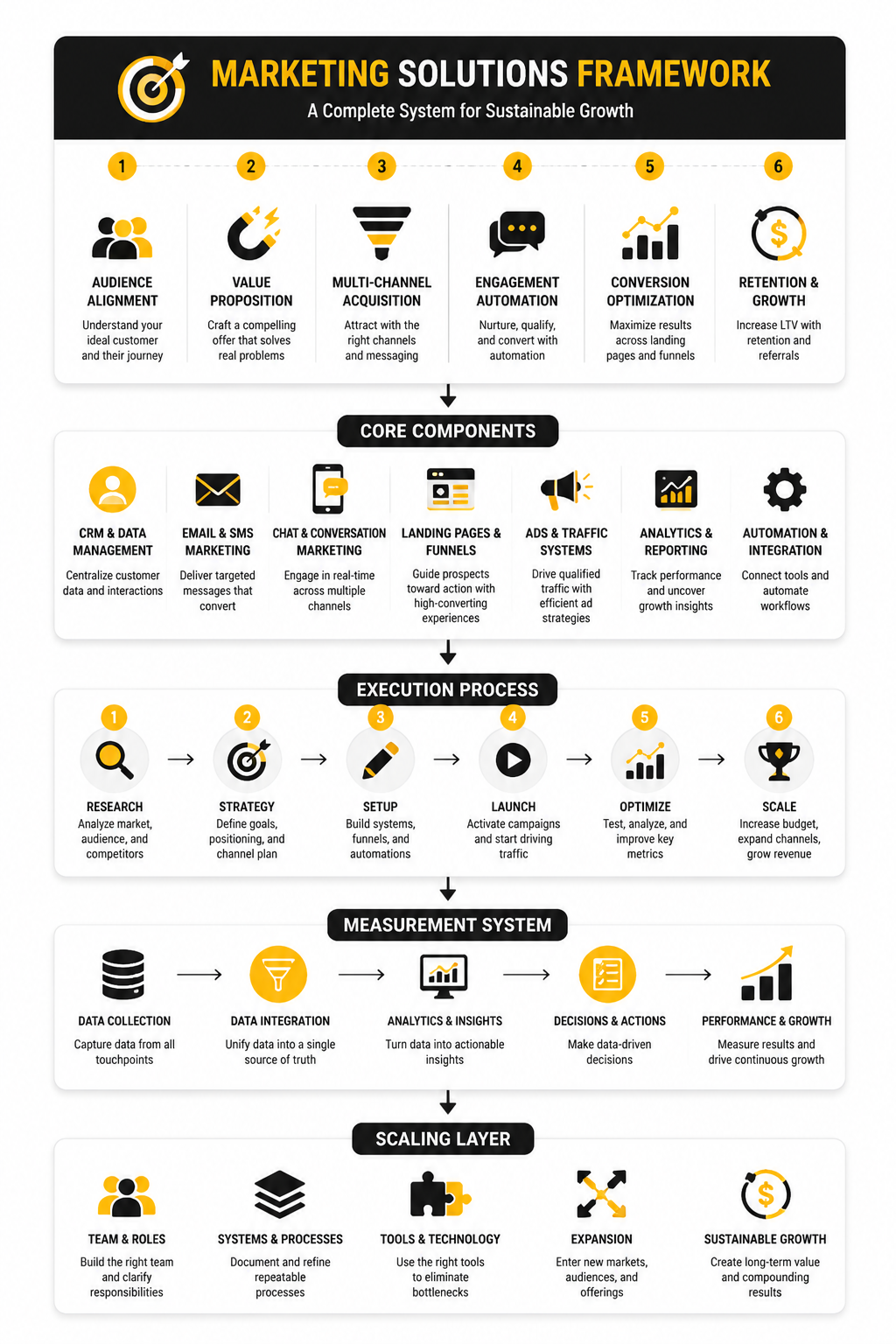
A marketing solution framework serves as the blueprint for structuring and evaluating your marketing efforts. Frameworks help teams define goals, segment audiences, choose channels, and measure performance in a systematic way.
Popular models used in designing marketing solutions include:
- Customer Journey Frameworks — Map each phase of customer interaction from awareness to conversion and retention.
- Segmentation‑Targeting‑Positioning (STP) — Focuses on identifying target groups and tailoring messages for distinct audiences.
- Integrated Marketing Frameworks — Ensure cohesive execution across digital, traditional, and emerging channels.
- Marketing Mix Models like the 4 Ps (Product, Price, Place, Promotion) that balance strategy across fundamentals.
These frameworks give structure to how marketing solutions operate, helping teams coordinate activities and assess progress toward broader business goals.
Core Components of Effective Marketing Solutions
A strong marketing solution comprises three foundational elements that work together to drive impact:
- Strategy — A clear direction built on research, audience insights, and measurable objectives.
- Technology — Platforms that automate repetitive tasks, manage data, and enable personalization at scale.
- People and Expertise — Skilled professionals who interpret data, optimize campaigns, and adapt tactics in real time.
Together, these components replace fragmented activities with a unified system that supports the full customer lifecycle, from lead generation to customer retention and advocacy.
Professional Implementation of Marketing Solutions
Deploying marketing solutions professionally requires thoughtful planning and execution:
- Assess Needs and Goals — Start by defining what success looks like for your business and where gaps exist in your current approach.
- Choose the Right Stack — Select tools and platforms that align with your strategy and integrate smoothly with existing systems.
- Create Repeatable Processes — Standardize workflows to ensure consistency, accountability, and scalability.
- Measure and Iterate — Use performance data to refine campaigns, reallocate resources, and improve overall ROI.
Professional implementation also means training teams to use technology effectively and establishing governance practices that ensure data quality and compliance.
Real‑World Applications and Trends
Modern marketing solutions span numerous channels and functions:
- Digital Advertising and Search — SEO, SEM, and display campaigns that reach users when they’re actively searching.
- Marketing Automation Platforms — Tools that handle email sequences, lead scoring, and campaign automation.
- Analytics and Personalization Engines — Systems that personalize experiences and measure impact across touchpoints.
Businesses of all sizes — from startups to global enterprises — leverage these solutions to stay competitive, optimize spending, and drive growth in complex, data‑driven markets.
Future Directions and Strategic Insights
The future of marketing solutions will be shaped by advances in AI, real‑time analytics, and cross‑channel integration. These technologies promise even deeper customer insights and more adaptive, responsive marketing systems.
As solutions become more sophisticated, the emphasis will shift toward ethical data use, transparency, and delivering authentic customer value. Organizations that embrace these trends will be better positioned to build trust, foster long‑term relationships, and achieve sustainable growth in a rapidly evolving marketplace.
Core Components of Effective Marketing Solutions
To build marketing solutions that truly drive business growth, you need to understand the foundational elements that make them work together seamlessly. At their best, these solutions integrate strategy, insights, execution, and continuous improvement into a unified system that supports measurable outcomes rather than ad‑hoc tactics.
1. Clear Strategic Foundation
Every successful marketing solution starts with a well‑defined strategy that aligns with your business objectives. Strategy is the “why” behind your activities — identifying your goals, target audiences, value propositions, and how success will be measured. Strong strategic direction prevents scattered efforts and ensures campaigns contribute directly to growth goals.
2. Audience Insights and Data‑Driven Decision‑Making
Understanding your customers is non‑negotiable. Audience insights, drawn from real data, inform every aspect of how you communicate and deliver value — from segmentation to messaging and channel selection. This emphasis on data helps you avoid guesswork and adjust your approach based on actual behavior and performance trends.
3. Integrated and Adaptive Marketing Channels
Modern marketing is inherently multi‑channel. From search and social to email and content ecosystems, your channels must work together, not in silos. Integrated solutions ensure consistent experiences across touchpoints, reinforcing messaging and strengthening customer engagement throughout the journey.
4. Technology and Automation for Scale
Technology underpins scalable, repeatable marketing. Automation platforms handle tasks like segmentation, campaign delivery, lead nurturing, and performance reporting — freeing teams to focus on strategy and creativity. When chosen and configured well, technology enables personalization at scale and real‑time responsiveness.
5. Content that Educates and Converts
Content remains at the heart of effective marketing solutions. But the best content doesn’t just sell — it informs, educates, and solves real problems for your audience. By prioritizing value‑driven content, you build credibility, trust, and deeper engagement over time.
6. Continuous Measurement and Optimization
Launching a campaign isn’t the end — it’s the beginning of the learning cycle. Effective solutions embed measurement from the outset, tracking performance against defined KPIs and using insights to refine strategy, reallocate resources, and optimize campaigns continuously for better results.
These core components work together to transform isolated marketing activities into a cohesive system that drives efficiency, clarity, and growth for your business.
Professional Implementation of Marketing Solutions
Deploying a comprehensive marketing solution isn’t automatic — it requires intentional planning, cross‑functional coordination, and ongoing refinement. The implementation process determines whether your solution drives results or becomes an under‑utilized expense.
Assessing Needs and Defining Objectives
Start by identifying your most pressing business challenges and clarifying what success looks like. Common goals include increasing qualified leads, improving customer retention, or optimizing marketing ROI. This assessment should shape both the technology you adopt and the processes you design.
Selecting the Right Tools and Expertise
Not all tools fit every business. Prioritize platforms that integrate with your existing systems, support your strategic goals, and scale with your growth. For teams that lack in‑house expertise, partnering with a specialist or agency can accelerate implementation and avoid costly mistakes.
Standardizing Processes and Workflows
Define clear, repeatable processes for tasks like campaign planning, audience segmentation, content creation, and performance reporting. Standardized workflows improve efficiency and make it easier to onboard new team members or external partners.
Data Governance and Quality Control
Reliable data is the backbone of any modern marketing solution. Establish governance practices to ensure data is accurate, consistent, and compliant with relevant privacy regulations. Poor data quality undermines decision‑making and leads to wasted spend.
Measurement, Learning, and Iteration
With your solution live, obsess over results. Use dashboards and analytics to track how campaigns perform against objectives. Look for trends, test hypotheses, and refine your approach regularly. The best marketing solutions evolve with market conditions and customer preferences.
Professional implementation turns strategy into execution and separates high‑impact marketing from guesswork and inefficiency. By building on structured processes and real‑time insights, teams can unlock the full potential of their marketing solutions.
Step‑by‑Step Implementation of Marketing Solutions
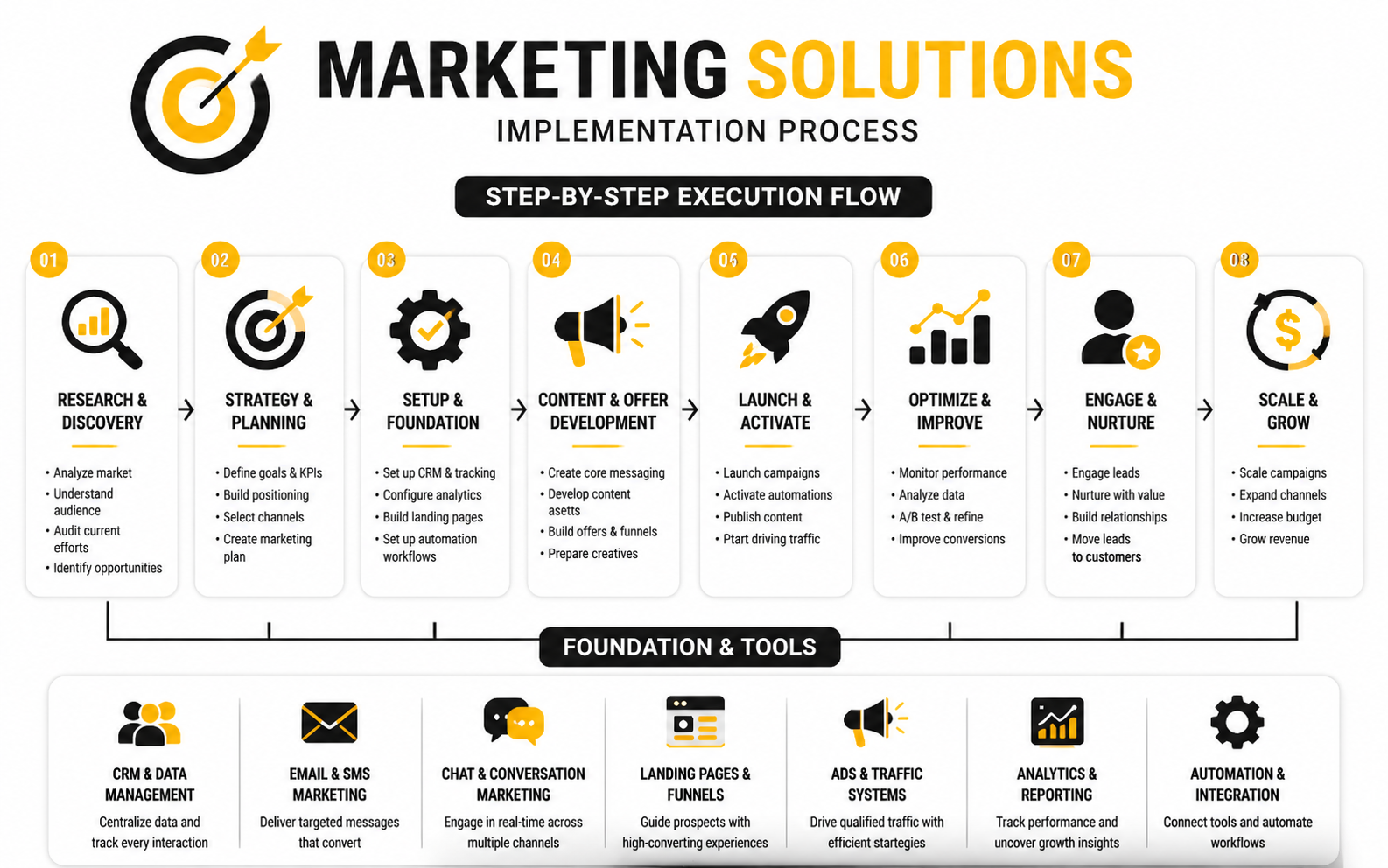
Successfully executing marketing solutions requires a clear, structured process that transforms strategy into tangible results. Implementation is where planning meets action, and this stage determines whether your investment translates into measurable growth.(ansira.com)
1. Kickoff and Stakeholder Alignment
Begin with a formal kickoff that brings all stakeholders together. This includes marketing teams, sales, IT, and any external partners. The goal is to establish shared understanding of objectives, define roles, and clarify expectations. Misalignment at this stage can lead to duplication, delays, or underutilization of tools.
2. Infrastructure and Technology Setup
Set up the platforms and tools that will power your solution. This may include marketing automation platforms, CRM integrations, analytics dashboards, and content management systems. Ensure that each component integrates seamlessly to allow smooth data flow and unified reporting.(www.gohighlevel.com)
3. Data Migration and Segmentation
Accurate, well‑organized data is essential. Migrate customer and prospect data into your systems, and segment audiences based on demographics, behavior, and engagement levels. Proper segmentation allows for highly targeted campaigns and personalized messaging that drives higher conversions.(climbtheladder.com)
4. Campaign Development and Content Creation
With infrastructure in place, develop campaigns aligned with your strategy. This includes crafting content, designing creatives, and scheduling messaging across multiple channels. The emphasis should be on consistency and relevance, ensuring every piece of content supports broader objectives.([www.clickfunnels.com/signup-flow?aff=b2210814891723f0f24429789399ca6dbf89a7a4032a3b7607c67ec619f7c98d])
5. Pilot Testing and Quality Assurance
Before a full rollout, conduct pilot tests to validate workflows, messaging, and technical integrations. Quality assurance identifies errors, bottlenecks, or gaps in automation, allowing adjustments before campaigns scale. Early testing mitigates risks and improves efficiency.
6. Launch and Real‑Time Monitoring
Deploy campaigns across selected channels and monitor performance continuously. Use dashboards to track KPIs such as engagement, conversion, and ROI. Immediate insights enable rapid adjustments, ensuring campaigns stay aligned with business objectives.(nloop.ai)
7. Optimization and Iteration
Implementation isn’t a one‑time event. Collect performance data, analyze results, and refine strategies iteratively. Testing variations in messaging, timing, and audience segments leads to higher efficiency and better outcomes over time.(ansira.com)
By following these steps, businesses transform marketing solutions from conceptual strategies into actionable, measurable campaigns that drive growth and strengthen customer relationships.
Measurement, Analytics, and What the Data Means
To make marketing solutions truly effective, you need more than raw numbers — you need a structured measurement system that turns data into decisions. Analytics and benchmarks help teams evaluate performance, optimize campaigns, and justify investment by connecting activity back to business outcomes like revenue and customer growth.([turn0search0])()
What Metrics Reveal About Performance
At the core of measurement are Key Performance Indicators (KPIs), which are the specific metrics directly tied to strategic goals rather than surface‑level activity. Metrics such as Customer Acquisition Cost (CAC), conversion rate, lifetime value (CLV), and marketing ROI allow teams to assess efficiency and profitability, not just visibility. Tracking too many metrics — especially vanity metrics like impressions and followers — can produce noise instead of insight, so good analytics strategies focus on those KPIs with direct business impact.([turn0search7])
- Customer Acquisition Cost (CAC) shows how much it costs to acquire each new customer and signals whether acquisition channels are efficient.
- Conversion Rate links interest to action, revealing whether your campaigns and landing experiences are compelling enough to trigger desired outcomes.
- Marketing ROI translates campaign results into financial return, showing how much revenue each dollar of marketing investment generates.
- Customer Lifetime Value (CLV) frames revenue potential over the long term, helping teams set sustainable acquisition goals. These KPIs, when read together, paint a fuller picture of performance than any single metric alone.([turn0search0])
Benchmarks and Contextual Interpretation
Benchmarks give meaning to the numbers by establishing reference points for what “good” performance looks like in your industry and channel mix. For example, a marketing ROI of 5:1 (five dollars back for every one spent) is widely considered strong in digital marketing, while exceeding 10:1 is exceptional. Benchmarks vary across channels — email marketing often delivers higher ROI than paid social — and over time, so teams should compare like with like when evaluating performance.([turn0search2])()
Benchmarks matter because:
- They help identify underperforming campaigns that need optimization or budget reallocation.
- They set realistic internal targets that reflect both industry standards and your organization’s maturity.
- They avoid misinterpretations where high activity doesn’t translate into business impact (e.g., high impressions with low conversion).([turn0search1])()
From Data to Action
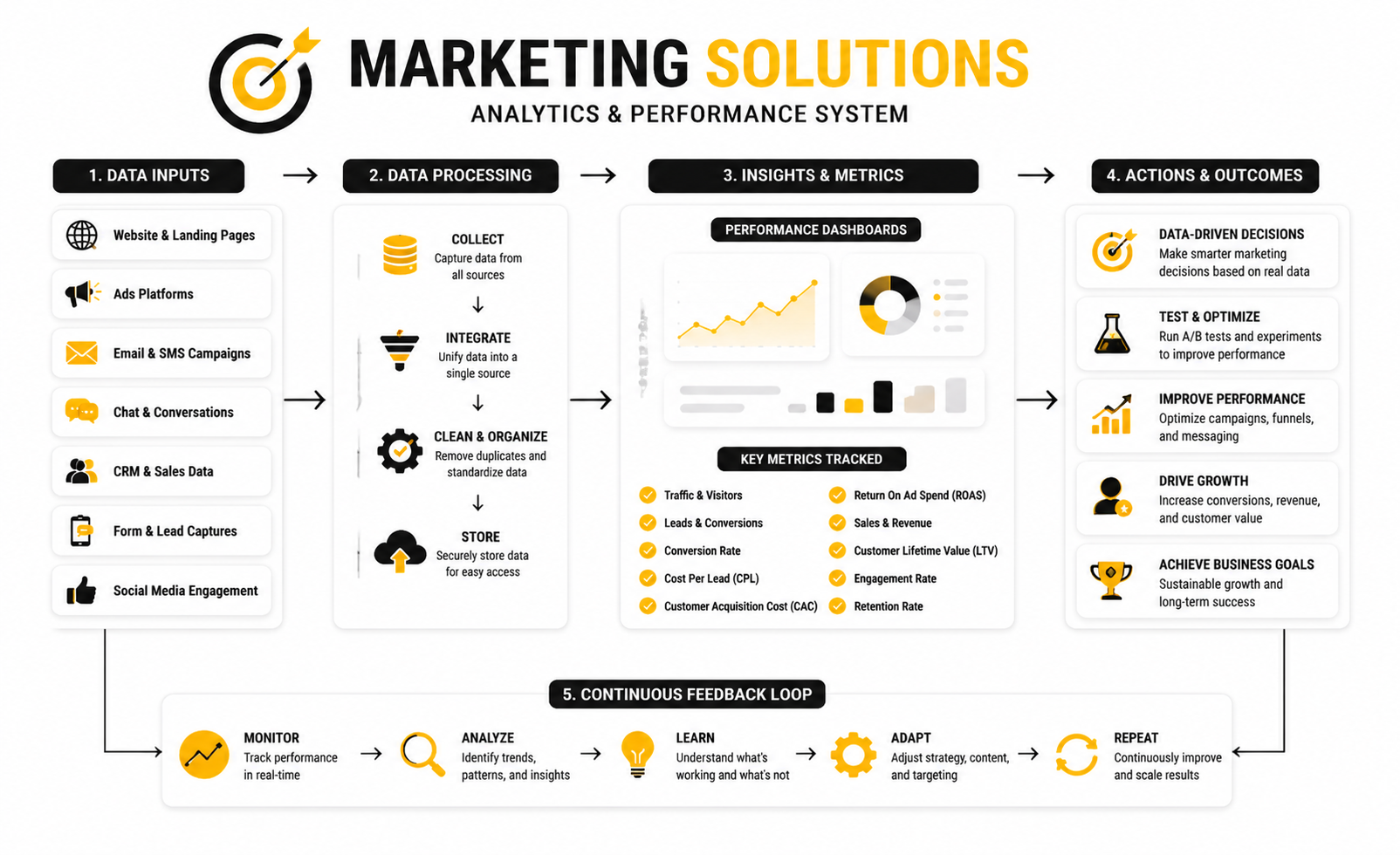
Good analytics isn’t just about reporting numbers — it’s about interpreting what they mean and acting on them. For example:
- A high CAC relative to CLV may signal inefficient targeting or poor channel choice, prompting refinement in audience segmentation or budget shifts.
- Conversion rates below benchmarks might reveal friction in key funnel steps, suggesting improvements in creative, offer value, or landing page experience.
- If marketing ROI lags expectations, deeper attribution analysis may reveal under‑crediting of assistive touchpoints or an overreliance on short‑term channels.([turn0search1])()
Effective analytics frameworks also incorporate multi‑touch attribution models and longitudinal tracking, recognizing that different touchpoints contribute value at different stages of the customer journey. This type of measurement turns marketing from a cost center into a growth driver that informs smarter decisions across campaigns, channels, and customer segments.([turn0search1])()
By tying data back to strategic goals and using benchmarks appropriately, marketing solutions become adaptive systems that not only report performance but actively guide where to invest, improve, or innovate.
Advanced Considerations for Marketing Solutions
Once a marketing solution is running, the next layer of sophistication involves understanding tradeoffs, scaling challenges, and long-term strategy. Experts recognize that every decision — from budget allocation to channel selection — has downstream implications that influence both efficiency and effectiveness.(gartner.com)
Balancing Reach and Personalization
A core strategic tradeoff in marketing solutions is balancing broad audience reach with deep personalization. Mass campaigns can generate volume but often fail to engage meaningfully, while highly targeted personalization requires investment in data, segmentation, and automation tools. Companies that achieve the right balance see improved conversion and customer loyalty without overextending operational resources.(climbtheladder.com)
Risk Management and Compliance
Marketing solutions rely heavily on data, which introduces risk in privacy, security, and regulatory compliance. As businesses scale, failure to maintain proper governance can result in legal exposure and reputational damage. Implementing robust compliance frameworks and continuously monitoring changes in laws like GDPR, CCPA, and emerging digital advertising regulations is essential.(nloop.ai)
Scaling and Resource Allocation
Scaling a marketing solution effectively involves careful resource allocation across technology, people, and campaigns. Overinvesting in one area can starve another, reducing ROI. Expert teams prioritize automation, process optimization, and cross-functional collaboration to maintain performance while expanding reach. For example, using marketing automation platforms like GoHighLevel or ClickFunnels helps scale operations without proportional increases in personnel.(ansira.com)
Advanced Analytics and Decision Support
Beyond standard metrics, advanced marketing solutions incorporate predictive analytics, attribution modeling, and scenario planning. These tools identify emerging trends, anticipate customer behavior, and optimize campaign spend before issues manifest. Integrating AI-driven insights allows teams to prioritize high-impact actions and reduce guesswork in strategic decision-making.(nloop.ai)
Long-Term Strategic Alignment
Marketing solutions should evolve alongside the organization’s strategic goals. This involves regular audits of campaigns, channels, and technology to ensure alignment with business objectives and market shifts. Teams that embed flexibility and continuous learning into their systems can pivot faster, maintain relevance, and maximize long-term growth.(climbtheladder.com)
Advanced consideration of these factors ensures that marketing solutions are not just operational tools but strategic engines capable of sustaining competitive advantage and adapting to complex, dynamic markets.
Marketing Solutions Ecosystem and Final Insights
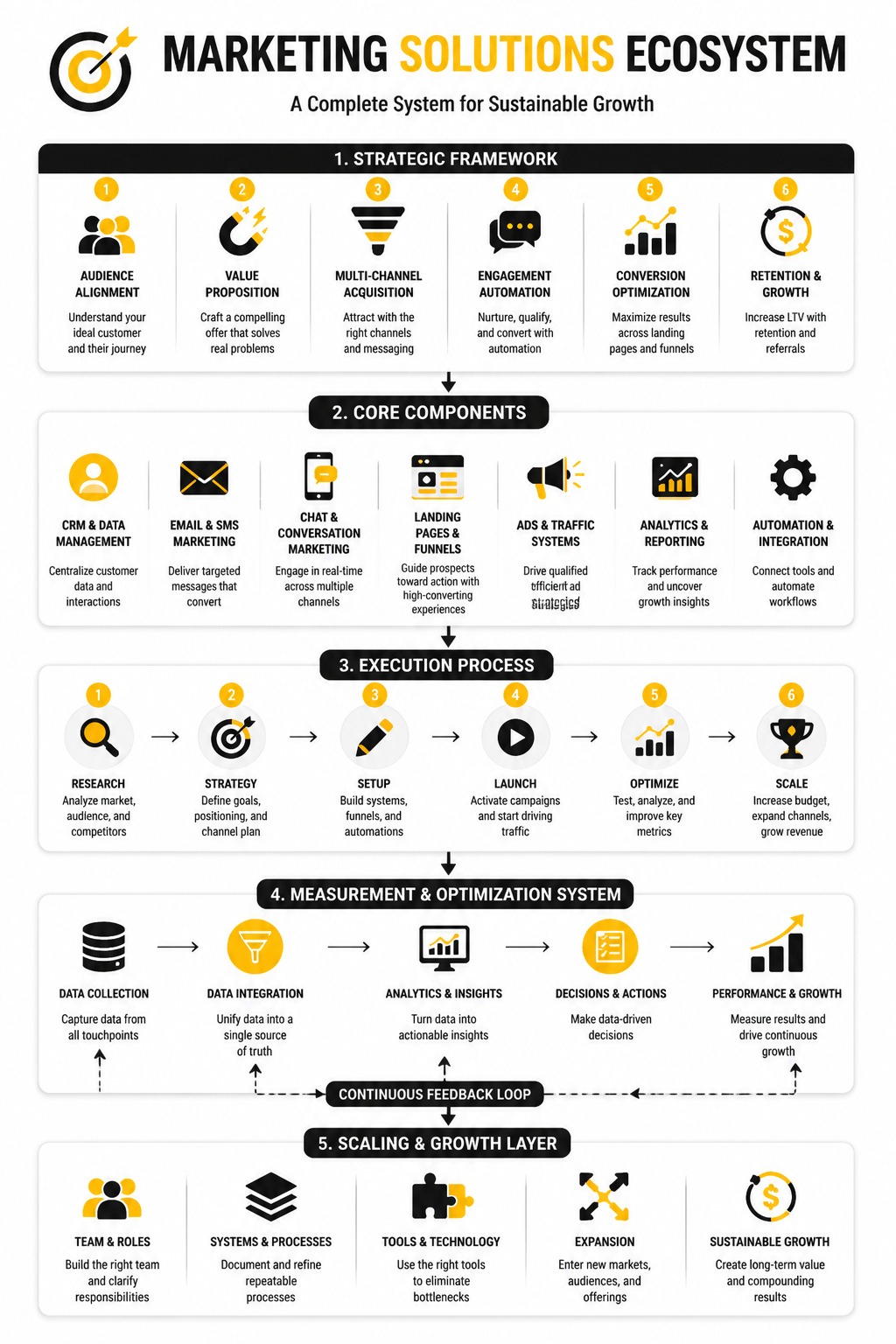
A comprehensive marketing solutions ecosystem integrates strategy, technology, content, analytics, and execution into a seamless system that drives growth. This final stage emphasizes how all components interact, highlighting dependencies, feedback loops, and decision-making points. Understanding the ecosystem ensures campaigns are not only executed efficiently but also continuously optimized based on performance data, strategic priorities, and customer behavior.(climbtheladder.com)
FAQ - Built for Complete Guide
1. What exactly is a marketing solution?
A marketing solution is a structured system combining strategy, technology, content, and analytics to achieve measurable marketing objectives across channels.
2. Why do businesses need integrated marketing solutions?
Integration ensures consistency, efficiency, and the ability to track performance, improving ROI compared to isolated marketing tools or tactics.
3. What are the core components of a marketing solution?
Key components include strategy, audience insights, technology/automation, content, and analytics that together create a unified system.
4. How does technology support marketing solutions?
Technology enables automation, personalization at scale, centralized data management, and advanced analytics for actionable insights.
5. How do you measure the effectiveness of a marketing solution?
Use KPIs like CAC, conversion rate, marketing ROI, and CLV. Benchmarks contextualize performance and guide optimization decisions.
6. What are common pitfalls when implementing marketing solutions?
Challenges include poor data quality, misaligned strategy, lack of stakeholder buy-in, and overcomplicated workflows that hinder adoption.
7. Can marketing solutions scale for growing businesses?
Yes, scalable solutions rely on automation, standard processes, cross-functional coordination, and adaptive technology platforms.
8. How does personalization affect campaign outcomes?
Personalization improves engagement, conversion, and loyalty, but requires investment in audience segmentation, content, and automation systems.
9. Are marketing solutions suitable for small businesses?
Absolutely. Small businesses can leverage simplified platforms like GoHighLevel or ClickFunnels to achieve high-impact marketing without excessive overhead.
10. How often should marketing solutions be reviewed or updated?
Regularly — at least quarterly — to ensure alignment with strategic goals, adapt to market changes, and incorporate performance insights for continuous improvement.
11. What role does analytics play in marketing solutions?
Analytics tracks performance, informs optimization, validates strategy, and provides data-driven insights for future campaigns.
12. How can businesses avoid compliance and privacy risks?
Implement strict data governance, stay updated on privacy laws (GDPR, CCPA), and train teams on ethical handling of customer data.
Work With Professionals
Explore 10K+ Remote Marketing Contracts on MarkeWork.com
Most marketers spend too much time chasing clients, competing on crowded platforms, and losing a percentage of every project to middlemen. MarkeWork gives you a better way. Browse thousands of remote marketing contracts and connect directly with companies desperate to hire skilled marketers like you, without platform commissions and without unnecessary gatekeepers.
If you're serious about finding better opportunities and keeping 100% of what you earn, invite readers to explore available contracts and create a profile for free at MarkeWork.com.