

A marketing specialist is the person who turns marketing strategy into measurable execution. They research audiences, build campaigns, coordinate content, manage channels, track performance, and help the business understand what is actually working.
That matters because marketing is no longer just “make something look good and publish it.” Budgets are tight, channels are crowded, and teams are expected to prove impact. Marketing budgets stayed at 7.7% of company revenue in 2025, based on Gartner’s CMO Spend Survey, which means specialists have to be sharper with execution, measurement, and prioritization.
The good news is that the role is still growing in importance. The U.S. Bureau of Labor Statistics projects employment for advertising, promotions, and marketing managers to grow 6% from 2024 to 2034, faster than the average for all occupations, and marketing specialists often build the hands-on experience that leads into those roles through campaign, research, content, analytics, and channel work.

Article Outline
- What a Marketing Specialist Actually Does
- Why the Marketing Specialist Role Matters
- The Marketing Specialist Framework
- Core Skills Every Marketing Specialist Needs
- Tools, Systems, And Professional Implementation
- Career Path, Hiring, Salary Factors, And FAQs
What A Marketing Specialist Actually Does
A marketing specialist supports the planning, execution, and improvement of marketing activities across one or more channels. In a smaller company, that can mean handling email, social media, landing pages, reporting, and campaign coordination. In a larger company, the role may be narrower, such as paid media specialist, content marketing specialist, lifecycle marketing specialist, or product marketing specialist.
The role sits between strategy and execution. A marketing manager may define the campaign goal, but the specialist often builds the assets, coordinates deadlines, checks performance data, and recommends what should change next. That makes the job practical, visible, and very tied to business outcomes.
A strong marketing specialist is not just “creative” or “analytical.” The best ones connect both sides. They understand the customer, communicate clearly, use tools well, and keep improving the work based on evidence instead of opinions.
Why The Role Matters Now
Marketing teams are under more pressure than they were a few years ago. AI has made production faster, but it has also raised the bar because average content is easier to create than ever. HubSpot’s 2026 marketing research says 61% of marketers believe marketing is experiencing its biggest disruption in 20 years because of AI, which makes human judgment, positioning, and execution discipline even more valuable.
That is exactly where a marketing specialist becomes useful. Someone still has to decide what message fits the audience, which channel deserves attention, what data matters, and which campaign should be improved or stopped. Tools can accelerate the work, but they do not replace strategic taste.
This is also why the role is a strong entry point into modern marketing. A specialist gets close to the real work. They see what customers click, what sales teams need, what content performs, and what executives care about when budgets are reviewed.
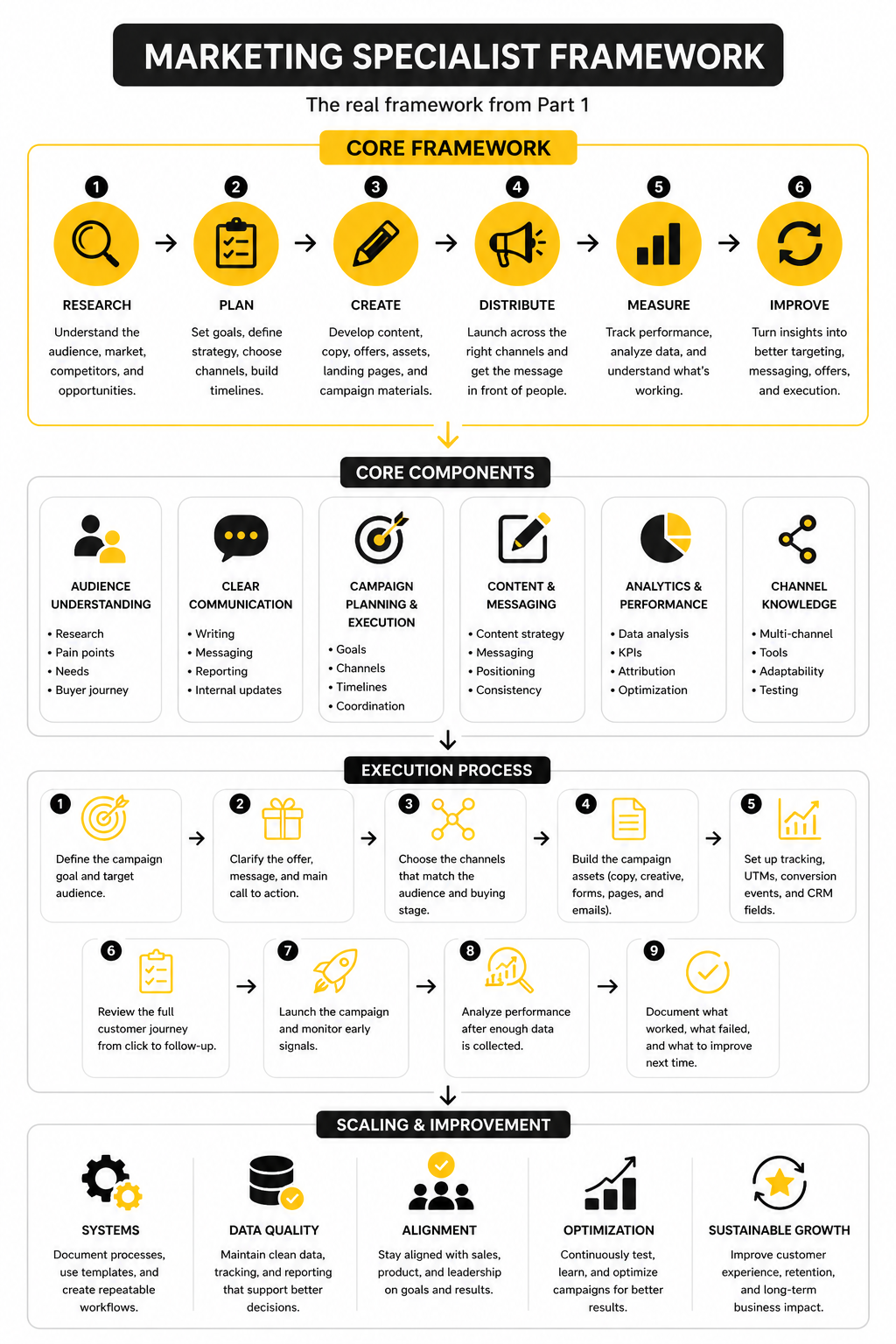
The Marketing Specialist Framework
A marketing specialist’s work usually fits into a simple framework: research, plan, create, distribute, measure, and improve. This sounds basic, but it is the difference between random marketing activity and professional marketing execution. Without that structure, teams publish more but learn less.
Research comes first because campaigns need a real audience, real pain points, and a clear offer. Planning turns that information into priorities, timelines, channels, and responsibilities. Creation turns the plan into assets such as emails, landing pages, ads, social posts, lead magnets, webinars, or sales enablement materials.
Distribution is where the work meets the market. Measurement shows whether the campaign created attention, leads, revenue, retention, or another useful result. Improvement closes the loop by turning performance data into better targeting, sharper messaging, stronger offers, and cleaner execution in the next cycle.
Core Skills Every Marketing Specialist Needs
A marketing specialist needs enough range to move from customer insight to finished campaign without getting lost in the middle. That does not mean being world-class at everything. It means understanding the full marketing workflow well enough to make smart decisions, ask better questions, and execute without constant hand-holding.
The first skill is audience understanding. A specialist has to know who the campaign is for, what the customer wants, what problem they are trying to solve, and why they might choose one offer over another. This connects directly with research work such as tracking trends, studying competitors, and measuring marketing effectiveness, which are core duties listed for market research roles by the U.S. Bureau of Labor Statistics.
The second skill is clear communication. A marketing specialist writes briefs, landing page copy, email drafts, social captions, reports, and internal updates. Even when they are not the main copywriter, they still need to explain ideas clearly so designers, sales teams, founders, and managers can understand what is happening and why it matters.
Campaign Planning And Execution
Campaign planning is where a marketing specialist proves they can think beyond single tasks. A campaign needs a goal, an audience, a message, a channel mix, a timeline, and a way to measure success. Without those pieces, marketing becomes a pile of disconnected activities.
Execution is the part most people underestimate. Someone has to build the landing page, check the tracking links, prepare the email sequence, coordinate creative files, schedule social posts, test the form, and make sure the offer is clear before traffic starts arriving. For landing pages and campaign funnels, tools like Replo or ClickFunnels can help a specialist move faster when the campaign needs to launch without waiting on a full development cycle.
This is also where attention to detail becomes a real career advantage. Small mistakes can ruin clean data or damage conversion rates. A broken form, missing UTM parameter, unclear CTA, or mismatched email subject line can make a good campaign look weak when the real issue is poor setup.
Content, Messaging, And Positioning
Content is not just publishing more posts. A marketing specialist needs to understand how content supports the buyer journey, answers objections, and gives the audience a reason to trust the brand. That could mean educational blog content, short-form social posts, case study summaries, email newsletters, comparison pages, lead magnets, or product explainers.
Messaging is the sharper layer underneath content. It defines what the business says, who it says it to, and why that message should matter right now. In crowded markets, weak messaging is expensive because it makes every channel work harder than it should.
Positioning is the bigger strategic frame. A specialist may not own company positioning, but they need to understand it well enough to keep campaigns consistent. If the brand is premium, practical, fast, simple, technical, affordable, or expert-led, that should show up in the copy, visuals, offers, and channel choices.
Analytics And Performance Thinking
A marketing specialist does not need to be a data scientist, but they do need to be comfortable with numbers. They should know how to read traffic, conversion rates, email performance, cost per lead, cost per acquisition, retention signals, and campaign attribution with a critical eye. Data is not there to decorate reports; it is there to improve decisions.
This matters more now because marketers are expected to connect activity with outcomes. The Deloitte CMO Survey tracks marketing priorities, staffing, budgets, and investment areas, which reflects how closely marketing leaders watch resource allocation and performance. A specialist who can explain what happened, why it happened, and what to do next becomes much more valuable than someone who only reports surface metrics.
The practical rule is simple: measure what helps the next decision. Vanity metrics can be useful when they reveal attention or reach, but they should not be confused with business impact. A good marketing specialist can separate “this looked busy” from “this moved the business forward.”
Channel Knowledge And Practical Adaptability
Most specialists start with one or two core channels, then expand. Common paths include email marketing, SEO, paid ads, organic social, lifecycle marketing, partnerships, events, influencer campaigns, or marketing operations. The goal is not to chase every new channel, but to understand how each channel fits the customer journey.
For example, social scheduling tools like Buffer can help organize consistent publishing, while email platforms like Brevo or Moosend can support newsletters, automations, and segmented campaigns. A specialist should not pick tools because they are trendy. They should pick tools because they match the workflow, budget, audience, and campaign goal.
Adaptability is the hidden skill behind all of this. Channels change, algorithms shift, customer expectations move, and AI keeps speeding up production. A strong marketing specialist stays useful by learning quickly, testing carefully, and keeping the customer at the center instead of becoming attached to one tactic.
Tools, Systems, And Professional Implementation
A marketing specialist becomes much more valuable when they can turn ideas into a repeatable system. One campaign can succeed by luck, timing, or a strong offer. A professional marketing process makes success easier to understand, repeat, and improve.
The system does not need to be complicated. It needs to be clear. The specialist should know what happens before launch, what must be checked during launch, and what gets reviewed after the campaign has enough data to judge.
The Campaign Implementation Process
A clean implementation process protects the team from messy execution. It gives every campaign a path from idea to live asset to performance review. This is especially important when the campaign touches several channels, because email, paid ads, landing pages, CRM fields, forms, analytics, and sales follow-up all need to work together.
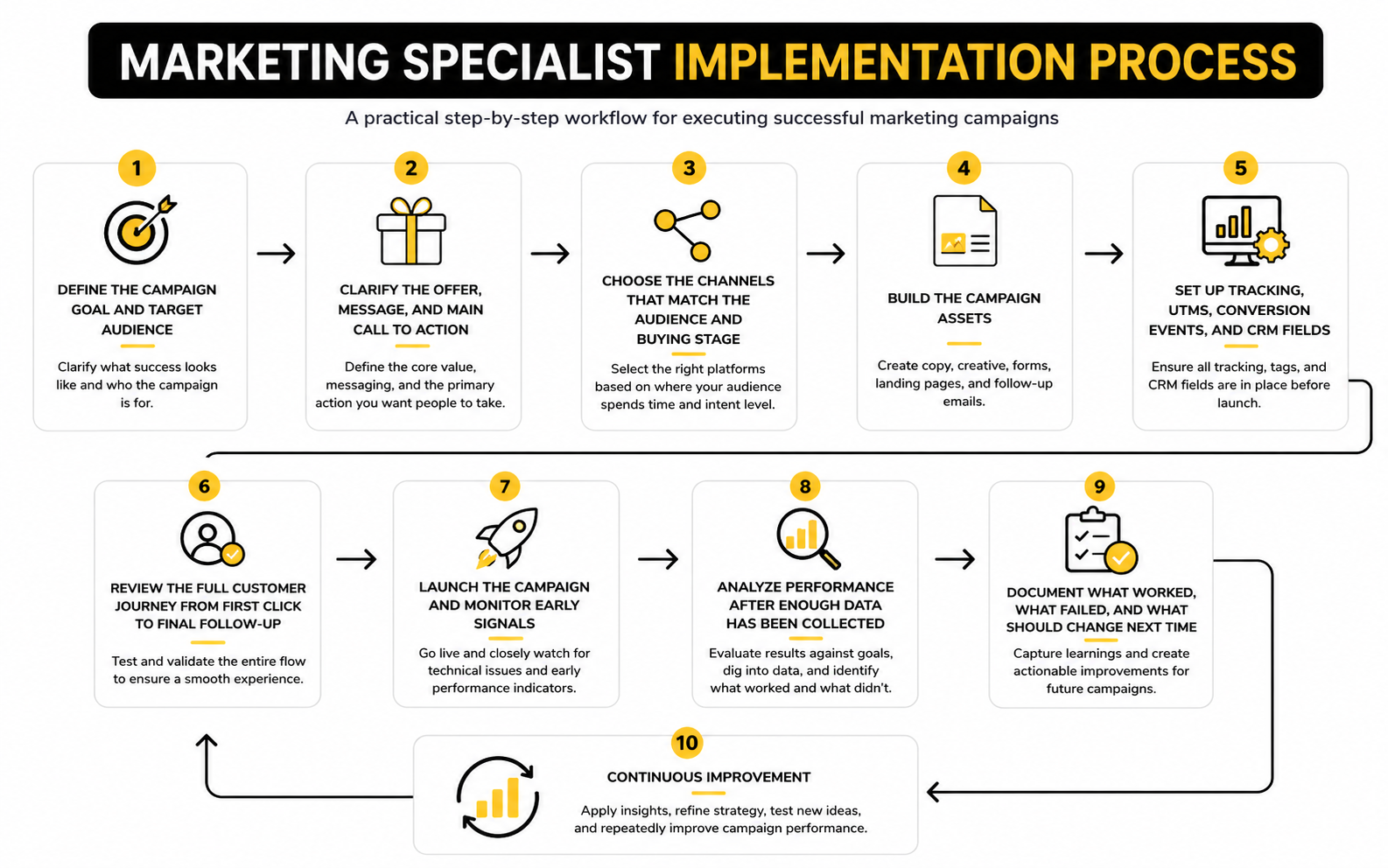
A practical campaign process usually looks like this:
- Define the campaign goal and target audience.
- Clarify the offer, message, and main call to action.
- Choose the channels that match the audience and buying stage.
- Build the campaign assets, including copy, creative, forms, landing pages, and follow-up emails.
- Set up tracking, UTMs, conversion events, and CRM fields before launch.
- Review the full customer journey from first click to final follow-up.
- Launch the campaign and monitor early signals for technical issues.
- Analyze performance after enough data has been collected.
- Document what worked, what failed, and what should change next time.
This is where the marketing specialist needs to be practical, not precious. A beautiful campaign that cannot be tracked is not finished. A clever idea with no follow-up sequence is not finished. A landing page with a broken form is definitely not finished.
Building The Right Marketing Stack
The marketing stack is the set of tools a team uses to plan, publish, automate, measure, and improve campaigns. A specialist does not need every tool on the market. They need a stack that supports the actual workflow without creating more complexity than the team can manage.
For many small businesses and agencies, an all-in-one platform like GoHighLevel can make sense because CRM, funnels, automations, calendars, and follow-up live closer together. For lean creators or simple digital product funnels, Systeme.io can be enough to build pages, emails, and basic sales flows without stacking too many tools.
The key is fit. A marketing specialist should ask whether the tool makes execution faster, data cleaner, or follow-up stronger. If it only adds another dashboard to check, it is probably not solving the real problem.
Managing Data, Tracking, And Reporting
Data quality is where many campaigns quietly fall apart. The ad may be good, the email may be good, and the landing page may be good, but the team still cannot explain what happened because tracking was set up badly. That creates confusion, and confusion usually leads to bad decisions.
A specialist should treat tracking as part of the launch checklist, not something to fix later. UTMs, conversion events, form fields, CRM stages, source attribution, and dashboard definitions need to be agreed before traffic goes live. The Salesforce State of Marketing report highlights how heavily modern marketing depends on AI, data, and personalization, which makes clean customer data even more important.
Reporting should be simple enough that people actually use it. Show the goal, the result, the cost, the conversion points, and the next action. Nobody needs a 40-slide report when a clear one-page summary would drive a better decision.
Coordinating With Sales, Product, And Leadership
A marketing specialist rarely works in isolation. Sales teams need better leads, product teams need clearer customer feedback, and leadership needs to know whether marketing spend is creating momentum. Good implementation means keeping those groups connected before the campaign launches, not only after something goes wrong.
Sales alignment is especially important. If marketing promises one thing and the sales team follows up with another, trust breaks quickly. The specialist can help by sharing campaign context, lead source details, objections addressed in the content, and the exact offer the prospect responded to.
Leadership alignment matters too. A campaign should have a clear business reason behind it, whether that is pipeline, retention, launch awareness, event registrations, product adoption, or direct revenue. When the marketing specialist understands that reason, their daily decisions get sharper.
Statistics, Benchmarks, And What The Data Actually Means
A marketing specialist should never treat analytics as decoration. Numbers only matter when they change a decision. If a report shows traffic, clicks, leads, and revenue but nobody knows what to do next, the reporting system is too noisy.
The first job is to separate performance signals from vanity signals. Reach can tell you whether people saw the message, but it does not prove demand. Clicks can show interest, but they do not prove qualified intent. Revenue, pipeline, customer acquisition cost, conversion rate, retention, and payback period usually get closer to the truth.
Marketing leaders are under pressure to prove that truth. The 2025 CMO Survey reported average marketing expenses at 9.35% of company revenue in its sample, which means marketing is a serious investment, not a side activity. A marketing specialist who can connect campaign work to measurable business outcomes becomes easier to trust and harder to replace.
The Measurement System A Specialist Should Use
A useful measurement system follows the customer journey. It starts with awareness, moves into engagement, captures conversion, and then tracks what happens after the lead or customer enters the business. That is how a specialist avoids judging every channel by the same shallow metric.
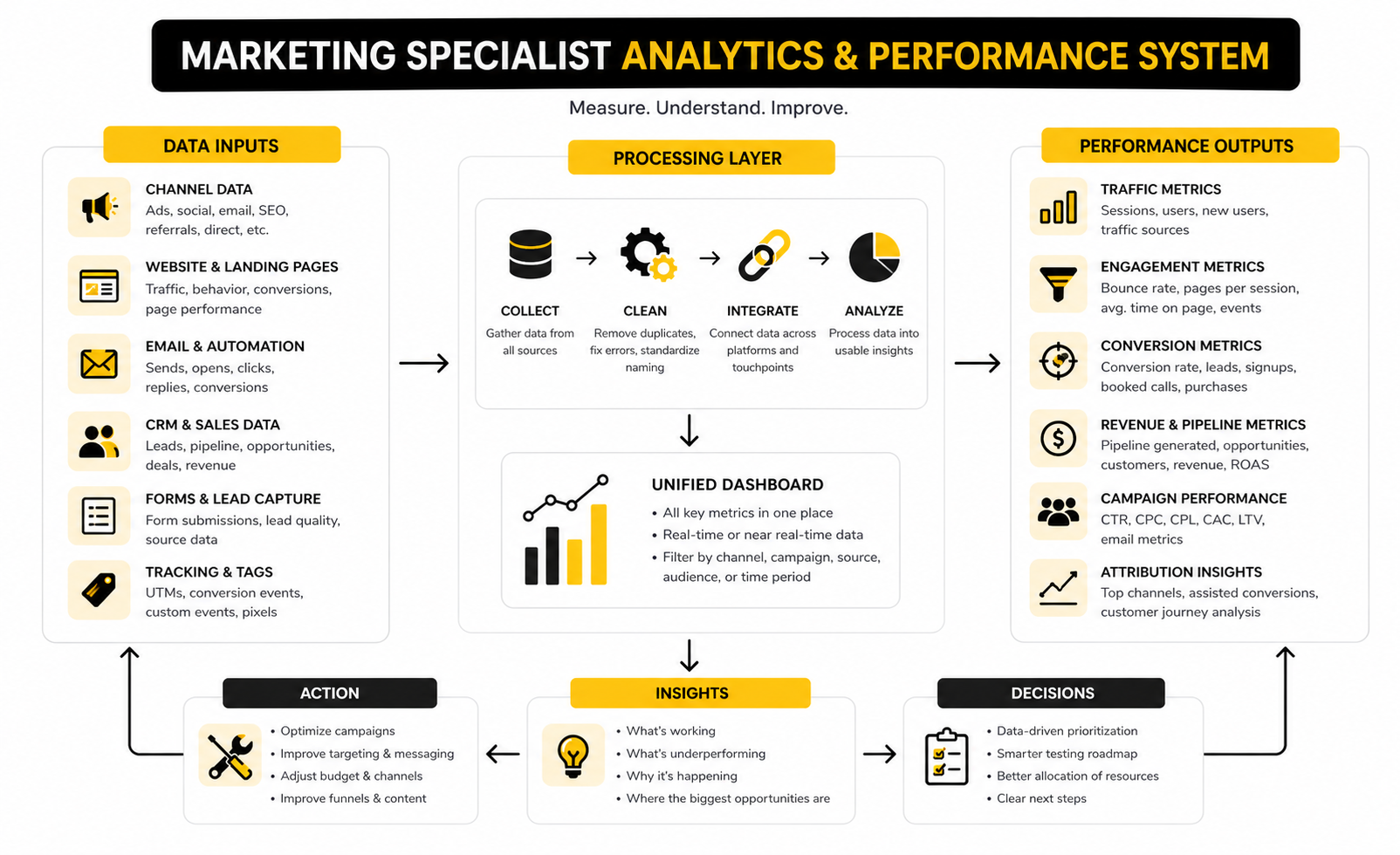
The cleanest way to think about it is this:
- Awareness: impressions, reach, branded search growth, audience growth, video views, and referral traffic.
- Engagement: click-through rate, time on page, email clicks, content saves, replies, comments, and repeat visits.
- Conversion: form submissions, booked calls, trials, purchases, demo requests, and cost per lead.
- Quality: lead-to-opportunity rate, sales acceptance rate, close rate, average order value, and customer fit.
- Retention: repeat purchases, churn, expansion revenue, renewal rate, product usage, and lifecycle engagement.
This matters because a campaign can look successful at the top of the funnel and still fail commercially. A social post may generate attention but no qualified demand. A paid campaign may produce cheap leads that sales cannot close. A marketing specialist has to look beyond the first number and ask what the number means downstream.
Benchmarks Are Useful, But Context Wins
Benchmarks can help a marketing specialist spot obvious problems, but they should not become the strategy. Email open rates, landing page conversion rates, ad click-through rates, and cost-per-lead ranges vary heavily by industry, offer, audience temperature, and channel. A cold B2B demo campaign should not be judged against a warm ecommerce discount campaign.
Email is a perfect example. Some 2025 benchmark datasets show high average open rates, but privacy changes can inflate opens, so clicks, replies, conversions, and revenue are usually stronger performance signals. This is why a specialist should read benchmarks as directional guidance, not absolute truth.
The better comparison is usually your own historical performance. If last quarter’s webinar page converted at 18% and the new one converts at 9%, something changed. The specialist should investigate the offer, traffic source, page message, form friction, audience match, and follow-up sequence before blaming the channel.
What Good Performance Signals Look Like
Good performance signals are specific, tied to a goal, and useful for action. “Traffic increased” is not enough. “Organic traffic increased from comparison keywords and produced more qualified demo requests” is a signal the team can use.
For a marketing specialist, the most useful signals usually answer practical questions. Is the audience responding to the message? Is the offer strong enough? Is the landing page clear? Are leads turning into opportunities? Is sales following up quickly enough? Is the campaign profitable after costs?
This is where reporting becomes a decision tool. If email clicks are strong but conversions are weak, improve the landing page or offer. If landing page conversions are strong but lead quality is poor, adjust targeting. If lead quality is strong but close rates are weak, the issue may sit in sales enablement, pricing, timing, or follow-up.
The Metrics That Actually Deserve Attention
A marketing specialist should track fewer metrics than most dashboards show. Too many numbers create confusion. The goal is not to prove that work happened; the goal is to understand what moved the business.
Useful campaign metrics often include:
- Conversion rate by channel
- Cost per lead or cost per acquisition
- Lead quality by source
- Landing page conversion rate
- Email click rate and conversion rate
- Sales acceptance rate
- Pipeline created
- Revenue influenced or generated
- Customer acquisition cost
- Retention or repeat purchase rate
The right metric depends on the campaign goal. A launch campaign may care about awareness and waitlist signups. A lead generation campaign may care about booked calls and qualified pipeline. A lifecycle campaign may care about activation, retention, or expansion revenue.
Turning Data Into Better Marketing Decisions
The best marketing specialist does not just report what happened. They explain what should happen next. That is the difference between analytics and insight.
A weak report says, “The campaign generated 300 leads.” A useful report says, “The campaign generated 300 leads, but paid search produced the highest sales acceptance rate, while social produced cheaper but weaker leads. Next month, we should shift budget toward high-intent search terms, tighten the social offer, and test a shorter lead form.”
That is the standard. Data should lead to a decision, a test, or a change in priorities. When a marketing specialist can do that consistently, they stop being just an executor and start becoming a strategic operator.
Advanced Tradeoffs A Marketing Specialist Has To Understand
At a higher level, a marketing specialist is not just choosing tactics. They are constantly managing tradeoffs. Fast launches can create momentum, but rushed execution can break tracking, weaken messaging, or create low-quality leads that waste sales time.
The biggest tradeoff is usually speed versus precision. Moving quickly is useful when the offer is clear and the campaign risk is low. But when the campaign involves paid budget, sales follow-up, customer data, or brand positioning, the specialist has to slow down enough to protect the business.
There is also a tradeoff between creativity and consistency. Fresh ideas help a brand stand out, but every campaign still has to feel connected to the same promise, audience, and customer experience. A good marketing specialist knows when to experiment and when to stay disciplined.
Scaling Without Creating Chaos
Scaling marketing is not just doing more. More campaigns, more tools, more channels, and more content can easily create operational drag. If the process is weak, scale only makes the weakness louder.
A specialist can help the team scale by turning repeated work into templates, checklists, workflows, and reusable assets. That might include campaign briefs, UTM naming rules, reporting templates, email sequence frameworks, landing page sections, creative request forms, and post-campaign review formats. Boring? Maybe. Valuable? Absolutely.
This is where marketing operations becomes important. As budgets remain tight, with 2025 marketing budgets flat at 7.7% of company revenue in Gartner’s survey, teams need productivity gains without adding unnecessary complexity through smarter prioritization and cleaner execution. The specialist who makes campaigns easier to repeat is helping the company grow without burning out the team.
Using AI Without Letting It Dilute The Brand
AI can make a marketing specialist faster, but it can also make the work generic. That is the trap. When every team can generate emails, captions, outlines, and ad variations quickly, speed alone stops being an advantage.
The advantage comes from judgment. McKinsey’s 2025 AI research found that organizations report some of the strongest AI-related revenue benefits in marketing and sales, but the value comes from rewiring workflows, governance, and execution rather than just experimenting with tools. A specialist should use AI to accelerate research, draft variations, summarize insights, and test angles, while keeping human control over positioning, claims, compliance, and final messaging.
This is also why AI output needs a quality bar. The specialist should check whether the message is specific, true, differentiated, and useful. If the content sounds like it could belong to any brand in the category, it is not finished.
Risk Management In Real Marketing Work
Marketing risk is not only about public backlash. It also includes weak data handling, misleading claims, poor consent practices, inconsistent offers, broken automations, and campaigns that attract the wrong audience. These problems are not glamorous, but they are expensive.
A marketing specialist should be careful with customer data, email permissions, claims, testimonials, pricing language, and competitive comparisons. If the campaign touches regulated industries, health claims, finance, legal services, or employment promises, the review process should be stricter. Practical marketing is not reckless marketing.
The same applies to automation. A tool like ManyChat can be powerful for conversational flows, lead capture, and social messaging, but the specialist still needs to think through consent, timing, segmentation, and handoff. Automation should make the customer journey smoother, not make the brand feel careless.
When To Specialize And When To Stay General
Early in a marketing career, being broad is useful. A generalist marketing specialist learns how campaigns connect, how channels support each other, and how business goals shape priorities. That broad view makes it easier to understand the full marketing machine.
Over time, specialization can create leverage. A specialist might go deeper into lifecycle marketing, SEO, paid acquisition, marketing operations, product marketing, analytics, partnerships, or conversion optimization. The right choice depends on personal strengths and the type of business they want to work with.
The smart path is usually T-shaped. Build enough range to understand the whole system, then develop one or two deep skills that make you unusually valuable. That combination gives a marketing specialist flexibility without becoming shallow.
What Separates A Good Specialist From A Great One
A good marketing specialist completes tasks. A great one improves the system that produces the tasks. That difference shows up in how they brief projects, question assumptions, protect data quality, and turn results into better decisions.
Great specialists also think commercially. They do not hide behind impressions, posts, or clicks when the business needs pipeline, purchases, retention, or adoption. They understand that marketing is creative work, but it still has to earn its place.
The final difference is ownership. A great marketing specialist does not say, “I published it.” They ask, “Did it work, what did we learn, and what should we do next?” That mindset is what turns the role from support work into real strategic contribution.
Career Path, Hiring, Salary Factors, And FAQs
A marketing specialist career can move in several directions, which is one of the best parts of the role. Some people grow into marketing manager, growth manager, lifecycle marketer, product marketer, marketing operations manager, or head of marketing. Others go independent and build a freelance, consulting, or agency career around a specific skill.
The practical path is simple: build proof. A resume can say you understand campaigns, but a portfolio can show landing pages, email sequences, reports, briefs, funnel maps, content calendars, and measurable results. That proof matters because the market rewards marketers who can execute, explain their thinking, and show outcomes.
Salary depends on location, industry, seniority, channel specialization, and whether the role is in-house, agency-side, freelance, or contract-based. The U.S. Bureau of Labor Statistics lists the median annual wage for market research analysts, a category that includes marketing specialists, at $76,950 in May 2024 through its occupational outlook data. That number is useful context, but it should not be treated as a ceiling because specialized skills, commercial impact, and contract work can change earning potential quickly.
FAQ - Built For Complete Guide
What does a marketing specialist do?
A marketing specialist plans, executes, tracks, and improves marketing campaigns. Their work can include research, content, email, social media, paid ads, landing pages, reporting, CRM updates, and campaign coordination. The exact responsibilities depend on the company size, industry, and channel focus.
Is a marketing specialist the same as a marketing manager?
No, but the roles are connected. A marketing specialist usually handles more hands-on execution, while a marketing manager owns broader planning, team coordination, budgets, and performance accountability. Many marketing managers start as specialists because the role builds real campaign experience.
What skills does a marketing specialist need?
A strong marketing specialist needs audience research, writing, campaign planning, analytics, channel knowledge, tool fluency, and project management. They also need judgment, because marketing is full of tradeoffs. The best specialists know when to test, when to simplify, and when to challenge a weak assumption.
Do you need a degree to become a marketing specialist?
A degree can help, but it is not the only path. Employers often care more about proof of skill, campaign experience, writing ability, analytics comfort, and tool knowledge. A practical portfolio can be more persuasive than a generic credential.
Is marketing specialist a good career?
Yes, especially for people who like a mix of creativity, strategy, data, and execution. The role gives you exposure to how businesses attract customers and grow revenue. It can also lead into management, consulting, freelancing, agency work, or deeper channel specialization.
What tools should a marketing specialist know?
A marketing specialist should understand tools for analytics, email, CRM, social scheduling, landing pages, forms, automation, and reporting. The exact stack changes by company, but the thinking stays the same. Tools should make execution faster, data cleaner, or follow-up stronger.
How does a marketing specialist measure success?
Success should be measured against the campaign goal. That could mean qualified leads, booked calls, revenue, pipeline, product signups, retention, engagement, or brand awareness. The specialist should avoid judging every campaign by one metric because different campaigns serve different business purposes.
What is the difference between a marketing specialist and a digital marketing specialist?
A digital marketing specialist focuses mainly on online channels such as SEO, email, paid ads, social media, websites, and analytics. A general marketing specialist may also support events, partnerships, print materials, brand projects, sales enablement, or broader campaign coordination. In many modern teams, the roles overlap heavily.
Can a marketing specialist work remotely?
Yes, many marketing specialist roles can be done remotely because the work is often digital, tool-based, and results-driven. Remote work is especially common in content, email, SEO, paid media, analytics, marketing operations, and automation roles. The key is being organized, communicative, and reliable without needing constant supervision.
How can a beginner become a marketing specialist?
Start by learning the basic campaign workflow: research, message, create, publish, measure, and improve. Then build small projects that prove you can do the work, such as a landing page, email sequence, social campaign plan, SEO content brief, or analytics report. Do not wait until you feel perfectly ready; build proof while you learn.
What makes a marketing specialist valuable to employers?
Employers value specialists who reduce confusion and create momentum. That means clear communication, clean execution, strong follow-through, useful reporting, and practical ideas that connect to business goals. A specialist who can both execute and think commercially will stand out quickly.
Should a marketing specialist specialize or stay broad?
Early on, staying broad helps you understand the full marketing system. Later, specialization can increase earning power and make you easier to position. A strong path is to understand the whole workflow while becoming especially strong in one or two high-value areas.
Work With Professionals
Explore 10K+ Remote Marketing Contracts on MarkeWork.com
Most marketers spend too much time chasing clients, competing on crowded platforms, and losing a percentage of every project to middlemen.
MarkeWork gives you a better way. Browse thousands of remote marketing contracts and connect directly with companies desperate to hire skilled marketers like you, without platform commissions and without unnecessary gatekeepers.
If you're serious about finding better opportunities and keeping 100% of what you earn, explore available contracts and create a profile for free at MarkeWork.com.