

Marketing tactics are the specific actions a business uses to attract attention, build trust, capture demand, and turn that demand into revenue. They are not the same as strategy. Strategy decides where you will compete, who you will serve, and why people should choose you; tactics are the campaigns, channels, offers, messages, landing pages, emails, ads, partnerships, automations, and sales follow-ups that make that strategy real.
That distinction matters because most marketing problems do not come from a lack of activity. They come from disconnected activity. One team posts on social media, another runs paid ads, someone else sends emails, and the website quietly leaks qualified visitors because the whole system was never designed to work together.
Modern marketing is also more expensive to waste. Gartner’s 2025 CMO Spend Survey found that marketing budgets stayed flat at 7.7% of company revenue, while IAB projected overall ad spend growth of 7.3% in 2025. In plain English: competition keeps getting louder, but most teams are not getting unlimited budget to deal with it.
This article breaks marketing tactics into a practical six-part system. Not a random list. Not “try TikTok, run ads, send newsletters.” A real operating framework you can use to decide which tactics deserve attention, how they connect, and how to make them produce measurable outcomes.
Article Outline
- Part 1: Why Marketing Tactics Matter More Than Ever
- Part 2: The Marketing Tactics Framework
- Part 3: Demand Creation Tactics
- Part 4: Demand Capture Tactics
- Part 5: Conversion, Retention, and Automation Tactics
- Part 6: How to Choose, Measure, and Scale the Right Marketing Tactics
Why Marketing Tactics Matter More Than Ever
Marketing tactics matter because buyers rarely move in a straight line anymore. They discover brands through search, short-form video, recommendations, ads, communities, newsletters, podcasts, review sites, and direct conversations. A single tactic can create momentum, but a connected set of tactics creates a buying journey.
That is why random execution is so dangerous. A business can have strong ads but weak landing pages. It can have useful content but no email capture. It can generate leads but fail to follow up fast enough. Each isolated weakness reduces the value of everything else.
The best marketing tactics work because they reduce friction. They help the right person notice you, understand you, trust you, and take the next step. That sounds simple, but it requires discipline: clear positioning, consistent messaging, useful content, compelling offers, and a follow-up system that does not depend on memory or luck.
The Framework Overview
The simplest way to organize marketing tactics is to split them into four jobs: create demand, capture demand, convert demand, and expand demand. Each job needs different tactics because each one solves a different problem. A cold audience does not need the same message as someone comparing prices on your sales page.
Demand creation tactics help people become aware of a problem, desire, or opportunity. Demand capture tactics help people who are already searching, comparing, or ready to act. Conversion tactics turn that interest into leads, trials, demos, purchases, or booked calls. Expansion tactics increase retention, repeat purchases, referrals, and customer lifetime value.
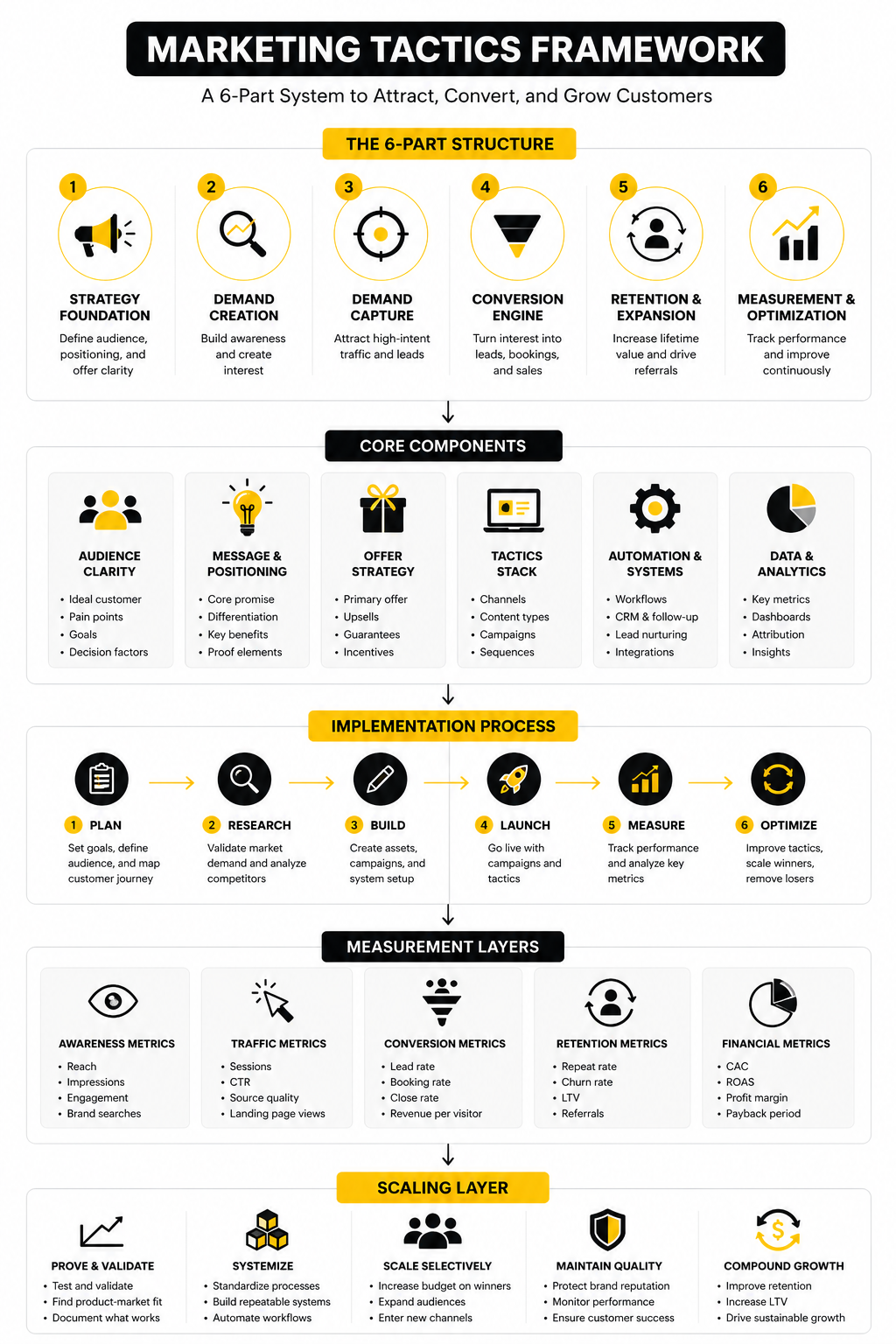
This framework keeps you from judging every tactic by the same metric. A thought leadership post should not be measured exactly like a checkout page. A retargeting campaign should not be judged like a brand awareness video. When the job is clear, the metric becomes clearer too.
Core Components of Effective Marketing Tactics
Strong marketing tactics usually have five components: audience, message, channel, offer, and measurement. If one of these is weak, the whole tactic becomes harder to scale. You can have the right channel and the wrong offer, or the right offer and the wrong audience.
The audience defines who the tactic is for. The message explains why they should care. The channel determines where the message appears. The offer gives the person a reason to act now. Measurement tells you whether the tactic is creating movement or just activity.
This is also where tools can help, but only after the thinking is clear. For example, a business using Instagram DMs as a lead channel may need automation through ManyChat, while a funnel-heavy business may need landing pages and offer flows through ClickFunnels or broader CRM automation through GoHighLevel. The tool is not the tactic by itself. The tool supports the tactic when the audience, message, channel, offer, and follow-up are already thought through.
Professional Implementation Starts With Focus
Professional implementation starts by narrowing the field. You do not need every marketing tactic. You need the few that fit your market, your offer, your buying cycle, your margins, and your team’s ability to execute consistently.
A local service business may win with Google Business Profile, review generation, local SEO, paid search, missed-call text-back, and automated follow-up. A SaaS company may need comparison pages, product-led onboarding, lifecycle email, webinars, retargeting, and partner content. An ecommerce brand may lean on paid social, creator partnerships, email flows, landing page testing, merchandising, and post-purchase retention.
The point is not to copy someone else’s stack. The point is to build a tactical system where every move has a role. In Part 2, we will turn that system into a practical framework you can use to evaluate and prioritize marketing tactics before spending money on them.
The Marketing Tactics Framework
The fastest way to make marketing tactics useful is to stop sorting them by channel and start sorting them by job. “Should we post on LinkedIn?” is a weaker question than “Are we trying to create demand, capture demand, convert demand, or expand demand?” The job decides the tactic, not the other way around.
This matters because the same channel can serve different purposes depending on how you use it. Search ads can capture urgent demand, but YouTube content can create demand months before someone is ready to buy. Email can convert a new lead, retain a customer, recover an abandoned checkout, or reactivate someone who went quiet.
So the framework is simple: match the tactic to the buying stage, then match the metric to the tactic. When you do that, marketing stops feeling like a pile of disconnected tasks. It becomes a system.
Demand Creation Comes First
Demand creation is about making the right people aware of a problem, opportunity, or better way to get what they already want. This is where content, social media, creator partnerships, webinars, podcasts, brand campaigns, communities, and educational assets can work well. The goal is not always an immediate sale.
That last sentence is important. Some marketing tactics are supposed to build memory, trust, and preference before the buyer enters the market. If you judge those tactics only by last-click conversions, you will cut the very work that makes future demand cheaper to capture.
Good demand creation usually teaches, reframes, or demonstrates. It helps people see the cost of inaction, the upside of change, or the difference between weak and strong solutions. The practical question is: after someone sees this tactic, do they understand the problem more clearly and associate your brand with the better path forward?
Demand Capture Finds Existing Intent
Demand capture is where you meet people who are already looking. These buyers are searching, comparing, reading reviews, checking pricing, asking peers, watching demos, and deciding who feels safest to trust. This is where SEO, paid search, comparison pages, review profiles, marketplace listings, retargeting, and high-intent landing pages matter.
The mistake is treating demand capture like a magic machine. It is not. If nobody knows you, trusts you, or understands your category, demand capture becomes expensive because you are fighting at the bottom of the funnel with everyone else.
Still, this stage is powerful because intent is visible. Someone searching for a solution, clicking a pricing page, or returning to a product demo is showing you they are closer to action. Your job is to reduce doubt, answer objections, and make the next step obvious.
Conversion Turns Interest Into Action
Conversion tactics turn attention and intent into measurable movement. That could mean a purchase, booked call, trial signup, demo request, quote request, email opt-in, webinar registration, or product activation. The exact conversion depends on the business model.
This is where landing pages, sales pages, checkout flows, lead magnets, forms, calendars, live chat, demos, follow-up emails, SMS reminders, and CRM workflows become critical. A business with strong traffic but weak conversion does not have a traffic problem first. It has a trust, offer, page, or follow-up problem.
Tools can help when the conversion path is clear. A creator or coach might build a focused offer funnel with ClickFunnels. A service business that needs CRM, pipelines, reminders, and sales automation may be better served by GoHighLevel. An ecommerce team that needs fast landing page testing may look at Replo. The tool should support the conversion system, not replace the thinking behind it.
Expansion Protects the Revenue You Already Earned
Expansion tactics are often ignored because they feel less exciting than acquisition. Big mistake. Retention, repeat purchases, referrals, upsells, onboarding, customer education, loyalty campaigns, and win-back flows can make every acquisition tactic more profitable.
This is especially important when paid media costs rise or organic reach becomes less predictable. If customers buy once and disappear, your marketing has to keep replacing lost revenue. If customers stay, buy again, refer friends, and engage with your brand, the whole business gets more durable.
Expansion tactics also create better data. You learn what customers actually value after buying, which objections disappear, which promises hold up, and which segments become most profitable. That feedback should improve your ads, content, offers, and sales process.
Match Metrics to the Stage
Each stage needs its own scorecard. Demand creation should not be judged only by immediate sales. Demand capture should not be judged only by impressions. Conversion should not be judged only by clicks.
For demand creation, useful signals include qualified reach, engaged attention, branded search lift, content saves, returning visitors, audience growth, and assisted pipeline. For demand capture, watch high-intent traffic, search visibility, click-through rate, landing page engagement, cost per qualified visitor, and comparison-page performance. For conversion and expansion, look at conversion rate, lead quality, sales cycle speed, purchase rate, activation, repeat purchase, churn, referral rate, and lifetime value.
This is where a lot of teams get sloppy. They use one dashboard for every tactic and then wonder why the numbers are confusing. Better measurement starts by asking what job the tactic was hired to do.
Build the System Before You Scale the Spend
Once the framework is clear, scaling becomes safer. You can see where the bottleneck lives instead of throwing money at the loudest channel. More traffic will not fix a weak offer. More content will not fix a broken follow-up process. More automation will not fix unclear positioning.
The practical order is simple. First, define the audience and offer. Second, choose the demand creation and demand capture tactics that fit how that audience buys. Third, build the conversion path. Fourth, add retention and expansion. Fifth, measure the system as a whole.
That is the foundation. Next, we move into demand creation tactics: the practical moves that help people notice you, understand why you matter, and start trusting you before they are ready to buy.
Demand Creation Tactics
Demand creation is where marketing tactics start to feel uncomfortable for impatient teams. You are not always asking for the sale right now. You are building familiarity, belief, and preference before the buyer is actively comparing options.
That does not mean demand creation is fluffy. It means the result is often delayed, assisted, or distributed across multiple touchpoints. The mistake is thinking that delayed impact means no impact.
Strong demand creation makes people more likely to search for you later, trust your offer faster, and choose you when the buying moment appears. That is the job. Now let’s make it practical.
Start With the Buyer’s Real Problem
Before choosing content formats or channels, define the problem your audience already feels. Not the problem you wish they cared about. The real one that shows up in their workday, budget, reputation, time, stress, or growth goals.
This is where many marketing tactics fail. They start with what the company wants to promote instead of what the buyer is already trying to solve. If your message does not connect to an existing pain, ambition, fear, or bottleneck, the audience has no reason to pay attention.
A useful demand creation message usually does one of three things. It names a problem the buyer has not fully articulated. It shows the hidden cost of staying the same. Or it gives the buyer a clearer path toward a result they already want.
Choose One Core Content Angle
Content works better when it has a point of view. Random tips can fill a calendar, but they rarely build memory. A core content angle gives your marketing tactics a repeatable theme people can recognize.
For example, a CRM company might focus on the cost of slow lead follow-up. A landing page platform might focus on the gap between ad spend and page performance. A social media tool might focus on consistency, planning, and audience engagement.
This does not mean saying the same thing every day. It means returning to the same strategic belief from different angles. When the audience hears that belief enough times, your brand starts to own a useful idea in their mind.
Turn the Angle Into Repeatable Assets
Once the angle is clear, turn it into assets that match how your audience consumes information. This is where blog posts, short-form videos, newsletters, webinars, podcasts, carousels, reports, templates, live sessions, and community posts can all fit. The right format depends on buyer behavior, not personal preference.
Short-form video still deserves attention because it remains one of the most widely used marketing formats, with HubSpot reporting that 60% of marketers used short-form video in 2025. But video is not automatically better than written content. A complex B2B buyer may need detailed guides, comparison pages, calculators, and webinars before they trust the next step.
The practical move is to create one strong idea, then adapt it across several formats. A webinar can become clips, emails, posts, a checklist, and a sales enablement asset. This gives your team more mileage without turning your marketing into a content treadmill.
Build a Simple Execution Process
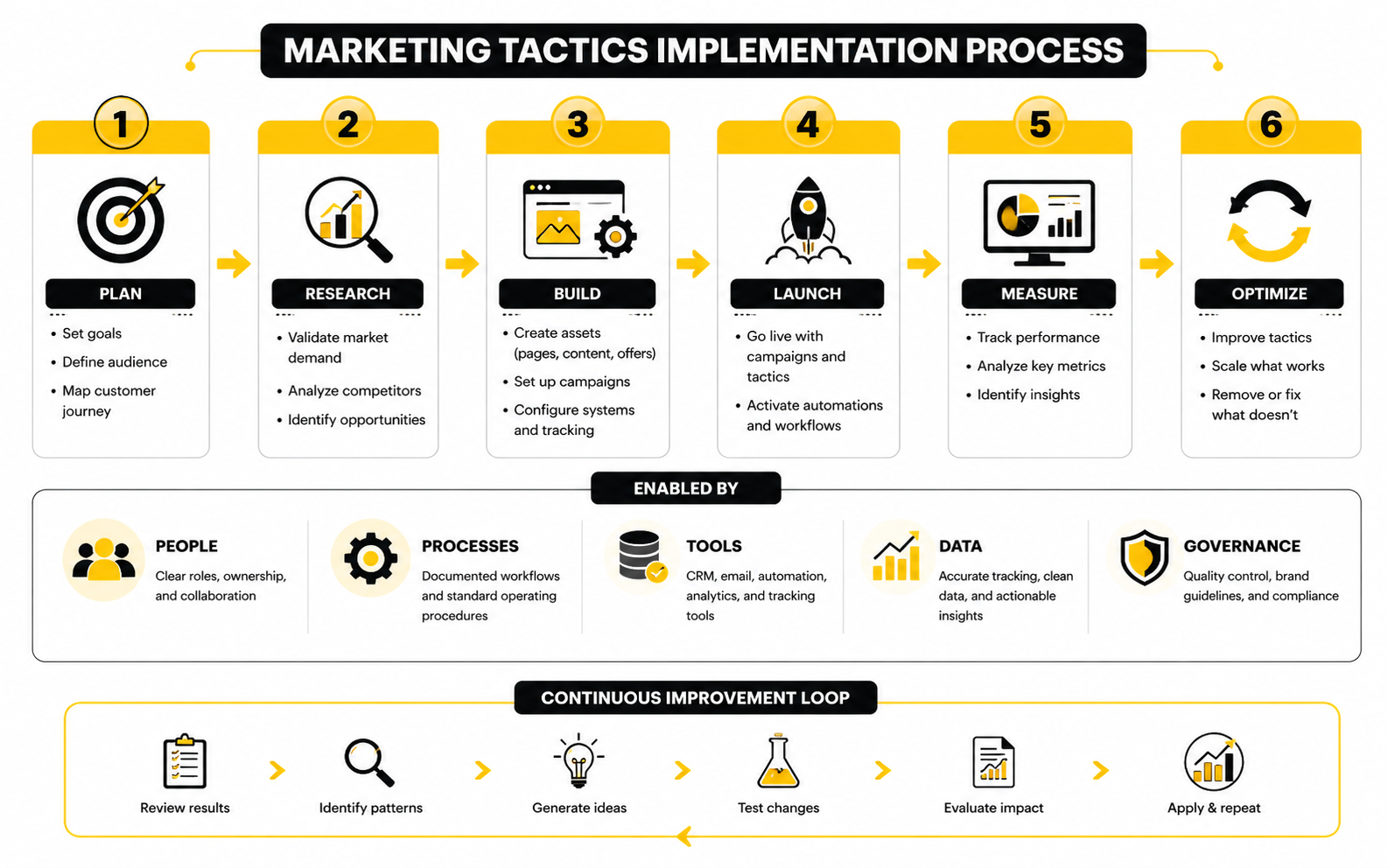
Execution becomes easier when every tactic follows the same basic process. You define the audience, choose the problem, shape the message, select the channel, publish the asset, distribute it, capture signals, and improve the next version. That is not glamorous, but it works.
A simple process also protects your team from random requests. When someone says “we should post more,” the process forces a better question: post what, for whom, tied to which problem, on which channel, with what next step? That is how marketing tactics become decisions instead of noise.
Use this sequence when building demand creation campaigns:
- Define the audience segment.
- Choose the problem or opportunity.
- Write the core message.
- Pick the best primary channel.
- Create the main asset.
- Repurpose it into supporting assets.
- Add a soft next step.
- Track engagement and downstream movement.
- Improve the next version based on real signals.
Use Social Media for Signals, Not Just Reach
Social media can create demand, but only when it is treated as more than a posting calendar. It gives you fast feedback on which ideas create attention, which phrases people repeat, which objections appear, and which topics deserve deeper assets. That feedback is valuable even before a sale happens.
The strongest teams do not only ask whether a post went viral. They ask what the audience revealed. Did people comment with objections? Did they save the post? Did they send direct messages? Did a topic create more profile visits, branded search, email signups, or sales conversations?
Scheduling tools can help when consistency becomes hard. A lean team may use Buffer to plan and publish content without turning every day into a scramble. But the point is not just output. The point is learning what earns attention from the right people.
Make Education Lead Somewhere
Educational content is one of the most useful marketing tactics, but it needs a path. If someone reads your guide, watches your video, or attends your webinar, what should happen next? Without a next step, you create interest and then let it disappear.
The next step does not always need to be a hard pitch. It might be a checklist, calculator, consultation, email series, demo, private community, product tour, or comparison guide. The offer should match the buyer’s level of intent.
For example, a cold audience may respond better to a practical template than a sales call. A warm audience that has watched multiple demos may be ready for booking. The point is to stop treating education as the end of the journey.
Partner With People Who Already Have Trust
Partnerships, creators, affiliates, newsletter swaps, podcast guesting, and co-marketing can speed up demand creation because they borrow trust from an existing relationship. This works especially well when the partner’s audience matches your buyer and the collaboration is genuinely useful. Forced partnerships feel like ads wearing a costume.
Creator and influencer marketing should be evaluated by relevance, credibility, content quality, and audience fit. Big reach can look impressive, but reach without trust does not move serious buyers. Smaller creators with loyal audiences often create better conversations because their recommendations feel specific and earned.
This is also where the offer matters. A partner campaign should give the audience a reason to act without damaging trust. That might be a useful training, limited bonus, practical resource, or clear product walkthrough.
Create Demand With Proof
Proof is not only for the bottom of the funnel. It can create demand by showing people what is possible, what others are doing differently, or what strong execution looks like. Proof helps the audience move from “I know this problem exists” to “I should probably do something about this.”
Use proof carefully. Real customer results, product screenshots, before-and-after workflows, public data, expert interviews, and transparent benchmarks can all strengthen demand creation. Vague claims do the opposite.
Trust is especially important now because Edelman’s 2025 brand research found that 80% of people trust brands they use, which means experience and familiarity still matter deeply. Your demand creation should help people feel that familiarity before they buy. The more concrete your proof, the easier that becomes.
Keep the First Conversion Light
Demand creation usually works best when the first conversion is light. Asking for a purchase too early can create resistance. Asking for a small, useful next step can turn passive attention into an owned audience.
That small step might be an email signup, quiz, free workshop, chatbot conversation, downloadable asset, waitlist, or reminder. A business using Instagram or Facebook conversations could use ManyChat to turn comments and DMs into a structured follow-up path. A team collecting webinar or lead magnet registrations could use Fillout for simple forms that do not create unnecessary friction.
The key is to keep the promise aligned with the content. If the post is about improving landing page conversion, the next step should help with that exact problem. Relevance beats cleverness.
Turn Demand Creation Into a Weekly Operating Rhythm
Demand creation gets stronger when it becomes a rhythm, not a burst. Pick a weekly cadence your team can actually sustain. Then protect it.
A simple rhythm might include one core asset, three supporting posts, one email, one short video, and one sales enablement takeaway each week. Another team might run one monthly webinar and repurpose it for four weeks. The right rhythm is the one you can execute without lowering quality.
This is where discipline matters. Most teams do not lose because they lack ideas. They lose because they change direction before the market has enough time to notice. Demand creation needs consistency long enough for the audience to remember what you stand for.
Prepare the Hand-Off to Demand Capture
Demand creation should make demand capture easier. People who discover your brand through useful content will eventually search, compare, visit your site, check reviews, read pricing, or ask someone about you. If those high-intent moments are weak, the demand you created leaks out of the system.
That is why the next part matters. Once attention turns into intent, your marketing tactics need to shift. The buyer no longer needs broad education first. They need clarity, proof, comparison, confidence, and a simple path to action.
Statistics and Data
Data should make marketing tactics easier to judge, not harder. The goal is not to collect every possible metric or decorate reports with impressive charts. The goal is to understand what is working, where buyers are dropping off, and what action should happen next.
This is where many teams get trapped. They look at impressions, clicks, open rates, conversion rates, and revenue in the same dashboard without separating the stage of the journey. Then every number feels important, which means no number is truly useful.
A better measurement system connects each tactic to one job. Demand creation should show whether the right people are becoming aware and engaged. Demand capture should show whether high-intent people are finding you. Conversion should show whether interest becomes pipeline or purchases. Expansion should show whether customers stay, buy again, and refer.
Start With the Business Outcome
Every measurement system should start with the outcome the business actually needs. That might be qualified pipeline, booked calls, ecommerce revenue, trial activation, customer retention, or repeat purchase rate. Once that outcome is clear, you can work backward into the marketing signals that predict it.
This prevents vanity metrics from taking over. A post with high reach but no relevant audience movement may be entertaining, not strategic. A landing page with modest traffic but strong qualified conversion may be more valuable than a campaign that looks bigger on the surface.
The practical question is simple: what decision will this number help us make? If a metric does not help you change budget, messaging, targeting, offer, creative, follow-up, or retention, it probably does not belong in the main scorecard.
Read Benchmarks Carefully
Benchmarks are useful, but they are not commandments. Gartner reported that 2025 marketing budgets stayed flat at 7.7% of overall company revenue, while IAB reported that U.S. internet advertising revenue reached nearly $300 billion in 2025. That combination matters because it shows a tougher environment: more money is flowing into digital advertising overall, but individual marketing teams are still being pushed to prove efficiency.
That does not mean you should blindly chase lower costs. A cheap lead that never buys is expensive. A higher-cost lead that closes quickly, retains well, and expands may be a bargain.
Use benchmarks to spot possible problems, not to replace judgment. If your conversion rate is far below your category norm, investigate the offer, page, traffic quality, trust signals, and follow-up. If your cost per acquisition is higher than average but your lifetime value is also much higher, the tactic may still be healthy.
Build a Stage-Based Analytics System
A stage-based analytics system is the cleanest way to measure marketing tactics without mixing weak signals with strong ones. Each stage needs its own leading indicators, lagging indicators, and diagnostic questions. This keeps the team focused on the real bottleneck.
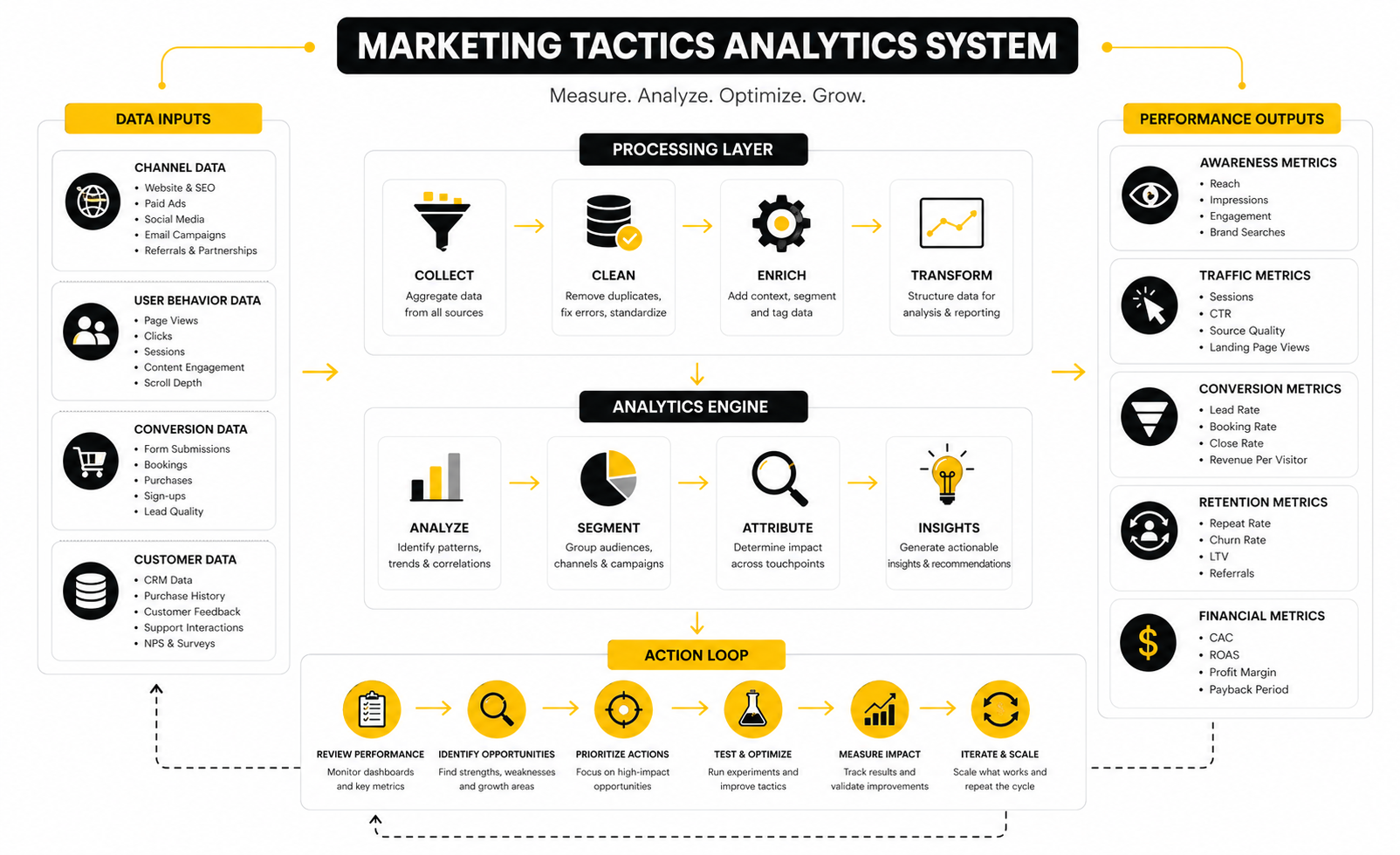
For demand creation, track qualified reach, engaged views, saves, shares, comments, returning visitors, branded search growth, and assisted conversions. These numbers do not always prove revenue by themselves, but they show whether the market is starting to notice and remember you. If they are weak, the issue may be positioning, creative quality, topic relevance, or distribution.
For demand capture, track organic rankings, paid search click-through rate, high-intent page visits, comparison-page engagement, demo-page traffic, review profile visits, and retargeting performance. These signals show whether people with existing intent can find and evaluate you. If they are weak, the issue may be search visibility, offer clarity, proof, or category positioning.
For conversion, track form completion, booking rate, checkout completion, trial signup, activation, sales-qualified leads, close rate, speed to lead, and revenue per visitor. These are closer to money, so they deserve tighter attention. If they are weak, the issue may be friction, weak copy, poor qualification, slow follow-up, missing proof, or a mismatch between the promise and the page.
For expansion, track repeat purchase rate, churn, renewal rate, upgrade rate, referral rate, customer satisfaction, product usage, and lifetime value. These metrics tell you whether the business is growing durable revenue or constantly refilling a leaky bucket. If they are weak, acquisition may look fine while profitability quietly suffers.
Separate Leading and Lagging Indicators
Leading indicators tell you what is likely to happen. Lagging indicators tell you what already happened. You need both, but you should not use them the same way.
A webinar registration rate is a leading indicator. Pipeline generated from that webinar is a lagging indicator. Add-to-cart rate is a leading indicator. Completed purchases are lagging indicators. Email click rate is a leading indicator. Revenue from the campaign is lagging.
This matters because lagging indicators often arrive too late for fast optimization. If you wait until the end of the quarter to learn that a campaign failed, you have already paid for the mistake. Leading indicators help you adjust earlier.
Diagnose the Funnel Before Changing the Tactic
When a tactic underperforms, do not immediately kill it. Diagnose where the breakdown happens first. A paid social campaign with low click-through may have a creative problem, while one with strong clicks and poor sales may have a landing page or offer problem.
This is why the sequence matters. Impressions show distribution. Clicks show interest. Landing page engagement shows message match. Conversions show trust and offer strength. Sales outcomes show lead quality and buying readiness.
For ecommerce, Triple Whale’s benchmark guidance notes that an add-to-cart rate below 5% can signal product page issues, while a low add-to-cart rate combined with high bounce often points to mismatched traffic. That is useful because it tells you what to fix first. Do not rewrite your entire ad strategy if the product page is where the buyer loses confidence.
Measure Speed, Not Just Volume
Volume can hide operational weakness. A business may generate plenty of leads but respond too slowly, follow up inconsistently, or lose buyers between systems. In that case, more leads only create more waste.
Speed-to-lead is especially important for service businesses, agencies, consultants, clinics, local businesses, and any company where a conversation drives the sale. The faster the response, the easier it is to catch the buyer while intent is still fresh. Slow follow-up turns warm demand cold.
This is where CRM and automation tools can protect revenue. A team using GoHighLevel can connect forms, pipelines, reminders, texts, and follow-up workflows so interested buyers do not disappear. The data you want to watch is not only how many leads came in, but how quickly and consistently each one was handled.
Use Attribution Without Worshipping It
Attribution is useful, but it is not perfect. Buyers see content, talk to peers, compare alternatives, return through search, click retargeting ads, read emails, and finally convert somewhere that may get too much credit. Last-click attribution often rewards the final touch while undervaluing the work that created trust earlier.
That does not mean attribution is useless. It means you should interpret it with context. Use platform data, CRM data, website analytics, customer surveys, sales notes, and cohort analysis together instead of expecting one report to explain the full journey.
The practical move is to ask new leads and customers how they found you, what influenced them, and what almost stopped them. Those qualitative answers often explain the gaps numbers cannot. When analytics and customer language point in the same direction, you have a much stronger signal.
Turn Data Into Action
A dashboard is only valuable if it changes behavior. If the numbers show weak demand creation, improve the message, angle, creative, or distribution. If demand capture is weak, build stronger search pages, comparison content, review assets, and high-intent landing pages.
If conversion is weak, tighten the offer, reduce form friction, improve proof, clarify pricing, strengthen follow-up, or test a better page. If expansion is weak, improve onboarding, retention emails, customer education, upgrade paths, and referral prompts. Each metric should point toward a next move.
That is how measurement becomes practical. You are not collecting data to admire it. You are using data to decide which marketing tactics deserve more investment, which need repair, and which should be retired before they keep draining budget.
Conversion, Retention, and Automation Tactics
Once your marketing tactics are creating attention, capturing intent, and producing measurable signals, the next challenge is leverage. This is where conversion, retention, and automation become more than operational details. They decide whether growth becomes profitable or exhausting.
A business can survive for a while with messy follow-up, weak onboarding, and disconnected systems. But scaling exposes every crack. More traffic creates more abandoned carts, more missed leads, more confused buyers, and more customer churn if the back end cannot handle the demand.
That is why advanced marketing is not only about finding new channels. It is about making the whole revenue system stronger. Better conversion increases the value of every visitor. Better retention increases the value of every customer. Better automation protects the process when volume grows.
Fix the Offer Before You Automate
Automation cannot save a weak offer. It can only deliver the offer faster, more consistently, and at greater scale. If people do not understand the value, believe the promise, trust the proof, or feel the urgency, automation simply spreads the weakness more efficiently.
Before adding complex workflows, check the fundamentals. Is the promise clear? Is the target buyer specific? Is the price justified by the perceived value? Is there enough proof? Is the next step obvious?
This is especially important for funnels. A tool like ClickFunnels can help structure pages, offers, upsells, and checkout paths, but the tool will not invent buyer motivation for you. The offer still has to earn the click, the opt-in, the booking, or the purchase.
Reduce Friction at the Moment of Intent
Conversion improves when you remove unnecessary effort from the buyer’s next step. That does not mean making everything shorter. It means making every step feel necessary, clear, and safe.
A long form can work if the buyer expects a serious consultation. A short form can fail if it attracts poor-fit leads and creates messy sales conversations. A detailed sales page can convert well if the buyer needs education, while a simple checkout can work when the offer is already understood.
The tradeoff is quality versus volume. More friction can improve lead quality but reduce total leads. Less friction can increase volume but create more filtering work later. The right answer depends on your sales capacity, margin, offer complexity, and how much qualification needs to happen before a human gets involved.
Build Follow-Up Around Buyer Behavior
Generic follow-up is better than no follow-up, but behavior-based follow-up is where marketing tactics become much sharper. Someone who watched a full webinar, visited pricing twice, and opened three emails should not receive the same sequence as someone who downloaded one checklist and disappeared. Intent level should shape the next message.
This is where segmentation matters. Salesforce’s State of Marketing research shows that 83% of marketers recognize the shift toward personalized, two-way messaging, but only one in four are satisfied with how they use data to power those moments. That gap is the opportunity.
The practical move is to trigger follow-up from real behavior. Pricing visits, abandoned carts, missed calls, form submissions, demo attendance, product usage, and reply intent should all change the path. If your CRM treats every lead the same, your marketing is leaving context unused.
Use Automation to Protect Consistency
Automation is not about removing humans from marketing. It is about removing avoidable gaps. The buyer should not suffer because someone forgot to send a reminder, missed a notification, failed to update the pipeline, or waited two days to reply.
For service businesses and agencies, a platform like GoHighLevel can connect landing pages, forms, calendars, pipelines, SMS, email, and missed-call follow-up in one system. For email-heavy campaigns, tools like Brevo or Moosend can support segmentation, campaigns, and lifecycle messaging. The point is not to collect tools. The point is to stop revenue from leaking between touchpoints.
Good automation should feel timely, relevant, and useful. Bad automation feels like pressure without context. If a workflow would annoy you as a buyer, it probably needs better timing, better segmentation, or a better reason to exist.
Balance Personalization With Trust
Personalization can lift performance, but it can also feel creepy when it is too aggressive or poorly explained. Buyers want relevance, not surveillance. This is a serious tradeoff.
The safest approach is to personalize around helpful context. Recommend the next resource based on what someone viewed. Send reminders for actions they clearly started. Follow up with content related to the problem they identified. Avoid making people feel like every movement was watched.
AI makes this more powerful and more risky. McKinsey’s 2025 global AI research describes adoption moving forward, but also notes that many organizations still struggle to move from pilots to scaled impact in a disciplined way. For marketing, that means AI should support research, segmentation, content variation, testing, and service quality without replacing judgment, brand voice, or human accountability.
Strengthen Retention Before Scaling Acquisition
Retention is the quiet multiplier. If customers stay longer, buy again, refer others, and expand, every acquisition channel becomes easier to justify. If customers leave quickly, even good conversion numbers can hide a weak business.
A 2025 Adobe, Publicis Sapient, and Incisiv report found that from 2022 to 2025, acquisition costs rose 35% while customer lifetime value grew just 4.5%. That gap matters because it shows why chasing more customers is not enough. If the economics after the first purchase are weak, growth gets harder as you scale.
Retention tactics include onboarding sequences, customer education, usage prompts, renewal reminders, loyalty offers, account check-ins, post-purchase surveys, referral prompts, and win-back campaigns. These are not “nice to have” activities. They protect margin.
Watch for Scaling Problems Early
Scaling does not only increase results. It increases pressure. Small tracking errors become bigger reporting problems. Minor creative fatigue becomes a performance drop. Slow lead response becomes a sales bottleneck. Weak onboarding becomes churn.
The warning signs usually show up before revenue fully suffers. Cost per qualified lead rises while close rate falls. More people book calls, but fewer are a fit. Email engagement drops across key segments. Repeat purchase slows. Customer support tickets increase after aggressive acquisition campaigns.
Do not ignore those signals. They are telling you where the system is under strain. The correct response may be better qualification, stronger creative rotation, clearer onboarding, tighter audience targeting, improved sales scripts, or a more realistic promise.
Choose Depth Before More Channels
Advanced marketing teams are not advanced because they use every tactic. They are advanced because they know which constraints matter and which actions compound. More channels can create reach, but they can also create chaos.
Before adding another channel, ask whether your current system is fully developed. Are your best pages converting well? Are your email flows segmented? Are sales conversations informed by marketing behavior? Are customers being onboarded properly? Are winning messages being reused across ads, content, landing pages, and sales?
Depth often beats novelty. A business with one strong acquisition channel, one strong conversion path, and one strong retention system can outperform a business that is “everywhere” but shallow. This is boring advice until it starts making money.
Create a Testing Discipline
Testing is not random experimentation. It is a disciplined way to learn what changes buyer behavior. The best tests isolate one meaningful variable and connect it to a clear business question.
You might test a new offer angle, pricing presentation, landing page headline, form length, follow-up timing, email sequence, webinar title, retargeting message, or onboarding step. But each test should have a reason. “Let’s see what happens” is not a strategy.
A useful testing rhythm has three parts:
- Identify the bottleneck.
- Choose one change that could realistically improve it.
- Measure whether the change improved the right metric without damaging a later-stage metric.
That last part matters. A tactic that increases leads but lowers close rate may not be a win. A discount that raises first purchases but trains customers to wait for promotions may create a long-term problem. Smart testing looks beyond the first number.
Make the System Easier to Operate
The more complex your marketing gets, the more important documentation becomes. You need clear campaign briefs, naming conventions, tracking rules, audience definitions, offer notes, workflow maps, and ownership. Without that, the system depends too much on memory.
This is not bureaucracy. It is how you protect speed. When the team knows how campaigns are named, where leads go, which automations fire, and what each metric means, fewer things break.
A clean operating system also makes outsourcing safer. Contractors, agencies, and new hires can only help if the system is understandable. If everything lives in someone’s head, scaling becomes fragile.
Prepare for the Final Prioritization
At this stage, the full picture is coming together. Demand creation makes people aware. Demand capture finds existing intent. Conversion turns interest into action. Retention and automation protect the revenue created by the system.
The final step is choosing what to do first. That is where many businesses get stuck because every marketing tactic sounds useful in isolation. The next section brings the whole article together with a practical way to prioritize, measure, and scale the tactics that actually fit your business.
How to Choose, Measure, and Scale the Right Marketing Tactics
The right marketing tactics are not the ones everyone is talking about. They are the ones that fit your audience, your offer, your economics, your team, and your current bottleneck. That is the filter.
Start by asking where the biggest constraint is right now. If nobody knows you, prioritize demand creation. If people know you but cannot find you when they search, improve demand capture. If traffic exists but revenue does not, fix conversion. If customers buy once and disappear, strengthen retention before spending more on acquisition.
This is the point where marketing becomes practical. You stop asking, “What should we try next?” and start asking, “What is the highest-leverage constraint we can remove?”
Prioritize Tactics by Fit, Not Popularity
Every tactic has a cost. Sometimes that cost is ad spend. Sometimes it is time, creative energy, technical setup, sales capacity, or strategic focus. A tactic that works beautifully for one company can be a distraction for another.
Use three filters before committing to any tactic:
- Does this tactic match how our buyer actually discovers and evaluates solutions?
- Can we execute it consistently enough to learn from it?
- Can we measure whether it is moving the business forward?
If the answer is no, do not force it. A half-executed tactic is usually worse than no tactic because it creates noise, consumes time, and gives you bad data. Focus wins.
Build a Simple Final System
At this stage, your marketing system should be easy to explain. One set of tactics creates demand. Another captures demand. Another converts demand. Another retains and expands customers. Everything should connect.
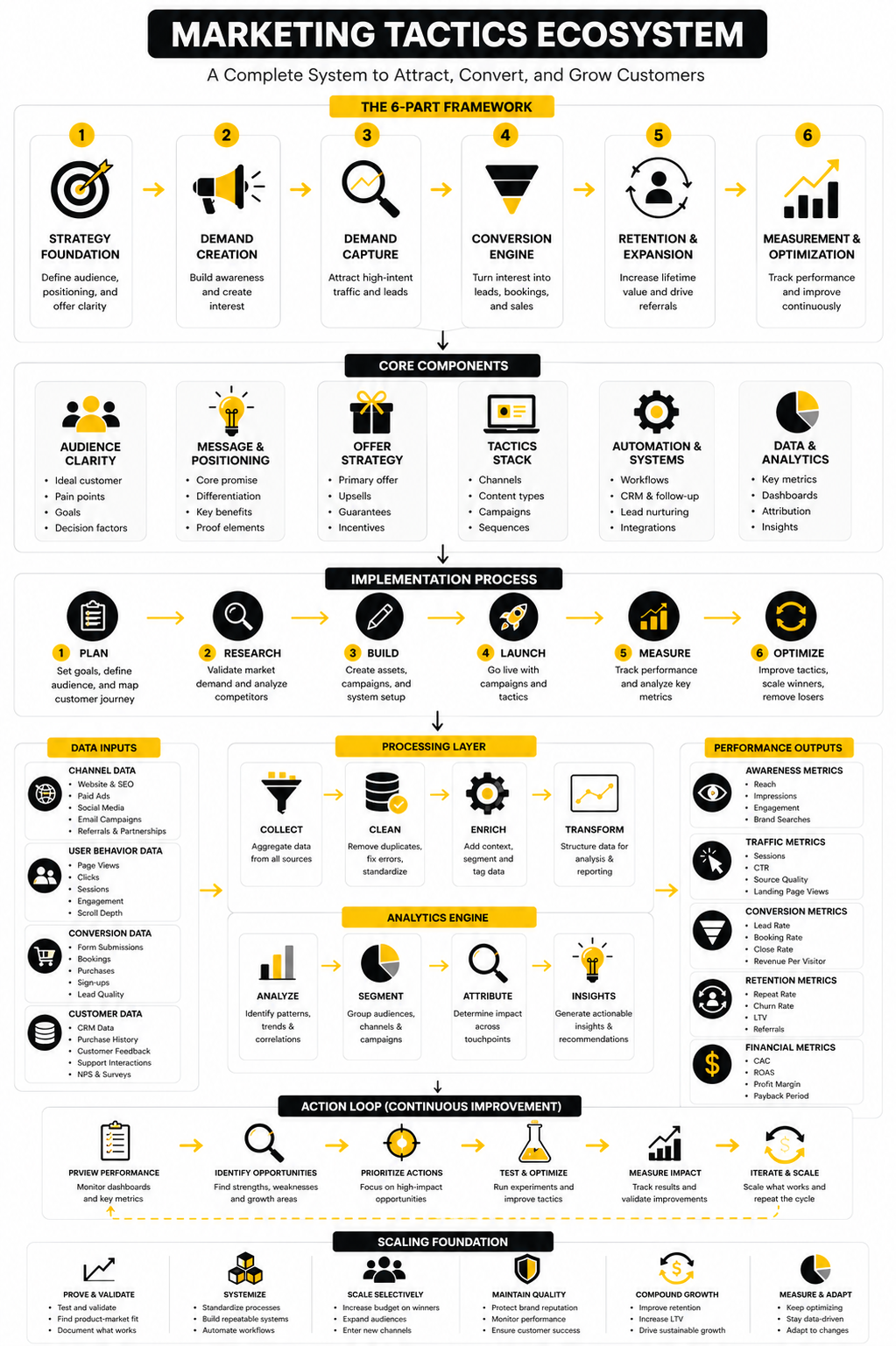
The best version is not complicated. It is clear. Your content creates familiarity, your search and comparison assets catch intent, your landing pages and follow-up convert interest, and your onboarding and retention flows protect the revenue after the sale.
That is the ecosystem. When one part improves, the others benefit. Better demand creation improves branded search. Better demand capture improves lead quality. Better conversion improves paid media economics. Better retention gives you more room to acquire customers profitably.
Scale What Has Proof
Scaling should come after proof, not before it. That proof does not need to be perfect, but it should be strong enough to show that the tactic is not just producing activity. It should be producing useful movement.
For content, proof might be qualified engagement, returning visitors, branded search growth, or assisted pipeline. For paid media, it might be profitable acquisition, strong lead quality, or consistent revenue per visitor. For email, it might be repeat purchases, booked calls, activations, or recovered carts.
Do not scale a tactic just because the first number looks good. A campaign that produces cheap leads but poor customers is not a winner. A tactic that looks slower but creates high-quality pipeline may deserve more patience and more budget.
Cut Tactics That Do Not Have a Job
Some marketing tactics stay alive because nobody wants to admit they are not working. They sit in the calendar, consume resources, and produce just enough activity to avoid scrutiny. That is dangerous.
Every tactic should have a defined job, owner, cadence, metric, and review cycle. If it does not, it becomes marketing clutter. Clutter slows teams down.
Cutting a tactic does not mean it was stupid. It may have been wrong for the stage, wrong for the audience, or wrong for the current resources. The goal is not to do less forever. The goal is to create space for what matters now.
FAQ - Built for Complete Guide
What are marketing tactics?
Marketing tactics are the specific actions used to attract, engage, convert, and retain customers. They include content, ads, SEO, email, landing pages, webinars, social media, partnerships, automation, referrals, and sales follow-up. Strategy decides the direction; tactics create the movement.
What is the difference between marketing strategy and marketing tactics?
Marketing strategy defines the market, audience, positioning, offer, and growth direction. Marketing tactics are the practical actions used to execute that strategy. Without strategy, tactics become random activity.
Which marketing tactics work best for small businesses?
Small businesses usually benefit most from tactics that create direct demand and measurable conversations. Local SEO, reviews, referral systems, email follow-up, paid search, simple landing pages, and fast lead response are often more useful than trying to be everywhere. The best choice depends on whether the business needs visibility, leads, bookings, purchases, or retention.
How many marketing tactics should a business use at once?
Most businesses should start with fewer tactics than they think. One or two strong acquisition tactics, one clear conversion path, and one retention system can outperform a messy mix of channels. Add more only when the existing system is stable and measurable.
How do I know if a marketing tactic is working?
A tactic is working when it moves the right metric for its stage. Demand creation should improve attention, trust, and future intent. Demand capture should bring in high-intent visitors. Conversion tactics should create qualified actions. Retention tactics should increase repeat value, referrals, or customer lifetime value.
What marketing tactics are best for demand creation?
Demand creation works well with educational content, social media, creator partnerships, webinars, newsletters, podcasts, community building, and brand-led campaigns. The goal is to make the right people understand the problem and associate your brand with the solution. It is not always supposed to create an immediate sale.
What marketing tactics are best for demand capture?
Demand capture works well with SEO, paid search, comparison pages, review profiles, retargeting, product pages, pricing pages, and high-intent landing pages. These tactics meet people who are already searching, evaluating, or close to making a decision. Clarity and proof matter more here than broad awareness.
How often should marketing tactics be reviewed?
Review high-spend or high-volume tactics weekly, but judge deeper performance over a longer window. Some tactics need fast optimization, especially ads and conversion pages. Others, like SEO, content, and retention, need enough time for patterns to become meaningful.
Should AI be part of modern marketing tactics?
Yes, but AI should support judgment, not replace it. It can help with research, content variation, segmentation, customer support, workflow automation, and analysis. The risk is using AI to produce more noise instead of better decisions.
What is the biggest mistake businesses make with marketing tactics?
The biggest mistake is using tactics without a system. Businesses post, advertise, email, automate, and redesign pages without knowing which stage they are improving. That creates activity, but not reliable growth.
What should I do before spending more on marketing?
Find the bottleneck first. If conversion is weak, more traffic will waste money. If retention is weak, more customers may not improve profit. If positioning is unclear, every tactic becomes harder. Fix the constraint before increasing spend.
Are benchmarks useful for choosing marketing tactics?
Benchmarks are useful for context, but they should not control your decisions. Averages can hide huge differences by industry, offer, price point, audience, and business model. Use benchmarks to spot questions worth investigating, then rely on your own data to make decisions.
Work With Professionals
Explore 10K+ Remote Marketing Contracts on MarkeWork.com
Most marketers spend too much time chasing clients, competing on crowded platforms, and losing a percentage of every project to middlemen.
MarkeWork gives you a better way. Browse thousands of remote marketing contracts and connect directly with companies desperate to hire skilled marketers like you, without platform commissions and without unnecessary gatekeepers.
If you're serious about finding better opportunities and keeping 100% of what you earn, explore available contracts and create a profile for free at MarkeWork.com.